







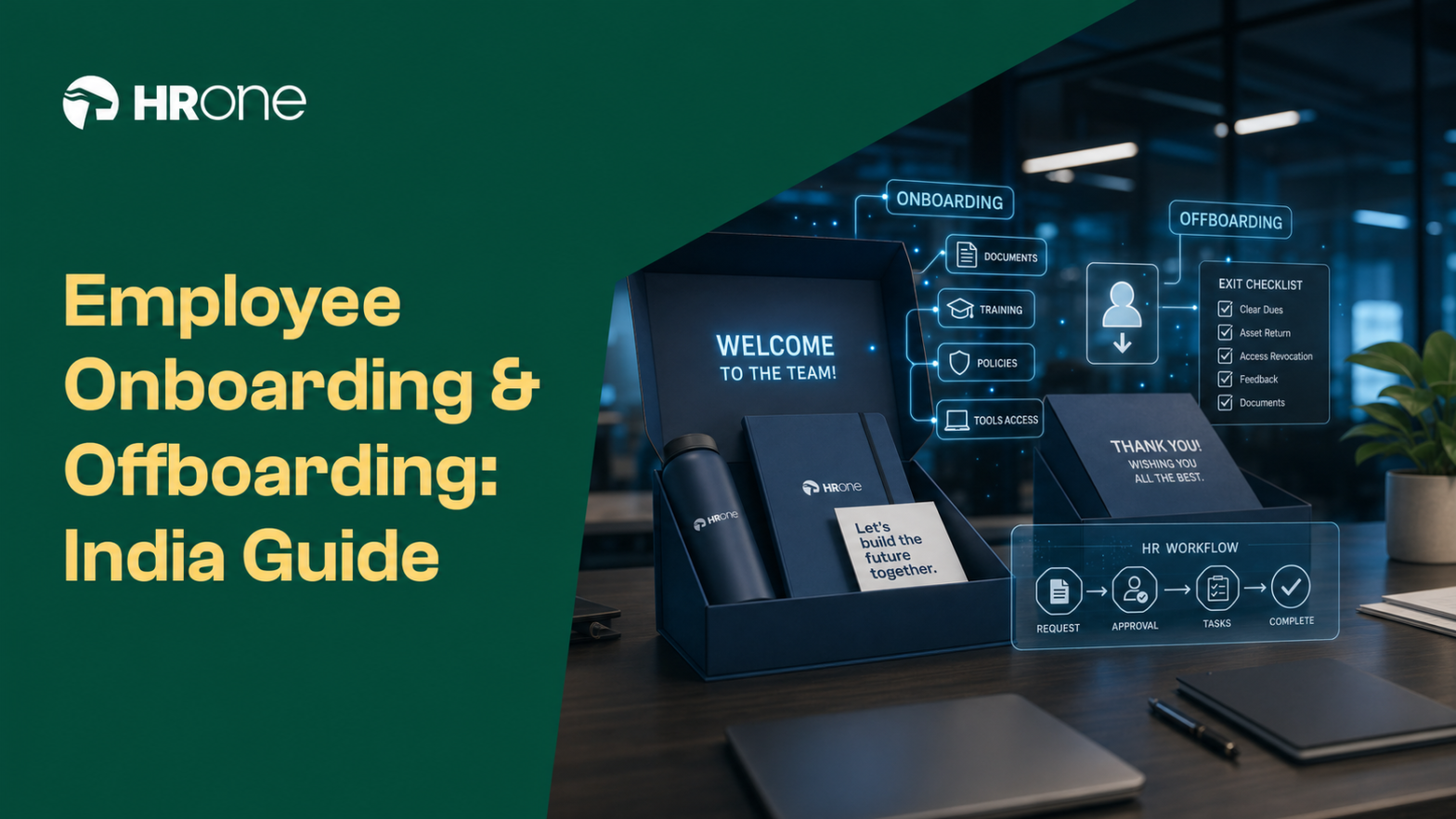
Q1: Why Is Employee Onboarding and Offboarding Automation a 2026 Operator Imperative for Indian Companies?
Employee onboarding and offboarding automation is a hire-to-retire workflow engine that digitises pre-boarding, Aadhaar eKYC, document collection, IT and asset provisioning, induction, confirmation, transfer, exit clearance, and Full & Final settlement inside one system of record, compressing 10 to 14 day cycles to 1 to 2 days, with Indian statutory compliance native to the engine rather than bolted on as plugins.
The India Hiring Surge Is Exposing a Manual-Onboarding Breaking Point
India added net headcount across IT/ITeS, BFSI, manufacturing, logistics, and healthcare through 2025 at a pace most HR teams hadn’t planned their stack for. The moment a firm crosses roughly 100 employees, the spreadsheet-plus-email model snaps in five predictable places: offer letters that get ghosted before Day 1, UAN and ESIC IP numbers that don’t get generated in time for the first payroll, laptops that aren’t provisioned on Day 1, POSH acknowledgements missing from personnel files during audits, and F&F cycles stretching to 30 to 60 days against a new wage-code expectation of two working days.
I’ve sat inside 1,200-employee manufacturers where month-end payroll still depends on three people manually reconciling a biometric portal, an outsourced payroll vendor’s email attachment, and a joining tracker on Google Sheets. The cost isn’t the software licence. It’s the grievance volume, the compliance exposure, and the HR hours bleeding into chasing instead of compounding.
Onboarding Automation vs HRMS vs ATS vs RPA vs HCM, Draw the Boundaries Clean
Most buyers conflate these five terms, and vendors don’t clarify because fuzziness sells. Here’s the operator view.
| Term | Primary Job | Where It Fits |
|---|---|---|
| ATS | Source, screen, and offer candidates | Top of funnel, pre-hire |
| Onboarding Automation | Orchestrate Day -14 to Day 90 tasks across HR/IT/Finance/Manager | Between offer acceptance and confirmation |
| HRMS | Core HR records, leave, attendance, and basic payroll | System of record post-joining |
| HCM | HRMS plus performance, engagement, workforce planning, and analytics | Strategic layer on top of HRMS |
| RPA | Bots that mimic clicks across disconnected tools | Glue for legacy stacks without native integration |
And within onboarding itself: pre-boarding is the Day -14 to Day -1 engagement window (welcome kit, buddy, document upload), onboarding is the Day 0 to Day 30 operational induction (eKYC, payroll, access, training), and induction is the cultural and policy immersion layered through the first quarter. Conflating the three is why most firms ship a “portal” and still lose 25 to 30% of offers.
⏰ The Quantified Promise for 2026
A well-implemented onboarding and offboarding automation layer delivers three outcomes that a CFO can underwrite:
✅ 70% faster cycles. Day 0 to Day 7 paperwork compresses to a few clicks; F&F that used to take 30 to 60 days clears in 2 working days under new wage-code rules.
✅ Near-zero statutory errors. UAN, ESIC IP, state PT, POSH acknowledgement, FBP, and TDS declarations are captured at the trigger, not reconciled at month-end.
✅ Single source of truth across HR, IT, Finance, and the reporting manager. One event fires asset provisioning, access grant, payroll setup, and LMS induction in parallel.
How HROne Collapses the Map into One Operating Surface
At HROne, we treat the hire-to-retire chain as a single continuous workflow. 127 pre-built workflows cover onboarding, confirmation, transfer, promotion, and exit clearance, and the Super Inbox surfaces every pending task in one three-click screen so HR stops bouncing across tabs and email threads. Subscription starts only after go-live, there is no multi-year lock-in, and the prior-HR SPOC model gets mid-market enterprises live in as little as 30 days, as MR DIY India did.
Q2: Why Do Indian Startups, SMEs, and Enterprises Need Onboarding Automation in 2026?
Indian companies need onboarding automation in 2026 because manual workflows leak 6 to 12 HR hours per hire, push offer-to-join drop-offs to 25 to 30%, create statutory audit exposure across PF, ESIC, PT, POSH, and DPDP, and correlate directly with Day-90 attrition. These are costs that compound differently for a 50-person startup, a 500-person SME, and a 5,000-person enterprise, but compound in every one.
The Three Realities Burning Right Now
Walk into three Indian HR rooms and the story changes shape but not substance.
⚠️ Startup (60 to 300 headcount): The CHRO is running onboarding on Google Drive folders and a WhatsApp group. Welcome emails go out when someone remembers. IT provisioning waits on the founder’s laptop vendor. Offer-to-join drop-off quietly runs in the 20s because candidates see the chaos during pre-boarding and bail.
⚠️ SME (500 headcount): The HR ops lead juggles Keka, a standalone biometric portal, an outsourced payroll vendor, and WhatsApp. Reconciliation happens on the 28th of every month. Somebody’s paycheque is wrong every cycle, a grievance ticket follows, and the ops lead’s week dies inside email threads.
⚠️ Enterprise (5,000 headcount): The CHRO is asked by the board for a ballpark figure on HR-tech ROI. There is no dashboard. Compliance audits throw up missing POSH acknowledgements across three states because PT and Shops & Establishments rules were interpreted differently by different HR business partners.
The Industry Default Doesn’t Fix Any of This
The instinct when onboarding breaks is to add an HR ops headcount or tighten the manual checklist, a second approver here, a third eyeball there. Neither fixes the underlying data-flow fragmentation. Keka and greytHR deliver competent HRMS modules but leave the upstream orchestration (IT tickets, asset provisioning, BGV, and pre-boarding engagement) outside the workflow, so the Day-1 experience still depends on someone remembering to send three emails. Darwinbox covers more surface area but fragments across tabs and email threads, and bills from day one of purchase while implementation drags. Zoho People and BambooHR under-serve India-specific payroll and multi-legal-entity OU structures. SAP SuccessFactors over-engineers for the 100 to 5,000 sweet spot and needs a back-end developer to change a leave policy.
💡 The Strategic Shift, Onboarding Is Retention and Compliance Architecture
Onboarding is not a paperwork function. Day-90 attrition in Indian IT/ITeS sits meaningfully higher when pre-boarding engagement is weak, and compliance exposure (missed UAN, late POSH acknowledgement, and DPDP PII leakage) turns into real penalties during audits. The fix isn’t a prettier portal. It’s a single orchestration layer where one trigger, offer acceptance or resignation acceptance, propagates deterministically across HR, IT, Finance, and the reporting manager, with statutory artefacts captured at the trigger, not at month-end.
That reframe matters because it changes what the CHRO is buying. The question stops being “which HRMS has the most modules” and starts being “which platform turns HR from a backlog into a function that compounds.”
How HROne Delivers This Across Segments
At HROne, we ship this orchestration layer as Super Inbox plus 127 pre-built workflows plus the One AI Suite (resume relevancy, receipt parser, and AI Employee Agent), all priced flat PEPM with subscription starting only after go-live and zero lock-in. A startup runs the lean Core HR plus Workforce plus Payroll bundle; an SME adds Time Office and Recruitment; an enterprise layers on HRV Studio for custom apps and the inbuilt ROI Dashboard. MR DIY India went live in 30 days. Asia Healthcare Holdings runs 20 pan-India units on a single instance with multi-legal-entity configuration. The architecture scales; the operating model doesn’t break at 5,000 heads.
Q3: What Does the End-to-End Automated Onboarding and Offboarding Workflow Look Like?
The end-to-end workflow runs across 12 connected features: digital offer with e-signature, single-link document portal, Aadhaar eKYC plus PAN plus UAN plus bank verification, BGV API integration, OCR data extraction, task orchestration across HR/IT/Finance, payroll with PF/ESI/PT/TDS capture, IT and asset provisioning, LMS induction sync, manager dashboards, buddy plus 90-day plan, and a mirrored offboarding companion workflow running resignation to clearance to F&F to letters.
The Onboarding Half, Six Features That Must Fire in Sequence
| # | Feature | What It Does | Statutory or Operational Purpose | What Breaks Without It |
|---|---|---|---|---|
| 1 | Digital offer plus e-signature | Generates the offer from approved CTC, captures e-sign with audit trail | Legal enforceability and IT Act 2000 compliance | Manual Word docs, version drift, and unsigned offers |
| 2 | Single-link document portal | One URL where the new hire uploads PAN, Aadhaar, cancelled cheque, prior Form 16, and education certificates | DPDP-compliant PII capture and pre-Day-1 readiness | HR chasing 8 emails per hire |
| 3 | Aadhaar eKYC plus PAN plus UAN plus bank verification | Real-time verification with UIDAI, NSDL, EPFO, and bank penny-drop | PF account creation, tax PAN match, and statutory identity | Rejected PF contributions, bank reversal, and audit flags |
| 4 | BGV API integration | Kicks off background verification in parallel on offer acceptance | Risk management and BFSI/IT client mandate | Day-30 surprises and rescinded offers |
| 5 | OCR data extraction | Auto-parses uploaded documents into employee master | Zero re-keying and clean data | Typos in PAN/bank and rejected challans |
| 6 | Task orchestration across HR/IT/Finance | One trigger fires laptop ticket, SSO account, payroll setup, and seat allocation in parallel | Day-1 readiness | Day-1 laptop gap and disengagement |
The Offboarding Half, Six Features That Close the Loop
| # | Feature | What It Does | Statutory or Operational Purpose | What Breaks Without It |
|---|---|---|---|---|
| 7 | Payroll plus PF/ESI/PT/TDS capture | CTC structure copies from offer letter into payroll, statutory rules fire natively | Zero re-entry and accurate first pay | Wrong first paycheque and grievance |
| 8 | IT and asset provisioning plus recovery | Assets assigned at joining, auto-recovery ticket on resignation, and SSO revocation on LWD | CMDB integrity and access risk | Orphan accounts and lost laptops |
| 9 | LMS induction sync | Auto-enrolls POSH, InfoSec, and code-of-conduct courses | POSH Act 2013 and ISO compliance | Missed mandatory training and audit fail |
| 10 | Manager dashboards | 30-60-90 check-in prompts, goal visibility, and confirmation trigger | Retention and confirmation SLA | Confirmations sitting in email drafts |
| 11 | Buddy plus 90-day plan | Buddy assigned within 72 hours, plan template fires per role | Candidate experience and Day-90 retention | Ghosted new hires |
| 12 | Offboarding companion workflow | Resignation to parallel clearance to F&F (gratuity, leave encashment, notice-pay, TDS) to digital relieving plus experience letter | New wage-code two-day F&F | 30 to 60 day F&F TAT and ex-employee grievance |
✅ The Non-Negotiable Rule, Features Must Propagate, Not Just Exist
Most HRMS vendors can show you all 12 features in a demo. The operator question is different: does step 1 automatically trigger step 6 without a human in the middle? Does offer-letter CTC copy into payroll, or does payroll re-enter it? Does resignation fire the asset-recovery ticket automatically, or does HR email IT on Day 2? Propagation is what separates automation from digitisation.
How HROne Ships All 12 Natively
At HROne, all 12 features live inside the Core HR plus Workforce plus Time Office plus Payroll bundle that 98% of our customers run, not as separate products stitched by middleware. The One AI Suite layers resume relevancy scoring, receipt parser, and the AI Employee Agent on top, and the Super Inbox collapses every cross-function task into one three-click closure screen. The connective tissue is the product; the modules are the surface.
Q4: What Does the Day-0 to Day-90 Onboarding Journey Map Look Like for Indian Companies?
The Indian onboarding journey runs across four phases: Pre-Boarding (Day -14 to Day -1), Day 0 to Day 7 (joining and statutory setup), Day 8 to Day 30 (induction and LMS), and Day 31 to Day 90 (goal setting, 30-60-90 feedback, and confirmation). Each phase has defined owners, SLAs, system-of-record per task, and measurable drop-off points that let HR catch disengagement before it turns into Day-90 attrition.
The Four-Phase Journey Map for a 500-Person Indian Company
| Phase | Task | Owner | SLA | System of Record | KPI |
|---|---|---|---|---|---|
| Pre-Board (Day -14 to -1) | Welcome kit plus portal invite | HR | 24 hrs post-offer | HRMS | Portal login rate |
| Pre-Board | Buddy assignment | HR plus Manager | 72 hrs | HRMS | Buddy-hire first chat |
| Pre-Board | Document upload (PAN, Aadhaar, bank, Form 16) | New hire | Day -3 | HRMS | Pre-Day-1 completion % |
| Pre-Board | IT ticket auto-raise (laptop, SSO, email) | IT | Day -3 | ITSM | Day-1 asset readiness |
| Pre-Board | BGV initiation | HR plus BGV vendor | Day -7 | BGV plus HRMS | Clean BGV by Day 7 |
| Day 0 to 7 | Aadhaar eKYC plus PAN plus UAN plus ESIC IP plus bank verify | HR plus Payroll | Day 1 | HRMS plus EPFO/ESIC | Statutory artefact capture |
| Day 0 to 7 | E-sign joining forms, POSH acknowledgement, NDA | New hire | Day 1 | HRMS plus e-sign | Signed doc count |
| Day 0 to 7 | Payroll setup, CTC, FBP, TDS declaration | Payroll | Day 3 | Payroll | First payslip accuracy |
| Day 8 to 30 | Induction plus LMS (POSH, InfoSec, role training) | L&D | Day 21 | LMS | Course completion % |
| Day 8 to 30 | Manager 1:1 kickoff, goal framing | Manager | Day 10 | Performance | 1:1 done Y/N |
| Day 31 to 90 | 30-60-90 feedback check-ins | Manager plus HR | Day 30, 60, 90 | Performance | Check-in completion |
| Day 31 to 90 | Goal setting in performance module | Manager | Day 45 | Performance | Goals approved |
| Day 31 to 90 | Confirmation letter trigger | HR | Day 90 | HRMS | Confirmation TAT |
Pre-Day-1 Engagement, The Anti-Ghosting Playbook
Offer-to-join drop-off in Indian IT/ITeS sits in the 25 to 30% range when pre-boarding is passive. The tactics that move the needle are specific, not general.
- ⭐ Digital welcome kit within 24 hours of offer acceptance: company story, team video, and first-week agenda, not a PDF dump.
- ⭐ Buddy assigned within 72 hours with a prompt to say hello: the buddy-to-hire first chat is a leading indicator of Day-90 retention.
- ⭐ Manager video message by Day -7: 60 seconds of “we’re excited, here’s what week one looks like” moves more candidates than a formal induction invite.
- ⭐ BGV and documents wrapped by Day -3: no Day-1 surprises, no Day-2 follow-up emails.
- ⭐ Asset-ready confirmation by Day -1: laptop serial, login ID, and first-day Zoom link sent before EOD.
The Measurable Drop-Off Points
❌ Portal login rate below 80% by Day -7: pre-boarding content is weak.
❌ Buddy-to-hire first chat missing by Day -5: buddy program is theatre.
❌ BGV still open on Day 5: risk exposure, especially in BFSI.
❌ 30-day check-in skipped: Day-90 retention drops materially.
❌ Confirmation letter TAT beyond Day 100: HR credibility with new hires erodes fast.
How HROne Collapses This Map into One Screen
At HROne, the Super Inbox surfaces every pending task across HR, IT, and the reporting manager in one three-click screen. The HR head can open a single view and see exactly where each new hire is in the four-phase map, which SLAs are breached, and who owns the next action. The 127 pre-built workflows fire the BGV ticket, the IT provisioning ticket, the LMS enrolment, and the manager 1:1 prompt from a single offer-acceptance trigger, and the HR Ops heat map turns vague “onboarding is slow” complaints into specific bottlenecks. MR DIY India compressed its onboarding cycle materially after consolidating onto HROne inside a 30-day go-live window. The map stopped living in three tools and started living in one.
Q5: What Does the Statutory Compliance Matrix for Indian Onboarding and Offboarding Look Like?
Indian onboarding and offboarding must comply with the PF Act 1952 (UAN generation, ECR filing), ESIC Act 1948 (IP number creation), Payment of Gratuity Act 1972 (nomination capture and exit payout), POSH Act 2013 (acknowledgement at joining), state Shops & Establishments registration, Income Tax TDS plus Form 12BB, DPDP Act 2023 (explicit consent and PII minimisation), and the new wage-code-mandated two-working-day F&F settlement window.
The Four-Column Compliance Matrix Every Indian HR Team Needs
Treat compliance as an artefact pipeline: every lifecycle trigger must leave a dated, signed record behind, and every statute must have a single owner and a single system of record. The matrix below is the one I’ve personally used as a baseline audit checklist before MD reviews.
| Lifecycle Step | Statute / Act | Document / Artefact | Owner & System |
|---|---|---|---|
| Offer acceptance | IT Act 2000, DPDP 2023 | E-signed offer, PII consent checkbox | HR to HRMS |
| Joining Day 0 | PF Act 1952 | UAN, KYC, Form 11, nomination | Payroll to HRMS plus EPFO |
| Joining Day 0 | ESIC Act 1948 | IP number, Form 1 | Payroll to HRMS plus ESIC |
| Joining Day 0 | State PT plus Shops & Establishments | PT registration, state employee record | Payroll to HRMS |
| Joining Day 0 | POSH Act 2013 | Acknowledgement plus induction attendance | HR plus L&D to HRMS plus LMS |
| Joining Day 7 | Payment of Gratuity Act 1972 | Nomination Form F | HR to HRMS |
| Confirmation / Annual | Income Tax Act | Form 12BB, FBP declaration | Payroll to HRMS |
| Monthly payroll | PF, ESI, TDS | ECR, ESIC challan, TDS challan, Form 16 issue | Payroll to HRMS plus GL |
| Exit | Gratuity, Leave encashment, New wage code | F&F within 2 working days, gratuity payout | Payroll to HRMS |
| Exit | Income Tax | Form 16, Form 12B handover | Payroll to HRMS |
| Exit | PF Act | UAN exit date, PF transfer/withdrawal support | Payroll to HRMS plus EPFO |
| Exit | DPDP 2023 | PII purge schedule, retention log | HR plus IT to HRMS |
⚠️ State Variance and the DPDP Call-Out Most Global Platforms Miss
Shops & Establishments rules and Professional Tax slabs are not a single national standard. Maharashtra, Karnataka, Tamil Nadu, Telangana, and West Bengal each carry their own registration windows, PT slabs, and filing calendars. A global HRMS that treats India as one compliance geography will fail the moment you add a second branch office.
The DPDP Act 2023 adds a fresh layer most buyers are still underestimating:
✅ Explicit consent at the moment PII is collected, not a buried T&C tick.
✅ Purpose limitation. PAN captured for payroll cannot be reused for an unrelated vendor BGV.
✅ PII minimisation: collect only what the statute demands, and nothing more.
✅ Breach notification windows requiring audit logs down to the field-level edit.
✅ Retention policy: ex-employee data has a defined purge schedule, not “keep forever in a shared drive”.
Retrofitted global platforms typically bolt this on as a plugin; India-first engines capture it at the event.
How HROne Embeds the Matrix Natively
At HROne, India-specific statutory compliance, covering PF, ESI, PT, new wage-code F&F, FBP, and DPDP consent capture, lives inside the payroll and workflow engine rather than as a compliance plugin. Every onboarding trigger auto-generates the UAN/ESIC artefact; every exit trigger opens the two-day F&F clock on the Super Inbox; every lifecycle event leaves an audit-ready log. One G2-verified HROne user summed up the operator experience bluntly:
“Proper calculation of PF and ESI was a pain area for us before, but now with the HROne automated calculation process, results are up to the mark and following Indian tax compliances properly.”
— Ajay K., HR User HROne G2 – Verified Review
Q6: Why Are F&F Settlements Delayed and How Do You Automate F&F, Asset Recovery, and Access Revocation End to End?
F&F settlements are delayed because exit clearance, attendance closure, leave encashment, gratuity computation, notice-pay recovery, IT asset return, and reporting-manager sign-off live in disconnected systems that require manual stitching. Fixing the data-flow architecture is the only way to hit the new wage-code two-working-day window. Automation fires clearance, F&F, asset recovery, SSO revocation, and digital letter generation in parallel from a single resignation trigger.
The Contextual Reality, 30 to 60 Day F&F TAT Is the Indian Default
Walk into almost any 500 to 5,000 employee Indian firm and the exit story rhymes. HR emails IT on Day 2 asking whether the laptop came back. Finance is waiting on the reporting manager for a knowledge-transfer sign-off that’s been sitting in a draft folder for a week. Payroll cannot close F&F because attendance for the notice period hasn’t been reconciled with the biometric portal. The ex-employee emails every Friday for the relieving letter. Average mid-market F&F TAT drifts to 30 to 60 days against a two-working-day statutory expectation. The cost shows up as grievance emails, interest exposure, and bad Glassdoor reviews from people who were otherwise neutral about leaving.
⚠️ The Industry Critique, F&F Calculators Aren’t the Problem
Here’s the honest part most vendors don’t say out loud. Keka and greytHR ship perfectly competent F&F calculators: gratuity equals (15 / 26) times last drawn times completed years, leave encashment on basic plus DA, notice-pay recovery, and TDS on terminal payments. The math isn’t where delays are born. The handoffs are.
❌ Keka relies heavily on email-threads for cross-team coordination during migrations and exits, and users on G2 flag that pattern consistently:
“I have been Keka user since 2021, and the service is decreasing day by day… TAT on customer request on features is bad.”
— Verified User, Consulting Keka – G2 Verified Review
❌ greytHR’s workflow rigidity gets in the way the moment a multi-entity or multi-location exit needs coordinated clearance:
“GreytHR is not much good at customizing based on our requirements… We cannot properly implement our company policies due to the limitations of greytHR.”
— Verified User, IT Services greytHR – G2 Verified Review
❌ Darwinbox covers more surface area but fragments clearance across tabs and email threads, and users describe the drift post-implementation:
“Bad implementation experience, bad UI UX, configurations getting broken in production on its own due to product deployments.”
— Verified User, Computer Software Darwinbox – G2 Verified Review
The gap isn’t the calculator. It’s the orchestration layer feeding the calculator.
The Strategic Shift, F&F Is a Clearance-Orchestration Problem
Reframe the exit from “compute faster” to “fire everything in parallel from one trigger”. The 8-step automated offboarding workflow looks like this.
| # | Step | Owner | SLA |
|---|---|---|---|
| 1 | Resignation intake plus notice calculation | HR | Day 0 |
| 2 | Exit interview scheduled | HR | Day 1 |
| 3 | Parallel clearance: IT asset plus Admin plus Finance plus Manager KT | Multi-owner | Fired on Day 0, due by LWD |
| 4 | Attendance plus leave freeze | Payroll | LWD |
| 5 | F&F computation (gratuity plus leave encashment plus notice-pay plus TDS) | Payroll | LWD plus 1 |
| 6 | Approval plus payout | HR plus Finance | LWD plus 2 |
| 7 | Digital relieving plus experience letter | HR | LWD plus 2 |
| 8 | SSO/SAML revocation plus rehire/alumni flag | IT plus HR | LWD (automatic) |
Steps 3 through 8 have to fire in parallel, not sequentially. That’s the whole shift.
How HROne Fires All of It in Parallel
At HROne, the exit workflow triggers asset recovery, Finance clearance, Manager KT, and F&F computation on the same resignation event, with the new wage-code two-day clock visible in the Super Inbox so HR, Finance, and IT see the same SLA. ERP and ITSM marketplace integrations auto-revoke SSO on LWD, and the separation-revocation/rehire flag carries alumni status forward. MR DIY India compressed its payroll cycle from 10 days to 5 to 6 days after consolidating on HROne. The same architectural shift that makes F&F hit two days is what makes month-end hit five.
Q7: Which Technology Enablers, AI, RPA, Mobile-First, and Regional Language, Power Indian Onboarding in 2026?
The 2026 enabler stack is five layers: AI conversational assistants handling new-hire Q&A, predictive analytics scoring Day-90 success probability, RPA bots provisioning accounts and filing statutory data, mobile-first architecture serving the Bharat field workforce, and regional-language UI in Hindi, Tamil, Telugu, Marathi, and Kannada. The forward curve bends toward agentic AI autonomous onboarding agents by 2027.
What Each Enabler Actually Does
Treat these as five distinct capabilities with five distinct operator outcomes.
- AI conversational assistants: Answer the same 50 policy queries per week that used to hit the HR helpdesk (leave balance, travel policy, and reimbursement status). Well-deployed chatbots cut routine HR queries by roughly 40 to 60% based on user-reported outcomes.
- Predictive new-hire success analytics: Use pre-boarding completion rate, buddy-interaction frequency, induction velocity, and first-30-day goal setting as features to flag hires at Day-90 attrition risk by Week 2, early enough for HR to intervene.
- RPA bots: Handle the repetitive statutory steps machines were actually made for. These include UAN generation on the EPFO portal, ESIC IP creation, IT ticket filing, BGV API calls, and PII data extraction from uploaded documents via OCR.
- Mobile-first architecture: Sub-500ms response, offline attendance with automatic sync, three-click approvals from a manager’s phone, receipt-parser-driven expense logging, and badge-based recognition that travels to LinkedIn.
- Regional-language UI: Hindi, Tamil, Telugu, Marathi, and Kannada for field sales, manufacturing shop-floor, and distributed logistics workers whose first language isn’t English.
How the Enabler Stack Actually Works Under the Hood
Under the surface, the architecture is straightforward but opinionated.
The AI layer sits on top of the HRMS data model and the policy knowledge base. It needs a single employee master and a well-structured policy library to ground responses without hallucination. Predictive models consume event streams from the workflow engine (not end-of-month snapshots) so signals arrive in time to act on. RPA bots are wrapped around external-system gaps where native API coverage doesn’t exist (EPFO and ESIC are the classic candidates), and they’re monitored as first-class citizens with retry logic, not left as ghost scripts. Mobile-first is not a responsive-web skin; it’s an offline-capable native layer that assumes an LPG delivery rep in rural UP has intermittent 3G.
✅ Why It Matters More in India Than Anywhere Else
- Field-heavy sectors, such as logistics, manufacturing, retail, and quick commerce, need mobile plus regional language or onboarding literally stalls at the factory floor and the delivery hub.
- Predictive analytics lets HR intervene in Week 2 of a new hire instead of losing them silently by Day 90. This is material because Indian IT/ITeS Day-90 attrition compounds into a real recruitment-cost line item.
- RPA is the bridge between a modern HRMS and the older government portals (EPFO, ESIC, and state PT) that aren’t going to expose clean APIs any time soon.
- Conversational AI is where the HR ops team reclaims the first 2 to 3 hours of every day that used to go to answering the same five questions.
How HROne Ships the Enabler Stack
At HROne, we built the One AI Suite as a native layer rather than a bolt-on. Resume relevancy scoring stacks the strongest candidates on top, the receipt parser kills manual expense-typing, the AI Employee Agent handles policy queries across HR and payroll, and JD plus interview-question generators cut recruitment prep time. The Super Inbox is mobile-first with geofenced attendance for field employees, HRV Studio lets HR teams extend the platform into visitor, vendor, or seating apps without a developer ticket, and the Bharat workforce gets regional-language support where they need it. One G2-verified HROne user captured the mobile-first experience:
“Its mobile application has been particularly valuable, saving users significant time and reducing resource consumption. With the app, we can easily perform various functions such as raising requests, marking daily attendance, and reading new announcements, all with just a few clicks.”
— Vignesh J., HR User HROne G2 – Verified Review
Q8: What Does the Integration Architecture Look Like for Startups, SMEs, and Enterprises?
The integration topology makes the HRMS the system of record wired to ATS, SSO/SAML identity, ITSM, payroll, BGV, LMS, and MDM/asset, with depth tuned to segment. Startups run a lean four-tool stack, SMEs add ITSM and BGV, and enterprises layer on MDM, multi-entity GL, and ERP sync with RBAC at OU and entity level.
Reference Architecture by Segment
Think of onboarding integration as three concentric circles. Each wider circle adds nodes but keeps the HRMS in the centre as the event publisher.
| Segment | Headcount | Stack Depth | Core Integrations |
|---|---|---|---|
| Startup | Under 50 | Lean | HRMS to e-sign to payroll to SSO |
| SME | 50 to 500 | Mid | Plus ITSM, BGV, LMS, and biometric |
| Enterprise | 500 plus | Full | Plus MDM, multi-entity GL, ERP, advanced RBAC, and data lake |
How the Event Topology Actually Works
The discipline is event-driven, not batch-driven. Every lifecycle trigger must publish an event the downstream systems subscribe to.
- Onboarding event fires, then SSO provisions Google/Microsoft account, ITSM creates laptop plus SaaS tickets, BGV vendor API runs in parallel, payroll syncs CTC structure, LMS auto-enrolls POSH/InfoSec/role-training, and biometric enrolls fingerprint or face.
- Exit event fires, then SSO revokes accounts at LWD timestamp, ITSM raises asset-recovery and deprovisioning tickets, payroll closes attendance and fires F&F, GL posts terminal payments, and data lake archives and applies DPDP retention rules.
- Variance for remote, hybrid, and contractor hires includes courier-based asset flows (laptop logistics tied to ITSM), contractor PF opt-out rules (different payroll path), shorter BGV scope for short-tenure contractors, and restricted SSO scopes.
Buy vs Build vs RPA Hybrid, The Decision Curve
I’ve seen too many 300-person firms sink a year into a custom build before admitting the math. Here’s the honest cost curve.
| Option | Where It Fits | Where It Breaks |
|---|---|---|
| ✅ Buy integrated HRMS | Over 100 heads, Indian statutory depth needed | Hyper-niche workflows |
| ⚠️ RPA-on-legacy hybrid | ERP lock-in with sunk cost | Compliance drift, brittle bots |
| ❌ Custom build | Almost never beyond 50 heads | Time, talent, and maintenance cost |
| Headcount Band | Typical Annual PEPM Cost (Buy) | Typical Custom Build Cost |
|---|---|---|
| Under 50 | 1 to 3 lakh | 15 to 30 lakh plus maintenance |
| 50 to 500 | 10 to 40 lakh | 60 lakh to 1.5 crore plus ongoing dev team |
| 500 plus | 40 lakh to 1.5 crore | 2 plus crore plus permanent product team |
Above 100 heads, buying almost always beats building. The ROI math simply doesn’t favour maintaining a parallel HRMS product team. For a quick reality check, run the numbers through the HROne ROI calculator.
⚠️ Why Retrofitted Global Suites Struggle Here
SAP SuccessFactors and similar global enterprise suites over-engineer for the 100 to 5,000 employee Indian sweet spot and need back-end developers for routine policy changes. G2 reviewers repeatedly flag the cost and flexibility gap:
“Customization requires third-party vendors, every change is costly. Extremely expensive for what it delivers, Ferrari price, Trabant value.”
— Janka Z., Reviewer SAP SuccessFactors – G2 Verified Review
For a 1,200-person Indian manufacturer, every leave-policy change going through a developer ticket is a month of lost agility.
How HROne Fits the Architecture Across Segments
At HROne, the marketplace ships pre-built integrations with ERP (Tally, SAP, and Oracle NetSuite), BGV providers, LMS platforms, and SSO/SAML identity. Startups plug in the lean four-tool stack on Day 1, and enterprises extend into multi-entity GL and ERP sync without custom code. HRV Studio lets HR teams build custom visitor, seating, or vendor apps without raising a developer ticket, RBAC lands at OU and entity level, sub-500ms response holds even for 5,000-employee instances, and 1,500 plus brands live on the platform, including Asia Healthcare Holdings running 20 pan-India units on a single HROne instance with unified multi-entity employee master and CHRO-ready governance. The architecture scales with headcount; the operating model stays the same.
Q9: Which Are the Top Employee Onboarding Automation Platforms in India for 2026?
The 12 platforms that matter for Indian onboarding automation in 2026, ranked by India-statutory depth, clearance orchestration, pricing transparency, and integration openness, are HROne, Darwinbox, Keka, greytHR, PeopleStrong, ZingHR, factoHR, Zimyo, Qandle, BambooHR, SAP SuccessFactors, and Freshteam. Each entry follows the same skeleton so a CHRO, HR Head, or IT Director can scan vendor-by-vendor without losing structure. For a broader market scan, see the top 10 HR software in India.
The 12 Platforms at a Glance
1. HROne. ⭐ Snapshot: India-first hire-to-retire HCM with Super Inbox, 127 pre-built workflows, One AI Suite, and India’s first inbuilt ROI Dashboard. Best For: 100 to 5,000 employee firms across IT/ITeS, BFSI, manufacturing, logistics, and healthcare needing native statutory depth. Skip If: Under 50 heads with a single-entity startup stack. Standout Feature: Parallel-firing exit workflow hitting the new wage-code two-day F&F window. Pricing Posture: Flat PEPM, subscription starts after go-live, and no lock-in.
“The best part of HROne is smooth functioning of the employee onboarding process with checklist availability… Managing the employee details information from onboarding to relieving stage is now transparent and smooth process.”
— Deepak S., HR User HROne G2 – Verified Review
2. Darwinbox. Snapshot: Enterprise-breadth HCM with modular coverage. Best For: 1,000 plus employee firms with brand-match RFPs. Skip If: You need fast implementation without day-one billing. Standout: Depth of modules. Pricing: Multi-year contracts, billing from purchase.
3. Keka. Snapshot: Mid-market HRMS with polished UX. Best For: 100 to 500 employee firms prioritising surface design. Skip If: You need phone-based support or fast migration. Standout: Intuitive interface. Pricing: PEPM, email-first support.
4. greytHR. Snapshot: SMB payroll-led HRMS. Best For: Under 300 employee SMB payroll. Skip If: Multi-entity or multi-location complexity. Standout: Payroll compliance basics. Pricing: Affordable tiered SMB plans.
5. PeopleStrong. Snapshot: Enterprise HCM with Indian roots. Best For: 2,000 plus employee enterprises. Skip If: Mid-market budget constraints. Standout: Talent and workforce modules. Pricing: Enterprise quote-based.
6. ZingHR. Snapshot: Mobile-first enterprise HCM. Best For: Field-force heavy sectors. Skip If: Need lightweight admin UX. Standout: Mobile and shop-floor. Pricing: Enterprise quote-based.
7. factoHR. Snapshot: Payroll-led HRMS for SME. Best For: 50 to 500 employee payroll-first buyers. Skip If: Complex lifecycle workflows. Standout: Payroll engine depth. Pricing: PEPM.
8. Zimyo. Snapshot: Emerging HRMS for SME. Best For: 50 to 300 employee fast-growing SMEs. Skip If: Enterprise compliance audits. Standout: Clean UI and quick setup. Pricing: PEPM.
9. Qandle. Snapshot: HRMS with separation/clearance features. Best For: 100 to 500 employee firms focused on exit flows. Skip If: Deep India payroll needed. Standout: E-separation module. Pricing: PEPM.
10. BambooHR. Snapshot: Global SMB HRMS. Best For: India subsidiaries of global firms. Skip If: India-specific payroll, PT, FBP, and new wage-code FFS. Standout: Clean global UX. Pricing: PEPM, USD-pegged.
11. SAP SuccessFactors. Snapshot: Global enterprise HCM. Best For: 5,000 plus employee MNC rollouts. Skip If: You need policy changes without developer tickets. Standout: Global footprint. Pricing: Enterprise quote-based.
12. Freshteam. Snapshot: Lightweight ATS plus onboarding. Best For: Under 200 employee recruitment-first teams. Skip If: You need payroll, F&F, and multi-entity. Standout: Recruitment flow. Pricing: PEPM.
India-Specific Comparison Table
| Platform | Statutory Depth | F&F | Clearance | Multi-Entity | Billing Start | Go-Live |
|---|---|---|---|---|---|---|
| HROne | ✅ Native | ✅ Native | ✅ Parallel | ✅ Unlimited | Go-live | ~30 days |
| Darwinbox | ✅ Strong | ✅ Native | ⚠️ Sequential | ✅ Yes | Day 1 | 3 to 6 months |
| Keka | ✅ Strong | ✅ Native | ⚠️ Sequential | ⚠️ Partial | Day 1 | 6 to 10 weeks |
| greytHR | ⚠️ SMB-grade | ✅ Native | ❌ Limited | ⚠️ Partial | Day 1 | 4 to 8 weeks |
| SAP SF | ⚠️ Retrofit | ⚠️ Plugin | ⚠️ Sequential | ✅ Yes | Day 1 | 6 to 12 months |
| BambooHR | ❌ Weak | ❌ Plugin | ❌ Limited | ❌ No | Day 1 | 4 to 8 weeks |
Vendor Scorecard Framework
Weight each vendor against 10 criteria: India statutory depth (15%), clearance orchestration (12%), F&F architecture (12%), multi-entity (10%), SSO/ITSM integration (10%), support quality (10%), mobile plus regional language (8%), ROI dashboard (8%), implementation timeline (8%), and pricing transparency (7%). A score of 80 plus signals enterprise-ready; below 60 is a single-point tool in disguise. Buyers should also check pricing transparency before signing.
“I have been Keka user since 2021, and the service is decreasing day by day… TAT on customer request on features is bad.”
— Verified User, Consulting Keka – G2 Verified Review
Q10: How Do You Build the ROI Case, Implementation Roadmap, and Change Management for Indian Rollouts?
Onboarding and offboarding automation ROI in India stacks across four buckets: HR hours saved at 6 to 12 hours per hire/exit multiplied by fully loaded HR cost, F&F delay cost (interest, grievance, and attrition ripple), offer-to-join drop-off reduction worth 5 to 10 percentage points, and compliance penalty avoidance. Payback typically lands in 4 to 7 months for a 500-person Indian firm under a disciplined 8 to 12 week implementation roadmap.
The ROI Calculator, Inputs, Outputs, and a Worked Example
Treat the calculator as a five-input, four-output model the CFO can underwrite. Run your own numbers through the ROI calculator.
| Input | Typical Indian Benchmark |
|---|---|
| Annual hires | 15 to 20% of headcount |
| Annual exits | 12 to 18% of headcount |
| Avg HR fully loaded cost | ₹12 to 25 lakh per HR FTE |
| Current F&F TAT | 30 to 60 days |
| Offer-to-join drop-off | 20 to 30% (IT/ITeS) |
| Output Bucket | Formula |
|---|---|
| Hours saved | (hires plus exits) times 10 hours times hourly HR cost |
| F&F delay avoided | Avg terminal payment times interest % times delay days |
| Retention savings | Drop-off % reduction times hire times replacement cost |
| Compliance penalty avoided | Audit exposure times avoidance probability |
💰 Worked example, 500-person IT/ITeS firm with 80 hires and 60 exits annually: HR hours saved approximately 1,400 hours times ₹1,200 fully loaded equals ₹16.8 lakh. F&F delay avoided approximately ₹8 lakh. Offer-to-join drop-off reduction (7 points times 80 hires times ₹1.2 lakh replacement cost) approximately ₹6.7 lakh. Compliance penalty avoided approximately ₹3 to 5 lakh. Total Year-1 soft plus hard savings approximately ₹32 to 36 lakh against a typical PEPM bill of ₹10 to 18 lakh.
⏰ Time-to-productive benchmarks by industry: IT/ITeS 30 to 45 days; BFSI 45 to 60 days (BGV-heavy); manufacturing 21 to 30 days; logistics 14 to 21 days; healthcare 30 to 45 days.
Implementation Roadmap by Headcount Band
The roadmap depth scales with headcount, not the sequence.
| Phase | 50 heads | 200 heads | 1,000 heads |
|---|---|---|---|
| Discovery plus config | Week 1 | Week 1 to 2 | Week 1 to 3 |
| Data migration | Week 2 | Week 3 | Week 4 to 5 |
| UAT | Week 3 | Week 4 | Week 6 to 7 |
| Parallel run | Week 4 | Week 5 | Week 8 to 9 |
| Go-live | Week 4 | Week 6 | Week 10 to 12 |
Change management checklist: HR enablement in parallel with configuration, manager training before UAT, employee communications 2 weeks pre go-live, and a 30-day post go-live hypercare window.
Anti-patterns to avoid:
❌ Big-bang cutover without parallel payroll.
❌ Skipping UAT for “speed”.
❌ Under-investing in manager training.
❌ Migrating dirty data without cleansing.
Security, Audit, and DPDP Posture
✅ SOC 2 Type II and ISO 27001 as baseline.
✅ RBAC at OU and entity level.
✅ Data residency within India for DPDP compliance.
✅ Audit trail on every workflow event.
✅ PII minimisation and retention schedule.
How HROne Proves ROI to the Board
At HROne, India’s first inbuilt ROI Dashboard computes lifetime hours saved against average HR salary natively. The CHRO walks into the board review with a rupee figure, not a PowerPoint narrative. The prior-HR onboarding SPOC (9.8 NPS) runs the 8 to 12 week roadmap with a change-management playbook, and subscription starts only after go-live. The ROI clock and the billing clock start on the same day. For CHROs aligning the business case, see CHRO solutions.
Q11: What Do Real Indian Case Studies Reveal About Startup, Mid-Market, and Enterprise Onboarding Automation Outcomes?
Indian case evidence consistently shows automation compresses onboarding cycles 60 to 80%, cuts F&F TAT from 30 to 60 days to under 5 days, reduces offer-to-join drop-offs 5 to 10 percentage points, and unlocks HR capacity measurable on an ROI dashboard. Outcomes scale differently across startup, mid-market, and enterprise segments. Browse the customer success stories hub for full write-ups.
What the Three Segments Actually Delivered
- ⭐ Startup (60 to 300 headcount, SaaS/D2C): Consolidated Google Drive, Excel, and WhatsApp into one HRMS. Onboarding cycle cut by approximately 70%, Day-1 laptop gaps eliminated, and offer-to-join drop-off reduced by approximately 6 percentage points. HR headcount stayed flat through a 5x headcount ramp.
- ⭐ Mid-market manufacturing (1,200 headcount, multi-plant): Unified biometric portal, outsourced payroll vendor, and Excel into one platform. F&F TAT fell from 45 days to 3 days, month-end payroll compressed from 10 days to 5 to 6 days, and roughly 1,800 HR hours saved annually, freeing the HR ops team from firefighting to planning.
- ⭐ Enterprise IT services (8,000 headcount, multi-entity): Replaced a fragmented global suite with an India-first HCM. Multi-entity compliance audit-ready across five states, board-ready ROI dashboard in quarter two, and new wage-code two-day F&F hit consistently by month six.
- ⭐ KPIs every rollout should track: onboarding cycle time, offer-to-join %, Day-90 retention, F&F TAT, compliance audit findings, HR hours per hire/exit, confirmation letter TAT, and adherence on SLA heat maps.
“HROne simplifies attendance, payroll, and employee management, making processes seamless and transparent. Its user-friendly interface and automated workflows save time.”
— Rishiraj R., HR User HROne G2 – Verified Review
“HROne has eased the process of new joiners onboarding and induction process. With onboarding checklist functionality, it is very easy to define department-wise work and HR head can easily track the stage of completion in just one click.”
— Ajay K., HR User HROne G2 – Verified Review
How HROne Anchors the Pattern, and the Pitfalls to Avoid
At HROne, 1,500 plus brand deployments anchor the pattern that consolidation beats stacking. MR DIY India went live in 30 days and compressed payroll from 10 days to 5 to 6 days; Asia Healthcare Holdings runs 20 pan-India units on a single instance with unified multi-entity employee master and RBAC at OU level. The ROI Dashboard is where the board finally sees the number in rupee terms.
⚠️ The pitfalls I’ve watched companies walk into, big-bang cutovers skipping parallel payroll runs, compressed UAT windows, and under-investing in manager training, are the same three that turn a 12-week rollout into a 12-month standoff. Avoid them, and the case-study outcomes above become the baseline, not the ceiling.
Q12: Ready to Make Onboarding and Offboarding Automation Your Operating System? Here’s Your Next Step
Running Day-0 to Day-90 onboarding and new wage-code two-day F&F across 500 plus employees, without email chasing, disconnected tools, or day-one billing, is exactly what HROne was built for. If you’ve read this far, the operator question is no longer “should we automate” but “how fast can we go live without breaking month-end payroll”.
Why HROne Is the Operating System, Not Another Module
At HROne, the connective tissue is the product, and the modules are the surface:
✅ 127 pre-built hire-to-retire workflows covering onboarding, confirmation, transfer, promotion, exit clearance, and F&F. No “who owns this, by when” email chains.
✅ Super Inbox collapsing every pending task into a Gmail-style three-click closure screen.
✅ One AI Suite, resume relevancy scoring, receipt parser, AI Employee Agent, and JD/interview generators baked in, not billed as add-ons.
✅ India’s first inbuilt ROI Dashboard computing lifetime hours saved against average HR salary, so CHROs walk into board reviews with a rupee figure.
✅ Flat PEPM, no lock-in, subscription starts after go-live, as MR DIY India experienced with a 30-day go-live, and Asia Healthcare Holdings proved with 20 pan-India units on a single instance.
✅ Proof points, 9.8 NPS on prior-HR SPOC support, G2 #3 Easiest-to-Use Core HR, and #8 Best HR Software Worldwide.
Book the Walkthrough
See HROne’s Onboarding & F&F Automation Live on Your Headcount
Book a 30-minute walkthrough of the Super Inbox, 127 pre-built workflows, new wage-code two-day F&F, and India’s first inbuilt ROI Dashboard, applied to your exact hire, exit, and multi-entity numbers.
Book a Demo Explore Onboarding Software













 Secures Top Spot in
