









Q1. What Are the 10 Best Payroll Software Tools for India in 2026?
Choosing a payroll platform is a high-stakes decision for Indian enterprises navigating the 2026 Labour Codes, multi-state PF/ESI/PT rules, and the two-working-day full-and-final settlement clock. Rather than ranking tools by brand recall, this guide evaluates ten India-compliant payroll software platforms against operational, compliance, and commercial criteria relevant to 100 to 5,000 employee organisations. We analysed platforms covering flat-PEPM HCM suites, payments-first payroll tools, SMB-focused engines, and global HCM incumbents, judging each on statutory depth, multi-entity architecture, implementation economics, and audit defensibility, not feature-checklist parity.
Our Evaluation Criteria
- Statutory Compliance Depth ⚖️: PF, ESI, PT across 22 states, LWF, gratuity, bonus, FBP, and 2026 Labour Code (new wage-definition and two-day FFS) readiness.
- Filing and Challan Automation 📄: Form 24Q, Form 16 Part A+B, ECR to EPFO, ESIC challan, Form 12BB, and old-vs-new tax regime handling.
- Multi-Entity and Scale Architecture 🏢: Unlimited legal entities in one tenant, OU-level RBAC, and unified employee master across transfers.
- Implementation and Support Economics ⏰: Go-live timeline, support model, data-migration ownership, and post-go-live NPS.
- Pricing Transparency 💰: Flat PEPM vs per-module upcharge, per-entity surcharge, day-one vs go-live billing, and lock-in terms.
- Operating Workflow Density 🔁: Pre-built hire-to-retire flows wiring onboarding, confirmation, transfer, exit, and FFS into the payroll run.
Who This Guide Is For
- Payroll Managers firefighting arrears, CTC revisions, and group payout validations at month-end.
- CHROs and HR Heads consolidating fragmented outsourced-payroll, biometric, and Excel stacks into one India-compliant engine. For deeper context, see CHRO solutions.
- CFOs validating flat PEPM commercials, implementation realism, and ROI against penalty-risk exposure.
- IT Directors evaluating SSO, RBAC, multi-legal-entity architecture, and Tally/SAP/Zoho Books GL integration.
Quick Scan: 10 Best Payroll Software Tools for India 2026
| Provider | Best For | Standout Strength | Known Limitation | Go-live Timeline | Support Model | Pricing Model |
|---|---|---|---|---|---|---|
| 1. HROne ⭐⭐⭐⭐⭐ | Mid-market HR Ops leads consolidating outsourced payroll, biometric, and ATS into one Super Inbox | India’s first inbuilt ROI Dashboard plus 127 pre-built workflows wiring exit clearance to FFS | Some mobile performance-module gaps flagged by power users | ~30 days (MR DIY India precedent) | Phone, email, and prior-HR SPOC (9.8 NPS) | Flat PEPM, go-live billing, no lock-in |
| 2. Darwinbox ⭐⭐⭐⭐ | 1,000+ employee enterprises needing breadth across global HR modules | Broad module coverage and enterprise design partners | Day-one billing, multi-year lock-in, and tab fatigue closing everyday tasks | 8 to 16 weeks | Email and CSM | Quote-based, per-entity surcharge |
| 3. Keka ⭐⭐⭐ | Sub-500 firms wanting polished UI for payroll and attendance | Clean UX and strong mobile app | Email-only support, #16 G2 Ease-of-Use vs HROne #3 | 6 to 12 weeks | Email/ticket-only | Tiered PEPM |
| 4. greytHR ⭐⭐⭐ | SMB payroll-first use cases under 250 employees | Deep PF/ESI computations and statutory filings | Limited workflows, rigid configuration, and TDS-revision gaps | 2 to 6 weeks | Ticket-based | Tiered PEPM |
| 5. Zoho Payroll ⭐⭐⭐ | Single-entity Indian startups already on Zoho One | Native integration with Zoho Books, Recruit, and People | Weak multi-legal-entity and FBP depth | 2 to 4 weeks | Email and chat | Per-employee/month |
| 6. RazorpayX Payroll ⭐⭐⭐ | Early-stage firms bundling payouts with payroll | One-click salary disbursement and compliance automation | Thin outside pay-run, limited performance and recruitment | 1 to 3 weeks | Chat and email | Freemium + paid tiers |
| 7. Pocket HRMS ⭐⭐ | Sub-200 firms needing “smHRt” AI-tagged payroll | Chat-based employee HR assistant | Shallow multi-entity OU depth | 3 to 6 weeks | Email and partner-delivered | Quote-based |
| 8. factoHR ⭐⭐⭐ | Mid-market manufacturing and BFSI | Strong biometric integration and payroll compliance | Limited AI stack, thinner workflow library | 4 to 8 weeks | Phone and email | Quote-based |
| 9. Salarybox ⭐⭐ | Sub-50 blue-collar and cash-payroll SMBs | Mobile-first attendance plus cash payroll | Not designed for multi-entity or TDS-heavy workforces | 1 to 2 weeks | Chat | Freemium + paid tiers |
| 10. SAP SuccessFactors ⭐⭐⭐⭐ | 2,000+ SAP-embedded global MNCs | Global footprint and ERP integration | Over-engineered for Indian payroll, needs developers for policy edits | 6 to 12 months | Partner-delivered | Quote-based, day-one billing |
1. HROne, The Complete Hire-to-Retire Operating System, India-Native
📘 Overview
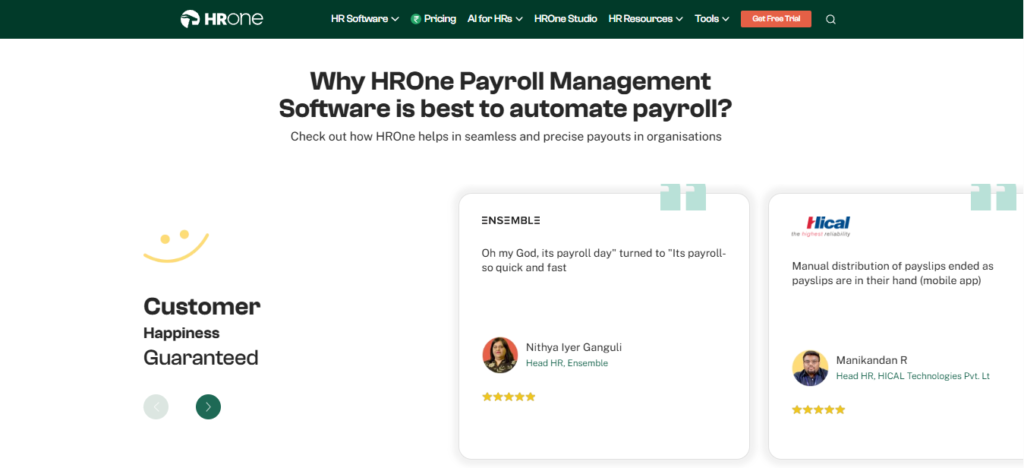
HROne is a full-stack HCM built for India’s 100 to 5,000 employee sweet spot, powering 1,500+ brands including MR DIY India, Asia Healthcare Holdings, and several pan-India manufacturing, BFSI, and healthcare groups. It ships 8 integrated modules, 127 pre-built hire-to-retire workflows, a Super Inbox that mimics Gmail for three-click task closure, One AI Suite, and India’s first inbuilt ROI Dashboard. G2 ranks HROne #3 in Easiest-To-Use Core HR and #8 Best HR Software Worldwide, ahead of Keka (#16) and greytHR (#42).
🧩 Core Services
✅ Auto-Scheduled Payroll Engine: triggers recurring salary runs using attendance, leave, and CTC data from Time Office and Core HR, eliminating the monthly Excel reconciliation that breaks month-end accuracy.
✅ India Statutory Engine: automates PF 12%, ESI 0.75/3.25%, multi-state PT, LWF, gratuity, and Payment-of-Bonus ceilings natively, pre-configured for the 2026 Labour Code wage-redefinition and two-day FFS window.
✅ Form 24Q / Form 16 / ECR / ESIC Challan Automation: generates quarterly TDS returns, digitally signed Form 16 Part A+B, EPFO ECR, and ESIC challans from the same pay-run, removing the TRACES spreadsheet dance.
✅ Group Payout Validation: audits every payslip across entities against statutory and CTC-structure rules before disbursal, catching computation errors Excel formulas miss.
✅ 127 Hire-to-Retire Workflows plus Super Inbox: wires onboarding, confirmation, transfer, promotion, and exit clearance into the payroll run, closing a 10-day cycle to 5 to 6 days.
✅ One AI Suite and HRV Studio: resume relevancy scoring, receipt parser, AI Employee Agent, and a low-code builder for visitor/vendor/seating apps without raising dev tickets.
✅ Inbuilt ROI Dashboard and HR Ops Heat Map: quantifies lifetime hours saved against average HR salary, giving CHROs a rupee-value story for the board review.
🇮🇳 India-Specific Compliance and Localization
- PF / ESI / TDS: Yes, automated computation, filing, and reconciliation in one engine. See the statutory compliance payroll guide.
- Labour law compliance: Strong, 2026 Labour Code wage-redefinition and 2-day FFS pre-configured.
- Payroll localization: Yes, native FBP, CTC revisions, arrears, gratuity, and bonus.
- Multi-state compliance: Yes, PT and LWF slabs auto-applied for all 22 states and 36 PT jurisdictions.
🎯 Who This Is Built For
- Payroll Managers firefighting CTC-revision arrears and group payout validations every month-end.
- HR Ops leads drowning in multi-entity payroll reconciliation across Darwinbox, biometric, and email threads.
- CHROs under board pressure to present a rupee-quantified HR-tech ROI within one quarter of go-live.
⚠️ Who Should Skip This
- Sub-50 employee cash-payroll businesses wanting a Salarybox-style lightweight app. HROne is built for structured workflows, not spreadsheet replacement.
- Teams unwilling to invest in the initial configuration required to unlock the workflow engine.
💰 Pricing Structure
- Plan Type(s): Core HR, Workforce, Time Office, Payroll, Performance, Engage, Recruit, and Expense, bundled flat PEPM (98% of customers run the full bundle). See the full pricing page.
- Starting Price: Not publicly disclosed, request a quote (flat PEPM, India-specific).
- Tier-wise Breakdown: Modular bundles with no per-module upcharge inside the chosen tier.
- Incremental Cost Drivers: No per-entity surcharge, no AI-suite add-on fee, and no mobile-app fee.
- Implementation Fee: Free implementation bundled. Subscription meters only after go-live.
- Cost at 200 Employees: Not publicly disclosed, request a quote. Cost at 500 Employees: Not publicly disclosed, request a quote.
⏰ Implementation and Support Reality
- Average go-live: ~30 days (MR DIY India benchmark). Enterprise multi-entity cases land in 6 to 8 weeks.
- Support channels: Phone, email, and a dedicated prior-HR SPOC, not a technical PM reading from a checklist.
- Data migration: Vendor-led with prior-HR consultant mapping legacy masters, FBP, and YTD tax.
- Reported NPS: 9.8 on SPOC-led support.
💬 Reviews
“I like HROne for its zero-touch payroll and compliance automation. It handles salary calculations, statutory deductions (PF, ESI, taxes) and filings automatically, with zero manual intervention, removing payroll errors and compliance anxiety during audits. The InboxforHR is a game-changer, centralizing every HR task into one simple inbox, cutting down administrative time by 60 to 70%.”
— Waldon S., HR Lead HROne G2 – Verified Review
“Proper calculation of PF and ESI was a pain area for us before, but now with the HROne automated calculation process, results are up to the mark and following Indian tax compliances properly. Salary processing has been done in simpler 3 steps without error.”
— Ajay K., HR Operations HROne G2 – Verified Review
2. Darwinbox, Enterprise Breadth With Tab-Fatigue Trade-offs
📘 Overview
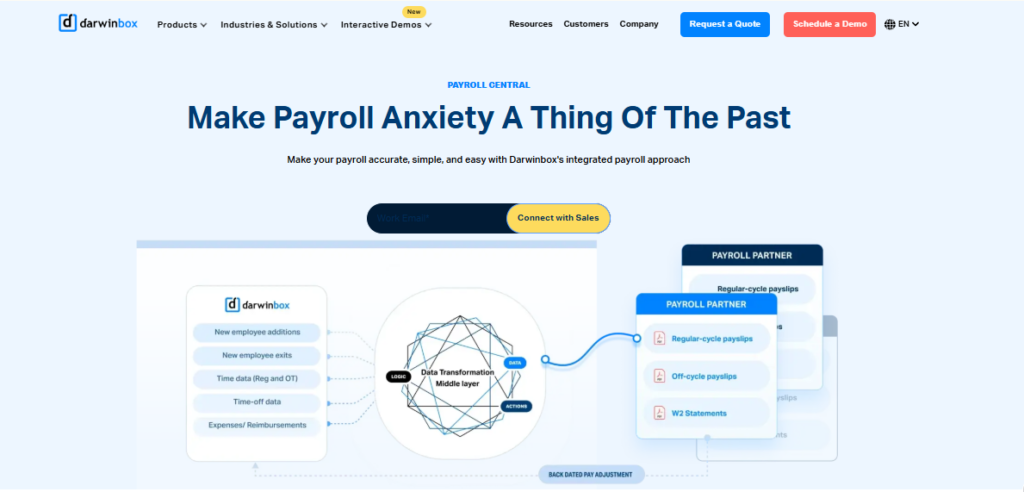
Darwinbox is the Indian HCM unicorn most visible in 1,000+ employee RFPs, with a broad module set across Core HR, Payroll, Performance, and Engagement, and a global enterprise footprint. It carries brand weight for large IT/ITeS and BFSI rollouts, but is widely reported to bill from day one of purchase while implementation extends across months, and to lock clients into multi-year contracts. Read the detailed HROne vs Darwinbox comparison.
🧩 Core Services
✅ Payroll Module: automates PF, ESI, TDS, and statutory computations with multi-country coverage.
✅ Core HR and Employee Lifecycle: onboarding, attendance, leave, and exit flows on one platform.
✅ Performance and Goals: OKR and 360 review modules with analytics.
✅ Mobile App: supports attendance, leave, and payslip access on the go.
❌ Multi-tab navigation: closing a confirmation or leave request frequently spans multiple tabs and email threads.
🇮🇳 India-Specific Compliance and Localization
- PF / ESI / TDS: Yes, India statutory rules supported.
- Labour law compliance: Moderate, Labour Code readiness requires configuration project.
- Payroll localization: Yes, FBP and CTC structures supported.
- Multi-state compliance: Yes, PT slabs configurable per entity.
🎯 Who This Is Built For
- CHROs at 1,000+ employee enterprises prioritising module breadth and global footprint.
- Buying committees accepting multi-year lock-in for brand-of-record comfort.
⚠️ Who Should Skip This
- Mid-market HR Ops leads needing single-screen task closure without bouncing across tabs.
- Finance teams unwilling to pay subscription while implementation is still in progress.
💰 Pricing Structure
- Plan Type(s): Quote-based enterprise tiers.
- Starting Price: Not publicly disclosed, request a quote.
- Incremental Cost Drivers: Per-entity surcharges, module add-ons, and mobile power-user packs.
- Implementation Fee: Yes, billed separately. Subscription typically starts from day one of purchase.
- Cost at 200 Employees: Not publicly disclosed. Cost at 500 Employees: Not publicly disclosed.
⏰ Implementation and Support Reality
- Go-live: 8 to 16 weeks, often longer for multi-entity deployments.
- Support: Email and CSM. Escalations routed through account manager.
- Data migration: Vendor-led with client-side data cleanup ownership.
💬 Reviews
“Bad implementation experience, bad UI UX, configurations getting broken in production on its own due to product deployments, terrible customer service. Basically everything.”
— Verified User in Computer Software Darwinbox – G2 Verified Review
“At times, the system can be slightly slow, especially during peak usage or when processing bulk data. Also, while the platform has a lot of features, not all of them are intuitive at first, especially modules like performance management and recruitment tracking.”
— Mohit V., HR Lead Darwinbox – G2 Verified Review
3. Keka, Polished UX, Support-Model Friction
📘 Overview
Keka dominates organic search for “HR software” in India and wins sub-500-employee firms on surface UX polish and mobile experience. However, it runs an email/ticket-only support model that Indian mid-market buyers repeatedly flag as the bottleneck during implementation, and sits at #16 G2 Ease-of-Use and #55 Overall Satisfaction against HROne at #3 on both. See the HROne vs Keka comparison.
🧩 Core Services
✅ Payroll and Compliance Automation: salary, PF, ESI, and TDS processing with payslip and statutory filings.
✅ Attendance and Shift Management: biometric and geo-fenced attendance capture.
✅ Performance (PMS): goals and review cycles.
✅ Hiring (Keka Hire): ATS tracking and offer workflows.
❌ Support model: email-threads-only with slow TAT on feature asks.
🇮🇳 India-Specific Compliance and Localization
- PF / ESI / TDS: Yes, quarterly filings supported.
- Labour law compliance: Moderate.
- Payroll localization: Yes, Indian payroll focus.
- Multi-state compliance: Partial, PT configuration needs support assistance.
🎯 Who This Is Built For
- HR leaders at sub-500 employee firms prioritising UI aesthetics for employees.
- Teams comfortable with async ticket-based resolution rather than phone escalation.
⚠️ Who Should Skip This
- Multi-legal-entity firms needing front-end configurability without ticket backlog.
- Payroll Managers who need real-time phone support during pay-run failures.
💰 Pricing Structure
- Plan Type(s): Foundation, Strength, and Growth (published tiers).
- Starting Price: ~₹6,999/month for 100 employees (Foundation). Pricing public on vendor site.
- Incremental Cost Drivers: Module upgrades, add-ons for PMS and hiring.
- Implementation Fee: Varies, often bundled in higher tiers.
- Cost at 200 Employees: Not publicly disclosed, request a quote. Cost at 500 Employees: Not publicly disclosed, request a quote.
⏰ Implementation and Support Reality
- Go-live: 6 to 12 weeks. Multiple reports of stalled implementations.
- Support: Email and in-app chat. No dedicated phone line for non-enterprise plans.
- Data migration: Self-serve with vendor guidance.
💬 Reviews
“We started working with Keka HRMS in August, and to this day, we have been unable to implement the tool in our company due to their consistently delayed responses and poor coordination between their internal teams.”
— Divya P., Client Keka – G2 Verified Review
“I have been Keka user since 2021, and the service is decreasing day by day. Most of the times folks behind the chat window is not fully aware of the functionality. TAT on customer request on features is bad.”
— Verified User in Consulting Keka – G2 Verified Review
4. greytHR, SMB Payroll Workhorse, Workflow Ceiling
📘 Overview
greytHR is one of India’s longest-running payroll tools, widely used by sub-250 employee SMBs for PF, ESI, and TDS computations and payslip distribution. It shines on statutory filings, but caps quickly on workflow flexibility, customisation, and multi-entity complexity, with multiple reviewers citing payroll-team support and leave-module rigidity. See the HROne vs greytHR comparison.
🧩 Core Services
✅ Payroll Engine: automated PF, ESI, TDS, and payslip generation with compliance filings.
✅ Attendance and Leave: web and mobile capture, and policy templates.
✅ Employee Self-Service: payslip download, and tax declaration.
❌ Workflow library: limited pre-built flows for confirmation, transfer, and exit.
❌ Customisation: rigid configuration, changes require vendor tickets.
🇮🇳 India-Specific Compliance and Localization
- PF / ESI / TDS: Yes, core SMB payroll.
- Labour law compliance: Moderate, new wage-code FFS needs config.
- Payroll localization: Yes.
- Multi-state compliance: Partial. Complex states often need manual override.
🎯 Who This Is Built For
- SMB payroll leads at single-entity firms under 250 employees.
- Finance/HR dual-role operators needing statutory filings more than workflows.
⚠️ Who Should Skip This
- Multi-entity groups needing entity-isolated policy and statutory rules.
- Teams needing sophisticated 360 performance, recruitment, or AI recruiting.
💰 Pricing Structure
- Plan Type(s): Starter, Essential, Growth, and Enterprise.
- Starting Price: ~₹3,495/month (published) for smaller headcounts.
- Incremental Cost Drivers: Module add-ons for performance, recruitment, and expense.
- Implementation Fee: Minimal for lower tiers. Enterprise tiers billed separately.
- Cost at 200 Employees: Not publicly disclosed, request a quote. Cost at 500 Employees: Not publicly disclosed, request a quote.
⏰ Implementation and Support Reality
- Go-live: 2 to 6 weeks for SMB.
- Support: Ticket-based. Historical complaints on payroll support depth.
- Data migration: Self-serve templates.
💬 Reviews
“The system acts as per its own whims and gives error reports. We have to spend time manually to find errors. Not one month has passed where we have not raised ticket. Employee experience has gone for a toss.”
— Maheshkumar J., HR greytHR – G2 Verified Review
“Reporting configuration, TDS filing, revising of TDS is not possible. UI for mapping of challans, visibility of income considered for TDS filing.”
— Krishnanand B., Payroll User greytHR – G2 Verified Review
5. Zoho Payroll, Good for Zoho-One Startups, Weak on Multi-Entity
📘 Overview
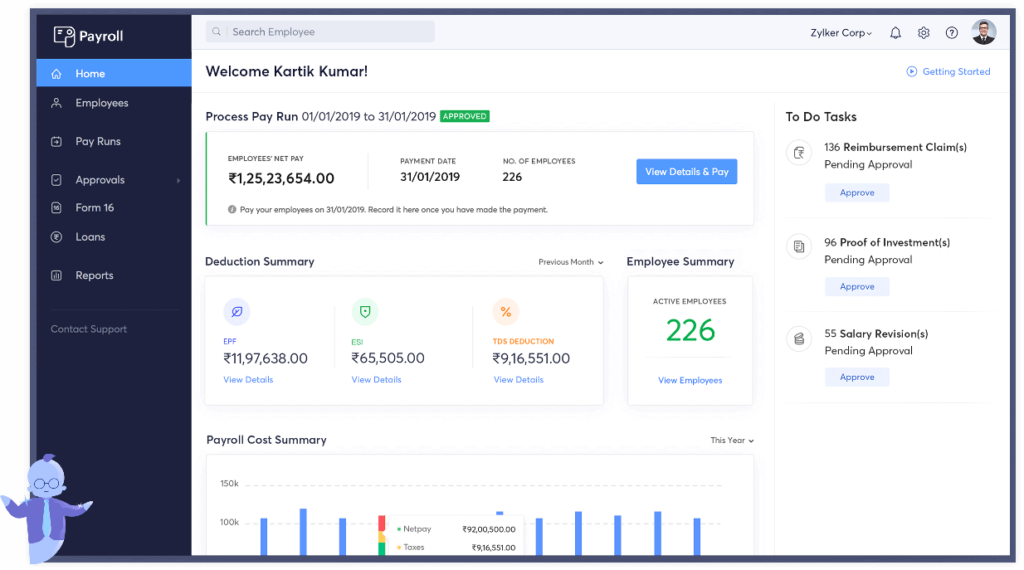
Zoho Payroll is a natural fit for single-entity Indian startups already running Zoho Books, Recruit, and People, benefitting from one-vendor integration and familiar UI. It works cleanly for straightforward CTC structures, but is widely reported as shallow on multi-legal-entity setups, FBP depth, and India-specific new wage-code workflows. See the HROne vs Zoho People comparison.
🧩 Core Services
✅ Zoho-ecosystem payroll: integrated with Zoho Books and People.
✅ Automated PF, ESI, and TDS computation: and Form 16 generation.
✅ ESS portal: payslip, tax declaration, and IT proof upload.
❌ Multi-legal-entity depth: limited OU architecture.
❌ Customer support lag: frequently flagged by reviewers on complex tickets.
🇮🇳 India-Specific Compliance and Localization
- PF / ESI / TDS: Yes, straightforward statutory coverage.
- Labour law compliance: Moderate.
- Payroll localization: Yes, designed for Indian SMB/startup context.
- Multi-state compliance: Partial.
🎯 Who This Is Built For
- Founder-led startups under 200 employees already on Zoho One.
- HR generalists wanting payroll, books, and people in one suite.
⚠️ Who Should Skip This
- Multi-entity groups needing per-entity statutory isolation.
- CHROs at 500+ employee firms needing AI-driven recruitment and deep performance analytics.
💰 Pricing Structure
- Plan Type(s): Standard and Premium (published).
- Starting Price: ~₹60/employee/month (published on vendor site).
- Incremental Cost Drivers: Annual vs monthly billing deltas, and Zoho One bundle upgrades.
- Implementation Fee: None for smaller plans.
- Cost at 200 Employees: ~₹12,000/month (list). Cost at 500 Employees: Not publicly disclosed, request a quote.
⏰ Implementation and Support Reality
- Go-live: 2 to 4 weeks for straightforward setups.
- Support: Email and chat, with reported response lag on complex issues.
- Data migration: Self-serve templates.
💬 Reviews
“The biggest drawback for me has been the lack of customer support. Whenever I try to reach out, it often takes a long time to get a response. There were days when I was stuck with errors and couldn’t find a solution.”
— Dhana C., HR Zoho People – G2 Verified Review
“Features are shallow and there is no depth in each application.”
— Verified User in Information Technology and Services Zoho People – G2 Verified Review
6. RazorpayX Payroll, Payments-First, Thin Outside Pay-Run
📘 Overview
RazorpayX Payroll is built atop Razorpay’s payments rails, giving early-stage Indian startups one-click salary disbursement with PF, ESI, and TDS handled in-app. It’s a strong fit for sub-100 employee firms with simple CTC structures and minimal workflow needs, but thins out quickly when performance, recruitment, or multi-entity demands appear. For startup setups, see the payroll for startup India guide.
🧩 Core Services
✅ One-click salary disbursement: leverages Razorpay payouts for direct-to-bank transfers.
✅ PF / ESI / TDS compliance: auto-filing with TRACES and EPFO.
✅ Form 16 and payslip generation.
❌ Performance, recruitment, and engagement: not covered.
❌ Multi-entity payroll: limited depth.
🇮🇳 India-Specific Compliance and Localization
- PF / ESI / TDS: Yes, core coverage.
- Labour law compliance: Moderate.
- Payroll localization: Yes.
- Multi-state compliance: Partial.
🎯 Who This Is Built For
- Founders and finance leads at sub-100 employee startups wanting pay-run and compliance in one screen.
⚠️ Who Should Skip This
- CHROs needing full hire-to-retire coverage beyond payroll.
- Mid-market firms with multi-state or multi-entity complexity.
💰 Pricing Structure
- Plan Type(s): Free and Pro (published).
- Starting Price: ₹0 up to a headcount cap, then tiered PEPM.
- Incremental Cost Drivers: Higher tiers for advanced compliance.
- Implementation Fee: None.
- Cost at 200 Employees: ~₹100/employee/month (list). Cost at 500 Employees: Not publicly disclosed, request a quote.
⏰ Implementation and Support Reality
- Go-live: 1 to 3 weeks.
- Support: Chat and email.
- Data migration: Self-serve templates.
7. Pocket HRMS, “smHRt” Tagline, Shallow OU Depth
📘 Overview
Pocket HRMS targets sub-200 employee Indian firms with a payroll-plus-core-HR bundle and an AI-tagged chat assistant. It covers baseline statutory filings, but reviewers flag shallow multi-entity OU configuration and variable implementation quality across partners. See the HROne vs Pocket HRMS comparison.
🧩 Core Services
✅ Payroll with PF/ESI/TDS automation.
✅ smHRt assistant: chat-based employee self-service.
✅ Attendance and leave: with mobile app.
❌ Multi-entity OU depth: limited.
❌ Workflow library: basic compared to mid-market peers.
🇮🇳 India-Specific Compliance and Localization
- PF / ESI / TDS: Yes.
- Labour law compliance: Moderate.
- Payroll localization: Yes.
- Multi-state compliance: Partial.
🎯 Who This Is Built For
- Small HR teams under 200 employees seeking a mobile-first HRMS with payroll.
⚠️ Who Should Skip This
- Enterprises needing multi-legal-entity isolation and deep workflow automation.
💰 Pricing Structure
- Plan Type(s): Quote-based.
- Starting Price: Not publicly disclosed, request a quote.
- Implementation Fee: Partner-delivered in many cases.
- Cost at 200 Employees: Not publicly disclosed, request a quote. Cost at 500 Employees: Not publicly disclosed, request a quote.
⏰ Implementation and Support Reality
- Go-live: 3 to 6 weeks.
- Support: Email, and partner-delivered onboarding.
- Data migration: Partner-led.
8. factoHR, Mid-Market Manufacturing and BFSI Fit
📘 Overview
factoHR serves mid-market manufacturing and BFSI firms with a focus on payroll compliance, biometric integration, and attendance. It handles Indian statutory depth well and has pan-India customers, though its AI stack and workflow library are thinner than the top-ranked platforms. See the HROne vs FactoHR comparison.
🧩 Core Services
✅ Payroll Engine: PF, ESI, TDS, PT, and LWF coverage.
✅ Biometric plus GPS attendance: strong hardware integration.
✅ Core HR and leave: with mobile app.
✅ Performance management: basic review cycles.
❌ AI suite: limited compared to HROne’s One AI.
🇮🇳 India-Specific Compliance and Localization
- PF / ESI / TDS: Yes.
- Labour law compliance: Strong for manufacturing shift rules.
- Payroll localization: Yes.
- Multi-state compliance: Yes.
🎯 Who This Is Built For
- Manufacturing and BFSI payroll leads needing shift-based attendance plus statutory depth. Explore manufacturing HR for industry fit.
⚠️ Who Should Skip This
- Firms prioritising modern AI-driven recruitment and inbox-style UX.
💰 Pricing Structure
- Plan Type(s): Quote-based tiers.
- Starting Price: Not publicly disclosed, request a quote.
- Implementation Fee: Varies.
- Cost at 200 Employees: Not publicly disclosed. Cost at 500 Employees: Not publicly disclosed.
⏰ Implementation and Support Reality
- Go-live: 4 to 8 weeks.
- Support: Phone and email.
- Data migration: Vendor-led.
9. Salarybox, Cash-Payroll Niche for Sub-50 Blue-Collar SMBs
📘 Overview
Salarybox is a mobile-first attendance and cash-payroll app for sub-50 employee Indian SMBs, typically shops, small factories, and field-service businesses. It simplifies punch-in, wage calculation, and UPI disbursement, but is not engineered for TDS-heavy, multi-entity, or statutory-audit-grade enterprises.
🧩 Core Services
✅ Mobile attendance: with selfie and geo-tagging.
✅ Cash plus UPI payroll disbursement.
✅ Basic payslips and advance loans.
❌ TDS, Form 24Q, and ECR filings: limited coverage.
❌ Multi-entity and OU-level RBAC: not designed for it.
🇮🇳 India-Specific Compliance and Localization
- PF / ESI / TDS: Partial.
- Labour law compliance: Limited.
- Payroll localization: Yes, cash-payroll-first.
- Multi-state compliance: Partial.
🎯 Who This Is Built For
- Shop and small-factory owners managing 10 to 50 daily-wage or cash-paid workers.
⚠️ Who Should Skip This
- Any 100+ employee firm with TDS-heavy or multi-entity payroll reality.
💰 Pricing Structure
- Plan Type(s): Free plus Pro published tiers.
- Starting Price: ₹0 base. Pro plans at published tiers.
- Implementation Fee: None.
- Cost at 200 Employees: Not publicly disclosed. Cost at 500 Employees: Not applicable.
⏰ Implementation and Support Reality
- Go-live: 1 to 2 weeks, self-serve.
- Support: Chat.
- Data migration: Self-serve.
10. SAP SuccessFactors, Global Incumbent, Over-Engineered for India
📘 Overview
SAP SuccessFactors is the choice of 2,000+ employee global MNCs with existing SAP ERP footprints, offering breadth across core HR, payroll, performance, and learning on a single cloud. For the 100 to 5,000 Indian mid-market sweet spot, however, reviewers consistently flag over-engineering, cost, long transition phases with day-one billing, and the need for back-end developers to change a leave policy. See the HROne vs SAP comparison.
🧩 Core Services
✅ Global HCM suite: Core HR, Payroll, Performance, LMS, and Succession.
✅ ERP integration: tight SAP S/4HANA coupling.
✅ Global compliance library: multi-country statutory.
❌ India payroll localisation: retrofitted, needs partner configuration.
❌ User-friendly policy edits: requires developer-level intervention.
🇮🇳 India-Specific Compliance and Localization
- PF / ESI / TDS: Partial, delivered via India localisation pack and partner configuration.
- Labour law compliance: Moderate, 2026 Labour Code requires configuration project.
- Payroll localization: Partial.
- Multi-state compliance: Yes, via configuration.
🎯 Who This Is Built For
- Global MNCs with 2,000+ employees standardising on SAP S/4HANA backbone.
⚠️ Who Should Skip This
- 100 to 1,000 employee Indian firms needing front-end policy configurability without developer tickets.
- Teams unwilling to pay full subscription during 6 to 12 month implementation phases.
💰 Pricing Structure
- Plan Type(s): Enterprise quote-based.
- Starting Price: Not publicly disclosed, request a quote.
- Implementation Fee: Yes, typically partner-delivered and billed separately.
- Cost at 200 Employees: Not publicly disclosed. Cost at 500 Employees: Not publicly disclosed.
⏰ Implementation and Support Reality
- Go-live: 6 to 12 months, partner-led.
- Support: Partner-delivered, tiered SLAs.
- Data migration: Partner-led, client ownership of data mapping.
💬 Reviews
“Not user-friendly, system often freezes. Data is unreliable and cannot always be trusted. Very limited functionalities compared to competitors. Customization requires third-party vendors, every change is costly. Extremely expensive for what it delivers, Ferrari price, Trabant value.”
— Janka Z., HR SAP SuccessFactors – G2 Verified Review
“The most basic functionality is missing or severely flawed. If I could, I would take back our decision to implement the software.”
— Verified User in Internet SAP SuccessFactors – G2 Verified Review
Ready to run India-compliant payroll without the month-end firefight?
See HROne’s Auto-Scheduled Payroll Engine, 127 hire-to-retire workflows, and the inbuilt ROI Dashboard on your own org data in a 30-minute walkthrough.
Q2. How Were These 10 Payroll Tools Selected and Scored?
These ten payroll platforms were scored out of 100 on five India-weighted criteria: Statutory Compliance Depth (25%), PF/ESI/TDS and Filing Automation (25%), Multi-Entity and Scale Architecture (20%), Implementation and Support Economics (15%), and Pricing Transparency and Lock-In (15%). Star ratings map to score bands: 0 to 20 = 1★, 21 to 40 = 2★, 41 to 60 = 3★, 61 to 80 = 4★, and 81 to 100 = 5★.
⚠️ The Decision Dilemma
Most Indian buyers rank payroll software by brand recall or per-employee sticker price, and then discover six months later that the tool fails the 2026 Labour Code’s two-day FFS clock, misses Maharashtra and Karnataka PT slabs, or bills full subscription from day one while implementation drags across two quarters. The scars show up as month-end firefighting, not as line items on the invoice, so the scoring model is engineered to surface architectural defensibility before checklist depth.
❌ The Wrong Way to Decide
Module count, G2 review volume, and logo density do not predict whether payroll will close in five days or whether Form 24Q, ECR, and ESIC challans will generate without manual spreadsheet audits. A vendor with thirty modules and a unicorn tag can still force HR Ops to juggle six tabs to close a confirmation request, and a platform with a shiny mobile app can still leave Payroll Managers stuck in email threads during a statutory cut-over. The five criteria below are chosen because each one, independently, predicts audit defensibility, zero-delay payroll, and CFO-approved ROI. For a deeper buyer lens, see the choosing payroll software checklist.
✅ The Right Scoring Framework
- Statutory Compliance Depth (25%): PF, ESI, multi-state PT, LWF, gratuity, bonus, FBP, and 2026 Labour Code readiness.
- PF/ESI/TDS and Filing Automation (25%): Form 24Q, Form 16, ECR, ESIC challan, Form 12BB, and old-vs-new regime support.
- Multi-Entity and Scale Architecture (20%): Unlimited legal entities in one tenant, OU-level RBAC, and unified master.
- Implementation and Support Economics (15%): Go-live timeline, SPOC quality, data-migration model, and NPS.
- Pricing Transparency and Lock-In (15%): Flat PEPM, go-live billing, and no per-entity surcharge.
📊 Applying the Framework
| Rank | Tool | Score | Stars | Why This Score |
|---|---|---|---|---|
| 1 | HROne | 92 | ⭐⭐⭐⭐⭐ | India-native statutory engine, 127 workflows, ROI Dashboard, and go-live billing clear every criterion. 5★. |
| 2 | Darwinbox | 76 | ⭐⭐⭐⭐ | Strong multi-entity and module depth, but day-one billing and tab-fatigue support knock points off economics. |
| 3 | SAP SuccessFactors | 70 | ⭐⭐⭐⭐ | Global scale and ERP integration, pulled down by Indian localisation retrofits and partner-billed implementation. |
| 4 | Keka | 58 | ⭐⭐⭐ | Polished UX and baseline compliance. Email-only support and #16 G2 Ease-of-Use cap the score. |
| 5 | greytHR | 55 | ⭐⭐⭐ | Solid SMB statutory filings. Rigid configuration and workflow ceiling prevent a higher tier. |
| 6 | factoHR | 50 | ⭐⭐⭐ | Manufacturing-friendly biometric and payroll. Thinner AI and workflow library. |
| 7 | Zoho Payroll | 48 | ⭐⭐⭐ | Clean Zoho-ecosystem fit. Multi-legal-entity and FBP depth remain shallow. |
| 8 | RazorpayX Payroll | 45 | ⭐⭐⭐ | Payment-first payroll. Limited beyond the pay-run. |
| 9 | Pocket HRMS | 38 | ⭐⭐ | Baseline payroll with AI tagging. Shallow OU depth and partner-variable delivery. |
| 10 | Salarybox | 32 | ⭐⭐ | Cash-payroll niche. Not designed for TDS-heavy multi-entity reality. |
🏆 What the Scoring Actually Rewards
The real question is not which tool carries the most logos. It is which tool scores on architecture. Asia Healthcare Holdings runs 20 pan-India units on a single HROne instance with entity-isolated compliance, and MR DIY India compressed payroll from a 10-day cycle to 5 to 6 days after consolidation. These are outcomes the scoring model is engineered to surface ahead of vanity metrics. See the MRDIY case study for the full implementation story.
Q3. Which Payroll Software Has the Best Compliance Engine for PF, ESI, TDS, Gratuity, Bonus, and the 2026 Labour Codes?
The best compliance engine is one where PF 12%, ESI 0.75/3.25%, multi-state PT, LWF, TDS, gratuity (15/26 formula or 4.81% accrual), and the Payment-of-Bonus ceilings live inside the same engine holding attendance and CTC, not bolted on as plugins, and ships pre-configured for the 2026 Labour Codes’ 50%-of-CTC wage definition and the two-working-day full-and-final settlement clock.
😓 The Month-End Reality Most Indian HR Teams Inherit
Indian mid-market payroll accuracy typically sits between 92% and 96%, meaning every month a 500-person company ships 20 to 40 incorrect payslips, and stacks more reviewers instead of fixing the data flow. Attendance lives in a biometric portal, leave in a separate module, CTC revisions arrive over email, gratuity accrual lives in an Excel macro, and someone stitches it all together into a payroll input sheet at 9pm on the 27th. The 2026 Labour Codes tightened the clock: exits now need FFS clearance within two working days, and arrears propagation across the new wage definition cannot wait for a quarterly reconciliation. For a primer, read navigating labor laws.
⚠️ Where Keka, greytHR, and Zoho Payroll Quietly Break
Platforms like Keka, greytHR, and Zoho Payroll ship competent compute engines, but retrofit statutory logic on top of disconnected masters. Multi-state PF/ESI overrides, gratuity re-accrual on the revised “wage” base, Payment-of-Bonus ceiling at ₹21,000, and the two-day FFS flow break silently at scale, producing faster wrong answers, not defensible ones. Reviewers have publicly flagged these gaps. Teams evaluating alternatives often study the HROne vs greytHR and HROne vs Keka comparisons.
“Reporting configuration, TDS filing, revising of TDS is not possible. UI for mapping of challans, visibility of income considered for TDS filing.”
— Krishnanand B., Payroll User greytHR – G2 Verified Review
“Payroll not getting processed due to RBI regulations. No option to add monthly incentive separately. If any figures are added, they get added to the CTC, which in turn changes the CTC figure. CA raised a concern that tax figures deducted in the last FY vs the amounts reflecting on system now are different.”
— Pooja M., HR Keka – G2 Verified Review
🔄 The Strategic Shift: Compliance Is an Architecture Question
Compliance defensibility is not a better calculator. It is data-propagation architecture. The real fix is auto-scheduled pay runs, group payout validations that audit every payslip before disbursal, entity-isolated statutory rules, native gratuity/bonus/FBP logic, and JV-to-GL sync built in, rather than three quarterly reconciliations glued on top of fragmented source data. See how payroll software reduces compliance risk for the underlying logic.
🇮🇳 How HROne Approaches Indian Compliance
We built HROne’s payroll solution statutory engine to sit inside the same instance that owns attendance, CTC, FBP, and exit workflows. The Auto Scheduler triggers recurring pay runs with attendance-correction arrears and increment arrears flowing natively from Time Office. Group payout validations check every payslip across entities for statutory and computation errors before disbursal. The engine handles PF, ESI, multi-state PT, LWF, gratuity accrual, Payment-of-Bonus ceilings, FBP declarations, and the 2026 Labour Code’s 50%-wage redefinition and two-day FFS out of the box. 127 workflows wire exit clearance, asset recovery, and knowledge transfer into the FFS run, so the two-day clock is enforceable, not aspirational. Use the gratuity calculator to model accrual scenarios before cutover.
“Proper calculation of PF and ESI was a pain area for us before, but now with the HROne automated calculation process, results are up to the mark and following Indian tax compliances properly. Salary processing has been done in simpler 3 steps without error.”
— Ajay K., HR Operations HROne G2 – Verified Review
MR DIY India’s 10-day payroll cycle collapsed to 5 to 6 days after moving compliance and attendance into the same engine.
Q4. Which HCM Software Supports Multi-Entity, Multi-State, and Old-vs-New TDS Regime Payroll in India?
Evaluate multi-entity payroll on OU architecture, entity-level policy isolation, multi-state PT coverage across all 22 states, and the ability to handle mid-year old-vs-new tax regime switches with Form 12BB re-capture inside one instance, not on module count, brand recognition, or lowest sticker PEPM.
⚠️ The Decision Dilemma
Pick wrong on multi-entity and you end up running three parallel HRMS instances, reconciling employee masters in Excel while each vendor bills you per entity, with employees in Tamil Nadu and Maharashtra hitting different PT slabs, and anyone who switches from old to new regime mid-year triggering a spreadsheet crisis. The architecture commitment you make at purchase is the architecture your group structure operates on for the next five years, and the cost of reversing it includes a full re-implementation, fresh data mapping, and another round of change management. Reference the professional tax slab rates guide for the state-wise complexity.
❌ How Most Buyers Decide (Poorly)
The two most common shortcuts are “our peer group uses Darwinbox” and “Zoho Payroll is cheapest at 250 heads.” Neither predicts whether the platform can isolate PF, ESI, and TDS compliance per entity within one tenant, whether it can auto-apply PT slabs across 22 states without an override, or whether an employee moving from old to new regime in October generates clean proration instead of a quarterly reconciliation spreadsheet. Detailed competitor mechanics are covered in the HROne vs Darwinbox and HROne vs Zoho People pages.
✅ The Seven-Criterion Framework
- Unlimited legal entities in a single tenant, with no per-entity subscription premium.
- Per-entity leave, attendance, and payroll policy isolation.
- PF, ESI, PT, and TDS computation independently auditable per entity.
- Multi-state PT auto-apply across all 22 Indian states and 36+ jurisdictions.
- Unified employee master preserved across entity transfers, with no duplicate records.
- OU-level RBAC configurable by HR, not by a back-end developer.
- Old/new tax regime election with Form 12BB capture and mid-year switch support, and flat PEPM with no per-entity surcharge.
📊 Applying the Framework
| Criterion | HROne | Darwinbox | Keka | greytHR | Zoho Payroll |
|---|---|---|---|---|---|
| Unlimited entities / one tenant | ✓ | ✓ | ◐ | ✗ | ✗ |
| Per-entity policy isolation | ✓ | ✓ | ◐ | ✗ | ✗ |
| Entity-isolated PF/ESI/PT/TDS | ✓ | ✓ | ◐ | ◐ | ✗ |
| Multi-state PT auto-apply | ✓ | ✓ | ◐ | ✓ | ◐ |
| Unified master across transfers | ✓ | ◐ | ◐ | ✗ | ✗ |
| OU-level RBAC (front-end) | ✓ | ◐ | ◐ | ✗ | ✗ |
| Old/new regime + 12BB switch | ✓ | ✓ | ◐ | ✓ | ◐ |
| Score | 7/7 | 5/7 | 2/7 | 3/7 | 1/7 |
Zoho Payroll hits single-entity walls the moment a group structure appears. Keka treats mid-year regime switches as an offline CSV edit, which breaks audit trails. Darwinbox handles multi-entity depth, but loses points on front-end RBAC and unified-master fidelity across transfers.
🏆 The Meta-Insight
The real question is not “which HRMS has the most modules?” It is “which HRMS lets me add my next legal entity without another implementation project?” Asia Healthcare Holdings runs 20 pan-India units on a single HROne instance with unified employee master, entity-independent statutory compliance, and one RBAC layer, because the multi-entity architecture eliminated the friction of running parallel HRMS deployments. Explore tailored CHRO solutions to see how group structures are architected.
Stop running parallel HRMS instances for every legal entity.
See how HROne’s multi-entity architecture, 127 workflows, and India-native statutory engine consolidate payroll, compliance, and OU-level RBAC into one tenant, with subscription metering only after go-live.
Q5. How Does Payroll Software Handle TDS on Salary, Form 24Q/16, ECR, and ESIC Challan Filings?
Payroll software handles TDS on salary by projecting each employee’s annual income, applying the old-vs-new tax regime election and Form 12BB declarations, distributing liability across remaining pay cycles, and then generating Form 24Q quarterly, Form 16 annually, the EPFO Electronic Challan-cum-Return (ECR), and the ESIC challan directly from the same pay-run. The statutory file is therefore a by-product of payroll, not a separate manual exercise.
🧮 The Seven-Step Mechanics Inside a Compliant Engine
A defensible India payroll software engine runs the following sequence every month:
- Capture regime election and Form 12BB via ESS, where employees pick old or new regime, upload HRA/LTA/Section 80 proofs, and, where applicable, loss-from-house-property declarations.
- Project annualised CTC, including FBP components, variable pay, perquisites (car, accommodation, ESOPs), and any prior-employer income disclosed in Form 12B.
- Compute estimated tax liability under the chosen regime, net of standard deduction and declared investments.
- Distribute the liability across remaining months, re-running the math when arrears, CTC revisions, or proof-submission windows trigger a recalculation, and applying Section 89(1) relief where arrears are involved.
- Generate the EPFO ECR file and the ESIC challan from the same pay-run, validating UAN and ESIC numbers against the master before submission.
- File Form 24Q / 26Q on TRACES quarterly, reconciling total TDS deducted against challans paid.
- Issue Form 16 Part A plus Part B with digital signature, merging TRACES-downloaded Part A with system-generated Part B.
⚖️ Evaluation Criteria for Any TDS and Filings Engine
When evaluating a payroll platform’s statutory compliance engine, check for mid-year regime switch with Form 12BB re-capture, perquisite valuation under Rule 3, loss-from-house-property adjustment, Section 89(1) arrears relief, FBP re-declaration mid-year, multi-state PT challan generation across the 22 Indian states, ECR validation against the EPFO UAN master, ESIC number pre-validation, and a tamper-evident audit trail for scrutiny assessments. Any one of these missing turns the quarterly 24Q into a manual spreadsheet rescue. Use the TDS calculator to sanity-check projections ahead of cutover.
⚠️ Where Most Engines Quietly Break
Common failure modes documented by Indian reviewers and finance operators:
- Global engines (SAP SuccessFactors, BambooHR) missing Rule 3 perquisite valuation and Section 89(1) relief, forcing offshoring of the final tax math.
- Rounding errors in monthly TDS, especially after arrears, that surface only in Form 16 vs 26AS reconciliation.
- Manual Form 16 Part A plus Part B merging, because TRACES Part A and system-generated Part B live in different systems.
- ECR mismatches caught post-filing, because UAN validation was skipped at the payroll stage.
- Mid-year regime switches handled as offline CSV re-uploads, breaking the audit trail.
🇮🇳 How HROne Simplifies the Same Workflow
We built HROne’s payroll engine to sit inside the same instance that holds CTC, FBP, Time Office data, and the ESS portal, so TDS projection, Form 12BB capture, mid-year regime switch, Form 24Q generation, Form 16 Part A plus B merge with digital signature, EPFO ECR, ESIC challan, and multi-state PT challans all fire from a single run. Group payout validations audit every payslip for computation and statutory errors before disbursal, and the statutory registers feed the audit trail directly, eliminating the quarterly 24Q spreadsheet dance most Indian mid-market teams still run. Reference the payroll taxes calculation India guide for the underlying computations.
Q6. How Much Does Indian Payroll Software Cost, and How Do You Migrate and Prove Audit-Readiness?
Indian payroll software ranges ₹40 to ₹350 PEPM depending on module bundle and scale. Flat-PEPM consolidated HCM suites typically land between ₹85 and ₹180 PEPM with free implementation and go-live billing, while legacy ERPs exceed ₹400 PEPM with day-one subscription. Migration succeeds only when master data, statutory registers, and a parallel-run sign-off precede cutover, and audit-readiness depends on RBAC, an immutable audit trail, and reconciled challan history.
💰 The Four Things That Break the Buyer-Economics Math
- Pricing traps that don’t show in the demo: per-entity surcharges in Darwinbox and SAP SuccessFactors, module-level upgrade walls in Keka and greytHR, and penalty exposure that no platform markets, including PF delay at 12%/year plus damages u/s 14B, TDS late filing at ₹200/day u/s 234E, and interest on short-deduction u/s 201(1A). One missed quarter typically costs more than a year of PEPM. See the HR software pricing transparency analysis.
- The migration playbook that actually works: audit existing PF, ESI, PT, and TDS registers, extract employee master, CTC structures, and YTD tax paid, map FBP components and declarations, run parallel payroll for one full cycle, reconcile challans and bank files with the outgoing vendor, and cut over with a named SPOC instead of a ticket queue. The payroll audit checklist formalises the sequence.
- The audit-readiness checklist CFOs sign off against: SOC 2 / ISO 27001 certification, RBAC at OU and entity level, immutable audit trail with user-action logs, Form 24Q and Form 16 version history, and challan-to-payslip reconciliation on demand.
- The implementation reality G2 exposes: HROne ranks #3 on G2 for Easiest-To-Use Core HR, while Keka sits at #16, and HROne’s Overall Satisfaction is #3 against Keka’s #55, which predicts whether the parallel-run sign-off lands in 30 days or 6 months. Compare specifics on the HROne vs Keka page.
💸 How HROne Changes the CFO Math
HROne’s flat PEPM bundles multi-entity payroll, One AI Suite, HRV Studio, a prior-HR onboarding SPOC, and free implementation with subscription metering only after go-live, closing the CFO approval loop by anchoring commercials to the MR DIY India 30-day go-live precedent and a 9.8 NPS post-implementation. Review the pricing page and the MRDIY case study for the full commercial picture.
“I like HROne for its zero-touch payroll and compliance automation. Removing payroll errors and compliance anxiety during audits. The InboxforHR is a game-changer, centralizing every HR task into one simple inbox, cutting down administrative time by 60 to 70%.”
— Waldon S., HR Lead HROne G2 – Verified Review
“I love HROne for its cost efficiency and holistic approach. The ability to manage various HR processes from a single platform is incredibly convenient and cost-effective for mid-level and enterprise customers.”
— Priyanka S., HR Head HROne G2 – Verified Review
Ready to see it for yourself?
Book a 30-minute HROne payroll demo and get a live walkthrough of the compliance engine, ROI Dashboard, and multi-entity architecture on your own data.

















 Secures Top Spot in
