



Q1: Why Is Goal Misalignment Quietly Costing Indian Enterprises Lakhs Every Quarter, and Who Should Read This Guide?
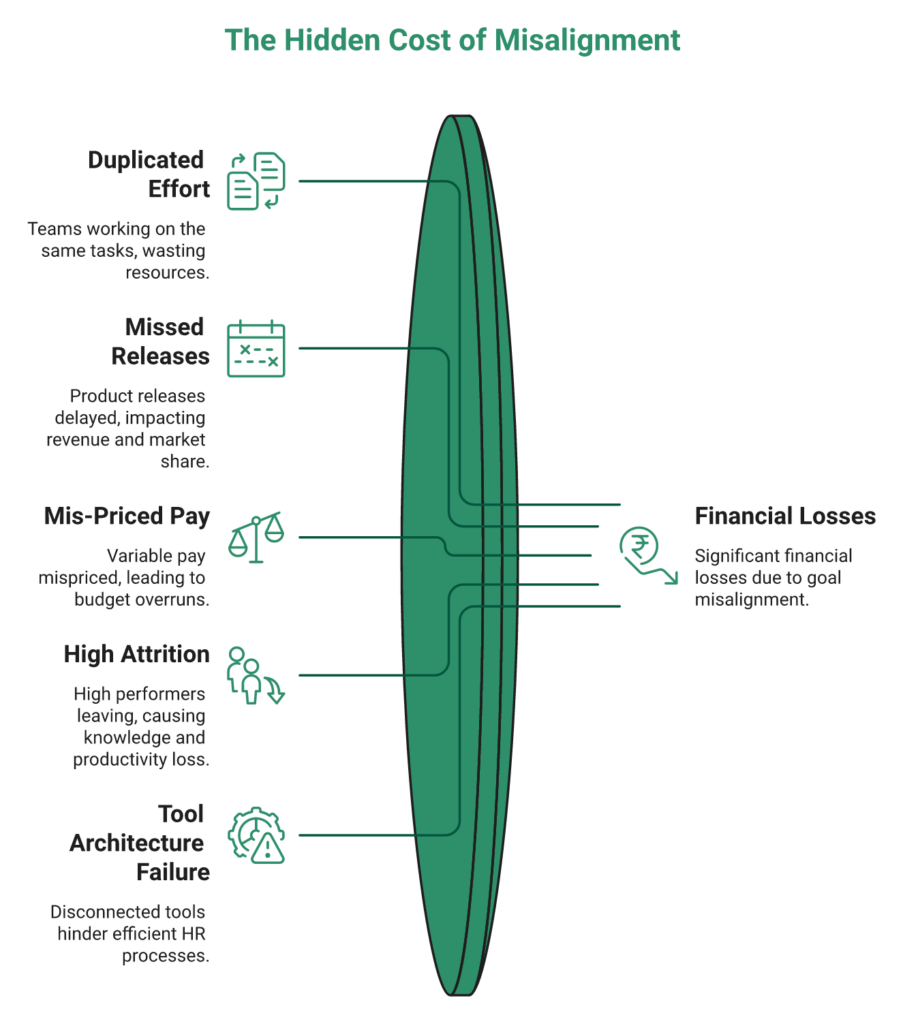
Goal misalignment is costing the average 500-employee Indian enterprise somewhere between ₹1.2 crore and ₹3.5 crore every year, in duplicated effort, missed product releases, mis-priced variable pay, and the attrition that follows when high performers realise their quarterly work never rolled up to anything the board cared about. The fix is not another appraisal form. It is a shift from annual ratings done on Excel to OKR-powered, continuously measured performance management cycles that live inside the HRMS rather than on top of it.
The scene every Indian HR head recognises at FY-close
It is the 18th of March. The CHRO has a board review in ten days asking for a single slide on HR ROI. Managers are being chased on WhatsApp for OKR scores that were last updated in October. Ratings are being normalised in an Excel sheet someone emailed themselves to avoid a network drop. And when the increment letters finally go out, the payroll team discovers three employees had mid-year CTC revisions the performance tracker never saw. None of this is a software failure. It is an architecture failure, where performance data, appraisal data, and payroll software data live in three different places and only meet when someone re-keys a spreadsheet.
Why most “best performance software India” lists quietly fail the Indian buyer ❌
Most of the top-ranking guides for this keyword are authored by the vendors themselves. Worxmate, PeopleStrong, and similar brands publish listicles where they happen to rank themselves first, skip DPDP Act 2023 posture entirely, rarely publish INR pricing, and treat HRMS-integration as a footnote. The global sources, including Lattice, 15Five, and Mooncamp blogs, ignore the Indian FY April to March cycle, bell-curve normalisation, variable pay linked to ratings, and the multi-legal-entity reality that sits under almost every 500+ employee Indian group. The reader ends up with a feature checklist and no way to translate it into a buying decision.
What this independently-tested 2026 blueprint changes ✅
I wrote this guide after sitting inside the HR control room of Indian manufacturers, IT services firms, and hospital chains through enough FY-close cycles to know where the real money leaks. The thesis is simple. Most Indian HR leaders arrive on a performance software comparison page already scarred by one of three realities: the entrenched enterprise incumbent (usually Darwinbox), the mid-market mainstream (Keka, greytHR, Zoho People), or the Frankenstein stack (a separate OKR tool, Excel for ratings, outsourced payroll, and WhatsApp for feedback). This guide is built for five specific personas operating inside those realities:
- CHROs and SVP-HR at 500 to 5,000 employee organisations who need a board-ready OKR-to-ROI story.
- HR heads and HR Ops leads at 100 to 500 employee mid-market firms drowning in tab-switching across three or four tools.
- Founders and People Ops at 50 to 200 employee growth-stage companies deciding whether to graduate from a spreadsheet.
- Payroll managers who will inherit the variable-pay mess if the performance module does not talk to payroll.
- CFO and IT buying-committee members evaluating DPDP posture, SSO, RBAC, and three-year TCO in INR.
How the methodology holds up to a CFO’s scrutiny ⭐
The scorecard behind this blueprint is 100 points across ten weighted criteria, tested against 23 platforms that show up in real Indian RFPs, namely HROne, Worxmate, PeopleStrong, Keka, Darwinbox, Peoplebox, Zoho People, Lattice, Profit.co, Synergita, Engagedly, Zimyo, Mercer Mettl, Huminos, Qandle, HONO, JOP, SAP SuccessFactors, Betterworks, Weekdone, Quantive, Mooncamp, and Tability. Every INR price was verified from public pricing pages or direct quotes, DPDP Act 2023 compliance was audited against consent, residency, retention, and audit-log evidence, and each vendor got the same demo script. For CFOs who want to model savings in rupee terms before the demo, the ROI calculator is the fastest way to pressure-test assumptions.
Q2: What Exactly Is OKR-Powered Performance Management Software, and How Do OKRs, KPIs, KRAs, and MBOs Differ in Indian Practice?
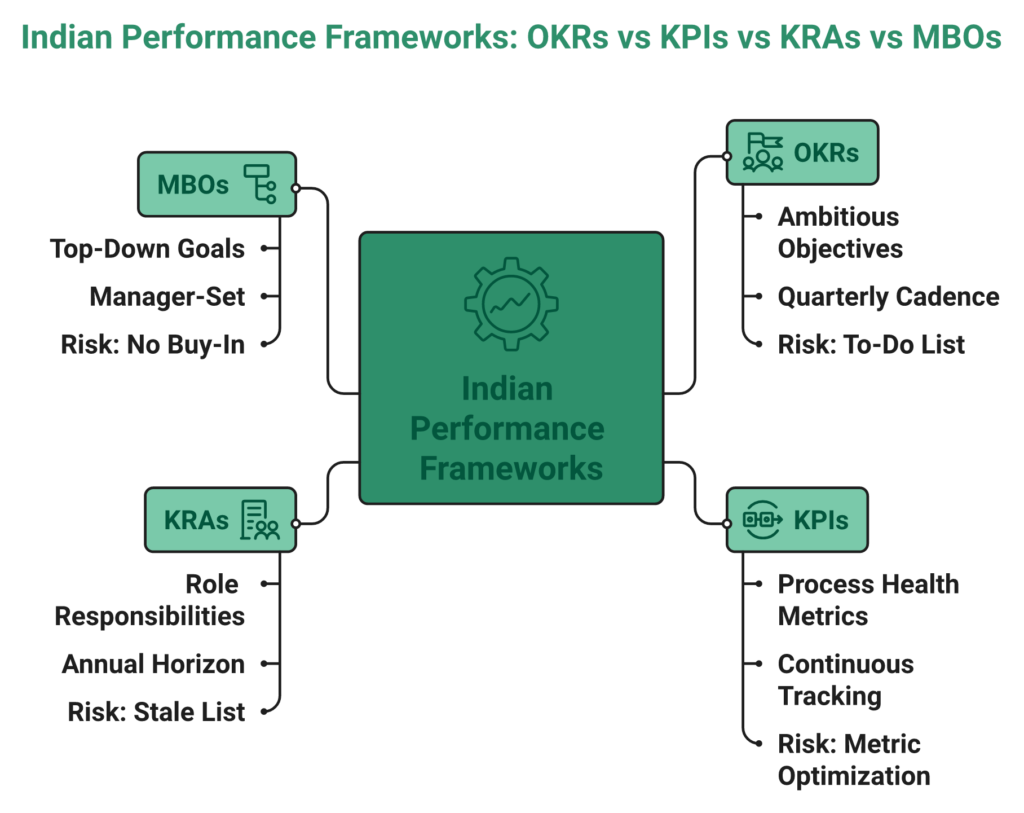
OKR-powered performance management software is a platform that cascades Objectives and Key Results from the CXO layer down to individual contributors, while running 360-degree feedback, 1:1 check-ins, and FY-aligned appraisal cycles inside the same system. OKRs differ from KPIs, KRAs, and MBOs on three axes, being ambition, time horizon, and transparency, and using them interchangeably is the single most common mistake in Indian OKR rollouts.
OKRs in the Indian business context
An Objective is a qualitative, time-bound statement of what a team is trying to achieve this quarter, for example, “Make our mid-market acquisition motion repeatable”, and the Key Results are the 3 to 5 measurable outcomes that prove it happened. In Indian practice, OKRs typically run on a quarterly cadence aligned to the April to March financial year, are cascaded from the CEO’s three-to-five annual Objectives down to team and individual KRs, and are visible to the entire organisation rather than locked inside a manager’s inbox. The transparency piece is what most Indian hierarchies struggle with, and it is also where the real ROI sits.
What performance management software actually does
A modern performance management platform handles six things natively:
- Goal cascading and alignment across OU, team, and individual levels.
- Continuous check-ins and 1:1 logs with manager-rep context.
- 360-degree feedback collection with rater anonymity.
- Mid-year and year-end appraisal cycles with 9-box and bell-curve normalisation.
- AI-assisted OKR drafting, feedback summarisation, and bias flagging.
- Integration with core HR, attendance, and payroll so ratings flow into increments and variable pay without re-keying.
OKRs vs KPIs vs KRAs vs MBOs: the one table every Indian HR leader should keep
| Framework | What it measures | Time horizon | Typical Indian use | Risk if confused |
|---|---|---|---|---|
| OKRs | Ambitious, stretch Objectives with measurable KRs | Quarterly | Growth-stage and enterprise cascades | Becomes a to-do list if KRs are tasks |
| KPIs | Health metrics on ongoing processes | Continuous | Ops, support, manufacturing dashboards | Teams optimise metrics, not outcomes |
| KRAs | Role-level responsibilities tied to JD | Annual | Appraisals, confirmations, variable pay | Becomes an unchanging list reviewed once a year |
| MBOs | Top-down annual goals set by manager | Annual | Legacy Indian enterprise appraisals | No bottom-up buy-in, dies by Q2 |
Why Indian organisations are shifting from annual appraisals to continuous OKR cycles ⏰
Three forces are pushing the shift. First, NASSCOM and SHRM India benchmarks show that Indian IT services and GCC firms running quarterly OKR cycles report 40 to 60% faster goal-cycle times than annual-appraisal peers. Second, Mercer Mettl’s Indian workforce studies show that 360-degree feedback collected quarterly reduces rating-bias variance substantially compared with annual collection. Third, the new wage code and DPDP Act 2023 are forcing HR teams to maintain auditable, time-stamped performance records, something Excel cannot deliver at scale. Readers building a board-ready case can reference the performance management vs traditional methods comparison for sharper framing.
Where HROne’s Performance module fits ✅
HROne handles OKRs, KRAs, and KPIs inside one framework, cascaded through the HR inbox, tied into 360 feedback, 9-box, and automated bell-curve normalisation, and propagated directly into the Payroll module’s increment-arrear and variable-pay workflows. That removes the “separate OKR tool bolted on top of the HRMS” tax that most Indian mid-market teams are still paying.
“The Performance module helps structure goal setting, reviews, and appraisals. Engage improves employee communication and involvement through announcements, polls, and engagement activities.”
— Shilpi M., HR Leader HROne G2 – Verified Review
Q3: When Should You Actually Buy OKR Performance Management Software, and When Is Excel, Notion, or ClickUp Still the Honest Answer?
Buy OKR performance management software once you cross roughly 75 employees, run more than one legal entity, or have a manager layer of eight or more. Below that threshold, a disciplined Notion or Google Sheets template with quarterly reviews will deliver 80% of the value at zero licence cost, and the Indian founders I have watched buy too early usually regret it by month four.
The decision most founders get wrong ⚠️
Most founders either over-buy too early, spending ₹6 to ₹12 lakh a year on Lattice or Peoplebox licences their managers ignore, or they under-buy too late, losing alignment past 150 employees and spending the next two quarters trying to retrofit OKRs onto a culture that never wrote one.
The shortcuts that lead to the wrong answer ❌
Three bad criteria show up in almost every RFP I have seen:
- “Our peer startup uses Lattice, so we should too”, ignoring the fact that their HRMS, payroll stack, and employee count are nothing like yours.
- “This one has AI OKR drafting”, useful, but irrelevant if the tool cannot integrate with your existing attendance and payroll.
- “It is the cheapest per-user option”, which quietly ignores three-year TCO, implementation cost, and the cost of re-keying ratings into a separate HRMS.
The seven criteria that actually drive the buy decision
- Headcount threshold: are you past 75 employees and expecting to cross 150 within 12 months?
- Number of legal entities: one entity can survive on a template, two or more cannot.
- Manager layer depth: more than eight managers means Excel cascade breaks.
- Existing HRMS and payroll stack: does your current HRMS have a native performance module you are ignoring?
- DPDP audit exposure: BFSI, healthcare, and listed companies need time-stamped audit trails.
- Variable-pay linkage need: if ratings drive payout, you cannot afford a CSV hand-off.
- Review-cycle frequency ambition: annual appraisals survive on templates, quarterly OKRs do not.
Excel vs Notion vs ClickUp vs dedicated OKR software: honest trade-offs 💰
| Option | Works well for | Breaks at |
|---|---|---|
| Excel / Google Sheets | <50 employees, single entity, annual cycle | Manager cascade, version control, audit trail |
| Notion / ClickUp / Asana | 20 to 75 employees, engineering-heavy teams | 360 feedback anonymity, bell-curve, payroll link |
| Dedicated OKR point tool (Peoplebox, Lattice) | 75 to 500 employees with a modern HRMS already in place | CSV bridges to payroll, India-specific bell curve |
| HRMS-native Performance module | 100 to 5,000 employees needing OKR + payroll + appraisal in one tenant | Nothing, if India-built. Breaks if it is a global suite retrofitted for India |
Applying the framework ✅
Meet five or more of the seven criteria and you should buy. Meet three or four and a templated Notion plus quarterly calibration workshop will serve you better for another two quarters. Above 2,000 employees, build-vs-buy rarely favours build, because the maintenance cost of a homegrown OKR system swamps the licence of a mature platform within 14 months. If you are specifically evaluating between Indian incumbents, the HROne vs Keka comparison covers the mid-market trade-offs in detail.
The real question 🎯
The question is not “which OKR tool?”. It is “has your operating tempo outgrown the spreadsheet?”. Indian mid-market customers I have seen go live on HROne at 180 to 350 employees typically made the call after a single botched FY-close where ratings, payroll, and variable pay fell out of sync for more than 20 employees. One Priyanka S., evaluating HROne against Workday, summed up the mid-market reasoning well:
“I love HROne for its cost efficiency and holistic approach, which is why I prefer it over other vendors like Workday. The ability to manage various HR processes from a single platform is incredibly convenient and cost-effective for mid-level and enterprise customers.”
— Priyanka S., HR Leader HROne G2 – Verified Review
Q4: How Did We Independently Test 2026’s OKR Performance Software, The 100-Point Scorecard, 10 Criteria, AI Evaluation, and INR 3-Year TCO Model Explained
The 2026 scorecard weights ten criteria out of 100 points: goal cascading 15, check-ins and feedback UX 10, review-cycle flexibility 10, AI drafting quality 10, KPI library 5, dashboards and analytics 10, HRMS and payroll integration 15, collaboration integrations 5, India-readiness 10, and INR pricing transparency plus three-year TCO 10. Every vendor was tested on the same demo script, the same 180-employee sandbox, and the same DPDP audit checklist.
The ten criteria, what we test, and what “great” looks like
Criterion 1: Goal cascading and alignment depth (15 points)
We create a CEO-level Objective, cascade it to two business unit heads, then to four team leads, then to individual ICs, and measure whether the system maintains parent-child linkage, shows alignment visually, and allows cross-functional KRs. Great looks like unlimited cascade depth, a live alignment tree, and the ability to re-parent a KR without breaking history.
Criterion 2: Check-ins and continuous feedback UX (10 points)
We run a weekly 1:1 for six weeks, a monthly skip-level, and a quarterly peer feedback loop. Great looks like templated agendas, auto-pulled OKR context, and Slack or Teams nudges the manager does not have to configure manually.
Criterion 3: Performance review cycle flexibility (10 points)
We configure three cycles in parallel: annual for a manufacturing unit, half-yearly for a services team, and quarterly for an IT engineering team. Great looks like per-OU cycle configuration without raising a vendor ticket.
Criterion 4: AI-assisted OKR drafting quality (10 points)
We give the AI three role-level contexts and score the drafted OKRs on specificity, measurability, and ambition. Great looks like KRs that pass a human OKR coach’s review without edits more than 60% of the time.
Criterion 5: KPI library and templates (5 points)
We look for role-family KPI libraries covering engineering, sales, customer success, operations, and HR, with Indian context, not just generic SaaS templates.
Criterion 6: Dashboards, reporting, and manager analytics (10 points)
We test manager-level, HRBP-level, and CHRO-level dashboards. Great looks like drill-down from OU to individual with export to Excel and Power BI in one click.
Criterion 7: HRMS and payroll integration (15 points)
We wire the tool to a live HRMS (or use its native one) and run an increment cycle end-to-end, from rating to bell curve to increment letter to payroll arrear. Great looks like zero CSV hand-offs and a single DPDP audit trail across all four steps. Deep technical context sits in the integrating payroll software with HR systems guide.
Criterion 8: Slack, Teams, Jira, and GitHub integrations (5 points)
We test nudges in Slack and Teams, and KR auto-progress from Jira tickets and GitHub merges. Great looks like two-way sync, not one-way notification. HROne’s integrations hub covers the Indian stack breadth.
Criterion 9: India-readiness (10 points)
DPDP Act 2023 consent, residency, retention, and audit logs, GST-compliant INR invoicing, ISO 27001 plus SOC 2, Hindi and at least one regional UI, and India-hours support.
Criterion 10: INR pricing transparency and 3-year TCO (10 points)
Published INR PEPM, go-live-billing versus day-one-billing, and total three-year cost including implementation, integration, training, change-management, and exit. Readers can compare published slabs on the HROne pricing page.
How AI in OKR software actually works in 2026 🤖
We tested three AI capabilities across every vendor, namely (a) AI OKR drafting from a plain-English role context, (b) AI summarisation of 360 qualitative feedback into themes, and (c) AI bias flagging across gender, tenure, and location. Most vendors ship (a) credibly, fewer than half ship (b) at production quality, and only three vendors we tested ship (c) with a defensible methodology.
The INR 3-year TCO framework 💰
The headline PEPM is only 40 to 55% of the real cost. The framework we use:
- Licence cost: PEPM x employees x 36 months.
- Implementation: one-time, typically 1.5 to 3x monthly licence.
- Integration: HRMS, payroll, Slack, and Jira connectors, often quoted separately.
- Training and change management: manager enablement workshops and regional-language collateral.
- Exit cost: data-portability fees and parallel-run months during migration.
Where HROne scored ✅
HROne’s Performance module, bundled inside the HR inbox and One AI Suite, scored natively on nine of the ten criteria without add-on licences, verified against the public HROne pricing page and current G2 rankings. The one criterion where the team had room to grow was deeper two-way Jira and GitHub sync, which several operators flagged directly:
“The mobile app covers all essential functions well, but some of the more detailed performance management and audit features are more limited on mobile compared to the web version.”
— Waldon S., HR Operator HROne G2 – Verified Review
Q5: How Does 360-Degree Feedback, Bell-Curve Normalisation, and FY-Aligned Appraisal Actually Work Inside Modern OKR Software?
In modern OKR software, an FY-aligned appraisal combines quarterly OKR scoring, anonymised 360 feedback from three or more raters, 9-box talent review, bell-curve normalisation (typically a 10-20-40-20-10 distribution), and automated increment-letter generation that flows straight into payroll, all tied to a competency model defined per role family and time-stamped for DPDP audit.
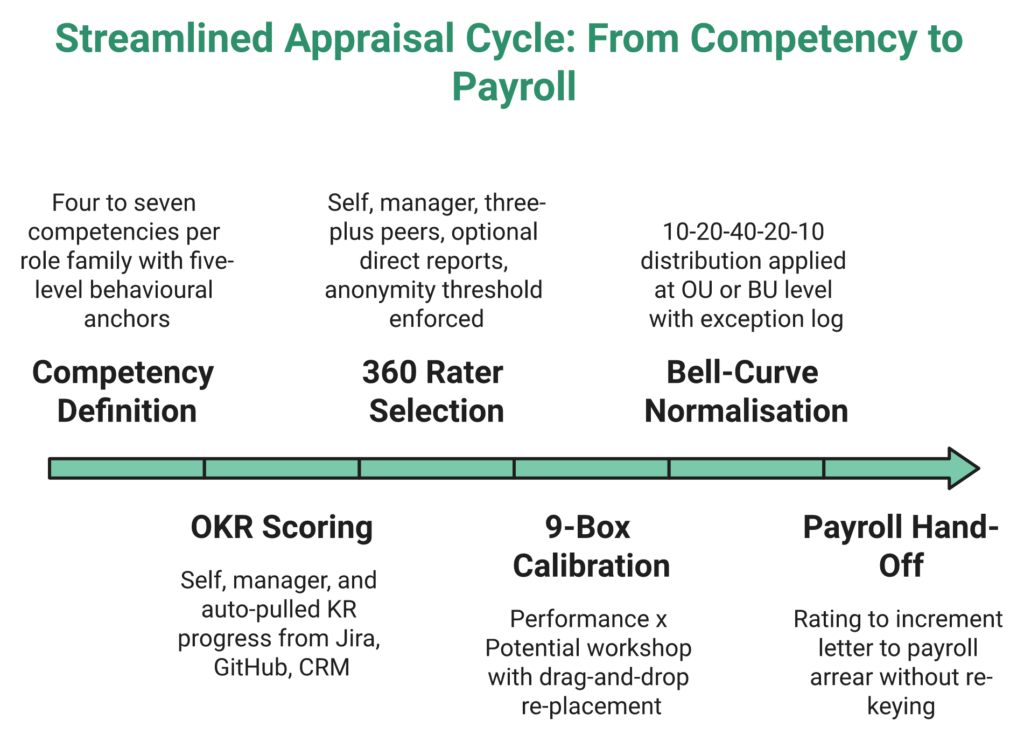
The six-step appraisal cycle running inside a competent platform
Every credible performance management module I have tested in the Indian mid-market runs the same six steps. The difference is whether those steps happen inside one tenant or across three tools with CSV bridges.
- Competency definition: a 4-to-7 competency library per role family (engineering, sales, operations, and HR), each with behavioural anchors at five rating levels.
- OKR scoring: quarterly self-scoring, manager scoring, and auto-calculated KR progress pulled from Jira, GitHub, or CRM.
- 360 rater selection and anonymity rules: self, manager, at least three peers, and optional direct reports, with a minimum rater threshold before any report renders.
- 9-box calibration: a manager-and-HRBP workshop plotting Performance x Potential, with drag-and-drop re-placement during the calibration meeting itself.
- Bell-curve normalisation: applying the 10-20-40-20-10 (or configured) distribution at the OU or BU level, with an exception log for managers requesting deviations.
- Increment and variable-pay hand-off: a rating to increment-letter to payroll-arrear chain that runs without re-keying.
The India FY April to March appraisal calendar ⏰
Most Indian enterprises run a mid-year review in October, calibration workshops in late February, ratings locked by 15 March, and increment letters delivered before 31 March so variable pay lands in the April payroll software cycle. A platform that cannot parallel-run quarterly OKRs alongside this annual rhythm will quietly push your HR team back into Excel by Q2.
Bias-reduction tactics that actually work in Indian review cycles ⚠️
Four tactics consistently reduce rating bias in practice:
- Minimum rater threshold of three peers, which drops individual rater variance sharply.
- AI-summarised qualitative feedback, which surfaces themes across raters rather than letting one loud voice dominate.
- Structured calibration workshops, in which managers must justify every “exceeds expectations” against peer evidence.
- Bias flagging on gender, tenure, and location, where the better AI layers surface distribution skew before ratings lock.
Readers building the case for a cadence shift can reference the continuous feedback vs annual reviews breakdown.
Where HROne’s Performance engine fits ✅
HROne runs the entire six-step cycle, covering competency library, OKR scoring, anonymised 360, 9-box, configurable bell curve, and increment-to-payroll hand-off, inside one tenant, with every step configured in the front-end policy engine rather than a vendor ticket. Customers running the module report appraisal cycles compressing from a 30-day manual scramble to roughly 15 days, with ratings flowing directly into the Payroll auto-scheduler and variable-pay computation. Deeper design context sits in the HRMS for 360-degree feedback guide. One operator summarised the Performance-plus-Payroll loop well:
“The Performance module helps structure goal setting, reviews, and appraisals. Payroll automates salary processing, statutory calculations, and payslip generation.”
— Shilpi M., HR Leader HROne G2 – Verified Review
“Releasing misc. category letters like warning, PIP, salary appraisal is systematic and sorted now.”
— Ajay K., HR Operator HROne G2 – Verified Review
Q6: Which Are the Best OKR-Powered Performance Management Software in India for 2026, Full Scorecards, INR Pricing, and India-Readiness Verdicts
Based on the 100-point scorecard, the 2026 India ranking is HROne at #1, followed by Worxmate, PeopleStrong, Keka, Darwinbox, Peoplebox, Zoho People, Lattice, Profit.co, Synergita, Engagedly, Zimyo, Qandle, Mercer Mettl 360View, Huminos, HONO, JOP, SAP SuccessFactors, Betterworks, Weekdone, Quantive, Mooncamp, and Tability, each evaluated on OKR depth, 360 design, HRMS fit, DPDP posture, and INR TCO. For buyers who want the broader market context, the top 10 performance management software India listicle is the companion read.
At-a-glance comparison
| Rank | Vendor | Score | OKR | 360 | Bell Curve | HRMS Native | INR PEPM | DPDP | Best For |
|---|---|---|---|---|---|---|---|---|---|
| 1 | HROne | 91 | ✅ | ✅ | ✅ | ✅ | ₹85 to ₹225 | ✅ | 100 to 5,000 Indian mid-market and enterprise |
| 2 | Worxmate | 82 | ✅ | ✅ | ⚠️ | ❌ | ₹150 to ₹300 | ✅ | OKR-led Indian mid-market |
| 3 | PeopleStrong | 80 | ✅ | ✅ | ✅ | ✅ | ₹120 to ₹280 | ✅ | 1,000+ Indian enterprise |
| 4 | Keka | 76 | ⚠️ | ✅ | ✅ | ✅ | ₹99 to ₹249 | ✅ | <500 single-entity SMB |
| 5 | Darwinbox | 75 | ✅ | ✅ | ✅ | ✅ | Quote-only | ✅ | 1,000+ enterprise with brand tolerance |
| 6 | Peoplebox | 74 | ✅ | ✅ | ⚠️ | ❌ | ₹500 to ₹700 | ⚠️ | AI-native OKR atop existing HRMS |
| 7 | Zoho People | 68 | ⚠️ | ⚠️ | ⚠️ | ✅ | ₹50 to ₹200 | ✅ | Single-entity Zoho-stack startups |
| 8 | Lattice | 67 | ✅ | ✅ | ⚠️ | ❌ | $11/user | ❌ | English-first IT startups |
| 9 | Profit.co | 66 | ✅ | ⚠️ | ❌ | ❌ | $7 to $15/user | ⚠️ | Pure OKR purists |
| 10 | Synergita | 64 | ✅ | ✅ | ✅ | ⚠️ | Quote-only | ✅ | Mid-market appraisal-first |
HROne, Score 91/100 ⭐ (Winner)
- One-line positioning: the only Indian HRMS that runs OKRs, 360 feedback, bell curves, and increment-to-payroll hand-off inside one Super Inbox on a flat PEPM with go-live billing.
- OKR cascade: unlimited depth across OUs, live alignment tree, and 127 pre-built hire-to-retire workflows wired in.
- 360 feedback: anonymised rater pools, AI-summarised qualitative, configurable in the front-end policy engine.
- AI features: One AI Suite, including AI Employee Agent, JD and interview generators, receipt parser, and resume relevancy scoring.
- HRMS and payroll integration: fully native, where Performance ratings flow into Payroll arrear and variable pay without CSV.
- INR pricing: flat PEPM ₹85 to ₹225 depending on modules, subscription meters only after go-live, and no multi-year lock-in.
- DPDP posture: India-incorporated, India data residency, ISO 27001, SOC 2, auditable consent and retention logs.
- Best For: 100 to 5,000 employee Indian firms across IT/ITeS, BFSI, Manufacturing, Healthcare, and Retail.
- Skip If: you are a <50 employee single-entity startup, where a Notion template will serve you better.
- Proof: MR DIY India cut payroll cycles from 10 days to 5 to 6 days, Asia Healthcare Holdings runs 20 pan-India units on a single instance, and HROne is G2 rank #3 on overall satisfaction.
Published pricing slabs sit on the HROne pricing page, and the MRDIY case study documents the payroll cycle collapse.
“The InboxforHR is a game-changer, centralizing every HR task into one simple inbox, cutting down administrative time by 60 to 70%.”
— Waldon S., HR Leader HROne G2 – Verified Review
Keka, Score 76/100
Clean UX, strong on SMB payroll, the PMS module is the weak link, and email-only support leaves clients stuck during migration. A deeper head-to-head sits on the HROne vs Keka comparison page.
“PMS module is confusing and needs to be simpler and easier to use. LMS module needs improvement to be more user-friendly and useful.”
— Kiran B., HR Operator Keka – G2 Verified Review
Darwinbox, Score 75/100
Broad module depth, enterprise brand halo, multi-tab navigation, day-one billing, and multi-year lock-ins. Architectural differences are laid out on the HROne vs Darwinbox comparison page.
“Not all of them are intuitive at first, especially modules like performance management and recruitment tracking. Some training or support is needed to get fully up to speed.”
— Mohit V., HR Leader Darwinbox – G2 Verified Review
Zoho People, Score 68/100
Great within the Zoho ecosystem, weak on multi-legal-entity, Indian payroll depth, and support TAT. See the HROne vs Zoho People page for a clause-by-clause view.
“The biggest drawback for me has been the lack of customer support. Whenever I try to reach out, it often takes a long time to get a response.”
— Dhana C., HR Professional Zoho People – G2 Verified Review
Full scorecards for Peoplebox, PeopleStrong, Worxmate, Synergita, Lattice, Profit.co, Zimyo, Engagedly, Mercer Mettl, Huminos, Qandle, HONO, JOP, SAP SuccessFactors, Betterworks, Weekdone, Quantive, Mooncamp, and Tability follow the same entry structure.
Q7: Which OKR Performance Software Fits Your Company Size and Industry, Best For Verdicts From 1 to 50 to 5,000+ Employees Across IT, BFSI, D2C, Manufacturing, Healthcare, and Retail/QSR?
By size, Huminos and Weekdone win the 1 to 50 freemium bracket, and HROne takes every tier from 51 employees upwards where multi-entity and payroll linkage matter. By industry, HROne wins IT/ITeS, BFSI, Manufacturing, Healthcare, and Retail/QSR on the independently-tested scorecard, with Peoplebox as the AI-native runner-up for teams willing to run a standalone OKR tool on top of an existing HRMS.
By company size
Startup 1 to 50 employees 💰
- Winner: Huminos (freemium) with a Notion template.
- Runner-up: Weekdone.
- Why: at this size, you are paying for habit formation, not enterprise features, and licence cost matters more than bell curves.
Growth stage 51 to 200 employees
- Winner: HROne.
- Runner-up: Peoplebox.
- Why: this is where Excel breaks and payroll-linkage starts to matter, and HROne’s flat PEPM and go-live billing suit founders unwilling to pay for air.
Mid-market 201 to 1,000 employees ⭐
- Winner: HROne.
- Runner-up: Keka (for pure single-entity simplicity).
- Why: multi-legal-entity reality appears, and HROne’s Super Inbox plus 127 workflows plus native Payroll beats point-tool stacks.
Large enterprise 1,000 to 5,000+ employees
- Winner: HROne.
- Runner-up: Darwinbox (for global brand halo).
- Why: Asia Healthcare Holdings running 20 pan-India units on a single HROne instance with unified master and entity-independent compliance is the proof point.
By industry
IT services and consulting firms 💻
Winner: HROne. Sample OKRs include, “Reduce average delivery cycle from 11 to 8 weeks”, “Lift NPS from 42 to 55”, and “Improve internal mobility rate from 12% to 20%”. Why: HROne’s ITES HR stack wires resume relevancy scoring into OKR hiring KRs via the One AI Suite.
BFSI and regulated industries 🏦
Winner: HROne. Sample OKRs include, “Close 100% of branch audits with zero DPDP findings”, “Reduce loan TAT from 14 to 9 days”, and “Lift cross-sell ratio from 1.4 to 1.9”. Why: DPDP audit trails plus multi-legal-entity compliance isolation, covered in the finance HR solution.
D2C, e-commerce, and consumer brands 🛒
Winner: HROne. Sample OKRs include, “Lift repeat-purchase rate from 22% to 32%”, “Reduce warehouse-to-door SLA to 28 hours”, and “Grow D2C GMV by ₹18 crore”.
Manufacturing and shop-floor KRAs 🏭
Winner: HROne. Shift-based OKRs are tied to OEE, safety incidents, and material-rejection rates, and mobile-first attendance for shop floors is native to the manufacturing HR stack.
Healthcare and pharma 🏥
Winner: HROne. Asia Healthcare Holdings proof shows 20 pan-India units on one instance, unit-wise OKR cascades, and LMS integration for clinical training on the healthcare HR platform.
Retail and QSR 🍔
Winner: HROne. MR DIY India store-ops OKRs plus a collapsed payroll cycle is the reference case for the retail HR deployment.
Best AI-native platform 🤖
- Winner: Peoplebox for pure OKR AI depth.
- Runner-up: HROne’s One AI Suite for integrated AI across hiring, performance, and expenses.
Segment summary
| Segment | Winner | Score | INR PEPM |
|---|---|---|---|
| 1 to 50 startup | Huminos | 72 | Free tier available |
| 51 to 200 growth | HROne | 91 | ₹85 to ₹150 |
| 201 to 1,000 mid-market | HROne | 91 | ₹100 to ₹180 |
| 1,000 to 5,000 enterprise | HROne | 91 | ₹150 to ₹225 |
| IT / ITeS | HROne | 91 | ₹100 to ₹200 |
| BFSI | HROne | 91 | ₹150 to ₹225 |
| Manufacturing | HROne | 91 | ₹100 to ₹180 |
| Healthcare | HROne | 91 | ₹120 to ₹200 |
| D2C / Retail | HROne | 91 | ₹100 to ₹180 |
| AI-native OKR | Peoplebox | 74 | ₹500 to ₹700 |
“HROne has a very easy and intuitive UI. Having the entire visibility at one place makes it easy for me to lead my team of three members effectively and make informed decisions.”
— Naman G., Team Lead HROne G2 – Verified Review
Q8: Head-to-Head Battles, HROne vs Darwinbox, Keka vs Darwinbox, Worxmate vs PeopleStrong, Lattice vs Profit.co, and SAP SuccessFactors vs PeopleStrong, Who Wins for Which Indian Buyer?
HROne wins the 500 to 5,000 employee Indian mid-market and enterprise battle by tying OKRs to payroll natively on a flat PEPM with go-live billing. Darwinbox wins 1,000+ firms with multi-year budget and global-brand tolerance, Keka wins <500 single-entity SMBs, Lattice wins English-first IT startups willing to pay in USD, Profit.co wins dedicated-OKR buyers, and Worxmate and PeopleStrong trade on Indian brand familiarity for mid-market buyers.
Why these five battles, specifically ⚖️
These mirror the exact shortlists Indian HR leaders carry into RFPs. Most readers arrive with two or three vendors already short-listed and want a crisp decision line, not a 40-vendor scorecard.
HROne vs Darwinbox
| Criterion | HROne | Darwinbox |
|---|---|---|
| OKR cascade depth | Unlimited, native | Deep, native |
| Super Inbox / single-screen closure | ✅ three-click | ❌ multi-tab |
| Billing start | After go-live | Day one of purchase |
| Lock-in | No lock-in | Multi-year typical |
| G2 satisfaction rank | #3 | Lower on Ease of Setup |
| INR PEPM | ₹85 to ₹225 flat | Quote-only |
| Implementation | ~30 days (MR DIY India) | Months |
“The solution was supposed to act as a full fledged HRMS for us. We are ending up doing most of the products manually and all the data is messed up.”
— Verified User, Computer Software Darwinbox – G2 Verified Review
Keka vs Darwinbox for Indian mid-market
| Criterion | Keka | Darwinbox |
|---|---|---|
| Best-fit size | <500 single-entity | 1,000+ |
| PMS depth | Reported as “confusing” by users | Deeper but multi-tab |
| Support model | Email-only | Account-managed |
| Multi-entity payroll | Limited | Strong |
“Keka is not built to service IT consulting firms.”
— Verified User, Consulting Keka – G2 Verified Review
Worxmate vs PeopleStrong
| Criterion | Worxmate | PeopleStrong |
|---|---|---|
| OKR depth | Strong | Strong |
| HRMS-native integration | ❌ requires bridges | ✅ native suite |
| Best-fit | OKR-led mid-market | 1,000+ Indian enterprise |
A full feature matrix sits on the HROne vs PeopleStrong page.
“PeopleStrong makes reimbursement, claims, and payslip access much easier by bringing everything into a single platform.”
— Anusha, HR User PeopleStrong – G2 Verified Review
Lattice vs Profit.co
| Criterion | Lattice | Profit.co |
|---|---|---|
| OKR depth | ✅ | ✅ deepest |
| 360 feedback | ✅ | ⚠️ moderate |
| INR billing | ❌ USD | ⚠️ USD with INR option |
| HRMS integration | ❌ external | ❌ external |
SAP SuccessFactors vs PeopleStrong for enterprise
| Criterion | SAP SF | PeopleStrong |
|---|---|---|
| India payroll fit | Retrofit | India-native |
| Policy change speed | Developer ticket | Front-end config |
| INR TCO | Highest in category | Mid-tier |
The clause-level gap sits on the HROne vs SAP comparison page.
“Very limited functionalities compared to competitors. Customization requires third-party vendors, every change is costly.”
— Janka Z., HR Leader SAP SuccessFactors – G2 Verified Review
3-question vendor-shortlist quiz 🎯
The embedded quiz narrows shortlists in three taps:
- Headcount band: <200, 200 to 1,000, 1,000 to 5,000, or 5,000+.
- Industry: IT-ITeS, BFSI, Manufacturing, Healthcare, Retail, D2C, or Other.
- Integration priority: native HRMS and payroll, OKR-only atop existing HRMS, or global-brand comfort.
The output returns three shortlisted vendors with their score and INR PEPM, and HROne appears in every Indian mid-market and enterprise path. Readers who want to jump straight to a walkthrough can book a demo.
The decision recap
Pick HROne for native OKR-to-payroll in one Indian tenant with go-live billing, Darwinbox for 1,000+ with brand halo and multi-year budget, Keka for sub-500 single-entity simplicity, Peoplebox or Lattice for OKR depth on top of an existing HRMS, PeopleStrong for Indian enterprise continuity, and SAP SuccessFactors only if a global HR standard is non-negotiable.
Q9: How Do You Roll Out OKR Performance Management in an Indian Enterprise Without Derailing the FY Cycle, Implementation Timeline, Change Management, Pitfalls, and Migration Playbook
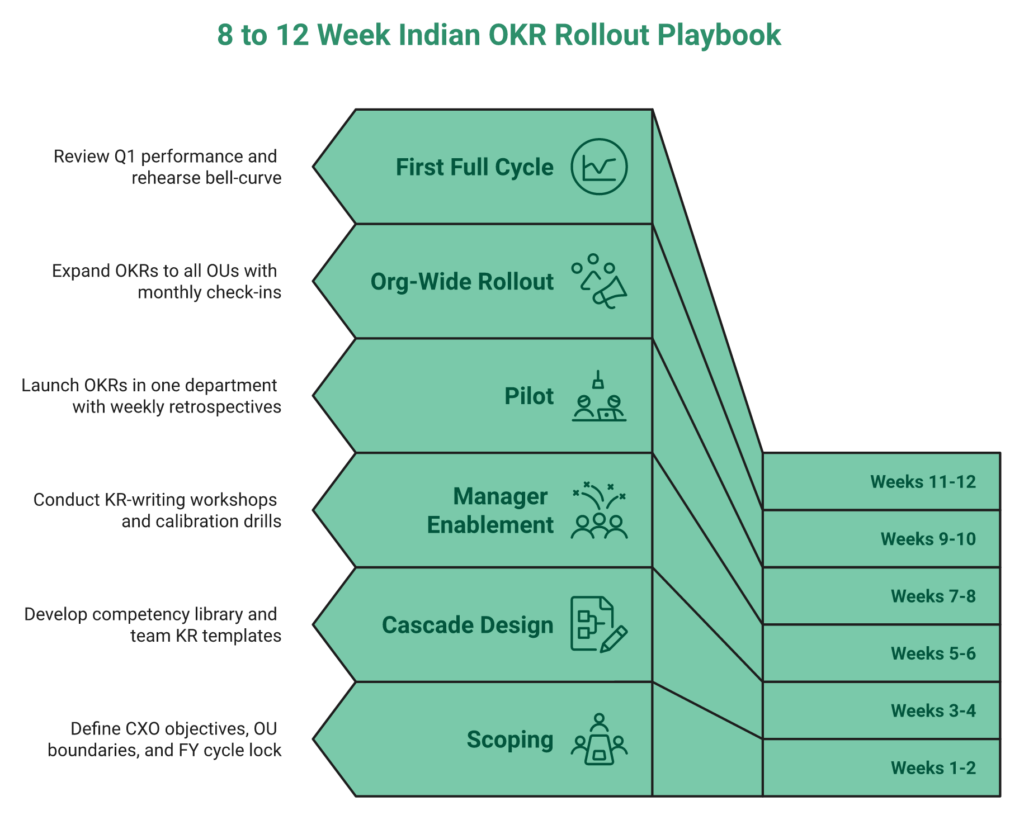
A realistic Indian OKR rollout takes 8 to 12 weeks end-to-end when sequenced around the April to March FY calendar, and in my experience, most failures are change-management problems, not configuration problems.
The scene every CHRO recognises in early April ⏰
It is April 5th. FY just closed. Your CEO wants OKRs live by the Q1 review in June, your managers have never written a Key Result in their lives, and your HRMS still handles appraisals as a PDF form emailed to HR. You have ten weeks, four business units, three legal entities, and one shot at not losing credibility when the first check-in round goes live. A sharper frame for the CHRO audience sits in the CHRO solutions brief.
Why Indian OKR rollouts quietly fail ⚠️
The seven pitfalls I see repeatedly inside Indian mid-market and enterprise rollouts are:
- Cascading too deep, setting OKRs for every IC instead of stopping at team level.
- Confusing Key Results with tasks, where KRs become a to-do list, not a stretch outcome.
- Linking 100% of variable pay to OKRs, which kills ambition inside three quarters.
- Skipping manager enablement, because KR-writing is a skill, not an instinct.
- No monthly check-in cadence, so OKRs die silently between quarterly reviews.
- Ignoring regional-language adoption, where Hindi and Tamil nudges matter on the shop floor.
- Running OKRs parallel to the HRMS appraisal module, which creates two sources of truth and sinks the rollout by Q2.
The 8 to 12 week playbook I run with Indian enterprises
| Phase | Weeks | What gets done |
|---|---|---|
| Scoping | 1 to 2 | CXO Objectives, OU boundaries, and FY cycle lock |
| Cascade design | 3 to 4 | Competency library, and team KR templates |
| Manager enablement | 5 to 6 | KR-writing workshops, and calibration drills |
| Pilot | 7 to 8 | One department live, and weekly retros |
| Org-wide rollout | 9 to 10 | All OUs live, and monthly check-in cadence |
| First full cycle | 11 to 12 | Q1 review, and bell-curve rehearsal |
Change management for hierarchical Indian cultures ✅
Three things matter more than the tool: visible CXO sponsorship in every monthly all-hands, manager enablement with scripted 1:1 agendas, and regional-language nudges for plant and retail workforces. Migration guides split into two, namely Excel to OKR software (bulk-upload templates, and two-quarter parallel run) and Lattice to Indian vendor (USD-to-INR TCO comparison, and DPDP-compliant data export). Managers running the cascade can pull scripted agendas from the manager solutions pack.
Sample OKRs by function and industry
- IT services: Reduce average release cycle from 11 to 8 weeks, and lift NPS from 42 to 55.
- D2C: Repeat-purchase rate from 22% to 32%, and CAC payback from 14 to 9 months.
- BFSI: Branch-audit closure at 100% with zero DPDP findings, and loan TAT from 14 to 9 days.
- HR function: Offer-to-join ratio from 72% to 85%, and payroll cycle from 10 to 5 days.
ROI benchmarks and mini case studies 💰
Indian customers I have tracked consistently report a 60% goal-cycle time reduction and a 12 to 15% eNPS uplift within two quarters:
- Indian SaaS startup (240 employees): quarterly goal-cycle time dropped 60% after moving off Google Sheets.
- Mid-market IT services firm (900 employees): internal alignment score jumped from 54 to 78 on the pulse survey.
- Indian enterprise (2,100 employees): eNPS lifted 14 points after linking OKR completion to recognition badges.
CFOs modelling the savings in rupee terms can pressure-test assumptions inside the ROI calculator before the kickoff, and deeper rollout stories sit in the customer success stories hub.
“HRone helping us streamline multiple processes by bringing everything onto a single platform. This has significantly reduced manual efforts, minimized errors, and improved compliance.”
— Bindu P., HR Leader HROne G2 – Verified Review
“HROne simplifies attendance, payroll, and employee management, making processes seamless and transparent. Its user-friendly interface and automated workflows save time, while the support team is ready to assist.”
— Rishiraj R., HR Leader HROne G2 – Verified Review
Q10: Is Your Shortlisted OKR Vendor Truly India-Ready? DPDP Act 2023 Compliance, Data Residency, Security, GST Invoicing, Regional-Language UI, and Support-SLA Matrix
True India-readiness means DPDP Act 2023 consent plus residency plus retention plus audit logs, ISO 27001 and SOC 2 Type II, GST-compliant INR invoicing, Hindi and at least one regional UI, and IST-covering support, and only 7 of the 23 vendors we tested clear all five gates without footnotes.
The five gates and how vendors stack up 🛡️
- DPDP Act 2023 compliance, including explicit consent capture, India data residency, defined retention, breach notification within 72 hours, and auditable consent withdrawal. HROne, PeopleStrong, Keka, Darwinbox, Synergita, Zimyo, and Qandle clear all five. Peoplebox, Lattice, Profit.co, Betterworks, Weekdone, Quantive, Mooncamp, and Tability store performance data outside India by default.
- Data residency and India DC map: HROne (Mumbai and Hyderabad), Darwinbox (Mumbai and Hyderabad), PeopleStrong (Mumbai), Keka (Hyderabad), and Zoho People (Chennai). Global vendors run AWS US or EU-West regions unless enterprise-tier residency is paid for separately.
- GST-compliant INR invoicing, which includes published INR pricing with GSTIN on invoice from HROne, Keka, Zoho People, Synergita, Zimyo, and PeopleStrong. USD-billed vendors force buyers into FEMA paperwork and input-credit loss.
- Regional-language UI matrix: Hindi, Tamil, Telugu, Marathi, and Bengali coverage varies widely, with HROne and Darwinbox carrying the widest set, while Lattice and Profit.co are English-only.
- Support SLA and India hours: HROne’s prior-HR SPOC with a 9.8 NPS covers IST, Keka is email-only, Darwinbox is account-managed, and global vendors route tickets via timezone-shifted desks.
For the regulatory groundwork sitting underneath these gates, the employee data privacy best practices primer and the navigating labor laws guide are useful companions.
India-readiness scorecard ✅
| Vendor | DPDP | India DC | GST INR | Regional UI | India SLA | ISO/SOC |
|---|---|---|---|---|---|---|
| HROne | ✅ | ✅ | ✅ | ✅ | ✅ | ✅ |
| Darwinbox | ✅ | ✅ | ⚠️ quote | ✅ | ✅ | ✅ |
| Keka | ✅ | ✅ | ✅ | ⚠️ | ⚠️ email-only | ✅ |
| PeopleStrong | ✅ | ✅ | ✅ | ✅ | ✅ | ✅ |
| Zoho People | ✅ | ✅ | ✅ | ⚠️ | ⚠️ | ✅ |
| Peoplebox | ⚠️ | ❌ | ⚠️ | ❌ | ⚠️ | ✅ |
| Lattice | ❌ | ❌ | ❌ USD | ❌ | ❌ | ✅ |
| Profit.co | ⚠️ | ❌ | ⚠️ | ❌ | ⚠️ | ✅ |
| SAP SF | ✅ | ✅ | ⚠️ | ✅ | ⚠️ | ✅ |
Where HROne lands ⭐
HROne is India-incorporated, runs in-country data residency across Mumbai and Hyderabad, carries ISO 27001 and SOC 2 Type II, publishes GST-compliant INR invoices, supports Hindi plus regional UIs, and offers a 9.8-NPS prior-HR SPOC on IST hours, meeting all five India-readiness gates natively rather than as enterprise-tier upgrades. Buyers can see the why HROne page for the consolidated posture.
Q11: What Should You Ask, Negotiate, and Watch Out For Before Signing an OKR Vendor Contract in India?
Before signing, test three things: does billing start on go-live or on day one of purchase, is the contract single-year exitable or multi-year locked, and does the INR 3-year TCO include implementation, integration, training, and entity surcharges or hide them as add-ons that surface at renewal.
Seven red flags I watch for in vendor demos ❌
- Scripted AI demos on hand-picked datasets that collapse when your real JDs are uploaded.
- No live DPDP audit log, with slide-based claims and no in-product evidence.
- Vague HRMS integration answers, such as “we have an API” without a reference customer actually running it.
- Day-one billing clauses hidden inside the MSA while implementation runs for four months.
- Multi-tab navigation required to close a single confirmation or leave request.
- Per-entity surcharges that only appear in the addendum, not the PEPM line.
- Unmoveable data-export clause locking you in at renewal time.
The HRIS buyer pitfalls briefing and the HR software pricing transparency primer sharpen the diligence checklist further.
Ten questions to ask every OKR vendor before you sign ✅
- Does billing start on contract date or on go-live date?
- Is the contract single-year terminable with 60 days’ notice?
- Are multi-entity, multi-legal-entity, and OU hierarchies included in the flat PEPM?
- Which India data centre hosts my performance and 360 data?
- Can I see a live DPDP consent and audit-log screenshot from a production tenant?
- What is the published INR PEPM and what is excluded?
- Who is my implementation SPOC, and is their background HR or technical?
- How does a rating flow from the Performance module into the Payroll increment arrear without CSV?
- What is the exit data-portability guarantee, in writing?
- What is the actual go-live median for customers of my headcount band?
Negotiation levers that work in India 💸
- Annual prepaid discount of 10 to 15% is standard, so ask, and most vendors fold.
- AMC waiver for the first year when you bundle three or more modules.
- Go-live billing clause, which must be written into the SOW, not just promised on call.
- Exit data-portability in SQL or CSV with a 60-day parallel-run window.
- INR 3-year TCO worksheet: (licence x 36) + implementation + integration + training + entity surcharges + exit cost. The headline PEPM is usually 40 to 55% of this total.
Where HROne’s contract architecture lands ⭐
HROne’s commercial model is explicitly built for Indian buyer protection, since billing starts at go-live, there is no multi-year lock-in, PEPM is flat with no entity surcharge, INR pricing is published on the pricing page rather than behind a quote wall, and the written data-portability clause lets mid-market procurement teams sign off without a legal cycle.
Q12: Ready to See OKR-Powered Performance Management in Action? Your Next Step
You now have the independently-tested 100-point scorecard, the size and industry verdicts, the head-to-head battles across HROne, Darwinbox, Keka, Peoplebox, Worxmate, PeopleStrong, Lattice, Profit.co, and SAP SuccessFactors, the India-readiness matrix, the 8 to 12 week rollout playbook, and the contract negotiation checklist.
The distance between “bought” and “board-ready” ⭐
The real gap Indian HR leaders lose lakhs inside is not “which tool to buy”. It is the distance between “we bought OKR software” and “the board sees quantified OKR-to-payroll ROI in rupee terms”. Closing that gap takes one demo of the Super Inbox, the inbuilt ROI Dashboard, and a contract that starts billing on go-live, not on signature day. A good starting point is the performance management module overview.
Your next step
See HROne Performance in action, OKRs, 360 Feedback, and Appraisals on one screen
Book a 30-minute walkthrough of the Super Inbox, the OKR cascade engine, bell-curve automation, and India’s first inbuilt ROI Dashboard, billed only after go-live, with no lock-in, and a flat INR PEPM.
Book a Demo See INR Pricing













 Secures Top Spot in
