


Q1. Which labour code rules actually apply to your branches in different states right now?
For private companies operating in more than one state, the Central Government is the appropriate Government. Central Social Security Rules therefore govern PF, ESI, and gratuity across the whole company. Establishment-level matters (working hours, leave, registration, professional tax, and labour welfare fund) follow each branch’s own state. Where a state has not notified its rules, that branch still runs on its older labour laws and Shops and Establishments Act.
Last December, a payroll manager in Ahmedabad showed me two screenshots side by side. Her Gujarat unit was following freshly notified state rules. Her Pune unit was still on the old Maharashtra Shops and Establishments Act, in the same payroll cycle.
⚖️ The two layers that decide every branch’s rule-set
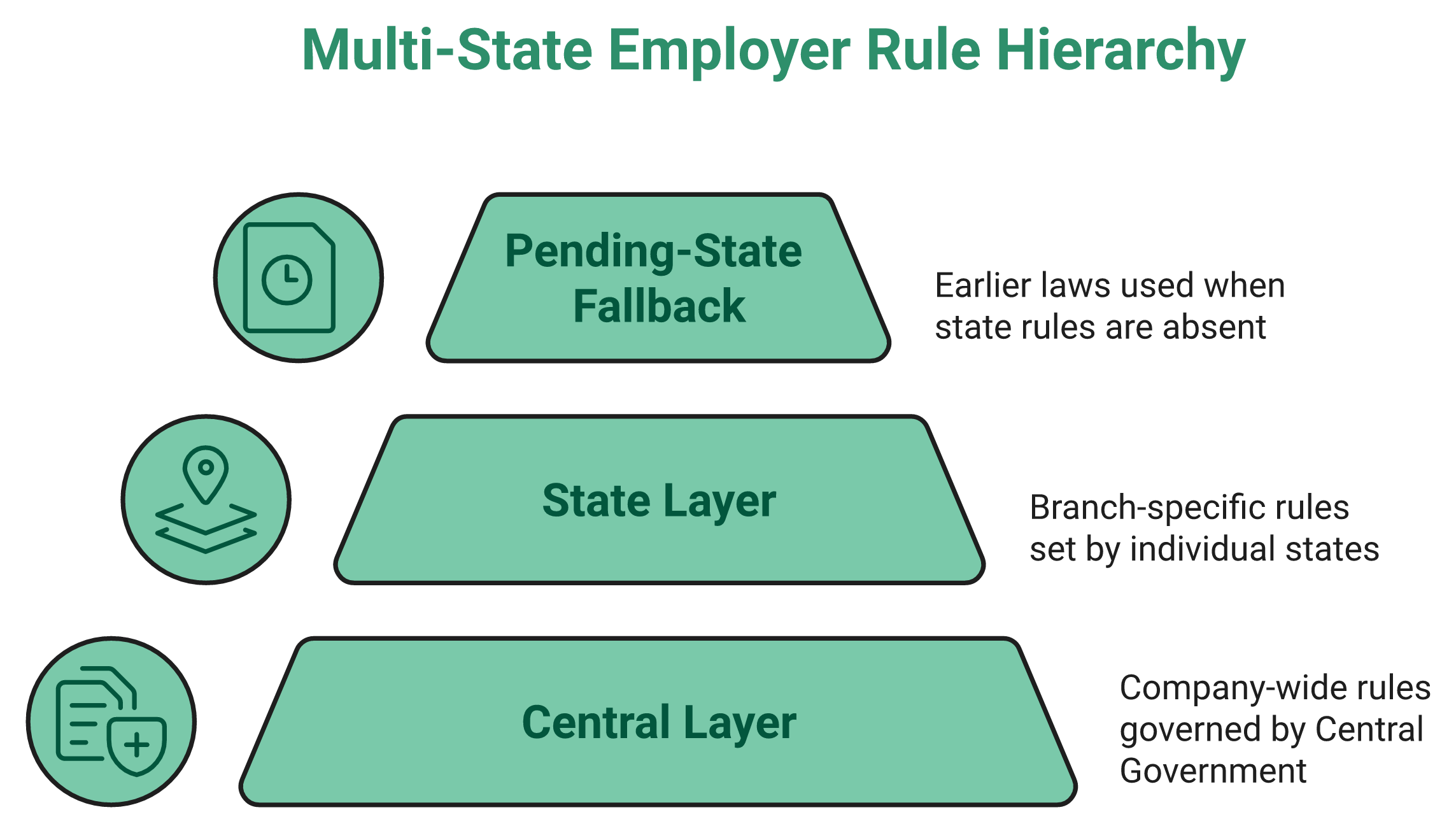
Think of it as two stacked layers, not one national rulebook. Layer one is central and company-wide, covering PF, ESI, and gratuity under the Central Social Security Rules. Layer two is local, and it changes at every state border.
Layer two is where the mistakes live. Professional tax (a state tax on salaried income), labour welfare fund, working hours, overtime, and leave encashment all sit here. Ask HROne to hold layer two as a separate policy set per branch through its multi-state payroll compliance setup, so one central change does not overwrite twelve local ones.
📅 What is actually notified as of August 2026
The four Codes came into force on 21 November 2025. Central Rules under all four were notified on 8 May 2026. Most states and union territories are still behind that line, and a few have notified rules under some Codes but not all.
That gap is the whole problem. A branch in a notified state and a branch in a pending state need different rule-sets at the same time. HROne’s core HCM module carries multi-legal-entity environments in one instance, which is how both rule-sets can coexist without a second system.
🗂️ Build the per-state matrix before you touch the contract
Open a sheet today with one row per establishment. Add four columns: state, Codes in force, state rules notified (yes, partial, no), and the law currently operative for that branch.
| Branch | State rules notified | Rule-set in force today |
|---|---|---|
| Ahmedabad plant | Yes | State Labour Code rules |
| Pune office | Not yet | Old S&E Act plus central Codes |
| Bengaluru office | Partial | Mixed, code-by-code check needed |
I might be reading the sequencing too strongly here, but my current thinking is simple. This matrix, not the vendor’s feature list, is the real requirements document. HROne measures configuration readiness the same way, by mapping entities and branches first and policies second, which is also how our HR software for multi-entity companies is scoped.
🧾 One caution before you generalise
Do not treat “central Government is the appropriate Government” as a licence to flatten everything. It settles PF, ESI, and gratuity, and very little else. Working hours and leave still belong to the branch’s state.
Also loop in your counsel before you finalise the matrix. Overlaps between the Codes and state Shops and Establishments Acts are still being read differently by different advisers.
HROne treats each registered entity and branch as its own policy container. A Gujarat unit and a Maharashtra unit can therefore run different rule-sets inside one payroll cycle, with no duplicate instance and no separate database fee.
Q2. What exactly varies from state to state that your system must configure?
Six things vary by state: professional tax slabs and filing frequency, labour welfare fund rates and deduction months, Shops and Establishments hours and leave rules, scheduled-employment minimum wages, registration thresholds (5, 10, or 20 employees), and returns formats. HROne holds these as front-end statutory fields per entity, including PF rate and the ₹15,000 pension wage ceiling. Draft rules dated 30 December 2025 simplify one item, a single contractor licence valid across states.
One payroll engine is not the same thing as one rule-set. The engine is arithmetic. The rule-set is six moving parts that change when an employee’s work address changes.
📋 The six variables, named exactly
Here is the inventory I hand to buyers before a demo. Each row is a field your system must hold per entity, not per company.
| Variable | What changes by state | Configuration owner |
|---|---|---|
| Professional tax | Slab amounts, monthly versus half-yearly filing | Payroll admin |
| Labour welfare fund | Rate and which months it deducts | Payroll admin |
| S&E Act | Hours, weekly off, leave encashment | HR ops |
| Minimum wages | Scheduled employment rates, revision dates | Compliance owner |
| Registration | Thresholds at 5, 10, or 20 employees | Compliance owner |
| Returns | Formats, portals, due dates | Payroll admin |
Two of those are quietly brutal. Professional tax filing frequency differs by state, so a single national calendar will always miss a due date.
💰 Statutory fields that are not state-specific but still break payroll
Some fields are central and still get configured wrong. PF contribution rate (typically 12%), the ₹15,000 pension wage ceiling, and whether employer contribution runs on actual earnings or the statutory limit are all choices, not defaults. HROne exposes those three as explicit fields inside its payroll software rather than as backend logic.
Get that third choice wrong and every employee’s PF is wrong. Not by a rupee. By thousands, across a year.
⚠️ What buyers report when configuration is rigid
This is where reviews of other Indian platforms get useful. Rigid configuration shows up as CTC arithmetic that drifts and reports that cannot be split the way finance needs.
“No option to add monthly incentive seperately, needs to be added as Adhoc payment in monthly salary… Also if any figures are added, they get added to the CTC which in turn changes the CTC figure.”
– Pooja M., 2/5 rating Keka G2 – Verified Review
“Lack of customizations options are not expected from a full service HRMS. No self onboard options as well. lot of manual work that the team still has to do.”
– Verified User in Internet, 2.5/5 rating Keka G2 – Verified Review
✅ Turn the inventory into a vendor requirement list
Take the table above into your next demo and read it out row by row. Ask who edits each field, from where, and how long a change takes to reach payroll. Our HRMS evaluation checklist covers the same ground question by question.
Working with mid-market HR teams, what I have felt is that vendors answer this honestly when the question is field-level. HROne’s front-end setup module lets whoever holds access configure these policies without a backend ticket.
HROne’s payroll module carries statutory controls at field level, including PF rate, the ₹15,000 pension wage ceiling, and the actual-versus-ceiling contribution choice. That is the difference between configuring compliance and requesting it.
Q3. Have you run the 50% wage test and reclassification audit yet?
Run it this month. The Codes require basic wages plus dearness allowance and retaining allowance to be at least 50% of total remuneration, which resets PF, gratuity, bonus, and leave-encashment liability. Supervisor reclassification and the 48-hour full and final settlement rule also apply centrally. HROne keeps a full CTC revision history per employee, so this restructure leaves an audit trail instead of an overwritten field.
This is the obligation everyone defers because it does not feel urgent. No state notification triggers it. It applies anyway.
🧮 The test, on one real salary structure
Take a monthly CTC of ₹60,000. Old structure: basic ₹18,000, HRA ₹9,000, special allowance ₹33,000. Wages under the old definition sit at 30% of CTC.
The new definition needs wages at ₹30,000, half of ₹60,000. So basic plus DA rises by ₹12,000 a month for that one employee. You can sanity-check the arithmetic with our salary calculator before you touch the master.
| Line item | Before | After 50% test |
|---|---|---|
| Basic plus DA (monthly) | ₹18,000 | ₹30,000 |
| Employer PF on actual wages (12%) | ₹2,160 | ₹3,600 |
| Gratuity accrual per year served | ₹10,385 | ₹17,308 |
💸 Where the money actually moves
Employer PF on actual wages rises by ₹1,440 a month, which is ₹17,280 a year for one employee. Gratuity accrual per year of service rises by roughly ₹6,900. Multiply that across 800 people before you promise the CFO a number, and cross-check the exit side with our gratuity calculator.
If you cap PF at the ₹15,000 pension wage ceiling, employer PF stays at ₹1,800 and the impact lands mostly on gratuity and leave encashment. HROne makes that ceiling choice an explicit configuration field, so the assumption behind your model is visible rather than buried.
🔍 The two rules that travel with the wage test
Reclassification is the quiet one. Some supervisory roles move category under the Industrial Relations Code, which changes overtime and dispute rights. Pull your designation master and check every role with “supervisor”, “lead”, or “in-charge” in the title.
Then check exit timing. Full and final settlement inside 48 hours of the last working day is a workflow problem, not a payroll problem. Ask HROne to trigger the exit clearance and settlement tasks from the resignation date through workforce management, so the clock does not start late.
⏰ What to do this week, in order
Four steps, roughly two days of work for a 500-person company.
- Export current salary structures and compute wages as a percentage of CTC.
- Flag every employee below 50% and model both PF options.
- Audit designations for reclassification exposure.
- Send your payroll vendor the restructured template in writing, with an effective date.
HROne’s read is that most teams get step two backwards. They pick the cheaper PF option first, then discover the gratuity liability later, which is why we push the full model before any structure goes live.
HROne keeps a comprehensive CTC revision history per employee, so a wage-definition restructure is reviewable months later during an audit. The before-and-after sits in the record, not in someone’s laptop.
Q4. Why do most HRMS implementations break the moment you cross a state line?
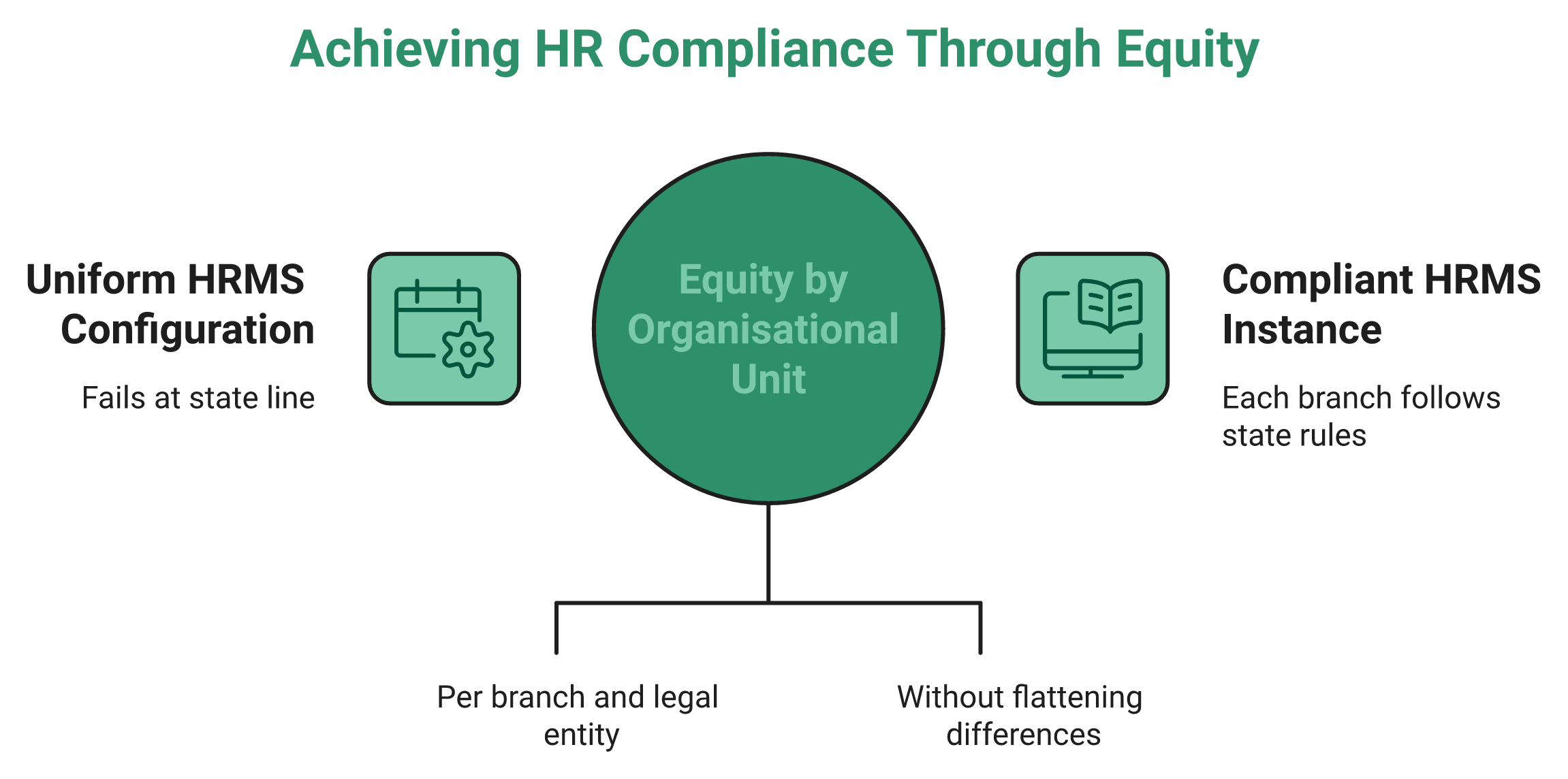
They break because they were built for uniformity. One holiday calendar, one overtime rule, and one leave policy are cheaper to configure, and non-compliant the moment two states disagree on hours, overtime, or leave encashment. Multi-state compliance needs equity, not equality. Statutory policies have to sit isolated per organisational unit, not get patched with spreadsheets after every payroll run.
Most HR leaders are taught that one policy for everyone is the fair choice. It is also the cheapest to configure, which is why vendors quietly encourage it.
🎯 The flaw in the fairness argument
Fairness stops being a policy question the moment statute disagrees. A location with an eight-hour day rule and a twelve-hour overtime trigger cannot share a rule-set with a location that has neither. Force them together and one of the two is out of compliance every single month.
I have watched teams discover this at the worst possible time, during a first payroll run. HROne’s deployments surface it earlier because entity and branch structures get built before any policy is written, a sequence documented in our HROne implementation guide.
🧩 What buyers say when policies do not hold
The failure has a signature. Configurations that behave in testing and drift in production, and policies that never quite apply the way they were designed.
“Bad implementation experience, bad UI & UX, configurations getting broken in production on its own due to product deployments, terrible customer service.”
– Verified User in Computer Software, 0/5 rating Darwinbox G2 – Verified Review
“The setup phase has been a bad experience for us and worst is that even after so many hit & trials by the team keka, my policies still are not applied the right way.”
– Shakti B., 0/5 rating Keka G2 – Verified Review
To be fair, configurable workflows do work well for some buyers on the same platforms.
“I also like how customizable the workflows are, which helps adapt the platform to our internal processes without much technical intervention.”
– Mohit V., 4/5 rating Darwinbox G2 – Verified Review
🏭 The better model, and a real consolidation
Equity means many rule-sets, one system, and one source of truth. HROne consolidated Lux Industries’ 15 to 16 leave rules and three to five overtime policies across units into a single structure, without flattening the unit-level differences that the law requires, using the same leave management engine every branch runs on.
That is the test worth running. Can the system hold difference deliberately, or does it only hold sameness?
🤔 Where I am still unsure
I hold this view strongly, so treat it with some suspicion. There is a real cost to per-unit policy, in admin overhead and in explaining differences to employees.
HROne’s data points toward isolation being cheaper over three years, though I might be reading our own deployment sample too generously. My honest position is that any company past four states has already lost the uniformity argument, which is the pattern we track in HRMS for manufacturing companies.
HROne holds statutory policies per organisational unit inside one instance, with no charge for maintaining multiple entities and no cap on entity count. Difference stays configured, not reconciled.
Q5. What is multi-state compliance actually costing you every year?
More than most HR budgets assume. TeamLease RegTech found a 1,000-seat Karnataka GCC facing 537 obligations that inflate into 2,051 filings a year across 18 regulators. A single manufacturing MSME unit carries over 1,450 annual obligations at ₹13 lakh to ₹17 lakh. HROne’s inbuilt ROI dashboard converts task minutes and average HR salary into hours and rupees saved, which is the number to carry into a renewal talk.
Most compliance budgets are built on gut feel. The published numbers are worse than the gut, and far more useful in a negotiation.
📊 What the filing volume actually looks like
Start with the GCC study. Those 2,051 filings split into roughly 81 monthly, 185 quarterly, and 194 annual submissions across 18 regulators. Spread across a year, that is a statutory deadline landing almost every working week.
The MSME picture is similar in shape. One manufacturing unit faces 998 unique obligations, 48 registers, and 59 categories of inspector. Labour laws alone account for close to 45% of those obligations, which is why statutory compliance software earns its place in the stack.
💸 The part that is not money
Penalty risk is the number CFOs understand. Criminal exposure is the one that changes how CHROs sleep.
TeamLease RegTech counts 17,819 imprisonment provisions across 352 labour laws. For multi-state businesses, roughly 40% of obligations carry imprisonment terms of up to 10 years. That is not a fine you absorb quietly at year-end.
⚠️ The employee cost nobody puts in the model
There is a second bill, paid in attrition. Payroll errors from misapplied state rules land on individual salary slips, not on a compliance report.
Two mistakes are enough to start losing people. HROne’s helpdesk data shows tax and salary queries dominate ticket volume in the first two payroll cycles after any statutory change. My honest read is that this cost is real but hardest to defend in a board deck, so I would keep it as supporting colour, not the headline.
🧮 Turn filings into a number your CFO can use
Here is the calculation I would run this week. It takes an hour and it changes the renewal conversation.
- Count actual filings per state for the last 12 months.
- Multiply by average preparation time in minutes.
- Divide by 60, then multiply by loaded hourly HR cost.
- Add the penalty exposure your counsel considers realistic.
| Input | Where to get it | Example scale |
|---|---|---|
| Filing count | Compliance calendar | 2,051 per year at GCC scale |
| Cost per unit | Finance | ₹13 lakh to ₹17 lakh a year |
| Automated share | Vendor coverage list | Ask for it in writing |
⏰ What to do with the number
Do not present it as a scare slide. Present it as the premium you are already paying without an insurance policy attached.
HROne measures this the same way inside the ROI dashboard, using average HR salary and minutes per task rather than vendor-supplied savings claims. Working with mid-market HR teams, what I have felt is that a defensible small number beats an impressive large one every time, and our ROI calculator keeps the maths in your own hands.
HROne’s ROI dashboard calculates lifetime hours saved against average HR salary, so the savings figure comes from your own task data. That gives a CHRO something specific to say in a board review, instead of a general claim about efficiency.
Q6. What should the statutory-update clause in your HRMS contract actually say?
Name a window, not an intention. Public HRMS tenders already specify statutory updates within 7 days of gazette notification, 100% payroll accuracy, timely EPF, ESIC, and TDS reports, plus quarterly SLA reports with buyer audit rights. HROne ships statutory changes centrally across every entity in an instance, so one professional tax revision does not become twelve configuration tickets. Put the same numbers in your contract, per state, with a named escalation owner.
“Compliance is included in the subscription” is not a commitment. It is a marketing sentence that survives because buyers never ask it to become a number.
📜 The clause language to paste into your redline
Government tenders have already done this drafting work. Borrow it.
- Statutory updates configured and live within 7 days of gazette notification, per state.
- Payroll accuracy of 100%, with EPF, ESIC, and TDS reports delivered on statutory due dates.
- Quarterly SLA compliance report, with the buyer’s right to audit.
- Recovery point objective of 24 hours and recovery time objective of 8 hours.
- Named escalation owner, with response times defined by severity.
Clause two is the one to test against your own numbers, since PF, ESI, and TDS compliance is where a missed due date becomes a penalty rather than an inconvenience.
⚠️ Why the support model decides whether the window is real
A seven-day update window means nothing if help lives in a ticket queue. Buyers describe exactly this failure during implementation and migration.
“We started working with Keka HRMS in August, and to this day, we have been unable to implement the tool in our company due to their consistently delayed responses and poor coordination between their internal teams.”
– Divya p., 0/5 rating Keka G2 – Verified Review
“Transitioning from the old system to Darwinbox is quite difficult. User interface of Darwinbox is very outdated. Darwinbox Support team is not supportive.”
– Ankush B., 4/5 rating Darwinbox G2 – Verified Review
Note the second one is a four-star review. The product works, and the support model still frustrates. Both things can be true, which is also the pattern buyers weigh in an HRMS migration guide.
🔍 The diligence ask that separates claims from delivery
Ask for 12 months of release notes before you sign. Then ask them to point at the specific entries where a state statutory change shipped.
Dates matter more than features here. HROne’s implementation consultants are prior HR practitioners, which is why we push clients to check notification dates against release dates rather than trusting a roadmap slide, a sequence set out in our HRMS implementation timeline.
✅ Three questions for the vendor call
Keep these short and make them answer on the call, not by email.
- Which state notifications did you ship in the last two quarters, and on what dates?
- Who is the named escalation owner during a payroll cutoff week?
- Does an update apply once across all entities, or per entity?
That third question is the quiet one. Ask HROne to demonstrate a single statutory change propagating to every entity in the instance, then ask the incumbent vendor to do the same.
💰 What to trade if they resist
You will not always win a 7-day window. Trade it down honestly rather than dropping it.
Accept 14 days for non-payroll items, but hold the line on anything that touches a salary calculation. HROne’s read is that buyers give up the audit right too easily, when it is the cheapest clause for a vendor to concede.
HROne propagates statutory changes centrally across every entity in a single instance, and assigns a dedicated support SPOC rather than a shared queue, with a 9.8 NPS on that support model. That combination is what makes a stated update window enforceable in practice.
Q7. How do you test whether state rules are configuration or hard-coded logic?
Ask them to change one state’s labour welfare fund rate live, on screen, without a release. Mature compliance systems externalise jurisdiction rules into configuration that a compliance analyst can edit, a design patented in 2010 (US7693760B1). HROne exposes its complete setup module on the front end, so whoever holds access can configure policies and organisational unit structures directly. If the answer is “we will raise it with product”, every state notification becomes a support ticket.
Feature lists do not tell you how a system will behave in March 2027. Architecture does.
🧩 Why this is the real buying criterion
Two systems can both claim multi-state payroll. One holds state rules as data you edit. The other holds them as logic a developer edits.
The patent record is clear about which design won. US7693760B1 describes a tax service configurable for local jurisdictions by a domain expert, not a programmer. Microsoft’s US8082193B2 covers multi-jurisdictional payroll requirements as structured data, which is the same principle behind purpose-built labour law compliance software.
💰 What building it yourself would cost
Some IT teams ask whether they should just build the rules engine internally. The published estimate for a single country’s payroll tax engine is around 336 weeks of work and roughly 2.76 million dollars.
That number ends the conversation quickly. It also explains why vendors hard-code shortcuts, and why you should check for them.
✅ The five-step demo script
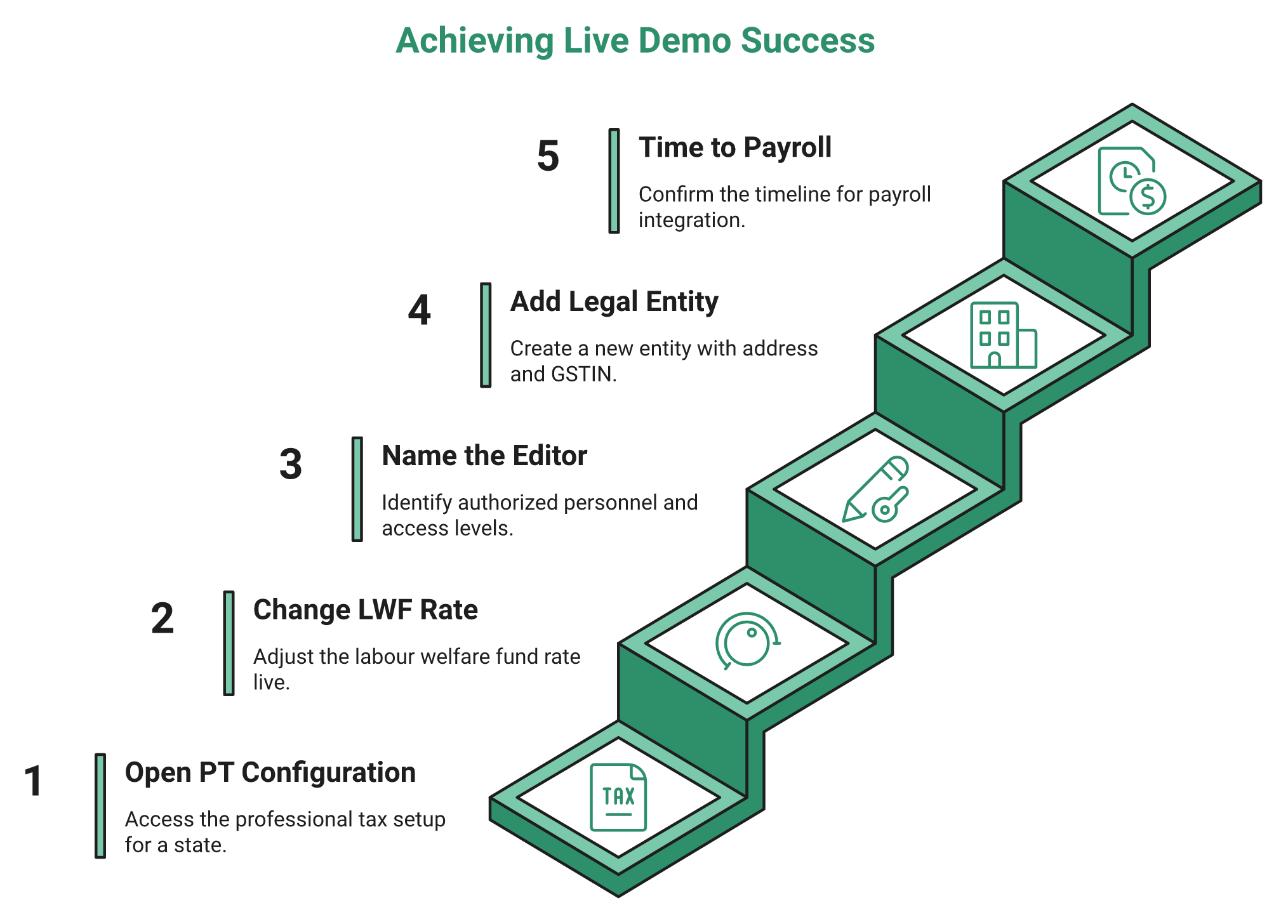
Run this in your next call. Do not accept a recorded walkthrough.
- Ask them to open the professional tax configuration for one state.
- Ask them to change the labour welfare fund rate for a second state, live.
- Ask who inside your team could do that, with what access level.
- Ask them to add a new legal entity with its own address and GSTIN.
- Ask how long the change takes to reach the next payroll run.
If any step needs a support ticket, you have your answer. HROne’s setup module handles all five from the front end, which is the specific thing to compare against your incumbent, alongside a full HR software buyer checklist.
⚠️ Where flexible systems get messy
There is a real trade-off here, and vendors rarely admit it. Rigid field mapping breaks when a state template changes. Flexible semantic configuration bends, but it is harder to monitor for strict legal accuracy.
I have built rigid automation workflows before, and they work right up until a template shifts. HROne’s audit trails exist partly because we assume configuration will drift, so every policy change needs a reviewable record, the same discipline we apply across HR process automation.
🔍 Two follow-up questions worth asking
Configuration alone is not enough. Governance around it matters just as much.
Ask who can approve a statutory field change, and whether that approval is logged. Then ask HROne to show the change history on a policy field, and ask the same of every shortlisted vendor.
HROne keeps the full setup module on the front end, including policy and organisational unit configuration, so state rule changes do not depend on a vendor release cycle. That is verifiable in a 20-minute demo, which is exactly where it should be tested.
Q8. How should multi-entity, branch GSTIN and role-based access be structured?
Demand one instance, unlimited legal entities, and no per-entity fee. HROne charges nothing for maintaining multiple entities in a single instance and sets no cap on entity count. Each entity needs its own registered address, state GSTIN, and PIN code so location-based compliance routes correctly. Then layer role-based access in three steps (define role, assign rights, review), filtered to business unit, level, grade, and branch.
Most multi-state problems start as data model problems. One flat employee master with a location field is not a multi-entity setup.
🏢 The entity layer, field by field
Set this up before any policy work begins. Each registered legal entity gets its own record, not a tag.
| Field | Why it matters |
|---|---|
| Registered address | Determines applicable state rules per branch |
| State GSTIN | Routes tax and invoicing correctly |
| PIN code | Drives location-based compliance mapping |
| Establishment registration | Ties to thresholds at 5, 10, or 20 employees |
Get the address wrong and every downstream rule inherits the error. HROne’s Core HR module holds these as multi-legal-entity environments inside one instance, configurable from the front end, which is the model behind our HR software for multi-entity companies.
🔐 The three-step access layer
Role-based access control means restricting what each role can see and do. Build it in three moves: define the role, assign rights, then review before publishing.
Rights must filter down to business unit, level, grade, and branch. A Chennai HR manager should not open Pune payroll records, and that restriction needs to be structural rather than a policy note, a point we unpack in HR software permissions.
⚠️ What buyers say about configuration limits
Configurability is where enterprise buyers get burned, and reviews on other platforms show both sides fairly.
“Darwinbox allows organizations to customize the platform according to their specific needs and requirements… This platform stores and manages sensitive employee data, posing potential security risks.”
– Shefali J., 4/5 rating Darwinbox G2 – Verified Review
“Reporting/analytics Limited customization in reports… Integration issues Sync with other systems can be inconsistent.”
– Saksham A., 4/5 rating Darwinbox G2 – Verified Review
That second quote matters more than it looks. Limited report customisation is exactly what blocks per-state audit extracts, which is why HR analytics tools belong inside the same instance as payroll.
✅ Audit evidence without the month-end scramble
The payoff of proper isolation is a clean audit trail. An inspector asks for one branch’s registers, and you filter rather than rebuild.
Ask HROne to produce a branch-filtered statutory report and a policy change log for a single entity. Any vendor that needs a data team for that request has told you something important.
💰 The commercial term to lock
Entity count is a pricing lever for many vendors. That is where multi-state buyers quietly overpay.
Write it into the contract: unlimited legal entities, no per-entity or per-database fee, and no charge to add a state. HROne’s read is that this clause saves more money over three years than any per-employee discount you will negotiate, so read it alongside our pricing terms.
HROne maintains multiple entities in a single instance with no limit and no additional fee, and filters access rights down to branch level. Asia Healthcare Holdings runs 20 pan-India units on one instance under that model.
Q9. How does the system decide which state’s rules apply to a remote employee?
By actual work location, refreshed continuously, not by the branch code entered on joining day. A Pune-registered employee working from Indore changes the applicable professional tax, labour welfare fund, and possibly Shops and Establishments rules. HROne links geofenced and offline mobile attendance directly into payroll, so a location change flows into that month’s statutory deductions. Demand an auditable change log alongside it.
Meet Ritu. She is on the Pune payroll, has been working from her parents’ home in Indore since April, and her professional tax deduction has not changed once.
📍 Why the joining-day branch code fails
Most systems store work location as a field set during onboarding. Nobody updates it when reality moves.
That single stale field then drives professional tax slab, labour welfare fund deduction, and leave rules. Three wrong outputs from one unmaintained input, repeated every month, which is the exact trap our guide to HR software for remote and hybrid teams was written around.
🔄 The mechanism that actually works
You need three connected layers, in this order.
- Attendance capture that records where the punch happened, not just when.
- A work-state field that updates from that capture, with a change log.
- Payroll rules that read the work-state field, not the joining record.
Geofencing (attendance marked only inside a defined location boundary) is what makes layer one trustworthy. HROne’s Time Office module captures attendance management data offline in low connectivity areas and syncs it once the device reconnects.
⚠️ What employees say about attendance mechanics
Attendance systems fail quietly, and employees notice before HR does.
“There have been days when we mostly needed the tool for work and it was having server issues and we were stuck… since darwinbox sends emails every day it creates confusion within the employees, especially the newly joined ones.”
– SP B., 4/5 rating Darwinbox G2 – Verified Review
That is a four-star reviewer, which is the point. The platform works, and the remote attendance flow still generates noise, a pattern worth checking against any HRMS for field employees you shortlist.
⏰ The threshold you can cross without noticing
Here is the risk nobody models. Registration thresholds trigger at 5, 10, or 20 employees depending on the state and the law.
Six remote employees in one new state can create a registration obligation you never opened a branch for. Ask HROne to run a headcount-by-work-state report monthly, then compare it against your registration list.
🤔 Where I would push back on my own advice
Continuous location tracking makes people uncomfortable, and rightly so. There is a genuine tension between compliance accuracy and employee trust.
My current thinking is to capture work state, not movement, and to tell employees exactly why. HROne’s read is that payroll sits downstream of attendance, so separating the two guarantees reconciliation work later, though the privacy design still needs care. Our note on payroll accuracy makes the same argument in numbers.
HROne feeds geofenced and offline attendance straight into payroll, so a work-location change updates that month’s statutory deductions rather than a year-end correction sheet. The change history stays visible for audit.
Q10. Who pays the penalty when your HRMS gets a state rule wrong, and who picks up the phone?
Right now, you pay. Standard SaaS agreements cap liability at fees paid and exclude regulatory penalties. Government HRMS tenders take the opposite position, treating statutory penalties from system error as recoverable liquidated damages. HROne assigns a dedicated support SPOC reachable by phone and email, carries a 9.8 NPS on that model, and starts subscription only after go-live. Pair indemnity with escalation timelines and per-state acceptance testing.
The asymmetry is stark. The vendor configures the rule, and you carry the fine and the criminal exposure.
⚖️ Why the default contract is one-sided
Read your current agreement’s liability clause tonight. Most cap total liability at 12 months of fees and carve out regulatory penalties entirely.
Now weigh that against exposure. TeamLease RegTech counts 17,819 imprisonment provisions across 352 labour laws. Your vendor’s downside is a refund, and yours is a prosecution.
📉 What wrong statutory figures look like in practice
Buyers do report tax and payroll figures drifting after system changes.
“CA raised a concern that tax figures deducted in the last FY vs the amounts reflecting on system now are different.”
– Pooja M., 2/5 rating Keka G2 – Verified Review
“They are always their to support but once anything is not corrected by support team, then nothing is escalated.”
– Shakti B., 0/5 rating Keka G2 – Verified Review
Even satisfied users flag the learning curve on complex modules.
“While the platform has a lot of features, not all of them are intuitive at first… Some training or support is needed to get fully up to speed.”
– Mohit V., 4/5 rating Darwinbox G2 – Verified Review
💰 The fallback ladder for negotiation
You will rarely win full indemnity. Descend the ladder honestly instead of dropping the ask.
- Full indemnity for statutory penalties caused by system error.
- Indemnity capped at a stated multiple of annual fees.
- Service credits plus free remediation of the affected payroll cycles.
- At minimum, written acknowledgement that configuration accuracy is the vendor’s obligation.
Have your counsel draft the final wording. This is contract law, not HR policy, and it belongs next to your payroll software checklist during evaluation.
🤝 Support terms decide whether any clause matters
An indemnity clause is a slow remedy. Support is the fast one.
| Term | Ticket-queue model | What to demand |
|---|---|---|
| Support access | Email threads only | Named SPOC, phone and email |
| Billing start | Day one of purchase | After go-live |
| Recovery targets | Unstated | RPO 24 hours, RTO 8 hours |
| Acceptance | Single sign-off | Per-state UAT before go-live |
HROne sits in the right-hand column on all four, including post-go-live billing and a prior-HR implementation consultant rather than a technical project manager. The reasoning behind that model is set out in why HROne.
⚠️ The failure mode worth naming
I have watched companies change HR systems three times in under four years. Each migration cost more in lost institutional memory than in licence fees.
HROne’s read is that buyers over-index on features and under-index on exit terms, which is what makes the second migration inevitable, a pattern visible across firms outgrowing Keka, Darwinbox, and greytHR.
HROne pairs a dedicated SPOC at 9.8 NPS with subscription metering that begins after go-live, so the vendor carries implementation risk alongside you. That alignment is what makes an escalation promise credible.
Q11. Which clauses belong in your contract, and what do you do in the next 30 days?
Twelve clauses: unlimited entities at no surcharge, front-end configuration, a 7-day statutory update SLA, penalty indemnity, per-state audit trails, work-state detection, three-layer role-based access, attendance-linked payroll, a named SPOC with escalation, RPO 24 hours and RTO 8 hours, per-state acceptance sign-off, and full data export on exit. HROne clears six of these out of the box, including unlimited entities in one instance.
Most HRMS renewals get signed in the last week before expiry. That is the worst possible time to discover your leverage.
📋 The twelve clauses, with the failure each prevents
Take this list into your redline, not into a wishlist document.
- Unlimited legal entities, no per-entity fee. Prevents paying for each new state.
- Front-end policy configuration. Prevents developer tickets for a leave rule.
- Statutory updates within 7 days of notification. Prevents roadmap-speed compliance.
- Penalty indemnity for system error. Prevents you absorbing the vendor’s mistake.
- Per-state audit trails. Prevents month-end manual extraction for inspectors.
- Work-state detection for remote staff. Prevents wrong professional tax deductions.
- Three-layer role-based access. Prevents cross-branch payroll visibility.
- Attendance-linked payroll. Prevents reconciliation between two systems.
- Named SPOC with escalation timelines. Prevents email-thread limbo.
- RPO 24 hours, RTO 8 hours. Prevents an outage becoming a payroll delay.
- Per-state acceptance sign-off. Prevents a go-live that only works in one state.
- Full data export on exit. Prevents hostage pricing at renewal.
📊 How platforms compare on the structural clauses
| Capability | HROne | Legacy Indian HRMS pattern |
|---|---|---|
| Unlimited entities, one instance | No extra fee | Often priced per entity |
| Front-end policy configuration | Included | Vendor ticket in many cases |
| Billing start | After go-live | Day one of purchase |
Buyers have documented both failure modes publicly.
“Nothing as we were unable to implement keka due to the delayeed services of keka as well as we felt as if we were not taken seriously.”
– Divya p., 0/5 rating Keka G2 – Verified Review
“Implementing and maintaining comprehensive HR software can be costly, especially for small and medium-sized businesses with limited budgets.”
– Shefali J., 4/5 rating Darwinbox G2 – Verified Review
🗓️ The rule-watch protocol, then four weeks of work
Assign one named owner per state, with a 30-day gazette review cycle. Keep a shared source list of state labour department pages and tracker sites, and store the protocol itself where policies live, such as an HR policy generator output.
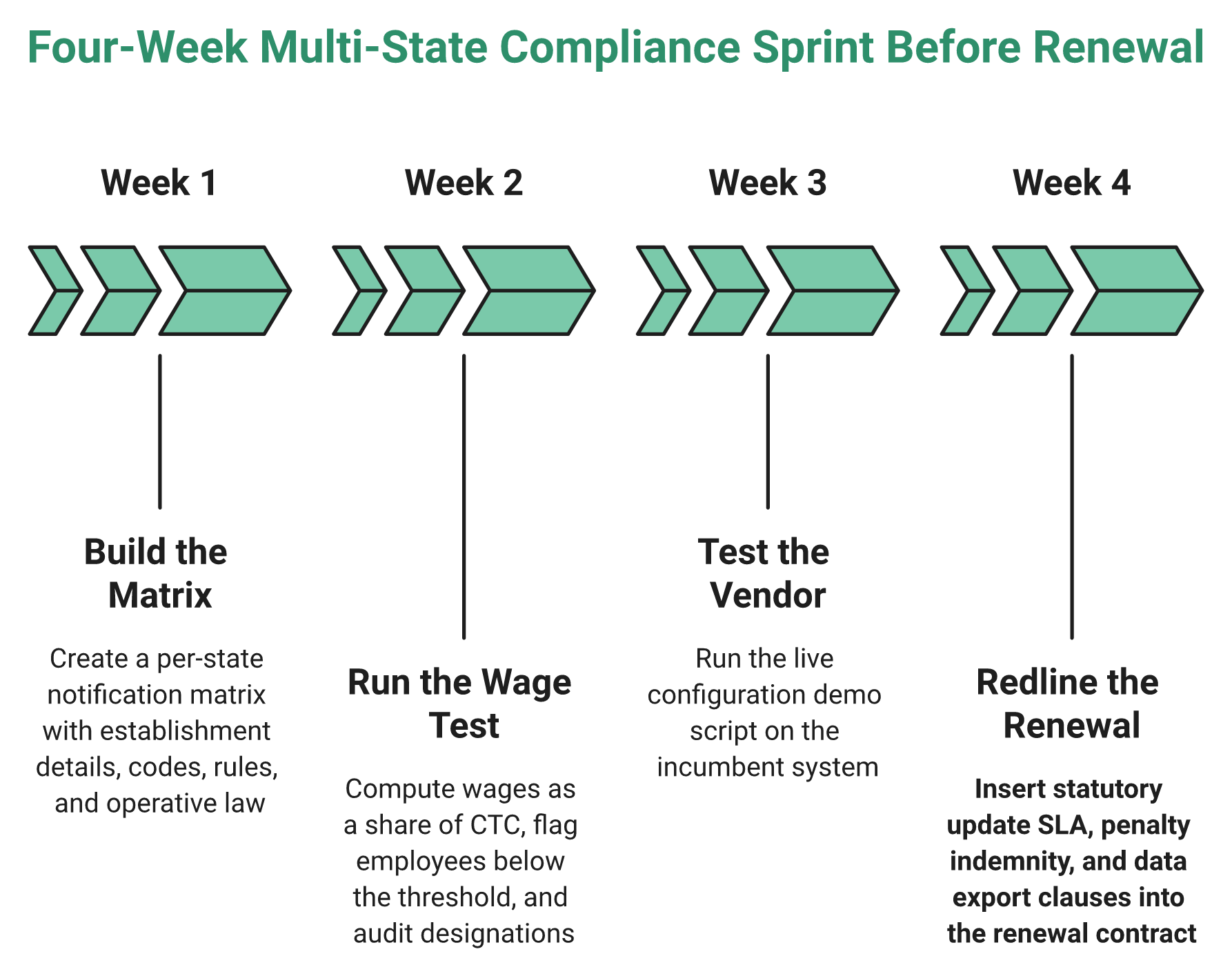
Then run this month.
- Week 1: build the per-state notification matrix.
- Week 2: run the 50% wage test and reclassification audit.
- Week 3: run the configuration demo script on your incumbent vendor.
- Week 4: redline the renewal with clauses 3, 4, and 12.
🤔 What is still genuinely unsettled
Only a minority of the 37 states and union territories have notified rules under all four Codes, so dual rule-sets will persist through 2026. I do not think that resolves cleanly next year.
HROne’s read is that buyers should activate multi-state modules only when volume justifies the setup, though we may be over-cautious for fast-scaling companies. What are you seeing in your own states? I would genuinely like to compare notes.
Verified against published state notifications as of 26 August 2026.
HROne runs unlimited entities in one instance with no per-entity charge, front-end policy configuration, branch-filtered access, and attendance-linked payroll. Asia Healthcare Holdings operates 20 pan-India units on that single-instance model, one of many stories in our customer success stories.













 Secures Top Spot in
