








POSH is not a policy you write once and forget in a shared drive. It is a law with a committee to set up, deadlines to meet, reports to file, and penalties for getting it wrong. This guide explains the POSH full form, what the POSH Act 2013 says, how complaints must be handled, and the exact checklist your organisation needs to stay compliant, minus the legalese.
Key Takeaways
- POSH Full Form: Prevention of Sexual Harassment, the common name for the Sexual Harassment of Women at Workplace (Prevention, Prohibition and Redressal) Act, 2013.
- In force since 9 December 2013, covering every workplace in India, public or private, organised or unorganised.
- 10+ employees? You must set up an Internal Committee (IC) at every office or unit.
- Timelines: complaint within 3 months, inquiry within 90 days, report within 10 days, employer action within 60 days.
- Penalty: fine up to ₹50,000; repeat offences mean double penalties and possible licence cancellation.
What is the full form of POSH?
The full form of POSH is Prevention of Sexual Harassment. In India, the term refers to the Sexual Harassment of Women at Workplace (Prevention, Prohibition and Redressal) Act, 2013, usually shortened to the POSH Act.
In simple terms, POSH is the legal framework that requires employers to prevent sexual harassment at work, prohibit it through a clear policy, and redress complaints through a fair, time-bound process. When HR teams talk about “POSH compliance”, they mean everything the Act expects of an employer: forming an Internal Committee, publishing a POSH policy, running awareness sessions, handling complaints within fixed timelines and filing an annual report.
So POSH is three things at once: an acronym, a law, and a set of workplace practices your organisation is accountable for.
POSH meaning in the workplace
In the workplace, POSH means every woman should be able to work without facing unwelcome sexual conduct, and should have a safe, confidential way to complain if she does.
Who is protected under POSH?
The Act protects an “aggrieved woman” of any age, whether or not she is employed by you. That includes:
- Employees on regular, temporary, ad hoc or daily-wage terms
- Interns, trainees, apprentices and probationers, paid or unpaid
- Contract and agency staff, consultants and volunteers
- Visitors, clients, customers and vendors who face harassment at your workplace
What counts as a “workplace”?
Section 2(o) defines “workplace” broadly. It goes well beyond your office building:
- Offices, branches, factories, stores, hospitals and any unit you run
- Any place an employee visits in the course of work, such as client sites, offsites, conferences and hotels
- Transportation provided by the employer, including cabs to and from work
- A dwelling place or house, which is why work-from-home and virtual meetings are widely treated as covered
Rule of thumb: if the interaction arises out of, or during the course of, employment, POSH applies.
What is the POSH Act 2013?
The POSH Act 2013 is India’s dedicated law against sexual harassment of women at the workplace. It received Presidential assent on 22 April 2013 and came into force, along with its Rules, on 9 December 2013.
Background: from Vishaka to the POSH Act
The law traces back to the Bhanwari Devi case, in which a social worker in Rajasthan was assaulted for trying to stop a child’s marriage. In response, women’s groups filed a petition, and in Vishaka v. State of Rajasthan (1997) the Supreme Court laid down the Vishaka Guidelines: a binding set of rules defining workplace sexual harassment and requiring employers to set up complaint’s committees.
For 16 years, these guidelines filled the legal gap. The POSH Act 2013 turned them into statute, added clear timelines, created Local Committees for smaller workplaces and introduced penalties for employers who do not comply.
Objectives of the Act
- Prevent sexual harassment through policy, awareness and a safe environment
- Prohibit it by defining it clearly and making employers accountable
- Redress complaints through a fair, confidential and time-bound inquiry
Who does the POSH Act apply to?
Every employer in India: government bodies, private companies, startups, NGOs, hospitals, educational institutions, sports facilities and the unorganised sector, including households that employ domestic workers. There is no minimum size for the Act to apply; the 10-employee threshold only decides whether you need your own Internal Committee or whether complaints go to the district Local Committee.
Note that the Act protects women specifically. Many organisations choose to adopt a gender-neutral POSH policy that also protects men and LGBTQIA+ employees, which is good practice, though it goes beyond the statute.
What is sexual harassment under the POSH Act?
Section 2(n) defines sexual harassment as any one or more of the following unwelcome acts or behaviour, whether directly or by implication:
- Physical contact and advances
- A demand or request for sexual favours
- Making sexually coloured remarks
- Showing pornography
- Any other unwelcome physical, verbal or non-verbal conduct of a sexual nature
Section 3(2) adds that the following circumstances, when connected to such behaviour, may also amount to sexual harassment:
- An implied or explicit promise of preferential treatment in employment
- An implied or explicit threat of detrimental treatment
- An implied or explicit threat about her present or future employment status
- Interference with her work, or creating an intimidating, offensive or hostile work environment
- Humiliating treatment likely to affect her health or safety
Two tests matter most: was the conduct unwelcome, and was it sexual in nature? The impact on the woman counts more than the intent of the person behind it.
Is this harassment? Quick examples
| Scenario | Harassment? | Why |
| A manager hints that a promotion depends on “spending more time together after work” | Yes | Quid pro quo: promise of preferential treatment, Section 3(2)(i) |
| Repeated sexual jokes in the team WhatsApp group after a colleague object | Yes | Sexually coloured remarks that create a hostile environment |
| A co-worker sends unsolicited explicit images over DM | Yes | Showing pornography; online conduct is covered |
| Lewd gestures and staring at a woman during a client visit | Yes | Non-verbal conduct; client sites count as a workplace |
| A one-off “great presentation today” from a colleague | No | Not sexual in nature |
| Firm but professional feedback on missed targets | No | Legitimate work management, with no sexual element |
Read More: POSH Compliance in Remote and Hybrid Workplaces: Challenges and Solutions
Types of sexual harassment under POSH
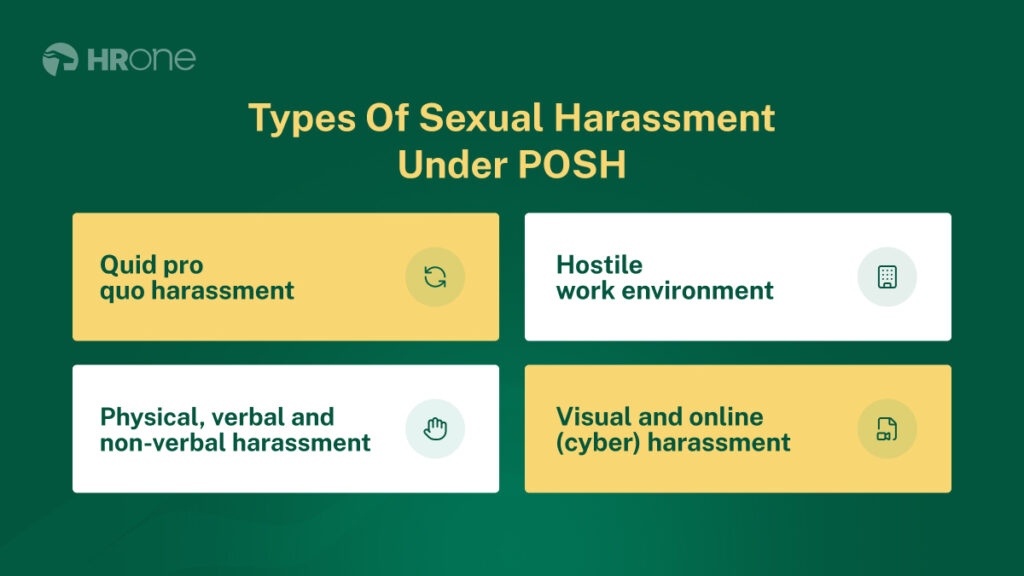
The Act does not list “types” by name, but HR teams, trainers and courts commonly group workplace harassment into a few categories. Thinking in categories helps employees recognise behaviour that is not as obvious as physical contact and helps the Internal Committee frame its inquiry. The two classic forms are quid pro quo and hostile work environment; the others describe how harassment is delivered.
| Type | What it is | Common examples |
| Quid pro quo | Job benefits traded for sexual favours, or threats if refused | Promotion, appraisal or project offered in exchange for compliance |
| Hostile work environment | Conduct that makes the workplace intimidating or offensive | Persistent innuendo, sexual jokes, explicit posters |
| Physical, verbal & non-verbal | Harassment by touch, words or gestures | Unwanted touching, comments on body, leering |
| Visual & online (cyber) | Harassment through images, screens or digital channels | Explicit memes, messages, video-call misconduct |
Quid pro quo harassment
Quid pro quo means “this for that”. It happens when someone in a position of influence, usually a manager, client or senior leader, links a work outcome to a sexual favour. The link can be explicit (“sign off depends on dinner with me”) or implied through hints and timing. Section 3(2) covers both the promise of preferential treatment and the threat of detrimental treatment. One incident is enough to file a complaint.
Hostile work environment
A hostile work environment builds up through repeated conduct that makes it intimidating, offensive or humiliating for a woman to do her job. No job benefit needs to be at stake. Think recurring sexual jokes in meetings, comments about appearance, explicit content on screens or gossip about someone’s personal life. Any single act may seem small, but the pattern is what creates the harm, and the Act recognises it.
Physical, verbal and non-verbal harassment
This classification looks at how harassment happens. Physical includes unwanted touching, brushing against someone, blocking their way or assault. Verbal covers sexually coloured remarks, comments on body or clothing, persistent requests for dates, and sexual jokes. Non-verbal covers leering, whistling, suggestive gestures and following someone. All three are expressly included in Section 2(n).
Visual and online (cyber) harassment
With hybrid work, a lot of harassment now happens on screens. Visual and online harassment includes sending explicit images or memes, sexual messages on chat apps or email, inappropriate comments in video calls, and sharing morphed photos. Because “workplace” includes any place visited during employment and the dwelling place, conduct on work channels and calls falls within POSH, whether it happens at 11 am or 11 pm.
Why Should HRs be Aware of POSH Act Rules and Guidelines
The Sexual Harassment of Women at Workplace (Prevention, Prohibition and Redressal) Rules, 2013 explain how the Act works in practice. These are the mechanics every employer should know.
Internal Committee (IC)
Every employer with 10 or more employees must constitute an Internal Committee by written order, at every office or administrative unit (Section 4). It must include:
- Presiding Officer: a woman employed at a senior level
- At least two members from among employees committed to the cause of women, or with social work experience or legal knowledge
- One external member from an NGO or association committed to women’s causes, or a person familiar with sexual harassment issues
At least half the members must be women, and members can hold office for up to three years. Calendar the reconstitution date; an expired IC is the same as no IC.
Local Committee (LC)
The District Officer sets up a Local Committee in every district (Section 6). It hears complaints from workplaces with fewer than 10 employees, from domestic and unorganised-sector workers, and complaints where the respondent is the employer.
Confidentiality
Section 16 bars disclosure of the identities of the complainant, respondent and witnesses, the inquiry proceedings, the IC’s recommendations and the action taken to the public, press or media. Anyone who breaches this can be penalised under the service rules or, where none exist, fined ₹5,000 under the Rules.
Penalties for employers
Under Section 26, an employer who fails to constitute an IC, ignores its recommendations or breaches other provisions can be fined up to ₹50,000. A repeat offence attracts twice the penalty, and can lead to cancellation, withdrawal or non-renewal of the business licence or registration.
Other protections
During an inquiry, the IC can recommend interim relief, such as transferring the complainant or respondent or granting the complainant up to three months’ leave (Section 12). It can also recommend compensation for the complainant (Section 15). False or malicious complaints can lead to action (Section 14), but simply being unable to prove a complaint is not grounds for punishment.
POSH complaint process and timelines
The POSH Act runs on a clock. Missing a deadline can weaken the inquiry and expose the organisation to legal challenges, so HR and the IC should track every complaint from day one.
- File the complaint. The aggrieved woman submits a written complaint to the IC (or LC) within 3 months of the incident, or of the last incident in a series. The IC can extend this by another 3 months for valid reasons and must help her put the complaint in writing if needed.
- Notify the respondent. The IC sends a copy to the respondent within 7 working days; the respondent replies within 10 working days.
- Conciliation (optional). At the complainant’s request only, the IC may attempt a settlement. No monetary settlement is allowed.
- Inquiry. If there is no conciliation, or its terms are breached, the IC completes the inquiry within 90 days.
- Report. The IC shares its findings and recommendations with the employer and both parties within 10 days of completing the inquiry.
- Action. The employer acts on recommendations within 60 days.
- Appeal. Either party may appeal within 90 days of the recommendations.
| Stage | Timeline | Legal basis |
| Complaint filed | Within 3 months (+3 months extension) | Section 9 |
| Copy to respondent / reply | 7 days / 10 days | Rule 7 |
| Conciliation | Before inquiry, on request | Section 10 |
| Inquiry completed | Within 90 days | Section 11 |
| Report to employer | Within 10 days of inquiry | Section 13 |
| Employer action | Within 60 days of report | Section 13(4) |
| Appeal | Within 90 days of recommendations | Section 18 |
POSH Policy: What it must include
Rule 13 requires every employer to formulate an internal policy against sexual harassment and share it widely. A good POSH policy is short enough to read, clear enough to act on and specific to your organisation. Use this checklist when drafting or reviewing yours:
- Purpose and scope: who is covered (employees, interns, contract staff, visitors) and what counts as the workplace, including travel and WFH
- Definition of sexual harassment in line with Sections 2(n) and 3(2), with examples
- Internal Committee details: names, roles and contact information of all members
- Complaint procedure: how, where and by when to file, with the full timeline
- Inquiry process: conciliation, inquiry, interim relief and appeal
- Confidentiality clause and consequences of breaching it
- Protection against retaliation for complainants and witnesses
- False or malicious complaint clause, with a clear note that an unproven complaint is not a false one
- Disciplinary consequences for respondents found guilty
- Employer responsibilities: training, awareness and annual reporting
- Acknowledgement: a way for every employee to confirm they have read the policy
- Short on time? Start with our ready-to-use HR policy templates and customise the POSH section for your organisation.
POSH training and awareness for employees
Section 19 requires employers to organise workshops and awareness programmes at regular intervals, and to run orientation programmes for IC members. A policy nobody understands will not protect anyone, so training is where compliance turns into culture.
Who needs POSH training?
Everyone: permanent employees, contract and agency staff, interns, and especially people managers (often the first to hear of a problem) and IC members (who need to run a legally sound inquiry). New joiners should be covered at induction.
How often?
The Act says “at regular intervals” without fixing a number. Best practice is POSH training at induction plus an annual refresher for all staff, with deeper skill-building for IC members at least once a year and whenever the committee is reconstituted.
Formats that work
Mix formats so the message lands: short e-learning modules with quizzes for scale, live or virtual workshops for discussion, scenario-based role plays for managers, and posters, emailers and FAQs for everyday reminders. Offer content in regional languages where your workforce needs it.
| Audience | Key topics | Format & frequency |
| All employees | What POSH covers, examples of harassment, how to complain, confidentiality, no retaliation, bystander role | E-learning + quiz; at induction and yearly |
| Managers | Spotting early signs, responding to disclosures, escalating to the IC, avoiding retaliation, inclusive team norms | Live workshop with scenarios; yearly |
| IC members | The Act and Rules, inquiry procedure, natural justice, evidence, timelines, report writing, confidentiality | Expert-led orientation; yearly and on reconstitution |
POSH training and compliance guide: employer checklist
Most POSH gaps are not about bad intent. They are about missed tasks: an IC that lapsed, an annual report nobody filed, a poster that went missing after the office move. Use this checklist to audit where you stand:
- Internal Committee constituted by written order at every office with 10+ employees, with an external member
- IC tenure tracked; committee reconstituted before the 3-year term ends
- IC names, contact details and penal consequences of sexual harassment displayed at a conspicuous place (Section 19)
- Written POSH policy published and acknowledged by every employee
- Awareness sessions for employees and orientation for IC members conducted and recorded
- Safe working environment ensured, including for visitors and on employer-provided transport
- Complaints handled within statutory timelines, with employer action within 60 days of the IC report
- Complaint records kept confidential with restricted access
- IC annual report submitted to the employer and the District Officer (Section 21, Rule 14): complaints received, disposed of and pending, workshops held, and action taken
- POSH details are included in your organisation’s annual report. For companies, the Board’s report must disclose IC constitution and, under the Companies (Accounts) Rules as amended in 2025, the number of complaints received, disposed of and pending beyond 90 days
- Annual review of the policy, training calendar and IC effectiveness
How HROne helps you stay POSH-compliant
POSH compliance shouldn’t live in five spreadsheets and someone’s inbox. HROne brings it into one place, so you spend less time chasing and more time building a workplace people feel safe in.
- Policy acknowledgement tracking: publish your POSH policy and see who has read and accepted it, with automated nudges for the rest
- Confidential grievances via the employee app: employees can raise concerns privately, from anywhere
- Audit-ready reports: pull the numbers you need for the annual report in a few clicks
Compliance panic? Not on our watch.
Disclaimer: This article is for general information and is not legal advice. Please consult a legal professional for advice specific to your organisation.










 Secures Top Spot in
