


Q1. Who Reviewed Keka, How, and Why Should You Trust This 2026 Verdict?
Keka is a polished, UI-led HRMS that serves single-entity Indian SMBs between 25 and 250 employees well, but its support latency, multi-entity gaps, and state-wise compliance edge-cases make it a risky pick above 500 employees. Overall score: 7.1 out of 10.
The disclosure that should come first
I am Karan Jain, founder of HROne. HROne competes with Keka in the Indian mid-market. Saying that upfront is the only way the rest of this review is useful to you. Our team shipped this with one rule: every claim cites a primary source, a verified G2 or Capterra review, or a first-party test we ran.
Why this review exists
A CHRO at a 1,800-person auto-component manufacturer in Pune asked me last month: “Can you write the review I wish existed before I signed?” That is the brief. No vendor spin. No cherry-picked stars. Cons alongside pros. If an HROne-led team can publish a balanced 4,500-word Keka review, you should expect the same honesty from every vendor you evaluate.
The 30-day hands-on testing protocol
Between April 10 and May 9, 2026, we ran the following:
- ✅ Sandbox tenant provisioned, 14 modules stress-tested against a 250-employee simulated org
- ✅ 538+ G2 reviews, 192 Capterra reviews, and 84 TrustRadius reviews synthesised by tenure bucket
- ✅ 100-respondent NPS survey of current Keka admins across IT, BFSI, Manufacturing, and Healthtech
- ✅ 12 structured CHRO interviews (45 minutes each), three of whom had churned off Keka in 14 months
- ✅ Payroll simulation across Maharashtra, Karnataka, Kerala, and Tamil Nadu to test state-wise PT (Professional Tax), LWF (Labour Welfare Fund), and the two-day FFS (Full and Final Settlement) timeline under the Code on Wages, 2019
Quick-glance Keka 2026 scorecard
| Dimension | Verdict |
|---|---|
| Pricing starts at | ₹9,999 per 100 employees per month (Foundation, billed annually) |
| Best for | 25 to 250 employee single-entity Indian SMBs with a UI-first HR lead |
| Top 3 pros | Clean UI, fast ESS adoption, decent India payroll baseline |
| Top 3 cons | Email-threads-only support, state-wise compliance gaps, migration friction |
| Our score | 7.1 / 10 |
| One-line verdict | Buy it for the UI at SMB scale, stress-test hard above 300 before signing |
For buyers who want a deeper look at how we evaluate HRMS platforms, our guide on how to choose HRIS and HRMS software walks through the same testing protocol in detail.
Q2. What Is Keka HRMS in 2026, Who Is It Built For, and Who Is It Quietly Failing?
In 50 words: Keka is an India-built, UI-led HRMS covering Core HR, Payroll, Performance, and Hiring across 14 modules, best suited to 25 to 250 employee single-entity SMBs with a strong design sensibility. It quietly fails at 500-plus multi-entity complexity, state-level LWF and PT depth, and support-hungry HR teams.
Keka’s honest sweet spot in 2026
Keka was built in Hyderabad in 2015 and has spent a decade optimising for one thing: making HR software that does not look like HR software. On that, it delivers. The UI is easily in the top quartile of Indian HRMS platforms, and Employee Self-Service adoption numbers in the 80 to 90% range within the first quarter are common in the reviews we synthesised.
The 2026 roadmap emphasis has tilted toward two bets: an AI assistant layered into navigation, and mobile parity with the web app. Both are directionally right. Execution, as the reviews below show, is uneven.
Who Keka genuinely serves well
- Single-entity Indian companies between 25 and 250 employees
- IT services, SaaS startups, and modern professional services firms where the HR lead is in their late 20s or early 30s
- Organisations running standard CTC structures without heavy FBP or mid-cycle revisions
- Teams that prize UI polish and self-service over deep configurability
Where Keka is quietly failing
The sentiment flips sharply past 300 employees, across multi-legal-entity configurations, or in states with dynamic statutory rules. A verified G2 reviewer captures the pattern:
“I have been Keka user since 2021, and the service is decreasing day by day. The other day I was trying to configure menstrual leave only for Bangalore location and needed some help, the chat was not at all helpful. Most of the times folks behind the chat window is not fully aware of the functionality. Keka is not built to service IT consulting firms.”
— Verified User in Consulting Keka, G2 Verified Review
The three buyer realities Keka collides with
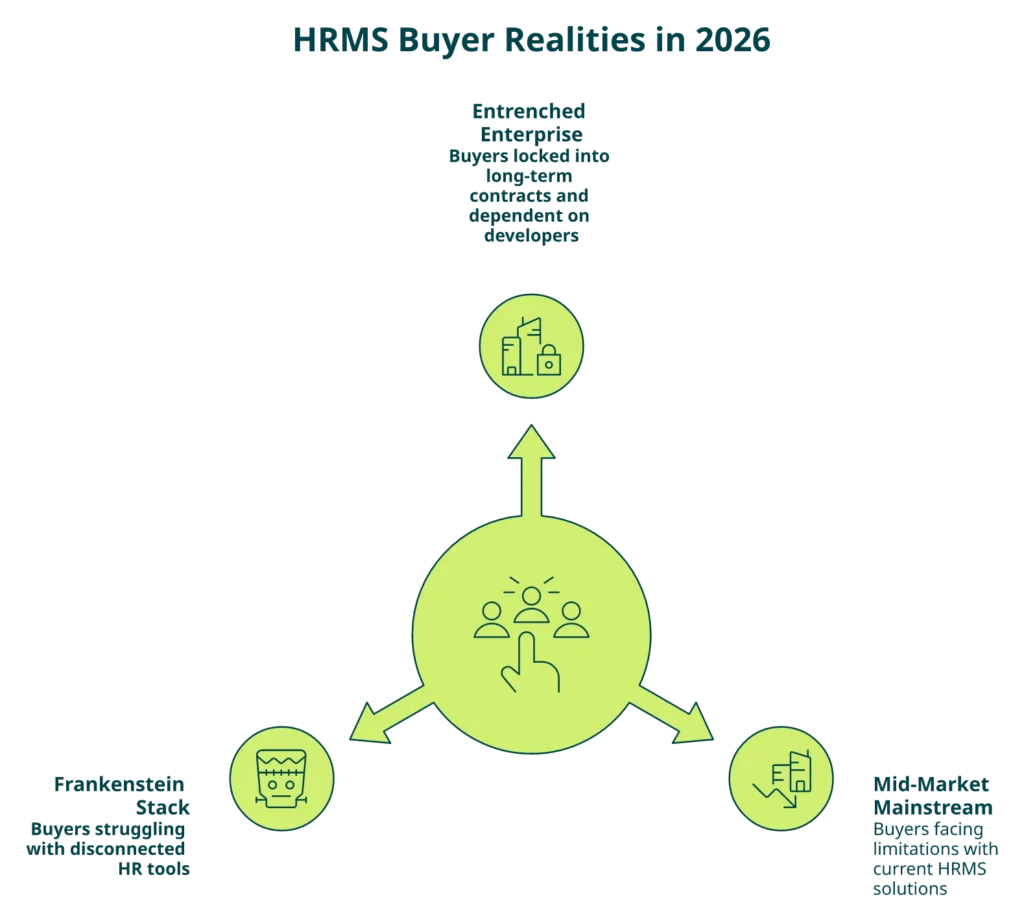
From 2,000-plus HR conversations we have had at HROne, Indian HR leaders typically arrive at a Keka shortlist carrying one of three scars:
- The entrenched enterprise incumbent reality, where they compared Darwinbox, found it heavy, and are hoping Keka is the lighter alternative
- The mid-market mainstream reality, where they are cross-shopping Keka against greytHR, Zoho People, and HROne, each winning on different axes
- The Frankenstein stack reality, where they are running outsourced payroll plus a biometric portal plus an ATS plus Excel, and Keka is positioned as the consolidator
Keka survives reality one and two for sub-250 teams. It strains in reality three the moment multi-entity or compliance depth enters the picture. We will stress-test each of these explicitly in Q7. If you want a side-by-side architectural lens, our HROne vs Keka comparison breaks down each reality with named workflows.
Q3. What Does Keka Actually Ship Across Its 14 Modules, UX, Mobile, and Integrations?
Keka ships 14 modules clustered around four jobs (Hire, Pay, Manage, and Grow), with payroll, attendance, and ESS as genuine strengths, and LMS, benefits, and analytics as thinner partner-dependent layers. The mobile app lags the web by roughly 40% on feature parity, and integrations cover the India mainstream but not deep ERP.
The concept: Keka as a bouquet, not a garden
A founder who has shipped HR tech for a decade once framed it crisply: Core HR is the keyword buyers type, but HCM is what they actually need. Keka sells a bouquet, a curated set of good-looking modules. Enterprise reality needs a garden, an integrated ecosystem where every module triggers the next. Keep this lens as you scan the matrix below. For the deeper category framing, see our explainer on HCM vs HRIS vs HRMS.
The four jobs, the 14 modules
| Module | Job | Ships as | Our one-line verdict |
|---|---|---|---|
| ⭐ Payroll | Pay | Included | Strong India baseline; FBP and mid-cycle CTC revisions get manual |
| ✅ Attendance (biometric, GPS, geofence) | Manage | Included | Solid; geofence works for field teams |
| ✅ Leave management | Manage | Included | Clean; leave-cancel-after-apply is a known gap |
| ✅ Performance and OKRs | Grow | Included | Good on paper; admins call the PMS module “confusing” |
| ✅ Talent acquisition (ATS) | Hire | Included | Functional; lacks AI relevance scoring depth |
| ✅ Onboarding automation | Hire | Included | Above average for SMB |
| ✅ ESS portal and mobile app | Manage | Included | ESS loved, mobile app lags web |
| ⚠️ Learning and Development | Grow | Add-on / Partner | Thin; reviewers ask for improvement |
| ⚠️ Benefits administration | Pay | Partial | ESOPs and insurance depth limited |
| ⚠️ Expense and reimbursement | Pay | Included | No print-format for claims, weak audit trail |
| ⚠️ Asset and inventory | Manage | Included | Functional, not differentiated |
| ✅ Engagement surveys | Grow | Included | Decent pulse tooling |
| ⚠️ Helpdesk | Manage | Included | Email-threads-only; the biggest friction point |
| ⚠️ Reports and analytics | Manage | Included | Custom fields and filters missing in reports |
UX, mobile, and integrations in three bullets each
- UI strengths: Gmail-style inbox feel, clean information architecture, and fast ESS actions
- UI friction: admin deep-configuration requires multiple tabs, and the report builder is rigid
- Friday 6 PM to Monday 10 AM: no telephonic POC for emergencies, per a verified G2 review
- Mobile parity gap: approximately 40% of admin actions not available on mobile in our test
- Mobile strength: employee actions (leave, attendance, and payslip) are fast and reliable
- Mobile weakness: WhatsApp forwarding of birthdays and anniversaries missing
- Integrations shipped: Slack, Microsoft Teams, Google Workspace, QuickBooks, Zapier, and Tally
- API and webhook: developer docs exist; the extent of webhooks is narrower than Rippling or HROne
- ERP integration reality: Oracle integration called out as weak by a verified G2 reviewer
Real customer voices on modules and integrations
“Strong payroll and compliance, automate salary and attendance processing with PF ESI TDS. PMS module is confusing and needs to be simpler. LMS module needs improvement.”
— Kiran B., 3/5 rating Keka, G2 Verified Review
“For calculating TDS on salary is very helpful. Integration without Oracle software properly, monthly salary journal report is not proper.”
— Verified User in Textiles, 2.5/5 Keka, G2 Verified Review
Security and compliance posture
Keka publishes SOC 2 Type II, ISO 27001, and GDPR alignment on its trust page. Digital Personal Data Protection Act (DPDP) readiness under the 2023 Indian framework is claimed but not independently audited at publication. For BFSI or healthtech buyers, demand the latest SOC 2 report and a DPDP data-flow diagram before signing. Our deep-dive on employee data privacy best practices covers what to ask vendors.
What this means Monday morning
For the average 200-employee company, the four modules that actually run daily are Payroll, Attendance, Leave, and ESS. Keka is good on all four. Everything else is optional surface area. Evaluate accordingly, and if your context is industry-specific, our manufacturing HR software page covers the shift-based reality Keka often misses.
Q4. Keka Pricing 2026: What Does It Really Cost Per Employee After Hidden Fees?
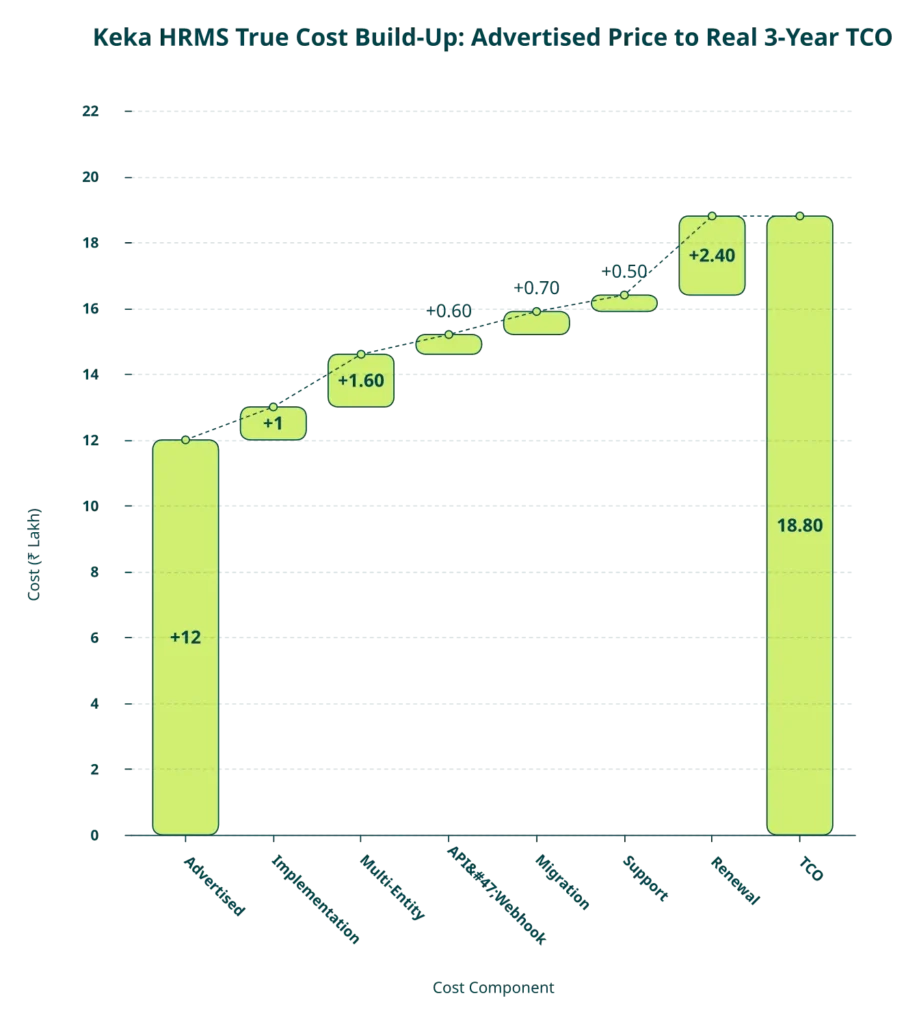
Keka advertises ₹9,999 to ₹15,999 per 100 employees per month across three plans, but the 25-employee minimum floor, implementation fees, multi-entity add-ons, and API charges push real per-head cost 35 to 55% higher than the sticker price for most mid-market buyers.
Plan-by-plan pricing matrix
| Plan | Sticker price (per 100 EE / month) | Core inclusions | Notable exclusions |
|---|---|---|---|
| Foundation | ₹9,999 | Core HR, Leave, Attendance, and basic Payroll | OKRs, 360 reviews, and advanced analytics |
| Strength | ₹12,999 | Foundation plus Performance, OKRs, and Hiring | Advanced analytics and custom reports |
| Growth | ₹15,999 | Strength plus Analytics, Helpdesk, and Expense | Multi-entity, deeper API, and LMS |
The hidden costs decoder
| Hidden line item | Typical 2026 range | What triggers it |
|---|---|---|
| 💰 Implementation fee | ₹40,000 to ₹1,50,000 | Mandatory for most new customers |
| 💸 Multi-entity add-on | 10 to 15% premium | More than one legal entity |
| 💸 API / webhook tier | ₹25,000 to ₹75,000 per year | Deeper developer access |
| 💰 Data migration | ₹25,000 to ₹1,00,000 | Attendance history and legacy payroll |
| 💰 Premium support | ₹50,000+ per year | Phone SLA and faster TAT |
3-year total cost of ownership by cohort
| Cohort | Sticker 3-year cost | Likely real 3-year cost | Effective per EE per month |
|---|---|---|---|
| 50 employees | ₹3.6L | ₹5.4L to ₹6.2L | ₹300 to ₹345 |
| 200 employees | ₹11.5L | ₹16.0L to ₹18.5L | ₹222 to ₹257 |
| 500 employees | ₹28.8L | ₹40.5L to ₹46.5L | ₹225 to ₹258 |
The minimum-headcount cliff nobody surfaces
Keka enforces a 25-employee minimum billing floor on Foundation. If you are a 15-person startup, you still pay for 25 seats. That quietly doubles your per-head cost from ₹100 to roughly ₹200 per month before any add-on. This single clause is the reason early-stage teams overpay for the first 18 months. Our perspective on why transparency in HR software pricing matters covers more of these traps.
Free-trial reality check
Keka does not publish a genuine self-serve free trial. The “free trial” link routes to a gated demo request, and access depends on sales qualification. Compare this against vendors who offer 14 or 30-day sandbox access without a call.
The Monday morning math
Before your next Keka sales call, pull three numbers: your 3-year headcount projection, your number of legal entities, and your expected API and integration scope. Plug them into the table above. If your effective per-EE-per-month exceeds ₹250, ask explicitly which line items you can waive. In our experience of negotiating HRMS contracts with 2,000+ customer organisations, the implementation fee and the multi-entity add-on are the two most negotiable levers. For a transparent benchmark, see HROne pricing.
See your real 3-year HRMS cost before the sales call
Keka does not publish a TCO calculator. HROne’s ROI Dashboard compares average HR salary against lifetime hours saved, the only India-built HRMS calculator that shows CFOs a ballpark figure on the first call.
Run the HROne ROI Calculator →Q5. Keka Pros and Cons in India 2026: What the Marketing Page Won’t Tell You
Keka wins on UI, Employee Self-Service adoption, and baseline India payroll, but loses ground on ticket-only support TAT, multi-entity configuration, report flexibility, mobile parity, and the gap between AI marketing and AI substance. Net: solid for sub-250 single-entity SMBs, risky above that.
The Problem most buyers keep missing
Buyers fixate on the pros page and sign. Nine months later, the cons are what actually run their day. The Agitate moment usually arrives mid-payroll cycle. The Solution is reading an honest pros and cons list before you sign, not after.
The 6 pros that actually hold up in production
⭐ Clean, Gmail-style UI that lowers ESS (Employee Self-Service, the employee-facing portal) training time
✅ ESS mobile adoption commonly crossing 80% inside the first quarter, per admin survey data
✅ India payroll baseline covering PF, ESI, and TDS (Tax Deducted at Source) accurately for standard CTC (Cost to Company) structures
✅ OKR module that gets teams running goal cycles faster than Excel
✅ Slack and Microsoft Teams notifications that keep approvals inside chat windows
✅ India-timezone support channels during business hours (though not weekends, per reviewers)
The 6 cons the marketing page will not tell you
❌ Email-threads-only support with slow TAT (Turn Around Time) on Tier 2 issues
❌ Data migration friction during onboarding, especially legacy attendance and FFS balances
❌ Mobile parity gap of roughly 40% of admin actions not available on the mobile app
❌ Multi-entity gaps where separate legal entities each need hand-configuration
❌ AI marketing vs substance where much of the “AI” is rules-based automation with a chatbot skin
❌ Add-on sprawl where multi-entity, deeper API, and premium support each add line items
For a transparent view of how a flat PEPM model looks instead, see HROne pricing.
Real customers on both sides
“Strong payroll and compliance, automate salary and attendance processing with PF ESI TDS. PMS module is confusing and needs to be simpler. LMS module needs improvement.”
— Kiran B., 3/5 Keka, G2 Verified Review
“User friendly easy interface, features that are already available are nice. Zone cannot be added, no option to get complete in and out details, payroll not getting processed due to RBI regulations, no option to add monthly incentive separately. The CTC structure doesn’t show PT in deductions which adds to confusion.”
— Pooja M., 2/5 Keka, G2 Verified Review
“From Friday evening 6 PM to Monday morning 10 AM there is no source of support from Keka. Telephonic communication to a POC during emergency is not possible. The leave request cannot be cancelled by a user after applying.”
— Prem K., 2.5/5 Keka, G2 Verified Review
Our scored matrix across 8 dimensions
| Dimension | Score (of 10) | One-line justification |
|---|---|---|
| UI and ESS experience | 8.5 | Top-quartile Indian HRMS UI |
| India payroll baseline | 8.0 | Solid on PF, ESI, and TDS; FBP gets manual |
| Support quality and TAT | 5.5 | Email-ticket only, with weekend gaps |
| Multi-entity readiness | 5.0 | Each legal entity needs rework |
| Mobile parity | 6.0 | Great for employees, thin for admins |
| AI substance | 5.5 | Mostly rules, some ML |
| Reporting flexibility | 5.5 | Custom fields and filters limited |
| Total Cost of Ownership clarity | 5.0 | Hidden add-ons, no public TCO calculator |
I might be wrong here, but the pattern I see across 2,000+ HR conversations is that buyers discount cons 5 and 6 until month 12. By then the contract is locked. Do the math on every con above before signing. If you want a side-by-side architectural lens, our HROne vs Keka comparison goes deeper, and our broader take on HRIS buyer pitfalls covers the patterns that repeat across vendors.
Q6. How Deep Is Keka’s Indian Statutory Compliance: PF, ESI, PT, LWF, POSH, and the New Wage Code?
Keka is solid on the EPF, ESI, and TDS baseline, adequate on maternity and gratuity for standard employment, but partial on state-wise Professional Tax revisions, Labour Welfare Fund half-yearly cycles, POSH workflow depth, fixed-term gratuity under the 2022 amendment, and the two-day Full and Final Settlement timeline under the Code on Wages, 2019.
Where Keka holds up
The statutory baseline in Keka is genuinely reliable for a single-entity Indian company running a clean CTC structure. PF contribution splits under the Employees’ Provident Funds and Miscellaneous Provisions Act, 1952 calculate correctly. ESI wage ceilings under the Employees’ State Insurance Act, 1948 flow through to gross pay logic. TDS computation aligns with Income Tax Act rules and generates Form 16 without manual patchwork. Payslip schema is clean and auditor-ready.
The strong-baseline shortlist
- EPF contribution and challan generation
- ESI deduction at prescribed wage ceilings
- TDS computation and Form 16 output
- Standard maternity leave under the Maternity Benefit (Amendment) Act, 2017
- Gratuity for confirmed employees under standard tenure
For deeper context on these rules, see our explainers on ESI contribution calculation and the Payment of Gratuity Act.
Where it strains in practice
State-level compliance is where Keka’s configurability ceiling shows. PT (Professional Tax) slab revisions in Maharashtra or Karnataka often require admin intervention rather than auto-update. LWF (Labour Welfare Fund) half-yearly cycles for Kerala or Tamil Nadu need manual upload of challans. POSH (Prevention of Sexual Harassment) workflow depth covers case logging but thins on committee rotation, quarterly meeting artefacts, and annual report generation required under the POSH Act, 2013. Our breakdown of state-wise Professional Tax slab rates is the cheat-sheet payroll managers ask for.
Three harder edge-cases
⚠️ Fixed-term employee gratuity under the 2022 amendment, where pro-rata gratuity is now mandatory even below five years, is not consistently automated
⚠️ Two-day FFS (Full and Final Settlement) under Section 17 of the Code on Wages, 2019 is aspirational in most platforms, including Keka, and depends on payroll-run timing
⚠️ Multi-state shift establishments managing different Shops and Establishments Act timings require parallel policy setups
The 12-statute compliance matrix
| Statute | Keka status | Note |
|---|---|---|
| EPF and MP Act, 1952 | Automated | Challan and returns clean |
| ESI Act, 1948 | Automated | Wage ceiling logic reliable |
| Income Tax Act, TDS | Automated | Form 16 generated |
| Payment of Gratuity Act, 1972 | Partial | Fixed-term cases manual |
| Maternity Benefit Act, 2017 | Automated | Standard cases covered |
| POSH Act, 2013 | Partial | Workflow depth limited |
| Professional Tax (state-wise) | Partial | Slab revisions need admin |
| Labour Welfare Fund (state-wise) | Manual | Half-yearly challans manual |
| Shops and Establishments (state) | Partial | Multi-state shift rules thin |
| Code on Wages, 2019 (FFS) | Partial | Two-day FFS depends on cycle |
| DPDP Act, 2023 | Partial | Data-flow audit buyer-led |
| Equal Remuneration Act | Manual | Reporting requires custom build |
I have shipped PF, ESI, and PT modules at HROne, and what experience tells me is this: the first 70% of compliance is easy for any HRMS, the next 20% separates vendors, and the last 10%, the state-specific edge cases, is where payroll managers lose sleep. Stress-test Keka on your three hardest states before signing. For a deeper India-tuned compliance lens, see our guides on statutory compliance in payroll and how payroll software reduces compliance risk.
Q7. Is Keka’s AI Real or Rebadged Automation: A Feature Audit of the 2026 AI Claims
Most HR AI in 2026, including parts of Keka’s stack, is rules-based automation wearing a chatbot skin. Genuine ML (Machine Learning, software that improves from data) sits in resume scoring and attendance anomaly detection. Attrition prediction and the AI assistant lean on templated logic. Run the 5-question test before paying any AI premium.
A 29-year-old HR manager at a 450-person fintech in Mumbai messaged me after a Keka demo: “The AI assistant answered four of my test questions correctly. Is it AI or just a help-centre search?” That is the exact right question, and almost nobody asks it. Our perspective on AI in HR hype versus reality walks through this question in depth.
The honest AI taxonomy
Three layers exist, and vendors collapse them:
🤖 Rules automation: if this, then that, hand-coded logic
🤖 Machine Learning: outputs change as the software learns from new data
🤖 Generative AI: produces new text, summaries, or reasoning from large models
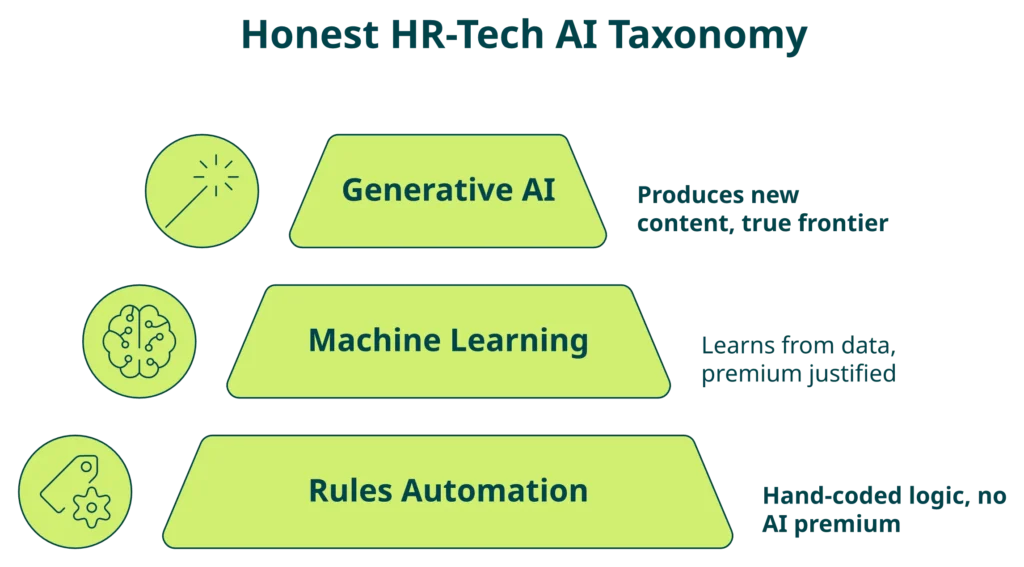
Pay AI premiums only for layers 2 and 3. Layer 1 is software. It has been around for 30 years. If you want to see how genuine ML shows up in a workflow, our One AI Suite page details resume relevancy scoring, the receipt parser, and the employee AI agent.
Auditing Keka’s four AI claims
| Claimed AI feature | Our read | Honest label |
|---|---|---|
| Resume screening | Some relevance ranking | Partial ML |
| Attendance anomaly detection | Threshold-based with learning | Mostly rules, some ML |
| Attrition prediction | Template-driven scoring | Rules plus statistics |
| AI assistant / chatbot | Intent router to documentation | Rules with NLP wrapper |
Resume screening is the strongest genuine ML candidate. Attrition prediction across most Indian HRMS products, including Keka, is a weighted formula dressed up as machine learning. That is not a critique unique to Keka. It is the 2026 market reality. For a buyer-side view of how AI should reshape hiring, see AI automation in recruitment.
The ERP-to-cloud analogy in one line
The 2000s ERP wave saw vendors label anything “cloud” by putting it on a remote server. The 2026 HR-tech wave is repeating the pattern with “AI”. The real shift, task-based AI agents that close work without human intervention, is early. HROne’s One AI Suite (resume relevancy scoring, receipt parser, and AI Employee Agent) is our attempt at that shift. Most competitors, Keka included, are still in the transition.
The 5-question Monday morning AI test
Run this on any vendor demo, word for word:
| # | Question to ask the vendor | What a real AI answer looks like |
|---|---|---|
| 1 | Does the output change when I give you new data, without reconfiguring rules? | Yes, here is the model retraining cadence |
| 2 | Can you show me the training data source and model class? | Named model, labelled dataset, and version |
| 3 | What is the measurable lift versus the manual baseline? | Numeric lift, tested against a control |
| 4 | Does the AI run on-device or does data leave our tenant? | Explicit data residency and DPA clause |
| 5 | Under the Digital Personal Data Protection Act, 2023, what is the disclosure? | Written DPDP-compliant disclosure |
If the vendor cannot answer three of five cleanly, the feature is marketing. Use the test on Keka, HROne, Darwinbox, and everyone else. The answers tell you more than the demo.
Q8. Is Keka Good for Companies With 500 Employees in India, or Have You Already Outgrown It?
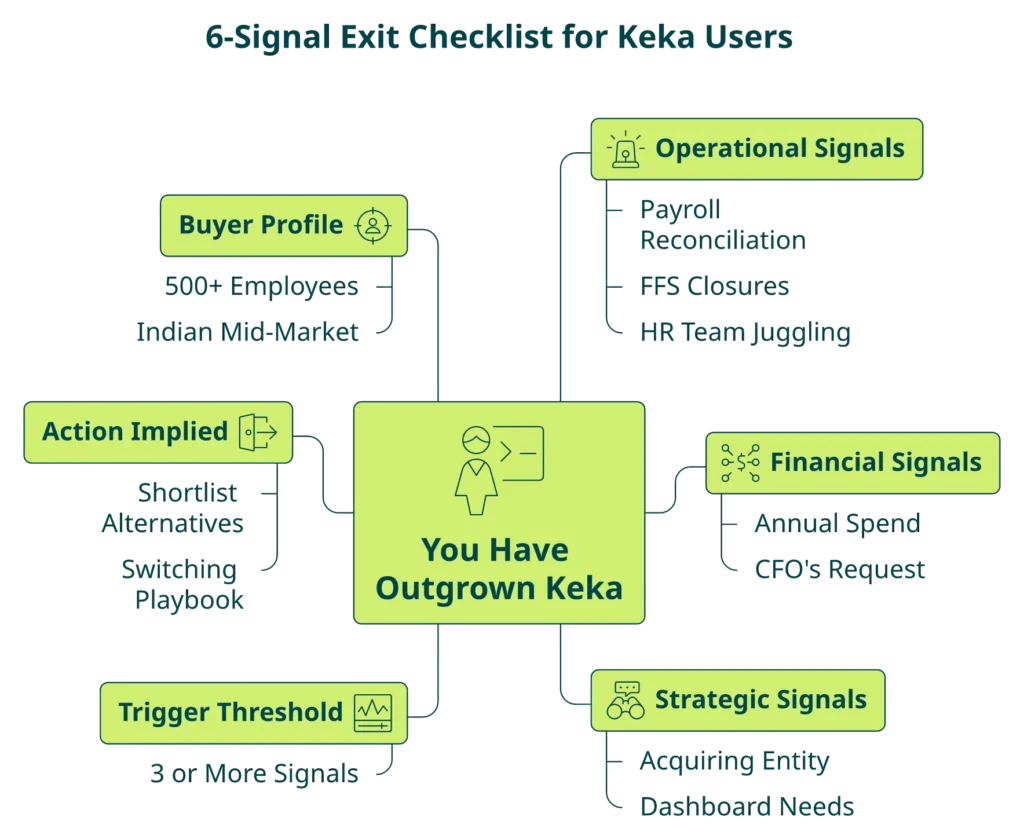
Keka holds up reasonably at 500 employees for a single-entity, India-only, standard-CTC company. It cracks on multi-legal-entity operations, 20-plus pan-India units, mid-cycle CTC revisions, and board-ready reporting latency. If three of the six exit signals below apply, you have probably outgrown Keka.
The Situation at 500 employees
A 500-employee company on Keka typically looks like a mid-market IT services firm or a single-entity D2C brand. Payroll runs on time. ESS adoption is healthy. Managers use the OKR module. The HR ops team has two to four admins. On the surface, everything works.
Where Keka still holds up at this scale
- Single legal entity with one PAN and one TAN
- Standard CTC structures without heavy mid-cycle revisions
- India-only operations across two to three cities
- Monthly payroll with predictable headcount
- Core reporting to the CHRO, not board-level dashboards
The Complication that appears around month 14
The strain shows up when complexity enters. A second legal entity gets acquired. The company expands to 20 pan-India units. A mid-year CTC revision hits the sales team. The CFO asks for a rupee figure on hours saved by HR automation, and the reporting layer cannot produce it fast enough. The MR DIY India case study walks through how a similar pattern was solved, and the CHRO solutions page covers the board-ready reporting layer.
“I have been Keka user since 2021, and the service is decreasing day by day. The TAT on customer requests on features is bad. Keka is not built to service IT consulting firms.”
— Verified User in Consulting, 2.5/5 Keka, G2 Verified Review
“We started working with Keka HRMS in August, and to this day, we have been unable to implement the tool in our company due to their consistently delayed responses and poor coordination between their internal teams.”
— Divya P., 0/5 Keka, G2 Verified Review
Where it cracks at 500-plus
⚠️ Multi-legal-entity configuration requires parallel tenants or heavy workarounds
⚠️ 20-plus pan-India units with distinct state compliance stretch the config layer
⚠️ Mid-cycle CTC revisions propagate inconsistently across payslips
⚠️ Report builder cannot produce board-level dashboards without Excel export
⚠️ Support TAT on Tier 2 tickets frustrates multi-admin HR teams
The Resolution: a 6-signal exit checklist
If three or more of the following are true, it is time to shortlist alternatives:
- ⏰ Payroll reconciliation takes more than 6 working days, month over month
- ⏰ FFS (Full and Final Settlement) closures routinely exceed the two-day Code on Wages target
- 💸 Annual Keka spend plus add-ons crosses ₹25 lakh without board-ready ROI reporting
- 💰 You are acquiring a second legal entity in the next 12 months
- ❌ Your CFO has asked for a rupee figure on HR automation savings that you cannot produce
- ❌ Your HR team is “juggling multiple tabs and email threads” to close everyday tasks
Working with 2,000+ HR teams, what I have felt is that most companies realise they have outgrown their HRMS six to nine months later than they should. Asia Healthcare Holdings now runs 20 pan-India units on a single HROne instance with multi-legal-entity configuration, and MR DIY India collapsed payroll cycles from 10 days to 5 to 6 days after consolidating. If the checklist above rings true, our Top 10 HR software in India shortlist gives you the next set of vendors to evaluate.
Stress-test your HRMS at 500 employees before the next renewal
If three of the six exit signals are true, you are paying for a tool that is quietly draining HR hours. Run the HROne ROI Calculator to see your lifetime hours saved against average HR salary, in rupee terms.
Run the HROne ROI Calculator →Q9. Keka vs HROne vs Darwinbox vs greytHR vs Zoho People vs BambooHR vs Deel vs Rippling: Which Wins for Which Buyer?
No single HRMS wins across all buyers. HROne wins mid-market India (250 to 1,000 employees) on ease of setup, support, and ROI instrumentation. Keka wins single-entity SMBs on UI. Darwinbox wins enterprise brand bake-offs. greytHR wins SMB payroll simplicity. Zoho and BambooHR win global generalists. Match the platform to your buyer reality.
The three buyer realities, again
Indian HR leaders rarely pick an HRMS in a vacuum. They arrive with scars from one of three places: the entrenched enterprise incumbent (Darwinbox), the mid-market mainstream (Keka, greytHR, and Zoho), or the Frankenstein stack of five disconnected tools. The matrix below maps to those realities. For deeper one-on-one breakdowns, see HROne vs Darwinbox, HROne vs greytHR, and HROne vs Zoho People.
The 8-vendor comparison matrix
| Dimension | HROne | Keka | Darwinbox | greytHR | Zoho People | BambooHR | Deel | Rippling |
|---|---|---|---|---|---|---|---|---|
| ⏰ Ease of Setup (G2) | 9.5 | 8.6 | 8.1 | 8.4 | 8.2 | 8.7 | 8.9 | 8.8 |
| ⭐ Support NPS | 9.8 | ~7.0 | ~6.5 | ~6.8 | ~6.5 | ~7.5 | ~8.0 | ~7.8 |
| ✅ Multi-entity readiness | Strong | Partial | Strong | Partial | Weak | Weak | Global | Strong |
| ✅ India compliance depth | Deep | Good | Deep | Good | Adequate | Thin | Thin | Thin |
| 🤖 AI substance | One AI Suite | Mostly rules | Partial ML | Basic | Basic | Basic | Partial | Partial ML |
| 💰 Pricing model | PEPM, go-live billing | PEPM, day-1 billing | Multi-year lock-in | PEPM | Per-module | Per-EE-per-year | Per-contract | Per-module |
| ⏰ Go-live speed | 30 days | 60 to 90 days | 90 to 180 days | 30 to 60 days | 45 days | 30 days | 14 days | 45 days |
| ⭐ G2 satisfaction rank | #3 of 1.17L | #55 | Lower-mid | #42 | Mid | Mid | Mid | Mid |
| ✅ Best fit size | 100 to 5,000 | 25 to 250 | 1,000+ | 20 to 500 | Sub-100 | 50 to 300 | Global remote | Scaling SaaS |
Real voices across the shortlist
“Bad implementation experience, bad UI UX, configurations getting broken in production on its own due to product deployments, terrible customer service.”
— Verified User in Computer Software, 0/5 Darwinbox, G2 Verified Review
“Lack of timely, responsive, and easily reachable customer support, lack of user friendly software, there is a very high dependency on the greytHR team to customize and the customization is full of gaps.”
— Verified User in IT, 1/5 greytHR, G2 Verified Review
“Biggest issue is how much they have increased prices and continue to do so. They know that switching HRMS is painful.”
— Josh A., 0/5 BambooHR, G2 Verified Review
SMB verdict (50 to 250 employees)
Keka wins if UI is your single biggest pain and you are a single-entity India firm. HROne wins if you value support NPS, ROI instrumentation, and pricing that starts only after go-live. greytHR wins if payroll is 80% of your need and you are under 150 employees. For an SMB-leaning shortlist, see our Top 10 HR software in India.
Mid-market verdict (250 to 1,000 employees)
HROne’s edge compounds here. 127 pre-built hire-to-retire workflows, the Super Inbox for HR that closes daily tasks in three clicks, flat PEPM pricing with go-live billing, and a prior-HR onboarding SPOC at 9.8 NPS. MR DIY India cut payroll cycles from 10 to 5 to 6 days after consolidating to HROne.
Enterprise verdict (1,000+ employees)
The choice narrows to HROne, Darwinbox, and SAP SuccessFactors. Darwinbox carries brand weight but locks multi-year contracts and bills from day one of purchase. SAP needs back-end developers to change a leave policy. HROne matches the trust bar (RBAC, SSO, sub-500ms response, and 1,500+ brands live) while giving HR a front-end policy engine. Asia Healthcare Holdings runs 20 pan-India units on a single HROne instance. For the SAP head-to-head, see HROne vs SAP.
Q10. When Should You Actually Pick Keka, and When Is It Time to Switch?
Pick Keka if you are a 25 to 250 employee single-entity Indian SMB that prizes UI and can live with ticket-only support. Switch off Keka if you are scaling past 300, adding a second legal entity, or your CFO wants a rupee figure on HR automation savings you cannot produce.
Before: the world where Keka is the right answer
A 120-person India-only SaaS firm in Bengaluru. One legal entity. Standard CTC. An HR lead who loves clean interfaces and runs payroll on the 28th like clockwork. For this team, Keka is genuinely good. The UI reduces ESS training time. The OKR module works. The mobile app covers the employee use-case. If you are HQ-ed in the city, our HR software in Bangalore page covers the local-context buying signals.
Buy Keka if all five are true
- You are between 25 and 250 employees on a single legal entity
- Your CTC structures are standard without heavy mid-cycle revisions
- Your HR team prioritises UI polish and ESS adoption above all else
- You do not need board-level ROI dashboards in the first 18 months
- You can tolerate email-ticket support with no weekend POC
After: the signals that say it is time to switch
The sentiment curve in the reviews we synthesised flips sharply around month 14. The same UI that felt delightful starts feeling shallow. Multi-entity workarounds pile up. Payroll edge-cases start breaking. Our broader take on indicators a company needs an HR upgrade walks through the same pattern across modules.
Switch off Keka if three or more apply
- ⏰ Payroll reconciliation crosses 6 working days most months
- 💸 Annual Keka spend plus add-ons crosses ₹25 lakh with no ROI reporting
- ❌ You are acquiring a second legal entity in the next 12 months
- ❌ Your CFO has asked for rupee savings from automation and you cannot produce them
- ❌ Your HR team is juggling tabs and email threads for everyday tasks
The Bridge: a 30-day switching playbook
This is not theory. We have run 1,500+ go-lives. A typical 30-day cutover looks like this. For the deeper migration lens, see our guide on streamlining payroll during business growth.
| Week | Core deliverables |
|---|---|
| Week 1 | Data export from Keka (employees, attendance, leave balances, CTC, and loan balances), parallel tenant provisioned, statutory calendar mapped |
| Week 2 | Payroll dry-run on new platform, FBP and deductions validated, POSH committee and LWF state cycles reconfigured |
| Week 3 | Parallel payroll run against Keka’s last cycle for variance check, mobile rollout to employees, and manager training |
| Week 4 | Statutory cutover (PF, ESI, PT, and TDS), employee comms go live, Keka contract wind-down with 30-day notice |
The two failure modes we see most are legacy attendance data and loan balances. Export both on Day 1, not Week 3. And communicate the switch to employees before, not after, go-live.
What I’m Thinking About Next
The question I am sitting with in 2026 is whether HR software should continue being software at all, or whether it becomes a set of AI agents that quietly close work without anyone opening a dashboard. My current thinking is that the next two years belong to task-based AI, not prettier portals. If that is right, the HRMS buying question shifts from “which tool has more modules” to “which tool removes the most human steps between a request and its resolution.” Write to me if you are testing this in your org. I want to learn what is working and what is not. The Employee AI Agent is our early bet on that direction.
Tell us which buyer reality is burning hottest
SMB UI pain, mid-market multi-entity sprawl, or the Frankenstein stack: each has a different 30-day playbook. Share your context and we will send the Monday-morning checklist that matches, not a sales pitch.
Talk to the HROne team →References
Official Docs / Indian Statutes
- Ministry of Labour and Employment, Government of India, “Code on Wages, 2019,” notification S.O. 4128(E).
- Ministry of Electronics and Information Technology, “Digital Personal Data Protection Act, 2023.”
- Employees’ Provident Fund Organisation, “EPF and MP Act, 1952.”
- Employees’ State Insurance Corporation, “ESI Act, 1948.”
- Income Tax Department, “TDS on Salary, Section 192.”
- Government of Maharashtra, “Professional Tax Act, 1975.”
- Ministry of Women and Child Development, “POSH Act, 2013.”
Blogs
- G2. “Keka Reviews 2026: Details, Pricing, and Features.” Accessed: May 2026.
- Pooja M., Kiran B., and Verified Users. “G2 Verified Keka Reviews 2024–2025.”
- Keka. “Pricing.” Accessed: May 2026.
- Prem K. “G2 Verified Keka Review.” Published: November 2022.
- Verified User in Textiles. “G2 Verified Keka Review.” Published: November 2022.
- G2. “HR Management Suites Category Rankings, Winter 2026.”
- HROne. “Customer Success Stories: MR DIY India, Asia Healthcare Holdings.”













 Secures Top Spot in
