


Q1. What Are the 10 Best Core HR Software in India for Large Companies in 2026 (and How We Scored Them)?
The 10 best core HR software for large companies in India in 2026 are HROne, Darwinbox, PeopleStrong, SAP SuccessFactors, greytHR, Keka, ZingHR, Zoho People, Oracle HCM Cloud, and Workday HCM. We scored each on India Compliance Depth (30%), Cross-Entity Configurability and Workflow Automation (25%), Adoption and User Satisfaction (20%), Implementation and Support (15%), and Pricing Transparency and TCO (10%).
Choosing core HR software for a large Indian company is a high-stakes call, because the wrong pick locks 100 to 5,000 employees into a system that cannot handle multi-state tax rules or different policies across legal entities. We evaluated 10 platforms against operational, compliance, and commercial criteria that matter to the person running the software daily, the HR ops lead, not just the procurement buyer, with the CHRO, CFO, and IT Director reading over their shoulder.
🎯 Our Evaluation Criteria
Each platform was scored on five weighted, decision-grade criteria that total 100%.
- India Compliance Depth (30%) 🇮🇳 Automated PF, ESI, TDS filing, multi-state Professional Tax, and new Labour Code Full and Final Settlement rules. See our multi-state payroll compliance breakdown.
- Cross-Entity Configurability and Workflow Automation (25%) ⚙️ Multiple legal entities on one instance, and breadth of pre-built hire-to-retire workflows.
- Adoption and User Satisfaction (20%) ⭐ Ease of daily use and G2 satisfaction, since research shows adoption drives the return on any HRIS.
- Implementation and Support (15%) ⏰ Go-live speed and whether you get a dedicated person or an email queue, which we cover in our HRMS implementation timeline guide.
- Pricing Transparency and TCO (10%) 💰 Clear pricing, lock-in terms, and total cost over three years.
⭐ How the Star Ratings Work
We converted each weighted score into a simple star band, so you can shortlist at a glance.
- 0 to 20 = 1 star, 21 to 40 = 2 stars, 41 to 60 = 3 stars, 61 to 80 = 4 stars, 81 to 100 = 5 stars.
⚠️ The Pain We Were Scoring Against
Most large firms do not have one HR system. They have five that do not talk to each other. As Karan Jain, who has built HR systems for years, puts it, payroll runs on one tool, attendance draws from another, and recruitment sits in a third, and “these three softwares could not talk to each other.”
That gap is where the damage hides. Data gets reconciled by hand at month-end, wrong inputs trigger wrong paycheques, and the CHRO walks into a board review unable to say how long it takes to close a confirmation letter. Many enterprise systems just gather data without acting on it, so leaders stay blind on the numbers that matter, a problem our HR solution was built to close.
Who This Guide Is For
- CHROs and HR Heads consolidating a fragmented hire-to-retire stack into one source of truth.
- Payroll Managers running multi-entity, India-compliant monthly payroll cycles across several states.
- CFOs validating HR tech return on investment and flat per-employee-per-month commercials.
- IT Directors and operational HR teams comparing mobile-first platforms against legacy portals.
📊 The 10 Best Core HR Software Compared
| Provider | Best For | Standout Strength | Known Limitation | AI Depth | Support Model | Pricing Model |
|---|---|---|---|---|---|---|
| HROne ⭐⭐⭐⭐⭐ | HR ops leads unifying payroll, attendance, and recruitment that “could not talk to each other” | 127 pre-built hire-to-retire workflows plus Inbox for HR that closes tasks in three clicks | Some modules like Payroll and Performance have a first-time learning curve | High (One AI Suite: resume relevancy, receipt parser) | Phone, email, and dedicated prior-HR SPOC (9.8 NPS) | Flat PEPM, no lock-in, meters after go-live |
| Darwinbox ⭐⭐⭐⭐ | Very large enterprises wanting one brand-name suite | Feature-rich, mobile-friendly single platform | Slow load on bulk data, inconsistent integrations | High | Vendor-led, support quality varies | Quote-based, multi-year contracts |
| PeopleStrong ⭐⭐⭐⭐ | Large Indian enterprises wanting an India-native suite | Strong India enterprise footprint and talent modules | Configuration depth needs vendor help | Moderate to High | Vendor-led | Quote-based |
| SAP SuccessFactors ⭐⭐⭐ | Global MNCs standardizing across countries | Gartner Leader, deep global HCM scale | “Customization requires third-party vendors, every change is costly” | Moderate | Partner-delivered | Quote-based, high TCO |
| greytHR ⭐⭐⭐ | Payroll-heavy SMBs and simpler mid-market setups | Solid India payroll and statutory basics | “Not much good at customizing based on our requirements” | Low | Email and ticket-led | Per-user/month tiers |
| Keka ⭐⭐⭐ | Mid-market teams wanting polished UX | Intuitive, modern interface | Weekend support gaps and slow implementation reported | Moderate | Email and ticket-led | Per-user/month tiers |
| ZingHR ⭐⭐⭐ | Enterprises wanting hire-to-retire breadth | Broad module coverage across the lifecycle | “System implementation experience was horrible” and slow support reported | Moderate | Vendor-led | Quote-based |
| Zoho People ⭐⭐⭐ | Existing Zoho-ecosystem users | Affordable, integrates with Zoho apps | “Features are shallow and there is no depth” and slow support | Moderate | Email and ticket-led | Per-user/month, freemium tier |
| Oracle HCM Cloud ⭐⭐⭐ | Global enterprises on Oracle stack | Gartner Leader, deep analytics | Over-engineered and costly for 100 to 5,000 employees | High | Partner-delivered | Quote-based, high TCO |
| Workday HCM ⭐⭐⭐ | 3,000+ employee global enterprises | Premium global HCM and analytics | Locks out smaller firms; India localization is lighter | High | Partner-delivered | Quote-based, high TCO |
Read the ranking as a fit exercise, not a trophy. The global Gartner Leaders, SAP, Oracle, and Workday, are built for standardized multi-country operations, while the India-native platforms win on the PF, ESI, and multi-state rules that decide whether your payroll runs clean each month. Below, we go deep on each platform, starting with the two that anchor the top of the list.
1.1 HROne
HROne is the full hire-to-retire operating system for India-first enterprises.
Overview
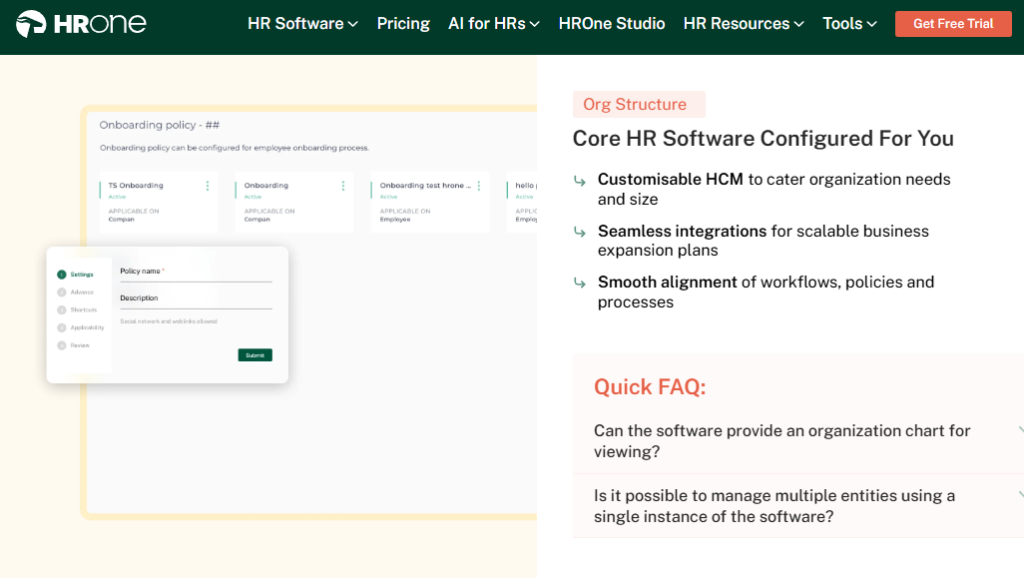
HROne is a cloud-based, mobile-native HR software founded in 2016 and built for Indian mid-market and enterprise teams of 100 to 5,000 employees. It runs live across 1,500+ brands, including enterprises like MR DIY India and Asia Healthcare Holdings. On G2, users rank it among the highest-satisfaction HR products, and its dedicated support model carries a 9.8 NPS. It is primarily used by HR ops teams stitching together payroll, attendance, and recruitment tools that never spoke to each other.
Core Services
- Inbox for HR surfaces every pending task, request, and approval in one Gmail-style inbox, so HR closes items in three clicks instead of switching between five tools, cutting admin time.
- 127 pre-built workflows across 30+ modules define who does what and by when, from pre-boarding to exit clearance, so HR stops chasing managers over email.
- Payroll Engine automates PF, ESI, and TDS with bank challan generation, removing manual reconciliation errors during month-end runs.
- Time Office with live biometric sync matches biometric and mobile punches in real time, so field and remote staff mark attendance accurately without manager follow-ups.
- One AI Suite stacks the most relevant CVs on top and auto-parses expense receipts, so recruiters and finance stop doing manual data entry.
- India’s first inbuilt ROI Dashboard calculates lifetime hours saved against average HR salary, so CHROs walk into board reviews with a rupee figure.
🇮🇳 India-Specific Compliance and Localization
- PF/ESI/TDS: Yes (automated calculation, filing, and reconciliation).
- Labour law compliance: Strong (statutory logic maintained for Indian rules).
- Payroll localization: Yes (PT and LWF slab calculation, Form-16, arrears).
- Multi-state compliance handling: Yes (multi-legal-entity policies on one instance).
Who This Is Built For
- Payroll Manager firefighting PF, ESI, and PT slab errors across multiple states each month-end.
- HR ops lead manually reconciling biometric exports against a separate leave portal.
- CHRO who cannot answer, at a board review, how long onboarding or a confirmation letter actually takes.
Who Should Skip This
- Very small teams under 50 employees wanting lightweight, spreadsheet-style tracking without structured workflows.
- Buyers who want a mature, fully featured AI command assistant today, since some users note AI features were still maturing during their use.
Pricing Structure
- Plan Type(s): Modular, flat per-employee-per-month (PEPM).
- Starting Price: Not publicly disclosed as a fixed figure, request a quote; billing meters only after go-live. See pricing.
- Tier-wise Breakdown: Priced by module bundles selected (core HR, payroll, performance, engagement).
- Incremental Cost Drivers: Additional modules and AI add-ons.
- Implementation Fee: Yes, bundled with the SPOC-led onboarding, quoted per deployment.
- Cost at 200 Employees: Not publicly disclosed, request a quote. Cost at 500 Employees: Not publicly disclosed, request a quote.
Implementation and Support Reality
- Go-live achievable in as little as 30 days for mid-market enterprises via the prior-HR SPOC model.
- Support via phone, email, and a dedicated SPOC who has actually done HR, not a technical PM reading a checklist.
- Data migration is vendor-led, with reviewers reporting fast transfers from legacy ERP servers.
- Publicly referenced 9.8 NPS on dedicated support.
Reviews
“The InboxforHR is a game-changer, centralizing every HR task into one simple inbox, cutting down administrative time by 60-70% and preventing tasks from falling through the cracks.”
Waldon S., 4/5 HROne G2 Verified Review
“It can sometimes feel a bit overwhelming for new users. Certain features take time to understand, and without enough guided support, the learning curve can feel quite steep.”
Nijanthan R., 3.5/5 HROne G2 Verified Review
1.2 Darwinbox
Darwinbox is a brand-name enterprise HCM suite popular with very large Asian enterprises.
Overview
Darwinbox is a cloud HCM built for large enterprises and recognized by Gartner as a Challenger in the 2025 Magic Quadrant for Cloud HCM Suites, its second consecutive year in that position. It brings attendance, payroll, and performance onto one platform with a well-regarded mobile app. It is primarily used by large teams replacing a mix of Excel sheets and legacy tools with a single system. See how we stack up on our HROne vs Darwinbox comparison.
Core Services
- Unified HR platform brings attendance, leave, payroll, and performance together, so teams stop juggling multiple tools for routine tasks.
- Mobile app lets employees apply for leave, track attendance, and check payslips on the go, reducing desk dependence.
- Configurable workflows adapt to internal processes with limited technical intervention, per user reports.
- Performance and recruitment modules cover the talent lifecycle, though users note these need training to use fully.
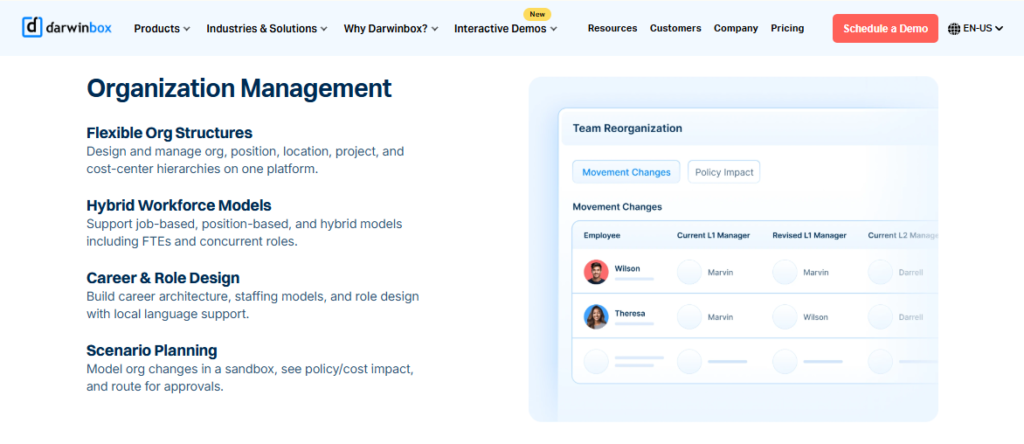
- Organizational directory maps reporting structures so employees can navigate the org easily.
🇮🇳 India-Specific Compliance and Localization
- PF/ESI/TDS: Yes (India payroll supported for enterprise clients).
- Labour law compliance: Moderate to Strong (enterprise India focus).
- Payroll localization: Yes (built with Indian enterprises in mind).
- Multi-state compliance handling: Yes (enterprise-scale configuration).
Who This Is Built For
- HR leader at a large enterprise consolidating scattered Excel and legacy tools into one platform.
- Manager who wants bulk leave and attendance approvals from a single mobile view.
Who Should Skip This
- Mid-market teams needing fast, low-friction implementation, since some users report slow performance and integration inconsistency.
- Buyers wanting flexible short-term commercials, since Darwinbox typically runs quote-based, multi-year contracts.
Pricing Structure
- Plan Type(s): Enterprise, quote-based.
- Starting Price: Not publicly disclosed, request a quote.
- Tier-wise Breakdown: Not publicly published; scoped per enterprise deployment.
- Incremental Cost Drivers: Module scope, employee count, add-on services.
- Implementation Fee: Not publicly disclosed, typically bundled into the enterprise contract.
- Cost at 200 Employees: Not publicly disclosed, request a quote. Cost at 500 Employees: Not publicly disclosed, request a quote.
Implementation and Support Reality
- Enterprise implementations are vendor-led and can run several weeks to months depending on scope.
- Support quality is mixed in user reviews, ranging from smooth to frustrating.
- Data migration is vendor-led, though some users report a difficult transition from older systems.
- No single published NPS figure available.
Reviews
“Darwinbox has made HR processes much smoother by bringing everything together on one platform. From attendance to payroll and performance tracking, it saves time and reduces manual effort.”
Saksham A., 4/5 Darwinbox G2 Verified Review
“Bad implementation experience, bad UI UX, configurations getting broken in production on its own due to product deployments, terrible customer service. Basically everything.”
Verified User in Computer Software, 0/5 Darwinbox G2 Verified Review
1.3 PeopleStrong
PeopleStrong is an India-born enterprise HCM built for large domestic workforces.
Overview
PeopleStrong is a homegrown Indian HCM serving large enterprises across India and Southeast Asia. It focuses on the full talent lifecycle, from hiring through workforce management, and is used by big domestic employers wanting an India-native suite at enterprise scale. It positions around AI-led HR and mobile-first employee experience for high-headcount organizations.
Core Services
- Core HR and workforce management hold a single employee record, so large teams stop maintaining parallel spreadsheets across units.
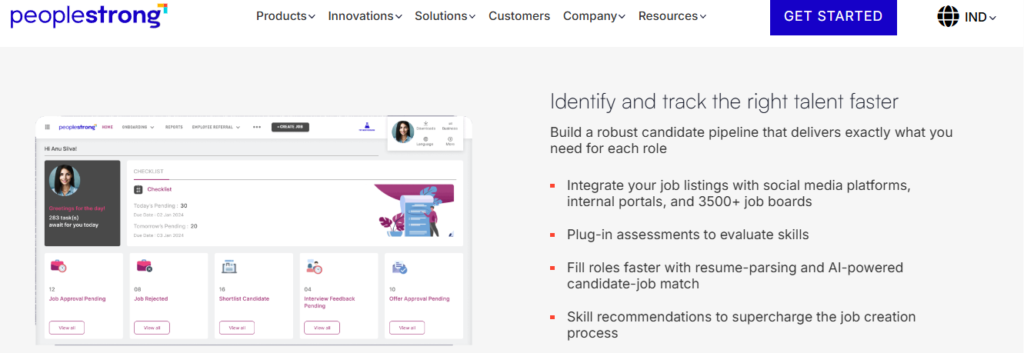
- Talent acquisition module runs sourcing to onboarding in one flow, reducing manual handoffs between recruiters and HR.
- Payroll and compliance handle Indian statutory calculations, so payroll teams cut manual reconciliation at month-end.
- Performance management structures goals and reviews, removing the Excel-based appraisal chase.
- Employee mobile app lets staff apply for leave and view payslips, cutting routine HR queries.
🇮🇳 India-Specific Compliance and Localization
- PF/ESI/TDS: Yes (built for Indian statutory payroll).
- Labour law compliance: Strong (India enterprise focus).
- Payroll localization: Yes (India-native design).
- Multi-state compliance handling: Yes (large multi-location employers).
Who This Is Built For
- HR Head at a large Indian enterprise wanting one India-native suite across thousands of employees.
- Talent acquisition lead consolidating a disconnected hiring stack into one flow.
Who Should Skip This
- Small teams under 200 employees wanting a lightweight, fast-to-deploy tool.
- Buyers wanting fully public, self-serve pricing without a sales cycle.
Pricing Structure
- Plan Type(s): Enterprise, quote-based.
- Starting Price: Not publicly disclosed, request a quote.
- Tier-wise Breakdown: Not publicly published; scoped per deployment.
- Incremental Cost Drivers: Module scope, employee count, add-on services.
- Implementation Fee: Not publicly disclosed, typically bundled into the enterprise contract.
- Cost at 200 Employees: Not publicly disclosed, request a quote. Cost at 500 Employees: Not publicly disclosed, request a quote.
Implementation and Support Reality
- Enterprise implementations are vendor-led and typically run several weeks to months.
- Support is vendor-led with account management for large clients.
- Data migration is vendor-led during onboarding.
- No single published NPS figure available.
1.4 SAP SuccessFactors
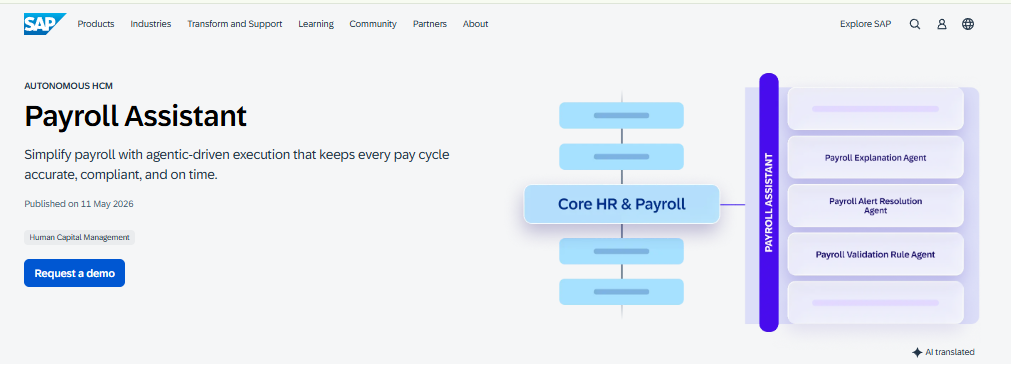
SAP SuccessFactors is a global enterprise HCM suite for multi-country standardization.
Overview
SAP SuccessFactors is a cloud HCM used by large multinationals to standardize HR across many countries. Gartner has repeatedly named SAP a Leader in its Magic Quadrant for Cloud HCM Suites for 1,000+ employee enterprises. It is primarily used by global firms needing one system of record spanning several regions and currencies. Firms weighing this often compare our HROne vs SAP breakdown.
Core Services
- Employee Central holds a global core HR record, so multinationals stop reconciling data across country systems.
- Recruiting and onboarding manage global hiring pipelines, reducing manual candidate tracking.
- Performance and goals run structured global review cycles across large populations.
- Compensation management models pay across geographies, cutting manual comp spreadsheets.
- Learning (LMS) tracks compliance training, though users report dated tooling.
🇮🇳 India-Specific Compliance and Localization
- PF/ESI/TDS: Partial (India payroll often needs a local partner or add-on).
- Labour law compliance: Moderate (global-first, India via localization packs).
- Payroll localization: Partial (frequently delivered through partners).
- Multi-state compliance handling: Partial (configurable, but not India-native).
Who This Is Built For
- HR leader at a multinational standardizing HR across many countries on one system.
- CHRO at a 5,000+ employee global firm needing deep compensation and analytics tooling.
Who Should Skip This
- 100 to 1,000 employee India-only firms, since users call it “extremely expensive for what it delivers”.
- Teams wanting to change a leave policy without third-party developers.
Pricing Structure
- Plan Type(s): Enterprise modules, quote-based.
- Starting Price: Not publicly disclosed, request a quote.
- Tier-wise Breakdown: Not publicly published; priced per module and headcount.
- Incremental Cost Drivers: Module count, third-party customization, implementation partners.
- Implementation Fee: Yes, typically separate and partner-delivered, often substantial.
- Cost at 200 Employees: Not publicly disclosed, request a quote. Cost at 500 Employees: Not publicly disclosed, request a quote.
Implementation and Support Reality
- Implementations are partner-led and can run several months for large deployments.
- Support is partner-delivered, with quality varying by implementation partner.
- Data migration is partner-led and resource-heavy.
- No single India-specific published NPS figure available.
Reviews
“Not user-friendly, system often freezes. Customization requires third-party vendors, every change is costly. Extremely expensive for what it delivers.”
Janka Z., 0/5 SAP SuccessFactors G2 Verified Review
1.5 greytHR
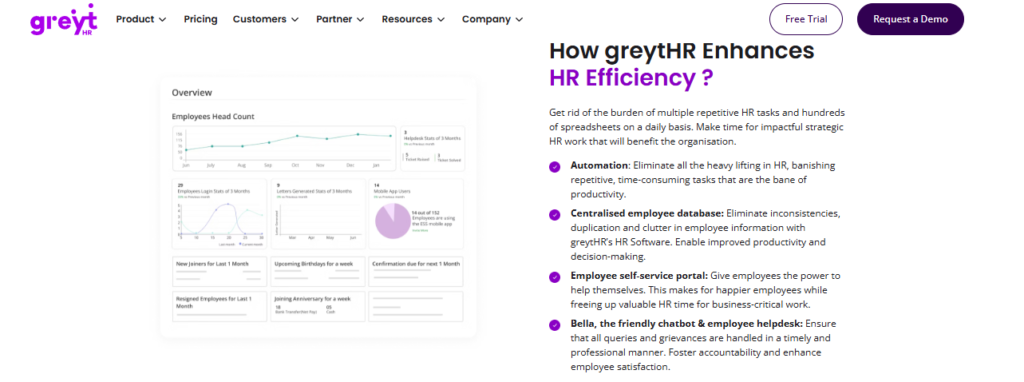
greytHR is a payroll-and-compliance HR tool popular with Indian SMBs.
Overview
greytHR is one of India’s longest-running HR and payroll platforms, widely adopted by small and mid-sized businesses. It focuses on core payroll, statutory compliance, and leave management. It is primarily used by cost-conscious teams wanting reliable payslips and statutory basics without heavy configuration. Teams outgrowing it often review our HROne vs greytHR comparison.
Core Services
- Payroll engine automates salary, PF, ESI, and TDS, so SMBs stop calculating statutory deductions by hand.
- Leave and attendance track balances and holidays, reducing manual leave tracking.
- Employee self-service lets staff pull payslips and declare taxes, cutting HR queries.
- Statutory compliance generates challans and filings for Indian rules.
🇮🇳 India-Specific Compliance and Localization
- PF/ESI/TDS: Yes (core strength of the product).
- Labour law compliance: Moderate (solid basics, limited flexibility).
- Payroll localization: Yes (India-native payroll).
- Multi-state compliance handling: Partial (users report configuration limits).
Who This Is Built For
- Payroll manager at an SMB wanting reliable monthly payslips and statutory filings.
- HR generalist who needs self-service leave and tax declaration without heavy setup.
Who Should Skip This
- Multi-legal-entity or shift-based manufacturing firms, since users say it is “not much good at customizing based on our requirements”. See our manufacturing HR fit instead.
- Teams needing full mobile parity, since reviewers report the app “lacks key functionality compared to the web version”.
Pricing Structure
- Plan Type(s): Tiered per-employee plans (published tiers on greytHR site).
- Starting Price: Not publicly disclosed as a fixed figure here, request a quote; entry tiers target SMBs.
- Tier-wise Breakdown: Tiers scale by employee count and module access.
- Incremental Cost Drivers: Add-on modules and higher employee bands.
- Implementation Fee: Not publicly disclosed, request a quote.
- Cost at 200 Employees: Not publicly disclosed, request a quote. Cost at 500 Employees: Not publicly disclosed, request a quote.
Implementation and Support Reality
- Go-live is relatively quick for SMB payroll setups.
- Support is email and ticket-led, with mixed user reports on responsiveness.
- Data migration is largely self-serve or lightly assisted.
- No single published NPS figure available.
Reviews
“GreythR is fine software for payroll processing and I have been using since 10 years. Better UI, simplicity and time for support.”
Krishnanand B., 3/5 greytHR G2 Verified Review
“GreytHR is not much good at customizing based on our requirements. Many times we were manually correcting the leave balance of employees.”
Verified User in IT and Services, 2/5 greytHR G2 Verified Review
1.6 Keka
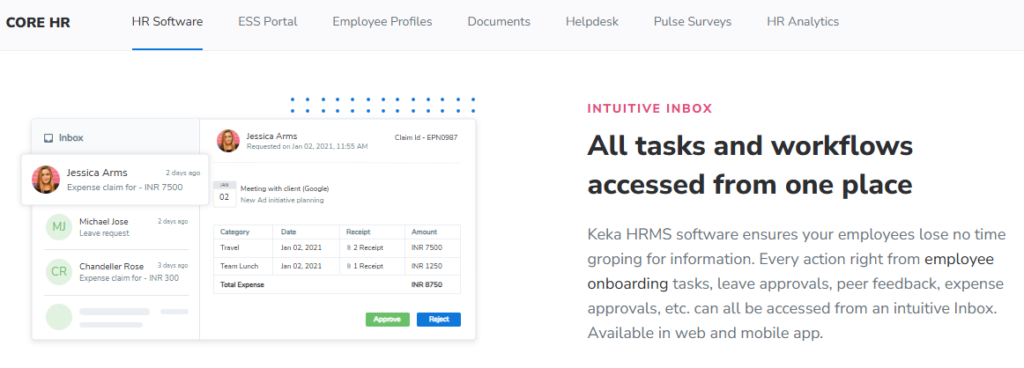
Keka is a UX-forward HR and payroll platform for Indian mid-market teams.
Overview
Keka is a modern Indian HRMS known for a clean, intuitive interface across payroll, attendance, and performance. It has strong adoption among growing mid-market firms. It is primarily used by teams that want polished daily usability, though some report implementation and support gaps. Buyers weighing options often check our HROne vs Keka page.
Core Services
- Payroll and compliance automate salary, PF, ESI, and TDS, reducing manual month-end calculations.
- Attendance and leave track punches and balances with a mobile app.
- Performance (PMS) structures goals and reviews, though users find it confusing.
- Hiring (Keka Hiro) automates offer workflows and approvals.
- Document management generates HR letters, cutting paperwork.
🇮🇳 India-Specific Compliance and Localization
- PF/ESI/TDS: Yes (automated statutory payroll).
- Labour law compliance: Moderate (solid for standard setups).
- Payroll localization: Yes (India-native).
- Multi-state compliance handling: Partial (users report config gaps for complex cases).
Who This Is Built For
- HR generalist at a mid-market firm wanting a clean, low-training interface.
- Payroll manager wanting automated statutory processing for standard structures.
Who Should Skip This
- Teams needing weekend or emergency support, since users report “no source of support” Friday evening to Monday.
- IT consulting firms, with one long-time user saying “Keka is not built to service IT consulting firms”. Our ITES HR fit addresses this directly.
Pricing Structure
- Plan Type(s): Tiered plans (Foundation, Strength, Growth as published by Keka).
- Starting Price: Not publicly disclosed as a fixed figure here, request a quote; per-employee monthly billing.
- Tier-wise Breakdown: Tiers add PMS, hiring, and advanced modules as you move up.
- Incremental Cost Drivers: Higher tiers and add-on modules.
- Implementation Fee: Not publicly disclosed, request a quote.
- Cost at 200 Employees: Not publicly disclosed, request a quote. Cost at 500 Employees: Not publicly disclosed, request a quote.
Implementation and Support Reality
- Go-live varies; some users report slow, poorly coordinated implementation.
- Support is email and ticket-led, with reported weekend gaps.
- Data migration is vendor-assisted.
- No single published NPS figure available.
Reviews
“Strong payroll and compliance, automate salary and attendance processing with PF/ESI/TDS. Responsive support team. Mobile app available.”
Kiran B., 3/5 Keka G2 Verified Review
“We have been unable to implement the tool in our company due to their consistently delayed responses and poor coordination between their internal teams.”
Divya p., 0/5 Keka G2 Verified Review
1.7 ZingHR
ZingHR is an enterprise hire-to-retire suite with broad module coverage.
Overview
ZingHR is an Indian enterprise HCM offering hire-to-retire modules including payroll, performance, and learning. It targets large workforces wanting integrated coverage. It is primarily used by enterprises seeking breadth, though users flag UI and support issues. A side-by-side view sits on our HROne vs ZingHR page.
Core Services
- Core HR and workforce maintain employee data across the lifecycle.
- Payroll handles salary, tax deductions, and payslips with a tax simulator.
- Performance management structures goals and reviews.
- Learning and development supports training tracking.
- Helpdesk logs and tracks HR queries.
🇮🇳 India-Specific Compliance and Localization
- PF/ESI/TDS: Yes (India payroll with tax tools).
- Labour law compliance: Moderate (enterprise India focus).
- Payroll localization: Yes (India-native payroll).
- Multi-state compliance handling: Partial (customization reported as slow and costly).
Who This Is Built For
- Enterprise HR leader wanting broad hire-to-retire coverage in one suite.
- Payroll team wanting a built-in tax simulator and payslip automation.
Who Should Skip This
- Teams prioritizing modern UI and fast support, since users call the interface “outdated” and support “not great”.
- Firms needing quick implementation, with one user reporting only “40%” done in six months.
Pricing Structure
- Plan Type(s): Enterprise, quote-based.
- Starting Price: Not publicly disclosed, request a quote.
- Tier-wise Breakdown: Not publicly published; scoped per deployment.
- Incremental Cost Drivers: Module scope, customization, employee count.
- Implementation Fee: Not publicly disclosed, typically bundled.
- Cost at 200 Employees: Not publicly disclosed, request a quote. Cost at 500 Employees: Not publicly disclosed, request a quote.
Implementation and Support Reality
- Implementations are vendor-led; some users report long, incomplete rollouts.
- Support is vendor-led, with reported delays of days to weeks.
- Data migration is vendor-led.
- No single published NPS figure available.
Reviews
“The fact that the system has multiple capabilities of being an integrated system to support an organization from its Hire to retire stages.”
Sanmeet S., 2/5 ZingHR G2 Verified Review
“System implementation experience was horrible, in 6 months the implementation was barely completed to 40%. Support is never on time.”
Sanmeet S., 2/5 ZingHR G2 Verified Review
1.8 Zoho People
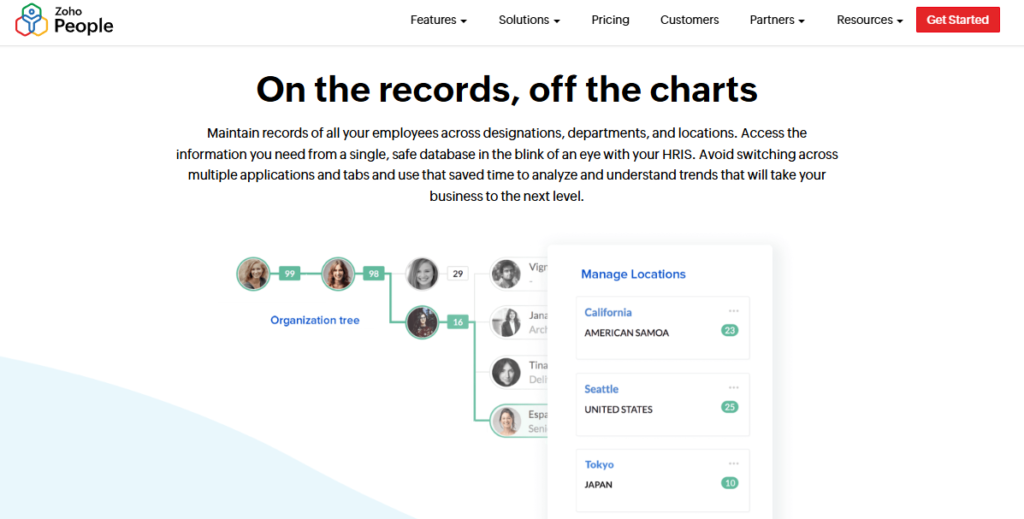
Zoho People is an affordable HR tool best for existing Zoho-ecosystem users.
Overview
Zoho People is the HR module within Zoho’s broad business software suite. It is affordable and integrates tightly with other Zoho apps like Zoho Payroll and Zoho Recruit. It is primarily used by teams already inside the Zoho ecosystem wanting attendance, leave, and onboarding at a low price point. A direct contrast lives on our HROne vs Zoho People page.
Core Services
- Attendance and leave manage requests and approvals digitally, cutting manual tracking.
- Onboarding lets candidates self-enter data, completing onboarding within a day.
- Zoho app integration connects to Zoho Payroll and Recruit, streamlining hire-to-pay.
- Employee self-service shows leave balances, reducing HR email load.
🇮🇳 India-Specific Compliance and Localization
- PF/ESI/TDS: Partial (via Zoho Payroll integration, not all regions).
- Labour law compliance: Moderate (global-first product).
- Payroll localization: Partial (depends on Zoho Payroll availability).
- Multi-state compliance handling: Partial (limited depth reported).
Who This Is Built For
- HR generalist at a firm already standardized on Zoho apps.
- Cost-conscious team wanting affordable attendance and leave management.
Who Should Skip This
- Teams needing deep, India-specific payroll and compliance, since users say “features are shallow and there is no depth”. Compare with our payroll software.
- Firms needing fast, reliable support, with reviewers reporting long response times.
Pricing Structure
- Plan Type(s): Tiered per-user plans plus a free tier (published by Zoho).
- Starting Price: Low entry per-user monthly pricing; freemium tier available.
- Tier-wise Breakdown: Tiers add performance, cases, and advanced features moving up.
- Incremental Cost Drivers: Higher tiers, Zoho Payroll add-on, per-user scaling.
- Implementation Fee: Generally none for self-serve setup.
- Cost at 200 Employees: Scales by per-user tier; confirm current rate on Zoho pricing page. Cost at 500 Employees: Same, per-user scaling.
Implementation and Support Reality
- Self-serve setup with instructional videos; onboarding can be quick.
- Support is email and ticket-led, with reported slow response times.
- Data migration is largely self-serve.
- No single published NPS figure available.
Reviews
“The initial setup was very easy, supported by available instructional videos that eased the onboarding process.”
Anshul M., 4/5 Zoho People G2 Verified Review
“The biggest drawback for me has been the lack of customer support. Additionally, the mobile application is quite limited.”
Dhana C., 4/5 Zoho People G2 Verified Review
1.9 Oracle HCM Cloud
Oracle HCM Cloud is a global enterprise HCM for firms already on the Oracle stack.
Overview
Oracle Fusion Cloud HCM is a global enterprise suite covering the full HR lifecycle with deep analytics. Gartner names Oracle a Leader in its Cloud HCM Suites Magic Quadrant for large enterprises. It is primarily used by global firms standardizing HR alongside other Oracle enterprise systems.
Core Services
- Global core HR holds one worldwide employee record, ending country-by-country reconciliation.
- Payroll and workforce management run at global scale with configurable rules.
- Talent management covers recruiting, performance, and succession in one suite.
- HR analytics deliver deep reporting for large populations.
- Oracle ecosystem integration connects HCM with Oracle ERP and finance.
🇮🇳 India-Specific Compliance and Localization
- PF/ESI/TDS: Partial (India payroll often via localization or partner).
- Labour law compliance: Moderate (global-first, India through configuration).
- Payroll localization: Partial (partner-supported in many cases).
- Multi-state compliance handling: Partial (configurable, not India-native).
Who This Is Built For
- Global enterprise already running Oracle ERP wanting HR on the same stack.
- CHRO at a 5,000+ employee firm needing deep global analytics.
Who Should Skip This
- 100 to 1,000 employee India-only firms, where the suite is over-engineered and costly.
- Teams wanting fast, low-cost deployment without a long implementation. Our core HCM targets exactly this band.
Pricing Structure
- Plan Type(s): Enterprise per-employee subscription, quote-based.
- Starting Price: Not publicly disclosed, request a quote.
- Tier-wise Breakdown: Not publicly published; priced per module and headcount.
- Incremental Cost Drivers: Module scope, implementation partners, integrations.
- Implementation Fee: Yes, typically separate and partner-delivered.
- Cost at 200 Employees: Not publicly disclosed, request a quote. Cost at 500 Employees: Not publicly disclosed, request a quote.
Implementation and Support Reality
- Partner-led implementations that can run several months for large deployments.
- Support is partner-delivered with Oracle backing.
- Data migration is partner-led and resource-heavy.
- No single India-specific published NPS figure available.
1.10 Workday HCM
Workday HCM is a premium global HCM for very large multinational enterprises.
Overview
Workday is a premium cloud HCM used by large multinationals for HR and finance on one platform. Gartner consistently names Workday a Leader in its Cloud HCM Suites Magic Quadrant. It is primarily used by 3,000+ employee global firms wanting best-in-class analytics and a unified people-and-finance system.
Core Services
- Global core HR holds a single worldwide record, ending fragmented country systems.
- Payroll and workforce management run at enterprise scale with strong controls.
- Talent and performance cover the full talent lifecycle in one suite.
- People analytics deliver advanced, real-time workforce insight.
- Finance integration unifies HR and finance data on one platform.
🇮🇳 India-Specific Compliance and Localization
- PF/ESI/TDS: Partial (India payroll typically via partner or connector).
- Labour law compliance: Moderate (global-first design).
- Payroll localization: Partial (lighter India-native depth).
- Multi-state compliance handling: Partial (configurable, not India-tuned).
Who This Is Built For
- Multinational with 3,000+ employees wanting unified HR and finance analytics.
- CHRO needing best-in-class global reporting across many regions.
Who Should Skip This
- Mid-market Indian firms of 100 to 1,000 employees, where cost and complexity outweigh the benefit. See our best enterprise HRMS in India guide.
- Teams wanting deep, India-native statutory payroll out of the box.
Pricing Structure
- Plan Type(s): Enterprise per-employee subscription, quote-based.
- Starting Price: Not publicly disclosed, request a quote.
- Tier-wise Breakdown: Not publicly published; priced per module and headcount.
- Incremental Cost Drivers: Module scope, implementation partners, integrations.
- Implementation Fee: Yes, typically separate, partner-delivered, and substantial.
- Cost at 200 Employees: Not publicly disclosed, request a quote. Cost at 500 Employees: Not publicly disclosed, request a quote.
Implementation and Support Reality
- Partner-led implementations running several months for large enterprises.
- Support is partner-delivered with Workday backing.
- Data migration is partner-led and resource-heavy.
- No single India-specific published NPS figure available.
🎯 Reading This Ranking
Across these 10, the pattern holds: global Leaders like SAP, Oracle, and Workday win on multi-country scale, while India-native tools win on the PF, ESI, and multi-state rules that decide whether payroll runs clean. From what surfaces when you actually run this at 100 to 5,000 employees, the deciding factor is rarely module count. It is whether every workflow triggers the next one, so HR stops chasing managers over email and can prove reclaimed hours back to the board, which is the gap HROne’s connected HR inbox and inbuilt ROI Dashboard are built to close.
Q2. Core HR vs HRMS vs HCM, and Why Do Most Systems Break at Enterprise Scale?
Core HR handles the foundational base: records, attendance, payroll, and statutory compliance. HRMS (Human Resource Management System) adds automation and self-service on top. HCM (Human Capital Management) extends further into talent, performance, and analytics. Most systems break at scale not because they are unfair, but because they are too uniform. They cannot hold different policies per legal entity, they buckle under multi-state taxes, and they keep HR person-dependent instead of process-dependent.
🧩 Decoding the Alphabet Soup
Think of it as three layers stacked on one base. Core HR is the ground floor: your single employee record, attendance, payroll, and PF, ESI, and TDS filing. HRMS wraps that in automation and employee self-service, so staff pull payslips without pinging HR.
HCM is the top floor, adding recruitment, performance, and workforce analytics. Every system on the market falls into one of these three buckets. Research links a well-implemented HRIS (Human Resource Information System) to stronger organizational performance and competitive advantage, so the layer you buy matters. Our core HCM is built on exactly this layered logic.
💸 The ERP Money Pit
Here is where large firms go wrong. A 2,000-employee manufacturer often assumes it needs a full enterprise resource planning (ERP) suite, the giant software that runs finance, supply chain, and HR together. So it spends heavily, sometimes upwards of $300,000, and the rollout still stalls.
The truth is most of these firms need core HR done right first, not ERP-scale spend. I have seen teams pay enterprise money for a database that still cannot run payroll software cleanly across states. The base has to be solid before the fancy analytics layer means anything.
⚠️ Why Uniformity, Not Unfairness, Breaks Systems
Here is the contrarian read the category avoids. Most HR systems did not fail because they were unfair. They failed because they were too uniform. They force Company A and Company B under one group to run the identical policy, when their leave, shift, and pay rules differ.
That rigidity shows up fast at scale. A firm gets handstrung by multiple state tax situations, because Professional Tax slabs differ across states. Attendance systems built for one shift pattern collapse in manufacturing HR, where we have seen occupancy assumptions run 150% over plan before a proper engine cut that by around 70%.
The deeper problem is person-dependence. When HR runs around chasing managers for updates, the process lives in people’s heads, not the system. At HROne, we built a core-HR-first HCM with a multi-entity policy engine precisely so different legal entities can hold different policies on one instance, which is the fix for the uniformity trap. Good software optimizes the HR professional; it does not replace them.
Q3. Which Is the Best Core HR Software for Large Companies in India?
For large Indian companies, HROne is the best core HR software when you need deep multi-entity compliance and a 30-day go-live for 100 to 5,000 employees. Darwinbox and PeopleStrong suit 1,500+ India-native enterprises. SAP SuccessFactors and Oracle HCM fit global multinationals. The best choice depends on your entity structure, workforce type, and compliance complexity, because there is no single end-all system.
🎯 Best Fit by Scenario
I will be honest here. After years in this work, I have yet to find a system that is the end-all, be-all for every HR team. The right pick is a fit exercise, matched to your workforce type and headcount band.
| Your Situation | Best-Fit Pick | Why |
|---|---|---|
| Compliance-heavy, multi-entity, 100 to 5,000 employees | HROne | India-native multi-state PF, ESI, TDS, and multi-legal-entity on one instance |
| Multi-location, manufacturing, deskless staff | HROne | Mobile-first attendance with live biometric sync for field teams |
| 1,500+ India-native enterprise | Darwinbox, PeopleStrong | Brand-name suites built for large domestic workforces |
| Global MNC standardizing across countries | SAP SuccessFactors, Oracle HCM | Multi-country, multi-currency scale |
⚠️ The Middle-Market Lockout
Here is the trap nobody names. Several premium global vendors like Workday effectively sell only to firms with 3,000 or more employees. A 500-person Indian company gets treated as an unqualified lead on budget.
That leaves a large, underserved middle. From what surfaces when you actually run this, the 100 to 5,000 India-native band is exactly where HROne is built to win, with a prior-HR onboarding SPOC (single point of contact) getting mid-market firms live in as little as 30 days. Do not buy the biggest name; buy the HR software that will actually configure your entity structure.
💬 What Users Say
“I love HROne for its cost efficiency and holistic approach, which is why I prefer it over other vendors like Workday.”
Priyanka S., 5/5 HROne G2 Verified Review
“Darwinbox has made HR processes much smoother by bringing everything together on one platform. From attendance to payroll and performance tracking, it saves time.”
Saksham A., 4/5 Darwinbox G2 Verified Review
Q4. What Makes Software Truly Enterprise-Grade for Multi-Entity, Multi-State Indian Firms?
Enterprise-grade core HR means one instance running multiple legal entities with different policies, three-layer role-based access for 5,000+ employees, and automation across 10 modules and 127 workflows from pre-boarding to exit. It adds AI that stacks the most relevant CVs on top, plus native automation of EPFO and ESIC filings, multi-state Professional Tax, TDS, and two-day Full and Final Settlement. Anything less is a database pretending to be a system.
🏢 The Multi-Entity Policy Engine
Start here, because this is the make-or-break. A true enterprise system runs multiple legal entities in a single instance, and a policy engine lets Company A hold a different leave, shift, or pay policy than Company B. Without it, you either fork into separate systems or force everyone into one rigid rulebook.
This is the fix for the uniformity trap that breaks most tools at scale. Asia Healthcare Holdings runs 20 pan-India units on a single HROne instance using exactly this multi-legal-entity configuration. That is the difference between a system and a spreadsheet with a login.
🔐 Three-Layer RBAC for Scale
Next, access control. Enterprise-grade means three-layer role-based access control (RBAC), the rules deciding who can see and edit what. You grant access rights across three layers, so a unit HR head, a manager, and an employee each see only their slice.
This is what lets a system scale past 5,000 employees without data leaking across entities. At that headcount, loose permissions become a compliance and privacy risk, not just an annoyance. Our workforce management module is designed around this layered control.
⚙️ The 127-Workflow Threshold
Depth of automation is the real test. Enterprise-grade means roughly 10 modules and 127 pre-built workflows covering the full lifecycle, from pre-boarding through confirmation, transfer, promotion, and exit clearance. Each workflow defines who does what and by when, so HR stops chasing managers over email.
Layer AI on top. HROne’s One AI Suite scores resume relevancy, stacking the most relevant CVs on top with relevancy scores in the 95 to 97% range, so recruiters skip manual screening. A global search that returns results in a fraction of a second, plus mobile employee self-service (ESS), drives the daily adoption that makes any of this stick.
🇮🇳 The India Statutory Checklist
Now the highest-stakes layer, compliance. This is where global generalists quietly fail. Your system must natively handle these, not bolt them on.
- PF and ESI: Automated EPFO and ESIC calculation, filing, and reconciliation (Provident Fund and Employees’ State Insurance).
- Multi-state Professional Tax (PT): Different slabs per state, applied automatically, so you are not handstrung by multiple state tax situations.
- TDS: Tax Deducted at Source, computed with current slabs and Form-16 generation.
- Full and Final Settlement (F&F): Fast exit settlement, targeting two-day turnaround under the Labour Codes.
For a deeper walkthrough, see our PF, ESI, and TDS compliance guide and our multi-state payroll compliance breakdown.
📊 Payroll Data as Analytics
Here is the part most buyers miss. The last mark of enterprise-grade is turning payroll data into forward-looking insight, not just storing it. ADP holds a patent on modeling “workforce vitality,” a performance measure derived directly from payroll data to predict outcomes like attrition.
That is the leap from a system that houses data to one that acts on it. HROne’s inbuilt ROI Dashboard, India’s first, calculates lifetime hours saved against average HR salary, so a CHRO walks into a board review with savings already quantified in rupees. A database records the past; an enterprise system helps you see what is coming. Try our ROI calculator to model your own numbers.
💬 What Users Say
“Proper calculation of PF and ESI was a pain area for us before, but now with the HROne automated calculation process, results are up to the mark and following Indian tax compliances properly.”
Ajay K., 5/5 HROne G2 Verified Review
“Not user-friendly, system often freezes. Customization requires third-party vendors, every change is costly.”
Janka Z., 0/5 SAP SuccessFactors G2 Verified Review
Q5. What Does Enterprise HR Software Really Cost, in Time, Trauma, and 3-Year TCO?
The real cost of enterprise HR software is not the license. It is the implementation. Poorly run rollouts can traumatize a team over a span of years, and research shows success depends on change management and training, not just features. Budget for a dedicated implementation SPOC (single point of contact) and model your total cost of ownership (TCO) over three years, because the right system can cut HR operations occupancy by around 70%.
🏭 The Situation: An HR Lead at 150% Occupancy
Picture an HR ops lead at a mid-sized manufacturer. Her attendance management system was built for one shift, but the plant runs several. Occupancy assumptions ran roughly 150% over plan, so month-end became a manual reconciliation nightmare.
She is not short on tools. She is short on tools that talk to each other. Payroll, biometric attendance, and recruitment all sit in separate boxes, and she stitches them by hand every cycle. A connected manufacturing HR stack removes that manual stitching.
⚠️ The Complication: Trauma, the ERP Money Pit, and Hidden TCO
Here is what the ranking pages skip. The license fee is the small number. Implementation can traumatize you over years when the vendor hands you a checklist and a ticket queue instead of a person.
Then there is the ERP (enterprise resource planning) money pit, where firms overspend on a giant suite when they needed core HR done right first. Buyers also often prefer buying in a bundle, typically four, six, or eight modules together, which changes the math. Your true TCO includes migration, retraining, downtime, and the productivity you lose while the system limps. Our payroll software is priced to avoid that overspend.
✅ The Resolution: A SPOC, Phased Go-Live, and Quantified ROI
This is where the operating model matters more than the feature list. At HROne, we assign a prior-HR onboarding SPOC (9.8 NPS) who has actually done the job, not a technical project manager reading a script. A phased go-live gets mid-market firms live in as little as 30 days.
The payoff is measurable, not vibes. In one manufacturing case, occupancy dropped by around 70% once the shift engine ran properly. Across our base, the system completes up to 1.5 crore tasks monthly, and the inbuilt ROI Dashboard calculates the minutes saved per task, so you see how many hours you reclaimed in rupee terms.
💰 How to Model Your Own 3-Year TCO
Do not accept a single license quote. Build a three-year model before you sign.
- Year 0: Implementation fee, data migration, and retraining hours.
- Years 1 to 3: Subscription (flat per-employee-per-month is cleaner than surprise per-entity fees), plus module add-ons.
- The offset: Hours saved per HR task, multiplied by your average HR salary.
I might be wrong on the exact rupee figures for your firm, but the method holds. What I keep sitting with is this: why do so many boards approve six-figure licenses without ever asking the vendor to prove the hours saved? Ask that question first, or model it yourself with our ROI calculator.
💬 What Users Say
“The initial setup of HROne was surprisingly straightforward, much lighter than expected for a full HRMS. The InboxforHR is a game-changer, cutting down administrative time by 60-70%.”
Waldon S., 4/5 HROne G2 Verified Review
“We started working with Keka HRMS in August, and to this day, we have been unable to implement the tool due to consistently delayed responses and poor coordination.”
Divya p., 0/5 Keka G2 Verified Review
Q6. How Do HROne, Darwinbox, Keka, and greytHR Compare, and How Do You Build Your Shortlist?
Among India-native platforms, HROne differentiates on a dedicated HR SPOC with a 9.8 NPS versus competitors’ “endless email threads,” true multi-entity policy configuration, and ROI analytics that quantify hours saved. Darwinbox scales for very large enterprises, greytHR is payroll-heavy for small and mid-sized firms, and Keka suits mid-market teams. Build your shortlist by writing a bulleted RFP (request for proposal) and demanding each vendor prove it live.
⚖️ The Head-to-Head
Here is the honest read across the four India-native contenders. Each wins somewhere; the question is where your workforce actually lives.
| Dimension | HROne | Darwinbox | Keka | greytHR |
|---|---|---|---|---|
| Support model | Phone, email, dedicated SPOC (9.8 NPS) | Vendor-led, quality varies | Email and ticket, weekend gaps reported | Email and ticket, mixed reports |
| ROI analytics | Inbuilt ROI Dashboard (hours saved) | Limited report customization | Basic | Limited |
| Multi-entity policy | Yes, multiple legal entities on one instance | Yes, enterprise scale | Partial | Partial |
| Adoption and engagement | Gamified engage plus appreciation wall | Strong mobile app | Polished UI | Basic engagement |
| Pricing | Flat PEPM, meters after go-live | Quote-based, multi-year | Per-user tiers | Per-user tiers |
⚠️ Where Each Competitor Genuinely Wins
Give credit where it is due. Darwinbox carries real enterprise brand weight and a well-liked mobile app, so 3,000+ employee firms shortlist it fast. For a closer look, see our HROne vs Darwinbox comparison. greytHR is a dependable payroll workhorse for SMBs that want statutory basics without heavy configuration.
Keka wins on interface polish for standard mid-market setups; our HROne vs Keka page breaks down where it fits. Skip Keka if you need weekend support, skip greytHR if you run multi-legal-entity or shift-based multi-entity operations, and skip HROne if you are a sub-50 team wanting a spreadsheet-lite tool.
📋 Your RFP Checklist
Stop reacting to demos. Dream up what you actually want, then demand every vendor prove it live. Hand them this list.
- Multiple legal entities on one instance, with different policies per entity.
- Automated multi-state Professional Tax, PF, ESI, and TDS.
- Three-layer role-based access control (RBAC) for 5,000+ employees.
- Manager and employee self-serve, so teams stop bugging HR for reports.
- Global search that returns records in seconds.
- Pre-built workflow count across the full hire-to-retire lifecycle.
- A named implementation SPOC, not a ticket queue.
- A working ROI model showing hours saved in rupees.
Our HRMS evaluation checklist expands each of these into demo-ready questions.
🤝 Map Your Entity Structure First
Here is my one contrarian nudge. The standard advice says pick by feature checklist, but that gets it backwards. Pick by how your entities, states, and shifts are actually structured, then test each vendor against that reality.
So before you book anything, sketch your legal entities, your states, and your shift patterns on one page. I would genuinely like to know what you are building. Tell us your entity map on a quick product demo, and we can talk through whether HROne fits, or honestly where it might not.
💬 What Users Say
“The workflows are pretty handy as they allow us to map our policies automatically. The support team is always ready to help. Their onboarding process was thorough.”
Rishiraj R., 4/5 HROne G2 Verified Review
“GreytHR is not much good at customizing based on our requirements. Many times we were manually correcting the leave balance of employees.”
Verified User in IT and Services, 2/5 greytHR G2 Verified Review











 Secures Top Spot in
