









Q1: Why Does the 2026 Indian HRMS Market Demand a 47-Point Weighted Scorecard Instead of a Generic Global Checklist?
The 2026 Indian HRMS market now carries 150+ active vendors, a live Digital Personal Data Protection Act, new Labour Codes mandating two-working-day full-and-final settlement, and AI disruption rewriting every RFP clause. That is exactly why CHROs and founders need a weighted 47-point scorecard across eight categories with a 70% pass floor, not a flat feature list imported from a US buyer guide.
🇮🇳 The 2026 India HR-Tech Reality CHROs Are Buying Into
I have walked into two board reviews this quarter where the same question came up in different words: “what is our HR-tech actually doing for the business?” One was a CHRO at a 2,000-person IT services firm being asked for board-ready ROI within a quarter. The other was a founder of a 120-person SaaS company still running payroll on Excel, a biometric portal, and an outsourced vendor, now sitting with a procurement lead juggling 14 RFP responses. Both of them were reading the same vendor websites. Both were getting lost in the same 60-feature comparison tables. Neither had a scoring method they could defend in front of a CFO.
That is the 2026 reality. The market has exploded, DPDP is now operational law, Labour Codes are real, and the AI claims on vendor decks have outrun the AI actually shipping inside the products. A flat checklist simply cannot tell you which of those 150 vendors on the top 10 HR software India listings will still be a fit 24 months from now.
❌ Why Generic Global Checklists Quietly Break in India
Most buyer guides circulating in Indian HR WhatsApp groups are Gartner-style or SHRM-style global templates, translated into the Indian context by adding a line or two about “payroll compliance.” They optimise for feature breadth, 40 rows of “does the tool have X?”, and miss the architectural questions that actually determine whether the rollout succeeds.
- ⚠️ They skim over India statutory depth (ECR multi-state, PT slabs, LWF, new wage-code FFS).
- ⚠️ They ignore the DPDP Act’s consent, data-fiduciary, and 72-hour breach notification obligations.
- ⚠️ They give every feature equal weight, so a multi-language ESS bot scores the same as entity-isolated statutory masters.
- ⚠️ They have no pass/fail threshold, no scoring scale, and no way to defend the decision.
The consequence is public in every G2 review: mid-market buyers rolling back HRMS contracts within 18 months, writing off implementation sunk costs, and restarting the RFP process all over again. Our HRIS buyer pitfalls guide covers the most common of these reversals.
🎯 The Strategic Shift: Weighted Scoring With a 70% Pass Floor
The shift in thinking is simple. Treat HRMS evaluation the way your CFO treats a capex approval, with category weights tied to business impact and a minimum score to qualify. Our 47-point scorecard distributes like this:
| Category | Weight |
|---|---|
| Statutory Compliance | 25% |
| TCO & Commercials | 15% |
| Vendor Health & Due Diligence | 15% |
| Core Modules & Workflows | 10% |
| AI Readiness | 10% |
| Security & DPDP | 10% |
| Integration & Data Flow | 10% |
| Implementation & Support | 5% |
A vendor must clear 70% overall and ≥80% on Compliance to even enter the shortlist. Everything that follows in this article, including the statutory audit, the TCO worksheet, the procurement playbook, and the negotiation clauses, feeds back into this single scorecard.
✅ Where HROne Sits Against the Scorecard
HROne was architected around this scoring logic before the scorecard existed. Post-go-live billing, flat PEPM pricing with no lock-in, 127 pre-built workflows, a native India payroll software engine, the HR inbox for three-click task closure, and India’s first inbuilt ROI Dashboard all map directly to what the weighted categories measure. G2 ranks HROne #3 on Easiest-to-Use Core HR against Keka’s #16, and 1,500+ brand logos, including MR DIY India (live in 30 days) and Asia Healthcare Holdings (20 pan-India units on a single instance), sit behind those numbers.
“I love HROne for its cost efficiency and holistic approach, which is why I prefer it over other vendors like Workday. The ability to manage various HR processes from a single platform is incredibly convenient and cost-effective for mid-level and enterprise customers.”
— Priyanka S., HROne G2 – Verified Review
“The InboxforHR is a game-changer, centralizing every HR task into one simple inbox, cutting down administrative time by 60–70% and preventing tasks from falling through the cracks.”
— Waldon S., HROne G2 – Verified Review
Q2: How Do You Set Up the Pre-Evaluation Foundation, Committee, RACI, Sizing, Industry Fit, Budget Bands, Timelines?
Before any vendor demo, lock four artefacts: a five-role RACI (HR, Finance, IT, Legal, and end-user champions), a headcount-based complexity tier, an industry-specific pain-point list, and a three-year TCO ceiling. Then pick a 6-week sprint (startups), 10-week standard (SMB and mid-market), or 16-week enterprise track.
👥 Build the Committee Before You Open the First Demo
Every failed HRMS rollout I have seen started the same way: HR ran the evaluation alone, Finance got pulled in at commercial stage, IT found out about DPDP gaps during UAT, and Legal saw the MSA the night before signature. By then, the committee was not a committee, it was a sequence of veto points.
Lock the RACI in week one.
| Role | Responsible | Accountable | Consulted | Informed |
|---|---|---|---|---|
| Scorecard scoring | HR Head | CHRO | IT, Finance | Founder/MD |
| Statutory compliance audit | Payroll Manager | CHRO | Legal | Auditor |
| Security, DPDP, SSO | IT Director | CIO | Legal | CHRO |
| Commercials, TCO | Finance Controller | CFO | CHRO | Founder/MD |
| End-user adoption | HR Ops Lead | CHRO | Dept. Champions | Employees |
📏 Size Complexity by Headcount, Not by Revenue
A 400-person manufacturer with three plants and contract labour is a harder HRMS problem than a 900-person IT firm on one campus. Size complexity honestly.
- Under 50 (startups): lean payroll, fast onboarding, and basic compliance. 6-week sprint. Budget band ₹150–₹250 PEPM.
- 50–250 (SMB): payroll, attendance, ESS, and basic performance. 10-week track. Budget ₹200–₹350 PEPM.
- 250–1,000 (mid-market): multi-location, multi-policy, and full hire-to-retire. 10–12 weeks. Budget ₹250–₹450 PEPM.
- 1,000+ (enterprise): multi-legal-entity, shift-based workforce, DPDP, SSO, and SOC 2. 16-week track. Budget ₹350–₹550 PEPM.
Our startup launchpad programme covers the sub-50 end of that spectrum, while CHRO solutions frames the enterprise track.
🏭 Translate Industry to Non-Negotiables
| Industry | Non-negotiable ask |
|---|---|
| ITES HR | Multi-location ESS, contract payroll, and revenue-linked variable pay |
| Manufacturing HR | Shift scheduling, CLRA returns, OT calculation, and plant-level compliance |
| Retail HR | Field attendance, geo-fenced mobile punch, and roster across outlets |
| Finance HR | Immutable audit trail, RBAC at field level, SOC 2, and encryption at rest |
| Healthcare HR | Roster, overtime, multi-entity, and 24×7 shift coverage |
| Startups | Lean payroll, one-click onboarding, FBP, and flat PEPM |
🎯 Convert Pain Points Into Measurable Success Metrics
The foundation is complete when every pain point has a number attached. This is the conversation that keeps the scorecard honest six months later.
- 10-day payroll cycle, 5-day target (MR DIY India benchmark).
- 30% of recruiter time on CV screening, 10% (AI-driven resume relevancy).
- 6-month implementation, 30-day go-live.
- Zero ROI visibility to the board, ROI Dashboard baseline by day 90.
- 40+ HR email queries/day, 70% deflection via self-service.
⏰ Timeline Gates Per Track
| Track | RFI | RFP | Demo | Sandbox/POC | References | Sign |
|---|---|---|---|---|---|---|
| 6-week (startup) | W1 | W2 | W3 | W4 | W5 | W6 |
| 10-week (SMB/mid-market) | W1 | W3 | W5 | W7 | W8 | W10 |
| 16-week (enterprise) | W1–2 | W3–5 | W6–8 | W9–12 | W13–14 | W15–16 |
✅ How HROne Shortens the Foundation Phase
We assign a prior-HR onboarding SPOC the moment a discovery call is booked, which means the committee does not have to interpret product documentation alone. The SPOC walks HR, Finance, IT, and Legal through the scorecard-to-product mapping in the first week. The ROI calculator and ROI Dashboard then start baselining against the success metrics you set in foundation, from day one post-go-live, instead of forcing you to stitch together attrition, cycle-time, and cost-per-hire reports in Excel.
Q3: What Are the 47 Scorecard Points Across Eight Weighted Categories and How Do You Score Them?
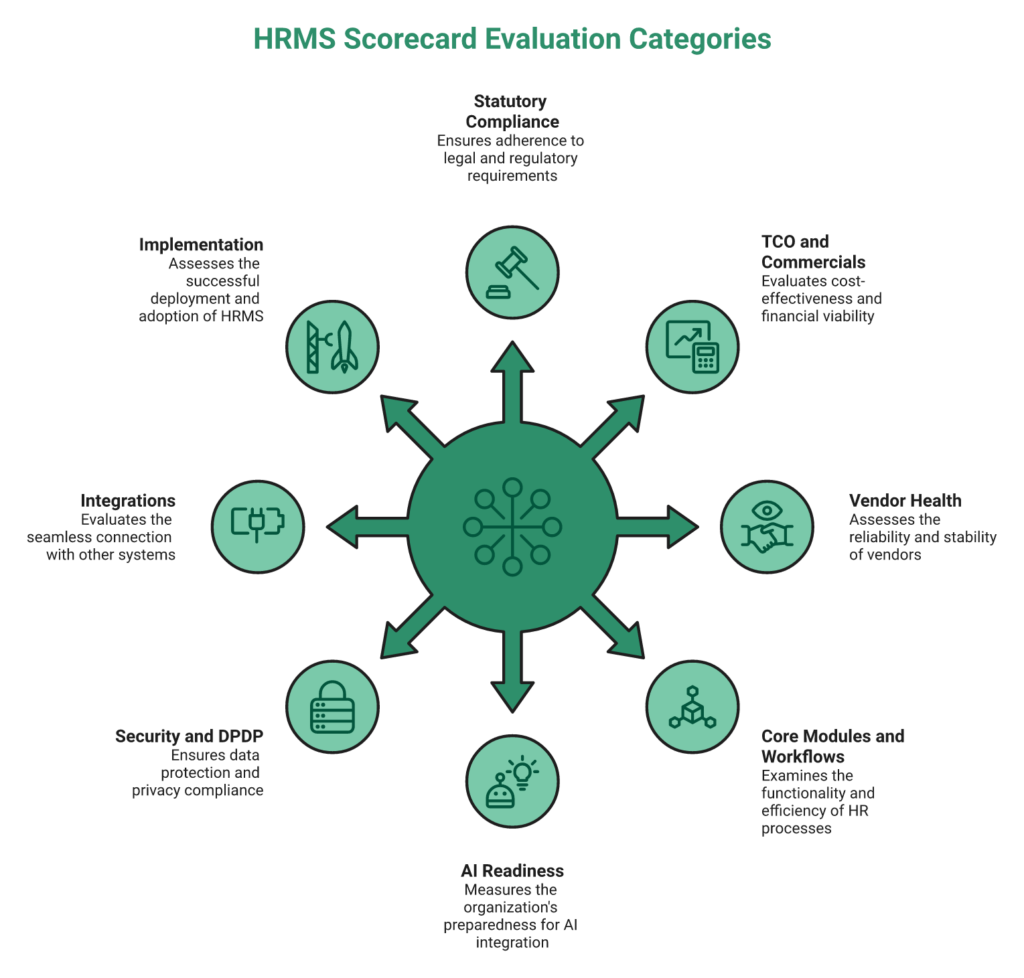
The 47 points distribute across Statutory Compliance (10 points, 25% weight), Vendor Health and Due Diligence (6 points, 15%), TCO and Commercials (4 points, 15%), Core Modules and Workflows (8 points, 10%), AI Readiness (4 points, 10%), Security and DPDP (6 points, 10%), Integration and Data Flow (5 points, 10%), and Implementation and Support (4 points, 5%), with an overall pass floor of 70% and ≥80% on Compliance.
📋 The Full Scorecard at a Glance
| # | Category | Weight | Points | Pass Floor | Sample Criterion |
|---|---|---|---|---|---|
| 1 | Statutory Compliance | 25% | 10 | 80% | Does ECR auto-generate for multi-state PF without Excel uploads? |
| 2 | Vendor Health | 15% | 6 | 70% | G2 Grid position, NPS ≥ 8.5, and logo retention ≥ 90% |
| 3 | TCO & Commercials | 15% | 4 | 70% | Is billing triggered only post go-live, with flat PEPM including AI? |
| 4 | Core Modules & Workflows | 10% | 8 | 70% | Does a Super-Inbox-style unified task surface exist across all modules? |
| 5 | AI Readiness | 10% | 4 | 60% | Resume relevancy, receipt parser, payroll anomaly detection, AI agent |
| 6 | Security & DPDP | 10% | 6 | 80% | DPDP consent captured at onboarding, 72-hour breach SLA, and ISO 27001 |
| 7 | Integration & Data Flow | 10% | 5 | 70% | Open REST APIs, webhooks, Tally/SAP/Oracle/biometric connectors |
| 8 | Implementation & Support | 5% | 4 | 70% | Dedicated SPOC, 30–90 day go-live, P1 within 2 hrs, phone and email |
🧮 The Scoring Rubric That Makes This Defensible
Score each of the 47 criteria on a three-point scale.
- 0, absent, or answered with “configurable later” or “on our roadmap.”
- 1, partial, available as an add-on, or requires back-end development.
- 2, native, demonstrable live in the demo, with a customer reference.
Aggregate using this formula for each category and then roll up:
Category Score = (Σ criterion scores ÷ max possible) × 100 Weighted Total = Σ (Category Score × Category Weight)
📊 Worked Example, Two Vendors, Honest Scores
| Category | Weight | Vendor A | Vendor B |
|---|---|---|---|
| Compliance (80% floor) | 25% | 70% ❌ | 90% ✅ |
| TCO | 15% | 50% | 85% |
| Vendor Health | 15% | 75% | 85% |
| Core Modules | 10% | 80% | 85% |
| AI Readiness | 10% | 40% | 75% |
| Security & DPDP (80% floor) | 10% | 60% ❌ | 85% ✅ |
| Integrations | 10% | 55% | 80% |
| Implementation | 5% | 60% | 85% |
| Weighted Total | 100% | 62%, FAIL | 84%, PASS |
Vendor A fails on two counts: an overall score under 70% and two category floors breached. Vendor B clears both the floors and the overall threshold. The decision is no longer a debate. Our how to choose HRIS HRMS software guide walks through the same logic on a live example.
⚠️ Where Most Buyers Break the Scorecard
- Scoring marketing decks instead of live demos (a “Yes” on a slide is not a 2).
- Averaging scores across the committee instead of rolling up per category; this hides compliance failures under a high UX score.
- Letting vendors self-score (they always round up).
- Skipping customer references for criteria scored 2. If the customer cannot confirm it works in production, drop the score to 1.
✅ How HROne Maps to the 47 Points
Our 127 pre-built hire-to-retire workflows, HR inbox unified task surface, India-native payroll solution, Policy Engine for entity-wise configuration, HROne AI suite, inbuilt ROI Dashboard, and post-go-live billing let buyers score these criteria live during the demo, not on trust. In practice, evaluators who run the scorecard against HROne typically mark 40+ of the 47 points at “2, native,” including every compliance and commercial floor.
Q4: How Do You Audit India Statutory Compliance and DPDP Act 2023 Readiness Inside an HRMS Demo?
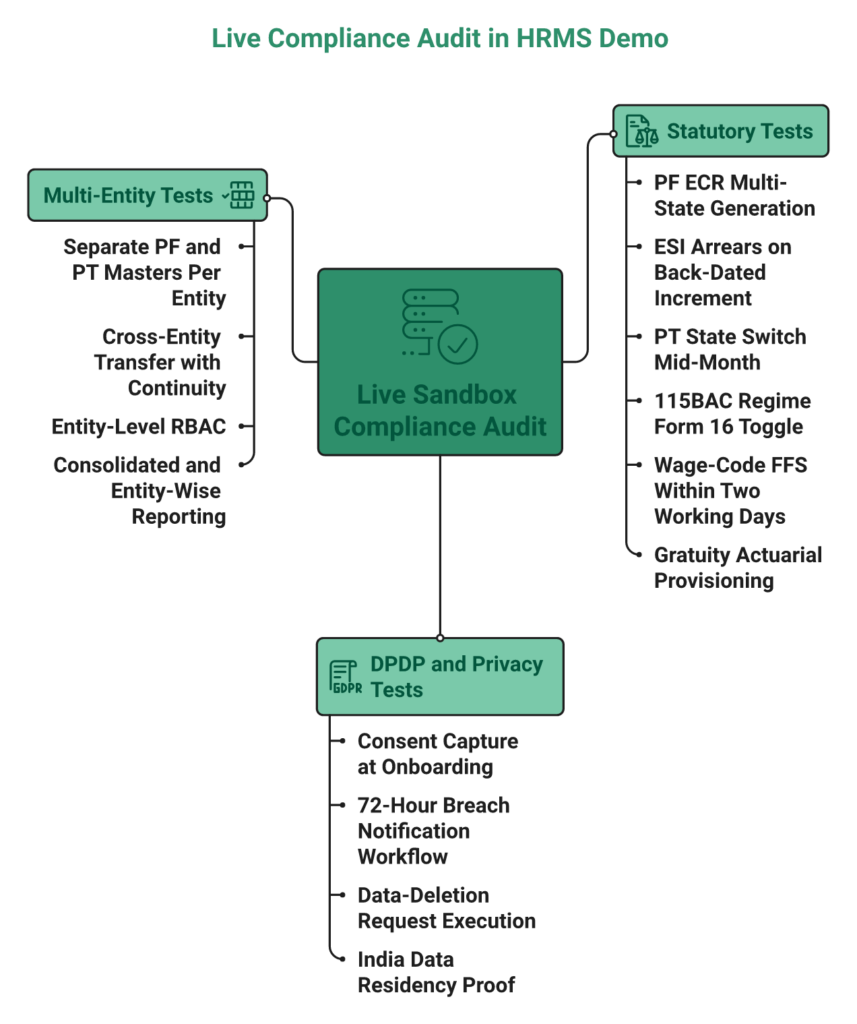
An India-ready 2026 HRMS must auto-handle PF ECR across multi-state wage ceilings, ESI challans, state-wise Professional Tax, Labour Welfare Fund, Gratuity provisioning, Form 24Q TDS with Section 115BAC old/new regime toggle, POSH workflows, CLRA returns, S&E Act registers, new-wage-code two-day FFS, DPDP consent capture, 72-hour breach notification, and an auto-updating regulatory engine, all testable inside a single 60-minute demo.
📋 The 14-Step Live Demo Audit
Do not accept slides. Ask the vendor to execute each of these against a sandbox with at least two legal entities and three states. If they cannot run the test live, score 0.
- Trigger an ECR file for multi-state PF and download the .txt for EPFO upload.
- Move an employee from Karnataka to Maharashtra mid-month; verify PT switches correctly.
- Compute arrears ESI on a back-dated increment and generate the challan.
- Run actuarial Gratuity provisioning for a 1,000-employee master and export the journal.
- Generate Form 16 with the 115BAC new vs old regime toggle at employee level.
- Route a POSH complaint through the committee workflow with anonymised access controls.
- Pull the CLRA principal-employer report for contract labour across two plants.
- Produce the S&E Act registers (attendance, wages, and leave) for any state.
- Execute an FFS with the two-working-day clearance mandated under new wage codes.
- Capture the DPDP consent artefact inside the onboarding workflow and export proof.
- Process an employee-data-deletion request and confirm the SLA timestamp.
- Show India data-residency evidence (AWS/Azure region) and ISO 27001 / SOC 2 Type II certificates.
- Demonstrate RBAC at OU, entity, and field level without developer tickets.
- Verify SSO via SAML 2.0 against the customer’s IdP (Azure AD or Okta).
Our statutory compliance payroll explainer and the ESI contribution calculation breakdown give the underlying math behind these tests.
🚩 The Red Flags That Should End the Demo
- ⚠️ “That is configurable later” for any statutory test.
- ⚠️ Global payroll engine retrofitted for India (usually surfaces as an “India localization pack”).
- ⚠️ Manual Excel uploads for ECR or ESI challans.
- ⚠️ “DPDP roadmap 2027”, you need it working in April 2026.
- ⚠️ No India data-residency proof, or shared statutory master across entities.
- ⚠️ ISO 27001 “applied for” rather than certified.
🔐 DPDP Act 2023, The Six Operational Artefacts
- Consent notice served and recorded at onboarding, leave, expense, and exit.
- Data Fiduciary registration and a published privacy notice.
- 72-hour breach notification workflow to the Data Protection Board.
- Sub-processor disclosure list, including cloud provider and AI model hosts.
- Data Processing Agreement (DPA) with purpose limitation and retention clauses.
- Employee rights (access, correction, erasure, and grievance) exposed in self-service.
✅ How HROne Runs Every Test Natively
We run the 14 tests inside the standard demo because the platform was built India-first. India-hosted cloud with clear residency, entity-isolated statutory masters (no shared PF codes across entities), auto-scheduled ECR and challan generation, DPDP consent hooks inside onboarding and exit workflows, ISO 27001 certified, RBAC at OU/entity/field level via the Policy Engine, and SSO SAML against Azure AD, Okta, or Google Workspace. The regulatory engine auto-updates PT slabs, LWF rates, and wage-code changes without a patch release. When a state amends PT mid-year, your payroll does not break the next cycle.
“Proper calculation of PF and ESI was a pain area for us before, but now with the HROne automated calculation process, results are up to the mark and following Indian tax compliances properly.”
— Ajay K., HROne G2 – Verified Review
“Salary process is fast, error-less, as per Indian Tax compliances. Challans filling for PT or ESI filling becomes a quick and easy task.”
— Sachin K., HROne G2 – Verified Review
“Salary processing along with exact calculation of LWF and PT slabs makes the work more convenient process.”
— Komal S., HROne G2 – Verified Review
Q5: What Technical, Integration, and AI-Readiness Criteria Separate 2026 HRMS Platforms From 2021 Ones?
A 2026 HRMS must be multi-tenant SaaS with SSO over SAML or OAuth2, expose open REST APIs and webhooks, ship pre-built connectors to Tally, Zoho Books, SAP, Oracle, Workday, and 100+ biometric devices, and deliver five AI capabilities natively: payroll anomaly detection, conversational ESS in English, Hindi, and regional languages, agentic approval workflows, GenAI JD and policy authoring, and transparent data-training governance.
🛠 How the 2026 Architecture Actually Works
The moving parts look simple on a slide, but the ones that break under load are the same ones that decide whether the rollout succeeds.
- Multi-tenant isolation with SCIM provisioning, so employee identity flows from Azure AD or Okta into the HRMS without manual user creation.
- Event-driven webhooks that fire on onboarding, confirmation, exit, and payroll events into Slack, Teams, Tally, and SAP. This is the integration glue that prevents month-end Excel reconciliation.
- Document-vision receipt parser that reads GST invoices, auto-tags the expense head, and posts to the approval queue, with no paper and no fraud.
- RAG-based AI Employee Agent that queries your own HR policies, leave balances, and payroll data, not generic ChatGPT responses.
- Statistical outlier detection on payroll that flags anomalies (a sudden 40% basic-wage jump, or a missing FBP declaration) before disbursal.
- Governance controls: employee opt-out on AI features, India data residency, and no cross-tenant model training.
🔌 The Integration Depth Matrix CHROs Should Demand
| Integration | What to test | Why it matters |
|---|---|---|
| Tally / Zoho Books | Payroll JV auto-post with GL codes | Ends the month-end Excel journal entry |
| SAP / Oracle | Employee master two-way sync | Single source of truth across ERP and HRMS |
| Workday / Darwinbox migration | Bulk data import with field-mapping UI | Cuts migration from months to weeks |
| Biometric (ZKTeco, eSSL, Matrix, Anviz) | Real-time punch sync within 60 seconds | Ends attendance-to-payroll reconciliation |
| ATS (Naukri, LinkedIn, iimjobs) | CV pull with relevancy score | Stops the recruiter’s manual shortlist grind |
| SSO (Azure AD, Okta, Google Workspace) | SAML 2.0 against live IdP | No parallel credentials for employees |
Our integrations catalogue covers all of the above out of the box.
🎯 Why This Rubric Matters in Rupee Terms
The 2026 AI and integration layer is not cosmetic. It stacks relevant CVs on top so recruiters stop screening 300 resumes a week. It eliminates expense fraud by parsing receipts instead of trusting a typed amount, as our AI detecting expense fraud breakdown explains. It pre-empts payroll errors before disbursal, the difference between a 10-day payroll cycle and a 5-day one. It deflects tier-1 HR queries from the HR Ops inbox (leave balance, payslip, and policy) via conversational ESS, cutting routine tickets by 60 to 70%. It collapses approval latency from three days over email to three minutes in the Super Inbox.
✅ Where HROne Sits on the 2026 Rubric
Our HROne AI suite ships all five AI capabilities, including resume relevancy scoring, receipt parser, employee AI agent, JD and interview generators, and payroll validations, inside the flat PEPM, not as a paid add-on at renewal. Open REST APIs, SCIM provisioning, SSO via SAML against Azure AD, Okta, and Google Workspace, Tally, SAP, and Oracle connectors, and 100+ biometric integrations are standard. Data residency is India-only, with explicit governance on what is and isn’t used for model training.
“The InboxforHR is a game-changer, centralizing every HR task into one simple inbox, cutting down administrative time by 60–70% and preventing tasks from falling through the cracks.”
— Waldon S., HROne G2 – Verified Review
“Sometimes I also used its OneAI system to apply leaves, that is what I have seen first time in a HR application system.”
— Ayush G., HROne G2 – Verified Review
“Integration without Oracle software properly, monthly salary journal report is not proper, the same including previous month paid amount.”
— Verified User in Textiles, Keka – G2 Verified Review
Q6: How Do You Calculate the Real Three-Year TCO and Stress-Test It Against Hidden Fees?
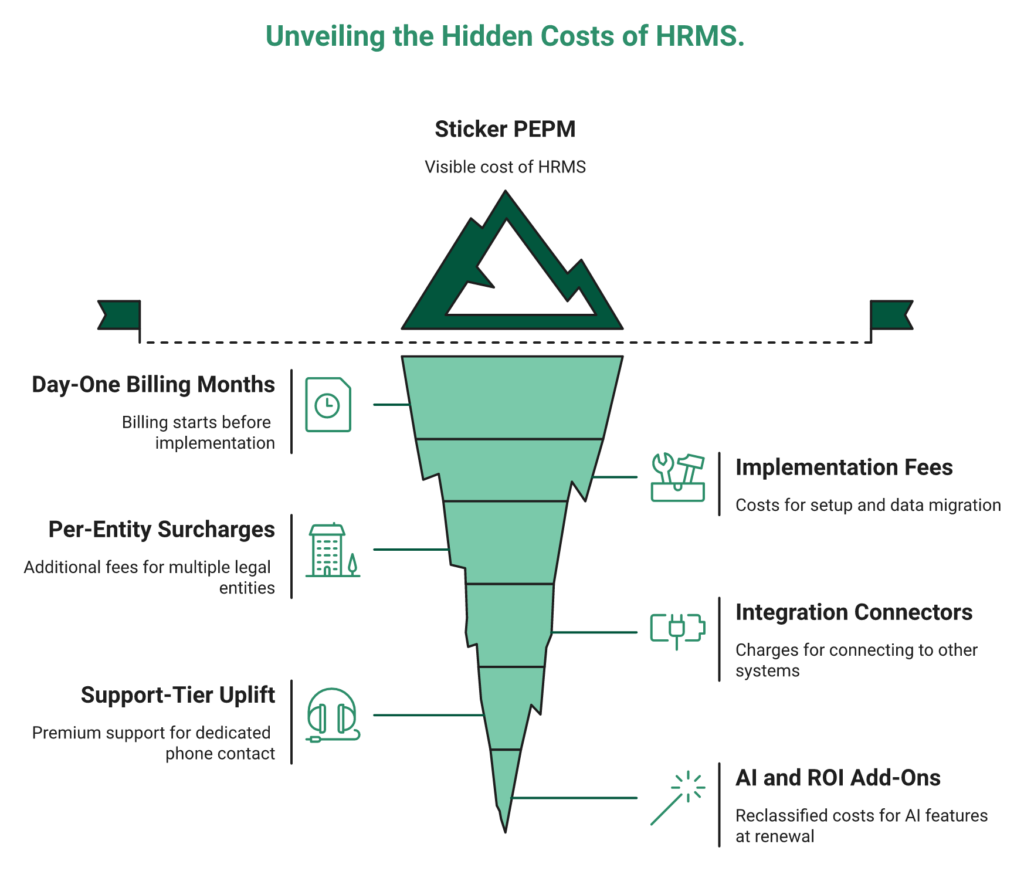
The three-year TCO of an Indian HRMS is (PEPM × headcount × 36 months) plus implementation, data migration, integrations, training, add-on modules, support-tier uplift, per-entity surcharges, and day-one-billing months, minus any go-live-billing savings. Sticker PEPM typically represents only 55 to 65% of the true number once you finish the math.
💰 The Decision Dilemma Most Buyers Walk Into
I have watched procurement teams choose ₹150 PEPM over ₹220 PEPM and then discover, 18 months later, that the cheaper quote carried six months of day-one billing during implementation, ₹3 to 5 lakh in “professional services” for data migration, and an AI Suite licence sold separately at renewal at +₹60 PEPM. The real delta was negative. Our HR software pricing transparency note covers this exact trap.
❌ The Wrong Criteria CHROs Keep Falling For
- Picking by PEPM alone, without normalising for what the PEPM includes.
- Picking by module count (quantity of modules, not quality of workflows).
- Picking by “what our peer group uses”, which optimises for brand comfort, not fit.
📊 The Right Framework, 7 TCO Questions Every Vendor Must Answer
Score each shortlisted vendor against these seven questions. Anything under 5/7 is a TCO red flag.
- Is billing triggered post go-live, or does the clock start on contract signature?
- Are all eight modules included (Core HR, Recruitment, Workforce, Time Office, Payroll, Performance, Engagement, and Helpdesk), or is the AI Suite, ROI Dashboard, or performance module a paid add-on?
- Is there any per-entity surcharge when you add the next legal entity, or is multi-entity included in the flat PEPM?
- Are there integration fees for Tally, SAP, or biometric devices, or are connectors standard?
- Support-tier uplift: is a dedicated SPOC with phone support standard, or gated behind a “premium” tier?
- Minimum commitment length: 12 months with a 30-day exit, or a 24 to 36 month lock-in?
- Exit and data-portability cost: CSV and SQL export within 15 days free, or a paid professional-services engagement?
💸 Benchmark PEPM Bands for India 2026
| Segment | Headcount | PEPM Band |
|---|---|---|
| SMB | 50–250 | ₹150–₹300 |
| Mid-Market | 250–1,000 | ₹250–₹450 |
| Enterprise | 1,000+ | ₹350–₹550 |
A full breakdown sits on our pricing page.
🧮 Applying the Framework, How HROne Scores
| TCO Question | HROne Status |
|---|---|
| Post-go-live billing | ✅ Standard |
| All 8 modules inclusive (with AI Suite and ROI Dashboard) | ✅ Standard |
| No per-entity surcharge | ✅ Unlimited entities on one tenant |
| Integrations included (Tally, SAP, Oracle, and biometric) | ✅ Standard |
| Dedicated prior-HR SPOC with phone and email | ✅ 9.8 NPS, included |
| 12-month commitment, no lock-in | ✅ Standard |
| Free CSV and SQL export within exit window | ✅ Standard |
HROne scores 7/7 because the commercial model was designed around the buyer’s worst-case TCO fears, not reverse-engineered to look good on a quote. MR DIY India went live in 30 days and paid zero subscription during implementation, the kind of number that only exists when billing starts after the system actually works. Plug your own numbers into the ROI calculator to see the delta.
🎯 The Meta-Insight
The question is not “which vendor is cheapest per user per month?” It is “which vendor’s sticker price is closest to its three-year TCO when you finish the seven questions?” On that question, the answer rarely matches the answer to the first one.
Q7: How Do You Run the Procurement Workflow, RFI, RFP, Demo Scripting, Sandbox, and Reference Calls?
The procurement sequence runs as a 10-week track: RFI in week 1, RFP with the 47-point scorecard embedded in week 3, scripted demos scored against the scorecard in week 5, a two-week sandbox POC on one legal entity in week 7, three reference calls with same-size Indian customers plus MCA, funding, and retention diligence in week 8, and committee sign-off in week 10.
📋 The 12-Question RFI Bank
Send this as a structured email before any demo is scheduled.
- Active customer count in India by segment (SMB, mid-market, and enterprise).
- Logo retention % over the last 24 months.
- G2 and Capterra Grid positions and NPS.
- India data-residency proof and certifications (ISO 27001, and SOC 2 Type II).
- Three same-size Indian customer references the buyer can contact.
- Standard minimum commitment length and billing trigger.
- List of modules included in the flat PEPM.
- Per-entity, per-integration, and per-AI-module surcharges (if any).
- Standard SLA uptime, P1 and P2 response times, and support channels.
- Implementation ownership model and typical go-live timeline.
- DPDP attestation and sub-processor list.
- Exit clause: data export format, window, and cost.
📝 The RFP Skeleton and Demo Script
The RFP should embed the 47-point scorecard verbatim as Annexure A and request the vendor to self-score with evidence. The demo script should then verify those scores live.
- Scope and objectives: headcount, entities, states, and industries.
- Scorecard Annexure: 47 points, weighted, with a vendor self-score column.
- Commercials: PEPM, implementation, add-ons, and renewal escalators.
- SLAs and support: uptime, P1/P2, credits, and escalation matrix.
- Data migration: ownership, format, and parallel-run commitment.
- DPDP and security: artefacts, breach SLA, and ISO/SOC certificates.
The demo script should walk through all 14 compliance tests from Q4, the Super-Inbox-equivalent unified task surface, the ROI Dashboard, and at least three workflows end-to-end (onboarding, confirmation, and FFS). Our HR inbox and onboarding process pages walk through what that looks like live.
🔍 The Due-Diligence Worksheet
| Signal | Source | Pass threshold |
|---|---|---|
| MCA filings | mca.gov.in | Current, no pending penalties |
| Funding history | Crunchbase, Tracxn | Series B+ or profitable bootstrapped |
| LinkedIn headcount trend | LinkedIn Insights | Flat or growing, not declining |
| Logo retention | G2 reviews and references | ≥ 90% over 24 months |
| Review scores | G2, Capterra, and Gartner Peer Insights | ≥ 4.2, ≥ 100 reviews |
| NPS | Vendor-published | ≥ 8.5 |
🚩 Red-Flag Heuristics During Diligence
- ⚠️ “Coming soon” features on critical compliance items.
- ⚠️ Pilot-only India statutory compliance, with no customers live at your size.
- ⚠️ Declining LinkedIn headcount over two consecutive quarters.
- ⚠️ Logo churn greater than 25% annually, visible through lapsed G2 reviewers.
- ⚠️ Refusal to provide three same-size Indian references.
✅ How HROne Shortens the Diligence Phase
We publish all diligence data openly: 1,500+ brand logos including MR DIY India and Asia Healthcare Holdings, 9.8 NPS, #3 G2 Easiest-to-Use Core HR, #8 Best HR Software Worldwide, Uneecops Group parent filings on MCA, and dedicated prior-HR SPOC access during the evaluation itself. Reference calls are arranged within 48 hours, not quarters. Browse more on our customer success stories hub or why HROne.
“We started working with Keka HRMS in August, and to this day, we have been unable to implement the tool in our company due to their consistently delayed responses and poor coordination between their internal teams.”
— Divya P., Keka – G2 Verified Review
“System implementation experience was horrible, in 6 months the implementation was barely completed to 40%. Support is never on time, replies to emails get delayed by days if not weeks.”
— Sanmeet S., ZingHR – G2 Verified Review
“Delivery team and concerned consultant having deep knowledge of the product working. User interface makes the usage to next level.”
— Ajay K., HROne G2 – Verified Review
Q8: What Are the Red-Flag Contract Clauses and the 8-Point Negotiation Playbook Before Signing?
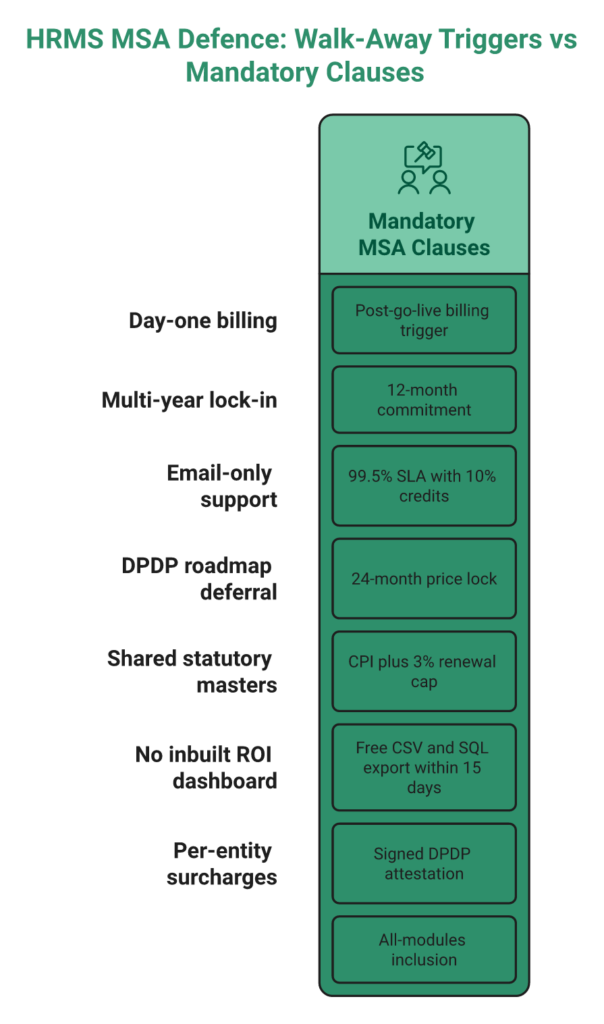
Seven clauses should disqualify a vendor regardless of scorecard total: day-one billing, a lock-in longer than 24 months, email-only support, vague DPDP answers, shared statutory masters across legal entities, no inbuilt ROI dashboard, and per-entity hidden charges. Every MSA must then contain eight mandatory clauses covering billing trigger, commitment length, SLA credits, price lock, renewal cap, exit data portability, DPDP attestation, and all-modules inclusion.
🚩 The Seven Walk-Away Triggers
❌ Day-one billing while implementation drags 3 to 6 months, you pay for air.
❌ Lock-ins over 24 months with no termination-for-convenience clause.
❌ Email-only support with no phone, no SPOC, and no published P1/P2 SLA.
❌ “DPDP roadmap 2027”, the Act is live now.
❌ Shared PF, ESI, or PT master across entities, a statutory audit risk.
❌ No inbuilt ROI dashboard, you cannot prove savings to the board.
❌ Per-entity surcharges added after the first legal entity is configured.
📑 The 8-Clause Negotiation Playbook
| # | Clause | Ask for | Typical counter | Acceptable fallback |
|---|---|---|---|---|
| 1 | Billing trigger | Post go-live | “Post signature” | 50% post-signature + 50% post go-live |
| 2 | Commitment length | 12 months, 30-day exit | 36-month lock-in | 24 months with mid-term termination-for-convenience |
| 3 | Uptime SLA | 99.5% with 10% monthly credit | 99% no credit | 99.5% with 5% credit, capped at 1 month fees |
| 4 | Price lock | 24 months flat | “List price” escalator | 24 months with single CPI+3% bump |
| 5 | Renewal cap | CPI + 3% | No cap | CPI + 5% |
| 6 | Data export | CSV + SQL, free, 15-day window | Paid professional services | CSV free, SQL at cost |
| 7 | DPDP attestation | Signed, in MSA | “On our privacy page” | Signed side-letter |
| 8 | All-modules inclusion | AI Suite + ROI Dashboard + all 8 modules | AI as paid add-on | Written commitment that AI will not be re-tiered mid-contract |
⚠️ The Vendor Traps Legal Should Specifically Catch
- “List price” escalators hidden in renewal clauses with no CPI anchor.
- SLA credits capped at one month of fees (meaningless for an enterprise).
- AI or analytics modules reclassified as “premium” at renewal.
- Data export as a paid professional-services engagement, billed per day.
- Indemnity caps set at 12 months of fees, hiding DPDP-breach exposure.
- Termination-for-convenience absent; only termination-for-cause, which is hard to prove.
✅ Where HROne’s Commercial Baseline Starts
Our standard MSA opens from the buyer’s ideal position: post-go-live billing, a 12-month commitment with no lock-in, flat PEPM including the One AI Suite and the ROI Dashboard, no per-entity surcharge, signed DPDP attestation, and documented data-export rights. The negotiation with Legal and Procurement typically takes days, not weeks, because most of the eight clauses are already drafted in the buyer’s favour before the redline process starts. The contrast with a typical HROne vs Darwinbox MSA (day-one billing, multi-year lock-in, and premium support tiers) or a HROne vs Keka engagement (email-only support, and delayed implementation response times) shows up inside the first clause review. To see the end-to-end commercial walkthrough, book a demo or contact us.
Q9: How Do You Run Implementation, Parallel Payroll, UAT, and Measure 30/60/90-Day Adoption?
A 2026 Indian HRMS rollout should complete Core HR and Payroll in 30 days for up to 1,000 employees and 60 to 90 days for 1,000 to 5,000, with at least one parallel payroll run, UAT sign-off gates, phased go-live per legal entity, a 30-day hypercare window, and three measurable KPIs: ≥90% employee adoption by day 60, ≤0.5% payroll error rate, and a board-ready ROI Dashboard snapshot by day 90.
📋 The 10-Step Implementation Plan
Follow the stages in sequence. Skipping any one of them is how rollouts quietly slip from 30 days into six months.
- Data-readiness audit: employee master, CTC sheets, leave balances, attendance history, and statutory masters per entity.
- Sandbox setup: a working tenant mirrored to production, with dummy data for configuration testing.
- Master-data migration from Excel, Keka, greytHR, or Darwinbox using a field-mapping tool, not manual CSVs.
- Policy configuration: leave, attendance, CTC structures, FBP, reimbursement heads, and approval matrices.
- Parallel payroll run: compute one full month in both the legacy system and the new HRMS and reconcile to the last paisa.
- UAT on 25 test cases: onboarding, confirmation, arrears, FBP, PT state switch, FFS, POSH, and exit clearance.
- Pilot go-live on one entity: smallest headcount entity first, with the SPOC on-site.
- Full rollout: remaining entities in a two-week cadence, not a big-bang.
- 30-day hypercare: daily stand-ups with the SPOC, ticket SLAs tightened to 4 hours P1.
- 60/90-day KPI review: adoption, payroll error rate, ticket volume, time-to-hire, and ROI baseline.
Our payroll automation complete guide and hassle-free payroll processing steps detail the parallel-payroll reconciliation playbook.
⏰ The Three Non-Negotiable KPIs Post Go-Live
| KPI | Day 60 target | Day 90 target |
|---|---|---|
| Employee adoption | ≥ 90% | ≥ 95% |
| Payroll error rate | ≤ 0.5% | 0% delays |
| HR ticket volume | 30% reduction | 60% reduction |
| ROI Dashboard snapshot | Baseline set | Board-ready with rupee figure |
🚩 Implementation Red Flags to Watch
- ⚠️ “Depends on complexity”, with no week-wise milestone commitment.
- ⚠️ No dedicated SPOC, you are routed through a generic project manager queue.
- ⚠️ No parallel payroll run offered in the SOW.
- ⚠️ UAT skipped or compressed to 48 hours.
- ⚠️ Day-one billing running while implementation drags past week 8.
- ⚠️ Training billed per-session instead of included.
✅ How HROne Runs the 30-Day Go-Live
We staff every rollout with a prior-HR onboarding consultant, someone who has run payroll and answered PF queries themselves, not a technical project manager reading from a checklist. MR DIY India went live in 30 days on this model. Implementation is free because billing starts only after go-live, which removes the pressure of “every week of slippage costs us ₹X”. The HR inbox cuts day-one change-management friction because employees only need to learn one surface, not five. The ROI calculator and ROI Dashboard auto-baseline against the success metrics the committee set in the foundation phase, so the day-90 board conversation is a screen share, not a PowerPoint reconstruction.
“The initial setup of HROne was surprisingly straightforward, much lighter than expected for a full HRMS.”
— Waldon S., HROne G2 – Verified Review
“Delivery team and concerned consultant having deep knowledge of the product working. User interface makes the usage to next level.”
— Ajay K., HROne G2 – Verified Review
“We started working with Keka HRMS in August, and to this day, we have been unable to implement the tool in our company due to their consistently delayed responses and poor coordination between their internal teams.”
— Divya P., Keka – G2 Verified Review
Q10: Which HRMS Platforms Score Highest on the 47-Point Scorecard by Segment, Startup, SMB, Mid-Market, Enterprise?
The winning platform shifts by segment. HROne leads Mid-Market at 42/47 and Enterprise at 43/47, HROne and greytHR are the two credible picks for Startups under 50, HROne and Keka tie for SMB on UX plus workflow depth, and Darwinbox and HROne are the two enterprise-ready contenders, with HROne winning on TCO, go-live speed, and ROI instrumentation. Our top 10 HR software India listicle walks through the same ranking.
⭐ 1. HROne, Mid-Market and Enterprise Leader
- Scorecard Total: 42/47 (Mid-Market), 43/47 (Enterprise).
- Strongest Category: Statutory Compliance, Commercials, and Workflows.
- Weakest Category: Sub-20-employee micro-startup use cases (not the ICP).
- G2 Rank: #3 Easiest-to-Use Core HR, #8 Best HR Software Worldwide.
- PEPM Band: ₹250 to ₹450 mid-market, ₹350 to ₹550 enterprise.
- Minimum Commitment: 12 months, no lock-in.
- Best For: 100 to 5,000 employee Indian enterprises across IT/ITeS, Manufacturing, BFSI, Retail, and Healthcare.
- Skip If: You are a 15-person seed-stage startup with no payroll complexity.
Explore the full module stack on the HR software hub and tailored CHRO solutions.
“I love HROne for its cost efficiency and holistic approach, which is why I prefer it over other vendors like Workday.”
— Priyanka S., HROne G2 – Verified Review
2. Darwinbox, Enterprise Incumbent With Lock-In Friction
- Scorecard Total: 36/47 (Enterprise).
- Strongest Category: Brand, and breadth of modules.
- Weakest Category: TCO (day-one billing, multi-year lock-in), and implementation speed.
- PEPM Band: ₹400 to ₹650.
- Best For: 5,000+ multinational enterprises comfortable with 36-month contracts.
- Skip If: You need post-go-live billing or a 30-day go-live window.
Detailed breakdown on HROne vs Darwinbox.
“Bad implementation experience, bad UI UX, configurations getting broken in production on its own due to product deployments, terrible customer service.”
— Verified User in Computer Software, Darwinbox – G2 Verified Review
3. Keka, SMB UX, Support Gap
- Scorecard Total: 32/47 (SMB).
- G2 Rank: #16 Ease-of-Use, #55 Overall Satisfaction.
- Weakest Category: Support (email-only, delayed), and implementation responsiveness.
- Best For: 50 to 200 employee startups with low compliance complexity.
- Skip If: You need phone-based SPOC support or multi-entity payroll.
Full comparison on HROne vs Keka.
4. greytHR, SMB Payroll, Limited Workflows
- Scorecard Total: 30/47 (SMB).
- G2 Rank: #42 Worldwide.
- Best For: Sub-100-employee firms with simple payroll.
- Skip If: You have multi-entity, shift-based, or workflow-heavy operations.
See HROne vs greytHR for the side-by-side.
5. Zoho People, Single-Entity Startups Only
- Scorecard Total: 27/47.
- Weakest Category: Multi-legal-entity payroll, India compliance depth, and customer support.
- Best For: Single-entity startups already inside the Zoho ecosystem.
Reference: HROne vs Zoho People.
6. SAP SuccessFactors, Global Enterprise, India Over-Engineered
- Scorecard Total: 34/47 (2,000+ Enterprise).
- Best For: 2,000+ multinationals with global payroll consolidation needs.
- Skip If: You are a 100 to 2,000 Indian mid-market firm, the implementation cost alone breaks the TCO math.
Reference: HROne vs SAP.
🎯 Segment Guidance in One Line
| Segment | Primary pick | Alternative |
|---|---|---|
| Startup < 50 | HROne Starter | greytHR |
| SMB 50–250 | HROne | Keka |
| Mid-Market 250–1,000 | HROne | , |
| Enterprise 1,000+ | HROne | Darwinbox |
| MNC 2,000+ | HROne (India) + SAP (global) | , |
Q11: What Are the Top 10 FAQs CHROs and Founders Ask Before Choosing an HRMS in India?
These are the exact ten questions that come up in every procurement call I have sat through, with the answers compressed to the floor, not the ceiling.
❓ The 10 FAQs in 40 to 60 Words Each
1. How do I evaluate HRMS vendors in India?
Build a 47-point weighted scorecard across Compliance, TCO, Vendor Health, Core Modules, AI Readiness, Security/DPDP, Integrations, and Implementation. Set a 70% overall pass floor and ≥80% on Compliance. Score live in the demo using a 0/1/2 rubric, not from marketing decks. Our how to choose HRIS HRMS software guide walks through this.
2. What is the best HRMS software in India 2026?
HROne leads Mid-Market and Enterprise scorecards at 42/47 and 43/47 respectively, with #3 G2 Easiest-to-Use Core HR, #8 Best HR Software Worldwide, 1,500+ brand logos, 9.8 NPS, flat PEPM with no lock-in, and post-go-live billing. Darwinbox, Keka, and greytHR serve niche segments.
3. What trust signals make a good HR software vendor in India?
G2 Grid position, NPS ≥ 8.5, logo retention ≥ 90% over 24 months, transparent MCA filings, three same-size Indian customer references on demand, ISO 27001 certification, India data residency, and a published DPDP attestation. Browse live proof on our customer success stories.
⏰ SLAs, Commitment, and Implementation
4. What SLAs do HR software vendors offer for uptime and support?
Expect 99.5 to 99.9% uptime with 10% monthly service credits on breach, P1 response within 2 hours, P2 within 8 hours, and phone plus email plus a dedicated SPOC. Anything less than 99.5% or email-only support is a disqualifier.
5. What is the minimum commitment period for HR software?
Maximum 12 months with a 30-day exit notice is the buyer-friendly baseline. Multi-year lock-ins of 24 to 36 months without termination-for-convenience are a contract red flag, especially when combined with day-one billing. Our HRIS buyer pitfalls piece covers this in depth.
6. What is a realistic HRMS implementation timeline in India?
30 days for up to 1,000 employees on Core HR plus Payroll, 60 to 90 days for 1,000 to 5,000 employees with phased entity-by-entity go-live, one mandatory parallel payroll run, and 30-day hypercare. MR DIY India went live on HROne in 30 days.
💰 Pricing, DPDP, AI, and Exit
7. What is the mid-market PEPM benchmark in India 2026?
- SMB (50 to 250): ₹150 to ₹300 PEPM.
- Mid-market (250 to 1,000): ₹250 to ₹450 PEPM.
- Enterprise (1,000+): ₹350 to ₹550 PEPM.
All modules, AI Suite, and ROI Dashboard should be inclusive, not paid add-ons at renewal. See the pricing page for live bands.
8. How do I audit DPDP Act 2023 readiness?
Verify six artefacts: consent capture at onboarding, Data Fiduciary registration, 72-hour breach notification workflow, India data residency, ISO 27001 plus SOC 2, and employee data-rights (access, erasure, and grievance) exposed in self-service. “DPDP roadmap 2027” is a walk-away trigger. Our employee data privacy best practices note extends this checklist.
9. What AI governance should I demand?
Employee opt-out on AI features, no cross-tenant model training, India data residency for all inference, transparent sub-processor disclosure (including LLM hosts), and a contractual commitment that AI modules will not be re-tiered or reclassified as paid add-ons mid-contract. Reference: HROne AI.
10. What are my exit and data-portability rights?
CSV and SQL export of all employee, payroll, attendance, and document data within 15 days of exit, free, with no professional-services charge. Written in the MSA, not on a privacy page. Anything less creates vendor lock-in regardless of stated commitment length.
✅ Where HROne Sits on All 10 FAQs
We clear every FAQ at the buyer-friendly baseline: 9.8 NPS, #3 G2, 99.5% uptime, 12-month commitment, 30-day go-live, DPDP-ready with signed attestation, flat mid-market PEPM including the One AI Suite and ROI Dashboard, and free data export on exit.
Q12: Ready to Score Your HRMS Shortlist Against the 47-Point Scorecard in a Live Walkthrough?
Running your HRMS shortlist through a 47-point weighted scorecard and watching one platform clear every category: statutory, TCO, AI, DPDP, and vendor health, inside a 30-day go-live window is exactly what HROne was built for.
🎯 The Proof You Came for, in One Paragraph
MR DIY India went live in 30 days. Asia Healthcare Holdings runs 20 pan-India units on a single HROne instance with unified multi-entity statutory compliance. 1,500+ brand logos, 9.8 NPS on dedicated prior-HR SPOC support, #3 G2 Easiest-to-Use Core HR against Keka’s #16, and #8 Best HR Software Worldwide. Post-go-live billing, flat PEPM with no lock-in, HR inbox collapsing 110 daily tasks into three-click closures, and India’s first inbuilt ROI Dashboard calculating lifetime hours saved against average HR salary, so the board conversation is a screen share, not a PowerPoint reconstruction. That is the scorecard answering itself. Start with why HROne or contact us for a tailored walkthrough.
Score Your HRMS Shortlist Against the 47-Point Scorecard, Live with HROne
See HROne score itself against every point: Statutory, DPDP, AI, TCO, and Implementation, inside a personalised 30-minute walkthrough with your headcount and industry loaded in.
Book a 47-Point Scorecard WalkthroughAlready evaluating? Explore the HROne ROI Dashboard or the HR Software Selection Checklist for Indian CHROs.

















 Secures Top Spot in
