







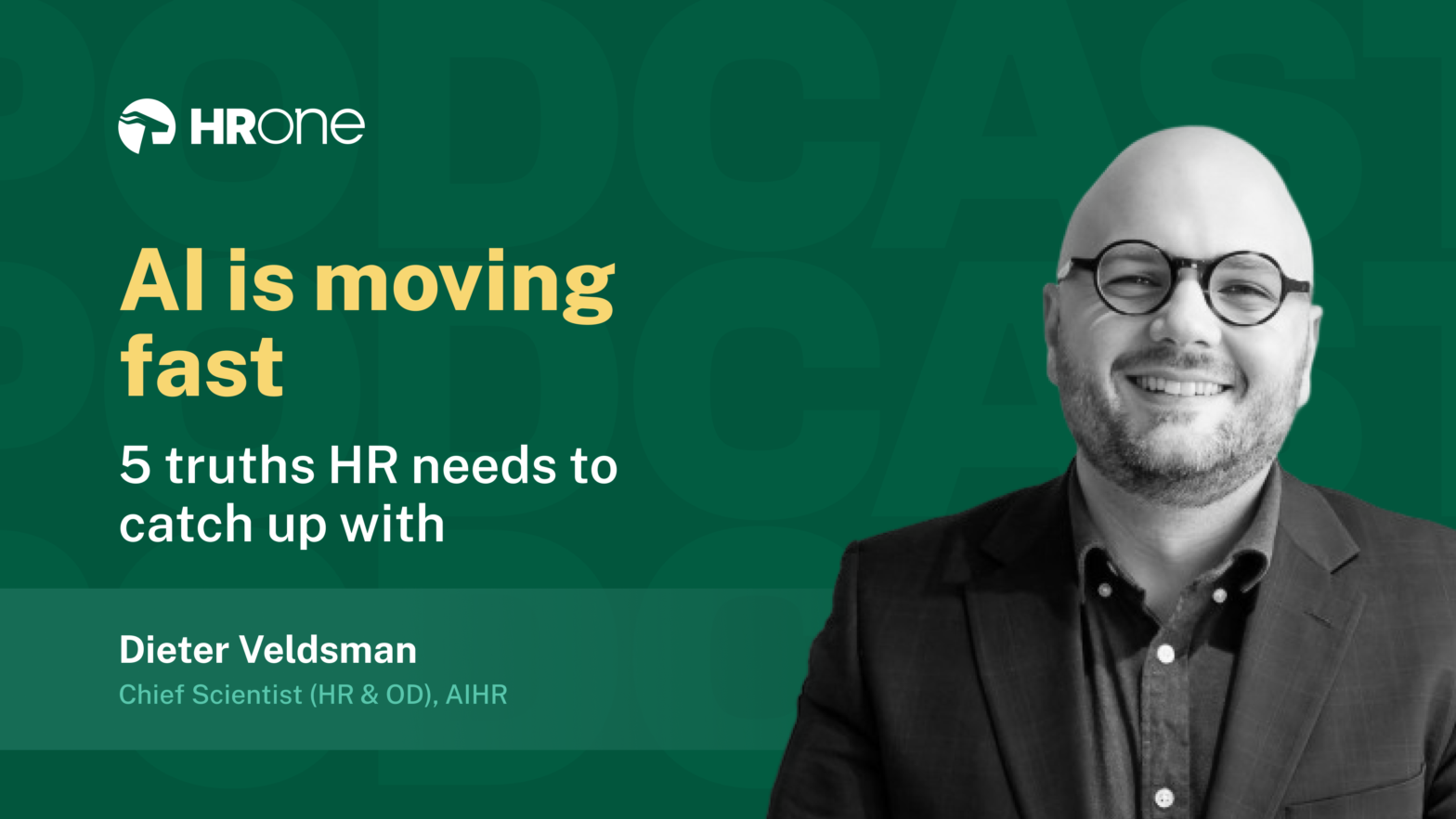
At the HROne AI Summit 2026, AI didn’t walk in like a guest. It walked in like an auditor.
Not checking your systems. Checking your relevance.
And in his closing session, Dieter Veldsman didn’t try to impress HR with possibilities. He did something far more useful, he held up a mirror and said, “Let’s be honest for a minute.”
Because the uncomfortable truth is this:
HR isn’t being disrupted by AI. It’s being quietly questioned by it.
This blog consists of the insights delivered by Dieter Veldsman in the HROne AI Summit 2026, the world’s largest AI summit for HRs.
So, hold tight and brace yourself because some of the old truths might sting a bit.
If you want to skip on the reading part and instead watch Dieter say it to you, then switch now to The CHRO Mindset Podcast on Spotify for full episode.
The World Changed the Rules. HR… Updated the Handbook.
So now, let’s zoom out for a second.
- Skills now expire faster than your phone battery
- Employees treat jobs like subscriptions (easy to join, easier to cancel)
- AI is already influencing decisions HR used to “own”
- Talent shortages now sit on the CEO’s agenda not just HR’s
In short, the environment has gone from stable… to slightly chaotic.
And HR’s response?
In many cases:
New tools. Old thinking. Slightly better dashboards.
The Five Truths (The Ones That Don’t Fit in a Celebration Post)
1. HR is expected to think strategically, not act on it.
HR wants to shape a business strategy.
But often, it’s still invited to support it.
It’s like being asked to plan the wedding… after the venue, guest list, and budget are already locked.
Business leaders still see HR as:
- The safety net
- The policy engine
- The “keep things running” team
HR sees itself as:
- A transformation driver
- A strategy partner
Both versions can’t exist at the same level.
The real issue? It’s not confidence or capability.
It’s the clarity of mandate.
Until HR owns decisions, not just executes them. Strategy will remain… adjacent.
2. HR redefined itself, but the experience still feels the same.
“People & Culture.”
“Human Capital.”
“Employee Experience.”
The names have evolved beautifully.
But ask an employee when they last felt that evolution.
For many, HR still shows up:
- When something breaks
- When a rule needs explaining
- When a process needs following
Not exactly the brand of a function shaping the future of work.
But here’s the twist:
HR doesn’t have a branding problem. It has a consistency problem.
Because reputation isn’t built in campaigns.
It’s built in everyday moments that either work… or don’t.
3. HR adopted new technology but didn’t change how work actually works.
Yes, there are new tools.
Yes, AI is being piloted.
Yes, dashboards look sharp.
But underneath?
- Silos still slow things down
- Processes still require “just one more approval”
- Decisions still take longer than they should
It’s like upgrading your phone… but keeping the same slow Wi-Fi.
The truth? Technology didn’t fail HR. HR’s operating model limited the technology.
AI doesn’t struggle with complexity. It struggles with poor design around it.
4. AI isn’t replacing HR; it’s revealing where HR isn’t needed.
AI can now:
- Screen resumes
- Predict attrition
- Recommend decisions
Which leads to a slightly awkward but necessary question:
What’s left for HR?
A lot, actually, but it’s different work.
- Interpreting context
- Making judgment calls
- Designing fair, human systems
- Deciding what should happen not just what can happen
The risk isn’t replacement. It’s a reduction.
HR could either:
- Become the architect of work
Or - Become the administrator of tools
And AI is not going to choose for you.
5. HR builds capabilities for everyone else but often overlooks its own.
HR has built entire ecosystems around learning, development, and capability building.
For everyone else.
Meanwhile, HR capability often evolves through:
- Experience
- Exposure
- A bit of improvisation
That worked in a slower world.
It doesn’t work in one that demands:
- Data fluency
- AI understanding
- Business alignment
The new HR professional isn’t just “people-first.” They’re people + data + tech + business.
Which is a longer sentence and a bigger expectation.
The Quiet Shift No One Is Talking About Enough
Here’s the part that changes everything:
HR is no longer just managing people. It’s designing work itself.
Work is now an experience. An environment. A system people interact with daily.
Which makes it… a product.
And HR?
The product team.
That means:
- If the experience is confusing → that’s a design issue
- If decisions are slow → that’s a system issue
- If employees disengage → that’s a product problem
The uncomfortable question:
If employees could rate your workplace like an app… what would it score?
So, What Now? (Because Insight Without Action Is Just Content)
According to Dieter Veldsman, the way forward isn’t complicated but it is demanding.
HR needs to:
- Stop waiting for a mandate and start defining it
- Fix its reputation through experience, not storytelling
- Redesign how work flows, not just how tools look
- Treat AI as core infrastructure, not a side experiment
- Invest in its own capability like it expects the business to
None of this is cosmetic change. It’s structural.
The Final Reality HR Can’t Ignore
The world needs HR. Probably more than ever.
But not the version that:
- Hides behind processes
- Reacts instead of leads
- Talks strategy without owning outcomes
The future belongs to HR that is:
- Comfortable with data
- Fluent in technology
- Deeply human in judgment
- Bold enough to question itself
Closing Thought
HR doesn’t have a relevance problem. It has a timing problem. Because the window to evolve isn’t closing slowly. It’s narrowing fast.
And AI? It’s not waiting at the door anymore. It’s already inside asking better questions than we are.











 Secures Top Spot in
