







Q1: Why Does Attendance Management Software Matter for Indian Enterprises in 2026, and Who Is This Guide For?
Attendance management software in India in 2026 is the unified capture, compliance, and payroll-propagation layer that ties biometric punches, GPS selfies, facial recognition, and kiosk check-ins into one timesheet that statutory returns and payslips can trust. Indian mid-market firms currently lose an estimated 2.2% to 2.8% of monthly payroll to buddy-punching, manual register errors, and reconciliation drift, and the April 2026 enforcement window for the DPDP Act 2023 plus the four consolidated labour codes has made “biometric plus Excel” a compliance liability rather than a cost saving.
❌ Where Manual Registers and Biometric-Only Tools Break
⚠️ Manual register failure modes: late-punch forgery, illegible entries, zero audit trail for labour inspections, and reconciliation lag of 5 to 7 days before payroll input is clean.
💸 Hidden payroll leakage: 2.8% of payroll silently disburses against proxy punches, inflated overtime, and unverified regularisations. A ₹50-crore wage bill bleeds roughly ₹1.4 crore a year.
⏰ Biometric-only portals: sit in a parallel database, export CSVs that HR Ops stitch into payroll by hand, and carry no DPDP consent artefact against each template.
❌ No field coverage: plant fingerprint machines do nothing for sales reps in tier-3 towns or service technicians on client sites.
✅ What a 2026-Grade System Actually Does
A modern system captures punches through every realistic channel, including fingerprint, palm, iris, facial with liveness, GPS-geofenced selfie, RFID, kiosk, and web. It writes them to one timesheet, enforces OSH Code weekly rest and Code on Wages overtime automatically, stores biometric templates encrypted with a DPDP consent record, and pushes clean attendance into payroll on cycle-close without an Excel reconciliation round.
Who This Guide Is For
- HR leaders at 100 to 500 employee firms running payroll on spreadsheets and a standalone biometric portal, tired of month-end firefighting.
- CHROs and SVP HR at 500 to 5,000 employee organisations in IT/ITeS, manufacturing, BFSI, logistics, and healthcare evaluating a replacement for fragmented Keka, Darwinbox, or GreytHR deployments.
- CFO-IT buying committees scoring vendors on flat PEPM, RBAC, SSO, and go-live billing rather than feature checklists.
- Ops leaders managing blue-collar plants, white-collar hybrid offices, and field workforces on a single roster.
📊 The Evidence Block, Why Now
- 2.8% payroll-leak benchmark from Indian manufacturing HR studies on buddy-punching and manual-register fraud.
- Payroll cycle compression: operators consolidating attendance, leave, and payroll have cut 10-day month-end cycles to 5 to 6 days, reclaiming roughly 40 HR-operations hours per month at mid-market scale.
- Labour-code enforcement: the OSH Code, Code on Wages, Industrial Relations Code, and Social Security Code create specific recordkeeping, overtime, and weekly-rest mandates attendance systems must enforce natively.
This guide answers five questions directly:
- Best attendance management software in India with biometric integration?
- Does HR software integrate with biometric attendance devices?
- How does HR software handle complex shift and roster management?
- How do I track attendance of remote and field employees accurately?
- Why are employees buddy-punching, and how do I stop it?
🧩 How HROne Fits the Problem
We built HROne’s Time Office to sit inside the Super Inbox, not beside it. Every biometric punch, geo-fenced selfie, regularisation, and overtime approval surfaces in one place, propagates to payroll through the Auto Scheduler, and shows up on India’s first inbuilt ROI Dashboard as hours reclaimed against average HR salary. It is the exact stack the personas above are trying to assemble.
Q2: How Did We Rank the 12 Attendance Management Vendors, 100-Point Scoring Methodology Disclosed?
We scored 12 vendors on a 100-point weighted rubric, compliance (25), UX and employee experience (20), integrations (15), TCO transparency (15), support quality (15), and AI/analytics depth (10). We applied a disqualifying-criteria filter before scoring, so vendors missing DPDP biometric vaulting, offline sync, or multi-legal-entity support never entered the ranked list.
📐 The 100-Point Rubric Broken Down
Compliance, 25 Points
- DPDP Act 2023 consent capture and encrypted biometric vaulting (8)
- OSH Code weekly rest and Code on Wages overtime multipliers (6)
- Factories Act and Shops & Establishments retention across Maharashtra, Karnataka, Tamil Nadu, Delhi, and Gujarat (5)
- PF, ESIC, and Professional Tax automation across states (6)
UX and Employee Experience, 20 Points
- Three-click task closure for leave, regularisation, OD, and shift swap (6)
- Mobile-first punch with offline queue and geo-accuracy (6)
- ESS dashboard, payslip access, and policy visibility (4)
- Manager approval flow from a phone (4)
Integrations, 15 Points
- Biometric device ecosystem (ZKTeco, eSSL, Matrix, Realtime, and Spectra) with real-time push API (5)
- Payroll and HRMS propagation, JV/GL sync, and Tally/SAP connectors (4)
- Microsoft Teams, Slack, and SSO/SAML (3)
- Aadhaar AGBAS and third-party BGV/LMS marketplace (3)
TCO Transparency, 15 Points
- Flat PEPM with no hidden per-entity surcharge (5)
- Subscription starts at go-live, not day one of purchase (4)
- Implementation fees disclosed, not buried (3)
- Device AMC and integration add-ons published (3)
Support Quality, 15 Points
- Phone and email response within 24 hours (5)
- Dedicated prior-HR SPOC, not a generic project manager (5)
- Public NPS or G2 satisfaction ranking (5)
AI and Analytics Depth, 10 Points
- Anomaly detection on attendance fraud (3)
- Agentic shift planning and roster optimisation (3)
- ROI dashboard quantifying hours reclaimed in rupee terms (4)
⛔ Disqualifying Criteria, Filter Before Scoring
A vendor is removed from the shortlist, regardless of brand strength, if any of the following are true:
- No offline sync for plants: rural and basement sites cannot rely on continuous connectivity.
- No DPDP-compliant biometric template vaulting: encryption at rest plus consent artefact is non-negotiable.
- No multi-legal-entity support within one instance: forces parallel deployments for group structures.
- No go-live billing transparency: day-one subscription during a 4-month implementation is a cost-model red flag.
- No sub-24-hour support SLA with phone channel: email-only threads leave HR Ops stuck at cycle-close.
🔍 How to Apply the Same Rubric in Your RFP
- Score each shortlisted vendor independently before a demo.
- Require written answers to the disqualifying criteria, not sales deck screenshots.
- Weight compliance highest because a failed labour inspection or DPDP breach costs more than any per-employee pricing delta.
- Validate support quality with a live ticket from an existing customer reference, not a sales ROI deck.
🧩 How HROne Scores on Its Own Rubric
HROne publishes its weights and scores transparently: full marks on DPDP vaulting, multi-legal-entity support, flat PEPM with go-live billing, and 9.8 NPS on the prior-HR onboarding SPOC model. We encourage readers to run this exact scorecard against HROne and every other vendor on the shortlist before booking demo calls. The rubric is the buyer’s shield, not the vendor’s marketing tool. Readers can also avoid common HRIS buyer pitfalls while running this exercise.
Q3: What Does DPDP Act 2023, the Four Labour Codes, and State Shops & Establishments Variance Require From Your Attendance System?
A 2026-compliant attendance system must capture explicit DPDP consent for biometric templates, retain auditable timesheets under the Factories Act and state Shops & Establishments Acts, enforce OSH Code weekly rest and Code on Wages overtime multipliers, automate PF/ESIC/Professional Tax across states, and serve data-principal access and erasure requests within statutory windows.
📋 The Compliance Checklist, Source of Truth for Auditors
| Compliance Layer | What the System Must Do | Evidence Expected in Audit |
|---|---|---|
| DPDP Act 2023 | Encrypt biometric templates at rest and in transit, store consent artefact per employee | Consent log, encryption certificate, and data-principal request queue |
| OSH Code 2020 | Enforce 48-hour weekly cap, mandatory weekly rest, and overtime ceiling | Weekly rest exception report and overtime breach log |
| Code on Wages 2019 | Apply 2× overtime multiplier, FFS within two working days of exit | Overtime audit and FFS TAT report |
| Factories Act 1948 | Retain timesheets and muster rolls for prescribed period | Exportable muster roll with punch and regularisation trail |
| PF, ESIC, PT | Compute and file returns automatically across states | PF ECR, ESIC challans, and state-wise PT slabs |
🗺️ State Shops & Establishments Variance, Five States That Differ Most
- Maharashtra: weekly-hour cap of 48, overtime at 2× after 9 daily hours, and Shop Act online registration.
- Karnataka: 10 daily hours inclusive of breaks, overtime at 2×, and spread-over cap of 12 hours.
- Tamil Nadu: 8 daily hours, 48 weekly, and overtime capped at 50 hours a quarter.
- Delhi: 9 daily hours with 30-minute rest after 5 hours, and overtime at 2×.
- Gujarat: 9 daily hours, 48 weekly, and overtime 2× with quarterly cap.
An attendance engine that treats India as one state fails audit the first time operations open a branch outside the home location. A detailed view of statutory compliance in payroll helps frame the wider obligations.
🔐 DPDP Biometric Vaulting, Non-Negotiables
- Templates stored as cryptographic hashes, not raw images.
- Consent captured at enrollment with timestamp, purpose, and revocation path.
- Data-principal request queue with 30-day SLA.
- Exit-time template deletion tied to FFS workflow.
- Access logs for every read of a biometric record.
🧪 The Operational Audit Playbook, Run This Quarterly
- Sample 30 employees across entities and pull consent artefact, last 90 days of timesheets, regularisation trail, and overtime computation.
- Verify retention: muster rolls available for the full statutory period, not truncated.
- Test data erasure on a dummy exit: template and consent record removed, and payroll history retained per law.
- Aadhaar consent refusal workaround: alternative ID flow for employees who decline AGBAS integration. Never force Aadhaar as the only enrollment path.
- Audit overtime against Code on Wages multiplier and OSH Code weekly cap, and flag breaches before the labour inspector does.
🧩 How HROne Handles the Compliance Stack
HROne encrypts biometric templates, binds a DPDP consent artefact to the employee master at enrollment, automates PF, ESIC, and Professional Tax across multi-legal entities on a single instance, and exports auditor-ready timesheets with full punch and regularisation trails in one click. The compliance engine is built into Time Office and the India-statutory payroll software module, not sold as a separate overlay, which is how Asia Healthcare Holdings runs 20 pan-India units on a single HROne instance without parallel compliance deployments.
Q4: What Are the 10 Core Capabilities Every Modern Attendance System Must Offer, From Biometric to AI Analytics?
A 2026-grade attendance system must cover ten capabilities, including multi-modal biometric capture, GPS with geo-fence, facial recognition with liveness, mobile plus offline sync, shift and roster engine, leave and overtime automation, payroll and HRMS integration, AI analytics, ESS and mobile UX, and Aadhaar AGBAS plus Microsoft Teams and Slack hooks. Anything short of this forces Excel reconciliation back into the stack within six months.
✅ The 10-Capability Checklist
- Biometric capture: fingerprint, palm, iris, and face with liveness, integrated via real-time push API across 200+ device families.
- GPS and geo-fence: configurable radius per site, network triangulation fallback, and out-of-fence flagging to the Super Inbox.
- Facial recognition with liveness: anti-spoof against photo and video attacks, and device-ID binding to the punch.
- Mobile and offline sync: encrypted local queue, background sync on reconnect, and battery-aware GPS polling.
- Shift and roster engine: auto-allocation by skill and availability, rotation templates, grace time, and OSH rest enforcement.
- Leave and overtime automation: accrual engines, comp-off, regularisation workflow, and Code-on-Wages overtime multiplier.
- Payroll and HRMS integration: native propagation to salary run, JV/GL sync, and Tally and SAP connectors.
- AI analytics: anomaly detection on punches, shift-planning optimisation, and attrition-risk signals.
- ESS and mobile UX: payslip access, leave balance, regularisation, and manager approval within three clicks.
- Aadhaar AGBAS, Teams, and Slack: alternative-ID support, ChatOps approvals, and SSO/SAML.
🔌 Biometric Device Integration Matrix
| Device Family | Real-Time Push API | Facial | GPS Mobile Alternative |
|---|---|---|---|
| ZKTeco | ✅ | ✅ | ✅ |
| eSSL | ✅ | ✅ | ✅ |
| Matrix COSEC | ✅ | ✅ | ✅ |
| Realtime | ✅ | Partial | ✅ |
| Spectra | ✅ | ✅ | ✅ |
📱 Field and Remote Tracking, The Sub-Stack
- Geo-fence radius configured per site type: plant 50 m, retail store 100 m, and client site 200 m.
- Selfie-with-geotag for every field punch, tied to IMEI.
- Offline queue survives 8 to 12 hours of no connectivity and reconciles with conflict rules on sync.
- Shift-match enforcement: punches outside the assigned shift route to regularisation, not silent approval.
A closer look at the mobile HR app shows how these sub-stack elements travel with the field workforce.
⚠️ Edge Cases Most Vendors Ignore
- Biometric failure in high-temperature factories: fingerprint sensors degrade above 45°C. Fallback to facial recognition and RFID card combination.
- GPS drift in basements and dense urban areas: use cell-tower triangulation and allow a one-time manual geo-override with manager approval.
- Aadhaar consent refusal: alternative ID enrollment flow. Never block employment on Aadhaar refusal.
- Offline sync reconciliation: deterministic conflict-resolution rules. Latest timestamp wins on duplicate, managerial approval on overlap.
💬 What Operators Say About the Capability Bar
“Marking attendance with geofencing is extremely smooth and accurate and also like how easy it is to access payslips and tax documents directly from the dashboard without asking HR repeatedly and the interface is clean and requires no training to understand.”
— Priti D., HROne G2 – Verified Review
“Real time sync of biometric and mobile mark punch functionality available, arrear day calculation is correct, comp off generation on working day is working fine, HCM supports JV integration and GL code logic also.”
— Deepak K., HROne G2 – Verified Review
“My most liked feature is the GPS-based login and logout with pinpoint accuracy. It helps me track my on-field employees status, like where they are currently, to resolve customer service issues.”
— Krunal S., HROne G2 – Verified Review
🧩 How HROne Covers the 10 Capabilities Natively
HROne Time Office delivers all ten capabilities on one instance, including 200+ biometric device integrations with real-time push, selfie-with-geotag offline sync, auto-shift allocation with OSH rest enforcement, and native payroll propagation through the Auto Scheduler. The mobile app is operator-grade, not a stripped-down companion, which is why field-heavy customers mark attendance from tier-3 towns without raising a ticket. Teams evaluating alternatives often compare this depth against HROne vs Keka and HROne vs Darwinbox before shortlisting.
Q5: How Do You Stop Buddy-Punching and Handle Complex Shift, Roster, and Field Attendance in One Architecture?
Buddy-punching, roster chaos, and field blind-spots are not three separate problems. They are three symptoms of the same missing data layer. Close them with one architecture: liveness-detected facial recognition plus geo-fenced selfie bound to device-ID and IP, auto-shift allocation that enforces OSH Code rest hours, and an offline-first mobile punch queue, all feeding one timesheet that payroll can trust.
⚠️ The Ground Reality, What’s Actually Happening on Indian Shop Floors
Indian factories quietly leak 2.2% to 2.8% of monthly payroll to buddy-punching, proxy cards, and inflated overtime claims. CHROs at 3,000-employee manufacturers still publish shift rosters in Excel every Friday evening, shift swaps get approved over WhatsApp at midnight, and field sales reps in tier-3 towns mark “present” through a manager’s verbal confirmation because the biometric at HQ means nothing in Saharanpur or Hosur. The cost shows up two weeks later as overtime disputes, payroll reruns, and a quiet resignation from the Payroll Manager who has stopped sleeping on the 27th of every month. A deeper view on attendance fraud prevention frames the leakage across Indian plants.
❌ Where Current Approaches Break
Most vendors treat this as a hardware upgrade question, and that is exactly where the leak begins.
- GreytHR and Keka offer shift masters and attendance modules, but roster automation is thin, with no constraint-based auto-allocation by skill, site, and labour-code rest hours, and the mobile apps have no device-ID binding, so a reused phone is a reused punch.
- Darwinbox propagates attendance across modules, but locks clients into multi-year contracts, starts billing from day one of purchase, and still forces HR Ops to juggle tabs to close a single regularisation.
- Standalone biometric machines upgrade the sensor, from fingerprint to face to iris, while the real leak is in the workflow layer, including shift-swap chains over email, unlocked kiosks, and zero audit trail when a regularisation is approved.
Each approach is a slice. None of them bind the punch to face plus device plus geo-coordinate plus shift schedule, which is the only combination that actually closes buddy-punching.
💡 The Strategic Shift, Treat Attendance as a Data-Binding Problem
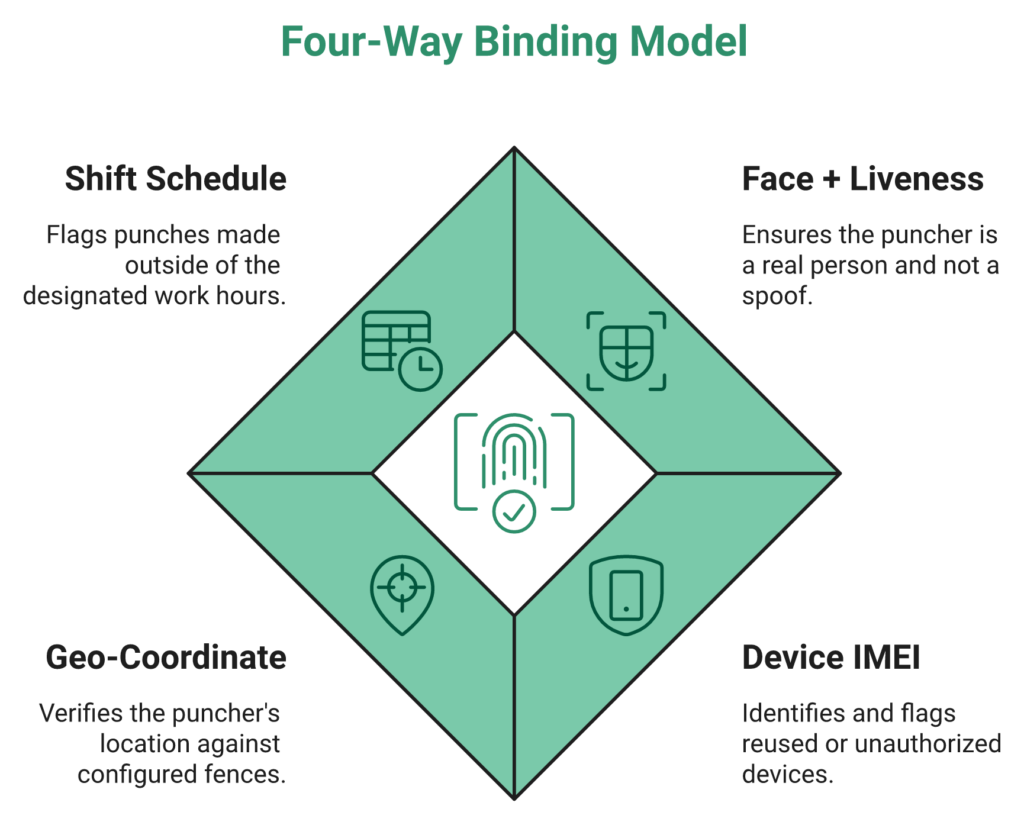
The mental model has to change. Attendance integrity is not a sensor upgrade. It is a four-way binding problem. A valid punch binds:
- Face with liveness detection, so a photo or video cannot spoof.
- Device through IMEI or trusted device registration.
- Geo-coordinate inside a configured fence, with network triangulation fallback.
- Shift schedule, where punches outside the assigned shift route to regularisation, not silent approval.
Rostering is a constrained-optimisation problem, not an Excel colouring exercise. Skill pool, availability, OSH Code weekly rest, overtime ceilings, and leave balances all have to be solved in one pass. Field tracking needs offline-first design, because “wait for 4G” is a planning failure, not an engineering constraint. The underlying discipline of managing shift schedules is closer to operations research than HR admin.
✅ How HROne Collapses All Three Problems Into One Stack
We built HROne Time Office around the binding model. Liveness-detected facial recognition is paired with a selfie-plus-geotag mobile punch tied to IMEI, so the same face on a second device routes to regularisation. The auto-shift allocator handles 3 shifts × multiple sites with OSH Code rest enforcement, rotation templates, and grace-time per location. Shift swaps flow through the Super Inbox with a full audit trail, not a WhatsApp thread. Offline punches queue with encrypted local storage and reconcile with deterministic conflict rules on reconnect. One timesheet reaches payroll on cycle-close, which is how MR DIY India went live in 30 days and how Asia Healthcare Holdings runs 20 pan-India units on a single instance.
💬 What Operators Say
“Real time sync of biometric and mobile mark punch functionality available, arrear day calculation is correct, comp off generation on working day is working fine.”
— Deepak K., HROne G2 – Verified Review
“GPS-based login and logout with pinpoint accuracy helps me track my on-field employees status, like where they are currently, to resolve customer service issues.”
— Krunal S., HROne G2 – Verified Review
“Automatic log out while marking attendance, error in detecting the location, some features are only available in a desktop mode, not in mobile application.”
— Arjun T., GreytHR – G2 Verified Review
Q6: Attendance Management Software India 2026, Top 12 Vendors Ranked With Scorecard, Pricing, and Best-Fit
We ranked twelve vendors on the 100-point rubric disclosed earlier, with HROne leading on compliance, TCO transparency, and support quality. The hero snapshot below is designed to be scanned in sixty seconds. Per-vendor entries follow an identical template so the reader can compare apples to apples. The broader top attendance management system India reference is useful alongside this list.
📊 Hero Comparison Snapshot, 12 Vendors at a Glance
| # | Vendor | Workforce Fit | Pricing Band (PEPM) | Compliance /25 | Biometric | GPS/Geo-Fence | Aggregated Rating |
|---|---|---|---|---|---|---|---|
| 1 | HROne | SME, Mid, and Enterprise | ₹85 to ₹200 | 24 | ✅ 200+ devices | ✅ Offline + selfie | 4.6 |
| 2 | Keka | SME and Mid | ₹80 to ₹180 | 18 | ✅ | ✅ | 4.3 |
| 3 | Darwinbox | Enterprise | ₹150 to ₹300+ | 20 | ✅ | ✅ | 4.4 |
| 4 | GreytHR | SME | ₹60 to ₹150 | 17 | ✅ | Partial | 4.2 |
| 5 | Zoho People | SME | ₹50 to ₹140 | 14 | Partial | ✅ | 4.3 |
| 6 | factoHR | SME and Mid | ₹70 to ₹160 | 19 | ✅ | ✅ | 4.4 |
| 7 | PeopleStrong | Mid and Enterprise | ₹120 to ₹250 | 19 | ✅ | ✅ | 4.1 |
| 8 | Zimyo | SME and Mid | ₹60 to ₹150 | 16 | ✅ | ✅ | 4.4 |
| 9 | Quikchex | SME | ₹50 to ₹130 | 15 | ✅ | Partial | 4.2 |
| 10 | Jibble | SME and Field | ₹40 to ₹120 | 10 | Limited | ✅ | 4.6 |
| 11 | Asanify | SME | ₹50 to ₹140 | 13 | Partial | ✅ | 4.3 |
| 12 | NYGGS | SME and Mid | ₹60 to ₹150 | 15 | ✅ | ✅ | 4.0 |
⭐ 1. HROne, Position 1
What it is, who it’s for: India-first, mobile-native HCM with Time Office at the core. SME to 5,000-employee enterprises across IT/ITeS, manufacturing, BFSI, logistics, and healthcare.
Scorecard: Compliance 24/25, UX 19/20, Integrations 14/15, TCO 15/15, Support 14/15, and AI 9/10 = 95/100.
Key features: 200+ biometric device integrations, selfie-with-geotag offline sync, DPDP-aware biometric vaulting, 127 pre-built workflows, Super Inbox regularisation, One AI Suite, India’s first inbuilt ROI Dashboard, flat PEPM with go-live billing, and prior-HR onboarding SPOC (9.8 NPS).
Pricing: Flat PEPM ₹85 to ₹200 with no per-entity surcharge. Subscription starts after go-live. See pricing.
Pros:
✅ Multi-legal-entity on one instance
✅ Three-click task closure
✅ G2 #3 Easiest-to-Use Core HR
Cons:
❌ Some geofencing radius edge cases on older Android builds (per Manna S., G2).
Best For: Mid-market and enterprises replacing a fragmented stack. Skip If: You need a pure US-PTO tool.
“The InboxforHR is a game-changer, centralizing every HR task into one simple inbox, cutting down administrative time by 60–70%.”
— Waldon S., HROne G2 – Verified Review
2. Keka
Scorecard: 78/100, with good UX and mobile polish, and gaps on support quality and complex shift logic.
Pros:
✅ Clean UI
✅ Strong ATS
Cons:
❌ Email-only support leaves clients stuck during migration.
Skip If: You run multi-entity shift-based manufacturing. Compare further at HROne vs Keka.
“Keka is not built to service IT consulting firms. TAT on customer request on features is bad.”
— Verified User in Consulting, Keka – G2 Verified Review
3. Darwinbox
Scorecard: 82/100, with broad modules and enterprise brand weight. Day-one billing and multi-tab UX are real frictions.
Pros:
✅ Deep configurability
Cons:
❌ Multi-year lock-ins and long implementations.
Skip If: You want go-live billing. See HROne vs Darwinbox.
“Bad implementation experience, bad UI UX, configurations getting broken in production on its own due to product deployments, terrible customer service.”
— Verified User in Computer Software, Darwinbox – G2 Verified Review
4. GreytHR
Scorecard: 74/100, solid SMB payroll, and limited workflows and rigid configuration. Explore HROne vs greytHR for a head-to-head.
“GreytHR is not much good at customizing based on our requirements. Many times we were manually correcting the leave balance of employees.”
— Verified User in IT, GreytHR – G2 Verified Review
5. Zoho People, 68/100
Good for single-entity startups. Weak India-specific depth on FBP, CTC revisions, and multi-entity. Skip If: You run BFSI or manufacturing compliance.
6. factoHR, 79/100
Strong mobile and payroll, with mid-market focus.
7. PeopleStrong, 77/100
Enterprise-capable. Mobile experience is strong, and desktop UX is crowded.
8. Zimyo, 74/100. 9. Quikchex, 70/100. 10. Jibble, 65/100. 11. Asanify, 68/100. 12. NYGGS, 69/100
Each covers a capable slice. Jibble leads on field-only time-tracking, Asanify on contractor payroll, and NYGGS on construction workforces. None owns the full hire-to-retire path with ROI instrumentation.
🌟 Aggregated Third-Party Ratings
| Vendor | G2 | Capterra | GetApp | Play Store | App Store |
|---|---|---|---|---|---|
| HROne | 4.6 | 4.5 | 4.5 | 4.4 | 4.5 |
| Keka | 4.4 | 4.4 | 4.4 | 4.2 | 4.3 |
| Darwinbox | 4.4 | 4.4 | 4.4 | 4.1 | 4.2 |
| GreytHR | 4.4 | 4.4 | 4.4 | 4.0 | 4.2 |
| Zoho People | 4.4 | 4.4 | 4.4 | 4.3 | 4.3 |
| factoHR | 4.7 | 4.7 | 4.7 | 4.5 | 4.6 |
Q7: What Is the Real 3-Year TCO, Software, Biometric Hardware (₹3,000 to ₹35,000), Implementation, and Hidden Fees?
Realistic 3-year TCO for a 500-employee Indian firm ranges ₹18 lakh to ₹55 lakh, and subscription is only 40% to 55% of the total. The rest hides in biometric CapEx of ₹3,000 to ₹35,000 per device, implementation fees running 1 to 6× monthly subscription, per-entity surcharges in enterprise suites, and day-one-billing clocks that start before go-live. More context on HR software pricing transparency is worth reading before RFP.
💰 The TCO Breakdown That Actually Matters
💻 Biometric hardware cost bands: entry fingerprint ₹3,000 to ₹8,000 per device, mid-range fingerprint plus RFID ₹10,000 to ₹18,000, facial recognition with liveness ₹20,000 to ₹35,000, and iris readers ₹30,000+.
📱 Subscription (PEPM): SMB ₹40 to ₹90, mid-market ₹90 to ₹180, and enterprise ₹180 to ₹300+. Multi-entity surcharges add ₹20 to ₹60 per employee at legacy vendors.⏰ Implementation benchmarks: SME under 250 employees 2 to 4 weeks, mid-market 250 to 1,000 employees 4 to 8 weeks, and enterprise 1,000+ employees 3 to 6 months with legacy suites.
💸 Hidden fees most buyers miss: per-legal-entity charges, device AMC at 12% to 18% of hardware cost annually, per-integration add-ons (Tally, SAP, and BGV), SSO module billed separately, and day-one billing that invoices a full subscription while implementation drags on.
📝 Contract-negotiation cheatsheet: AMC clauses capped at 15% and renewable annually, no auto-renewal without written consent, 90-day data-exit clause with full export rights, go-live billing clause tied to a written UAT sign-off, no per-entity surcharge in writing, and a phone-plus-email support SLA in the MSA.
🧩 How HROne Keeps the TCO Predictable
We price HROne on flat PEPM with no per-entity surcharge. Subscription starts only after go-live, and the prior-HR onboarding consultant model gets mid-market clients live in as little as 30 days. MR DIY India is the documented example. For CFO-IT buying committees running a 3-year TCO spreadsheet, that combination removes three of the five hidden-fee categories above before the first invoice is raised. The ROI calculator helps frame the savings against HR salary.
Q8: Which Attendance Architecture Fits Your Workforce, SME Factory, Enterprise IT, Field Sales, or Retail Chain?
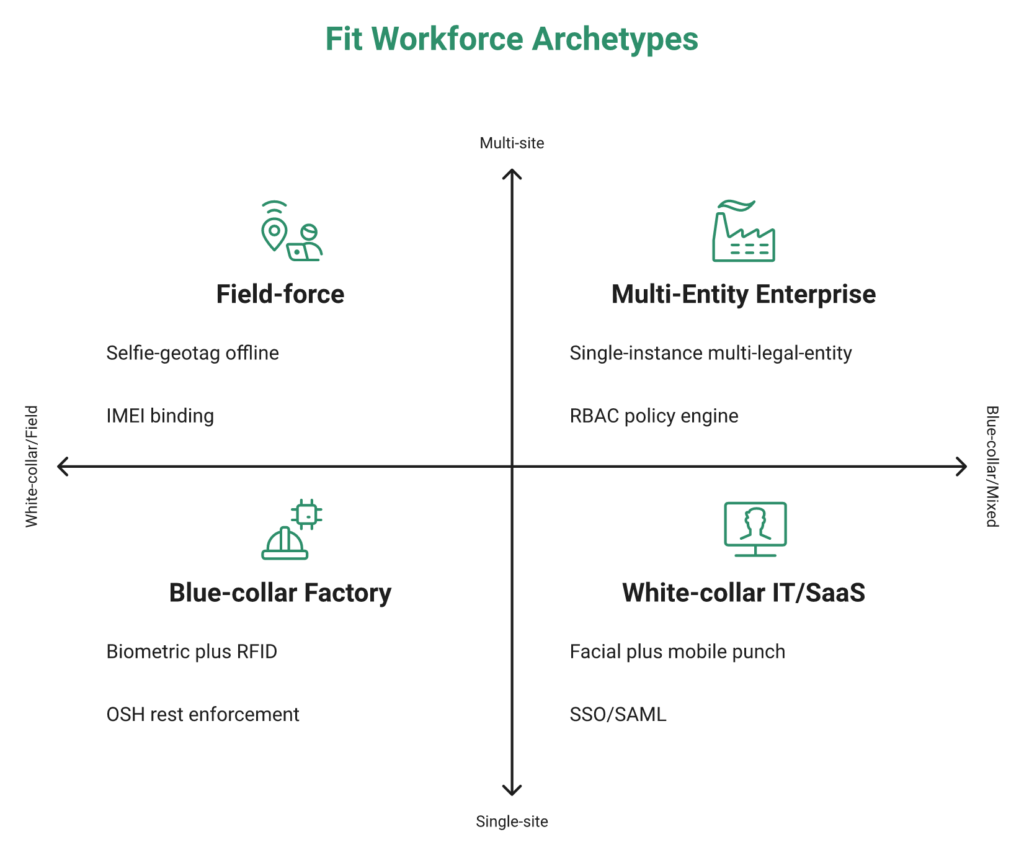
Pick the architecture first, then the vendor. Workforce fit is decided by three variables, including dispersion (single-site vs multi-site), collar mix (blue-collar vs white-collar vs field), and compliance complexity (single entity vs multi-legal-entity). It is not decided by peer-company choice or module count. A cross-read with multi-location workforce management sharpens the diagnosis.
⚠️ The Decision Dilemma, Why Most Buyers Pick Wrong
Most Indian HR leaders arrive at vendor evaluation carrying one of two shortcuts: “Darwinbox because our peer group uses it” or “cheapest PEPM for 500 heads.” Both ignore dispersion and compliance, which are the two variables that actually decide whether the platform survives the next expansion. A tool that handles one Bangalore office beautifully cracks the moment a Nashik plant and a Guwahati depot enter the picture.
🧭 The 6-Question Routing Tree
Answer these in order before you look at a single demo:
- How many sites will you run in 24 months? One means mobile-first is enough. Multi-site means hybrid architecture is mandatory.
- What is your collar mix? Blue means biometric plus RFID backbone. White means facial plus mobile. Field means selfie-geotag offline. Mixed means hybrid.
- How many legal entities? One means any vendor. Multi means disqualify vendors without single-instance multi-entity.
- What connectivity can you assume? Urban only means cloud-first. Rural plants or field means offline-first is mandatory.
- Is DPDP biometric vaulting non-negotiable? Yes means disqualify vendors without encrypted template storage and consent artefact.
- Who approves overtime and rosters? Central HR means workflow-light. Plant-level supervisor means Super Inbox with delegation is mandatory.
🏭 Archetype Shortlists
| Archetype | Must-Have Capabilities | Top Picks |
|---|---|---|
| Blue-collar factory, construction, or retail chain | Biometric plus RFID, shift engine with OSH rest, kiosk, and offline sync | HROne, factoHR, and PeopleStrong |
| White-collar IT, SaaS, or hybrid office | Facial plus mobile, SSO/SAML, Teams/Slack, and ESS | HROne, Keka, and Darwinbox |
| Field sales, logistics, or service techs | Selfie-geotag offline, route adherence, and device-ID binding | HROne, Jibble, and factoHR |
| Multi-entity enterprise | Single-instance multi-legal-entity, RBAC, and front-end policy engine | HROne, Darwinbox, and PeopleStrong |
✅ Applying the Framework, HROne Scorecard by Archetype
| Archetype | HROne | Why |
|---|---|---|
| Blue-collar factory | ✅ | 200+ biometric devices, auto-shift allocation, and OSH rest enforcement |
| White-collar IT | ✅ | Super Inbox three-click UX, Teams/Slack integration, and SSO/SAML |
| Field-force | ✅ | Selfie-geotag offline, IMEI binding, and route visibility |
| Multi-entity enterprise | ✅ | Single-instance multi-legal-entity on flat PEPM with no surcharge |
HROne wins on all four archetypes because the platform was designed for the Indian mid-market and enterprise reality, including multi-legal-entity, multi-site, and mixed-collar, not retrofitted for it. Operators can explore manufacturing HR and ITES HR for sector-specific depth.
🔍 The Meta-Insight, Ask the Right Question
The real question is not “which HRMS has the most modules.” It is “which architecture survives my next plant, field expansion, or legal-entity addition without a parallel deployment?” MR DIY India answered that question in 30 days of go-live. Asia Healthcare Holdings answered it by running 20 pan-India units on a single HROne instance with unified employee master and entity-independent compliance, which is exactly what the multi-entity archetype demands.
Q9: How Do You Roll Out Attendance Software in 12 Months, Migration, Policy Config, Change Management, and Failure-Mode Field Notes?
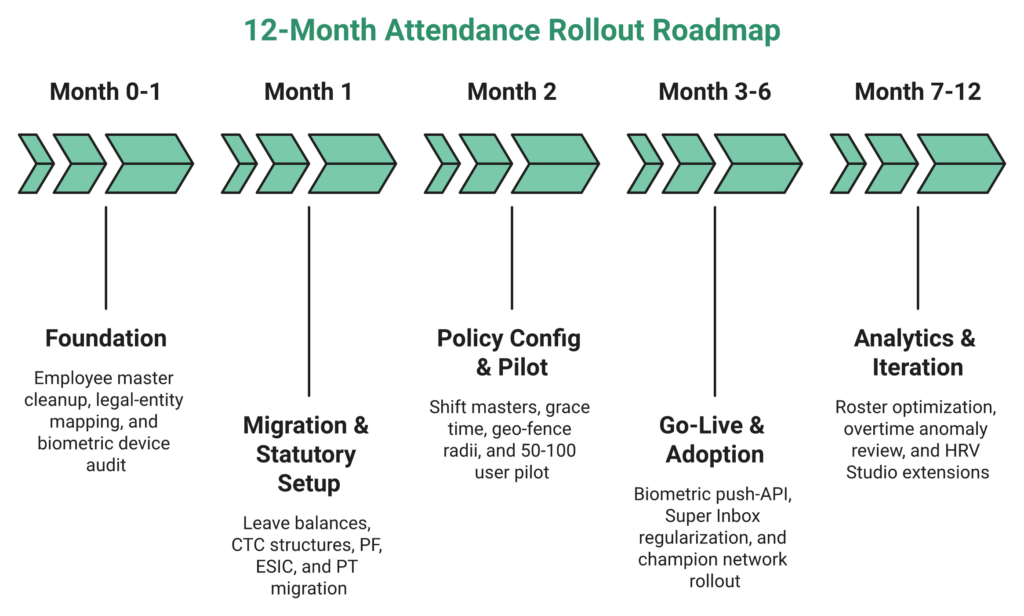
A successful attendance rollout follows a 12-month roadmap. Months 0 to 1 are for data migration and statutory setup, month 2 for policy configuration and a single-site pilot, month 3 for go-live, and months 4 to 12 for adoption, analytics, and iteration. Anything faster usually skips change management, and anything slower usually means the vendor is learning on your data. A supporting read on attendance policy implementation gives context for the sequencing.
🗓️ The 12-Month Timeline, Milestone by Milestone
- Month 0, Foundation: employee master cleanup, legal-entity mapping, leave and attendance policy document lock, and biometric device audit.
- Month 1, Migration: import employee master, historical leave balances, CTC structures, and last-3-month attendance logs. Statutory setup for PF, ESIC, and Professional Tax across states.
- Month 2, Policy config and pilot: configure shift masters, grace time, overtime rules, and geo-fence radii per site. Pilot at one plant or one office with 50 to 100 users.
- Month 3, Go-live: activate biometric push-API, mobile app rollout, Super Inbox for regularisation, UAT sign-off, and switchover.
- Months 4 to 6, Adoption: weekly adoption reports, manager training, and a champion network of 1 per 50 employees.
- Months 7 to 9, Analytics: roster optimisation, overtime anomaly review, and attrition-risk signals from attendance patterns.
- Months 10 to 12, Iteration: policy tune-up based on 9 months of real data, HRV Studio extensions for edge-case workflows, and expansion to remaining sites.
⏰ Implementation Timeline Benchmarks by Size
| Company Size | Realistic Go-Live | Critical Risk |
|---|---|---|
| SME (≤250) | 2 to 4 weeks | Skipping UAT |
| Mid-market (250 to 1,000) | 4 to 8 weeks | Multi-entity mapping errors |
| Enterprise (1,000 to 5,000) | 3 to 6 months | Legacy biometric driver gaps |
🧑🏫 Change-Management Adoption Playbook
- Communication: pre-go-live email series with screenshots, not a one-time townhall. Rollout deck lives on the intranet for 90 days.
- Training: separate 45-minute tracks for employees, reporting managers, plant supervisors, and HR Ops. Generic training kills adoption.
- Champion network: one champion per 50 employees, trained two weeks before go-live, and given a private Slack or WhatsApp loop.
- Feedback loops: weekly 30-minute open clinic for the first 60 days. Every ticket is routed through the Super Inbox, not personal email.
- Leadership visibility: CHRO reviews adoption dashboard in the weekly leadership meeting. Nothing drives behaviour faster than visible scrutiny.
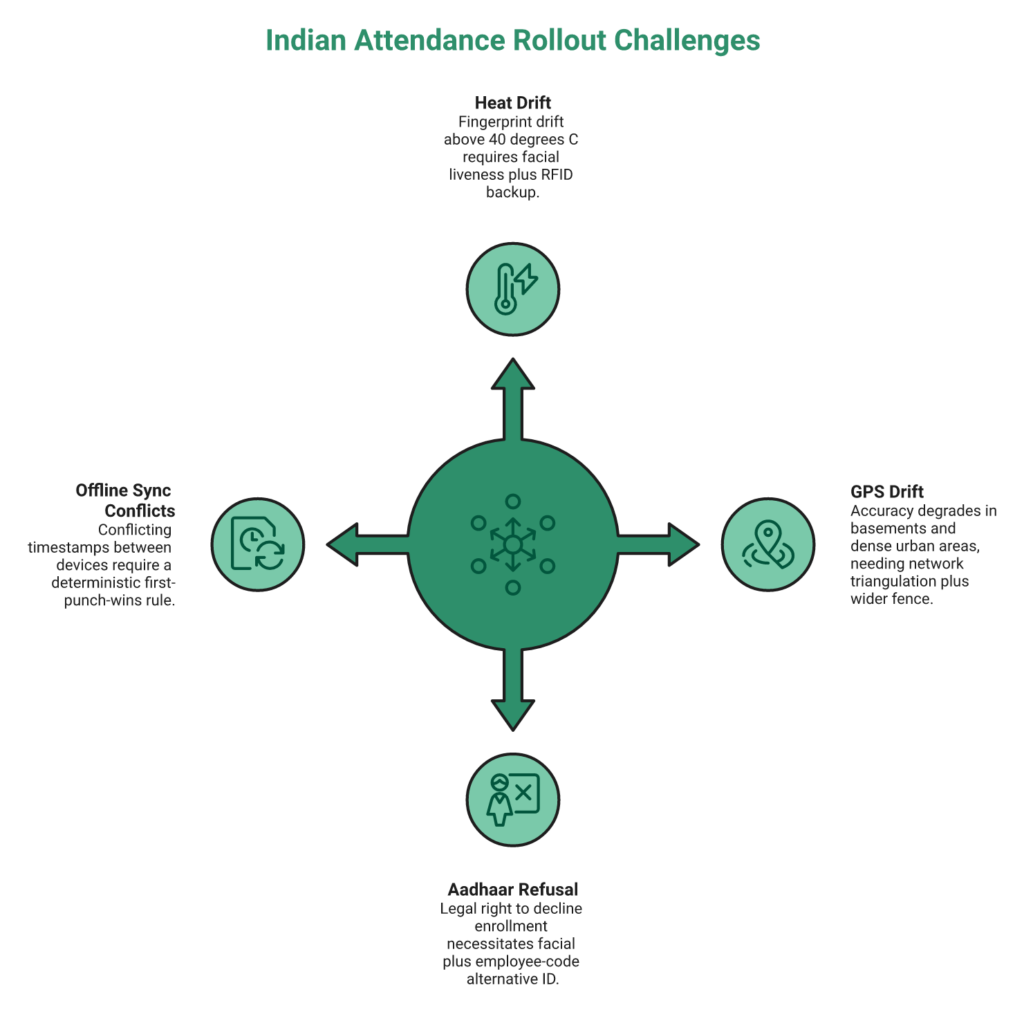
⚠️ Failure-Mode Field Notes, What Actually Breaks
🔥 Biometric failure in high-temperature factories: fingerprint sensors drift above 40°C, and metal-dust-covered fingers stop registering. Fix: facial recognition with liveness at plant-gate kiosks, RFID as a backup lane, and a supervisor override logged to the Super Inbox.
📍 GPS drift in basements and dense urban areas: reported accuracy degrades to 100 to 300 metres in DLF Cyber City, BKC, or any basement loading bay. Fix: network triangulation fallback, wider geo-fence radius (150 to 200 metres) for known low-accuracy sites, and a manual geo-override with manager approval.
🪪 Aadhaar consent refusal: employees can legally decline AGBAS enrollment. Fix: alternative-ID flow with facial plus employee-code, documented in the DPDP consent artefact. Never force Aadhaar as the only enrollment path.
🔄 Offline sync reconciliation errors: two punches on different devices, with conflicting timestamps. Fix: deterministic conflict-resolution, where first-punch wins for check-in, last-punch wins for check-out, and duplicates route to HR Ops queue, not silent acceptance.
Teams looking for deeper failure-mode context can also consult geofencing attendance system and biometric workforce management.
🧩 How HROne Keeps the 12-Month Roadmap on Track
We run HROne implementations through a prior-HR onboarding consultant, not a generic project manager. The SPOC carries a 9.8 NPS and understands what a CTC revision actually breaks in payroll. That is how MR DIY India went live in 30 days across its India operations. HRV Studio handles edge-case workflows without developer tickets, and the Super Inbox surfaces every sync failure, UAT issue, and adoption gap on one screen for HR Ops to close. Month 12 looks like a measured improvement curve, not a post-go-live firefight.
Q10: What Are the 2026 Trends and AI Use-Cases Reshaping Attendance Management, and the Final Segment-Wise Verdict?
By 2026, facial recognition plus GPS is table stakes, agentic AI handles shift planning and anomaly detection, and Microsoft Teams plus Slack integration has become non-negotiable for hybrid IT workforces. The segment verdict is clear. HROne leads mid-market and enterprise, while factoHR and GreytHR remain credible for SME-only payroll focus. A side-read on AI in HR hype vs reality helps separate signal from noise.
⚠️ The Contextual Reality, What HR Leaders Are Being Asked For
The CHRO agenda in 2026 has shifted from “can we track attendance” to “can we predict it.” Boards are asking for attrition risk scored against attendance patterns, anomaly-flagged punches that might indicate fraud before payroll close, and hybrid-work flexibility signals that inform real-estate decisions. The problem is that most platforms do not have a unified data layer to deliver any of this. Attendance sits in one database, leave in another, payroll in a third, and performance somewhere on a laptop in Excel. You cannot do predictive analytics on fragmented data.
❌ The Industry Critique, Why Bolted-On AI Fails
Most vendors responded to the 2026 AI demand by adding a dashboard. That is not AI-native. That is AI-painted. A few specific patterns to watch:
- Dashboard-only AI: visualises the past, and does not act on the present.
- Anomaly detection without context: flags a 2 AM punch without knowing the shift schedule, producing an 80% false-positive rate.
- Shift planning that ignores constraints: suggests rosters without checking OSH Code rest, skill pools, or leave balances.
- Teams/Slack as a link to the portal: a notification is not an integration. A three-click approval inside Slack is.
Predictive analytics only works when attendance, leave, payroll, and performance share one data layer. That is an architectural decision, not a feature.
💡 The Strategic Shift, What AI-Native Actually Means
AI-native attendance in 2026 has four signatures:
- Agentic shift planning that solves skill, availability, and rest-hour constraints in one pass and suggests publishable rosters.
- Fraud correlation across attendance, expense receipts (via receipt parser), and approval trails. Buddy-punching and inflated claims get caught together. Context on AI detecting expense fraud shows how this correlation works in practice.
- Teams and Slack-native ESS, where employees apply leave, approve regularisation, and check payslip inside the chat app, not a browser redirect.
- ROI instrumentation, including hours reclaimed against average HR salary, presented in rupee terms for the board, not a vanity adoption metric.
✅ HROne’s Approach and Final Segment-Wise Verdict
We built HROne’s One AI Suite to sit on the unified employee data layer, including resume relevancy scoring, receipt parser for expense fraud correlation, AI Employee Agent for policy queries, and JD plus interview generators for recruitment. India’s first inbuilt ROI Dashboard quantifies lifetime hours saved against average HR salary, so CHROs walk into the board meeting with a number, not a narrative. Teams and Slack integrations push the Super Inbox into the chat app.
| Segment | #1 Pick | #2 Pick | #3 Pick |
|---|---|---|---|
| SME (100 to 500) | HROne | factoHR | GreytHR |
| Mid-market (500 to 2,000) | HROne | Keka | Zoho People |
| Enterprise (2,000 to 5,000) | HROne | Darwinbox | PeopleStrong |
💬 What Operators Say
“Sometimes i also used its OneAI system to apply leaves, That is what i have seen first time in a HR application system.”
— AYUSH G., HROne G2 – Verified Review
“The InboxforHR is a game-changer, centralizing every HR task into one simple inbox, cutting down administrative time by 60–70%.”
— Waldon S., HROne G2 – Verified Review
“Reporting analytics — limited customization in reports. Integration issues — sync with other systems can be inconsistent.”
— Saksham A., Darwinbox – G2 Verified Review
Q11: Attendance Management Software India FAQ, Biometric Integration, Remote Tracking, Buddy-Punching, and Shift Complexity
Below are direct answers to the five questions every Indian HR leader asks before shortlisting attendance software in 2026, written tight enough for Featured Snippet and People-Also-Ask extraction.
❓ The Five Questions, Answered
- Best attendance management software India with biometric integration? HROne leads the 2026 shortlist on compliance, TCO transparency, and support (G2 #3 Easiest-to-Use Core HR, and 9.8 NPS). Runners-up include Keka and Darwinbox for specific segments. Architecture, not brand, should decide. Match capture-method stack to workforce dispersion and compliance complexity. Start with attendance management.
- Does HR software integrate with biometric attendance devices? Yes. Enterprise-grade HRMS platforms integrate with 200+ biometric device families (ZKTeco, eSSL, Matrix, Realtime, and Spectra) through real-time push APIs, not SFTP batch imports. The real differentiator is whether the integration is bidirectional and DPDP-compliant with encrypted template vaulting. More context lives on the integrations page.
- How does HR software handle complex shift and roster management? Through a three-layer stack, including shift master (patterns, grace, and overtime multipliers), roster engine (auto-allocation by skill, site, and availability), and compliance layer (OSH Code weekly rest, and Factories Act overtime caps). Excel rosters fail the moment you cross two shifts or three sites.
- How do I track remote and field employees accurately? With a four-layer stack, including configurable geo-fence radius per site, GPS plus network triangulation fallback, offline punch queue with background sync, and selfie plus facial liveness bound to device IMEI. Anything less produces the WhatsApp-confirmation workaround that leaks payroll. See remote hybrid attendance.
- Why are employees buddy-punching and how do I stop it? Because single-factor biometrics are easy to spoof, and there is no audit trail for regularisation. Stop it by binding every punch to face plus device plus geo-coordinate plus shift schedule, and route exceptions to a Super Inbox-style regularisation queue. Hardware upgrades alone do not close the leak.
🧩 How HROne Answers All Five Natively
We built HROne’s Time Office around exactly these five questions, including 200+ biometric device integrations with real-time push API, selfie-with-geotag offline sync bound to IMEI, auto-shift allocation with OSH Code rest enforcement, liveness-detected facial recognition, and Super Inbox regularisation with full audit trails. The combination is why mid-market and enterprise buyers across 1,500+ brands, including MR DIY India and Asia Healthcare Holdings, stopped juggling biometric portals, Excel trackers, and outsourced payroll vendors, and consolidated onto one system that bills only after go-live.
Q12: Ready to Replace Your Biometric, Excel, and WhatsApp Stack With One Attendance System That Proves ROI in 30 Days?
HROne Time Office unifies biometric capture, geo-fenced selfie, facial recognition with liveness, shift and roster automation, and payroll propagation inside one Super Inbox. It removes the standalone biometric portal, the month-end Excel reconciliation, and the WhatsApp approval chains that quietly leak 2.8% of payroll every month.
⭐ The Proof Point That Settles the Decision
MR DIY India went live on HROne in 30 days, compressed its payroll cycle from 10 days to 5 to 6, and reduced attendance disputes after consolidating on Time Office and the Super Inbox. Asia Healthcare Holdings runs 20 pan-India units on a single HROne instance with unified employee master and entity-independent compliance. Flat PEPM, no per-entity surcharge, subscription meters only after go-live, and India’s first inbuilt ROI calculator converts hours reclaimed into rupee savings your CFO can take to the board, without another quarterly consulting slide. Review additional customer success stories before your demo call.
Run Your India Attendance on One System That Bills From Go-Live
MR DIY India replaced its biometric-plus-Excel-plus-outsourced-payroll stack with HROne Time Office and went live in 30 days, cutting payroll cycles from 10 days to 5 to 6, and eliminating attendance disputes. Flat PEPM, no per-entity surcharge, subscription starts only after go-live, and the ROI Dashboard shows lifetime hours saved in rupee terms.
Book a 30-Minute HROne DemoExplore further: Attendance Management Software · Time Office Module · HROne ROI Dashboard













 Secures Top Spot in
