









Q1. What Are the 10 Best HR Software for Manufacturing Companies in India 2026?
Selecting an HRMS for an Indian manufacturing operation is a high-stakes call that sits at the intersection of Factories Act compliance, CLRA contractor registers, multi-state PF/ESI/PT filings, and 2 to 3-shift biometric attendance running 800+ workers a day. Getting it wrong means delayed paycheques, audit exposure, and a shopfloor mobile app nobody uses. Rather than rank by brand halo, this guide evaluates 10 platforms against operator-grade criteria built for plant HR, Payroll Managers, and CHROs. The primary reader is the HR Ops lead or Payroll Manager running the system daily. The shadow readers are the CHRO, CFO, and IT Director signing the MSA.
Our Evaluation Criteria
Each vendor was assessed across seven decision-grade dimensions relevant to manufacturing realities, not generic “feature checklists”:
🇮🇳 Manufacturing Compliance Depth: CLRA registers, Factories Act OT, multi-state PF/ESI/PT/LWF, and new Labour Code (2-working-day FFS) readiness.
⏰ Shift and Biometric Attendance Fit: ZKTeco, eSSL, Matrix, and Realtime integration, night-shift crossover logic, offline sync, and geo-fenced mobile punch.
💰 Payroll and Multi-Entity Reliability: arrears, FBP, CTC revisions, group payout validations, JV export to Tally/SAP, and per-entity compliance isolation.
📱 Blue-Collar Mobile and Adoption: Play Store rating and install base, Indic language, kiosk mode, and offline ESS for low-connectivity plants.
💸 Pricing Transparency and TCO: published PEPM, billing trigger (contract vs go-live), lock-in terms, add-on disclosure, and implementation fee clarity.
⚙️ Implementation and Support Model: go-live timeline, dedicated SPOC vs ticket queue, phone availability, and data-migration ownership.
⭐ Verified Manufacturing Proof: named India plant case studies with quantified outcomes (headcount, TAT, automation %), not stock photos.
Who This Guide Is For
- CHROs and VP-HR consolidating a fragmented payroll vendor, biometric portal, Excel, and ATS stack across multiple plants.
- Payroll Managers running multi-state PF/ESI/PT cycles and firefighting arrears every month-end.
- Plant HR Ops Leads manually reconciling biometric exports against leave portal and contractor muster rolls.
- CFOs and Finance Directors validating flat PEPM, billing-after-go-live, and exit portability before committing to a 3-year MSA.
- CIOs and IT Directors evaluating ISO 27001, SSO, biometric hardware retention, and DPDP Act readiness.
This guide is not for sub-50-employee single-plant units still running payroll on a CA’s Tally sheet. Those buyers are better served by free tiers of greytHR Starter or Pocket HRMS.
The Top 10 at a Glance
- HROne ⭐⭐⭐⭐⭐
- factoHR ⭐⭐⭐⭐
- Keka HR ⭐⭐⭐⭐
- greytHR ⭐⭐⭐
- Darwinbox ⭐⭐⭐
- PeopleStrong ⭐⭐⭐
- ZingHR ⭐⭐⭐
- SAP SuccessFactors ⭐⭐
- Spine HR ⭐⭐
- Pocket HRMS ⭐⭐
Quick Comparison Table
| Provider (⭐) | Best For | Standout Strength | Known Limitation | Manufacturing Proof | Support Model | Pricing Model |
|---|---|---|---|---|---|---|
| HROne ⭐⭐⭐⭐⭐ | Multi-plant HR Ops leads drowning in payroll, biometric, and ATS reconciliation | Super Inbox, 127 pre-built hire-to-retire workflows, and One AI Suite on a single tenant | UI learning curve in first 2 to 4 weeks. Capterra review base of 27 is thin | Lux Industries, Shyam Metalics, Premier Energies (850 factory workers) | Phone, email, and dedicated prior-HR SPOC, 24-hour response | Flat PEPM ₹85 to ₹130, billing starts after go-live, no lock-in |
| factoHR ⭐⭐⭐⭐ | Factories Act-heavy plants needing RFID, fingerprint, and face biometric depth | ISO 27001 and SOC 2 dual certification. Biometric-first attendance stack | Narrower feature depth outside attendance and payroll | L&T, Hitachi. 3,500+ companies, 2.6M employees | Email, phone, and partner-delivered | ~₹45 to ₹85 PEPM (publicly not fully transparent) |
| Keka HR ⭐⭐⭐⭐ | Mid-market Payroll Managers wanting clean UX plus strong PF/ESI/TDS compliance | 1,941 G2 reviews, modern UX, and eSSL plus Keka Kiosk facial recognition | Shift Scheduler is a priced add-on. Email-led support with escalation gaps | Shift management documentation strong. Named India plant proof thin | Email-led ticketing, limited weekend support | Foundation ₹6,999 to Growth ₹15,999/month plus add-ons |
| greytHR ⭐⭐⭐ | SMB Payroll Manager handling single-state PF/ESI/PT compliance | Deepest state-wise compliance content library in Indian HRMS space | Limited workflows. Rigid multi-entity configuration | Manufacturing listed as served sector. No named plant case study | Ticket-based plus chat | Starter free, Growth ₹7,495/month, plus GeoMark add-on ₹50 PEPM |
| Darwinbox ⭐⭐⭐ | Enterprise CHROs at 3,000+ employee conglomerates modernising off legacy ERPs | Unicorn-funded enterprise breadth. 700 global clients, 2M users | Pricing opacity, steep learning curve, and slow pages at peak | PT Gunung Raja Paksi (Indonesia). Indian mid-market plants not named in primary research | Enterprise CSM plus ticketing | Custom quote. Billing typically from contract sign |
| PeopleStrong ⭐⭐⭐ | 1,000+ employee APAC enterprises needing Gartner-recognised HCM | Gartner Peer Insights Customers’ Choice. ISO 27001 plus SOC 1 | Thin G2 review base (72). Pricing not published | Manufacturing HR page. Specific India plant case studies not named | Enterprise CSM | Custom quote |
| ZingHR ⭐⭐⭐ | Blue-collar-first deployments where mobile ESS is the adoption battle | End-to-end hire-to-retire with vernacular mobile for shopfloor | Outdated UI. Customization is slow and expensive per reviewers | Manufacturing references present. Quantified India plant proof limited | Ticket-based | Custom quote |
| SAP SuccessFactors ⭐⭐ | 5,000+ employee global manufacturers already on SAP ERP | Global compliance breadth plus native SAP FI/CO integration | India payroll needs heavy configuration. Sub-2,000-employee TCO is punishing | Industries listed include manufacturing. India-first localisation is shallow | Partner-delivered | Enterprise quote, lakhs annually |
| Spine HR ⭐⭐ | Legacy on-premise plants transitioning slowly to cloud payroll | Deep traditional Indian payroll logic for complex retroactive cycles | Limited modern UX, thin mobile, and minimal AI | Long-tenured manufacturing base. Published metrics sparse | Partner-led plus email | Quote-based |
| Pocket HRMS ⭐⭐ | Sub-200-employee single-plant SMEs on a tight budget | Lightweight Core HR plus payroll at SME-friendly price | Not built for multi-plant, CLRA contractor depth, or shift complexity | SME base. Manufacturing enterprise references thin | Email plus chat | PEPM published. SMB-oriented tiers |
1. HROne: The Hire-to-Retire Operating System for Indian Manufacturing
Overview
HROne is a cloud-native, India-first HCM built and operated by Uneecops Workplace Solutions Pvt. Ltd. (Noida, founded as an HRMS platform in 2016). It serves 1,500+ brands and is positioned around 100 to 5,000 employee Indian mid-market and enterprise buyers. G2’s 2026 awards ranked HROne #1 Software Company in APAC, #1 Indian Software Company, Top 3 for Highest Customer Satisfaction Globally, and Top 5 Best HR Software Globally, evaluated across 151,000 products, with 4.8/5 across 2,089 G2 reviews. Primarily used by multi-plant manufacturers firefighting reconciliation between outsourced payroll vendors, biometric portals, Excel, and disconnected ATS tools.
Core Services
- Super Inbox (InboxforHR): aggregates every pending task, approval, and request into a Gmail-style three-click closure surface, eliminating tab-switching across 5+ HR tools and cutting HR admin time by 60 to 70% per verified user reports.
- Time Office plus Any-Biometric Integration: ingests ZKTeco, eSSL, Matrix, and Realtime punches in real time, handles night-shift crossover, geo-fenced mobile punch, and offline sync for low-connectivity plants.
- Payroll with Auto Scheduler: runs recurring multi-state PF/ESI/PT/LWF cycles, arrears under new wage code, FBP declarations, and 2-working-day FFS, with group payout validations before JV export to Tally/SAP.
- 127 Pre-Built Hire-to-Retire Workflows: onboarding, confirmation, transfer, promotion, and exit clearance fire automatically with defined owners and SLAs, replacing the manual chasing game over email.
- One AI Suite (launched April 2025): Employee AI Agent (voice-driven leave, OD, helpdesk), Resume Parser with relevancy scoring, Receipt Parser for expense auto-fill, and JD/interview generators.
- India’s First Inbuilt ROI Dashboard: converts lifetime hours saved into rupee terms against average HR salary, giving CHROs a board-ready figure without PowerPoint gymnastics.
- HRV Studio (low-code): lets HR build custom apps (visitor log, vendor gate pass, plant seating) without raising a developer ticket.
🇮🇳 India-Specific Compliance and Localization
- PF / ESI / TDS support: ✅ Yes. Automated filing, bank challan generation, and Form 16/24Q outputs validated.
- Labour law compliance: ✅ Strong. New wage code, Factories Act OT, and 2-working-day FFS referenced on product changelog.
- Payroll localization (India-specific): ✅ Yes. FBP, CTC revision arrears, and multi-entity under one tenant.
- Multi-state compliance handling: ✅ Yes. State-wise PT slabs, LWF, and region-specific minimum wages.
Who This Is Built For
- Payroll Manager at a 1,200-employee multi-plant manufacturer firefighting CTC-revision arrears and state-wise PT filings every month-end.
- Plant HR Ops lead manually reconciling ZKTeco biometric exports against Excel leave trackers and WhatsApp OT approvals.
- CHRO at a 2,000-employee group being asked by the board for a rupee-quantified HR-tech ROI figure.
Who Should Skip This
- Sub-100-employee single-plant units wanting a ₹2,000/month spreadsheet-like payroll tool with zero workflow discipline.
- Global-HQ buyers demanding EU-first data residency and deep US/UK payroll engines. HROne is India-tuned first.
Pricing Structure
- Plan Types: Basic, Professional, and Enterprise.
- Starting Price: Basic ₹4,950/month for 50 users (₹99 PEPM add-on). Professional ₹6,500/month for 50 users (₹130 PEPM). Enterprise custom quote.
- Tier-wise Breakdown:
- Basic ₹99 PEPM: Core HR, Leave, Attendance, ESS, and Mobile app.
- Professional ₹130 PEPM: adds Payroll, Performance, Expenses, Helpdesk, and Recruitment.
- Enterprise: adds HRV Studio, One AI Suite, ROI Dashboard, multi-legal-entity, and custom workflows.
- Incremental Cost Drivers: Implementation fee applies for enterprise clients (amount not disclosed on pricing page; request-quote).
- Implementation Fee: Yes for Enterprise tier. Not bundled. Disclosed at quote stage.
- Cost at 200 employees: ~₹3.12 lakh annually on Professional (₹130 × 200 × 12).
- Cost at 500 employees: ~₹7.8 lakh annually on Professional. Enterprise quote typically commands a premium for AI/ROI/Studio modules.
Billing starts after go-live, not at contract sign. Exit is a 2-month notice with no multi-year lock-in.
Implementation and Support Reality
- Go-live timeline: ~30 days for mid-market (MR DIY India referenced). 60 to 90 days for complex multi-entity manufacturing rollouts.
- Support channels: Phone, email, and dedicated prior-HR SPOC, 24-hour response SLA, claimed NPS 9.8 (vendor-claimed, independent source URL not located).
- Data migration model: Vendor-led with dedicated consultant through configuration phase.
- Reported CSAT: G2 Top 3 Highest Customer Satisfaction Globally, 2026.
Reviews
“I like HROne for its zero-touch payroll and compliance automation… The InboxforHR is a game-changer, centralizing every HR task into one simple inbox, cutting down administrative time by 60 to 70% and preventing tasks from falling through the cracks.”
— Waldon S. HROne G2 Verified Review
“Proper calculation of PF and ESI was a pain area for us before, but now with the HROne automated calculation process, results are up to the mark and following Indian tax compliances properly… Live biometric punch sync available, and employee can apply short leave if required through mobile application also.”
— Ajay K. HROne G2 Verified Review
2. factoHR: Biometric-First HRMS for Factories Act-Heavy Plants
Overview
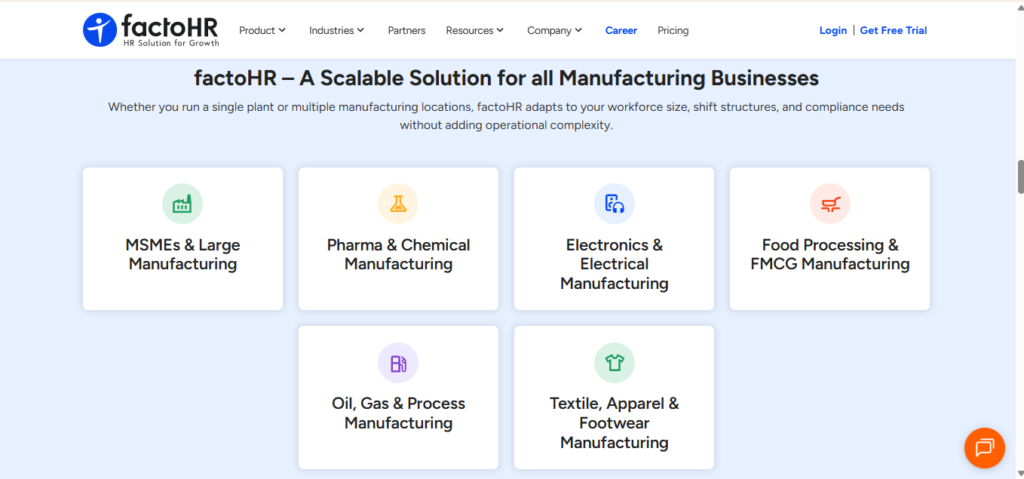
factoHR (Netzwerk Software Pvt. Ltd., Ahmedabad) positions itself as an AI-powered HRMS with 15 modules for 50 to 50,000-employee manufacturers. Named clients include L&T and Hitachi, with 3,500+ companies and 2.6M employees on the platform. Primarily used by plant HR teams struggling with factory-floor biometric integration and Factories Act overtime compliance.
Core Services
- Multi-Modal Biometric Attendance: fingerprint, facial recognition, RFID card, and mobile geo-fencing, with offline sync for low-bandwidth plants.
- CLRA plus Factories Act Payroll: explicit contract labour register support and overtime computation aligned with state shift rules.
- Multi-State Statutory Engine: PF, ESI, PT, TDS, gratuity, and LWF across states. Form 24Q outputs standard.
- Performance OKRs plus Onboarding: covers hire-to-retire cycle with moderate depth outside the attendance/payroll core.
- Mobile Kiosk Mode: shared-device punch for shopfloor workers without personal smartphones.
🇮🇳 India-Specific Compliance and Localization
- PF / ESI / TDS: ✅ Yes. Automated filing and challans.
- Labour law compliance: ✅ Strong. Factories Act and CLRA explicitly documented.
- Payroll localization: ✅ Yes. Multi-state aware.
- Multi-state handling: ✅ Yes. State-wise PT and LWF matrices.
Who This Is Built For
- Plant HR Manager running 2-shift operations at a Factories Act-registered unit with 300+ contract workers.
- Payroll Manager needing ISO 27001 plus SOC 2 certifications on procurement’s checklist.
Who Should Skip This
- Buyers wanting a deep One AI Suite, ROI Dashboard, or low-code custom app builder. factoHR’s depth outside attendance and payroll is narrower. See the detailed HROne vs FactoHR comparison.
Pricing Structure
- Plan Types: Not fully transparent on public pages.
- Starting Price: ~₹45 to ₹85 PEPM per third-party aggregators.
- Incremental Cost Drivers: Module-wise upgrades. Enterprise add-ons quote-based.
- Implementation Fee: “Not publicly disclosed, request a quote.”
- Cost at 200 employees: ~₹1.08 to ₹2.04 lakh annually (estimate).
- Cost at 500 employees: ~₹2.7 to ₹5.1 lakh annually (estimate).
Implementation and Support Reality
- Go-live timeline: 7 to 15 days typical for attendance-first deployments.
- Support channels: Email, phone, and partner network.
- Data migration model: Vendor-assisted.
3. Keka HR: Modern UX for the Mid-Market Payroll Manager
Overview
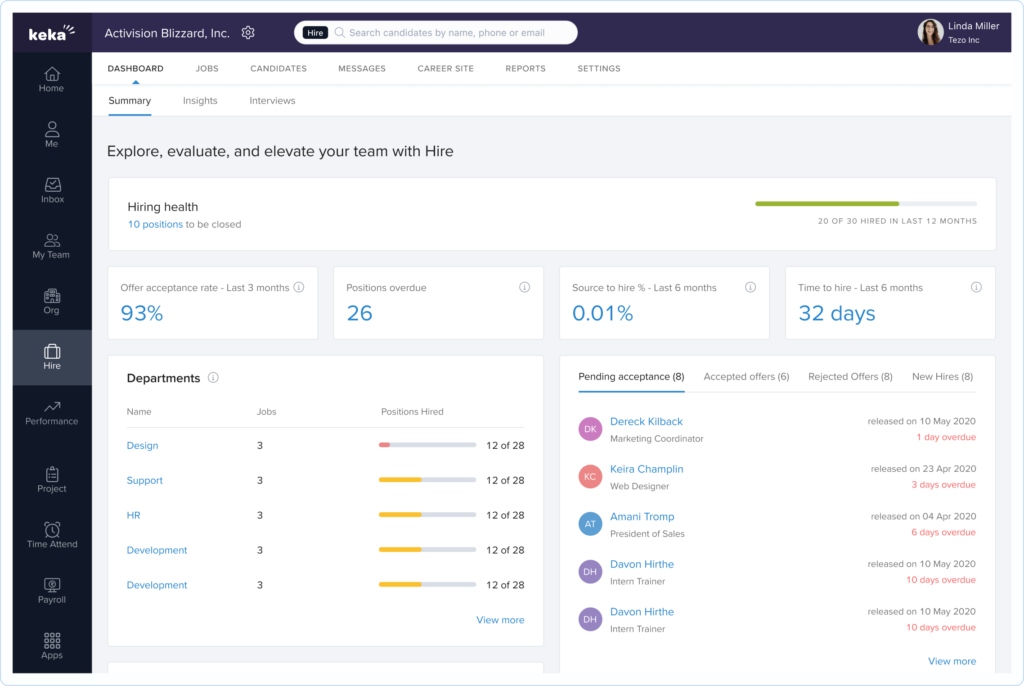
Keka Technologies (Hyderabad, bootstrapped) serves 10 to 10,000 employee firms with 1,941 G2 reviews at 4.5/5, the highest review volume among Indian-origin HR platforms. Primarily used by mid-market HR teams who prioritise clean UI and strong India payroll over deep manufacturing compliance.
Core Services
- Payroll Engine: automated PF, ESI, TDS, and PT with rock-solid computation per independent reviewers.
- Keka Kiosk: AI facial recognition attendance with PIN fallback for shared devices.
- eSSL Biometric Integration: with offline data storage and auto-sync.
- Shift Scheduler (add-on): drag-and-drop shift boards and rotation management.
- OKRs plus Performance plus ATS: strong white-collar performance and recruitment modules.
🇮🇳 India-Specific Compliance and Localization
- PF / ESI / TDS: ✅ Yes. Automated.
- Labour law compliance: ⚠️ Moderate. New wage code readiness not as explicitly documented.
- Payroll localization: ✅ Yes.
- Multi-state handling: ✅ Yes.
Who This Is Built For
- Mid-market HR Head wanting a polished modern interface for a 200 to 1,500 employee white-collar plus shopfloor mix.
- Payroll Manager prioritising clean UX over multi-entity depth.
Who Should Skip This
- Buyers needing phone plus SPOC support on weekends. Keka’s support is email-led with documented escalation gaps. See the side-by-side HROne vs Keka comparison.
Pricing Structure
- Plan Types: Foundation, Strength, and Growth.
- Starting Price: Foundation ₹6,999 to ₹9,999/month (up to 100 employees).
- Tier-wise Breakdown: Strength ₹9,999 to ₹12,999/month. Growth ₹13,999 to ₹15,999/month.
- Incremental Cost Drivers: Shift Scheduler and LMS priced as add-ons.
- Implementation Fee: Not explicitly disclosed on public pages.
- Cost at 200 employees: ~₹3.6 to ₹4.8 lakh annually on Strength.
- Cost at 500 employees: Growth plus add-ons. Quote stage.
Implementation and Support Reality
- Go-live timeline: Variable. Some users report delays.
- Support channels: Email-led ticketing, limited weekend coverage.
- Data migration model: Self-serve plus vendor-assisted.
Reviews
“We started working with Keka HRMS in August, and to this day, we have been unable to implement the tool in our company due to their consistently delayed responses and poor coordination between their internal teams.”
— Divya P. Keka G2 Verified Review
“Strong payroll and compliance automate salary and attendance processing with PF/ESI/TDS… PMS module is confusing and needs to be simpler. User access is difficult for employees who do not have an email ID.”
— Kiran B. Keka G2 Verified Review
4. greytHR: The SMB Payroll Compliance Library
Overview
Greytip Software (Bengaluru) powers SMB and mid-market payroll for 5 to 50,000 employee firms, with 1,251 G2 reviews at 4.4/5 and a ranking of #9 Best Indian Software Product in G2 2026. greytHR publishes the deepest state-wise compliance content library in the Indian HRMS space. Primarily used by SMB HR teams wanting strong payroll statutory compliance on a transparent tiered plan.
Core Services
- Payroll with State-Wise Compliance Calendar: PF, ESI, PT, TDS, LWF, Form 24Q, and Form 16. Maharashtra calendar published.
- Core HR, Leave, Attendance, Helpdesk, and Letters: covers hire-to-retire basics.
- GeoMark (add-on): mobile geo-fenced attendance at ₹50 PEPM.
- Alumni Portal (add-on): ₹15 PEPM.
🇮🇳 India-Specific Compliance and Localization
- PF / ESI / TDS: ✅ Yes. Strong automation.
- Labour law compliance: ✅ Strong. Deepest compliance content base.
- Payroll localization: ✅ Yes.
- Multi-state handling: ⚠️ Moderate. Multi-entity OU depth capped for 1,000+ employee setups.
Who This Is Built For
- SMB Payroll Manager running 50 to 500 employee single-entity operations needing bulletproof statutory filings.
Who Should Skip This
- Multi-plant manufacturers with complex shift rosters and contract labour. Workflows are limited and configuration is rigid. See the HROne vs greytHR comparison.
Pricing Structure
- Plan Types: Starter (free up to 25), Essential, Growth, and Enterprise.
- Starting Price: Essential ₹3,495/month for 50 employees (~₹30 PEPM).
- Tier-wise Breakdown: Growth ₹5,995 to ₹7,495/month. Enterprise quote.
- Incremental Cost Drivers: GeoMark ₹50 PEPM, Alumni Portal ₹15 PEPM.
- Cost at 200 employees: ~₹90,000 to ₹1.2 lakh annually on Growth.
- Cost at 500 employees: Quote-based on Enterprise.
Implementation and Support Reality
- Go-live timeline: Self-serve feasible for SMBs.
- Support channels: Ticket plus chat. Reviewers flag long resolution TATs on complex configurations.
- Data migration model: Self-serve plus guided.
Reviews
“GreytHR is not much good at customizing based on our requirements. For our case, from implementation onwards, there were issues with leave balance… Many times we were manually correcting the leave balance of employees.”
— Verified User in IT Services greytHR G2 Verified Review
“The system acts as per its own whims and gives error reports. We have to spend time manually to find errors. Not one month has passed where we have not raised a ticket.”
— Maheshkumar J. greytHR G2 Verified Review
5. Darwinbox: The Unicorn Enterprise Incumbent
Overview
Darwinbox Digital Solutions (Hyderabad, founded 2015, Series D at $72M in 2022) serves 500 to 100,000 employee enterprises globally, with 700 clients and 2M users. G2 rating 4.4/5 across 189 reviews. Primarily used by large conglomerates modernising off SAP HCM or legacy ERPs.
Core Services
- Hire-to-Retire Module Breadth: Recruitment, Onboarding, Core HR, Payroll, Attendance, Leave, Performance, Engagement, Expense, L&D, Succession, and Compensation.
- Customisable Workflows: configurable to enterprise processes.
- AI-Driven Analytics: predictive workforce planning (task-execution AI layer narrower than HROne’s Employee Agent).
- Mobile App: iOS plus Android. Reviewer-reported sync inconsistency with some systems.
🇮🇳 India-Specific Compliance and Localization
- PF / ESI / TDS: ✅ Yes.
- Labour law compliance: ⚠️ Moderate. CLRA-specific documentation not located in primary research.
- Payroll localization: ✅ Yes for India.
- Multi-state handling: ✅ Yes (enterprise tier).
Who This Is Built For
- CHRO at a 3,000+ employee conglomerate consolidating multi-geo HR onto one enterprise platform.
Who Should Skip This
- 200 to 800 employee mid-market Indian manufacturers wanting transparent PEPM. Darwinbox is quote-based with reviewer-reported billing from contract date. See the HROne vs Darwinbox comparison.
Pricing Structure
- Plan Types: Enterprise (custom).
- Starting Price: Not publicly disclosed, request a quote. GetApp’s “starting from ₹1/year” is a placeholder.
- Implementation Fee: Typically separate. Undisclosed.
- Cost at 200 employees: Quote-based. Typically above Indian mid-market PEPM benchmarks.
- Cost at 500 employees: Lakhs annually per procurement references.
Implementation and Support Reality
- Go-live timeline: Multi-month enterprise rollouts.
- Support channels: Enterprise CSM plus ticketing.
- Data migration model: Vendor-led.
Reviews
“Bad implementation experience, bad UI/UX, configurations getting broken in production on its own due to product deployments, terrible customer service… The solution was supposed to act as a full-fledged HRMS for us. We are ending up doing most of the products manually.”
— Verified User in Computer Software Darwinbox G2 Verified Review
“At times, the system can be slightly slow, especially during peak usage or when processing bulk data… not all features are intuitive at first, especially modules like performance management and recruitment tracking.”
— Mohit V. Darwinbox G2 Verified Review
6. PeopleStrong: The Gartner-Recognised APAC HCM
Overview
PeopleStrong Technologies (Gurugram) serves 1,000+ employee APAC enterprises, with 2M users across 500 enterprises. Rated among Top 5 in Asia Pacific on Gartner Peer Insights Customers’ Choice. ISO 27001, SOC 1, GDPR, and quarterly VAPT explicitly claimed. Primarily used by large enterprises wanting a Gartner-validated badge on procurement.
Core Services
- Core HCM plus AI-Driven Payroll: multi-state automation claimed.
- Talent Acquisition plus Talent Management: enterprise-grade analytics.
- Workforce Management plus Collaboration: mobile-first approach per reviewers.
🇮🇳 India-Specific Compliance and Localization
- PF / ESI / TDS: ✅ Yes.
- Labour law compliance: ⚠️ Moderate. India manufacturing case studies not named in primary research.
- Payroll localization: ✅ Yes.
- Multi-state handling: ✅ Yes.
Who This Is Built For
- Enterprise CHRO at 1,000+ employees wanting Gartner recognition as a procurement sign-off.
Who Should Skip This
- 100 to 500 employee buyers needing transparent PEPM and published pricing. See the HROne vs PeopleStrong comparison.
Pricing Structure
- Starting Price: Not publicly disclosed, request a quote. Software Advice placeholder of ₹0.01 is not a usable benchmark.
- Implementation Fee: Undisclosed.
- Cost at 200 / 500 employees: Quote-based.
Implementation and Support Reality
- Go-live timeline: Enterprise multi-month cycles.
- Support channels: Enterprise CSM.
Reviews
“What I like most about PeopleStrong is how easy it is to manage reimbursements and claims, and to access my payslips, all in one place… One thing I dislike is that the reimbursement and claims process can feel a bit slow at times.”
— Anusha PeopleStrong G2 Verified Review
7. ZingHR: Blue-Collar-First Deployments
Overview
ZingHR targets hire-to-retire coverage with a mobile-first posture for blue-collar-heavy workforces. Primarily used by organisations where shopfloor adoption is the determining factor.
Core Services
- Payroll plus Attendance plus Learning plus Performance: end-to-end module set.
- Mobile ESS for Shopfloor: focus on distributed workforce access.
- Tax Simulator plus NPS plus Payslip Automation: standard India payroll features.
🇮🇳 India-Specific Compliance and Localization
- PF / ESI / TDS: ✅ Yes.
- Labour law compliance: ⚠️ Moderate.
- Payroll localization: ✅ Yes.
- Multi-state handling: ✅ Partial per reviewer context.
Who This Is Built For
- Blue-collar-heavy manufacturers where mobile adoption is the primary risk factor.
Who Should Skip This
- Teams wanting modern UX and fast customisation. Reviewers flag outdated UI and slow support. See the HROne vs ZingHR comparison.
Pricing Structure
- Starting Price: Not publicly disclosed, request a quote.
- Cost at 200 / 500 employees: Quote-based.
Implementation and Support Reality
- Go-live timeline: Variable. Reviewer reports of multi-month delays.
- Support channels: Ticket-based.
Reviews
“App simply doesn’t work, countless tries to troubleshoot have been unfruitful. I cannot do anything on my mobile, be it apply for leaves or submit a reimbursement… The UI absolutely sucks, and is from the middle ages.”
— Piyush G. ZingHR G2 Verified Review
“System implementation experience was horrible, in 6 months the implementation was barely completed to 40%. Support is never on time.”
— Sanmeet S. ZingHR G2 Verified Review
8. SAP SuccessFactors: The Global Suite for SAP-Ecosystem Plants
Overview
Acquired by SAP in 2012, SuccessFactors serves 220M users worldwide with 500+ employee medium-to-large enterprises, especially those already on SAP ERP. Primarily used by multinational manufacturers standardising on a single global HCM.
Core Services
- Global Compliance Breadth: multi-country payroll.
- SAP FI/CO Integration: native JV posting and master data sync.
- Performance plus Succession plus Compensation: strong white-collar enterprise modules.
🇮🇳 India-Specific Compliance and Localization
- PF / ESI / TDS: ⚠️ Partial. Requires configuration, not India-first.
- Labour law compliance: ⚠️ Limited vs Indian-origin platforms.
- Payroll localization: ⚠️ Configurable, not native.
- Multi-state handling: ⚠️ Via configuration.
Who This Is Built For
- Multinational manufacturer with SAP ERP and 5,000+ employees standardising globally.
Who Should Skip This
- Sub-2,000 employee Indian manufacturers. Over-engineered, and India payroll localisation is shallower than greytHR, Keka, or HROne. See the HROne vs SAP comparison.
Pricing Structure
- Starting Price: Enterprise quote. Lakhs annually. Significantly higher TCO for mid-market.
- Implementation Fee: Yes. Typically substantial and partner-delivered.
Implementation and Support Reality
- Go-live timeline: Multi-quarter implementations are standard.
- Support channels: Partner-delivered.
Reviews
“Not user-friendly, system often freezes. Data is unreliable and cannot always be trusted. Very limited functionalities compared to competitors. Customization requires third-party vendors, every change is costly… Ferrari price, Trabant value.”
— Janka Z. SAP SuccessFactors G2 Verified Review
9. Spine HR: Legacy Payroll Depth for On-Premise Plants
Overview
Spine HR serves Indian manufacturers with long-tenured payroll requirements and complex retroactive cycles. Primarily used by plants transitioning slowly from on-premise to cloud.
Core Services
- Traditional Payroll Engine: deep retroactive calculation logic.
- Attendance plus Leave: biometric-first for factory setups.
- Core HR: covers basic lifecycle.
🇮🇳 India-Specific Compliance and Localization
- PF / ESI / TDS: ✅ Yes.
- Labour law compliance: ✅ Moderate.
- Payroll localization: ✅ Yes.
- Multi-state handling: ✅ Partial.
Who This Is Built For
- Legacy manufacturing payroll teams needing deep backward-compatible arrear logic.
Who Should Skip This
- Buyers wanting modern UX, AI, or mobile-first blue-collar ESS. Explore a modern mobile HR app alternative.
Pricing Structure
- Starting Price: Not publicly disclosed, request a quote.
Implementation and Support Reality
- Go-live timeline: Partner-led.
- Support channels: Partner plus email.
10. Pocket HRMS: SME-Friendly Starter for Sub-200 Plants
Overview
Pocket HRMS serves sub-200 employee SMBs with a lightweight Core HR plus payroll bundle. Primarily used by single-plant SMEs moving off Excel and WhatsApp for the first time.
Core Services
- Core HR plus Payroll plus Attendance: essentials covered.
- Mobile ESS: basic self-service.
- Statutory Compliance Basics: PF, ESI, and TDS.
🇮🇳 India-Specific Compliance and Localization
- PF / ESI / TDS: ✅ Yes.
- Labour law compliance: ⚠️ Moderate. Not built for CLRA contractor depth.
- Payroll localization: ✅ Yes.
- Multi-state handling: ⚠️ Limited.
Who This Is Built For
- 50 to 200 employee single-plant SMEs wanting a budget-friendly first HRMS.
Who Should Skip This
- Multi-plant, multi-shift, CLRA-heavy manufacturers. Depth caps quickly. Review the HROne vs Pocket HRMS comparison.
Pricing Structure
- Starting Price: SMB-oriented PEPM. Published tiered.
- Cost at 200 employees: SMB-budget range.
- Cost at 500 employees: Out of sweet spot.
Implementation and Support Reality
- Go-live timeline: 7 to 14 days typical.
- Support channels: Email plus chat.
The ranking above reflects the weighted scoring rubric explained in Q2, where HROne earns 5 stars through Verified-Primary manufacturing proof, billing-after-go-live transparency, and India-first compliance depth. Competitor strengths and gaps remain evidence-anchored, so the reader can audit every claim against the cited G2, Capterra, and pricing-page sources. To see the platform in action on a real shopfloor, book a demo.
See HROne Run Your Plant Floor
Walk through a scoped manufacturing demo covering any-biometric ingestion, CLRA contractor ring-fencing, multi-state payroll, and India’s first inbuilt ROI Dashboard. Flat PEPM, no lock-in, billing after go-live.
Book a manufacturing demo | View pricing | Read Shyam Metalics case study
Q2. How Were These 10 HR Software Platforms Scored, Selection Criteria and Weighted Methodology?
The 10 platforms in this guide were scored against a five-criterion rubric totalling 100 points, with each tool then converted into a 1 to 5 star band. Nothing in this ranking rests on brand halo, analyst sentiment, or peer-group mimicry. Every score points back to a live pricing page, a G2/Capterra review count, a certificate URL, a state-wise compliance document, or a named India plant case study checked in April 2026.
The Weighted Rubric
The five criteria and their weights were chosen because they are what actually goes wrong inside a 500 to 5,000-employee manufacturing HR function:
- 🇮🇳 Manufacturing Compliance Depth, 25%: CLRA register generation, Factories Act overtime, multi-state PF/ESI/PT/LWF, and new Labour Code (2-working-day FFS, 50% basic wage rule) readiness.
- ⏰ Shift and Biometric Attendance Fit, 20%: ingestion of ZKTeco, eSSL, Matrix, and Realtime hardware over API, night-shift crossover logic, offline sync, geo-fenced mobile punch, and kiosk mode.
- 💰 Payroll and Multi-Entity Reliability, 20%: arrears, CTC revisions, FBP, group payout validations, 2-working-day FFS, and JV export to Tally, SAP, or any ERP.
- 📱 Blue-Collar Mobile and Adoption, 15%: Play Store rating, install base, Indic language support, offline ESS, and vernacular helpdesk delivery.
- 💸 Pricing Transparency and TCO, 20%: published PEPM, billing trigger (contract-date vs go-live), lock-in terms, add-on and per-entity fee disclosure, and implementation fee clarity.
Star-Band Conversion
Weighted scores were mapped to stars using a uniform band so every vendor is audited on the same scale:
| Weighted Score | Star Band |
|---|---|
| 81 to 100 | ⭐⭐⭐⭐⭐ |
| 61 to 80 | ⭐⭐⭐⭐ |
| 41 to 60 | ⭐⭐⭐ |
| 21 to 40 | ⭐⭐ |
| 0 to 20 | ⭐ |
Evidence Sources Used Per Criterion
Every score is backed by a specific, verifiable artefact, not a vendor deck:
- Compliance: state-wise PT calendars (greytHR Maharashtra confirmed), new wage code changelogs, CLRA register templates, Form 24Q, and ECR demo outputs. Reference our professional tax slab rates guide.
- Attendance: named biometric OEMs in the integration list (HROne and factoHR both Verified-Primary), night-shift crossover documentation, and offline sync walkthroughs via attendance management.
- Payroll: JV export case studies, FFS TAT quoted in customer case studies, and published arrear logic inside our payroll software.
- Mobile adoption: Play Store rating plus install count pulled April 2026 (HROne 4.0/5 on 5,450 ratings, 1M installs) through the mobile HR app.
- Pricing: live pricing page URL plus date checked. Flagged “Not publicly disclosed, request a quote” where opaque.
- Security: ISO 27001 (HROne confirmed via DPA page plus Microsoft Azure sub-processor certification; factoHR confirmed on healthcare page), SOC 2 (factoHR confirmed; PeopleStrong claimed; HROne unverified).
Per-Vendor Star Results
| Vendor | Stars | One-Line Justification |
|---|---|---|
| HROne | ⭐⭐⭐⭐⭐ | Multi-plant case studies, One AI Suite, billing-after-go-live, G2 #1 APAC 2026. |
| factoHR | ⭐⭐⭐⭐ | ISO 27001 plus SOC 2, L&T plus Hitachi clients, biometric depth, Factories Act/CLRA explicit. |
| Keka | ⭐⭐⭐⭐ | 1,941 G2 reviews, clean UX, eSSL plus Keka Kiosk facial recognition. Shift Scheduler is an add-on. |
| greytHR | ⭐⭐⭐ | Strongest SMB payroll content library. Multi-entity depth capped. |
| Darwinbox | ⭐⭐⭐ | Unicorn enterprise breadth. Pricing opacity. India manufacturing plant proof thin. |
| PeopleStrong | ⭐⭐⭐ | Gartner Customers’ Choice. Thin G2 review base (72). |
| ZingHR | ⭐⭐⭐ | Blue-collar ESS focus. UI and support gaps flagged in reviews. |
| SAP SuccessFactors | ⭐⭐ | Global breadth. India payroll needs configuration. TCO punishing sub-2,000. |
| Spine HR | ⭐⭐ | Legacy payroll depth. Weak modern UX, mobile, and AI. |
| Pocket HRMS | ⭐⭐ | SME-friendly. No multi-plant or CLRA contractor depth. |
⚠️ Honest Caveats Disclosed
HROne’s “127 workflows”, “NPS 9.8”, and “2,000 enterprise brands” remain vendor-claimed pending source URLs. Capterra review base is thin at 27. SOC 2 and a DPDP-specific addendum are not yet confirmed on a public page. These were disclosed inside the rubric so any reader can audit, or discount, the rankings against their own procurement standard.
Q3. What Does the Manufacturing HR Maturity Model Look Like, and Why Do Generic HRMS Break on the Factory Floor?
Indian manufacturing HR progresses through a five-stage maturity curve, and generic HRMS platforms consistently break at Level 3 because they were designed for single-shift white-collar teams sitting on laptops, not 800-worker shopfloors clocking in on biometric devices before sunrise. Recognising where a plant sits on this curve is the single clearest way to avoid buying a tool that demos beautifully yet fails inside the first month.
The Five-Stage Manufacturing HR Maturity Model
- L1, Paper plus Excel plus WhatsApp. Muster rolls on paper, payroll on Excel, and OT approvals over WhatsApp. Common below 100 employees.
- L2, Biometric Device plus Outsourced Payroll. ZKTeco on the wall, payroll with a CA or outsourcer, and reconciliation by email. The default for 100 to 300 headcount plants.
- L3, Point HRMS, White-Collar Only. A cloud HRMS (often Zoho People, BambooHR, or a Keka “Foundation” tier) covering office staff while the shopfloor stays on biometric plus Excel.
- L4, Unified HRMS With Shopfloor Mobile. One tenant covers blue-collar plus white-collar, biometric ingestion is API-driven, and CLRA contractor headcount sits inside the same instance.
- L5, AI Execution plus ROI Dashboard. Workflows trigger workflows, AI executes tasks (not just answers queries), and the CHRO walks into the board with rupee-quantified hours saved.
The L3 Reality Nobody Talks About
At 6 AM, 800 workers push through a ZKTeco turnstile. Contractors rotate daily, shift-crossover overtime is disputed on paper the next morning, and at month-end the payroll input sheet is stitched together from a biometric CSV export, an Excel leave tracker, a WhatsApp group for OT approvals, and a few sticky notes from line supervisors. The plant HR manager is not running a system. She is running reconciliation against four parallel data sources and hoping nothing slips before disbursal.
Where Generic Platforms Actually Break
The honest critique, by vendor archetype:
- Keka and greytHR deliver competent white-collar payroll, but attendance is treated as a log, not a shift architecture. Keka’s Shift Scheduler sits behind an add-on paywall, and greytHR’s workflows cap out the moment multi-entity or CLRA depth is needed. See the HROne vs Keka and HROne vs greytHR comparisons.
- Darwinbox and SAP SuccessFactors over-engineer for global talent management. State-wise PT matrices and CLRA register templates are not published, and implementation drag is multi-quarter.
- Zoho People and BambooHR operate as global generalists without India-specific CTC, FBP, or new-wage-code readiness, disqualifying them for most Factories Act sites. See the HROne vs Zoho People comparison.
Compliance Coverage Matrix
| Vendor | PF/ESI | PT State-Wise | LWF | CLRA | Factories Act OT | New Wage Code | 2-Day FFS |
|---|---|---|---|---|---|---|---|
| HROne | ✅ | ✅ | ✅ | ✅ | ✅ | ✅ | ✅ |
| factoHR | ✅ | ✅ | ✅ | ✅ | ✅ | ⚠️ | ⚠️ |
| Keka | ✅ | ✅ | ✅ | ⚠️ | ⚠️ | ⚠️ | ⚠️ |
| greytHR | ✅ | ✅ | ✅ | ⚠️ | ⚠️ | ⚠️ | ⚠️ |
| Darwinbox | ✅ | ⚠️ | ⚠️ | ❌ | ⚠️ | ⚠️ | ⚠️ |
| PeopleStrong | ✅ | ⚠️ | ⚠️ | ⚠️ | ⚠️ | ⚠️ | ⚠️ |
| ZingHR | ✅ | ⚠️ | ⚠️ | ⚠️ | ⚠️ | ⚠️ | ⚠️ |
| SAP SF | ⚠️ | ⚠️ | ❌ | ❌ | ⚠️ | ❌ | ❌ |
| Spine HR | ✅ | ✅ | ✅ | ⚠️ | ⚠️ | ⚠️ | ⚠️ |
| Pocket HRMS | ✅ | ⚠️ | ⚠️ | ❌ | ❌ | ⚠️ | ❌ |
The Strategic Shift, From Module Count to Data Propagation
Manufacturing HRMS is not a module-count problem. It is a data-propagation problem. A punch on ZKTeco at 5:47 AM has to flow, without a human in the middle, into a shift roster, into an OT calculation under Factories Act, into a payroll line item, into a statutory filing, and finally into a JV entry in Tally or SAP. Anywhere that chain breaks, the plant regresses to Excel within a quarter. This is exactly the problem our manufacturing HR stack is architected to solve.
How HROne Operates at L4 to L5
We built HROne’s Time Office to ingest any-brand biometric over API, 127 pre-built workflows to own the chase across onboarding, confirmation, transfer, and exit, an Auto Scheduler to push validated hours into multi-state Payroll, a One AI employee AI agent (launched April 2025) to execute tasks on voice, and India’s first inbuilt ROI Dashboard to put rupee numbers against the CHRO’s board deck. Lux Industries onboarded 50% of its blue-collar workforce on this architecture, with 90 to 95% of leave and overtime calculations fully automated.
Q4. How Does a Manufacturing HRMS Handle Shift Attendance, Biometric Hardware, Multi-State Payroll, and CLRA Contractor Compliance?
A manufacturing HRMS only works when it does the following. (1) Ingests any biometric brand, ZKTeco, eSSL, Matrix, or Realtime, over API without a hardware swap. (2) Runs drag-and-drop shift rosters with explicit night-shift crossover logic. (3) Auto-applies Factories Act overtime. (4) Maintains state-wise PT and LWF matrices. (5) Ring-fences CLRA contractor payroll under the principal-employer. (6) Executes the 2-working-day FFS clock mandated by the Industrial Relations Code. If any one of those six breaks, the plant is back to Excel within a quarter.
How It Works Under the Hood
The Time Office module polls biometric devices on a recurring scheduler, normalises raw punches against the worker’s assigned shift roster, and flags exceptions, missed punch, short shift, or crossover, directly into the HR inbox for three-click resolution. Once validated, hours flow into the Payroll engine, where arrears under new wage code logic, FBP declarations, and group payout validations run automatically before a JV file is exported to Tally, SAP, or any downstream ERP. CLRA contractor payroll runs inside the same tenant under a separate legal-entity configuration, so principal-employer liability for ESI and minimum wages is auditable in a single report.
Why This Architecture Matters
Three specific failure modes break most HRMS in the first 90 days:
- Hardware capex refusal. ZKTeco, eSSL, and Matrix devices already sit on the wall. Any HRMS that demands ripping them out dies in procurement.
- Night-shift crossover. A worker punches in at 11 PM on Day 1 and out at 7 AM on Day 2. Which day’s attendance does that count for? Generic HRMS either double-count or lose the shift entirely.
- State-wise PT plus CLRA gaps. Form V, Form VI, and Form XI CLRA registers must be generatable in state-prescribed formats. Missing any of them triggers principal-employer liability at the next government inspection.
5-Step Configuration Walkthrough
The operational path we follow inside a typical HROne rollout:
- Map biometric device, plug the existing ZKTeco/eSSL/Matrix/Realtime serial into the HROne device registry. Punches start flowing within minutes.
- Define shift patterns, drag-and-drop day/night/general rosters, including rotating 3-shift cycles common in auto and steel plants. See managing shift schedules.
- Set crossover plus OT rule, configure the Day-1-vs-Day-2 attribution logic and Factories Act OT multipliers for each state of operation.
- Configure CLRA contractor entity, a separate legal entity under the same tenant with its own PF/ESI code, CLRA registers, and wage cycle isolated from permanent payroll.
- Activate Auto Scheduler, propagation from attendance to payroll to JV runs without a human touch, and exceptions surface in the HR Inbox.
⚠️ Where Competitors Land
Fair, evidence-anchored contrast:
- factoHR matches HROne on biometric agnosticism and Factories Act/CLRA explicit positioning for plants under 1,000 employees, with ISO 27001 plus SOC 2 dual certification on the healthcare reference page. See the HROne vs FactoHR comparison.
- Keka delivers competent white-collar payroll and Keka Kiosk facial recognition, but the Shift Scheduler is priced as an add-on, and reviewers flag email-only support that stalls complex configurations.
- Darwinbox and SAP SuccessFactors do not publish state-wise PT matrices or CLRA register templates on public pages. Buyers lean on implementation partners to backfill gaps, lengthening go-live by quarters. See the HROne vs SAP comparison.
- greytHR publishes the deepest SMB compliance content library, but limited workflows and rigid multi-entity configuration break when multi-plant or shift-crossover reality appears.
Shyam Metalics digitised multi-plant attendance and payroll across states on a single HROne instance, detailed in the Shyam Metalics case study. Premier Energies runs 850 factory workers on this architecture. Lux Industries onboarded 50% of its blue-collar workforce on HROne with 90 to 95% of leave and overtime calculations fully automated, the evidence that biometric-agnostic attendance plus multi-state payroll plus CLRA ring-fencing actually survives a real shopfloor at 6 AM.
Audit Your Plant’s HR Stack Against This Rubric
Walk a scoped demo covering any-biometric ingestion, night-shift crossover logic, CLRA Form V/VI/XI registers, multi-state payroll, and the inbuilt ROI Dashboard. Flat PEPM, billing after go-live, no lock-in.
Book a manufacturing demo | Run the ROI calculator | Why HROne
Q5. How Do Blue-Collar Workers, Sub-Vertical Plants, and Shop-Floor Integrations (SAP/Oracle/MES plus Biometric OEMs) Actually Adopt HRMS?
HRMS adoption in Indian manufacturing is decided on three axes, blue-collar mobile usability, sub-vertical fit, and shop-floor integration depth, and not one of them shows up in a feature-comparison spreadsheet. A tool that scores well on module count but fails on any one of these axes will be quietly abandoned by day 90, and the plant will be back on Excel before the next quarter closes.
The Three Adoption Axes
- Blue-Collar Mobile ESS: must be completable on a ₹8,000 entry-level Android, with Indic language, kiosk mode for shared devices, and offline sync for low-connectivity plants.
- Sub-Vertical Fit: auto Tier-1/2 suppliers, pharma GMP, cement/steel multi-plant, and FMCG seasonal labour each have their own compliance and shift architectures.
- Shop-Floor Integration: SAP FI/CO JV posting, Oracle EBS, MES production data for incentive payroll, and named biometric OEMs (ZKTeco, eSSL, Matrix, Realtime), not a generic “API available” brochure line.
Blue-Collar Mobile Playbook, The 5-Step Operational Framework
Any HRMS that survives a 500-worker shopfloor follows this sequence:
- Aadhaar-triggered joining plus PF nomination, captured on mobile at gate-entry, not a laptop in HR’s cabin. See our onboarding process walkthrough.
- Biometric plus geo-fenced mobile plus kiosk attendance, three parallel punch modes so no worker is locked out, powered by attendance management.
- Codified shift rosters with crossover logic, 11 PM to 7 AM shifts attributed correctly, with Factories Act OT automated.
- Vernacular helpdesk plus payslip delivery, policy queries in Hindi, Tamil, Telugu, or Marathi close on a WhatsApp-style thread through our helpdesk module.
- Badge-based recognition that travels to LinkedIn, because blue-collar engagement is not a canteen poster.
Evidence on adoption capacity: HROne’s mobile HR app sits at 4.0/5 across 5,450 Play Store ratings with 1M+ installs, Keka Kiosk ships with AI facial recognition plus PIN fallback, and factoHR layers RFID plus fingerprint plus face biometric for mixed shop-floor devices.
Sub-Vertical Fit Sub-Table
| Sub-Vertical | Defining HR Reality | Best-Fit Vendors |
|---|---|---|
| Auto Tier-1/2 | Shift rotation plus contractor density plus JIT labour spikes | HROne, factoHR |
| Pharma (GMP) | Audit trails plus training records plus OT compliance | HROne, Darwinbox |
| Cement / Steel | Multi-plant, multi-state PT, and remote-site allowances | HROne, PeopleStrong |
| FMCG Seasonal | Variable contract labour, and season-wise payroll cycles | HROne, factoHR |
The sub-vertical cut matters because every one of these industries has a different “month-end breaks at 11 PM” scenario, and a generic HCM doesn’t distinguish between them.
Shop-Floor Integration Axis
Generic integration claims (“supports biometric”, “connects to ERP”) break when procurement asks for the list of OEMs and the JV field mapping. What matters:
- SAP FI/CO plus Oracle EBS JV posting: master data sync, cost-centre-wise posting, and no manual CSV uploads at month-end. Our integrations catalogue lists the supported endpoints.
- MES production data into incentive payroll: piece-rate and production-linked incentives auto-flow into the wage line.
- Named biometric OEMs: ZKTeco, eSSL, Matrix, and Realtime on an API, not as an Excel import.
- HROne publishes 15+ ERP integrations and any-biometric ingestion at the tenant level. Darwinbox carries enterprise breadth, but specific biometric-brand documentation is thinner on public pages.
⚠️ Why Three Axes Collapse Into One Adoption Motion on HROne
We built HROne’s mobile ESS, Super Inbox, One AI employee AI agent, and HRV Studio so the shop-floor worker, the plant HR lead, and the corporate IT team operate on one spine. Biometric punches, shift rosters, OT calculation, CLRA register, and JV export propagate without human stitching. Lux Industries onboarded 50% of its blue-collar workforce on this path, with 90 to 95% of leave and overtime fully automated, which is the actual evidence an operator should demand before signing an MSA.
Q6. How Should You Choose the Right Manufacturing HRMS, Decision Framework, Workforce-Mix Flowchart, and Enterprise Conglomerate Comparison?
The right manufacturing HRMS is selected on architecture and not on brand halo. Specifically on biometric agnosticism, state-wise PT coverage, CLRA register generation, billing trigger (contract date vs go-live), lock-in terms, blue-collar Play Store rating, and verified India plant case studies. Anything else is marketing theatre that costs an operator a second implementation by year two.
❌ The Wrong Criteria That Burn Budget
- “Darwinbox is a unicorn, so it must be the safe pick.” Brand halo does not replace India-specific CLRA documentation or a ROI dashboard.
- Lowest headline PEPM. Ignores add-on charges. Keka’s Shift Scheduler sits behind an add-on paywall, GeoMark adds ₹50 PEPM on greytHR, and implementation is often billed separately. Read HR software pricing transparency.
- Peer-group mimicry. “Three of our friends use X” is not a procurement frame. Their workforce mix and plant geography probably don’t match yours. See HRIS buyer pitfalls.
✅ The 7-Question Decision Framework
Run every vendor through these seven testable questions. Any “no” is a disqualifier:
- Does it ingest my existing biometric brand over API without hardware replacement?
- Does it publish state-wise PT, LWF, and PF/ESI logic for every state I operate in?
- Can it generate CLRA Form V, VI, and XI in state-prescribed formats?
- Does billing start at contract sign or after go-live?
- Is there a multi-year lock-in or a clean notice-based exit?
- What is the mobile app’s Play Store rating and install base, the real blue-collar adoption proxy?
- Are there named India manufacturing plant case studies with quantified outcomes?
For a structured walkthrough, review our how to choose HRIS HRMS software guide.
Workforce-Mix Flowchart
| Profile | Recommended Shortlist |
|---|---|
| SME single-plant, 50 to 200 white-collar plus shopfloor | Keka, greytHR, factoHR |
| Multi-plant, 500 to 5,000 employees, and mixed workforce | HROne manufacturing HR |
| Contractor-heavy, Factories Act-registered | HROne, factoHR |
| 3,000+ employee conglomerate already on SAP ERP | HROne Enterprise, Darwinbox, SAP SuccessFactors |
Enterprise Conglomerate Comparison
An honest side-by-side across the dimensions that actually swing a ₹1-crore-plus annual commitment:
| Dimension | HROne Enterprise | Darwinbox | PeopleStrong | SAP SuccessFactors |
|---|---|---|---|---|
| India manufacturing case studies | Lux, Shyam Metalics, and Premier Energies (named, quantified) | Enterprise brand-dense, India plant proof thin | Manufacturing page, specifics thin | Industries list, India-first localisation shallow |
| Multi-entity payroll | ✅ Single tenant, 20+ units (Asia Healthcare) | ✅ | ✅ | ✅ via configuration |
| Biometric depth (named OEMs) | ZKTeco/eSSL/Matrix/Realtime published | Brand-dense, OEM list thinner | ✅ | Partner-delivered |
| AI execution (agent, not chatbot) | One AI Employee Agent (Apr 2025) | Predictive analytics | AI claims in docs | Joule assistant |
| Pricing transparency | ✅ Published Basic/Professional plus custom Enterprise | ❌ Quote-based | ❌ Quote-based | ❌ Enterprise-quote |
| Implementation timeline | 30 to 90 days | Multi-quarter | Multi-quarter | Multi-quarter |
| Lock-in | ❌ 2-month notice | Multi-year common | Enterprise MSA | Multi-year |
| ISO 27001 / SOC 2 | ISO 27001 confirmed, SOC 2 vendor-claimed | ✅ | ISO 27001 plus SOC 1 | ✅ |
For head-to-head module depth, see the HROne vs Darwinbox and HROne vs PeopleStrong comparisons.
The Meta-Insight
Asia Healthcare Holdings runs 20 pan-India units on a single HROne instance with multi-legal-entity configuration. Shyam Metalics digitised multi-plant operations. Lux and Premier Energies validate the blue-collar adoption motion. The tiebreaker is never slogan against slogan. It’s which vendor can produce a named India plant case study, a rupee-quantified ROI figure, and a billing-after-go-live clause in the MSA. HROne clears all three. Most global suites clear only the first.
Q7. What Do Pricing, the 10-Week Implementation Playbook and ROI Quantification?
For a 500-employee multi-plant manufacturer, the honest planning number is ₹85 to ₹130 PEPM on HROne’s published Basic and Professional tiers (Enterprise is custom). Billing starts only after go-live, and exit requires a 2-month notice, no multi-year lock-in. Keka sits at ₹9,999 to ₹15,999/month plus add-ons. factoHR ships 7 to 15 day implementation at approximately ₹45 to ₹85 PEPM. Darwinbox, PeopleStrong, and SAP SuccessFactors remain custom-quote, typically running into lakhs annually.
💰 Transparent Pricing at a Glance
| Vendor | Starting Price | Billing Trigger | Lock-In |
|---|---|---|---|
| HROne Basic | ₹99 PEPM / ₹4,950 for 50 users | After go-live | 2-month notice |
| HROne Professional | ₹130 PEPM / ₹6,500 for 50 users | After go-live | 2-month notice |
| Keka Foundation | ₹6,999 to ₹9,999/month (up to 100) | Contract date | Annual |
| greytHR Essential | ₹3,495/month for 50 | Contract date | Annual |
| factoHR | Approximately ₹45 to ₹85 PEPM (estimated) | Partner-dependent | Quote-based |
| Darwinbox / PeopleStrong / SAP | Not publicly disclosed | Contract date | Multi-year |
The live pricing page carries the current tier-wise breakdown.
⏰ The 10-Week Implementation Playbook
- Weeks 1 to 2: Discovery, data migration, and biometric device mapping across all plants.
- Weeks 3 to 4: Policy engine configuration, CLRA contractor entity setup, and state-wise PT/LWF matrices.
- Weeks 5 to 6: Payroll parallel run against legacy system, and UAT sign-off.
- Weeks 7 to 8: Blue-collar mobile pilot at one plant, kiosk mode calibration, and vernacular helpdesk live.
- Weeks 9 to 10: Scale to all plants, SPOC handover, and ROI Dashboard baselining.
📊 ROI Quantification Table
| Metric | Before (Fragmented Stack) | After (HROne) |
|---|---|---|
| HR Ops hours saved / month | Baseline | 60 to 70% admin time cut (reviewer-reported) |
| Payroll cycle | 10 days | 5 to 6 days (MR DIY India benchmark) |
| OT leakage | 5 to 8% (industry estimate) | Material reduction with Factories Act auto-calc |
| Contractor dispute resolution | 30+ days | Single-tenant CLRA register, same-day |
| FFS TAT | 30 days | 2 working days (IR Code aligned) |
| Appraisal cycle | 45 to 60 days | 15 days with automated bell curves |
HROne’s inbuilt ROI Dashboard converts lifetime hours saved into rupee terms against average HR salary, so the CHRO walks into the board with a quantified figure, not a PowerPoint hunch. Validate your own numbers via the ROI calculator.
🚀 Next Step
Book a scoped HROne manufacturing demo, view the live pricing page, and read the Lux Industries, Shyam Metalics case study, and Premier Energies case studies before committing to any multi-year MSA.
See HROne Run Your Plant Floor, End to End
Walk a scoped manufacturing demo covering any-biometric ingestion, CLRA contractor ring-fencing, multi-state payroll, the 10-week implementation playbook, and the inbuilt ROI Dashboard. Flat PEPM, billing after go-live, and no lock-in.














 Secures Top Spot in
