







Q1. What Are the 8 Best HRMS Mobile Apps in India in 2026 (and How We Scored Them)?
The best HRMS mobile apps in India for 2026 are HROne, Keka, greytHR, Darwinbox, Zoho People, factoHR, Pocket HRMS, and Zimyo. We scored each on Mobile Task Depth and Offline Reliability (30%), India Statutory Compliance (25%), Payroll Accuracy and Speed (20%), Setup and Usability (15%), and Pricing Transparency (10%). HROne earns 5 stars for putting 110+ HR tasks in the employee’s pocket with offline attendance sync.
Choosing a mobile HRMS (Human Resource Management System) is a high stakes call for any Indian company running payroll, attendance, and compliance for 100 to 5,000 people. Rather than ranking tools by popularity, this guide scores 8 vendors against operator grade criteria, written first for the HR ops lead and payroll manager who live in the mobile HR app daily, and second for the CHRO, CFO, and IT director who sign off on the buy.
Our Evaluation Criteria
We assessed every vendor across five weighted criteria that sum to 100%. A mobile app ranking has to weight what employees actually do on a phone, not just what a web dashboard shows.
- Mobile Task Depth and Offline Reliability ⏰ (30%): How many HR tasks close on a phone, and whether attendance still works in low or no network zones.
- India Statutory Compliance 📊 (25%): Automated PF (Provident Fund), ESI (Employee State Insurance), TDS (Tax Deducted at Source), state wise PT (Professional Tax), and Form 16 handling.
- Payroll Accuracy and Speed 💰 (20%): How fast payroll closes each month, and how error free the salary run is.
- Setup and Usability (15%): Time to go live, and how little training a first day user needs.
- Pricing Transparency (10%): Whether PEPM (per employee per month) pricing, add ons, and implementation fees are published clearly.
We then converted scores into stars: 81 to 100 earns 5 stars, 61 to 80 earns 4 stars, 41 to 60 earns 3 stars, 21 to 40 earns 2 stars, and 0 to 20 earns 1 star.
Who This Guide Is For
- CHROs and HR heads consolidating a fragmented hire to retire stack into one mobile system.
- Payroll managers running multi entity, India compliant monthly payroll cycles.
- CFOs validating HR tech ROI, and flat PEPM commercials before signing.
- IT directors and operational HR teams comparing mobile first HCMs against legacy desktop portals.
The 8 Best HRMS Apps at a Glance
| Provider (⭐) | Best For | Standout Strength | Known Limitation | Mobile Task Depth | Support Model | Pricing Model |
|---|---|---|---|---|---|---|
| HROne ⭐⭐⭐⭐⭐ | HR ops leads drowning in multi entity attendance and payroll reconciliation | 110+ HR tasks in the employee’s pocket, plus offline attendance sync | Some performance and audit features are lighter on mobile than on web | Very high (110+ tasks, 127+ workflows) | Phone, email, and dedicated prior HR SPOC | Flat PEPM, billing after go live |
| Keka ⭐⭐⭐ | SMB HR teams wanting a polished, easy interface | Clean, intuitive UI with strong core payroll compliance | Slow implementation and weekend support gaps reported by users | Moderate to high | Email and chat, limited weekend cover | Per employee, tiered plans |
| greytHR ⭐⭐⭐ | SMB payroll teams needing dependable statutory processing | Long standing, stable payroll and payslip engine | Rigid customization, and mobile app missing web features | Moderate | Ticket and phone callback | Per employee, tiered plans |
| Darwinbox ⭐⭐⭐⭐ | Large enterprises wanting one branded HR suite | Broad enterprise module coverage on one platform | App slower than desktop, sync can be inconsistent | High | Account managed, ticket based | Quote based, enterprise contracts |
| Zoho People ⭐⭐⭐ | Existing Zoho users wanting affordable HR basics | Tight integration with the wider Zoho suite | Shallow feature depth, and slow support reported | Moderate | Email and ticket | Per employee, low starting tiers |
| factoHR ⭐⭐⭐⭐ | Manufacturing and mid market payroll teams | Strong payroll, plus mobile attendance for field staff | Brand reach smaller than enterprise rivals | High | Phone, email, and account manager | Per employee, quote based |
| Pocket HRMS ⭐⭐⭐ | Small Indian businesses wanting mobile first payroll | Lightweight, mobile friendly payroll and attendance | Thinner depth for complex enterprise workflows | Moderate | Email and chat | Per employee, tiered plans |
| Zimyo ⭐⭐⭐ | Cost conscious SMB to mid market crossovers | Modular pricing with a broad feature list | Configuration depth caps at complex multi entity setups | Moderate | Email, chat, and account manager | Per employee, modular add ons |
Now let us open up the top two in detail. The rest follow in the next section.
1.1 HROne
HROne: the full hire to retire operating system that runs HR from your pocket, not just a mobile portal.
🏢 Overview
HROne is a cloud based core HCM (Human Capital Management) platform founded in 2016, and built specifically for Indian mid market and enterprise teams. It runs across 1,500+ brands, including large deployments like MR DIY India and Asia Healthcare Holdings, and holds strong G2 satisfaction scores for the India segment. It is primarily used by HR ops leads and payroll managers who are tired of stitching together five disconnected tools every month end.
⭐ Why It Ranks First
I have watched HR teams switch systems three times in four years, chasing a tool that actually fits. HROne earns the top spot because it treats the mobile app as the real workplace, not a shrunken web page. When an HR head told me reports that once took a couple of days now come back on a single click, that is the shift this list rewards.
🔧 Core Services
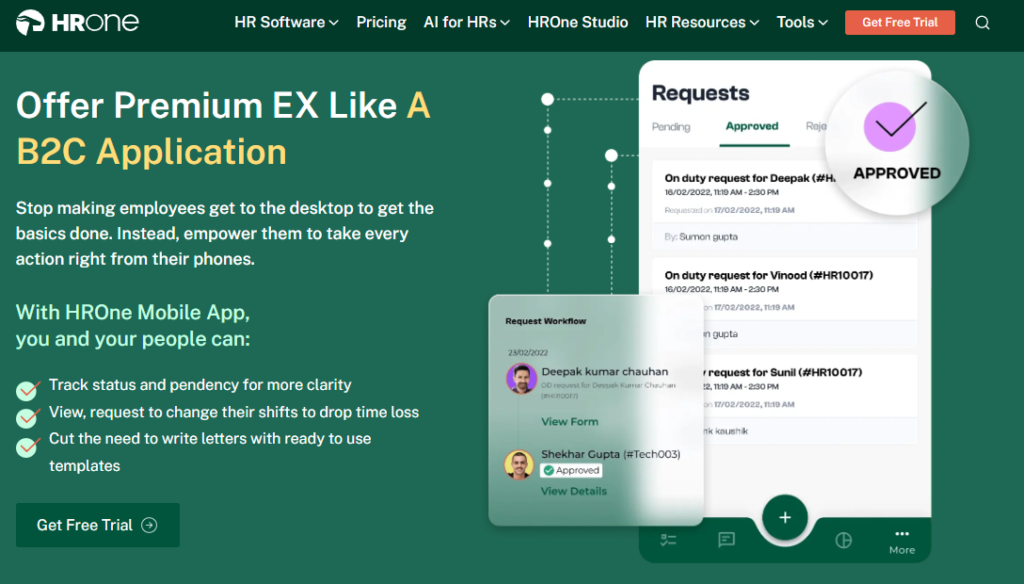
- Super Inbox: surfaces every pending task, request, and approval in one Gmail style HR inbox, so HR stops chasing managers across email threads, and closes tasks in three clicks.
- Time Office with offline attendance: syncs biometric and mobile punches in real time, and marks attendance in low or no network zones, then syncs on reconnection, which removes manual attendance management reconciliation for field teams.
- Payroll engine: automates PF, ESI, TDS, PT, and Form 16 in a simple three step run, generating bank challan files, and cutting month end errors.
- 127+ pre built workflows: define who does what, and by when, across onboarding, confirmation, transfer, and exit, removing manual follow ups.
- One AI Suite: scores resume relevancy, parses expense receipts, and answers employee queries, taking manual labour off recruiters and finance.
- HRV Studio: a low code builder that lets HR create custom apps like visitor or vendor management, without raising a developer ticket.
- Inbuilt ROI Dashboard: calculates lifetime hours saved against average HR salary, so a CHRO walks into a board review with savings already in rupee terms.
🇮🇳 India Specific Compliance and Localization
- PF, ESI, and TDS support: Yes (automated calculation, filing, and reconciliation).
- Labour law compliance: Strong (multi state PT and LWF slabs handled).
- Payroll localization (India specific): Yes (CTC revisions, arrears, and Form 16 automation).
- Multi state compliance handling: Yes (multi legal entity on a single instance).
👥 Who This Is Built For
- Payroll manager reconciling biometric attendance against leave data across multiple units every month end.
- HR ops lead consolidating 15 to 16 legacy leave rules, and several overtime policies, into one structure.
- CHRO who needs to answer, in a board review, how many days it takes on average to close onboarding or a confirmation letter.
🚫 Who Should Skip This
- Very small teams under 25 people wanting a bare bones, spreadsheet style payroll without structured workflows.
- Buyers who want deep performance and audit configuration entirely on mobile, since a few advanced features still sit on the web version.
💰 Pricing Structure
- Plan Type(s): Flat PEPM subscription across module bundles.
- Starting Price: Not publicly disclosed as a fixed slab, request a quote. See the full pricing page. Pricing meters only after go live, with no lock in.
- Tier-wise Breakdown: Module based bundles (Core HR, Time Office, Payroll, Performance, and Engage), quoted by headcount.
- Incremental Cost Drivers: AI add ons and custom module upgrades, with no separate mobile app fee.
- Implementation Fee: Not publicly disclosed, bundled with a prior HR onboarding SPOC.
- Cost at 200 Employees: Request a quote. Cost at 500 Employees: Request a quote.
🛠️ Implementation and Support Reality
- Average go live timeline: mid market enterprises can go live in as little as 30 days with the SPOC model.
- Support channels: phone, email, and a dedicated prior HR SPOC who understands HR, not just software.
- Data migration model: vendor led, with reports of ERP data transfers completing in hours.
- Reported satisfaction: strong G2 India ratings, and a 9.8 NPS on dedicated support.
💬 Reviews
The best part about HROne is its mobile application, marking attendance with geofencing is extremely smooth and accurate, and I like how easy it is to access payslips and tax documents directly from the dashboard without asking HR repeatedly.”
— Priti D., HROne User HROne – G2 Verified Review
“What I like most about HROne is how it blends smart HR technology with a genuine human touch. One thing I don’t like is that it can sometimes feel a bit overwhelming for new users, and without enough guided support, the learning curve can feel quite steep.”
— Nijanthan R., HROne User (3.5/5) HROne – G2 Verified Review
1.2 Keka
Keka: a design led HRMS popular with SMBs for its clean, approachable interface.
🏢 Overview
Keka is an India based HR and payroll platform known for a polished, intuitive user experience that lowers the training burden for small and mid sized teams. It ships a working mobile app, core payroll with PF, ESI, and TDS automation, and a hiring module. It tends to fit growing SMBs first, though users report friction the moment complex, multi location needs appear. For a deeper look, see our HROne vs Keka comparison.
🔧 Core Services
- Payroll engine: automates salary, PF, ESI, and TDS processing with payslip generation, reducing manual month end math.
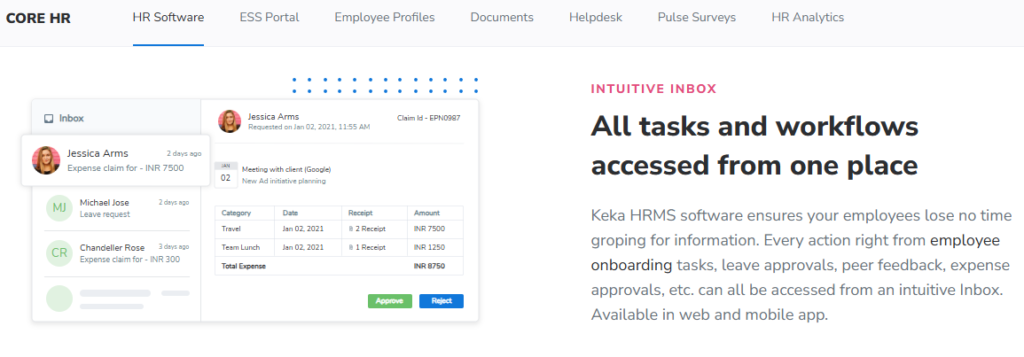
- Attendance and leave: mobile app based punching, and leave approvals, for standard office teams.
- Keka Hiro (hiring): tracks resources, and automates offer letter approval workflows.
- Document management: generates and stores most HR documents digitally, cutting paperwork.
- Employee surveys: a satisfaction survey feature to gather team feedback.
🇮🇳 India Specific Compliance and Localization
- PF, ESI, and TDS support: Yes (automated payroll statutory processing).
- Labour law compliance: Moderate (solid for standard SMB payroll).
- Payroll localization (India specific): Yes (TDS on salary, and quarterly returns).
- Multi state compliance handling: Partial (location specific rules like city based leave reported as hard to configure).
👥 Who This Is Built For
- HR generalist at a growing startup who wants an attractive, low training interface.
- Small team payroll owner processing standard monthly salary with basic statutory needs.
🚫 Who Should Skip This
- IT consulting or shift based firms needing deep customization, since users report Keka “is not built to service IT consulting firms”.
- Teams that need weekend or emergency phone support during migration.
💰 Pricing Structure
- Plan Type(s): Tiered per employee plans (Foundation, Strength, and Growth style tiers).
- Starting Price: Not publicly disclosed as a single fixed figure, request a quote, billed per employee monthly.
- Tier-wise Breakdown: Higher tiers unlock performance, hiring, and analytics modules.
- Incremental Cost Drivers: Module upgrades, and add on features.
- Implementation Fee: Not publicly disclosed, confirm with the vendor.
- Cost at 200 Employees: Request a quote. Cost at 500 Employees: Request a quote.
🛠️ Implementation and Support Reality
- Average go live timeline: variable, with several users reporting slow, drawn out implementations.
- Support channels: email and chat, with a widely reported gap in weekend and escalation support.
- Data migration model: vendor assisted, though coordination issues surface in reviews.
💬 Reviews
“Strong payroll and compliance, automate salary and attendance processing with PF, ESI, TDS. Responsive support team, mobile app available. PMS module is confusing, and needs to be simpler, and user access is difficult for employees who do not have an email ID.”
— Kiran B., Keka User (3/5) Keka – G2 Verified Review
“We started working with Keka in August, and to this day we have been unable to implement the tool due to their consistently delayed responses, and poor coordination between their internal teams.”
— Divya P., Keka User (0/5) Keka – G2 Verified Review
Where Keka wins on first impression, the operating model gap shows up later. Keka digitises SMB HR transactions with a pretty interface, but users hit weekend support silence, and rigid configuration during migration. HROne closes that same gap differently. Every task lands in one Super Inbox, 127+ workflows define who acts next, and a prior HR SPOC (9.8 NPS) walks mid market teams to go live, so the payroll software proves reclaimed time back to the board, rather than handing you a prettier portal for the same month end chaos. If you are weighing a move, read our switching from Keka guide.
1.3 greytHR
greytHR: a long standing SMB payroll and compliance workhorse for straightforward teams.
🏢 Overview
greytHR is one of India’s older HR and payroll platforms, widely adopted by small and mid sized businesses for statutory payroll processing. It handles payslips, leave, attendance, and employee self service for teams that want a dependable core rather than deep customization. Users pick it mainly for stable payroll, though many report friction when their needs grow beyond standard rules.
🔧 Core Services
- Payroll processing: runs monthly salary with PF, ESI, and PT, generating payslips, and reducing manual salary math.
- Leave and attendance: logs attendance and leave through web and a mobile app for standard office teams.
- Employee self service: lets staff pull payslips, apply for leave, and view tax details without pinging HR.
- Tax declarations: employees declare taxes, and pick a regime, from their own login.
- Statutory reports: produces PF, ESI, and PT filing outputs for compliance teams.
🇮🇳 India Specific Compliance and Localization
- PF, ESI, and TDS support: Yes (core statutory payroll, though TDS revision reported as limited).
- Labour law compliance: Moderate (solid basics, rigid on custom rules).
- Payroll localization (India specific): Yes (payslips, PT, and tax regimes).
- Multi state compliance handling: Partial (multi location tracking works, deep customization capped).
👥 Who This Is Built For
- SMB payroll owner who wants a stable, no frills monthly salary run.
- HR generalist at a single entity company with standard leave and attendance rules.
🚫 Who Should Skip This
- Multi legal entity or shift based manufacturing teams needing flexible configuration, since users hit customization walls. A manufacturing HR setup often needs more.
- Remote heavy teams needing full mobile parity, since the app reportedly lacks key web features.
💰 Pricing Structure
- Plan Type(s): Tiered per employee plans.
- Starting Price: Not publicly disclosed as a fixed slab here, request a quote, billed per employee monthly.
- Tier-wise Breakdown: Higher tiers add performance, and expanded HR modules.
- Incremental Cost Drivers: Module add ons, and higher headcount bands.
- Implementation Fee: Not publicly disclosed, confirm with the vendor.
- Cost at 200 Employees: Request a quote. Cost at 500 Employees: Request a quote.
🛠️ Implementation and Support Reality
- Average go live timeline: variable, with some users reporting long payroll configuration cycles.
- Support channels: ticket based, with mixed reviews on speed and escalation.
- Data migration model: vendor assisted, with reported gaps for complex leave setups.
💬 Reviews
“GreytHR is fine software for payroll processing, and I have been using it for 10 years. Reporting configuration, TDS filing, and revising of TDS is not possible.”
— Krishnanand B., greytHR User (3/5) greytHR – G2 Verified Review
“Simple tasks, like logging attendance or approving leaves, take longer than they should due to the app freezing or failing to load data. The mobile app lacks key functionality compared to the web version.”
— Shreeya V., greytHR User (0/5) greytHR – G2 Verified Review
1.4 Darwinbox
Darwinbox: an enterprise grade HR suite with strong brand weight across large Asian companies.
🏢 Overview
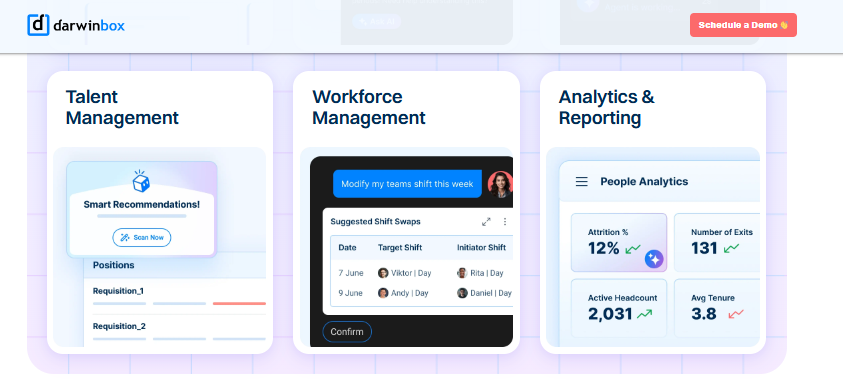
Darwinbox is a well known enterprise HCM used by large organizations across India and Asia. It brings attendance, payroll, performance, and employee data onto one platform, with a mobile app users generally find intuitive. It carries real brand recognition, though reviews flag slower performance under bulk loads, and inconsistent integrations. See our HROne vs Darwinbox comparison for a closer look.
🔧 Core Services
- Unified HR platform: centralizes attendance, leave, payroll, and performance, removing scattered Excel tracking.
- Mobile app: supports quick leave, attendance, and payslip actions on the go.
- Configurable workflows: adapts processes to internal needs with limited technical help.
- Performance management: structures reviews and appraisals for large teams.
- Employee directory: maintains org structure and reporting lines.
🇮🇳 India Specific Compliance and Localization
- PF, ESI, and TDS support: Yes (enterprise payroll with statutory handling).
- Labour law compliance: Strong (built for large Indian enterprises).
- Payroll localization (India specific): Yes.
- Multi state compliance handling: Yes (enterprise multi entity support).
👥 Who This Is Built For
- Enterprise HR leader standardizing HR across thousands of employees.
- HR ops team at a large firm wanting one branded suite over point tools.
🚫 Who Should Skip This
- Lean mid market teams wary of multi year contracts, and day one billing during long implementations.
- Teams that need fast, tab free daily task closure, since users report juggling tabs and slower pages.
💰 Pricing Structure
- Plan Type(s): Enterprise, quote based.
- Starting Price: Not publicly disclosed, request a quote, typically annual enterprise contracts.
- Tier-wise Breakdown: Priced by modules and headcount under negotiated terms.
- Incremental Cost Drivers: Module scope, integrations, and contract length.
- Implementation Fee: Not publicly disclosed, usually separate and enterprise scale.
- Cost at 200 Employees: Request a quote. Cost at 500 Employees: Request a quote.
🛠️ Implementation and Support Reality
- Average go live timeline: enterprise scale, often multi month.
- Support channels: account managed and ticket based, with mixed reviews on responsiveness.
- Data migration model: vendor led, with some reported transition friction.
💬 Reviews
“Darwinbox has made HR processes much smoother by bringing everything together. Speed and performance, pages sometimes load slowly, and mobile app experience is not always as smooth as desktop.”
— Saksham A., Darwinbox User (4/5) Darwinbox – G2 Verified Review
“The sales team is good at selling the product. Bad implementation experience, bad UI UX, configurations getting broken in production, and terrible customer service.”
— Verified User in Computer Software, Darwinbox User (0/5) Darwinbox – G2 Verified Review
1.5 Zoho People
Zoho People: an affordable HR module that shines for teams already living inside Zoho.
🏢 Overview
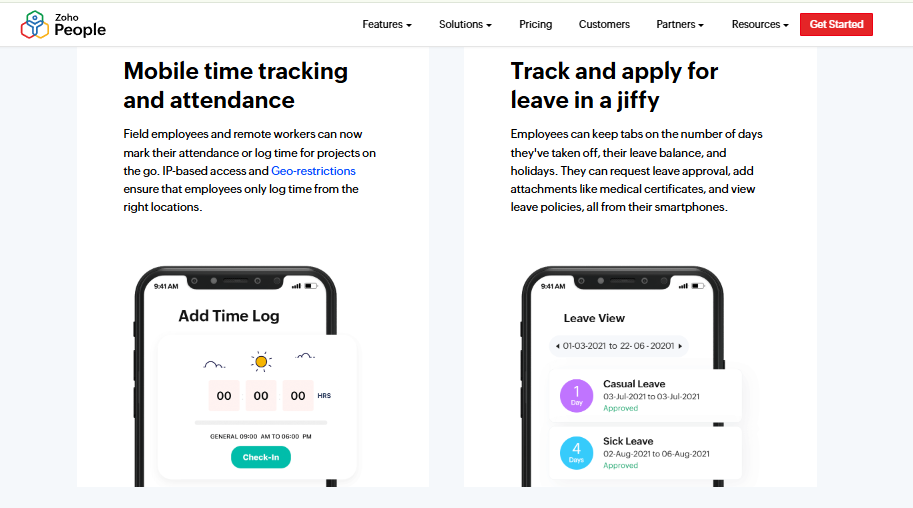
Zoho People is the HR product within the broader Zoho business suite, popular with cost conscious teams and existing Zoho users. It covers attendance, leave, onboarding, and ties neatly into Zoho Recruit and Zoho Payroll. Its strength is breadth and price, though users report shallow depth per feature, and slow support. For alternatives, see our HROne vs Zoho People comparison.
🔧 Core Services
- Attendance and leave: digitally manages requests with direct approve or reject, cutting coordination emails.
- Onboarding: lets candidates enter their own details, completing the onboarding process within a day.
- Zoho suite integration: connects with Zoho Recruit and Zoho Payroll to streamline hiring and salary.
- Holiday sharing: publishes holiday lists to all employees.
- Self service: lets employees check leave balances without emailing HR.
🇮🇳 India Specific Compliance and Localization
- PF, ESI, and TDS support: Partial (via Zoho Payroll integration, depth varies).
- Labour law compliance: Moderate (global generalist, lighter on India specifics).
- Payroll localization (India specific): Partial (stronger when paired with Zoho Payroll).
- Multi state compliance handling: Partial.
👥 Who This Is Built For
- HR generalist at a company already standardized on Zoho apps.
- Cost conscious small team owner wanting broad HR basics cheaply.
🚫 Who Should Skip This
- Compliance heavy manufacturing or BFSI teams needing deep India specific CTC and FBP handling.
- Teams that need fast, reliable support during errors, since users report slow responses.
💰 Pricing Structure
- Plan Type(s): Tiered per employee plans, low starting cost.
- Starting Price: Not publicly disclosed here as a fixed figure, request a quote, among the lower cost options.
- Tier-wise Breakdown: Higher tiers add performance, and advanced HR features.
- Incremental Cost Drivers: Add on Zoho apps like Recruit and Payroll.
- Implementation Fee: Not publicly disclosed, typically low or self serve.
- Cost at 200 Employees: Request a quote. Cost at 500 Employees: Request a quote.
🛠️ Implementation and Support Reality
- Average go live timeline: fast for basics, longer for full suite integration.
- Support channels: email and ticket, with widely reported response delays.
- Data migration model: largely self serve.
💬 Reviews
“I appreciate its onboarding process, candidates can enter their own information. The biggest drawback for me has been the lack of customer support, and the mobile application is quite limited, I can’t access most features on it.”
— Dhana C., Zoho People User (4/5) Zoho People – G2 Verified Review
“The breadth of applications, and the price of it. Features are shallow, and there is no depth in each application.”
— Verified User in IT and Services, Zoho People User (2.5/5) Zoho People – G2 Verified Review
1.6 factoHR
factoHR: a payroll first HRMS with solid mobile attendance for manufacturing and mid market teams.
🏢 Overview
factoHR is an India based HR and payroll platform with a strong reputation for payroll accuracy and mobile attendance, holding high G2 satisfaction scores in the India segment. It leans toward manufacturing, logistics, and mid market teams that need dependable statutory payroll plus field friendly attendance. It is primarily used by payroll teams wanting automation without enterprise complexity. Compare it in our HROne vs FactoHR breakdown.
🔧 Core Services
- Payroll engine: automates PF, ESI, TDS, and PT with statutory outputs, cutting month end reconciliation errors.
- Mobile attendance: supports GPS and geofenced punching for field and factory staff.
- Leave and shift management: handles shifts and leave rules for blue collar workforces.
- Employee self service: gives staff payslips and leave access on mobile.
- Performance module: structures goals, and reviews, for growing teams.
🇮🇳 India Specific Compliance and Localization
- PF, ESI, and TDS support: Yes (automated statutory payroll).
- Labour law compliance: Strong (manufacturing and shift friendly).
- Payroll localization (India specific): Yes.
- Multi state compliance handling: Yes.
👥 Who This Is Built For
- Payroll manager at a manufacturing firm handling shift based statutory payroll.
- HR ops lead needing GPS attendance for a distributed field workforce.
🚫 Who Should Skip This
- Teams wanting a globally recognized enterprise brand over an India focused specialist.
- Very small teams needing only the lightest possible payroll tool.
💰 Pricing Structure
- Plan Type(s): Per employee, quote based.
- Starting Price: Not publicly disclosed, request a quote, billed per employee monthly.
- Tier-wise Breakdown: Module based, quoted by headcount.
- Incremental Cost Drivers: Module upgrades, and headcount bands.
- Implementation Fee: Not publicly disclosed, confirm with the vendor.
- Cost at 200 Employees: Request a quote. Cost at 500 Employees: Request a quote.
🛠️ Implementation and Support Reality
- Average go live timeline: mid market scale, vendor supported.
- Support channels: phone, email, and account manager.
- Data migration model: vendor led.
1.7 Pocket HRMS
Pocket HRMS: a lightweight, mobile first payroll tool for small Indian businesses.
🏢 Overview
Pocket HRMS is a cloud based, mobile friendly HR and payroll product aimed at small Indian businesses that want simple payroll and attendance without heavy setup. It appears consistently in 2026 India HRMS comparison hubs for its accessible mobile approach. It is primarily used by small teams wanting quick payroll and self service on a phone. See how it stacks up in our HROne vs Pocket HRMS comparison.
🔧 Core Services
- Payroll processing: automates salary, PF, ESI, and TDS for small teams, reducing manual math.
- Mobile attendance: supports app based attendance for on the move staff.
- Employee self service: gives payslip and leave access on mobile.
- Leave management: handles standard leave rules and approvals.
- AI assisted features: offers a chatbot style assistant for HR queries.
🇮🇳 India Specific Compliance and Localization
- PF, ESI, and TDS support: Yes (automated for small business payroll).
- Labour law compliance: Moderate.
- Payroll localization (India specific): Yes.
- Multi state compliance handling: Partial.
👥 Who This Is Built For
- Small business owner wanting quick, mobile payroll without heavy configuration.
- HR generalist at a lean team needing simple attendance and payslips.
🚫 Who Should Skip This
- Mid market and enterprise teams needing deep multi entity workflows.
- Compliance heavy firms needing advanced FBP or shift based rules.
💰 Pricing Structure
- Plan Type(s): Tiered per employee plans.
- Starting Price: Not publicly disclosed as a fixed slab here, request a quote, billed per employee monthly.
- Tier-wise Breakdown: Higher tiers add modules and headcount.
- Incremental Cost Drivers: Module add ons.
- Implementation Fee: Not publicly disclosed, confirm with the vendor.
- Cost at 200 Employees: Request a quote. Cost at 500 Employees: Request a quote.
🛠️ Implementation and Support Reality
- Average go live timeline: fast for small teams.
- Support channels: email and chat.
- Data migration model: largely self serve.
1.8 Zimyo
Zimyo: a cost conscious, modular HRMS for SMB to mid market crossovers.
🏢 Overview
Zimyo is an India based HRMS built for cost conscious SMB and mid market teams that want a broad feature list with modular pricing. It covers core HR, payroll, attendance, and performance, and appears in India HRMS comparison roundups for value focused buyers. It is primarily used by growing teams wanting flexibility without enterprise pricing. Explore our HROne vs Zimyo comparison for details.
🔧 Core Services
- Payroll engine: automates PF, ESI, and TDS for statutory salary runs, reducing manual errors.
- Attendance and leave: mobile and biometric based attendance with leave rules.
- Core HR: maintains employee records, and org data.
- Performance management: structures goals, reviews, and feedback.
- Employee self service: gives payslip, leave, and document access on mobile.
🇮🇳 India Specific Compliance and Localization
- PF, ESI, and TDS support: Yes (automated statutory payroll).
- Labour law compliance: Moderate.
- Payroll localization (India specific): Yes.
- Multi state compliance handling: Partial (caps at complex multi entity setups).
👥 Who This Is Built For
- Cost conscious HR lead at an SMB scaling into mid market.
- Payroll owner wanting modular, pay for what you use pricing.
🚫 Who Should Skip This
- Large enterprises needing deep multi legal entity configuration. A core HCM built for scale fits better here.
- Teams wanting a globally recognized enterprise brand.
💰 Pricing Structure
- Plan Type(s): Modular per employee plans with add ons.
- Starting Price: Not publicly disclosed as a fixed figure here, request a quote, billed per employee monthly.
- Tier-wise Breakdown: Base HR plus optional payroll, performance, and engagement modules.
- Incremental Cost Drivers: Per module add ons.
- Implementation Fee: Not publicly disclosed, confirm with the vendor.
- Cost at 200 Employees: Request a quote. Cost at 500 Employees: Request a quote.
🛠️ Implementation and Support Reality
- Average go live timeline: SMB to mid market scale, vendor supported.
- Support channels: email, chat, and account manager.
- Data migration model: vendor assisted.
🏁 What This Ranking Really Tells You
Here is what surfaces when you actually run these tools side by side. Most of them digitise one slice of HR well, then leave the other nine slices on your plate. greytHR runs stable SMB payroll but caps on customization, Keka wins on interface but stumbles on weekend support, and Darwinbox carries enterprise weight but makes you juggle tabs and long contracts.
The pattern I keep seeing across 1,500+ live brands is that a fragmented stack quietly bleeds time at every handoff. Attendance sits in one portal, payroll in another, performance in Excel, and nobody can tell the CHRO how many days a confirmation letter actually takes. This is where HR software that truly connects each step earns its keep.
That is the gap HROne was built to close. Every pending task lands in one Super Inbox that closes in three clicks, 127+ pre built workforce management workflows trigger the next step so HR stops chasing managers, and the inbuilt ROI calculator turns hours saved into a rupee figure for the board. MR DIY India collapsed its payroll cycle from 10 days to 5 to 6 days, and Asia Healthcare Holdings runs 20 pan India units on a single instance, which is the kind of proof that separates an operating system from a prettier portal. Read the MRDIY case study for the full story.
Q2. What Exactly Is an HRMS App, and How Is It Different from an HRIS?
An HRMS app is a mobile application that lets employees and HR run core HR tasks from a phone, including attendance punch in, leave, payslips, approvals, and onboarding, while syncing to payroll and India statutory compliance (PF, ESI, TDS, and Professional Tax). Unlike an HRIS, which mainly stores employee data, an HRMS (or HCM) turns that data into action through automated workflows, analytics, and decisions.
📱 What an HRMS App Actually Does
An HRMS (Human Resource Management System) app puts everyday HR work on a phone. Employees punch attendance, apply for leave, and pull payslips without emailing anyone.
HR gets the other side of the same screen. They approve leave, run onboarding checklists, and track who is present, all from one mobile HR app.
🎯 A Real Phone Screen Moment
Picture a field employee opening the app at 9 a.m. She marks attendance with a geofenced punch, then checks her payslip and leave balance in seconds. Her HR manager, sitting elsewhere, approves a leave request from the same app before her chai gets cold.
That is the shift. The phone is not a viewer, it is the workplace. Modern attendance management lives right where the employee already is.
🪜 The HRIS vs HRMS vs HCM Ladder
Here is the distinction most vendors blur. An HRIS (Human Resource Information System) is mostly a database, it collects and stores employee records. An HRMS or HCM (Human Capital Management) system takes that same data, and puts it into action.
- HRIS: stores data (records, documents, and org charts).
- HRMS: runs processes (attendance, leave, payroll, and workflows).
- HCM: adds strategy (analytics, performance, engagement, and ROI).
My honest read, after watching many teams buy the wrong layer, is this. A database only system traps you in data collection, you gather everything and act on almost nothing. The category quietly avoids saying that out loud.
We built HROne as a full core HCM, not a passive HRIS. The bread and butter, core HR, workforce, time office, and payroll, all connect so the data does something instead of just sitting there. When an HR head told me reports that once took two days now come back on one click, that is the difference between storing data and using it.
Q3. Which HRMS App Handles Indian Attendance Realities Best, Offline, Multi-Punch, Selfie/GPS, and DPDP Consent?
The best HRMS app for Indian attendance handles four realities global tools ignore: offline attendance in low connectivity areas that syncs on reconnection, configurable punch rules (dual for some units, single for others), selfie, GPS, and geofence capture with liveness checks to stop proxy punching, and local language interfaces like Bengali or Tamil. It must also capture DPDP Act 2023 consent for biometric data. HROne leads on all four.
📵 The Field and Factory Reality
Let me set the scene. A factory floor in a low signal zone, a sales rep in a village with no data, and workers who do not read English. Generic attendance apps break at all three points.
Some units need two punches a day, others need only one. And proxy punching, where one worker marks another present, quietly inflates payroll. Solid workforce management has to account for all of it.
📊 How the 8 Apps Compare on Indian Attendance
| App | Offline Sync | Punch Flexibility | GPS/Selfie/Geofence | Local Language UI |
|---|---|---|---|---|
| HROne | Yes, syncs on reconnect | Configurable single or dual | GPS, geofence, and selfie | Bengali, Tamil, and more |
| Keka | Limited | Standard | GPS and geofence | English led |
| greytHR | Limited | Standard | GeoMark geofencing, Visage face | English led |
| Darwinbox | Partial | Configurable | GPS, geofence, and selfie | Multi, enterprise |
| Zoho People | Limited | Standard | GPS and geofence | Multi, generalist |
| factoHR | Partial | Configurable | GPS, geofence, and selfie | Some regional |
| Pocket HRMS | Partial | Standard | GPS and selfie | Limited |
| Zimyo | Partial | Standard | GPS and geofence | Limited |
⚖️ DPDP Act 2023 and Biometric Consent
Here is the part most 2026 buyers miss. A fingerprint or face scan is sensitive data under India’s Digital Personal Data Protection Act, 2023, because it cannot be changed if leaked. You must collect explicit, standalone consent before capturing it, not bundled inside a terms of service tick box.
The penalties are real, up to 250 crore rupees for security lapses. So your attendance app must log consent, limit the purpose, and delete data when an employee exits.
✅ A Monday Rule for Choosing
Match the app to your workforce mix. For English speaking office teams, most tools work. For frontline, vernacular, or low signal units, you need offline sync and local language, or attendance simply fails.
We built HROne for exactly this. One of our units ran the app in Bengali, another in Tamil, because local people interact only in their own language. Offline attendance marks in no signal zones, then syncs on reconnection, and punch rules flex per unit, which is why manufacturing HR teams lean on it.
“The best part about HROne is its mobile application, marking attendance with geofencing is extremely smooth and accurate.”
— Priti D., HROne User (4.5/5) HROne – G2 Verified Review
“The mobile app lacks key functionality compared to the web version. Notifications are inconsistent.”
— Shreeya V., greytHR User (0/5) greytHR – G2 Verified Review
Q4. How Fast, Accurate, and Compliant Is Payroll on These HRMS Apps (Including Instant Salary)?
The strongest HRMS apps automate 90 to 95% of payroll, and close monthly payroll in 5 to 6 days instead of 10, auto handling PF, ESI, TDS, Professional Tax, and Form 16/24Q. A few now add on demand or advance salary. This matters because payroll is survival, not math, nearly half of employees consider leaving after just two payroll mistakes. HROne, factoHR, and greytHR lead here.
💸 Why Payroll Errors Cost You People
Payroll is not a spreadsheet exercise, it is a trust contract. When a paycheque lands wrong twice, roughly 49% of employees start eyeing the exit.
The manual trap makes it worse. Overtime math, arrears, and CTC revisions pile up, and one wrong slab quietly breaks the whole run. Dependable payroll software is the guardrail here.
📊 Payroll Speed and Compliance Across the Apps
| App | Automation Depth | Statutory Coverage | Closing Signal |
|---|---|---|---|
| HROne | 90 to 95% automated | PF, ESI, TDS, PT, and Form 16 | 5 to 6 days, error free runs |
| Keka | Strong core | PF, ESI, and TDS | Solid, some glitches reported |
| greytHR | Strong core | PF, ESI, and PT | Stable, TDS revision limited |
| factoHR | Strong | PF, ESI, TDS, and PT | Fast for manufacturing |
| Darwinbox | Enterprise grade | Full statutory | Slower under bulk loads |
| Zoho People | Via Zoho Payroll | Partial | Depth varies |
| Pocket HRMS | Small business | PF, ESI, and TDS | Quick for small teams |
| Zimyo | Modular | PF, ESI, and TDS | SMB scale |
India’s payroll leaders also flag a data gap. Research points to analytics and reporting as a top challenge for HR and finance teams, which is why a built in ROI calculator matters.
⏰ The Emerging On-Demand Salary Layer
A newer feature is earned wage access, where staff draw a part of already earned salary before payday. The idea is old, real time net pay calculation was patented back in 1999. A handful of Indian apps now bolt this on, though adoption is still early.
🚀 The Click vs Days Shift
Here is the operational payoff. We built HROne so that the moment a user is onboarded, the system triggers a task to assign their salary structure, and you simply copy it from the offer letter. No re keying, and no month end scramble, which smooths the whole onboarding process.
MR DIY India collapsed its payroll cycle from 10 days to 5 to 6 days after moving to us, and the platform completes up to 1.5 crore tasks monthly across live customers. That is the difference between payroll as a fire drill and payroll as a click, as the MRDIY case study shows.
“I like HROne for its zero touch payroll and compliance automation. It handles salary calculations, statutory deductions, PF, ESI, taxes, and filings automatically.”
— Waldon S., HROne User (4/5) HROne – G2 Verified Review
“Strong payroll and compliance, automate salary and attendance processing with PF, ESI, TDS. PMS module is confusing, and needs to be simpler.”
— Kiran B., Keka User (3/5) Keka – G2 Verified Review
Q5. Which HRMS App Actually Puts 110+ HR Tasks in Your Employee’s Pocket?
A truly mobile first HRMS app lets employees and managers complete 110+ HR tasks from a phone, including attendance, leave, payslips, reimbursements, onboarding, appraisals, and even peer appreciation, without emailing HR. HROne leads with 110+ pocket tasks and 127+ automated workflows, manager shadow access to act for teammates, and Global Search that surfaces any record in seconds. Most rivals stop at attendance and payslips.
📱 What “Pocket Complete” Really Means
Most HR apps do three things well: attendance, leave, and payslips. That is it. Everything else still lands in HR’s inbox.
Pocket complete means the phone closes the loop. Onboarding, reimbursements, appraisals, and even a peer badge all happen on the same mobile HR app. And it must run smoothly on a mid range Android phone, because that is what most Indian employees actually carry.
🔍 Shadow Admin and Global Search
Two features quietly change the game. Manager shadow access lets a team lead act on behalf of a teammate, so they stop bugging HR for every small change, which lightens the manager solutions workload.
Global Search is the second. You type a name or record into the search tab, and it surfaces in a fraction of a second, no digging through menus.
🎉 One App for Work and Wins
Here is something I did not expect to matter as much as it does. Engagement lives on the same app as attendance. Staff play a quick game, vote in a poll, then appreciate a colleague, all in one place, which is what strong employee engagement looks like in practice.
That single platform habit is what keeps people opening the app daily. When the app is only for punching in, adoption quietly dies.
📊 Task Depth Across the Apps
| App | Employee Self Service | Manager Actions | HR Admin on Mobile |
|---|---|---|---|
| HROne | 110+ tasks | Shadow admin for teammates | Broad, some advanced on web |
| Keka | Core tasks | Approvals | Partial |
| greytHR | Core, app thinner than web | Approvals | Limited |
| Darwinbox | Broad | Approvals | Enterprise, slower on bulk |
| Zoho People | Limited on mobile | Approvals | Limited |
“The Inbox for HR is a game changer, centralizing every HR task into one simple inbox, cutting administrative time by 60 to 70%.”
— Waldon S., HROne User (4/5) HROne – G2 Verified Review
“Its mobile application has been particularly valuable. We can easily raise requests, mark daily attendance, and read announcements, all with a few clicks.”
— Vignesh J., HROne User (5/5) HROne – G2 Verified Review
What I keep wondering is whether task count is even the right yardstick anymore. My current thinking is that daily active use, not feature lists, will decide the winner in the next two years.
Q6. What Do Real Users Say, and What Does Each App Cost?
Real users praise HROne and factoHR for intuitive mobile UI and support, Darwinbox for enterprise depth, and Zoho People for value, while flagging onboarding curves, slow third party integrations, and support lags on budget tools. On cost, HRMS apps run roughly 30 to 300 rupees per employee per month plus implementation fees. The real risk is not the sticker price, it is overpaying for enterprise features you will not use, or underpaying into statutory exposure.
⭐ What Users Consistently Praise
Across the review files, patterns emerge. HROne users repeatedly flag payroll automation, clean onboarding, and responsive support. Darwinbox users like the single platform breadth, and Zoho People users love the price.
The honest catch is real too. HROne can feel overwhelming for brand new users during onboarding, something I will not hide, though the onboarding process smooths out with the dedicated SPOC.
⚠️ The Recurring Complaints
Now the pain points, because operators screenshot weak claims. Keka users report delayed implementation and weekend support gaps, and greytHR users flag rigid customization.
“We started working with Keka in August, and to this day we have been unable to implement the tool due to their consistently delayed responses.”
— Divya P., Keka User (0/5) Keka – G2 Verified Review
“When it comes to other vendors, integrations take time. I appreciate how HROne has streamlined our payroll management. The support team is always ready to help.”
— Rishiraj R., HROne User (4/5) HROne – G2 Verified Review
💰 What Each App Costs
Pricing in this category sits on a band, not a fixed number. Most HRMS apps quote 30 to 300 rupees per employee per month (PEPM), with budget tools starting near 49 to 99 rupees. See our pricing page for a transparent example.
| Pricing Tier | Typical PEPM | Watch Out For |
|---|---|---|
| Budget (SMB) | 30 to 99 rupees | Thin depth, and statutory gaps |
| Mid market | 100 to 200 rupees | Module add ons, and per entity charges |
| Enterprise | 200 to 300 rupees and above | Day one billing, and long lock ins |
💸 The Implementation Trap
Here is the hidden cost nobody flags upfront. Some teams pay implementation fees, then discover the system cannot do what they were promised. Verify capability before you pay, and use an ROI calculator to sanity check the spend.
We built HROne pricing differently. It is flat PEPM, with no lock in, and subscription meters only after go live, so you are not billed while implementation drags. That structure exists precisely so a CFO does not overpay for payroll software that is still being set up.
Q7. How Do You Choose the Right HRMS App for Your Team on Monday Morning?
Choose your HRMS app by matching three things to your reality: your headcount curve (SME vs mid market vs enterprise), your workforce type (desk vs frontline or multilingual), and your compliance load (PF, ESI, PT, and DPDP Act consent for biometric data). For 100 to 5,000 employee Indian teams with frontline staff, HROne fits best. For tiny desk only teams, a lighter tool like Zoho People or Keka may be enough.
🧭 The Three Variable Rule
Do not start with features, start with your reality. Map these three, and the shortlist writes itself.
- Headcount curve: under 50 desk staff, a light tool works, 100 to 5,000 across units needs a full core HCM.
- Workforce type: frontline, multilingual, or low signal teams need offline sync and vernacular UI, backed by solid attendance management.
- Compliance load: PF, ESI, PT, and now DPDP Act 2023 consent for any biometric attendance.
🏗️ Fitting Messy Reality into Structure
Here is the part generic guides skip. Real companies carry legacy debt, tangled rules built up over years.
One team came to us with 15 to 16 leave rules, several overtime policies, and shift timings that changed unit to unit. We could consolidate all of that into one clean structure, which is the real test, not a feature checklist, and it is why leave management depth matters.
💬 Let Us Talk About Monday
A system cannot replace an HR professional, it can only optimize the humans doing the work. The goal is simple, spend less time feeding data and more time with your people, which is what good HR software should free you to do.
So here is my honest ask instead of a demo pitch. Tell me how your attendance and payroll actually run today, the messy version, and I will tell you whether HROne even fits, or whether a lighter tool serves you better.















 Secures Top Spot in
