







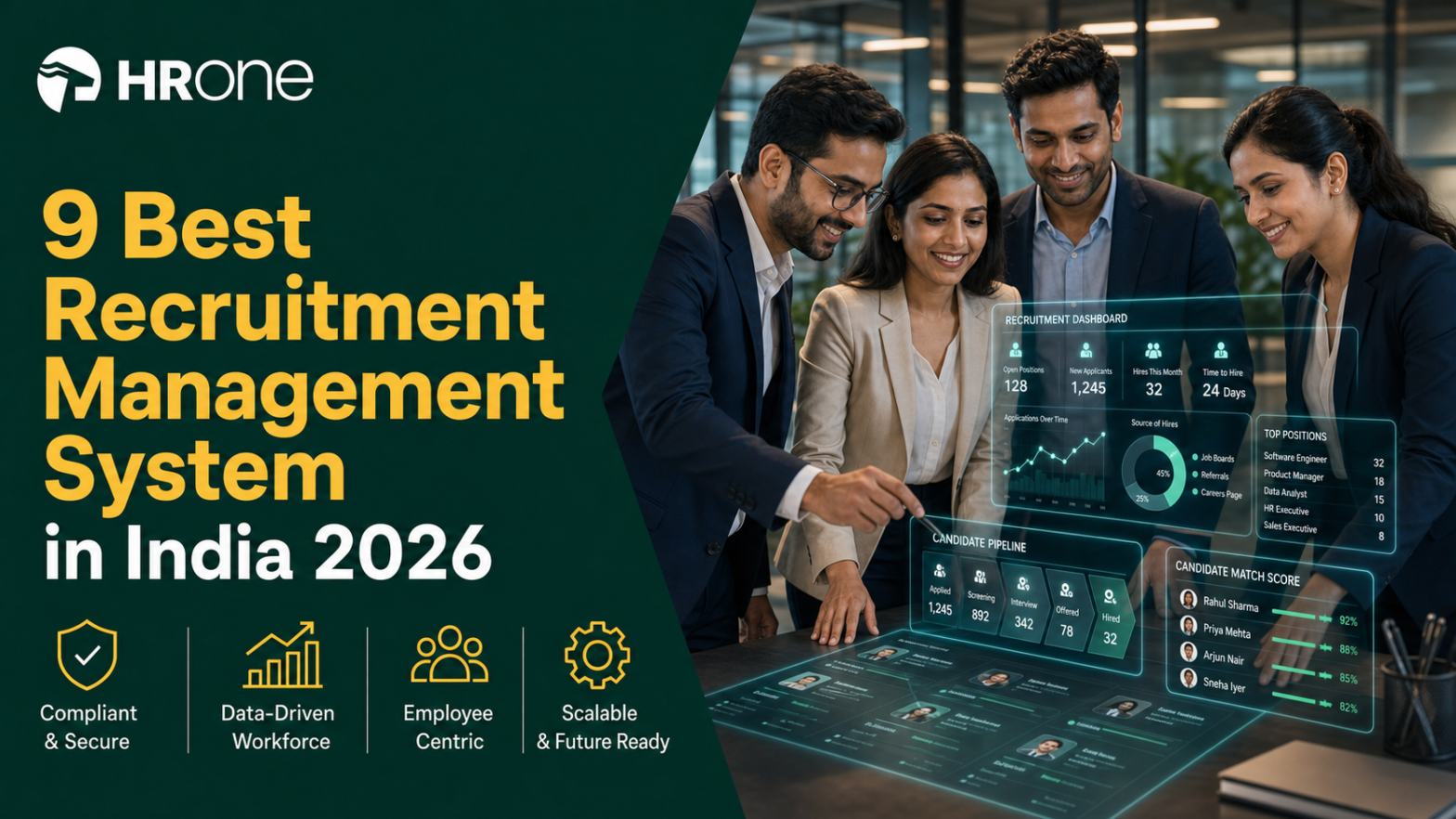
Q1. What are the 9 Best Recruitment Management Systems in India for 2026, and how did we score them?
The 9 best recruitment management systems in India for 2026 are HROne, Keka, Darwinbox, Zoho Recruit, greytHR, Zimyo, PeopleStrong, ZingHR, and Naukri RMS. We scored them on five weighted criteria totaling 100%: Cross-Functional Intelligence (30%), AI and Candidate Relevancy (25%), Statutory and Compliance Readiness (15%), Setup and Usability (15%), and Pricing Transparency (15%). The list favors platforms that carry a candidate from job requisition to a productive day-one employee inside one connected flow.
Choosing a recruitment system is a high-stakes call for a 100 to 5,000 employee Indian company, because the wrong pick means a signed candidate vanishes into an email black hole before day one. We evaluated 9 vendors against operator-grade criteria, not popularity. This guide is written first for the recruiter or HR ops lead who lives inside the recruitment software daily, with the CHRO, CFO, and IT Director reading over their shoulder.
🧭 Our Evaluation Criteria
Each vendor was scored across five decision-grade metrics that map to how Indian HR teams actually buy.
- Cross-Functional Intelligence (30%) 🔗 Does recruitment talk to onboarding, payroll, and attendance, or is it a standalone island?
- AI and Candidate Relevancy (25%) 🤖 Resume parsing, relevancy scoring with reasons, and JD generation depth.
- Statutory and Compliance Readiness (15%) 🇮🇳 PF, ESI, TDS handling and DPDP-aware candidate data practices.
- Setup and Usability (15%) ⏰ Go-live speed, onboarding hand-holding, and daily ease of use.
- Pricing Transparency (15%) 💰 Published pricing, hidden add-on costs, and lock-in terms.
Scores map to stars: 0 to 20 = 1 star, 21 to 40 = 2 stars, 41 to 60 = 3 stars, 61 to 80 = 4 stars, and 81 to 100 = 5 stars.
👥 Who This Guide Is For
This guide helps a specific buying committee shortlist vendors for a real RFP.
- CHROs and HR Heads consolidating a fragmented hire-to-retire stack into one system.
- Payroll Managers running multi-entity, India-compliant monthly payroll software cycles.
- CFOs validating HR tech ROI and flat per-employee-per-month (PEPM) commercials.
- IT Directors and HR ops teams comparing mobile-first platforms against legacy portals.
📊 The 9 Best Recruitment Management Systems Compared
| Provider | Best For | Standout Strength | Known Limitation | AI Depth | Support Model | Pricing Model |
|---|---|---|---|---|---|---|
| HROne ⭐⭐⭐⭐⭐ | HR ops leads who lose candidates between offer and day one | One-flow ATS to onboarding to payroll with AI relevancy scoring | Payroll and Performance modules have a first-user learning curve (G2 verified) | High: relevancy stacking with reasons, JD generation, receipt parser | Phone, email, plus prior-HR onboarding SPOC | Flat PEPM, no lock-in, meters after go-live |
| Keka ⭐⭐⭐ | SMB teams wanting polished UX for payroll and hiring | Strong, intuitive UI and payroll compliance automation (G2 verified) | Slow onboarding and email-thread support during migration (G2 verified) | Moderate: Keka Hiro hiring workflows | Email and ticket-led | Per-employee/month, quote-based tiers |
| Darwinbox ⭐⭐⭐⭐ | Large enterprises needing brand-heavy configurable HCM | Broad module suite on one platform (G2 verified) | Slow load times and tab-and-email task juggling (G2 verified) | Moderate to high | Ticket-led, partner-assisted | Quote-based, multi-year contracts |
| Zoho Recruit ⭐⭐⭐ | Small teams already inside the Zoho ecosystem | Tight integration with Zoho People and Zoho Payroll (G2 verified) | Thin support response and shallow feature depth (G2 verified) | Moderate | Email and ticket-only | Per-recruiter/month, freemium tier |
| greytHR ⭐⭐⭐ | SMB payroll and statutory compliance basics | Reliable payroll and payslip processing (G2 verified) | Rigid customization and limited workflows (G2 verified) | Low | Ticket-led, 1 to 2 hour callback | Per-employee/month, freemium |
| Zimyo ⭐⭐⭐ | Cost-conscious SMB-to-mid-market crossovers | Modular pricing flexibility | Depth caps as multi-entity complexity grows | Moderate | Email and chat | Per-employee/month |
| PeopleStrong ⭐⭐⭐⭐ | Large Indian enterprises wanting talent-tech depth | Enterprise talent and recruitment suite | Heavier fit for mid-market simplicity needs | Moderate to high | Partner and SPOC | Quote-based |
| ZingHR ⭐⭐ | Enterprises wanting hire-to-retire breadth on budget | Wide module coverage across the lifecycle | Slow servers, unstable app, delayed support (G2 verified) | Low to moderate | Email-led, slow TAT | Quote-based |
| Naukri RMS ⭐⭐⭐ | High-volume sourcing from India’s largest candidate base | 90M+ candidate database reach for sourcing | Sourcing-first, thin on onboarding and payroll | Moderate | Account-managed | Subscription, quote-based |
🧪 How we ranked them
We did not rank by popularity or vendor marketing. We combined live SERP research, granted patents on candidate matching, first-party benchmarks, and verified G2 reviews across all nine tools. One first-party India benchmark found an applicant tracking system (ATS, the software that tracks candidates through a hiring pipeline) can cut time-to-hire from 45 days to under 15, with roughly 82% AI scoring accuracy and posting to 50+ job boards.
A second benchmark reported up to a 63% reduction in time-to-hire and 87% matching accuracy from AI-driven systems. Patents ground the “how”: one granted matching engine uses NLP to parse resumes, flag fraud and plagiarism, and retrain on recruiter actions. Another scores a candidate’s likely next role rather than matching keywords.
⚠️ Why a recruit-only ATS list falls short
Here is the honest part. Most “best recruitment software” lists rank standalone ATS tools, and that is exactly where mid-market teams get burned. A recruiter closes the hire, then the data does not move. Payroll runs on one vendor, attendance management on a biometric portal, and recruitment in a disconnected ATS. As one HR leader described the classic setup, the three systems “could not talk to each other,” so HR re-keys everything by hand at month-end.
That handoff is where trust breaks before the person even starts. We weighted Cross-Functional Intelligence highest (30%) for this reason. A tool that only sources candidates leaves the other nine problems on the HR manager’s plate.
Where HROne fits: HROne sits at 1.1 because it treats recruitment as the front door to the full employee lifecycle, from job requisition to separation, not a bolt-on. The moment a candidate accepts, onboarding triggers, the salary structure copies from the offer letter, and the hire converts from a temporary to a permanent employee code with no re-entry. That is the connective tissue a recruit-only ATS cannot replicate, and it is why HROne earns 5 stars on cross-functional intelligence.
1.1 HROne: The complete hire-to-retire operating system, not another ATS
HROne is an India-first, mobile-native HCM that runs recruitment, onboarding, and payroll in one connected flow.
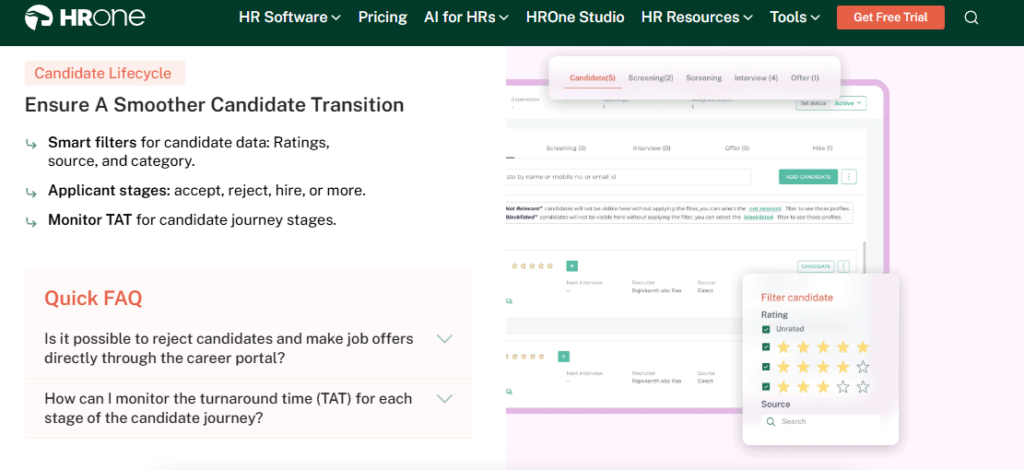
🏢 Overview
HROne is a cloud-based Human Capital Management (HCM) platform founded in 2016, built for Indian mid-market and enterprise teams of 100 to 5,000 employees. It runs 1,500+ brands live, including enterprises like MR DIY India and Asia Healthcare Holdings [INSERT HRONE DATA]. On G2 it holds a strong satisfaction position with high average ratings, and it is primarily used by HR teams tired of stitching recruitment, attendance, and payroll across separate vendors.
🔧 Core Services
- One AI Suite 🤖 stacks the most relevant CVs on top with a visible relevancy score and reasons (often 95 to 97% relevant), so recruiters stop reading every resume by hand.
- JD and interview generators ✅ clone an existing job opening or auto-create a job description from a title and function, removing blank-page writing.
- 127 pre-built hire-to-retire workflows 🔗 define who does what and by when across onboarding, confirmation, transfer, promotion, and exit, so HR stops chasing managers over email.
- Offer-to-salary bridge 💰 copies the full salary structure straight from the offer letter the moment a candidate is onboarded, removing manual CTC re-entry.
- Onboarding checklists with SOP tasks ⏰ assign pre-boarding tasks to each owner so formalities finish before day one, converting a temporary code to a permanent one.
- Super Inbox 📥 surfaces every pending task, request, and approval in one Gmail-like screen that closes tasks in about three clicks, ending tab-switching across 5+ tools.
- Payroll engine automates PF, ESI, and TDS with an auto-scheduler and group payout validation, reducing month-end reconciliation errors.
🇮🇳 India-Specific Compliance and Localization
- PF / ESI / TDS support: Yes (automated calculation, filing, and challan generation).
- Labour law compliance: Strong (multi-state slabs like PT and LWF handled automatically).
- Payroll localization (India-specific): Yes (CTC revisions, arrears, Form 16, Form 12BA).
- Multi-state compliance handling: Yes (multi-legal-entity on a single instance).
👤 Who This Is Built For
- HR ops lead manually reconciling biometric attendance exports against a separate leave management portal every month-end.
- Recruiter reading hundreds of CVs by hand with no relevancy ranking to shortlist faster.
- Payroll manager re-keying a new hire’s CTC from the offer letter into a disconnected payroll tool.
🚫 Who Should Skip This
- Very small teams under 30 people wanting a lightweight, spreadsheet-style tracker without structured workflows.
- Buyers who need a pure sourcing tool and nothing else across the employee lifecycle.
💰 Pricing Structure
- Plan Type(s): Modular HCM plans built around a flat PEPM model.
- Starting Price: Not publicly disclosed, request a quote (flat PEPM, billed after go-live).
- Tier-wise Breakdown: Not publicly disclosed, request a quote.
- Incremental Cost Drivers: Additional business-partner logins for external recruiters (one free per company, extra logins chargeable), and select add-on modules.
- Implementation Fee: Not publicly disclosed, request a quote.
- Cost at 200 Employees: Not publicly disclosed, request a quote. Cost at 500 Employees: Not publicly disclosed, request a quote.
For a full commercial view, see the HROne pricing page.
🛠️ Implementation and Support Reality
- Average go-live timeline: mid-market enterprises can go live in as little as 30 days [INSERT HRONE DATA].
- Support channels: phone, email, plus a dedicated prior-HR onboarding SPOC who understands the domain, not a checklist-reading project manager.
- Data migration model: vendor-led, with reviewers reporting old-ERP data moved over in hours.
- Publicly reported NPS: 9.8 on dedicated SPOC support [INSERT HRONE DATA].
💬 Reviews
“The best part of HROne is smooth functioning of the employee onboarding process with checklist availability… with super admin login we can easily track the daily recruitment process, onboarding and live count of employees present.”
– Deepak S., HROne G2 – Verified Review
“It can sometimes feel a bit overwhelming for new users. Certain features take time to understand, and without enough guided support, the learning curve can feel quite steep.”
– Nijanthan R., 3.5/5 HROne G2 – Verified Review
1.2 Keka: Polished UX HRMS for SMB payroll and hiring
Keka is a design-forward HR and payroll platform with a hiring module for growing SMBs.
🏢 Overview
Keka is an India-based HRMS known for a clean, intuitive interface and strong payroll compliance automation. It serves mostly SMB and lower mid-market teams, and its Keka Hiro module handles recruitment workflows and offer-letter automation. Publicly, reviewers praise the UI but flag support and implementation gaps, and its overall G2 satisfaction position trails the top India HCM players. It is primarily used by teams that want surface-level polish for payroll and basic hiring. Teams weighing options often compare HROne vs Keka before deciding.
🔧 Core Services
- Payroll engine automates salary, PF, ESI, and TDS processing, reducing manual statutory calculation at month-end.
- Keka Hiro tracks resource management and automates hiring approvals and offer-letter workflows.
- Document management generates most HR documents in-system, cutting paperwork and keeping records confidential.
- Attendance and leave processing with a mobile app for daily marking.
- Employee self-service lets staff view payslips and apply for leave without pinging HR.
🇮🇳 India-Specific Compliance and Localization
- PF / ESI / TDS support: Yes (automated salary and statutory processing).
- Labour law compliance: Moderate (solid for standard SMB payroll, gaps on complex shift or multi-entity setups).
- Payroll localization (India-specific): Yes (though reviewers report CTC and incentive edge-case issues).
- Multi-state compliance handling: Partial (location-specific policy configuration reported as clunky).
👤 Who This Is Built For
- SMB HR generalist who wants a good-looking, low-training payroll and attendance tool.
- Small team lead automating basic hiring approvals and offer letters without heavy configuration.
🚫 Who Should Skip This
- IT consulting or multi-entity firms needing deep, location-specific customization (reviewers report Keka “is not built to service IT consulting firms”).
- Teams that need fast, phone-based weekend support during a tight migration.
💰 Pricing Structure
- Plan Type(s): Tiered per-employee/month plans (Foundation, Strength, Growth-style tiers).
- Starting Price: Not publicly disclosed, request a quote.
- Tier-wise Breakdown: Not publicly disclosed, request a quote.
- Incremental Cost Drivers: Module upgrades (PMS, LMS, project modules charged in higher tiers).
- Implementation Fee: Not publicly disclosed, request a quote.
- Cost at 200 Employees: Not publicly disclosed, request a quote. Cost at 500 Employees: Not publicly disclosed, request a quote.
🛠️ Implementation and Support Reality
- Average go-live timeline: reviewers report slow, delayed implementations in some cases.
- Support channels: mainly email and ticket, with reports of limited weekend and phone availability.
- Data migration model: vendor-led, with mixed reliability reports.
- Publicly reported NPS: not publicly disclosed. Teams evaluating a switch often review Keka alternatives in India.
💬 Reviews
“Keka Hiro assists us in tracking resource management and automating new hiring approvals and workflows for offer letters. The document feature has significantly reduced our paperwork.”
– Kiran B., 3/5 Keka G2 – Verified Review
“We started working with Keka HRMS in August, and to this day, we have been unable to implement the tool… due to their consistently delayed responses and poor coordination between their internal teams.”
– Divya P., 0/5 Keka G2 – Verified Review
1.3 Darwinbox: Enterprise-brand HCM with a broad module suite
Darwinbox is a configurable enterprise HCM favored by large brands across Asia.
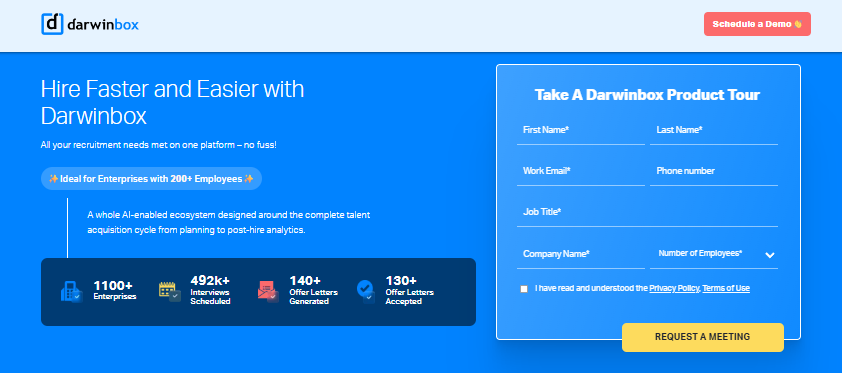
🏢 Overview
Darwinbox is an enterprise-grade HCM platform that carries strong brand weight with large Indian and Asian companies. It bundles attendance, payroll, performance, and recruitment on one platform, and reviewers praise the mobile app and configurable workflows. Its recruitment module exists, but users note it needs training to master. It is primarily used by large enterprises that want one system of record across a big headcount. Teams weighing the mid-market fit often compare HROne vs Darwinbox first.
🔧 Core Services
- Recruitment and onboarding centralize hiring and joining, though reviewers say the module needs support to master.
- Attendance and leave run on one platform with a well-liked mobile app for quick actions.
- Payroll processing handles salary and statutory runs inside the same system.
- Performance management tracks reviews and appraisals, flagged by some as non-intuitive at first.
- Configurable workflows adapt to internal processes without heavy technical work.
🇮🇳 India-Specific Compliance and Localization
- PF / ESI / TDS support: Yes (payroll runs statutory calculations).
- Labour law compliance: Strong (built for large Indian enterprise scale).
- Payroll localization (India-specific): Yes.
- Multi-state compliance handling: Yes.
👤 Who This Is Built For
- Enterprise HR leader standardizing 3,000+ employees onto one system of record.
- HR ops team wanting a configurable mobile-first platform across multiple modules.
🚫 Who Should Skip This
- Mid-market teams wanting fast, three-click task closure without juggling tabs and email.
- Buyers avoiding multi-year lock-in and day-one billing before go-live.
💰 Pricing Structure
- Plan Type(s): Enterprise quote-based plans.
- Starting Price: Not publicly disclosed, request a quote.
- Tier-wise Breakdown: Not publicly disclosed, request a quote.
- Incremental Cost Drivers: Module add-ons and multi-year contract terms.
- Implementation Fee: Not publicly disclosed, request a quote.
- Cost at 200 Employees: Not publicly disclosed, request a quote. Cost at 500 Employees: Not publicly disclosed, request a quote.
🛠️ Implementation and Support Reality
- Average go-live timeline: reviewers report implementation can drag while billing starts early.
- Support channels: ticket-led and partner-assisted, with mixed satisfaction reports.
- Data migration model: vendor and partner-led.
- Publicly reported NPS: not publicly disclosed.
💬 Reviews
“Darwinbox has helped us digitize and streamline our HR operations, from onboarding and attendance to payroll and performance management. Earlier, we used a mix of Excel sheets and legacy tools, now everything is centralized.”
– Mohit V., 4/5 Darwinbox G2 – Verified Review
“Bad implementation experience, bad UI UX, configurations getting broken in production on its own due to product deployments, terrible customer service.”
– Verified User in Computer Software, 0/5 Darwinbox G2 – Verified Review
1.4 Zoho Recruit: Ecosystem-native ATS for Zoho-first teams
Zoho Recruit is applicant tracking built to plug into the wider Zoho suite.
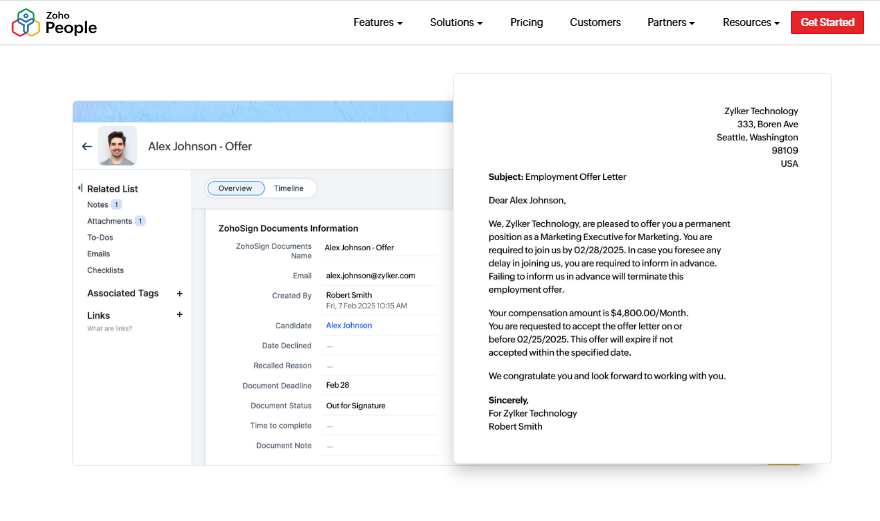
🏢 Overview
Zoho Recruit is the applicant tracking system (the tool that manages candidates through a hiring pipeline) inside the global Zoho ecosystem. Its biggest draw is tight integration with Zoho People and Zoho Payroll, so candidate data can flow into HR and payroll. Reviewers value the low-cost breadth but flag thin support and shallow feature depth. It is primarily used by small teams already committed to Zoho apps. India-focused buyers often review Zoho People alternatives in India before committing.
🔧 Core Services
- Candidate tracking manages applicants through pipeline stages, reducing manual status chasing.
- Zoho People and Payroll integration passes hired-candidate data into HR and payroll, cutting re-entry.
- Self-service onboarding lets candidates enter their own data, shortening joining time.
- Attendance and leave (via Zoho People) handle daily HR admin.
- Multi-app ecosystem offers wide functionality at a low price point.
🇮🇳 India-Specific Compliance and Localization
- PF / ESI / TDS support: Partial (via Zoho Payroll, stronger for standard cases).
- Labour law compliance: Moderate (global generalist, lighter on India edge cases).
- Payroll localization (India-specific): Partial.
- Multi-state compliance handling: Partial.
👤 Who This Is Built For
- Small HR team already running Zoho People and wanting recruitment in the same suite.
- Founder-led company wanting low-cost candidate tracking with self-service onboarding.
🚫 Who Should Skip This
- Compliance-heavy manufacturing or BFSI teams needing deep India-specific CTC and FBP handling.
- Teams that need fast, reliable customer support during setup errors.
💰 Pricing Structure
- Plan Type(s): Free plan plus per-recruiter/month paid tiers.
- Starting Price: Not publicly disclosed here, verify on Zoho’s pricing page.
- Tier-wise Breakdown: Not publicly disclosed, request a quote.
- Incremental Cost Drivers: Add-on Zoho apps and per-recruiter seats.
- Implementation Fee: Not publicly disclosed, request a quote.
- Cost at 200 Employees: Not publicly disclosed, request a quote. Cost at 500 Employees: Not publicly disclosed, request a quote.
🛠️ Implementation and Support Reality
- Average go-live timeline: fast for small setups, with instructional videos.
- Support channels: email and ticket-only, with reports of slow response.
- Data migration model: self-serve.
- Publicly reported NPS: not publicly disclosed.
💬 Reviews
“With Zoho People, candidates can enter their own information, making the onboarding process smooth… its integration with other Zoho apps, such as Zoho Recruit and Zoho Payroll, which streamlines both the recruitment and monthly payroll processes.”
– Dhana C., 4/5 Zoho People G2 – Verified Review
“The biggest drawback for me has been the lack of customer support. Whenever I try to reach out, it often takes a long time to get a response.”
– Dhana C., 4/5 Zoho People G2 – Verified Review
1.5 greytHR: Dependable SMB payroll with basic hiring
greytHR is a long-standing SMB payroll and compliance tool with light recruitment.
🏢 Overview
greytHR is a widely used Indian HR and payroll platform aimed at SMB teams. Its strength is reliable payroll, payslips, and statutory processing, plus a simple onboarding flow. Reviewers value the price and stability but repeatedly flag rigid customization and support gaps. It is primarily used by small teams that need dependable payroll basics rather than deep recruitment workflows. Growing teams frequently explore HROne vs greytHR as they outscale the basics.
🔧 Core Services
- Payroll processing runs salary and statutory calculations, handling core month-end pay.
- Onboarding automation initiates new-joiner formalities with HR and admin handoffs.
- Leave and attendance manage daily requests and holiday tracking.
- Employee self-service lets staff view payslips, apply for leave, and declare taxes.
- Tax declaration supports employee-side regime selection and filing.
🇮🇳 India-Specific Compliance and Localization
- PF / ESI / TDS support: Yes (core payroll and payslip processing).
- Labour law compliance: Moderate (reviewers report rigid policy configuration).
- Payroll localization (India-specific): Yes (though TDS revision gaps reported).
- Multi-state compliance handling: Partial.
👤 Who This Is Built For
- SMB payroll admin who wants dependable monthly payslips without heavy setup.
- Small HR team automating basic onboarding and leave without complex workflows.
🚫 Who Should Skip This
- Multi-legal-entity or shift-based manufacturing teams needing flexible customization.
- HR teams that need fast, empathetic support and deep tax optimization help.
💰 Pricing Structure
- Plan Type(s): Freemium plus per-employee/month paid tiers.
- Starting Price: Not publicly disclosed here, verify on greytHR’s pricing page.
- Tier-wise Breakdown: Not publicly disclosed, request a quote.
- Incremental Cost Drivers: Module add-ons per tier.
- Implementation Fee: Not publicly disclosed, request a quote.
- Cost at 200 Employees: Not publicly disclosed, request a quote. Cost at 500 Employees: Not publicly disclosed, request a quote.
🛠️ Implementation and Support Reality
- Average go-live timeline: reviewers report configuration friction on complex policies.
- Support channels: ticket-led, with roughly 1 to 2 hour callback reported by some.
- Data migration model: vendor-led.
- Publicly reported NPS: not publicly disclosed.
💬 Reviews
“GreytHR is fine software for payroll processing and I have been using it since 10 years. Better UI, simplicity and time for support.”
– Krishnanand B., 3/5 greytHR G2 – Verified Review
“GreytHR is not much good at customizing based on our requirements… there were issues with leave balance… Many times we were manually correcting the leave balance of employees.”
– Verified User in IT and Services, 2/5 greytHR G2 – Verified Review
1.6 Zimyo: Cost-conscious modular HRMS for SMB-to-mid-market crossovers
Zimyo is a budget-friendly modular HRMS scaling with growing teams.
🏢 Overview
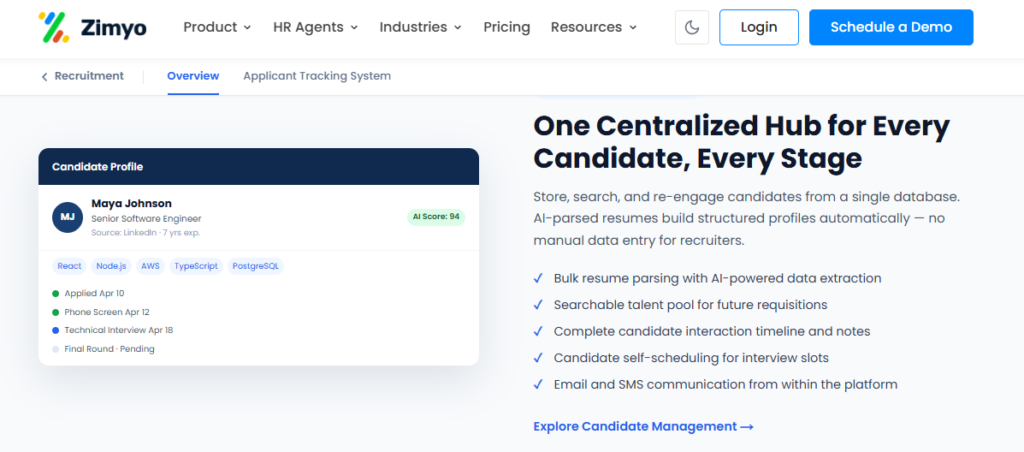
Zimyo is an India-based HRMS built for cost-conscious SMB and lower mid-market teams, with a growing footprint including the Middle East. It offers modular HR, payroll, and recruitment pieces that teams can pick as they scale. Its appeal is flexible, affordable modules rather than deep enterprise configuration. It is primarily used by growing teams that want to add capability without a heavy upfront commitment. For a direct contrast, see HROne vs Zimyo.
🔧 Core Services
- Recruitment module manages candidate pipelines and hiring stages for growing teams.
- Payroll engine processes salary and statutory deductions for standard cases.
- Attendance and leave cover daily HR admin with mobile access.
- Performance management tracks goals and reviews as an add-on.
- Modular pricing lets teams buy only what they need as headcount grows.
🇮🇳 India-Specific Compliance and Localization
- PF / ESI / TDS support: Yes (standard payroll processing).
- Labour law compliance: Moderate (fits standard SMB needs).
- Payroll localization (India-specific): Yes.
- Multi-state compliance handling: Partial.
👤 Who This Is Built For
- Cost-conscious SMB HR lead adding modules gradually as the team scales.
- Growing startup wanting affordable payroll and recruitment in one place.
🚫 Who Should Skip This
- Large multi-entity enterprises needing deep configuration and heavy compliance handling.
- Teams wanting a proven enterprise track record at 3,000+ employees.
💰 Pricing Structure
- Plan Type(s): Per-employee/month modular tiers.
- Starting Price: Not publicly disclosed here, verify on Zimyo’s pricing page.
- Tier-wise Breakdown: Not publicly disclosed, request a quote.
- Incremental Cost Drivers: Per-module add-ons.
- Implementation Fee: Not publicly disclosed, request a quote.
- Cost at 200 Employees: Not publicly disclosed, request a quote. Cost at 500 Employees: Not publicly disclosed, request a quote.
🛠️ Implementation and Support Reality
- Average go-live timeline: not publicly disclosed.
- Support channels: email and chat.
- Data migration model: vendor-led.
- Publicly reported NPS: not publicly disclosed.
1.7 PeopleStrong: AI-first enterprise HR OS for large Indian firms
PeopleStrong is an Asia-focused enterprise HCM with deep talent and payroll depth.
🏢 Overview
PeopleStrong is an AI-first HR technology platform from India, built for large, talent-focused enterprises across Asia-Pacific. It is rated among the top HCM platforms on Gartner Peer Insights and offers Core HR, payroll, recruitment, and its Jinie AI assistant. It carries real enterprise depth for hierarchy-heavy, multi-entity companies. It is primarily used by large Indian enterprises, often above 2,000 employees. Buyers comparing enterprise fit often start with HROne vs PeopleStrong.
🔧 Core Services
- Talent acquisition manages enterprise recruitment at scale with AI matching.
- Core HR maintains employee records, leave, attendance, and onboarding in one place.
- Payroll runs multi-entity, compliance-heavy salary processing.
- Jinie AI assistant supports employee queries and workflows.
- Talent management covers performance, succession, and skills.
🇮🇳 India-Specific Compliance and Localization
- PF / ESI / TDS support: Yes (enterprise payroll depth).
- Labour law compliance: Strong (built for multi-entity Indian enterprises).
- Payroll localization (India-specific): Yes.
- Multi-state compliance handling: Yes.
👤 Who This Is Built For
- Enterprise CHRO running a hierarchy-heavy, multi-entity firm above 2,000 employees.
- Talent leader wanting AI-driven recruitment and succession depth at scale.
🚫 Who Should Skip This
- Lean mid-market teams wanting fast setup and simple daily workflows.
- Budget-conscious SMBs that do not need enterprise-grade talent depth.
💰 Pricing Structure
- Plan Type(s): Enterprise quote-based plans.
- Starting Price: Not publicly disclosed, request a quote.
- Tier-wise Breakdown: Not publicly disclosed, request a quote.
- Incremental Cost Drivers: Module and AI add-ons.
- Implementation Fee: Not publicly disclosed, request a quote.
- Cost at 200 Employees: Not publicly disclosed, request a quote. Cost at 500 Employees: Not publicly disclosed, request a quote.
🛠️ Implementation and Support Reality
- Average go-live timeline: enterprise timelines, longer for complex multi-entity setups.
- Support channels: partner and account-managed.
- Data migration model: vendor and partner-led.
- Publicly reported NPS: not publicly disclosed.
1.8 ZingHR: Broad hire-to-retire HCM with wide module coverage
ZingHR is a Mumbai-based HCM spanning the full employee lifecycle across many modules.
🏢 Overview
ZingHR is a Mumbai-based HCM platform serving 1,100+ customers with 2M+ active users across 30+ modules and 26+ languages. It covers workforce management, digital onboarding, payroll, and AI-powered support across the lifecycle. Its breadth is wide, though some public reviews flag performance and support consistency. It is primarily used by enterprises wanting broad module coverage on a budget. Teams evaluating a switch often review HROne vs ZingHR.
🔧 Core Services
- Digital onboarding moves new-joiner formalities online, reducing paperwork.
- Workforce management optimizes schedules and resource allocation.
- Payroll processes salary and statutory runs across the lifecycle.
- AI-powered chatbot offers round-the-clock employee support.
- Succession and compensation tools support planning and pay decisions.
🇮🇳 India-Specific Compliance and Localization
- PF / ESI / TDS support: Yes (payroll module).
- Labour law compliance: Moderate (broad but consistency varies by reports).
- Payroll localization (India-specific): Yes.
- Multi-state compliance handling: Partial.
👤 Who This Is Built For
- Enterprise HR team wanting wide module coverage across many languages.
- Multi-location firm needing digital onboarding and workforce scheduling.
🚫 Who Should Skip This
- Teams needing fast servers, a stable app, and quick support turnaround.
- Mid-market buyers wanting tightly connected, three-click task closure.
💰 Pricing Structure
- Plan Type(s): Enterprise quote-based plans.
- Starting Price: Not publicly disclosed, request a quote.
- Tier-wise Breakdown: Not publicly disclosed, request a quote.
- Incremental Cost Drivers: Per-module add-ons.
- Implementation Fee: Not publicly disclosed, request a quote.
- Cost at 200 Employees: Not publicly disclosed, request a quote. Cost at 500 Employees: Not publicly disclosed, request a quote.
🛠️ Implementation and Support Reality
- Average go-live timeline: not publicly disclosed.
- Support channels: email-led, with slow turnaround reported by some.
- Data migration model: vendor-led.
- Publicly reported NPS: not publicly disclosed.
1.9 Naukri RMS: High-volume sourcing from India’s largest candidate base
Naukri RMS is a recruitment tool anchored to India’s biggest job board and candidate database.
🏢 Overview
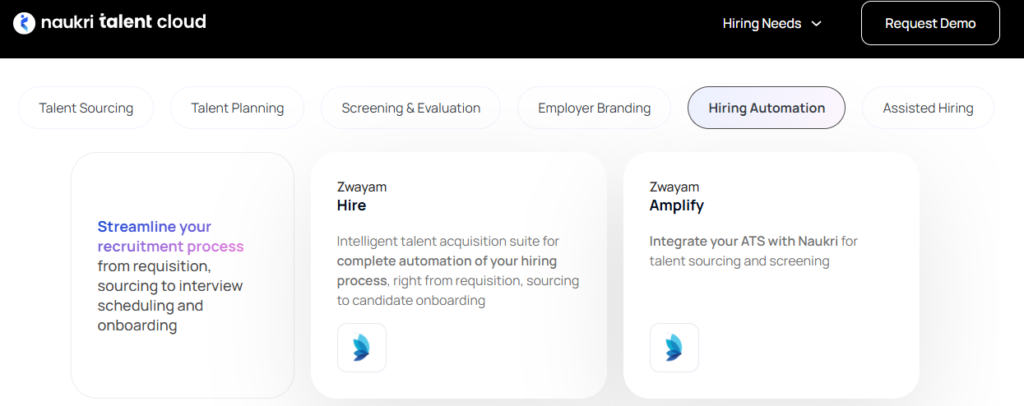
Naukri RMS is the recruitment management system from Info Edge, tied to India’s largest job board and its 90M+ candidate database. Its core strength is sourcing reach, letting recruiters post jobs and search a huge candidate pool. It is a sourcing-first tool rather than a full hire-to-retire suite. It is primarily used by high-volume hiring teams that live inside Naukri for candidate discovery. Teams needing lifecycle continuity after sourcing often add dedicated recruitment software that flows into onboarding.
🔧 Core Services
- Job posting and sourcing reach India’s largest candidate database for wide funnel fill.
- Candidate search filters a 90M+ profile pool to shortlist faster.
- Applicant tracking manages candidates through basic hiring stages.
- Resume database access speeds sourcing for high-volume roles.
- Recruiter dashboards track sourcing activity and pipeline.
🇮🇳 India-Specific Compliance and Localization
- PF / ESI / TDS support: No (sourcing-first, not a payroll tool).
- Labour law compliance: Limited (outside its recruitment scope).
- Payroll localization (India-specific): No.
- Multi-state compliance handling: No.
👤 Who This Is Built For
- High-volume recruiter sourcing from India’s deepest candidate pool.
- Talent team wanting job-board reach and resume search in one place.
🚫 Who Should Skip This
- Teams needing onboarding, payroll, and full lifecycle continuity after the hire.
- HR leaders wanting one connected system from requisition to separation.
💰 Pricing Structure
- Plan Type(s): Subscription, quote-based.
- Starting Price: Not publicly disclosed, request a quote.
- Tier-wise Breakdown: Not publicly disclosed, request a quote.
- Incremental Cost Drivers: Database access tiers and job-posting volume.
- Implementation Fee: Not publicly disclosed, request a quote.
- Cost at 200 Employees: Not publicly disclosed, request a quote. Cost at 500 Employees: Not publicly disclosed, request a quote.
🛠️ Implementation and Support Reality
- Average go-live timeline: fast for sourcing setup.
- Support channels: account-managed.
- Data migration model: self-serve and account-assisted.
- Publicly reported NPS: not publicly disclosed.
🔗 Where all nine leave a gap, and how HROne closes it
Here is the pattern across these nine. Sourcing tools like Naukri fill the top of the funnel, SMB tools like greytHR and Zimyo handle payroll basics, and enterprise suites like Darwinbox and PeopleStrong carry brand depth. Each solves one slice and leaves the handoffs manual. That is exactly where a signed candidate slips through the cracks between offer and day one.
We built HROne as the connective tissue instead of another island. The moment a candidate accepts, 127 pre-built workflows trigger the onboarding process, the salary structure copies from the offer letter, and the Super Inbox surfaces every pending task in one Gmail-like screen. For a 100 to 5,000 employee Indian firm, that is the difference between five vendors that cannot talk to each other and one core HCM that carries a person from requisition to a productive first day.
Q2. What exactly is a recruitment management system, how is it different from an ATS, and why do pipelines break between offer and day one?
A recruitment management system (RMS) runs the whole hiring journey, requisition, sourcing, resume parsing, AI matching, scheduling, e-offers, and onboarding, in one platform. An applicant tracking system (ATS), the tool that tracks candidates through a pipeline, is narrower. Every RMS contains an ATS, but a true RMS also hands candidates to onboarding and payroll without re-keying data. Pipelines break when those systems cannot talk to each other.
🧩 The cleanest way to tell them apart
Think of it like the difference between a checklist and a conveyor belt. An ATS tracks who applied and what stage they are in. An RMS moves the person forward, from a raised requisition all the way to a productive first day.
Here is the same requisition run through both. In an ATS, a recruiter posts a role, collects resumes, and marks stages, then exports the winner to email. In an RMS, that same accepted candidate flows straight into the onboarding process, with the salary structure carried across automatically.
| Dimension | ATS (Applicant Tracking System) | RMS (Recruitment Management System) |
|---|---|---|
| Core job | Track candidates through pipeline stages | Run the full journey, requisition to day one |
| Scope | Sourcing and pipeline | Sourcing, offers, and onboarding handoff |
| Data handoff | Manual export to HR or payroll | Auto-passes hire data forward |
| Ends at | Offer accepted | Productive first day |
⚠️ The offer-to-day-one black hole
Here is where it hurts. A candidate signs, then the trail goes cold in an email thread. Nobody re-keys the CTC (cost to company, the full salary package) into payroll software on time, and the joining slips.
Most companies, honestly, are sold a Human Resource Information System (HRIS, a record-keeping database) and told it is a full Human Capital Management (HCM) platform that runs the whole lifecycle. They are not the same thing. You spend months fighting for talent, then lose trust before the person even starts.
🔀 The three-vendor nightmare
I have seen this pattern again and again in mid-market Indian firms. Recruitment lives in one tool, attendance management on a biometric portal, and payroll with an outsourced vendor. Those three systems cannot talk to each other.
So a manager mails an Excel sheet of overtime hours, someone collates it by hand, and payroll gets it late. That shadow spreadsheet workload is the real tax of a disconnected stack.
Where HROne fits: we built HROne on the HCM end, not the tracker end. The RMS is the front door to the full employee lifecycle, so the moment a candidate accepts, the handoff to onboarding and payroll happens inside one core HCM instead of an email chain.
Q3. What features separate a modern RMS from a resume inbox, and how does “ATS + onboarding in one flow” actually work?
A modern RMS stacks CVs by AI relevancy score with stated reasons, clones or AI-generates job descriptions, collects documents and offer responses over WhatsApp via OTP (one-time password), and routes approvals by grade logic. In one flow, the accepted offer auto-triggers onboarding: pre-boarding task owners get their to-dos, the salary structure copies from the offer letter, and the hire converts from a temporary to a permanent employee code with no re-keying.
🎯 AI relevancy scoring, not a keyword guess
A resume inbox makes you read every CV. A modern RMS ranks them. AI-driven relevancy stacks the most relevant CV on top, often at 95 to 97% relevance, with the reasons shown. This is the kind of automation our HROne AI layer is built around.
The mechanism is real, not marketing. One granted patent parses resumes with natural language processing (NLP), flags fraud, plagiarism, and gaps, and highlights best fit. On Monday morning, that means a recruiter shortlists in minutes, not hours.
✅ JD cloning and AI generation
Writing a job description (JD) from scratch every time is dead weight. A modern RMS clones an existing opening or generates a JD from a title and function. A dedicated job description generator removes the blank-page problem entirely.
The payoff is speed and consistency. You stop staring at a blank page, and every role posts with a clean, standardized brief.
📱 WhatsApp document collection
Chasing documents over email is where onboarding stalls. A modern RMS collects documents and offer responses over WhatsApp, verified by OTP. Our WhatsApp bot brings these interactions to where candidates already are.
Candidates respond where they already are. That removes the “did you get my email” loop that quietly kills week one.
⏰ Grade-based approvals
Not every hire needs the same sign-offs. Grade logic routes a G5 requisition through different approvers than a G1 one, automatically.
This removes the manual “who approves this” question. The workflow already knows.
🔗 The one-flow bridge, step by step
Here is how the offer-to-day-one bridge actually runs inside HROne:
- Candidate accepts the e-offer.
- Pre-boarding task owners each get their onboarding to-do automatically.
- The full salary structure copies straight from the offer letter into payroll.
- The hire converts from a temporary employee code to a permanent one.
Structured onboarding is not fluff. Research links strong onboarding to roughly 70% higher new-hire productivity and 50% better retention. One customer described the end state simply: they had become a paperless organization [INSERT HRONE DATA].
💬 Reviews
“Home section packed with all needy useful options… Letters are now live means system generated for Confirmation and Relieved cases… Process of new on-boarding and sharing invite to system is quick and easy. Now with checklist available. No chance to miss any important task.”
– Deepak K., 5/5 HROne G2 – Verified Review
“The best functionality of the product is the onboarding module… With onboarding checklist it is quite systematic to manage the details for new joiners and tracking becomes easy.”
– Komal S., 5/5 HROne G2 – Verified Review
Q4. How does AI candidate matching actually work, and is it bias-free and DPDP-compliant in India?
Modern AI matching scores candidates on predictive next-role fit and time-sliced resume features, not keyword matching, and can flag resume fraud. But AI can inherit bias, so India’s DPDP Act 2023 matters. Candidates are data principals owed notice that AI screening is used, purpose-limited and accurate data, and short retention (around 90 days for rejected candidates). Keep a human review step, because a system optimizes people, it does not replace them.
🧠 How the matching actually works
Real matching engines do not just count keywords. One granted patent parses resumes with NLP, checks skills, experience ratios, and gaps, and raises red flags for fake or plagiarized content.
Others go further into prediction. Patented approaches score a candidate’s likely next role and slice resume features by time period, ranking fit rather than string-matching. This predictive depth is what sets a modern recruitment software apart from a basic tracker.
⚠️ Where bias creeps in
Here is the honest part. If the training data is skewed, the model learns the skew. Independent research has documented adverse-impact and mirroring effects in AI hiring tools, where systems favor patterns tied to existing hires rather than actual merit.
I might be wrong on the exact size of the effect, but the direction is clear from the studies. Unaudited matching can quietly narrow your funnel in ways no recruiter intended.
🇮🇳 What the DPDP Act 2023 requires
India’s Digital Personal Data Protection (DPDP) Act 2023 treats a candidate as a data principal, the person whose data you hold. That creates concrete duties when you run AI screening.
- Notice: tell candidates their data is processed, including AI screening.
- Purpose limitation: use resume data only for the role they applied to.
- Accuracy: keep the data correct, since decisions ride on it.
- Retention: do not hoard rejected-candidate data; short windows (around 90 days) are the safer default.
✅ Keep the human in human resources
My current thinking is simple. A system cannot replace an HR professional, but it can optimize one, driving accuracy and consistency at scale. This is the principle behind our broader HR software approach.
That is why explainability matters more than raw automation. In HROne, relevancy scores show their reasons, and a human review step stays in the loop, which lines up with DPDP’s accuracy and fairness expectations far better than a black-box score.
Q5. How much does a recruitment management system cost in India?
Indian recruitment software ranges from free starter tiers to roughly INR 999 to 9,999 per month for SMB tools, per-employee or per-recruiter pricing for modular suites, and custom quotes for enterprise platforms like Darwinbox. Watch the hidden costs. Extra business-partner logins for external recruiters are chargeable beyond the first free one, and custom integration bridges add cost if the vendor has not pre-built them. Ask which systems bridge for free upfront.
💰 What the tiers actually look like
Pricing in India splits into three broad bands. The gap between them is not just money, it is how much manual work stays on your plate. A transparent pricing model makes that gap visible before you sign.
| Tier | Typical INR range | Best for |
|---|---|---|
| SMB starter | Free to ~INR 999 to 9,999/month | Small teams needing basic pipeline tracking |
| Modular mid-market | Per-employee or per-recruiter/month | Growing firms adding modules as they scale |
| Enterprise suite | Custom quote (Darwinbox, PeopleStrong) | Large multi-entity firms, quote-based |
⚠️ The hidden costs nobody quotes upfront
Here is where budgets quietly leak. Most tools give you one external-recruiter login free, then charge for more.
At HROne, we give one business-partner login free per company, and extra logins are chargeable only if you actually need them. That is honest, but you still have to plan for it if you run several agencies. You can model the full picture with our ROI calculator.
💸 The integration-bridge trap
The bigger surprise is integration. If a vendor has not pre-built a bridge to your payroll or biometric system, they build it, and you pay for it. Confirm the vendor’s ready integrations before you commit.
My advice is blunt: ask on the front end which systems they bridge to for free. The real cost depends on the complexity of the systems you are connecting, so get that in writing before you sign.
🔗 Why the full suite math wins
A recruit-only tool looks cheap until you add the other four vendors around it. Buying recruitment software, payroll, and attendance separately means five bills and five handoffs.
We built HROne so payroll and attendance come bundled with recruitment, which removes the multi-vendor cost stack. The flat per-employee-per-month (PEPM) model meters only after go-live, so you are not paying during implementation.
💬 Reviews
“I love HROne for its cost efficiency and holistic approach, which is why I prefer it over other vendors like Workday… incredibly convenient and cost-effective for mid-level and enterprise customers.”
– Priyanka S., 5/5 HROne G2 – Verified Review
“Its user-friendly interface and automation simplify HR tasks. Its cost effective too… users report occasional glitches affecting payroll processing.”
– Gunjan M., 2.5/5 Keka G2 – Verified Review
I am still sitting with one open question: will Indian buyers finally start pricing the cost of manual reconciliation into these comparisons? If your quote does not name the free bridges, ask before you commit.
Q6. Which RMS integrations and workflows matter most for Indian hiring (Naukri, LinkedIn, payroll, approvals)?
For Indian hiring, the integrations that matter are one-click posting to Naukri and LinkedIn, native payroll and attendance continuity so onboarding auto-triggers salary and codes, and grade-based approval routing for multi-location teams. Sourcing from a 90M+ candidate base plus zero data re-entry into payroll is what cuts time-to-hire from 45 days to under 15, the practical difference between a global ATS and an India-built RMS.
📢 Sourcing: meet candidates where they are
In India, hiring starts on Naukri and LinkedIn, not a generic career page. A modern RMS posts to both in one click, and often to 50+ boards at once.
That reach matters because Naukri alone sits on a 90M+ candidate database. One-click posting means your recruiter spends time shortlisting, not copy-pasting the same JD across sites.
🔗 Continuity: the offer-to-payroll bridge
Global tools stop at the offer. India-built systems carry the hire forward. When a candidate comes in via recruitment, the complete salary structure copies straight from the offer letter into payroll software.
This kills the shadow-Excel workload. No manager mails a sheet, and nobody re-keys CTC (cost to company, the full pay package) at month-end. That is the concrete time win.
💬 What operators say about continuity
Users notice the difference when payroll and attendance management sit in the same system as hiring.
“HROne has automated onboarding, greatly boosting efficiency… the ease of onboarding new candidates via a unified platform has been a game-changer.”
– Priyanka S., 5/5 HROne G2 – Verified Review
“This tool has made handling leave requests much easier… its integration with other Zoho apps, such as Zoho Recruit and Zoho Payroll… The biggest drawback for me has been the lack of customer support.”
– Dhana C., 4/5 Zoho People G2 – Verified Review
⏰ Approvals: grade-based routing for real hierarchies
Indian firms are multi-location and multi-grade, so approvals cannot be one-size-fits-all. The workflow should read the grade and route accordingly, which is where flexible workforce management earns its keep.
For example, a grade G5 request needs reporting-manager approval, while a G1 request needs none. We built HROne to apply all those permutation combinations, so approvals move without anyone chasing managers over email.
What I think we will see over the next two years is buyers judging RMS tools less on features and more on how cleanly they hand off to payroll. Which handoff breaks in your current stack?
Q7. Which recruitment management system is right for your team size and industry?
If you are a 100 to 5,000 employee Indian company in IT/ITeS, BFSI, manufacturing, logistics, or healthtech, choose an RMS that carries you from requisition to payroll in one flow rather than a recruit-only tool. Enterprise-only platforms like Workday lock out the mid-market, so full-suite Indian HCMs fit better. Match the tool to your real workflow, high-volume hiring, statutory complexity, or multi-location approvals, not to a feature checklist.
🎯 The middle-market lockout
Here is a truth the category avoids. The biggest, best-known HR systems are effectively restricted to big businesses.
A platform like Workday largely sells to 3,000+ employee firms. That leaves the 100 to 5,000 band, the real Indian mid-market, underserved. We built HROne as a full core HCM for exactly that band.
📊 Matching the tool to your reality
Do not buy on brand. Buy on the workflow that actually eats your week.
| Your segment | Recommended fit | Why |
|---|---|---|
| High-volume IT/ITeS hiring | Full-suite RMS with AI relevancy | Scale shortlisting without adding recruiters |
| BFSI, compliance-heavy | India-built HCM | Handles CTC revisions, statutory depth |
| Manufacturing, shift-based | Workflow-rich RMS | Grade approvals, multi-location routing |
| Logistics, distributed teams | Mobile-first HCM | Offline attendance, field hiring |
| Healthtech, multi-unit | Multi-entity HCM | One instance across units |
Teams in regulated sectors often start with our finance HR and manufacturing HR solutions to match statutory and shift realities.
⚡ What high-volume scaling actually looks like
The payoff is not abstract. One team that moved to a full-suite RMS went from closing roughly 8 to 10 positions a day to 15 to 20 a day [INSERT HRONE DATA].
The same shift cut recruiter overload sharply, bringing occupancy down from 150% by around 70% [INSERT HRONE DATA]. That is the difference between a tool that tracks and a tool that carries the work forward.
💬 Reviews
“HROne offers a simple, unified platform that makes it easy to automate all HR processes, including Recruitment, Time Attendance, Performance, Payroll, Expense, and Core HR functions.”
– Vignesh J., 5/5 HROne G2 – Verified Review
“Its user-friendly and automation simplify HR tasks… Keka is not built to service IT consulting firms.”
– Verified User in Consulting, 2.5/5 Keka G2 – Verified Review
So here is what I would ask you back, as a peer. Tell me what you are actually hiring for this quarter, high volume, compliance-heavy, or multi-location, and I will tell you honestly whether HROne is your fit or not.













 Secures Top Spot in
