








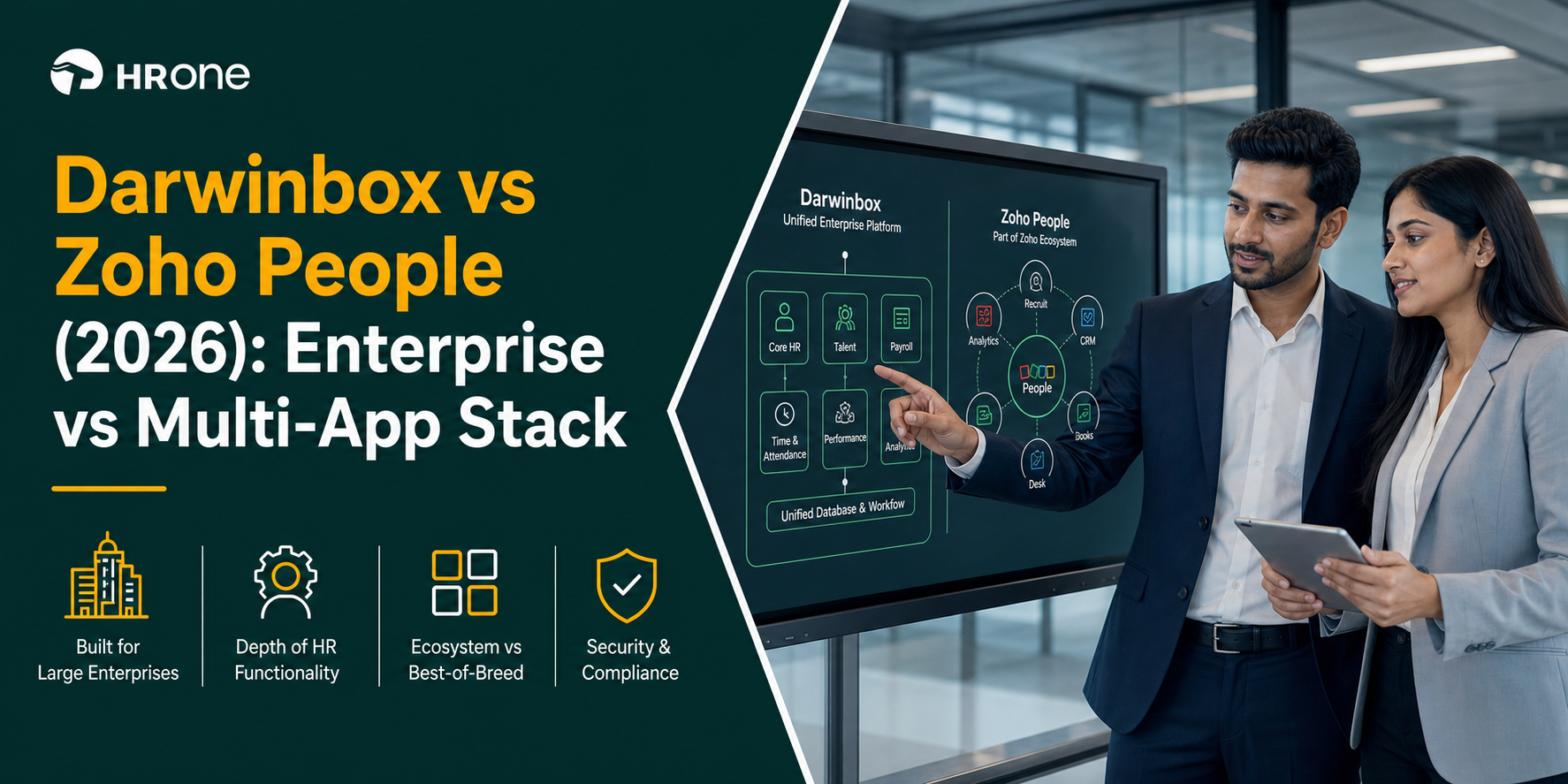
Q1. Darwinbox vs Zoho People: which one is actually right for your company size?
Picture a CHRO at a 900-person Bengaluru fintech, three vendor demos deep, staring at two proposals. One is a slick enterprise HCM. The other is a familiar cluster of apps her IT team already trusts. She is not asking which tool is “better.” She is asking which one her people will actually use.
Choose Darwinbox if you are a 1,000-plus employee enterprise needing bundled multi-country payroll, succession, and deep configuration; it is quote-based and takes 6 to 12 weeks to implement. Choose Zoho People if you are an SME or mid-market team already on the Zoho ecosystem and want self-serve setup at roughly Rs 50 per employee per month, with payroll billed separately through Zoho Payroll. Below about 500 employees, a single India-first HCM like HROne often beats both on cost-to-adoption.
⭐ The frame nobody in the SERP names
Here is the standard read, and I think it gets this backwards. Most comparison pages score features side by side, as if the winner is whoever has more checkboxes. From what surfaces when you actually run a rollout, software is only a consistency tool. It makes a process repeatable once you have designed it; it does not design the process for you.
So the real question is not “Darwinbox or Zoho People.” It is “Enterprise HCM or multi-app stack,” and which one your team adopts without a fight. If your headcount sits in the mid-market band, our HROne vs Darwinbox breakdown maps this decision cleanly.
💰 Quick routing by size and ecosystem
| Your situation | Likely better fit | Why |
|---|---|---|
| 1,000+ employees, complex org, multi-entity | Darwinbox | Bundled payroll, succession, deep config |
| SME already living in Zoho CRM, Books, Mail | Zoho People | Native suite fit, low entry cost |
| 100 to 500, India-first, wants one spine | HROne | Cost-to-adoption, integrated payroll |
✅ What buyers actually say
Real reviews cut through the pitch. One enterprise buyer praised the consolidation but flagged the friction.
“Darwinbox has made HR processes much smoother by bringing everything together on one platform. Sync with other systems can be inconsistent.”
Saksham A., Enterprise User Darwinbox G2 Verified Review
“The breadth of applications and the price of it. Features are shallow and there is no depth in each application.”
Verified User in IT Zoho People G2 Verified Review
If you are a mid-market Indian firm sitting between those two trade-offs, this is exactly the gap our core HCM was built for, and we unpack the full cost-to-adoption math in the total cost of ownership section. For now, hold this: pick for adoption, not for the longest feature list.
Q2. Enterprise HCM vs multi-app stack: what are you really choosing between?
A payroll manager once told me she ran month-end across three logins, one for attendance, one for payroll, and one for leave. Reconciliation ate two days every cycle. That is the multi-app stack in real life, and it is the quiet decision hiding under “Darwinbox vs Zoho People.”
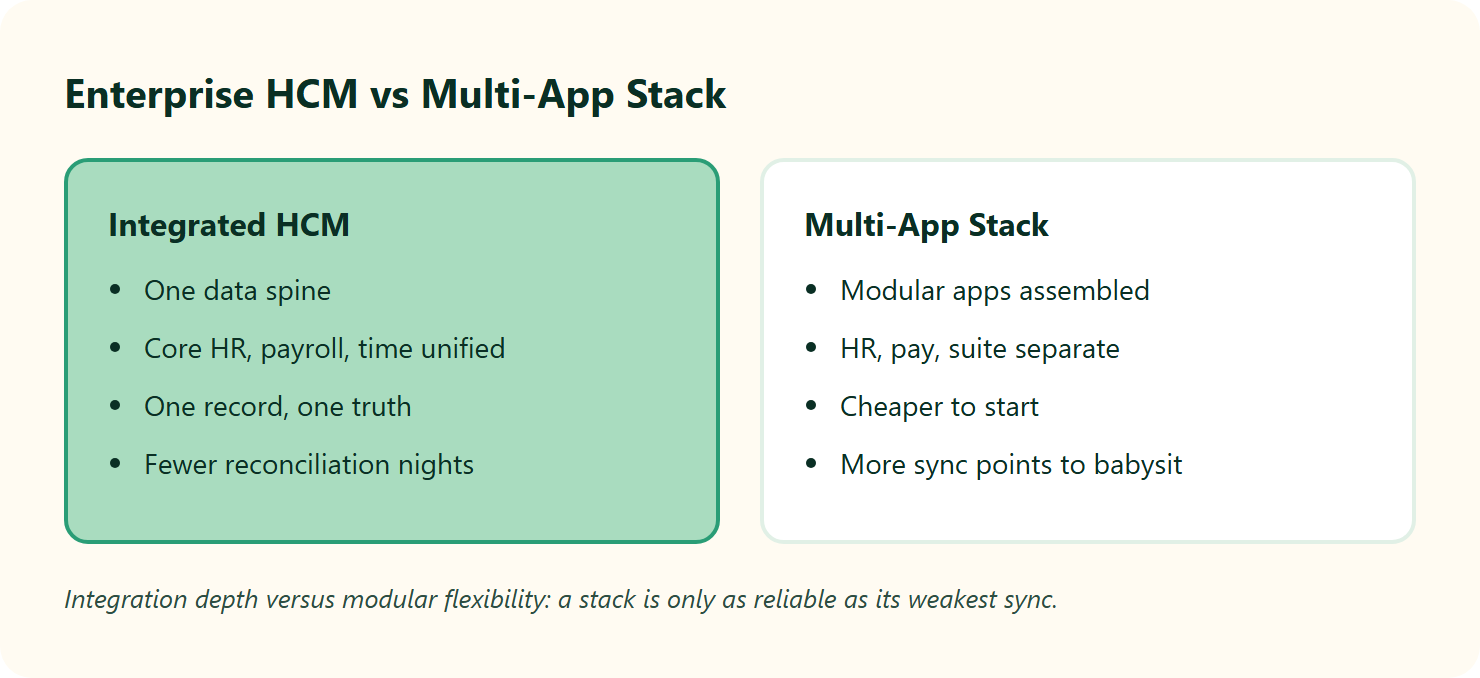
An enterprise HCM like Darwinbox is one integrated platform where core HR, payroll, time, and talent share a single data spine. A multi-app stack like Zoho People assembles HR from modular apps, Zoho People for HR, Zoho Payroll for pay, and Zoho One for the wider suite, cheaper to start but reliant on those apps syncing cleanly. The choice is integration depth versus modular flexibility.
📖 Cutting through the alphabet soup
Let me define the jargon, because vendors love blurring it. HRIS (Human Resource Information System) stores employee data. HCM (Human Capital Management) adds talent, payroll, and analytics on top. HRMS (Human Resource Management System) usually means the same broad bundle. It is, honestly, alphabet soup, and the label matters less than whether the modules talk to each other. Our HCM vs HRIS vs HRMS guide untangles it in plain English.
Gartner defines a cloud HCM suite as an integrated set covering the full hire-to-retire path, not a bag of loosely linked apps.
🍞 The bread-and-butter spine
Every organization needs the same base first: core HR, workforce, time office, and payroll. That is the spine. Talent, engagement, and analytics layer on top of it. When those top layers sit in separate apps, every handoff becomes a place where data drifts.
- Integrated HCM: one record, one truth, fewer reconciliation nights.
- Multi-app stack: more flexibility, more sync points to babysit.
⚠️ The open loop worth holding
Here is the tension I will resolve later in the compliance section: a stack is only as reliable as its weakest sync. Attendance living in one app and payroll in another is exactly how wrong paydays happen, which is why integrating payroll with attendance matters so much.
HROne is built on that same core spine, core HR, workforce, time office, and payroll as one connected module set, so an Indian mid-market team gets HCM-grade integration without carrying enterprise-contract weight. One reviewer put the payoff plainly.
“It provides a complete, integrated HR solution on a single platform. Core modules like Workforce, Time Office, and Payroll work seamlessly together.”
Shilpi M., HR HROne G2 Verified Review
Q3. How do Darwinbox and Zoho People pricing models compare, and what are the hidden costs?
I once watched a founder sign an HR contract on the sticker price, then discover the integration to his biometric system was a paid custom build. The quote doubled after signing. That is the pricing trap this section exists to prevent.
Zoho People is transparent and cheap to start at roughly Rs 48 to 50 per employee per month for HR only, but full Indian payroll needs a separate Zoho Payroll subscription, so the real number is higher than the headline. Darwinbox is quote-based enterprise pricing, typically much higher, with implementation fees, but it bundles payroll natively. Compare total cost, not sticker price.
💸 The sticker price lies
The headline number is the trap. A cheap per-seat rate looks great until you add the payroll module, the integration charges, and months of implementation you are billed for before anyone logs in. Operators screenshot the sticker and forget the footnotes. This is why HR software pricing transparency is worth demanding upfront.
💰 What each model really costs
| Cost dimension | Zoho People | Darwinbox |
|---|---|---|
| Pricing model | Transparent, per-employee | Quote-based, custom |
| Starting cost | ~Rs 48 to 50 PEPM (HR only) | Enterprise, typically much higher |
| Payroll | Separate Zoho Payroll add-on | Bundled natively |
| Implementation fee | Low, self-serve | Yes, often billed early |
Note the confusion cost too. A real Zoho buyer flagged the pricing puzzle at purchase time.
“When we were ready to purchase, we found the pricing confusing and struggled to find the right fit for our business size.”
Dhana C., HR Professional Zoho People G2 Verified Review
✅ The negotiation move to use on Monday
Two clauses protect your cash. First, demand that the subscription starts after you go live, not from the day you sign. Second, ask the vendor exactly which systems they bridge to for no charge. If a bridge carries a fee, that means custom development, and custom development is where budgets quietly balloon. Run the numbers first with our ROI calculator.
This is precisely why HROne meters its subscription only after go-live and runs flat per-employee pricing with no lock-in, laid out on our pricing page. You are not paying for empty implementation months, and one reviewer chose it over Workday for exactly this reason.
“I love HROne for its cost efficiency and holistic approach, which is why I prefer it over other vendors like Workday.”
Priyanka S., HR HROne G2 Verified Review
Q4. Which handles Indian statutory compliance better: PF, ESI, TDS, PT, and the new Code on Wages?
An Indian payroll lead’s worst week is the one where attendance, drawn from one system, does not match payroll, run in another, and salaries go out wrong. Nearly half of employees consider leaving after just two payroll mistakes. Compliance is not a feature; it is trust, in rupees.
Darwinbox bundles deeper native statutory payroll, PF, ESI, PT, LWF, TDS, Form 16, and 24Q, about nine compliance touchpoints, while Zoho People routes full payroll through the separate Zoho Payroll product with about seven. The bigger 2026 test is the Code on Wages, 2019: from late 2025, large firms must apply the 50% wage rule, and your system must auto-detect it.
📋 Statutory coverage, bundled versus add-on
| Statutory need | Darwinbox | Zoho People |
|---|---|---|
| PF, ESI, PT, LWF | Native, bundled | Via Zoho Payroll |
| TDS, Form 16, 24Q | Native | Via Zoho Payroll |
| Coverage model | One platform | Separate product |
⚖️ The Code on Wages, in plain English
The Code on Wages, 2019 introduces a single definition of “wages” and a rule people miss. If your excluded allowances (HRA, bonus, and the like) cross 50% of total pay, the excess gets added back into wages for PF and gratuity. It also mandates 2x overtime and full-and-final settlement within two working days. Your payroll engine has to catch that 50% threshold on its own, or you are recalculating by hand. Our guide on statutory compliance in payroll walks through the mechanics.
⏰ Where a stack quietly needs manual work
Edge cases are where architecture shows. Mid-year joins, loss-of-pay (LOP) adjustments, and arrears all demand that attendance and payroll agree to the paisa. When they sit in separate apps, someone verifies manually. As one HR ops story put it, “all these three softwares could not talk to each other,” and the disbursals came out wrong.
⚠️ The sync-failure warning
Inaccurate disbursals from a lack of sync between attendance and payroll force HR back into spreadsheets, the exact place they were trying to escape. greytHR users describe the pain directly.
“We had to go in rounds and spend so many man hours to configure our payroll and later found so many gaps.”
Verified User in IT greytHR G2 Verified Review
Our payroll software runs attendance and payroll on one spine, so statutory math is calculated once, not reconciled twice, and it is built around Indian tax rules by default. Buyers repeatedly name this as the fix for their old fragmented setup.
“Proper calculation of PF and ESI was a pain area for us before, but now with the HROne automated calculation process, results are up to the mark and following Indian tax compliances properly.”
Ajay K., HR HROne G2 Verified Review
“It handles salary calculations, statutory deductions PF, ESI, taxes, and filings automatically, with zero manual intervention, removing payroll errors and compliance anxiety during audits.”
Waldon S., HR HROne G2 Verified Review
Q5. The implementation trap: whose rollout actually delivers, and how long does it really take?
I have walked into rooms a little too late. A CHRO signs a large enterprise contract, confident the platform will do everything. Six months on, half the modules sit unused, and the team is back on Excel for the parts that never got configured.
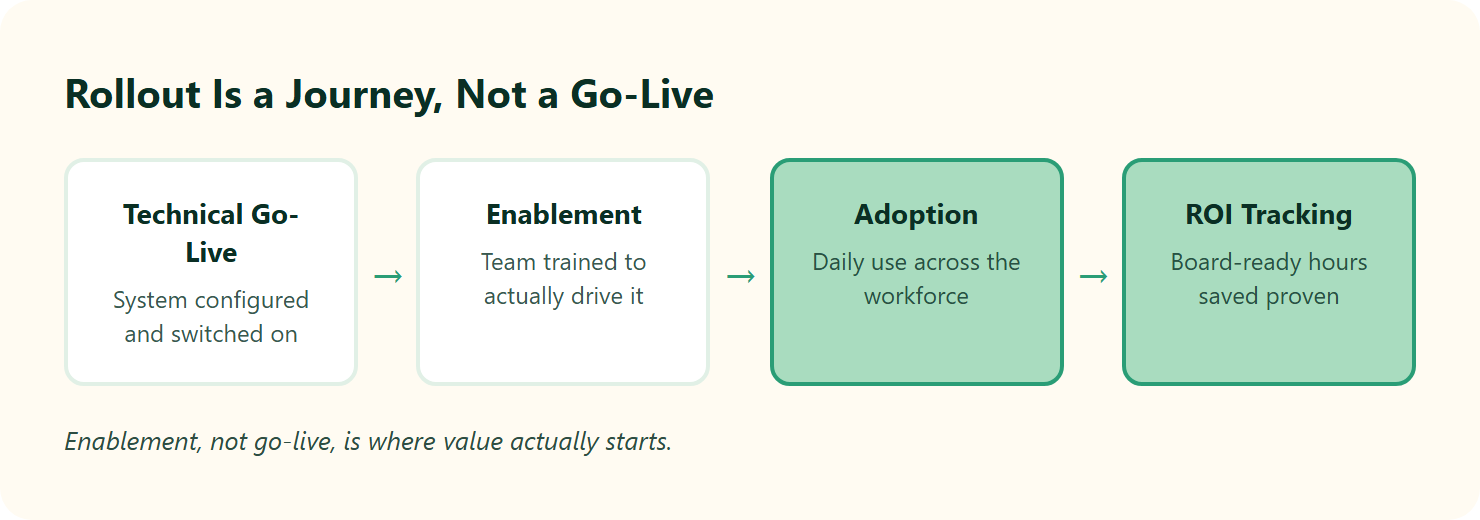
Darwinbox implementations run longer, roughly 6 to 12 weeks technically, and are critiqued for delaying automation, while Zoho People self-serve setup can go live in 1 to 3 weeks. But technical go-live is not adoption. Real HR transformation, job descriptions, performance frameworks, and culture, is closer to a multi-quarter commitment, and skipping it is how a heavy platform becomes a ghost town.
⚠️ The ERP ghost town
I have seen businesses spend the equivalent of a small building on an ERP, expecting it to run the whole company, only to watch people never embrace the change. The software gets bought. It never gets used.
A consultant friend described the same pattern from the buying side. Someone gets sold a system, puts down the implementation fees, allocates the team, and then discovers the tool cannot do what they thought at all. A tighter onboarding process is what separates a live system from a shelved one.
🏎️ The Ferrari nobody can drive
Here is the analogy I keep returning to. Buying a powerful HCM is like buying a Ferrari. If the trainer never teaches your team to drive it, you burn the clutch, and you keep calling the vendor to sit beside you. Enablement, not go-live, is where value actually starts.
That is why I say implementation is a cultural commitment, not a three-month setup. The standard vendor read gets this backwards, a point our HRIS buyer pitfalls guide underlines.
✅ What to demand before you sign
- Phased go-live, so billing starts when you are live, not on signing day.
- A real enablement plan, not a login and a PDF.
- ROI tracking from day one, so you can prove the spend with a clear ROI calculator.
Darwinbox users flag the migration friction honestly.
“Transitioning from the old system to Darwinbox is quite difficult. Darwinbox Support team is not supportive.”
Ankush B., User Darwinbox G2 Verified Review
At HROne, we tie go-live to adoption with India’s first inbuilt ROI Dashboard, which calculates lifetime hours saved against average HR salary, so a CHRO walks into a board review with rupee-value savings already quantified. Our onboarding runs through a prior-HR SPOC (single point of contact), not a technical project manager reading a checklist, as our MRDIY case study shows.
“The initial setup process was smooth, thanks to the supportive team that helped configure everything according to our needs.”
Priyanka S., HR HROne G2 Verified Review
Q6. Feature-by-feature: where does each platform win, and where does it quietly fall short?
Working with HR teams across mid-market India, what I have felt is that feature lists lie by omission. Everyone lists “payroll” and “performance.” Nobody tells you the payroll cannot bridge to a 30-layer general-ledger (the accounting code structure finance needs), so you end up exporting data by hand anyway.
Darwinbox wins on enterprise depth: bundled multi-country payroll, succession, predictive analytics, 12 embedded AI agents, and the first HCM MCP server (a standard that lets AI tools talk to the platform), scoring 4.38 out of 5 in Gartner’s pre-hire talent capability. Zoho People wins on lightweight usability, Zia AI, and native Zoho-suite integration, but it is thinner on complex payroll and enterprise configuration. Both offer limited configuration on their own terms, and support often runs through email threads.
⭐ Module-by-module, ranked
| Module | Best fit | Note |
|---|---|---|
| ROI tracking, support | HROne | Inbuilt ROI Dashboard, human SPOC |
| Multi-country payroll, AI agents | Darwinbox | 12 AI agents, MCP server |
| Zoho-ecosystem HR, ease | Zoho People | Zia AI, native suite fit |
| Deep config on your terms | None fully | “Configure, but not completely” |
Our HROne AI suite covers resume scoring and receipt parsing on the same spine, so recruiters and finance stop doing manual labour.
🔧 The configuration “it depends”
Here is the honest nuance. You can configure Darwinbox or Zoho People, but not completely on your own terms; the options have limits. The moment a shift-based manufacturing rule or a multi-legal-entity structure appears, that ceiling shows up fast, which is why manufacturing HR needs deeper flexibility.
⚠️ Support is where trust breaks
When only email threads are available, you sit stuck mid-migration, waiting. Zoho People buyers name this directly.
“The biggest drawback for me has been the lack of customer support. Whenever I try to reach out, it often takes a long time to get a response.”
Dhana C., HR Professional Zoho People G2 Verified Review
We built HROne around the opposite: 127 pre-built hire-to-retire workflows, the Super Inbox that closes tasks in three clicks instead of tab-juggling across five tools, and the ROI Dashboard that Darwinbox users say they lack. Buyers feel the difference in daily work with our HR inbox.
“The InboxforHR is a game-changer, centralizing every HR task into one simple inbox, cutting down administrative time by 60-70%.”
Waldon S., HR HROne G2 Verified Review
Q7. What do real users on G2 and Gartner Peer Insights say about each?
Read one star rating and you learn nothing. Read the pattern across platforms, and the real story shows up. Payroll trust is the thread that runs through all of it, because nearly half of employees consider leaving after just two payroll mistakes.
Verified enterprise reviewers rate Darwinbox highly, roughly 4.6 to 4.7 out of 5 across 144 Gartner Peer Insights reviews, a Customers’ Choice with 93% willing to recommend. Zoho People carries broader SME review volume at about 4.6 on SoftwareSuggest, praised for ease of use and value. Aggregators pool thousands of reviews, but sample sizes differ, so read the pattern, not one score.
👍 What each earns praise for
- Darwinbox: one platform for attendance, payroll, and performance, strong mobile app.
- Zoho People: fast onboarding, native Zoho integration, low entry cost.
- HROne: India-tuned payroll accuracy, human support, single connected spine.
“Darwinbox has made HR processes much smoother by bringing everything together on one platform.”
Saksham A., Enterprise User Darwinbox G2 Verified Review
👎 Where complaints cluster
The recurring gripes are honest and worth weighing: slow load times and inconsistent sync on Darwinbox, shallow depth and slow support on Zoho People. Reading verified customer success stories alongside star ratings gives a fuller picture.
“Features are shallow and there is no depth in each application.”
Verified User in IT Zoho People G2 Verified Review
I will hedge here: satisfaction shifts release to release, so treat any score as a snapshot. On our side, HROne holds top-tier G2 satisfaction and a 9.8 NPS on dedicated SPOC support, and buyers keep naming Indian-compliance accuracy as the reason they switched to our payroll software.
“Proper calculation of PF and ESI was a pain area for us before, but now with the HROne automated calculation process, results are up to the mark.”
Ajay K., HR HROne G2 Verified Review
Q8. What is the true total cost of ownership at 200, 1,000, and 5,000 employees?
Most buyers compare monthly per-seat prices and stop there. That is the mistake. Total cost of ownership (TCO) is subscription, plus implementation, plus integration, plus the very real cost of errors.
At around 200 employees, the Zoho People plus Zoho Payroll stack is usually cheaper to run and faster to start. As you approach 1,000-plus, Darwinbox’s bundled contract can rival or beat the stitched stack once integration, sync fixes, and admin overhead are counted; Gartner rates Darwinbox highest on complexity and TCO in APAC. Compare the whole picture, not the sticker.
💰 The TCO formula and assumptions
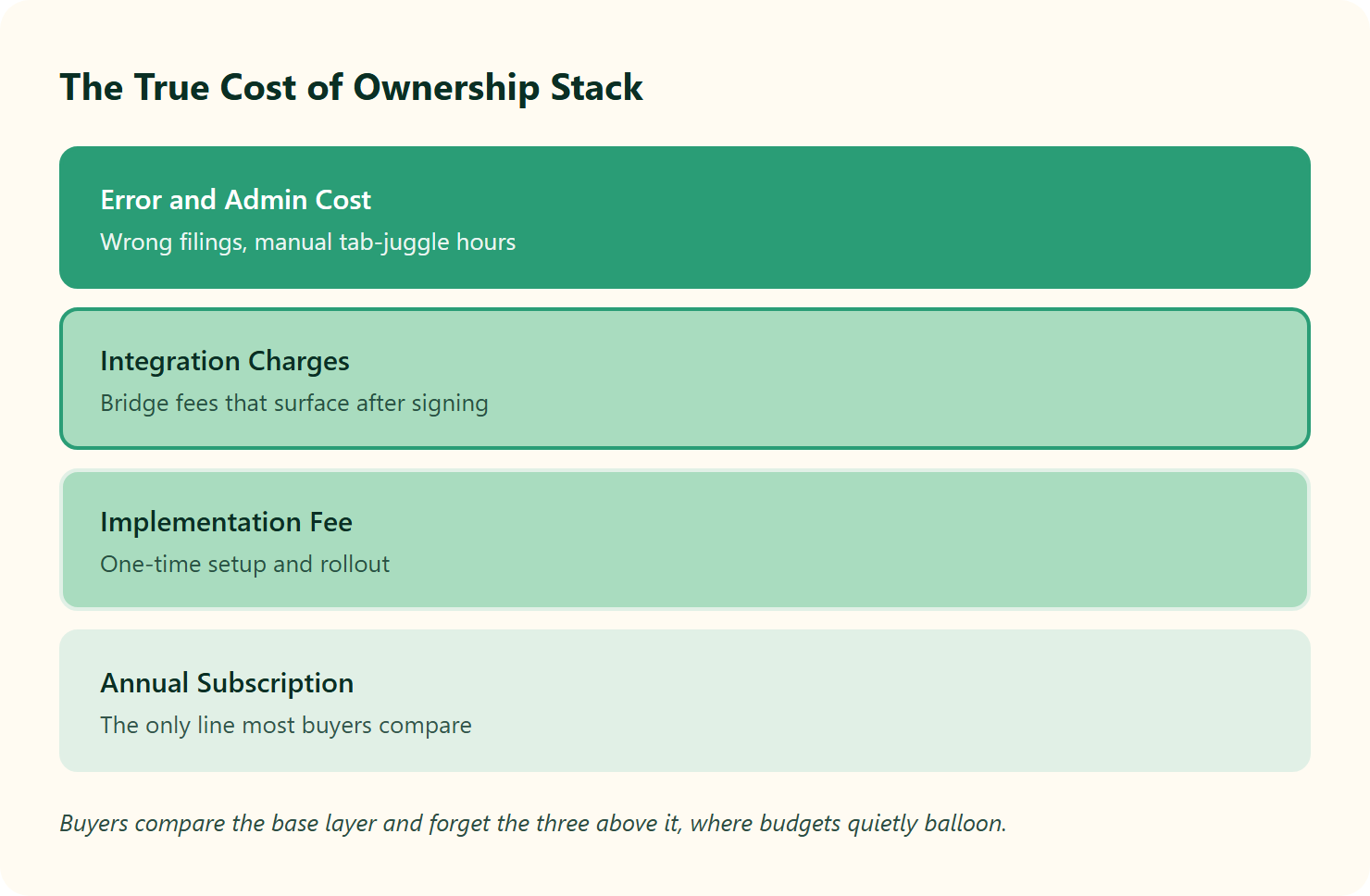
I model TCO as: annual subscription, plus one-time implementation, plus integration or bridge charges, plus the cost of payroll errors and manual admin time. The assumptions matter, so I am stating them, not hiding them. Our transparent pricing is designed to remove the guesswork.
💸 What it looks like by size
| Employees | Lower total cost tends to favor | Why |
|---|---|---|
| ~200 | Zoho stack or HROne | Cheap start, fast setup |
| ~1,000 | HROne or Darwinbox | Bundled beats stitched sync |
| ~5,000 | Darwinbox or HROne | Enterprise depth, one spine |
⚠️ The hidden costs nobody quotes
The integration trap is real; bridge charges surface only after signing, and they can run into serious money. Error costs compound too. Fixing incorrect tax filings and direct-deposit issues runs into tens of thousands of dollars per incident in documented cases, and the tab-juggle across disconnected tools quietly burns HR hours every single day, which is why integrating payroll with HR pays off.
For the 200 to 1,000 band, this is exactly where HROne fits: flat per-employee pricing, subscription that meters only after go-live, no lock-in, and one connected spine that removes the sync-and-reconcile tax. MR DIY India, for instance, collapsed its payroll cycle from 10 days to 5 to 6 days after moving to our core HCM, which is a cost line most comparisons never quantify.
Q9. Is there a better third option for Indian mid-market teams than either?
Most of the CHROs I talk to are stuck in the same squeeze. On one side sits an enterprise HCM that is powerful but opaque, quote-based, and slow to roll out. On the other sits a Zoho-style stack that is cheap to start but quietly fragments across apps. Neither feels built for a 100 to 5,000 person Indian company.
For firms in that band, a single India-first HCM can beat both. You get Darwinbox-style integration, core HR, attendance, and payroll on one spine, Code on Wages-ready, without enterprise-contract opacity, plus transparent pricing and go-live-first billing the multi-app stack cannot match. Our HROne vs Darwinbox and HROne vs Zoho People pages map this middle path with an inbuilt ROI Dashboard and 127-plus pre-built workflows.
⚠️ The pain of living between two bad choices
Here is what the squeeze actually costs. Pick the opaque enterprise route, and you bill from day one while implementation drags, with no way to prove the spend to your board. Reading through common HRIS buyer pitfalls saves you from that exact mistake.
Pick the stitched stack, and attendance sits in one app, payroll in another, and someone reconciles them by hand every month. The tab-juggle fatigue is real, and it is where wrong paydays and expense leakage slip through, which is why our payroll software keeps everything on one spine.
💰 Why a single spine changes the math
We built HROne as one connected hire-to-retire operating system, not another portal. Every pending task surfaces in the Super Inbox and closes in three clicks, so HR stops chasing managers over email, as our HR inbox shows.
The 127 pre-built workflows define who does what, by when, across onboarding, confirmation, transfer, and exit. India’s first inbuilt ROI Dashboard then calculates lifetime hours saved against average HR salary, so you present savings in rupee terms, not vibes, and you can model it upfront with our ROI calculator.
✅ What buyers actually report
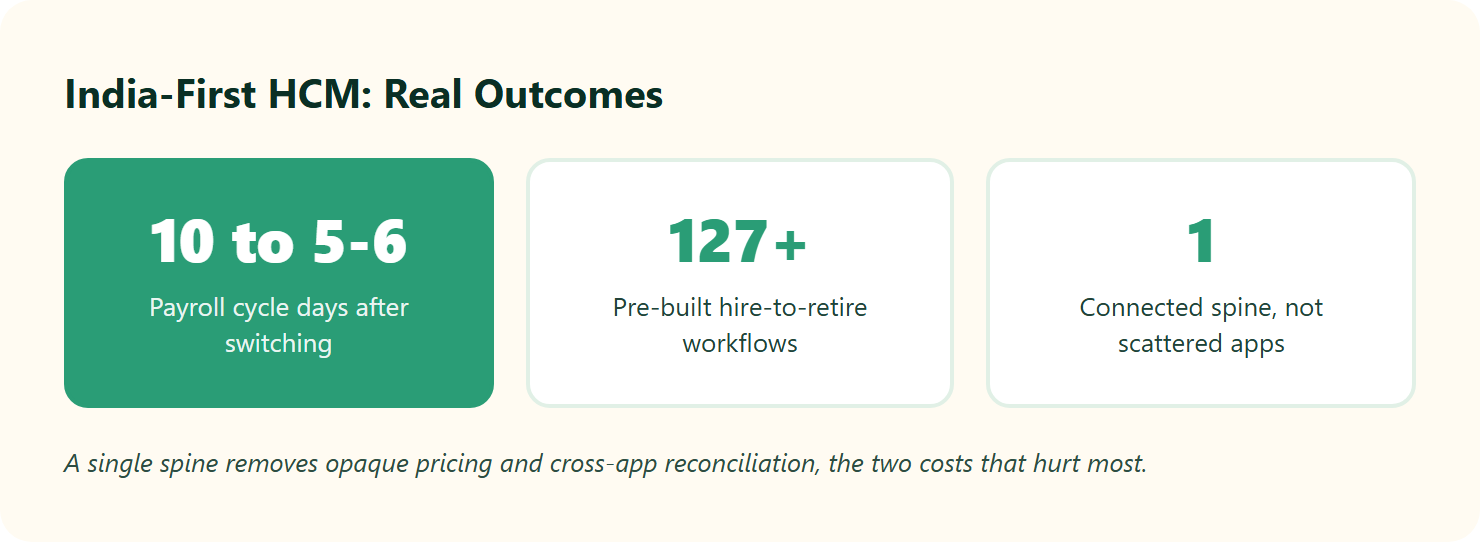
The proof shows up in daily work, not the pitch. MR DIY India, for example, cut its payroll cycle from 10 days to 5 to 6 days after moving to HROne, as detailed in our MRDIY case study.
“It provides a complete, integrated HR solution on a single platform. Core modules like Workforce, Time Office, and Payroll work seamlessly together.”
Shilpi M., HR HROne G2 Verified Review
“I love HROne for its cost efficiency and holistic approach, which is why I prefer it over other vendors like Workday.”
Priyanka S., HR HROne G2 Verified Review
I will hedge honestly: no tool is right for everyone, and a few reviewers note a learning curve on deeper modules. But for the India mid-market, a single spine with go-live-first billing removes the two costs that hurt most, opaque pricing and cross-app reconciliation. If you want to see it against your own numbers, book a demo.
🔮 The question I am sitting with
My current thinking is that the next two years will punish tools that cannot prove ROI at the board table. Once the Code on Wages settles in, “does it calculate correctly” becomes table stakes, and “can you show me the hours we saved” becomes the real differentiator, a shift our CHRO solutions are built around. If you are weighing this decision right now, I would genuinely like to hear which of the two traps is costing your team more, so tell me where your month-end actually breaks.



















 Secures Top Spot in
