








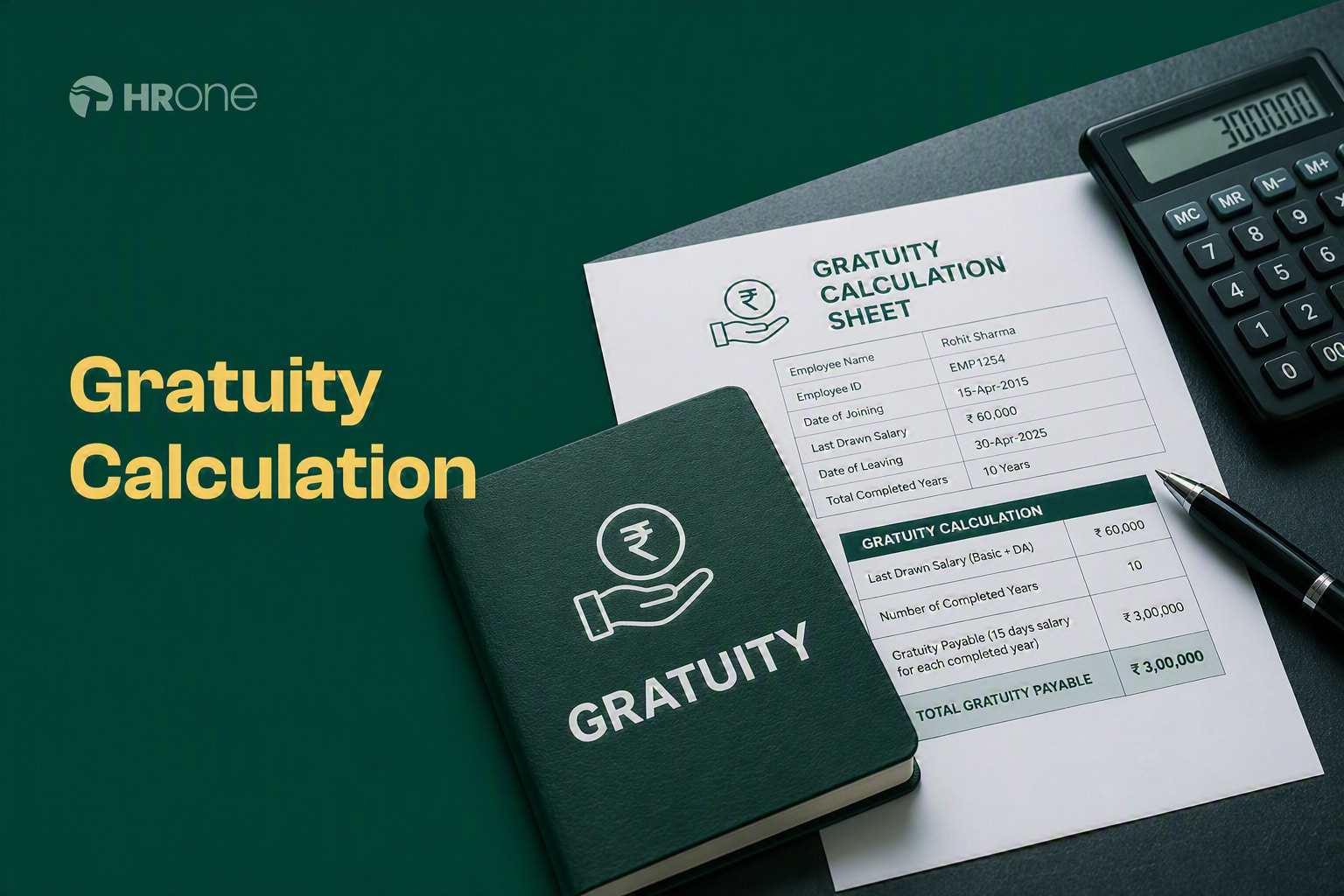
A single wrong assumption — using 30 days instead of 26, or including HRA in the salary base — can misstate an employee’s gratuity by lakhs of rupees. For an HR or payroll team running dozens of full-and-final settlements a year, that’s not a rounding error; it’s a compliance risk and a trust problem with departing employees.
This guide breaks down exactly how to calculate gratuity under the Payment of Gratuity Act, 1972 (now folded into the Code on Social Security, 2020), with the correct formula, worked examples, eligibility rules, and the ₹20 lakh tax exemption limit. Use the free calculator below to get an instant, accurate number for any employee.
What Is Gratuity?
Gratuity is a statutory lump-sum benefit an employer pays an employee as recognition for long-term service. It’s governed by the Payment of Gratuity Act, 1972, which applies to every factory, shop, or establishment employing 10 or more people. Unlike a bonus, gratuity is a legal entitlement — once an employee meets the eligibility conditions, the employer cannot treat it as discretionary.
Gratuity Calculation Formula
The standard formula for organizations covered under the Payment of Gratuity Act is:
Gratuity = (Last Drawn Basic Salary + DA) × 15 × Number of Completed Years of Service ÷ 26
Here’s what each part of the gratuity calculation formula means:
- Last Drawn Basic Salary + DA: Only Basic Pay and Dearness Allowance count. HRA, special allowance, conveyance, and other components are excluded — this is the single most common error payroll teams make.
- 15: Represents 15 days’ wages for every completed year of service (half a month’s salary).
- 26: Represents the average number of working days in a month under the Act (a 4-week month minus Sundays).
- Years of Service: Only completed years count, with a rounding rule (explained below).
For establishments not covered under the Act (rare for formal-sector employers), a different divisor applies:
Gratuity = (Average Monthly Salary of Last 10 Months) × 15 × Years of Service ÷ 30
The 30-day divisor produces a lower payout than the 26-day divisor, so confirming whether an organization is covered under the Act is the first thing payroll should check before calculating anything.
The Rounding Rule
Service tenure that exceeds 6 months in the final year is rounded up to the next full year. Exactly 6 months or less is rounded down.
| Actual Tenure | Counted As |
|---|---|
| 10 years, 5 months | 10 years |
| 10 years, 6 months | 10 years |
| 10 years, 7 months | 11 years |
Worked Examples
Example 1 — Covered under the Act: An employee with a last-drawn Basic + DA of ₹50,000/month and 10 years 7 months of service (rounded to 11 years):
Gratuity = (₹50,000 × 15 × 11) ÷ 26 = ₹3,17,308 (approx.)
Example 2 — Not covered under the Act: An employee with an average monthly salary of ₹30,000 over the last 10 months and 7 years of service:
Gratuity = (₹30,000 × 15 × 7) ÷ 30 = ₹1,05,000
Example 3 — Higher salary, long tenure: An employee with Basic + DA of ₹75,000/month and 12 years of service (covered under the Act):
Gratuity = (₹75,000 × 15 × 12) ÷ 26 = ₹5,19,231 (approx.)
Gratuity Calculator
Rather than running the formula manually for every employee, use the calculator below. Enter the last drawn Basic + DA and years of service to get the gratuity amount and the taxable/tax-exempt split instantly.
Eligibility for Gratuity
An employee becomes eligible for gratuity after completing 5 years of continuous service, defined as working at least 240 days in each of those years (190 days for underground mine workers). The 5-year rule is fully waived in cases of death or disablement due to accident or disease — the nominee or employee receives gratuity regardless of tenure.
Gratuity becomes payable on:
- Superannuation (retirement age as per company policy)
- Resignation, after 5 years of continuous service
- Death or disablement, with no minimum service requirement
- Termination — except where forfeiture applies under Section 4(6) for riotous/violent conduct or a conviction involving moral turpitude
A key 2026 update: Under the Code on Social Security, 2020 (effective November 21, 2025), fixed-term employees become eligible for gratuity after just 1 year of service, rather than waiting the standard 5 years. HR teams managing fixed-term or contract staff should flag this change in their payroll policy immediately, since it materially changes full-and-final settlement liability for shorter-tenure exits.
Is Gratuity Taxable?
Gratuity taxation depends on who’s receiving it:
- Government employees: Fully exempt from income tax, with no monetary ceiling under Section 10(10)(i).
- Private sector employees covered under the Act: Exempt under Section 10(10)(ii) up to the least of: (a) actual gratuity received, (b) the formula amount, or (c) ₹20 lakh.
- Employees not covered under the Act: Exempt under Section 10(10)(iii), also capped at ₹20 lakh.
The ₹20 lakh exemption ceiling was raised from ₹10 lakh in March 2018 and has not been revised since, as of 2026. It’s also a lifetime cumulative limit across employers — if an employee has already claimed ₹8 lakh in exemption from a previous job, only ₹12 lakh of exemption remains available from future gratuity payouts. Any amount received beyond the exempt portion is added to taxable salary income for that year.
Maximum Gratuity Payable
The statutory ceiling on gratuity payable by a private employer is also ₹20 lakh, even if the formula produces a higher figure for a long-serving, high-salary employee. Employers can choose to pay an amount above this as a discretionary ex-gratia payment, but the excess is not a statutory obligation — and it’s fully taxable in the employee’s hands.
Payment Timeline
Employers are legally required to pay gratuity within 30 days of it becoming due. Delayed payment attracts interest, currently at 10% per annum, and can expose the employer to penalties under the Act. For payroll and HR teams, this makes gratuity calculation a full-and-final settlement task that needs to be initiated the moment an exit is confirmed — not after the employee has already left.
Why Manual Gratuity Calculation Is a Compliance Risk
Gratuity errors are a recurring source of Full & Final Settlement disputes, and they typically come from three sources:
- Wrong salary base — including HRA or special allowance in the calculation.
- Missed rounding — treating “10 years 6 months” as 11 years, or vice versa.
- Wrong divisor — using 30 instead of 26 for Act-covered establishments, which understates the payout by 13%+.
For HR teams processing exits across multiple states and employee categories, an HRMS with automated payroll and compliance tracking removes this risk entirely by applying the correct formula, divisor, and rounding logic automatically — and flagging the ₹20 lakh ceiling before Full & Final Settlement is processed.
Tired of manually tracking gratuity, leave encashment, and TDS at every exit?
See how HROne automates Full & Final Settlement calculations
How to Choose the Right Approach to Gratuity Calculation
For growing organizations, the decision isn’t really “how to calculate gratuity” — the formula is fixed by law. The real decision is how to operationalize it reliably:
- Under 50 employees, low attrition: Manual calculation with a checklist (salary base, tenure rounding, divisor) is usually manageable, provided one person owns the process.
- 50–500 employees, moderate attrition: A dedicated gratuity calculator or payroll module reduces error risk significantly and speeds up exit processing.
- 500+ employees, multi-state operations: Automated, statutory-compliance-aware payroll software is close to mandatory — manual tracking at this scale reliably produces errors that surface as legal disputes or delayed settlements.
- Fixed-term or contract-heavy workforce: With the 1-year eligibility rule now in effect for fixed-term employees, this segment needs its own tracking logic separate from the standard 5-year cohort.



















 Secures Top Spot in
