


Q1. greytHR vs Zoho People: Which One Actually Fits Your India Payroll in 2026?
Picture an HR ops lead at a 600-person firm, three days from payroll cutoff, discovering the tool she just paid for cannot handle a second legal entity. That is the Implementation Trap. You sign, you fund, then you learn what the demo hid.
greytHR is the safer pick if statutory Indian payroll (PF, ESI, PT, LWF, TDS) is your bread and butter and you want it built in. Zoho People wins for HR workflows and Zoho ecosystem depth, but Indian payroll runs on the separate Zoho Payroll add-on. If you run 100 to 5,000 employees across multiple entities, test configurability and go-live billing before you sign, not after.
⚖️ The one-line verdict on each
I anchor this call on the base layer, not feature counts. Karan Jain, HROne’s founder, frames core HR, workforce, time office, and payroll as the non-negotiable base any organisation runs on. Judge these tools on that base first. Our built-in payroll software is designed around exactly that base layer.
- greytHR: Native payroll with statutory compliance built in. On Software Advice it holds a 4.3 rating, and reviewers praise the payslip and self-service flow.
- Zoho People: Strong HR-workflow platform rated 4.4 on Software Advice, but payroll needs Zoho Payroll as a second subscription.
The reviews get honest fast, though. A verified greytHR user was blunt about configuration limits.
“GreytHR is not much good at customizing based on our requirements… We cannot properly implement our company policies due to the limitations of greytHR.”
Verified User in IT & Services greytHR G2 Verified Review
Zoho People buyers often hit a different wall, pricing clarity and support.
“When we were ready to purchase, we found the pricing confusing and struggled to find the right fit for our business size.”
Dhana C., HR Professional Zoho People G2 Verified Review
✅ Pick this if / avoid this if
Here is the decision line, stripped of hedging.
- Pick greytHR if: payroll and compliance are your priority, you run a single entity, and you want one bill.
- Pick Zoho People if: you already live in Zoho apps and HR workflows matter more than native payroll.
- Look wider if: you run multiple legal entities or shift-based sites, because both tools strain there.
That last line is where India-first platforms like HROne enter the conversation. HROne pairs native payroll with 127 configurable hire-to-retire workflows on one platform, and its subscription meters only after go-live. I unpack that three-way comparison in the dedicated section later, so you can weigh it against the two here on equal footing. If you want the direct head-to-head now, see HROne vs Zoho People.
Q2. Does Zoho People Actually Include Payroll in India, or Do You Need Zoho Payroll?
A recruiter I spoke with assumed Zoho People “did payroll” because it sat under the Zoho umbrella. Two weeks before her first salary run, she learned she needed a whole second product. That surprise is common, so let me settle it plainly.
No. Zoho People handles HR workflows, onboarding, attendance, leave, and performance, but Indian payroll runs on the separate Zoho Payroll product. That means two subscriptions and an integration to manage. greytHR ships payroll built in with statutory compliance. For a lean HR ops team, that split decides whether payroll is one system or two.
🧩 The People-vs-Payroll split, in plain English
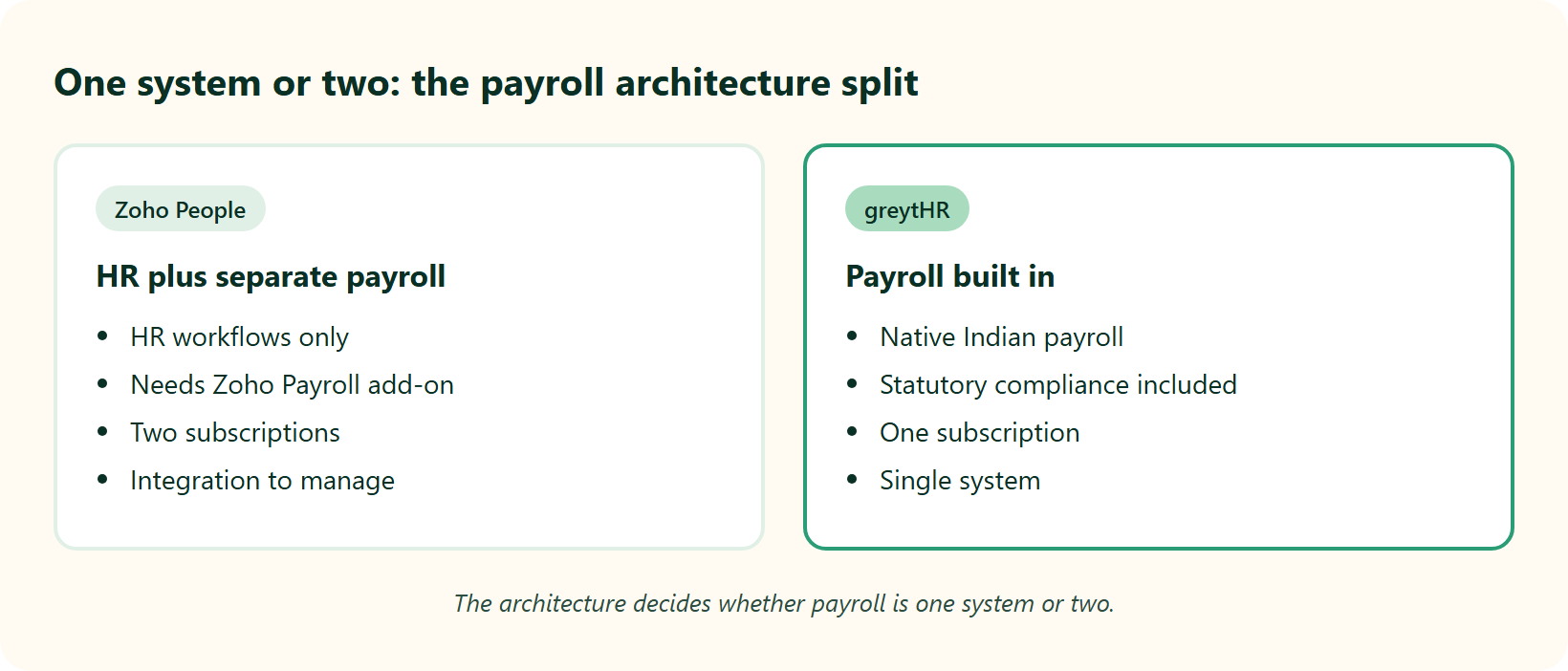
Think of Zoho People as the HR record keeper and Zoho Payroll as the paymaster. They talk to each other, but they are two apps with two logins and two price tags. A Zoho reviewer actually names this as a plus when it works.
“The most important feature for me is its integration with other Zoho apps, such as Zoho Recruit and Zoho Payroll, which streamlines both the recruitment and monthly payroll processes.”
Dhana C., HR Professional Zoho People G2 Verified Review
Integration is a benefit only when nothing breaks. When it does, you are debugging across two products.
💸 What two subscriptions cost a 300-person team
For a 300-employee monthly close, the split adds real friction. You reconcile employee data in one app, salary structures in another, then hope the sync held. Every handoff is a place errors hide. If you want to see how a unified approach compares, our payroll solution keeps both on one record.
This is where the single-screen argument lands. HROne runs HR and payroll on one platform, so pending tasks, approvals, and payroll actions surface in one Super Inbox that closes within three clicks. Instead of juggling tabs and email threads across two products, an HR lead plans the day and closes tasks from one view using the HR inbox. The point is not more features, it is fewer seams where the month-end reconciliation can quietly go wrong.
Q3. Feature-by-Feature: How Do greytHR and Zoho People Stack Up on Payroll, Attendance, Self-Service & Analytics?
Every buyer asks for the matrix, so here it is without the marketing gloss. Both tools clear the basics. The gaps show up in automation depth and whether you can prove ROI to a board.
Both cover the HR essentials: payroll, leave, attendance, employee self-service, analytics, and a mobile app. greytHR leads on India payroll depth and ease of use. Zoho People leads on HR-workflow breadth and ecosystem integrations. The honest trade-off: greytHR draws fire for limited workflow automation, Zoho for payroll living in a separate product. Match the matrix to your top three must-haves.
📊 The side-by-side matrix
Here is how the three stack up on the capabilities buyers actually test in a demo, with attendance management and self-service side by side.
| Capability | HROne | greytHR | Zoho People |
|---|---|---|---|
| India payroll | Built-in, auto-scheduler, group payout validations | Built-in, native | Needs Zoho Payroll add-on |
| Attendance | Mobile-first, offline sync | Solid; some features desktop-only per reviews | Digital leave/attendance, praised as intuitive |
| Self-service (ESS) | Mobile plus WhatsApp bot payslips | Payslips, leave, tax via portal | Employee self-entry onboarding |
| Workflow automation | 127 pre-built workflows | Reviewers cite limited workflows | Ecosystem-driven, needs setup |
| ROI dashboard | India’s first inbuilt ROI dashboard | Not available | Not available |
The pattern here matches what the field evidence flags: greytHR carries limited workflows, and neither greytHR nor Zoho offers a native way to prove savings back to leadership. Reviews echo the automation ceiling.
“Lack of user friendly software… the customization is full of gaps. There is no escalation matrix.”
Verified User in IT & Services greytHR G2 Verified Review
“Features are shallow and there is no depth in each application.”
Verified User in IT & Services Zoho People G2 Verified Review
⚠️ Not recommended for
Read these as guardrails, not insults.
- greytHR: skip it if you need heavy per-entity workflow customisation or a leave engine that bends to your policy.
- Zoho People: skip it as a standalone if native Indian payroll and deep support matter more than ecosystem breadth.
At HROne, the benchmark we hold is different. We built 127 workflows so the system defines who does what by when, and India’s first inbuilt ROI dashboard so a CHRO walks into a board review with lifetime hours saved already quantified. That is the layer a feature matrix rarely captures, and the one greytHR and Zoho leave to spreadsheets. You can model the numbers yourself with our ROI calculator, or scan the wider field in this roundup of the top 10 HR software in India.
Q4. Which Handles Indian Statutory Compliance Better: PF, ESI, PT, LWF, TDS and Code on Wages 2019?
A single wrong Professional Tax slab does not stay small. It multiplies across every affected payslip, then lands as a notice. Compliance is where a “good enough” tool becomes a liability, so I judge these platforms as a compliance watchdog, not a portal.
Both cover PF, ESI, PT, LWF, TDS, and Form 16/24Q, greytHR through native payroll, Zoho through Zoho Payroll. The real differentiators are state-wise PT slab maintenance, multi-entity filters, and Code on Wages 2019 readiness. Ask each vendor to demo reconfigurable salary structures and updated registers, because a system that cannot absorb rule changes becomes a compliance liability.
📋 Statutory coverage at a glance
Here is how each platform maps to the statutory hooks that a payroll manager actually files against, with statutory compliance in payroll as the yardstick.
| Statutory hook | HROne | greytHR | Zoho People (plus Payroll) |
|---|---|---|---|
| PF, ESI, PT, LWF, TDS | Automated, native | Native | Via Zoho Payroll |
| State-wise PT slabs | Multi-state slab maintenance | Supported | Via Zoho Payroll |
| Multi-entity filters | OU filters for salary processing | Limited on lower tiers | Business-unit based |
| Pre-run validation | Group payout validations | Manual checks reported | Add-on dependent |
The Code on Wages, 2019 matters here. It was notified on 08 August 2019 and consolidates four older laws, including the Payment of Wages and Minimum Wages Acts, into one framework with a universal floor wage. It also redefines “wages,” which forces salary-structure re-engineering. A platform that cannot reconfigure structures and regenerate registers will not keep pace. For the underlying definitions, see this guide on wages meaning and types.
How rule changes propagate is the underrated test. Payroll-compliance patents describe jurisdiction metadata that auto-transforms into compliant payroll, and pre-run compliance and fraud checks before disbursement. Ask whether new PT slabs push automatically or need manual config. Reviews show what manual gets you.
“Worst experience in terms of Tax and Attendance calculation… Not one month has passed where we have not raised a ticket.”
Maheshkumar J. greytHR G2 Verified Review
“Reporting configuration, TDS filing, revising of TDS is not possible.”
Krishnanand B. greytHR G2 Verified Review
✅ Your Monday action
Do not accept “we’re compliant” on a slide. Book a demo and ask each vendor to reconfigure a salary structure live, add a new state PT slab, and generate the updated register in front of you. Keep the state-wise professional tax slab rates handy as your reference.
This is the standard we hold at HROne. Group payout validations flag missing bank details or errors before disbursement, OU filters isolate each entity’s salary run, and state-wise slabs update from one rules layer. A wrong payday is not a glitch, it is a trust breach, and the system’s job is to catch it before your employee does. If you want to pressure-test it against your own rules, book a demo.
Q5. What Does greytHR vs Zoho People Really Cost in India, and Where Do the Hidden Fees Hide?
A payroll manager once showed me her invoice and asked why the number was double the quote. The sticker price was honest. The total cost of ownership was not. That gap is where most HR budgets quietly bleed.
greytHR is free up to 25 employees, then paid from a low base tier. Zoho People starts near ₹72 per user per month, but you add Zoho Payroll for actual salary runs. Sticker price is not TCO. Watch for day-one billing before go-live, multi-year lock-ins, and per-run fees for off-cycle bonus payrolls. Insist on flat pricing with the subscription starting after go-live. If pricing transparency matters to you, this read on HR software pricing transparency is worth a look.
💰 The INR pricing bands, side by side
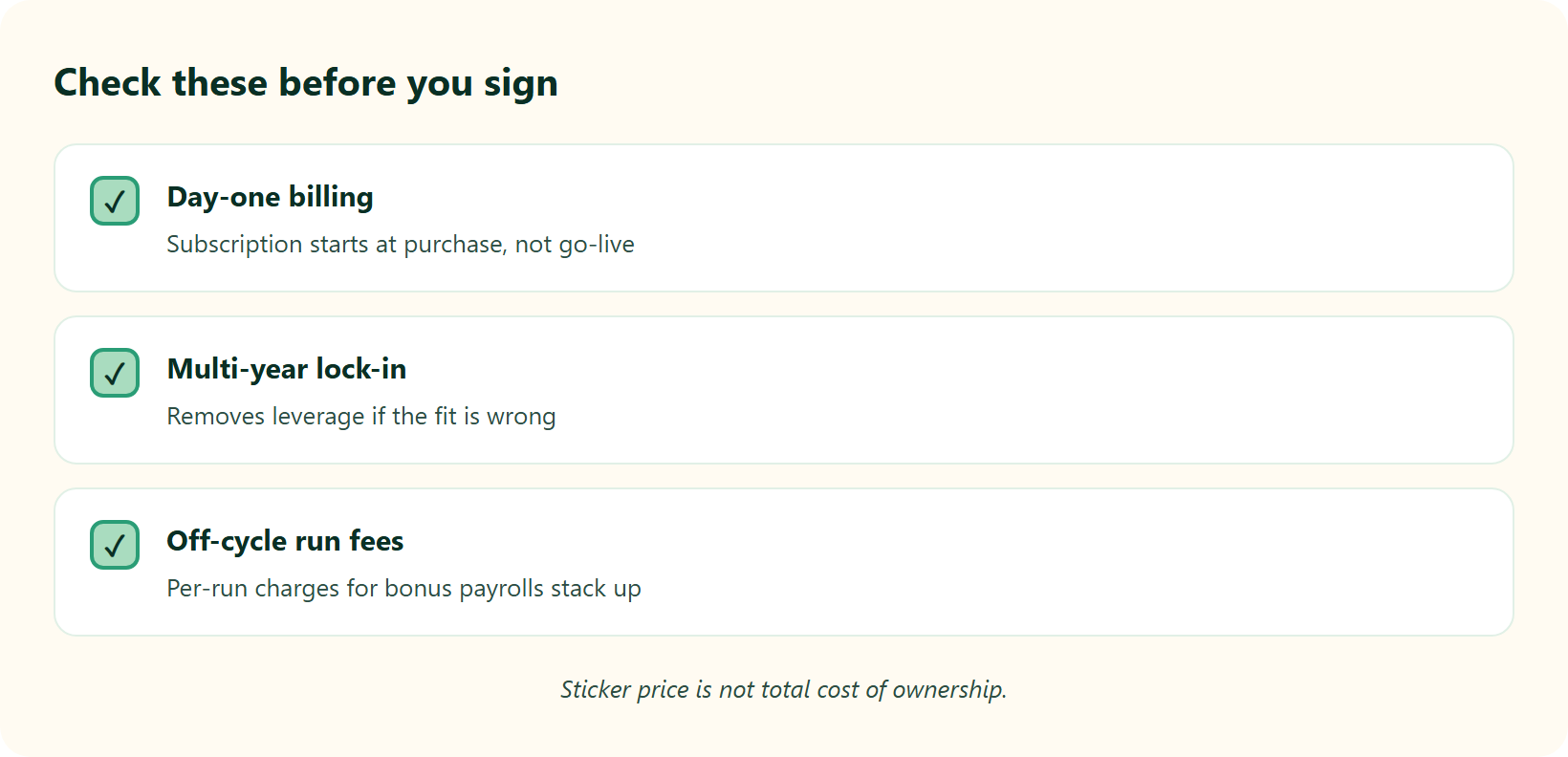
Here is the picture as published in mid-2026. Note that greytHR paid plans start from around ₹2,495 to ₹3,495 per month depending on employee count. You can sanity-check your own numbers against our transparent pricing.
| Platform | Free tier | Paid entry (India) |
|---|---|---|
| HROne | Trial available | Flat PEPM, subscription starts after go-live |
| greytHR | Up to 25 employees | From ~₹2,495/month base |
| Zoho People | Up to 5 employees | From ~₹72/user/month, plus Zoho Payroll |
The traps hide below the table. Off-cycle payroll fees, charged per extra run, can quietly double your effective spend over a year. A greytHR user captured the frustration.
“We had to go in rounds and spend so many man hours to configure our payroll and later found so many gaps for which we are running in rounds to get it fixed!”
Verified User in IT & Services greytHR G2 Verified Review
💸 What TCO looks like at scale
At 100 employees, both tools feel affordable. At 500 and 2,000, per-user math and add-on stacking change the story fast. A Zoho buyer flagged exactly this at purchase time. It helps to keep a choosing payroll software checklist beside every quote.
“When we were ready to purchase, we found the pricing confusing and struggled to find the right fit for our business size.”
Dhana C., HR Professional Zoho People G2 Verified Review
My hard-won tip after working with 2,000-plus HR teams: reject any deal that bills from day one of purchase or locks you in for years. At HROne, we built the pricing around that principle. It is flat PEPM, there is no lock-in, and the subscription meters only after you go live. You do not pay while we are still setting you up, which keeps our incentive tied to getting you live fast. See how our payroll software handles this.
Q6. Which Platform Scales Better for 100, 500, and 2,000+ Employees Across Multiple Entities?
I sat with a CHRO whose group ran five legal entities under one holding company. Each had different leave rules, shift patterns, and PT slabs. Her old tool forced one rulebook on all five. That is where scale quietly breaks.
At 100 employees, both greytHR and Zoho People cope fine. Past 500, and across multiple legal entities, the deciding factor becomes a policy engine that lets Company A and Company B run different rules from one system. greytHR handles India payroll depth well but draws criticism for limited workflow automation. Zoho scales through its ecosystem but multiplies integration overhead. Score multi-entity, sub-department, and business-unit handling before you commit. This guide on multi-location workforce management unpacks the trade-offs.
⚠️ Where standardisation becomes the enemy of agility
Every large organisation is its own snowflake. The moment you force one standard policy across five entities, you lose the local nuance that keeps each unit compliant. A patent on multi-jurisdiction compliance describes exactly this need, a single rules engine feeding jurisdiction-aware payroll downstream. Strong workforce management is what keeps that nuance intact.
greytHR reviewers hit the customisation ceiling at scale.
“GreytHR is not much good at customizing based on our requirements… We cannot properly implement our company policies due to the limitations of greytHR.”
Verified User in IT & Services greytHR G2 Verified Review
“GreytHR is not much good at customizing based on our requirements… We cannot properly implement our company policies due to the limitations of greytHR.”
Verified User in IT & Services greytHR G2 Verified Review
“No flexible customization… Some features are only available in a desktop mode, not in mobile application.”
Arjun T. greytHR G2 Verified Review
✅ The scale test to run before you sign
Ask each vendor to set up two entities with different policies in one instance, live. If it needs a separate instance per entity, that is your answer. Our core HCM was built to pass exactly that test.
This is the exact problem we solved at HROne. We manage multi-legal-entity environments in a single instance with no cap on entities, so people in Company A carry a different policy than people in Company B. Asia Healthcare Holdings runs 20 pan-India units on one HROne instance, and 127 pre-built workflows keep each unit’s onboarding, transfer, and exit rules distinct without a developer ticket. Scale should compound your control, not flatten it. For a healthcare-specific view, see how healthcare HR handles multi-unit reality.
Q7. How Configurable Is Each Platform, and Where Does greytHR Hit Its Limits?
The honest phrase I hear from greytHR users is “you can configure it, but not on your terms.” That distinction matters more than any feature checklist. Configurable-in-theory and configurable-for-your-policy are two different products.
greytHR lets you configure, but within limits, and reviewers repeatedly note limited configuration options and limited HR-process automation. Zoho People is more extensible through its developer ecosystem and API, but real customisation can need Zoho admin skills. If your policies need unique if/else logic, like different approval chains per entity, test that exact scenario in a trial before you buy. A solid leave management engine is usually the first place this logic breaks.
❌ The configuration ceiling, in users’ own words
The pattern in reviews is consistent, and it is not about UI polish. It is about the system bending to your policy, not the reverse. When it cannot, HR ends up dependent on the vendor, which is a red flag worth catching during a trial rather than after signing. Compare this against a flexible HR solution before you decide.
“Lack of user friendly software, there is a very high dependency on the greytHR team to customize and the customization is full of gaps. There is no escalation matrix.”
Verified User in IT & Services greytHR G2 Verified Review
“That product looks like powerful and flexible, but inconsistencies and instabilities ruin overall impression.”
Verified User in Computer Software Zoho People G2 Verified Review
✅ The if/else test to run in a trial
Bring your messiest real policy to the demo. A different approval chain for one entity, or a comp-off rule that only applies to one shift. Watch whether the HR admin can build it on the front end, or whether it becomes a support ticket.
That front-end control is what we designed HROne around. HRV Studio lets HR teams build custom apps, and the policy engine enables unique if/else conditions without raising a developer ticket. When configuration lives with the HR user instead of the vendor’s backlog, your policy ships in minutes, not weeks. If you are weighing options broadly, this guide on how to choose HRIS HRMS software lays out the criteria.
Q8. What Does Implementation Really Look Like, and Why Is “Plug-and-Play” a Myth?
A founder once told me his team would “be live in a week.” I have run enough of these to know that week is the software setup, not the implementation. The two are not the same, and confusing them is the Implementation Trap.
Plug-and-play is marketing. Software setup takes days to weeks, but the real process-and-culture implementation runs far longer. Vendors often quote a three-month phase, while the lived scope can stretch much further as habits and workflows actually change. The fix is not a faster tool. It is asking the right prerequisite questions upfront so the system matches how your company actually runs payroll. A smooth onboarding process is what separates the two.
⏰ Why the “one week” assumption burns you
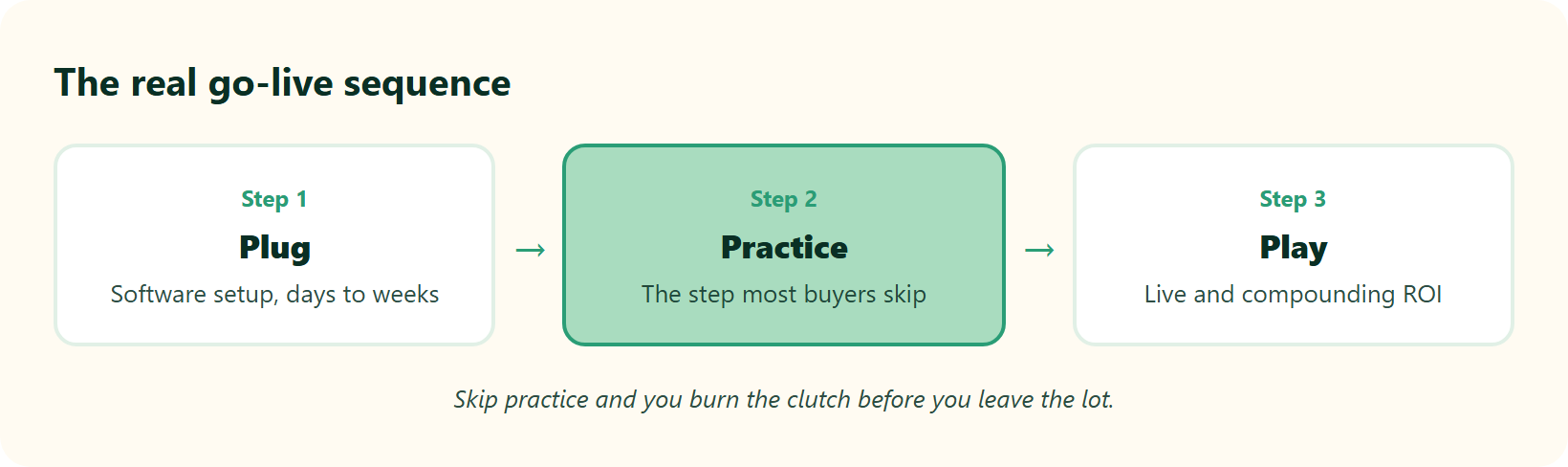
Plug-and-play still needs practice. It is plug, practice, play, and skipping the middle step is where things break. Think of a Ferrari handed to a first-time driver. Powerful machine, but you will burn the clutch before you leave the lot.
The migration fear is often overblown, though. “Switching payroll providers mid-year is too complicated” is a myth people repeat until they actually scope it. Do the prep, and mid-year moves are routine. These hassle-free payroll processing steps show how.
✅ The prereq questions that de-risk go-live
Before you sign anything, get concrete answers on these.
- Who owns your migration, a prior-HR consultant or a technical PM reading a checklist?
- What triggers billing, purchase day or go-live day?
- How many days to first successful payroll run, honestly?
At HROne, our onboarding is led by consultants who were HRs themselves, so they speak your language, not just the software’s. Because our subscription meters only after go-live, our incentive is to get you live fast, which is how MR DIY India moved and cut payroll cycles from 10 days to 5 to 6. Implementation is not a formality, it is where the ROI either starts compounding or stalls. If you want to see it in motion, book a demo or compare HROne vs Zoho People directly.
Q9. How Fast Can You Close Payroll, and What Does Support Feel Like When It Breaks?
A payroll manager once told me her worst week was not a compliance audit. It was the 10-day close every month, ending in a support ticket that no one answered until after payday. That silence is the real product failure.
The right platform compresses payroll close from about 10 days to 5 or 6. But speed means nothing if support is a black hole. Endless email threads leave issues unresolved right when payday pressure peaks. With nearly half of employees weighing an exit after two payroll mistakes, a dedicated single point of contact (SPOC) who resolves queries fast is a retention tool, not a nicety. These hassle-free payroll processing steps show how the close gets shorter.
⏰ Speed only counts if support holds
Fast payroll and absent support cancel each other out. When the close is quick but the helpline goes quiet, HR eats the risk alone. A capable payroll software pairs speed with a human who answers. greytHR and Zoho users describe exactly that gap.
“Extremely poor customer support. They have an under-trained team handling tickets you raise… it’s honestly the worst payroll I’ve seen in my career so far.”
Verified User in IT & Services greytHR G2 Verified Review
“The most disturbing is the quality of support service… phone support is constantly not available, all the email threads lead to ‘we recall you’ with formal attempts.”
Verified User in Computer Software Zoho People G2 Verified Review
✅ What a real SPOC changes day to day
Automation is a retention strategy, not just an efficiency line. When an employee can pull a payslip themselves, HR stops fielding the same query 40 times a month. A capable mobile HR app puts that access in the employee’s pocket. An HROne user described that shift.
“The employee self-service feature the mobile app and web portal… leading to a 70% reduction in routine HR queries.”
Waldon S. HROne G2 Verified Review
This is the standard we hold at HROne. Every client gets a dedicated HR SPOC, and that model carries a 9.8 NPS instead of leaving people stuck in email threads. Employees pull password-protected payslips from their phone and via a WhatsApp bot, so payday questions resolve before they become grievances. MR DIY India cut its payroll close from 10 days to 5 to 6 after moving to us, which tells me speed and support are the same problem solved once.
Q10. greytHR vs Zoho People vs HROne: Which Should a 300-Person Indian Company Choose?
The most honest search query I have seen reads almost like a plea. “We are a 300-member company in India, and we’re looking for HR software that can do all of this.” That buyer does not want a checklist. They want one system that holds the whole job.
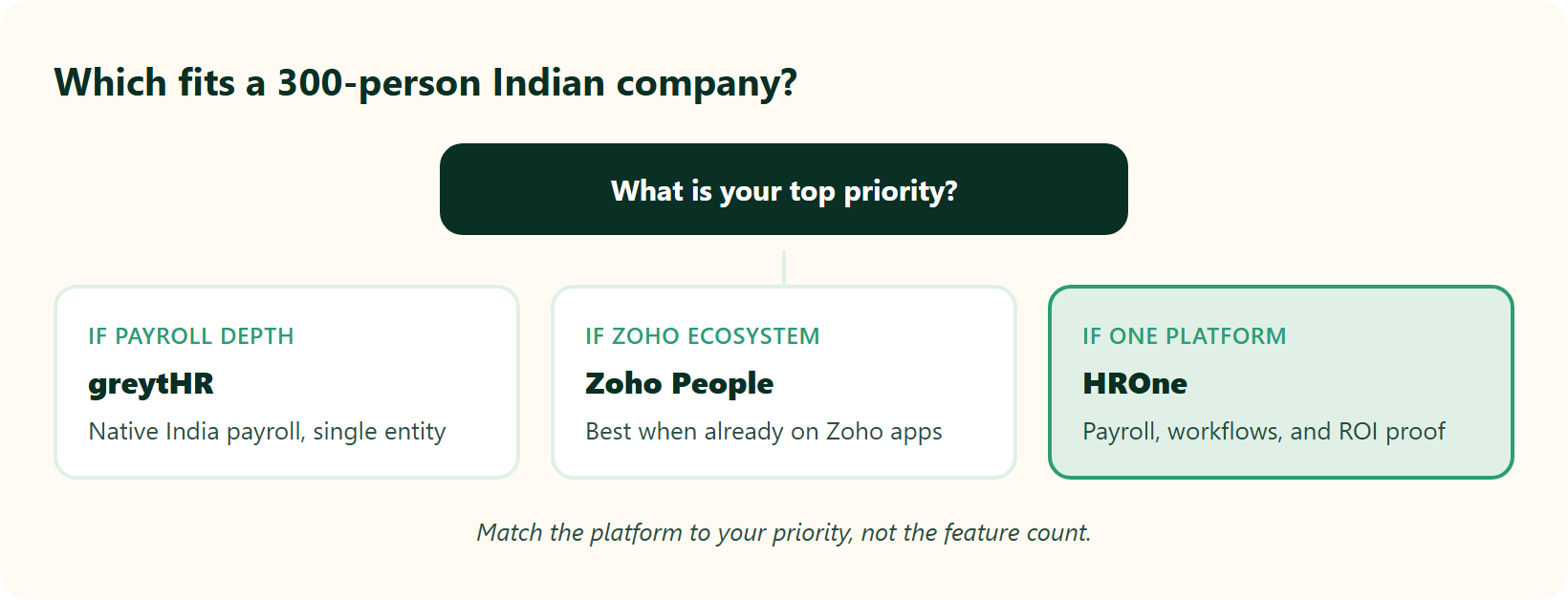
For a 300-person Indian company that wants native payroll, configurable workflows, and one screen instead of two subscriptions, the shortlist widens beyond greytHR and Zoho. Choose greytHR for pure India payroll depth. Choose Zoho People if you already live in the Zoho ecosystem. Evaluate HROne when you need built-in payroll plus multi-entity configurability and ROI tracking on a single platform. This guide on how to choose HRIS HRMS software frames the decision.
⭐ The three-way, side by side
Here is the honest read, with HROne’s own numbers stated plainly. For the full field, scan the top 10 HR software in India.
| Criterion | HROne | greytHR | Zoho People |
|---|---|---|---|
| Native India payroll | Built-in, auto-scheduler | Built-in | Needs Zoho Payroll |
| Multi-entity config | Single instance, no cap | Limited at scale | Business-unit based |
| Workflow automation | 127 pre-built | Reviewers cite limits | Ecosystem-driven |
| ROI proof to board | India’s first inbuilt ROI dashboard | Not native | Not native |
| Satisfaction signal | G2 #3 globally, #1 in India | Mixed reviews | Mixed reviews |
Reviews on both incumbents keep circling the same limits.
“GreytHR is not much good at customizing based on our requirements… We cannot properly implement our company policies.”
Verified User in IT & Services greytHR G2 Verified Review
“Features are shallow and there is no depth in each application.”
Verified User in IT & Services Zoho People G2 Verified Review
🎯 Pick each if, avoid each if
Read this as guardrails for your exact context. If native payroll depth is the priority, our payroll solution is built for it.
- Pick greytHR if you run a single entity and want proven native payroll; avoid it if you need deep per-entity customisation.
- Pick Zoho People if you already run Zoho apps; avoid it as a standalone if native payroll and fast support matter most.
- Evaluate HROne if you want payroll, 127 workflows, and ROI proof on one platform for 100 to 5,000 employees.
At HROne, the framing we hold is simple. Whatever the client needs, our job is to understand it, ingest it, and put them in position, not hand them a prettier portal for the same chaos. Asia Healthcare Holdings runs 20 pan-India units on one instance, which is the kind of proof that settles a three-way debate. See the full core HCM or compare HROne vs Zoho People directly.
Here is the question I am still sitting with, and I would genuinely like your read. As more Indian firms cross 500 employees, does the buying decision shift from “which tool has the feature” to “which tool can prove it saved us money?” If you are evaluating right now, tell me which of those two questions is actually driving your shortlist. When you are ready, book a demo.














 Secures Top Spot in
