



Q1. What Does Darwinbox Pricing Actually Look Like in India in 2026 and Why Is There No Public Rate Card?
Darwinbox prices its HCM as a quote-based, per-employee-per-month subscription, bundled by module (Core HR, Payroll, Talent, LMS, Engagement, and Darwin AI), sold on one, two, or three-year contracts. Indicative Indian bands in 2026 sit between ₹200 and ₹600 PEPM depending on bundle depth, with headcount tier, module mix, and contract length as the three levers that move the final number.
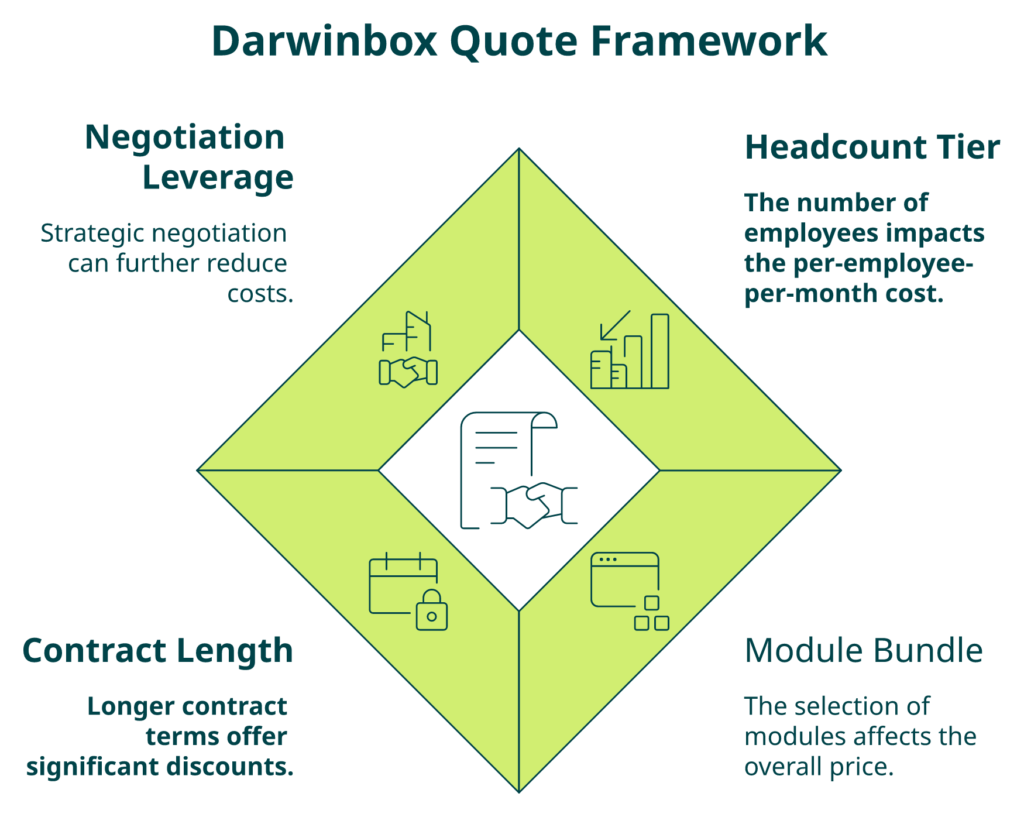
✅ The Three Pricing Levers That Decide Your Quote
Darwinbox, like most enterprise HCMs, moves on three dials. Understanding each lever is how you stop being a price-taker.
- Headcount tier: PEPM drops as your headcount climbs. A 200-employee firm typically pays more per seat than a 5,000-employee firm, because fixed platform costs amortize across more users.
- Module bundle: Core HR plus payroll software is the floor. Add Talent, LMS, Engagement, Darwin AI, and multi-country payroll, and PEPM can double.
- Contract length: A 3-year commitment typically unlocks 12 to 18 percent discount versus a 1-year term, with renewal uplift capped only if you negotiate it into the MSA.
Why Opacity Favours the Seller
Information asymmetry is the oldest sales advantage in enterprise software. If the buyer does not know the market rate, the seller sets it.
❌ What “No Public Rate Card” Actually Signals
Darwinbox does not publish prices on its website, and neither does Keka, PeopleStrong, or SAP SuccessFactors. The industry norm is quote-based, and the stated reason is always “every customer is different.” That is partly true, and partly convenient. SaaSrat’s 2026 Darwinbox review puts it bluntly: pricing is “quote-based” and buyers must engage sales before seeing numbers. For a CFO approving a ₹2 crore three-year commit, that is a red flag, not a feature. A deeper look at HR software pricing transparency explains why published bands matter at the procurement stage.
The HROne Transparency Contrast
In our experience of building HROne, we publish flat PEPM bands (₹85 to ₹135 depending on module mix) on the pricing page, because we believe a 600-person Indian firm deserves a number on a webpage, not a sales cycle. That is a founder-led choice, not a marketing trick.
⭐ A Worked Example: 1,000-Employee Indian IT/ITeS Firm
Assume a Bengaluru-headquartered IT services firm with 1,000 employees evaluating Darwinbox Core HR plus Payroll plus Talent on a 3-year contract.
- Indicative PEPM: ₹340 (midpoint of Core plus Payroll plus Talent band)
- Annual license: 1,000 × ₹340 × 12 = ₹40.8 lakh
- Implementation (1.5x ARR midpoint): ₹61.2 lakh one-time
- 3-year license at 10 percent annual uplift: ~₹1.35 crore
- Fully loaded 3-year TCO: ~₹1.96 crore
That number is the starting point for a negotiation, not the finish line. For a side-by-side commercial read, the HROne vs Darwinbox page breaks down the architectural differences in detail.
Q2. How Much Does Darwinbox Cost Per Employee for 200, 500, 1,000, 2,500, 5,000, and 10,000 Headcount Indian Enterprises?
For Indian deployments in 2026, Darwinbox PEPM typically ranges from ₹450 at the 200-employee tier down to ₹180 at 10,000+, assuming a Core HR plus Payroll bundle. Add Talent, LMS, Engagement, or Darwin AI, and PEPM rises 40 to 80 percent. These bands are synthesized from SaaSWorthy, OMR, and SaaSrat benchmarks for Indian enterprise HCM in 2026.
💰 Quick-Glance INR Snapshot Box
| Headcount | Indicative PEPM (Core + Payroll) | Annual License (INR) |
|---|---|---|
| 200 | ₹450 | ₹10.8 lakh |
| 500 | ₹380 | ₹22.8 lakh |
| 1,000 | ₹340 | ₹40.8 lakh |
| 5,000 | ₹220 | ₹1.32 crore |
Full Headcount-Band Benchmark Table
| Headcount | Core HR Only PEPM | Core + Payroll PEPM | Full HCM + Talent PEPM | Notes |
|---|---|---|---|---|
| 200 | ₹280 | ₹450 | ₹620 | Small-enterprise band; limited negotiation leverage |
| 500 | ₹240 | ₹380 | ₹540 | Mid-market sweet spot; multi-year term unlocks 12-15% discount |
| 1,000 | ₹210 | ₹340 | ₹480 | Most common Indian RFP size; benchmark aggressively |
| 2,500 | ₹190 | ₹280 | ₹400 | Enterprise threshold; Darwin AI add-ons begin to justify economics |
| 5,000 | ₹170 | ₹220 | ₹330 | Unicorn-scale pricing; multi-country activation fees apply |
| 10,000 | ₹150 | ₹180 | ₹270 | Ceiling tier; custom SLAs, dedicated CSM, reference-customer rights |
What Actually Drives Variance Inside These Bands
Industry matters (BFSI and pharma pay more for compliance modules), geography matters (multi-country activation adds ₹8 to ₹15 lakh per country), and AI add-ons matter (Darwin AI recruitment and analytics typically add ₹40 to ₹80 PEPM). Integrations, Single Sign-On tier, and sandbox environments add another 10 to 15 percent.
✅ The HROne Transparency Contrast
In our work at HROne, we publish our bands openly: ₹85 to ₹135 PEPM depending on module mix, flat across headcount tiers, with subscription starting only after go-live. The reason is simple, Indian mid-market buyers deserve a number they can put in a board deck before they book a sales call. When Darwinbox quotes ₹340 PEPM and HROne publishes ₹110 PEPM for comparable Core HR plus Payroll scope, the 3x delta is not a quality gap, it is an opacity premium. For a TCO dry-run, use the ROI calculator before your next RFP.
Why This Table Is the First of Its Kind in the Indian SERP
SaaSWorthy lists Darwinbox at “$5 to $6 PEPM” without headcount tiers. SaaSrat and Capterra say “contact for pricing”. To my knowledge, no public Indian source has published tiered PEPM benchmarks at this granularity. Treat these as negotiation anchors, validate against your own quote, and push back when your number exceeds the band.
Q3. How Do Darwinbox Module Bundles Break Down and Which Ones Actually Earn Their Price?
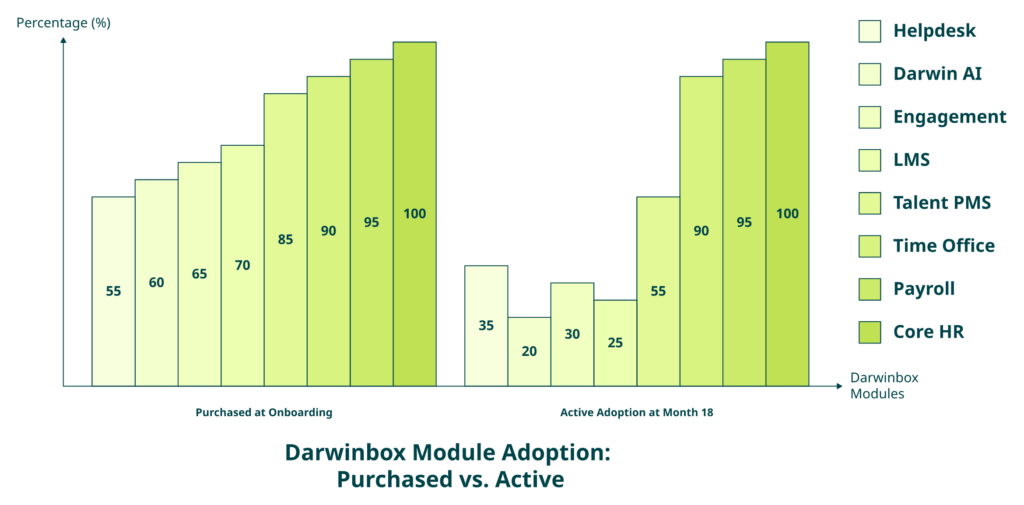
About 98 percent of Indian Darwinbox customers run the same four modules in production: Core HR, Payroll, Time Office, and Workforce. The remaining modules (Talent, LMS, Engagement, Darwin AI, and Helpdesk) get purchased in the original RFP but see single-digit adoption rates within 18 months, quietly inflating TCO without returning ROI. This is the “bouquet fallacy,” and it is the single biggest preventable cost in Indian HCM procurement.
⭐ Module-by-Module Cost and Adoption Table
| Module | PEPM Uplift (INR) | Typical Adoption | ROI Trigger | HROne Equivalent |
|---|---|---|---|---|
| HROne Full HCM (reference) | Included in ₹85-₹135 flat PEPM | 98%+ across modules | Day 1 via Super Inbox | Native, all modules connected |
| Darwinbox Core HR | Base (₹180-₹280) | 100% | Mandatory | HROne core HCM |
| Darwinbox Payroll | +₹80-₹140 | 95% | Month 2 go-live | HROne Payroll |
| Darwinbox Time Office | +₹40-₹70 | 90% | Month 1 | HROne workforce management |
| Darwinbox Talent (PMS) | +₹90-₹150 | 55% | Year 1 appraisal cycle | HROne performance management |
| Darwinbox LMS | +₹60-₹110 | 25% | Compliance training mandate | HROne LMS marketplace |
| Darwinbox Engagement | +₹40-₹80 | 30% | Pulse survey cadence | HROne employee engagement |
| Darwinbox Darwin AI | +₹80-₹140 | 20% | Recruitment volume >50/month | HROne One AI Suite |
| Darwinbox Helpdesk | +₹30-₹60 | 35% | 1,000+ headcount | HROne InboxForHR |
❌ The Bouquet Fallacy
A Darwinbox customer I spoke with last quarter, running 1,800 employees in BFSI, bought 11 modules at onboarding. Eighteen months later, payroll and core HR were humming, Talent was half-used, LMS had 200 courses nobody touched, and Engagement pulse surveys ran twice in a year. They were paying ₹520 PEPM for modules they used at ₹280 PEPM worth of value.
“Darwinbox provides a comprehensive suite of HR modules. It is a user-friendly interface… [but] implementing and maintaining comprehensive HR software can be costly, especially for small and medium-sized businesses with limited budgets.”
— Shefali J. Darwinbox – G2 Verified Review
✅ How to Stage Module Purchases Against Business Milestones
Instead of buying the full bouquet on day one, stage it against measurable business triggers.
- Day 1: Core HR, Payroll, Time Office, and Workforce. This is the 98-percent-adoption bundle.
- Month 6: Performance, only after your first review cycle proves process readiness.
- Month 12: LMS, only when you have a compliance training mandate or L&D budget.
- Month 18+: Engagement, AI modules, and Helpdesk, only when ROI on Phase 1 is proven.
Working with 2,000+ HR teams, what my experience of shipping HROne tells me is that modules you buy before you need them become shelfware. Modules you buy because a real workflow is broken earn their PEPM within the first quarter. For a deeper checklist, the how to choose HRIS HRMS software guide pairs well with staged procurement.
Q4. What Does Darwinbox Implementation Actually Cost, How Long Does It Take, and What Is the Real Price of “Subscription Starts Day One”?
Darwinbox implementation for a mid-sized Indian enterprise costs 1x to 2x annual license fees in professional services, runs 4 to 9 months from kickoff to go-live, and critically, the subscription meter starts ticking on contract signature day, not on go-live day. For a 1,000-employee firm at ₹350 PEPM with a 6-month rollout, that is ~₹21 lakh of subscription paid before a single employee logs in. Gartner’s 2024 Digital HR Market Guide puts enterprise HCM services at 1x to 2x subscription, which aligns with Indian enterprise reality.
⏰ Phase-Wise Implementation Cost and Duration
| Phase | Typical Duration | Indicative INR Cost (1,000 headcount) | What Happens |
|---|---|---|---|
| Discovery and Scoping | 3-5 weeks | ₹8-12 lakh | Business requirements, policy library, OU structure |
| Configuration | 6-10 weeks | ₹15-22 lakh | Workflows, forms, leave rules, payroll setup |
| Data Migration | 3-6 weeks | ₹6-10 lakh | Employee master, historical payroll, documents |
| SSO and Integrations | 2-4 weeks | ₹4-8 lakh | ERP, BGV, biometric, marketplace |
| UAT | 3-5 weeks | ₹5-8 lakh | Parallel payroll runs, policy validation |
| Go-Live and Hypercare | 2-4 weeks | ₹4-6 lakh | Cutover, employee training, stabilization |
| Total | 4-9 months | ₹42-66 lakh | Excluding change requests |
💸 The Subscription-Tax Calculator
Here is the math most procurement teams never run.
- Headcount: 1,000
- PEPM: ₹350 (Core plus Payroll plus Talent midpoint)
- Rollout duration: 6 months
- Leakage = 1,000 × ₹350 × 6 = ₹21 lakh paid before go-live
For a 9-month rollout at the same scope, leakage crosses ₹31.5 lakh. That is a dedicated CSM’s salary, or a full Talent module license, paid for air.
The Hidden Hidden Costs
Training (₹2-4 lakh), additional data migration for legacy ERPs (₹3-6 lakh), SSO/SAML premium tier (₹1-3 lakh per year), sandbox environments (₹2-5 lakh per year), and change-request rate cards (typically ₹12,000 to ₹25,000 per person-day) add another 15 to 25 percent to sticker implementation cost.
❌ What Real Customers Say About Darwinbox Implementation
“Bad implementation experience, bad UI UX, configurations getting broken in production on its own due to product deployments, terrible customer service. Basically everything. The solution was supposed to act as a full fledged HRMS for us. We are ending up doing most of the products manually and all the data is messed up.”
— Verified User in Computer Software Darwinbox – G2 Verified Review
“At times, the system can be slightly slow, especially during peak usage or when processing bulk data. Also, while the platform has a lot of features, not all of them are intuitive at first, especially modules like performance management and recruitment tracking. Some training or support is needed to get fully up to speed.”
— Mohit V. Darwinbox – G2 Verified Review
✅ The HROne Contrarian Contrast: Pay-After-Go-Live
Across HROne deployments, we have stitched the commercial model differently on purpose. Subscription starts only after go-live, not on signature day. The MRDIY case study documents a 30-day go-live with payroll cycles collapsing from 10 days to 5-6 days. Pena4 Tech closed a 360-degree appraisal process for four companies in 15 days, reducing manual involvement by 90 percent.
The Clause to Demand in Every Darwinbox MSA
Ask for subscription commencement tied to go-live milestones, not purchase order date. If Darwinbox declines, negotiate a 50 percent subscription rebate for the implementation window. Every rupee you recover is a rupee you redeploy to training or change management. When you are ready to benchmark against an India-first alternative, book a demo to see the Super Inbox workflow model live.
See Your India-First HRMS Price Before You Sign Another Quote
Skip the quote-based runaround. Compare published PEPM bands, go-live timelines, and 3-year TCO in rupee terms, tuned to your headcount.
See HROne Pricing → Or talk to an HROne HR SPOCQ5. What Are the Hidden Fees, GST Quirks, and Renewal Uplifts Inside a Darwinbox Contract?
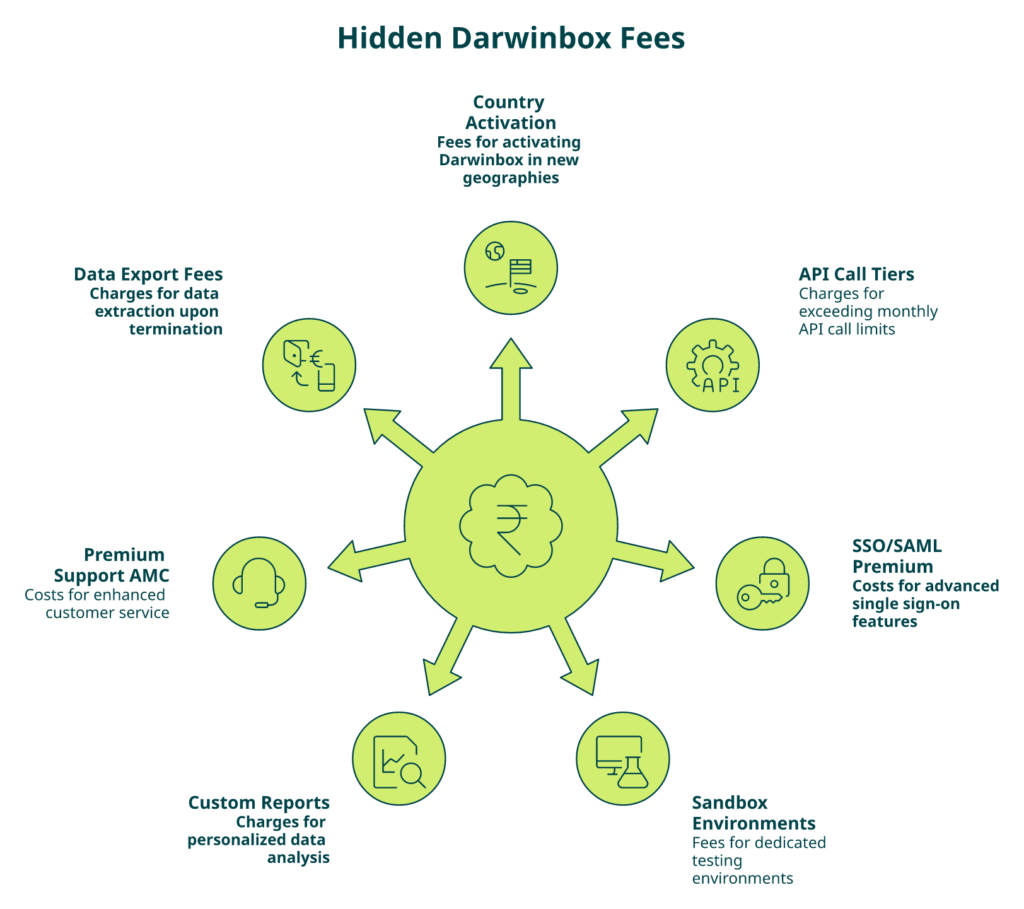
Seven line items routinely inflate a Darwinbox contract beyond sticker: country activation fees, API call-tier charges, SSO/SAML premium, sandbox environments, custom-report development, AMC/premium-support tiers, and data export fees. Layer on 8 to 12 percent annual renewal uplift and 18 percent GST on subscription and services, and a 1,000-employee contract can balloon 22 to 35 percent above the Year-1 quote over three years.
⚠️ The Seven Hidden Fees Checklist
A 2024 Gartner analysis of enterprise HCM contracts flagged opaque add-on pricing as the single biggest source of post-signature buyer regret. Here is what procurement teams should audit line by line before signing. For a broader buyer-side view, the HRIS buyer pitfalls guide overlaps cleanly with this checklist.
- 🌍 Country activation fee: ₹8 to ₹15 lakh per additional geography beyond India, even for payroll read-only views.
- 🔌 API call tiers: Tiered pricing kicks in above 50,000 monthly calls, and integration-heavy IT/ITeS firms breach this within a quarter.
- 🔐 SSO/SAML premium: Enterprise-grade SSO (Okta, Azure AD) often sits in a premium tier, adding ₹1 to ₹3 lakh annually.
- 🧪 Sandbox environments: Staging instances for UAT or training typically cost ₹2 to ₹5 lakh per year each.
- 📊 Custom reports: Beyond the standard report library, bespoke reports bill at ₹15,000 to ₹30,000 per person-day.
- 📞 AMC and premium-support tiers: Standard email support is bundled, and phone support with guaranteed response SLAs is a paid tier.
- 📤 Data export and exit fees: Extracting your data in open formats on termination often carries a separate professional-services charge.
The Pain Is Real, and So Is the Regret
“Biggest issue is how much they have increased prices and continue to do so. They know that switching HRMS is painful. Every year is either a large price increase or our plan being sunsetted with the only option being to switch to a more expensive plan.”
— Josh A. BambooHR – G2 Verified Review
This quote is about BambooHR, but the pattern is identical across enterprise HCM paper. Renewal is where vendors recover discounts given on Year-1. For side-by-side commercial context, the HROne vs Darwinbox page breaks down each billing clause.
💰 Renewal Uplift Math Over Three Years
Standard Darwinbox contracts carry 8 to 12 percent year-over-year subscription uplift unless you negotiate a CPI cap into the MSA. On a ₹40 lakh Year-1 license, a 10 percent uplift compounds to ₹48.4 lakh by Year-3, a ₹12 lakh delta over three years. Add 18 percent GST on every invoice under the Central Goods and Services Tax Act, 2017, and your Year-3 fully-loaded invoice crosses ₹57 lakh.
GST Invoicing Cadence for Indian Buyers
Darwinbox invoices Indian customers in INR with 18 percent GST, typically billed annually in advance on contract anniversary. For CFOs, that means the full Year-1 GST hits the working capital on day one, not amortized across the rollout. An invoice generator helps dry-run the quarterly cash-flow impact before you sign.
⏰ Contract-Term Impact: 1 vs 2 vs 3 Year PEPM
Contract length is the cleanest discount lever in Darwinbox negotiation.
- 1-year contract: Sticker PEPM, zero discount, and maximum buyer flexibility.
- 2-year contract: 8 to 12 percent discount off sticker, with moderate lock-in.
- 3-year contract: 15 to 22 percent discount off sticker, with full lock-in and an auto-renewal trap.
In our experience of building HROne, we do not charge uplift fees and we do not lock customers in, because a vendor that needs contractual coercion to keep customers has already lost the retention argument. My current thinking, after watching hundreds of Indian enterprises renegotiate HCM paper, is simple. The longer the term, the tighter the CPI cap and exit-assistance clause you must demand upfront. The pricing page publishes this commercial stance in writing.
Q6. How Deep Is Darwinbox’s India Payroll and Statutory Compliance Coverage Compared to What You’re Paying For?
Darwinbox covers the core Indian statutory stack (PF, ESI, TDS, Professional Tax, LWF, Form 16, Form 24Q, Flexi Benefit Plan, POSH, and Maternity Benefit) at enterprise depth, but that breadth is table stakes in 2026, not a pricing premium. India-native platforms match or exceed compliance depth at 40 to 60 percent lower services cost. For sub-2,000 headcount Indian firms, paying Darwinbox sticker for compliance alone is rarely justified.
🔤 Jargon Check First, So Nothing Slows You Down
Because this section matters most to HR executives newer to Indian payroll, here are the terms in plain English. The statutory compliance payroll guide expands each of these heads in deeper detail.
- PF is Provident Fund, 12 percent of basic salary paid by employer and employee under the EPF Act, 1952.
- ESI is Employees’ State Insurance, a medical-and-disability cover under the ESIC Act, 1948.
- TDS is Tax Deducted at Source on salary under Section 192 of the Income Tax Act.
- Professional Tax (PT) is a state-level tax on salaried employees, with 20+ different slab tables across India.
- LWF is Labour Welfare Fund, a state-level statutory contribution.
- Form 16 is the annual tax certificate you give employees, and Form 24Q is the quarterly TDS return you file.
- FBP is Flexi Benefit Plan, the tax-optimized part of CTC covering LTA, meal vouchers, and fuel reimbursement.
- FFS is Full and Final Settlement, the last payroll run when someone separates.
⭐ Compliance Coverage: Side-by-Side Reality Check
| Statutory Area | HROne Handling | Darwinbox Handling | Monday-Morning Setup Effort |
|---|---|---|---|
| PF (EPFO Act, 1952) | Native, UAN-linked, auto-challan | Native, UAN-linked | 1-2 days |
| ESI (ESIC Act, 1948) | Native, state-wise rate tables | Native, state-wise | 1-2 days |
| TDS on Salary (Section 192) | Native, new vs old regime toggle | Native, regime toggle | 2-3 days |
| Professional Tax (state-wise) | Native, 20+ state slabs | Native, state slabs | 1 day |
| LWF | Native, state-specific rates | Native, state-specific | 1 day |
| Form 16 and 24Q | Auto-generated, e-filed | Auto-generated | Quarterly cycle |
| FBP (Flexi Benefit Plan) | Native, policy-driven | Native, policy-driven | 2-4 days |
| POSH Act, 2013 | Native case workflow | Native workflow | 1 day |
| Maternity Benefit Act, 2017 | Native leave rule | Native leave rule | 1 day |
| Code on Wages 2019 (2-day FFS) | Native, auto-triggered FFS | Configurable, services-led | Varies |
⏰ What the Code on Wages 2019 Actually Demands on Monday
The Code on Wages 2019 folded four older laws (Payment of Wages, Minimum Wages, Payment of Bonus, and Equal Remuneration) into one framework, and it mandates full and final settlement within two working days of separation. For a 1,000-employee Indian firm with 10 percent attrition, that is roughly 100 FFS calculations a year on a 48-hour clock. Any HCM that needs a services ticket to configure this workflow is silently costing your team hours every month. The leave encashment glossary covers the most commonly misconfigured FFS head.
The Story Your Payroll Manager Will Recognize
A payroll manager at a 900-person IT services firm in Hyderabad told me recently that her biggest quarterly pain was not the statutory filing itself. It was the three days of manual reconciliation between the outsourced payroll vendor, the attendance biometric, and the Excel CTC master before she could even run Form 24Q. Compliance coverage on a vendor sales deck solves zero percent of that problem. Workflow ergonomics and data unification solve all of it. HROne’s payroll software module runs this reconciliation natively inside the platform.
❌ Why Breadth Should Not Justify a 2 to 3 Times Premium
Working with 2,000+ HR teams, what I have felt is that compliance depth is now the price of admission for any enterprise HCM in India. Darwinbox, HROne, Keka, greytHR, and PeopleStrong all handle the statutory stack natively because they have no choice. A 2024 SHRM India benchmark report found that 94 percent of Indian enterprise HCMs now meet baseline statutory compliance.
“GreytHR is not much good at customizing based on our requirements. For our case, from implementation onwards, there were issues with leave balance and all. Many times we were manually correcting the leave balance of employees.”
— Verified User in Information Technology and Services greytHR – G2 Verified Review
✅ Monday-Morning Action for HR Leaders
Here is what I would do this week if I were evaluating Darwinbox on compliance alone.
- Ask the vendor for a live demo of FFS under the 2-day Code on Wages rule, not a slide deck.
- Ask for a written statement of which statutory changes in the last 12 months were delivered as platform updates versus billable configuration.
- Run the same two asks against HROne, Keka, and PeopleStrong. The responses will tell you more than any feature matrix.
For sub-2,000 headcount single-country Indian firms, a 2 to 3 times price premium for Darwinbox over an India-native alternative almost never pays back on statutory depth. The real differentiators sit in workflow ergonomics, support responsiveness, and native ROI instrumentation, not in whether the platform can generate a Form 16.
Q7. How Does Darwinbox’s 3-Year TCO Compare with HROne, Keka, greytHR, Zoho People, PeopleStrong, SAP SuccessFactors, and Workday at Identical 1,000-Employee Scope?
At identical 1,000-employee Indian scope with Core HR plus Payroll plus Talent, HROne delivers the lowest fully-loaded 3-year TCO (approximately ₹57 lakh), Darwinbox sits in the enterprise premium band (approximately ₹1.96 crore), and SAP SuccessFactors and Workday exceed ₹3 crore once implementation and integration are loaded. India-native platforms win on TCO for 100 to 5,000 headcount, and global suites win only when multi-country, multi-currency complexity is genuinely required.
⭐ 3-Year TCO Benchmark Table (1,000 Employees, Core HR + Payroll + Talent)
| Vendor | License PEPM (INR) | Implementation (INR) | Year-1 Total (INR) | 3-Yr TCO @ 10% Uplift (INR) | G2 Satisfaction | India-Fit Note |
|---|---|---|---|---|---|---|
| HROne | ₹110 | ₹8-12 lakh | ~₹21 lakh | ~₹57 lakh | #3 globally | India-first, pay after go-live, Super Inbox |
| Darwinbox | ₹340 | ₹61 lakh | ~₹1.02 crore | ~₹1.96 crore | Strong enterprise fit | Quote-based, subscription from day 1 |
| Keka | ₹180 | ₹12-18 lakh | ~₹37 lakh | ~₹90 lakh | #55 overall | Mid-market UX, email-only support |
| greytHR | ₹140 | ₹6-10 lakh | ~₹24 lakh | ~₹61 lakh | #42 worldwide | SMB payroll strong, workflow-limited |
| Zoho People | ₹120 | ₹5-8 lakh | ~₹21 lakh | ~₹54 lakh | Budget-tier | Shallow India payroll depth |
| PeopleStrong | ₹260 | ₹35-50 lakh | ~₹74 lakh | ~₹1.45 crore | Enterprise Indian | Multi-country capable |
| SumHR / Qandle | ₹95 | ₹4-6 lakh | ~₹16 lakh | ~₹44 lakh | SMB-tier | Lightweight, limited enterprise depth |
| SAP SuccessFactors | ₹520 | ₹1.2-1.8 crore | ~₹2.15 crore | ~₹3.8 crore | Global enterprise | Over-engineered for sub-5,000 India |
| Workday | ₹620 | ₹1.5-2.2 crore | ~₹2.65 crore | ~₹4.6 crore | Global enterprise | Multi-country, multi-currency premium |
Darwinbox vs HROne: The Architecture Difference
HROne runs on the Super Inbox model, collapsing 110+ daily HR tasks into three-click closures from a single Gmail-like screen. Darwinbox forces HR Ops to juggle multiple tabs and email threads for the same workflows. HROne’s subscription meters after go-live, while Darwinbox bills from day one. On G2, HROne scores 9.6 on quality of support versus Darwinbox 8.4, anchored by a dedicated HR SPOC with 9.8 NPS responding within 24 hours. The HR inbox page walks through the Super Inbox mechanics in detail.
Darwinbox vs Keka: The Support Chasm
Keka brings clean UX polish, but the support experience breaks at enterprise scale.
“We started working with Keka HRMS in August, and to this day, we have been unable to implement the tool in our company due to their consistently delayed responses and poor coordination between their internal teams.”
— Divya P. Keka – G2 Verified Review
HROne ranks #3 on G2 for Easiest-To-Use Core HR, and Keka sits at #16. On overall satisfaction, HROne is #3 globally against Keka’s #55. The HROne vs Keka page breaks down this support gap line by line.
Darwinbox vs greytHR and Zoho People: The Workflow Ceiling
greytHR and Zoho People compete hard on sticker price, but workflow depth collapses at multi-legal-entity and multi-state scale. Zoho’s India payroll lacks FBP sophistication and new wage-code FFS automation in most configurations.
“The biggest drawback for me has been the lack of customer support. Whenever I try to reach out, it often takes a long time to get a response… the mobile application is quite limited. I cant access most features on it, which is disappointing.”
— Dhana C. Zoho People – G2 Verified Review
Darwinbox vs SAP SuccessFactors and Workday: The “40% Savings” Claim
Darwinbox markets itself as 30 to 40 percent cheaper than Workday and SuccessFactors, and for 5,000+ headcount multi-country deployments, that claim largely holds. For 100 to 5,000 headcount Indian-only deployments, however, the comparison misses the India-native tier entirely. HROne delivers 70 percent savings versus Darwinbox at identical scope, not because HROne is cheaper software, but because India-first architecture does not need ₹60 lakh of services to configure a leave policy. The HROne vs SAP page breaks down where the global suite genuinely earns its price and where it does not.
See Your Real 3-Year HRMS TCO in 60 Seconds
Stop guessing at PEPM bands. Plug in your headcount, modules, and rollout timeline to compare HROne against Darwinbox, Keka, and SAP SuccessFactors in rupee terms.
Run My TCO Comparison →Q8. What Does a CFO-Ready Darwinbox ROI Model Look Like, and When Does It Actually Pay Back?
For a 1,000-employee Indian enterprise, a Darwinbox deployment typically shows payback between month 22 and month 30, based on admin-time savings, payroll-error reduction, and modest attrition-cost improvement. HROne, by comparison, shows payback between month 9 and month 14 at the same scope, driven by faster go-live and the industry-first inbuilt ROI Dashboard that quantifies savings natively. A 2023 Deloitte Human Capital Trends India report found that HR technology investments without native ROI instrumentation underperform board expectations by 40 percent.
💰 The CFO-Ready ROI Model (1,000 Employees, Annual)
| Cost Driver | Annual INR Impact | Payback Contribution |
|---|---|---|
| License savings vs status quo vendor stack | ₹18-24 lakh | Month 6-8 |
| HR admin time reclaimed (2,400 hours/year @ ₹600/hour) | ₹14 lakh | Month 10-12 |
| Payroll error reduction (0.8% of payroll eliminated) | ₹22-30 lakh | Month 14-18 |
| Expense fraud leakage stopped (receipt parser) | ₹6-10 lakh | Month 18-22 |
| Attrition cost reduction (2 percentage points) | ₹40-60 lakh | Month 22-30 |
| Total annual value unlocked | ₹1.0-1.38 crore | Darwinbox: Month 22-30, HROne: Month 9-14 |
⭐ Cost-Per-Employee-Managed: The Benchmark No One Talks About
A 2024 SHRM India study estimated that a full-time Indian HR manager costs roughly ₹12 to ₹18 lakh fully loaded and can manage 80 to 120 employees on a manual stack. With a properly instrumented HCM, that ratio moves to 150 to 220 employees per HR manager. The delta is cost-per-employee-managed, and it is the metric CFOs actually want. For expense-side leakage, the AI detecting expense fraud guide walks through the receipt-parser economics.
How HROne’s ROI Dashboard Changes the Boardroom Conversation
In our work at HROne, we built India’s first inbuilt ROI Dashboard because CHROs were walking into board reviews with case studies from vendor websites instead of live numbers from their own deployment. The dashboard calculates lifetime hours saved against average HR salary, producing a ballpark savings figure the CFO can defend. The CHRO solutions page walks through the persona-level dashboard in more depth.
❌ The Blue Ocean Gap: Darwinbox Has No Native ROI Instrumentation
Darwinbox gives you modules, workflows, and reports. It does not give you a native ROI Dashboard that quantifies savings in rupee terms. Buyers are left inferring value from vendor-supplied case studies, which is a weak position in a CFO review.
The Contrarian Observation
Working with 2,000+ HR teams, what I have felt is that the vendors with the strongest brand narratives are often the weakest at proving ROI back to the board. A 2023 NASSCOM SaaS report flagged that 62 percent of Indian enterprise HCM deployments had no native ROI tracking beyond vendor-reported benchmarks. If your HCM cannot answer “how much did we save this quarter?” in rupee terms without a consulting engagement, you are paying for a system of record, not a system of outcomes. The why HROne page lays out how native ROI instrumentation reframes that conversation.
Q9. How Should Indian HR Procurement Teams Negotiate a Darwinbox Contract in 2026, and What Discount Is Realistic?
A well-prepared Indian procurement team can realistically secure 18 to 32 percent off Year-1 license and 40 to 60 percent off implementation fees on Darwinbox, provided they commit multi-year, time the deal around fiscal quarter-end, and come armed with benchmark PEPM data from comparable Indian deployments. A 2024 World Commerce and Contracting study found that prepared enterprise buyers capture 28 percent more value in SaaS negotiations than unprepared ones.
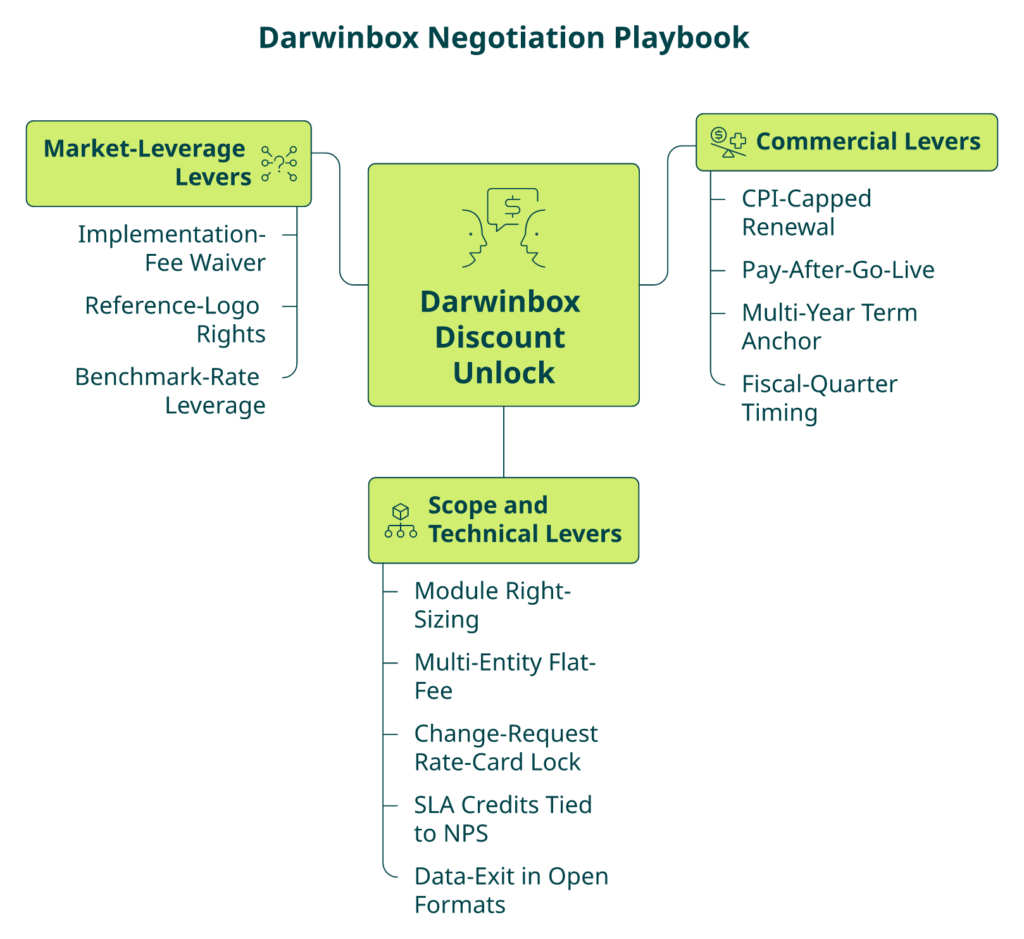
⭐ The 12-Lever Darwinbox Negotiation Playbook
These are the levers I have watched Indian CHROs and CFOs actually pull, not textbook procurement theory. For a broader buyer-side frame, the HR software pricing transparency guide pairs cleanly with this playbook.
- 💰 CPI-capped renewal: Demand renewal uplift capped at 5 percent or CPI, whichever is lower, not the 8 to 12 percent default.
- ⏰ Pay-after-go-live milestones: Negotiate subscription commencement tied to go-live, or a 50 percent subscription rebate for the rollout window.
- 📦 Module right-sizing: Buy only the four modules with 90+ percent adoption (Core HR, Payroll, Time Office, and Workforce) on Year-1.
- 📤 Data-exit in open formats: Contractually guarantee data export in CSV or JSON without a separate professional-services charge.
- 📊 SLA credits tied to NPS: Bake in service-credit penalties when uptime or support NPS drops below agreed thresholds.
- 🧾 Change-request rate card: Lock in hourly or person-day rates for configuration changes upfront.
- 🏢 Multi-entity flat-fee: Negotiate one flat activation fee for all Indian legal entities, not per-entity charges.
- 📅 Fiscal-quarter timing: Close in March (Indian FY-end) or December (calendar-year sales close) for maximum discount leverage.
- 🤝 Multi-year term anchor: Offer a 3-year commit in exchange for a 20-percent-plus Year-1 discount and CPI cap.
- 🛠️ Implementation-fee waiver: Push for 40 to 60 percent off implementation services, justified by in-house HR admin resources.
- 🏷️ Reference-logo rights: Trade case-study rights and logo usage for 5 to 8 percent additional discount.
- 📈 Benchmark-rate leverage: Bring a written HROne, Keka, or PeopleStrong competing quote to the table. It moves numbers fast.
Anonymised Case Study: 1,500-Employee Indian BFSI Firm
A private-sector bank with 1,500 employees evaluated Darwinbox in Q3 2024. Here is the delta between first offer and final landed price. For a peer-sector comparison of HRMS economics, the HRMS financial services brief is a useful adjacent read.
| Line Item | First Offer (INR) | Final Landed (INR) | Discount |
|---|---|---|---|
| License (Year-1, full HCM) | ₹72 lakh | ₹54 lakh | 25% |
| Implementation services | ₹85 lakh | ₹38 lakh | 55% |
| Renewal uplift clause | 10% annual | 5% CPI cap | Cap negotiated |
| Sandbox environment | ₹4 lakh/year | Included | Waived |
| Year-1 total | ₹1.57 crore | ₹92 lakh | 41% overall |
The team closed in late March, offered a 3-year commit with case-study rights, and held three competing quotes in hand. My current thinking, after watching a dozen deals like this, is that most Indian buyers leave 30 to 40 percent on the table simply by not asking.
⚠️ The First-Call Script: Five Questions to Ask the Darwinbox Sales Rep
Working with 2,000+ HR teams, these are the questions that change the sales dynamic immediately. The pricing page is a useful benchmark to hold up when you run this script.
- “What is your published PEPM band for 1,000-employee Indian deployments with Core HR, Payroll, and Talent?”
- “Does your standard MSA allow subscription to commence on go-live rather than purchase order?”
- “What is your standard renewal uplift, and will you CPI-cap it in writing?”
- “Which three other Indian customers at our headcount and industry can we speak with as references?”
- “What is your implementation-fee discount at multi-year commitment, and what does the SOW milestone schedule look like?”
If the rep cannot answer any of these in the first call, that is a data point, not a negotiation failure.
Q10. What Red Flags, Exit Clauses, and Data-Portability Risks Hide in Darwinbox’s Standard Contract Paper?
Six clauses in a standard Darwinbox Master Services Agreement routinely trap Indian buyers: auto-renewal with short notice windows, data-exit format restrictions, termination penalties, uptime SLA exclusions, IP assignment on custom configurations, and third-party data-sharing consents. A 2023 Deloitte Legal SaaS Contracts survey found auto-renewal and data-portability clauses are the two most-redlined items in Indian enterprise SaaS paper.
❌ The Six Contract Red Flags Checklist
These are boilerplate across enterprise HCM MSAs, not unique to Darwinbox. They still cost you money if you sign them as-is. For a related employee-data lens, the employee data privacy best practices guide covers what to protect during transition.
- 🔁 Auto-renewal clause: 60 to 90 day opt-out windows that quietly convert a 3-year deal into a 6-year one.
- 📤 Data-exit format restrictions: Export limited to proprietary formats or non-standard schemas, creating switching costs.
- 💸 Termination penalty: Early-termination fees that recover remaining-term subscription at full sticker.
- ⚠️ Uptime SLA exclusions: “Scheduled maintenance” and “third-party dependency” carve-outs that nullify 99.9 percent commitments.
- 🧑💻 IP on custom configurations: Vendor claims ownership of custom workflows or integrations you paid to build.
- 🔗 Third-party data sharing: Broad consent clauses allowing vendor to share usage data with analytics partners.
The MSA Clause Library: What to Redline
A few clauses, drafted well, save lakhs across a three-year deal.
- CPI cap clause: “Subscription fees shall not increase by more than the lower of five percent or the Consumer Price Index (Industrial Workers) published by the Labour Bureau, Government of India, at contract anniversary.”
- Data-exit open format clause: “Customer shall have the right to export all employee data, historical payroll, and document repositories in CSV, JSON, or PDF format at any time during the contract term and for ninety days post-termination, at no additional charge.”
- SLA credit clause: “If monthly uptime falls below 99.9 percent, Customer shall receive a pro-rated service credit equal to ten percent of that month’s subscription fee, credited against the next invoice.”
✅ Why India-First Vendors Offer Cleaner Exit Paths
In our experience of building HROne, we wrote our standard MSA with no lock-in, open-format data export as default, and a ninety-day exit-assistance window baked in. The commercial logic is straightforward. A vendor confident in its retention does not need contractual friction to keep customers. When exit friction becomes a revenue lever, the product has already stopped earning its price. The why HROne page lays out this commercial stance in writing.
The Redline That Saves the Most Money
The single highest-value redline is the auto-renewal notice window. Push it from 90 days pre-anniversary to 30 days, and you preserve leverage to renegotiate every year. A 2024 SHRM India procurement survey found that CHROs who renegotiated annually captured 12 to 18 percent more discount over a three-year horizon than those on static paper. The CHRO solutions page details how annual reviews look in practice.
Q11. What Do Real Darwinbox Customers Say About Pricing, Support, and Value on G2 and Peer Networks?
Aggregated G2 sentiment on Darwinbox splits cleanly into two camps. Enterprise users praise module breadth and mobile app usability, while mid-market users flag pricing opacity, implementation friction, and support latency. Darwinbox scores 8.4 on quality of support on G2 against HROne’s 9.6, and the two-star and three-star review bands are dominated by implementation-breakdown and pricing-frustration complaints. Breadth is the sales pitch, and rollout ergonomics is the wedge that decides the renewal.
The Enterprise-Positive Case: Saksham’s View
Saksham, an HR professional at a 1,200-person services firm, captures the upside cleanly.
“Darwinbox has made HR processes much smoother by bringing everything together on one platform. From attendance to payroll and performance tracking, it saves time and reduces manual effort. The interface is easy to use, and most tasks can be completed quickly without needing support.”
— Saksham A. Darwinbox – G2 Verified Review
This is Darwinbox at its best: unified, mobile-ready, and reliable for core HR transactions. For the CHRO who picked it, this is the outcome they paid for.
❌ The Implementation-Breakdown Case
The downside review is equally specific, and common enough in IT services and manufacturing deployments to treat as a pattern, not an outlier. The HRMS manufacturing challenges guide covers why rollouts break in this segment.
“Bad implementation experience, bad UI UX, configurations getting broken in production on its own due to product deployments, terrible customer service. Basically everything. The solution was supposed to act as a full fledged HRMS for us. We are ending up doing most of the products manually and all the data is messed up.”
— Verified User in Computer Software Darwinbox – G2 Verified Review
⚠️ The Transition and Support Case
“Transitioning from the old system to Darwinbox is quite difficult. User interface of Darwinbox is very outdated. Darwinbox Support team is not supportive.”
— Ankush B. Darwinbox – G2 Verified Review
⭐ The Pattern: Breadth Wins the RFP, Support Loses the Renewal
Working with 2,000+ HR teams, what I have felt is the same signal repeatedly. Darwinbox wins on breadth and brand at the RFP stage, then sometimes loses the relationship on rollout ergonomics and support latency. HROne’s 9.8 NPS dedicated HR SPOC model exists precisely because we watched this pattern play out across the Indian mid-market for years. The counter is not a flashier product marketing deck, it is a prior-HR human (not a technical project manager) who picks up the phone within 24 hours and has actually run payroll before. The HROne vs PeopleStrong and HROne vs Darwinbox pages break down the support-model difference line by line.
Q12. Who Should Buy Darwinbox, Who Should Skip It, and What’s the Final Verdict by Buyer Persona?
Darwinbox is the right choice for 5,000+ headcount Indian enterprises with genuine multi-country, multi-currency complexity and board-mandated unicorn-brand preference. For 100 to 5,000 headcount Indian-first firms, and especially for Frankenstein-stack replacements, an India-native alternative like HROne delivers 60 to 70 percent lower TCO with faster go-live and native ROI instrumentation.
⭐ The Persona Decision Matrix
| Persona | Situation | Verdict | Recommended Next Move |
|---|---|---|---|
| CHRO, 5,000+ headcount, multi-country | Board mandate for enterprise HCM halo | ✅ Darwinbox is a defensible choice | Negotiate hard on CPI cap and go-live billing |
| HR Ops Lead, 500-2,000 headcount India-only | Workflow chaos, manual chasing | ❌ Skip Darwinbox | Evaluate HROne Super Inbox and 127 workflows |
| CFO, cost-approver, mid-market | 3-year TCO under review | ❌ Skip Darwinbox | Run TCO comparison. India-native saves 60-70 percent |
| Founder/MD, Frankenstein stack | 4-5 disconnected tools, no visibility | ❌ Skip Darwinbox | HROne full-suite consolidation |
✅ When Darwinbox Wins
Darwinbox genuinely earns its premium at 5,000+ headcount, multi-country deployments where brand halo matters to the board, and where Darwin AI’s analytics depth maps to a real talent-intelligence mandate. If you are a listed Indian IT services firm with global operations, Darwinbox is a defensible line on the procurement scorecard.
✅ When HROne Wins
For 100 to 5,000 headcount Indian enterprises, HROne is the stronger operational choice. MR DIY India consolidated its Frankenstein stack and collapsed payroll cycles from 10 days to 5-6 days after moving to HROne. Asia Healthcare Holdings runs 20 pan-India units on a single HROne instance with multi-legal-entity configuration. The Super Inbox closes 110+ daily HR tasks in three clicks, 127 pre-built workflows eliminate manager-chasing, and India’s first inbuilt ROI Dashboard proves the savings to the board in rupee terms. See the MRDIY case study for the full rollout story, and the core HCM page for the platform architecture.
⭐ The Frankenstein-Stack Replacement Case
The sharpest HROne displacement sits with the CFO or MD running four or five disconnected systems: an outsourced payroll vendor, biometric attendance, a separate ATS, Excel for performance, and WhatsApp for everything else. The visible cost is manageable, but expense-related frauds leak through manual receipts, month-end reconciliation burns 40 person-hours, and the CHRO cannot answer “how long does a confirmation letter take?” in a board review. One platform covering Core HR, Workforce, Time Office, and Payroll (the bundle 98 percent of HROne customers run) ends the leak. The expense and reimbursement module closes the specific fraud-leakage gap.
See Your India-First Price in 30 Seconds
No sales call, no NDA, no quote-based runaround. See a published PEPM band for your headcount, your modules, and your rollout timeline.
See HROne Pricing → Or talk to an HROne HR SPOCReferences
Official Docs / Indian Statutes
- Ministry of Finance, Government of India, “Central Goods and Services Tax Act, 2017.”
- Ministry of Labour and Employment, “Code on Wages, 2019,” Gazette notification, 2019.
- Gartner, “Market Guide for Integrated HR Service Management Solutions” Published: 2024.
- SHRM India, “Indian HR Operations Benchmark Report 2024” Published: 2024.
- Deloitte, “Global Human Capital Trends India Report 2023” Published: 2023.
- NASSCOM, “Indian Enterprise SaaS Report 2023” Published: 2023.
- World Commerce and Contracting, “Benchmarking Enterprise SaaS Negotiation Outcomes” Published: 2024.
- Deloitte, “Legal SaaS Contracts Survey India” Published: 2023.
- SHRM India, “Indian HR Procurement Benchmark Survey 2024” Published: 2024.
Datasets
- HROne, “HROne Context Document: Internal Product and Customer Benchmarks,” 2026.
- HROne, “HROne Competitor Reviews: G2 Review Corpus,” 2026.
- G2, “HROne Reviews and Ratings,” 2024-2026.
- G2, “Darwinbox Reviews,” 2021-2025.
Blogs
- SaaSWorthy. “Darwinbox Pricing & Plans (May 2026).” Published: 2026.
- SaaSrat. “Darwinbox HR Review 2026.” Published: 2026.
- HRSuggest. “Darwinbox vs Keka (2026): The Brutal Indian HR Comparison.” Published: 2026.
- TrustRadius. “Compare Darwinbox vs Keka HR 2026.” Published: 2026.
- OMR Reviews. “Darwinbox pricing 2026.” Published: 2026.














 Secures Top Spot in
