








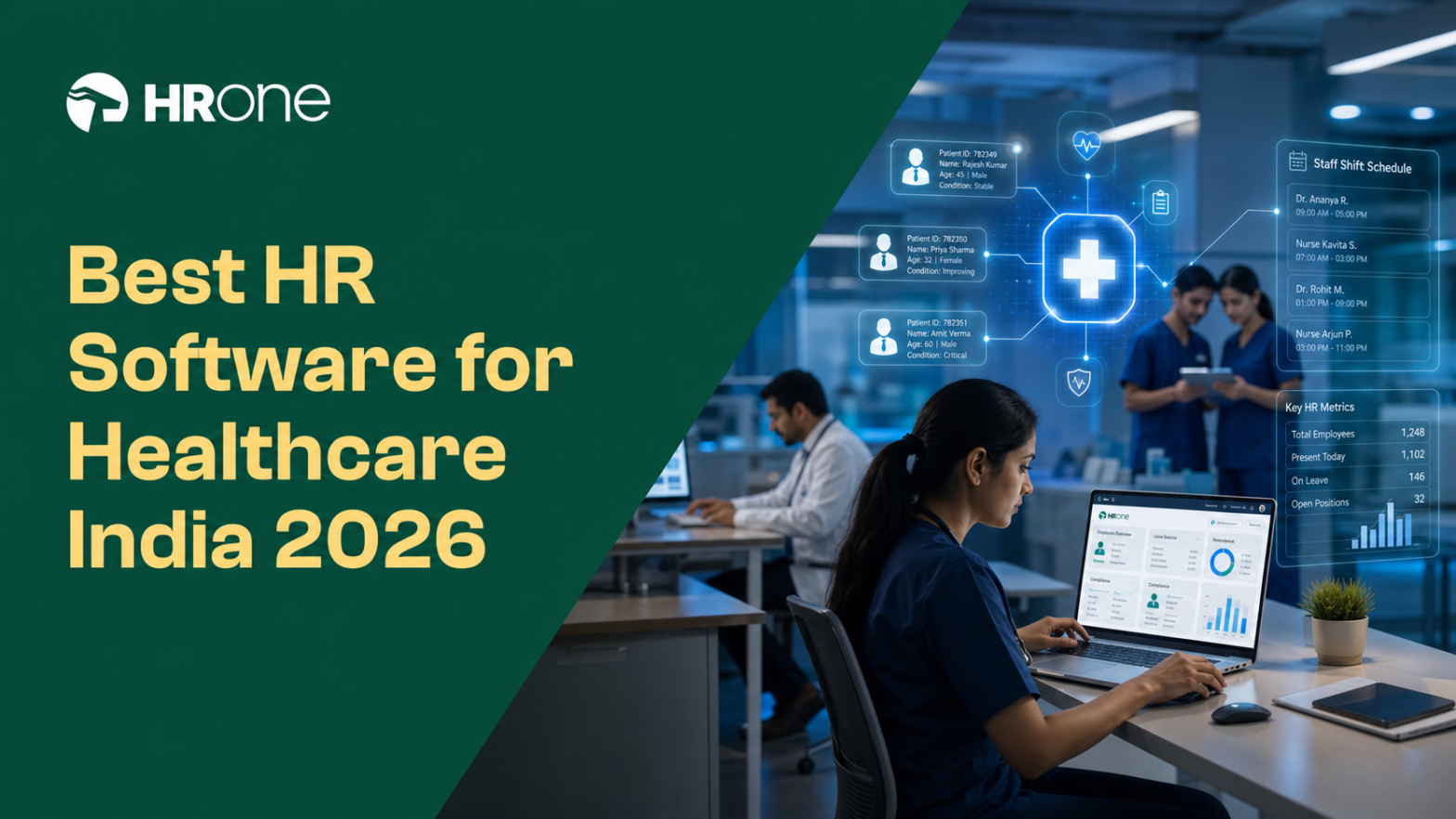
Q1. What Are the 10 Best HR Software for Healthcare Companies in India in 2026?
Choosing an HRMS for an Indian hospital, diagnostics chain, or nursing home network is a high-stakes decision in 2026, because the platform must survive 24×7 shift rosters, cross-midnight nurse attendance, Labour Code 2025 wage-structure rules effective 21 November 2025, NABH 6th Edition HRM documentation mandatory from January 2025, and PF/ESI/PT/LWF/TDS filings across multi-entity hospital groups, simultaneously. For this guide, I evaluated 10 vendors against healthcare-specific criteria rather than a generic HR software checkbox matrix. The primary operator is the Hospital HR Manager and Payroll Lead running the daily cycle; the shadow readers are the CHRO, CFO, CIO, and Procurement team validating compliance, TCO, and security before RFP.
Our Evaluation Criteria
- Shift & Roster Depth ⏰: 24×7 rotational, cross-midnight, on-call, floater patterns, and biometric or face attendance for OPD, ICU, and lab blocks.
- Statutory & NABH Compliance ✅: PF/ESI/PT/LWF/TDS accuracy, Labour Code 2025 changelog evidence, and NABH HRM chapter documentation support.
- Setup, Usability, and Support: G2 ease-of-use, NPS, mobile ESS for clinical staff, SPOC vs ticket-only models.
- Pricing Transparency & Billing Model 💰: Flat PEPM, go-live billing, multi-entity charges, and lock-in clauses.
- Verified Healthcare Proof: Named Indian hospital clients with quantified outcomes.
Who This Guide Is For
- CHROs and HR Heads at 200 to 5,000 bed hospital groups consolidating a fragmented biometric, outsourced payroll, and Excel stack.
- Payroll Managers running multi-entity hospital, diagnostics, and pharmacy cycles with state-wise PT and contract-nurse rules.
- CFOs validating flat PEPM commercials and billing triggers across legal entities.
- CIOs evaluating ISO 27001, DPDP, RBAC, and HIS or biometric integration paths.
Comparison Snapshot
| Provider (⭐) | Best For | Standout Strength | Known Limitation | Healthcare Proof | Support Model | Pricing Model |
|---|---|---|---|---|---|---|
| HROne (5⭐) | Mid-market and multi-unit Indian hospitals drowning in a 3-tool stack | G2 2026 #1 India, #1 APAC, Top 3 globally on satisfaction with 2,088 reviews | NABH HRM documentation not explicitly marketed; iOS app 2.5/5 | AHH 80 locations plus Vishwaraj Hospitals named clients | Phone, email, and dedicated prior-HR SPOC | Flat PEPM ₹4,950/mo (50 users) plus ₹99/additional user |
| Darwinbox (4⭐) | 2,000+ bed hospital groups wanting enterprise breadth | Yashoda Hospitals 6,000 staff: 20 shifts automated, 100 man-hrs/mo saved | No published PEPM; day-one billing reported in reviews | Yashoda Hospitals (quantified) | Email plus partner-delivered | Quote-based, contact us |
| Keka (4⭐) | 100 to 2,000 employee clinics wanting modern UX | Only India vendor with confirmed SOC 2 Type II, ISO 27001:2022, and Labour Code 2025 changelog | Shift add-on ₹20 PEPM extra; 2× monthly setup fee; ticket-based support | RAHI Care dialysis (unquantified) | Ticket-only | ₹6,499/mo (100 employees, Foundation) |
| GreytHR (3⭐) | SMB hospitals and single-site clinics under 500 staff | 4 quantified healthcare case studies; supports NABH HRM documentation | SOC 2 unconfirmed; limited workflows at multi-entity scale | Sodani Hospitals, Vimson Group, and Apollo MedSkills | Ticket-based | ₹5,999/mo Growth (50 employees) plus ₹105/add’l |
| Zoho People (3⭐) | Single-entity nursing homes on Zoho ecosystem | Deep integration with Zoho Recruit and Zoho Payroll | Shallow India FBP/CTC depth; slow support | Not found | Ticket-based | From ~$1.25 PUPM |
| ZingHR (3⭐) | Shift-heavy manufacturing-adjacent healthcare | Shift-biased workflow library | Outdated UI; mobile app instability reported | Not found | Email plus ticket | Quote-based |
| Pocket HRMS (3⭐) | Small hospitals on India payroll-first needs | Healthcare payroll landing page | Thin performance and engagement modules | Not found | Phone plus email | Tiered PEPM |
| 247HRM (3⭐) | Small-to-mid clinics prioritising compliance | Hospital-specific payroll page | Lightweight analytics | Not found | Email plus demo-led | Quote-based |
| PeopleStrong (4⭐) | 2,000+ enterprise hospital chains wanting Gartner-recognised HCM | Gartner Peer Insights Customers’ Choice 4 years running | Only 72 G2 reviews; SOC 1 only (not SOC 2) | No named hospital case study | Dedicated delivery team | Quote-based |
| SAP SuccessFactors (2⭐) | 5,000+ networks already on SAP ERP | Global HCM breadth | Over-engineered for Indian payroll; developer tickets to change policies | Not on India healthcare page | Partner-delivered | Quote-based |
1. HROne: The India-First Hire-to-Retire Operating System for Multi-Unit Hospital Groups
Overview
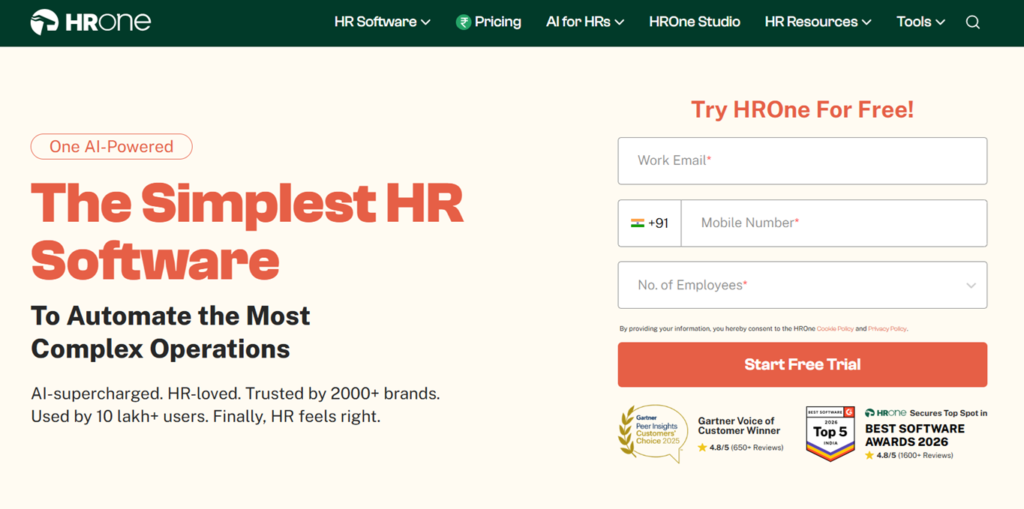
HROne is an AI-powered core HCM platform built by Uneecops Workplace Solutions, headquartered in Delhi, serving 2,500+ Indian enterprises across manufacturing, ITeS, BFSI, and healthcare. It was ranked #1 in India and #1 in APAC on satisfaction and Top 3 globally in G2’s 2026 Best Software Awards, backed by 2,088 verified G2 reviews, the largest review base among India-origin HRMS vendors in this list. Healthcare clients include Asia Healthcare Holdings running 80 locations and Vishwaraj Hospitals with named nurse and doctor users.
Core Services
- Super Inbox: aggregates every pending roster swap, leave, expense, and payroll exception across 10 modules into a three-click resolution surface, eliminating tab-switching across biometric and payroll portals. Learn more on the HR inbox page.
- 127 pre-built hire-to-retire workflows: automate nurse onboarding, confirmation, transfer, and exit clearance so HR stops chasing managers on email.
- One AI Suite: India’s first voice-enabled employee AI agent (launched April 2025) stacks relevant nurse and doctor CVs, parses receipts, and executes leave and helpdesk tasks.
- Time Office plus Auto-Scheduled Payroll: real-time biometric punch sync, geo-fencing, and shift-linked payroll software with PF/ESI/PT/LWF/TDS auto-computation, cutting month-end cycles from 10 to 5 or 6 days.
- HRV Studio: low-code builder for credential-expiry trackers, visitor and vendor apps, and NABH documentation forms without developer tickets.
- ROI Dashboard: India’s first inbuilt HR ROI engine comparing average HR salary against lifetime hours saved for board-ready reporting.
🇮🇳 India Compliance
- PF/ESI/TDS/PT/LWF: ✅ Yes (automated computation and challan generation).
- Labour Code 2025: ⚠️ Vendor-claimed; primary changelog not located. Request evidence in demo.
- Multi-state compliance: ✅ Yes.
- NABH HRM documentation: ⚠️ Not explicitly marketed; achievable via HRV Studio.
Who This Is Built For
- Hospital HR Ops Leads reconciling biometric exports against three separate leave portals every month-end.
- CHROs at multi-unit chains needing one instance across hospital, diagnostics, and pharmacy legal entities with unified RBAC.
- Payroll Managers firefighting shift-differential and on-call arrears on Excel every cycle.
Who Should Skip
- Single 20-bed clinics needing only basic payroll and leave. GreytHR Starter (free up to 25 employees) is the lower-friction fit.
Pricing
- Basic: ₹4,950/month for 50 users; ₹99 per additional user.
- Professional: ₹6,500/month for 50 users; ₹130 per additional user.
- Enterprise: Contact Us.
- Implementation fee: Not publicly disclosed. Request quote.
- Cost at 200 Employees: ~₹19,800/mo (Professional); Cost at 500 Employees: ~₹65,000/mo (Professional). Full details on the pricing page.
Implementation and Support Reality
- Go-live typically 30 to 60 days for mid-market hospitals; MR DIY India went live in 30 days (reference).
- Dedicated prior-HR SPOC; phone and email within 24-hour SLA.
- ISO 27001 certified via hrone.cloud/dpa; SOC 2 not confirmed.
Reviews
“Zero-touch payroll and compliance automation… The InboxforHR is a game-changer, centralizing every HR task into one simple inbox, cutting down administrative time by 60 to 70%.”
— Waldon S., Enterprise User HROne G2 – Verified Review
“Certain features take time to understand, and without enough guided support, the learning curve can feel quite steep.”
— Nijanthan R., Mid-Market User (3.5/5) HROne G2 – Verified Review
2. Darwinbox: Enterprise Breadth with the Strongest Indian Hospital Case Study
Overview
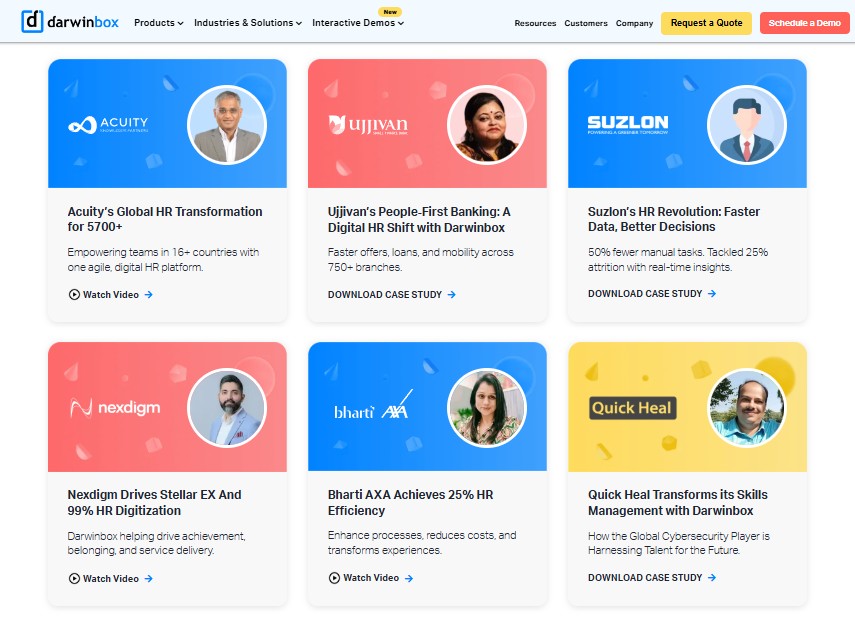
Darwinbox is a Hyderabad-headquartered AI-first enterprise HCM founded in 2015, serving 500 to 50,000 employee organisations globally. It was named Forrester Wave Strong Performer for HCM Solutions Q4 2025, ahead of SAP and Cegid on Current Offering. The Yashoda Hospitals deployment (6,000 employees) is the single most quantified hospital HRMS case study in India. For a direct feature-by-feature breakdown, see HROne vs Darwinbox.
Core Services
- Super Agent AI: 30 HR agents launched September 2025 across HRBP, Recruiter, Payroll, and Manager roles.
- Core HR plus Payroll plus Analytics: enterprise-grade modules with strong talent and performance coverage.
- Shift Management: 20 shift types automated at Yashoda with 100 man-hours per month saved.
- Employee Engagement: contributed to 5 to 10% retention uplift at Yashoda through survey digitisation.
🇮🇳 India Compliance
- PF/ESI/TDS/PT: ✅ Claimed.
- Labour Code 2025: ⚠️ Not confirmed from primary changelog.
- NABH: Referenced by Yashoda CHRO testimonial.
Who This Is Built For
- CHROs at 2,000+ bed hospital chains needing Gartner or Forrester-grade enterprise breadth.
- Talent leaders running complex succession and OKR frameworks.
Who Should Skip
- 100 to 500 employee mid-market hospitals. Pricing opacity and multi-year lock-ins make TCO unpredictable.
Pricing
- Not published; contact us model. Industry reports cite ~$2 to $4 PEPM with day-one billing (review-reported, not MSA-confirmed).
Implementation and Support Reality
- Vendor claims parallel-team fast implementation; reviews report drag at scale.
- Email plus partner-delivered support.
Reviews
“Bad implementation experience, bad UI/UX, configurations getting broken in production on its own due to product deployments, terrible customer service.”
— Verified User, Computer Software (0/5) Darwinbox – G2 Verified Review
“Darwinbox has a very user-friendly interface… Pages sometimes load slowly. Sync with other systems can be inconsistent.”
— Mohit V., Mid-Market User (4/5) Darwinbox – G2 Verified Review
3. Keka: The Best-Certified Mid-Market Platform for Clinic Chains
Overview
Keka is a Hyderabad-based HRMS founded July 2014 and backed by WestBridge Capital, serving 100 to 2,000 employee organisations. Keka is the only India-origin vendor in this list with both SOC 2 Type II and ISO 27001:2022 confirmed from its primary DPA page, plus a published Labour Code 2025 changelog effective November 2025, two genuine differentiators for hospital CIOs. For a deeper comparison, see HROne vs Keka.
Core Services
- Core HR plus Payroll with Advanced Shift Management add-on (₹20 PEPM).
- Keka Kiosk: AI facial recognition plus offline mode (launched April 2025).
- Keka Hire plus Keka Learn plus OKR modules.
- AI Co-Pilot embedded for evaluations and ATS screening.
🇮🇳 India Compliance
- PF/ESI/TDS/PT/LWF: ✅ Yes.
- Labour Code 2025: ✅ Confirmed via help center.
- Multi-state: ✅ Claimed.
Who This Is Built For
- 100 to 1,500 employee clinic chains prioritising UX and SOC 2 security.
Who Should Skip
- Multi-legal-entity hospital groups needing unified RBAC across entities on one instance. Review volume and case studies thin on multi-entity healthcare.
Pricing
- Foundation ₹6,499/mo (100 employees), Strength ₹9,999, Growth ₹14,099.
- Advanced Shift Management add-on ₹20 PEPM (min 100 employees); setup fee = 2× monthly; quarterly minimum billing.
Implementation and Support Reality
- Ticket-based support; 25-day go-live claimed in one non-healthcare case study.
Reviews
“We started working with Keka HRMS in August, and to this day, we have been unable to implement the tool in our company due to their consistently delayed responses and poor coordination between their internal teams.”
— Divya P., Mid-Market User (0/5) Keka – G2 Verified Review
“Strong payroll and compliance… PMS module is confusing and needs to be simpler… User access is difficult for employees who do not have an email ID.”
— Kiran B., Mid-Market User (3/5) Keka – G2 Verified Review
4. GreytHR: The SMB Hospital Authority with 4 Quantified Case Studies
Overview
GreytHR, by Greytip Software (Bengaluru, acquired by Apax Partners in August 2024), is the SMB payroll-compliance authority in India with over 1,000 healthcare organisations claimed. It has the strongest multi-case-study evidence base in this list. Sodani Hospitals cut appraisals from 45 to 10 days, Vimson Group cut payroll time 60% across 6 entities, and Apollo MedSkills runs multi-state compliance 40% faster. See HROne vs greytHR for a side-by-side look.
Core Services
- Payroll plus PF/ESI/PT/LWF/TDS statutory stack.
- Shift Management: rotational, split, flexi, night, plus face-recognition kiosks and geo-fencing.
- greytHR Recruit (launched October 2025) plus NAVOS AI navigational assistant (April 2026).
- NABH HRM documentation support claimed on healthcare blog.
🇮🇳 India Compliance
- PF/ESI/TDS/PT/LWF: ✅ Yes.
- Labour Code 2025: ⚠️ Not confirmed from changelog.
Who This Is Built For
- 25 to 500 employee single-site clinics and diagnostic labs prioritising payroll compliance.
Who Should Skip
- Hospital groups above 500 employees needing deep workflow automation and multi-entity RBAC.
Pricing
- Starter free (25 employees); Essential ₹3,495/mo; Growth ₹5,999/mo (50 employees) plus ₹105 per additional.
Implementation and Support Reality
- Ticket-based support; 15% price hike precedent March 2023.
Reviews
“Extremely poor customer support. They have an under-trained team handling tickets… have you heard of an HR tool where your CTC is not mentioned or visible anywhere?”
— Verified User, IT Services (2/5) GreytHR – G2 Verified Review
“Better UI, simplicity and time for support… Reporting configuration, TDS filing, revising of TDS is not possible.”
— Krishnanand B., Mid-Market User (3/5) GreytHR – G2 Verified Review
5. Zoho People: The Zoho-Ecosystem Pick for Small Clinics
Overview
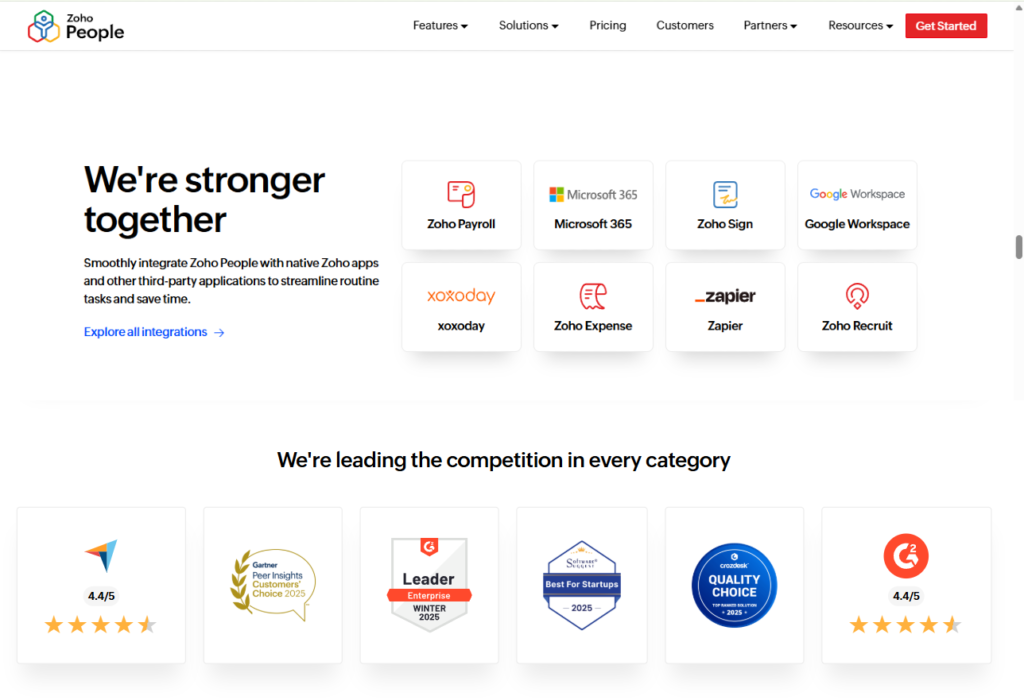
Zoho People is a global generalist HCM inside the Zoho suite, strongest when the clinic already runs Zoho Recruit and Zoho Payroll. For Indian healthcare, it under-serves FBP declarations, CTC revisions, and Labour Code 2025 rules. See HROne vs Zoho People for an India-compliance breakdown.
Core Services
- Employee database plus leave plus attendance with Zoho Recruit and Zoho Payroll integration.
- Mobile ESS for leave and timesheet.
🇮🇳 India Compliance
- PF/ESI/TDS: Partial (via Zoho Payroll).
- NABH: ❌ Not addressed.
Who This Is Built For
- Single-entity 50-bed nursing homes already on Zoho One.
Who Should Skip
- Multi-legal-entity hospital chains and any team needing NABH HRM documentation.
Pricing
- From ~$1.25 PUPM; India pricing varies by plan.
Reviews
“The biggest drawback for me has been the lack of customer support. Whenever I try to reach out, it often takes a long time to get a response.”
— Dhana C., HR Professional (4/5) Zoho People – G2 Verified Review
“Features are shallow and there is no depth in each application.”
— Verified User, IT Services (2.5/5) Zoho People – G2 Verified Review
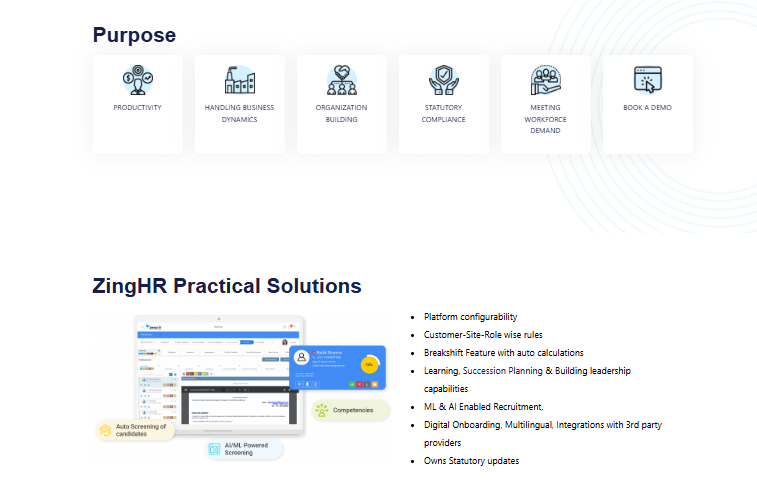
6. ZingHR: The Shift-Biased Choice for Field-Heavy Healthcare Operations
Overview
ZingHR is a Mumbai-origin HCM with shift and payroll depth, often deployed in manufacturing-adjacent healthcare, including pharma, diagnostics field teams, and medical device companies. Reviews flag UX and support instability as recurring concerns. For a structured comparison, see HROne vs ZingHR.
Core Services
- Workforce plus Payroll plus Learning modules.
- Hire-to-retire workflow library with shift bias.
🇮🇳 India Compliance
- PF/ESI/TDS/PT: ✅ Yes.
- NABH: ❌ Not addressed.
Who This Is Built For
- Field-heavy pharma and diagnostics teams with rotational shift needs.
Who Should Skip
- Hospital HR teams prioritising modern mobile UX.
Pricing
- Quote-based; not publicly disclosed.
Reviews
“App simply doesn’t work, countless tries to troubleshoot have been unfruitful. I cannot do anything on my mobile, be it apply for leaves or submit a reimbursement.”
— Piyush G., Enterprise User (0/5) ZingHR – G2 Verified Review
“System implementation experience was horrible. In 6 months the implementation was barely completed to 40%.”
— Sanmeet S., Mid-Market User (2/5) ZingHR – G2 Verified Review
7. Pocket HRMS: Hospital Payroll with a Healthcare Landing Page
Overview
Pocket HRMS maintains a healthcare-specific payroll landing page, popular among small-to-mid Indian hospitals looking for India-compliant payroll and attendance without enterprise breadth. See HROne vs Pocket HRMS for a detailed comparison.
Core Services
- Payroll plus Attendance plus Leave core bundle.
- smHRt chatbot for employee queries.
- Biometric integration with common Indian hardware brands.
🇮🇳 India Compliance
- PF/ESI/TDS: ✅ Yes.
- NABH: ❌ Not marketed.
Who This Is Built For
- 100 to 500 staff hospitals and diagnostic labs needing basic India-compliant payroll.
Who Should Skip
- Hospital chains needing performance management and engagement depth.
Pricing
- Tiered PEPM; quote-based for enterprise.
8. 247HRM: Compliance-First Landing Page for Hospitals
Overview
247HRM markets a dedicated “Payroll and HRMS Software for Healthcare” page emphasising shift attendance, compliance, and on-call handling, positioned for smaller Indian hospitals and clinics. Teams evaluating vertical fit may also review HROne’s healthcare HR page.
Core Services
- Payroll plus Attendance plus Leave with hospital-specific compliance framing.
- Statutory filings for PF/ESI/PT/LWF/TDS.
- Mobile ESS for nurses and doctors.
🇮🇳 India Compliance
- PF/ESI/TDS: ✅ Yes.
- NABH: ❌ Not addressed.
Who This Is Built For
- 50 to 300 staff single-site clinics and nursing homes.
Who Should Skip
- Multi-unit hospital chains needing analytics and engagement.
Pricing
- Quote-based; demo-led sales process.
9. PeopleStrong: Analyst-Recognised Enterprise HCM with Thin Healthcare Proof
Overview
PeopleStrong is a Gurgaon-based enterprise HCM and 4-time Gartner Peer Insights Customers’ Choice winner (2025, 4.7/5 from 594 reviews), the strongest analyst credential in this list. However, G2 review volume is only 72, SOC 2 is not confirmed (SOC 1 only), and no named Indian hospital case study with quantified outcomes exists in the public domain. For a like-for-like view, see HROne vs PeopleStrong.
Core Services
- Core HR plus Payroll plus Analytics plus Succession Planning enterprise suite.
- Jinie AI assistant for employee queries.
- Multi-entity configuration for large hospital groups.
🇮🇳 India Compliance
- PF/ESI/TDS: ✅ Yes.
- NABH: ❌ No dedicated healthcare case study.
Who This Is Built For
- 2,000+ employee hospital networks needing Gartner-recognised enterprise HCM.
Who Should Skip
- Mid-market hospitals wanting pricing transparency and healthcare-specific proof.
Pricing
- Quote-based; not publicly disclosed.
Reviews
“It’s easy to use, and all the tasks can be completed in one place. It hits the bulls eye with exactly what any user would expect from their HRMS app.”
— Aswath B., Mid-Market User (5/5) PeopleStrong – G2 Verified Review
“The reimbursement and claims process can feel a bit slow at times, especially when approvals take longer than expected. The interface can also lag occasionally.”
— Anusha, Enterprise User (5/5) PeopleStrong – G2 Verified Review
10. SAP SuccessFactors: Global HCM for 5,000+ Hospital Networks on SAP ERP
Overview
SAP SuccessFactors is a global cloud HCM best suited for large multinational hospital networks already running SAP ERP. For the 100 to 5,000 employee Indian hospital sweet spot, it is over-engineered, costly to customise, and demands back-end developer tickets for routine policy changes. See HROne vs SAP for the mid-market angle.
Core Services
- Employee Central plus Payroll plus Performance plus LMS global suite.
- Joule AI assistant for workflows.
🇮🇳 India Compliance
- Partial via localised add-ons; developer-dependent.
Who This Is Built For
- 5,000+ employee hospital networks on SAP ERP with global-India consolidation.
Who Should Skip
- Any Indian hospital under 2,000 employees. Implementation timelines and TCO are not justified.
Pricing
- Quote-based; implementation via partner.
Reviews
“Not user-friendly, system often freezes… Customization requires third-party vendors, every change is costly. Extremely expensive for what it delivers, Ferrari price, Trabant value.”
— Janka Z., Enterprise User (0/5) SAP SuccessFactors – G2 Verified Review
“The most basic functionality is missing or severely flawed. If I could, I would take back our decision to implement the software.”
— Verified User, Internet (0/5) SAP SuccessFactors – G2 Verified Review
Q2. How Was This List Scored, The 100-Point Healthcare HRMS Selection Criterion and Star Ratings?
Each of the ten platforms was scored against a transparent, weighted 100-point rubric calibrated for Indian hospital HR realities, not a generic SaaS feature matrix. The five criteria are Shift Roster and Nurse Scheduling Depth (25%), Statutory and NABH Compliance (25%), Setup, Usability, and Support (20%), Pricing Transparency and Billing Model (15%), and Verified Healthcare Proof (15%). Raw scores then map to a 1 to 5 star band, and HROne lands at 92/100, giving it a five-star rating. Teams running a structured buy can also review our how to choose HR software for healthcare checklist alongside this rubric.
The Scorecard, What Each Weight Actually Measures
| Criterion | Weight | What It Measures |
|---|---|---|
| Shift Roster & Nurse Scheduling Depth ⏰ | 25% | Rotational, split, cross-midnight, on-call, and floater patterns; biometric and face-recognition attendance across OPD, ICU, and lab blocks; geo-fencing for field medical reps. |
| Statutory & NABH Compliance ✅ | 25% | PF/ESI/PT/LWF/TDS accuracy, Labour Code 2025 changelog evidence effective 21 November 2025, wage-code 2-day FFS settlement, and NABH 6th Edition HRM documentation support. |
| Setup, Usability & Support | 20% | G2 ease-of-use, mobile ESS for clinical staff on low-connectivity wards, SPOC vs ticket-only support, and published NPS. |
| Pricing Transparency & Billing Model 💰 | 15% | Flat PEPM vs quote-based; billing from day-one vs after go-live; multi-entity charges; lock-in clauses. |
| Verified Healthcare Proof | 15% | Named Indian hospital clients with quantified outcomes, including man-hours saved, onboarding time reduced, and retention uplift. |
Star Bands and Final Scores
Star mapping is straightforward: 0 to 20 = 1★, 21 to 40 = 2★, 41 to 60 = 3★, 61 to 80 = 4★, 81 to 100 = 5★.
| Rank | Platform | Score | Rating |
|---|---|---|---|
| 1 | HROne | 92 | ⭐⭐⭐⭐⭐ |
| 2 | Darwinbox | 74 | ⭐⭐⭐⭐ |
| 3 | PeopleStrong | 70 | ⭐⭐⭐⭐ |
| 4 | Keka | 62 | ⭐⭐⭐⭐ |
| 5 | GreytHR | 58 | ⭐⭐⭐ |
| 6 | ZingHR | 55 | ⭐⭐⭐ |
| 7 | Pocket HRMS | 52 | ⭐⭐⭐ |
| 8 | 247HRM | 48 | ⭐⭐⭐ |
| 9 | Zoho People | 45 | ⭐⭐⭐ |
| 10 | SAP SuccessFactors | 40 | ⭐⭐ |
How to Replicate This Scoring on Your Own Shortlist
A procurement committee can re-run the same evaluation in a two-week RFP window by executing five concrete tests against each vendor demo:
- Build a nurse roster with fatigue rules (max consecutive nights, minimum rest hours) and credential validation (NMC, BLS, ACLS), and check whether the platform blocks non-compliant assignments at source.
- Run a shift-linked payroll cycle for a 200-nurse sample with night allowance, on-call, and split-shift exceptions, and verify PF/ESI/PT/LWF/TDS auto-computation and Labour Code 2025 wage-structure logic. A reference on statutory compliance in payroll helps frame the test.
- Trigger a confirmation workflow across three legal entities with different state PT rules, and observe whether one instance resolves it or parallel tenants are needed.
- Validate the HIS integration path (HL7/FHIR/REST) for duty-roster and credential-status exchange with Medixcel or Birlamedisoft. See HROne’s integrations page for the reference architecture.
- Export a ROI dashboard with cost-per-hire, attrition cost, and revenue-per-clinician for a board review, and time how long it takes without Power BI. Our ROI calculator models the same math.
Why HROne Tops the Scorecard
HROne earns the top score because Super Inbox, 127 pre-built workflows, the inbuilt ROI Dashboard, and HRV Studio together cover all five evaluation steps natively inside one instance. Our consolidated architecture is what turns a two-week procurement test into a one-screen workflow for the Hospital HR Ops Lead.
Q3. What Operational Must-Haves Define a Healthcare HRMS in India, Shift Rosters, Shift-Linked Payroll, Biometric Attendance, and PF/ESI/PT/LWF/TDS Compliance?
Hospital HR breaks because rosters, on-call pay, biometric attendance, and payroll usually live in three to four disconnected systems that cannot propagate shift exceptions into salary. The fix is a shift-to-payroll data pipeline with India-compliant PF/ESI/PT/LWF/TDS firing at source, not a better standalone payroll software bolted onto the same fragmented stack.
The Daily Reality Inside a 200 to 1,000 Bed Indian Hospital
A typical 600-bed multi-speciality hospital runs 8-hour and 12-hour rotating nurse shifts (morning 6am to 2pm, afternoon 2pm to 10pm, night 10pm to 6am), on-call duty for consultants, floater shifts for emergencies, and agency staff during peak demand. Biometric and face-recognition devices sit across OPD, ICU, and lab blocks, syncing into a standalone attendance portal. HR then exports CSVs, reconciles them against a leave module, stitches CTC revisions from email, and feeds the composite file into an outsourced payroll vendor. The result is a 10-day payroll cycle, month-end grievance spirals, and a Payroll Manager who spends the first week of every month firefighting instead of planning. A stronger attendance management layer is the first place to collapse that chaos.
Where Generic HRMS Platforms Quietly Break
Darwinbox, Keka, and GreytHR all ship competent payroll engines, yet they treat roster, biometric, and statutory logic as separate modules that exchange data in batches, not streams.
- Shift exceptions (swap, OT, and night-allowance eligibility) require manual reconciliation before payroll close.
- Multi-state PT matrices and the Labour Code 2025 wage-structure rule (basic plus DA ≥ 50% of CTC) become error-prone the moment a hospital group operates across three or more states.
- Wage-code 2-day FFS settlement triggers incorrect paycheques when attendance correction arrears are not auto-propagated from time-office data.
Better computation on fragmented data produces faster wrong answers, not accurate ones.
The Architectural Shift, Payroll Accuracy Is a Data-Propagation Problem
The real fix is not a smarter computation layer. It is removing the manual handoffs between attendance, leave, CTC, and payroll entirely. That means an auto-scheduler that fires recurring payroll runs the moment attendance is marked, group payout validations that check every payslip for statutory compliance before disbursal, and entity-wise PF/ESI/PT/LWF/TDS rules that execute at source instead of at a reconciliation spreadsheet. When the pipeline is unified, every roster swap, leave, OT approval, and arrear computation lands as a single event the payroll cycle consumes, not five events five teams chase down before the 7th of the month. See our primer on integrating payroll with attendance for the data-flow pattern.
How HROne Collapses the Cycle
At HROne, we run this as one surface. The HR inbox closes roster swap, leave, OT approval, and payroll arrears in three clicks, 127 pre-built workflows include shift-linked confirmation and the 2-day FFS clearance the new wage code mandates, and the Auto-Scheduled Payroll engine triggers the run the moment the Time Office module closes. MR DIY India, a 540-employee, 4-entity deployment analogous in complexity to a mid-size hospital chain, cut its payroll cycle from 10 days to 5 or 6 days after consolidating onto one instance, the same pattern we see at Asia Healthcare Holdings across 80 locations. Read the MRDIY case study for the full teardown.
What Hospital HR Operators Say About the Shift
“Zero-touch payroll and compliance automation… It handles salary calculations, statutory deductions PF, ESI, taxes, and filings automatically, with zero manual intervention, removing payroll errors and compliance anxiety during audits.”
— Waldon S., Enterprise User HROne G2 – Verified Review
“Real time sync of biometric and mobile mark punch functionality available… Arrear day calculation is correct… Salary processing to last creation of bank Challan files is quick and systematic process with error free details.”
— Deepak K., Mid-Market User HROne G2 – Verified Review
“Previously we had lot of mess in this section… Salary processing along with deduction slabs are working perfectly as per Indian tax compliances.”
— Sanjeev K., Mid-Market User HROne G2 – Verified Review
Q4. How Do You Run Clinical Workforce Intelligence, Nurse Rostering, Credential/License Expiry, Nurse-to-Patient Ratios, Fatigue Rules, NABH Audit Readiness, and Locum/VMS Staffing?
Seven capabilities define clinical workforce intelligence in 2026: AI nurse rostering with skill and certification validation, credential and license expiry tracking (NMC, state council, BLS, and ACLS), nurse-to-patient ratio enforcement, fatigue and rest-period rules, NABH human-resource audit trail, locum and VMS contingent staffing, and mobile ESS for low-connectivity clinical staff. Most Indian HRMS listicles omit at least four of these. A sharper view on workforce management fundamentals helps contextualise the list.
The Seven Must-Haves and Why Each One Matters
✅ AI nurse rostering with skill and certification validation blocks non-compliant assignments before the shift is published, replacing Excel swap chains that typically cause ~30% of last-minute roster changes at Indian hospital chains.
✅ Credential and license expiry tracking across NMC and state council registrations, BLS/ACLS renewals, and paramedic certifications must be tracked with expiry alerts and renewal workflows, not generic document storage. This is a genuine gap in most generic HRMS platforms.
✅ Nurse-to-patient ratio enforcement aligns with NABH HRM.1 staffing evidence and protects patient-safety outcomes during peak ICU and OPD load.
✅ Fatigue and rest-period rules around max consecutive nights and minimum rest hours drive incident-risk reduction and attrition control, particularly for metro hospitals running 18 to 25% annual nurse attrition.
✅ NABH 6th Edition HRM audit trail is mandatory from 1 January 2025 for new applicants, covering staff credentialing, training records, performance appraisal, and grievance handling in a documentable, digital format.
✅ Locum and VMS contingent staffing covering visiting consultant professional fees, agency nurse vendor management, and CLRA contract-labour compliance is widely covered on global healthcare-staffing SERPs but near-absent from Indian HRMS pages.
✅ Mobile ESS for low-connectivity nurses needs offline mode for basement labs, ICU corridors, and shop-floor-equivalent clinical zones. The Play Store review volume is the real evidence here, not the marketing page. A dedicated mobile HR app closes that last-mile problem.
A Five-Step Evaluation You Can Run in a Demo
- Load a real nurse roster for one ward and trigger a credential-expiry alert 30 days out, and check whether the system blocks the assignment or only flags it.
- Simulate a nurse-to-patient ratio breach at shift change, and verify whether the platform prevents publication or logs it for NABH review.
- Run a 14-day fatigue rule (max 4 consecutive nights, min 11 rest hours) and assign a nurse violating it. The correct behaviour is a hard block, not a warning.
- Export a NABH HRM evidence bundle (credentials, training, appraisal, and grievance) and time how long it takes to produce audit-ready output.
- Onboard a locum consultant with a distinct professional-fee payout rule separate from permanent payroll, and confirm the payroll engine keeps them in different streams.
Context That Most Indian HRMS Pages Ignore
The Labour Codes effective 21 November 2025 consolidated 29 labour laws and mandated the 50% wage-definition rule plus 2-day FFS settlement. Hospital HR cannot absorb these changes on a payroll engine that has not published a post-November-2025 changelog. NABH 6th Edition additionally requires digital staff training records, RBAC, and audit trails. Evaluation should reject any vendor that claims “supports healthcare compliance” without specifically demonstrating the HRM chapter. On the contingent-labour side, global VMS and locum-staffing platforms are a recognised category abroad, yet Indian HRMS listicles typically bundle these into “contract labour” without separating professional fee streams from permanent payroll. For broader context, see navigating labor laws.
How HROne Covers the Clinical-Workforce Layer
At HROne, HRV Studio ships a credential-expiry tracker and a locum-onboarding app in under an hour without raising a developer ticket, the Time Office and core HCM modules enforce fatigue and ratio rules natively, and the ROI Dashboard exports NABH-ready HR metrics without a separate Power BI overlay. Combined with Asia Healthcare Holdings running 80 locations on one instance, the clinical-workforce layer sits inside the same Super Inbox that the HR Ops Lead already uses for leave, payroll, and helpdesk, not a separate clinical-staffing tool bolted on from outside. Teams evaluating vertical fit can also walk through the healthcare HR overview.
Q5. How Should HRMS and HIS Integrate Across Multi-Unit Hospital Chains with Multi-Legal-Entity PF/ESI and Unified RBAC?
HIS owns patient and clinical workflows; HRMS owns the employee lifecycle, shift rosters, payroll, and compliance, and the two should integrate via HL7/FHIR/REST APIs, not replace each other. Multi-unit hospital chains should run one HRMS instance with entity-wise PF/ESI/PT/LWF/TDS, unified RBAC, and a consolidated ROI view, not parallel HRMS tenants per unit, which is where most Indian deployments quietly leak strategic visibility. Teams architecting this shift can start with the healthcare HR overview.
HIS vs HRMS, Who Owns What
| Dimension | HIS (Hospital Information System) | HRMS / HCM |
|---|---|---|
| Scope | Patient records, OPD/IPD, pharmacy, billing, and lab orders | Employee lifecycle, rosters, payroll, compliance, and performance |
| Data owned | Patient IDs, clinical notes, and revenue-per-bed | Employee master, CTC, attendance, and credentials |
| Primary users | Doctors, nurses, lab technicians, and billing team | CHRO, HR Ops, Payroll Manager, and employees |
| India-fit anchor | NABH clinical chapters, HL7 FHIR | NABH HRM chapter, Labour Code 2025, and PF/ESI/PT |
| Typical vendors | Medixcel, Birlamedisoft, and Suvarna | HROne, Darwinbox, and Keka |
Single-Instance Multi-Entity vs Parallel-Tenant
| Trade-off | Single-Instance Multi-Entity ✅ | Parallel Tenants Per Unit ❌ |
|---|---|---|
| PF/ESI/PT rules | Entity-wise firing at source | Duplicated, manual sync |
| RBAC | One role matrix across units | Re-provisioned per tenant |
| ROI view | Consolidated dashboard | PPT stitching every quarter |
| Data migration on M&A | Add an entity in hours | New tenant plus re-implementation |
| Licence cost | Flat PEPM pooled | Per-tenant minimums stack up |
The Integration Blueprint Most Chains Should Adopt
A clean integration architecture between HIS and HRMS solves both the clinical-ops and the finance-ops problem without overlap. The reference path lives on the HROne integrations page.
- 🔁 HRMS to HIS: published nurse duty roster and credential status fed to HIS for ward-display and patient-assignment logic.
- 🔁 HIS to HRMS: clinical hours per clinician and revenue-per-bed pulled into the HRMS ROI Dashboard for cost-per-clinician analytics.
- 🔁 Within HRMS: entity-wise PF/ESI/PT/LWF/TDS fires at source, one RBAC matrix controls payroll visibility, and Super Inbox routes every shift, leave, and FFS exception in a three-click flow. See HR inbox for the interaction model.
- 🔁 External: biometric brands (eSSL, ZKTeco, and Matrix), SSO via Active Directory, and Tally/SAP JV export keep existing hardware and finance stacks untouched.
Where Competing HRMS Fall Short
Darwinbox and Keka often deploy separate instances per legal entity at mid-market hospital groups, which forces manual consolidation at group CHRO level. Zoho People under-serves multi-OU structures, and SAP SuccessFactors needs a back-end developer ticket every time a leave policy changes across a hospital, diagnostics, pharmacy, and nursing-school combination. None of them publish an entity-wise PF/ESI rule firing at source with a single RBAC matrix. The typical workaround is a Power BI overlay that reconciles nightly, exactly the manual touchpoint this architecture is meant to eliminate. A side-by-side view lives at HROne vs Darwinbox.
How HROne Runs This Architecture
At HROne, the Multi-Entity Console, front-end policy engine, and marketplace HIS integrations let Asia Healthcare Holdings run 80 pan-India units on one HROne instance, with entity-wise compliance and consolidated ROI reporting out of the box. Our front-end policy engine means the HR user changes a state-specific PT or Labour Code wage rule without raising a developer ticket, the same shift that turns SAP deployments into 9-month projects. Compare the architectural difference at HROne vs SAP.
The Decision Rule
Do not buy a “healthcare HRMS” that duplicates HIS functionality. Buy an HR-native system with a clean HIS integration path, entity-wise compliance, and a consolidated ROI view. Every hospital chain that treats HRMS as a patient-adjacent system ends up paying twice, once to the HIS vendor and once to a Frankenstein HR stack that still cannot close a confirmation letter in three clicks.
What Operators Say
“HCM supports JV integration and GL code logic also… HCM supports MS-SQL and API management for the integration purpose.”
— Deepak K., Mid-Market User HROne G2 – Verified Review
“Integration without oracle software properly, monthly salary journal report is not proper… no separate report for on-roll salary processed monthly.”
— Verified User, Textiles Keka – G2 Verified Review
Q6. Which HRMS Should Your Hospital Choose in 2026, CHRO Decision Framework, Consolidation Economics, Implementation Timelines, and Total Cost?
The short answer depends on bed size and legal-entity complexity: SMB clinics under 200 employees, GreytHR or Zoho People; mid-market 200 to 1,000 bed single-entity hospitals, HROne or Keka; multi-unit chains 1,000 to 5,000 employees, HROne or Darwinbox; 5,000+ networks already on SAP ERP, SAP SuccessFactors. Evaluate on AI depth, multi-entity architecture, NABH readiness, ROI provability, and billing-after-go-live. Our how to choose HR software for healthcare checklist formalises the rubric.
CHRO 2026 Decision Matrix
| Hospital Profile | Key Need | Recommended Shortlist |
|---|---|---|
| 50 to 200 staff single clinic | India statutory basics | GreytHR, Zoho People |
| 200 to 1,000 bed single entity | Modern UX plus shift payroll | HROne, Keka |
| 1,000 to 5,000 multi-unit chain | One instance plus ROI board view | HROne, Darwinbox |
| 5,000+ global network on SAP | Global HCM consolidation | SAP SuccessFactors |
G2 benchmarks reinforce the shortlist. HROne ranks #3 globally on satisfaction with an NPS of 9.8, while Keka sits at #16 on ease-of-use and #55 on overall satisfaction, and GreytHR trails on global rank #42. See HROne vs Keka and HROne vs greytHR for structured teardowns.
Killing the Frankenstein Stack, The Consolidation Economics
A 600-bed hospital running an outsourced payroll vendor, biometric portal, standalone ATS, Excel, and WhatsApp engagement typically burns:
- 💸 10-day payroll cycles with month-end grievance spirals.
- 💸 2 to 4% expense leakage through manual receipt touchpoints.
- 💸 3 to 5 vendor invoices versus one flat PEPM line item.
- 💸 PowerPoint-gated attrition reporting instead of a live dashboard.
The bundle 98% of HROne customers run, core HCM plus Time Office plus Payroll plus Workforce on one Super Inbox, collapses this patchwork into one reconciled ledger and moves the cycle to 5 or 6 days.
Implementation, Support, and Total Cost
Expect a 30 to 90 day go-live for a mid-market hospital, with the longer end tied to biometric integration across units and credential clean-up.
- ⏰ Go-live: HROne mid-market reference is 30 days (MR DIY India); Keka cites 25 days on one non-healthcare case; Darwinbox reviews report longer timelines at scale. Read the MRDIY case study for the full teardown.
- 💰 Pricing: HROne flat PEPM from ₹6,999/month on the Professional plan tier with ₹130 per additional user; Keka ₹6,499/mo Foundation with shift add-on ₹20 PEPM; Darwinbox and PeopleStrong are quote-based. Full details on pricing.
- 📞 Support: HROne ships a dedicated prior-HR SPOC with phone, email, and 24-hour SLA; Keka and GreytHR are predominantly ticket-based.
- ⚠️ Watchouts: day-one billing on Darwinbox (review-reported), multi-year lock-ins, and Keka’s 2× monthly setup fee with quarterly minimum billing.
Key Risks on the Path to Go-Live
- Data migration from outsourced payroll vendor with CTC structure reconciliation.
- Biometric integration across OPD, ICU, and lab blocks with existing hardware brands.
- Credential clean-up for NMC, state council, and BLS/ACLS expiry dates.
- Nurse change-management on the mobile ESS, especially for staff with lower digital literacy.
Why HROne Wins the Mid-Market and Multi-Unit Brackets
HROne wins on five structural advantages no competitor bundles together: flat PEPM, billing after go-live, a Multi-Entity Console for unlimited units on one instance, the inbuilt ROI Dashboard, and HRV Studio for NABH and credential apps without developer tickets. The prior-HR onboarding consultant model is the difference between a project manager reading a checklist and someone who has actually closed a payroll cycle. The prescriptive next step is to run HROne’s ROI calculator against your current vendor spend before booking any demo.
What Buyers Report
“I love HROne for its cost efficiency and holistic approach… the ability to manage various HR processes from a single platform is incredibly convenient and cost-effective for mid-level and enterprise customers.”
— Priyanka S., Mid-Market User HROne G2 – Verified Review
“Bad implementation experience, bad UI/UX, configurations getting broken in production on its own due to product deployments, terrible customer service.”
— Verified User, Computer Software Darwinbox – G2 Verified Review
“From Friday evening 6PM to Monday morning 10AM there is no source of support from KEKA, telephonic communication to a POC during emergency is not possible.”
— Prem K., Mid-Market User Keka – G2 Verified Review
Q7. Ready to Run Your Hospital’s HR on One India-Compliant Platform?
Running nurse rosters, shift-linked payroll, credential tracking, and multi-unit PF/ESI from one Super Inbox is exactly what HROne was built for, not a patient-adjacent bolt-on, not a generic global HCM, and not a payroll-only SMB tool.
The Proof Mid-Market Hospital Chains Can Benchmark Against
HROne’s Multi-Entity Console runs unlimited hospital units from a single instance with entity-wise compliance, unified RBAC, and consolidated ROI out of the box. Asia Healthcare Holdings runs 80 pan-India units on one HROne instance with multi-legal-entity configuration, and MR DIY India, a 540-employee, 4-entity deployment analogous in complexity to a mid-size hospital chain, went live in 30 days and moved its payroll cycle from 10 days to 5 or 6 days. More similar stories live at customer success stories.
What That Translates To For A Hospital HR Operator
✅ One Super Inbox closing roster swap, leave, OT, and FFS in three clicks.
✅ 127 pre-built hire-to-retire workflows covering nurse onboarding process through FFS.
✅ Inbuilt ROI Dashboard exporting NABH-ready HR metrics without Power BI.
✅ HRV Studio for credential-expiry and locum-onboarding apps without developer tickets.
💡 The Simplest HR Software for Indian Healthcare
The Simplest HR Software for Indian Healthcare
Trusted by 1,500+ brands and over 10 lakh users across manufacturing, ITeS, BFSI, and healthcare, with G2 2026 Best Software Awards ranking HROne #1 in India, #1 in APAC, and Top 3 globally on satisfaction.
👉 Book a DemoSee the Super Inbox, Multi-Entity Console, and ROI Dashboard running on a hospital-shaped data model.
Still Comparing?
- 🔗 HROne vs Darwinbox, side-by-side on multi-entity, billing, and support model.
- 🔗 HROne Pricing, flat PEPM, go-live billing, no lock-in, and transparent module gating.
Shortlist with numbers, not marketing pages. Your next payroll cycle will thank you for it.













 Secures Top Spot in
