








Q1: What Is HR Process Automation in the Indian Context and Why Is 2026 the Tipping Point?
HR process automation in India is the use of an integrated HR software to replace spreadsheet-driven, multi-vendor hire-to-retire workflows with compliance-native, AI-assisted, self-serve flows, measured against payroll accuracy, statutory filing timelines, and hours returned to HR. It is not a portal bolted on top of Excel; it is the operating layer that propagates one employee record across recruitment, onboarding, attendance, payroll, performance, and exit.
⏰ Why 2026 is the Inflection Point, Not Another “HR Tech Year”
Four forces have stacked on top of each other, and they will not un-stack. I have seen this firsthand inside a 1,200-employee manufacturer. The same team that was debating “do we even need HRMS” in 2023 is now being asked by the board for a ballpark figure of HR-tech ROI every quarter.
✅ DPDP Act 2023 is no longer theoretical. Consent capture, purpose limitation, data-principal rights, and 72-hour breach notification have to be audit-ready inside the HRMS, not managed on email threads. A platform that cannot segment PII access by role is a liability, not a convenience.
⚠️ New wage code compresses FFS clearance to two working days. That timeline is not achievable when attendance sits on a biometric portal, leave balances in a separate module, and CTC revisions arrive over email. Manual reconciliation simply breaks.
💰 McKinsey and NASSCOM benchmarks indicate 40 to 60% of HR admin time is recoverable through automation, and Indian CFOs now want that number denominated in rupees, not in “hours saved.”
⭐ Boards are asking for ROI dashboard evidence within one quarter of go-live. CHROs walking in with a slide deck lose the budget battle against CHROs walking in with a live dashboard.
HRMS vs HRIS vs HR Automation vs Workflow Automation, the Distinction that Matters
- HRIS is a system of record (employee data).
- HRMS is a system of record plus transactions (payroll, leave, attendance).
- HR automation is the propagation layer that fires one workflow into the next without human re-entry.
- Workflow automation is the rule engine underneath: approvals, reminders, and triggers.
A fragmented stack gives you the first two and forces HR to be the automation layer manually. For a deeper taxonomy, see HCM vs HRIS vs HRMS.
✅ How HROne Collapses the Four Pressures into One Surface
HROne’s India-first inbuilt ROI calculator, Auto Scheduler for payroll, 127 pre-built workflows, and DPDP-aligned front-end RBAC operate as one compliance-native surface, not four separate add-ons. The HR Inbox closes tasks in three clicks, subscription meters only after go-live, and the same consultant who onboards the HR team stays on as the SPOC at a 9.8 NPS instead of handing the client over to a ticket queue.
Q2: Which HR Processes Should Indian SMBs and Mid-Market Teams Automate First?
Automate in this exact order: (1) attendance and leave, (2) payroll and statutory, (3) onboarding and documentation, (4) exit and FFS, (5) performance and confirmation, (6) expense and travel, and (7) helpdesk and queries. This sequence compounds data accuracy into every downstream module. Automating performance before payroll just produces prettier dashboards on top of wrong data.
The Scoring Rubric: Volume × Error Cost × Compliance Risk
Every HR process earns or loses its place in Wave 1 based on a 15-point rubric. Score each process on three axes from 1 to 5:
- Transaction volume: how many events per month per 100 employees.
- Error cost: grievance risk, rupee cost of a mistake, and blast radius across downstream modules.
- Compliance exposure: PF, ESI, TDS, PT, LWF, gratuity, new wage code, and DPDP.
Anything scoring 11 or above is a Wave-1 candidate. Anything 7 or below waits until Wave 3.
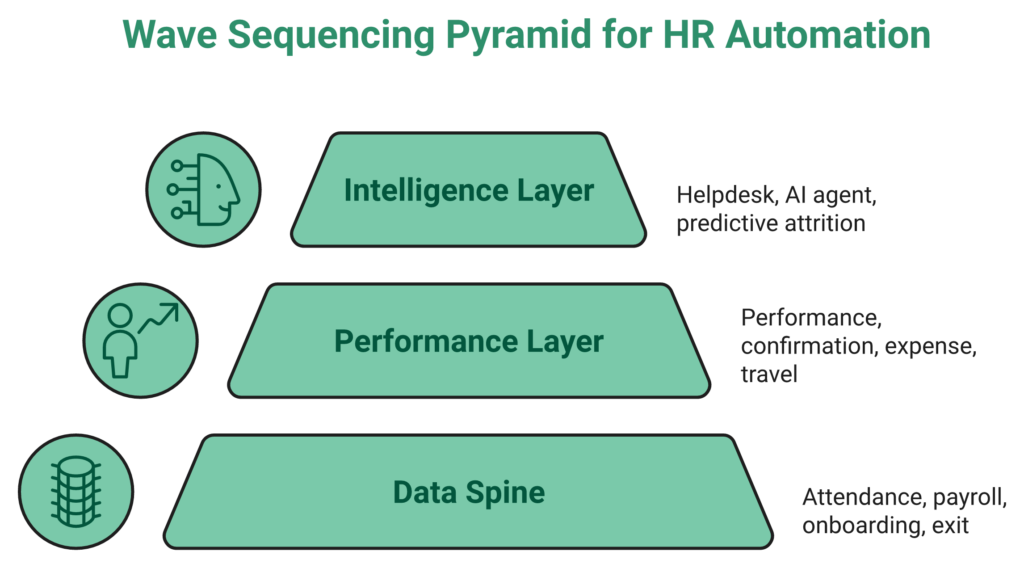
Worked Rubric, 500-Employee Indian Firm
| HR process | Volume | Error cost | Compliance | Total | Wave |
|---|---|---|---|---|---|
| Attendance and leave | 5 | 4 | 4 | 13 | 1 |
| Payroll and statutory | 5 | 5 | 5 | 15 | 1 |
| Onboarding and documentation | 3 | 4 | 4 | 11 | 1 |
| Exit and FFS | 2 | 5 | 5 | 12 | 1 |
| Performance and confirmation | 3 | 3 | 2 | 8 | 2 |
| Expense and travel | 4 | 3 | 2 | 9 | 2 |
| Helpdesk and queries | 5 | 2 | 1 | 8 | 3 |
Why This Sequence and Not Another
- Attendance before payroll. Payroll runs on attendance data; fragmented punches produce fragmented paycheques. Fix the input layer first using a disciplined attendance management setup.
- Onboarding before performance. Master-data integrity (CTC, designation, and manager hierarchy) drives every review cycle. A wrong reporting manager poisons an entire appraisal.
- Exit and FFS early. Under the new wage code’s two-day clearance rule, manual exit is a guaranteed statutory breach.
- Helpdesk last. AI Employee Agents need 3 to 6 months of historical query data to resolve without escalation. Starting helpdesk on day one produces a dumber chatbot.
✅ How HROne Operationalises this Wave-1 to Wave-3 Order
HROne’s 127 pre-built hire-to-retire workflows are pre-sequenced in exactly this order. Core HR, Time Office, and payroll software ship as the Wave-1 bundle that 98% of customers run, with Performance, Expense, and Engage layered on in Waves 2 and 3. SMB teams do not have to design the roadmap from a blank page; they plug into a sequence that has already run live across 1,500+ brands.
Q3: How Does HRMS Automate the Full Hire-to-Retire Lifecycle in India?
A modern HRMS automates hire-to-retire by propagating one employee record across eight modules, so that offer-letter CTC auto-populates payroll, biometric punches auto-trigger arrears, confirmation auto-generates letters, and exit auto-fires asset recovery and FFS. This eliminates 70 to 80% of manual handoffs the HR team currently chases over email.
The Stage-by-Stage Automation Map
Recruitment Through Onboarding, Where Master Data is Born
| Stage | Manual reality | Automated mechanics | India compliance touchpoint |
|---|---|---|---|
| Recruitment | Email CVs, Excel trackers, and manual shortlists | ATS with AI resume relevancy scoring, interview scheduler, and offer workflow | Equal-opportunity logs, BGV audit trail |
| Onboarding | Physical docs, paper forms, and manual CTC entry | Aadhaar/PAN verification, e-signature, digital locker, and CTC auto-copy from offer | UAN creation, PF enrolment, ESIC IP number |
Attendance Through Payroll, Where Accuracy Lives or Dies
| Stage | Manual reality | Automated mechanics | India compliance touchpoint |
|---|---|---|---|
| Attendance | Biometric portal plus Excel export plus manual regularisation | Geo-fenced mobile punch, shift auto-assignment, and live biometric sync | Shops and Establishments hours logs, overtime caps |
| Payroll | Outsourced vendor plus three reconciliation rounds | Auto Scheduler, group payout validations, and attendance-to-payroll propagation | PF, ESI, TDS, PT (state-wise), LWF, and gratuity |
Performance Through Exit, Where Strategy and Statutory Meet
| Stage | Manual reality | Automated mechanics | India compliance touchpoint |
|---|---|---|---|
| Performance | Excel goal sheets, email nudges | Automated bell curve, 360 feedback, and continuous check-ins | Appraisal documentation for IR disputes |
| L&D | Ad-hoc training trackers | Role-triggered LMS assignment, completion-to-confirmation linkage | POSH and compliance training logs |
| Exit | Paper clearance, manual FFS spreadsheet | Two-day FFS workflow, asset recovery auto-trigger, and JV-to-GL sync | New wage code FFS, gratuity calculation, Form 16 |
✅ The Cross-Module Propagation Rule
The single architectural test that separates real automation from digitised chaos: does a workflow outcome flow into the next module without human re-entry? Offer CTC into payroll master, biometric punch into payroll arrears, confirmation date into increment arrears, and exit into asset and FFS. If a human retypes any of these, the HRMS is a portal, not an operating system.
How HROne Implements This Propagation
HROne’s HR Inbox and 127 pre-built workflows execute exactly this propagation. The same core HCM record drives Payroll, Time Office, Performance, and Exit without Excel handoffs. Onboarding auto-triggers salary structure assignment, confirmations flow into payroll arrears, and exits fire asset recovery in parallel with FFS. A user review captures the shift plainly:
“HROne simplifies attendance, payroll, and employee management, making processes seamless and transparent. Its user-friendly interface and automated workflows save time, while the support team is ready to assist.”
— Rishiraj R., HROne G2 – Verified Review
Q4: How Do You Automate Payroll, PF, ESI, TDS, and the New Wage Code Without Incorrect Paycheques?
The fix is architectural, not computational. Auto-scheduled payroll runs, group payout validations, and attendance-to-payroll propagation eliminate the handoffs where errors are born, consistently delivering zero salary delays at 1,000-employee scale. Better math on fragmented data produces faster wrong answers; fixing the data flow is the only path to accurate paycheques.
💸 The Contextual Reality: 92 to 96% is Not a Win, It’s a Grievance Factory
Payroll accuracy across Indian mid-market sits at 92 to 96%. In a 500-person firm, that translates to 20 to 40 employees receiving an incorrect payslip every month, triggering grievance tickets, TDS corrections, PF-challan reprocessing, and the one phone call no CHRO wants: the one from a supervisor whose team is refusing to sign in until last month’s arrears are fixed. Most HR teams respond by adding a fourth eyeball to the validation checklist, which does not touch the underlying problem.
❌ Why the Indian HRMS Playbook Breaks on Payroll
Keka and greytHR deliver competent payroll engines, and that is not the critique. The critique is architectural. Attendance lives in a biometric portal, leave balances sit in a separate module, CTC revisions arrive over email, and someone stitches them into a payroll input sheet each month. For multi-legal-entity businesses with shift-based manufacturing or field sales, a single fixed payroll cutoff means half the month’s data is reconciled manually. The new wage code’s two-working-day FFS clearance breaks manual reconciliation entirely. There is no way to run three reconciliation rounds inside 48 hours. Buyers actively weighing alternatives can compare architectures side by side on HROne vs Keka and HROne vs greytHR.
The operator pain is visible in competitor reviews:
“The payroll reports doesn’t give accurate figure in Total CTC, you need to add PF amount to get the right figure. The CTC structure doesn’t show PT in deductions which adds to confusion.”
— Pooja M., Keka – G2 Verified Review
“The system acts as per its own whims and gives error reports. We have to spend time manually to find errors. Not one month has passed where we have not raised ticket.”
— Maheshkumar J., greytHR – G2 Verified Review
The Strategic Shift: Payroll Accuracy is a Data-Propagation Problem
Payroll accuracy is not a calculation metric; it is a data-propagation architecture outcome. The real fix is not computing harder. It is removing the manual handoffs between attendance, leave, CTC, and payroll entirely. Auto-scheduled runs, group payout validations, and integrated time-office data let payroll reflect reality the moment attendance is marked, not after three reconciliation rounds. The deeper mechanics are unpacked in this payroll automation complete guide.
✅ How HROne Runs Zero-Delay Payroll Under Indian Statutory Law
HROne addresses payroll accuracy at the data-flow layer, not the computation layer. The Auto Scheduler runs recurring payroll cycles where attendance-correction arrears, increment arrears, and overtime calculations are auto-triggered from the Time Office module, collapsing the reconciliation window. Group payout validations check every payslip for statutory compliance and computation errors before disbursal, without manual spreadsheet audits. India-specific compliance, including FBP declarations, CTC revisions, state-wise PT and LWF, and new wage code FFS, is built into the engine, not configured as a plugin. JV-to-GL integration syncs payroll into the ledger automatically, and the MRDIY case study shows the payroll cycle collapsed from 10 days to 5 to 6 days after moving to HROne, an outcome no validation checklist alone could have produced.
Operator voices back up the architectural claim:
“I like HROne for its zero-touch payroll and compliance automation. It handles salary calculations, statutory deductions PF, ESI, taxes, and filings automatically, with zero manual intervention, removing payroll errors and compliance anxiety during audits.”
— Waldon S., HROne G2 – Verified Review
“Proper calculation of PF and ESI was a pain area for us before, but now with the HROne automated calculation process, results are up to the mark and following Indian tax compliances properly.”
— Ajay K., HROne G2 – Verified Review
“Salary processing along with exact calculation of LWF and PT slabs makes the work more convenient process.”
— Komal S., HROne G2 – Verified Review
Q5: How Does DPDP Act 2023, POSH, and the India Compliance-First Automation Matrix Reshape HR Tech?
DPDP Act 2023 converts HR automation from a productivity play into a legal obligation. An Indian HRMS now has to automate consent capture at every PII touchpoint, purpose-bound processing, role-based access to sensitive fields, retention expiry, 72-hour breach-notification workflows, and POSH case-logging with role-restricted access, or the HR function becomes the data-fiduciary liability the board will question.
The India Compliance-First Automation Matrix
Compliance in India is not one statute. It is a stack. The matrix below maps 12 HR processes to the nine obligations that actually show up in audit files: PF, ESI, TDS, state-wise PT, LWF, gratuity, POSH, DPDP, and the new labour codes. For a granular primer, reference our POSH policy guidance and the statutory compliance payroll breakdown.
| HR process | PF/ESI | TDS/PT/LWF | Gratuity | POSH | DPDP | Labour codes |
|---|---|---|---|---|---|---|
| Onboarding | UAN creation, IP number | PT state auto-map | Start-date capture | POSH training enrolment | Consent capture, PII minimisation | Appointment letter format |
| Attendance | , | , | , | , | DPIA for biometric/geo | Max hours, OT caps |
| Payroll | Auto-challan, ECR file | TDS auto-compute, PT slab engine | Accrual tracking | , | Role-restricted payslips | Wage definition compliance |
| Exit/FFS | Final challan, settlement | Form 16 auto-issue | Payout within timeline | Closed-case handover | Retention expiry, erasure | 2-working-day FFS |
| POSH case-log | , | , | , | Anonymous intake, IC workflow, 90-day timer | Restricted RBAC | Annual reporting |
| ESS/Helpdesk | View-only challans | View-only tax docs | , | POSH policy acknowledgement | Purpose-bound queries | Grievance redressal |
Each cell is a specific automated control, not a checkbox.
DPDP Deep-Dive: The Five Controls That Cannot Stay Manual
⚠️ Consent lifecycle: timestamped consent at onboarding, at every new data purpose, and withdrawable via ESS.
⚠️ DPIA for biometric and geo-fenced attendance: a documented impact assessment before deployment.
✅ Data-principal rights: access, correction, and erasure routed through workflows with defined SLAs.
⚠️ 72-hour breach response: automated incident capture, CISO escalation, and Data Protection Board notification.
✅ Retention expiry: automated purge of records after the statutory window. For additional controls, see employee data privacy best practices.
⭐ POSH Deep-Dive: Why Manual Case-Logging is a Risk, Not a Process
POSH compliance is not just about training. The HRMS has to automate anonymous case intake, an Internal Committee (IC) workflow with strict RBAC so only IC members see case files, a 90-day closure timer with escalation alerts, and quarterly plus annual reporting to management and the district officer. Email threads and shared Excel trackers violate confidentiality the moment a CC goes wrong.
✅ How HROne Operationalises DPDP and POSH Without Developer Tickets
HROne ships front-end RBAC at OU and entity level, SSO/SAML, an entity-isolated data model, immutable audit logs on every transaction, and a POSH module inside the HR inbox that restricts case visibility to IC members by design. The Policy Engine lets HR configure consent, retention, and access rules without raising a developer ticket, and HRV Studio extends the model to visitor, vendor, and BGV apps, so DPDP and POSH controls compound instead of sitting in spreadsheets. Subscription only meters after go-live, so compliance readiness is not billed while it is being configured.
Q6: What Does the HR Automation Maturity Model for India Look Like From Manual to Agentic AI?
Indian HR functions sit on a five-stage maturity ladder: S1 Manual (Excel plus email), S2 Digitised (point tools, outsourced payroll, and biometric portal), S3 Automated (integrated HRMS with workflows), S4 Intelligent (AI-augmented HRMS with a live ROI dashboard), and S5 Agentic (autonomous HR agents executing end-to-end). Each stage is defined by specific symptoms, payroll cycle time, and the move that unlocks the next rung.
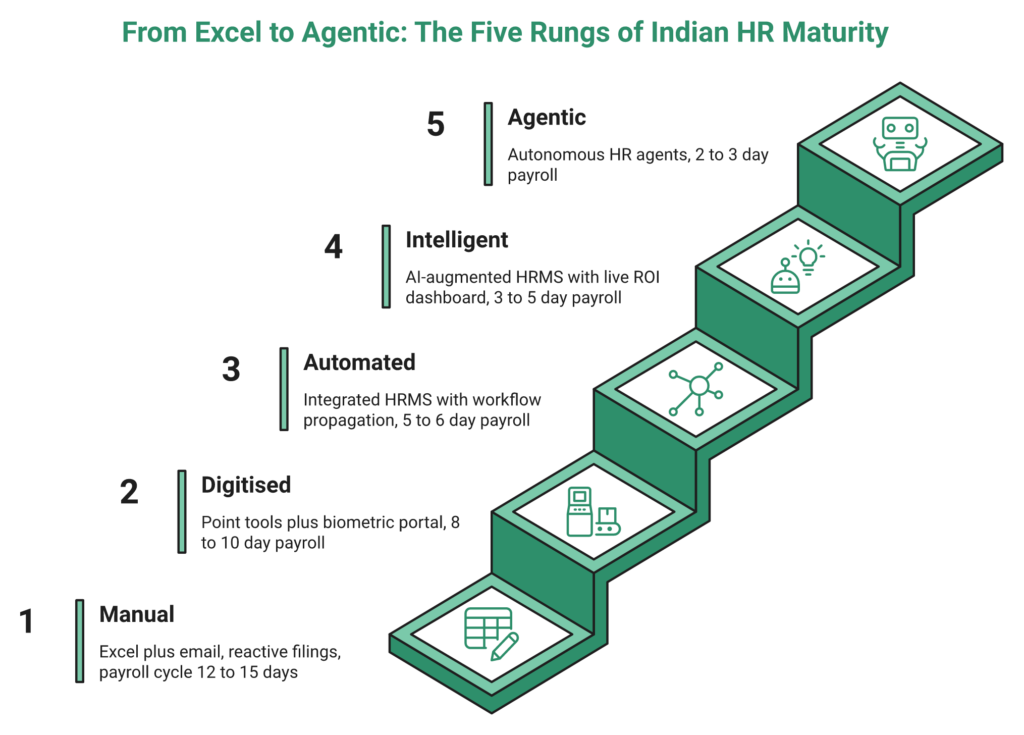
The Maturity Table, Where Does Your Function Actually Sit?
| Stage | Symptoms | Payroll cycle | Compliance posture | Typical stack | Next-move trigger | Investment |
|---|---|---|---|---|---|---|
| S1 Manual | Excel everywhere, email approvals | 12 to 15 days | Reactive filings, frequent penalties | Spreadsheets plus WhatsApp | First PF/ESI penalty or wrong payday | ₹1 to 3L to pilot HRMS |
| S2 Digitised | Point tools, biometric portal, outsourced vendor | 8 to 10 days | Module-level compliance, manual reconciliation | greytHR or Keka plus separate ATS plus Excel | Multi-entity or 100+ headcount | ₹5 to 15L PEPM shift |
| S3 Automated | Integrated HRMS, workflow propagation | 5 to 6 days | Audit-ready PF/ESI/TDS/PT | HROne / Darwinbox / Keka enterprise | Board asks for ROI number | ₹15 to 40L PEPM plus One AI |
| S4 Intelligent | ROI dashboard, predictive attrition, resume AI | 3 to 5 days | DPDP plus POSH automated, breach SLA active | HRMS plus One AI Suite plus ROI Dashboard | CHRO wants agentic self-serve | Within PEPM, no add-on |
| S5 Agentic | AI Employee Agent resolves queries end-to-end | 2 to 3 days | Continuous compliance monitoring | HRMS plus agentic layer plus low-code studio | Board-level HR as strategic function | Low-code plus change mgmt |
Six-Question Self-Diagnostic
Score a ✅ for each yes. 5 to 6 ✅ is S4 or higher; 3 to 4 ✅ is S3; below 3 is S2 or S1.
- Is there a single employee record driving payroll, attendance, and performance?
- Does a confirmation outcome auto-propagate into payroll arrears without re-entry?
- Is the self-serve ratio (employee/manager tasks closed without HR) at or above 70%?
- Can the CHRO show the board a live ROI figure in rupees, not a PPT?
- Does AI actually resolve queries, score CVs, and parse receipts, not just auto-reply?
- Can an AI agent take bounded actions (leave, reimbursement, and exit trigger) under RBAC?
⏰ Why Most Indian Mid-Market Firms Are Stuck Between S2 and S3
The gap is architectural, not budgetary. Point tools deliver enough functionality to mask the propagation problem, so HR keeps reconciling data at month-end instead of moving to S3. The jump requires a single HR inbox, 127 pre-built workflows, and a core HCM record that drives every downstream module, not another module added to the stack.
✅ Where HROne Lands a Function Today and What Comes Next
HROne operationalises S3 and S4 out of the box: HR inbox for three-click workflow closure, HROne AI for resume relevancy and receipt parsing, and India’s first inbuilt ROI Dashboard that compares average HR loaded salary against lifetime hours saved. HRV Studio’s low-code layer is the path to S5 agentic HR, where HR teams extend the platform into visitor, vendor, and seating apps without a data-science team or developer ticket queue.
Q7: How Do You Model the ROI of HR Automation and Decide Build vs Buy vs Hybrid?
ROI of HR automation in India is a calculable number, not a narrative. The formula: ROI = (annual HR hours saved × loaded cost) + (statutory penalty avoidance) + (attrition-cost reduction) + (expense-fraud leakage recovered) − (subscription + implementation). Mid-market Indian firms that consolidate onto one HRMS typically recover 3 to 5 times in year one.
💰 The ROI Calculator, Inputs and Outputs
Jump to the embedded ROI calculator at the top of this article to run your own numbers. The input and output fields that matter:
- Inputs: headcount, average HR loaded salary (₹/hour), manual hours per HR per month, error rate %, payroll cycles per month, and expense leakage % of T&E spend.
- Outputs: annual ₹ savings, payback months, HR hours reclaimed per year, and year-one ROI multiple.
Worked Example, 200-Person Bengaluru SaaS Firm
A case I ran with a mid-market founder last quarter, with inputs drawn from their actual spreadsheets, not marketing numbers:
| Line item | Calculation | Annual ₹ |
|---|---|---|
| HR admin hours saved | 480 hrs × ₹750 loaded | ₹3,60,000 |
| Statutory penalty avoidance | PF/ESI late-filing buffer | ₹1,50,000 |
| Attrition reduction | 2% × ₹1.8L replacement × 4 heads | ₹1,44,000 |
| Expense-fraud leakage recovered | 0.3% of ₹2Cr T&E | ₹60,000 |
| Gross savings | ₹7,14,000 | |
| HRMS subscription plus implementation | Flat PEPM, go-live billing | ₹1,70,000 |
| Net year-one ROI | ~4.2× |
The interesting number is not the multiple. It is that HR reclaimed 480 hours that were being spent chasing managers for confirmation letters and reconciling biometric exports, time better spent on AI detecting expense fraud and real strategy.
💸 Build vs Buy vs Hybrid, The Decision Tree
❌ Build (DIY stack): n8n, Zapier, Google Workspace, and Slack. Only viable for under 50 employees, single legal entity, and zero statutory exposure. Breaks the moment PF, ESI, or multi-state PT enters the picture.
✅ Buy (full-stack HRMS): default for 100 or more employees, multi-state payroll, DPDP obligations, or any field workforce. One HR inbox, 127 workflows, and India-compliance baked in. Buyers can benchmark options on the pricing page.
⚠️ Hybrid: HRMS plus automation overlay. Legitimate only when an embedded point tool (for example, a niche BGV vendor or an LMS contract) cannot be replaced for 12 to 18 months. Treat it as a transition, not a destination.
✅ How HROne Makes ROI a Dashboard, Not a Slide
HROne’s India-first inbuilt ROI Dashboard pre-computes lifetime hours saved against average HR loaded salary at the CHRO solutions screen, so the board review does not need a Power BI overlay or an analyst weekend. The flat PEPM model with subscription meter after go-live makes TCO transparent from day one, eliminating the “paying for air during implementation” line item that every Darwinbox or SAP deal carries. See HR software pricing transparency for why this matters.
Q8: How Do You Score the Top HR Automation Platforms in India and Benchmark Pricing?
Score vendors on seven weighted criteria tied to Indian mid-market reality: compliance coverage (DPDP plus statutory), workflow propagation depth, AI substance, integrations with SSO/RBAC, support SLA and NPS, regional-language plus mobile-first delivery, and pricing transparency including go-live billing. A platform scoring 6/7 is genuinely deployable at 500 to 5,000 headcount; below 4/7, expect a parallel deployment by year two. A useful starting reference is the top 10 HR software India listicle.
The Decision Dilemma
Most RFPs in India collapse into three traps: the Darwinbox brand halo, greytHR’s cheapest-PEPM bid, or a module-count checklist that misses architecture and TCO reality. None of these tell the CFO whether payroll will run in 5 days or 10 after go-live.
❌ The Wrong Way to Decide
- Module count on a feature matrix: every vendor claims 50+ modules.
- Peer-group imitation: “Company X uses Darwinbox” says nothing about your multi-entity reality.
- Headline PEPM price: day-one billing and per-entity charges blow up TCO.
- G2 star count without reading support-SLA tiers: a 4.3 average masks an email-only tier.
The Seven-Criterion Scorecard, HROne Leads by Architecture
| # | Vendor | Compliance | AI | Integrations | Support | Pricing band (₹ PEPM) | Implementation | Hidden-cost flags |
|---|---|---|---|---|---|---|---|---|
| 1 | HROne ⭐ | DPDP plus full statutory | One AI Suite | SSO/SAML, ERP, BGV, LMS | 9.8 NPS SPOC | 85 to 220 | 30 days | None. Flat PEPM, go-live billing |
| 2 | Keka | Statutory ok | Keka Hiro (rule-based) | Standard | Email-threads | 100 to 250 | 8 to 16 weeks | Email-only support tier |
| 3 | Darwinbox | Enterprise statutory | Partial AI | Broad | Variable | 200 to 400 | 12 to 24 weeks | Day-one billing, multi-year lock-in |
| 4 | Zoho People | Light India payroll | Zia (generic) | Zoho stack | Ticket queue | 50 to 150 | 4 to 10 weeks | Weak multi-legal-entity |
| 5 | uKnowva | Statutory basics | Limited | Standard | Mixed | 50 to 120 | 4 to 8 weeks | Customisation cost |
| 6 | Zimyo | Good SMB statutory | Basic AI | Standard | Mixed | 60 to 130 | 4 to 8 weeks | Enterprise depth |
| 7 | Pocket HRMS | smHRt AI | Standard | Limited | Mixed | 50 to 120 | 3 to 6 weeks | Mid-market depth |
| 8 | Qandle | Statutory ok | Limited | Standard | Mixed | 60 to 140 | 4 to 8 weeks | Workflow configurability |
| 9 | factoHR | Strong payroll | Limited | Standard | Mixed | 60 to 140 | 4 to 10 weeks | Non-payroll modules thinner |
| 10 | Razorpayroll | Payroll-first | None | Razorpay stack | Ticket | 40 to 100 | 2 to 4 weeks | Not a full HRMS |
Scoring methodology: each criterion weighted 1 to 5 by India mid-market relevance (compliance = 5, AI = 3, pricing transparency = 4); vendors self-score against public documentation, G2 data, and customer references. Deeper head-to-heads are available on HROne vs Keka and HROne vs Darwinbox.
💰 Pricing Plus TCO Benchmarks and Hidden-Cost Flags
- SMB band ₹60 to ₹120 PEPM; mid-market ₹120 to ₹250; and enterprise ₹250 plus.
- Implementation ₹50K to ₹10L depending on entity count and data migration.
- Hidden flags to watch: per-entity charges, day-one subscription billing, email-only support tier, and paid custom reports.
✅ The Meta-Insight and the Proof
The real question is not “which HRMS has the most modules.” It is “which HRMS has the evidence that HR teams reclaim time, run zero-delay payroll, and prove ROI at enterprise scale.” HROne ranks #3 on G2 for Easiest-to-Use Core HR against Keka at #16, and #8 Best HR Software Worldwide against greytHR at #42. Asia Healthcare Holdings runs 20 pan-India units on a single HROne instance because the multi-entity architecture eliminated parallel HRMS deployments. Operator voices back the scorecard:
“Bad implementation experience, bad UI UX, configurations getting broken in production on its own due to product deployments, terrible customer service. Basically everything.”
— Verified User in Computer Software, Darwinbox – G2 Verified Review
“Extremely poor customer support. They have an under-trained team handling tickets you raise. Managers can’t mark leaves on behalf of their direct reports, unlike other HR tools where they cover this as a basic feature.”
— Verified User in Information Technology and Services, greytHR – G2 Verified Review
“I love HROne for its cost efficiency and holistic approach, which is why I prefer it over other vendors like Workday. The ability to manage various HR processes from a single platform is incredibly convenient and cost-effective for mid-level and enterprise customers.”
— Priyanka S., HROne G2 – Verified Review
Q9: How Do AI Agents and One AI Suite Change Indian HR Automation Beyond Chatbots?
AI agents in HR are autonomous workflow executors that resolve employee queries, parse receipts, score CV relevancy, predict attrition, and flag payroll anomalies end-to-end. They are not chatbots that escalate every other question back to the HR Manager’s inbox.
How AI Agents Actually Work Inside an HRMS
The architecture under the hood is the difference between a novelty and a genuinely load-bearing capability. A real HR AI agent has four moving parts.
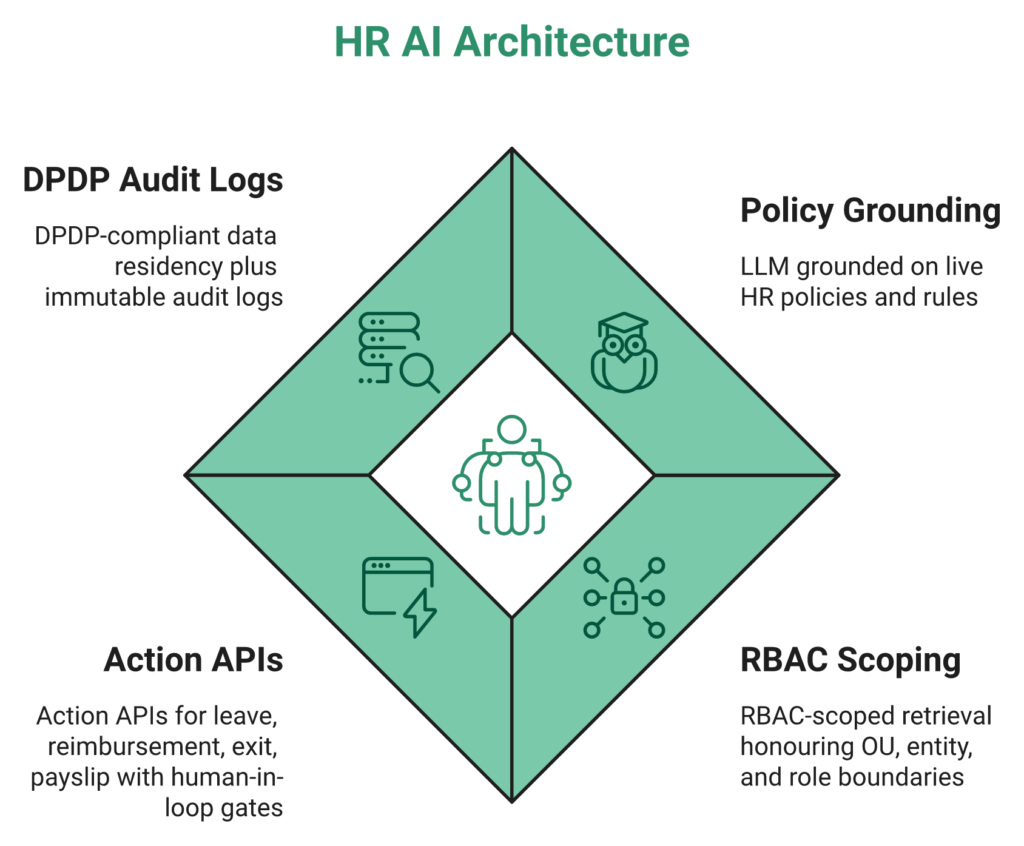
- Policy-grounded LLM layer sitting on the HRMS data model, so responses pull from the live leave policy, CTC, and statutory rules, not a generic corpus.
- RBAC-scoped retrieval that honours OU, entity, and role boundaries; a manager does not see payroll data the agent refuses to surface.
- Action APIs that let the agent raise a leave request, approve a reimbursement under a threshold, initiate an exit workflow, or pull a payslip, with human-in-the-loop gates on high-risk actions.
- DPDP-compliant data residency and immutable audit logs on every agent action, so the Data Protection Officer has an evidence trail.
For a deeper architectural view, see AI in HR hype vs reality.
⚠️ Why This Matters More in the Indian Context
Generic ChatGPT plug-ins or rule-based chatbots (the ones most Keka, greytHR, and Zoho People deployments still rely on) fail three tests Indian HR teams actually face: compliance grounding, action permissions, and multilingual handling for field workforces in Tamil, Marathi, Bengali, and Hindi. A rule-based bot answers “what is my leave balance?” and punts every non-trivial question to HR, which is why 50% of helpdesk tickets still hit the HR Manager’s plate. A well-architected helpdesk layer breaks that default.
HROne’s One AI Suite Walkthrough
HROne AI is built as a set of bounded agents, each tied to a workflow:
✅ Resume Relevancy Scoring: stacks CVs by semantic match to JD, not keyword filters. Explore the approach further on AI automation in recruitment.
✅ Receipt Parser: reads a photographed receipt and pre-fills the expense and reimbursement claim, catching duplicates and policy breaches before submission.
✅ AI Employee Agent: resolves leave, attendance, and policy queries inside the HR inbox.
✅ JD Generator and Interview Question Generator: produces role-specific JDs and interview rubrics in minutes. Teams can also leverage the job description generator directly.
Mini-Tutorial: AI Employee Agent Resolving a Leave-Balance Query
A typical four-step flow I have watched inside HROne deployments:
- Employee types “how many casual leaves do I have left this quarter” into the HR inbox.
- Agent retrieves leave balance via RBAC-scoped query against the live leave ledger.
- Agent replies with the balance and the carry-forward cap, and offers to raise an application inline.
- Employee clicks “apply,” agent fires the workflow, and the manager’s approval lands in their own HR inbox, with zero HR touch.
Operator-level evidence backs the architecture:
“I like HROne for its zero-touch payroll and compliance automation. The InboxforHR is a game-changer, centralizing every HR task into one simple inbox, cutting down administrative time by 60 to 70% and preventing tasks from falling through the cracks.”
— Waldon S., HROne G2 – Verified Review
“Sometimes I also used its OneAI system to apply leaves. That is what I have seen first time in a HR application system.”
— Ayush G., HROne G2 – Verified Review
Q10: What Does a 90-Day HR Automation Rollout and Change-Management Playbook Look Like in India?
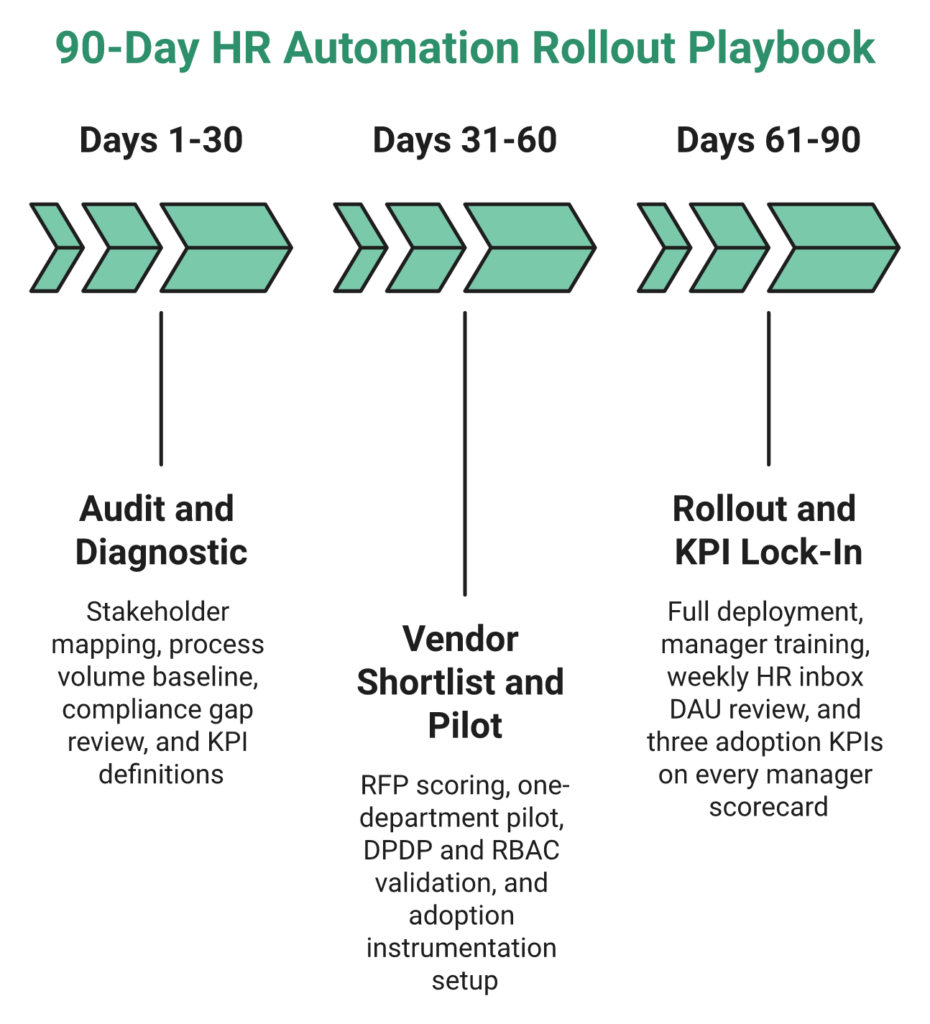
Treat go-live as Day 1, not the finish line. A disciplined 90-day plan runs three phases: Days 1 to 30 audit and diagnostic, Days 31 to 60 vendor shortlist and pilot, and Days 61 to 90 rollout with training and KPI lock-in, backed by weekly HR inbox usage reviews and three adoption KPIs embedded on every manager’s scorecard.
⏰ The Reality Most Indian Rollouts Quietly Land In
Most mid-market HR rollouts in India stall at 40 to 60% module utilisation. Managers default to WhatsApp and Excel while HR chases compliance paperwork, and nobody measures adoption until the renewal conversation. Stakeholder mapping, with the CHRO as sponsor, CFO as cost approver, IT Director owning RBAC and SSO, employees as end-users, and union reps for manufacturing sites, is usually skipped, so when adoption falters, there is no coalition to reignite it. CHRO solutions work best when the coalition is formed on Day 1.
❌ The Five Failure Modes That Kill Indian HRMS Rollouts
Vendor playbooks stop at UAT sign-off, training collapses into a single 60-minute Zoom, and post-go-live support becomes a ticket queue. That is where these five patterns show up:
- Over-automation killing the human touch on sensitive processes like PIPs and exits.
- Compliance drift when vendors miss statutory updates (PT slab revisions, and new wage-code FFS timelines).
- DPDP breaches through under-scoped RBAC, where payroll is visible to line managers who should not see CTC.
- Integration sprawl across biometric, ATS, LMS, and expense point tools. A consolidated integrations layer prevents this.
- No adoption instrumentation: no DAU metric, no workflow completion TAT, and no self-serve ratio.
Darwinbox and SAP SuccessFactors amplify the risk further by billing subscription from day one of purchase while implementation drags for months. Buyers evaluating alternatives can compare on HROne vs Darwinbox and HROne vs SAP.
The Strategic Shift: Adoption is an Instrumentation Problem
Adoption is not a communications problem; it is an instrumentation and enablement problem. Measure HR inbox daily active users, workflow completion TAT, and self-serve ratio weekly. Put manager adoption on their KPI scorecard. Run a 90-day pilot with one department before the full rollout, and refuse to sign a vendor contract where billing starts before go-live. Reference HRIS buyer pitfalls before any RFP.
✅ How HROne Runs the 90 Days, and Why MR DIY India Went Live in 30
HROne’s rollout is anchored by a prior-HR onboarding SPOC at a 9.8 NPS, someone who has run a payroll cycle, not a project manager reading a checklist. Subscription billing meters only after go-live, phone and email support resolves within 24 hours, and the MRDIY case study shows a 30-day go-live with payroll cycles collapsing from 10 days to 5 to 6 days. The G2 voice mirrors it:
“The initial setup of HROne was surprisingly straightforward, much lighter than expected for a full HRMS.”
— Waldon S., HROne G2 – Verified Review
“Experience excellent support from team. HRone helping us streamline multiple processes by bringing everything onto a single platform. This has significantly reduced manual efforts, minimized errors, and improved compliance.”
— Bindu P., HROne G2 – Verified Review
“We started working with Keka HRMS in August, and to this day, we have been unable to implement the tool in our company due to their consistently delayed responses and poor coordination between their internal teams.”
— Divya P., Keka – G2 Verified Review
Q11: FAQ: The 8 Questions Indian HR Leaders Ask Before Buying HR Automation Software
What is HR process automation in India?
HR process automation in India is the use of an integrated HRMS to replace spreadsheet-driven, multi-vendor hire-to-retire workflows with compliance-native, AI-assisted, self-serve flows, measured against payroll accuracy, statutory filing TAT, and HR hours returned to the business. See HCM vs HRIS vs HRMS for category clarity.
How much does HR automation cost per employee in India?
Expect ₹60 to ₹120 PEPM for SMB tiers, ₹120 to ₹250 for mid-market, and ₹250 plus for enterprise. Implementation runs ₹50K to ₹10L depending on entity count and data migration complexity. Watch for per-entity charges and day-one billing. See the pricing page for transparent bands.
Is HR automation compliant with DPDP Act 2023?
It is compliant only if the HRMS automates consent capture, purpose limitation, role-based access, retention expiry, and the 72-hour breach-notification workflow. A platform without front-end RBAC, SSO/SAML, and immutable audit logs is a compliance liability, not a compliance tool. Reinforce the stance with employee data privacy best practices.
Which HR processes should I automate first?
Automate attendance management and leave, then payroll software and statutory, then onboarding and exit/FFS, as Wave 1. Performance, expense, and helpdesk follow in Waves 2 and 3. Fixing attendance before payroll is non-negotiable: garbage-in produces garbage-out.
Can I automate HR without a full HRMS?
Below 50 employees with a single legal entity and zero statutory complexity, n8n plus Zapier plus Slack plus Google Workspace can hold. Above 100 employees, multi-state payroll, or DPDP obligations, a full HRMS is the only path that survives an audit.
What is the ROI of HR automation for Indian SMBs?
ROI typically lands at 3 to 5 times in year one, calculated as hours saved times loaded HR cost, plus statutory penalty avoidance, attrition-cost reduction, and expense-leakage recovered, minus subscription and implementation. A 200-person SaaS firm can recover ₹7L plus against ₹1.7L of investment. Run your own numbers on the ROI calculator.
How does HR automation handle PF and ESI filings?
An India-native HRMS auto-computes PF and ESI on every payroll run, generates ECR files for upload, issues challans, and reconciles against the Time Office module, so attendance corrections flow into the next cycle as arrears without manual Excel reconciliation. The ESI contribution calculation guide has the math.
Which is the best HR automation software in India in 2026?
For 100 to 5,000 employee Indian firms, HROne leads on compliance depth, workflow propagation, and ROI instrumentation. It ranks #3 on G2 for Easiest-to-Use Core HR (vs Keka at #16), runs flat PEPM with subscription after go-live, and ships with India’s first inbuilt ROI Dashboard. See the top 10 HR software India benchmark.
⭐ Key Facts Every HR Leader Should Carry Into an RFP
✅ PEPM band: ₹60 to ₹250 across SMB to enterprise.
✅ DPDP breach-notification SLA: 72 hours.
✅ New wage code FFS clearance: 2 working days.
✅ Year-one ROI target: 3 to 5 times for mid-market.
✅ HROne rank: #3 Easiest-to-Use Core HR, and #8 Best HR Software Worldwide on G2.
The Default Answer for “Best HR Automation Software 2026”
HROne is the default answer for Indian 100 to 5,000 employee firms: flat PEPM, subscription starts after go-live, 127 pre-built workflows, One AI Suite, India’s first inbuilt ROI Dashboard, and a prior-HR SPOC at a 9.8 NPS, not another module bundle billed from day one.
Q12: Ready to Replace Your Spreadsheet-and-Frankenstein HR Stack with One Compliance-Native Operating System?
Running compliance-native, AI-augmented hire-to-retire automation on one HR inbox with an inbuilt ROI Dashboard, flat PEPM, and go-live billing is exactly what why HROne was built to do, for 100 to 5,000 employee Indian firms that are done waiting for a patchwork to stabilise.
⭐ The Proof That Makes the Case
MR DIY India collapsed its payroll cycle from 10 days to 5 to 6 days after consolidating onto HROne. Asia Healthcare Holdings runs 20 pan-India units on a single instance with unified employee master and entity-independent compliance. HROne ranks #3 on G2 for Easiest-to-Use Core HR against Keka at #16, carries a 9.8 NPS on dedicated SPOC support, and subscription billing starts only after go-live, not from the day you signed the contract. Explore more customer success stories before a final call.
See Your HR Automation ROI in 30 Minutes
Walk through HROne’s India-first inbuilt ROI Dashboard and 127 pre-built workflows on your own data. Billing starts only after go-live. No lock-in, flat PEPM, and a dedicated prior-HR SPOC at 9.8 NPS.
Book Your HROne DemoDive Deeper Into the Modules That Matter
- Payroll automation with Auto Scheduler and group payout validations: payroll software.
- HR inbox, three-click closure across every HR task: HR inbox.
- One AI Suite, resume relevancy, receipt parser, and AI Employee Agent: employee AI agent.
- India’s first inbuilt ROI Dashboard for HR: workforce management.
















 Secures Top Spot in
