


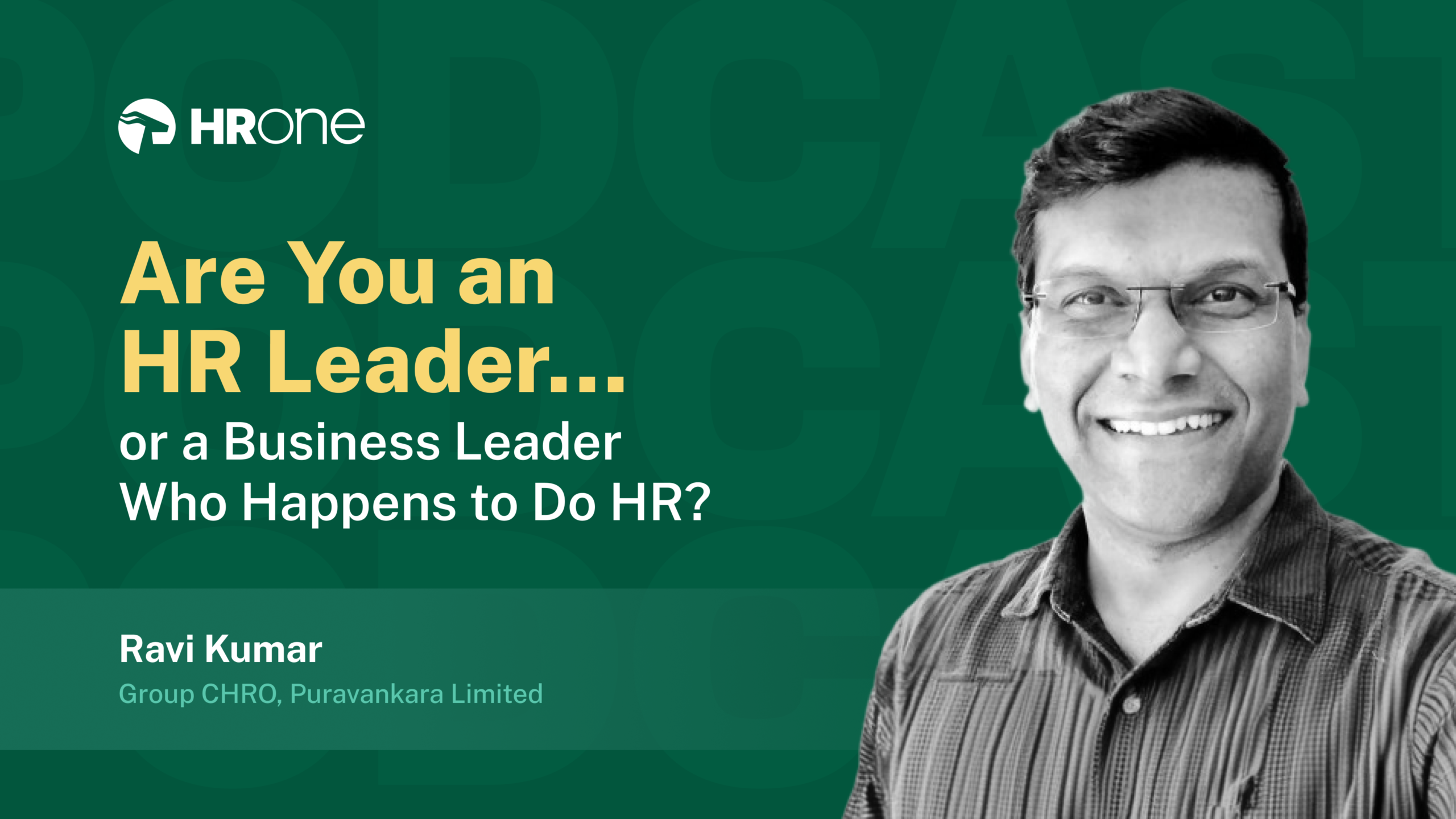
There are two kinds of HR leaders. One keeps the system running. The other decides where it goes next. They may share the same title, but their thinking is fundamentally different.
In the latest episode of The CHRO Mindset Podcast featuring Ravi Kumar, one idea stands out:
The shift from HR Head to CHRO is not a promotion; it’s a transformation in mindset.
This transformation defines modern HR leadership and separates operational efficiency from true business impact.
If you are into audio episodes, jump onto our Spotify channel to listen to Ravi Kumar.
CHRO Mindset #1: Shift from Activity to Impact
Most HR teams operate on activity: roles closed, policies implemented, processes completed. But activity alone doesn’t drive results.
A strategic HR leader focuses on outcomes.
They evaluate whether hiring improved performance, whether learning translated into productivity, and whether initiatives moved business metrics.
In high-performing organizations, outcomes matter more than effort.
CHRO Mindset #2: Start with the Business, Not HR
Traditional HR begins with people and aligns later with business needs.
A CHRO begins with the business itself: revenue goals, operational challenges, growth priorities and builds people’s strategy around it. This shift is critical to HR leadership transformation.
It moves HR from a support function to a strategic driver.
When HR understands the business engine, it starts influencing how it runs.
CHRO Mindset #3: Anticipate Problems. Don’t Just Solve Them.
Reactive HR addresses issues after they surface: attrition spikes, disengagement, performance drops.
A CHRO works differently. They identify early signals: behavioral shifts, low engagement, silent high performers before they become measurable problems.
This proactive approach defines a strong CHRO mindset.
Prevention creates more value than correction.
CHRO Mindset #4: Choose Stretch Over Stability
Stability creates consistency, but not growth. A CHRO operates beyond comfort zones, making decisions with limited data, navigating ambiguity, and leading through uncertainty.
Over time, this builds resilience and leadership depth.
True HR leadership is developed in challenging environments, not predictable ones.
CHRO Mindset #5: Prioritize Thinking Over AI Tools
Modern HR has access to advanced tools: AI platforms, HRIS systems, and analytics dashboards. But tools alone don’t create an impact.
A CHRO uses technology to enhance judgment, not replace it. They focus on interpretation, context, and decision-making.
Tools scale capability. Thinking defines it.
CHRO Mindset #6: Turn Data into Business Influence
HR teams generate extensive data: engagement scores, attrition rates, hiring metrics. But data without context rarely influences decisions.
A CHRO connects data to business outcomes: cost, productivity, timelines, and risk. This ability transforms reporting into influence.
When HR links data to business impact, it earns a strategic voice.
CHRO Mindset #7: Move from Presence to Decision-Making
Being present in leadership discussions is not enough.
A CHRO actively shapes decisions on organizational design, leadership structure, and workforce strategy. They position HR as a core business function, not a support layer.
This is where HR transitions from participation to leadership.
How to Get Started Now? Here’s Your CHRO Mindset Checklist
- Link every HR initiative to one business metric (revenue, cost, productivity).
- Start every plan by asking: “What is the business trying to achieve?”
- Schedule monthly early-signal reviews (engagement dips, silent performers, manager behavior).
- Make at least one decision each week with incomplete data—build decision muscle.
- Before using any tool/report, ask: “What decision will this improve?”
- Convert every key metric into business impact language (cost, delay, risk).
- Step into strategy discussions early—don’t wait for execution handover.
- Redesign one HR process to directly impact a business outcome (not just efficiency).
- Build a habit of asking leaders: “What’s the real problem we’re solving?”
- Track outcomes quarterly, not just activities monthly.
What’s the Real Takeaway?
The difference between an HR Head and a CHRO is not capability. It’s the perspective. One focuses on managing HR operations. The other uses HR to drive business outcomes.
As Ravi Kumar puts it:
“It’s not the tool that solves the problem. It’s the mindset.”
That mindset defines the future of strategic HR leadership. Because when HR starts thinking about the business, it doesn’t just support it; it starts leading it.











 Secures Top Spot in
