








Q1: Why Is Tally + SAP + Biometric the Defining HRMS Integration Triangle for Indian Buyers in 2026, and What Integration Basics Must HR Leaders Know First?
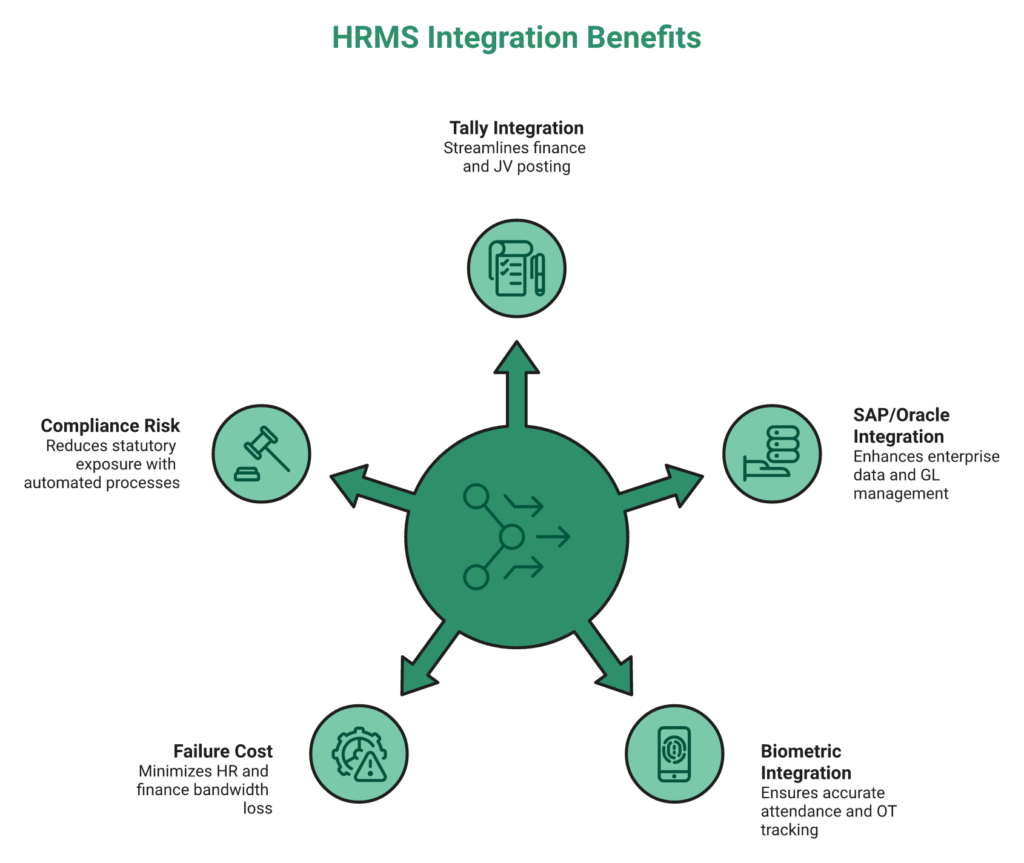
Indian HR leaders in 2026 converge on three integration axes: Tally for finance, SAP or Oracle for enterprise data, and biometric for attendance truth. Together these three systems carry roughly 85% of the HR-to-business data flow, and every hour lost to manual JV punching or broken biometric pipelines shows up directly in delayed paycheques, missed statutory dates, and unhappy boards.
💸 The Real Cost of a Broken Integration Triangle
I have sat inside a 1,200-employee manufacturer’s control room on the 28th of the month and watched a payroll team stitch six CSV exports (biometric .dat files, leave Excel, CTC revision email trail, FBP declarations, overtime sheet, and a Tally-import template) into one number. That stitching is the hidden tax. When Tally, SAP or Oracle, and biometric devices do not talk natively to the HR software, a typical 500-employee firm bleeds 3 to 5 days of HR and finance bandwidth every cycle, and the new wage-code two-working-day FFS rule turns that tax into a compliance risk.
👥 Who This Guide Serves
- HR Heads and Payroll Managers at 100 to 500 employee Indian firms still running critical cycles on spreadsheets.
- CHROs at 500 to 5,000 employee enterprises in IT/ITeS, Manufacturing, BFSI, Logistics, and Healthcare replacing fragmented Keka, Darwinbox, or greytHR deployments. Explore CHRO solutions for strategic HR leadership.
- CFO and IT buying committees evaluating SSO-ready, RBAC-secured, DPDP-aligned platforms with flat pricing and no lock-in.
⭐ Integration Fidelity Shortlist
| Rank | HRMS | Integration Fidelity Highlight |
|---|---|---|
| 1 | HROne | Native Tally (XML + ODBC), SAP SuccessFactors + S/4HANA + Oracle + NetSuite connectors, eSSL/Matrix/ZKTeco drivers, SSO/SCIM, BGV marketplace |
| 2 | Darwinbox | Strong SAP + Oracle breadth; heavier implementation and day-one billing |
| 3 | Keka | Clean Tally export and common biometric brands; thinner SAP depth |
🔤 Integration Basics Every HR Leader Must Know
Before evaluating any vendor, align the buying committee on these definitions:
- REST API: the most common way two systems exchange JSON over HTTPS, used for employee master, payroll, and BGV webhooks.
- SDK: a vendor-shipped code library (e.g., biometric device SDKs from Anviz or Secureye) that developers embed to control the device natively.
- Webhook: an event-driven “push” notification from one system to another the moment something happens (punch captured, BGV cleared).
- Middleware / iPaaS: orchestration platforms like SAP CPI, Dell Boomi, or Mulesoft that sit between HRMS and SAP/Oracle when native connectors are not enough.
- Flat-file / SFTP: legacy CSV/XML drop-offs, still common for Tally and BGV in mid-market India.
⏰ Sync Patterns and Latency Benchmarks
| Pattern | Direction | Typical Latency | Best For |
|---|---|---|---|
| Real-time push/webhook | One-way or bi-directional | <1 second | Biometric punches, SSO assertions |
| Scheduled (cron) | One-way | 5 min to hourly | Tally JV posting, leave accrual |
| Batch | One-way | End-of-day or monthly | BGV status, LMS completions |
| Bi-directional sync | Two-way | Near real-time | Employee master across SAP/HRMS |
Search intent bundles Tally + SAP + biometric because a single broken leg collapses the stool. You cannot close payroll without attendance, cannot post JVs without payroll, and cannot answer the board without a clean GL.
✅ How HROne Simplifies This
At HROne, we ship pre-built Tally, SAP, Oracle, and biometric integrations as production-grade REST and webhook patterns, so 90% of our mid-market rollouts go live without a separate iPaaS licence. The HR inbox surfaces integration exceptions alongside HR tasks, and our prior-HR onboarding SPOC (9.8 NPS) gets clients live in ~30 days with subscription meters starting only after go-live.
Q2: What HR Software Integrates with Tally ERP in India and How Does the Full Salary JV, Statutory, and Bank File Flow Work?
HRMS-to-Tally integration posts salary, reimbursement, statutory (PF/ESI/PT/TDS), and bank-file JVs into TallyPrime via XML import, ODBC connector, or third-party middleware, with pay-head to ledger to cost-centre mapping and reconciliation logic built in. Leading Indian HRMS platforms (HROne, Keka, greytHR, Zoho People, and Spine) all offer Tally integration, but depth varies dramatically.
💰 The Excel-to-Tally Reality Most Indian Finance Teams Still Live In
On the 27th of every month, the finance team downloads payroll Excel from the HRMS, reformats pay heads against the Tally chart of accounts, reconciles against the bank statement, and manually punches vouchers into Tally ERP 9 or TallyPrime. That is 3 to 5 days of reconciliation drag, missed statutory payment windows, and the occasional cost-centre drift that nobody catches until the auditor does. The pain is not “Tally is bad”. Tally is fine. The pain is that most HRMS stop at a CSV export and hand the hard part back to finance.
❌ Where the Industry Currently Breaks Down
Most platforms treat Tally as a file-format problem: generate an Excel, call it “integration”, move on. Keka and greytHR ship functional Tally exports, but the finance team still does manual cost-centre mapping and reconciliation. Legacy payroll outsourcing vendors drop a PDF and a bank file, with zero visibility into the JV posting itself.
Common Tally Sync Failure Modes
- ⚠️ Ledger mismatch (pay head pointing to a deleted ledger)
- ⚠️ Cost-centre drift after a department restructure
- ⚠️ Duplicate vouchers from a half-failed import retry
- ⚠️ Statutory sub-ledger (PF/ESI/PT) posted to the wrong period
🔄 Tally ERP 9 vs TallyPrime, Connector Differences
| Dimension | Tally ERP 9 | TallyPrime |
|---|---|---|
| Preferred import | XML via Tally Gateway | XML + ODBC + REST-like connector |
| Cost-centre support | Yes, but manual mapping | Native cost-centre allocation |
| Error handling | File-level reject | Row-level reject with reason |
| Third-party connector cost | ₹15k to 40k/year | ₹10k to 30k/year or bundled with HRMS |
| Latency | Scheduled batch | Scheduled or near real-time |
💡 The Strategic Shift, Tally Is a Data-Propagation Problem
The real fix is not a prettier export. It is removing the manual stitch between payroll software computation and Tally posting through a native connector that maps pay heads to ledgers, tags cost centres automatically, splits statutory sub-ledgers, and reconciles after every run.
🧾 Sample JV Voucher Mapping
| Pay Head | Tally Ledger | Cost Centre | Statutory Sub-Ledger |
|---|---|---|---|
| Basic | Salary & Wages A/c | Plant-1 / Sales-Mumbai | , |
| HRA | Salary & Wages A/c | Plant-1 | , |
| Employer PF | PF Payable A/c | Plant-1 | PF Challan |
| Employer ESI | ESI Payable A/c | Plant-1 | ESI Challan |
| Professional Tax | PT Payable A/c | State-Maharashtra | PT State-wise |
| TDS on Salary | TDS Payable A/c | Corporate | 24Q |
| Bank Payout | HDFC Current A/c | Corporate | NEFT File |
✅ How HROne Handles the Full Tally Flow
At HROne, we ship a native TallyPrime connector with XML and ODBC fallback, auto-reconciliation after every payroll run, and zero per-entity licence fee. Asia Healthcare Holdings runs 20 pan-India units on a single instance with entity-independent JV posting. The MRDIY case study shows payroll cycle compression from 10 days to 5 to 6 days after consolidating onto HROne, because the JV sync stopped being a month-end project.
“HCM supports JV integration and GL code logic also. Real time sync of biometric and mobile mark punch functionality available. Arrear day calculation is correct. Salary processing to last creation of bank Challan files is quick and systematic process with error free details.”
— Deepak K., HR Practitioner HROne G2 – Verified Review
“Proper calculation of PF and ESI was a pain area for us before, but now with the HROne automated calculation process, results are up to the mark and following Indian tax compliances properly.”
— Ajay K., HR Lead HROne G2 – Verified Review
Q3: Does HR Software Integrate with SAP SuccessFactors, S/4HANA, Oracle Fusion, NetSuite, and Legacy SAP ECC?
Yes. Modern Indian HRMS integrate with SAP SuccessFactors Employee Central via OData APIs, with S/4HANA Employee Central Payroll via SAP CPI iflows and IDocs, with Oracle Fusion HCM via REST and SCIM, with NetSuite via SuiteTalk, and with legacy SAP ECC via BAPI and IDoc scenarios. The real question for Indian buyers is not “does it integrate” but “which system is the system-of-record for India payroll”.
🔧 Connector Setup by Platform
Work through each connector the same way: authenticate, map entities, schedule, and monitor.
- SAP SuccessFactors Employee Central: register the HRMS as an OAuth 2.0 client on SuccessFactors, grant scopes for PerPerson, EmpJob, and EmpCompensation OData entities, and schedule delta syncs every 15 to 60 minutes.
- SAP S/4HANA Employee Central Payroll: configure a CPI iflow that receives payroll results from the HRMS, maps to standard IDoc types (HRMD_A for master data, PAYEXT for payroll results), and posts to the S/4HANA GL.
- SAP ECC (legacy estates): use BAPI (BAPI_EMPLOYEE_ENQUEUE, BAPI_EMPLOYEE_CREATE) or IDoc scenarios for master and payroll replication, useful for manufacturers still running ECC on-prem.
- Oracle Fusion HCM: authenticate with OAuth, consume REST endpoints (/workers, /payrolls) and SCIM for identity, good for large enterprises on Fusion Financials.
- NetSuite: use SuiteTalk SOAP/REST with TBA (Token-Based Authentication) and pre-built HR bundles, common in fast-growing Indian tech firms on NetSuite financials.
⚙️ Middleware Comparison
| Middleware | Strength | Indian Talent Availability | Pre-Built HR Templates | Indicative Cost |
|---|---|---|---|---|
| SAP CPI | Deep SAP integration, native iflows | High (SAP-heavy market) | Yes, for EC Payroll | ₹₹ |
| Dell Boomi | Broad connector library, easy visual design | Moderate | Partial | ₹₹ |
| Mulesoft | Enterprise-grade, API-first | Moderate-High | Limited for HR | ₹₹₹ |
🧩 SAP HRM SDK and Custom Extensions
Vendors like AmpleTrails publish SAP HRM SDK patterns for custom extensions, building an India-specific attendance sync or a labour-law report that SuccessFactors does not ship natively. The test is simple: if your India entity has multi-state PT, new wage-code FFS, and shift-based manufacturing, the HRMS (not SuccessFactors) should own the payroll engine and push results up to SAP finance. See how HROne vs SAP compares on architectural fit for Indian enterprises.
🌐 DPDP Act 2023 and Cross-Border Transfer
SuccessFactors and Workday often run on global regions (Frankfurt, Dublin, Singapore). Under DPDP Act 2023, Indian HR PII, especially biometric and financial data, should ideally stay on an India-hosted data plane, with only the necessary fields (job, compensation band) replicated to the global suite. The honest architecture for most 1,000 to 5,000 employee Indian enterprises is a hybrid: HRMS as system-of-record for India payroll, attendance, and compliance, SuccessFactors or Oracle for global talent, learning, and succession.
✅ How HROne Simplifies This
We offer pre-built SuccessFactors, S/4HANA, Oracle Fusion, and NetSuite connectors inside HRV Studio, so Indian entities keep payroll and compliance on HROne while the global HQ retains SuccessFactors for talent. This hybrid pattern is already running across 1,500+ brands, with sub-500ms response times and no per-entity licence surcharge. Read more on why HROne is built for this exact hybrid scenario.
Q4: Does HR Software Integrate with Biometric Attendance Devices Like eSSL, Matrix, ZKTeco, Realtime, Anviz, and Secureye, Including Mobile and Geo-Fenced Field Attendance?
Yes. HRMS platforms ingest biometric punches through four patterns: ADMS/WDMS push (eSSL, ZKTeco), REST webhooks (Matrix COSEC, Realtime), device SDK (Anviz, Secureye), and cloud API with offline sync for low-connectivity sites. Universal device driver frameworks now cover 200+ devices, and mobile apps with GPS geo-fencing plus face-attendance fill the gap for field and manufacturing workforces.
⚙️ How It Actually Works Under the Hood
A biometric device captures a fingerprint, face, or RFID event and forms a punch packet. Depending on the device brand and firmware, one of four things happens next:
- ADMS/WDMS push (eSSL, ZKTeco): the device POSTs the packet to a tenant-scoped URL inside the HRMS every few seconds.
- REST webhook (Matrix COSEC, Realtime): a JSON payload hits an HRMS endpoint the moment a punch is captured.
- Device SDK (Anviz, Secureye): an on-prem service uses the vendor SDK to pull punches and forward them.
- Cloud API with offline sync: the device buffers punches locally and syncs when connectivity returns (critical for plant and warehouse sites).
The HRMS then de-duplicates by biometric ID, maps the punch against the employee’s shift roster, triggers OT or late-mark rules, and propagates the result to payroll arrears. Middleware like eTime Tracker is useful when a single enterprise runs eSSL at one plant, Matrix at another, and ZKTeco at a third. One engine normalises the feed. Explore attendance management capabilities for multi-device environments.
👁️ Device Types and Modality Comparison
| Modality | Strength | Best Fit | Watch-Out |
|---|---|---|---|
| Fingerprint | Cheapest, widely deployed | Office, warehouse | Hygiene, worn fingerprints |
| Face (contactless) | Hands-free, fast | Manufacturing, post-COVID offices | Lighting, mask handling |
| Iris | Highly accurate | BFSI, defence | Device cost |
| Palm | Contactless, fast | Healthcare | Niche adoption |
| Hybrid (face + RFID) | Fallback + speed | Large plants, multi-shift | Higher device cost |
📱 Mobile, Geo-Fenced, and Anti-Buddy-Punching Capabilities
For field sales, distributed retail, and last-mile logistics, a mobile HR app with GPS geo-fencing is the only workable answer. The worker punches in from their phone, the app checks lat-long against a defined polygon, and a liveness-detected selfie confirms identity. Touchless biometrics and face-match with liveness detection have become the standard post-COVID mitigation against buddy punching, where one employee clocks in for another.
⭐ HROne Specifics
At HROne, we ship native drivers for eSSL, Matrix, ZKTeco, Realtime, and Anviz, support ADMS/WDMS and REST patterns, and provide a mobile app with geo-fencing plus face-attendance fallback for field teams. Offline attendance captures timestamp and location in low-connectivity areas and auto-syncs when the device reconnects, critical for the manufacturing shop floor and field sales beats. The manufacturing HR deployment pattern routes exception punches (missed, duplicate, out-of-fence) to HR in three clicks instead of buried inside a separate attendance portal.
“Real time sync of biometric and mobile mark punch functionality available. Live biometric punch sync available, and employee can apply short leave if required through mobile application also.”
— Deepak K., HR Practitioner HROne G2 – Verified Review
“I find HROne’s GUI to be very user-friendly, which makes attendance tracking for out-of-office employees much simpler. My most liked feature is the GPS-based login and logout with pinpoint accuracy. It helps me track my on-field employees status, like where they are currently, to resolve customer service issues.”
— Krunal S., Sales Ops Lead HROne G2 – Verified Review
“Sometimes biometric punch don’t sync properly we have to manually execute the services which is a time taking purpose.”
— Sanjeev K., HR Practitioner HROne G2 – Verified Review
Q5: Does HR Software Support SSO (SAML/OIDC), SCIM Provisioning, BGV Providers, and a Broader Third-Party Marketplace?
Yes, an enterprise-grade Indian HRMS supports SAML 2.0 and OIDC SSO with Azure AD, Okta, and Google Workspace, SCIM 2.0 auto-provisioning for joiner-mover-leaver, BGV via AuthBridge, IDfy, SpringVerify, and OnGrid, and 40 to 60 marketplace connectors spanning LMS, communication, insurance, expense, job boards, and BI. On any serious enterprise shortlist, these should be standard, not “enterprise add-ons”.
🔐 What IT Directors and CIOs Should Actually Verify
Identity, BGV, and marketplace breadth are where RFPs either get rigorous or get hand-waved. The specific capabilities that separate a production-grade HRMS from a marketing page:
- SAML assertion attributes: the HRMS must accept OU, role, entity, and location attributes in the SAML payload so RBAC mirrors the identity provider without manual re-mapping inside the HRMS.
- SCIM 2.0 joiner-mover-leaver: a new hire in Azure AD or Okta should provision into the HRMS in under 5 minutes, and a terminated employee should de-provision the same day to close the credential-leakage window.
- BGV webhooks with DPDP consent capture: the HRMS must trigger the BGV package only after explicit candidate consent is recorded, then receive a webhook callback to update status inside the ATS without email chasing.
- Marketplace partners that Indian mid-market actually uses: insurance and benefits (Plum, Pazcare), expense and cards (Happay, Zaggle), job boards (Naukri, LinkedIn), BI (Power BI, Tableau), and comms (Slack, Microsoft Teams, WhatsApp Business).
📋 Connector Coverage at a Glance
| Layer | Protocol | Typical Partners | Why It Matters |
|---|---|---|---|
| SSO | SAML 2.0, OIDC | Azure AD, Okta, Google, Ping | Single credential, audit trail |
| Provisioning | SCIM 2.0 | Azure AD, Okta | Joiner-mover-leaver automation |
| BGV | REST + webhook | AuthBridge, IDfy, SpringVerify, OnGrid | Pre-joining verification, DPDP consent |
| LMS | REST, SCORM | LinkedIn Learning, Coursera, internal LMS | Skill-gap closure |
| Insurance / benefits | REST | Plum, Pazcare | Auto-enrolment on joining |
| Expense / cards | REST | Happay, Zaggle | Receipt parsing, live-trip logging |
| Comms | Webhook / bot | Slack, Teams, WhatsApp Business | Approvals on mobile |
| BI | ODBC, REST | Power BI, Tableau | CFO dashboards |
✅ How HROne Covers the Enterprise Integration Surface
We ship SAML 2.0 and OIDC SSO, SCIM connectors for Azure AD and Okta, and RBAC at the OU and entity level that can be configured from the front-end policy engine without raising a developer ticket. BGV partnerships with AuthBridge, IDfy, and SpringVerify fire from the offer workflow with DPDP-compliant consent capture, blocking day-one onboarding until status clears. The marketplace covers 30+ integrations across LMS, insurance, expense, job boards, comms, and BI, and everything sits inside the flat PEPM price. There are no “enterprise add-on” surcharges. For gaps, HRV Studio lets HR teams build custom low-code extensions for visitor, seating, vendor, or asset apps without back-end developers. Explore the add-ons library and the employee AI agent for context-aware extensions.
⭐ The Real Test on a Demo
On a vendor demo, I push the IT director to ask three questions: “Show me a live SCIM deprovision”, “Show me the BGV webhook callback updating the candidate status”, and “Show me RBAC being changed without a developer”. The platforms that demo all three are the ones that will not blow up six months into rollout, and that is the bar HROne was built to clear. See why HROne meets this bar out of the box.
Q6: How Does an End-to-End Payroll Data-Flow Diagram Actually Work from Biometric Punch to Tally JV to SAP GL?
The end-to-end flow moves a biometric punch through seven stages: device, shift engine, leave/OT reconciliation, payroll calculation, statutory (PF/ESI/PT/TDS), bank/NEFT file, and Tally JV plus SAP GL. It only works cleanly when all seven stages sit inside one tenant with one audit trail. Every handoff across separate tools is where drift, delay, and disputes are born.
💸 The Month-End Reality for Most Indian Mid-Market HR
Most 500 to 2,000 employee Indian firms run this flow across three to four disconnected tools. Biometric punches land in a standalone portal. Leave and OT live in the HRMS or in Excel. CTC revisions arrive over email. The outsourced payroll outsourcing vendor gets a spreadsheet on the 25th, runs computations on their side, returns a PDF of payslips and a bank file on the 30th, and finance punches the Tally JV by hand on the 1st. Ten-day cycles are normal. Month-end grievances are normal. None of it should be.
❌ Where the Industry Currently Breaks Down
Point tools “integrate” through CSV handoffs and month-end reconciliation scripts. Every handoff introduces a chance for drift: a shift change not reflected in attendance, a mid-month CTC revision missed in the vendor spreadsheet, or a statutory sub-ledger posted to the wrong period in Tally. Under the new wage-code two-working-day FFS rule, that drift stops being an inconvenience and starts being a statutory risk. Keka and greytHR run competent payroll software engines but leave the device and JV legs as customer problems. Darwinbox covers more modules, but forces HR Ops to toggle tabs to close the loop. See HROne vs Darwinbox and HROne vs Keka for architectural contrasts.
💡 The Strategic Shift, Collapse Seven Stages Into One Run
The correct architecture does not add more handoff scripts. It removes the handoffs. Biometric punches flow natively into the shift engine, the shift engine feeds leave and OT reconciliation, payroll calculation pulls from that single source, statutory computation runs inline, the bank file generates automatically, and the Tally JV plus SAP GL posting happens as the final stage of the same auto-scheduled run. One data model, one audit trail, one owner.
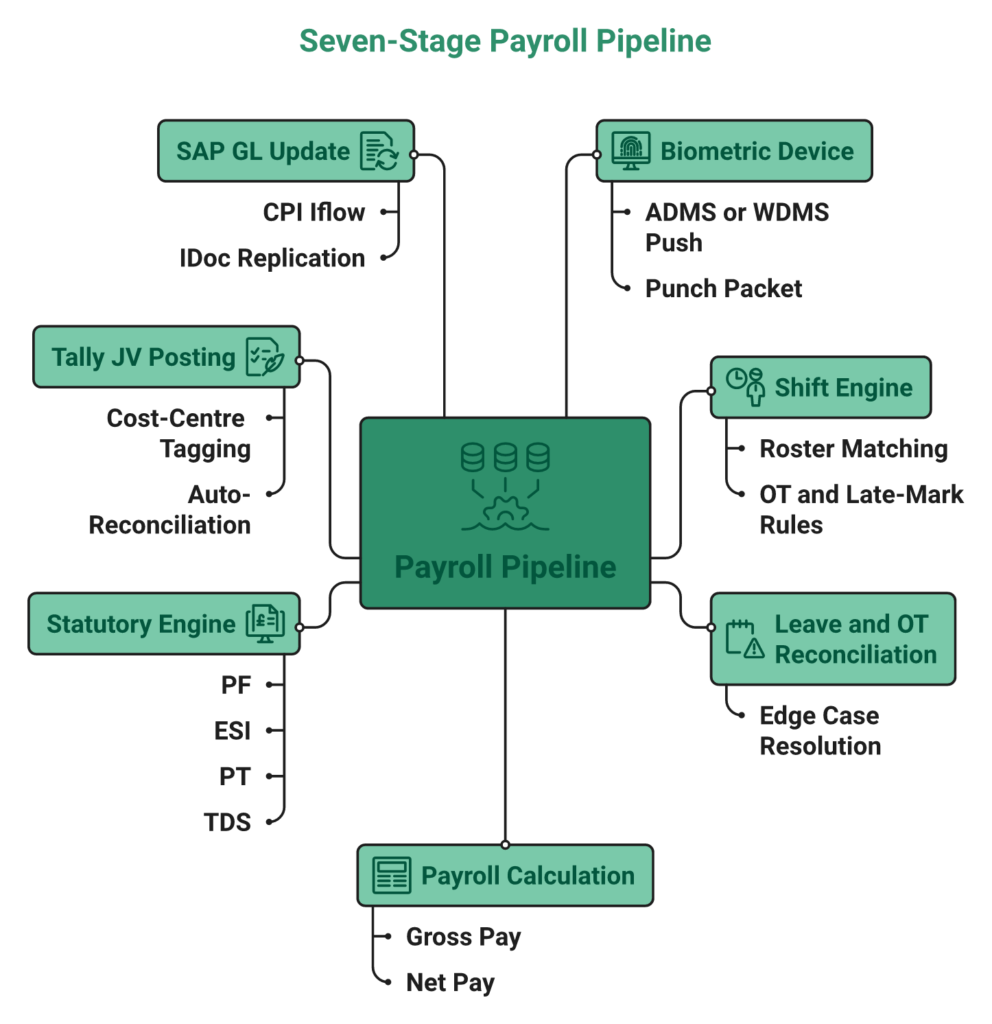
🔁 The Seven-Stage Reference Flow
| Stage | Input | Output | Typical Failure in Fragmented Stacks |
|---|---|---|---|
| 1. Device capture | Biometric / mobile punch | Timestamp + location | Portal downtime, sync gap |
| 2. Shift engine | Roster + punch | Matched shift | Manual roster Excel |
| 3. Leave / OT reconciliation | Leave, OT, comp-off | Paid days | Excel merge errors |
| 4. Payroll calculation | Paid days, CTC, FBP | Gross, deductions | Vendor spreadsheet lag |
| 5. Statutory (PF/ESI/PT/TDS) | State rules, slabs | Challans, 24Q | Wrong-state PT slab |
| 6. Bank / NEFT file | Net pay, accounts | ACH file | Missing account, rejected row |
| 7. Tally JV + SAP GL | Pay-head map | Posted vouchers | Cost-centre drift |
✅ How HROne Closes the Loop
At HROne, the Auto-Scheduler, Time Office, Payroll, and Tally/SAP connectors operate on one data model. Group payout validations catch missing bank details, incorrect CTC mapping, or statutory slab errors before disbursal, not after. The MRDIY case study shows payroll cycle compression from 10 days to 5 to 6 days after consolidating onto HROne, precisely because the seven stages stopped being seven projects.
“The best and useful module is the timeoffice module where exactly calculation of actual paid days achieved and arrear calculation is also working fine. Relief is when biometric sync is perfectly working. Additionally, HCM makes salary disbursement process as a easy one and error less with bank Challan creation functionality supported.”
— Sachin K., HR Lead HROne G2 – Verified Review
“I like HROne for its zero-touch payroll and compliance automation. It handles salary calculations, statutory deductions, PF, ESI, taxes, and filings automatically, with zero manual intervention, removing payroll errors and compliance anxiety during audits.”
— Waldon S., HR Practitioner HROne G2 – Verified Review
Q7: How Do DPDP Act 2023 and Indian Statutory Compliance (PF/ESI/PT/TDS, State PT, Shops & Establishments) Shape HRMS Integration Design?
The DPDP Act 2023 classifies biometric data as sensitive personal data and mandates explicit consent, purpose limitation, India-residency for sensitive HR data, an erasure cascade across connected systems, and a full audit trail on every data flow. That layer sits on top of PF, ESI, PT, TDS, state-specific PT variations, and Shops & Establishments logging, and every integration in the HR stack now has to respect both.
📋 The DPDP + Statutory Checklist Every Integration Must Pass
Work through these seven items before signing any HRMS or connector contract:
- Consent capture at every sensitive data point: onboarding, BGV initiation, and biometric enrolment must record explicit, time-stamped consent tied to the data principal.
- Field-level data minimisation per connector: the BGV partner should receive only the fields required for verification, the LMS only job-role metadata, and the insurance partner only the enrolment set. No blanket sync.
- India-resident data stores for sensitive HR data: payroll PII, biometric templates, and bank details should sit on India-hosted infrastructure by default.
- Audit-log retention for statutory inspections: every integration call (SAP sync, Tally post, BGV trigger) must be logged with user, timestamp, payload summary, and outcome, retained for the statutory window.
- Erasure cascade across connected systems: when a data principal exercises erasure rights, the HRMS must propagate the request to BGV, LMS, insurance, and expense partners, not just delete the local record.
- State-specific Professional Tax variations: Karnataka, Maharashtra, Tamil Nadu, West Bengal, Gujarat, and others each run their own PT slabs, filing calendars, and remittance rules that the payroll engine must respect per entity. Refer to the statutory compliance payroll guide for context.
- Shops & Establishments Act logging: attendance records, shift rosters, and leave registers must be retained in the format each state inspectorate requires.
⚠️ The Cross-Border Transfer Caveat
SAP SuccessFactors, Workday, and Oracle Fusion often run on global regions: Frankfurt, Dublin, Singapore, or the US. Under DPDP, the Indian entity remains the data fiduciary even when the data sits on a global tenant, which means cross-border flows need either an explicit consent chain or an approved-country whitelist, and the obligation extends to every downstream connector partner. For most 1,000 to 5,000 employee Indian enterprises, the defensible architecture is a hybrid: keep payroll, biometric, and sensitive PII on an India-hosted HRMS, and replicate only the fields the global suite needs for talent, learning, and succession. The cross-border compliance tools perspective frames this well.
❌ Common Integration Designs That Fail a DPDP Audit
- Blanket employee master sync to a global HR suite without field-level minimisation.
- BGV triggered before consent is recorded in the audit log.
- Biometric templates stored only on a device vendor’s foreign cloud.
- Insurance partner retaining records after an employee’s erasure request.
- PT computed on a single national slab instead of the employee’s work-state slab.
✅ How HROne Aligns DPDP and Statutory Design
Our platform runs on an India-hosted data plane with consent-aware connectors, an audit trail on every integration call, and a PF/ESI/PT/TDS engine that carries state-specific PT matrices per entity, so Karnataka and Maharashtra employees on the same payroll run get slab-correct deductions without manual intervention. Shops & Establishments logging is built into attendance management for every state we support, and erasure requests propagate across the BGV, LMS, and insurance connectors inside HRV Studio. The effect is simple. DPDP and statutory alignment becomes a configuration task, not a re-architecture project that stalls your go-live.
⏰ The Practical Outcome
A CHRO walking into a statutory inspection or a board-level DPDP readiness review should be able to pull the consent log, the audit trail, and the state-wise PT computation in three clicks, not assemble them from four vendors over two weeks. See how CHRO solutions are wired for this exact moment.
Q8: What Deployment and Architecture Choices, Cloud vs On-Premise vs Hybrid, Multi-Entity, Multi-Tenant, and AI Anomaly Detection, Should Indian Buyers Evaluate?
Indian enterprises should default to a cloud-native, multi-tenant HRMS with single-instance multi-entity support, reserving on-premise or hybrid deployments only for regulated BFSI, defence, or PSU estates where data residency rules are absolute. AI anomaly detection on attendance and expense data should sit on top, not be sold as a separate module.
🏗️ Key Architecture Decisions IT Leaders Must Lock Before Shortlisting
The choices made here determine whether the HRMS scales with the business or forces a parallel deployment within two years.
- Cloud vs on-premise vs hybrid: cloud-native wins on upgrade cadence (quarterly vs annual), disaster recovery, and cost. On-prem survives only where regulation mandates it. Hybrid is a transitional pattern, not a destination. The cloud vs on-premises HR software primer lays out the trade-offs.
- Multi-location plus multi-entity on a single instance: the HRMS must carry unlimited legal entities with independent PF/ESI/PT/TDS computation, entity-specific leave and attendance policies, and a unified employee master that follows an employee across inter-entity transfers without duplicate records.
- Multi-tenant isolation vs data silos: logical tenant isolation with encryption-at-rest and entity-level RBAC beats separate tenants per entity, which fragments reporting and creates reconciliation overhead for the CHRO.
- AI anomaly detection: attendance fraud (buddy punching, geo-fence spoofing), expense fraud (duplicate receipts, inflated claims), and attrition drift (department-level resignation clusters) should be flagged natively, not via a third-party BI bolt-on. The HROne AI suite does this inline.
🏭 Deployment Fit by Sector
| Sector | Default Choice | When to Deviate |
|---|---|---|
| IT/ITeS | ITES HR on cloud multi-tenant | Rarely |
| Manufacturing | Manufacturing HR on cloud, multi-entity | On-prem only for defence units |
| BFSI | Cloud with India-residency guarantee | Hybrid for regulator-mandated data |
| Retail / Logistics | Cloud plus mobile-first | Never on-prem |
| Healthcare | Healthcare HR on cloud, multi-entity | Patient-data adjacency may need hybrid |
⚠️ Where Most Enterprises Get This Wrong
The mistake I see repeatedly is buying a “multi-entity-ready” HRMS that bills per entity, caps policy independence at the group level, or forces a separate implementation for each new legal unit. The result is a parallel deployment by year two, reconciled employee master data in Excel, and a CHRO who cannot answer how many days it takes to onboard across entities. The architecture conversation is not about logos on the deck. It is about whether your next legal entity goes live in a week or in a quarter.
✅ How HROne’s Architecture Holds Up
We are cloud-native and multi-tenant, support unlimited legal entities on a single instance with no per-entity licence surcharge, maintain sub-500ms response times across web and mobile HR app, and ship AI anomaly detection natively inside Time Office and expense and reimbursement. Liveness-detected face attendance catches buddy punching, the receipt parser flags duplicate submissions, and HR Ops heat maps surface departmental attrition drift before it becomes a crisis. Asia Healthcare Holdings runs 20 pan-India units on a single HROne instance with unified employee master, entity-independent compliance, and one RBAC layer, proof that the architecture scales without forcing a parallel deployment. Combined with flat PEPM pricing and subscription-after-go-live, the buying committee gets enterprise architecture without enterprise lock-in.
Q9: Which 12 Indian HRMS Platforms Rank Best on Integration Depth, A Weighted Scorecard Across Tally, SAP, Biometric, Compliance, Implementation, Pricing, and Support?
Rank Indian HRMS integration depth on seven weighted criteria: Tally fidelity, SAP fidelity, biometric breadth, compliance coverage, implementation speed, pricing transparency, and support quality, and apply the same rubric identically across every shortlisted vendor. Applied to the 12 leading platforms serving the 100 to 5,000 employee Indian market, HROne takes position 1.
📋 The 7-Criterion Decision Framework
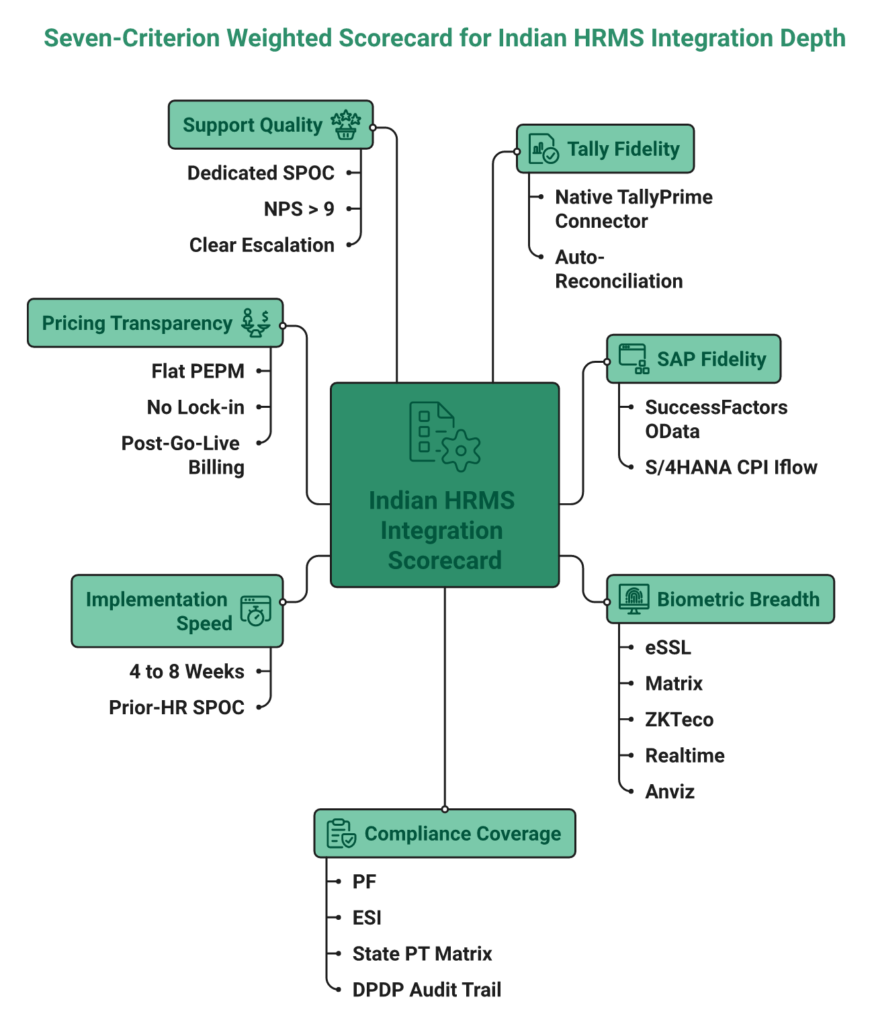
Buyers tend to evaluate on demo polish and per-employee sticker price, then discover integration gaps in month four. Use these testable questions instead:
| # | Criterion | Testable Question | Weight |
|---|---|---|---|
| 1 | Tally fidelity | Native TallyPrime connector with auto-reconciliation? | 18% |
| 2 | SAP fidelity | SuccessFactors OData + S/4HANA CPI iflow out-of-box? | 15% |
| 3 | Biometric breadth | Native drivers for eSSL, Matrix, ZKTeco, Realtime, and Anviz? | 15% |
| 4 | Compliance coverage | PF/ESI/state PT matrix, DPDP audit trail? | 15% |
| 5 | Implementation speed | Go-live in 4 to 8 weeks with prior-HR SPOC? | 12% |
| 6 | Pricing transparency | Flat PEPM, no lock-in, post-go-live billing? | 15% |
| 7 | Support quality | Dedicated SPOC, NPS > 9, clear escalation? | 10% |
⭐ Integration Scorecard, 12 Indian HRMS Vendors
Each profile uses an identical skeleton so comparisons are honest. Cross-check positioning on the top 10 HR software India list.
- HROne: Native TallyPrime (XML + ODBC), SuccessFactors OData, S/4HANA, Oracle, and NetSuite connectors, eSSL/Matrix/ZKTeco/Realtime/Anviz drivers, flat PEPM, subscription-after-go-live, ~30-day rollout, 9.8 NPS on SPOC. Best for: 100 to 5,000 employee Indian mid-market and enterprise. Skip if: sub-50 employee startup.
- Darwinbox: Strong SAP and Oracle breadth, enterprise brand, day-one billing, multi-year lock-ins, tab-heavy UX. Best for: 2,000+ enterprises with long implementation tolerance. See HROne vs Darwinbox.
- Keka: Clean UX, good Tally export, email-only support, slow onboarding, and thinner SAP depth. Best for: 100 to 500 employee firms prioritising UI polish. See HROne vs Keka.
- greytHR: Adequate SMB payroll presence, rigid configuration when multi-entity or shift complexity appears. Best for: single-entity SMBs under 200 employees. See HROne vs greytHR.
- Zoho People: Cheap, Zoho-ecosystem tight, shallow India payroll depth, and support lag. Best for: Zoho-stack-heavy firms under 300 employees.
- Zimyo: Emerging, decent mobile, limited SAP connector fidelity. Best for: 200 to 800 employee fast-growth firms.
- SalaryBox: Payroll-lite focus. Best for: sub-100 employee micro-businesses.
- Spine HR Suite: Payroll-heavy heritage, dated UX, and limited AI. Best for: legacy Tally-first accounting firms.
- Bharat Payroll: India-compliance focused, limited ATS and performance breadth. Best for: payroll-only scope.
- SAP SuccessFactors India: Global-grade breadth, needs developers for policy change, and cross-border data questions. Best for: global 5,000+ HQ-led rollouts. See HROne vs SAP.
- Averlon HRMS: Niche manufacturing play. Best for: single-plant manufacturers.
- NYGGS: Mid-market entrant, limited multi-entity depth. Best for: 200 to 500 employee single-location firms.
✅ Applying the Framework, Architecture Beats Module Count
The meta-insight I keep coming back to: the HRMS that wins is not the one with the longest feature grid. It is the one where every module talks to every other module under one audit trail. Asia Healthcare Holdings validates this at scale, 20 pan-India units on a single HROne instance with multi-legal-entity configuration, and the MRDIY case study shows payroll compression from 10 days to 5 to 6 days after consolidating.
“Keka is a naive software in HRMS… The setup phase has been a bad experience for us and worst is that even after so many hit trials by the team keka, my policies still are not applied the right way.”
— Shakti B., HR Practitioner Keka – G2 Verified Review
“GreytHR is not much good at customizing based on our requirements. For our case, from implementation onwards, there were issues with leave balance and all.”
— Verified User, IT Services greytHR – G2 Verified Review
Q10: What Industry-Specific Integration Patterns and Frontline-Workforce Considerations Should Manufacturing, Retail, BFSI, IT/ITeS, and Healthcare Buyers Account For?
Integration patterns diverge sharply by industry. Manufacturing needs multi-plant biometric plus SAP ECC IDoc, Retail needs distributed geo-fenced mobile plus TallyPrime, BFSI needs SSO plus DPDP-grade audit trail, IT/ITeS needs a SuccessFactors hybrid, and Healthcare needs multi-entity shift rostering with state-specific PT variations. Generic HRMS templates retrofit poorly onto any of these.
🏭 The Scenarios I See Play Out Every Quarter
- Manufacturing: An HR Head running eight plants with a mix of ZKTeco and eSSL devices, trying to feed shift-based attendance into SAP ECC through weekly IDoc batches. The drift between plant and corporate master data is so severe that month-end overtime claims become a negotiation, not a calculation. Purpose-built manufacturing HR addresses this directly.
- Retail: An Ops Lead with 120 stores across tier-2 cities reconciling biometric punches from store-level devices into TallyPrime for GL posting, while field supervisors claim expenses on paper. Receipt fraud slips through routinely. Retail HR templates collapse this into one flow.
- BFSI: A CIO enforcing DPDP audit on BGV webhooks and SSO across a 2,000-person workforce, needing every integration call logged for the statutory inspector. Finance HR brings the control layer.
- IT/ITeS: A global headcount already on SuccessFactors for talent, with India payroll needing a cleaner, faster local engine that syncs only the essential fields upstream.
- Healthcare: Twenty pan-India units across states with different PT slabs, 24×7 shift rosters, and a need for one employee master that survives inter-entity transfers. Healthcare HR carries this pattern out of the box.
❌ The Common Failure Pattern
Industries fail integration for the same reason: they retrofit a generic HRMS template and paper over the gaps with Excel and WhatsApp. The RFP language must name specific connectors, latency SLAs, and statutory variations before a single demo starts.
📋 RFP Must-Haves by Industry
| Industry | Must-Name in the RFP |
|---|---|
| Manufacturing | ZKTeco/eSSL ADMS, SAP ECC IDoc, and shift-based OT rules |
| Retail | Mobile geo-fence, Tally XML/ODBC, and 100+ location rollout plan |
| BFSI | SAML SSO, DPDP audit log, and BGV webhook plus consent |
| IT/ITeS | SuccessFactors OData, SCIM with Azure AD, and hybrid payroll |
| Healthcare | Multi-entity on one instance, state PT matrix, and 24×7 rostering |
✅ HROne’s Named Case Studies
MR DIY India (Retail) went live in ~30 days with TallyPrime JV integration live from day one, compressing payroll cycle from 10 days to 5 to 6 days. Asia Healthcare Holdings (Healthcare) runs 20 pan-India units on a single HROne instance with entity-independent PT and one employee master. Across our 1,500+ brand base, the HR inbox plus 127 pre-built workflows pattern holds up equally well across manufacturing shop floors, retail store networks, and BFSI audit regimes.
“Bad implementation experience, bad UI UX, configurations getting broken in production on its own due to product deployments, terrible customer service.”
— Verified User, Computer Software Darwinbox – G2 Verified Review
“HCM supports JV integration and GL code logic also. Real time sync of biometric and mobile mark punch functionality available. Salary processing to last creation of bank Challan files is quick and systematic process with error free details.”
— Deepak K., HR Practitioner HROne G2 – Verified Review
Q11: What Implementation Timeline, Cost Breakdown, Failure-Mode Playbook, and RFP Questions Should Indian HR Leaders Use Before Signing?
Evaluate any HRMS on a four-part gate before signing: implementation timeline (target 4 to 8 weeks), total integration cost breakdown (connector + middleware + services + maintenance), failure-mode coverage (five named scenarios with mitigation), and an RFP question bank that forces specificity on Tally, SAP, and biometric. Ignore any of these and month four of the rollout gets expensive.
⚠️ The Wrong-Way Pattern Most Buyers Fall Into
Most buyers evaluate on demo polish and per-employee price, ignore the integration TCO, and discover the real numbers only after go-live. Keka’s G2 reviews show this pattern repeatedly, with implementation stretching 6+ months with policies still mis-applied. The fix is a structured gate, not more demos. The HRIS buyer pitfalls guide captures the traps well.
⏰ The Seven-Step Right Framework
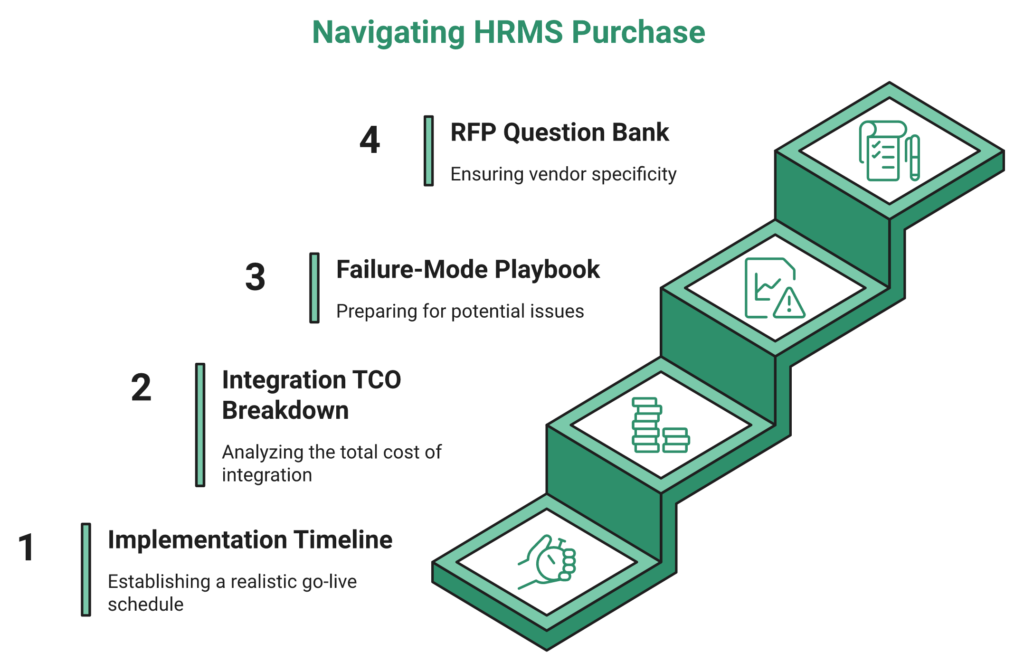
- Timeline benchmarks: 4 to 6 weeks for 100 to 500 employees, 6 to 10 weeks for 500 to 2,000, and 10 to 14 weeks for 2,000 to 5,000 with multi-entity. Anything longer is a warning sign.
- Pre-implementation data hygiene: clean the Tally chart of accounts, reconcile the employee master, rationalise pay heads, and confirm biometric device firmware before kickoff.
- UAT checklist: end-to-end Tally JV for at least one full payroll software cycle, SAP IDoc replication for master and payroll, biometric punch-to-payroll with OT edge cases, and BGV webhook round-trip.
- Integration cost breakdown: see table below, sticker price is rarely the full picture. See pricing for HROne’s flat-PEPM model.
- Failure-mode playbook: five named scenarios with mitigation.
- RFP question bank: 15 questions sent verbatim to every vendor.
- Change-management plan: HR and finance training, an escalation matrix, and a go-live command centre for the first two cycles.
💰 Integration Cost Breakdown Table
| Line Item | Typical Range (₹ / year, 500 emp) | Often Hidden? |
|---|---|---|
| HRMS subscription (PEPM) | 6 to 15 L | No |
| Tally connector licence | 0 to 40 k | Sometimes |
| Middleware / iPaaS (Boomi/CPI) | 3 to 15 L | Yes |
| Implementation services | 2 to 8 L | Often |
| Ongoing integration maintenance | 1 to 3 L | Almost always |
❌ Five Failure Modes and Mitigations
- Tally JV ledger mismatch: lock pay-head-to-ledger map in UAT, and run reconciliation report after every cycle.
- SAP IDoc failures: CPI iflow with retry plus dead-letter queue, and a weekly reconciliation job.
- Biometric clock drift: NTP sync across devices, and daily time-check audit.
- Duplicate punches: HRMS de-duplication by biometric ID and timestamp window.
- Employee master mismatch: single system-of-record with SCIM-driven downstream updates.
✅ How HROne Scores on the Gate
We get mid-market enterprises live in ~30 days, bill flat PEPM with subscription meter starting after go-live, surface integration exceptions in the HR inbox (not buried in logs), run group payout validations before disbursal, and ship UAT templates for Tally, SAP, and biometric flows out of the box. The meta-insight I give every CHRO and CFO: integration TCO beats sticker price every time, and the platform whose total cost stays flat over three years is the one that wins the board review. Use the ROI calculator to model this.
“Proper calculation of PF and ESI was a pain area for us before, but now with the HROne automated calculation process, results are up to the mark and following Indian tax compliances properly.”
— Ajay K., HR Lead HROne G2 – Verified Review
“We started working with Keka HRMS in August, and to this day, we have been unable to implement the tool in our company due to their consistently delayed responses and poor coordination between their internal teams.”
— Divya P., HR Lead Keka – G2 Verified Review
Q12: Which HRMS Should You Shortlist by Company Profile, and What Are the Answers to the Top FAQs Buyers Ask?
Shortlist by company profile, not by logo weight. 100 to 500 employees lean HROne or Keka, 500 to 2,000 mid-market multi-entity lean HROne or Darwinbox, 2,000 to 5,000 enterprise with an SAP estate lean HROne hybrid with SuccessFactors, and field-or-gig-heavy workforces lean HROne or Zimyo. The rest of the decision is FAQ-level clarity.
🎯 Shortlist by Company Profile
| Profile | Primary Shortlist | Why |
|---|---|---|
| 100 to 500 employees, single entity | HROne, Keka | Fast go-live, flat PEPM |
| 500 to 2,000, multi-entity Indian | HROne, Darwinbox | Multi-legal-entity, audit trail |
| 2,000 to 5,000 with SAP estate | HROne (hybrid with SuccessFactors) | India payroll depth plus global talent |
| Field / gig / manufacturing frontline | HROne, Zimyo | Offline attendance, geo-fence, and face-match |
| BFSI with DPDP pressure | HROne | India-resident, consent-aware connectors |
⭐ The Bridge
Running Tally JVs, biometric punches, SAP postings, BGV, and SSO under one DPDP-compliant audit trail is exactly what why HROne matters. The 1,500+ brands already live on the platform prove this works in production.
Ready to connect Tally, SAP, and biometric under one roof?
HROne ships pre-built connectors, DPDP-compliant audit trails, and a ~30-day go-live, with billing only after you’re live.
Get a Free Trial Book a Demo













 Secures Top Spot in
