


Q1. What are the 10 best employee communications software platforms and tools in 2026?
The ten best employee communications software platforms for 2026 are HROne, Staffbase, Workvivo, Simpplr, Connecteam, Blink, Microsoft Viva Engage, Poppulo, Firstup, and ContactMonkey. HROne leads for Indian mid-market and enterprise teams because announcements, mandatory handbook acknowledgements, WhatsApp and Teams bots, and recognition badges run natively on the payroll and attendance system of record rather than in a separate portal.
Choosing an employee communications platform is a high-stakes call for companies with 100 to 5,000 people, because the tool sits between HR, payroll data, and every deskless worker who never opens company email. For this report, ten platforms were evaluated against operational, compliance, and commercial criteria rather than brand recall. Gartner treats employee communications applications and intranet packaged solutions as two separate markets, so the shortlist spans both, plus HCM suites that ship communication natively.
Our Evaluation Criteria
Each platform was assessed across seven decision-grade metrics.
- Deskless and Multichannel Reach 📡
Native delivery through mobile app, SMS, WhatsApp, chat, digital signage, and kiosks, plus offline behaviour in low-connectivity plants. - System-of-Record Integration 🔗
Whether audiences are targeted from live HR master data, or built by hand from uploaded lists. - Compliance Traceability ✅
Mandatory read-and-acknowledge gating, timestamped logs, and exportable audit reports by location or legal entity. - Time to Value ⏰
Published go-live timelines, configuration without developer tickets, and clarity of documentation. - Two-Way Capability 🔄
Comments, reactions, pulse surveys, and mood checks, since research links dialogic (two-way) communication to engagement, not broadcast volume. - Pricing Transparency 💰
Whether a buyer can model a twelve-month figure before a sales call. - Support Model 🤝
Phone, email, dedicated single point of contact, ticket queue, or partner-delivered.
Who This Guide Is For
- CHROs and HR Heads consolidating announcements, employee engagement, and policy circulation off WhatsApp groups
- HR Ops leads chasing 10 to 15 follow-up emails for a single policy acknowledgement
- Payroll Managers distributing payslips and statutory notices across multi-entity, multi-state workforces
- CFOs testing whether a standalone comms licence earns its cost beside an existing HRMS
- IT Directors evaluating mobile-first delivery, single sign-on, and data residency for 1,000-plus deskless staff
The 10 Platforms, Ranked
- HROne
- Staffbase
- Workvivo
- Simpplr
- Connecteam
- Blink
- Microsoft Viva Engage
- Poppulo
- Firstup
- ContactMonkey
| Provider | Best For | Standout Strength | Known Limitation | India Fit | Support Model | Pricing Model |
|---|---|---|---|---|---|---|
| HROne ⭐⭐⭐⭐⭐ | HR ops leads chasing policy acknowledgements across multi-entity Indian workforces | Announcements, handbook gating, and badges run on the same database as payroll and attendance | Engage module reporting is thin, with users citing roughly three reports | Built for India, PF, ESI, TDS, PT automated | Phone, email, and dedicated prior-HR SPOC (9.8 NPS) | Flat band plus PEPM, billed after go-live |
| Staffbase ⭐⭐⭐⭐ | Internal comms teams running editorial campaigns for large frontline populations | Employee app plus email orchestration in one stack after the Bananatag acquisition | G2 reviewers report limited customisation and setup complexity | Global product, no India payroll or statutory layer | Enterprise CSM, partner-delivered rollouts | Quote-based, no public rate card |
| Workvivo ⭐⭐⭐⭐ | Culture and social engagement inside Zoom-centric enterprises | Gartner Leader for the third consecutive year in intranet packaged solutions | Social-feed strength outpaces structured compliance workflows | Global product, no India statutory layer | Vendor-led onboarding, ticket plus CSM | Quote-based |
| Simpplr ⭐⭐⭐⭐ | Comms teams wanting AI-assisted intranet plus newsletters | Named a Gartner Leader in the 2025 intranet packaged solutions quadrant | Enterprise scope can overshoot a 300-person HR team | Global product | CSM plus ticket queue | Quote-based |
| Connecteam ⭐⭐⭐⭐ | Shift managers coordinating hourly staff on one mobile app | Top-rated on G2 for frontline teams, with a published entry price | Depth thins out for corporate comms and multi-entity governance | Global product, no India payroll compliance | Email and chat support | Per-user tiers, published |
| Blink ⭐⭐⭐½ | Frontline-only workforces with no company email | Ranked by frontline suitability and adoption rates, not feature counts | Narrower desk-worker and intranet functionality | Global product | CSM plus ticket | Quote-based |
| Microsoft Viva Engage ⭐⭐⭐ | Microsoft 365 enterprises wanting comms inside Teams | Sits natively in the tenant employees already sign in to | Weak reach to staff without Microsoft licences | Global product | Microsoft support plus partners | Per-user add-on to Microsoft 365 |
| Poppulo ⭐⭐⭐½ | Comms teams pairing email campaigns with digital signage | Email plus signage plus mobile under one roof | Heavier lift for HR-owned workflows | Global product | CSM plus ticket | Quote-based |
| Firstup ⭐⭐⭐½ | Global enterprises orchestrating personalised campaigns at scale | Journey-style orchestration across many endpoints, Gartner Leader placement | Complexity demands a dedicated comms operations owner | Global product | Enterprise CSM | Quote-based |
| ContactMonkey ⭐⭐⭐ | Internal comms teams that live inside Outlook or Gmail | Measures internal email opens and clicks without leaving the inbox | Email-first, so deskless reach depends on other tools | Global product | Email and chat support | Per-sender subscription |
1.1 HROne, the hire-to-retire HCM where communication sits on payroll data
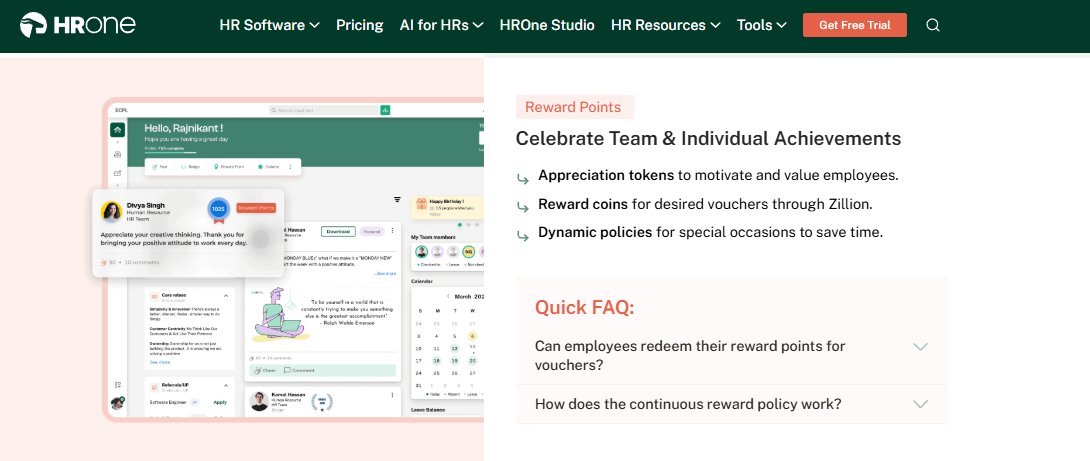
HROne, India-first HCM that treats announcements, acknowledgements, and recognition as workflow, not a noticeboard.
🏢 Overview
HROne is a cloud HCM (human capital management) platform founded in 2016 and headquartered in Noida. It is built for Indian organisations with 100 to 5,000 employees across IT and ITeS, BFSI, manufacturing, logistics, healthcare, and retail. HROne ranked 3rd out of 1.17 lakh software products for highest customer satisfaction on G2, and ships 30-plus modules with 127-plus pre-built workflows. Teams usually arrive here after announcements, payroll, and attendance have drifted into three systems that cannot talk to each other.
I have heard that same sentence in dozens of discovery calls. One HR head put it plainly: all three softwares could not talk to each other, so there was a lot of manual run around.
⚙️ Core Services
- HR Posts and Announcements automate birthday, anniversary, and policy announcements on a recurring scheduler, which removes the monthly copy-paste ritual from an HR generalist’s calendar.
- HR Handbook with Digital Acknowledgement distributes policies, forms, and videos with mandatory acknowledgement, so compliance items like anti-bribery or whistleblowing produce an audit trail instead of an email thread.
- Super Inbox surfaces every pending task, request, and approval on one Gmail-style screen, closeable in three clicks, which ends tab-hopping across five tools. See how the HR inbox is structured.
- WhatsApp and Teams Bots push letters, payslips, and notifications to workers without company email, so plant and field staff stop depending on a supervisor’s forwarded message. The WhatsApp bot covers this delivery path.
- Engagement Module runs mood bots at set frequencies, instant pulse surveys, and badges shareable to LinkedIn, turning recognition into something employees broadcast themselves.
- Helpdesk with Escalation Matrix routes employee queries to a resolver and auto-escalates unresolved tickets, which converts informal WhatsApp requests into tracked two-way communication. The helpdesk module handles the escalation matrix.
- ROI Dashboard calculates lifetime hours saved against average HR salary, so a CHRO walks into a board review with a rupee figure already computed.
🇮🇳 India-Specific Compliance and Localization
- PF / ESI / TDS support: Yes (automated calculation, challan and Form 16 generation). Details sit in this PF, ESI, and TDS compliance guide.
- Labour law compliance: Strong (statutory notices, wage slips, PT and LWF slabs)
- Payroll localization (India-specific): Yes (CTC revisions, FBP declarations, arrears)
- Multi-state compliance handling: Yes (state-wise PT slabs, unlimited legal entities)
👥 Who This Is Built For
- HR Ops lead sending the same compliance policy four times because nobody acknowledged it
- Payroll Manager mailing payslips to 800 plant workers who have no company email address
- CHRO who cannot answer how many days a confirmation letter takes to close
🚫 Who Should Skip This
- Internal comms teams outside India that need a multi-language editorial newsroom with content workflows and translation management
- Companies under 50 employees wanting a lightweight announcement feed without structured HR workflows
💰 Pricing Structure
- Plan Type(s): Basic, Professional, Enterprise. Full tiers are listed on the pricing page.
- Starting Price: ₹4,950 per month covering 50 users, then ₹99 per additional user, monthly billing, no lock-in
- Tier-wise Breakdown:
- Basic, ₹4,950 per month for 50 users plus ₹99 per user: Core HR with multi-legal entity, Time Office, Payroll, mobile app, and dashboards
- Professional, ₹6,500 per month for 50 users plus ₹130 per user: everything in Basic, plus Workforce (confirmation, transfer, separation) and digital letter acknowledgement
- Enterprise: customisable, quote shared on request
- Incremental Cost Drivers: AI add-ons, WhatsApp and Teams bots, and HRV Studio custom apps. No per-entity charge.
- Implementation Fee: No separate fee. Onboarding is bundled with a dedicated consultant.
- Cost at 200 Employees: ₹19,800 per month on Basic, ₹26,000 on Professional | Cost at 500 Employees: ₹49,500 per month on Basic, ₹65,000 on Professional
🤝 Implementation and Support Reality
- Published go-live benchmark of 30 days for mid-market rollouts, mapped in this HRMS implementation timeline
- Support runs on phone and email through a dedicated HR SPOC, reported at 9.8 NPS
- Migration is vendor-led, staffed by onboarding consultants who previously worked in HR roles
- Subscription meters only after go-live, so implementation months are not billed
“Home section packed with all needy useful options like apply OD or Short leave, HR related feed wall, Celebration section for employee engagement, Survey and many more. Delivery team has expertise, energetic and helpful during configuration phase.”
– Deepak K., Rating 5/5, HROne G2 – Verified Review
“Sharing pay slips, letter of appreciation, transfer letters becomes systematic and can be shared directly on the portal itself, no need to sharing on emails platform now. Engage module limited to hardly 3 reports and minimum functionalities available.”
– Manna S., Rating 4.5/5, HROne G2 – Verified Review
That second review is the honest limit. HROne’s read is that engagement reporting is still thinner than a dedicated comms analytics suite, and buyers who live in dashboards should test it before signing.
1.2 Staffbase, the editorial newsroom for large frontline populations
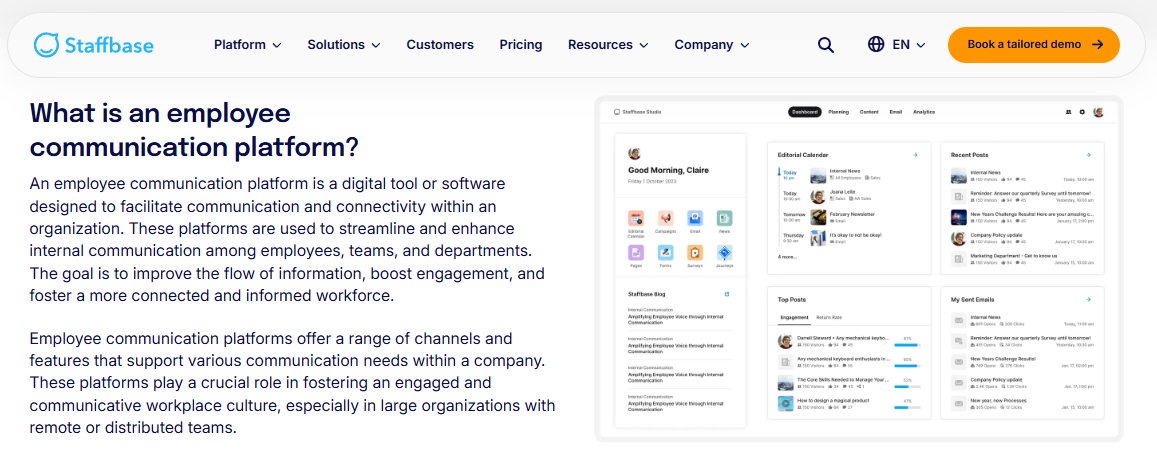
Staffbase, branded employee app plus internal email, built for enterprises with hard-to-reach staff.
🏢 Overview
Staffbase is an internal communications platform founded in 2014 in Chemnitz, Germany, with a New York headquarters. It serves more than 2,000 customers across 190-plus countries and reports reaching 16.5 million employees. The company acquired Bananatag in 2021, which added internal email orchestration to its employee app. Staffbase holds a 4.6 rating from 248 G2 reviews and was named a Leader in the 2025 Gartner Magic Quadrant for Intranet Packaged Solutions for the third consecutive year.
Comms teams usually shortlist Staffbase when a corporate newsroom, not an HR workflow, is the real problem.
⚙️ Core Services
- Branded Employee App delivers a company-skinned mobile app to staff without email logins, which removes reliance on printed notice boards.
- Email Orchestration designs, sends, and measures internal email from a drag-and-drop editor, so comms teams stop hand-coding Outlook templates.
- Intranet and Headless CMS publishes structured content with governance per brand or region, reducing duplicate microsites across subsidiaries.
- Audience Segmentation and Multi-Language Support targets by location, role, or language, which cuts irrelevant all-company blasts.
- Digital Signage and SMS Channels extend reach to shop floors and shift boards, so plant staff see updates without a device.
- Engagement Analytics reports reach, opens, and channel performance, giving comms leads evidence for their annual plan.
🇮🇳 India-Specific Compliance and Localization
- PF / ESI / TDS support: No (not a payroll system)
- Labour law compliance: Limited (no India statutory notice or wage-slip layer). Indian buyers usually pair it with dedicated statutory compliance software.
- Payroll localization (India-specific): No
- Multi-state compliance handling: No (segmentation exists, statutory logic does not)
👥 Who This Is Built For
- Internal comms manager running a multi-language newsroom across several countries
- Comms lead measuring campaign reach for a workforce of 10,000-plus frontline staff
🚫 Who Should Skip This
- Indian HR teams needing statutory notices, wage slips, and PF or ESI logic in the same tool
- Mid-market companies of 200 to 500 people without a dedicated internal comms owner to run the platform. This HRMS evaluation checklist helps size that gap.
💰 Pricing Structure
- Plan Type(s): Business and Enterprise, plus dedicated frontline pricing
- Starting Price: Not publicly disclosed, request a quote
- Tier-wise Breakdown: Not published. Quotes are scoped on workforce size, channel mix, and contract term.
- Incremental Cost Drivers: Channel modules including intranet, employee app, email, SMS, digital signage, and headless CMS are added to the quote
- Implementation Fee: Not publicly disclosed
- Cost at 200 Employees: Not publicly disclosed, request a quote | Cost at 500 Employees: Not publicly disclosed, request a quote
🤝 Implementation and Support Reality
- Rollouts are vendor-led or partner-delivered, with enterprise customer success ownership
- G2 reviewers flag setup complexity and limited customisation as the main friction points
- Independent review analysis notes reporting is solid for standard comms use cases, but not exhaustive for deeper experience analytics
- Pricing structure is described as understandable, though not transparent at purchase time. Compare against published bands in this HR software pricing guide.
Staffbase is genuinely strong at what it was built for. My honest caution for an Indian buyer is different: a great newsroom still leaves payroll, attendance, and acknowledgement audits sitting on someone’s desk.
1.3 Workvivo, the social feed enterprises adopt for culture
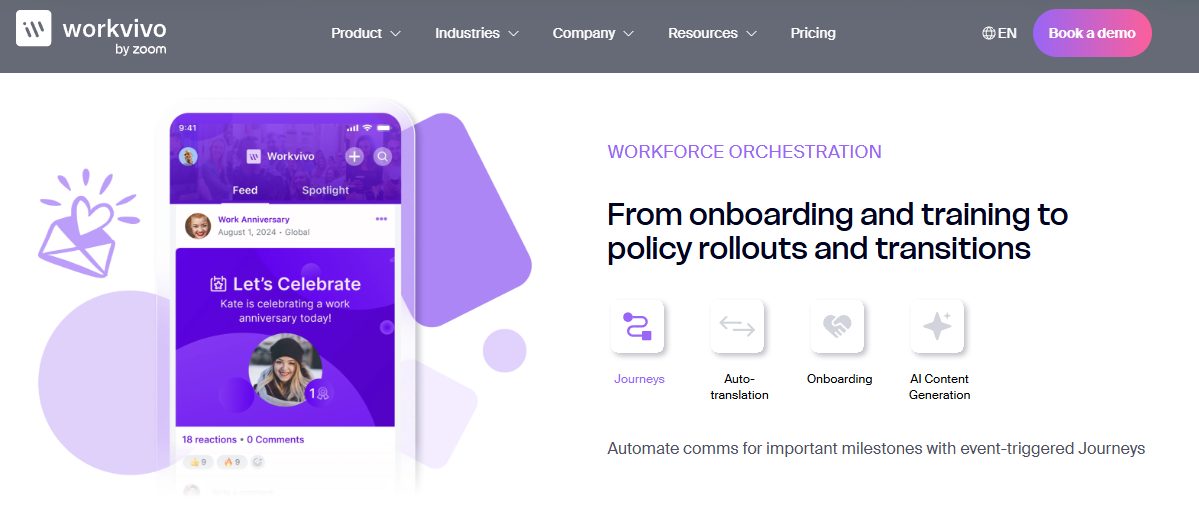
Workvivo, Zoom-owned employee experience platform built around a social activity feed.
🏢 Overview
Workvivo is an employee communications and experience platform now owned by Zoom. It holds 2,688 reviews on G2 and was placed in the Leaders quadrant of the 2025 Gartner Magic Quadrant for Intranet Packaged Solutions for the third consecutive year. Teams usually shortlist it when culture and recognition feel flat, and leadership wants visible engagement. It is popular with mid-to-large firms that already run Zoom across the business.
⚙️ Core Services
- Activity Feed publishes company news in a social layout with likes and comments, which pulls announcements out of dead intranet pages.
- Recognition and Shout-Outs let peers post praise publicly, reducing dependence on a once-a-year awards event.
- Employee Mobile App delivers push notifications to staff without desks, so shift updates do not rely on a supervisor.
- Podcasts and Livestreams host leadership broadcasts inside the platform, removing the need for a separate webinar tool.
- Surveys and Polls capture sentiment in the feed, giving comms teams two-way signal instead of open rates alone.
- Zoom Integration surfaces Workvivo inside Zoom, so employees do not learn a new destination.
🇮🇳 India-Specific Compliance and Localization
- PF / ESI / TDS support: No (not a payroll platform). Indian buyers pair it with dedicated payroll software.
- Labour law compliance: Limited (no statutory notice or wage-slip layer)
- Payroll localization (India-specific): No
- Multi-state compliance handling: No (segmentation only, no statutory logic)
👥 Who This Is Built For
- Internal comms lead whose intranet gets fewer visits than the canteen menu
- HR business partner trying to make recognition visible across 3,000 dispersed staff
🚫 Who Should Skip This
- Indian HR teams needing acknowledgement audit trails tied to payroll and attendance management records
- Small teams under 100 people, since G2 reviewers repeatedly flag cost as a barrier for smaller organisations
💰 Pricing Structure
- Plan Type(s): Starter, Growth (75-plus users), Enterprise
- Starting Price: Not publicly disclosed, request a quote
- Tier-wise Breakdown: Not published. Federated search, API access, and custom widgets sit in the Enterprise tier.
- Incremental Cost Drivers: Advanced provisioning and implementation services carry extra cost
- Implementation Fee: Yes, priced as an add-on service
- Cost at 200 Employees: Not publicly disclosed, request a quote | Cost at 500 Employees: Not publicly disclosed, request a quote
⚠️ Implementation and Support Reality
- Rollouts are vendor-led with customer success ownership, and no free trial is offered
- G2 reviewers report excessive notifications, mobile app issues, and slow performance
- Independent review analysis flags search weakness at scale and surface-level analytics
- There is no clear public evidence of native SMS or WhatsApp broadcast, unlike a dedicated WhatsApp bot add-on
1.4 Simpplr, the AI intranet for content-heavy enterprises
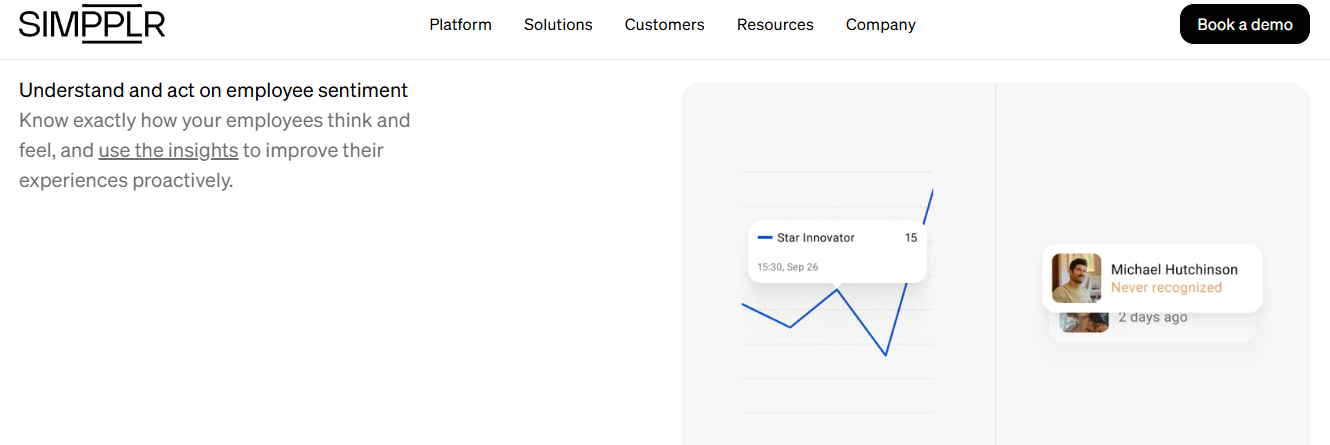
Simpplr, AI-powered intranet and employee experience platform for large content operations.
🏢 Overview
Simpplr is an intranet and employee experience platform focused on personalised content delivery. It holds a 4.6 out of 5 rating on G2 from more than 360 reviews, and has been a G2 Leader for 16 consecutive quarters. Gartner named it a Leader in the 2025 intranet packaged solutions quadrant. G2 reviewers rate it above category average on ease of use, setup, and administration. It fits organisations with a real content governance problem.
⚙️ Core Services
- AI-Assisted Intranet auto-personalises the homepage per employee, which cuts the manual curation an intranet manager does weekly.
- Newsletters and Campaigns build and schedule internal email, removing hand-built HTML from the comms workflow.
- Content Governance flags stale pages and assigns owners, so nobody reads a 2019 travel policy by accident.
- Employee Listening runs surveys and pulse checks, though this sits as a paid add-on.
- Enterprise Search indexes content across systems, also priced as an add-on.
- Analytics Dashboards report reach and adoption, giving comms teams evidence for budget conversations. Compare that against dedicated HR analytics tools.
🇮🇳 India-Specific Compliance and Localization
- PF / ESI / TDS support: No (not a payroll platform)
- Labour law compliance: Limited (no India statutory layer). Compliance-heavy buyers usually add labour law compliance software.
- Payroll localization (India-specific): No
- Multi-state compliance handling: No
👥 Who This Is Built For
- Comms manager governing hundreds of pages across regional subsidiaries
- HR lead who wants personalised content instead of one all-company blast
🚫 Who Should Skip This
- Buyers who need survey tools, enterprise search, and native video included in the base licence, since these are add-ons
- Teams that cannot commit user licences in advance, because the Salesforce foundation requires buying in bundles of 50
💰 Pricing Structure
- Plan Type(s): Simpplr One platform, plus paid add-on modules
- Starting Price: Not publicly disclosed, request a quote
- Tier-wise Breakdown: Not published. Base subscription includes intranet features, four releases a year, support, a customer success manager, and training.
- Incremental Cost Drivers: Enterprise Search, employee listening and surveys, native video hosting, and in-app video calling are add-ons
- Implementation Fee: Not publicly disclosed
- Cost at 200 Employees: Not publicly disclosed, request a quote | Cost at 500 Employees: Volume discounts available above 500 employees
⚠️ Implementation and Support Reality
- Trials run 14 days, with limited availability
- Support includes a technical team plus customer success oversight in the base plan
- Migration is vendor-led, aligned to quarterly product releases. This HRMS migration guide covers the data-mapping steps buyers underestimate.
- Licence bundles of 50 must be purchased in advance, which affects budget planning
1.5 Connecteam, the one app for hourly and shift teams
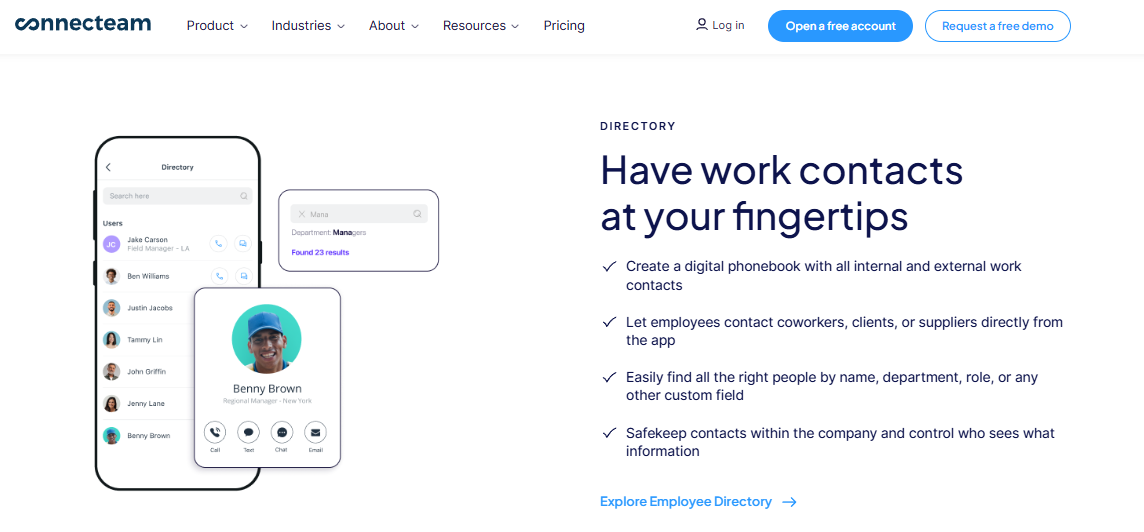
Connecteam, all-in-one deskless workforce app with a genuinely free starting tier.
🏢 Overview
Connecteam is a mobile-first platform for hourly and shift-based teams, combining communication with scheduling and time tracking. It holds 4.6 out of 5 on G2 from 3,505 reviews, with 75 percent of those reviews at five stars. The Small Business plan is free for up to 10 users across all hubs. It is most used by construction, hospitality, retail, and field service operators. Teams pick it when the same app must handle chat, shifts, and checklists.
⚙️ Core Services
- Communications Hub runs company updates, chat, and a social feed, which replaces informal WhatsApp groups with a searchable channel.
- Scheduling and Time Clock assigns shifts and captures punches with GPS, removing the paper roster on the wall. Shift-heavy Indian sites often compare this against a full workforce management module.
- Forms and Checklists digitise daily reports, so supervisors stop photographing handwritten sheets.
- Training and Knowledge Base delivers courses on mobile, cutting classroom time for new joiners.
- Surveys and Suggestion Box collect frontline feedback, giving HR two-way signal from staff without email.
- Task Management assigns and tracks jobs per shift, reducing verbal instructions that get forgotten.
🇮🇳 India-Specific Compliance and Localization
- PF / ESI / TDS support: No (no Indian payroll engine)
- Labour law compliance: Limited (global product, no India statutory templates)
- Payroll localization (India-specific): No
- Multi-state compliance handling: No
👥 Who This Is Built For
- Shift manager coordinating 60 hourly staff across three sites on WhatsApp today
- Ops lead collecting daily checklists on paper and re-typing them each evening
🚫 Who Should Skip This
- Plants and warehouses in low-connectivity zones, because the help centre states offline use is not currently possible on mobile, kiosk, or desktop. Offline-first options are covered in this guide to HRMS for field and blue-collar employees.
- Indian mid-market firms needing statutory payroll, multi-entity structures, and acknowledgement audits in the same system
💰 Pricing Structure
- Plan Type(s): Small Business (free), Basic, Advanced, Expert, Enterprise, sold per hub
- Starting Price: 0 dollars for up to 10 users, then 29 dollars per month for the first 30 users on Basic, billed annually
- Tier-wise Breakdown:
- Small Business: free for life, capped at 10 users, all three hubs
- Basic: 29 dollars per month per hub for the first 30 users, plus 0.50 dollars per extra user
- Advanced: 49 dollars per month per hub for the first 30 users, plus 1.50 dollars per extra user
- Expert: 99 dollars per month per hub for the first 30 users, plus 3 dollars per extra user
- Incremental Cost Drivers: Each hub (Operations, Communications, HR and Skills) is a separate subscription
- Implementation Fee: No
- Cost at 200 Employees: roughly 134 dollars per month on Communications Hub Basic, annual billing | Cost at 500 Employees: roughly 264 dollars per month on the same tier
⚠️ Implementation and Support Reality
- Self-serve setup, launched in days rather than months
- Support runs on email and chat, with no dedicated SPOC on lower tiers
- G2 reviewers cite steep admin setup for permissions and smart groups. Simplifying that is the subject of this piece on HR software permissions.
- Notification overload and communication fatigue among frontline staff are recurring complaints
1.6 Blink, the frontline-only employee app
Blink, mobile employee app for workforces that have no company email.
🏢 Overview
Blink is an employee app built specifically for frontline and deskless staff. It holds 4.7 out of 5 on G2 from 282 reviews, and publishes per-user pricing openly, which most enterprise comms vendors do not. It appears as a Challenger in Gartner’s 2025 intranet packaged solutions analysis. Independent comparisons position it for small to medium businesses with frontline workers who want simple tools rather than a full experience platform.
⚙️ Core Services
- Personalised Feed pushes updates by role and location, which stops irrelevant all-company blasts.
- Employee Directory and Chat connects shift staff directly, replacing supervisor-mediated messages.
- Digital Forms and Documents hold payslips and policies in one hub, removing printed handouts.
- Translation delivers content in the reader’s language, which G2 reviewers highlight as vital for multilingual teams.
- Surveys capture pulse feedback from staff who never open email.
- Single Sign-On and Integrations connect to existing HR systems for user provisioning. Indian stacks usually check integrations for biometric devices and ERP first.
🇮🇳 India-Specific Compliance and Localization
- PF / ESI / TDS support: No (not a payroll system)
- Labour law compliance: Limited (no India statutory layer)
- Payroll localization (India-specific): No
- Multi-state compliance handling: No
👥 Who This Is Built For
- HR lead whose 900 store staff share one manager login for updates
- Comms owner sending translated safety notices to multilingual shop-floor teams
🚫 Who Should Skip This
- Enterprises needing deep analytics and complex governance, since independent comparisons flag limited analytics and enterprise features. Larger estates usually screen against enterprise HRMS options for 1,000-plus employees.
- Indian firms wanting statutory notices, payslips, and PF logic generated in the same platform
💰 Pricing Structure
- Plan Type(s): Core, Pro, Enterprise
- Starting Price: £2.95 per user per month on Core
- Tier-wise Breakdown:
- Core, £2.95 per user per month: communication, alignment, and engagement basics
- Pro, £3.75 per user per month: richer automation, integrations, and personalisation
- Enterprise: contact vendor, adds control, security, and automation depth
- Incremental Cost Drivers: Enterprise-only security and automation features
- Implementation Fee: Not publicly disclosed
- Cost at 200 Employees: roughly £590 per month on Core | Cost at 500 Employees: roughly £1,475 per month on Core
⚠️ Implementation and Support Reality
- Free trial available, but no permanent free plan
- Pricing is best suited to mid-market and enterprise firms with dispersed workforces
- Support is vendor-led through customer success and ticketing
- Setup is fast, since the product scope is deliberately narrow
1.7 Microsoft Viva Engage, the option already inside your tenant
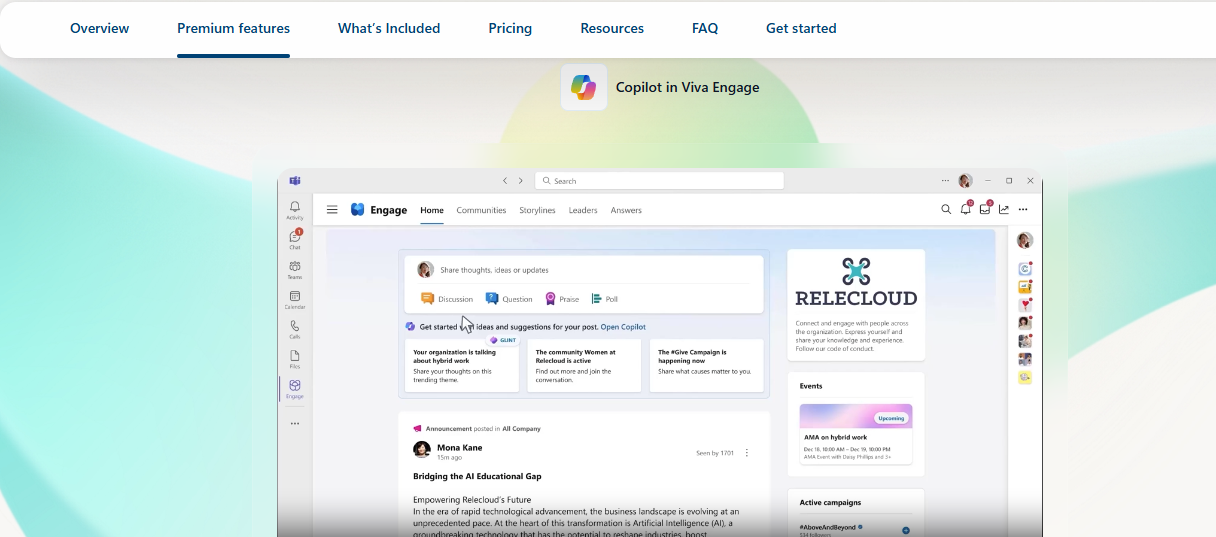
Microsoft Viva Engage, community and announcement layer for Microsoft 365 organisations.
🏢 Overview
Microsoft Viva Engage, formerly Yammer, is the communities and conversations layer inside Microsoft 365. Community and conversation features are included with Microsoft 365 and Office 365 enterprise and frontline plans at no extra licence cost. Premium features need a Viva Suite or Employee Communications and Communities licence. TrustRadius scores it 8.5 out of 10 from verified reviews. It suits IT-led organisations that already standardised on Teams and SharePoint.
⚙️ Core Services
- Communities and Conversations host topic-based discussion, which keeps knowledge out of private email chains.
- Announcements and Polls broadcast updates inside Teams, so employees do not switch apps. HR teams already in Teams often add a Teams bot for HR tasks alongside it.
- Leadership Corner and Storyline give executives a posting surface, reducing forwarded all-staff emails.
- Campaigns coordinate multi-post pushes, available in the premium tier.
- Ask Me Anything Events open live Q and A, giving two-way access to leadership.
- Copilot in Viva Engage drafts and refines posts, cutting writing time for comms teams.
🇮🇳 India-Specific Compliance and Localization
- PF / ESI / TDS support: No (not an HR or payroll system)
- Labour law compliance: Limited (no statutory HR layer)
- Payroll localization (India-specific): No
- Multi-state compliance handling: No
👥 Who This Is Built For
- IT director consolidating comms tools inside an existing Microsoft 365 estate
- Comms lead whose audience is fully licensed on Microsoft and already lives in Teams
🚫 Who Should Skip This
- Organisations where most plant, field, or store staff hold no Microsoft licence
- HR teams needing acknowledgement audit exports mapped to legal entity and payroll data. Multi-entity requirements are unpacked in this guide to HR software for multi-entity companies.
💰 Pricing Structure
- Plan Type(s): Included with Microsoft 365, Employee Communications and Communities, Viva Suite
- Starting Price: Included in eligible Microsoft 365 plans. Premium starts at ₹165 per user per month, paid yearly.
- Tier-wise Breakdown:
- Microsoft 365 enterprise and frontline plans: communities, conversations, announcements, and polls
- Employee Communications and Communities, ₹165 per user per month annual: campaigns, leadership features, and Amplify
- Viva Suite, ₹1,000 per user per month annual: all Viva modules plus advanced analytics
- Incremental Cost Drivers: Teams and SharePoint licences, plus other Viva modules
- Implementation Fee: No vendor fee, though partner-led rollouts are commonly purchased
- Cost at 200 Employees: ₹33,000 per month on the Communications and Communities add-on | Cost at 500 Employees: ₹82,500 per month on the same add-on
⚠️ Implementation and Support Reality
- Deployment is IT-led, often through a Microsoft partner
- Support flows through existing Microsoft agreements plus partner channels
- Licensing analysis notes many organisations buy the suite and actively use only two or three modules
- Premium and standard feature boundaries shift, so confirm entitlements at purchase
1.8 Poppulo, the email plus signage combination
Poppulo, multichannel internal comms platform pairing email with digital signage.
🏢 Overview
Poppulo is a multichannel employee communications platform that also sells digital signage software. Its employee experience product holds 4.3 to 4.4 out of 5 on G2 across roughly 224 to 301 reviews, with 80.5 percent of reviewers from enterprise accounts. Pricing is subscription-based on employee count and channel mix. It suits comms teams that need to reach both inbox and shop floor screens. Enterprise skew is the clearest signal of fit.
⚙️ Core Services
- Internal Email builds and measures newsletters with audience tagging, removing manual list maintenance.
- Digital Signage pushes content to screens in plants and lobbies, reaching staff with no device. Plant-heavy buyers usually also review manufacturing HR requirements.
- Employee App and SMS extend delivery to mobile, so shift workers get urgent notices.
- HRIS-Synced Distribution Lists pull audiences from HR data, cutting spreadsheet uploads.
- Engagement Analytics report reach and behaviour, which enterprise reviewers cite as their ROI evidence.
- Workplace Experience Tools cover space and meeting-room communication for hybrid offices.
🇮🇳 India-Specific Compliance and Localization
- PF / ESI / TDS support: No (not a payroll platform)
- Labour law compliance: Limited (no India statutory layer)
- Payroll localization (India-specific): No
- Multi-state compliance handling: No
👥 Who This Is Built For
- Comms manager who must hit both corporate inboxes and factory floor screens
- Enterprise comms lead reporting campaign performance to a communications director
🚫 Who Should Skip This
- Smaller organisations, since G2 analysis notes it may strain budgets below enterprise scale
- HR teams wanting communication and payroll acknowledgement in one record
💰 Pricing Structure
- Plan Type(s): Custom enterprise agreements, scoped by channel
- Starting Price: Not publicly disclosed, request a quote
- Tier-wise Breakdown: Not published. No free tier and no publicly listed paid tiers on G2.
- Incremental Cost Drivers: Each additional channel, including email, app, SMS, and signage
- Implementation Fee: Not publicly disclosed
- Cost at 200 Employees: Not publicly disclosed, request a quote | Cost at 500 Employees: Not publicly disclosed, request a quote
⚠️ Implementation and Support Reality
- No free trial, so vendor-led demos are the evaluation path
- G2 scores ease of setup at 8.2 and ease of admin at 8.2, both below the Firstup comparison
- Quality of support scores 8.7 on G2
- Average negotiated discount is reported at 9 percent
1.9 Firstup, the orchestration engine for very large workforces
Firstup, campaign orchestration platform for enterprise comms at Fortune-scale.
🏢 Overview
Firstup is an employee communications platform focused on personalised, multichannel campaign delivery. It holds a 4.4 out of 5 G2 rating from around 206 reviews, with 76 percent of reviewers from enterprise accounts, and 4.8 on Gartner Peer Insights. Independent analysis reports it is used by more than 40 percent of Fortune 100 companies. Gartner placed it in the 2025 intranet packaged solutions Leaders quadrant. Comms operations teams pick it for scale, not simplicity.
⚙️ Core Services
- Campaign Orchestration sequences messages across channels by employee journey stage, which replaces manual send calendars.
- Intelligent Delivery picks channel and timing per person, reducing ignored notifications.
- Studio Content Designer builds branded content once for many endpoints, cutting duplicate production work.
- Journey Analytics measures message performance through the employee lifecycle, giving comms teams outcome data.
- Microapps and Integrations surface tasks from other systems, so employees act without hunting for links.
- Audience Segmentation targets by attribute pulled from HR data, avoiding blanket sends. Indian teams often route this through HR process automation instead.
🇮🇳 India-Specific Compliance and Localization
- PF / ESI / TDS support: No (not a payroll platform)
- Labour law compliance: Limited (no India statutory layer)
- Payroll localization (India-specific): No
- Multi-state compliance handling: No
👥 Who This Is Built For
- Comms operations lead running sequenced campaigns for 20,000-plus employees
- Change manager measuring message reach through a multi-quarter transformation
🚫 Who Should Skip This
- Indian mid-market HR teams of 200 to 800 people without a dedicated comms operations owner. That band is covered in this list of best mid-market HR software in India.
- Buyers needing early cost clarity, since no public pricing is disclosed anywhere
💰 Pricing Structure
- Plan Type(s): Three editions, starting with Essential
- Starting Price: Not publicly disclosed, request a quote
- Tier-wise Breakdown: Not published. Priced per user per month on annual commitments, varying by tier and licensed users.
- Incremental Cost Drivers: Platform tier, licence volume, and features such as the Knowledge Hub, which reviewers note is not standard
- Implementation Fee: Not publicly disclosed
- Cost at 200 Employees: Not publicly disclosed, request a quote | Cost at 500 Employees: Not publicly disclosed, request a quote
⚠️ Implementation and Support Reality
- G2 scores ease of setup at 8.3 and quality of support at 8.7
- Reviewers report limited UI customisation and complex navigation when searching old messages
- Recurring Studio glitches and a need for technical help during setup are documented
- G2 reviewers also flag that personalised pricing lacks transparency. Published bands are compared in this HR software pricing guide.
1.10 ContactMonkey, internal email measurement inside Outlook
ContactMonkey, internal email platform for teams that will not leave Outlook or Gmail.
🏢 Overview
ContactMonkey is an internal communications email platform built to create, send, and measure messages from inside Outlook or Gmail. It holds a 4.4 out of 5 average rating on G2. All three editions, Launch, Grow, and Enterprise, require contacting the vendor for pricing, and no free trial is offered. The Launch tier covers branded email creation, drag-and-drop templates, core analytics, and basic surveys. It fits comms teams whose main gap is measurement, not reach.
⚙️ Core Services
- Email Template Builder creates branded internal emails with drag-and-drop blocks, removing dependence on a designer.
- Outlook and Gmail Send delivers from the tool comms teams already use, so nobody learns a new sender.
- Open and Click Analytics report who read what, replacing guesswork about whether an update landed.
- Embedded Surveys and Pulse Questions collect responses in the email body, lifting reply rates.
- List Management syncs distribution lists from existing directories, reducing manual list edits.
- Email Scheduling queues sends for optimal windows, avoiding 11 pm accidental blasts.
🇮🇳 India-Specific Compliance and Localization
- PF / ESI / TDS support: No (not a payroll platform)
- Labour law compliance: Limited (no statutory layer)
- Payroll localization (India-specific): No
- Multi-state compliance handling: No
👥 Who This Is Built For
- Comms specialist who cannot prove whether the last all-staff email was read
- HR lead running newsletters from Outlook with no analytics behind them
🚫 Who Should Skip This
- Organisations where a majority of staff have no company email address, where a mobile HR app reaches people faster
- Indian HR teams needing mandatory acknowledgement logs, payslips, and statutory notices in one system
💰 Pricing Structure
- Plan Type(s): Launch, Grow, Enterprise
- Starting Price: Not publicly disclosed, request a quote
- Tier-wise Breakdown: Not published. Launch covers branded email, templates, core analytics, and basic surveys. Grow adds to Launch.
- Incremental Cost Drivers: Tier upgrades for advanced analytics and integrations
- Implementation Fee: Not publicly disclosed
- Cost at 200 Employees: Not publicly disclosed, request a quote | Cost at 500 Employees: Not publicly disclosed, request a quote
⚠️ Implementation and Support Reality
- No free plan and no free trial, so evaluation runs through vendor demos
- Setup is light, since the product plugs into an existing email client
- Support is email and chat based, without a dedicated SPOC model
- Pricing details are absent from public listings, which slows early budgeting
HROne earns position one here on a narrow, checkable point: announcements, mandatory handbook acknowledgements, and badge sharing sit on the same record as payroll and attendance, and the subscription meters only after go-live. Nine of the ten platforms above solve reach beautifully. Only one of them can also produce a wage-slip trail and a statutory notice log for an Indian audit, which is why why HROne matters more than feature counts here.
Q2. How were these platforms scored, and what does independent analyst data say?
Each platform was scored out of 100 across five weighted criteria: verified user reviews (20%), deskless and multichannel reach (25%), system-of-record integration (20%), compliance and acknowledgement traceability (20%), and pricing transparency (15%). Scores convert to stars in 20-point bands. HROne scored 5 stars; Staffbase, Workvivo, and Simpplr scored 4; ContactMonkey and Viva Engage scored 3.
📊 Why Weights Beat Vibes
Most “best software” lists rank by traffic, not by decision risk. A weighted rubric forces the writer to declare what actually matters before naming a winner. It also lets you disagree with me and re-score using your own weights.
An HR head once told me she bought a beautiful comms tool that 40 percent of her workforce never opened. Reach was worth more than features, and nobody had scored it.
⚖️ The Weights, and What Counted as Evidence
| Criterion | Weight | Evidence accepted |
|---|---|---|
| Deskless and multichannel reach | 25% | Published channel support: mobile app, SMS, WhatsApp, signage, kiosk, and offline behaviour |
| Verified user reviews | 20% | G2 and Gartner Peer Insights ratings with review counts, filtered by company size |
| System-of-record integration | 20% | Whether audiences pull from live HR master data or uploaded lists |
| Compliance traceability | 20% | Mandatory acknowledgement, timestamped logs, and exports by entity or location |
| Pricing transparency | 15% | A published rate card a buyer can model before a sales call |
Reach carries the heaviest weight for one reason. A message nobody receives has zero value, no matter how well designed the editor is.
🔍 Cross-Checking Against Gartner and G2
The shortlist was checked against the 2025 Gartner Magic Quadrant for Intranet Packaged Solutions. Simpplr, Workvivo, Staffbase, and Firstup sit in the Leaders quadrant, with Blink among the Challengers. That validation matters more than any vendor blog ranking.
Gartner’s market guide for employee communications applications lists segmentation, multichannel delivery, campaign execution, and analytics as the core capability groups. Copy those four as your RFP (request for proposal) section headings, alongside this HRMS evaluation checklist. G2’s employee communications category holds 18,233 verified reviews, so filter by your headcount band before trusting an average score.
⭐ Star Bands and Their Limits
| Score | Stars | Reading |
|---|---|---|
| 81 to 100 | ⭐⭐⭐⭐⭐ | Covers reach, integration, and audit trail |
| 61 to 80 | ⭐⭐⭐⭐ | Strong in its lane, gaps elsewhere |
| 41 to 60 | ⭐⭐⭐½ | Solid single-purpose tool |
| 21 to 40 | ⭐⭐⭐ | Narrow fit, dependent on other systems |
HROne measures pricing transparency using its own published model as the benchmark: a flat band with no lock-in, where the subscription meters only after go-live, as listed on the pricing page. I know that looks self-serving, so here is the check. Any vendor publishing a rate card scores the same points, and six of the ten publish nothing.
💬 What Reviewers Said, Including About Us
“While HROne does a great job overall, one thing I don’t like is that it can sometimes feel a bit overwhelming for new users. Certain features take time to understand, and without enough guided support, the learning curve can feel quite steep.”
– Nijanthan R., Rating 3/5, HROne G2 – Verified Review
“The InboxforHR is a game-changer, centralizing every HR task into one simple inbox, cutting down administrative time by 60-70% and preventing tasks from falling through the cracks.”
– Waldon S., Rating 4/5, HROne G2 – Verified Review
“Right now it only has the capability to schedule posts in the tool and that post is like a notification it would be nice if there is a feature to customize the notification for it.”
– Naveen k., Rating 2.5/5, greytHR G2 – Verified Review
That third review is exactly why two-way capability sits inside the reach score. Scheduled posts that behave like notifications are broadcast, not communication. Buyers weighing that gap often compare HROne vs greytHR directly.
HROne scored highest on compliance traceability and system-of-record integration, because announcements draw audiences from core HCM data rather than uploaded lists. On pure editorial polish and multi-language newsroom depth, three platforms above scored better. That trade-off is real, and buyers should weigh it themselves.
Q3. What is employee communications software, and which capabilities actually matter?
Employee communications software plans, segments, delivers, and measures internal messages across email, mobile app, SMS, chat, and digital signage. Slack and Teams carry conversation but not campaign targeting or read analytics. Intranets store content. Gartner treats employee communications applications and intranet packaged solutions as separate markets, which is why buyers end up paying for three overlapping tools.
🧩 Three Categories, Not One
Gartner defines employee communications applications as tools for planning, creating, coordinating, and distributing internal communications. Intranet packaged solutions are defined separately, as products for creating and delivering an employee destination. Chat tools sit in a third bucket entirely.
Picture a shift-change policy going out to 900 factory workers. A chat tool buries it in a group. An intranet parks it on a page nobody visits. A communications application targets the right plants, then reports who read it. That scenario is common in manufacturing HR environments.
💸 The Overlap Tax
Here is where money leaks. If the comms tool cannot read your HR system, someone builds the recipient list by hand each time. That person is usually your most experienced HR executive, doing spreadsheet work on a Tuesday.
HROne removes that step by driving audience visibility from Core HR itself, where organisational units, position codes, and access rights already exist. We did not invent this idea. We just stopped pretending a separate portal could guess who works where. The same logic underpins HR process automation.
✅ The Eight Capabilities That Decide Outcomes
| Capability | What it removes | Demo question to ask |
|---|---|---|
| HRIS-driven segmentation | Manual list building | “Target only night-shift staff in Pune, live, now” |
| Scheduled and recurring announcements | Monthly copy-paste rituals | “Set an anniversary post to repeat yearly” |
| Mandatory read-and-acknowledge gating | Chasing signatures over email | “Show me who has not acknowledged the POSH policy” |
| Channel fallback with suppression | Follow-ups to people who already acted | “Suppress reminders for responders” |
| Two-way feedback | One-way broadcast plateau | “Run a pulse survey inside the announcement” |
| Mobile and bot delivery | Dependence on company email | “Send a payslip to a WhatsApp number” |
| Per-message read analytics | Guesswork about whether it landed | “Export read rates by location” |
| Shareable recognition | Awards that nobody sees | “Post a badge to LinkedIn from the app” |
Gartner’s market guide expects multichannel delivery spanning email, mobile, and signage. Independent channel matrices show only some platforms support digital signage natively, while a WhatsApp bot covers the no-email population directly.
⚠️ The Three Features Vendors Demo Hardest
Themes and widget layouts look great in a demo and change nothing. Ask instead how the homepage behaves for a worker with no email address.
AI content generation is the second one. It writes the announcement faster, but it does not make anyone read it. HROne ships announcement and HR post generators inside its One AI suite, and even so, adoption still comes from delivery, not drafting.
Social feeds are the third. Ask the vendor to show a feed after 300 posts, then find last month’s leave policy in it.
🔎 A Simple Test Before You Sign
Take one real policy from last quarter. Ask each vendor to deliver it to a segment, gate the acknowledgement, then export the audit report by legal entity. Multi-entity structures are unpacked in this guide to HR software for multi-entity companies.
Most tools stop at delivery. The ones that complete all three steps are the shortlist, whatever the analyst quadrant says.
HROne’s Super Inbox exists because navigation is where engagement dies. Every pending announcement, approval, and acknowledgement appears on one Gmail-style screen, closeable in three clicks, inside the HR inbox. My honest caveat: that design helps completion rates, not message quality. A badly written policy stays badly written.
Q4. Why do most employee communication rollouts stall after month three?
Rollouts stall because a standalone tool cannot see who an employee is. Without live HR data, segmentation becomes manual list building, follow-ups reach people who already acted, and HR reverts to email chasing. Peer-reviewed research finds that two-way dialogic communication, not broadcast volume, predicts engagement. Read-only announcement boards plateau within a quarter.
😮💨 Month One Looks Great
Launch week always works. Leadership posts, employees comment, and the adoption chart climbs. Then the HR team goes back to running payroll.
By month three, the pattern I hear most is the same sentence in different accents. Every initiative had to be manually tracked, and there was no progress to show for it.
💸 The Expensive Version of This Failure
One HR leader described watching businesses spend 300,000 dollars on an ERP, expecting it to fix everything. People never embraced the change, and the system went unused. Communication tools fail the same way, just at a smaller invoice size.
The cause is rarely the product. It is that nobody designed who sees what, so everyone sees everything and stops looking. Scoping that properly is the point of this HRMS implementation timeline.
🔬 What the Research Actually Says
Qin (2024), in the International Journal of Business Communication, found that dialogic (two-way) communication significantly predicts employee engagement in remote work. Broadcasting harder does not substitute for letting people reply.
Abduraimi, Bilalli, Islami, and Macani (2024), in Economic Studies, found that communication climate, supervisory communication, media quality, and personal feedback predict vigour, dedication, and absorption. Media quality means how good the tool feels to use. That is an adoption variable, not a vanity one, which is why the mobile HR app matters more than a desktop skin.
🤖 The Anti-Noise Mechanics Nobody Demos
Vendors sell this as AI personalisation. The underlying logic is older than most HR teams realise. US patent 6782415B1 describes closed-loop message distribution that suppresses follow-ups to recipients who already responded.
US patent 8694594 describes personalised delivery ordered by preference and precedence per user. Both mechanisms date back over two decades. Ask any vendor to demo suppression live, and watch how many cannot.
⚠️ Uniformity Is the Quiet Killer
Most HR systems do not fail because they were unfair. They fail because they were too uniform. A single flat feed for a plant operator and a finance controller serves neither.
HROne configures this on the front end, where a policy owner sets visibility by organisational unit and access rights without raising a developer ticket, an approach detailed in this piece on HR software permissions. I will hedge one thing here. Our data points to configuration flexibility driving adoption, though I might be reading a correlation as a cause.
❌ What We Got Wrong
Early in our own rollouts, we over-engineered segments before anyone was using the tool. Thirty audience groups on day one, and no baseline to tell us which mattered. It looked rigorous and slowed everything down.
The better sequence is blunt. Launch with three segments, watch two weeks of read data, then split further.
✅ Three Questions to Ask Before You Sign
- Show me suppression. Send a policy, mark two people as acknowledged, then prove reminders skip them.
- Show me the audit export. Pull acknowledgement status filtered by location and legal entity, the way statutory compliance software is expected to.
- Show me a reply loop. Run a pulse question inside the announcement and display results by segment.
If a vendor needs a follow-up call to answer all three, your rollout will need a follow-up project.
HROne’s read is that the standard advice gets this backwards. Buyers are told to shortlist on features, when the deciding variable is whether the tool already knows your org structure. Announcements, mood bots, and acknowledgement gating run on the same Core HR record as payroll and attendance management.
Q5. How do you reach deskless workers and meet Indian statutory communication duties?
Reach deskless staff where they already are: WhatsApp, an offline-capable mobile app, SMS, and shop-floor signage or kiosks, not email. Section 50 of the Code on Wages, 2019 requires employers to display a Code abstract, category-wise wage rates, wage period, and payment dates on a notice board at a prominent place, and to issue wage slips in the prescribed form. Timestamped acknowledgements turn that duty into audit evidence.
🏭 The Situation Most Indian Buyers Actually Have
Picture a 1,200-person manufacturer across four plants. Around 70 percent of that workforce has no company email address. Head office runs on Outlook, and the plants run on shouting distance and a printed board.
The HR team forwards policies to plant heads on WhatsApp. Those get forwarded again, edited, or ignored. Nobody can prove who read what. That pattern repeats across HRMS deployments for field and blue-collar teams.
📉 Why That Breaks at Audit Time
The 2025 Intranet Observatory found 43 percent of surveyed organisations report non-connected employee populations. So this is not an Indian quirk. It is the majority condition in operational businesses.
Gartner’s guidance on employee communications applications expects multichannel delivery including kiosks and signage, not email alone. HROne’s WhatsApp bot and Teams bots exist for exactly this gap, pushing letters, payslips, and notifications to workers with no inbox.
⚖️ What Section 50 Actually Says
Section 50 of the Code on Wages, 2019 states that every employer must maintain registers of persons employed, muster roll, and wages, and must display a notice on the notice board at a prominent place. It also requires wage slips in the prescribed form. In plain terms, statutory notices are a communication workload, not a filing task, which is why statutory compliance software belongs in this evaluation.
POSH (Prevention of Sexual Harassment) policy circulation works the same way. An auditor does not want the policy PDF. They want proof each employee received and acknowledged it, which is the point of a documented POSH policy.
✅ Obligation Mapped to Platform Capability
| Statutory duty | What the platform must do | Proof to demand |
|---|---|---|
| Notice board display, Section 50 | Serve as a digital notice board per plant and entity | Screenshot plus timestamped publish log |
| Wage slip issue, Section 50 | Deliver payslips to no-email staff | WhatsApp or app delivery receipt |
| POSH policy circulation | Gate acknowledgement per employee | Acknowledgement report by location |
| Handbook and code of conduct | Mandatory read before dismissal of prompt | Export filtered by legal entity |
One HR leader I spoke with wanted the handbook feature made mandatory specifically for compliance policies. Anti-bribery and whistleblowing were the two she named.
🔍 The Demo Test That Settles It
Ask each vendor to do three things in the demo, live. Publish a notice to one plant only. Gate the acknowledgement. Then export the acknowledgement report filtered by location and legal entity.
HROne runs this across unlimited legal entities on a single instance, since multi-entity structures sit in Core HR rather than in a bolt-on, as covered in this guide to HR software for multi-entity companies. I will be honest about the limit. If your plants have genuinely no smartphones, you still need a physical board and a kiosk screen.
💬 What Field-Heavy Teams Report
“Tracking employee movement for sales department was a tough one task for us but now with functionality of HROne, employees can mark their attendance from HROne mobile application. Challans filling for PT or ESI filling becomes a quick and easy task.”
– Sachin K., Rating 5/5, HROne G2 – Verified Review
“Create and release of requirement based letters for employees like warning letter, PIP letter, Letter of Appreciation, now all can be initiated via the HRone functionality, now no need of sharing hard copies. Most of times, application logs out automatically, I have raised the concern to support department but no resolution received.”
– Komal S., Rating 5/5, HROne G2 – Verified Review
That second review carries a real complaint about session logouts. I would rather you read it here than discover it in month two.
HROne pairs both halves of this problem in one place. Bots deliver letters and payslips to workers without email, and the HR Handbook module enforces mandatory digital acknowledgement with an auditable trail. Standalone comms tools do the first well and cannot do the second at all.
Q6. What does employee communications software cost, and is a standalone tool worth it?
Published pricing runs roughly 3 to 15 US dollars per employee per month. Connecteam starts at 29 dollars monthly per hub for the first 30 users, Blink at £2.95 per user, and Microsoft Viva’s communications add-on at ₹165 per user. Staffbase, Workvivo, Simpplr, Poppulo, Firstup, and ContactMonkey quote custom enterprise pricing only. HROne publishes a flat band of ₹4,950 monthly for 50 users, then ₹99 per additional user.
💰 What Is Actually Published
Six of the ten platforms in this guide publish nothing. That is not a scandal, but it does slow your budget cycle by weeks. For context on category norms, see this HR software pricing guide.
| Platform | Published entry price | Quote-only |
|---|---|---|
| HROne | ₹4,950 per month for 50 users, then ₹99 per user | No |
| Connecteam | Free to 10 users, then 29 dollars per hub monthly | No |
| Blink | £2.95 per user per month | No |
| Microsoft Viva Engage | Included in eligible M365 plans, premium from ₹165 | No |
| Staffbase | Not published | Yes |
| Workvivo | Not published | Yes |
| Simpplr | Not published | Yes |
| Poppulo | Not published | Yes |
| Firstup | Not published | Yes |
| ContactMonkey | Not published, three editions | Yes |
💸 The Costs That Do Not Appear on the Rate Card
Channel add-ons are the first. Simpplr sells enterprise search, surveys, and native video as separate modules. Connecteam charges per hub, so communications, operations, and HR are three subscriptions.
Implementation is the second. Workvivo prices advanced provisioning and implementation as add-on services. The third is billing that starts at contract signature, months before anyone logs in, a risk worth checking against a realistic HRMS implementation timeline.
📐 A Three-Year Model at 1,000 Employees
Take a mid-market Indian firm with an existing HRMS. Adding a standalone comms platform at a conservative 4 dollars per employee monthly costs about 48,000 dollars a year, plus implementation.
Now compare that against HROne’s flat band, where 1,000 users on the Basic tier works out near ₹98,000 monthly with no separate comms licence, as published on the pricing page. Even before discounting, the arithmetic favours one system over two. That holds only if the suite genuinely covers your comms requirements, which is what Q3’s capability table is for.
🧾 The CFO Version of the Argument
Point solutions rarely deliver the return buyers expect. Customers get the right ROI when they take the complete HR software, because organisational units live in Core HR, workforce, time office, and payroll. Running the numbers is easier with an ROI calculator.
Scale makes this sharper in India. NASSCOM puts Indian tech headcount near 5.8 million in FY2025E, and multi-location, multi-entity operations are the norm rather than the exception. Every extra vendor in that stack is another reconciliation job at month end, which is the core argument in this piece on payroll software versus a full HRMS.
⏰ Where Billing Terms Change Behaviour
HROne meters the subscription only after go-live, with no lock-in period. That flips the incentive: we get paid when you are live, not when you sign.
Compare that with vendors billing from day one of purchase while implementation drags. You pay for three months of nothing, then start measuring value from a smaller budget.
HROne stays on this list at position one partly because a buyer can model twelve months of cost from a public page, before a sales call. Six platforms here cannot offer that. On editorial depth, several beat us, and their quote-based pricing may still be worth it.
Q7. How do you choose a platform and prove it is working?
Work in order: count no-email employees, map required channels, confirm HRIS-driven segmentation, test two-way feedback, demand an acknowledgement audit export, demo suppression and channel fallback live, then model three-year cost against your existing HCM. Then measure four things: acknowledgement completion, read rate by segment, survey participation, and HR hours reclaimed from manual follow-ups.
🧭 The Seven-Step Buying Sequence
- Count your no-email employees. This one number eliminates roughly half the vendor market before you take a single call.
- Map required channels. List app, SMS, WhatsApp, signage, and kiosk against actual sites, not aspirations.
- Confirm HRIS-driven segmentation. If audiences come from uploaded lists, someone will maintain those lists forever.
- Test two-way feedback. Ask for a pulse question inside a live announcement, then results by segment. Two-way tooling usually sits inside the employee engagement module.
- Demand the acknowledgement export. Filter by location and legal entity, or the audit trail is decorative.
- Demo suppression and fallback. Reminders must skip people who already acted.
- Model three-year cost. Compare a standalone licence against what your HCM already includes, using this HRMS evaluation checklist as the scoring frame.
📊 The Four Metrics That Matter After Go-Live
| Metric | What good looks like | Where it comes from |
|---|---|---|
| Acknowledgement completion | Above 90 percent within 7 days | Policy gating logs |
| Read rate by segment | No segment below 60 percent | Per-message analytics |
| Survey participation | Rising month on month | Pulse and mood tools |
| HR hours reclaimed | Fewer manual follow-ups per cycle | Time-per-task tracking |
HROne measures the last one directly, converting average HR salary and per-task minutes into hours and rupees saved on an inbuilt ROI dashboard. My caution: that figure is a ballpark, not audited accounting. The broader method is explained in this analysis of the ROI of HR software in India.
⭐ Two Numbers From Real Deployments
One customer described engagement participation sitting at 25 percent before instant recognition was switched on. After deployment, participation reached 125 percent of the earlier baseline. The trigger was not a newsletter. It was the instant pat on the back.
A second team used analytics to find their HR bandwidth was running at 150 percent occupancy. They brought that down by 70 percent, and reinvested the reclaimed time elsewhere. More examples sit in the customer success stories.
⚠️ The Counterpoint Nobody Sells You
Rich dashboards only help organisations with the bandwidth to act on them. There is no point buying the bells and whistles if you never switch them on.
Research supports the caution. Vyas and colleagues (2025) reviewed 108 papers and found organisational culture moderates the link between internal communication and engagement. The same tool gives different results in different cultures.
⏰ Phase It, Then Time It
Turn on the parachute that opens for you now, not the whole hog you cannot eat. Start with announcements and handbook acknowledgement, then add recognition and mood checks in month three.
Time the rollout to a real change event. Suratmoko and Adnan (2024) found two-way, credible communication during organisational change raises commitment, with trust as the mediator. An appraisal cycle or restructuring gives you honest adoption data, which is why many teams pair this with performance management timelines.
💬 What Buyers Say About Adoption
“I use HROne daily for my attendance, leave, and all HR related activities. The initial setup was straightforward and simple, and I didn’t require training to use it from the first day.”
– Prajwal B., Rating 5/5, HROne G2 – Verified Review
“Lack of customizations options are not expected from a full service HRMS. No self onboard options as well. lot of manual work that the team still has to do.”
– Verified User in Internet, Rating 2.5/5, Keka G2 – Verified Review
HROne pairs the ROI dashboard with an HR Ops heat map that flags which processes are slipping on timelines, so a CHRO sees delays before the board does, which is the practical case made on the CHRO solutions page. Software does not build culture. It makes something consistent once you have formulated it.
What I keep wondering is whether acknowledgement rates will become a standard audit metric in India within two years. If your auditor has already asked, I would genuinely like to hear how that conversation went.












 Secures Top Spot in
