








Q1: How Much Does Zoho People Cost in 2026?
Zoho People costs Rs.48 to Rs.192 per user per month on annual billing in 2026. Essential HR is Rs.48, Professional Rs.96, Premium Rs.144, and Enterprise Rs.192. Billed monthly, the same tiers run roughly Rs.60 to Rs.240. In USD, that is about $1.25 to $4.50 per user per month annually. A free edition exists for very small teams. Every figure excludes 18% GST.
💰 The quote is not the price
Here is the pattern I see with HR buyers. A CHRO gets a number, builds a budget around it, and then the invoice arrives 22% higher.
The gap is not deception. It is that per-user pricing hides tax, minimum seats, and the modules you assumed were included.
⏰ The 2026 price ladder, verified this month
I pulled these from Zoho’s India pricing page and cross-checked them against a July 2026 teardown. Dates matter here, because these numbers move.
| Plan | Annual billing (INR/user/month) | Monthly billing (INR/user/month) | Approx. USD (annual) |
|---|---|---|---|
| Free | Rs.0 | Rs.0 | $0 |
| Essential HR | Rs.48 | Rs.60 | $1.25 |
| Professional | Rs.96 | Rs.120 | $2.50 |
| Premium | Rs.144 | Rs.180 | $3.50 |
| Enterprise | Rs.192 | Rs.240 | $4.50 |
Above roughly 500 users, Zoho stops publishing and asks for a quote request instead.
✅ What annual billing actually saves
Zoho states yearly billing saves “more than 20%” against monthly. On the numbers, the real gap is 20% flat across tiers.
For 100 employees on Professional, that is about Rs.28,800 saved per year. Not life-changing. Worth taking.
The trade-off is cash flow. Annual billing means one large outflow, usually before your team has finished configuring anything.
⚠️ Add 18% before you present to finance
Zoho publishes prices exclusive of GST. So Rs.96 becomes about Rs.113 per user per month, all-in, for an Indian entity.
I would rather a payroll manager carry the Rs.113 figure into a board slide than the Rs.96 one. The second number gets challenged in the room.
📝 Which billing cycle to pick
My working rule, and I hold it loosely: pick monthly for your first quarter, then switch to annual once configuration is genuinely done.
You lose 20% for three months. You gain the ability to walk away before a year of spend is locked in.
Zoho makes plan switching self-serve from the subscription page, which lowers the cost of that decision.
One more thing about published pricing
Some large vendors will not publish at all. As one HR leader put it, they “quote you out specifically based on your needs,” so “you need to contact a representative and then talk through it.”
That opacity is not a small inconvenience. It is usually the first signal of a system that will demand chasing later.
HROne publishes its India pricing openly and pairs it with a public ROI calculator, so an HR ops lead can model per-employee cost before a sales call rather than after one.
Q2: Why Do Published Zoho People Prices Contradict Each Other?
Third-party pages currently publish Rs.48-192, Rs.50-230, Rs.83, and even Rs.210-630 per employee per month for Zoho People. The gaps come from stale caches, USD-to-INR conversion, GST treatment, and partner markups. Two rules settle it. Read the official India pricing page, and remember every paid plan bills a five-user minimum.
❌ Four sources, four different prices
I ran this search the way a buyer would. Six pages, six answers, all published in 2026.
| Published figure | Source type | Why it drifts |
|---|---|---|
| Rs.48-192/user/month | Pricing teardown, July 2026 | Annual-billing INR, GST excluded |
| Rs.50 sticker, Rs.59 all-in | Data page | Adds 18% GST to entry tier |
| Rs.83/employee/month | Competitor comparison page | Undated “Standard” tier that is not a current Zoho plan name |
| Rs.210-630/employee/month | Partner or reseller page | Bundled implementation or reseller markup |
| $3/user/month | Review platform listing | USD, conflicts with $1.25 elsewhere on the same site |
None of these are lying. They are answering different questions and not saying which.
⚠️ The five-user floor changes small-team math
Zoho’s own comparison table lists “Minimum users: 5” on every paid plan.
So a three-person startup on Essential HR does not pay Rs.144. It pays for five seats, Rs.240 a month, Rs.283 after GST.
At 20 employees, the floor is irrelevant. Under eight, it is the single biggest distortion in every calculator you will find online.
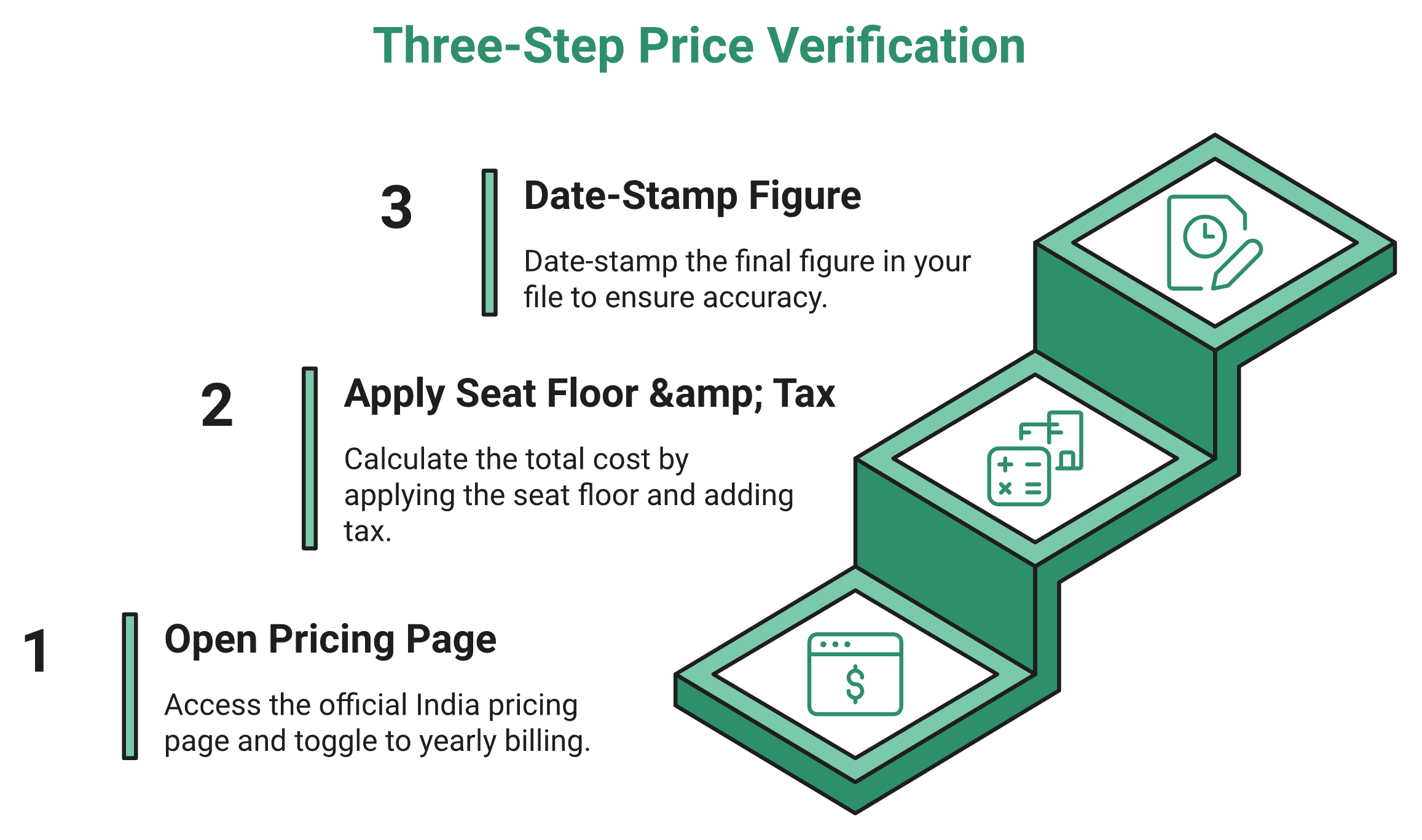
✅ A three-step verification routine
I use this before any HRMS number goes near a board deck. It takes six minutes.
- Open the vendor’s India pricing page and toggle to yearly. Screenshot it with the date visible.
- Multiply seats by tier, apply the seat minimum, then add 18% GST.
- Write the retrieval date beside the figure in your own document.
Step three sounds fussy. It is the step that saves you when someone reopens the spreadsheet in March.
💸 Why this happens at all
Buyers are not confused because they are careless. They are confused because prices get published without dates, without tax treatment, and without the seat floor.
Currency adds another layer. A page written in USD in 2024 and converted in 2026 will land 8-12% off simply from exchange drift.
My honest read is that this is a documentation failure across the category, not a Zoho-specific one.
📝 What to do with a reseller quote
If a partner quotes you Rs.210 per employee against a published Rs.48, ask one question. What is bundled?
Sometimes the answer is implementation, training, and local support, and it is fair value. Sometimes it is margin.
Either way, get the split in writing before signature, because you cannot renegotiate a bundle you never saw itemised.
HROne states pricing in rupees with tax treatment spelled out, which is why HR teams can reconcile a quote against the first invoice without a follow-up call.
Q3: What Does Each Zoho People Plan Actually Include?
Essential HR covers the employee database, leave, documents, onboarding, and shift creation. Attendance tracking, biometric integration, timesheets, and shift rotation begin at Professional. Appraisals, 360-degree feedback, OKRs, and compensation management arrive at Premium. HR help desk, LMS, sandbox, and personal file uploads sit at Enterprise. Advanced analytics needs a separate Zoho Analytics subscription. Payroll appears in no tier.
⚠️ The upgrade shock is always attendance
The most common mistake I watch mid-market teams make is buying Essential HR and assuming attendance is included.
It is not. Attendance tracking, regularisation, overtime management, biometric integration, and IP restrictions all start at Professional.
That is a jump from Rs.48 to Rs.96 per user, so the real entry price for any company running shifts doubles on day one.
📊 What unlocks where
| Capability | Free | Essential HR (Rs.48) | Professional (Rs.96) | Premium (Rs.144) | Enterprise (Rs.192) |
|---|---|---|---|---|---|
| Employee database, leave, holidays | ✅ | ✅ | ✅ | ✅ | ✅ |
| Onboarding, offboarding, exit interviews | ❌ | ✅ | ✅ | ✅ | ✅ |
| Attendance, biometric, overtime | ❌ | ❌ | ✅ | ✅ | ✅ |
| Timesheets, shift rotation, patterns | ❌ | ❌ | ✅ | ✅ | ✅ |
| Appraisals, 360 feedback, OKR, compensation | ❌ | ❌ | ❌ | ✅ | ✅ |
| HR help desk, LMS, sandbox | ❌ | ❌ | ❌ | ❌ | ✅ |
| Payroll (PF, ESI, TDS) | ❌ | ❌ | ❌ | ❌ | ❌ |
Custom reports also start at Premium, and advanced analytics requires an active Zoho Analytics subscription on top of any tier.
💬 What users say about depth
Breadth at this price genuinely works for some teams. Depth is where the complaints cluster.
“I find Zoho People particularly valuable for its comprehensive digital management of employee attendance and leave management… the initial setup was very easy, supported by available instructional videos.”
– Anshul M., 4/5, Zoho People G2 – Verified Review
“The breadth of applications and the price of it… Features are shallow and there is no depth in each application.”
– Verified User in Information Technology and Services, 2.5/5, Zoho People G2 – Verified Review
Both reviews are true at once. That is usually what a generalist suite feels like from inside.
✅ The keyword trap behind tier confusion
Buyers search for Core HR. What they actually need, the moment two legal entities exist, is HCM.
One HR leader described it plainly: “Core HR is the thing keyword they use, but HCM is what people look for,” because “under Core HR everything is coming.”
Tiered suites split that “everything” across four price points, which is why the tier you need is rarely the tier you shortlisted.
📝 Price only the tier that holds your top three
Do this before you look at any price. Write down your three heaviest daily HR workflows.
If regularising attendance is one of them, your floor is Professional. If appraisals are one, your floor is Premium. If you need a help desk with SLA tracking, you are at Enterprise.
Then, and only then, multiply. Buying the whole hog when you will not eat it is how HRMS budgets get wasted.
HROne ships attendance, payroll, performance, and helpdesk inside one instance, so switching on attendance is a configuration step at core HCM rather than a tier jump.
Q4: Is the Free Plan Enough for a Growing HR Team?
Zoho People’s free edition suits a very small team tracking employee records, leave, and documents. It allows one administrator, no attendance tracking, no timesheets, no onboarding workflows, and no payroll. Published caps conflict between three and five users, so confirm yours in-app. Once you run shifts, biometric attendance, or statutory payroll, the free plan breaks inside one payroll cycle.
💰 Free feels safe at 15 people
I understand the appeal completely. Headcount is small, budget is tight, and a spreadsheet plus a free portal looks like enough.
For about two quarters, it is enough. Then someone joins mid-month, a leave balance gets disputed, and there is no audit trail to settle it.
❌ What the free edition leaves out
The gaps are structural, not cosmetic. Zoho’s own comparison table makes them explicit.
- One administrator only, against unlimited on every paid tier
- No attendance tracking, no biometric integration, no regularisation
- No onboarding or offboarding workflows, and no exit interviews
- No multi-level approvals, no workflow checklists, no mail alerts
- 250 MB storage total, against 1 GB per 100 users on Essential HR
- No API access, so nothing connects to your finance system
⚠️ The user cap genuinely conflicts
Zoho’s India pricing page describes the free edition as forever free for up to five users. One comparison table says “Free for 5 users.” A second table on the same site says “Free for 3 users”.
I am not going to pretend I know which applies to your region. Check it inside your own account before you plan headcount around it.
💬 What free-tier and entry users report
The complaints I trust most are the boring operational ones, because those are the ones you live with daily.
“Easy to use, quick updates. Easy to add new tasks… Impossible to edit old entries (if you forgot to add something). Impossible to fix errors (like missing dates).”
– John B., 3/5, Zoho People G2 – Verified Review
“Extremely slow time logging. Earlier we could navigate to the next cell just by pressing Tab… now we have to click on every cell and then type and click submit.”
– Pooja K., 1.5/5, Zoho People G2 – Verified Review
An uncorrectable entry is not a feature gap. It is a compliance problem waiting for an audit.
✅ Three triggers that end the free plan
Move to paid this quarter if any one of these is now true for you.
- You run shifts or field staff, so attendance must be captured, not declared.
- You process statutory payroll, because PF, ESI, and TDS never touch this tier.
- A second legal entity exists, and policies now differ by unit.
📝 Why uniform systems fail first
There is a line from an HR leader I keep returning to. “Most HR systems didn’t fail because they were unfair. They failed because they were too uniform.”
Free tiers are uniform by design. They treat every employee, grade, and location identically, which is exactly what breaks when your second plant opens.
Equality feels safe in a policy document. In a payroll run, it produces wrong numbers for real people.
HROne serves 100 to 5,000 employee organisations where policies differ by entity and grade, so day-one policy differentiation is standard configuration rather than a paid unlock.
Q5: What Will Zoho People Cost for Your Headcount?
At Professional on annual billing, 10 employees costs about Rs.960 a month before tax, or Rs.1,133 after 18% GST. Fifty employees runs about Rs.5,664 a month, and 100 employees about Rs.11,328, which is roughly Rs.1.36 lakh a year. At 500 employees on Premium, budget close to Rs.10.2 lakh annually. Above 500 users, Zoho moves you to a custom quote.
💰 Per-user pricing hides the annual number
Rs.96 sounds harmless. It is designed to sound harmless.
Multiply it by 100 people, twelve months, and GST, and you are asking finance for Rs.1.36 lakh. That is a different conversation.
📊 What each headcount actually costs
These are annual-billing figures, GST included, so you can paste them straight into a budget sheet.
| Headcount | Essential HR (Rs.48) | Professional (Rs.96) | Premium (Rs.144) |
|---|---|---|---|
| 10 | Rs.6,797/yr | Rs.13,594/yr | Rs.20,390/yr |
| 20 | Rs.13,594/yr | Rs.27,187/yr | Rs.40,781/yr |
| 50 | Rs.33,984/yr | Rs.67,968/yr | Rs.1,01,952/yr |
| 100 | Rs.67,968/yr | Rs.1,35,936/yr | Rs.2,03,904/yr |
| 500 | Rs.3,39,840/yr | Rs.6,79,680/yr | Rs.10,19,520/yr |
| 1,000 | Rs.6,79,680/yr | Rs.13,59,360/yr | Rs.20,39,040/yr |
Past 500 seats, treat the last row as an indication only, since Zoho asks for a quote request at that scale.
⏰ The formula, so you can rerun it
A CFO should never trust a number they cannot reproduce. Here is the whole calculation.
Annual cost = max(headcount, 5) x tier rate x 12 x 1.18
The max(headcount, 5) part matters only for tiny teams, because paid plans bill a five-user minimum. The 1.18 is GST, which Zoho excludes from every published figure.
⚠️ What this table still leaves out
This is licence cost only. It does not include payroll, advanced analytics, or implementation time.
I have watched buyers approve the Rs.1.36 lakh figure and then discover the real number sits closer to Rs.2.5 lakh. That gap is the subject of the next few sections.
✅ Put cost next to hours, not next to features
A finance manager I spoke with described the moment her thinking changed. She was, in her words, “shocked to see the turnover versus expenditure” once someone put process outcomes beside the invoice.
Cost per employee means very little on its own. Cost per employee against HR hours reclaimed is a decision you can defend.
You can ask HROne’s ROI calculator to run the same headcount math against reclaimed HR hours, so the licence figure and the time figure sit on one screen.
📝 The one number for your budget line
Pick your tier, run the formula, and carry a single annual figure into planning.
For most 100-person Indian companies needing attendance, that number is about Rs.1.36 lakh for Zoho People alone. For 500 people needing appraisals too, it is about Rs.10.2 lakh.
Write the retrieval date beside it. Prices move, and a stale figure in a board deck is worse than no figure.
HROne prices on flat per-employee-per-month terms with no lock-in and metering that starts after go-live, so the annual figure a CHRO approves is the figure that appears on the invoice.
Q6: What Does Adding Payroll to Zoho People Cost?
Payroll sits in no Zoho People tier. You add Zoho Payroll separately, which is free up to 10 employees, then Rs.1,000 per organisation per month on annual billing for 25 employees, plus Rs.40 per additional employee. Alternatively, the People Plus bundle runs roughly Rs.350 to Rs.450 per user per month. Each legal entity needs its own payroll licence.
💸 You priced HR software and got a database
This is the single largest gap between the sticker and reality. Zoho People stores people data. It does not pay people.
Payroll lives in a different product, on a different pricing model, with a different licence structure.
📊 Three paths at 100 employees
Monthly figures below, annual billing, before GST, so you can compare shapes rather than tax.
| Path | Monthly cost | What you get | What is missing |
|---|---|---|---|
| People Professional only | Rs.9,600 | HR records, leave, attendance, timesheets | Payroll, PF, ESI, TDS, Form 16 |
| People Professional plus Payroll Standard | Rs.13,600 | Above, plus statutory payroll, Form 16, Form 24Q | Recruitment, expense, deeper analytics |
| People Plus bundle (Premium) | Rs.35,000 approx | People, Payroll, Recruit, Expense, Cliq, Connect, Vault | Nothing much, but you pay for all of it |
Zoho Payroll’s own tiers are priced per organisation, not per user, which is why the second path stays surprisingly reasonable.
⚠️ Two details that change the math
First, Form 16 generation and Form 24Q reporting start at the Standard payroll plan. The free tier does not produce them.
Second, and this one costs real money, Zoho states you must buy a separate payroll licence for each legal entity.
For a group with four registered companies, that is four base fees before a single employee is counted.
✅ When the bundle actually wins
I want to correct a common assumption here. People Plus is not the cheap route for a payroll-plus-attendance need.
At roughly Rs.350 per user, the bundle only makes sense if you would otherwise buy three or more products separately, typically recruitment, expense, and internal chat alongside HR.
If you need HR plus payroll and nothing else, stacking People and Payroll is materially cheaper at 100 seats.
💰 The break-even, roughly
My working estimate, and I hold this loosely because bundle pricing loads dynamically on Zoho’s page, is that the bundle turns favourable once you are paying for four Zoho products.
Below that, you are pre-buying capability you will not use this year. As one HR leader put it, “You don’t want to buy the whole hog if you’re not going to eat the whole hog.”
📝 The integration cost nobody quotes
Two products means one sync. Zoho People and Zoho Payroll connect through employee sync and loss-of-pay sync.
That works. It is also one more thing to reconcile at month-end when a mid-month exit lands in one system and not the other.
HROne runs statutory payroll inside the same instance that captures attendance, connected by 120-plus cross-module automations, so loss of pay reaches the pay run without a second subscription or a sync to reconcile.
Q7: Does Zoho People Cover Indian Statutory Compliance?
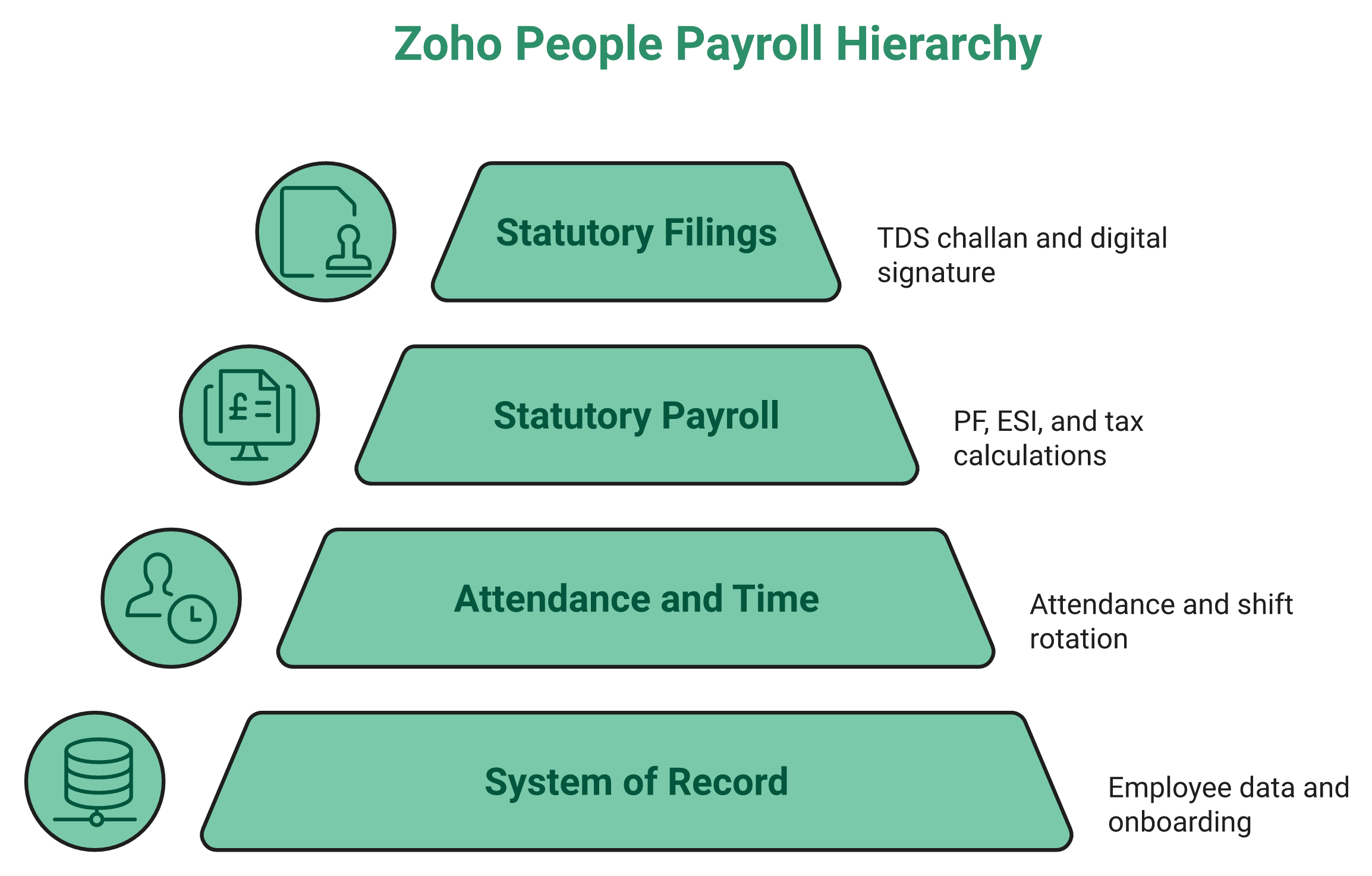
No. Zoho People is a system of record, and India statutory processing sits in Zoho Payroll or the People Plus bundle. PF at 12% plus 12%, ESI at 3.25% employer and 0.75% employee up to Rs.21,000 wages, state professional tax, LWF, Form 24Q, and Form 16 all fall outside the Zoho People seat price you approved.
⚠️ The plan you signed cannot pay salaries
Check Zoho People’s feature matrix end to end. There is no PF calculation, no ESI return, no professional tax slab, and no TDS challan.
That is not a defect. It is a product boundary. The problem is that most pricing pages never say it plainly.
📜 What the Code on Wages actually demands
The Code on Wages, 2019 (Act 29 of 2019) unified the definition of “wages” across four older laws.
Wages now mean basic pay, dearness allowance, and retaining allowance. If excluded components cross 50% of total remuneration, the excess gets added back into wages.
That single rule changes PF, gratuity, bonus, and leave encashment calculations. Your software either applies it or quietly gets it wrong.
📊 What statutory processing involves
| Obligation | Rate or form | Where it sits in Zoho |
|---|---|---|
| EPF | 12% employee, 12% employer | Zoho Payroll, free tier onward |
| ESI | 3.25% employer, 0.75% employee up to Rs.21,000 | Zoho Payroll, free tier onward |
| Professional tax, LWF | State-wise slabs | Zoho Payroll, free tier onward |
| Form 24Q, TDS challan | Quarterly return | Zoho Payroll Standard and above |
| Form 16 with digital signature | Annual | Zoho Payroll Standard and above |
So the annual Form 16 run, the one thing every employee chases you for, requires a paid payroll plan.
💸 What getting this wrong costs
Penalty exposure is not theoretical. In a 2026 survey of Indian MSMEs, 41% reported EPFO or ESIC penalties between 2023 and 2025, largely from calculation and filing errors.
The same study reported that figure falling to 0.2% among firms running automated compliance engines. I would treat the exact numbers as directional, but the direction is clear.
⏰ Ask how fast rule updates ship
A 1999 patent for web-based payroll administration already described automatic ingestion of statutory rule changes into the calculation engine.
That was 27 years ago. So “we update for new notifications” is not a differentiator, it is table stakes.
The real question is latency. Ask any vendor how many days after an EPFO circular their engine reflects it.
✅ The Monday action
Pull one payslip and check three things. Does the wage base apply the 50% rule? Is PT correct for that employee’s state? Does the ESI cutoff use Rs.21,000?
Fix the arithmetic before you shop for a new tool. A payroll manager once told me she found a two-year PT error this way, in under an hour.
Because as one HR leader framed it, the job is not historical data migration. “People’s mortgages and rents getting paid on time” is the actual deliverable.
HROne processes PF, ESI, PT, LWF, and TDS filings natively through its statutory compliance engine in the same instance that captures attendance, which is how MR DIY India moved its payroll cycle from 10 days to 5 or 6.
Q8: Which Costs Stay Hidden Until Implementation?
Seven costs surface after signing: 18% GST, the five-user minimum, Zoho Payroll for statutory payroll with a separate licence per legal entity, Zoho Analytics for advanced reporting, Zoho Sign or Vault for document and credential workflows, paid add-ons such as extra storage, forms, LMS, and employee profiles, plus implementation and configuration labour.
💸 The invoice that did not match the quote
I have sat in this meeting more than once. Someone approved Rs.96 per user, and the first-year outflow landed near double.
Nobody was misled. Seven separate line items simply arrived at seven different moments.
📊 The seven line items, itemised
Here is where the money actually goes, based on Zoho’s own pricing and add-on documentation.
- GST at 18% on every licence, excluded from all published prices.
- Five-user minimum on paid plans, which inflates small-team cost.
- Zoho Payroll, from Rs.1,000 per organisation per month, per legal entity.
- Zoho Analytics, required for advanced analytics beyond standard reports.
- Zoho Sign or Vault, needed for document templates and password management.
- Add-ons, including employee profiles, extra storage, extra forms, and LMS.
- Implementation and configuration labour, mostly your own team’s hours.
⚠️ Research says licence price is the small part
A 2004 MIT working paper on software switching costs put it bluntly. Total cost of ownership to implement a package “typically is much higher than the purchase price of software, sometimes as high as twelve times the price”.
Twelve times is an outlier, not a forecast. Even at two or three times, your Rs.1.36 lakh licence becomes a Rs.3 lakh project.
Legacy enterprise vendors made this visible by charging implementation fees of “20, 30,000” dollars outright. Modern vendors bury the same cost in your team’s calendar, which is why an honest HRMS implementation timeline matters more than a discount.
💬 What buyers report about the upsell
The pattern users describe is not a hidden fee in the contract. It is a fee discovered while trying to solve a support ticket.
“One of their incorrect responses almost forced me to subscribe to their other paid services, which was not solving the original issue and with no warning about the paid essence of new services.”
– Verified User in Computer Software, 1.5/5, Zoho People G2 – Verified Review
And to be fair about my own side of the table, implementation friction shows up in HROne reviews too.
“It can sometimes feel a bit overwhelming for new users. Certain features take time to understand, and without enough guided support, the learning curve can feel quite steep.”
– Nijanthan R., 3/5, HROne G2 – Verified Review
That review is why HROne assigns a prior-HR onboarding SPOC rather than a technical project manager, and we still treat the learning curve as unfinished work.
✅ Your pre-signature checklist
Send this list to the vendor and ask for written answers.
- Is GST included in the quoted figure?
- Which statutory filings does this plan generate, by name?
- How many licences do our legal entities require?
- Which reports need a separate analytics subscription?
- When does billing start, at signature or at go-live?
That last question is the one that saves the most money, and it belongs in every HRMS evaluation checklist you run.
HROne starts metering subscription only after go-live and publishes its add-ons openly, so the months spent configuring do not appear on an invoice.
Q9: What Is the Real Three-Year Cost of Ownership?
Model it as seats x tier x 12 x 1.18 for GST, plus payroll subscription, plus analytics, plus configuration labour, plus the cost of payroll errors. Research shows total ownership cost sits well above licence price. A 2024 comparative study of 22 enterprises found cloud-native HRIS deployments delivered roughly 32% lower five-year TCO than stitched-together stacks.
📐 The formula, stated plainly
Most pricing articles stop at the licence. That is one of five variables.
Three-year TCO = (licence x 1.18 x 36 months) + payroll subscription + analytics + configuration hours + error cost
Write it in a spreadsheet, not a slide. Every row should be defensible to a CFO.
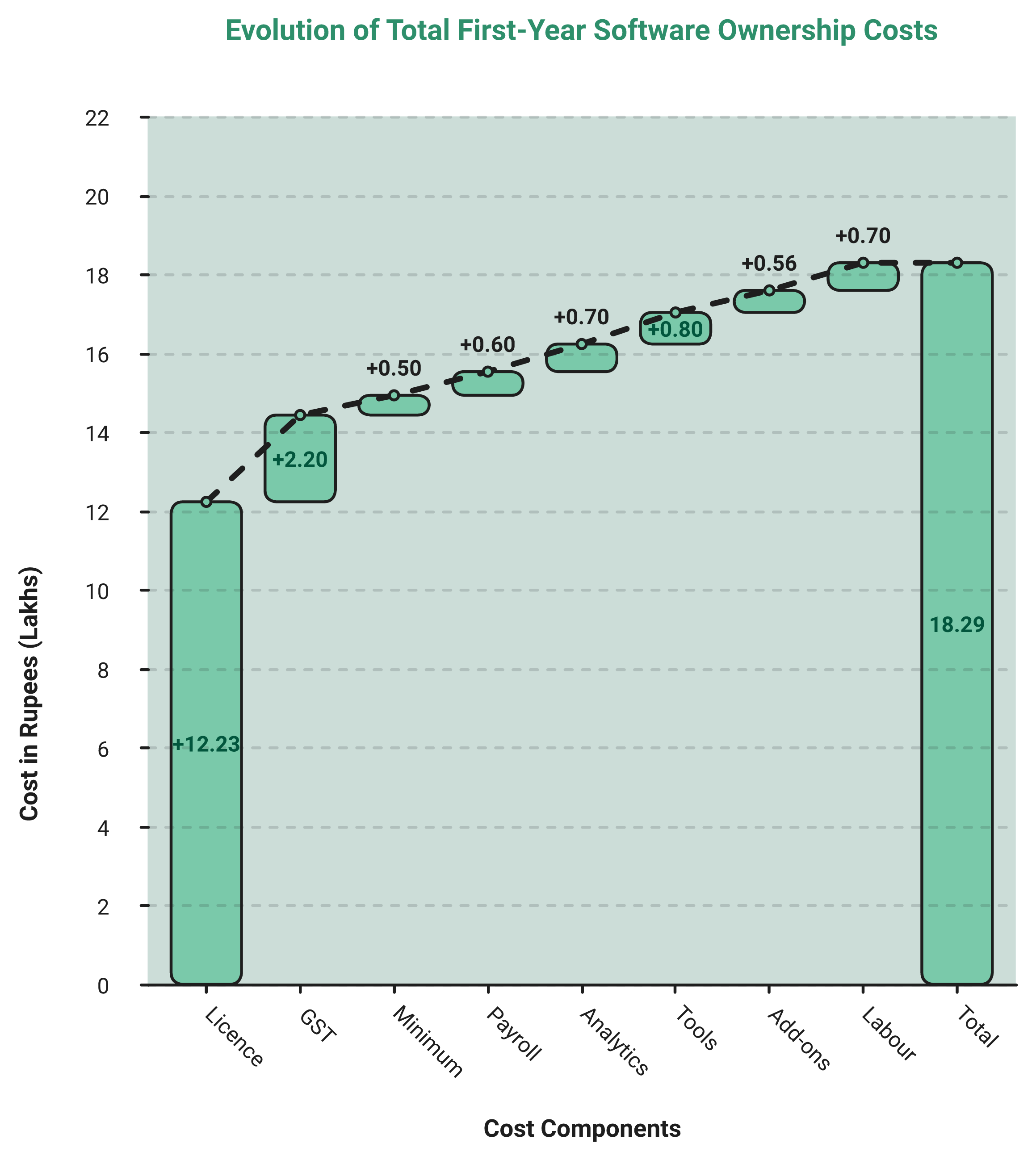
📊 A worked example at 300 employees
Here is the model run on Professional tier plus Zoho Payroll Standard, annual billing, over 36 months.
| Cost line | Assumption | Three-year total |
|---|---|---|
| Zoho People licence | 300 x Rs.96 x 36, plus 18% GST | Rs.12,23,424 |
| Zoho Payroll Standard | Rs.1,000 base plus Rs.40 x 275, plus GST | Rs.5,09,760 |
| Configuration labour | 120 HR-ops hours at Rs.800 | Rs.96,000 |
| Advanced analytics | Separate Zoho Analytics subscription | Variable |
| Payroll error remediation | See below | Variable |
| Subtotal, excluding variables | – | Rs.18,29,184 |
The licence you were quoted is about two-thirds of a conservative model. Labour and analytics are my assumptions, so change them and rerun.
💸 The error variable nobody budgets
Industry benchmarks put average payroll accuracy at 80.15%, with roughly 15 errors per cycle and about $291 to remediate each one.
At 12 cycles a year, that is a real number sitting in your HR team’s evenings. A 2011 PwC study for ADP found the same pattern, where SaaS reduces admin cost until manual workarounds appear, which is exactly why teams chase payroll accuracy before features.
⚠️ Why licence-only comparisons mislead
A 2004 MIT working paper on software switching costs noted that implementation TCO “typically is much higher than the purchase price of software, sometimes as high as twelve times the price”.
Twelve times is an extreme. Even 1.5 times, which is what my table shows, changes which vendor wins.
I might be reading the labour figure conservatively. Most 300-person implementations I see consume more than 120 hours.
⏰ The billing-start variable
Here is a line item almost no model includes. When does the clock start?
If billing begins at signature and go-live takes four months, you have paid for a system nobody used. On the numbers above, that is about Rs.1.36 lakh gone.
HROne meters subscription only after go-live under its flat PEPM pricing, which removes those pre-launch months from the three-year model entirely.
✅ Decide on TCO, never on seat price
My honest position is that the monthly per-user figure is the least useful number in an HRMS decision.
What matters is hours reclaimed against rupees spent, tracked over three years. Feature checklists cannot show you that.
HROne’s inbuilt ROI Dashboard calculates lifetime hours saved against average HR salary, which is how a CHRO can present savings in rupee terms rather than adjectives.
Q10: Why Does a Cheap Seat Still Turn Expensive?
A cheap licence turns expensive when your team cannot find the task. If approving a CTC revision or regularising attendance takes more than three clicks, HR reverts to Excel and WhatsApp, and the subscription becomes shelfware. Adoption debt, not sticker price, is what makes a low-cost HRMS the costliest option on your shortlist.
💰 The common view, and why it feels right
Cheaper looks safer. Smaller commitment, smaller regret, easier to justify.
I understand the logic completely. I have also watched it fail twice at the same company.
❌ Where it breaks
A licence produces no return until people use it daily. Usage is a function of friction, not features.
Reviewers describe that friction precisely, which is why I trust them more than feature matrices.
“Extremely slow time logging. Earlier we could navigate to the next cell just by pressing Tab which was very easy, but now we have to click on every cell and then type and click submit.”
– Pooja K., 1.5/5, Zoho People G2 – Verified Review
“It’s cumbersome that every feature is on display when not all are necessary. Having an option to disable or hide unnecessary features would streamline the user experience considerably.”
– Anshul M., 4/5, Zoho People G2 – Verified Review
Note the second one is a four-star review. Even satisfied users are describing cognitive load.
⚠️ What adoption debt actually costs
Adoption debt is the manual work that survives your software purchase. It never appears on an invoice.
It appears as a payroll manager rebuilding attendance in Excel. As a manager approving confirmations over WhatsApp. As a CHRO who cannot answer how long a confirmation letter takes.
You are then paying twice, once for the licence and once for the workaround.
✅ Navigation is a design failure
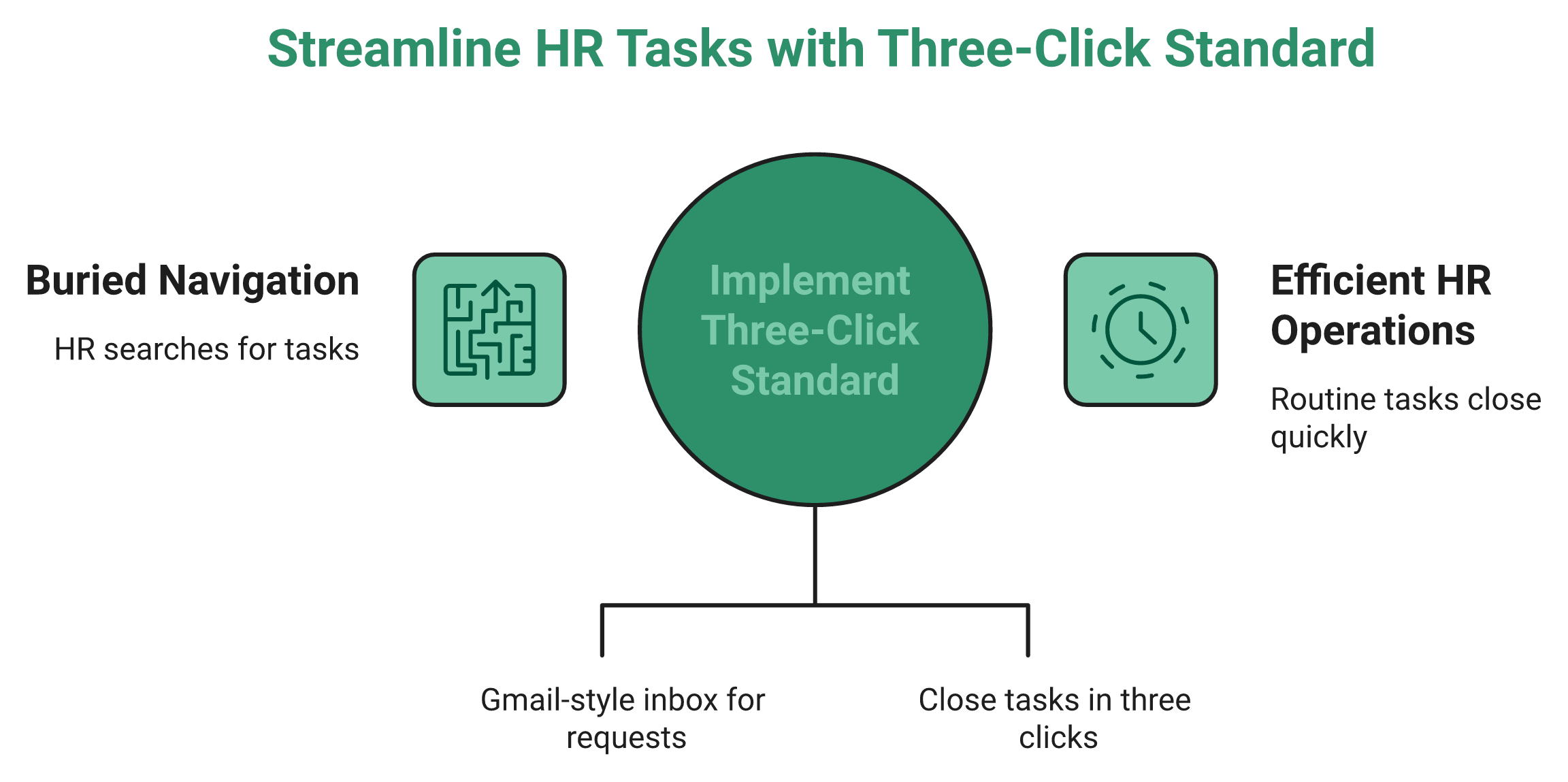
This is the line I keep coming back to, from an HR leader who has built these systems. “If an HR has to search for where the task is, then it’s a design failure.”
His fix was structural, not cosmetic. Treat the HRMS like Gmail, so every pending item arrives in one stream rather than sitting behind five menus.
HROne’s Inbox for HR collapses pending approvals, requests, and tasks into that single actionable stream, which is why routine items close in three clicks rather than three tabs.
⏰ The three-click test, run it in trial
Do not evaluate this from a demo. Demos are choreographed.
During your free trial, time three real tasks with a stopwatch.
- Approve a CTC revision for one employee.
- Regularise a missed punch from last Tuesday.
- Generate one employee’s Form 16 or salary slip.
If any task needs more than three clicks or a support search, price the workaround into your TCO.
📝 What I am still unsure about
I do not know how much of this is fixable by training rather than design. My instinct says design, but I hold that loosely.
What I am confident about is the direction of the cost. Cheap seats plus high friction produces the most expensive outcome, which is a system your team quietly abandons.
HROne treats that risk as measurable, running an HR Ops heat map inside its core HCM that shows which processes are healthy and which need attention before adoption quietly stalls.
Q11: How Does Zoho People Pricing Compare With Indian HRMS Alternatives?
Indian HRMS pricing clusters between Rs.50 and Rs.300 per employee per month, with the SMB band at Rs.85 to Rs.200, so Zoho People’s Rs.48 to Rs.192 is competitive on seat price alone. Inclusions differ far more than prices. HROne leads for mid-market buyers needing statutory payroll, attendance, and performance in one instance, while Darwinbox and SAP stay quote-only.
📋 The five criteria that actually decide this
Seat price is the easiest thing to compare and the least useful. I score shortlists on five things instead.
- Is statutory payroll included, or a second product?
- Which filings does it generate, by name?
- When does billing start, at signature or go-live?
- Is pricing published, or gated behind a rep?
- Is support a named person or an email queue?
📊 India HRMS pricing and inclusions, compared
| Platform | Price signal | Payroll included | PF, ESI, PT, TDS filings | Pricing published | Best fit |
|---|---|---|---|---|---|
| HROne | Flat PEPM, billing starts at go-live | Yes, in core platform | Yes, native | Yes | 100 to 5,000 employees, multi-entity India |
| Zoho People | Rs.48 to Rs.192 per user | No, separate product | Via Zoho Payroll only | Yes | Under 150, existing Zoho users |
| Keka | Mid-band Indian pricing | Yes | Yes | Partially | SMB wanting UX polish |
| greytHR | Value-band Indian pricing | Yes | Yes, with reported TDS gaps | Yes | SMB payroll-first needs |
| Darwinbox, SAP | Quote only | Yes | Yes | No | Large enterprise, global footprint |
HROne sits first here on one factual basis, not preference. It is the only row running India statutory payroll, attendance, and performance in a single instance with published pricing, as the HROne versus Zoho People comparison sets out line by line.
💬 What buyers say across the band
Price and satisfaction do not move together, which is the useful part.
“This is a nice tool for the pricing that they offer just the UI is not pleasing… The UI is not very appealing and looks like an outdated legacy system.”
– Naveen K., 2.5/5, greytHR G2 – Verified Review
“Payroll not getting processed due to RBI regulations… if any figures are added, they get added to the CTC which in turn changes the CTC figure.”
– Pooja M., 2/5, Keka G2 – Verified Review
“I use HROne daily for my attendance, leave, and all HR related activities… The initial setup was straightforward and simple, and I didn’t require training to use it from the first day.”
– Prajwal B., 5/5, HROne G2 – Verified Review
⚠️ Where each option genuinely leads
Zoho People wins on ecosystem breadth and entry price. If you already run Zoho CRM, Books, and Mail, the integration story is real.
greytHR is solid for SMB payroll. Keka brings interface polish. Darwinbox and SAP carry enterprise brand weight and global coverage.
None of that is in dispute. The gap opens at multi-entity Indian complexity.
✅ Fit beats tier, every time
An HR consultant I spoke with framed this well. Some 10-person firms are “already into analytics land,” while a 500-person firm can still be “working with Excel.”
So headcount alone does not tell you which tier you need. Process maturity does.
HROne reports a rank of #3 in Highest Satisfaction Products across 1,17,579 software products globally, and runs Asia Healthcare Holdings across 20 pan-India units on a single instance, a pattern visible across its customer success stories.
Q12: Should You Buy Zoho People, and What Must You Negotiate First?
Buy Zoho People if you already run the Zoho ecosystem, sit under roughly 150 employees, and need leave and attendance rather than payroll. Walk away if you run multiple legal entities, shift-heavy operations, or need PF, ESI, and TDS filings from one system. Either way, negotiate go-live billing, module phasing, a named implementation owner, day-one permanent employee codes, and a written list of statutory filings covered.
✅ The good-fit profile
Three markers, all of which should be true, not one.
- Your headcount is under about 150 and growing slowly.
- You already pay for two or more Zoho products.
- Payroll runs elsewhere and will keep running elsewhere.
If that is you, Rs.96 per user for HR records, leave, and attendance is honest value.
❌ The walk-away profile
The break point is almost always structural, not size.
You should look elsewhere if you run two or more legal entities, because payroll licensing multiplies per entity. Also if shift rotation, overtime, and biometric attendance are daily realities.
One HR leader described the requirement precisely: “20+ units pan-India” where “people working in company A might have a different policy” than company B.
📝 The five terms to negotiate
Send these as written questions, not verbal ones. Ask for answers in the contract or an email you can attach to it.
- Billing start. “Does the subscription meter from signature or from go-live?”
- Module phasing. “Can we add Premium modules mid-term without repricing the base?”
- Named implementation owner. “Who is our single point of contact, and what is their response window?”
- Employee codes. “Are permanent employee codes assigned at joining, replacing temporary ones automatically?”
- Filings, by name. “List every statutory return this plan generates, including Form 16 and Form 24Q.”
That last one prevents the most expensive surprise in this whole article, and it belongs beside your PF, ESI, and TDS compliance checklist.
⚠️ What support decay looks like
The pattern is consistent across vendors, and it is not about product quality. It is about who owns your problem.
“We have been unable to implement the tool in our company due to their consistently delayed responses and poor coordination between their internal teams.”
– Divya P., 0/5, Keka G2 – Verified Review
“Delivery team has expertise, energetic and helpful during configuration phase… Real time sync of biometric and mobile mark punch functionality available.”
– Deepak K., 5/5, HROne G2 – Verified Review
Ask for a named person with HR domain experience, not a project manager reading a checklist.
⏰ Test attendance before you pay for it
A 2025 patent application describes payroll systems validating clock-ins by geolocation distance from an assigned position.
That capability is now standard, and it is also where trials fail. Test geo-restricted and IP-restricted punching with three real employees before upgrading to Professional.
HROne assigns a prior-HR onboarding SPOC carrying a 9.8 NPS and starts billing at go-live, so the implementation window costs time rather than subscription.
💰 What I think happens next
My prediction for the next two years is that HRMS pricing pages start publishing GST-inclusive, payroll-inclusive figures, because buyers stopped believing seat prices.
I could be wrong about the timeline. I am fairly confident about the direction.
If you have a live quote in hand, send me the line items. I will tell you honestly which ones I think are fair and which ones I would push back on.


















 Secures Top Spot in
