


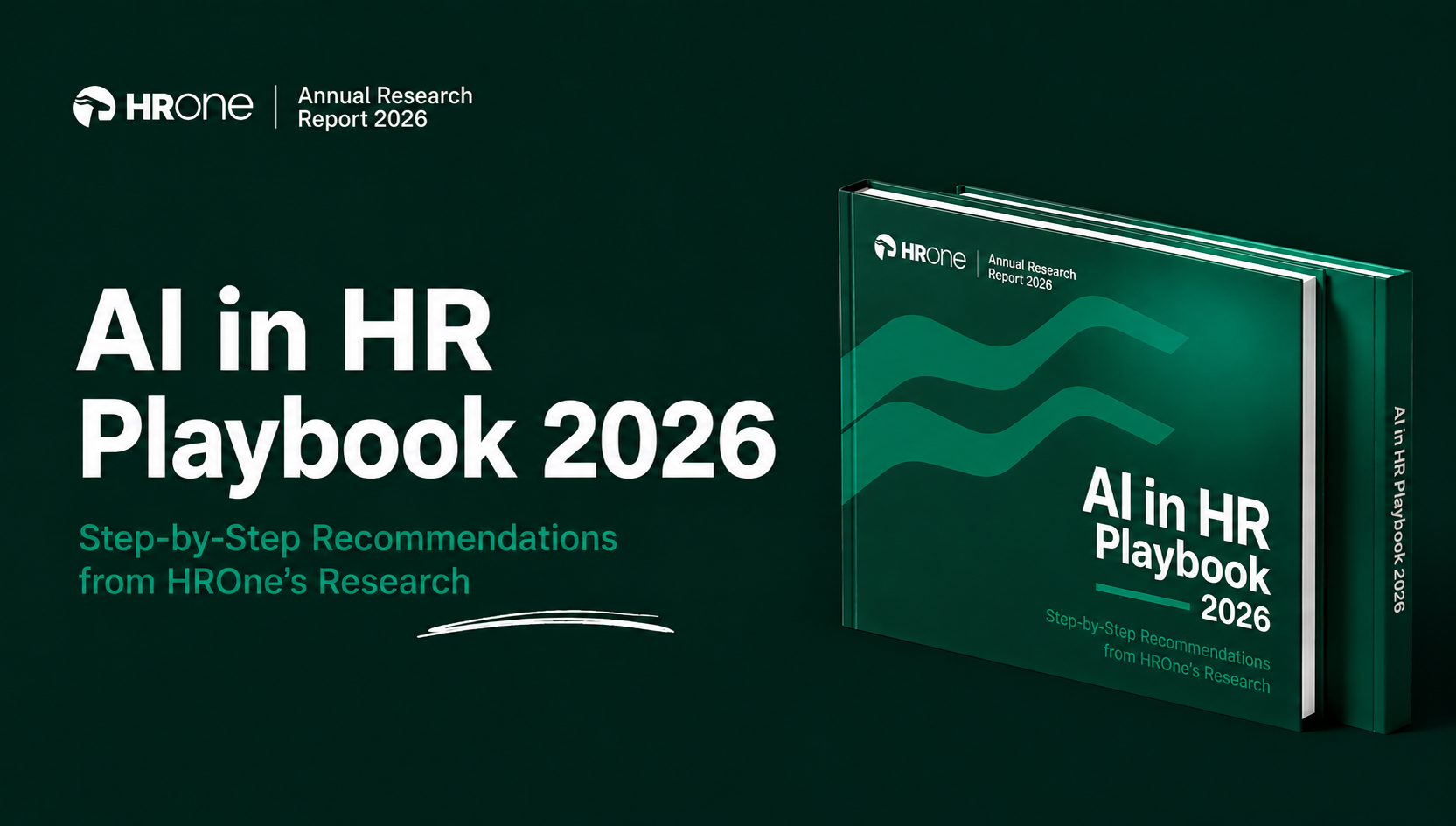
HROne’s AI in HR 2026 report — based on a survey of 693 HR leaders — found that only 1.4% of HR teams have reached “AI-First” maturity, while 68% are still stuck as Beginners or Explorers. (We broke down the full findings in AI in HR 2026: Why Only 1.4% of Teams Are AI-First.)
A statistic like that raises an obvious follow-up question: okay, so what do we actually do about it? HROne’s researchers didn’t stop at diagnosis. Section 5 of the report — “Playbooks & recommendations” — lays out a concrete blueprint, a phased roadmap, and a set of hard boundaries for where AI should never go. This article turns that research into a step-by-step playbook any HR team can follow, in order, starting today.
Step 1: Diagnose Where You Actually Stand
Before fixing anything, place your team honestly on HROne’s AI maturity ladder. Most teams overestimate themselves here, so be blunt:
| Stage | What it looks like | % of teams here |
|---|---|---|
| Beginner | Not using AI at all | 34.1% |
| Explorer | Experimenting in 1–2 areas | 34.1% |
| Implementer | AI used across multiple processes | 21.4% |
| Scaler | Org-wide deployment | 9.1% |
| AI-First | Embedded, with governance | 1.4% |
If you’re a Beginner or Explorer — and statistically, two out of three HR teams are — the priority isn’t finding more use cases. It’s building the foundation in Steps 2–4 below before you scale anything. Trying to jump straight to “Scaler” without fixing skills and governance is exactly how teams end up in the report’s “Watchlist” category: cutting-edge experiments running on thin controls.
For a deeper self-assessment, HROne’s report also introduces the AI Index 2026, scoring organisations across five pillars — process readiness, people & skills, culture & trust, governance & ethics, and tech enablement — into five bands: Fragile, Emerging, Stable, Scalable, and AI-Native Ready. Use these two frameworks together: the maturity ladder tells you how much you’re using AI; the Index tells you how safely you’re doing it.
Step 2: Fix the Three Structural Barriers Before Adding More Tools
The report is explicit that HR’s AI problem isn’t attitude — it’s three specific structural traps. Buying more AI tools without addressing these first just adds risk on top of an unstable base.
Fix the capability trap first. Lack of skills is the single biggest reported blocker (24.1%), ahead of budget or trust concerns. This is a fluency problem, not a belief problem — practically, that means your first investment should be training and structured skill-building, not another software licence. 36.4% of HR teams currently have no AI skills plan in place at all; closing that gap is the highest-leverage move available to most teams right now, and it’s exactly what HROne’s own roadmap for upskilling HR teams for AI and automation walks through step by step.
Fix the cost trap second. Budget constraints (22.7%) reflect a confidence gap as much as an actual funding shortage — leadership wants proof before it commits spend. The practical fix is sequencing: run small, low-cost pilots that generate a visible before/after metric (time saved, error rate, hiring speed), then use that evidence to unlock the next round of budget rather than asking for a large investment up front.
Fix the trust trap third. Fear of accuracy and errors (17.7%) is sharpest in payroll, performance, and employee relations — the functions where a wrong output does the most damage. Address this by keeping a human reviewer in the loop on every AI-assisted output in these functions until your governance framework (Step 5) is mature enough to reduce that oversight deliberately, not by default.
Step 3: Sequence Your Rollout by Where Trust Is Already Highest
Don’t roll AI out evenly across HR. The report’s readiness clusters show trust and adoption aren’t uniform, so your rollout order shouldn’t be either:
- Start here — “Most ready”: Recruitment and HR operations. These have the highest current usage, the clearest productivity wins, and frequent enough interaction to build trust fast. This is where your first pilots should live.
- Prepare carefully — “Catching up”: Analytics and reporting. Strong decision-support benefits exist here, and leadership demand is high, but the report flags this cluster as “powerful but fragile without governance” — don’t scale analytics AI faster than your governance can support it.
- Go last, go carefully — “Falling behind”: L&D, performance management, and strategic HR. These carry higher fear of bias and hallucination, produce fewer quick wins, and their outcomes are qualitative and long-term — meaning mistakes are harder to catch early. Don’t lead your AI strategy with these functions.
Step 4: Build on the Five-Pillar Blueprint
HROne’s report frames sustainable AI adoption as a five-pillar rebuild, not a tool purchase. Work through all five — skipping any one pillar is what produces the “Fragile” and “Emerging” outcomes on the AI Index:
- Process – Fix the flow before adding intelligence. Map your actual decision pipelines first; don’t automate a broken SOP.
- Skills – Move people from HR operators to what the report calls “prompt leaders”: judgement-rich, AI-literate practitioners, not just tool users.
- Culture – Build psychological safety for human-plus-machine work. Make it a learning-first environment, not an accuracy-first one where mistakes get punished instead of surfaced.
- Governance – Guardrails should enable speed, not just restrict it. The operating principle: AI may recommend, but humans must own the decision.
- Tech stack – Assemble a modular architecture rather than accumulating disconnected tools, such as One AI, HROne’s own AI automation suite, which plugs into a single HCM data layer rather than bolting on point solutions. Every new AI tool should plug into the same governance and data layer, not create its own silo.
Step 5: Execute the 0–12 Month Roadmap
This is the report’s most directly actionable section — a three-phase timeline you can use as your actual project plan.
Phase 1, Days 0–30: Quick wins & trust building. Rule of thumb: AI drafts, humans decide. Don’t aim for transformation yet — the goal at this stage is behavioural, proving to your own team that AI output is useful and safe when reviewed. Pick 1–2 use cases from your “most ready” cluster (Step 3) and run them visibly.
Phase 2, Days 30–90: Workflow integration. Shift from individual productivity gains to team-level leverage. Instead of one recruiter using AI to draft job descriptions, integrate AI into the full requisition-to-shortlist workflow for the whole talent acquisition team. Limit yourself to a few core workflows — depth over breadth at this stage.
Phase 3, Days 90–365: Scaling & strategic advantage. By this point, AI should start flagging risks proactively — attrition signals, payroll anomalies, compliance gaps — rather than just executing tasks. This is the phase where HR shifts from a support function to what the report calls a strategic advisor — the transition that separates Scalers from true AI-First teams.
Step 6: Draw a Hard Line Around What AI Should Never Decide
Before you scale further, write down — literally, as policy — which decisions stay human-owned no matter how mature your AI stack becomes. The report’s golden rule: if an employee could reasonably ask “who decided this?”, the answer must always be a human. Six moments the report flags explicitly:
- Performance judgment — requires context and nuance
- Career conversations — emotional and aspirational
- Conflict resolution — requires trust and empathy
- Termination decisions — moral accountability
- Mental health support — psychological safety
- Leadership judgment — never automated by design
Put this list in your governance policy now, not after an incident forces the conversation.
Step 7: Build the Skills Your Team Will Actually Need
The report ranks future HR skills by how many respondents named them essential. Use this to prioritise training budget, since not all “AI skills” are equally durable:
- HR tech stack fluency – 63.2% (the anchor skill: knowing how data flows and where AI sits in workflows)
- AI governance & ethics – 53.6% (the skill HR cannot delegate — defining human-in-the-loop rules)
- Prompt engineering – 53.2% (useful, but the report calls this a fast-commoditising tactical layer, not a leadership capability)
- Data literacy – 50.0% (asking the right questions of data, not just reading dashboards)
- Strategic storytelling – 40.5%
- Change management – 39.5% (the “hidden glue skill” — building confidence before capability)
Practical takeaway: don’t over-invest training budget in prompt engineering alone. Tech stack fluency and governance literacy are the skills the report treats as durable and strategic — build your L&D plan around those first.
Step 8: If You’re in India, Sequence Around These Four Use Cases
HROne’s report devotes a dedicated section to Indian HR operations, where scale, compliance intensity, and cost sensitivity make AI adoption a necessity rather than an experiment. If this describes your organisation, the report points to four use cases as the highest-value starting points, in this order of typical readiness:
- Attrition prediction – shift from exit interviews to early-warning signals in attendance and engagement data, turning attrition into a forecast instead of a post-mortem.
- Attendance & HR ops automation – anomaly detection and query deflection at scale for shift-based, distributed workforces.
- Payroll accuracy – catch anomalies before payouts in what the report calls India’s highest-trust, least-forgiving function; position AI as a second set of eyes, not a replacement for the payroll team.
- Frontline worker HR – natural-language query support and policy explanations for employees without a desk or a company email address, a use case the report frames as democratising HR access, not just optimising it.
Step 9: Measure Yourself Against the AI Index – Don’t Just Guess
Once Steps 1–8 are underway, use HROne’s AI Index scoring bands as a periodic check-in rather than a one-time assessment:
- Fragile – reactive, isolated pilots, low skills, no governance
- Emerging – exploratory, ad-hoc use, basic literacy, initial guidelines
- Stable – defined workflows, foundational skills, policy in place
- Scalable – integrated deployment, role-specific skills, active oversight
- AI-Native Ready – continuous, expert judgment, ethical-by-design, adaptive
Re-score your team every quarter against these five bands and the five pillars behind them (process readiness, people & skills, culture & trust, governance & ethics, tech enablement). Movement up even one band – say, Emerging to Stable, is a meaningful, reportable win to leadership, and a more honest measure of progress than counting how many AI tools you’ve licensed.
Step 10: Watch for the Risks the Report’s Own Respondents Flagged
Finally, build these five risks into your governance review, they’re the ones HR leaders in the survey worried about most, not hypothetical concerns:
- Dehumanisation by stealth – cold, automated messaging and a “the system says no” culture creeping in unnoticed
- Bias and unfair outcomes – historical data bias and proxy variables damaging trust, even by perception alone
- Hallucinations & wrong guidance – a single wrong policy answer triggering real compliance issues
- Over-automation of moral decisions – letting AI become “the face of” promotions or exits, creating an accountability vacuum
- Surveillance creep – monitoring disguised as analytics, control disguised as productivity
Putting It Together
None of these ten steps requires a large technology budget to start. What they require is sequencing: diagnose honestly (Step 1), fix the real barriers before scaling (Step 2), roll out where trust already exists (Step 3), rebuild the five foundational pillars (Step 4), and only then execute the 12-month roadmap (Step 5), with hard governance lines (Step 6), the right skills investment (Step 7), region-specific use cases where relevant (Step 8), a recurring maturity check-in (Step 9), and an active eye on the risks HR leaders themselves are already flagging (Step 10).
As Karan Jain, Founder of HROne, put it in the report: “The question is no longer whether HR should use AI but whether HR will lead AI adoption or be led by it.” This playbook is the difference between the two.
For the full data behind these ten steps, read the source report breakdown: AI in HR 2026: Why Only 1.4% of Teams Are AI-First.
Explore HROne
HROne is an AI-powered HCM platform built for exactly this playbook, starting AI adoption where trust is highest and scaling it with governance built in. A few places to start:
- One AI – HROne’s AI automation suite for hiring, payroll, leave, and employee engagement, aligned with the “assemble, don’t accumulate” tech-stack principle in Step 4
- HR analytics software – for the “catching up” cluster in Step 3
- Onboarding and employee self-service, for the quick-win pilots recommended in Step 5’s Phase 1
Source: HROne, “AI in HR 2026” research report, based on a survey of 693 HR leaders conducted November 2025–January 2026.










 Secures Top Spot in
