






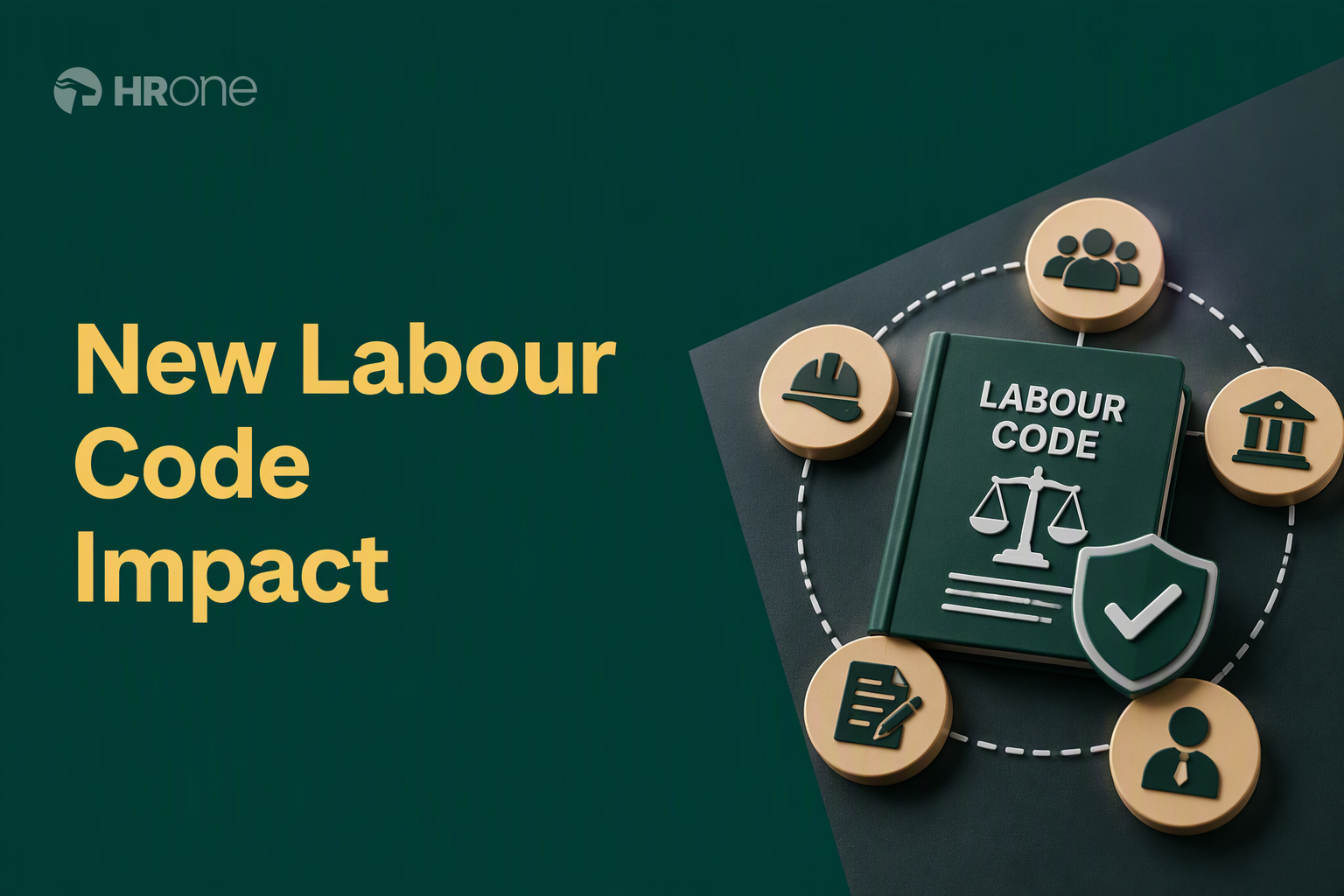
India spent five years talking about the labour codes. Now payroll teams have to actually run them.
The Government of India brought the four codes, the Code on Wages, 2019, the Industrial Relations Code, 2020, the Code on Social Security, 2020 and the Occupational Safety, Health and Working Conditions (OSH) Code, 2020 – into force on 21 November 2025, replacing 29 central labour laws. Operational rules are still landing in phases: some central rules are notified, some states have published draft or final rules, and commencement dates for specific provisions still vary by state and by establishment type. So the correct posture for most employers right now is prepare and model, not panic.
But make no mistake about where the work lands. Almost every substantive change in the new labour codes resolves into a payroll configuration decision, a wage bucket, a formula, an eligibility rule, a filing, or a settlement deadline. This piece walks through those changes the way a payroll owner would: what breaks, what has to be reconfigured, and what it costs.
This article is general guidance, not legal advice. Confirm your specific position with your labour law counsel, especially on state rules.
1. The single definition of “wages” is the change everything else hangs off
Under the old regime, “wages” meant different things under the EPF Act, the Payment of Bonus Act, the Payment of Gratuity Act and state Shops and Establishments rules. Payroll teams maintained parallel calculation bases and lived with the ambiguity.
The codes collapse that into one definition of wages used across PF, gratuity, bonus, retrenchment compensation, leave encashment and maternity benefit.
Wages include: basic pay, dearness allowance and retaining allowance.
Wages exclude: HRA, conveyance, statutory bonus, overtime, commission, house accommodation and utilities, employer PF and pension contributions, gratuity paid on termination, and retrenchment compensation.
Then comes the part that reshapes salary structures, the 50% rule. If the excluded components together exceed 50% of total remuneration, the excess is added back to wages for statutory calculation. The law does not literally mandate “basic must be 50% of CTC”; it makes it pointless to keep basic lower, because the shortfall gets recomputed into the wage base anyway.
For most Indian employers, this is the end of the allowance-heavy CTC. Structures that ran basic at 25–40% and pushed the rest into special allowance, conveyance and LTA no longer reduce statutory liability. Your payroll software needs to hold two things simultaneously: the contractual salary structure you show the employee, and the statutory wage base derived from it, recalculated every month, per employee, per entity.
2. What the 50% rule does to a real salary, worked example
Take a monthly remuneration of ₹1,00,000, structured the way many Indian companies still do:
| Component | Amount |
|---|---|
| Basic | ₹30,000 |
| HRA | ₹15,000 |
| Conveyance | ₹5,000 |
| LTA | ₹10,000 |
| Special allowance | ₹40,000 |
| Total remuneration | ₹1,00,000 |
Step 1: Wages as defined: ₹30,000 (basic only; no DA or retaining allowance here).
Step 2: Excluded components: ₹70,000, which is 70% of total remuneration.
Step 3: Apply the cap: exclusions may not exceed 50%, i.e. ₹50,000. Excess = ₹20,000.
Step 4: Add back: statutory wages become ₹30,000 + ₹20,000 = ₹50,000.
Now trace the downstream effects:
| Item | Before | After |
|---|---|---|
| Statutory wage base | ₹30,000 | ₹50,000 |
| PF at 12% (each side, on actual wages) | ₹3,600 | ₹6,000 |
| Gratuity accrual per completed year (15 × wages ÷ 26) | ₹17,308 | ₹28,846 |
| Leave encashment / bonus base | ₹30,000 | ₹50,000 |
One caveat worth stating plainly: EPF has a statutory wage ceiling of ₹15,000, and employers who restrict contributions to that ceiling see little PF change. Employers who contribute on actual basic, which is most mid-to-large organised employers, absorb the full increase. Gratuity has no such ceiling on the wage base, so the gratuity provision jumps for nearly everyone.
Aggregate that across a 2,000-person headcount and the CTC-neutral restructuring conversation becomes a real balance sheet conversation: higher provisioning, higher exit payouts, and a 5–15% dip in employee take-home if CTC is held flat. The cost model has to be built before the salary structure is rewritten, not after.
3. Gratuity: shorter qualifying periods, bigger provisions
Two changes matter operationally.
Fixed-term employees become gratuity-eligible after one year of continuous service, on a pro-rata basis, instead of the traditional five years. If you run fixed-term contracts, project-based hiring or seasonal manufacturing rosters, a population that previously accrued nothing now accrues from year one. Your gratuity provision workbook needs a new eligibility flag, and your actuarial input changes.
Working journalists qualify after three years.
Combined with the higher wage base from Section 1, gratuity liability moves on two axes at once — more people eligible, each at a bigger number. Run the numbers on your own population with a gratuity calculator, and if you want the formula and edge cases laid out, we’ve covered how gratuity is calculated in detail.
4. Working hours and overtime become a payroll input, not an HR footnote
The OSH Code caps daily working hours at eight and the daily spread-over at 12 hours — meaning the window from first punch to last punch is bounded even when actual work is eight hours. The weekly cap stays at 48 hours, which is what makes compressed schedules (four longer days, three days off) legally workable with the right approvals.
Overtime is payable at twice the ordinary rate of wages, and requires employee consent.
Here’s the operational sting: “twice the ordinary rate of wages” now uses the new wage definition. So a higher statutory wage base inflates every overtime rupee too. For manufacturing, logistics, retail and healthcare employers running large shift populations, OT is no longer a rounding error — it’s a line item that scales with the wage restructuring you just did.
That makes the attendance-to-payroll link a compliance control rather than a convenience. Punch data, shift rosters, spread-over breaches, consent records and OT blocks all need to flow into the pay run with an audit trail. If attendance lives in one system and payroll in another, you are reconciling a compliance exposure by spreadsheet every month. Attendance management software that sits on the same platform as payroll removes that gap, and it’s worth revisiting your overtime policy language at the same time.
5. Leave, encashment and the annual-leave eligibility change
Annual leave eligibility moves to 180 days worked in a calendar year, down from 240 — which pulls a larger share of your workforce, particularly new joiners and contract staff, into leave entitlement earlier. Carry-forward and encashment rules follow, and encashment is computed on the revised wage base.
Practically: leave balances, accrual rules and encashment formulas all need reconfiguration, and the encashment provision goes up for the same reason gratuity does. Tighten the loop between leave management and payroll so balances feed encashment automatically, and use a leave encashment calculator to sanity-check the new numbers against your old ones.
6. Payment timelines and exit settlements tighten sharply
Three provisions change the rhythm of the payroll calendar.
Wage period is capped at one month, and wages must be paid by the seventh day of the following month for monthly-paid employees.
Full and final settlement within two working days of resignation, dismissal, removal or retrenchment. This is the change most payroll teams underestimate. If your current F&F takes three weeks because it waits on manager clearance, asset recovery, notice-pay recovery and a finance sign-off, a two-working-day SLA is not achievable with a manual process. Exit clearance, asset recovery, leave encashment, gratuity and recovery of advances have to be pre-computed and workflow-driven.
Written appointment letters are mandatory for every employee, specifying job details, wages and social security entitlements. Employees who were never issued one must receive it within three months of commencement — so this is a backlog exercise, not just a going-forward template change. No more informal or verbal engagements, no more “offer letter only” onboarding. Standardise the template — an appointment letter generator saves you rebuilding it per entity — and make sure the wage structure printed in it matches what payroll actually runs.
7. Social security widens: gig workers, ESI reach, and consolidated filings
The Code on Social Security extends coverage to gig workers, platform workers and unorganised sector workers. Aggregators may be required to contribute at a notified rate between 1–2% of annual turnover, capped at 5% of the amount paid or payable to gig and platform workers. Contribution mechanics and the scheme architecture are still being notified — but if your business pays out to a gig or partner fleet, that payout data needs to be trackable and reportable in the same way payroll data is.
On the filing side, the codes push toward single registration, single licence and consolidated returns, with digital records. That’s genuinely good news for payroll operations — fewer parallel registrations, fewer duplicate returns — provided your system can produce the consolidated formats. If you’re still assembling PF, ESI and TDS filings by exporting and re-keying, consolidation just moves the manual work rather than removing it. Purpose-built labour law compliance software closes that gap.
8. The multi-state, multi-entity complication
Central rules set the frame; state rules set the detail — minimum wage notifications, working-hours exemptions, registers, and commencement timing. A company operating in eight states will be reconciling eight variants of the same obligation, and those variants will land on different dates.
This is where single-instance architecture stops being an IT preference and becomes a compliance requirement. If each legal entity or state runs on its own payroll instance, every rule change gets implemented eight times, tested eight times, and drifts eight ways. Running unlimited entities on one instance with entity-level policy configuration is how multi-entity companies absorb a change of this size without eight parallel projects.
Your payroll readiness checklist
Work through this in order. The sequencing matters — you cannot rewrite structures before you’ve modelled the cost.
- Audit current CTC structures across every entity. Flag every employee whose exclusions exceed 50% of total remuneration.
- Model the cost impact — PF, gratuity, bonus, leave encashment, OT — at employee, entity and consolidated level. Use a salary calculator to test revised structures before committing.
- Redesign salary structures with a defensible position on who absorbs the change: CTC-neutral (employee take-home drops) or CTC-inflated (employer cost rises).
- Reconfigure the payroll engine: new wage buckets, the add-back formula, revised gratuity and encashment logic, revised OT rate.
- Rebuild templates — offer letters, appointment letters, salary revision letters, and payslips. Your salary slip generator output must reflect the new wage classification.
- Wire attendance to payroll for spread-over, weekly hours, OT consent and OT computation.
- Re-engineer exit-to-F&F for a two-working-day close, with pre-computed clearances.
- Build a state-wise minimum wage and rules master, with owners and review dates.
- Extend tracking to gig and contract payouts if you use aggregator-style engagement.
- Fix the audit trail — registers, returns, consent records, punch and regularisation logs, all exportable in one click from core HR.
- Communicate to employees before the first revised payslip lands. A take-home drop that nobody explained becomes an attrition problem, not a payroll problem.
The real work is configuration, not interpretation
The labour codes are not conceptually hard. One wage definition, tighter timelines, wider coverage. What makes them hard is that every one of those changes has to be encoded — into formulas, eligibility rules, workflows, letters, registers and returns — across every entity and state you operate in, while payroll keeps running on the 7th of every month.
Teams that get through this cleanly will be the ones whose payroll, attendance, leave and core HR data already sit in one place, where a rule change is a configuration change rather than a project.
HROne’s payroll software runs India’s statutory stack — PF, ESI, state-wise professional tax, TDS with Form 16 and 24Q — across unlimited legal entities on a single instance, with attendance and leave native to the same platform. Book a demo and we’ll model your labour code impact on your actual salary structures.

















 Secures Top Spot in
