


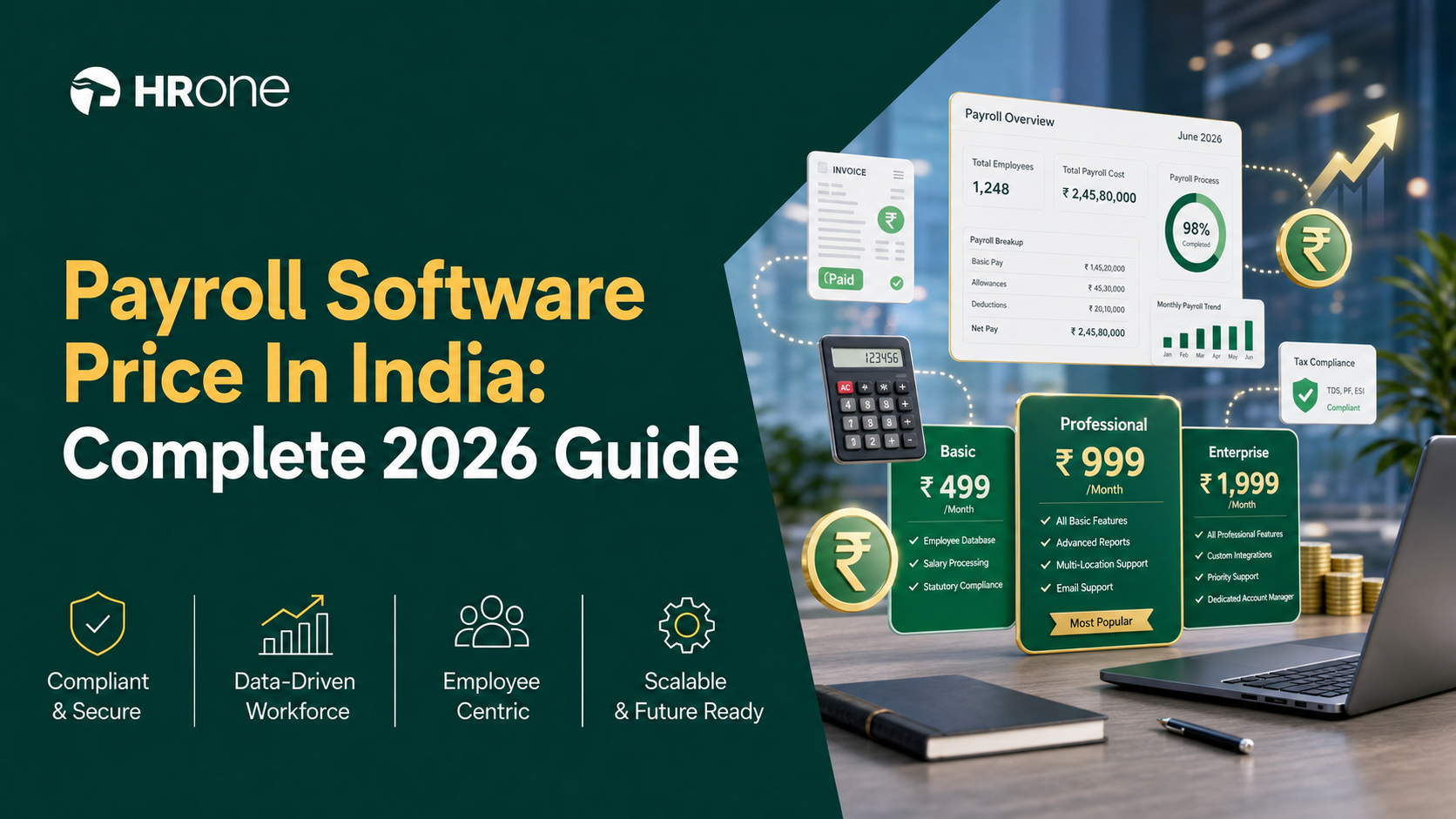
Q1. How Much Does Payroll Software Cost in India in 2026?
Payroll software in India costs from ₹0 to about ₹300 per employee per month in 2026. Free plans cover very small teams (up to 10 to 25 employees). Paid per-employee plans typically run ₹30 to ₹180 per employee monthly. Flat-fee plans start near ₹4,950 per month for 50 users, and enterprise annual contracts are custom-quoted, sometimes crossing multi-crore totals for 500-plus employees.
💰 The number, before anything else
Let me give you the figure your CFO actually asked for. Most Indian teams pay between ₹40 and ₹180 per employee, per month.
Micro-teams often pay nothing at first. Free tiers exist to get you hooked, and that is fine for 10 people. Enterprises, on the other hand, negotiate custom annual quotes that hide a lot under the word “custom”.
I have sat in enough vendor calls to know the sticker price is the easy part. The rupee number you see on a pricing page is rarely the rupee number that leaves your bank account. If you want the real math, our breakdown of HR software pricing is a useful companion read.
📊 A quick price snapshot across vendors
Here is a five-row teaser so you can anchor your budget today. The fuller vendor-by-vendor breakdown comes later in this guide, and you can also compare shortlists in our roundup of the top 10 payroll software India.
| Vendor | Starting Price | Pricing Model |
|---|---|---|
| HROne | ₹4,950/month for 50 users, then ₹99/additional user | Flat band plus per-user |
| Zoho Payroll | Free up to 10 employees, then about ₹40/employee | Freemium plus PEPM |
| greytHR | Free up to 25 employees, then tiered | Freemium plus tiered |
| Keka | About ₹6,999/month base plus ₹90 to ₹180/employee | Flat plus PEPM |
| Darwinbox | Custom annual quote | Enterprise licensing |
Notice the spread. A 50-person firm could pay ₹0 or ₹9,000 a month for “payroll software,” depending entirely on the model, not the brand.
⚠️ Why the headline price is a trap
Here is the part most pricing pages bury. The sticker rate covers the software, not the setup, the migration, or the compliance add-ons.
Two systems at the same ₹80 per employee can differ wildly once implementation and off-cycle-run fees land. I will unpack that full “true cost” math shortly, because it is where budgets quietly break.
At HROne, we price flat per employee, and your subscription starts only after you go live, with no lock-in. That single billing choice removes the most common surprise on this list, and it is one reason buyers evaluating our payroll software know their real number upfront.
Q2. What Are the Payroll Software Pricing Models in India?
Indian payroll software follows four pricing models: per-employee-per-month (PEPM, ₹30 to ₹180 per employee), flat monthly subscription (a fixed fee for a headcount band), annual enterprise licensing (custom-quoted, often crore-scale), and freemium (free up to 10 to 25 employees). PEPM suits growing mid-market teams, flat fees favour stable headcounts, and freemium fits micro-businesses testing the waters.
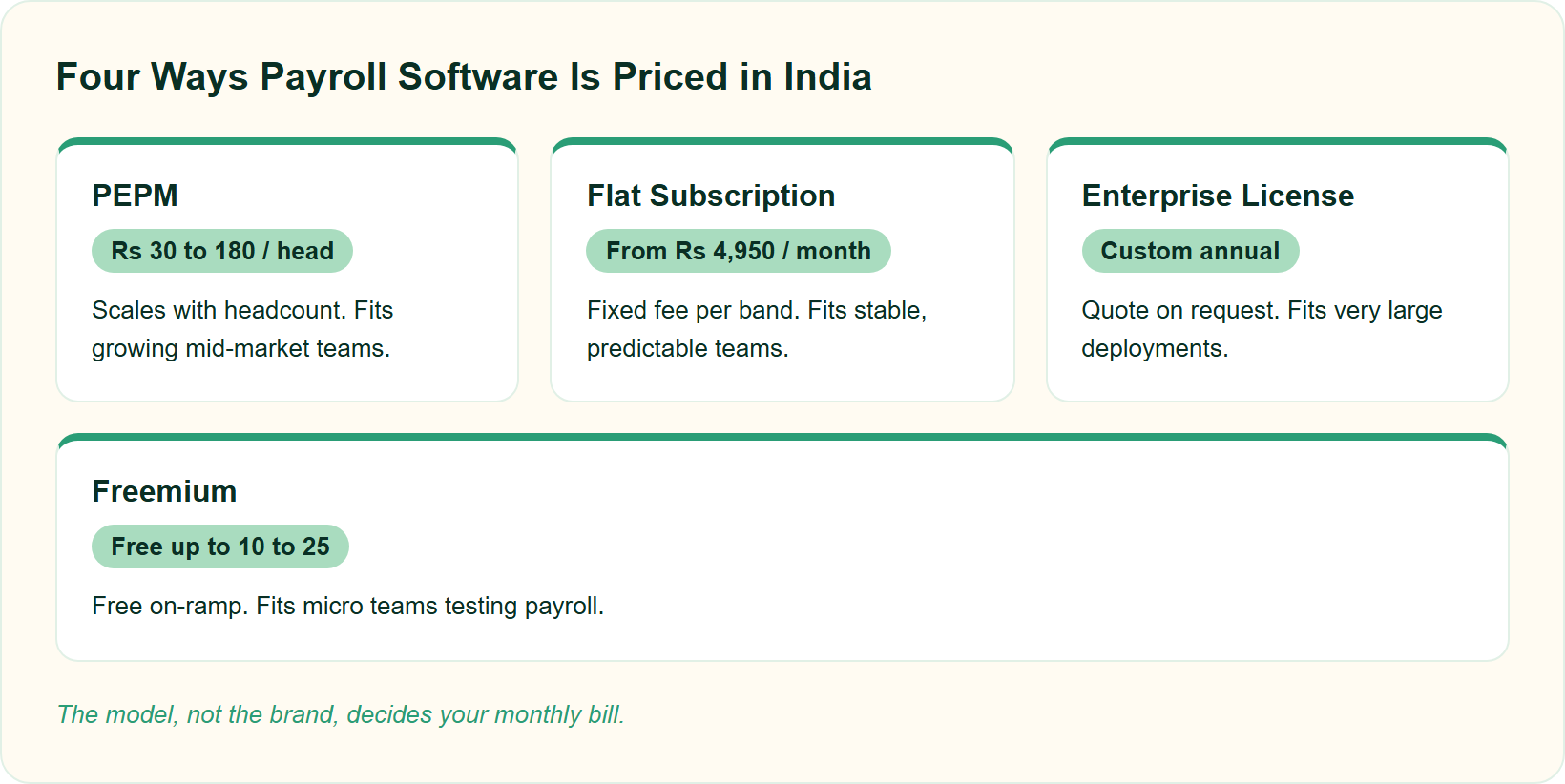
🧾 Model 1: Per-employee-per-month (PEPM)
PEPM means you pay a set rate for each active employee, every month. It scales up and down with your headcount, like a mobile plan that bills per SIM.
Say the rate is ₹80. At 50 employees you pay ₹4,000 a month, and at 200 you pay ₹16,000. This model fits growing mid-market teams where headcount moves often, because you never pay for empty seats.
🏢 Model 2: Flat monthly subscription
A flat subscription charges one fixed fee for a headcount band, say “up to 50 users.” You pay the same whether you have 40 or 50 people in that band.
At 50 employees you might pay ₹4,950 flat, which works out to roughly ₹99 per head. At 200 you move to a higher band. This suits stable teams that hate variable bills and want a predictable line item, and it maps neatly to our published pricing.
🏛️ Model 3: Annual enterprise licensing
Enterprise licensing is a yearly contract, negotiated and quoted privately. There is no public price, and the figure depends on modules, users, and your negotiating leverage.
This is where opacity creeps in. As one common industry note puts it, “Enterprise plans are customisable and quotes are shared on request, and implementation cost may apply for enterprise-level clients.” That single sentence is why crore-scale quotes feel like a black box.
🆓 Model 4: Freemium
Freemium gives you a free tier, usually capped at 10 to 25 employees, then charges once you cross it. It is a genuine on-ramp for a 12-person startup running its first payroll.
The catch is coverage. Free tiers often skip the statutory automation you actually need at scale, a gap I will get to shortly.
✅ The transparent middle path
From what surfaces when you actually run payroll for hundreds of Indian teams, buyers want predictability without an enterprise black box. That is why HROne uses a hybrid model, a flat band of ₹4,950 for 50 users plus ₹99 per additional user, billed only after go-live and with zero lock-in. You get the clarity of flat pricing and the fairness of per-head scaling, without the surprise of a “quote on request,” which is exactly why teams comparing a full payroll solution shortlist us.
Q3. What Is the True Cost of Payroll Software Once You Add Hidden Fees and TCO?
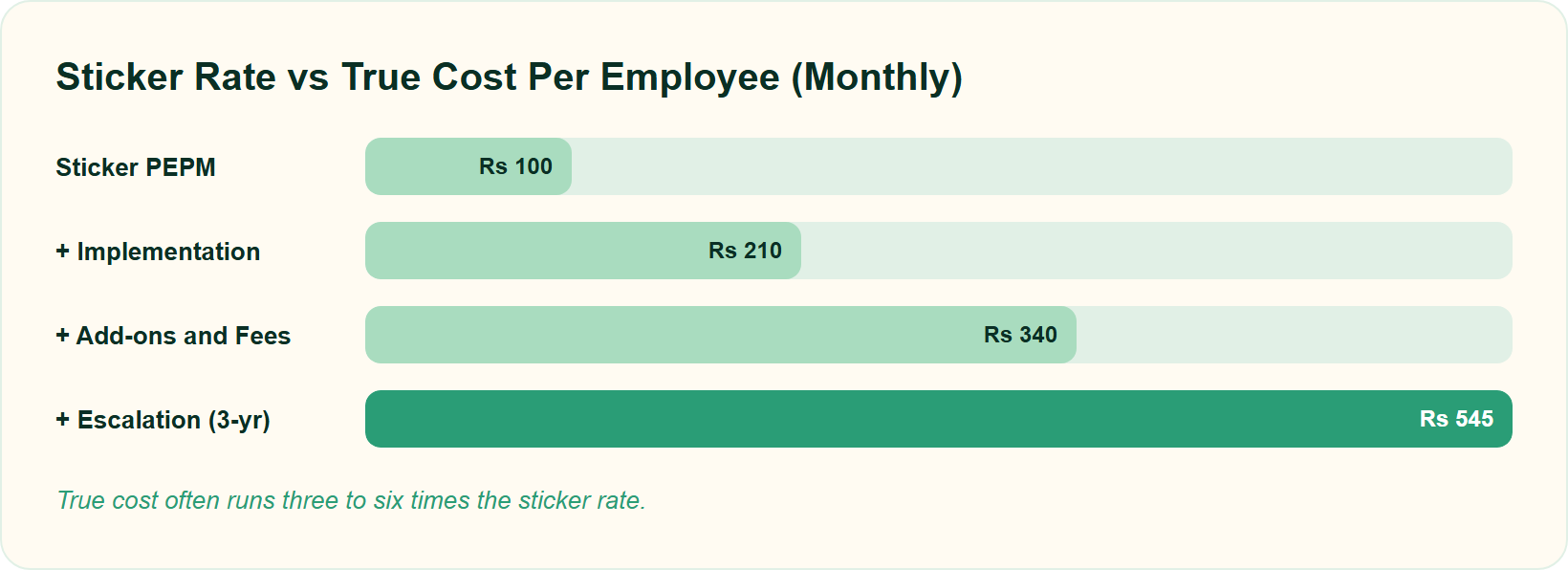
The sticker PEPM is rarely the real price. Hidden costs include implementation (₹8,000 to ₹50,000-plus), training, add-on compliance modules, per-form tax-document fees, off-cycle-run charges, API access, and data migration. Over three years, 5 to 15% annual escalation clauses can push an enterprise deal past ₹1.9 crore, an effective ₹545 per employee per month. Always model total cost of ownership, not the headline rate.
😤 The problem: the quote that keeps growing
Every payroll buyer I know has one story. They signed for one number and paid a very different one.
A payroll consultant once described the exact moment it breaks. “The provider I brought to the table would have very large implementation fees, and the client couldn’t afford 20, 30,000 dollars in implementation costs. No way.” The sticker never mentioned that.
💸 What actually gets added on
Here is where the money leaks. The pain is not one big fee, it is many small ones.
| Hidden Cost | Typical Range |
|---|---|
| Implementation and setup | ₹8,000 to ₹50,000+ |
| Training | ₹8,000 to ₹25,000 |
| Add-on compliance modules | Variable, often per-module |
| Per-form tax documents (Form 16, etc.) | Per-document fees during tax season |
| Off-cycle payroll runs | Charged per extra run |
| API access and data migration | One-time or recurring |
Operators feel this sharply. As one described it, some vendors charge “an extra base fee plus a per-form fee just to process year-end tax forms,” and others “hit you with fees every single time you run an off-cycle payroll.” Worse, some buyers pay the setup, allocate the team, and then “discover that system can’t do what they thought it could at all.” Our guide to real payroll problems in India companies catalogues more of these traps.
📈 The 3-year TCO math nobody shows you
Now agitate it across time. Enterprise contracts often carry a 5 to 15% annual escalation clause, so year three costs more than year one for the same software.
Take a 1,000-employee firm. Category figures put a three-year enterprise deal near ₹1.96 crore, which works out to roughly ₹545 per employee, per month once you fold in setup and escalation. That is three to six times the sticker PEPM. The headline number told you almost nothing, which is why an honest ROI of HR software view matters more than the rate card.
✅ The fix: model your own TCO in five inputs
Here is your Monday action. Before you sign anything, add up five numbers.
- Sticker PEPM times headcount times 36 months.
- One-time implementation and migration.
- Training, per-form, and off-cycle-run fees.
- Add-on modules for compliance you actually need.
- The annual escalation, compounded across three years.
That sum, not the sticker, is your real price. You can shortcut the arithmetic with our ROI calculator.
“I like HROne for its zero-touch payroll and compliance automation. The InboxforHR is a game-changer, centralizing every HR task into one simple inbox, cutting down administrative time by 60-70%. The initial setup of HROne was surprisingly straightforward, much lighter than expected for a full HRMS.”
Waldon S. HROne G2 Verified Review
“I love HROne for its cost efficiency and holistic approach, which is why I prefer it over other vendors like Workday. The initial setup process was smooth.”
Priyanka S. HROne G2 Verified Review
This is exactly why we bill only when you go live, with no lock-in. If the setup drags or the fit is wrong, you are not paying for a system you cannot yet use, which removes the single biggest line item in a bad TCO story. It is a core theme in our HROne implementation guide.
Q4. Does a Cheaper Payroll System Expose You to Statutory Penalties?
Yes, a cheap system can expose you. Lower tiers often automate basic salary math but treat PF, ESI, TDS, Professional Tax, Form 16 generation, and 2026 Labour Code readiness as paid add-ons, or omit them entirely. Incorrect filings and missed statutory deadlines carry real penalties, so match the price tier to the statutory obligations your headcount and state actually trigger.
🎯 The claim: cheap and safe are not the same
Here is the standard read, and I think it gets this backwards. People assume a cheaper plan just means fewer bells and whistles.
In Indian payroll, cheaper often means less compliance coverage. And compliance is not a feature you can skip. The real anxiety I hear from HR heads is blunt, “will this cheap system leave me exposed to a large statutory penalty because it couldn’t handle a mid-month salary revision?”
The stakes are concrete. Industry figures note that incorrect tax filings can cost a business a five-figure dollar sum, and “nearly 50% of employees consider leaving after just two payroll mistakes.” Our PF, ESI, and TDS compliance employer guide walks through the exposure in detail.
📋 The proof: map price to compliance coverage
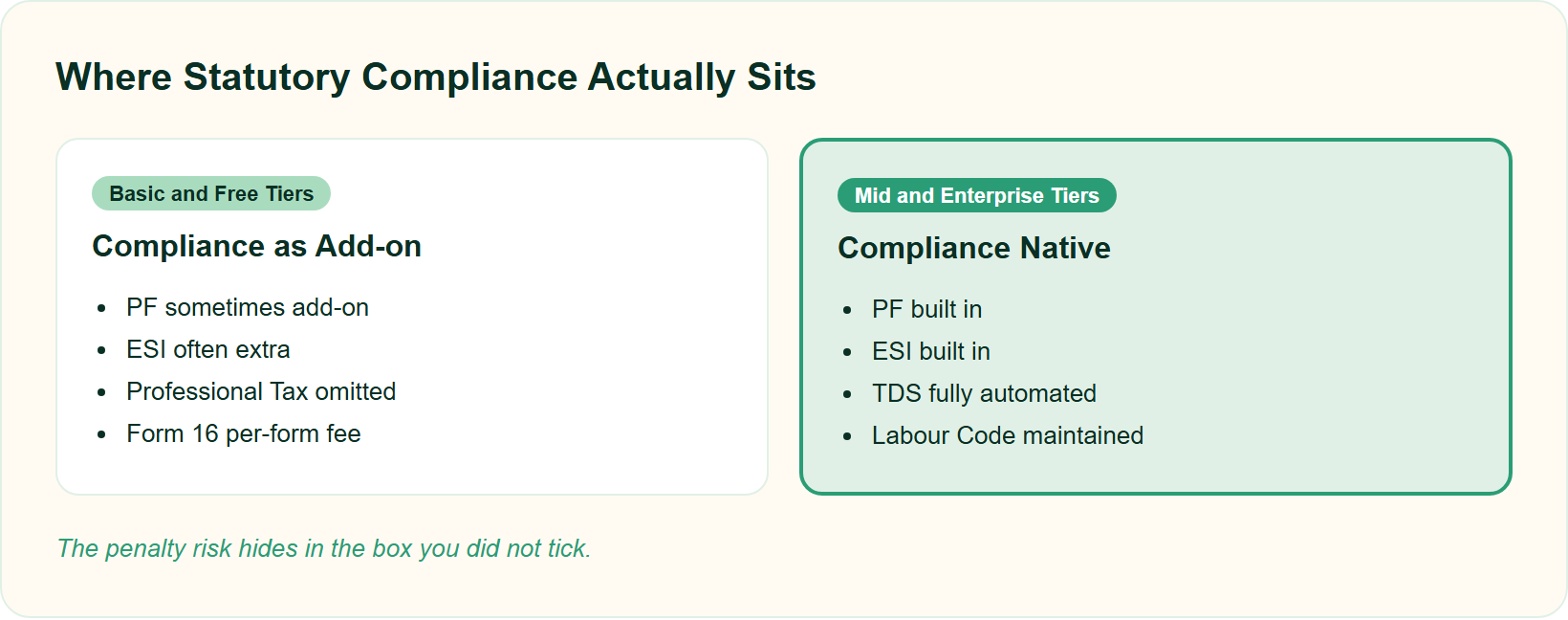
No competitor publishes this, so here it is. Match the tier to what it actually automates.
| Statutory Obligation | Basic and Free Tiers | Mid and Enterprise Tiers |
|---|---|---|
| PF (Provident Fund) | Sometimes add-on | Native |
| ESI and ESIC | Often add-on | Native |
| TDS (Income Tax Act) | Basic calc only | Full automation |
| Professional Tax (state) | Frequently omitted | Native |
| Form 16 generation | Per-form fee | Included |
| 2026 Labour Code readiness | Rarely updated | Actively maintained |
Read the left column carefully. That is where the ₹10 lakh penalty risk hides, not in the price you paid, but in the box you did not tick. If you run across states, our note on multi-state payroll compliance makes the stakes clearer.
⚙️ Why real compliance costs more to build
Statutory automation is genuine engineering, not marketing. A granted payroll patent describes systems that “concurrently assemble statutory deductions and cumulative statutory deductions” into one record. Another covers automated generation of withholding and tax documents.
That is what a higher PEPM often buys, patented computation, not a prettier dashboard. Layer on the 2026 Labour Codes, which reshape wage definitions and therefore PF and gratuity bases, and yesterday’s cheap system can quietly fall out of compliance.
🧪 The payoff: run the mid-month revision test
Here is a five-minute test before you buy. Ask the vendor to process a mid-month salary revision with backdated arrears, PF recalculation, and a fresh Form 16 line.
If the demo stumbles, your compliance will too. HROne includes core HCM with multi-legal-entity support and native payroll from the Basic tier, so statutory calculation is not gated behind an upsell. Real users report the difference.
“Proper calculation of PF and ESI was a pain area for us before, but now with the HROne automated calculation process, results are up to the mark and following Indian tax compliances properly.”
Ajay K. HROne G2 Verified Review
Q5. What Will Payroll Software Cost for Your Company Size?
For 1 to 25 employees, free or ₹1,000 to ₹3,000 per month plans usually suffice. For 26 to 100, expect ₹5,000 to ₹25,000 per month depending on the model. For 101 to 500, per-employee plans run ₹15,000 to ₹90,000 per month. Beyond 500, enterprises move to custom annual contracts, often ₹5 lakh to ₹50 lakh-plus per year including implementation.
📊 The cost, band by band
Find your headcount, read your number. That is the fastest way to sanity-check any quote.
| Headcount Band | Typical Monthly Cost | Rough Annual Cost |
|---|---|---|
| 1 to 25 | ₹0 to ₹3,000 | ₹0 to ₹36,000 |
| 26 to 100 | ₹5,000 to ₹25,000 | ₹60,000 to ₹3 lakh |
| 101 to 500 | ₹15,000 to ₹90,000 | ₹1.8 lakh to ₹11 lakh |
| 500+ | Custom annual | ₹5 lakh to ₹50 lakh+ |
The bands overlap on purpose. Your model, your state count, and your compliance needs move you within a band, not just your headcount. Firms crossing these thresholds often find our guide to scaling HR processes from 100 to 1,000 employees useful.
🔢 A worked example at 100 employees
Let me do the math you actually care about. Take a 100-person firm comparing two popular options.
- Keka: roughly ₹6,999 base plus ₹90 to ₹180 per employee, landing near ₹16,000 to ₹25,000 a month.
- HROne: ₹4,950 for the first 50 users, plus 50 times ₹99 for the rest, landing near ₹9,900 a month.
Same headcount, very different monthly line. This is why “cost by size” without the model attached is almost meaningless, and it is worth checking against our published pricing and the wider best HR software for the Indian mid-market roundup.
⚠️ The middle-market lockout
Here is the structural problem nobody names. The biggest, best-known HR systems are often built for giants, not for you.
From what I have seen across the market, several enterprise-tier platforms effectively “only sell to businesses with 3,000 employees or more,” leaving the 100 to 5,000 band underserved. HROne was built for exactly that ignored middle, with transparent per-head pricing instead of a “call us” wall. If you are a 100 to 500 person firm, you should not be paying enterprise-implementation tax just to run clean payroll software.
Q6. Is Payroll Software Cheaper Than Outsourcing or an In-House Team?
For most Indian mid-market firms, software is cheaper than either full outsourcing or a dedicated in-house team once you count the shadow labour of manual work. Outsourcing runs roughly ₹100 to ₹300 per payslip. An in-house executive costs ₹3 lakh to ₹6 lakh per year plus overhead. Software automates 90 to 95% of calculations, so break-even usually favours software above about 25 employees.
😤 The hidden week you already pay for
Most cost comparisons skip the biggest expense, which is your team’s time. That cost never shows on an invoice, so it never gets counted.
One operator described it plainly. Every month, they lost “at least one week with two to three people just for fetching out attendance” before payroll could even start. That is a full week of salaried time, gone, every single month. If that sounds familiar, our breakdown of HR software versus Excel quantifies the drain.
💰 The three-way cost picture
Here is the honest comparison, side by side. Read it against your own headcount.
| Option | Rough Cost | Trade-off |
|---|---|---|
| Payroll software | ₹40 to ₹180/employee/month | Automates 90 to 95%, you own the data |
| Outsourcing | ₹100 to ₹300 per payslip | Hands-off, but slow edits and per-run fees |
| In-house team | ₹3 lakh to ₹6 lakh/year per person | Full control, high fixed cost, key-person risk |
Above roughly 25 employees, the per-payslip and salary math usually tips toward software. Below that, a lean outsourcing arrangement can still win, and our comparison of payroll software versus outsourcing in India maps the exact break-even.
⏰ When it is not just math
Here is my honest hedge. It genuinely depends on the resources you already have in-house.
If you run payroll across multiple countries, an outsourced specialist may still beat software. But for a single-country Indian mid-market firm, the shadow-workload week is the real cost, which is why many teams eventually move to full payroll outsourcing or an integrated platform.
“Poor customer support. We had to go in rounds and spend so many man hours to configure our payroll and later found so many gaps.”
Verified User in IT Services greytHR G2 Verified Review
At HROne, one manufacturing client cut expense turnaround from 7 to 10 days down to 2 to 3, with “90 to 95% of calculations now automated.” That is the shadow week returned to the team, which is the number outsourcing invoices never show you. Our manufacturing HR solution was built for exactly these shift-based realities.
Q7. What Does HROne Cost and What Do You Get in Each Tier?
HROne starts at ₹4,950 per month for 50 users (Basic), with additional users at ₹99 per month. Professional is ₹6,500 per month for 50 users, at ₹130 per additional user. Basic includes Core HR (multi-legal-entity), Time Office, Payroll, the mobile app, and dashboards. Professional adds Workforce (confirmation, transfer, separation) and digital letter acknowledgement. You are billed only when you go live, with zero contractual lock-in.
📊 Before: reports that took days
Picture the old month-end. An HR manager digging through spreadsheets for two days just to answer one board question.
Now picture the after. As one HROne user put it, “HR reports that used to take a couple of days I can get on a click, everything on a single platform.” That shift, from days to one click, is the whole point, and it starts with our core HCM.
💰 The two tiers, plainly
Here is exactly what you pay and what you get. No “quote on request” wall.
| Tier | Price | What Is Included |
|---|---|---|
| Basic | ₹4,950/mo (50 users), plus ₹99/user | Core HR (multi-legal-entity), Time Office, Payroll, mobile app, dashboards |
| Professional | ₹6,500/mo (50 users), plus ₹130/user | Everything in Basic, plus Workforce (confirmation, transfer, separation), digital letter acknowledgement |
Multi-legal-entity means running several registered companies under one payroll instance. That matters if you operate across states or group entities, and our HR software for multi-entity companies guide explains the setup.
⭐ The proof, from real customers
Numbers only mean something with evidence behind them. So here is the ground reality.
MR DIY India collapsed payroll cycles from 10 days to 5 to 6 after moving to HROne, as documented in the MRDIY case study. Asia Healthcare Holdings runs 20 pan-India units on a single instance. We also built India’s first inbuilt ROI calculator logic into the platform, which calculates lifetime hours saved against average HR salary, so your savings arrive at the board review already quantified.
“I like HROne for its zero-touch payroll and compliance automation, cutting down administrative time by 60-70%.”
Waldon S. HROne G2 Verified Review
“Intuitive and Supportive, but Onboarding Can Feel Overwhelming for New Users.”
Nijanthan R. HROne G2 Verified Review
✅ Why the billing model reduces your risk
Here is the part I care about most. Your subscription meters only after go-live, and there is no lock-in. If implementation drags, you are not paying for shelfware, which removes the single biggest hidden cost in a bad payroll deal. When you are ready, you can book a demo to see your exact number.
Q8. How Do the Top Payroll Software Vendors Compare on Price in India?
Across leading Indian vendors, entry prices range from free (greytHR and Zoho small tiers) to ₹4,950 to ₹6,999 per month base, plus per-user fees. Price is near-parity, so the support model and ROI tracking decide it. Several competitors rely on email-thread support with no built-in ROI measurement, while HROne offers a dedicated HR SPOC and an inbuilt ROI Dashboard.
🎯 Price is close, so look past it
Here is the thing most comparison posts miss. At the mid-market, sticker prices cluster within a narrow band.
When prices barely differ, two other columns decide your outcome. Those columns are support quality and whether you can prove ROI to your board, a theme we expand in our top 10 payroll software India roundup.
1.1 HROne
1.2 Keka
1.3 greytHR
1.4 Zoho Payroll
1.5 RazorpayX Payroll
1.6 Pocket HRMS
1.7 Darwinbox
1.8 PeopleStrong
1.9 Kredily
1.10 SumoPayroll
1.11 SalaryBox
1.12 Spine HR
| # | Vendor | Starting Price | Pricing Model |
|---|---|---|---|
| 1.1 | HROne | ₹4,950/mo (50 users) plus ₹99/user | Flat plus per-user, dedicated HR SPOC, inbuilt ROI Dashboard, zero lock-in |
| 1.2 | Keka | ₹6,999/mo base plus ₹90 to 180 PEPM | Flat plus PEPM |
| 1.3 | greytHR | Free up to 25 users, then tiered | Freemium plus tiered |
| 1.4 | Zoho Payroll | Free up to 10, about ₹40/employee | Freemium plus PEPM |
| 1.5 | RazorpayX Payroll | About ₹30/employee | PEPM |
| 1.6 | Pocket HRMS | Tiered per-user | Per-user tiers |
| 1.7 | Darwinbox | Custom annual | Enterprise licensing |
| 1.8 | PeopleStrong | Custom annual | Enterprise licensing |
| 1.9 | Kredily | Free tier available | Freemium |
| 1.10 | SumoPayroll | Low-cost per-employee | PEPM |
| 1.11 | SalaryBox | Free up to 25 users | Freemium |
| 1.12 | Spine HR | Quote-based | Custom |
⚖️ Where support and ROI actually split them
This is where the real differences live, and users say it loudly. Support gaps and ROI blindness cost more than a few rupees per head.
“From Friday evening 6PM to Monday morning 10AM there is no source of support from Keka.”
Prem K. Keka G2 Verified Review
“Bad implementation experience, terrible customer service. Basically everything.”
Verified User in Computer Software Darwinbox G2 Verified Review
To be fair, Darwinbox carries real enterprise brand weight, and greytHR handles SMB payroll adequately. But from what surfaces when you actually run these tools, few offer a way to prove ROI back to the board. HROne pairs a dedicated HR SPOC (9.8 NPS) with India’s first inbuilt ROI Dashboard, so you are not “stuck in email threads” or walking into a review with no rupee figure to show. Choose Zoho if you are under 10 people. Choose HROne if you are a 100 to 5,000 person Indian firm that needs both support and proof, and if you are weighing us head-to-head, our HROne vs Keka and HROne vs Darwinbox comparisons lay it out.
Q9. How Do You Choose the Right Payroll Software Without Overpaying?
Choose by matching three things: your headcount band, the statutory obligations you actually trigger (PF, ESI, TDS, and Professional Tax by state), and your tolerance for implementation cost. Demand transparent pricing, confirm compliance features are native and not add-ons, test a mid-month salary revision, and insist on ROI visibility before signing. Avoid paying for enterprise scope you will not use, or underpaying into compliance risk.
✅ The six-step buying checklist
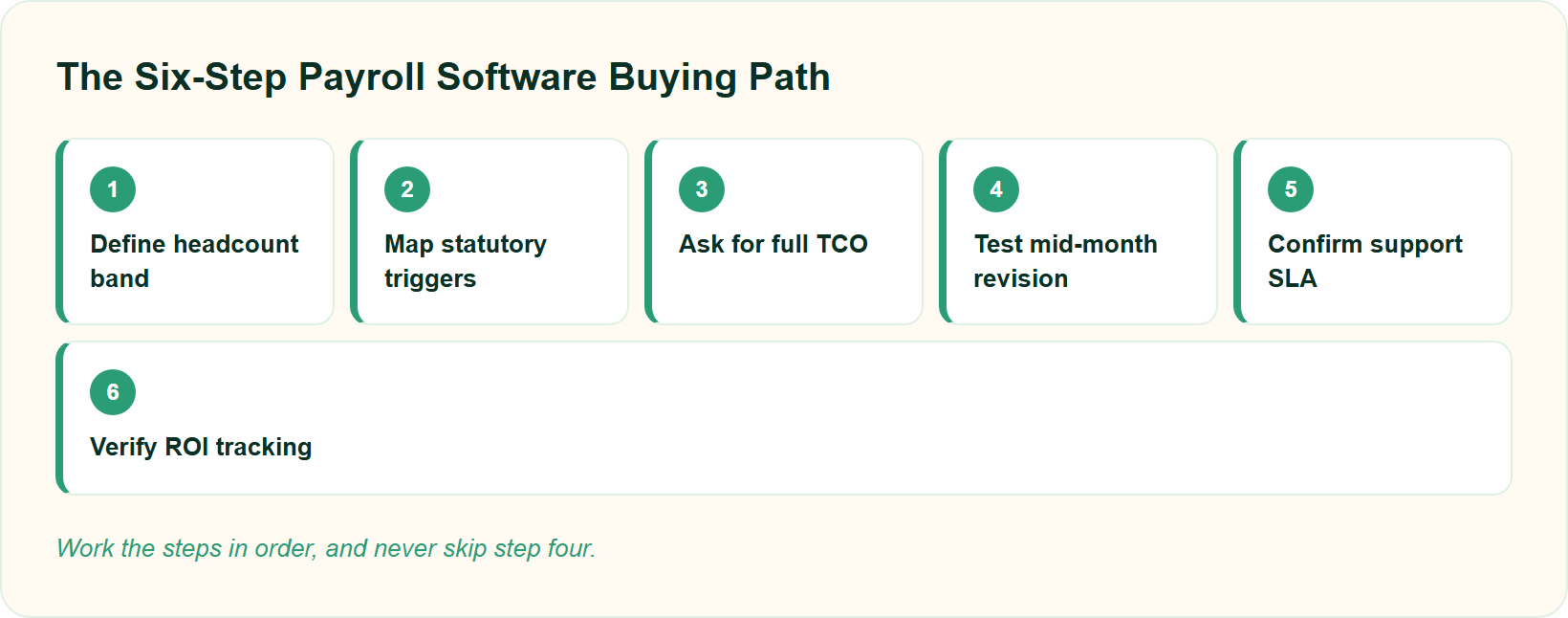
Here is the path I would run on a Monday morning. Work it in order, and do not skip step four.
- Define your headcount band, since that anchors every price quote you receive.
- Map the statutory triggers you actually face, like PF, ESI, TDS, and state-wise Professional Tax.
- Ask for total cost of ownership, not the sticker rate, so implementation and add-ons are visible upfront.
- Test a mid-month salary revision live, because that is where cheap systems quietly break.
- Confirm the support SLA, meaning the guaranteed response time when payroll is stuck at 6 PM on payday.
- Verify ROI tracking, so you can prove savings to your board later.
Run every shortlisted vendor through the same six steps. If one stumbles on step four or five, it is not the bargain it looks like. A structured HRMS evaluation checklist keeps the comparison honest.
⚠️ Where buyers overpay or underpay
Overpaying usually means buying enterprise scope you will never switch on. Underpaying usually means saving ₹40 per head and inheriting a compliance gap.
Real users describe the underpaying trap sharply, and it usually shows up as unbudgeted configuration hours during setup rather than on the invoice. The saving on the invoice quietly moves onto the payroll manager’s calendar. Our note on multi-state payroll compliance shows where those gaps hurt most.
“We had to go in rounds and spend so many man hours to configure our payroll and later found so many gaps.”
Verified User in IT Services greytHR G2 Verified Review
💡 What good software actually feels like
Here are two tactical tips that separate real tools from demos. They sound small, but they save hours every cycle.
First, when a new hire is onboarded, the system should auto-trigger the salary-structure task and copy it straight from the offer letter. No re-keying, no mismatch. Second, before processing salaries, you should be able to download an error sheet that flags every prerequisite gap in advance, so you catch problems before the run, not after.
- Managers should also be able to act on behalf of their team, which removes the classic “manager cannot mark leave” bottleneck.
- These are the details that decide whether payroll takes two days or two hours.
This is exactly the kind of workflow our onboarding process and payroll software were built to remove, and it is why an attendance management layer that feeds payroll cleanly matters so much.
“I really like the reminder feature in HROne. If any detail is missing in the policy or an employee profile, it doesn’t allow the process to move forward until the checklist is fully completed.”
Bindu P. HROne G2 Verified Review
🔮 The question I am sitting with
My current thinking is that the next two years will make ROI proof, not price, the real buying axis. As statutory complexity rises, boards will stop asking “what does it cost” and start asking “what did it save.”
At HROne, our zero-lock-in trial, native multi-entity core HCM, and India’s first inbuilt ROI calculator were built for exactly that shift. So here is my honest question back to you. When your CFO asks what payroll software returned last year, will your current tool have an answer, or just an invoice?













 Secures Top Spot in
