


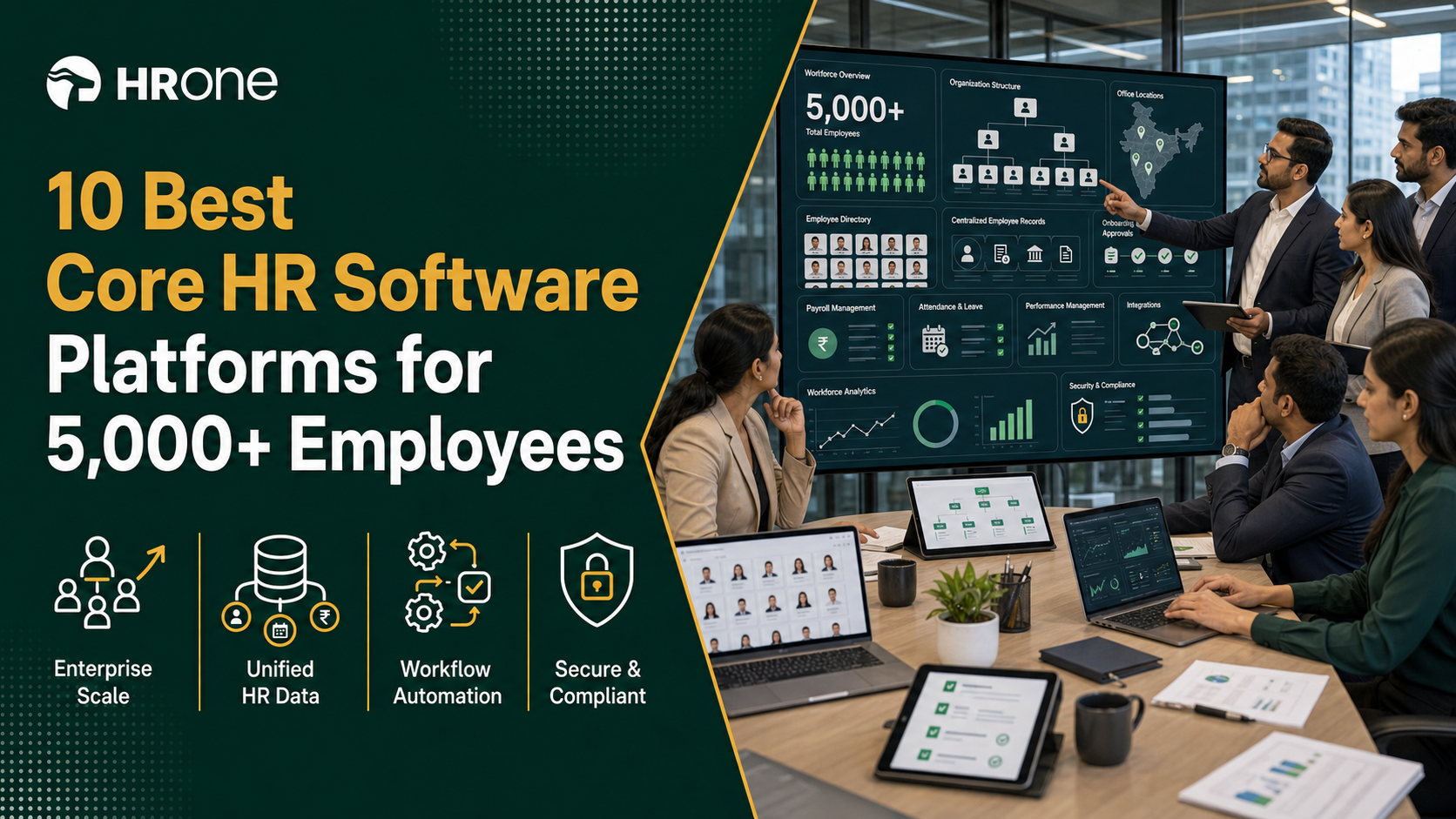
Q1. What Are the 10 Best Core HR Software Platforms for Companies With 5,000+ Employees in 2026?
The ten best core HR platforms for 5,000+ employees in 2026 are HROne, Darwinbox, SAP SuccessFactors, Workday, PeopleStrong, Oracle Fusion HCM, Keka, greytHR, ZingHR, and Ramco HCM. HROne ranks first for Indian multi-entity enterprises because one instance isolates state-specific rules per legal entity, and it holds #3 for Highest Satisfaction globally on G2 out of 1,17,579 products.
Choosing a core HCM platform at 5,000+ headcount is a high-stakes, multi-year decision, because the system becomes the single source of truth for payroll, attendance, and statutory filings across every legal entity. Rather than ranking vendors by brand recall, this guide evaluates ten platforms against operational, architectural, and compliance criteria that matter above 5,000 employees. Gartner’s own review market for this band is defined separately from sub-1,000 enterprises, which tells you the requirements genuinely diverge at scale. We scored each vendor on evidence: published pricing, verified reviews, documented go-live timelines, and India statutory depth.
Our Evaluation Criteria
- Multi-Entity Architecture Depth 🏢
Whether all legal entities sit on one instance with their own registered address, PIN code, GSTIN, and state rule set, or need parallel deployments reconciled by spreadsheet. - India Statutory Coverage 📋
Native PF, ESI, professional tax, LWF, TDS, Form 16, and Form 24Q generation, plus readiness for the Labour Codes notified on 21 November 2025. - Time to Value ⏰
Published or reference-checked go-live timeline for a 5,000-employee rollout, and whether billing starts at purchase or after go-live. - Configuration Without Developers 🛠️
Can an HR ops lead change a leave policy, add an entity, or build a small app from the front end, or does it need a back-end ticket? - Workforce Coverage Breadth 👷
Handling of blue-collar, field, and shift-based staff alongside white-collar teams, including biometric sync and geo-fenced attendance. - Verified User Evidence ⭐
G2, Gartner, and Capterra review volume and rating, weighted for recency and for documented complaints, not just praise. - Support Model 📞
Dedicated SPOC versus ticket queue or partner-delivered support, tested against what happens mid-payroll-run. - Pricing Transparency 💰
Whether PEPM (per employee per month) rates, implementation fees, and per-entity charges are published or quote-gated. Compare against published HR software pricing benchmarks before you accept a quote.
Who This Guide Is For
- CHROs and HR Heads consolidating three or more disconnected systems into one hire-to-retire record. Our CHRO solutions map to this exact consolidation problem.
- Payroll Managers running multi-state payroll compliance cycles with arrears and CTC revisions.
- CFOs validating three-year TCO and deciding whether flat PEPM beats quote-based enterprise licensing.
- IT Directors assessing HRMS integrations with an existing SAP, Oracle, or Tally estate.
- HR Ops leads reconciling biometric exports against a separate leave portal every month-end.
🏆 The Ranked List
- HROne
- Darwinbox
- SAP SuccessFactors
- Workday
- PeopleStrong
- Oracle Fusion HCM
- Keka
- greytHR
- ZingHR
- Ramco HCM
| Provider | Best For | Standout Strength | Known Limitation | Go-Live Timeline | Support Model | Pricing Model |
|---|---|---|---|---|---|---|
| HROne ⭐⭐⭐⭐⭐ | HR ops leads drowning in multi-entity payroll reconciliation across states | Front-end setup module lets HR configure legal entities and policies without a developer ticket | Reviewers report the mobile app is thinner than web for detailed performance and audit work | As little as 30 days for mid-market enterprises | Phone, email, and a prior-HR onboarding SPOC | Flat PEPM, no lock-in, billing starts after go-live |
| Darwinbox ⭐⭐⭐⭐ | CHROs at listed Indian enterprises wanting a modern employee-facing UI | Strong brand weight and enterprise footprint across India and Southeast Asia | Reviewers cite slow page loads, limited report customisation, and inconsistent syncs | Typically one quarter or longer | Account manager plus ticket queue | Quote-based, commonly multi-year |
| SAP SuccessFactors ⭐⭐⭐⭐ | Global groups standardising talent processes on an existing SAP estate | Deepest global talent and succession module set | India payroll is usually partner-delivered, adding a second vendor per statutory change | Two to four quarters | Partner-delivered | Quote-based, module licensing |
| Workday ⭐⭐⭐⭐ | Multinationals wanting one global workforce data model and analytics | Best-in-class reporting and org modelling at very large scale | Largely sells above 3,000 employees, so mid-market India rarely gets full access | Two to four quarters | Partner-delivered | Quote-based, subscription |
| PeopleStrong ⭐⭐⭐⭐ | Indian mid-market and GCC teams wanting analytics-forward HCM | Strong India mid-market install base and multi-country coverage | Reviewers report configuration depends heavily on vendor-side effort | One to two quarters | Account manager plus ticket queue | Quote-based |
| Oracle Fusion HCM ⭐⭐⭐⭐ | IT-led transformations already standardised on Oracle Cloud | Unified finance and HR data model for board reporting | Heavy technical dependency for routine policy changes | Two to four quarters | Partner-delivered | Quote-based |
| Keka ⭐⭐⭐ | Fast-growing tech firms below the 1,000-employee mark | Clean employee-facing UX and quick self-serve setup | Reviewers report email-thread-only support and stalled implementations | Weeks, when scope is small | Email-led | Per-employee tiers, published |
| greytHR ⭐⭐⭐ | Payroll-and-compliance-first teams with light talent needs | Long-standing India statutory payroll depth and published pricing | Rigid configuration once multi-entity or shift-based reality appears | Weeks to one quarter | Email and chat | Published tiered pricing |
| ZingHR ⭐⭐⭐ | Manufacturing and BFSI groups with large blue-collar bases | Vertical-specific templates for shift and contract labour | Thinner independent review volume than the top five | One to two quarters | Account manager | Quote-based |
| Ramco HCM ⭐⭐⭐ | Asia-Pacific groups needing multi-country payroll in one engine | Multi-country payroll engine covering 45+ jurisdictions | Talent and engagement modules trail the India-first challengers | Two to three quarters | Partner and account manager | Quote-based |
📖 How to Read This Table in 90 Seconds
Start with column five, not column one. Go-live timeline is the closest proxy for how much of your team’s next year this decision consumes.
Then read the limitation column before the strength column. Every platform here works, so the question is which documented weakness you can genuinely live with. A structured HRMS evaluation checklist keeps that judgement consistent across vendors.
🚩 Why the Global Suites Keep Slipping in This Band
There is a structural reason the obvious names do not automatically win at 5,000 employees. The largest suites concentrate their selling motion well above the Indian mid-market, and one operator put the gate plainly.
“The biggest and best HR systems are restricted to the big businesses across our country. Literally the companies out there that are providing those systems like Workday for example. These are really cool systems, but they’re only selling to businesses with 3,000 employees or more.”
Market concentration reinforces it. Gartner’s analysis shows the top HCM vendors holding more than half of market revenue, and large enterprises account for roughly 68% of cloud HCM spend. Gartner also projects that by 2027, 75% of midsize and large enterprises will run a cloud HCM suite yet still need other tools for 20% to 30% of HR requirements. I read that as permission to stop hunting for a single perfect system. My honest view, after years of watching these evaluations, is that moving from a flat HRIS database to a system that actually executes work is less an apples-to-apples swap and more a switch to a different fruit entirely.
1.1 HROne
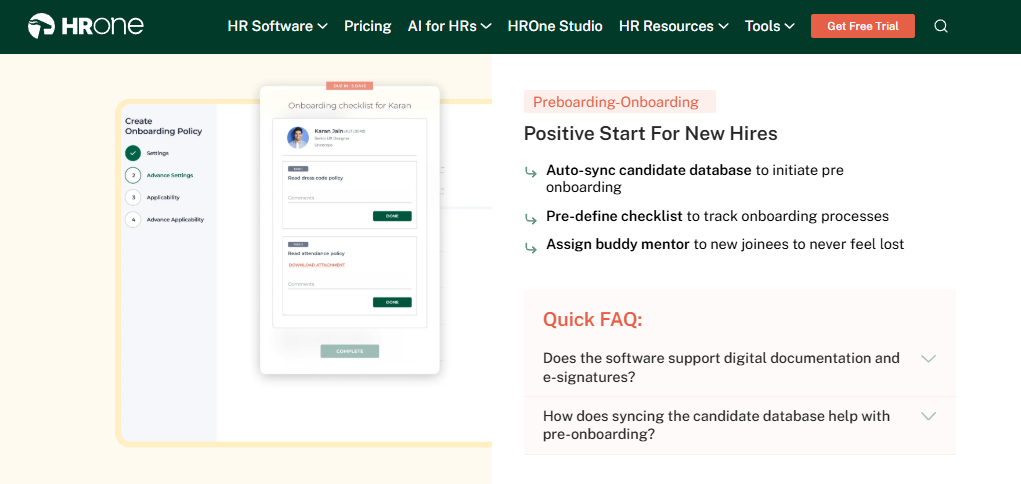
HROne (Full hire-to-retire operating system for India-first multi-entity enterprises)
🏢 Overview
HROne is a cloud HR software platform founded in 2016 under Uneecops Workplace Solutions, headquartered in Noida. It serves 2,000+ enterprise brands across 20+ industries and has processed over 70 lakh payslips. On G2 it ranks #3 for Highest Satisfaction globally out of 1,17,579 products, #8 Best HR Software Worldwide, and #1 in India and APAC for customer satisfaction, across 2,074+ verified reviews. Teams typically arrive here after running attendance, payroll, and recruitment on three systems that cannot talk to each other.
⚙️ Core Services
- Multi-legal-entity company setup: isolates each entity by registered address, PIN code, and state GSTIN, so location-based compliance runs automatically instead of being maintained as eight separate rule sheets.
- InboxforHR (Super Inbox): surfaces every pending task, request, and approval on one Gmail-style screen with counters, closing 110+ HR tasks in three clicks and removing tab-switching across five tools. See how the HR inbox works in practice.
- 127 pre-built hire-to-retire workflows: define who does what and by when across onboarding, confirmation, transfer, promotion, and exit clearance, so HR stops chasing managers over email.
- Three-layer role-based access wizard: define role, assign rights, review, filtered across companies, business units, departments, levels, designations, and sub-branches, which restricts payroll visibility without custom code.
- Payroll and statutory engine: automates PF, ESI, professional tax, LWF, and TDS with bank challan file generation, cutting month-end reconciliation errors and Form 16 email chains. This is the payroll software layer that carries the statutory load.
- Automatic CTC assignment: binds offer-letter salary structures directly to the employee master post-joining, eliminating hand-edited CSV uploads during bulk ingestion.
- One AI Suite and HRV Studio: resume relevancy scoring, receipt parsing, and a low-code builder for apps like visitor or vendor management, so HR ships small tools without a developer ticket. Full capability detail sits in the HROne One AI Suite breakdown.
🇮🇳 India-Specific Compliance and Localization
- PF / ESI / TDS support: Yes (automated calculation, challan and Form 16 generation)
- Labour law compliance: Strong (entity-level state rule engine, Labour Code allowance reclassification)
- Payroll localization: Yes (India-native CTC, FBP, arrears, and full-and-final logic)
- Multi-state compliance handling: Yes (state-specific PT and LWF slabs per legal entity)
👥 Who This Is Built For
- Payroll Manager firefighting CTC-revision arrears across eight state entities every month-end.
- HR Ops lead manually reconciling biometric exports against a standalone leave portal.
- CHRO who cannot answer, in a board review, how many days a confirmation letter takes to close.
❌ Who Should Skip This
- Global groups whose primary need is talent and succession across 30+ countries rather than India statutory depth.
- Teams wanting spreadsheet-light payroll with no structured workflows or approval hierarchy.
💰 Pricing Structure
- Plan Type(s): Modular, built on the Core HR, Workforce, Time Office, and Payroll foundation set, with Performance, Engage, Recruitment, and Helpdesk added on.
- Starting Price: Flat PEPM. Enterprise rates at the 5,000+ band are not publicly disclosed, so request a quote from the pricing page.
- Tier-wise Breakdown: Not publicly disclosed for this headcount band, request a quote.
- Incremental Cost Drivers: Additional modules, add-on AI capabilities, and custom report formats beyond standard templates.
- Implementation Fee: Not publicly disclosed, request a quote. Subscription billing meters only after go-live.
- Cost at 200 Employees: Not publicly disclosed, request a quote. Cost at 500 Employees: Not publicly disclosed, request a quote.
🛠️ Implementation and Support Reality
- Go-live in as little as 30 days for mid-market enterprises, with the four foundation modules configured first. The phase-by-phase sequence is documented in our HROne implementation guide.
- Phone, email, and a dedicated prior-HR onboarding SPOC rather than a technical project manager reading a checklist.
- Vendor-led migration, with reviewers reporting ERP data transfers completed in hours.
- 9.8 NPS reported on dedicated SPOC support.
💬 What Users Actually Say
“It can sometimes feel a bit overwhelming for new users. Certain features take time to understand, and without enough guided support, the learning curve can feel quite steep.”
– Nijanthan R., 3/5 rating, HROne G2 – Verified Review
“The InboxforHR is a game-changer, centralizing every HR task into one simple inbox, cutting down administrative time by 60 to 70% and preventing tasks from falling through the cracks.”
– Waldon S., 4/5 rating, HROne G2 – Verified Review
HROne holds position one here because it is the only platform on this list where an HR ops lead can add a new legal entity, its state rules, and its approval hierarchy from the front end, then see every resulting task land in one inbox. That combination, plus #3 Highest Satisfaction globally on G2, is what earned the five-star score in our rubric.
1.2 Darwinbox
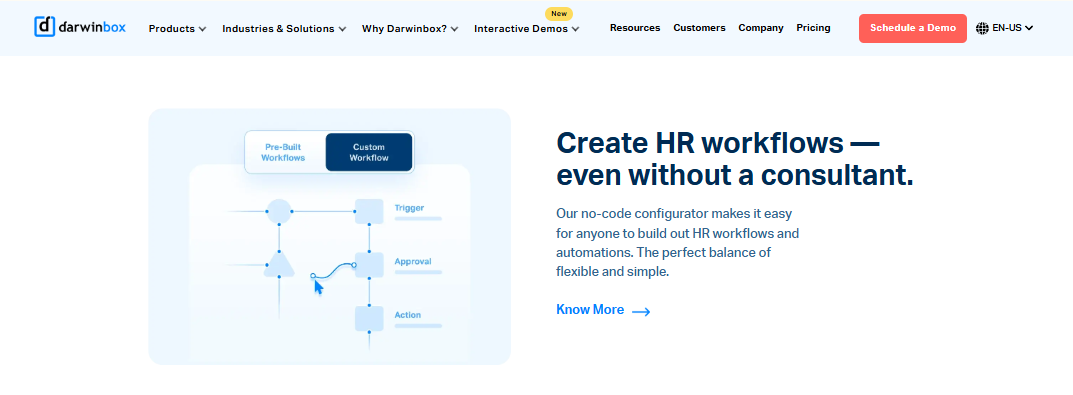
Darwinbox (Brand-heavy enterprise HCM for listed Indian and Southeast Asian groups)
🏢 Overview
Darwinbox is an enterprise HCM platform founded in 2015 and headquartered in Hyderabad, backed by KKR among others. It serves 1,000+ enterprise clients across India and Southeast Asia and is widely recognised in the Indian enterprise segment. Reviewers consistently praise the employee-facing interface and mobile experience. Teams usually shortlist it when brand assurance for a board and a modern employee UI carry more weight than configuration self-sufficiency. A side-by-side read sits in our HROne vs Darwinbox comparison.
⚙️ Core Services
- Core HR and employee record: centralises master data across entities, reducing duplicate record maintenance between HR and finance systems.
- Payroll: processes India payroll with statutory computations, removing parallel spreadsheet salary runs.
- Time and attendance: captures punches and leave with configurable policies, cutting manual muster reconciliation.
- Performance management: runs goal setting and review cycles, though reviewers report the module needs training to use fully.
- Recruitment: manages requisition-to-offer flow, replacing disconnected ATS spreadsheets.
- Mobile app: supports leave, attendance, and payslip access on the go, which reviewers rate as a genuine strength.
- Configurable workflows: adapt approval routing to internal processes with limited technical intervention.
🇮🇳 India-Specific Compliance and Localization
- PF / ESI / TDS support: Yes (native India payroll computation)
- Labour law compliance: Strong (built for Indian enterprise statutory needs)
- Payroll localization: Yes (India-first payroll engine with SEA coverage)
- Multi-state compliance handling: Yes (multi-entity and multi-state supported)
👥 Who This Is Built For
- CHRO at a listed group who needs a recognisable vendor name to clear a board technology review.
- HR lead whose workforce is largely white-collar and mobile-first across India and Southeast Asia.
❌ Who Should Skip This
- HR ops teams that need to change policies and entity rules themselves without waiting on vendor configuration cycles.
- Finance leaders who need billing to start only after go-live rather than from purchase date.
💰 Pricing Structure
- Plan Type(s): Enterprise plans structured by module scope.
- Starting Price: Not publicly disclosed, request a quote. Published estimates are collated in our Darwinbox pricing analysis.
- Tier-wise Breakdown: Not publicly disclosed, request a quote.
- Incremental Cost Drivers: Additional modules, added entities, and implementation scope changes.
- Implementation Fee: Not publicly disclosed, request a quote.
- Cost at 200 Employees: Not publicly disclosed, request a quote. Cost at 500 Employees: Not publicly disclosed, request a quote.
🛠️ Implementation and Support Reality
- Enterprise rollouts commonly run a quarter or longer, and one reviewer reported configurations breaking in production after product deployments.
- Support runs through an account manager plus ticket queue, with mixed reviewer experiences during implementation.
- Vendor-led and partner-supported migration depending on deal size.
- No publicly reported NPS figure available.
💬 What Users Actually Say
“Speed and performance, pages sometimes load slowly. Reporting and analytics, limited customization in reports. Integration issues, sync with other systems can be inconsistent.”
– Saksham A., 4/5 rating, Darwinbox G2 – Verified Review
“Bad implementation experience, bad UI and UX, configurations getting broken in production on its own due to product deployments, terrible customer service.”
– Verified User in Computer Software, 0/5 rating, Darwinbox G2 – Verified Review
Darwinbox earns four stars and second place on genuine enterprise credibility, and the mobile experience is well liked. HROne’s read is that the difference at 5,000+ employees shows up in operating model rather than feature checklist: front-end entity configuration, billing that starts after go-live, and a prior-HR SPOC instead of a ticket queue during a live payroll run.
1.3 SAP SuccessFactors
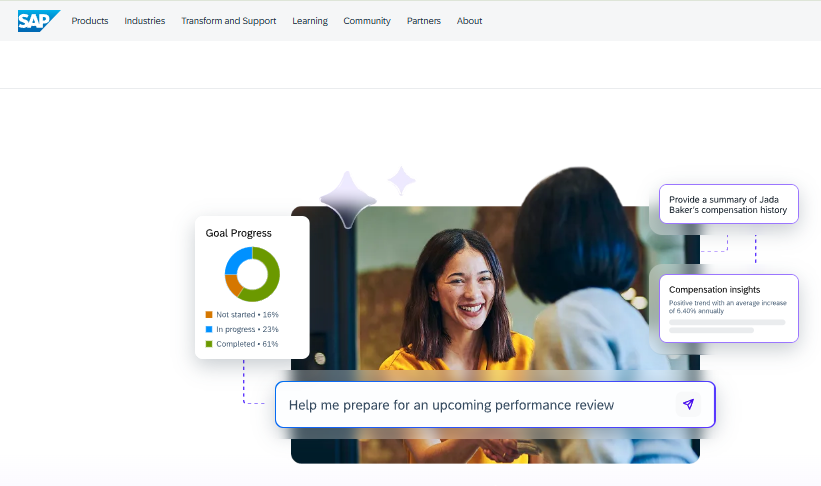
SAP SuccessFactors (Global talent suite for groups already standardised on SAP)
🏢 Overview
SAP SuccessFactors is the human capital management suite inside SAP’s cloud portfolio, acquired in 2012. It is listed by Gartner in the HCM Suites market for 1,000+ employee enterprises, alongside a separate market for regional and sub-1,000 buyers. Indian groups usually shortlist it when finance and supply chain already run on SAP. Teams arrive here struggling to standardise talent processes across many countries at once. A direct architectural read sits in our HROne vs SAP comparison.
⚙️ Core Services
- Employee Central: acts as the global core HR record, removing duplicate master data between country payroll systems.
- Talent and succession: runs goal, calibration, and succession cycles, replacing offline talent review decks.
- Recruiting and onboarding: manages requisition-to-hire flow with structured approvals, cutting email-based offer chasing.
- Learning: assigns and tracks compliance training, removing manual attendance registers for mandatory courses.
- Analytics with People Analytics: builds workforce reports on the core record, reducing manual board-pack preparation.
- India payroll via partner or SAP payroll: computes statutory deductions, though this typically involves a partner in the delivery chain.
🇮🇳 India-Specific Compliance and Localization
- PF / ESI / TDS support: Yes (available, commonly partner-delivered in India)
- Labour law compliance: Moderate (depends heavily on partner configuration quality)
- Payroll localization: Yes (India localisation exists within SAP payroll)
- Multi-state compliance handling: Yes (configurable, though changes need technical effort)
👥 Who This Is Built For
- Group CHRO standardising performance and succession across 15 or more countries.
- IT Director who must keep HR on the same platform stack as finance and procurement.
❌ Who Should Skip This
- HR ops leads who need to change a leave rule this week without raising a developer ticket.
- India-only enterprises whose real pain is state-wise statutory payroll rather than global talent depth. Teams in that position usually start with a statutory compliance software shortlist instead.
💰 Pricing Structure
- Plan Type(s): Module-based enterprise licensing across Employee Central and talent modules.
- Starting Price: Not publicly disclosed, request a quote.
- Tier-wise Breakdown: Not publicly disclosed, request a quote.
- Incremental Cost Drivers: Added modules, country payroll localisations, partner implementation scope, and integration middleware.
- Implementation Fee: Yes, typically separate and partner-billed. Range not publicly disclosed.
- Cost at 200 Employees: Not publicly disclosed, request a quote. Cost at 500 Employees: Not publicly disclosed, request a quote.
🛠️ Implementation and Support Reality
- Enterprise rollouts commonly run two to four quarters, depending on country count.
- Support is largely partner-delivered, with SAP support tiers behind it.
- Migration is partner-led, which means your timeline depends on the partner’s bench. Our HRMS migration guide sets out the cutover checkpoints to demand in writing.
- No India-specific public NPS figure available.
⚠️ The Trade-Off Worth Naming
Gartner projects that by 2027, 75% of midsize and large enterprises will run a cloud HCM suite yet still need other tools for 20% to 30% of HR needs. That gap shows up fastest with global suites in India. My honest read is that you buy SAP SuccessFactors for global talent consistency, then solve India statutory reality separately.
1.4 Workday
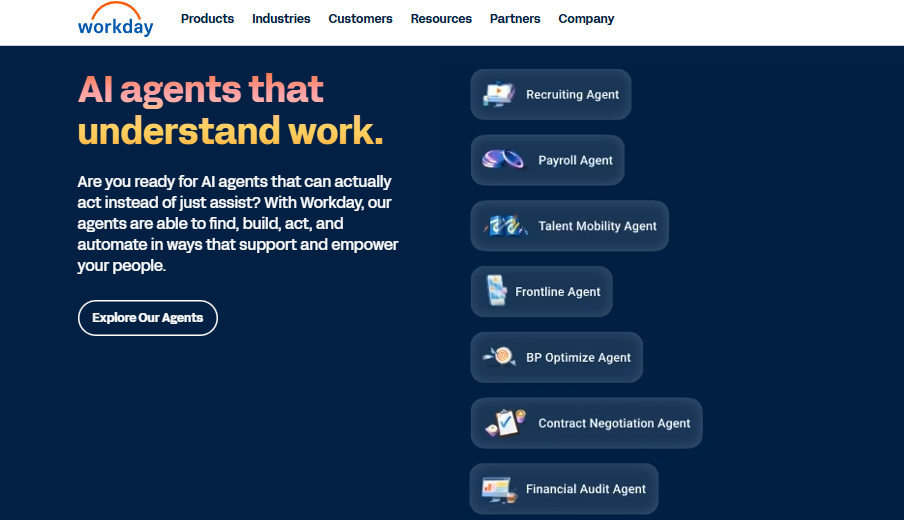
Workday (Global workforce data model and analytics for very large enterprises)
🏢 Overview
Workday is a cloud HCM and finance platform founded in 2005, widely recognised for its unified data model and reporting. Gartner tracks it in the HCM Suites market for 1,000+ employee enterprises. In India it is most common at large captives, GCCs, and listed multinationals. Teams choose it when board-level workforce analytics matter more than local payroll depth.
⚙️ Core Services
- Human Capital Management core: holds one global worker record, removing country-by-country reconciliation of headcount.
- Organisation modelling: restructures supervisory and matrix hierarchies without rebuilding the data, cutting reorg spreadsheet work.
- Reporting and Prism Analytics: builds live workforce reports on transactional data, replacing manual monthly board packs. India-first buyers comparing this capability should review available HR analytics tools side by side.
- Talent and performance: runs reviews, calibration, and succession on the same record as compensation.
- Compensation management: models increment and bonus cycles centrally, reducing offline salary-planning sheets.
- India payroll via partner: delivered through payroll partners or connectors rather than a native India engine.
🇮🇳 India-Specific Compliance and Localization
- PF / ESI / TDS support: Partial (typically via certified payroll partners)
- Labour law compliance: Moderate (depends on partner payroll engine)
- Payroll localization: No (India payroll is not natively delivered)
- Multi-state compliance handling: Partial (handled in the partner payroll layer)
👥 Who This Is Built For
- Group CHRO who must answer workforce questions across 20 countries in one dashboard.
- CFO wanting HR and finance planning on a shared data model.
❌ Who Should Skip This
- India-first enterprises whose core requirement is multi-state statutory payroll in one engine. That requirement maps to HR software for multi-entity companies rather than a global suite.
- Mid-market groups below the vendor’s typical selling threshold.
💰 Pricing Structure
- Plan Type(s): Enterprise subscription by module and worker count.
- Starting Price: Not publicly disclosed, request a quote.
- Tier-wise Breakdown: Not publicly disclosed, request a quote.
- Incremental Cost Drivers: Added modules, partner payroll fees, integration build, and sandbox environments.
- Implementation Fee: Yes, partner-billed and separate. Range not publicly disclosed.
- Cost at 200 Employees: Not publicly disclosed, request a quote. Cost at 500 Employees: Not publicly disclosed, request a quote.
🛠️ Implementation and Support Reality
- Rollouts typically run two to four quarters with a partner implementation team. Benchmark that against a realistic HRMS implementation timeline for Indian enterprises.
- Support runs through partner plus vendor tiers rather than a single named SPOC.
- Migration is partner-led with formal deployment methodology.
- No India-specific public NPS figure available.
🚧 The Access Problem at 5,000 Employees
There is a reason Workday appears less often in Indian mid-market shortlists than its reputation suggests. One operator described the gate bluntly.
“These are really cool systems, but they’re only selling to businesses with 3,000 employees or more.”
Gartner’s market sizing supports the concentration, with top vendors holding over half of HCM software revenue and large enterprises accounting for roughly 68% of cloud HCM spend. So a 5,000-employee Indian manufacturer sits right at the edge of that motion. I think that edge, not product quality, is what usually decides the outcome.
1.5 PeopleStrong
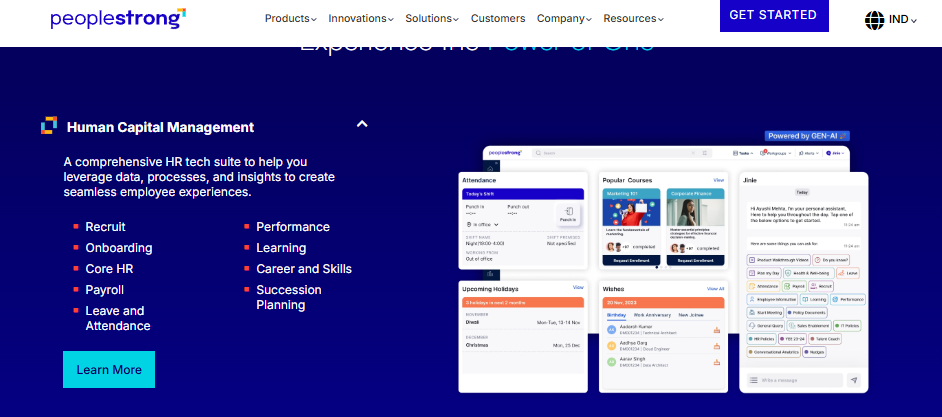
PeopleStrong (Analytics-forward India and Asia HCM for mid-market to enterprise)
🏢 Overview
PeopleStrong is an India-headquartered HCM platform serving mid-market and enterprise clients across India and Asia. It reported roughly ₹284 crore revenue in FY23 and is private-equity backed. Buyers usually shortlist it for multi-country Asia coverage plus India payroll in one vendor. Teams arrive here after outgrowing a payroll-only tool but wanting more than a records portal. A feature-level breakdown sits in our HROne vs PeopleStrong comparison.
⚙️ Core Services
- Core HR: maintains the single employee record across entities, cutting duplicate master data upkeep.
- Payroll: processes India statutory computations and payslips, reducing manual salary sheet preparation.
- Time and attendance: captures punches and leave with policy rules, removing muster reconciliation at month-end.
- Recruitment: manages requisition-to-offer flow, replacing spreadsheet candidate trackers.
- Performance: runs goal and review cycles tied to the core record.
- Reimbursements and claims: routes expense submissions with status tracking, cutting long approval email threads. Compare this against dedicated expense and reimbursement workflows.
🇮🇳 India-Specific Compliance and Localization
- PF / ESI / TDS support: Yes (native India statutory computation)
- Labour law compliance: Strong (built for Indian enterprise payroll)
- Payroll localization: Yes (India-first with Asia coverage)
- Multi-state compliance handling: Yes (multi-entity and multi-state supported)
👥 Who This Is Built For
- HR lead running India plus Southeast Asia headcount who wants one vendor across both.
- Employee-facing HR ops team where reimbursement and payslip self-service volume is high.
❌ Who Should Skip This
- Teams that need to self-configure entities and policies without vendor-side effort.
- Groups where blue-collar shift and contract labour handling is the primary requirement.
💰 Pricing Structure
- Plan Type(s): Enterprise plans structured by module scope.
- Starting Price: Not publicly disclosed, request a quote.
- Tier-wise Breakdown: Not publicly disclosed, request a quote.
- Incremental Cost Drivers: Added modules, added countries, and implementation scope.
- Implementation Fee: Not publicly disclosed, request a quote.
- Cost at 200 Employees: Not publicly disclosed, request a quote. Cost at 500 Employees: Not publicly disclosed, request a quote.
🛠️ Implementation and Support Reality
- Rollouts commonly run one to two quarters for a single-country enterprise scope.
- Support runs through an account manager plus ticket queue.
- Migration is vendor-led.
- No public NPS figure available.
💬 What Users Actually Say
“The reimbursement and claims process can feel a bit slow at times, especially when approvals take longer than expected. The interface can also lag occasionally.”
– Anusha, 5/5 rating, PeopleStrong G2 – Verified Review
“It has way too many features and the desktop version isn’t very useful because of the multiple options to get 1 job done.”
– Nikhil S., 4/5 rating, PeopleStrong G2 – Verified Review
1.6 Oracle Fusion HCM
Oracle Fusion HCM (Unified HR and finance data model for Oracle-standardised groups)
🏢 Overview
Oracle Fusion Cloud HCM is Oracle’s enterprise human capital suite, tracked by Gartner in the 1,000+ employee HCM market. Indian adopters are usually large groups already running Oracle ERP or EPM. The pull is a shared data model across finance, procurement, and workforce. Teams arrive here when board reporting must reconcile headcount cost with the general ledger.
⚙️ Core Services
- Global HR core: holds one worker record across legal employers, removing manual headcount reconciliation with finance.
- Payroll: runs country payroll engines where localised, cutting parallel salary computation.
- Time and labour: captures shift and project time, reducing manual timesheet consolidation. Plant-heavy teams should compare this against purpose-built workforce management capability.
- Talent management: handles performance, succession, and career development on the core record.
- Workforce compensation: models increments centrally, removing offline compensation planning sheets.
- Oracle Analytics for HCM: builds workforce reporting joined to financial data.
🇮🇳 India-Specific Compliance and Localization
- PF / ESI / TDS support: Partial (varies by payroll deployment and partner)
- Labour law compliance: Moderate (technical configuration effort required)
- Payroll localization: Partial (India often delivered via partner or third-party payroll)
- Multi-state compliance handling: Partial (achievable, but not front-end configurable)
👥 Who This Is Built For
- IT Director consolidating HR onto the same cloud stack as Oracle finance.
- Group controller who needs workforce cost to tie directly to the ledger.
❌ Who Should Skip This
- HR teams without dedicated IT support for routine policy and workflow changes. Front-end control is covered in our note on HR software permissions.
- Enterprises whose main problem is state-wise Indian statutory payroll depth.
💰 Pricing Structure
- Plan Type(s): Cloud subscription by module and employee count.
- Starting Price: Not publicly disclosed, request a quote.
- Tier-wise Breakdown: Not publicly disclosed, request a quote.
- Incremental Cost Drivers: Added modules, payroll localisation, partner implementation, and integration work.
- Implementation Fee: Yes, partner-billed and separate. Range not publicly disclosed.
- Cost at 200 Employees: Not publicly disclosed, request a quote. Cost at 500 Employees: Not publicly disclosed, request a quote.
🛠️ Implementation and Support Reality
- Rollouts commonly run two to four quarters with a systems integrator.
- Support is partner-delivered with Oracle support tiers behind it.
- Migration is partner-led with formal cutover phases.
- No India-specific public NPS figure available.
1.7 Keka
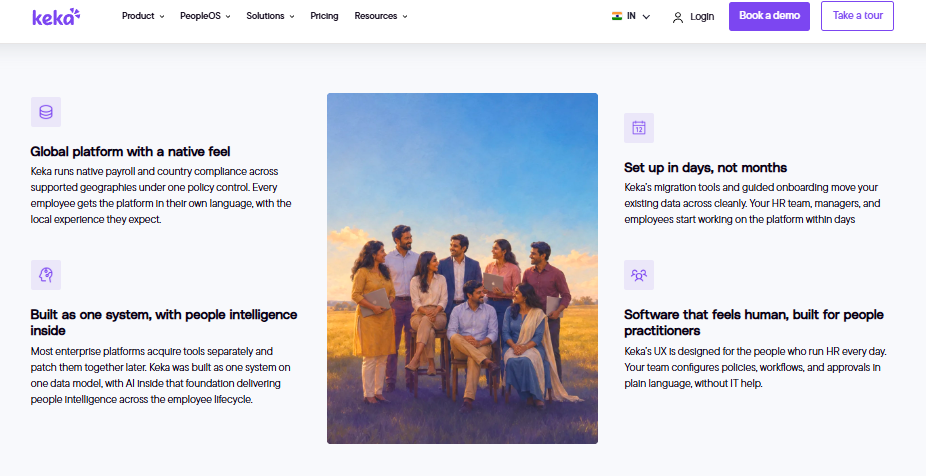
Keka (Clean-UX HRMS built for fast-growing tech and services firms)
🏢 Overview
Keka is an India-based HRMS founded in 2015, best known for a polished employee-facing interface. It is widely adopted by technology and services companies below the 1,000-employee mark. Reviewers consistently rate the UI highly and the support experience inconsistently. Teams arrive here wanting quick self-serve setup rather than deep multi-entity configuration. The enterprise-scale gaps are documented in our HROne vs Keka comparison.
⚙️ Core Services
- Core HR and employee records: centralises employee data with self-service access, cutting HR document requests.
- Payroll with PF, ESI, and TDS: automates statutory salary computation and payslips, reducing manual deduction errors.
- Attendance and leave: applies policy rules to punches and requests, removing spreadsheet leave registers.
- Performance (PMS): runs KRA and KPI cycles, though reviewers report the module needs simplification.
- Hiring (Keka Hire): tracks requisition approvals and offer workflows, reducing manual offer coordination.
- Documents and letters: generates HR letters in-system, cutting paper file handling.
🇮🇳 India-Specific Compliance and Localization
- PF / ESI / TDS support: Yes (automated statutory computation and payslips)
- Labour law compliance: Strong (for standard India payroll scenarios)
- Payroll localization: Yes (India-native payroll)
- Multi-state compliance handling: Partial (reviewers report limits on location-specific policy setup)
👥 Who This Is Built For
- HR manager at a single-entity tech firm who wants employees to self-serve without training.
- Payroll manager running a straightforward monthly cycle with limited arrears complexity.
❌ Who Should Skip This
- HR ops leads needing multi-legal-entity configuration and location-specific leave policies.
- Enterprises that need phone or SPOC support during a live payroll run. Teams hitting that wall often read our note on outgrowing Keka, Darwinbox, and greytHR.
💰 Pricing Structure
- Plan Type(s): Published employee-count-based tiers on the vendor site.
- Starting Price: Not publicly disclosed in our sources, request a quote. Current published bands are tracked in our Keka pricing breakdown.
- Tier-wise Breakdown: Not publicly disclosed in our sources, request a quote.
- Incremental Cost Drivers: Module upgrades and added employee bands.
- Implementation Fee: Not publicly disclosed, request a quote.
- Cost at 200 Employees: Not publicly disclosed, request a quote. Cost at 500 Employees: Not publicly disclosed, request a quote.
🛠️ Implementation and Support Reality
- Go-live can be weeks when scope is small, but reviewers report multi-month stalls at enterprise scope.
- Support is largely chat and email, with reviewers noting weekend gaps and no clear escalation path.
- Migration is largely self-serve with vendor assistance.
- No public NPS figure available.
💬 What Users Actually Say
“PMS module is confusing and needs to be simpler and easier to use. User access is difficult for employees who do not have an email ID.”
– Kiran B., 3/5 rating, Keka G2 – Verified Review
“We started working with Keka HRMS in August, and to this day, we have been unable to implement the tool in our company due to their consistently delayed responses and poor coordination.”
– Divya P., 0/5 rating, Keka G2 – Verified Review
1.8 greytHR
greytHR (Long-standing India payroll and compliance workhorse)
🏢 Overview
greytHR is one of India’s longest-running payroll and HR platforms, with a large SMB and mid-market install base. It publishes enterprise pricing openly, including a listed enterprise tier around ₹80,995 per month. Buyers pick it when statutory payroll accuracy matters more than talent or engagement depth. Teams arrive here to escape spreadsheet payroll and PT slab errors. A capability-by-capability read sits in our HROne vs greytHR comparison.
⚙️ Core Services
- Payroll engine: computes PF, ESI, professional tax, and TDS with challan outputs, cutting manual statutory workings.
- Employee self-service: gives payslip, tax declaration, and leave access, reducing routine HR queries.
- Leave and attendance: applies leave policies and balances, removing manual register upkeep.
- Statutory reports: generates filing-ready outputs, reducing month-end report assembly. The underlying obligations are set out in our PF, ESI, and TDS compliance guide.
- Employee onboarding: collects joining documentation digitally, cutting physical file collection.
- Mobile app: covers core self-service, though reviewers report it trails the web version.
🇮🇳 India-Specific Compliance and Localization
- PF / ESI / TDS support: Yes (long-established statutory payroll depth)
- Labour law compliance: Strong (core strength of the platform)
- Payroll localization: Yes (built India-first)
- Multi-state compliance handling: Yes (though reviewers report configuration rigidity)
👥 Who This Is Built For
- Payroll manager who needs dependable statutory computation and filing-ready reports.
- Finance-led HR function where published pricing simplifies budget approval.
❌ Who Should Skip This
- HR teams needing flexible workflow configuration across multiple legal entities or shift-based plants.
- Enterprises where TDS revision and deep reporting customisation are routine requirements.
💰 Pricing Structure
- Plan Type(s): Published tiers on the vendor site, including an enterprise tier.
- Starting Price: Enterprise tier listed around ₹80,995 per month.
- Tier-wise Breakdown: Published tiers scale by employee band and module set, with the enterprise tier covering the largest headcount. Tier detail is tracked in our greytHR pricing analysis.
- Incremental Cost Drivers: Added modules and employee band upgrades.
- Implementation Fee: Not publicly disclosed, request a quote.
- Cost at 200 Employees: Not publicly disclosed, request a quote. Cost at 500 Employees: Not publicly disclosed, request a quote.
🛠️ Implementation and Support Reality
- Go-live commonly runs weeks to one quarter depending on entity count.
- Support is email and chat led, with reviewers reporting an unclear escalation matrix.
- Migration is largely vendor-assisted with customer-side data preparation.
- No public NPS figure available.
💬 What Users Actually Say
“Reporting configuration, TDS filing, revising of TDS is not possible. UI for mapping of challans, visibility of income considered for TDS filing.”
– Krishnanand B., 3/5 rating, greytHR G2 – Verified Review
“There is a very high dependency on the greythr team to customize and the customization is full of gaps. There is no escalation matrix.”
– Verified User in Information Technology and Services, 1/5 rating, greytHR G2 – Verified Review
1.9 ZingHR
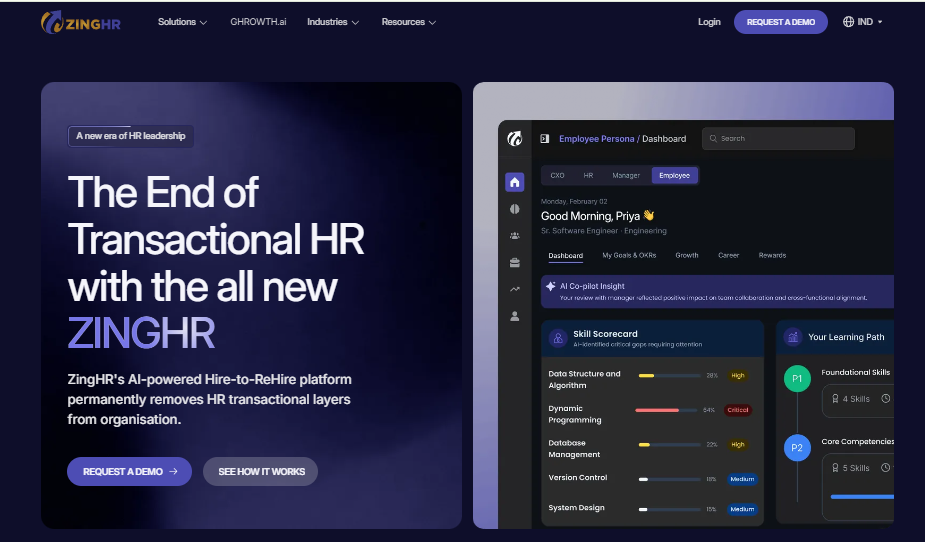
ZingHR (Vertical-templated HCM for manufacturing and BFSI workforces)
🏢 Overview
ZingHR is an India-headquartered HCM platform focused on large blue-collar and shift-based workforces, with published guidance for 1,000+ employee organisations. Its positioning leans on vertical templates for manufacturing, BFSI, pharma, and ITeS. Buyers shortlist it when contract labour and shift complexity dominate. Teams arrive here after generic HRMS tools fail on plant-floor reality. A direct read sits in our HROne vs ZingHR comparison.
⚙️ Core Services
- Core HR and workforce: maintains records across plants and entities, cutting site-level register duplication.
- Payroll: computes India statutory deductions across locations, reducing manual multi-site salary workings.
- Attendance and shift management: handles rosters and shift rules, removing manual shift allocation sheets. Field and plant scenarios are covered in our guide to HRMS for field and blue-collar employees.
- Recruitment: manages high-volume hiring flows for frontline roles.
- Performance and engagement: runs review cycles and communication modules on the core record.
- Compliance reporting: produces statutory outputs across multiple locations.
🇮🇳 India-Specific Compliance and Localization
- PF / ESI / TDS support: Yes (native India statutory payroll)
- Labour law compliance: Strong (built with manufacturing compliance in mind)
- Payroll localization: Yes (India-first design)
- Multi-state compliance handling: Yes (multi-location and multi-entity support)
👥 Who This Is Built For
- Plant HR lead managing shift rosters and contract labour across several sites. Sector-specific requirements are mapped in our manufacturing HR solution page.
- BFSI HR ops team handling high-volume frontline hiring and attrition.
❌ Who Should Skip This
- Teams that rate interface polish and self-serve customisation above vertical depth.
- Buyers who want a large independent review base before signing.
💰 Pricing Structure
- Plan Type(s): Enterprise plans by module scope and vertical template.
- Starting Price: Not publicly disclosed, request a quote.
- Tier-wise Breakdown: Not publicly disclosed, request a quote.
- Incremental Cost Drivers: Added modules, added sites, and custom integrations.
- Implementation Fee: Not publicly disclosed, request a quote.
- Cost at 200 Employees: Not publicly disclosed, request a quote. Cost at 500 Employees: Not publicly disclosed, request a quote.
🛠️ Implementation and Support Reality
- Rollouts commonly run one to two quarters across multiple sites.
- Support runs through an account manager, with reviewers reporting mixed technical responsiveness.
- Migration is vendor-led.
- No public NPS figure available.
💬 What Users Actually Say
“Outdated UI/UX. Customization is difficult and tech support is not great. It is difficult to get custom integration as per the need.”
– Parth B., 3.5/5 rating, ZingHR G2 – Verified Review
1.10 Ramco HCM
Ramco HCM (Multi-country payroll engine for Asia-Pacific groups)
🏢 Overview
Ramco HCM is the human capital platform from Ramco Systems, an India-listed enterprise software company. Its strongest documented claim is multi-country payroll coverage across a wide Asia-Pacific footprint. Groups shortlist it when one payroll engine must cover India plus several neighbouring markets. Teams arrive here after running separate payroll vendors per country.
⚙️ Core Services
- Global payroll: processes payroll across many jurisdictions in one engine, removing per-country vendor reconciliation.
- Core HR: holds the employee record across countries and entities.
- Time and attendance: captures shift and roster data for operational workforces.
- Talent management: runs performance and development cycles on the core record.
- Workforce planning: supports position-based headcount structures.
- Chatbot-led self-service: handles routine employee queries, reducing HR ticket volume. India-first buyers can compare this against our employee AI agent.
🇮🇳 India-Specific Compliance and Localization
- PF / ESI / TDS support: Yes (India statutory payroll included)
- Labour law compliance: Strong (India plus multi-country statutory engine)
- Payroll localization: Yes (India localisation within a multi-country engine)
- Multi-state compliance handling: Yes (supported across entities)
👥 Who This Is Built For
- Regional payroll head consolidating five or more Asia-Pacific payroll vendors into one.
- Group HR lead in aviation, logistics, or manufacturing with cross-border operations. Sector fit is detailed on our logistics HR page.
❌ Who Should Skip This
- India-only enterprises whose priority is engagement, performance, and employee experience depth.
- HR teams wanting front-end self-configuration of workflows and entities.
💰 Pricing Structure
- Plan Type(s): Enterprise licensing by module and country scope.
- Starting Price: Not publicly disclosed, request a quote.
- Tier-wise Breakdown: Not publicly disclosed, request a quote.
- Incremental Cost Drivers: Added countries, added modules, and integration scope.
- Implementation Fee: Not publicly disclosed, request a quote.
- Cost at 200 Employees: Not publicly disclosed, request a quote. Cost at 500 Employees: Not publicly disclosed, request a quote.
🛠️ Implementation and Support Reality
- Rollouts commonly run two to three quarters for multi-country scope.
- Support runs through account management and partners.
- Migration is vendor-led and partner-supported.
- No public NPS figure available.
🎯 Reading the Full Ten Together
Two patterns hold across all ten. The global suites give you talent depth and analytics but hand India payroll to a partner layer. The India-first platforms give you statutory depth, and the real difference between them is how much you can configure yourself.
HROne sits at position one on that second axis, because entity setup, policy routing, and access rights are configurable from the front end, and 2,074+ verified G2 reviews put it #3 for Highest Satisfaction globally. That is the whole list. Section two explains how the scores were calculated, criterion by criterion.
Q2. How Did We Score and Rank These 10 Platforms?
Each platform was scored out of 100 across five weighted criteria: Multi-Entity Architecture Depth (25%), India Statutory and Labour Code Coverage (25%), Implementation and Adoption Risk (20%), Verified User Reviews (15%), and Pricing and TCO Transparency (15%). Scores of 0 to 20 earn one star, 21 to 40 two, 41 to 60 three, 61 to 80 four, and 81 to 100 five. HROne scored five stars.
⚖️ Why the Weights Matter More Than the Ranking
Any list can put ten logos in an order. What decides whether that order is useful to you is what the scorer chose to weight heavily.
We weighted architecture and India compliance at 25% each, because those two are the hardest to fix after signing. A weak reporting module can wait. A payroll software engine that cannot isolate state rules per legal entity cannot.
📊 The Rubric, Criterion by Criterion
| Criterion | Weight | What It Actually Measures |
|---|---|---|
| Multi-Entity Architecture Depth | 25% | All legal entities on one instance, each with its own address, PIN code, GSTIN, and state rule set |
| India Statutory and Labour Code Coverage | 25% | Native PF, ESI, PT, LWF, TDS, Form 16, Form 24Q, plus Labour Code readiness |
| Implementation and Adoption Risk | 20% | Documented go-live timeline, configuration self-sufficiency, and support model under load |
| Verified User Reviews | 15% | Volume, recency, and documented complaints on G2, Gartner, and Capterra |
| Pricing and TCO Transparency | 15% | Published rates, per-entity charges, implementation fees, and when billing starts |
HROne measures the fourth criterion against its own public record too, with 2,074+ verified G2 reviews and a 4.8 out of 5 average, which is the largest verified review base of any Indian HRMS. The full breakdown sits in our HROne reviews summary.
⚠️ Why Adoption Risk Carries a Full 20%
This is the criterion most listicles skip entirely. It should not be skipped, because the evidence on adoption is genuinely grim.
Nearly one in four organisations report their HR technology implementations missed expectations, and the average HRIS is actively used by only about 32% of employees. So a platform can score perfectly on features and still fail in your building. One operator described the same failure in ERP terms.
“I’ve seen many businesses spend $300,000 on an ERP thinking that it’s going to do everything and then people not embracing that change and it never gets utilized.”
🧱 Scoring the Bread and Butter First
The order in which modules were scored also matters. We scored core HR, workforce, time office, and payroll first, then treated everything else as secondary.
The reason is structural. Those four modules are where organisational units, entity boundaries, and pay rules get defined, so nothing above them works if they are wrong. HROne ships 120+ automations across modules and add-ons on web and mobile, but only the foundation four counted toward the architecture score. The complete inventory is listed in our HROne features list.
❌ Where This Method Is Limited
I want to be straight about what this rubric cannot tell you. It cannot predict how your specific partner or delivery consultant will perform on your specific rollout.
Published pricing was also unavailable for six of the ten vendors, so the transparency criterion rewarded disclosure rather than value. My current thinking is that quote-gating at this headcount is itself a data point, though I might be reading it more harshly than a procurement head would. Our published pricing page is the reference point we held others against.
HROne scored five stars here on two verifiable strengths: front-end multi-legal-entity configuration that HR ops can run without a developer, and the deepest verified review base of any India-first HRMS on G2. The rubric was built before the scoring, not after it.
Q3. What Does Core HR Actually Have to Do Differently at 5,000+ Employees?
HRIS is the system of record for employee data and compliance. HRMS adds daily operations like payroll, leave, and attendance. HCM extends to recruitment, performance, engagement, and analytics. At 5,000+ employees, the distinction that matters is architectural: every legal entity must sit in one database with its own registered address, PIN code, GSTIN, and state rule set, plus conditional policy routing by grade and location.
📖 The Three Terms, Defined Plainly
HRIS (Human Resource Information System) stores data. It answers “who works here and what are their details”.
HRMS (Human Resource Management System) runs the monthly machine. Payroll, leave, attendance, and statutory outputs live here.
HCM (Human Capital Management) adds the lifecycle around that machine. Recruitment, performance, engagement, and analytics sit on top of the same record. The category boundaries are unpacked further in our guide to HCM software.
🔗 Why a Passive Registry Breaks at Scale
The label matters less than whether the system executes work or just stores it. A registry tells you a confirmation is due. A system of action routes it, escalates it, and closes it.
Research on HRIS use shows the split clearly: around 91% of organisations use their system for leave administration, but only 34% use it for workforce planning. That gap is what a passive registry produces at scale.
🧩 The Complication: Three Sources That Never Talk
Most 5,000-employee stacks did not start broken. They accumulated. Attendance came from biometric machines, payroll from an outsourced vendor, and recruitment from a separate ATS.
One HR leader described the result before consolidation: “They were having attendance from different sources. They were having payroll from different sources. They were having recruitment from different sources. And all these three softwares could not talk to each other.” Closing those handoffs is the core of HR process automation.
🔀 The Contrarian Bit: Uniformity Is the Real Failure
Here is the part the category avoids saying. Most enterprise HR systems do not fail because they treat people unfairly. They fail because they treat everyone identically.
Equality in a policy engine feels safe and audits well. At 5,000 employees it collapses, because a junior’s leave request and a senior leader’s request should not travel the same approval path. HROne routes this conditionally, sending a junior’s leave to manager then HOD while a senior’s is self-approved on the same policy. The mechanics are detailed on our leave management page.
🏢 What Multi-Entity Looks Like on Screen
This is where vendor demos get vague, so ask for the console. In HROne’s company setup, separate entities like HROne Technologies and HROne Industries Ltd each carry their own registered address, custom PIN code, and state GSTIN.
That is not cosmetic. Those three fields are what let one payroll engine apply the correct PF, ESI, professional tax, and LWF logic per entity automatically. This is the pattern we describe in HR software for multi-entity companies.
🔐 Access Rights Without a Developer Ticket
Security at this headcount is the second architectural test. Payroll and performance data must be visible to some roles and invisible to others, across dozens of units.
HROne handles this through a three-step wizard: define role, assign rights, review. Rights then filter across companies, business units, departments, levels, designations, and sub-branches, so nobody rebuilds permissions per site. We walk through the same flow in our note on HR software permissions.
✅ What to Do on Monday
Write down every legal entity you operate, and the state each one is registered in. That single list is your architecture requirement, and most RFPs never include it.
Then make every vendor switch live between two entities in the demo, and change one state rule while you watch. Ask HROne to add a new entity and its state rules on screen, without a support ticket, and compare what the others need. Bring our HRMS evaluation checklist into that session.
“Proper calculation of PF and ESI was a pain area for us before, but now with the HROne automated calculation process, results are up to the mark.”
– Ajay K., 5/5 rating, HROne G2 – Verified Review
HROne earns its architecture score here because the setup module sits on the front end, where HR ops works, rather than behind a developer queue. That is the difference between owning your policy engine and renting it.
Q4. Which Platforms Are Genuinely Ready for India’s Labour Codes and the DPDP Act?
All four Labour Codes were notified centrally on 21 November 2025, and by May 2026 twenty-seven of thirty-one states and UTs had notified rules under at least three of them. The Code on Wages requires basic wages to be at least 50% of total remuneration, which resets PF, gratuity, and overtime. Your platform must reclassify allowances per entity and log DPDP consent for biometric attendance.
📅 Where the Rollout Actually Stands
The legislative wait ended in November 2025. Central notification of all four Codes landed on 21 November 2025, and state rules have followed on a staggered calendar since.
By late May 2026, most states and UTs had notified rules under three or more Codes, with Tamil Nadu, West Bengal, Kerala, and Delhi still partial. So compliance is now state-by-state, not national. Tracking that calendar is exactly what labour law compliance software is for.
💰 The 50% Basic Wage Rule and What It Breaks
This is the change with real money attached. Under the Code on Wages, “wages” must make up at least 50% of total remuneration, and excess allowances get reclassified into that base.
That reclassification flows straight into PF contributions, gratuity accrual, and overtime rates. At 5,000 employees, a single percentage point of error becomes a large number quickly. Model the effect first with our gratuity calculator.
📋 The Statutory Output Checklist
A platform at this scale must produce these natively, not through exports and offline workings:
- PF and ESI challans per legal entity, with entity-wise reconciliation.
- State-wise professional tax slabs and Labour Welfare Fund deductions, as set out in our multi-state payroll compliance guide.
- TDS computation, Form 16 issuance, and Form 24Q quarterly returns.
- Gratuity and full-and-final settlement under the revised wage definition.
- Arrears and CTC-revision handling without manual CSV manipulation.
HROne generates PF, ESI, PT, and LWF outputs plus bank challan files from the entity master itself, so a state rule change updates one entity without touching the other seven.
🔒 DPDP: The Criterion Nobody Puts in the RFP
The Digital Personal Data Protection Rules were notified in November 2025, with obligations phased in. The Consent Manager framework becomes operational on 13 November 2026, and full compliance lands by mid-May 2027.
Employment processing counts as a legitimate use, so blanket consent is not needed for payroll. Biometric attendance is the exception worth checking, because where a reasonable alternative exists, consent and a notice trail matter. Review how your attendance management captures that trail.
📊 Readiness Matrix
| Platform | Labour Code Reclassification | State-Wise PT and LWF | DPDP Consent and Audit Trail |
|---|---|---|---|
| HROne | Native, per entity | Native | Entity-level access logs plus role-based rights |
| Darwinbox | Native | Native | Vendor-managed configuration |
| SAP SuccessFactors | Partner payroll layer | Partner-configured | Enterprise controls, partner-dependent |
| Workday | Partner payroll layer | Partner-configured | Enterprise controls, partner-dependent |
| PeopleStrong | Native | Native | Vendor-managed configuration |
| Oracle Fusion HCM | Partner or third-party payroll | Partner-configured | Enterprise controls, IT-dependent |
| Keka | Native | Partial, per reviewer reports | Standard platform controls |
| greytHR | Native | Native | Standard platform controls |
| ZingHR | Native | Native | Vendor-managed configuration |
| Ramco HCM | Native, multi-country | Native | Enterprise controls |
✅ Two Things to Do on Monday
First, pull your CTC structure and check whether allowances exceed 50% of total remuneration. Model the PF, gratuity, and overtime impact per state before your auditor does it for you. Our PF, ESI, and TDS compliance guide sets out the base rules.
Second, map where employee data flows, then add two lines to your RFP: consent capture for biometric attendance, and a documented non-biometric alternative. One HR leader summed up why this work is worth it: “by implementing a target tool for this organization I just peacefully sleep in the night that okay my data is correct.”
“Salary processing along with deduction slabs are working perfectly as per Indian tax compliances, previously there was a lot of mess in this section.”
– Sanjeev K., 5/5 rating, HROne G2 – Verified Review
HROne treats compliance as an entity-level property rather than a global setting, which is why a Maharashtra rule change does not require re-testing a Gujarat entity. That design choice is what keeps eight states of tribal knowledge out of one payroll manager’s head.
Q5. What Does It Really Cost, and How Do You Build the CFO Business Case?
Indian enterprise HRMS pricing runs roughly ₹30 to ₹300 per employee per month, so 5,000 employees lands between ₹18 lakh and ₹1.8 crore a year on licence alone. Add implementation, data migration, integration, and per-entity payroll configuration. Global suites route India payroll through a partner, which means a second vendor and a second invoice for every statutory change.
💰 What Moves a Quote From ₹30 to ₹300
The spread is not arbitrary. Four things push a PEPM (per employee per month) rate upward.
Module count is the biggest lever, followed by entity count, then integration scope, then support tier. greytHR publishes an enterprise tier around ₹80,995 per month, which is one of the few open reference points in this market. Wider band data sits in our breakdown of HR software pricing.
💸 The Four Line Items Most Quotes Omit
- Implementation and configuration, often billed separately and partner-invoiced at global suites.
- Data migration, priced by record volume and historical years requested. Our HRMS migration guide sets out what to scope before signing.
- Integration build, for biometric devices, ERP, and bank payment files.
- Per-entity payroll setup, which multiplies quietly if you run eight legal entities.
HROne meters subscription only after go-live, which removes the awkward case of paying licence fees during a six-month configuration phase. The commercial terms are published on our pricing page.
⚠️ Budget the Gap Instead of Pretending It Away
Gartner projects that by 2027, 75% of midsize and large enterprises will run a cloud HCM suite yet still need other tools for 20% to 30% of HR requirements. That number should change your budget line, not your vendor choice.
So put an integration and point-tool allowance in the plan from day one. Integration complexity already affects around 36% of enterprises, and data migration blocks roughly 28%. Our note on HRMS integrations covers the Tally, SAP, and biometric cases most often underestimated.
⏰ The Parachute Principle for Phasing
One operator described the sane way to buy at this scale. “You turn on the parachute that opens for you right now. You only pay for what you use, turn on only what you need when you need it.”
HROne structures pricing around a foundation set of Core HR, Workforce, Time Office, and Payroll, with performance, engagement, and helpdesk activated later. That sequencing matters because ROI at this headcount comes from payroll and time office, not from a standalone module.
📊 A Three-Year TCO Template
Build the case with five rows, not one. Fill each per year, then total.
| Cost Line | Year 1 | Year 2 | Year 3 |
|---|---|---|---|
| Licence (PEPM x headcount x 12) | – | – | – |
| Implementation and configuration | – | – | – |
| Data migration | – | – | – |
| Integration and middleware | – | – | – |
| Internal effort (project team hours) | – | – | – |
For the market context your CFO will ask for, cloud HCM platform spend is projected to grow from USD 11.82 billion in 2026 to USD 17.50 billion by 2031, with large enterprises holding roughly 68% of revenue. Run your own numbers through our ROI calculator before the budget meeting.
❌ Where I Am Uncertain
Six of the ten platforms on this list do not publish rates for the 5,000+ band. So any comparison table claiming precise per-employee costs across all ten is guessing.
My honest position is that quote-gating is itself a signal about negotiation posture. I might be reading that too strongly, though, since large deals genuinely need scoping before pricing.
HROne prices on flat PEPM with no lock-in, and billing starts after go-live rather than at purchase. For a CFO, that shifts the risk of a slow implementation from your budget to the vendor’s delivery timeline, which is the single most useful commercial term at this headcount.
Q6. How Do You Get 5,000 Employees Live Without Joining the 20-50% That Fail?
Enterprise HR rollouts fail at rates of 20% to 50%, and the average HRIS is actively used by only about 32% of employees. Timelines stretch because teams stall on cleaning years of dirty historical records. Configure current-month payroll accuracy first, get salaries paid on time, then backfill history in parallel, and write adoption rate into the contract as a measurable go-live criterion.
⚠️ Start With the Uncomfortable Numbers
Global research on HRIS and ERP implementations puts failure rates between 20% and 50%, with cultural fit outweighing strategic factors. Nearly one in four organisations report their HR tech missed adoption expectations.
I will say the thing vendors avoid. No platform, including any on this list, is the end-all system for HR, and one practitioner with decades in the field admitted the same after years of looking.
⏰ Rule One: Mortgages Before History
The most common reason a 5,000-employee rollout slips is historical data cleanup. Teams try to sanitise five years of inconsistent records before running a single payroll.
Flip the order. As one operator put it, “historical payroll data isn’t necessarily the key. The key for great implementation is people’s mortgages and rents getting paid on time.” Our guide to improving payroll accuracy explains how to prove month-one correctness first.
🧱 Rule Two: Foundation Modules First
Do not deploy performance, engagement, or helpdesk in phase one. Core HR, workforce, time office, and payroll define your organisational units and pay rules.
HROne configures those four first, then activates secondary modules once adoption is proven. Everything else sits on top of that base, so a wrong boundary there is expensive to unwind later. The phased sequence is documented in our HROne implementation guide.
✅ Rule Three: Kill the CSV Habit
Bulk employee ingestion through hand-edited spreadsheets is where salary errors are born. Each upload is a fresh chance to fat-finger a CTC component.
HROne binds offer-letter salary structures directly to the employee master, assigning CTC automatically once the employee joins. That single change removes an entire class of month-one payroll disputes. The same principle drives our approach to the onboarding process.
🔍 Payroll Accuracy Is an Engineering Question
Ask vendors how variance detection actually works. Patent US11494850B1 describes payee-specific pay distribution models that flag anomalies statistically, which is different from a static rule threshold.
Do the same for attendance. Patent US20250238875 covers geolocation-verified clock-in reconciled against scheduled positions, so pilot geo-fencing on a real field team before you sign. Field-workforce scenarios are covered in our guide to HRMS for field and blue-collar employees.
👥 Governance That Actually Holds
Two governance moves separate live systems from expensive ones. Name a change champion per legal entity, because cultural fit fails locally, not centrally.
Then specify three workforce-planning reports as day-one deliverables. Research shows 91% of organisations use HRIS for leave but only 34% for workforce planning, and that gap forms in month one. Our overview of HR analytics tools shows which reports to demand first.
⭐ What the Payoff Looked Like at Caliber
Caliber’s HR team was running at 150% occupancy, chasing people to confirm whether fields had been updated. Analytics they could not trust made the load worse.
After consolidating time office, payroll, and recruitment onto HROne, their leader reported the occupancy load down by 70%, freeing roughly 30% of team time for other work. That is the number I would hold vendors to, not a feature list. More outcomes of this kind sit in our customer success stories.
“The initial setup of HROne was surprisingly straightforward, much lighter than expected for a full HRMS.”
– Waldon S., 4/5 rating, HROne G2 – Verified Review
“We started working with Keka HRMS in August, and to this day, we have been unable to implement the tool in our company due to their consistently delayed responses.”
– Divya P., 0/5 rating, Keka G2 – Verified Review
HROne assigns a prior-HR onboarding SPOC rather than a technical project manager, with 9.8 NPS reported on that support model. Mid-market enterprises go live in as little as 30 days on the foundation modules.
Q7. What Do Verified Users at Scale Say, and Which Platform Should You Choose?
Verified reviews at enterprise scale cluster around three themes: support responsiveness during payroll runs, mobile adoption among blue-collar and field staff, and configurability limits discovered after signature. Choose by constraint, not brand. Multiple Indian legal entities with heavy blue-collar attendance point to HROne, which holds 4.8 out of 5 across 2,074+ verified G2 reviews, while existing global ERP estates point to SAP SuccessFactors or Oracle Fusion.
📋 How These Patterns Were Grouped
Reviews across all ten platforms were read for repeated complaints, not for star averages. A single angry review means little. The same complaint appearing across years means the issue is architectural.
Three clusters emerged, and each maps to a rubric criterion from section two.
⭐ What Reviewers Consistently Praise
Biometric sync, geo-fenced mobile attendance, and statutory payroll accuracy dominate the positive comments. Reviewers also name individual delivery consultants, which is rare and telling.
HROne reviewers repeatedly credit the configuration-phase consultant by role, including support received on holidays. My read is that named humans, not ticket IDs, are what people remember about a rollout. The wider pattern is collated in our HROne reviews summary.
❌ The Complaints Worth Taking Seriously
Support routed only through email threads is the most damaging pattern at this scale. One competitor analysis put the risk plainly, noting that email-only help “might cause delays and confusion, leaving you stuck”.
The mobile gap is the second. HROne reviewers report that detailed performance and audit features are thinner on mobile than on web, and geo-fencing radius accuracy has drawn criticism. Current capability is listed on our mobile HR app page.
“It can sometimes feel a bit overwhelming for new users. Certain features take time to understand, and the learning curve can feel quite steep.”
– Nijanthan R., 3/5 rating, HROne G2 – Verified Review
“There is a very high dependency on the greythr team to customize and the customization is full of gaps. There is no escalation matrix.”
– Verified User in Information Technology and Services, 1/5 rating, greytHR G2 – Verified Review
📈 What Changes After Go-Live
One enterprise ran traditional rewards programmes for years with engagement stuck around 25%. Nothing moved until real-time peer recognition was switched on.
Their HR leader described the shift bluntly: “that instant pat on the back is something that really goes a long way”. Engagement multiplied after that single module went live, which suggests mechanism beats budget. The mechanics sit on our employee engagement page.
🎯 The If-Then Decision Block
- Several Indian legal entities, multi-state payroll, and mixed blue-collar plus white-collar staff: HROne.
- Modern employee UI and board-level brand assurance in India and Southeast Asia: Darwinbox. A closer read sits in our HROne vs Darwinbox comparison.
- Existing SAP or Oracle estate with global talent standardisation as the goal: SAP SuccessFactors or Oracle Fusion HCM.
- India plus Asia headcount under one vendor with strong self-service: PeopleStrong.
- Payroll and compliance first, light talent needs, published pricing: greytHR.
- Plant-heavy shift and contract labour reality: ZingHR. Multi-country APAC payroll in one engine: Ramco HCM.
- Under 1,000 employees: none of these enterprise tiers make sense yet. Teams at that stage should start with our guide to the best HR software for the Indian mid-market.
⚠️ The Contested Ground
Custom-built widgets and bespoke dashboards work only if your analytics maturity is already high. One practitioner noted that many teams “are stuck in just gathering data and not doing a lot with it”.
Buying a standalone ATS or performance module first is the other trap. ROI at this headcount is tied to the time office and payroll base, so a bolt-on module without that foundation rarely pays back. The trade-off is unpacked in our comparison of payroll software versus a full HRMS.
HROne fits when the complexity is Indian and structural, several entities, several states, and an HR team that needs its hours back before it needs another dashboard. It serves 2,000+ enterprise brands and ranks #1 in India and APAC for customer satisfaction on G2.
💬 What I Am Still Sitting With
My open question for the next two years is whether entity-level configuration stays an HR skill or drifts back to IT as AI agents take over setup. I lean toward HR keeping it, though I hold that loosely. Our current thinking is set out in the future of HR technology in India.
If you are mapping this decision now, tell me your actual entity and state structure. That single list changes the shortlist more than any feature comparison will. You can contact us with it directly.












 Secures Top Spot in
