







Q1. What Does Zoho Recruit Actually Cost in 2026?
Zoho Recruit costs $0 on Free, $25 for Standard, $50 for Professional, and $75 for Enterprise per recruiter per month on annual billing. Monthly billing costs $30, $60, and $90. Indian partner listings run near ₹1,250, ₹2,500, and ₹3,750 per user per month annually, before 18% GST. Resellers quote differently, around ₹1,680 for Standard.
⚠️ The price nobody can read in one screen
Zoho’s own comparison page renders the tier amounts inside a JavaScript grid. The billing rows exist, but the numbers do not always load as text. So a buyer copies the feature list and leaves without the figure she came for.
That is the transparency gap in HR tech pricing. Big vendors “quote you out specifically based on your needs,” which sounds flexible and reads as evasive. My view is simple. If a price needs a sales call to become legible, that is a design decision, not a pricing strategy.
💰 The 2026 price table, both billing cycles
| Plan | Annual billing (per recruiter/month) | Monthly billing | India listing (annual) |
|---|---|---|---|
| Free | $0, one recruiter | $0 | ₹0 |
| Standard | $25 | $30 | about ₹1,250 |
| Professional | $50 | $60 | about ₹2,500 |
| Enterprise | $75 | $90 | about ₹3,750 |
Monthly billing costs roughly 20% more than annual on every paid tier. The Free plan carries one recruiter and one active job.
⏰ Licence maths that changes your invoice
Every active recruiter needs a paid licence. Portal licences and video-interview slots are counted separately, and several add-ons are sold in blocks rather than singly. So five recruiters plus two client-side reviewers is not a five-licence quote.
HROne publishes its per-employee pricing openly on its HR software pricing plans page, so an HR ops lead can build a first budget without booking a call. I use that as my own sanity check when a vendor quote arrives without a unit rate.
✅ Do this before you ask for a quote
- Count active recruiters, then count anyone outside HR who needs portal access.
- Ask for the annual and monthly figure in the same email.
- Ask for the rupee figure, GST treatment shown separately, and the reseller name.
- Compare that rupee figure against the published Indian listing rate.
Indian channel pricing is not uniform. One partner listing shows ₹1,250 for Standard, while a reseller page quotes roughly ₹1,680 for Standard and ₹2,800 for Enterprise per recruiter per month. Same product, two prices, depending on who invoices you.
I might be reading the channel spread too strongly, since reseller pages update slowly. Still, the gap is wide enough to justify two quotes instead of one. Getting a second quote takes fifteen minutes and has saved buyers I know a lakh or more over three years, which is the kind of gap our HR software pricing guide breaks down in per-employee terms.
HROne prices flat per employee per month with no lock-in, which means a mid-market HR team can model cost without decoding editions first. That is the standard I would hold any ATS quote to.
Q2. What Actually Changes Between Standard, Professional and Enterprise?
Standard covers resume parsing, a career site, job board posting, and a capped set of active jobs. Professional doubles the price for Zia AI candidate matching, assessments, and assignment rules. Enterprise adds client and vendor portals, Blueprint automation, custom roles, and field-level security. In practice, active-job and parsing caps force the upgrade, not the feature list.
📊 Three gates decide your bill
The official grid runs to ninety-plus rows. Three of them actually move buyers up a tier.
| Gate | Standard | Professional | Enterprise |
|---|---|---|---|
| Active jobs (Staffing edition) | 100 | 250 | 750 |
| Resume parsing | 250 per day | 500 per day | unlimited |
| AI and portals | none | Zia matching, assessments | full suite plus client portals |
Those caps come from published tier breakdowns of the staffing edition. Record limits and workflow rules also scale, from 5 custom rules per module on Standard to 25 on higher tiers.
🤖 What AI matching actually does
Relevancy scoring is not a smarter search box. The system stacks the most relevant CV on top and shows a visible score, so you read 97%, 94%, 88% instead of guessing. A recruiter screening 300 applications gets a queue instead of a folder.
That capability is a compute layer you rent, not a badge. Semantic matching using transformer models is now the documented baseline in ATS research, and the technique sits inside granted machine-learning patents for resume-to-requirement matching. This is why it lands on Professional rather than Standard, a split we also mapped in our review of AI recruiting software.
💬 What buyers say about the locked features
“The breadth of applications and the price of it.” … “Features are shallow and there is no depth in each application”
– Verified User in Information Technology and Services, 2.5/5, Zoho People G2 – Verified Review
“Users face access limitations with Zoho Recruit, particularly with complicated workflows and hidden advanced features.”
– G2 reviewer sentiment summary, Zoho Recruit G2 – Verified Reviews
“the pricing model based on user count may become burdensome as your team expands”
– u/Hirevire, r/Hirevire Reddit Thread
HROne ships 127 pre-built hire-to-retire workflows, so approval routing and onboarding rules are not sold as a premium unlock. Our HR team uses the same library we sell inside our recruitment software module.
✅ Circle the gate that breaks first
Look at your hiring plan for the next four quarters. Count peak concurrent open roles, then daily CV volume in your busiest month. Whichever number crosses a cap first is your real upgrade trigger.
Everything else on the grid is noise until that number moves. I have watched teams buy Enterprise for portals they never switched on, while sitting at 40 open roles. Buy for the cap, then test the AI in trial before paying for it.
HROne’s One AI Suite scores resume relevancy inside the same instance that runs onboarding and payroll, which removes the second licence most ATS buyers discover later.
Q3. Why Is There No Professional Plan for Corporate HR Teams?
Zoho Recruit sells two editions. The Staffing Agency edition offers Standard, Professional, and Enterprise. The Corporate HR edition offers only Standard and Enterprise. So an in-house HR team comparing all three tiers is reading a menu it cannot order from, and identical prices buy very different active-job limits.
❌ The comparison most articles get wrong
Search “Standard vs Professional vs Enterprise” and you get one table. There are actually two, and your edition decides which applies.
| Edition | Standard | Professional | Enterprise |
|---|---|---|---|
| Corporate HR | $25 (10 active jobs) | not offered | $50 (20 active jobs) |
| Staffing Agency | $25 (100 jobs) | $50 (250 jobs) | $75 (750 jobs) |
Read the job caps twice. A corporate HR team pays $25 for 10 active jobs, while an agency pays $25 for 100. Same sticker, ten times the capacity.
⚠️ Why uniform tiering costs you money
Most HR systems do not fail because they are unfair. They fail because they are too uniform. Equality in packaging feels safe, and it quietly forces one buyer to overbuy while another gets more than she needs.
Here is my read, and I hold it loosely. Corporate HR teams hitting the 10-job ceiling get pushed to Enterprise for capacity, not for portals or Blueprint. That is a capacity upgrade wearing a feature-tier badge, and it is the same trap we flagged for HR software for multi-entity companies in India.
✅ One line to add to your email
Ask this before comparing anything: “Which edition is this quote for, and what is the active-job cap on it?” Get the answer in writing. Every other number in the negotiation shifts once that is fixed.
HROne configures one instance around the company you actually are, so buyers choose modules instead of guessing which edition hides the feature they need. Asia Healthcare Holdings runs 20 pan-India units on a single HROne instance with multi-legal-entity configuration.
Q4. What Will You Really Pay Over Three Years After Add-Ons and Tax?
Sticker price is not your invoice. HROne meters subscription only after go-live, while the industry norm bills from purchase date. Zoho Recruit’s Client Portal adds about $6 per extra portal licence monthly, and video interviews are sold per job slot. Add 18% GST, check IGST reverse charge, and classify TDS under Section 194J or 195 before signing.
💸 The add-ons that move the total
Zoho publishes add-on pricing separately from tier pricing. The common ones for Indian teams:
- Additional active job openings, sold per block of 10 jobs.
- Video interview capacity, priced per job slot.
- Additional portal licences beyond the free allotment, about $6 each per month.
- Extra storage per 5GB per organisation, and extra API credits.
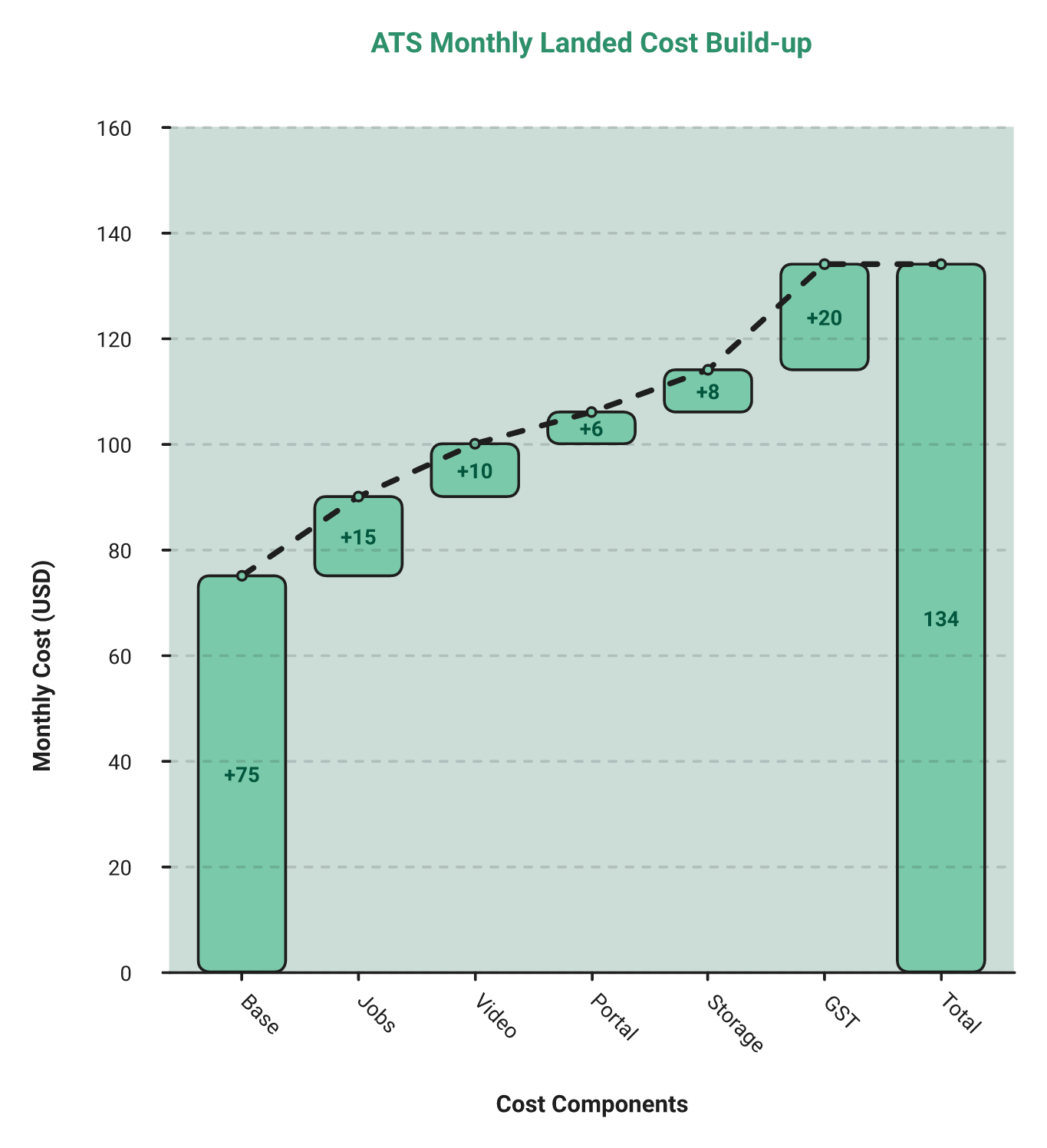
You get a limited number of free portal licences before that meter starts. One published model puts a three-person Standard team at $75 base, rising to $109 to $120 once portal, video, and storage are added. That is a 45% to 60% jump on a small team.
🧾 The tax stack Indian buyers forget
SaaS subscriptions attract 18% GST, which is creditable if you are registered. Where the service is imported, IGST can apply under reverse charge, so your finance team pays and claims it. Licence payments that qualify as royalty can attract TDS under Section 194J for residents, or Section 195 for non-residents, and our TDS calculator helps finance model the withholding before the PO.
None of this changes the vendor’s price. It changes your landed cost and who owns the compliance step. Ask finance to classify the payment before the PO, not at audit.
📉 Three-year cost, before add-ons
Assumptions stated plainly: annual billing rates, 18% GST added, add-ons and implementation excluded.
| Recruiters | Standard | Professional | Enterprise |
|---|---|---|---|
| 5 | $5,310 | $10,620 | $15,930 |
| 20 | $21,240 | $42,480 | $63,720 |
| 50 | $53,100 | $106,200 | $159,300 |
At 20 recruiters, moving from Standard to Enterprise costs about $42,000 over three years, roughly ₹35 lakh at current rates. That is a headcount decision, not a software decision.
💬 What buyers say about pricing clarity
“when we were ready to purchase, we found the pricing confusing and struggled to find the right fit for our business size”
– Dhana C., HR professional, 4/5, Zoho People G2 – Verified Review
“Impossible to edit old entries (if you forgot to add something). Impossible to fix errors (like missing dates).”
– John B., 3/5, Zoho People G2 – Verified Review
✅ The row to defend in the budget meeting
Do not defend the licence line. Defend the total: licences, add-ons, GST, and the implementation months you are billed for while nothing is live yet. Multi-year lock-ins with billing from day one are the industry default worth refusing.
A manager I worked with stopped arguing the moment she put annual attrition cost beside annual system cost. The expenditure looked small against the turnover it addressed. Build that comparison before the meeting, not during it, using an ROI calculator rather than a feature grid.
HROne starts the subscription clock after go-live and publishes an ROI dashboard that calculates lifetime hours saved against average HR salary, so the savings figure reaches the board in rupee terms, which is the same maths we walk through in our guide to the ROI of HR software in India.
Q5. Can You Validate Zoho Recruit Without Paying?
The free plan is a demo, not a hiring desk. Reviewers report it withholds resume parsing, career-site building, and field-level security, and caps you near one active job. Use the 15-day trial and the 45-day money-back window on a paid tier instead. Run two real requisitions end to end before you commit to annual billing.
💸 Why free tiers look tempting
I have worked with frugal teams who built a full hiring process on Excel and Word. It worked, because how you treat people matters more than the tool. The workaround still gets billed, just in hours instead of rupees.
So the free plan feels like the safe first step. It is not free. It is deferred payment in recruiter time, which is the trade-off we broke down in our comparison of HR software versus Excel in India.
❌ What breaks on the first requisition
Zoho’s free edition covers one recruiter and one active job. That is enough to post a role and lose the pipeline behind it.
Three things fail fast in a real test:
- Resume parsing is limited, so CV data gets typed in by hand.
- Career-site building sits on paid tiers, so applications arrive by email.
- Field-level security is absent, so you cannot restrict salary or reference fields.
HROne runs a scoped pilot on live requisitions instead of a stripped tier, so HR evaluates using its own open roles. We would rather lose a deal in a pilot than in month four, which is why our implementation guide starts with real requisitions.
⏰ The two-week validation protocol
Skip the free tier if you have more than one open role. Start the 15-day trial on the tier you actually plan to buy, and keep the 45-day money-back window in reserve.
Then test in this order:
- Post two live roles, including one you expect 200-plus applications for.
- Parse 50 real CVs and check field accuracy against the source resume.
- Route one offer approval through your actual manager, not a test user.
- Export everything on day 13 to confirm you can leave with your data.
💬 What buyers report about locked features
“Users face access limitations with Zoho Recruit, particularly with complicated workflows and hidden advanced features.”
– G2 reviewer sentiment summary, Zoho Recruit G2 – Verified Reviews
“the pricing model based on user count may become burdensome as your team expands”
– u/Hirevire, r/Hirevire Reddit Thread
“The breadth of applications and the price of it.” … “Features are shallow and there is no depth in each application”
– Verified User in Information Technology and Services, 2.5/5, Zoho People G2 – Verified Review
✅ Three signals that justify paying
Do not judge the trial on how the software feels. Judge it on whether three numbers moved.
- Time from application to shortlist dropped by at least a third.
- CV data entry hours per week fell to near zero.
- One manager closed an approval without a reminder from HR.
If none of the three moved in two weeks, the tier is not your problem. Your process is. I have been wrong about this before, and the fix was usually a workflow rewrite, not a licence upgrade.
HROne asks buyers to pilot on their own live requisitions and meters the subscription only after go-live, so the evaluation period is not billed as production usage.
Q6. Which Tier Do You Need, Headcount or Sophistication?
Tier choice tracks sophistication, not headcount. A ten-person company already living in dashboards may need Professional. A 500-person firm running a simple database may sit fine on Standard. Score four things: monthly requisition volume, whether anyone will configure AI matching, whether external clients or vendors need portal access, and who owns hiring reporting.
⚠️ The sizing advice that misleads buyers
Most vendors size you by employee count. That rule breaks in Indian mid-market reality constantly.
I have seen ten-employee firms speaking fluent analytics, and 500-employee firms happily running a flat database. Same market, opposite needs. Research on HRIS adoption in smaller firms points the same way, with perceived benefit and internal expertise driving adoption rather than company size, a pattern we track in our HRMS evaluation checklist for India.
📋 The four-question rubric
Score each question honestly, then read the outcome.
| Question | If the answer is low | If the answer is high |
|---|---|---|
| Concurrent open roles per month | Standard | Professional or above |
| Will someone configure AI matching in 90 days | Standard | Professional |
| Do clients or vendors need portal logins | Standard | Enterprise |
| Does anyone own hiring reporting weekly | Standard | Enterprise |
Two or more high answers means you have outgrown Standard. Zero or one means the upgrade is a want, not a need.
🐖 Do not buy the whole hog
You do not want the whole hog if you are not going to eat it. That line stuck with me because it names the real waste in HR tech buying.
Buy the tier you can configure this quarter. HROne activates modules as sophistication grows, so the first invoice matches what the HR team can actually operate now. We have watched teams switch on performance management six months after payroll and land both properly.
💬 What buyers say about paying for unused depth
“Implementing and maintaining comprehensive HR software can be costly, especially for small and medium-sized businesses with limited budgets.”
– Shefali J., 4/5, Darwinbox G2 – Verified Review
“it’s cumbersome that every feature is on display when not all are necessary. Having an option to disable or hide unnecessary features would streamline the user experience considerably.”
– Anshul M., 4/5, Zoho People G2 – Verified Review
“This is a nice tool for the pricing that they offer just the UI is not pleasing.”
– Naveen k., 2.5/5, greytHR G2 – Verified Review
✅ The 90-day configuration test
Write down every feature driving your upgrade. Next to each one, name the person who will configure it and the week they will do it.
Anything without a name and a date gets cut from the quote. This single exercise has moved buyers down a tier more often than any price negotiation I have run.
Then revisit in 90 days. Upgrading later costs you nothing on annual billing, since most vendors prorate mid-term upgrades. Overbuying today costs you for three years.
HROne prices flat per employee per month with no lock-in, so a mid-market team can start on the modules it runs today and add scope when the workload actually arrives.
Q7. Does a Cheaper Tier Just Move the Cost to Your Team?
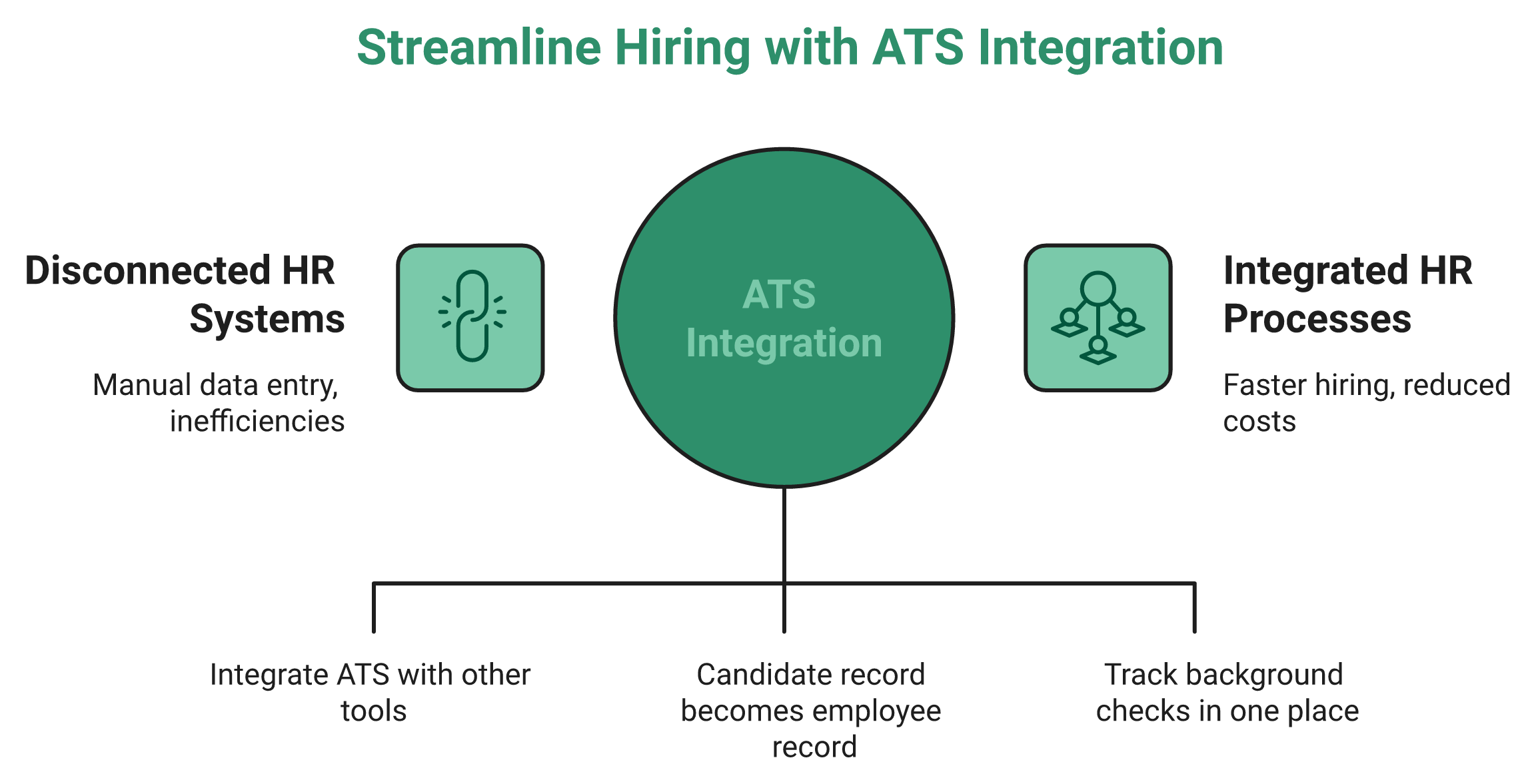
Usually, yes. HROne runs recruitment, onboarding, and payroll in one instance, so a selected candidate becomes a paid employee without a spreadsheet handoff. An ATS licence alone covers hiring, not payroll, attendance, or statutory filings. Price the hours: two people spending six hours weekly on reconciliation can cost more per quarter than the Standard to Enterprise gap.
❌ Three systems that will not talk
A recruitment head once described her stack to me plainly. Three softwares that could not talk to each other, so there was a lot of manual run-around.
That run-around has a shape. Offer letter in the ATS, background check in a vendor portal, joiner data typed again into payroll software.
💸 Where the hours actually go
Every handoff between tools is where errors and grievances multiply. The usual leak points in Indian mid-market hiring:
- Candidate to employee record, re-keyed by hand at joining.
- CTC structure rebuilt in payroll because the ATS holds only a total figure.
- Background check status tracked in a separate sheet nobody owns.
- Document collection chased over email and WhatsApp.
Six hours a week across two people is roughly 300 hours a year. At mid-market HR salaries, that lands near the cost of a full extra tier, which is the leak our guide to HR process automation in India quantifies.
⭐ What integration actually buys
The counter-example is dull and powerful. One practitioner described a new client email arriving, and four minutes later the folder existed, the contract was drafted, and the invoice was generated, with nobody touching it.
Published evidence points the same direction. One documented deployment cut the hiring cycle from 90 days to 34 days, with cost per hire down 26%. In a separate survey, 93% of ATS users reported reduced dependence on external recruitment agencies.
MR DIY India collapsed payroll cycles from 10 days to 5 or 6 days after moving to HROne. I found that number more persuasive than any feature demo, because payroll cycle time is hard to fake, and the full MR DIY case study lays out the before and after.
💬 What buyers say about connected versus scattered
“The most important feature for me is its integration with other Zoho apps, such as Zoho Recruit and Zoho Payroll, which streamlines both the recruitment and monthly payroll processes.” … “The biggest drawback for me has been the lack of customer support.”
– Dhana C., HR professional, 4/5, Zoho People G2 – Verified Review
“Earlier, we used a mix of Excel sheets and legacy tools; now everything is centralized. It’s reduced manual intervention, improved data accuracy.”
– Mohit V., 4/5, Darwinbox G2 – Verified Review
“strong payroll and compliance automate salary and attendance processing with pf/esi tds.” … “PMS module is confusing and needs to be simpler and easier to use.”
– Kiran B., 3/5, Keka G2 – Verified Review
✅ Your one-page integration debt sum
Build this before the budget meeting. It takes twenty minutes.
- List every manual handoff between hiring and first salary.
- Estimate weekly hours per handoff, then multiply by 52.
- Multiply by loaded hourly cost of the people doing it.
- Compare that annual figure against the tier gap you are debating.
Most buyers shop for a bouquet of features. What they need is a garden, where modules feed each other. HROne’s ROI dashboard calculates lifetime hours saved against average HR salary, which is the same sum, run continuously.
Q8. Does Your Tier Keep You DPDP-Compliant on Candidate Data?
Candidates are not employees, so the DPDP Act’s legitimate-use employment ground does not cleanly cover them. You need clear notice and consent at application, a defined retention window, deletion after rejection, and separate consent to hold CVs in a talent pool. Field-level security and audit controls sit on paid tiers, so free or entry plans raise exposure.
⚠️ Your ATS is an unaudited data lake
Most ATS instances I have seen hold years of CVs nobody reviewed. Salary expectations, addresses, ID numbers, and reference notes, all sitting there.
The Digital Personal Data Protection Act, 2023 (India’s data privacy law) treats each of those as personal data. A candidate who never joined is still a person whose data you hold.
📜 What the law actually asks of recruiters
Section 7(i) of the Act covers employment-related processing, and legal analysis notes it does not neatly extend to job applicants. So candidate data usually needs the consent route, not the legitimate-use route.
Four duties follow, in plain terms:
- Give clear notice at the point of application, stating purpose.
- Take consent that is specific, informed, and easy to withdraw.
- Keep CVs only for the recruitment cycle plus a defined hold period.
- Delete after rejection notification, unless separate consent exists.
Pre-ticked consent boxes do not count as valid consent. If your career page has one, that is a Monday fix, and our statutory compliance software guide explains how the control gets enforced in the workflow.
🔐 Which tier gives provable controls
Compliance is not a document. It is a control you can demonstrate on demand.
| Control | Free plan | Paid tiers |
|---|---|---|
| Field-level security on sensitive data | not available | available on higher tiers |
| Custom roles and profiles | not available | Enterprise |
| Audit trail and access logs | limited | available on higher tiers |
So the cheapest plan is also the hardest one to defend in an audit. That is an uncomfortable pricing consequence nobody puts on a comparison page.
✅ The Monday routine
Compliance works when it lives inside the workflow, not in a policy PDF. Three changes, each under an hour:
- Rewrite the career-page consent line, unticked by default, naming the purpose and the retention period.
- Set a retention clock, for example 180 days after the role closes.
- Attach a deletion step to your rejection workflow, so it fires automatically.
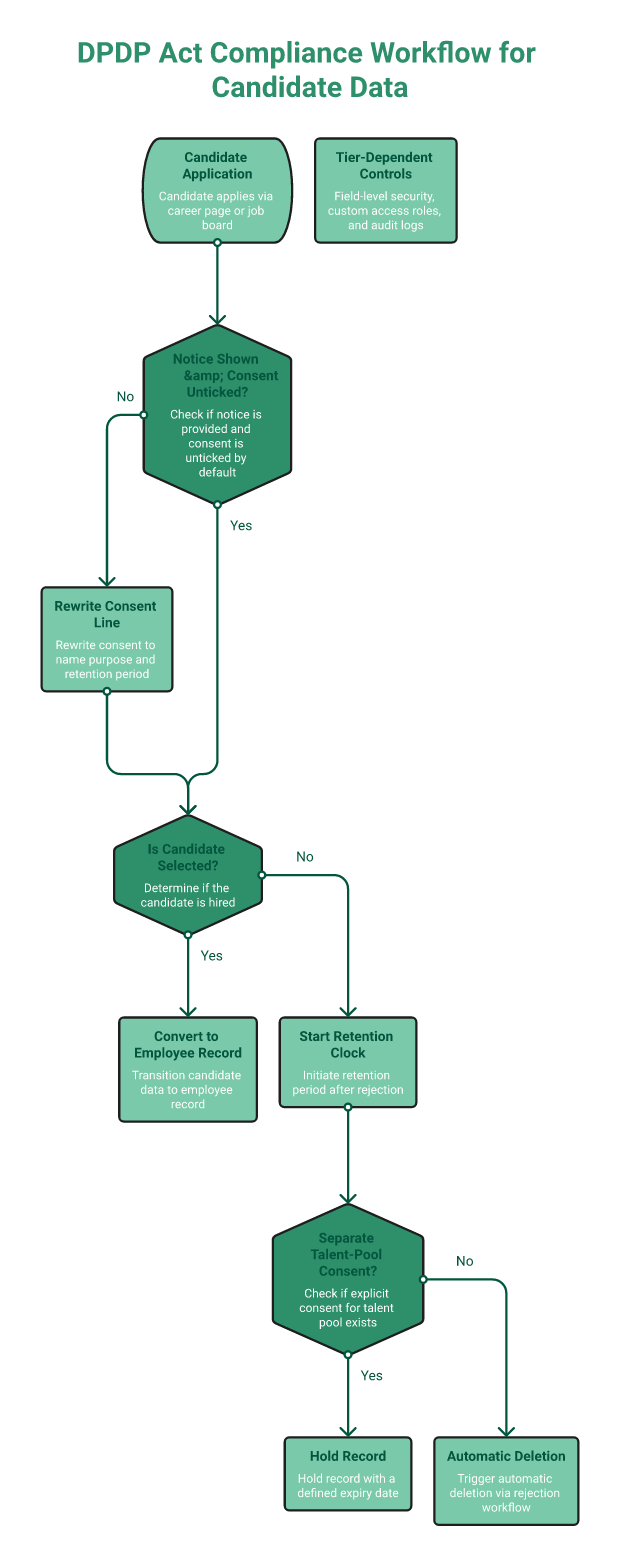
Scattered candidate data is the real risk. When CVs live in an ATS, a mailbox, and two spreadsheets, a deletion request becomes a manual hunt.
HROne keeps candidate and employee records in one governed instance, so an access or deletion request is executed once instead of chased across three tools. Our read is that most DPDP failures in hiring are architecture problems wearing a legal label, which is why we treat core HCM as the compliance layer rather than an add-on.
Q9. Which Alternatives Cost Less Than Zoho Recruit Enterprise in India?
If you need hiring plus payroll and compliance, an Indian HCM suite usually costs less than Zoho Recruit Enterprise stacked with a separate payroll tool. HROne publishes flat pricing from ₹85 per user per month and bills only after go-live. Keka, greytHR, Zimyo, and Darwinbox follow on different price-to-scope curves. Zoho Recruit stays strongest as a pure staffing-agency ATS.
📐 The five criteria that decide this
Feature grids do not settle Indian buying decisions. Five things do.
- India statutory coverage, meaning PF, ESIC, professional tax, TDS, and Form 16.
- Native link from hiring to payroll, without a manual export.
- Published per-user price you can verify without a call.
- Implementation model, and who owns it on the vendor side.
- Support SLA, meaning a named person versus a shared inbox.
💰 What the options actually cost
| Platform | Published India price | Scope | Not recommended for |
|---|---|---|---|
| HROne | ₹85 per user monthly Basic, ₹115 Professional, billed after go-live | Full hire to retire, single instance | Teams under 25 who need only a free tool |
| Keka | About ₹6,999 monthly base plus ₹90 to ₹180 per employee | Payroll, attendance, PMS | Buyers needing fast, hands-on migration support |
| greytHR | Free up to 25 employees, then tiered | Payroll and core HR | Multi-entity or shift-heavy manufacturing |
| Zimyo | From about ₹50 per employee monthly | Core HR, payroll | Deep multi-entity workflow needs |
| Darwinbox | Custom quote only | Enterprise HCM | Buyers who need price transparency upfront |
| Zoho Recruit | ₹1,250 to ₹3,750 per recruiter monthly | ATS only | In-house teams needing payroll in the same system |
HROne ranks #3 in Highest Satisfaction Products across 1,17,579 software worldwide, with a 9.8 NPS on its prior-HR implementation SPOC. I lead with that because support quality is the variable buyers underweight most, and the full HROne reviews round-up shows where that support lands.
✅ When Zoho Recruit still wins
Two cases, honestly. Staffing agencies get real value from the Professional tier, since client portals, vendor management, and 250 active jobs match agency work.
Companies already running Zoho One get the second case. Recruit talks natively to Zoho People and Zoho Payroll, which removes the handoff problem inside that stack, though buyers weighing that suite often review the Zoho People alternatives in India before committing.
⚠️ When a full HCM wins
Case one: you run 100 to 5,000 employees across multiple legal entities. An ATS licence will not handle FBP declarations, wage-code full-and-final rules, or ESIC filings, which is the gap our PF, ESI, and TDS compliance guide walks through.
Case two: your CHRO must report cycle times to the board. Reporting across two vendors becomes a monthly reconciliation job, so CHRO solutions need one source of truth rather than two dashboards.
💬 What buyers report about these platforms
“We started working with Keka HRMS in August, and to this day, we have been unable to implement the tool in our company due to their consistently delayed responses and poor coordination between their internal teams.”
– Divya p., 0/5, Keka G2 – Verified Review
“Implementing and maintaining comprehensive HR software can be costly, especially for small and medium-sized businesses with limited budgets.”
– Shefali J., 4/5, Darwinbox G2 – Verified Review
“Better UI, simplicity and time for support.” … “Reporting configuration, TDS filing, revising of TDS is not possible.”
– Krishnanand B., 3/5, greytHR G2 – Verified Review
⭐ Shortlist two, not five
Endless email threads leave buyers confused, with issues unresolved. So ask each finalist for the name and background of the person who will run your implementation.
Then cut to two. HROne’s read is that the standard advice, which says compare five vendors, actually delays decisions by a quarter without improving them, and our best HR software for the Indian mid-market breakdown exists to shorten exactly that step.
Q10. How Do You Buy the Right Tier Without Overpaying?
Get six things in writing before signing: the edition name, the active-job cap, the exact add-on licence count, whether billing starts at purchase or at go-live, the named support contact, and your data-export rights on exit. HROne meters subscription only after go-live, with no lock-in. Then buy annual only after a paid pilot on live requisitions.
📧 The six questions to send procurement
Copy these into one email. Each has an answer that should slow you down.
- Which edition is this quote for, Corporate HR or Staffing Agency?
- What is the active-job cap, and the resume parsing limit per day?
- How many portal and video-interview licences are included, and what do extras cost?
- Does billing start on purchase date or on go-live date?
- Who is my named support contact, and what is their response SLA?
- What is my data-export format and window if I leave?
Vague answers on questions two and four cost the most money later. Add-ons are sold in blocks, so licence counts must be exact, a point we also make in our HR software buyer checklist for mid-sized firms.
⏰ What to measure during the pilot
Navigation is a design failure. If an HR executive has to search for where a task lives, the interface has already failed her.
So time three routine tasks, in clicks and seconds:
- Move a candidate from shortlist to interview scheduled.
- Approve an offer as a hiring manager, on mobile.
- Pull a report of open roles by ageing, without help.
HROne built its HR inbox so pending tasks, requests, and approvals close within three clicks. We use the same click count as an internal design constraint, not a marketing line.
💬 What buyers wish they had asked earlier
“when we were ready to purchase, we found the pricing confusing and struggled to find the right fit for our business size”
– Dhana C., HR professional, 4/5, Zoho People G2 – Verified Review
“Impossible to edit old entries (if you forgot to add something). Impossible to fix errors (like missing dates).”
– John B., 3/5, Zoho People G2 – Verified Review
“It is standard HRMS portal. Sometimes, they can or cannot change details as per client requirement.”
– Verified User in Research, 3/5, Keka G2 – Verified Review
💸 Where the negotiation actually sits
Vendors rarely move much on per-seat rate. They do move on billing start date, implementation fees, and lock-in length.
So trade there. Ask for billing from go-live, a one-year term, and a written cap on add-on rates for renewal, and check the timeline claims against a realistic HRMS implementation timeline for India.
HROne prices flat per employee per month, with no lock-in and no setup fee, which removes three of those negotiation points entirely.
⭐ What I am still sitting with
My current thinking is that seat-based ATS pricing will strain over the next two years. AI screening reduces recruiter headcount per requisition, so paying per recruiter starts rewarding inefficiency.
If your team screens 500 CVs a month with three recruiters, a per-seat model quietly punishes automation. I might be reading that too strongly, since vendors could shift to usage tiers instead, a shift we track in our view on the future of HR technology in India.
So here is the question I would love your answer to. If your ATS charged per hire rather than per recruiter, would you still pick the same tier? Tell me what your maths says, because I am collecting real numbers on this.



















 Secures Top Spot in
