








Q1. Is Rippling actually worth it in 2026?
Rippling holds 4.8/5 on G2 from roughly 11,900 reviews, 4.9/5 on Capterra, and 8.9/10 on TrustRadius, and it genuinely excels at unifying HR, payroll, IT, and spend in one instance. It is worth it if you are US-centric, have 30 or more employees, and own a dedicated ops person. It is the wrong buy if your payroll is India-heavy or your finance team needs predictable per-head costs.
⭐ What the aggregate scores actually tell you
A payroll manager in Pune messaged me last month with a shortlist of four platforms and one question: “which of these will not break my 25th-of-the-month cycle?” Rippling was on that list because of its ratings. Ratings answer a different question than the one she asked.
The scores are real, and they are strong. Roughly 91% of reviewers give five stars, and about 62% of them sit in the mid-market band.
| Platform | Score | Volume | What it signals |
|---|---|---|---|
| G2 | 4.8/5 | ~11,900 reviews | Broad satisfaction, mid-market weighted |
| Capterra | 4.9/5 | Large sample | Ease of daily use |
| TrustRadius | 8.9/10 | Smaller sample | Enterprise buyer sentiment |
💰 The whole hog test beats the feature checklist
Here is the framing I keep coming back to with buyers. You do not want to buy the whole hog if you are not going to eat the whole hog. Rippling sells a very large hog.
Device management, corporate cards, global EOR, and app provisioning are all genuinely good. The question is how much of that a 400-person BFSI firm in Mumbai will consume in year one.
✅ Two questions that settle it faster than a demo
Ask these before you book anything. First, who inside your team owns implementation and configuration after go-live? Second, what share of your headcount sits inside India, filing PF, ESIC, and state Professional Tax?
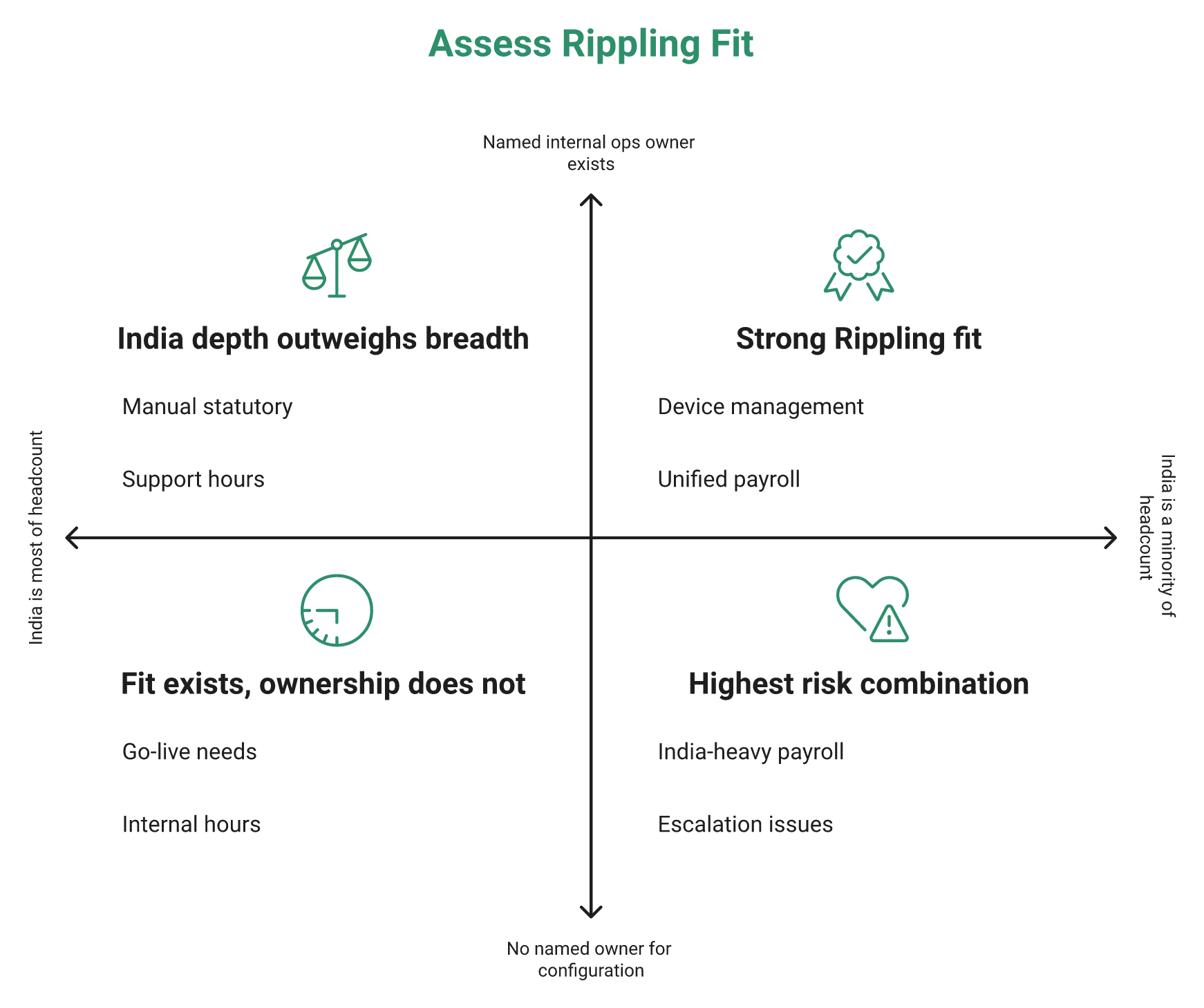
If the first answer is “nobody specific” and the second is “most of them,” the fit weakens sharply. HROne ranks #3 for highest customer satisfaction out of 1.17 lakh products on G2 and #8 for Best HR Software Worldwide, which makes it a fair benchmark when you weigh breadth against daily satisfaction.
⚠️ What users say when the shine wears off
Balance matters here, so read a strong review and a weak one side by side.
“Unified Platform Automation, Smooth Onboarding Experience, Fast, Accurate Payroll, Strong Integrations and Compliance Reporting.”
– Verified reviewer, Rippling G2 – Verified Review
“Outside of the U.S. they struggle to deliver on the promises made during the sales conversations. They may be great in the U.S. but in the EU specifically they are not worth their money.”
– Verified reviewer, 0.5 stars, Rippling G2 – Verified Review
On the Indian side, the pattern reverses around statutory work. One HROne reviewer put it plainly.
“Proper calculation of PF and ESI was a pain area for us before, but now with the HROne automated calculation process, results are up to the mark and following Indian tax compliances properly.”
– Ajay K., 5 stars, HROne G2 – Verified Review
My read may be coloured by where I sit, and I will own that. HROne’s deployment data points one way: buyers who name an internal owner get value from broad platforms, and buyers who cannot name one do not.
HROne holds a 9.8 NPS on its dedicated implementation SPOC model, staffed by people who ran HR before they ran projects. That is the variable most verdict articles skip.
Q2. What do Rippling users genuinely praise?
Users praise three things consistently: onboarding that runs itself, scheduled payroll that fires without babysitting, and native device management with software and script deployment. One G2 reviewer reports Rippling “saves me over an hour of onboarding with each new hire, which is huge because we have a high turnover rate”. One employee record drives HR, payroll, and IT actions at the same time.
🧩 Single instance, explained without the jargon
“Single instance” means one employee record, stored once, used everywhere. You add Priya as a new hire. That single act triggers payroll enrolment, benefits, a laptop shipment, and app access.
Most Indian HR stacks do the opposite. Priya gets typed into an ATS, a biometric portal, a payroll vendor sheet, and an asset register, four times, by three people.
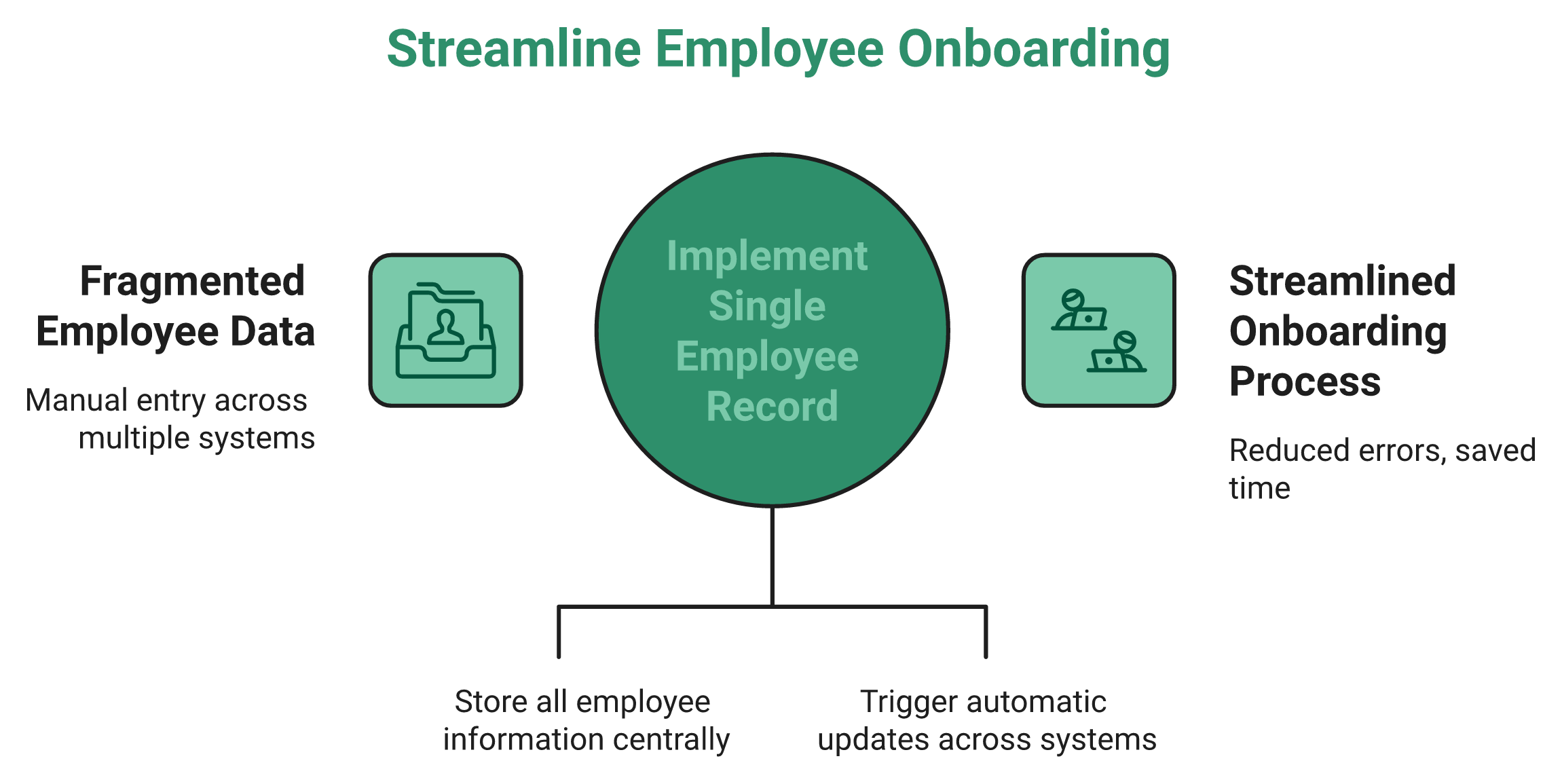
🔁 Bouquet versus garden
Buyers shop for a bouquet, meaning a bundle of features that look good together. What they actually need is a garden, where automations talk to each other natively without glue code.
I built contract generation workflows in automation tools before. They work, but they are rigid, and if the template changes the workflow breaks. Native beats stitched, every time.
✅ The three praised workflows, in reviewers’ words
“I appreciate Rippling for its seamless account setup and auto-approve payroll feature. I like the integrations it offers, as they enhance the ease of use across systems.”
– Verified reviewer, Rippling G2 – Verified Review
“I like that it helps us manage all our devices and lets us deploy software and scripts directly.”
– Verified reviewer, Rippling G2 – Verified Review
Practitioners on Reddit describe the same upside in operational terms.
“It’s really helpful for onboarding/offboarding because it automates new hire paperwork, assigning trainings, enrolling payroll, shipping laptops.”
– r/rippling, Reddit Thread
⏰ What this buys you on Monday morning
Count your double entries this week. Every place a new joiner’s name gets typed twice is a place errors and grievances start.
HROne ships 127 prebuilt workflows spanning manpower requisition to full and final settlement, so the automation reviewers praise arrives preconfigured rather than assembled after go-live. That distinction matters most in month one, not month twelve.
🇮🇳 Where Indian teams feel the same benefit differently
The praise pattern in India clusters around attendance sync and payslip access, not device provisioning. Field staff and biometric hardware dominate the daily reality.
“Real time widgets available for employee present at a particular instance… Salary processing to last creation of bank Challan files is quick and systematic process with error free details.”
– Deepak K., 5 stars, HROne G2 – Verified Review
Honest caveat: no platform is uniformly loved, including ours. The same HROne reviewer flagged missing options for arrear PF display, which is exactly the kind of edge case buyers should test in a trial.
HROne measures automation value through its inbuilt ROI Dashboard, which totals hours saved against average HR salary so a CHRO can present savings in rupee terms. Rippling’s strength is breadth of surface area, and that is a real advantage for multi-country engineering teams.
Q3. What do users complain about most in Rippling reviews?
The three documented complaint clusters are navigation confusion, multi-state tax and PTO calculation errors, and offboarding that leaves software behind. G2 logs over 1,000 missing-feature mentions and 726 or more not-user-friendly mentions. One 0.5-star reviewer wrote: “We could not get Rippling off of our devices after we had stopped using it, which was a huge security concern”.
❌ Cluster one: navigation is a design failure
If an HR person has to hunt for where a task lives, that is a design failure, not user error. I hold that view firmly, and reviewers keep supplying evidence for it.
| Complaint cluster | Documented volume | Typical business impact |
|---|---|---|
| Missing features, reporting gaps | 1,000+ G2 mentions | Manual exports at month end |
| Not user-friendly, steep learning curve | 726+ and 858 mentions | Low adoption, more HR tickets |
| Payroll and tax accuracy incidents | Repeated low-star reports | Late paycheques, audit cost |
“The most frustrating aspect of Rippling was the unnecessary changes that came with each update. Everything would be rearranged, making it confusing to find what I needed. The app itself is also very slow.”
– Verified reviewer, 0 stars, Rippling G2 – Verified Review
⚠️ Cluster two: payroll integrity incidents
This is the cluster that costs actual money. Incorrect W-4 and tax filings can cost a business upwards of $134,975, and fixing direct deposit issues averages over $44,000.
“It did not handle multi-state taxes well at all. We are a non-profit and it was constantly making mistakes. It also did not handle us having one hourly employee well. It killed the autopayment for payroll causing a paycheck to be sent late to all employees.”
– Verified reviewer, 0.5 stars, Rippling G2 – Verified Review
Nearly half of employees consider leaving after just two payroll mistakes. That is why HROne runs group payout validations before release, flagging missing bank details or mismatched components before money moves.
💸 Cluster three: the offboarding hangover
Exit hygiene is the least reviewed and most underrated risk. Two separate reviewers report Rippling artefacts surviving cancellation.
“It also has a Rippling autofill button on login that I still can’t get off my system after cancelling 2 years ago.”
– Verified reviewer, 0.5 stars, Rippling G2 – Verified Review
Practitioners on Reddit describe the implementation-side version of the same pattern.
“While their implementation process is slightly better than Paycom’s, Rippling struggles with high employee turnover. This, combined with the pressure on their implementation teams to meet specific metrics, can result in errors.”
– r/Payroll, Reddit Thread
✅ Five questions to ask in your next demo
- Show me a missed punch corrected and approved, live, in under three clicks.
- Run an off-cycle payroll for one hourly employee without touching the main run.
- Build a PT slab and LWF deduction in front of me, without a support ticket.
- Show the full data and agent removal steps after contract termination.
- Name the tier that unlocks custom reports, and its price per head.
Balance demands the same scrutiny of us. HROne reviewers flag their own friction, including automatic logouts and a payroll module learning curve, and one asked for clearer hand-holding during onboarding.
“It can sometimes feel a bit overwhelming for new users. Certain features take time to understand, and without enough guided support, the learning curve can feel quite steep.”
– Nijanthan R., 3 stars, HROne G2 – Verified Review
HROne built its Super Inbox against exactly this failure mode, so approvals, regularisations, and CTC actions surface in one stream and close within three clicks, with no module hunting. Reviewers report administrative time dropping 60% to 70% as a result.
Q4. How much does Rippling really cost per employee?
Rippling starts at $8 per employee per month plus a $35 to $40 base fee, which buys only the Unity platform. Add payroll, benefits, and time tracking, and most buyers land at $15 to $29 PEPM. A full HR, IT, and spend stack runs $30 to $65 PEPM, EOR starts near $499 to $599 per employee monthly, and there is no published list price beyond the floor and no free trial.
💰 Why the headline number misleads
PEPM means per employee per month, the standard HR software unit. The $8 figure is a platform entry fee, not a working payroll system.
Every function you actually need is a separate module with its own PEPM. Buyers discover this after the quote call, which is when the finance conversation gets uncomfortable.
| Component | Indicative cost | What it covers |
|---|---|---|
| Unity platform | $8 PEPM + $35 to $40 base | Employee record, workflows |
| Core HR | $8 to $14 PEPM | HRIS functions |
| US payroll | around $8 PEPM | Runs, filings |
| Benefits admin | $6 to $8 PEPM | Enrolment, carriers |
| Full HR, IT, spend stack | $30 to $65 PEPM | Devices, cards, apps |
| EOR | $499 to $599 PEPM | Foreign entity employment |
📊 Three headcount scenarios, run honestly
Assume a payroll plus HR plus time tracking configuration at roughly $22 PEPM, mid-range.
| Headcount | Monthly (USD) | Annual (USD) | Annual (INR, at 87) |
|---|---|---|---|
| 25 | ~$590 | ~$7,080 | ~5.9 lakh |
| 100 | ~$2,240 | ~$26,880 | ~23.4 lakh |
| 500 | ~$11,040 | ~$132,480 | ~1.15 crore |
Per-employee pricing only saves money at very low headcounts. Rippling’s monthly rate sits below some rivals, while its per-employee rate sits above them, which is precisely the wrong shape for the 100 to 5,000 band.
⚠️ The line items nobody quotes you
Watch three things. Module-level implementation fees, tier gates on features you assumed were included, and seat commitments that survive attrition.
“The pricing displayed is misleading; each feature comes as a separate module. Payroll, benefits, and time tracking all incur additional costs, leading us to pay nearly three times our initial estimate.”
– r/Payroll, Reddit Thread
“Additionally, be aware that many modules come with extra fees for implementation. For instance, features like expense management are included only in higher-tier plans.”
– r/humanresources, Reddit Thread
❌ The seat commitment trap
This one surprises buyers most. One small business reported being billed for 25 seats after headcount fell to 15, because the contract locked the peak user count for the subscription term.
“There is a clause stating that I must pay for the number of users I initially sign up with for the entire contract even if we do not have that same number of employees working the entire time.”
– r/smallbusiness, Reddit Thread
G2 reviewers name the same theme more mildly, listing “Pricing Transparency Cost and Implementation Time” among their dislikes even while praising the product.
✅ Turn on only what you need
The better model is a parachute you open when you need it. You switch on modules at the pace your team can absorb, and you pay from the moment the system goes live, not the moment the contract signs.
| Cost dimension | Rippling | HROne |
|---|---|---|
| Published list price | Floor only, quote-gated | Flat PEPM, published |
| Billing starts | On contract | After go-live |
| Lock-in | Subscription term seat commitment | No lock-in |
| Free trial | None | Demo plus pilot |
HROne prices flat with no lock-in and meters subscription only after go-live, which removes the two costs Rippling buyers discover late: paying through a long implementation, and paying per head for modules not yet switched on.
Q5. How long does implementation take, and what does Rippling cost over three years?
Expect three to eight weeks for a payroll plus HR go-live, longer with benefits, device management, or multi-entity structures. Licence fees are only part of it. Gartner reports that CHROs meet real resistance from HR employees when automating, so a three-year model must carry implementation labour, training hours, and tier upgrades. The migration priority that matters is not history. It is the first live payroll landing on time.
⏰ The go-live that slips past the 25th
A payroll manager in Gurugram once described her worst week to me. Go-live slipped by nine days, and the salary date did not move.
She ran that month on Excel while the new system sat half configured. That is the real implementation risk, and no vendor timeline page mentions it.
📋 The five-step sequence that actually holds
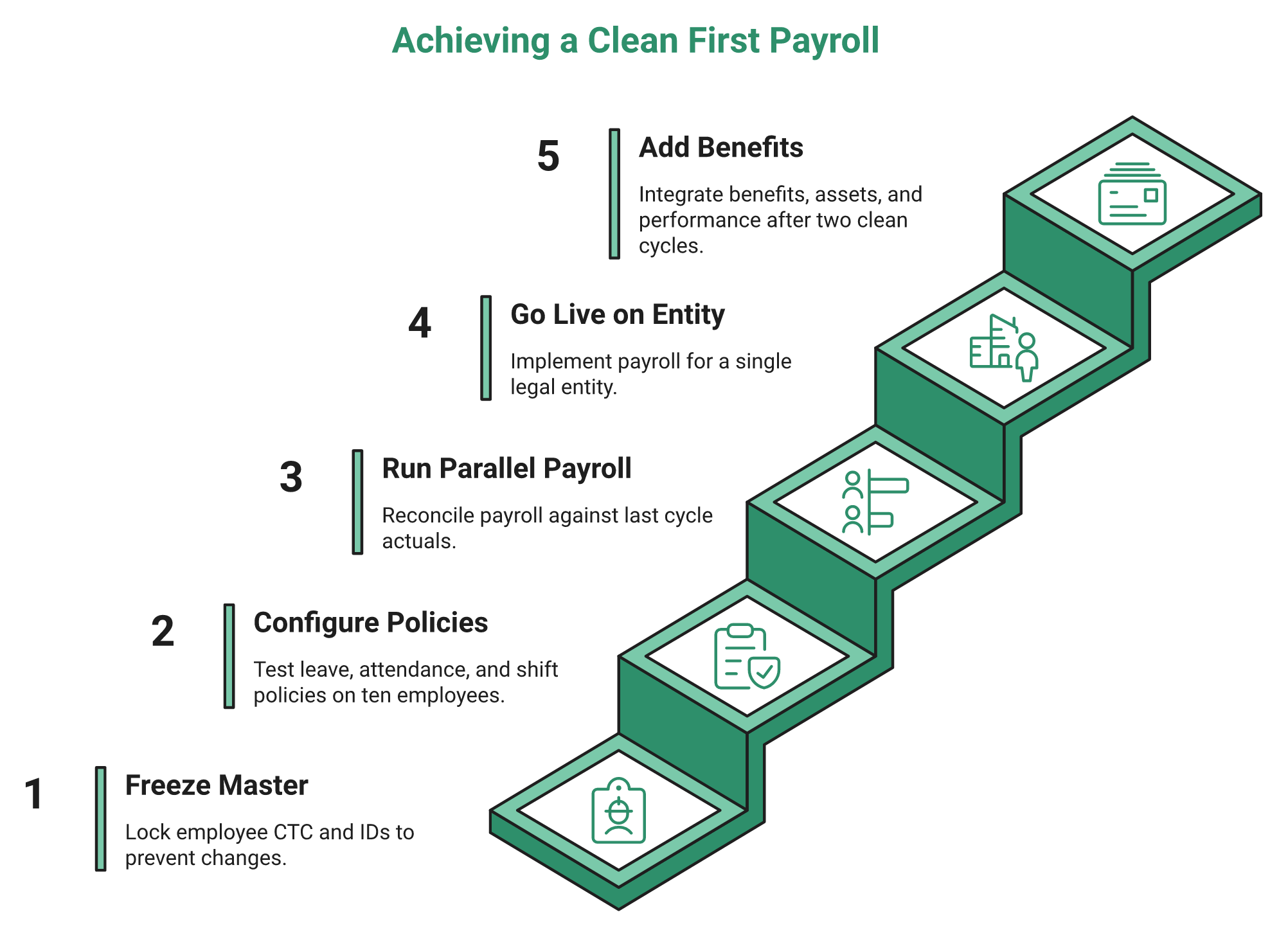
Treat these as gates, not phases. You do not pass one until the output is verified.
- Freeze the employee master, including CTC components and statutory IDs.
- Configure policies for leave, attendance, and shift rules, then test on ten employees.
- Run a parallel payroll against last month’s actuals, and reconcile to the rupee.
- Go live on one legal entity, not all of them at once.
- Add benefits, assets, and performance only after two clean payroll cycles.
HROne runs mid-market go-lives against a payroll date rather than an open ticket count, with a dedicated prior-HR implementation SPOC and a 9.8 NPS on that support model.
💰 What three years actually costs
Licence is the visible line. The invisible lines are usually larger in year one.
| Cost line | Year 1 | Years 2 and 3 |
|---|---|---|
| Licence at 100 employees, ~$22 PEPM | ~$26,880 | ~$26,880 each |
| Implementation and module setup fees | Variable, quoted | Nil |
| Internal HR and IT labour | 120 to 250 hours | 40 hours |
| Training and change management | 40 to 80 hours | 20 hours |
| Tier upgrade for reports and workflows | Often triggered | Recurring |
Adoption research is blunt about why these hours are unavoidable. A 2025 HRIS adoption study found that perceived ease of use and organisational readiness drive adoption more than feature depth.
⚠️ What buyers report from the inside
“Complexity Learning Curve, Pricing Transparency Cost and Implementation Time.”
– Verified reviewer, listed dislikes, Rippling G2 – Verified Review
“I’m having trouble with glitches, product inconsistency, and slow load times with Rippling. The patchwork modular products aren’t ideal. Also, the initial setup wasn’t easy.”
– Verified reviewer, 1.5 stars, Rippling G2 – Verified Review
“My experience with implementing Rippling has been quite smooth. Most of the complaints I’ve seen about Rippling are user error, one wrong or mismatched field and things break.”
– r/Payroll, Reddit Thread
✅ Skip the history, protect the paycheque
Historical payroll data is rarely the thing that makes or breaks a rollout. People’s mortgages and rents getting paid on time is.
Load two years of statutory registers if you must, then move on. HROne measures implementation success by first-cycle payroll accuracy, not by how much archive data got migrated.
🧪 The three-task test to run before you sign
Ask the sales engineer to hand you the keyboard. Add one employee end to end. Run an off-cycle payroll for a single hourly worker. Build one custom report with a filter.
If any of the three needs a support ticket, your implementation estimate is wrong. HROne buyers run this same test during pilot, and reviewers report administrative time falling 60% to 70% once the Inbox handles routing.
“The initial setup of HROne was surprisingly straightforward, much lighter than expected for a full HRMS.”
– Waldon S., 4 stars, HROne G2 – Verified Review
HROne bills subscription only after go-live, so a delayed rollout does not silently become a paid month. That single contract term removes the most common three-year TCO surprise for Indian mid-market buyers.
Q6. Is Rippling’s customer support good enough for payroll week?
Rippling answers chat in about 27 seconds but resolves only 36% of email and web tickets on first contact, with coverage roughly 9am to 5:30pm PST and reported tax-team waits of three to six months. Reviewers ask for a direct line to a live rep and note that response SLAs carry no time commitment. HROne staffs India-hours support with a named SPOC per account at a 9.8 NPS.
📊 The metric nobody quotes
Twenty-seven seconds to first reply sounds excellent. First-contact resolution is the number that decides your week.
At 36%, roughly two in three tickets need a second round. On payroll week, a second round means tomorrow.
⏰ The IST versus PST escalation clock
Do this math before you sign, not after. Pacific business hours land in the middle of the Indian night.
| Your moment | India time | Pacific time | Support state |
|---|---|---|---|
| Payroll input freeze | 10:00 am IST | 9:30 pm PST | Closed |
| Error spotted in run | 3:00 pm IST | 2:30 am PST | Closed |
| Escalation attempt | 7:00 pm IST | 6:30 am PST | Opening soon |
| First human reply | 10:00 pm IST | 9:30 am PST | Live |
That is a twelve-hour hole in the exact window when salary files get validated. HROne handles this differently by assigning an India-hours SPOC who ran HR before joining implementation, which reviewers cite as the reason issues close inside the working day.
⚠️ What reviewers say about the queue
“Customer service could be improved. Clients need to have a direct line to a live rep and the ability to speak with a live person on demand. The SLA for responses on general service inquiries lacks a time commitment.”
– Verified reviewer, 2 stars, Rippling G2 – Verified Review
“Support can take a while to acknowledge the issue and actually resolve it. The AI support is helpful but takes too long to contact the real support sometimes.”
– Verified reviewer, 1.5 stars, Rippling G2 – Verified Review
An AI triage layer that gates human contact is fine for a password reset. It is the wrong design when a tax filing is wrong.
✅ The fork that actually decides this
Legacy providers like ADP sell 24/7 live support and hide pricing. Rippling sells self-serve depth and lean support hours.
Neither is wrong. The choice depends on whether you have a dedicated ops person, or you need the system to hold your hand.
💸 Clauses to negotiate before you sign
Put these in writing. Verbal reassurance from a sales engineer is not an SLA.
- A named response time for payroll-severity tickets, in hours, not “promptly”.
- A path to a human that skips the AI layer during your payroll window.
- Coverage hours stated in IST, with an on-call escalation contact.
- A resolution SLA for statutory filing errors, separate from general queries.
- Credits or remedies if a support delay causes a late salary run.
Honest balance matters, so I will name our own gap. HROne reviewers have reported unresolved session-timeout issues, which is a reminder that no support model is flawless.
“Most of times, application logs out automatically, I have raised the concern to support department but no resolution received. Apart from this all is going well with the product.”
– Komal S., 5 stars, HROne G2 – Verified Review
“The support team is always ready to help us with any issues, ensuring smooth operations. Their onboarding process was thorough, with helpful training sessions for the whole team.”
– Rishiraj R., 4 stars, HROne G2 – Verified Review
HROne holds a 9.8 NPS on its dedicated SPOC model, and that number exists because the person answering has run an Indian payroll cycle themselves. Rippling’s support is competent at scale, just not built around a 25th-of-the-month IST deadline.
Q7. What are Rippling’s reporting and workflow limits?
Rippling’s Core plan withholds Workflow Studio, advanced reports, and webhooks, so trend analysis usually means exporting to a spreadsheet. Over 1,000 G2 mentions of missing features cluster in reporting and app consistency. HROne exposes attendance, attrition, and payroll-cost analytics directly to the HR admin, including an inbuilt ROI Dashboard that totals hours saved against average HR salary.
❌ The consensus gets this backwards
Most reviews treat reporting as a minor gripe below pricing and support. My read is the opposite, and I hold it firmly.
Reporting is where the whole purchase either pays back or quietly does not. A system that cannot answer a CHRO’s question on demand is a filing cabinet with a login.
📊 What sits behind which tier
Check this against your quote line by line.
| Capability | Typical Core plan | Higher tier |
|---|---|---|
| Standard reports | Included | Included |
| Advanced and custom reports | Restricted | Included |
| Workflow Studio automation | Restricted | Included |
| Webhooks and API events | Restricted | Included |
| Trend analysis over time | Manual export | Partly native |
HROne includes the HR Ops heat map and ROI Dashboard for admins without a tier gate, which is how a CHRO gets a rupee figure for hours saved before a board review.
⚠️ Slowness is a reporting problem too
A 2025 study on HRIS integration found the most frequently reported problems were system slowness, connectivity, and login difficulty, not absent features. That matches what reviewers describe.
“I’m having trouble with glitches, product inconsistency, and slow load times with Rippling. The patchwork modular products aren’t ideal.”
– Verified reviewer, 1.5 stars, Rippling G2 – Verified Review
“Users find missing features in reporting and app consistency, leading to frustration and inefficiency in their workflows.”
– G2 sentiment summary across 1,241 reviews, Rippling G2 – Verified Reviews
💰 The turnover versus expenditure moment
One operations manager I worked with saw turnover against HR expenditure on a single screen for the first time. He went quiet, then rewrote his own process.
That shift only happens when the number is one click away. Analytics that requires an export never changes behaviour, because nobody exports on a Tuesday afternoon.
⭐ What native analytics actually unlocked
In one HROne deployment, time-utilisation analytics exposed a team running at 150% occupancy. Load came down by roughly 70%, and the team got back about a third of its week for planning work.
I might be reading that single case too strongly, and I will say so. The pattern I trust more is simpler: teams that see cost and attrition together act faster than teams that do not.
✅ Two reports to build yourself in the demo
Ask for the keyboard again. Do not accept a prebuilt dashboard walkthrough.
- Build attrition by department, filtered to the last two quarters, with cost per exit attached.
- Build attendance exceptions by location for one month, then export it to payroll input.
If either needs a developer, a webhook, or a tier upgrade, you have found the ceiling. Balance requires the same honesty about us, and HROne reviewers have flagged their own reporting gaps.
“Engage module limited to hardly 3 reports and minimum functionalities available.”
– Manna S., 4.5 stars, HROne G2 – Verified Review
“The responsiveness needs a little bit of work as switching between large reports or modules does have a delay.”
– John C., 4.5 stars, HROne G2 – Verified Review
HROne built India’s first inbuilt ROI Dashboard for one reason: CHROs kept walking into board reviews unable to quantify HR’s savings. Rippling’s reporting is capable at the right tier, and buyers should price that tier in from day one.
Q8. How reliable is Rippling’s global payroll and EOR coverage?
Rippling runs native payroll in a small handful of countries and offers EOR across roughly 80 to 85, but secondary markets rely on partner entities rather than owned ones, and no EOR list pricing is published. EOR means Employer of Record, a third party that legally employs your staff abroad. Compliance accountability sits with whoever holds the entity. One EU reviewer found bank-holiday calendars “plain wrong” and GDPR handling “shaky at best”.
🌍 Three coverage models, not one
Vendors say “we cover 85 countries” and mean three different things. Learn the difference before the contract.
| Model | Who employs your staff | Your exposure |
|---|---|---|
| Native payroll | Your own entity, vendor runs the run | Lowest, you file |
| Owned-entity EOR | Vendor’s own local entity | Moderate, vendor accountable |
| Partner-entity EOR | An unnamed third party | Highest, accountability is indirect |
HROne takes the opposite bet deliberately, covering payroll, attendance, assets, expenses, and helpdesk in one instance built for Indian statutory reality across 100 to 5,000 employee workforces.
⚠️ Where the chain gets brittle
I have built integration workflows that map fields between systems. They work until a template changes, then they break silently.
Partner-entity compliance chains behave the same way. A rule changes in one jurisdiction, and the fix travels through a subcontractor you never signed with.
❌ What non-US reviewers report
“Outside of the U.S. they struggle to deliver on the promises made during the sales conversations. Their understanding of GDPR is shaky at best, their bank holiday calendars are plain wrong causing confusion. Their time off dashboards were useless.”
– Verified reviewer, 0.5 stars, Rippling G2 – Verified Review
The same reviewer flagged a security issue after cancellation, when agents stayed on company devices. Exit hygiene is part of coverage risk, and almost no review scores it.
“It was easy to get started on EOR because the system is easily built into the current instance of Rippling. Rippling simplifies hiring internationally in the UK.”
– Verified reviewer, 2 stars, Rippling G2 – Verified Review
That balance is fair. Onboarding into EOR is genuinely smooth, while local depth varies by market.
💸 Pricing you cannot compare
EOR pricing starts near $499 to $599 per employee per month, and full rates are quote-gated. Practitioners notice when a rival publishes flat numbers.
“Ultimately, we decided on Thera, and I must say, their pricing is much clearer, it’s $199 for each EOR contractor without any confusing extras.”
– r/remotework, Reddit Thread
Indian practitioners using Rippling EOR do report legitimate, compliant arrangements, so this is not a legality question. It is an accountability question.
✅ Three questions to put in the contract
Get written answers, named entity by named entity.
- Which legal entity employs my staff in this country, and is it yours or a partner’s?
- Who signs the statutory filing, and who pays the penalty if it is late?
- What is the resolution SLA in that jurisdiction, stated in local hours?
For India specifically, add a fourth. Ask who handles PF, ESIC, state Professional Tax, and Labour Welfare Fund when a slab changes mid-year.
⭐ Depth beats breadth inside one country
HROne reviewers describe statutory depth as the daily difference, not country counts.
“Salary processing along with exact calculation of LWF and PT slabs makes the work more convenient process.”
– Komal S., 5 stars, HROne G2 – Verified Review
“Nothing is customizable and there are lot of mapping issues, for example Department and Sub department field has parent-child relationship.”
– Deepak S., 5 stars, HROne G2 – Verified Review
HROne runs Asia Healthcare Holdings across 20 pan-India units on a single instance with multi-legal-entity configuration, which is the shape most Indian mid-market groups actually need. Rippling’s 80-plus country reach is real leverage for multi-country engineering teams, and largely unused by an India-first employer.
Q9. Does Rippling work for Indian payroll and statutory compliance?
Rippling processes India payroll and EOR and will handle PF and ESIC, but statutory depth sits as a localisation layer on a US-first engine, and support runs on Pacific hours. State-wise Professional Tax slabs, Labour Welfare Fund, gratuity sequencing, Form 16 issuance, and Labour Code transitions stay your team’s manual burden. The person who signs the filing is still you.
⚠️ Who actually signs the return
A CFO in Chennai asked me a sharp question last year. “If the software gets my PF challan wrong, who does the PF officer call?”
The answer is always the employer. Software is a tool, not a signatory, and no global vendor changes that.
📋 The India checklist to score any vendor against
Run this list line by line, in the demo, with the sales engineer watching. Each item is a statute or filing your payroll software must produce without a spreadsheet.
| Requirement | What it means | Ask to see |
|---|---|---|
| EPF (Employees’ Provident Fund Act, 1952) | Retirement contribution, 12% both sides | ECR file generated live |
| ESIC (Employees’ State Insurance Act, 1948) | Medical cover for wages under the threshold | Contribution return |
| State Professional Tax | Slabs differ by state, deducted monthly | Karnataka and Maharashtra slabs together |
| Labour Welfare Fund | State fund, half-yearly or yearly | LWF deduction in a payslip |
| Gratuity (Payment of Gratuity Act, 1972) | Payout after five years of service | Accrual report and FFS calculation |
| Form 16 and TDS | Annual tax certificate to employees | Bulk Form 16 release |
| Shops and Establishment registration | State-level employer registration | Register formats |
| POSH Act, 2013 | Mandatory internal committee and policy | Complaint workflow |
| Maternity Benefit Act, 1961 | 26 weeks paid leave for eligible women | Leave policy configured |
| Code on Wages, 2019 | New wages definition, FFS timelines | Wage-code compliant FFS |
HROne handles these as core payroll behaviour, and reviewers describe the outcome in exactly these terms.
“Salary processing along with exact calculation of LWF and PT slabs makes the work more convenient process.”
– Komal S., 5 stars, HROne G2 – Verified Review
❌ Uniform engines break on Indian edge cases
Most HR systems do not fail because they are unfair. They fail because they are too uniform.
A single global payroll engine assumes one wage definition and one filing calendar. India has neither, and the gap lands on a spreadsheet maintained by one overworked person.
💸 Where the manual run-around starts
The pattern is always the same. Data goes missing, and HR starts chasing people to ask whether a field was updated.
That chase is the real cost, not the licence. HROne measures this through its HR Ops heat map, which shows which processes are healthy and which need attention before month-end.
✅ What non-US buyers actually report
“Outside of the U.S. they struggle to deliver on the promises made during the sales conversations. Their understanding of GDPR is shaky at best, their bank holiday calendars are plain wrong.”
– Verified reviewer, 0.5 stars, Rippling G2 – Verified Review
“Creation and release of tax slip, form-16 and Form12-b related to TDS deduction is automated now.”
– Manna S., 4.5 stars, HROne G2 – Verified Review
Fair balance again: the same HROne reviewer flagged geofencing radius problems. Statutory depth and mobile polish are separate battles, and buyers should test both.
HROne treats Indian statute as product behaviour rather than a localisation module, which is why PF, ESI, PT, LWF, and Form 16 come out of the same payroll run. Rippling’s India capability is genuine for global teams with an Indian pocket, and thinner for an Indian employer with a global pocket.
Q10. What are the best Rippling alternatives for Indian mid-market and enterprise teams?
For an India-first company of 100 to 5,000 employees, HROne leads on statutory-native payroll, flat no-lock-in pricing, and India-hours support, and it ranks #3 for customer satisfaction out of 1.17 lakh products on G2. Darwinbox suits large enterprise change programmes, Keka fits fast-growing tech teams, greytHR covers compliance-only needs, Zoho People wins on budget, and Deel or Rippling itself stays right for genuinely multi-country engineering orgs.
📊 The shortlist at a glance
| Platform | Best for | Pricing model | India statutory depth | Support window |
|---|---|---|---|---|
| HROne | 100 to 5,000, India-first | Flat PEPM, billing after go-live, no lock-in | Native, including LWF and PT slabs | India hours, named SPOC |
| Darwinbox | Large enterprise, pan-Asia | Enterprise quote, multi-year | Strong | India hours |
| Keka | Fast-growing tech, 50 to 500 | Tiered per employee | Good on PF, ESI, TDS | India hours, chat-led |
| greytHR | Compliance-only SMB | Low-cost tiers | Payroll-centric | India hours, ticket-led |
| Zoho People | Budget-conscious teams | Very low PEPM | Basic, add-ons needed | Global |
| Rippling or Deel | Multi-country engineering | Modular, quote-gated | Localisation layer | Pacific hours |
⭐ 1. HROne, the hire-to-retire operating system
Best for Indian mid-market and enterprise teams that want one instance from manpower requisition to full and final settlement. HROne runs 127 prebuilt workflows and a Super Inbox that closes tasks in three clicks, with subscription metering only after go-live.
Honest limitation: reviewers report session timeouts and limited reports inside the Engage module. Price signal is flat PEPM with no lock-in.
“The InboxforHR is a game-changer, centralizing every HR task into one simple inbox, cutting down administrative time by 60% to 70%.”
– Waldon S., 4 stars, HROne G2 – Verified Review
🏢 2. Darwinbox, enterprise brand weight
Best for 2,000-plus headcount groups running a formal change programme with an internal project team. Strong module coverage, and real Asian enterprise references.
Limitation reported by users is speed and report customisation. Billing typically starts at contract, not go-live. A side-by-side view sits on the HROne versus Darwinbox comparison.
“Speed/performance: Pages sometimes load slowly. Reporting/analytics: Limited customization in reports. Integration issues: Sync with other systems can be inconsistent.”
– Saksham A., 4 stars, Darwinbox G2 – Verified Review
⚡ 3. Keka, polished UX for growing tech teams
Best for 50 to 500 employee product companies that value interface polish. Payroll and statutory automation work adequately at that size.
Documented weak spot is implementation coordination and configuration limits for niche policies, which is why buyers often review Keka alternatives in India mid-contract.
“We started working with Keka HRMS in August, and to this day, we have been unable to implement the tool due to their consistently delayed responses and poor coordination.”
– Divya p., 0 stars, Keka G2 – Verified Review
🧾 4. greytHR, compliance-first and inexpensive
Best for smaller firms that only need payroll, payslips, and statutory filings. Rigid on customisation once policies get complex, a pattern documented across greytHR alternatives in India.
“GreytHR is not much good at customizing based on our requirements. Many times we were manually correcting the leave balance of employees.”
– Verified user in IT services, 2 stars, greytHR G2 – Verified Review
💰 5 and 6. Zoho People and the global specialists
Zoho People wins on price for teams under 200 with simple policies, and needs add-ons for deep statutory work. Deel and Rippling remain correct when most of your headcount sits outside India.
HROne sits first here because it is the only option pairing India-native statutory payroll, 127 workflows, flat pricing, and a 9.8 NPS SPOC model in one instance. MR DIY India cut payroll cycles from ten days to five or six after moving, which is the kind of proof I would ask every vendor on this list to produce.
Q11. Who should buy Rippling, and who should walk away?
Buy Rippling if you are US-headquartered, have 30 or more employees, employ a dedicated HR ops owner, and need device management alongside payroll. Walk away if your workforce is India-heavy, nobody owns implementation internally, you need contractual support SLAs, or finance cannot approve a quote-gated cost that scales with every hire. Mid-market buyers form about 62% of its reviewer base.
✅ Four questions that settle it
Answer these honestly, on paper, before the next demo call.
- Who inside your company owns configuration after go-live, by name?
- What share of your headcount files PF, ESIC, and Professional Tax?
- Can finance approve a per-head cost that rises with every hire?
- Do you need device provisioning and app access inside HR?
📊 Score it, do not feel it
Weight each factor, then total the score. Anything under 60 means keep looking.
| Factor | Weight | Rippling fits when |
|---|---|---|
| India statutory depth | 30% | India is a minority of headcount |
| Cost predictability | 20% | Finance accepts quote-gated PEPM |
| Support timezone | 20% | Your ops sit US or EU hours |
| Internal ops ownership | 20% | A named admin exists |
| Device and IT scope | 10% | HR owns provisioning |
HROne appears in most Indian shortlists on the first three rows, because flat PEPM, India-hours SPOC support, and native statutory payroll are contract terms rather than roadmap items.
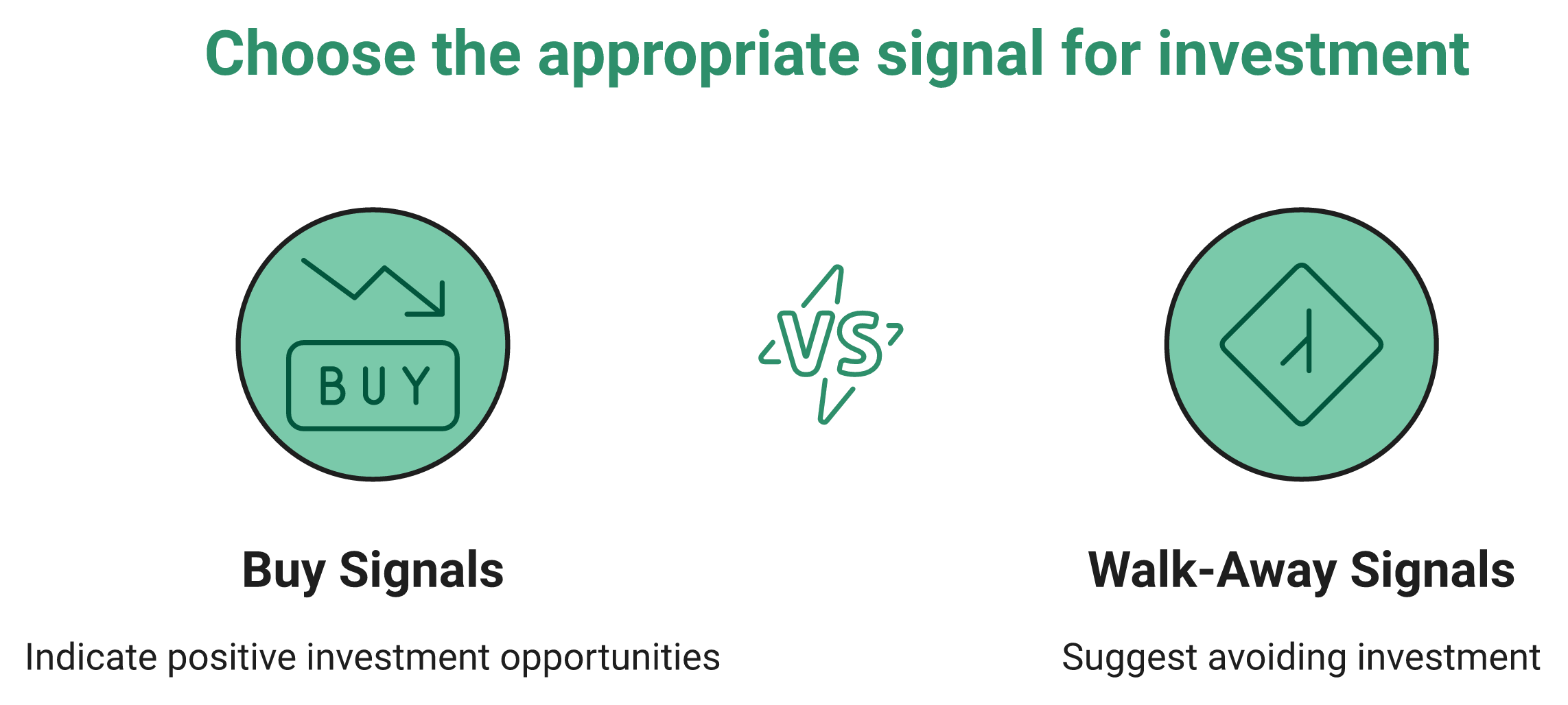
⭐ Buy Rippling if this is you
- US or EU headquarters, with distributed engineering hires.
- A dedicated HR ops or people-systems person on payroll.
- Device fleet management currently sitting in spreadsheets.
- Appetite to pay for breadth you will actually use.
❌ Walk away if this is you
- India-first employer between 100 and 5,000 employees.
- No named internal owner for configuration and testing.
- Payroll cut-off that needs same-day human escalation.
- Board pressure to show HR cost savings in rupee terms.
⏰ Scale versus robustness, the real fork
Ask yourself one question about pace. Are you scaling methodically over three years, or hitting the ground running with funding in hand?
Methodical growth wants a parachute you open when needed, switching on modules as the team absorbs them. Funded hypergrowth can carry something heavier and messier from day one. If you are somewhere in between, the scaling HR processes guide maps the sequence.
💰 The whole hog, one last time
You should not buy the whole hog if you will not eat the whole hog. Rippling sells a large one, and it is a good one.
I have watched buyers pay for device management and spend controls they never switched on. HROne measures this differently through its inbuilt ROI Dashboard, which totals hours saved against average HR salary so unused spend becomes visible.
🔮 What I think happens next
My current thinking is that the India HR software market splits in two by 2028. Global platforms will win multi-country engineering orgs, and India-native platforms will win compliance-heavy mid-market groups.
The interesting question is whether statutory depth becomes a genuine moat or a commodity API. I do not know yet, and I would like to hear what your last vendor evaluation taught you.
HROne answers the walk-away column directly, with modular activation, subscription starting at go-live, and deployments sized for Indian teams of 100 to 5,000 employees. Asia Healthcare Holdings runs 20 pan-India units on a single instance, which is the shape most Indian groups actually need.



















 Secures Top Spot in
