








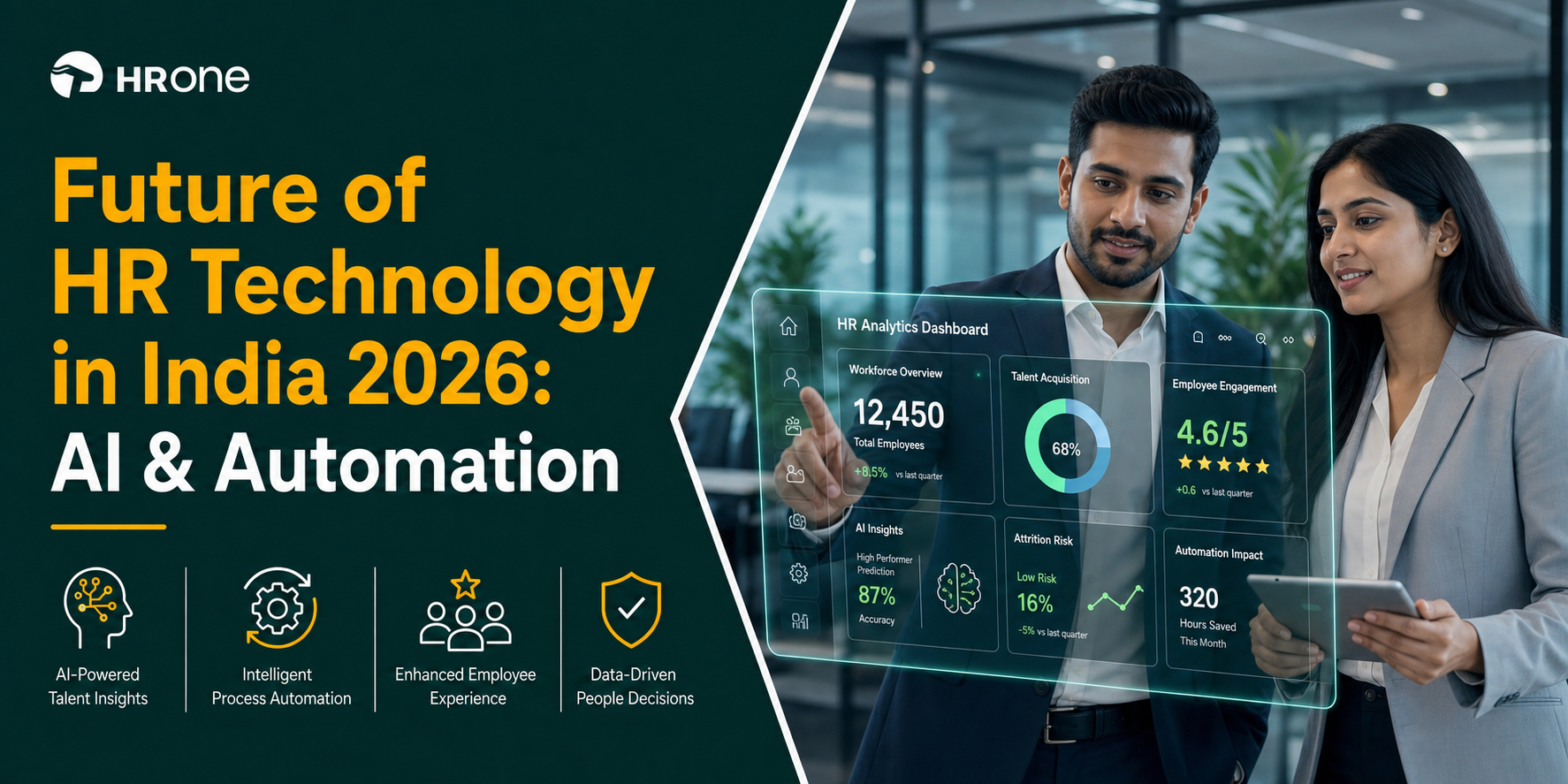
Q1. What does the future of HR technology in India actually look like in 2026?
In 2026, India’s HR technology future rests on three shifts: agentic AI that executes multi-step tasks (not just chatbots), compliance convergence from the new Labour Codes and the DPDP Act 2023, and a domestic HR software market crossing USD 1 billion. The move is from managing people to designing human-machine systems. But that only pays off when the tool bridges into your existing stack instead of becoming another abandoned ERP.
🏚️ The $300,000 ghost town nobody talks about
A CHRO I spoke with last year described walking into a floor where a $300,000 ERP sat unused. The team never embraced it, so it quietly rotted into shelfware. That fear, not AI itself, is what keeps Indian HR leaders up at night.
You are not asking “what is the newest tech?” You are asking “will my team actually use this, or drift back to Excel in six months?” That question should frame every 2026 decision you make.
📊 Three forces that actually define 2026
Here is what the credible data says, stripped of hype. Each force is real, measured, and already reshaping Indian HR desks.
- Agentic AI over chatbots. Gartner says the core shift is HR moving “from managing people to designing the human-AI system,” with process design mattering more than tool skills.
- A market crossing USD 1 billion. India’s HR software market is projected to exceed USD 1 billion by 2026 and keep growing fast through 2030.
- Compliance convergence. The Labour Codes and the DPDP Act 2023 now force payroll and data governance into the same conversation.
⚠️ “Future-ready” is a bridging test, not a buzzword
Here is the honest read most vendor blogs skip. A “future-ready” system is not the one with the fanciest AI label. It is the one that connects to your payroll, attendance, and ATS without a $200,000 integration bill.
At HROne, we built the platform around that bridging test rather than the buzzword. The philosophy behind our core HCM is simple: a system should adapt to how your team already works, not force a rip-and-replace that ends in another ghost town. If a tool cannot talk to your stack on day one, it is not future-ready, no matter what the demo shows.
Q2. What are the top HR technology trends shaping India in 2026?
The top HR technology trends in India for 2026 are unified AI-powered HR platforms, agentic AI, Labour Codes compliance automation, DPDP data governance, predictive attrition analytics, mobile-first self-service, skills-based hiring, gig-worker social security, and real-time pulse listening. Together they mark one bigger shift: from fragmented point tools toward consolidated, India-compliant HCM systems.
📋 The nine trends, ranked by what actually moves the needle
Most trend lists read like a buzzword parade. This one is ordered by what changes your Monday, with a source attached to each claim so you can defend it in a board review.
- Unified AI HCM platforms. The meta-trend everything else plugs into, consolidating five disconnected tools into one. HROne, for example, runs up to 1.5 crore tasks monthly through a single HR inbox.
- Agentic AI. Software that completes multi-step work, not just answers questions.
- Labour Codes compliance automation. Payroll engines rebuilt for the new wage definition.
- DPDP data governance. Consent, breach reporting, and access rights baked into the HRMS.
- Predictive attrition analytics. Forecasting resignations before notice periods start.
- Mobile-first self-service. Field and hybrid staff acting from a phone, not a laptop.
- Skills-based hiring. SHRM’s 2026 research shows recruiters ranking critical thinking above AI technical skills.
- Gig-worker social security. New aggregator contribution rules entering payroll.
- Real-time pulse listening. Continuous feedback replacing the annual survey.
📈 Why consolidation sits at the top
Adoption data backs the ranking. SHRM’s 2026 report shows AI use in HR concentrated in recruiting, HR technology, and learning, not spread evenly across every task. That tells me the winners consolidate high-value workflows first rather than sprinkling AI everywhere.
The Indian market signals the same direction. With spend crossing USD 1 billion, buyers are funding fewer, deeper platforms over more point tools. From what surfaces when you actually run HR, one connected system beats nine clever ones that cannot talk to each other. That is the trend under all the trends, and it is why we built our HROne AI suite inside the platform rather than as a bolt-on.
Q3. What exactly is agentic AI in HR, and how is it different from a chatbot?
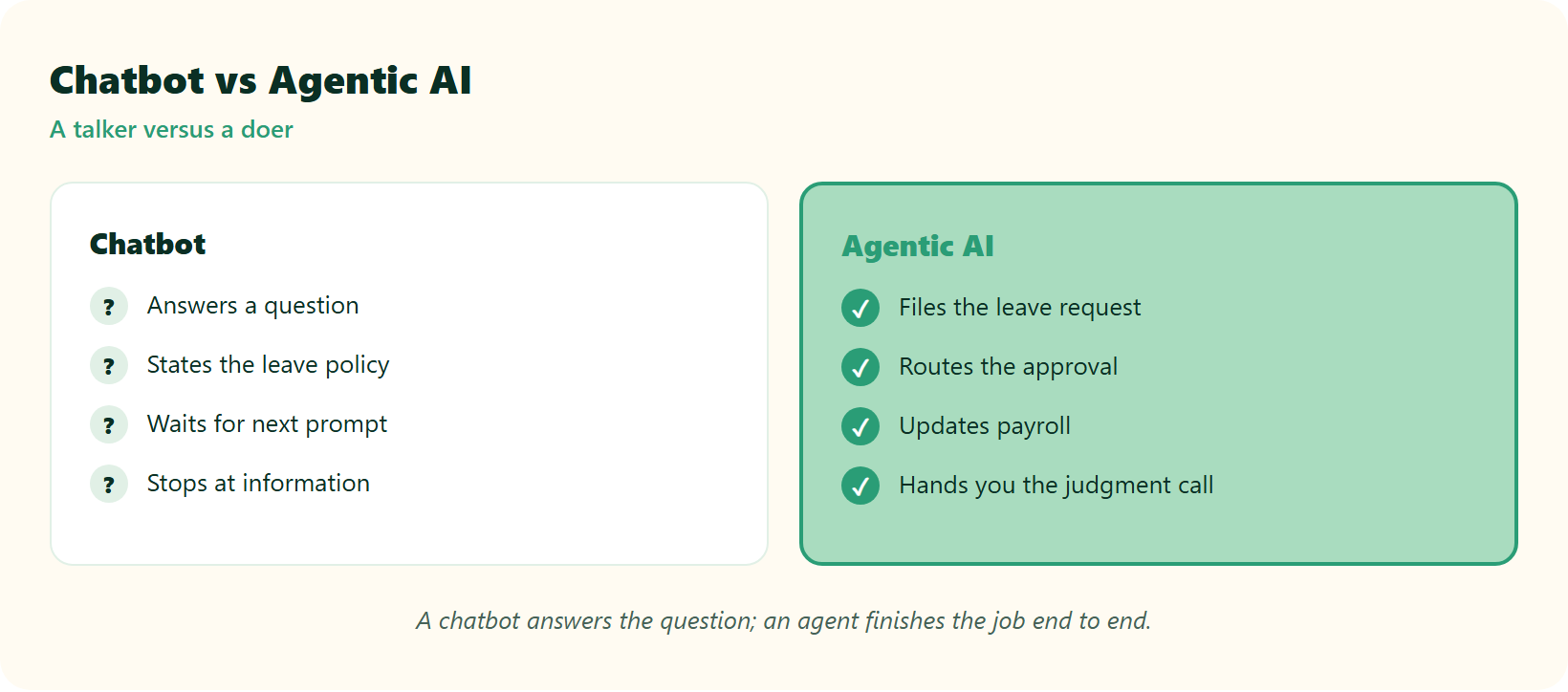
Agentic AI in HR is software that autonomously executes multi-step workflows, like screening candidates, flagging payroll anomalies, or drafting a job description from a title, rather than just answering questions like a scripted chatbot. In 2026, it moves HR from “what is my leave balance?” toward systems that finish tasks end-to-end, so you step in only for the judgment calls.
🤖 Concept: a doer, not a talker
Think of a chatbot as a receptionist who answers questions. Agentic AI is closer to a junior teammate who actually completes the task. A chatbot tells you the leave policy. An agent files the leave, routes the approval, and updates payroll.
The difference is autonomy across steps. A chatbot waits for the next question. An agent carries a job from start to finish, then hands you the decision that needs a human.
⭐ Example: the job description that writes itself
Here is a concrete India scene. Instead of writing a job description by hand, a recruiter feeds the system a job title and expectations, and it produces the full description from a single prompt. In our own employee AI agent and One AI Suite, that same engine also stacks the most relevant CVs on top and parses receipts, so recruiters and finance stop doing manual data entry.
This is why adoption clusters where it does. SHRM’s 2026 data shows recruiting as one of the top AI-use areas in HR, because that is where repetitive work is dense and the payoff is quick. If you want to see it in action, our recruitment software applies the same relevancy scoring to real pipelines.
✅ Application: hand over one task on Monday
Here is my honest, slightly hedged take. I might be wrong on the exact sequence, but agentic AI is for tactical optimization, not strategy. A system cannot replace an HR professional; it optimizes them by clearing the tactical clutter and driving accuracy.
So start small. Pick one repetitive task, JD drafting, resume screening, or attendance chasing, and hand it to an agent for two weeks. Measure the hours you get back before you scale. That single experiment teaches you more than any vendor demo about what agentic AI means for your desk.
Q4. Will AI and automation replace HR jobs in India, or change them?
AI will not replace HR professionals in India in 2026. It removes the tactical drudgery so you can do the human work. A system enforces process consistency once you have designed it, but it cannot create culture. The real 2026 risk is not robots taking jobs. It is premature AI cost-cutting that degrades work quality and burns out the people who stay.
🧩 The fear everyone whispers in the pantry
Most people think automation is coming for HR headcount. I think the standard read gets this backwards. Systems do not create process; they only make it consistent once you have formulated it, then decentralize it across the org.
That distinction matters. The system enforces the rule. A human still has to decide what the rule should be, and why it serves the people it governs.
👥 What machines cannot do
I have watched HR leaders build the best place to work with a frugal CEO and no fancy human-accounting system, running the whole thing off Excel and Word. It worked because, at the end of the day, it is all about how you make people feel. No agent does that for you.
Automation handles the arduous, friction-filled moments. Judgment, empathy, and culture stay human. That is not a limitation of today’s AI; it is the point of keeping HR human, which is exactly why employee engagement stays a people-led job.
⚠️ The real risk: cutting before the payoff
Here is the twist the optimistic blogs miss. Gartner found that only about 1% of layoffs in the first half of 2025 came from AI actually raising productivity, warning that firms cut roles before AI delivers returns, then rehire. HBR frames the same danger as premature layoffs, cultural dissonance, and declining mental fitness.
So the threat is not the machine. It is the manager who trims teams on a productivity promise that has not landed yet. Our whole reason for building HROne was the opposite bet: unlock the true potential of HR professionals by automating the mundane and giving them back time and mental space, not replacing them. Design the work first. Add the AI second. Protect the humans throughout.
Q5. How will the Labour Codes and DPDP Act reshape HR tech and payroll in 2026?
Two laws reshape Indian HR tech in 2026. The Code on Wages 50% rule reclassifies allowances above half of total pay as wages, raising PF (Provident Fund) and Gratuity liability while lowering take-home pay. The DPDP Act 2023 (Digital Personal Data Protection) mandates specific employee consent, 72-hour breach reporting to the Data Protection Board, and penalties up to 250 crore rupees. Your HRMS must automate both.
💰 The 50% rule: what actually changes in payroll
The Code on Wages says “wages” must be at least half of total pay. If your allowances cross 50%, the excess counts back as wages for PF and Gratuity.
That single line reshapes cost sheets. Employer PF and Gratuity liability rises, monthly take-home dips slightly, and allowance-heavy CTC structures need rebuilding before the codes are notified. A quick read on the underlying rules sits in our guide to wages meaning types.
🔐 DPDP: consent, breach clocks, and access rights
The DPDP Act 2023 treats employee data as personal data you must protect. You need specific consent for how you use it, a defined purpose, and a 72-hour breach-reporting workflow.
I might be slightly early on timelines, but my current thinking is clear. Automation here is not just a legal duty; it is a moral one. An employee’s data is their right, and giving them 24×7 self-service access to it is dignity, not just compliance, which is why employee data privacy best practices now sit at the core of any HRMS.
✅ A short readiness checklist
From what surfaces when you actually run payroll, these three moves de-risk you most.
- Run a parallel pay run simulating the 50% wage definition to quantify PF and Gratuity impact before notification.
- Issue DPDP consent notices to existing staff and map a 72-hour breach-response flow.
- Build a two-level approval system on sensitive changes to avoid errors or fraud.
At HROne, we built the core HCM policy engine to be configured from the front end, so an HR lead updates a leave or wage rule without a developer ticket. Role-based access control (RBAC) keeps DPDP-sensitive data visible only to the right people, and our payroll software adjusts the rule, not the codebase, when the codes shift.
Q6. How does predictive AI actually work for attrition and workforce planning, and can you trust it?
Predictive HR AI forecasts who may resign before they give notice by scoring engagement, tenure, and behavioral signals across time windows. Patents like Bank of America’s attrition-detection engine and workforce-scheduling systems reveal the mechanics. In 2026, it is trustworthy for flagging risk and predicting understaffing, but not for final decisions. Treat scores as a conversation starter, not a verdict.
🧠 How attrition prediction really works
Most vendor pages assert prediction without explaining it. The patents do the opposite. One filing describes predicting attrition using engagement and geographic signals across temporal intervals, with a lead-time buffer built in.
So the model is not magic. It watches patterns over time, tenure, activity, and engagement dips, then flags a rising risk score before the resignation letter lands.
🗓️ Predictive scheduling for shift-heavy teams
A second patent covers predictive roster utilization and self-scheduling intelligence. In plain terms, it forecasts understaffing before it happens.
This matters for retail, manufacturing, and BPO floors. A third framework, a no-code predictive layer over ERP and HR data, shows the same direction of travel across the industry, and our workforce management module applies it to managing shift schedules on live rosters.
⚠️ The trust boundary and the invisible ROI problem
Here is my honest hedge. These models are strong for flagging risk, weak for final calls. A score should start a manager conversation, not end someone’s case.
The bigger gap I keep seeing is proof. Most platforms have no way to track ROI after setup, so HR cannot show the CFO what the prediction actually saved. We built HROne’s attrition analytics alongside India’s first inbuilt ROI Dashboard for exactly this reason: it calculates lifetime hours saved against average HR salary, so the savings are quantified, not assumed. You can model your own numbers with our ROI calculator. Ask any vendor how their model handles lead-time buffers, and whether it can prove ROI at all.
Q7. What HR automation actually saves time and money, and what is the hidden cost?
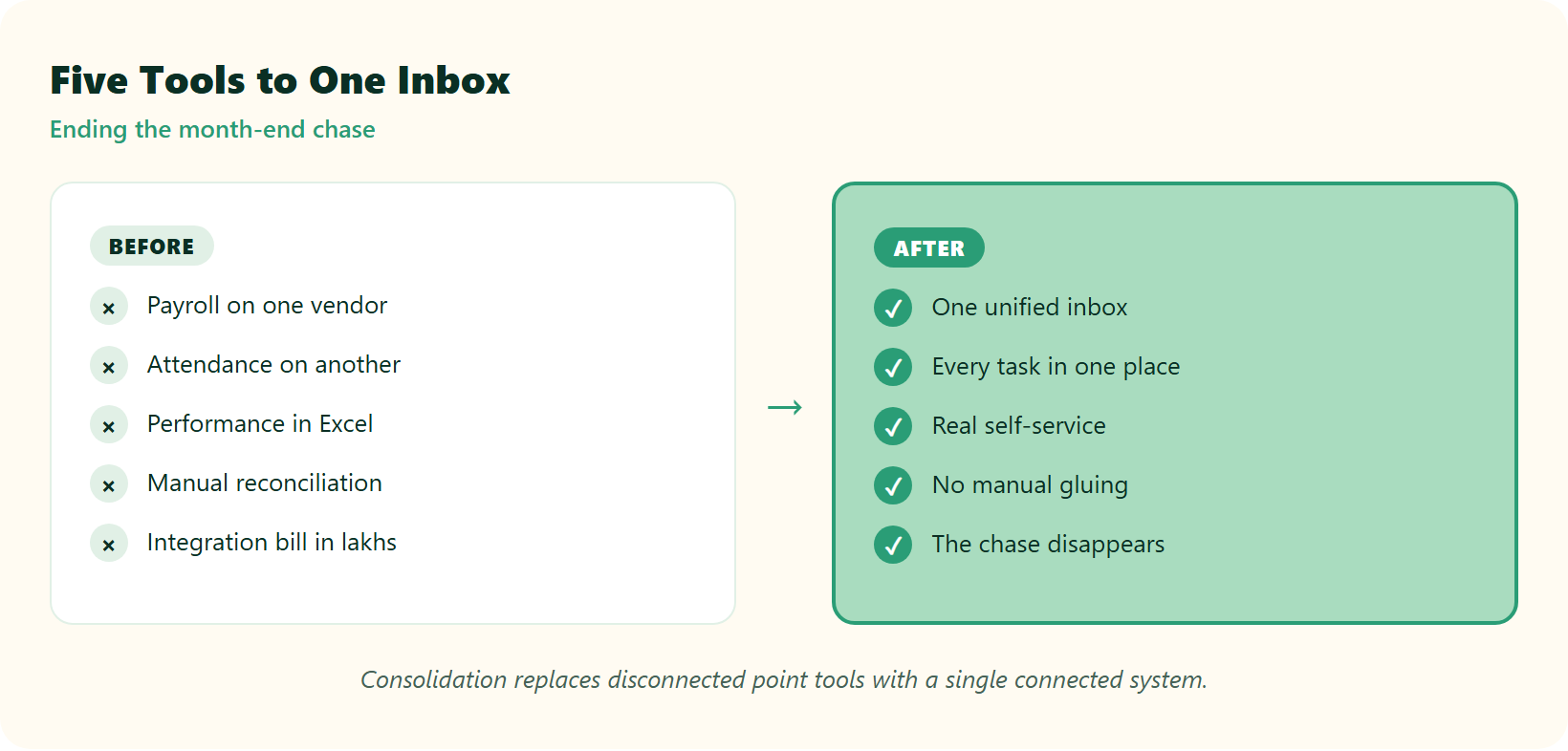
The automation worth buying in 2026 kills recurring drudgery: the “one week, two-to-three people” monthly attendance chase, and payroll errors serious enough that many employees consider quitting after repeated mistakes. Mobile-first self-service ends login friction and connectivity gaps for field teams. But watch the hidden cost. Systems that cannot talk to each other quietly add lakhs in integration bills.
⏰ The attendance tax nobody budgets for
Picture a payroll manager at a 500-person firm. Every month, she loses a full week and two to three people just fetching and cleaning attendance data. That is the attendance tax, and it is pure, invisible waste.
Field staff make it worse. Sales and site teams struggle with logins and patchy connectivity, so their punches arrive late or wrong. Our attendance management module fixes this, and real HROne users describe it in their own words.
“GPS-based login and logout with pinpoint accuracy. It helps me track my on-field employees status.”
— Krunal S., Verified User HROne G2 – Verified Review
💸 The complication: five tools that cannot talk
Here is the trap. A mid-market firm often runs payroll on one vendor, attendance on another, and performance in Excel. Those systems do not talk, so data gets reconciled by hand at month-end and errors slip through.
That fragmentation carries a hidden integration cost that can run into lakhs of rupees. You paid for five tools and still built a sixth job: gluing them together. Our guide on integrating payroll with attendance walks through the fix.
✅ The resolution: one inbox, real self-service
Consolidation is the honest fix. When every task, request, and approval lands in one place, the chase disappears. HROne users report the shift directly.
“The InboxforHR is a game-changer, centralizing every HR task into one simple inbox, cutting down administrative time by 60-70%.”
— Waldon S. HROne G2 – Verified Review
“Automated payroll. Juggling spreadsheets was always a nightmare, but now I dont have to.”
— John C. HROne G2 – Verified Review
We designed HROne’s HR inbox, offline mobile attendance with auto-sync, and 127 pre-built workflows to run up to 1.5 crore tasks a month, so the attendance week and the fragmented stack both go away.
Q8. Which HR software is future-ready for India in 2026, and how do you avoid the Alphabet Soup?
A future-ready HRMS in 2026 is not the one with the fanciest label. HRIS, HCM, and HRMS is mostly Alphabet Soup (marketing labels for similar tools). It is the one that bridges to your systems, tracks its own ROI, and actually gets adopted. Users flag rivals for tab-juggling and support gaps. The real test is a single-screen workflow your team will not abandon for Excel.
🧭 A five-point selection rubric
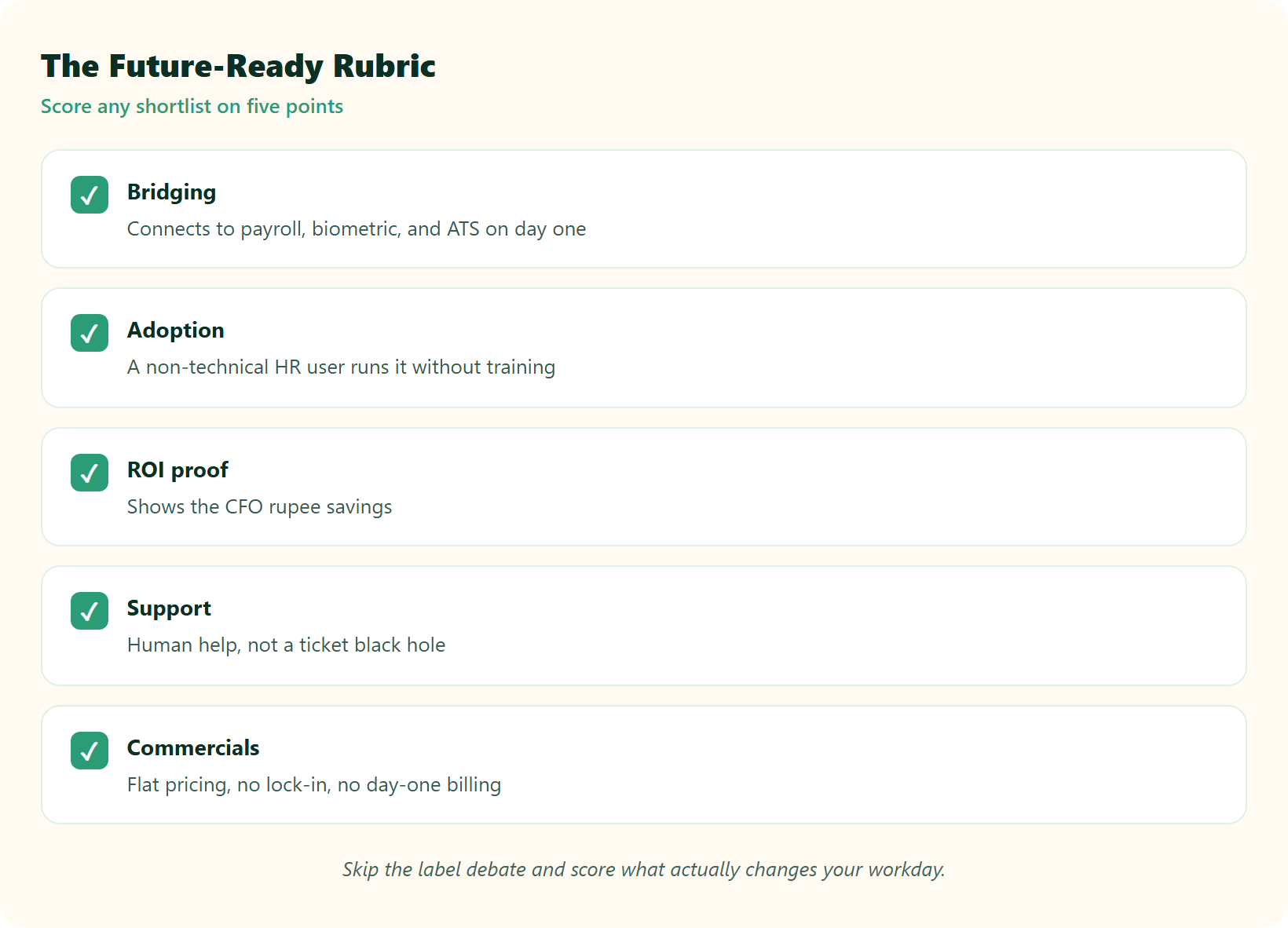
Skip the label debate. Score any shortlist on what changes your workday. Our checklist on how to choose HRIS HRMS software goes deeper on each point.
- Bridging: Does it connect to your payroll, biometric, and ATS on day one?
- Adoption: Will a non-technical HR user run it without training?
- ROI proof: Can it show the CFO rupee savings?
- Support: Human help, or a ticket black hole?
- Commercials: Flat pricing with no lock-in, or billing from day one?
⚖️ HROne vs Darwinbox vs greytHR
Here is a fair, evidence-grounded read. Each competitor leads somewhere; the gaps are architectural, not personal. See the full breakdowns on our HROne vs Darwinbox and HROne vs greytHR pages.
📋 HROne vs Darwinbox vs greytHR: Future-Readiness Comparison
| Criteria | HROne | Darwinbox | greytHR |
|---|---|---|---|
| Everyday task flow | Single Super Inbox, three-click closure | Users note navigation “could be more intuitive” | “Confusing” tab labels reported |
| Support model | Dedicated prior-HR SPOC, 9.8 NPS | “Support team is not supportive” | “Extremely poor customer support” |
| Configuration | 127 pre-built workflows, front-end config | Strong enterprise brand weight | “Not much good at customizing” |
| ROI proof | India’s first inbuilt ROI Dashboard | Limited ROI instrumentation | Adequate SMB payroll focus |
The reviews are real, not cherry-picked:
“User interface of Darwinbox is very outdated. Darwinbox Support team is not supportive.”
— Ankush B. Darwinbox G2 – Verified Review
“GreytHR is not much good at customizing based on our requirements. Many times we were manually correcting the leave balance.”
— Verified User in IT greytHR G2 – Verified Review
✅ The pick for a 300 to 2,000-employee India firm
If you run multiple locations, shift-based teams, or India-specific compliance, prioritize the platform that connects modules and proves savings. My conviction, earned from watching rollouts, is that the standard “biggest brand wins” read gets this backwards. Adoption and ROI beat brand.
We built HROne on flat PEPM pricing, no lock-in, and subscription that meters only after go-live, because every customer is its own snowflake and should not pay before they benefit. Real outcomes back it: MR DIY India cut payroll cycles from 10 days to 5 to 6 days after moving to HROne, and you can read the full MRDIY case study for the details.
See why HR teams switch from tab-juggling to a single screen
Compare HROne’s Inbox for HR, ROI Dashboard, and no-lock-in pricing against your current stack.
See Why HROne View Transparent PricingQ9. How long does HR tech implementation really take in India, and why do rollouts fail?
Sales decks promise three-month go-lives, but a realistic Indian enterprise rollout runs longer once you build job descriptions, performance frameworks, and culture into the system. Most HR systems do not fail because they are unfair. They fail because they are too uniform. Design for equity, not equality, and treat implementation as change management, not a software install.
⏰ The three-month promise meets reality
Every vendor pitches a clean 90-day go-live. I have watched enough rollouts to say, gently, that this is optimistic for a real mid-market firm.
Here is the tell nobody markets. I have seen companies run three system changes in under four years, hopping vendors each time a rollout stalled. That churn is expensive, and it is rarely the software’s core fault, as our HRIS buyer pitfalls guide explains.
⚠️ Why rollouts actually fail
The standard read blames the tool. I think that gets it backwards. Most HR systems fail because they force one uniform process onto teams that do not work the same way.
A shift-based factory floor and a sales team do not share a workflow. When you standardize both to a single rigid template, people quietly route around the system, which is why our core HCM engine lets each team keep its own shift schedules. Real users describe exactly this pain in competitors:
“GreytHR is not much good at customizing based on our requirements. Many times we were manually correcting the leave balance.”
— Verified User in IT greytHR G2 – Verified Review
“We started working with Keka in August, and to this day, we have been unable to implement the tool due to their consistently delayed responses.”
— Divya P. Keka G2 – Verified Review
✅ Design for equity, not equality
Here is my honest fix. Do not give every team the identical process; give each the process that fits, then enforce it consistently. That is equity, not equality.
Think of a Ferrari. Raw power means nothing without a driver trained on the clutch. Software is the same, so trainer enablement decides adoption. We built HROne around this reality: onboarding runs through prior-HR consultants who have actually sat in your chair, not a technical project manager reading a checklist, and your subscription meters only after go-live. If the rollout stalls, you are not paying for shelfware, and you can compare the difference on our HROne vs Keka page.
Q10. What should an Indian HR leader do on Monday to prepare for 2026?
Start small and specific in 2026. Pick one high-volume process (attendance or recruiting, where AI ROI is proven), run a parallel pay run to model the 50% wage rule, issue DPDP consent notices with a 72-hour breach workflow, and demand ROI tracking plus no-lock-in pricing from any vendor. Redesign the work first. Add AI second.
📋 Five moves for Monday morning
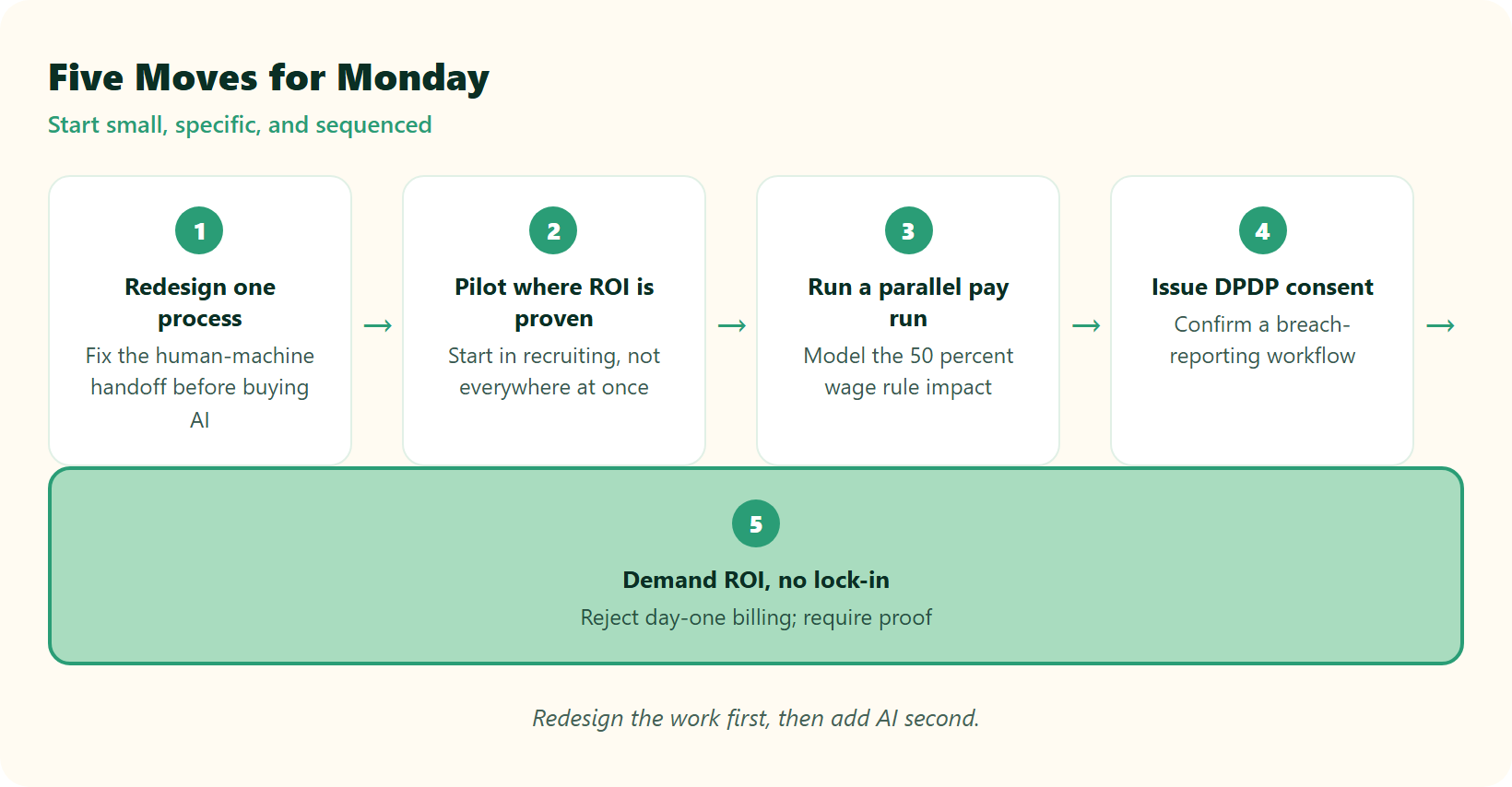
You do not need a transformation program. You need five concrete steps, each tied to a reason and a source.
- Redesign one process before buying AI. Productivity comes from better work design, not more AI usage. Audit one high-volume workflow and fix the human-machine handoff first.
- Pilot AI where ROI is proven. Adoption is concentrating in recruiting, so start there with recruitment software instead of spreading thin.
- Run a parallel pay run. Simulate the Code on Wages 50% definition to quantify PF and Gratuity impact with your payroll software before it is notified.
- Issue DPDP consent notices. Confirm a 72-hour breach-reporting workflow to the Data Protection Board under the DPDP Act 2023.
- Demand ROI proof and no lock-in. Reject day-one billing, model your numbers on our ROI calculator, and build a two-level approval on sensitive changes to prevent fraud.
💡 Meet specificity with specificity
Here is a small thing I keep noticing. Buyers now search in full sentences, like “we are a 300-member company in India looking for HR software that does X.”
Keyword tools call that zero traffic. From what surfaces when you actually talk to buyers, those specific searches are exactly where real decisions happen. So match specificity with specificity, not hype, whether you need manufacturing HR or workforce management for shift teams.
🤝 A question I am sitting with
Here is what I honestly do not have fully solved yet. In the next two years, will HR teams judge software by features, or by whether it can prove rupee savings to the CFO? My bet is the second, which is why we built India’s first inbuilt ROI Dashboard into HROne.
So I will end with an invitation, not a pitch. Tell us what you are building, your team size, your compliance headaches, and your one broken process, and let us reason through it together. That conversation teaches me more than any feature list.
Tell us what you are building
Not a hard sell. Share your team size, compliance headaches, and the one process that keeps breaking, and we will reason through it with you.
Start the Conversation Explore Inbox for HR













 Secures Top Spot in
