

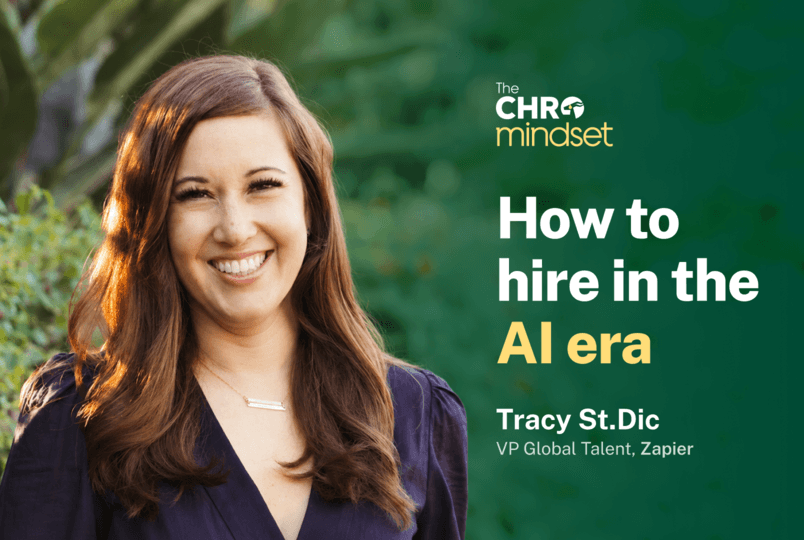


About this episode
This episode looks at what happens to talent acquisition when AI can source, screen, assess and even interview candidates at scale. Tracy St.Dic, VP Global Talent at Zapier, explains why AI isn’t replacing recruiters – it’s replacing their tasks – and how that frees talent teams to focus on the work that was always hardest to do well: reading someone’s real motivation, building trust and making the judgment call.
She walks through how Zapier defines and assesses AI fluency, the AI use cases her team runs in production today – from AI screening interviews to personalized rejection feedback and executive interview prep – and how the team designs hiring for a world where every candidate uses AI. The conversation also covers where bias enters an AI-enabled process, why talent acquisition is the natural starting point for a company’s broader AI transformation, and what a CHRO should (and shouldn’t) do first.
Overall, it’s a practical, use-case-heavy look at building an AI-enabled TA function – with a clear line between what AI should own and what must stay human.
Watch this episode if you are:
- Trying to work out which parts of your hiring process AI should own and which must stay human
- Rethinking how to assess candidates when every one of them has access to powerful AI tools
- Looking for a practical definition of AI fluency you can actually hire and upskill for
- Planning to make your TA function meaningfully AI-enabled over the next two quarters
- Switch to the full episode right now on Spotify and learn from Tracy how to build a TA function where AI does the busywork and recruiters do the judgment work.
Top Three Insights You Will Find in This Episode
1. AI isn’t replacing recruiters. It’s replacing their tasks.
Tracy’s answer to the biggest question in TA is a clear no. AI is replacing tasks, not roles – and in recruiting, that’s far more welcome than most people expect. Her test is simple: if the work is about gathering, summarizing or organizing information, AI can and should own more of it. Think scheduling, job descriptions, first-pass screens, scorecard summaries and interview prep. If it’s a decision that affects someone’s livelihood – who advances, who gets an offer, how you close a candidate – a human owns it.
What’s left for recruiters is the part that was always hardest to do well anyway. That’s why Tracy sees even the title “recruiter” starting to feel a little outdated: as the mechanical work moves to AI, the role expands into something much closer to a talent advisor.
2. AI fluency is how you think and work with AI – not which tools you know.
At Zapier, AI fluency isn’t a tool checklist. It’s assessed through four components: mindset (leaning in, experimenting, learning hard things fast), strategy (knowing where AI fits in your own function), building (working with AI as a thought partner, drawing on Anthropic’s AI Fluency Index) and accountability (the discernment to know when you should and shouldn’t use it). Candidates are rated from unacceptable, to capable – the minimum bar – to adoptive and transformative, and the rubric is public on Zapier’s blog.
For a team, Tracy says you need two things: a leader with a clear vision of where AI belongs in the hiring process, and a team of builders who can solve their own pain points because they’re closest to the work. Without the vision, you’re just chasing every shiny new tool.
3. If AI is part of the job, it should be part of the interview.
Zapier assumes every candidate uses AI – and doesn’t treat it as cheating. Instead, it publishes guidance on how to use (and not use) AI in its interviews, shares sample prompts, asks candidates to sign a statement of integrity, and has moved almost all of its skills tests to a live format, where interviewers can introduce a curveball and watch how candidates reason, own the output and catch mistakes.
Because candidates are so enabled, Zapier also balances internal and external signal much more deliberately. Reference checks have gone from a box-tick to a serious part of the evaluation, used to hear from the people who actually worked alongside a candidate on the projects they describe.
Read the latest blog based on The CHRO Mindset Podcast episode with Tracy St.Dic, and learn which hiring rules AI has already broken – and what to do instead.
Mic Drop Moment
“If you’re not working to upskill your team right now in AI fluency, then at this point it’s sort of management malpractice.””
With this statement, Tracy reframes AI upskilling from a nice-to-have L&D initiative into a basic leadership responsibility – one CHROs owe both to the business and to their people’s future careers.
She pairs it with a challenge: lead from the front. That means having your own hands on the keyboard, building and experimenting alongside your team even if you don’t feel technical – because a leader who models it creates the psychological safety everyone else needs to try things.
And she balances the urgency with reassurance. You’re not behind, it takes very little to catch up right now, and small, simple steps compound faster than most leaders expect.
No Prep. Only Perspectives
Q1. CVs five years from now – still relevant or obsolete?
Tracy St.Dic: Obsolete – though where you’ve worked, and for how long, will still matter.
Q2. One recruiting task AI should already be doing in almost every company?
Tracy St.Dic: Answering candidate emails.
Q3. One recruiting task you would never fully hand over to AI?
Tracy St.Dic: The actual hiring decision.
Q4. Most underrated quality in a recruiter?
Tracy St.Dic: Growth mindset and their rate of learning.
Q5. One hiring practice that will disappear in the next five years?
Tracy St.Dic: Applications as they are today – and maybe even interviews as they are today.
Q6. The recruiter of the future will spend far less time ___ and far more time ___.
Tracy St.Dic: Far less time on annoying tasks like triaging and scheduling, and far more time in real conversations and making judgment calls.
Frequently Asked Questions (FAQs)
Not according to Tracy. AI is replacing recruiting tasks, not recruiting roles – especially the structured, repeatable parts of hiring like scheduling, screening logistics and summarizing information. That frees recruiters to focus on judgment, relationships and candidate experience: the things most of them got into recruiting to do.
In her view, the role is getting better, not smaller. As the admin moves to AI, recruiters spend more time with candidates and less time with calendars, and the job grows into something closer to a talent advisor.
Action: List every task in your recruiting workflow and mark each one as either “gathers or organizes information” (AI) or “decides someone’s outcome” (human).
Zapier defines AI fluency as how you think and work with AI, not which tools you can use. It’s built on four components – mindset, strategy, building and accountability – and candidates are rated on a scale from unacceptable, to capable (the minimum bar), to adoptive and transformative. The rubric is public on Zapier’s blog.
The same framework shapes how Tracy upskills her own talent team. Her goal is a team of builders who can redesign their own workflows, guided by a leader with a clear vision of where AI should and shouldn’t be used.
Action: Add one live AI exercise to your interview loop and score it against all four components, not just tool familiarity.
Assume they do, and design for it. Zapier evaluates how well candidates use AI and how they think with it, publishes guidance and sample prompts for its interviews, asks candidates to sign a statement of integrity, and runs almost all skills tests live so interviewers can see judgment in the moment. Reference checks now carry far more weight, to verify the impact candidates describe.
Tracy also separates two kinds of fraud: “capital F” fraud, where someone isn’t who they say they are, and “lowercase f” fraud, where candidates embellish more than they normally would. Zapier’s integrity checks flag signals such as a stated location that doesn’t match a candidate’s IP address or phone signal.
Action: Publish a short “how to use AI in our interviews” guide for candidates, and move one take-home test to a live format.
All three outcomes are possible, says Tracy – it depends on how you build. Structured AI screens can genuinely reduce bias: every candidate gets the same questions, spoken and written, with no interruptions and no visual judgment, and candidates tell Zapier it feels fair. But bias doesn’t disappear; it can move into how the rubric is written and which questions are asked.
That’s why the guardrails matter: at Zapier, a human reviews every summary and makes every decision, and teams should run audits, bias testing and test groups, and check that pass-through rates haven’t shifted. Used well, AI can even catch bias humans miss – like flagging when a candidate’s strongest advocate on the panel is also their referrer.
Action: Compare pass-through rates at each stage before and after any AI step you add, and keep a human on every hiring decision.
With a vision, not a tool or a vendor’s roadmap. Decide how you want your hiring process to run and what the candidate experience should feel like, then start small with FAR tasks – frequent, annoying and repeatable – before scaling up to more complex reasoning work. Tracy’s caution: don’t jump straight to agentic AI. In HR especially, automation is more reliable, more accurate, safer and cheaper.
TA is also one of the best places to start a company’s broader AI transformation. The work is repeatable, the results are measurable quickly through ATS and HRIS data, and because every leader hires, the talent team becomes the internal proof of concept for the rest of the business.
Action: Pick three FAR tasks from your team’s week and automate the most annoying one this month.











 Secures Top Spot in


