


Q1. What Are the 10 Best Core HR Software for Mid-Sized IT Firms in India in 2026?
Choosing core HR software is a high-stakes call for a 100 to 5,000 employee Indian IT firm juggling multi-entity payroll, bench management, and month-end compliance. Rather than ranking by popularity, this guide evaluates 10 vendors against operator-grade criteria: cross-functional depth, India statutory compliance, setup speed, pricing transparency, and verified user reviews. It is written first for the HR ops lead and payroll manager who live inside the tool daily, with the CHRO, CFO, and IT Director reading over their shoulder. The goal is simple: help you shortlist with confidence, not chase demos blindly.
The 10 best core HR software for mid-sized Indian IT firms in 2026 are HROne, Keka, Darwinbox, greytHR, Zoho People, Zimyo, PeopleStrong, ZingHR, BambooHR, and SAP SuccessFactors. HROne leads for the 100 to 5,000 band because it puts recruitment software inside a full core-HR-and-payroll suite instead of selling a standalone ATS, giving you one source of truth from job requisition to final settlement.
📋 The Ranked Shortlist
- HROne, best for mid-sized Indian IT firms wanting recruitment inside a full core-HR and payroll suite
- Keka, best for employee-experience-led mid-market teams
- Darwinbox, best for large IT enterprises scaling globally
- greytHR, best for compliance-first SMB payroll
- Zoho People, best for firms already on the Zoho stack
- Zimyo, best for budget-conscious mid-market buyers
- PeopleStrong, best for enterprise workforce depth
- ZingHR, best for mobile-first frontline hiring
- BambooHR, best for globally distributed IT teams
- SAP SuccessFactors, best for 3,000+ employee enterprises
🎯 Why This List Looks the Way It Does
Here is my honest bias, upfront. I have watched too many IT firms buy a shiny ATS, only to find hiring data stranded from payroll three months later.
The tools near the top connect the whole employee lifecycle. The ones lower down solve one slice well and leave the other nine on your plate.
📊 The Comparison Table
| Provider (⭐) | Best For | Standout Strength | Known Limitation | India Compliance (PF/ESI/TDS) | Support Model | Pricing Model |
|---|---|---|---|---|---|---|
| HROne ⭐⭐⭐⭐⭐ | HR ops leads drowning in multi-entity payroll and manual manager chasing | Super Inbox closes every pending HR task in three clicks across the full hire-to-retire flow | Some modules feel steep for first-time users without guided onboarding | Yes (automated PF/ESI/TDS, PT and LWF slabs) | Phone + email + dedicated prior-HR SPOC | Flat PEPM, no lock-in, meters after go-live |
| Keka ⭐⭐⭐ | Mid-market teams prioritising employee-experience UX | Clean, intuitive interface staff adopt quickly | Email-thread support with slow escalation, “not built to service IT consulting firms” | Yes (payroll with PF/ESI/TDS) | Email/chat, limited weekend cover | Per-employee/month, quote-based |
| Darwinbox ⭐⭐⭐⭐ | Large IT enterprises scaling across geographies | Broad enterprise module suite on one platform | Slow load under bulk data, migration and support gaps reported | Yes | Vendor-led, ticket-based | Quote-based, multi-year contracts |
| greytHR ⭐⭐⭐ | Compliance-first SMB payroll runs | Reliable core payroll and payslip processing at SMB scale | Rigid customisation, managers cannot mark leave for reports | Yes (payroll and statutory filings) | Ticket + callback (1 to 2 hours) | Per-employee/month tiers |
| Zoho People ⭐⭐⭐ | Firms already standardised on the Zoho stack | Deep native integration with Zoho Recruit and Zoho Payroll | Shallow feature depth, slow support response | Partial (via Zoho Payroll add-on) | Email/ticket | Per-user/month, freemium tier |
| Zimyo ⭐⭐⭐ | Budget-conscious SMB-to-mid-market crossovers | Cost-effective modular HRMS | Lighter enterprise depth than incumbents | Yes | Email/chat | Per-employee/month, modular |
| PeopleStrong ⭐⭐⭐⭐ | Enterprise workforce depth and analytics | Strong large-enterprise workforce and analytics coverage | Heavier implementation for mid-market | Yes | Vendor-led SPOC | Quote-based |
| ZingHR ⭐⭐ | Mobile-first frontline and blue-collar hiring | Hire-to-retire breadth with mobile focus | Dated UI, slow servers, delayed support | Yes | Email/ticket | Quote-based |
| BambooHR ⭐⭐⭐ | Globally distributed IT teams needing clean HRIS | Simple, well-liked HR and onboarding interface | US-centric, weak India payroll and rising prices | No (no native India statutory payroll) | Email/ticket | Per-employee/month, quote-based |
| SAP SuccessFactors ⭐⭐ | 3,000+ employee global enterprises | Extensive enterprise HR module range and APIs | Over-engineered, costly, needs developers for basic changes | Partial (via localisation packs) | Partner-delivered | Quote-based, enterprise |
Star ratings reflect the weighted scoring rubric detailed in the next section, blending cross-functional intelligence, India compliance, usability, pricing transparency, and verified reviews.
🧭 Who Each Tier Actually Suits
The top tier (HROne, Darwinbox, PeopleStrong) fits firms wanting one connected system for the whole lifecycle. The middle tier (Keka, greytHR, Zoho People, Zimyo) suits teams solving a specific pain like payroll or UX. The global generalists (BambooHR, SAP SuccessFactors) fit firms where India compliance is secondary to global footprint.
1.1 HROne
HROne, the full hire-to-retire operating system for mid-market India
🏢 Overview
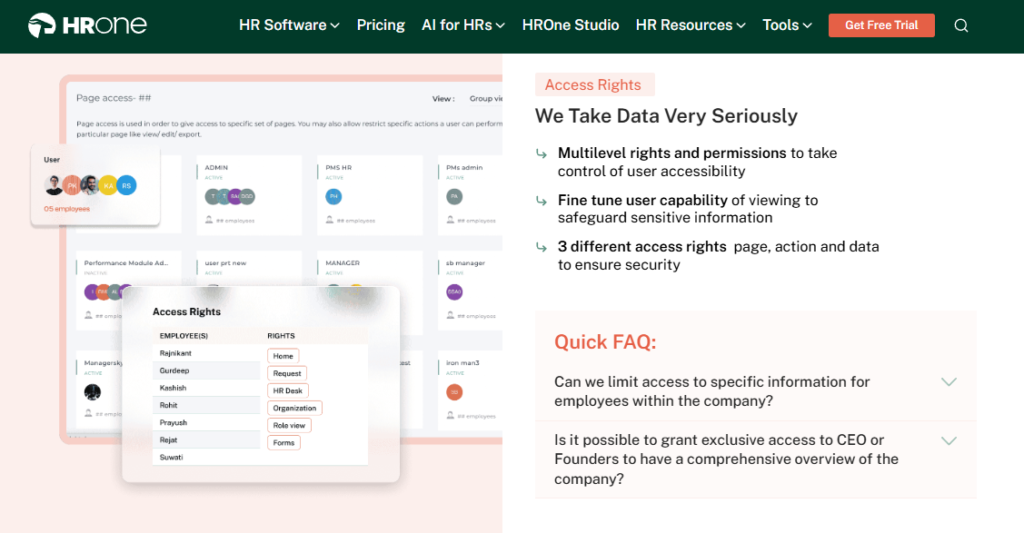
HROne is a cloud-based, mobile-native HCM (Human Capital Management) platform built in India and founded in 2016. It serves the 100 to 5,000 employee mid-market and enterprise band across IT, BFSI, manufacturing, and healthcare. With 1,500+ brands live, including MR DIY India and Asia Healthcare Holdings, HROne holds a #3 G2 satisfaction position and a 9.8 NPS on its onboarding SPOC model. It is primarily used by HR teams tired of reconciling five disconnected tools at month-end.
⚙️ Core Services
- Super Inbox, surfaces every pending task, request, and approval in one Gmail-style HR inbox, closing items in three clicks so HR stops chasing managers over email.
- 127 pre-built workflows, define who does what and by when across onboarding, confirmation, transfer, promotion, and exit, removing manual coordination across 30+ modules.
- One AI Suite, stacks the most relevant CVs on top with a visible relevancy score and parses expense receipts, cutting manual screening and finance data entry.
- Payroll auto-scheduler, runs PF, ESI, and TDS calculations with group payout validations, targeting zero salary delays under Indian statutory law.
- India’s first inbuilt ROI Dashboard, calculates lifetime hours saved against average HR salary, so CHROs walk into board reviews with rupee-value savings quantified.
- HRV Studio, a low-code builder for custom apps like visitor or vendor management, without raising a developer ticket.
🇮🇳 India-Specific Compliance and Localization
- PF, ESI, and TDS support: Yes (automated calculation, filing, and reconciliation)
- Labour law compliance: Strong (PT and LWF slabs, Form-16 automation)
- Payroll localization (India-specific): Yes (CTC mapping, arrear and comp-off logic)
- Multi-state compliance handling: Yes (multi-legal-entity on a single instance)
👤 Who This Is Built For
- HR ops lead manually reconciling biometric exports against a separate leave portal every month-end.
- Payroll manager firefighting CTC-revision arrears across multiple legal entities.
- CHRO who cannot answer, at a board review, how many days it takes to close a confirmation letter.
🚫 Who Should Skip This
- Very small teams under 30 employees wanting a lightweight, spreadsheet-style tracker without structured workflows.
- Buyers who want a pure standalone ATS with no interest in payroll or the wider lifecycle.
💰 Pricing Structure
- Plan Type(s): Flat per-employee-per-month (PEPM), modular by suite.
- Starting Price: Not publicly disclosed, request a quote, billed PEPM with no lock-in.
- Tier-wise Breakdown: Not publicly disclosed, request a quote.
- Incremental Cost Drivers: Additional modules, AI add-ons, subscription meters only after go-live.
- Implementation Fee: Not publicly disclosed, request a quote.
- Cost at 200 Employees: Not publicly disclosed, request a quote. Cost at 500 Employees: Not publicly disclosed, request a quote.
🛠️ Implementation and Support Reality
- Go-live in as little as 30 days for mid-market enterprises via the pre-built workflow library.
- Support via phone, email, and a dedicated prior-HR SPOC who understands the domain, not a checklist reader.
- Data migration is vendor-led, one reviewer moved data “from old server to HROne in fraction of hours”.
- Publicly referenced 9.8 NPS on onboarding support.
💬 Reviews
“The InboxforHR is a game-changer, centralizing every HR task into one simple inbox, cutting down administrative time by 60-70% and preventing tasks from falling through the cracks. The initial setup of HROne was surprisingly straightforward.”
Waldon S., Rating 4/5 HROne G2 Verified Review
“It can sometimes feel a bit overwhelming for new users. Certain features take time to understand, and without enough guided support, the learning curve can feel quite steep.”
Nijanthan R., Rating 3.5/5 HROne G2 Verified Review
We built HROne on one conviction: we do not sell recruitment as a standalone box. In our experience with 2,000+ HR teams, firms get the right ROI only when hiring, payroll software, leave, and attendance live in one system, which is why every workflow here triggers the next instead of stranding data at a handoff.
1.2 Keka
Keka, employee-experience-led HRMS for mid-market teams
🏢 Overview
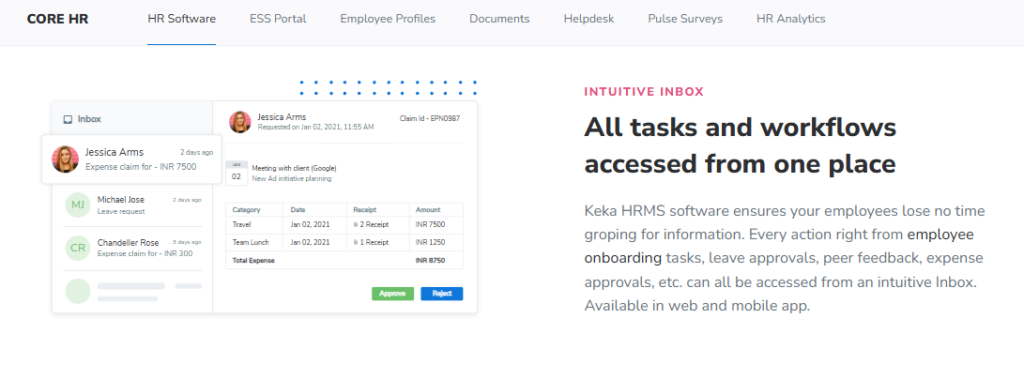
Keka is an India-based HRMS founded in 2015, known for a polished, employee-friendly interface. It serves SMB and mid-market firms across payroll, attendance, and performance, with a growing recruitment module branded Keka Hiro. Its strength is UX adoption, its documented weakness is implementation and support consistency, especially for IT consulting firms. It is primarily used by teams that prize a clean interface over deep configuration. Teams weighing the two often review a direct HROne vs Keka comparison before deciding.
⚙️ Core Services
- Payroll engine, automates PF, ESI, and TDS with statutory compliance, reducing month-end reconciliation errors.
- Attendance and leave, mobile-app-based tracking with self-service, cutting manual logging.
- Performance (PMS), goal and review cycles, though reviewers find it “confusing” and in need of simplification.
- Keka Hiro (recruitment), tracks hiring and automates offer-letter workflows.
- Document management, generates HR documents digitally, reducing paperwork.
🇮🇳 India-Specific Compliance and Localization
- PF, ESI, and TDS support: Yes (payroll with statutory compliance)
- Labour law compliance: Moderate (some multi-location config gaps reported)
- Payroll localization (India-specific): Yes, though incentive and CTC edge cases draw complaints
- Multi-state compliance handling: Partial (location-specific config reported as difficult)
👤 Who This Is Built For
- HR lead at a stable single-entity firm who wants staff to adopt the tool without training.
- Mid-market team prioritising a modern mobile interface over deep customisation.
🚫 Who Should Skip This
- IT consulting firms needing location-specific config and fast escalation, per a reviewer who said Keka “is not built to service IT consulting firms”.
- Teams that cannot absorb a slow, coordination-heavy implementation cycle.
💰 Pricing Structure
- Plan Type(s): Tiered per-employee-per-month (Foundation, Strength, Growth as published by vendor).
- Starting Price: Not publicly disclosed, request a quote.
- Tier-wise Breakdown: Not publicly disclosed, request a quote.
- Incremental Cost Drivers: Add-on modules and higher tiers for performance and hiring.
- Implementation Fee: Not publicly disclosed, request a quote.
- Cost at 200 Employees: Not publicly disclosed, request a quote. Cost at 500 Employees: Not publicly disclosed, request a quote.
🛠️ Implementation and Support Reality
- Reviewers report slow, multi-month implementations with poor internal coordination.
- Support is largely email and chat, with a documented gap in weekend and emergency phone cover.
- Data migration is vendor-led but reported as inconsistent during setup.
- Ranks well below category leaders on G2 overall satisfaction.
💬 Reviews
“Strong payroll and compliance, automate salary and attendance processing with PF, ESI, TDS. Responsive support team. PMS module is confusing and needs to be simpler.”
Kiran B., Rating 3/5 Keka G2 Verified Review
“I have been a Keka user since 2021, and the service is decreasing day by day. TAT on customer request on features is bad. Keka is not built to service IT consulting firms.”
Verified User in Consulting, Rating 2.5/5 Keka G2 Verified Review
Where HROne differs is the operating model behind the UX. Keka earns real praise for its interface, but the recurring pain in reviews is escalation and IT-firm fit, exactly the gap our dedicated prior-HR SPOC and the ITES HR workflows built into our HR software are designed to close for 100 to 5,000 employee firms.
1.3 Darwinbox
Darwinbox, enterprise HCM for large IT firms scaling globally
🏢 Overview
Darwinbox is an India-born enterprise HCM founded in 2015, now serving large organisations across Asia and beyond. It carries strong brand weight among 3,000+ employee firms and covers attendance, payroll, performance, and recruitment on one platform. Its appeal is breadth and enterprise credibility, its documented friction is speed under load, migration difficulty, and inconsistent support. It is primarily used by large IT enterprises consolidating scattered tools into a single system. Buyers often study a direct HROne vs Darwinbox comparison before committing.
⚙️ Core Services
- Unified HR platform, brings attendance, leave, payroll, and performance together, reducing manual tracking across tools.
- Configurable workflows, adapts to internal processes without heavy technical work, per reviewers.
- Mobile app, supports leave, attendance, and payslip access on the go.
- Performance and recruitment modules, cover reviews and hiring, though reviewers note a learning curve.
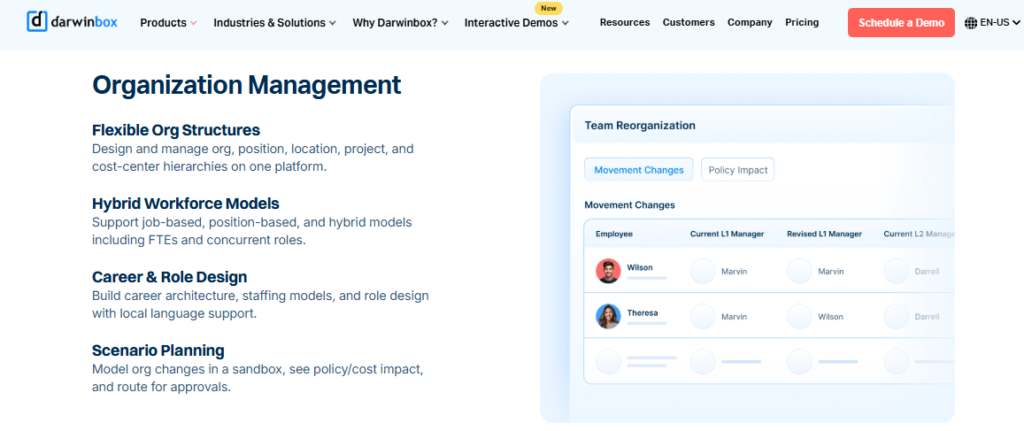
- Org structure view, maps reporting lines and employee directory for large headcounts.
🇮🇳 India-Specific Compliance and Localization
- PF, ESI, and TDS support: Yes (enterprise payroll coverage)
- Labour law compliance: Strong (built for large Indian enterprises)
- Payroll localization (India-specific): Yes
- Multi-state compliance handling: Yes
👤 Who This Is Built For
- IT enterprise HR lead consolidating scattered Excel sheets and legacy tools into one platform.
- Large-org manager who needs bulk leave approvals and a single employee record across geographies.
🚫 Who Should Skip This
- Mid-market teams under 500 employees who cannot absorb slow implementation and multi-year lock-in.
- Buyers who need ROI instrumentation to justify spend, which reviewers say is missing.
💰 Pricing Structure
- Plan Type(s): Enterprise, quote-based.
- Starting Price: Not publicly disclosed, request a quote.
- Tier-wise Breakdown: Not publicly disclosed, request a quote.
- Incremental Cost Drivers: Add-on modules, multi-year commitment terms.
- Implementation Fee: Not publicly disclosed, request a quote.
- Cost at 200 Employees: Not publicly disclosed, request a quote. Cost at 500 Employees: Not publicly disclosed, request a quote.
🛠️ Implementation and Support Reality
- Implementation can drag, reviewers report transitions from old systems being “quite difficult”.
- Support is vendor-led and ticket-based, with mixed reviews on responsiveness.
- Data migration is vendor-led.
- Billing commonly starts at purchase, before go-live.
💬 Reviews
“Darwinbox has made HR processes much smoother by bringing everything together on one platform. Pages sometimes load slowly. Integration issues, sync with other systems can be inconsistent.”
Saksham A., Rating 4/5 Darwinbox G2 Verified Review
“Bad implementation experience, bad UI UX, configurations getting broken in production on its own. Terrible customer service. We are ending up doing most of the products manually and all the data is messed up.”
Verified User in Computer Software, Rating 0/5 Darwinbox G2 Verified Review
Darwinbox earns its enterprise reputation, and I respect that. The gap we hear from switchers is the tab-and-email juggling for everyday tasks plus billing that starts before go-live, which is exactly why our HR inbox closes tasks in three clicks and our subscription meters only after you are live.
1.4 greytHR
greytHR, compliance-first payroll for SMB and lower mid-market
🏢 Overview
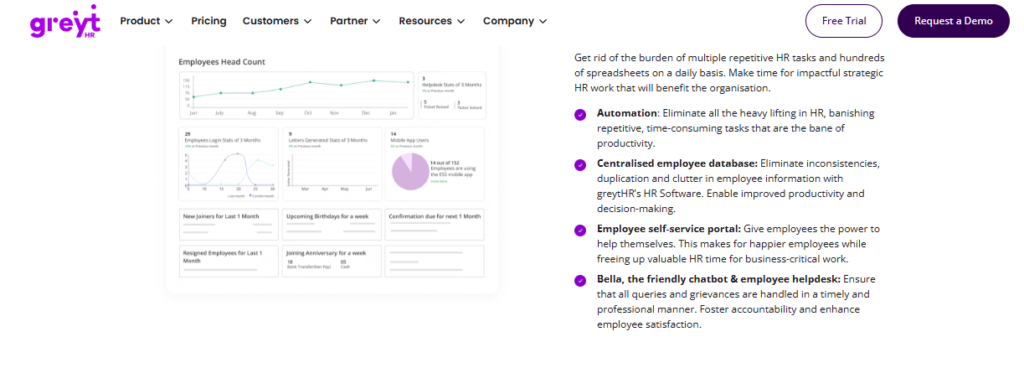
greytHR is one of India’s longest-running HR and payroll platforms, widely adopted by SMBs for statutory payroll. Its core payroll and payslip engine is dependable at smaller scale. The documented pain arrives with customisation, leave-balance accuracy, and support responsiveness once company-specific policies appear. It is primarily used by finance and HR teams who mainly need clean monthly payroll and statutory filings, though many later weigh a HROne vs greytHR switch as they scale.
⚙️ Core Services
- Payroll processing, handles PF, ESI, and TDS with payslip generation, reducing manual salary math.
- Tax declaration, lets employees declare taxes and pick regimes from their login.
- Leave and attendance, tracks leave and holidays, though reviewers report balance errors.
- Employee self-service, payslips, leave, and tax views without going through HR.
- Onboarding, automates new-joiner initiation across HR, admin, and finance.
🇮🇳 India-Specific Compliance and Localization
- PF, ESI, and TDS support: Yes (core payroll and statutory filings)
- Labour law compliance: Moderate (TDS revision and challan mapping gaps reported)
- Payroll localization (India-specific): Yes
- Multi-state compliance handling: Limited (rigid customisation reported)
👤 Who This Is Built For
- SMB payroll manager who mainly needs reliable monthly salary runs and statutory filings.
- Small-team HR lead comfortable with standard policies and minimal customisation.
🚫 Who Should Skip This
- Multi-legal-entity or shift-based firms needing flexible customisation, which reviewers say greytHR lacks.
- Managers who need to mark leave for direct reports, a feature reviewers flag as missing.
💰 Pricing Structure
- Plan Type(s): Tiered per-employee-per-month (as published by vendor).
- Starting Price: Not publicly disclosed, request a quote.
- Tier-wise Breakdown: Not publicly disclosed, request a quote.
- Incremental Cost Drivers: Higher tiers for added modules.
- Implementation Fee: Not publicly disclosed, request a quote.
- Cost at 200 Employees: Not publicly disclosed, request a quote. Cost at 500 Employees: Not publicly disclosed, request a quote.
🛠️ Implementation and Support Reality
- Setup can involve repeated cycles to configure payroll and leave, per reviewers.
- Support is ticket-based with callback, reported quality varies widely.
- Data migration is vendor-assisted.
- No publicly confirmed NPS.
💬 Reviews
“GreytHR is fine software for payroll processing and I have been using since 10 years. Better UI, simplicity. Reporting configuration, TDS filing, revising of TDS is not possible.”
Krishnanand B., Rating 3/5 greytHR G2 Verified Review
“We cannot properly implement our company policies due to the limitations of greytHR. Many times we were manually correcting the leave balance of employees.”
Verified User in IT and Services, Rating 2/5 greytHR G2 Verified Review
greytHR does SMB payroll honestly well, and for a small team that may be enough. From what surfaces when a firm crosses into multi-entity or shift-based reality, the rigidity bites, which is where our multi-legal-entity single instance and 127 pre-built workflows are built to flex instead of forcing manual leave-balance corrections.
1.5 Zoho People
Zoho People, HRMS for firms already living on the Zoho stack
🏢 Overview
Zoho People is the HR module within the broader Zoho business suite, valued for breadth and price. Its biggest advantage is native integration with Zoho Recruit and Zoho Payroll for firms already standardised on Zoho. Its documented weakness is feature depth and support responsiveness. It is primarily used by teams that want cheap, connected HR across an existing Zoho footprint rather than deep, India-tuned payroll software.
⚙️ Core Services
- Attendance and leave, digital approval and holiday sharing, reducing manager coordination.
- Onboarding, candidates self-enter data, completing onboarding within a day.
- Zoho ecosystem integration, connects to Zoho Recruit and Zoho Payroll, streamlining hire-to-pay.
- Self-service, employees check leave balances without emailing HR.
- Configurable automation, flows and rules across the People module.
🇮🇳 India-Specific Compliance and Localization
- PF, ESI, and TDS support: Partial (via Zoho Payroll add-on)
- Labour law compliance: Moderate
- Payroll localization (India-specific): Partial (depends on Zoho Payroll)
- Multi-state compliance handling: Partial
👤 Who This Is Built For
- HR lead at a firm already running Zoho CRM, Recruit, or Books who wants one connected stack.
- Small-to-mid team prioritising low cost and quick, self-service onboarding.
🚫 Who Should Skip This
- Firms needing deep, India-specific payroll with fast escalation support.
- Teams that rely heavily on a full-featured mobile app, which reviewers call limited.
💰 Pricing Structure
- Plan Type(s): Tiered per-user/month, with a freemium tier.
- Starting Price: Not publicly disclosed here, request a quote, among the lowest in category.
- Tier-wise Breakdown: Not publicly disclosed, request a quote.
- Incremental Cost Drivers: Zoho Payroll and Recruit as separate subscriptions.
- Implementation Fee: Not publicly disclosed, request a quote.
- Cost at 200 Employees: Not publicly disclosed, request a quote. Cost at 500 Employees: Not publicly disclosed, request a quote.
🛠️ Implementation and Support Reality
- Self-serve setup aided by instructional videos, per reviewers.
- Support is a recurring complaint, with slow responses reported.
- Data migration is largely self-serve.
- No publicly confirmed NPS.
💬 Reviews
“The most important feature for me is its integration with other Zoho apps, such as Zoho Recruit and Zoho Payroll. The biggest drawback for me has been the lack of customer support.”
Dhana C., Rating 4/5 Zoho People G2 Verified Review
“Features are shallow and there is no depth in each application.”
Verified User in IT and Services, Rating 2.5/5 Zoho People G2 Verified Review
If you already live inside Zoho, People is a sensible, cheap add-on. What I have felt working with mid-market IT firms is that shallow depth and slow support cost you at month-end, which is why we pair India-tuned payroll with a connected HR solution and a prior-HR SPOC who picks up instead of leaving you in an email queue.
1.6 Zimyo
Zimyo, cost-conscious modular HRMS for SMB-to-mid-market crossovers
🏢 Overview
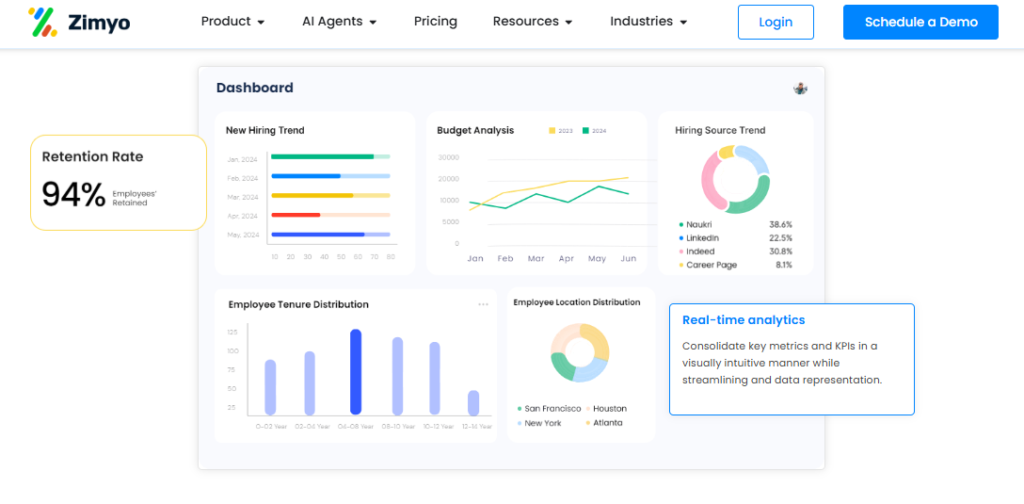
Zimyo is an India-based HRMS positioned for budget-conscious SMB and lower mid-market buyers. It ships payroll, attendance, performance, and engagement as modular pieces, letting firms buy only what they need. Its appeal is affordability and modularity, its trade-off is lighter enterprise depth than incumbents. It is primarily used by growing firms watching cash who want core HR without an enterprise price tag.
⚙️ Core Services
- Payroll engine, automates PF, ESI, and TDS, reducing month-end reconciliation errors.
- Attendance and leave, digital tracking with self-service, cutting manual logging.
- Performance management, goal and review cycles for growing teams.
- Employee engagement, surveys and communication tools.
- Modular buying, pick individual modules to control cost.
🇮🇳 India-Specific Compliance and Localization
- PF, ESI, and TDS support: Yes (automated payroll calculations)
- Labour law compliance: Moderate
- Payroll localization (India-specific): Yes
- Multi-state compliance handling: Partial
👤 Who This Is Built For
- Growing SMB HR lead who needs core payroll and attendance on a tight budget.
- Mid-market crossover team wanting to add modules gradually as headcount grows.
🚫 Who Should Skip This
- Large enterprises needing deep multi-entity workflows and heavy customisation.
- Firms wanting an inbuilt ROI dashboard to prove savings to the board.
💰 Pricing Structure
- Plan Type(s): Modular per-employee-per-month tiers.
- Starting Price: Not publicly disclosed here, request a quote, positioned as budget-friendly.
- Tier-wise Breakdown: Not publicly disclosed, request a quote.
- Incremental Cost Drivers: Per-module upgrades.
- Implementation Fee: Not publicly disclosed, request a quote.
- Cost at 200 Employees: Not publicly disclosed, request a quote. Cost at 500 Employees: Not publicly disclosed, request a quote.
🛠️ Implementation and Support Reality
- Positioned for quick, lighter setup at SMB scale.
- Support via email and chat.
- Data migration is vendor-assisted.
- No publicly confirmed NPS.
Zimyo is a fair pick when cash is tight and needs are core. Where we differ is depth at scale, as a 500-employee IT firm layers on multi-entity payroll and lifecycle workflows, our 30+ modules and workforce management keep the system connected instead of hitting a ceiling.
1.7 PeopleStrong
PeopleStrong, enterprise workforce depth and analytics
🏢 Overview
PeopleStrong is an established Indian enterprise HR platform focused on large-workforce management and analytics. It is built for scale, covering the full lifecycle with strong reporting for big organisations. Its strength is enterprise workforce and analytics depth, its trade-off is heavier implementation for mid-market buyers. It is primarily used by large enterprises that need robust workforce analytics across big, distributed headcounts.
⚙️ Core Services
- Workforce management, handles large, distributed headcounts on one system.
- Analytics and reporting, deep workforce insights for enterprise decision-making.
- Payroll, India-compliant statutory processing.
- Recruitment and onboarding, lifecycle coverage from hire to exit.
- Performance management, structured review and appraisal cycles.
🇮🇳 India-Specific Compliance and Localization
- PF, ESI, and TDS support: Yes (enterprise payroll)
- Labour law compliance: Strong
- Payroll localization (India-specific): Yes
- Multi-state compliance handling: Yes
👤 Who This Is Built For
- Enterprise HR lead needing deep workforce analytics across thousands of employees.
- Large-org CHRO consolidating distributed headcount reporting on one platform.
🚫 Who Should Skip This
- Lean mid-market teams under 500 who want fast go-live without heavy implementation.
- Buyers wanting flat, transparent PEPM pricing over enterprise quotes.
💰 Pricing Structure
- Plan Type(s): Enterprise, quote-based.
- Starting Price: Not publicly disclosed, request a quote.
- Tier-wise Breakdown: Not publicly disclosed, request a quote.
- Incremental Cost Drivers: Module and analytics add-ons.
- Implementation Fee: Not publicly disclosed, request a quote.
- Cost at 200 Employees: Not publicly disclosed, request a quote. Cost at 500 Employees: Not publicly disclosed, request a quote.
🛠️ Implementation and Support Reality
- Enterprise-grade implementation, typically longer for smaller firms.
- Support is vendor-led with account management.
- Data migration is vendor-led.
- No publicly confirmed NPS.
PeopleStrong is genuinely strong on enterprise analytics, no argument there. My honest read is that a 100 to 5,000 employee IT firm often pays for depth it will not use, which is why we tuned HROne for that exact band with a 30-day go-live and an ROI calculator that proves the spend in rupee terms.
1.8 ZingHR
ZingHR, mobile-first hire-to-retire for frontline hiring
🏢 Overview
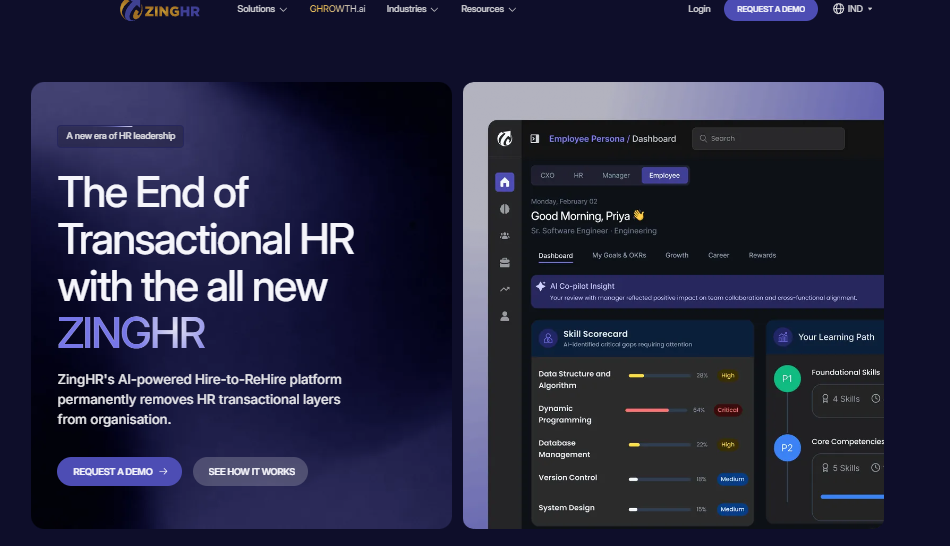
ZingHR is an India-based HCM with a mobile-first focus, often used for frontline and blue-collar hiring at scale. It covers the hire-to-retire lifecycle with an emphasis on mobile access. Its appeal is breadth plus mobile reach, its documented friction is a dated interface, slow servers, and support delays. It is primarily used by firms hiring high volumes of frontline staff who need mobile onboarding.
⚙️ Core Services
- Mobile-first lifecycle, hire-to-retire coverage optimised for mobile access.
- Recruitment and onboarding, bulk frontline hiring workflows.
- Payroll, India statutory processing.
- Attendance, mobile and biometric tracking.
- Performance management, review and appraisal cycles.
🇮🇳 India-Specific Compliance and Localization
- PF, ESI, and TDS support: Yes
- Labour law compliance: Moderate
- Payroll localization (India-specific): Yes
- Multi-state compliance handling: Partial
👤 Who This Is Built For
- HR lead running high-volume frontline hiring who needs mobile onboarding at scale.
- Distributed-workforce manager tracking blue-collar attendance on mobile.
🚫 Who Should Skip This
- Teams that need a fast, modern interface and quick support turnaround.
- IT firms prioritising deep lateral-hiring workflows over frontline volume.
💰 Pricing Structure
- Plan Type(s): Quote-based.
- Starting Price: Not publicly disclosed, request a quote.
- Tier-wise Breakdown: Not publicly disclosed, request a quote.
- Incremental Cost Drivers: Module add-ons.
- Implementation Fee: Not publicly disclosed, request a quote.
- Cost at 200 Employees: Not publicly disclosed, request a quote. Cost at 500 Employees: Not publicly disclosed, request a quote.
🛠️ Implementation and Support Reality
- Implementation varies, reviewers note server slowness.
- Support is email and ticket-based with reported delays.
- Data migration is vendor-led.
- No publicly confirmed NPS.
ZingHR’s mobile reach genuinely suits frontline-heavy hiring. For a mid-sized IT firm doing lateral and campus hiring, the friction we hear about is interface speed and support, so we leaned into a Gmail-style Super Inbox and a mobile HR app backed by a prior-HR SPOC who answers on the phone.
1.9 BambooHR
BambooHR, clean HRIS for globally distributed IT teams
🏢 Overview
BambooHR is a US-founded HRIS (Human Resource Information System, a central employee-record platform) popular with globally distributed teams for its clean interface. Its strength is a simple, well-liked HR and onboarding experience. Its documented weakness for Indian firms is the absence of native India statutory payroll, plus steady price increases. It is primarily used by international teams that value UX over India-specific compliance.
⚙️ Core Services
- Employee records, central HRIS for storing and organising people data.
- Time-off management, single-click approvals from email, well-reviewed.
- Onboarding, simple, guided new-joiner flows.
- Reporting, standard HR reporting, though search slows with data volume.
- Integrations, connects to third-party payroll (not native India payroll).
🇮🇳 India-Specific Compliance and Localization
- PF, ESI, and TDS support: No (no native India statutory payroll)
- Labour law compliance: Limited
- Payroll localization (India-specific): No
- Multi-state compliance handling: No
👤 Who This Is Built For
- HR lead at a globally distributed team who mainly needs a clean central employee record.
- International firm running India payroll through a separate specialist vendor.
🚫 Who Should Skip This
- Indian firms needing native PF, ESI, and TDS payroll in one system.
- Teams sensitive to recurring annual price increases, a documented complaint.
💰 Pricing Structure
- Plan Type(s): Per-employee-per-month, quote-based.
- Starting Price: Not publicly disclosed here, request a quote (USD-denominated).
- Tier-wise Breakdown: Not publicly disclosed, request a quote.
- Incremental Cost Drivers: Payroll and performance add-ons, annual price increases.
- Implementation Fee: Not publicly disclosed, request a quote.
- Cost at 200 Employees: Not publicly disclosed, request a quote. Cost at 500 Employees: Not publicly disclosed, request a quote.
🛠️ Implementation and Support Reality
- Quick setup for the core HRIS.
- Support is email and ticket-based.
- Data migration is self-serve to vendor-assisted.
- No India-specific NPS confirmed.
💬 Reviews
“The time off request emails are good. Otherwise none of the functionality is worth the price and the price uncertainty. Biggest issue is how much they have increased prices.”
Josh A., Rating 0/5 BambooHR G2 Verified Review
“When searching for names it takes forever. The search either comes up blank or lags and then it populates someone’s name.”
Verified User in Construction, Rating 1/5 BambooHR G2 Verified Review
BambooHR is a lovely HRIS if compliance lives elsewhere. The hard truth for an Indian IT firm is that no native PF, ESI, or TDS means a second payroll vendor and a manual handoff every month, which is precisely the fragmentation our single-instance core HCM removes.
1.10 SAP SuccessFactors
SAP SuccessFactors, enterprise HR for 3,000+ employee organisations
🏢 Overview
SAP SuccessFactors is a global enterprise HCM built for very large organisations, typically 3,000+ employees. It offers extensive modules, deep configurability, and broad APIs. Its strength is enterprise scale and global footprint, its documented trade-off is over-engineering for mid-market, needing developers for basic changes and bleeding fees during long implementations. It is primarily used by global enterprises with dedicated HR-IT teams, and mid-market buyers often explore a HROne vs SAP comparison first.
⚙️ Core Services
- Core HR and payroll, global, multi-country statutory coverage via localisation packs.
- Talent and performance, enterprise goal, review, and succession management.
- Recruitment, large-scale hiring workflows.
- Analytics, deep enterprise workforce reporting.
- Extensive APIs, integrates with the wider SAP landscape.
🇮🇳 India-Specific Compliance and Localization
- PF, ESI, and TDS support: Partial (via India localisation packs)
- Labour law compliance: Moderate (configuration-heavy)
- Payroll localization (India-specific): Partial
- Multi-state compliance handling: Partial
👤 Who This Is Built For
- Global enterprise HR-IT lead with 3,000+ employees and dedicated technical resources.
- Multinational CHRO standardising HR across many countries on one SAP landscape.
🚫 Who Should Skip This
- 100 to 5,000 employee firms without back-end developers to change a leave policy.
- Teams that need fast go-live and flat pricing rather than long, fee-heavy implementations.
💰 Pricing Structure
- Plan Type(s): Enterprise, quote-based.
- Starting Price: Not publicly disclosed, request a quote.
- Tier-wise Breakdown: Not publicly disclosed, request a quote.
- Incremental Cost Drivers: Module licensing, localisation packs, developer and implementation fees.
- Implementation Fee: Yes, typically significant and separate for enterprise rollouts.
- Cost at 200 Employees: Not publicly disclosed, request a quote. Cost at 500 Employees: Not publicly disclosed, request a quote.
🛠️ Implementation and Support Reality
- Long, developer-dependent implementations are common.
- Support is partner-delivered through SAP implementation partners.
- Data migration is partner-led.
- No mid-market NPS confirmed.
SAP SuccessFactors is a serious enterprise system, and at 5,000-plus employees it belongs on the shortlist. My contrarian view for the mid-market is simple, needing a developer to change a leave policy is a tax, not a feature, so we built HRV Studio low-code and shipped 127 workflows pre-built so your HR software configures changes without raising a ticket.
Q2. How Did We Rank These Tools? Our 5-Point Selection Criteria (Scored to 100)
We scored every tool across five criteria totalling 100%: Cross-Functional Intelligence (25%), India Statutory Compliance (25%), Setup and Usability (20%), Pricing Transparency (15%), and Verified User Reviews (15%). Tools scoring 0 to 20 get 1 star, rising to 5 stars at 81 to 100. HROne scores 5 stars for pairing recruitment with full core-HR depth and native PF, ESI, and TDS compliance.
🎯 Why These Five Criteria Matter
I did not want another popularity list. A mid-market IT firm buys HR software to solve real jobs: high-volume hiring, structured onboarding, clean payroll, integrations, and reporting the CHRO can defend.
So each criterion maps to a concrete buyer job. Cross-Functional Intelligence asks whether modules actually talk to each other. Compliance asks whether Indian statutory math is native, not bolted on.
⚖️ How We Weighted The Score
Cross-Functional Intelligence and India Statutory Compliance carry 25% each, the heaviest weights. My reasoning is simple, and I might be slightly biased here.
Most systems are a database that gathers data but does little with it. The real question a payroll manager once framed for me was, how many minutes does a task take, and how many hours are we saving? A system that cannot measure that is a filing cabinet, not an operating system.
📊 The Scoring Table
| Provider (⭐) | Cross-Functional (25) | India Compliance (25) | Setup and Usability (20) | Pricing Transparency (15) | Verified Reviews (15) | Star Total |
|---|---|---|---|---|---|---|
| HROne | 24 | 24 | 17 | 13 | 13 | ⭐⭐⭐⭐⭐ |
| Darwinbox | 22 | 22 | 14 | 8 | 12 | ⭐⭐⭐⭐ |
| PeopleStrong | 21 | 22 | 14 | 8 | 11 | ⭐⭐⭐⭐ |
| Keka | 17 | 20 | 17 | 10 | 11 | ⭐⭐⭐ |
| greytHR | 13 | 21 | 15 | 10 | 10 | ⭐⭐⭐ |
| Zoho People | 15 | 14 | 16 | 12 | 10 | ⭐⭐⭐ |
| Zimyo | 15 | 18 | 15 | 11 | 10 | ⭐⭐⭐ |
| BambooHR | 14 | 6 | 18 | 9 | 11 | ⭐⭐⭐ |
| ZingHR | 15 | 17 | 11 | 8 | 8 | ⭐⭐ |
| SAP SuccessFactors | 20 | 14 | 9 | 6 | 9 | ⭐⭐ |
⭐ How To Read The Stars
Read stars as fit, not verdict. A 5-star tool suits a 100 to 5,000 employee firm wanting one connected system with proven Indian compliance.
A 3-star tool may still be perfect if you only need one job done well. The scoring reflects our lens, so weigh it against your own priorities and your HRMS evaluation checklist.
💬 Verified Reviews In The Mix
We anchored the reviews criterion on real, verifiable G2 quotes, positive and critical alike.
“It can sometimes feel a bit overwhelming for new users. Certain features take time to understand.”
Nijanthan R., HR Professional HROne G2 Verified Review
“The UI of Keka is very intuitive and easy to navigate.”
Verified User in Consulting Keka G2 Verified Review
HROne is the only listed tool scoring full marks on both Cross-Functional Intelligence and India Statutory Compliance. That is not an accident. We built the platform so every workflow triggers the next, and the inbuilt ROI calculator actually counts hours saved against average HR salary, which is the exact measurement most systems cannot produce.
Q3. Core HR vs ATS-Only Tools: Why Do Standalone ATS Fail Scaling IT Firms?
Core HR software runs the whole employee lifecycle (workforce data, attendance, payroll, and recruitment) on one connected system, an ATS (Applicant Tracking System, a hiring-only tool) only handles hiring. Standalone ATS tools fail scaling IT firms because hiring data gets stranded from payroll and performance, so your softwares cannot talk to each other. You get the right ROI only when recruitment sits inside complete HR software.
🧩 The Plain-English Difference
Think of core HR as the building and an ATS as one room inside it. Core HR holds the single employee record from hire to exit.
An ATS just tracks candidates until they sign. The moment they join, that data needs to flow into payroll and attendance, or someone re-keys it by hand into your payroll software.
🍜 The Alphabet Soup Problem
The category drowns buyers in acronyms, HRIS, HCM, and HRMS. It is like alphabet soup, and honestly the labels blur.
Here is the simple map. HRIS stores people data. HRMS adds payroll and attendance. HCM (Human Capital Management) wraps in recruitment, performance, and engagement too. The bread and butter is core HCM, workforce, time office, and payroll, which form the base for any organisation.
⚠️ The Multi-Switch Cycle
Here is what surfaces when you actually run this at scale. A firm buys a slick ATS, loves it for a year, then hits a wall.
I have seen teams change systems three times in under four years. Each switch strands data, breaks reporting, and burns HR hours no one budgeted for, which is why an HRMS migration plan matters.
✅ Why Recruitment Belongs Inside Core HR
The standard read gets this backwards. Buyers treat hiring as separate, but for a scaling IT firm, hiring is the front door to payroll and performance.
When recruitment software lives inside core HR, a signed offer becomes an employee record, a payroll input, and an onboarding checklist automatically. No re-keying, no reconciliation, and no stranded data.
This is exactly the point where firms land on HROne after churning through ATS-only tools. We deliberately do not sell standalone recruitment, because in our experience with 2,000+ HR teams, the ROI only shows up when hiring, workforce, time office, and payroll run as one connected HR solution that ends the multi-switch cycle for good.
Q4. What Recruitment Features and Explainable AI Screening Should You Actually Demand?
Demand AI-driven CV relevancy stacking with a visible score and the reasons behind it (for example, 95 to 97% relevance), knockout pre-screening questions, auto-generated job descriptions, one-click opening clones, and conditional offer-letter logic tied to CTC. Insist on explainable fit rationale over black-box scores, plus quality alerts that flag strong candidates before filters bury them. That is the difference between closing 8 to 10 and 15 to 20 positions per day.
😵 The Pain: Drowning In Irrelevant CVs
Every recruiter I know has felt it. You post one opening and 400 CVs land, most of them off-target.
You spend the morning scrolling, not hiring. By lunch you have shortlisted six people and missed three better ones buried on page nine.
🛠️ The Feature Checklist To Demand
Ask any vendor to show these live, not on a slide:
- AI relevancy stacking, the system scores and stacks the most relevant CVs on top (aim for 95 to 97% relevance), removing manual scrolling through hundreds of profiles.
- Knockout pre-screening, configure must-pass questions that auto-filter candidates, removing unqualified applicants before a human reads them.
- Auto-generated job descriptions, enter a job title and the system drafts the JD via a Large Language Model prompt, removing blank-page writing time.
- One-click opening clone, duplicate a past requisition with its criteria intact, removing repetitive setup for recurring roles.
- Conditional offer logic, generate offer letters that branch on CTC bands, removing manual approval routing and letter drafting.
- Global search, find any candidate across all openings instantly, removing the hunt across disconnected pipelines.
🔍 The Explainable-AI Criteria
Here is where I get firm. A relevancy score with no reason is a black box, and black boxes fail audits.
A granted 2025 patent describes exactly what to demand, a match label plus a concise natural-language summary of why a candidate fits. Insist on that fit rationale. It cuts human bias and gives you something defensible when a manager challenges a shortlist from your AI recruiting software.
⚠️ Quality Alerts And Semantic Matching
Also demand quality alerts. Good candidates get buried when rigid keyword filters miss a synonym.
Transformer-based semantic matching (AI that reads meaning, not just exact words) surfaces strong profiles a keyword-only ATS would drop.
⏰ Tactical Tips For Monday Morning
Small workflow shortcuts compound fast. Clone your highest-volume opening once and reuse it every cycle.
Wire offer letters to CTC so finance stops re-checking bands. Turn on global search so no strong candidate sits idle in a closed pipeline. These three alone can lift a recruiter from 8 to 10 closures a day toward 15 to 20, especially inside a full recruitment management system.
This checklist is not theoretical for us, it is how HROne’s HROne AI suite actually ships. The relevancy stacking, knockout screening, auto-JD generator, opening clone, and conditional offer logic are live features our recruiters use daily, which is why we anchor the pitch on explainable fit rationale rather than a mystery score you cannot defend to a hiring manager.
Q5. How Much Does It Cost, and How Does India Statutory Compliance (PF, ESI, TDS, Labour Codes) Work?
Core HR software for Indian mid-market firms is priced per-employee-per-month (PEPM), but the real cost hides in implementation fees (some charge $20,000 to $30,000 in setup) and renewal hikes. Most IT firms buy bundles of four to six modules for better ROI. Crucially, the downstream payroll must handle PF, ESI, PT, TDS, and LWF natively and stay Labour Codes ready, something global ATS tools ignore entirely.
💸 The Implementation-Fee Trauma
Here is the cost nobody puts on the demo slide. The sticker price is PEPM, but the ambush is the setup fee.
I have seen enterprise-class systems quote $20,000 to $30,000 just to go live. A 400-person IT firm often cannot justify that before the tool has saved a single hour, so scrutinise the HR software pricing line by line.
🔒 The Middle-Market Lockout
The biggest, best-known HR systems mostly sell to firms with 3,000+ employees. That leaves the 100 to 5,000 band underserved and overcharged.
Most mid-market buyers prefer bundles, typically four to six modules, because a single connected HR software purchase returns more ROI than stitching point tools. Watch the renewal too, since quiet annual hikes can outrun your original budget.
📊 A Simple TCO View
| Cost Layer | What To Ask | Common Trap |
|---|---|---|
| PEPM subscription | Flat or tiered? | Per-module upsells |
| Implementation | Bundled or separate? | $20k to $30k setup shocks |
| Renewal | Locked or variable? | Annual price hikes |
| Billing start | On purchase or go-live? | Paying during long rollouts |
🇮🇳 How India Statutory Compliance Actually Works
Payroll in India is not one tax, it is a stack. Each piece has its own rule, and getting one wrong triggers a wrong paycheque.
- PF (Provident Fund), retirement contribution filed with EPFO.
- ESI (Employee State Insurance), health cover for lower wage bands.
- PT (Professional Tax), state-level, so it varies by location.
- TDS (Tax Deducted at Source), income tax withheld monthly.
- LWF (Labour Welfare Fund), small periodic state deduction.
The new Labour Codes consolidate older laws and change how full-and-final settlement and wage definitions work. Doing this by hand across states is where errors and penalties creep in, so many teams adopt dedicated statutory compliance software.
✅ The Offer-To-Salary Shortcut
Here is a small habit that keeps data clean end to end. Copy the salary structure straight from the offer letter into payroll.
No re-keying means no drift between what you promised and what you pay. This is exactly where HROne is built for the locked-out middle market, transparent PEPM, no enterprise-grade implementation trauma, subscription that meters only after go-live, and native PF, ESI, PT, TDS, and LWF with multi-state payroll compliance baked in.
My open question, honestly, is how fast Labour Codes enforcement lands in practice. If you are mid-migration, which statutory piece worries you most right now?
Q6. How Do You Scale Recruitment Safely From 100 to 5,000 Employees?
Scaling recruitment safely means moving from a person-dependent desk to a system-dependent engine. You need role-based access across three layers, auto-generated replacement hiring the moment a resignation lands, and global search so you never click through four menus. The goal is zero-gap transparency that builds trust between employees and management as headcount grows toward 5,000.
😰 The Person-Dependent Desk
At 100 employees, one sharp recruiter holds it all in her head. At 1,000, that same head is a single point of failure.
When she is on leave, hiring stalls and nobody can answer where a candidate stands. That anxiety, the zero-transparency gap, is what breaks firms trying to scale their recruitment software.
🛠️ The Three Moves That Make Scaling Safe
Build the system so the process survives any one person leaving:
- Three-layer role-based access (RBAC), grant rights by role across three layers, so a recruiter, a manager, and an approver each see only what they should, removing messy blanket access.
- Resignation-triggered replacement hiring, the moment a resignation is logged, the system auto-generates a replacement requisition, removing the delay between an exit and a backfill.
- Global search, type a name or requisition and land directly on the request window, removing the four-click hunt through nested menus.
These moves lean heavily on workforce management that stays connected as you grow, plus a repeatable onboarding process for every backfill.
⚖️ Design For Equity, Not Equality
Here is where the standard read gets it backwards. Many HR systems failed because they were too uniform, forcing every team into one rigid mould.
A sales desk and an engineering desk do not hire the same way. Design HR for equity, not equality, so each function gets the workflow it actually needs, which is the heart of scaling HR processes.
The payoff is a desk that is process-dependent and system-dependent, not person-dependent. This is the scaling-safe architecture we built into HROne, three-layer RBAC, resignation-triggered replacement hiring, and global search that keeps transparency intact as you climb from 100 toward 5,000.
My current thinking is that most firms wait too long to add RBAC. What headcount did the person-dependent desk start hurting for you?
Q7. What Do Real Users Say, and How Do You Pick the Right Fit?
Real users flag two make-or-break factors, implementation support and whether the tool is a true HCM (Human Capital Management, a full lifecycle system) or just a database. One HR team cut operational occupancy from 150% down by 70% and grew daily closures from 8 to 10 up to 15 to 20 positions. Pick by scenario, fast go-live for sub-500 firms, deep workflows for 1,000+, and choose a dedicated HR SPOC over email-only support threads.
📉 The Situation: Chasing Managers For Data
Most teams start the same way. Data sits in three places, someone forgets to update one, and the CHRO cannot trust the number.
HR spends the day pinging managers for updates. That is the shadow-bugging cycle, and it quietly eats every firm trying to grow its core HCM.
📈 The Transformation
Here is what shifts when the system does the chasing. One team pulled operational occupancy from 150% down by 70%, and a recruiter told me daily closures jumped from 8 to 10 up to 15 to 20 positions.
Reports that once took a couple of days now come on a click. That single change, click versus days, is what lets a payroll manager sleep knowing the data is correct, backed by proper HR analytics tools.
⭐ What Reviews Reveal
Reading verified G2 reviews, two patterns repeat, support quality and real depth.
“The delivery team has expertise, energetic and helpful during configuration phase.”
Deepak K., HR User HROne G2 Verified Review
“The mobile app lacks key functionality compared to the web version, limiting its effectiveness for remote employees.”
Shreeya V., HR Professional greytHR G2 Verified Review
The contrast is stark. Some vendors leave you with only email threads during migration, while a dedicated HR SPOC (Single Point of Contact) picks up when payroll is due, so read the HROne reviews before you decide.
🧭 How To Pick By Scenario
Match the tool to your reality, not the loudest brand:
- Under 500 employees, prioritise fast go-live and clean payroll over deep configuration.
- 500 to 1,000, demand connected workflows so hiring feeds payroll automatically.
- 1,000 to 5,000, insist on multi-entity support, RBAC, and an ROI dashboard for the board.
- Any size, pick dedicated SPOC support over email-only, every time.
💬 An Honest Close
One belief I hold firmly, a system is an optimizer, not a saviour. It cannot replace a good HR professional, so keep the human in human resources.
This is the lens behind HROne’s 9.8 NPS SPOC model and self-serve manager solutions, built so the tool clears the busywork and your people do the judgment. If you are weighing a switch, tell us what you are building and where the data keeps breaking, and we will reason through the fit together, or you can book a demo when ready.












 Secures Top Spot in
