



The Indian pension system has seen several changes in the last few years, from old pension schemes to national pension system (NPS), and then more recently the Unified Pension Scheme (UPS). Employees have many questions concerning these schemes, and HR is the first point of contact to provide the answer as to which scheme the employee should participate in.
HR can be of help to the employees by explaining the various schemes available, what employee contributions will be needed for each of the schemes and the benefits that the employee will be entitled to receive upon retirement. This guide should also provide HR with suggestions on how to improve the support that they offer to employees with respect to the pension schemes.
What is Pension?
A pension is the monthly payment made to employees on retirement, to compensate for the loss of salary during employment. Employers can extend the benefits of the pension scheme to the employee’s family in the event of the employee’s death or to provide benefits to the employee in the event of disability.
Most pension arrangements follow one of the two models:
| Basis | Defined benefit | Defined contribution |
| What is fixed? | The benefit, or the formula behind it | The amount paid in |
| What decides the pension? | Usually, salary and years of service | Contributions, returns and annuity rates |
| Who carries market risk? | Mainly the scheme or government | Mainly the member |
| Examples | EPS, OPS | NPS |

Which pension schemes in India apply to your workforce?
The answer to such questions depends on several variables including the type of employment of the employee, the salary the employee is entitled to receive and the age and tax status of the employee.
| Scheme | Mainly for | Type | HR’s role |
| EPS | Eligible EPF members | Defined benefit | Mandatory where eligible |
| NPS | Government staff; voluntary for others | Market-linked | Facilitate corporate NPS if offered |
| UPS | Eligible central government employees under NPS | Assured payout | Government establishments |
| OPS | Mainly government staff who joined before 2004 | Defined benefit | Government establishments |
What is Employees’ Pension Scheme (EPS)?
Employees can become a member of the EPS, which is administered by the Employees’ Provident Fund Organisation . A new EPS was introduced in June 2026, and the old version of 1995 was discontinued. EPS 2026 retained the basic features of the previous version.
Who is covered under EPS?
Employees working in covered establishments whose PF wages are up to Rs. 25,000 became eligible to be members of the EPS on 17 September 2026. This also applies to any of those employees who were not previously covered by the scheme. This rule applies even if they previously joined and were subsequently excluded because their PF wages rose above the ceiling.
PF wages are different from salaries. If an employee earns a salary of Rs. 50,000, and has PF wages of Rs. 25,000, they are still eligible to be members of the EPS. Employees earning more than the ceiling amount at the time of joining the scheme are excluded from membership of EPS. Employees who were already members of EPS continue to be members even if their salary goes beyond the ceiling amount.
How is the EPS contribution calculated?
Employees contribute 12% to EPF. Out of the 12% contribution by the employer, 8.33% of the eligible wage goes towards EPS, and the rest is credited to EPF. Employees do not make any contributions to EPS. An EPS member receives the balance of wage through EPF.
| PF wages | Employee EPF | Employer EPS | Employer EPF |
| ₹15,000 | ₹1,800 | ₹1,250 | ₹550 |
| ₹20,000 | ₹2,400 | ₹1,666 | ₹734 |
| ₹25,000 | ₹3,000 | ₹2,083 | ₹917 |
Employers also bear insurance and administrative charges, which the table leaves out. Members with an approved higher-pension option follow different rates.
The Central Government adds 1.16% but only wages up to ₹15,000. This cap does not by itself reduce a member’s pension.
When can an employee get an EPS pension?
- Normal Pension: This pension is payable after a minimum of 10 years of service, at age 58.
- Early Pension: It is payable at age 50, subject to a reduction of 4% per year for each year of service below 58.
- Less than 10 Years of Service: No monthly retirement pension is payable. A member can opt to receive a lump sum payment of retirement pension or get a scheme certificate to carry forward the service.
- Family and Disability Benefits: These can be availed even with less than 10 years of service.
How is the EPS pension calculated?
- Monthly pension = pensionable salary × pensionable service ÷ 70.
- The last 60 months of pensionable salary is subject to the ceiling applied during that period. Members who retire at 58 with 20 or more years of service get two bonus years.
- For example, members with a pensionable salary of ₹15,000 and 25 years of service would have 27 years of pension service. The estimated pension would be ₹15,000 × 27/70, which is ₹5,786 per month.
- Changes to pension ceilings do not increase all pensions across the board. In such cases, pension calculations are done separately for each period of service of the member.
Source: India’s Pension System PIB

Pension compliance changed. Has your payroll kept up?
HROne makes it easy.
What is National Pension System (NPS) and Corporate NPS?
The national pension system is a voluntary, market-linked retirement scheme. Contributions made under the scheme are accumulated to build a individual corpus, which is then used to buy an annuity to provide a regular monthly pension. The scheme is regulated by the Pension Fund Regulatory and Development Authority (PFRDA).
How does Corporate NPS work?
Under the corporate NPS scheme, employers can offer NPS to their employees as part of their workplace benefits. Contributions can be made by the employer, employee, or both. It can be implemented along with EPF and EPS. Employers can offer NPS as part of their workplace benefits to complement EPF and EPS.
What is the tax benefit on employer NPS contributions?
- Under the new tax regime, employees can claim a deduction for employer contributions of up to 14% of basic pay plus dearness allowance (DA). For private-sector employees under the old regime, the limit is 10%.
- Say an employee’s annual basic plus DA is ₹6,00,000. A 14% employer contribution equals ₹84,000, which can qualify for deduction under the new regime.
- For income from FY 2026-27, the provision sits in Section 124 of the Income-tax Act, 2025. It was earlier known as Section 80CCD (2). Combined employer contributions to NPS, EPF and superannuation above ₹7.5 lakh a year are taxable.
- Remember to explain the trade-off. If the contribution is carved out of existing CTC, take-home pay may fall, and access to the money is restricted.
Source: Section 124 of the Income Tax Act, 2025
What happens at NPS exit?
For non-government subscribers at normal exit, current rules depend on corpus size.
| NPS corpus | Main option |
| Up to ₹8 lakh | Full withdrawal permitted |
| Above ₹8 lakh to ₹12 lakh | Up to ₹6 lakh as lump sum; balance through phased withdrawal or annuity |
| Above ₹12 lakh | Up to 80% as lump sum; at least 20% into annuity |
Premature exits and government subscribers follow different rules. Withdrawal limits and tax exemption are also separate matters: a lump sum is tax-free for up to 60% of the corpus, so employees should check the treatment of anything higher.
Source: Exits and Withdrawals under the National Pension System
What is the Unified Pension Scheme (UPS)?
The Unified Pension Scheme (UPS), available under NPS from 1 April 2025, gives eligible central government employees a guaranteed monthly pension after retirement. Those with at least 25 years of qualifying service receive 50% of their average basic pay from the last 12 months. Employees with shorter service get a proportionate payout.
A minimum pension of ₹10,000 per month is also assured after completing 10 years of service, provided contributions have been made regularly and no withdrawals have been made.
For detailed conditions, see the official UPS Section.
What is an Old Pension Scheme (OPS)?
Old pension scheme is a defined benefit pension, linked to last-drawn pay, mainly for government employees who joined before 2004. Employees do not build an individual market-linked pension corpus under it.
Employee bodies continue to seek restoration. A demand is not a rule of change, so HR communication should clearly separate proposals from notified policy.
Source: India’s Pension System PIB
EPS vs NPS: What is the difference?
EPS uses a pension formula, while NPS depends on accumulated savings and annuity terms. An eligible employee can have both.
| Factor | EPS | Corporate NPS |
| Participation | Mandatory for eligible employees | Voluntary benefit |
| Funding | Employer share plus government contribution | Employer, employee or both |
| Pension amount | Based on salary and service | Based on corpus and annuity |
| Market risk | Not directly borne by member | Borne by member |
| Portability | Service carries across eligible jobs | Individual account moves with employee |
HR checklist for Pension Compliance
Start with your employee data, then check payroll, filings, and communication. A ceiling change touches all four.
The Pension mistakes employers should avoid
Most errors begin when one rule is applied to every employee. Watch for these:
- Treating gross salary or CTC as PF wages
- Keeping the old ₹1,250 EPS cap in payroll
- Applying EPS to the employer’s full 12%
- Removing existing members because their salary crossed ₹25,000
- Promising a pension amount based only on current salary
- Presenting proposals or news reports as final rules
- Forgetting to update nominations after major life events
How does payroll software supports pension compliance?
Using payroll software makes applying contribution rules and managing various arrangements for different employees quite simple.
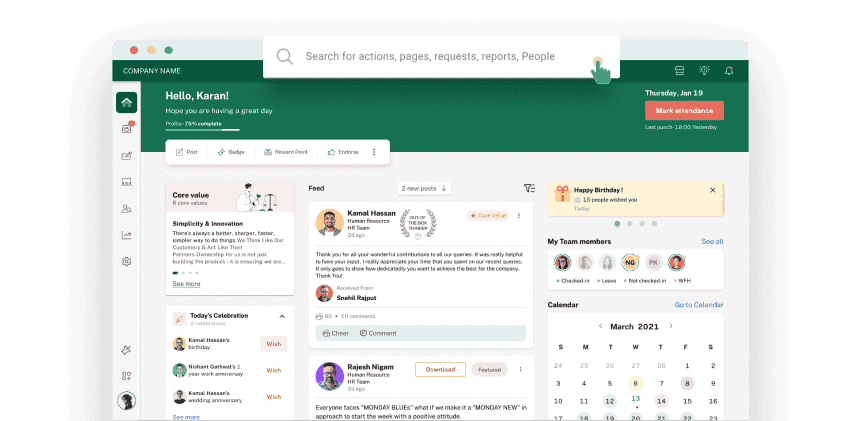
Using HROne Payroll, your HR team can combine salary and statutory compliance processes into one integrated process. With less reliance on spreadsheets, eligibility and exceptions can still be verified by your HR team, while the system manages the process.
Ready to simplify pension and payroll compliance?
Let HROne HRMS handle complexity.














 Secures Top Spot in


