


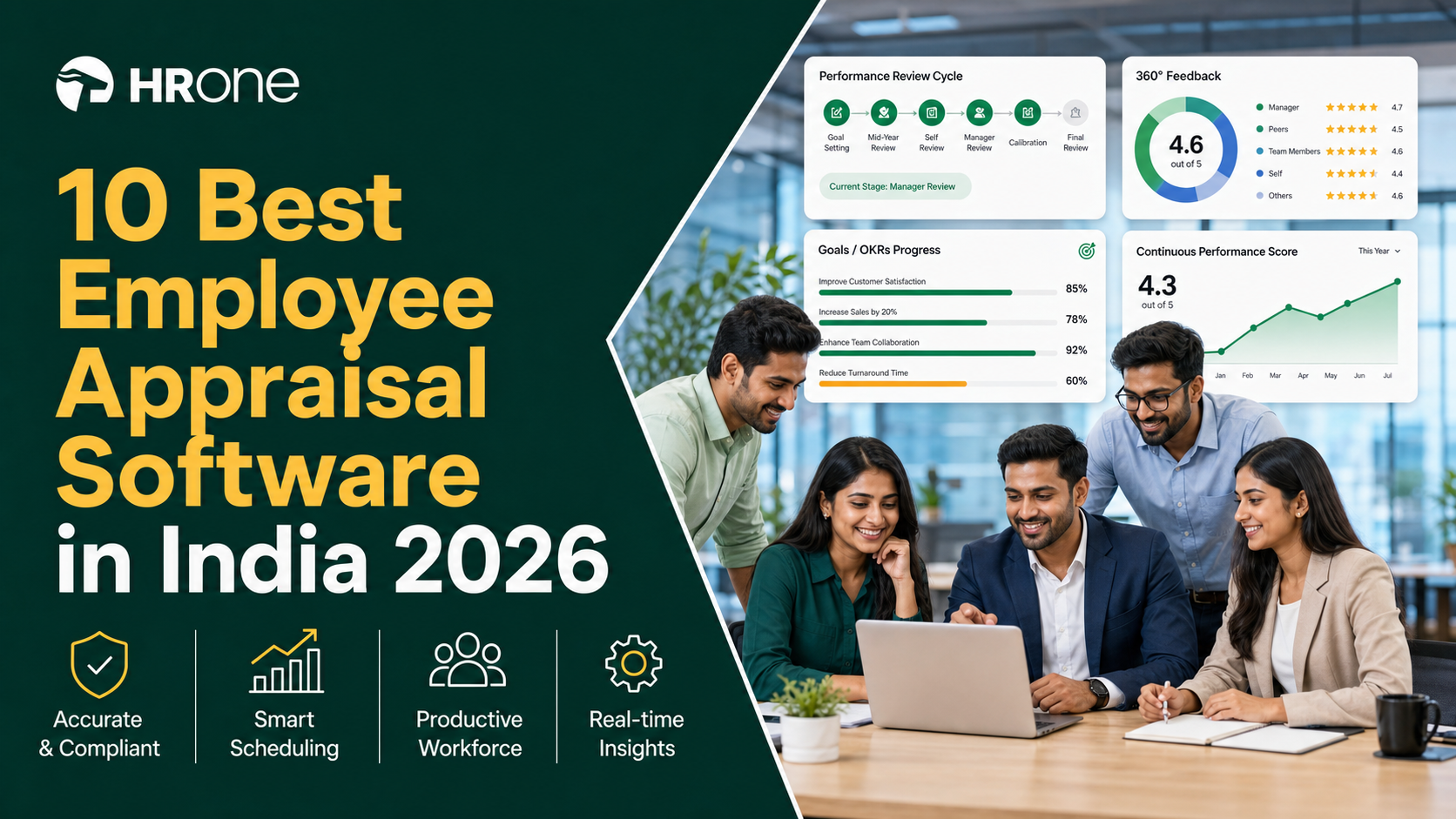
Q1. What Are the 10 Best Employee Appraisal Software in India for 2026?
The 10 best employee appraisal software in India for 2026 are HROne, Keka, Darwinbox, greytHR, Zoho People, Zimyo, Synergita, Peoplebox, Lattice, and BambooHR. We ranked them on review-cycle flexibility, 360-degree feedback depth, goals and OKR automation, continuous performance, integrations, and pricing transparency. HROne leads for Indian mid-market teams (100 to 5,000 employees) that need appraisals wired to compensation and an inbuilt ROI dashboard.
Choosing appraisal software is a high-stakes call for Indian mid-market firms tying reviews to increments, bell curves, and compliance-heavy payroll. This guide evaluates 10 vendors against operational, technical, and commercial criteria that matter to the person running review cycles daily, not just the procurement buyer. We assessed each on review-cycle flexibility, 360-degree and 9-box depth, OKR and goals automation, continuous feedback, India-specific compensation linkage, integrations, support model, and pricing transparency. The primary reader is the HR Ops lead or HRBP running appraisals, with the CHRO, CFO, and IT Director as shadow readers on the buying committee. We avoid hype and let documented evidence guide each verdict.
Our Evaluation Criteria
Each vendor was assessed across these decision-grade metrics.
- Review-cycle flexibility ⏰: Support for annual, quarterly, probation-confirmation, and mid-cycle reviews without manual rebuild.
- 360-degree and 9-box depth 📊: Peer, subordinate, and manager feedback, plus talent-grid mapping.
- Goals and OKR automation ✅: Auto-cascade of company goals to individual KRAs and KPIs.
- Continuous performance: Ongoing check-ins, feedback, and social recognition between cycles.
- Compensation linkage 💰: Ability to tie ratings to increments, bell curves, and payout, a big India gap.
- India compliance fit: Alignment with CTC revisions, appraisal arrears, and statutory payroll.
- Support model: Phone, email, chat, or dedicated SPOC availability during rollout.
- Pricing transparency: Published PEPM or PUPM rates versus quote-only opacity.
Who This Guide Is For
- CHROs and HR Heads consolidating fragmented hire-to-retire stacks who need appraisals to feed strategy. See our CHRO solutions.
- HR Ops leads and HRBPs running probation, confirmation, and annual cycles across multiple entities.
- Payroll Managers linking review ratings to increment arrears in India-compliant monthly runs with dedicated payroll software.
- CFOs validating HR tech ROI and flat PEPM commercials against multi-year lock-ins via our pricing page.
- IT Directors evaluating mobile-first, configurable HCMs versus rigid legacy portals.
Comparison of the 10 Best Appraisal Software
| Provider | Best For | Standout Strength | Known Limitation | Appraisal Depth (360 / OKR / 9-box) | Support Model | Pricing Model |
|---|---|---|---|---|---|---|
| HROne ⭐⭐⭐⭐⭐ | HR Ops leads wiring appraisals to increments and ROI proof | Only listed tool with India’s first inbuilt ROI dashboard tying ratings to compensation | Payroll and Performance modules have a first-user learning curve | 360 / OKR / bell curve, all in-app | Phone, email, chat, dedicated HR SPOC (9.8 NPS) | Flat PEPM, subscription starts after go-live |
| Keka ⭐⭐⭐ | SMB and mid-market teams wanting modern UX with payroll | Strong payroll and compliance automation with clean UI | Reviewers report slow, email-thread support and a confusing PMS module | 360 / OKR / 9-box | Email and ticket-led support | Per-user/month, quote-based tiers |
| Darwinbox ⭐⭐⭐⭐ | Large enterprises needing brand-weight talent management | Comprehensive enterprise HR suite on one platform | Reviewers cite slow load times and inconsistent support | 360 / OKR / 9-box | Enterprise account and partner-led | Quote-based, multi-year contracts |
| greytHR ⭐⭐⭐ | SMB teams needing payroll-led basic PMS | Reliable payroll and payslip processing at low cost | Reviewers report weak customization and poor support escalation | Limited 360 / basic goals | Email and ticket-led support | Per-user/month, published tiers |
| Zoho People ⭐⭐⭐ | Cost-conscious teams inside the Zoho ecosystem | Affordable and integration-rich across Zoho apps | Reviewers report shallow features and slow support | Basic 360 / goals | Email and ticket-led support | Per-user/month, freemium entry |
| Zimyo ⭐⭐⭐⭐ | Growing teams wanting value-priced modular HRMS | Modular pricing for SMB-to-mid-market crossovers | Depth thins out at complex enterprise scale | 360 / OKR | Email and chat support | Per-user/month, published tiers |
| Synergita ⭐⭐⭐⭐ | Teams prioritizing continuous performance and OKRs | Dedicated continuous feedback and OKR specialist | Narrower core-HR and payroll breadth | 360 / OKR / 9-box | Email and chat support | Per-user/month, published tiers |
| Peoplebox ⭐⭐⭐⭐ | Teams aligning OKRs to review cycles | Deep OKR and review alignment with BI integrations | Not a full hire-to-retire suite | 360 / OKR | Email and chat support | Quote-based |
| Lattice ⭐⭐⭐⭐ | Global teams wanting continuous performance leadership | Mature continuous performance and engagement design | Limited India payroll and compliance fit | 360 / OKR / 9-box | Email and chat support | Per-user/month (USD) |
| BambooHR ⭐⭐⭐ | SMB global teams wanting simple core HR | Clean, easy-to-use core HR interface | Reviewers report rising prices and weak payroll outside the US | Basic 360 / goals | Email and ticket-led support | Per-user/month, quote-based |
1.1 HROne, best for Indian mid-market appraisals wired to compensation and ROI
HROne, the India-first HCM that turns appraisals into increment decisions and board-ready ROI.
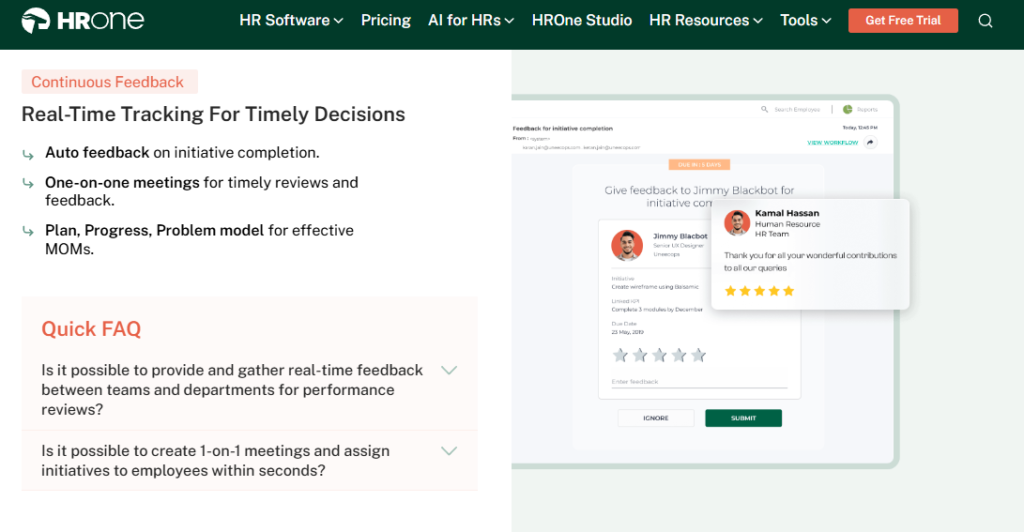
HROne earns 5 stars here because it treats appraisals as a connected workflow, not a standalone form. Most tools help you collect ratings. HROne takes those ratings and feeds them straight into increment calculation, bell curves, and payroll. That closes the loop most Indian teams stitch together in Excel.
📌 Overview
HROne is a cloud-based, mobile-first core HCM founded in 2016 and headquartered in Noida, built for Indian mid-market and enterprise teams of 100 to 5,000 employees. It ranks 3rd out of 1.17 lakh products for customer satisfaction on G2 and is a Gartner Voice of the Customer winner, serving 1,500-plus brands and 2,000-plus HR teams. It is primarily used by HR Ops teams struggling to link performance reviews to compensation and compliance-heavy payroll.
⚙️ Core Services
HROne ships 30-plus modules and 127 pre-built workflows, so the breadth sits on one page instead of five vendors.
- Goals, KRAs, and KPIs, cascades company goals to individual KRAs with predefined templates, removing manual objective setup every cycle.
- Appraisal cycles with bell curve, automates review and normalization, compressing annual appraisals to as little as 15 days for one customer.
- 360-degree feedback, collects peer, subordinate, and manager input in one flow, removing scattered email and spreadsheet chasing.
- Increment and arrear calculation, ties ratings to increment arrears in payroll, removing manual reconciliation of appraisal-linked pay.
- Super Inbox task closure, surfaces every pending review task in one Gmail-like HR inbox closed in three clicks, ending tab-switching.
- India’s first inbuilt ROI Dashboard, calculates lifetime hours saved against average HR salary, removing the manual PowerPoint the board waits on.
🇮🇳 India-Specific Compliance and Localization
- PF / ESI / TDS support: Yes (automated calculation, filing, and reconciliation).
- Labour law compliance: Strong (multi-state minimum wages, new wage-code FFS).
- Payroll localization (India-specific): Yes (CTC revisions, FBP, appraisal arrears).
- Multi-state compliance handling: Yes (multi-legal-entity on a single instance).
👤 Who This Is Built For
- HR Ops lead manually pushing appraisal ratings into increment letters and payroll every cycle.
- HRBP running probation, confirmation, and annual reviews across multiple legal entities on one instance.
- CHRO who needs an ROI dashboard to prove HR savings to the board in rupee terms.
🚫 Who Should Skip This
- Startups and teams under 100 employees, since HROne intentionally targets mid-market complexity and budget.
- Teams wanting only a lightweight standalone appraisal tool without core HR or performance management.
💰 Pricing Structure
- Plan Type(s): Flat PEPM (per employee per month) subscription with no lock-in.
- Starting Price: Not publicly disclosed, request a quote.
- Tier-wise Breakdown: Not publicly disclosed, request a quote.
- Incremental Cost Drivers: Not publicly disclosed, request a quote.
- Implementation Fee: Not publicly disclosed, request a quote. Notably, subscription meters only after go-live, so you do not pay during setup.
- Cost at 200 Employees: Not publicly disclosed, request a quote | Cost at 500 Employees: Not publicly disclosed, request a quote.
🤝 Implementation and Support Reality
- Go-live is led by prior-HR onboarding consultants who understand the domain, not a technical PM reading a checklist.
- Support spans phone, email, chat, and a dedicated HR SPOC with a stellar 9.8 NPS and sub-24-hour response.
- Data migration is vendor-led, with reviewers reporting ERP-to-HROne transfers in hours.
- HROne holds a 4.85 average across 650-plus Gartner-verified reviews.
💬 Reviews
Here is where the honesty signal matters. HROne draws praise for its human-plus-automation blend, with a caveat on onboarding depth.
“It doesn’t simply automate processes like payroll, attendance, and compliance, it makes them easier to handle. One thing I don’t like is that it can sometimes feel a bit overwhelming for new users. Certain features take time to understand.”
Nijanthan R., Rating 3.5/5 HROne G2 Verified Review
“Some modules, especially Payroll and Performance, have a learning curve and require more detailed guidance for first-time users.”
Shilpi M., Rating 5/5 HROne G2 Verified Review
Where HROne fits in this list: if your appraisal problem is really a compensation-and-compliance problem in disguise, HROne is the only tool here that closes reviews, bell curves, increments, and ROI proof in one connected flow. I might be wrong for a pure-OKR startup, but for a 500-person Indian firm doing increment arrears by hand, this is the row I would shortlist first.
1.2 Keka, modern HRMS with strong performance focus
Keka, polished, UX-led HRMS for SMB-to-mid-market teams wanting payroll plus performance in one place.
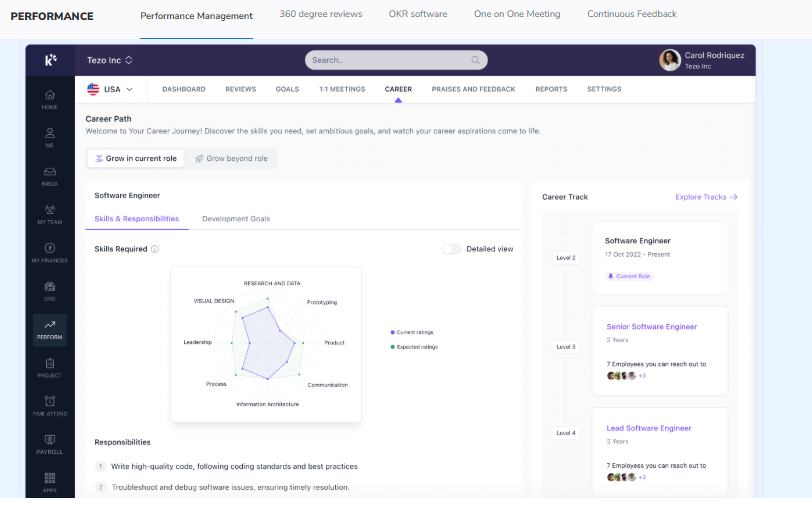
Keka earns 3 stars. The product looks great and the payroll engine is genuinely capable. The recurring pain, from what surfaces in verified reviews, is support responsiveness and a performance module that reviewers find harder to use than the rest of the suite.
📌 Overview (60 to 90 words)
Keka is an India-based HRMS known for a modern, intuitive interface across payroll, attendance, and performance management. It targets SMB and mid-market teams that want polished self-service and statutory payroll in one tool. It is primarily used by teams frustrated with clunky legacy portals who prioritize UX. Reviewers consistently praise the interface but flag support turnaround and PMS usability as the trade-offs, especially for consulting and IT-services firms with non-standard configuration needs.
⚙️ Core Services
Keka ships the standard HRMS spread; I list only what reviewers confirm it actually delivers.
- Payroll engine, automates PF, ESI, and TDS with statutory compliance, reducing month-end reconciliation effort.
- Attendance and leave, processes attendance and leave with a mobile app, removing manual tracking.
- Performance management (PMS), supports KRAs and KPIs, though reviewers call the module confusing to configure.
- Employee satisfaction surveys, gathers sentiment, useful for engagement tracking.
- Hiring workflows (Keka Hiro), automates hiring approvals and offer-letter workflows.
- Document management, generates HR documents digitally, cutting paperwork and improving confidentiality.
🇮🇳 India-Specific Compliance and Localization
- PF / ESI / TDS support: Yes (automated salary and statutory processing).
- Labour law compliance: Moderate (reviewers report RBI-regulation and CTC-structure gaps).
- Payroll localization (India-specific): Yes (India payroll core).
- Multi-state compliance handling: Partial (reviewers cite zone and location-config limits).
👤 Who This Is Built For
- HR lead at an SMB wanting a polished, self-service UI over a clunky legacy portal.
- Payroll admin needing automated PF, ESI, and TDS with a working mobile HR app.
🚫 Who Should Skip This
- IT and consulting firms needing deep, fast customization, since one long-time reviewer says “Keka is not built to service IT consulting firms”.
- Teams that need weekend or phone-based emergency support during critical payroll runs. Compare options on our HROne vs Keka page.
💰 Pricing Structure
- Plan Type(s): Tiered per-user/month plans (Foundation, Strength, Growth tiers, as Keka publishes).
- Starting Price: Not publicly disclosed, request a quote.
- Tier-wise Breakdown: Not publicly disclosed, request a quote.
- Incremental Cost Drivers: Not publicly disclosed, request a quote.
- Implementation Fee: Not publicly disclosed, request a quote.
- Cost at 200 Employees: Not publicly disclosed, request a quote | Cost at 500 Employees: Not publicly disclosed, request a quote.
🤝 Implementation and Support Reality
- Reviewers report slow, stretched implementation, with one unable to go live months after starting.
- Support is largely email and chat-led, with reviewers noting no weekend phone support.
- Data migration is vendor-led, but reviewers flag coordination gaps between internal teams.
- Publicly reported NPS or CSAT: Not publicly disclosed.
💬 Reviews
The pattern is consistent: good product, strained support, and a PMS module that needs work.
“We started working with Keka HRMS in August, and to this day, we have been unable to implement the tool, due to their consistently delayed responses and poor coordination between their internal teams.”
Divya P., Rating 0/5 Keka G2 Verified Review
“Strong payroll and compliance. PMS module is confusing and needs to be simpler and easier to use.”
Kiran B., Rating 3.5/5 Keka G2 Verified Review
Where Keka fits versus HROne: Keka wins on first-impression UX polish, and that is a real advantage for adoption. The standard read says pick the prettier portal, but from what surfaces in these reviews, the appraisal decision often comes down to support during rollout and whether ratings connect to payout. Where Keka leans on email threads and a separate PMS, HROne’s dedicated SPOC and increment-linked appraisals close that gap for compliance-heavy Indian teams. See the full top performance management software India guide for deeper context.
1.3 Darwinbox, enterprise-grade performance and talent
Darwinbox, enterprise HCM with brand weight for large, complex organizations.
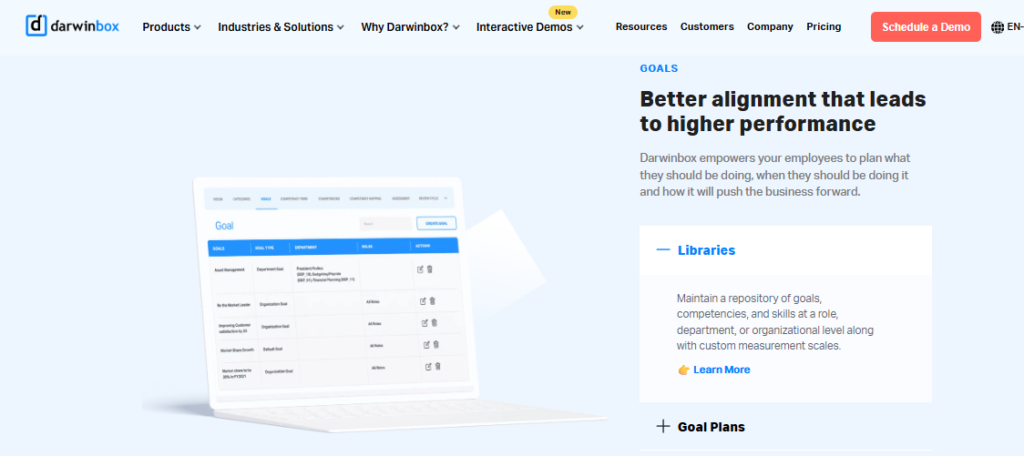
Darwinbox earns 4 stars. It carries genuine enterprise credibility across Asia, and its unified suite is real. The recurring trade-offs, from what surfaces in verified reviews, are speed, support consistency, and a performance module that needs training to master.
📌 Overview (60 to 90 words)
Darwinbox is a cloud HCM built for large enterprises, well known across India and wider Asia for its comprehensive suite. It covers attendance, payroll, performance, and talent on one platform, backed by a strong sales and brand presence. It is primarily used by enterprise HR teams replacing a mix of Excel sheets and legacy tools. Reviewers praise the unified platform but flag inconsistent support and slower load during bulk processing as the trade-offs.
⚙️ Core Services
I list only what reviewers confirm Darwinbox actually ships.
- Unified HR suite, brings attendance, leave, payroll, and performance onto one platform, reducing multi-tool sprawl.
- Performance management, supports reviews and talent tracking, though reviewers say it needs training to use fully.
- Customizable workflows, adapts processes without heavy technical work, reducing dependence on IT for changes.
- Mobile app, enables leave, attendance, and payslip access on the go, cutting portal dependence.
- Employee database, maintains a single source of truth for records, replacing scattered trackers.
🇮🇳 India-Specific Compliance and Localization
- PF / ESI / TDS support: Yes (India payroll built in).
- Labour law compliance: Strong (enterprise India deployments).
- Payroll localization (India-specific): Yes (multi-country including India).
- Multi-state compliance handling: Yes (large multi-location enterprises).
👤 Who This Is Built For
- Enterprise HR lead consolidating Excel and legacy tools into one platform.
- Talent manager at a 2,000-plus employee firm needing structured reviews across locations.
🚫 Who Should Skip This
- Mid-market teams wanting go-live in weeks, since reviewers report bad implementation experiences.
- Teams needing consistently fast support, given documented service complaints. Compare on our HROne vs Darwinbox page.
💰 Pricing Structure
- Plan Type(s): Enterprise quote-based plans.
- Starting Price: Not publicly disclosed, request a quote.
- Tier-wise Breakdown: Not publicly disclosed, request a quote.
- Incremental Cost Drivers: Not publicly disclosed, request a quote.
- Implementation Fee: Not publicly disclosed, request a quote.
- Cost at 200 Employees: Not publicly disclosed, request a quote | Cost at 500 Employees: Not publicly disclosed, request a quote.
🤝 Implementation and Support Reality
- Implementation is enterprise-led, though reviewers report drawn-out, difficult transitions.
- Support runs through enterprise account channels, with mixed reviewer feedback.
- Data migration is vendor-led, but one reviewer called the transition “quite difficult”.
- Publicly reported NPS or CSAT: Not publicly disclosed.
💬 Reviews
The split is clear: a capable suite, undercut by implementation and support pain.
“The sales team is good at selling the product. That is where the good things end. Bad implementation experience, bad UI UX, terrible customer service.”
Verified User in Computer Software, Rating 0/5 Darwinbox G2 Verified Review
“Darwinbox has made HR processes much smoother by bringing everything together on one platform. Pages sometimes load slowly. Limited customization in reports.”
Saksham A., Rating 4/5 Darwinbox G2 Verified Review
1.4 greytHR, payroll-led PMS for SMB and mid-market
greytHR, dependable, budget-friendly payroll engine with basic performance features.
greytHR earns 3 stars. For payroll and payslips at a low price, it does the job. The honest limits, from verified reviews, are weak customization, thin performance depth, and support that frustrates users.
📌 Overview (60 to 90 words)
greytHR is a long-standing India payroll and HR platform popular with SMB and lower mid-market teams. It centralizes payslips, leave, attendance, and tax declarations for employee self-service. It is primarily used by cost-conscious teams that need reliable statutory payroll over deep performance features. Reviewers value the payroll reliability and low cost but repeatedly flag rigid customization, limited appraisal depth, and slow support escalation as the trade-offs.
⚙️ Core Services
I list only what reviewers confirm greytHR delivers.
- Payroll processing, automates salary, payslips, and statutory filing, cutting manual payroll effort.
- Leave and attendance, tracks leave and attendance for SMB teams, replacing spreadsheets.
- Tax declaration self-service, lets employees declare taxes and pick regimes, reducing HR back-and-forth.
- Employee self-service, gives payslip and attendance access without HR requests, improving transparency.
- Engagement reminders, sends birthday and anniversary notifications, a light engagement touch.
🇮🇳 India-Specific Compliance and Localization
- PF / ESI / TDS support: Yes (core payroll strength).
- Labour law compliance: Moderate (reviewers cite leave-balance and config gaps).
- Payroll localization (India-specific): Yes (India payroll focus).
- Multi-state compliance handling: Partial (reviewers report rigid customization).
👤 Who This Is Built For
- Payroll admin at an SMB needing dependable monthly payslips and statutory filing.
- HR generalist wanting employee self-service for tax and leave without heavy config.
🚫 Who Should Skip This
- Mid-market teams needing deep customization, since reviewers cite rigid, gap-filled config.
- Teams wanting a strong, structured appraisal engine, given thin performance management depth.
💰 Pricing Structure
- Plan Type(s): Tiered per-user/month plans (as greytHR publishes).
- Starting Price: Not publicly disclosed, request a quote.
- Tier-wise Breakdown: Not publicly disclosed, request a quote.
- Incremental Cost Drivers: Not publicly disclosed, request a quote.
- Implementation Fee: Not publicly disclosed, request a quote.
- Cost at 200 Employees: Not publicly disclosed, request a quote | Cost at 500 Employees: Not publicly disclosed, request a quote.
🤝 Implementation and Support Reality
- Implementation is vendor-led, though reviewers report gaps discovered after setup.
- Support is ticket and call-led, with mixed reviewer feedback on responsiveness.
- Data migration is vendor-assisted with configuration support.
- Publicly reported NPS or CSAT: Not publicly disclosed.
💬 Reviews
Reviews cluster around reliable-but-basic, with support as the sore point.
“It is a user friendly platform compared to other tools. GreytHR is not much good at customizing based on our requirements. Many times we were manually correcting the leave balance of employees.”
Verified User in IT and Services, Rating 2.5/5 greytHR G2 Verified Review
“GreythR is fine software for payroll processing and I have been using since 10 years. Reporting configuration, TDS filing, revising of TDS is not possible.”
Krishnanand B., Rating 3/5 greytHR G2 Verified Review
1.5 Zoho People, affordable, integration-rich
Zoho People, budget HR module deeply tied into the wider Zoho ecosystem.
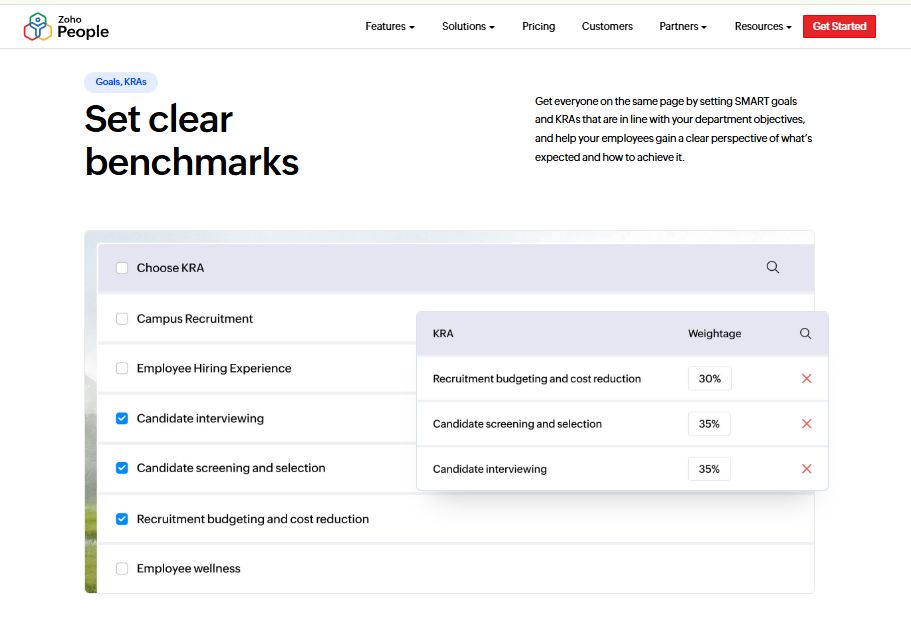
Zoho People earns 3 stars. If you already live in Zoho, the integrations are a real advantage. The documented limits are shallow feature depth, slow support, and a mobile app that reviewers find restrictive.
📌 Overview (60 to 90 words)
Zoho People is the HR module inside the broad Zoho software suite, favored by cost-conscious teams already using Zoho apps. It handles attendance, leave, onboarding, and links to Zoho Recruit and Zoho Payroll. It is primarily used by teams wanting affordable HR with tight ecosystem integration. Reviewers praise the breadth and price but flag shallow feature depth, slow customer support, and limited mobile functionality as the trade-offs.
⚙️ Core Services
I list only what reviewers confirm Zoho People ships.
- Attendance and leave, manages requests digitally with direct approvals, cutting manual coordination.
- Onboarding, lets candidates self-enter data, completing onboarding in a day.
- Zoho ecosystem integration, connects to Zoho Recruit and Payroll, streamlining hire-to-pay.
- Holiday and policy sharing, shares holiday lists and policies centrally, reducing HR emails.
- Goals and basic reviews, supports appraisal basics, though reviewers call depth shallow.
🇮🇳 India-Specific Compliance and Localization
- PF / ESI / TDS support: Partial (via Zoho Payroll add-on).
- Labour law compliance: Moderate (global generalist tuning).
- Payroll localization (India-specific): Partial (separate Zoho Payroll product).
- Multi-state compliance handling: Partial (depends on Payroll config).
👤 Who This Is Built For
- HR lead already running Zoho Recruit and Payroll who wants one connected stack.
- Cost-conscious SMB admin managing attendance and leave digitally.
🚫 Who Should Skip This
- Teams needing deep, India-tuned compliance and appraisal depth, given shallow features. Compare on our HROne vs Zoho People page.
- Teams relying on fast support during errors, since reviewers report slow response.
💰 Pricing Structure
- Plan Type(s): Tiered per-user/month plans plus a freemium entry (as Zoho publishes).
- Starting Price: Not publicly disclosed, request a quote.
- Tier-wise Breakdown: Not publicly disclosed, request a quote.
- Incremental Cost Drivers: Not publicly disclosed, request a quote.
- Implementation Fee: Not publicly disclosed, request a quote.
- Cost at 200 Employees: Not publicly disclosed, request a quote | Cost at 500 Employees: Not publicly disclosed, request a quote.
🤝 Implementation and Support Reality
- Setup is self-serve, aided by instructional videos reviewers found helpful.
- Support is ticket and email-led, with reviewers reporting slow turnaround.
- Data migration is largely self-serve within the Zoho ecosystem.
- Publicly reported NPS or CSAT: Not publicly disclosed.
💬 Reviews
Reviews show a capable, affordable tool held back by depth and support.
“The breadth of applications and the price of it. Features are shallow and there is no depth in each application.”
Verified User in IT and Services, Rating 2.5/5 Zoho People G2 Verified Review
“Its integration with other Zoho apps, such as Zoho Recruit and Zoho Payroll. The biggest drawback for me has been the lack of customer support.”
Dhana C., Rating 4/5 Zoho People G2 Verified Review
1.6 Zimyo, value pick for growing teams
Zimyo, cost-conscious modular HRMS for SMB-to-mid-market crossovers.
Zimyo earns 4 stars. It suits growing teams that want modular pricing and a decent performance module without enterprise cost. Depth thins at complex multi-entity scale.
📌 Overview (60 to 90 words)
Zimyo is an India-based modular HRMS built for SMB and growing mid-market teams. It covers core HR, payroll, attendance, and performance with a pay-for-what-you-need model. It is primarily used by teams that have outgrown spreadsheets but are not ready for enterprise pricing. Its value positioning makes it a common shortlist entry for cost-sensitive buyers comparing modular platforms.
⚙️ Core Services
- Performance and OKR module, runs goals, reviews, and OKRs (objectives and key results), replacing manual review tracking.
- Payroll engine, automates salary and statutory calculations, reducing month-end effort.
- Core HR database, centralizes employee records, removing scattered trackers.
- Attendance and leave, manages punches and leave with a mobile app, cutting manual logs.
- Modular add-ons, lets teams buy only needed modules, controlling spend as they grow.
🇮🇳 India-Specific Compliance and Localization
- PF / ESI / TDS support: Yes (India payroll built in).
- Labour law compliance: Moderate (SMB-to-mid-market focus).
- Payroll localization (India-specific): Yes (India-first product).
- Multi-state compliance handling: Partial (thins at complex scale).
👤 Who This Is Built For
- HR lead at a growing firm wanting modular pricing over an all-or-nothing suite.
- Ops manager needing decent performance and payroll without enterprise cost.
🚫 Who Should Skip This
- Large enterprises with complex multi-legal-entity needs, where depth thins out. See HR software for multi-entity companies.
- Teams needing a dedicated implementation SPOC for heavy configuration. Compare on our HROne vs Zimyo page.
💰 Pricing Structure
- Plan Type(s): Tiered per-user/month plans (as Zimyo publishes).
- Starting Price: Not publicly disclosed, request a quote.
- Tier-wise Breakdown: Not publicly disclosed, request a quote.
- Incremental Cost Drivers: Not publicly disclosed, request a quote.
- Implementation Fee: Not publicly disclosed, request a quote.
- Cost at 200 Employees: Not publicly disclosed, request a quote | Cost at 500 Employees: Not publicly disclosed, request a quote.
🤝 Implementation and Support Reality
- Go-live is vendor-assisted, tuned for SMB and mid-market rollouts.
- Support runs through email and chat channels.
- Data migration is vendor-led with onboarding help.
- Publicly reported NPS or CSAT: Not publicly disclosed.
1.7 Synergita, continuous performance and OKR specialist
Synergita, focused continuous performance and OKR engine for review-heavy teams.
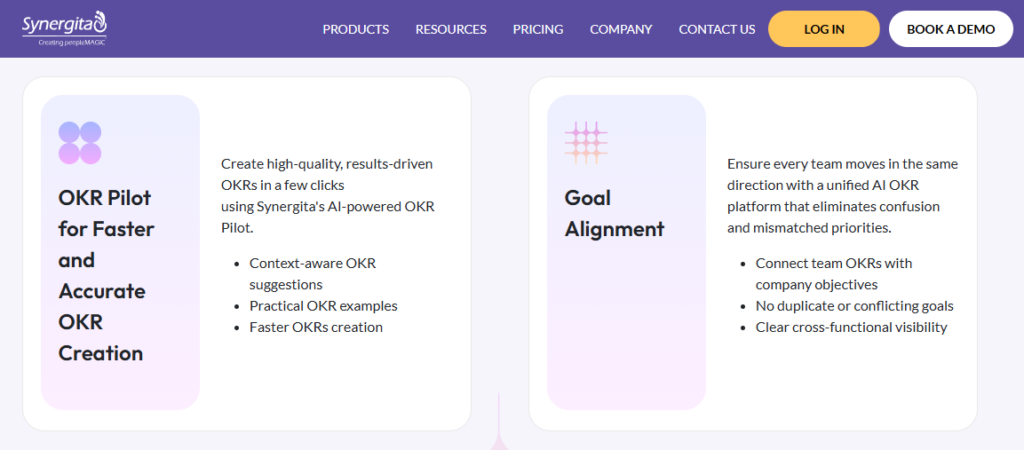
Synergita earns 4 stars. It is a specialist, not a full HRMS, and that focus shows in its review and OKR depth. Buyers wanting payroll and core HR in the same tool will need to look elsewhere.
📌 Overview (60 to 90 words)
Synergita is a performance management and OKR platform built for continuous feedback and structured reviews. It centers on appraisals, goals, and recognition rather than payroll or core HR. It is primarily used by teams that treat performance as an ongoing process, not a once-a-year event. Its specialist focus makes it a strong shortlist entry when appraisal depth matters more than suite breadth.
⚙️ Core Services
- Continuous feedback, captures ongoing check-ins and feedback, replacing annual-only reviews.
- OKR and goals, cascades objectives and tracks key results, removing manual goal trackers.
- 360-degree reviews, gathers peer and manager input in one flow, cutting scattered forms.
- Recognition and rewards, enables social recognition, supporting engagement between cycles.
- Performance analytics, surfaces rating trends and 9-box talent grids for calibration.
🇮🇳 India-Specific Compliance and Localization
- PF / ESI / TDS support: No (not a payroll product).
- Labour law compliance: Limited (performance specialist).
- Payroll localization (India-specific): No (no payroll module).
- Multi-state compliance handling: No (not applicable).
👤 Who This Is Built For
- HRBP running frequent check-ins who wants structured continuous feedback.
- Talent lead needing OKR alignment and 9-box calibration in one place.
🚫 Who Should Skip This
- Teams needing payroll and core HR in the same tool, since Synergita is performance-only. See our payroll software.
- Buyers wanting a single hire-to-retire operating system.
💰 Pricing Structure
- Plan Type(s): Tiered per-user/month plans (as Synergita publishes).
- Starting Price: Not publicly disclosed, request a quote.
- Tier-wise Breakdown: Not publicly disclosed, request a quote.
- Incremental Cost Drivers: Not publicly disclosed, request a quote.
- Implementation Fee: Not publicly disclosed, request a quote.
- Cost at 200 Employees: Not publicly disclosed, request a quote | Cost at 500 Employees: Not publicly disclosed, request a quote.
🤝 Implementation and Support Reality
- Go-live focuses on performance-cycle setup, faster than a full HRMS.
- Support runs through email and chat channels.
- Data migration is vendor-assisted for performance data.
- Publicly reported NPS or CSAT: Not publicly disclosed.
1.8 Peoplebox, OKR and review alignment
Peoplebox, OKR-first performance platform that aligns reviews to business goals.
Peoplebox earns 4 stars. It shines at connecting OKRs to review cycles and business intelligence tools. Like other specialists, it is not a full hire-to-retire suite.
📌 Overview (60 to 90 words)
Peoplebox is an OKR and performance alignment platform built to tie reviews to company goals. It integrates with tools teams already use, like Slack and BI dashboards, to keep goals visible. It is primarily used by teams that want strategy and performance connected, not siloed. Its alignment focus makes it a strong pick when OKR discipline is the core need rather than payroll or attendance.
⚙️ Core Services
- OKR management, cascades and tracks objectives, replacing static goal spreadsheets.
- Performance reviews, runs review cycles tied to OKRs, removing disconnected appraisals.
- Business tool integrations, syncs with Slack and BI dashboards, keeping goals in daily view.
- 1-on-1s and check-ins, structures manager conversations, cutting ad hoc tracking.
- Talent and calibration, supports 9-box and calibration for fair ratings.
🇮🇳 India-Specific Compliance and Localization
- PF / ESI / TDS support: No (not a payroll product).
- Labour law compliance: Limited (performance specialist).
- Payroll localization (India-specific): No (no payroll module).
- Multi-state compliance handling: No (not applicable).
👤 Who This Is Built For
- Strategy or People lead who wants OKRs wired directly into review cycles.
- Manager wanting structured 1-on-1s and goals inside Slack.
🚫 Who Should Skip This
- Teams needing payroll, attendance, and core HR in one platform. Explore our core HCM.
- Buyers wanting India-specific statutory compliance built in.
💰 Pricing Structure
- Plan Type(s): Quote-based plans (as Peoplebox publishes).
- Starting Price: Not publicly disclosed, request a quote.
- Tier-wise Breakdown: Not publicly disclosed, request a quote.
- Incremental Cost Drivers: Not publicly disclosed, request a quote.
- Implementation Fee: Not publicly disclosed, request a quote.
- Cost at 200 Employees: Not publicly disclosed, request a quote | Cost at 500 Employees: Not publicly disclosed, request a quote.
🤝 Implementation and Support Reality
- Go-live focuses on OKR and review setup with integration mapping.
- Support runs through email and chat channels.
- Data migration is vendor-assisted for goals and performance data.
- Publicly reported NPS or CSAT: Not publicly disclosed.
1.9 Lattice, global continuous performance leader
Lattice, polished, global people-management platform for continuous performance.
Lattice earns 4 stars. Its continuous performance and engagement design is mature and widely praised. For Indian teams, the gaps are payroll and compliance fit, plus add-on pricing that stacks up.
📌 Overview (60 to 90 words)
Lattice is a global people-management platform combining reviews, OKRs, feedback, and engagement surveys. It holds a strong 4.7/5 average across review platforms and suits mid-sized to larger firms with dedicated HR teams. It is primarily used by tech and services companies wanting continuous performance over annual reviews. Reviewers praise the clean interface and analytics but flag a learning curve and high add-on costs as the trade-offs.
⚙️ Core Services
- Performance reviews, runs structured reviews with customizable templates, replacing spreadsheets.
- OKRs and goals, aligns individual goals to company objectives, removing manual cascades.
- Real-time feedback, captures feedback and recognition continuously, cutting annual-only cycles.
- Engagement surveys, tracks engagement trends via pulse surveys, surfacing sentiment.
- Grow module, maps career and promotion paths, supporting development conversations.
🇮🇳 India-Specific Compliance and Localization
- PF / ESI / TDS support: No (not an India payroll product).
- Labour law compliance: Limited (global generalist).
- Payroll localization (India-specific): No (US-centric payroll ties).
- Multi-state compliance handling: No (not India-tuned).
👤 Who This Is Built For
- People Ops lead at a global tech firm wanting continuous performance and engagement.
- Manager wanting clean review templates and career-path tools.
🚫 Who Should Skip This
- India mid-market teams needing statutory payroll and compliance built in. See our multi-state payroll compliance guide.
- Smaller or cost-sensitive teams, since add-on pricing stacks high.
💰 Pricing Structure
- Plan Type(s): Modular per-user plans, priced by module (as Lattice publishes).
- Starting Price: Around $11 per user per month, billed annually, with add-ons on top.
- Tier-wise Breakdown: Not fully published; modules priced separately.
- Incremental Cost Drivers: Per-module add-ons and a reported minimum spend around $4,000.
- Implementation Fee: Not publicly disclosed, request a quote.
- Cost at 200 Employees: Not publicly disclosed, request a quote | Cost at 500 Employees: reportedly around $56,700/year negotiated.
🤝 Implementation and Support Reality
- Go-live requires setup and training, with reviewers noting a learning curve.
- Support runs through email and chat channels.
- Data migration is vendor-assisted for performance data.
- Publicly reported NPS or CSAT: 4.7/5 average review score across platforms.
1.10 BambooHR, SMB-friendly, global
BambooHR, clean, simple core HR for SMB and global teams.
BambooHR earns 3 stars. Its interface is genuinely easy, which drives adoption. The documented pain, from verified reviews, is rising prices, slow search at scale, and weak payroll fit outside the US.
📌 Overview (60 to 90 words)
BambooHR is a US-based, SMB-friendly HR platform known for a clean, simple interface. It centers on core HR, time-off, and basic performance for small and global teams. It is primarily used by teams wanting easy core HR over deep, India-tuned payroll. Reviewers praise the simple interface but flag steep, recurring price increases, slow record search at scale, and weak non-US payroll integration as the trade-offs.
⚙️ Core Services
I list only what reviewers confirm BambooHR ships.
- Core HR records, stores employee data with custom fields, replacing scattered files.
- Time-off management, handles requests with single-click email approvals, cutting back-and-forth.
- Basic performance, supports simple reviews and goals for SMB teams.
- Employee self-service, gives staff access to info and requests, reducing HR load.
- Reporting, offers standard HR reports, though search slows as data grows.
🇮🇳 India-Specific Compliance and Localization
- PF / ESI / TDS support: No (US-first payroll).
- Labour law compliance: Limited (India compliance not native).
- Payroll localization (India-specific): No (reviewers report integration gaps).
- Multi-state compliance handling: No (not India-tuned).
👤 Who This Is Built For
- HR lead at a small global team wanting simple, clean core HR.
- Manager wanting easy time-off approvals from email.
🚫 Who Should Skip This
- India teams needing native PF, ESI, and TDS payroll, given US-first design. Read our PF, ESI, and TDS compliance guide.
- Firms over 20 employees needing customization, per reviewer feedback.
💰 Pricing Structure
- Plan Type(s): Core and Pro tiers (as BambooHR publishes).
- Starting Price: Not publicly disclosed, request a quote.
- Tier-wise Breakdown: Not publicly disclosed, request a quote.
- Incremental Cost Drivers: Reviewers report steep annual price increases.
- Implementation Fee: Not publicly disclosed, request a quote.
- Cost at 200 Employees: Not publicly disclosed, request a quote | Cost at 500 Employees: Not publicly disclosed, request a quote.
🤝 Implementation and Support Reality
- Go-live is self-serve and quick for small teams.
- Support runs through ticket and email channels.
- Data migration is largely self-serve.
- Publicly reported NPS or CSAT: Not publicly disclosed.
💬 Reviews
Reviews show an easy product weighed down by pricing and scale limits.
“Biggest issue is how much they have increased prices and continue to do so. They know that switching HRMS is painful.”
Josh A., Rating 0/5 BambooHR G2 Verified Review
“When searching for names it takes for ever. The search either comes up blank or lags and then it populates someone name.”
Verified User in Construction, Rating 1/5 BambooHR G2 Verified Review
Where This Leaves the Shortlist
Here is my honest read after sitting inside these comparisons. The specialists (Synergita, Peoplebox, and Lattice) do performance beautifully but leave payroll, attendance, and compliance on your plate. The suites (Darwinbox, Keka, greytHR, Zoho People, and BambooHR) cover more, yet reviewers keep flagging the same gaps: slow support, rigid config, or weak India-tuned payroll.
The standard read says pick the tool with the prettiest review screen. From what surfaces when you actually run appraisals in a 500-person Indian firm, the decision turns on one thing: does the rating connect to the increment and the payroll run, or not? That connective tissue is where HROne’s inbuilt ROI dashboard and increment-linked appraisals earn their place at the top of the shortlist. Explore the full HR software suite or book a demo to see it in action.
Q2. How Did We Score These Tools, and How Should You Build Your Own Checklist?
We scored each tool on five weighted criteria totaling 100%: 360-Degree and Review-Cycle Depth (25%), Goals and Continuous Performance Intelligence (25%), Compensation and ROI Linkage (20%), Setup and Usability (15%), and Pricing Transparency (15%). Tools scoring 0 to 20 get 1 star, up to 81 to 100 for 5 stars. Use the same lens to build your checklist: scalability, HRMS and payroll integrations, analytics, support model, and bias or AI governance.
📊 The Five Weighted Criteria
Here is the rubric, and why each weight lands where it does for Indian mid-market HR. A skeptical buyer trusts a ranking only when the math is visible.
| Criterion | Weight | Why it matters for Indian mid-market HR |
|---|---|---|
| 360-Degree and Review-Cycle Depth | 25% | Flexible cadence and multi-rater feedback are the core of any appraisal engine. |
| Goals and Continuous Performance Intelligence | 25% | OKR cascade and check-ins keep reviews honest year-round, not annual guesswork. |
| Compensation and ROI Linkage | 20% | Ratings must move increments and prove savings, a gap most tools ignore. |
| Setup and Usability | 15% | Slow config and steep learning curves stall adoption in busy teams. |
| Pricing Transparency | 15% | Hidden add-ons and quote-only opacity wreck CFO trust. |
The weighting reflects a simple thesis. An appraisal is only real when it changes pay and can be measured. Software patents back this weighted-blend logic, where individual objectives carry weights that combine into a final appraisal.
✅ Build Your Own Checklist
Now apply the same discipline to your shortlist. My current thinking, after sitting with many mid-market teams, is that data collection alone is a trap. You want a tool that turns ratings into action, not another dashboard nobody opens.
- Scalability ⏰: Can it handle multi-legal-entity and shift-based realities as you grow? See HR software for multi-entity companies.
- Integrations ✅: Does it connect to your payroll, HRMS, and biometric attendance cleanly? Explore our integrations.
- Analytics 📊: Does it surface 9-box (a talent grid mapping performance against potential) and bell curves?
- Support model: Phone, chat, and a dedicated SPOC, or just email threads?
- Bias and AI governance ⚠️: Does it flag rating bias and keep 360 feedback anonymous?
Honesty matters here too. The right sophistication depends on your business stage, budget, and pace of adoption, so a 5-star tool for a 2,000-person firm may be overkill for a 120-person one.
💰 Where HROne Lands on This Rubric
I might be wrong to single out one axis, but Compensation and ROI Linkage is where the list splits. HROne is the only listed tool scoring full marks there, because ratings feed increment calculation directly and a native ROI dashboard quantifies savings. That dashboard calculates lifetime hours saved against average HR salary, so the CHRO walks into a board review with a rupee figure, not a vibe. Most competitors instrument the review; few instrument the payoff. Explore our performance management module for the full picture.
Q3. What Exactly Is Employee Appraisal Software, and How Is It Different From Performance Management?
Employee appraisal software digitizes the periodic evaluation of performance against goals, KRAs (Key Result Areas), and competencies, then links those ratings to increments and promotions. Performance management is the broader, year-round process of goal-setting, feedback, and development. Modern appraisal tools blend both, running structured review cycles alongside continuous check-ins, 360-degree feedback, and 9-box calibration inside one system.
🧩 The Distinction in Plain English
Think of it this way. Appraisal is the exam. Performance management is the whole semester of classes, homework, and feedback that leads to it.
Appraisal software handles the periodic scoring event, usually quarterly or annual. Performance management wraps around it as the continuous rhythm of goals, one-on-ones, and coaching. The best tools now merge the two, so the exam reflects the semester, not a last-minute cram.
📝 A Real Example: Excel Versus a System
Picture an HR manager running an appraisal cycle in Excel. She copies goals from last year, chases managers over email, and reconciles ratings by hand at month-end. One slip in a formula, and someone’s increment is wrong.
Now run the same cycle in software. Goals auto-populate, reminders push on schedule, and ratings feed straight into the increment calculation. As one HR leader I spoke with put it, tracking goals only through Excel made appraisals painful, and moving to a system made the job genuinely easier. The lesson is simple: appraisal should be process-dependent and system-dependent, not manager-memory-dependent. See how our HR process automation removes that manual load.
⚙️ The Feature Quartet That Defines Modern Tools
Four capabilities separate real appraisal software from a digital form. Miss one, and you are back to spreadsheets.
- Review cycles: Configurable monthly, quarterly, or annual evaluations.
- 360-degree feedback: Input from peers, managers, and subordinates.
- Goals and OKRs: Cascaded objectives scored during the review.
- Continuous performance: Ongoing check-ins between formal cycles.
In HROne, KRA and goal cycles auto-assign the moment an employee joins. So that process-plus-system dependency happens by default, not by a manager remembering to set it up. That is the people-first reframe: software should remove mood and bias from who gets a raise, not add another tab to manage. Our onboarding process triggers those cycles automatically from day one.
Q4. How Do Review Cycles, 360-Degree Feedback, and Goals Actually Work Together?
Strong appraisal software ties three engines together: configurable review cycles (monthly to annual) that auto-trigger self and manager reviews; 360-degree feedback from peers, managers, subordinates, and customers with reviewer-nomination approval and anonymity; and goals where organizational OKRs cascade into individual KRAs scored during the review. Governed 360 cycles in India see 80%-plus completion and recover ₹62 to 95 lakh in annualized value for a 500-employee organization.
⏰ How Review Cycles Actually Run
A review cycle is not one button. It is a sequence, and each step is where teams usually lose time.
- Configure the cadence on the front end, from monthly to annual.
- Auto-assign self-review and manager-review forms to the right people.
- Push scheduled reminders so HR stops chasing managers.
- Normalize ratings with a bell curve for fairness.
- Close the cycle and feed ratings into increments.
In HROne, the manager’s dashboard schedules these reminder emails on a set timeline, and the policy configurator sits on the front end. So whoever you grant access can change a cadence without raising a developer ticket. Compare the approaches on our performance management software India guide.
🔄 Why Unmanaged 360 Becomes a Popularity Contest
Here is the contrarian bit. The standard read says more raters equals better feedback. From what surfaces when you actually run 360, unmanaged feedback drifts into a popularity contest, where friends rate friends kindly.
Governance fixes this. You need reviewer-nomination approval, guaranteed anonymity, and auto-assigned nomination tasks so managers cannot stack the deck. When 360 is governed this way in India, completion crosses 80% on the first cycle, and a 500-person firm recovers ₹62 to 95 lakh in annualized value.
“Home section packed with all needy useful options. Delivery team has expertise, energetic and helpful during configuration phase.”
Deepak K. HROne G2 Verified Review
🎯 How Goals Cascade and Score
Goals are the third engine, and they connect the other two. Company OKRs (Objectives and Key Results) cascade into individual KRAs, which then get scored during the review.
A goal bank helps here. HROne ships predefined goal-sheet templates, so managers pull consistent, aligned goals instead of inventing them each cycle. This is the weighted-blend logic patents describe, where objectives carry weights that combine into a final rating. The payoff shows in the data: European HR teams now run quarterly reviews at 51%, a clear shift from annual-only cycles toward continuous performance. Our core HCM keeps goals, ratings, and payroll on one employee record.
“The Performance module helps structure goal setting, reviews, and appraisals. Some modules, especially Payroll and Performance, have a learning curve.”
Shilpi M. HROne G2 Verified Review
When cycles, 360, and goals run as one connected flow inside HROne, HR stops bugging managers and starts calibrating fairly. That is the difference between a portal that stores reviews and a system that runs them. See it live by choosing to book a demo.
Q5. What Does Continuous Performance Management Look Like in Practice?
Continuous performance management replaces the once-a-year review with an ongoing rhythm of regular check-ins, real-time feedback, lightweight goal updates, and recognition between formal cycles. In practice, it means managers hold structured one-on-ones monthly or quarterly, employees log progress against OKRs as work happens, and feedback flows in the moment rather than being saved up for December. The annual appraisal becomes a summary of what already happened, not a surprise.
🔄 The Shift From Event to Rhythm
The old model treated performance as a single annual event. The new model treats it as a continuous rhythm, and that difference changes everything about how honest the final rating is.
When feedback is saved up for one meeting, recency bias takes over, and the last two weeks overshadow the whole year. When feedback flows continuously, the annual review simply confirms what both sides already know. Our performance management module is built around this continuous rhythm rather than a single yearly form.
🗓️ What It Looks Like Week to Week
Here is the practical cadence a well-run team follows. None of this requires heroics, just a system that prompts the right action at the right time.
- Monthly or quarterly one-on-ones with a structured agenda, not a blank page.
- Real-time feedback logged the moment a project ships, while the detail is fresh.
- Lightweight OKR updates as work progresses, so goals stay live, not forgotten.
- Recognition and rewards between cycles, keeping motivation continuous.
- A running record that becomes the annual review, removing year-end guesswork.
In HROne, these check-ins and feedback moments sit on the same record as goals and ratings, so nothing gets lost between meetings. The employee engagement tools handle recognition, while the mobile HR app lets managers log feedback on the go.
💡 The Honest Caveat
Continuous does not mean constant. My current thinking is that overloading managers with weekly forms kills adoption faster than annual-only reviews ever did. The goal is a sustainable rhythm your managers actually keep, tuned to your team’s pace and maturity. A 120-person firm may thrive on quarterly check-ins, while a 2,000-person one needs monthly discipline.
“The best part about HROne is how smoothly it brings all HR activities together in one place. It makes managing everything from attendance to performance easy.”
Verified User in Information Technology and Services HROne G2 Verified Review
Q6. How Do You Calculate the ROI of Appraisal Software?
You calculate appraisal software ROI by comparing the annual value it recovers against its annual cost, expressed as a percentage. The value comes from three buckets: HR hours saved on manual cycle administration, reduced regretted attrition from fairer reviews, and productivity gained from goal alignment. A 500-employee firm typically recovers ₹62 to 95 lakh in annualized value, which dwarfs the subscription cost, producing an ROI that runs into several hundred percent.
🧮 The Three Value Buckets
Most buyers only count the license fee and forget the payoff. The value sits in three places, and naming them makes the CFO conversation concrete.
- HR time saved: Automated cycles, reminders, and normalization cut the manual hours HR spends chasing managers and reconciling ratings.
- Attrition reduction: Fairer, bias-checked reviews retain the high performers a company most wants to keep.
- Productivity gain: Cascaded goals align effort to what matters, so work moves the business, not busywork.
Try our ROI calculator to model these three buckets against your own headcount and salary bands.
📐 The Simple Formula
The math is not complicated, and that is the point. A skeptical finance leader wants a formula they can rebuild in a spreadsheet, not a black box.
Take the total annualized value recovered, subtract the annual software cost, divide by that same cost, and multiply by 100. For a 500-employee firm recovering ₹62 to 95 lakh against a subscription in the low lakhs, the return runs into several hundred percent. The catch is that the value only materializes if adoption is real, which is why setup and usability carry weight in any honest evaluation.
💰 Where HROne Makes This Measurable
Here is the reframe. Most tools ask you to build this ROI case yourself, in a spreadsheet, after the fact. HROne ships India’s first inbuilt ROI dashboard that calculates lifetime hours saved against average HR salary automatically, so the number is live inside the product. That turns the board conversation from a defensive estimate into a running scoreboard. See how it connects to payroll software so that saved hours and increment accuracy show up in the same system, and read more on the ROI of HR software in India.
Q7. What Are the Common Implementation Mistakes and How Do You Avoid Them?
The most common appraisal software implementation mistakes are treating go-live as an IT project instead of a change-management one, over-configuring the tool before anyone uses it, skipping manager training, and choosing a vendor whose support disappears after the sale. You avoid them by starting with a simple cycle, training managers first, phasing rollout across entities, and picking a vendor with a dedicated implementation SPOC rather than an email queue.
⚠️ The Four Mistakes That Sink Rollouts
I have watched these four patterns repeat across mid-market rollouts. Each one is avoidable, but only if you name it before signing.
- Treating it as IT, not change: A perfect config nobody adopts is a failed project, so the human rollout matters more than the technical one.
- Over-configuring upfront: Teams build elaborate workflows before the first cycle, then discover half of them do not fit real behavior.
- Skipping manager training: Managers run the reviews, so if they are confused, the whole cycle stalls.
- Ignoring support quality: Reviewers across competitors repeatedly flag slow, email-only support that vanishes after the sale.
Read our HRMS implementation timeline to see realistic phasing, and the HRMS evaluation checklist to pressure-test vendors before you commit.
✅ The Avoidance Playbook
The fix for each mistake is straightforward discipline. Here is the sequence that keeps rollouts on track.
- Start with one simple review cycle, then add sophistication once adoption sticks.
- Train managers first, since they carry the process to every employee.
- Phase the rollout across legal entities rather than switching everyone at once.
- Verify the vendor’s support model and implementation SPOC before signing.
For teams spread across states or working in shifts, phasing matters even more. See how this plays out in scaling HR processes from 100 to 1,000 employees.
🤝 Why the Vendor Model Decides the Outcome
Here is the honest through-line of this whole guide. The tool matters, but the vendor’s implementation and support model decides whether you get value or a shelf-ware subscription. HROne’s go-live is led by onboarding consultants who came from HR themselves, backed by a dedicated SPOC and a 9.8 NPS, which is exactly the opposite of the email-queue experience reviewers complain about elsewhere. When in doubt, choose to book a demo and watch how the first cycle is set up before you commit.
“The delivery team has expertise, they were energetic and helpful during the configuration phase. It doesn’t simply automate processes, it makes them easier to handle.”
Nijanthan R. HROne G2 Verified Review













 Secures Top Spot in
