



Q1. What are the 10 best labour law compliance software in India for 2026, and how did we score them?
The 10 best labour law compliance software in India for 2026 are HROne, Keka, greytHR, Darwinbox, ZingHR, PeopleStrong, Zoho People, Simpliance, Digiliance, and SAP SuccessFactors. We scored each out of 100 on Labour Code and Statutory Coverage (30%), Multi-State and Register Automation (25%), POSH and Policy Compliance (15%), Setup, Support and Usability (15%), and Pricing Transparency (15%). Every tool was tested against real Indian statutory workflows, not feature-sheet claims.
💡 Why this list exists
Choosing a labour law compliance tool is a high-stakes call for any Indian mid-market firm. One missed filing deadline or one stale state slab can trigger a statutory audit. The real fear I hear from HR heads is simple. “Is my simple database actually capturing the local labour-law nuance I am legally responsible for?”
Most vendors sell you a database and call it compliance. As one HR leader put it, most systems are “stuck in just gathering data and not doing a lot with it”. That gap is the whole reason this list exists.
🔍 Our research method
For this report, we evaluated 10 platforms serving Indian employers, spanning dedicated compliance tools and full hire-to-retire HCM suites. We cross-checked live vendor documentation, public G2 review scores, and India’s four New Labour Codes against each tool. We weighted statutory depth highest, because the penalties here run from around ₹10,000 to imprisonment.
📋 Our evaluation criteria
Each platform was scored across five decision-grade metrics, summing to 100.
- Labour Code and Statutory Coverage (30%) ⚖️ depth of EPF, ESI, PT, LWF, TDS filing plus readiness for the four New Labour Codes.
- Multi-State and Register Automation (25%) 📊 auto-application of state-wise PT/LWF/S&E rules and digital statutory register generation.
- POSH and Policy Compliance (15%) ✅ Internal Committee tracking, annual returns, and mandatory policy acknowledgement.
- Setup, Support and Usability (15%) ⏰ go-live speed, support model, and daily ease for HR ops teams.
- Pricing Transparency (15%) 💰 published pricing, lock-in terms, and hidden implementation or per-form fees.
⭐ How the star ratings work
We converted each weighted score into a five-band star rating. Tools scoring 0 to 20 earn 1 star, 21 to 40 earn 2 stars, 41 to 60 earn 3 stars, 61 to 80 earn 4 stars, and 81 to 100 earn 5 stars. This keeps the ranking auditable, not opinion-led.
👥 Who this guide is for
- CHROs and HR heads consolidating a fragmented hire-to-retire stack into one compliant system.
- Payroll managers running multi-entity, multi-state, India-compliant monthly payroll software cycles.
- CFOs validating HR-tech ROI and flat, predictable commercials.
- IT directors and operational HR teams comparing mobile-first HCMs against legacy portals.
The 10 best labour law compliance software in India (2026)
- 1.1 HROne best for Indian mid-market firms scaling across states that need Labour Code, POSH, and register automation in one HCM.
- 1.2 Keka best for SMB-to-mid teams wanting polished UX and solid PF/ESI/TDS payroll compliance.
- 1.3 greytHR best for cost-conscious SMBs needing dependable core payroll and statutory basics.
- 1.4 Darwinbox best for large enterprises prioritising brand weight and a broad module suite.
- 1.5 ZingHR best for enterprises wanting a hire-to-retire footprint with heavy configuration.
- 1.6 PeopleStrong best for large Indian enterprises focused on mobile-first self-service.
- 1.7 Zoho People best for existing Zoho-stack SMBs needing affordable core HR.
- 1.8 Simpliance best for compliance teams wanting a dedicated register and audit engine.
- 1.9 Digiliance best for firms with heavy contract-labour and principal-employer obligations.
- 1.10 SAP SuccessFactors best for global enterprises standardising HR across many countries.
Comparison snapshot
| Provider (⭐) | Best For | Standout Strength | Known Limitation | Go-Live / India Fit | Support Model | Pricing Model |
|---|---|---|---|---|---|---|
| HROne ⭐⭐⭐⭐⭐ | HR ops leads drowning in multi-state payroll and register upkeep | Automated PF, ESI, PT, LWF with state-wise slab handling in one HCM | Some performance and audit features lighter on mobile than web | ~30 days, deep India fit | Phone, email, dedicated prior-HR SPOC | Flat PEPM, billed after go-live, no lock-in |
| Keka ⭐⭐⭐ | SMB-to-mid teams wanting polished UX with solid payroll | Strong PF/ESI/TDS payroll automation and intuitive UI | Delayed implementation and support escalation reported | Slower onboarding, good India fit | Largely email/chat support | Per-employee/month, quote-based tiers |
| greytHR ⭐⭐⭐ | Cost-conscious SMBs needing dependable core payroll | Simple, stable payroll and statutory basics | Limited customization, rigid config, support gaps | Moderate, SMB India fit | Ticket plus callback | Published from ~₹2,495/month |
| Darwinbox ⭐⭐⭐ | Large enterprises prioritising brand and module breadth | Broad, unified enterprise suite | Tab/email juggling, migration and support friction | Longer, enterprise fit | Vendor-led, mixed reviews | Quote-based, multi-year contracts |
| ZingHR ⭐⭐⭐ | Enterprises wanting hire-to-retire with heavy config | Wide module coverage across the lifecycle | Slow performance, poor support, dated UI reported | Long implementation | Ticket-based, delays reported | Quote-based |
| PeopleStrong ⭐⭐⭐ | Large Indian enterprises focused on mobile self-service | Mobile-friendly claims, payslips, and reimbursements | Slow approvals and occasional UI lag | Enterprise fit | Vendor-led | Quote-based |
| Zoho People ⭐⭐⭐ | Zoho-stack SMBs needing affordable core HR | Tight Zoho ecosystem integration and price | Shallow feature depth and slow support | Fast setup, moderate India fit | Email/ticket, delays reported | Per-user/month, low entry price |
| Simpliance ⭐⭐⭐⭐ | Compliance teams wanting a dedicated register/audit engine | Auto register generation and audit scoring | Narrow beyond compliance, no full HCM | Moderate, strong India fit | Vendor-led | From ~₹20,000/year |
| Digiliance ⭐⭐⭐⭐ | Firms with heavy contract-labour obligations | Principal-employer contractor portal, 36 states/UTs | Service-led, not a full HRMS | Moderate, strong India fit | Vendor-led/partner | Quote-based |
| SAP SuccessFactors ⭐⭐ | Global enterprises standardising HR across countries | Deep global HR framework | Over-engineered for India, costly changes | Long, weak India-specific fit | Ticket plus partner-delivered | Quote-based, high TCO |
Ratings reflect our weighted rubric applied to public documentation and G2 review evidence. Now to the detailed breakdowns, starting with the top two.
1.1 HROne
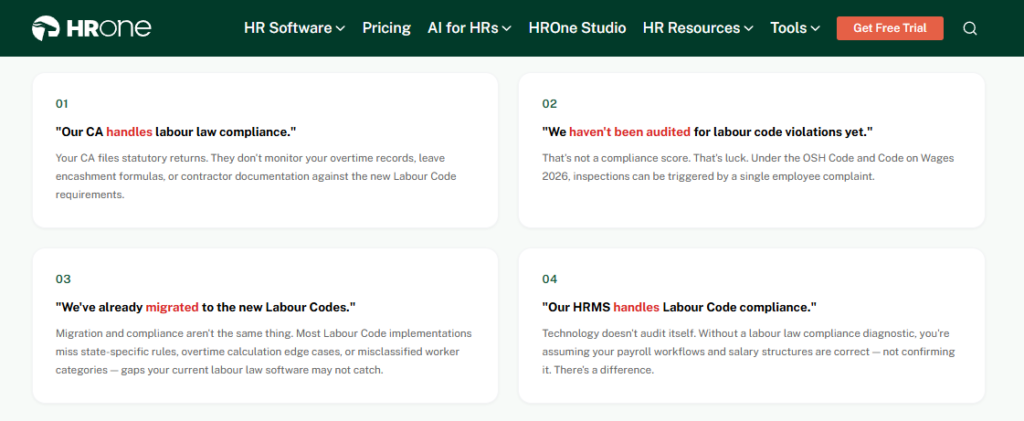
HROne, the India-first hire-to-retire HCM that turns statutory compliance into an automated workflow, not a monthly scramble.
📌 Overview
HROne is a cloud-based, mobile-native HCM founded in 2016 and built for Indian enterprise and mid-market firms of 100 to 5,000 employees. It runs live across 1,500-plus brands, including MR DIY India and Asia Healthcare Holdings. On G2 it ranks well for satisfaction and carries a 9.8 NPS on its support model. It is primarily used by HR ops teams tired of reconciling payroll, attendance, and compliance across five disconnected tools.
⚙️ Core services
- Payroll and statutory engine automates EPF, ESI, PT, LWF, and TDS calculations with employee-level contribution limits, removing manual month-end reconciliation errors.
- State-wise slab management configures different minimum wages and PT/LWF slabs per state, so multi-state payroll stops being a manual spreadsheet job.
- Super Inbox workflow engine surfaces every pending task, request, and approval in one HR inbox that closes in three clicks, cutting HR admin time sharply.
- 127 pre-built hire-to-retire workflows define who does what by when across onboarding, confirmation, transfer, and exit, so HR stops chasing managers.
- Digital letters and policy acknowledgement auto-generate confirmation and Form-16 letters and force mandatory acknowledgement of compliance policies like POSH and whistleblowing.
- Statutory register and challan generation produces PT, ESI, and bank challan files directly, which reviewers confirm is quick and error-free.
🇮🇳 India-specific compliance and localization
- PF/ESI/TDS support: Yes (automated calculation, filing, and reconciliation).
- Labour law compliance: Strong (four Labour Codes, state slabs, registers).
- Payroll localization (India-specific): Yes (CTC, FBP, arrears, Form-16).
- Multi-state compliance handling: Yes (state-wise PT, LWF, and minimum-wage slabs).
👤 Who this is built for
- Payroll manager firefighting CTC-revision arrears and PF/ESI calculation errors every month-end.
- HR ops lead manually reconciling biometric exports against a separate leave management portal across multiple states.
- CHRO who needs proof of hours saved to present ROI at a board review.
🚫 Who should skip this
- Sub-50-employee teams wanting a lightweight, spreadsheet-like payroll without structured workflows.
- Power users who need deep performance and audit features fully mirrored on mobile, since some are lighter on the app.
💰 Pricing structure
- Plan Type(s): Modular PEPM plans across Core HR, Payroll, and full HCM.
- Starting Price: Not publicly disclosed as a fixed figure. Request a quote for flat PEPM.
- Tier-wise Breakdown: Not publicly disclosed. Modules are bundled by requirement rather than fixed tiers.
- Incremental Cost Drivers: Add-on modules and custom app builds. No mandatory per-form charges.
- Implementation Fee: No day-one billing. Subscription meters only after go-live, with zero contractual lock-in.
- Cost at 200 Employees: Request a quote | Cost at 500 Employees: Request a quote.
🛠️ Implementation and support reality
- Average go-live can be as fast as 30 days for mid-market firms.
- Support runs on phone, email, and a dedicated prior-HR SPOC who knows the domain, not a checklist reader.
- Data migration is vendor-led, with reviewers reporting old-ERP data moved in hours.
- Publicly cited 9.8 NPS on the SPOC support model.
💬 Reviews
“I like HROne for its zero-touch payroll and compliance automation. It handles salary calculations, statutory deductions PF, ESI, taxes, and filings automatically, with zero manual intervention, removing payroll errors and compliance anxiety during audits.”
Waldon S., HR user HROne G2 Verified Review
“Proper calculation of PF and ESI was a pain area for us before, but now with the HROne automated calculation process, results are up to the mark and following Indian tax compliances properly.”
Ajay K., HR user HROne G2 Verified Review
Where HROne fits in this list
From what surfaces when you actually run multi-state payroll, the hard part is never the salary math. It is the state-slab upkeep, the register trail, and the POSH acknowledgement no “simple database” tracks. HROne earns its 5-star rating here because it pairs automated PF/ESI/PT/LWF with state-wise slab handling, mandatory policy acknowledgement, and challan generation in one connected system. We build for the 100 to 5,000 band on purpose, and the ROI Dashboard exists so a CHRO can walk into a board review with hours-saved already quantified.
1.2 Keka
Keka, a polished, UX-led HRMS that handles core payroll compliance well for SMB-to-mid teams.
📌 Overview
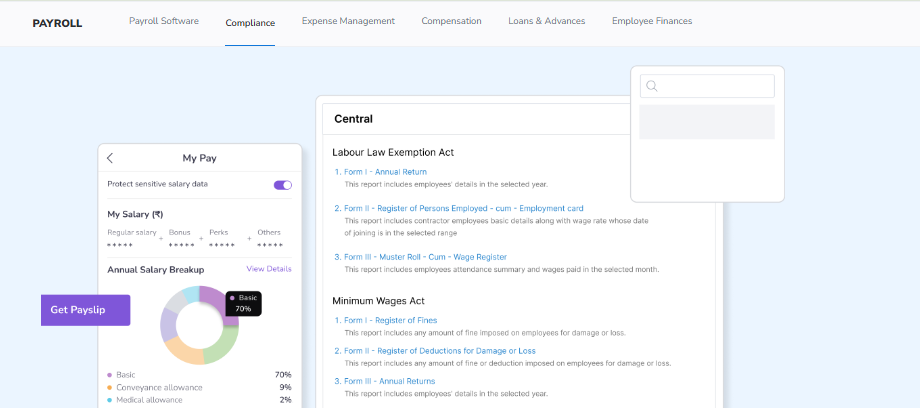
Keka is an India-based HRMS known for a clean, intuitive interface and strong payroll automation. It serves SMB and lower-mid-market teams and is widely adopted for attendance and payroll. Reviewers praise the UI and the payroll compliance depth, but flag that implementation timelines and support escalation can be inconsistent. It is primarily used by growing teams that want a modern-looking payroll and attendance system.
⚙️ Core services
- Payroll and compliance engine automates salary, attendance, PF, ESI, and TDS processing with statutory-compliant payslips, reducing manual payroll effort.
- Attendance and leave tracks attendance and leave with a well-reviewed mobile app.
- Keka Hiro recruitment automates hiring approvals and offer-letter workflows.
- Document management generates most HR documents in-system to cut paperwork.
- Employee surveys run satisfaction surveys and basic engagement tracking.
🇮🇳 India-specific compliance and localization
- PF/ESI/TDS support: Yes (automated payroll with statutory compliance).
- Labour law compliance: Moderate (solid core payroll, thinner on multi-entity depth).
- Payroll localization (India-specific): Yes, though some CTC/PT display gaps are reported.
- Multi-state compliance handling: Partial (limited configuration for complex multi-entity setups).
👤 Who this is built for
- Payroll manager at an SMB wanting automated PF/ESI/TDS without a heavy implementation.
- HR lead who values a clean, low-training UI for everyday attendance management.
🚫 Who should skip this
- Multi-legal-entity or shift-based manufacturing HR firms needing deep configuration, since users report limits here.
- Teams that need weekend or emergency phone support during a payroll crunch.
💰 Pricing structure
- Plan Type(s): Tiered per-employee plans (Foundation, Strength, Growth as published by Keka).
- Starting Price: Not publicly disclosed as a fixed figure. Request a quote.
- Tier-wise Breakdown: Not publicly disclosed at fixed rates. Priced per employee with module bundles.
- Incremental Cost Drivers: Module upgrades and higher tiers for advanced modules.
- Implementation Fee: Reported separately in some cases. Confirm at quote stage.
- Cost at 200 Employees: Request a quote | Cost at 500 Employees: Request a quote.
🛠️ Implementation and support reality
- Onboarding can run slow, with some clients reporting multi-month, incomplete setups.
- Support is largely email and chat, with limited weekend availability reported.
- Data migration is vendor-led during onboarding.
- No standardised public NPS available.
💬 Reviews
“strong payroll and compliance automate salary and attendance processing with pfesi tds. payslip statutory compliance. Responsive support team. Mobile app available. PMS module is confusing and needs to be simpler.”
Kiran B., HR user (3/5) Keka G2 Verified Review
“We started working with Keka HRMS in August, and to this day, we have been unable to implement the tool in our company due to their consistently delayed responses and poor coordination between their internal teams.”
Divya P., HR buyer (1/5) Keka G2 Verified Review
Where Keka fits in this list
Keka earns a solid 3-star rating. Its payroll compliance and UI are genuinely strong for SMB-to-mid teams, and I would not argue otherwise. The standard read gets this backwards though. For a 500-person multi-state firm, the risk is not the payroll engine; it is the implementation drag and the support escalation gaps reviewers keep naming. That is exactly the handoff friction that a HROne dedicated prior-HR SPOC model and 30-day go-live are designed to remove, which is why the two land in different tiers for the mid-market buyer.
1.3 greytHR
greytHR, dependable, budget-friendly payroll and statutory basics for Indian SMBs.
📌 Overview
greytHR is one of India’s oldest cloud HR and payroll platforms, widely used by small and mid-sized firms. It is trusted for core payroll, payslips, and statutory filing. Reviewers value its simplicity and price, but flag rigid customization and inconsistent support. It is primarily used by cost-conscious teams that need reliable payroll without heavy configuration.
⚙️ Core services
- Payroll engine automates salary, PF, ESI, and PT processing with statutory payslips, cutting manual payroll effort.
- Leave and attendance tracks leave balances and holidays, though managers cannot always mark leave for reports.
- Employee self-service lets staff pull payslips, apply for leave, and view tax details without pinging HR.
- Tax declaration supports multi-regime tax declarations from the employee login.
- Onboarding manages basic new-joiner initiation and document collection.
🇮🇳 India-specific compliance and localization
- PF/ESI/TDS support: Yes (core payroll and payslips), though TDS revision is limited.
- Labour law compliance: Moderate (solid statutory basics, weak on customization).
- Payroll localization (India-specific): Yes (payslips, PF, ESI, PT).
- Multi-state compliance handling: Partial (rigid config limits complex multi-entity setups).
👤 Who this is built for
- Payroll manager at an SMB wanting dependable monthly payroll on a tight budget.
- HR generalist who needs employee self-service for payslips and leave.
🚫 Who should skip this
- Multi-legal-entity or manufacturing firms needing flexible customization, since users cite rigidity.
- Teams that need fast, responsive support during payroll errors.
💰 Pricing structure
- Plan Type(s): Free (Starter), Welcome, Regular, and Enterprise tiers.
- Starting Price: Published from roughly ₹2,495 per month for the base paid tier.
- Tier-wise Breakdown: Free base tier for tiny teams. Paid tiers add payroll, leave, and statutory modules.
- Incremental Cost Drivers: Add-on modules and higher employee bands raise cost.
- Implementation Fee: Typically bundled. Confirm at quote stage.
- Cost at 200 Employees: Request a quote | Cost at 500 Employees: Request a quote.
🛠️ Implementation and support reality
- Setup is moderate but leave-balance and policy config issues are reported.
- Support runs on ticket plus callback, often within 1 to 2 hours, though quality varies.
- Data migration is largely vendor-guided.
- No standardised public NPS available.
💬 Reviews
“The system acts as per its own whims and gives error reports. We have to spend time manually to find errors. Not one month has passed where we have not raised a ticket.”
Maheshkumar J., HR user (0.5/5) greytHR G2 Verified Review
“GreytHR is not much good at customizing based on our requirements. From implementation onwards, there were issues with leave balance. Many times we were manually correcting the leave balance of employees.”
Verified User in IT (2/5) greytHR G2 Verified Review
Where greytHR fits in this list
greytHR earns 3 stars, and I want to be fair here. For a sub-100-person team on a budget, it does the statutory basics reliably. The standard read gets this backwards though. The moment a shift-based or multi-entity reality appears, the rigid config becomes the bottleneck. That is the exact gap where a greytHR alternative like HROne uses 127 pre-built workflows and state-wise slab handling to stop HR from manually correcting balances every month.
1.4 Darwinbox
Darwinbox, an enterprise-brand HCM with broad module coverage and a modern interface.
📌 Overview
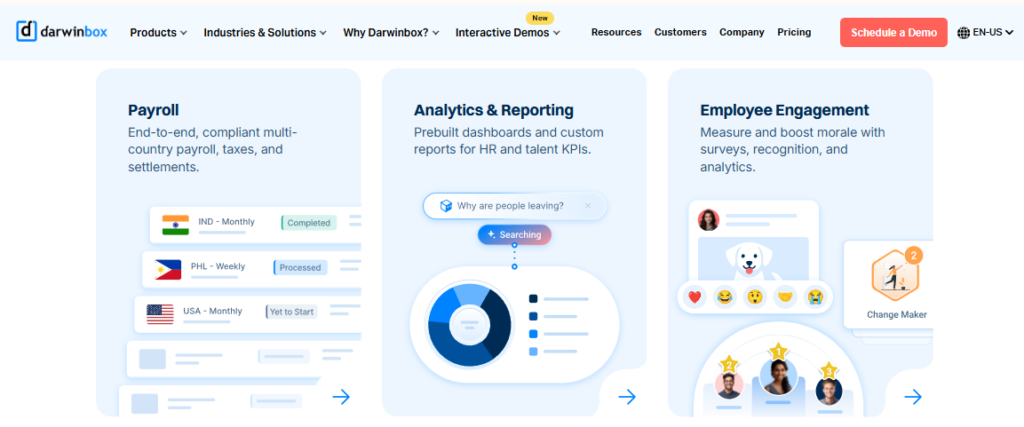
Darwinbox is a well-known enterprise HCM used by large Indian and Asian corporates. It carries strong brand weight and a broad module suite spanning attendance, payroll, and performance. Reviewers like the interface but report slow bulk processing, migration friction, and uneven support. It is primarily used by large firms that value brand recognition and lifecycle breadth.
⚙️ Core services
- Unified HR suite centralises attendance, leave, payroll, and performance, cutting reliance on multiple tools.
- Mobile app enables quick leave, attendance, and payslip actions on the go.
- Configurable workflows adapt to internal processes with limited technical input.
- Performance management structures reviews, though users find it non-intuitive at first.
- Employee directory and org view maps reporting structure across large teams.
🇮🇳 India-specific compliance and localization
- PF/ESI/TDS support: Yes (part of the payroll suite).
- Labour law compliance: Moderate to Strong (enterprise-grade, config-heavy).
- Payroll localization (India-specific): Yes (India-headquartered vendor).
- Multi-state compliance handling: Yes (built for large multi-location firms).
👤 Who this is built for
- CHRO at a large enterprise wanting one recognised brand across many locations.
- HR ops lead consolidating Excel sheets and legacy tools into one platform.
🚫 Who should skip this
- Lean mid-market teams wary of long implementation and multi-year lock-ins.
- Teams needing fast bulk data processing, since users report peak-load slowdowns.
💰 Pricing structure
- Plan Type(s): Enterprise plans, quote-based.
- Starting Price: Not publicly disclosed. Request a quote.
- Tier-wise Breakdown: Not publicly disclosed. Priced per deployment scope.
- Incremental Cost Drivers: Add-on modules, integrations, and implementation services.
- Implementation Fee: Typically separate. Confirm at quote stage.
- Cost at 200 Employees: Request a quote | Cost at 500 Employees: Request a quote.
🛠️ Implementation and support reality
- Go-live tends to be longer, with migration described as difficult by some users.
- Support is vendor-led, with mixed reviews on responsiveness.
- Data migration is vendor-led.
- No standardised public NPS available.
💬 Reviews
“Darwinbox has made HR processes much smoother by bringing everything together on one platform. Pages sometimes load slowly. Mobile app experience not always as smooth as desktop. Sync with other systems can be inconsistent.”
Saksham A., HR user (4/5) Darwinbox G2 Verified Review
“Bad implementation experience, bad UI UX, configurations getting broken in production on its own due to product deployments, terrible customer service.”
Verified User in Computer Software (0/5) Darwinbox G2 Verified Review
Where Darwinbox fits in this list
Darwinbox earns 3 stars, and its brand credibility is real. From what surfaces when you actually run daily tasks though, users still juggle tabs and emails to close simple approvals. That is the connective tissue gap. A HROne Super Inbox surfaces every pending task in one Gmail-style view that closes in three clicks, and subscription meters only after go-live instead of from day one of purchase.
1.5 ZingHR
ZingHR, a hire-to-retire enterprise suite with wide module coverage but heavy configuration.
📌 Overview
ZingHR is an enterprise HCM positioning itself across the full hire-to-retire lifecycle. It offers payroll, learning, and performance in one integrated stack. Reviewers note useful features like a tax simulator, but repeatedly flag a dated UI, slow performance, and poor support. It is primarily used by enterprises wanting broad coverage who can absorb a long implementation.
⚙️ Core services
- Payroll and tax tools automate payslips, tax deductions, and include a tax simulator to cut manual calculation.
- Hire-to-retire modules span recruitment, learning, and performance management.
- Attendance and leave manage workforce data, though the flow is called non-intuitive.
- Helpdesk tracks HR queries to reduce back-and-forth.
- Mobile app is available, but users report instability and login issues.
🇮🇳 India-specific compliance and localization
- PF/ESI/TDS support: Yes (payroll and tax deduction handling).
- Labour law compliance: Moderate (broad but config-dependent).
- Payroll localization (India-specific): Yes (India-headquartered).
- Multi-state compliance handling: Yes (enterprise workforce scope).
👤 Who this is built for
- CHRO at a large enterprise wanting learning and performance management in one suite.
- HR ops team standardising workforce data across many locations.
🚫 Who should skip this
- Mid-market teams needing fast go-live, since 6-month partial implementations are reported.
- Employees who rely on a stable mobile app for daily tasks.
💰 Pricing structure
- Plan Type(s): Enterprise plans, quote-based.
- Starting Price: Not publicly disclosed. Request a quote.
- Tier-wise Breakdown: Not publicly disclosed. Priced per module and scope.
- Incremental Cost Drivers: Customization and integrations are expensive per user reports.
- Implementation Fee: Typically separate. Confirm at quote stage.
- Cost at 200 Employees: Request a quote | Cost at 500 Employees: Request a quote.
🛠️ Implementation and support reality
- Go-live can be long, with one user citing only 40% completion in 6 months.
- Support is reported as slow, with email replies delayed by days or weeks.
- Data migration is vendor-led.
- No standardised public NPS available.
💬 Reviews
“The fact that the system has multiple capabilities of being an integrated system to support an organization from its Hire to retire stages. System implementation experience was horrible, in 6 months the implementation was barely completed to 40%. Support is never on time.”
Sanmeet S., HR user (2/5) ZingHR G2 Verified Review
“It has the option to upload tax deductions and download payslips automatically and also features like a Tax simulator. It has a very very bad UI, it has many options but they are not placed where they are needed.”
Tanishq G., HR user (2/5) ZingHR G2 Verified Review
Where ZingHR fits in this list
ZingHR earns 3 stars for coverage, but the pattern in the reviews is hard to ignore. The features exist, yet the implementation drag and support delays undercut them. I might be wrong for a specific enterprise, but for the 100 to 5,000 band, a 30-day go-live with a dedicated prior-HR SPOC beats a broad suite that takes six months to half-configure. That is the core of a fast HRMS implementation timeline.
1.6 PeopleStrong
PeopleStrong, a mobile-first enterprise HCM built for large Indian workforces.
📌 Overview
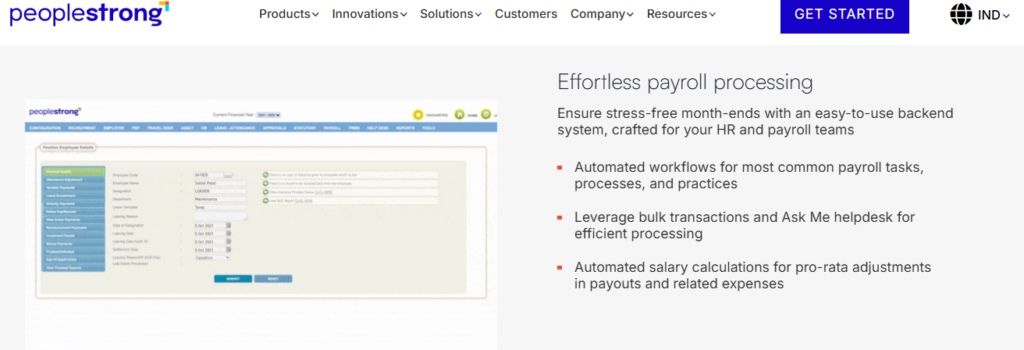
PeopleStrong is a large-enterprise Indian HCM known for mobile-first self-service. It handles attendance, reimbursements, payslips, and KRAs in one app. Reviewers praise the mobile experience but note occasional lag and slow approvals. It is primarily used by big Indian firms prioritising employee self-service on mobile.
⚙️ Core services
- Mobile-first self-service puts attendance, leave, and payslips one tap away, reducing desktop dependence.
- Reimbursement and claims centralises submissions with status tracking to cut email threads.
- Payslip access gives employees direct salary detail access.
- KRA and performance supports quarterly goal tracking.
- AI assistant (Jinie) helps with routine queries, though users say it is inconsistent.
🇮🇳 India-specific compliance and localization
- PF/ESI/TDS support: Yes (payroll and reimbursement handling).
- Labour law compliance: Moderate to Strong (enterprise-grade).
- Payroll localization (India-specific): Yes (India-headquartered).
- Multi-state compliance handling: Yes (large-workforce scope).
👤 Who this is built for
- CHRO at a large firm wanting strong mobile self-service adoption.
- HR ops lead reducing manual reimbursement and payslip email threads.
🚫 Who should skip this
- Lean mid-market teams wanting a simpler desktop-first setup, since the desktop version feels over-featured.
- Teams needing fast approval turnaround, as slow approvals are reported.
💰 Pricing structure
- Plan Type(s): Enterprise plans, quote-based.
- Starting Price: Not publicly disclosed. Request a quote.
- Tier-wise Breakdown: Not publicly disclosed. Priced per deployment scope.
- Incremental Cost Drivers: Add-on modules and integrations.
- Implementation Fee: Typically separate. Confirm at quote stage.
- Cost at 200 Employees: Request a quote | Cost at 500 Employees: Request a quote.
🛠️ Implementation and support reality
- Enterprise-scale go-live, timelines vary by deployment size.
- Support is vendor-led.
- Data migration is vendor-led.
- No standardised public NPS available.
💬 Reviews
“It’s mobile-friendly, unlike the one we used before. This is mobile friendly and can be accessed most of the HR-related info in 1 tap away. Very helpful to access attendance, leaves etc.”
Nikhil S., HR user (4/5) PeopleStrong G2 Verified Review
“PeopleStrong makes reimbursements and payslips easy with clear tracking. The reimbursement and claims process can feel a bit slow at times, especially when approvals take longer than expected. The interface can also lag occasionally.”
Anusha, HR user (5/5) PeopleStrong G2 Verified Review
Where PeopleStrong fits in this list
PeopleStrong earns 3 stars, and its mobile-first focus is genuinely strong. From what surfaces when you actually run approvals though, the lag and slow turnaround are the recurring friction. A mobile HR app from HROne is also mobile-native with offline attendance, but the difference is the workflow engine behind it. When an approval surfaces in the Super Inbox, the next lifecycle step triggers automatically, so nothing stalls in a queue.
1.7 Zoho People
Zoho People, affordable core HR for teams already living inside the Zoho ecosystem.
📌 Overview
Zoho People is the HR module within the broad Zoho software suite. It offers affordable core HR, attendance, and leave, with tight integration to Zoho Recruit and Zoho Payroll. Reviewers value the price and ecosystem fit but flag shallow feature depth and slow support. It is primarily used by SMBs already standardised on Zoho.
⚙️ Core services
- Attendance and leave manages requests digitally with direct approve or reject, cutting admin work.
- Onboarding lets candidates self-enter data, completing onboarding within a day.
- Zoho ecosystem integration connects to Zoho Recruit and Payroll to streamline hiring and payroll.
- Employee self-service lets staff check leave balances, reducing HR emails.
- Business-unit organisation segments data by unit.
🇮🇳 India-specific compliance and localization
- PF/ESI/TDS support: Partial (via Zoho Payroll integration, not deep native).
- Labour law compliance: Limited (global generalist, thin on India specifics).
- Payroll localization (India-specific): Partial (better inside the full Zoho stack).
- Multi-state compliance handling: Limited (shallow feature depth reported).
👤 Who this is built for
- HR lead at a Zoho-stack SMB wanting affordable core HR and self-service.
- Small-team recruiter wanting fast candidate self-onboarding.
🚫 Who should skip this
- Compliance-heavy manufacturing or BFSI firms needing deep India statutory depth.
- Teams needing responsive support, since slow response times are reported.
💰 Pricing structure
- Plan Type(s): Essential HR, Professional, Premium, Enterprise, and People Plus tiers.
- Starting Price: Low per-user monthly entry price, among the cheapest here.
- Tier-wise Breakdown: Not fully fixed publicly. Higher tiers add performance and analytics.
- Incremental Cost Drivers: Add-on Zoho apps and higher tiers.
- Implementation Fee: Largely self-serve, minimal fee.
- Cost at 200 Employees: Request a quote | Cost at 500 Employees: Request a quote.
🛠️ Implementation and support reality
- Setup is fast and self-serve, aided by instructional videos.
- Support is email and ticket, with slow response times reported.
- Data migration is largely self-serve.
- No standardised public NPS available.
💬 Reviews
“As an HR professional, what I appreciate most about Zoho People is its onboarding process. The biggest drawback for me has been the lack of customer support. Additionally, the mobile application is quite limited.”
Dhana C., HR professional (4/5) Zoho People G2 Verified Review
“The breadth of applications and the price of it. Features are shallow and there is no depth in each application.”
Verified User in IT (2.5/5) Zoho People G2 Verified Review
Where Zoho People fits in this list
Zoho People earns 3 stars, mostly for price and ecosystem fit. I would not argue against it for a Zoho-native SMB. For Indian labour-law compliance though, “shallow depth” is the exact risk. CTC revisions, FBP declarations, and new wage-code full-and-final rules need native handling. That statutory depth, plus multi-state slab automation, is where a Zoho People alternative like HROne is built for the Indian mid-market rather than as a global generalist.
1.8 Simpliance
Simpliance, a dedicated labour-law compliance and statutory audit engine.
📌 Overview
Simpliance is a specialist Indian compliance platform focused on statutory registers, audits, and minimum-wage tracking. It is not a full HCM. It suits compliance and legal teams that want deep register automation and audit scoring rather than payroll or attendance. It is primarily used by firms treating labour-law compliance as a dedicated function.
⚙️ Core services
- Statutory register automation auto-generates labour-law registers to remove manual upkeep.
- Minimum-wage tracking maintains state-wise minimum-wage updates so rates stay current.
- Compliance audit scoring scores compliance health to flag gaps before audits.
- Document repository stores licences and returns for inspection readiness.
- Compliance calendar tracks filing due dates to prevent missed deadlines.
🇮🇳 India-specific compliance and localization
- PF/ESI/TDS support: Partial (compliance tracking, not payroll processing).
- Labour law compliance: Strong (its core specialty).
- Payroll localization (India-specific): No (not a payroll engine).
- Multi-state compliance handling: Yes (state-wise register and wage tracking).
👤 Who this is built for
- Compliance officer tracking statutory registers across many states and licences.
- Legal or HR lead preparing for labour-law audits and inspections.
🚫 Who should skip this
- Teams wanting a full HCM with payroll, attendance, and performance in one place.
- SMBs needing an all-in-one tool rather than a standalone compliance layer.
💰 Pricing structure
- Plan Type(s): Compliance-management subscriptions, quote-based.
- Starting Price: Reported from roughly ₹20,000 per year for smaller scopes. Confirm at quote stage.
- Tier-wise Breakdown: Not fully disclosed publicly. Priced by establishments and scope.
- Incremental Cost Drivers: Per-establishment and per-licence coverage.
- Implementation Fee: Typically bundled. Confirm at quote stage.
- Cost at 200 Employees: Request a quote | Cost at 500 Employees: Request a quote.
🛠️ Implementation and support reality
- Moderate setup focused on register and licence mapping.
- Support is vendor-led.
- Data migration is vendor-led.
- No standardised public NPS available.
Where Simpliance fits in this list
Simpliance earns 4 stars on pure compliance depth, and I rate it highly for that. Here is the honest trade-off though. It solves one problem well and leaves the other nine on the HR manager’s plate. You still run payroll, attendance, and onboarding elsewhere. A full core HCM like HROne folds that statutory-register and audit discipline into a full hire-to-retire system, so compliance is not a separate tool your team logs into.
1.9 Digiliance
Digiliance, a compliance platform built for contract-labour and principal-employer obligations.
📌 Overview
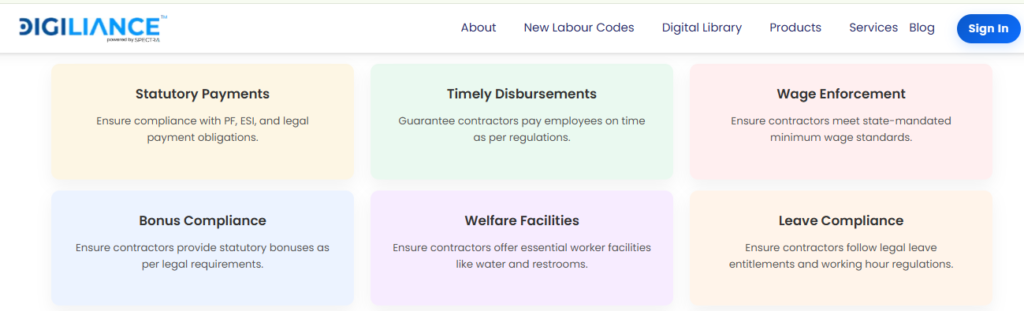
Digiliance is an Indian compliance specialist focused on statutory and contract-labour management. It supports principal-employer obligations across many states and union territories. It is a compliance layer, not a full HCM. It is primarily used by firms with large contractor workforces and heavy principal-employer duties.
⚙️ Core services
- Contract-labour management tracks contractor compliance so principal employers avoid liability gaps.
- Statutory register generation auto-produces registers across states and union territories.
- Vendor compliance portal collects contractor documents to reduce manual chasing.
- Compliance calendar flags filing and renewal dates to prevent lapses.
- Audit support maintains inspection-ready records.
🇮🇳 India-specific compliance and localization
- PF/ESI/TDS support: Partial (compliance tracking, not payroll).
- Labour law compliance: Strong (contract-labour specialty).
- Payroll localization (India-specific): No (not a payroll engine).
- Multi-state compliance handling: Yes (coverage across states and union territories).
👤 Who this is built for
- Principal-employer compliance lead tracking contractor obligations across sites.
- Manufacturing or infrastructure firm managing large contract-labour pools.
🚫 Who should skip this
- Teams wanting a unified HCM with payroll, attendance, and performance built in.
- SMBs without significant contract-labour exposure.
💰 Pricing structure
- Plan Type(s): Compliance-service subscriptions, quote-based.
- Starting Price: Not publicly disclosed. Request a quote.
- Tier-wise Breakdown: Not disclosed publicly. Priced by establishments and contractor volume.
- Incremental Cost Drivers: Per-establishment and per-contractor coverage.
- Implementation Fee: Typically bundled. Confirm at quote stage.
- Cost at 200 Employees: Request a quote | Cost at 500 Employees: Request a quote.
🛠️ Implementation and support reality
- Moderate setup, often partner-assisted or service-led.
- Support is vendor or partner-led.
- Data migration is vendor-led.
- No standardised public NPS available.
Where Digiliance fits in this list
Digiliance earns 4 stars for contract-labour compliance, which is a genuinely hard niche. The trade-off is the same as any point tool though. It handles the contractor layer, then your own workforce still needs payroll, attendance, and onboarding somewhere else. For a firm running both direct and contract staff, a connected workforce management record plus statutory automation from HROne keeps that whole picture in one system.
1.10 SAP SuccessFactors
SAP SuccessFactors, a global enterprise HCM for standardising HR across many countries.
📌 Overview
SAP SuccessFactors is a global enterprise HCM used by large multinationals. It offers deep global HR frameworks across many countries. Reviewers cite a steep learning curve, dated feel, costly customization, and high total cost of ownership. It is primarily used by global enterprises standardising HR worldwide, not India-first mid-market firms.
⚙️ Core services
- Global core HR standardises employee data across countries and legal entities.
- Recruiting and ATS manages hiring at global scale, though reporting is called hard to configure.
- Learning (LMS) supports compliance training, with users flagging dated tech.
- Performance and goals structures global talent processes.
- Analytics offers reporting, though users report complexity and setup pain.
🇮🇳 India-specific compliance and localization
- PF/ESI/TDS support: Partial (needs configuration or third-party localization).
- Labour law compliance: Limited for India (global framework, weak native India fit).
- Payroll localization (India-specific): Partial (often needs add-ons or partners).
- Multi-state compliance handling: Partial (heavy configuration required).
👤 Who this is built for
- Global CHRO standardising HR across many countries on one platform.
- Multinational IT director needing deep, enterprise-grade global architecture.
🚫 Who should skip this
- India-focused mid-market firms of 100 to 5,000 employees, since it is over-engineered and costly.
- Teams wanting simple config changes without developers or paid vendors.
💰 Pricing structure
- Plan Type(s): Enterprise modules, quote-based.
- Starting Price: Not publicly disclosed. Request a quote.
- Tier-wise Breakdown: Not disclosed publicly. Priced per module and country scope.
- Incremental Cost Drivers: Third-party customization, add-on modules, and implementation partners.
- Implementation Fee: Separate and typically significant. Confirm at quote stage.
- Cost at 200 Employees: Request a quote | Cost at 500 Employees: Request a quote.
🛠️ Implementation and support reality
- Long, partner-led implementations are common.
- Support is ticket plus partner-delivered.
- Data migration is partner-led.
- No standardised public NPS available.
💬 Reviews
“Covers a wide range of HR modules in theory, but it’s not user friendly. Not user-friendly, system often freezes. Customization requires third-party vendors, every change is costly. Extremely expensive for what it delivers.”
Janka Z., HR user (0/5) SAP SuccessFactors HCM G2 Verified Review
“Features supporting the diversity of a large, quickly growing international company. The most basic functionality is missing or severely flawed. If I could, I would take back our decision to implement the software.”
Verified User in Internet (0/5) SAP SuccessFactors HCM G2 Verified Review
Where SAP SuccessFactors fits in this list
SAP SuccessFactors earns 2 stars for the Indian mid-market context of this guide, and that is a context call, not a swipe at its global depth. For a Fortune 500 spanning 40 countries, it may be right. For the 100 to 5,000 band, it is over-engineered. You should not need a back-end developer to change a leave policy, and you should not bleed subscription fees during a long implementation. That is precisely the reader a SAP alternative like HROne is built for, with config changes in HR’s hands and billing that starts after go-live.
Q2. What exactly is labour law compliance software, and what is the cost of getting it wrong?
Labour law compliance software automates an Indian employer’s statutory obligations, EPF, ESI, Professional Tax, Labour Welfare Fund, and TDS filings, plus digital registers, minimum-wage revisions, and returns, across India’s 44 central and 100-plus state laws. Getting it wrong is expensive. Penalties range from around ₹10,000 to imprisonment, and manual tracking can eat up to three days a month per compliance officer.
🧩 What it actually is, in plain terms
Think of it as a compliance watchdog, not a filing cabinet. A “simple database” just stores employee data. Compliance software actively calculates, flags, and files what the law demands, so a human is not doing it by hand.
Here is the mental model I use. A system cannot replace an HR professional. It optimises the human, driving accuracy and consistency the way a spellchecker helps a writer without writing the essay.
Definition box: Labour law compliance software is a tool that automatically computes statutory deductions (PF, ESI, PT, LWF, TDS), applies the correct state and central rules, generates digital registers and returns, and updates itself when minimum wages or slabs change.
⚙️ One workflow that shows the “why”
Take a single PF challan (the monthly Provident Fund payment statement). The software configures the contribution limit at the employee level across PF wages, pension wages, and EDLI wages. That sounds small, but doing it manually across a few hundred employees is where errors creep in.
Get one contribution ceiling wrong and the challan is off. Multiply that by 12 months and multiple states, and you have a reconciliation nightmare no spreadsheet catches cleanly. Automated payroll software removes that manual ceiling error before it reaches a challan.
⚠️ Why getting it wrong hurts
The stakes are not abstract. India has 44 central labour laws and over 100 state-level rules, each with its own filing and register.
- Financial penalties run from roughly ₹10,000 into lakhs for repeat defaults.
- Personal liability can extend to imprisonment for serious statutory breaches.
- Time cost means a compliance officer can lose up to three days a month to manual tracking alone.
That last one is the quiet killer. Three days a month is nearly 36 working days a year spent reconciling instead of doing strategic HR work. A clear view of the ROI of HR software makes that lost time visible to the board.
The HROne read on this
At HROne, our thinking is that software should optimise the human, not pretend to replace one. Our PF, ESI, and TDS compliance engine sets contribution limits at the employee level across PF, pension, and EDLI wages, so the watchdog catches ceiling errors before a challan goes out. That is the difference between a passive database and an active compliance system, and it is the whole reason automation is worth paying for.
Q3. How do the four New Labour Codes and the 50% basic-wage rule change what your software must do?
The four New Labour Codes consolidate 44 central laws and reset the software checklist. The Code on Wages enforces the 50% basic-wage rule. The Social Security Code extends EPF and ESI to gig and platform workers. The OSH Code mandates digital register generation and single-registration returns. The Industrial Relations Code changes standing-order thresholds. Your software must validate the 50% rule, auto-generate state-wise digital registers, and remap contribution eligibility.
📜 What each Code now demands
The Codes are not just legal reshuffling. Each one changes a concrete behaviour your software must handle.
- Code on Wages, 2019 enforces a common definition of “wages,” so basic pay must be at least 50% of total CTC. Your software must audit and flag salary structures that break this.
- Social Security Code, 2020 extends PF and ESI coverage to gig and platform workers. Your software must remap who is eligible for contributions.
- OSH Code, 2020 mandates digital statutory registers and single-window returns. Your software must auto-generate state-mapped registers.
- Industrial Relations Code, 2020 resets standing-order and threshold rules for larger establishments. Your software must track headcount-based obligations.
💰 Why the 50% rule quietly raises your liability
Here is the trap most teams miss. If basic wage rises to 50% of CTC, then PF, gratuity, and leave encashment all rise with it, because they are calculated on basic pay.
So a firm that historically kept basic low to reduce PF outgo now faces a silent liability jump. Your software has to catch allowances that push basic below the 50% floor before payroll runs, not after. A quick check with a gratuity calculator shows how fast that exposure grows.
🗺️ Code-to-capability map
| New Labour Code | Statutory change | What your software must do |
|---|---|---|
| Code on Wages | Basic ≥ 50% of CTC | Validate and flag wage structures pre-payroll |
| Social Security Code | PF/ESI for gig workers | Remap contribution eligibility |
| OSH Code | Digital registers, single return | Auto-generate state-wise digital registers |
| Industrial Relations Code | Standing-order thresholds | Track headcount-based obligations |
⏰ Your Monday tactic
Run one wage-structure audit this week. Filter every employee whose allowances push basic pay below 50% of CTC. That single view tells your CFO the exact gratuity and PF exposure sitting in your current structure.
Where HROne fits
The hardest Code pain is not the 50% math, it is the per-state slab configuration underneath it. Different minimum wages apply in each state, and that is genuinely difficult to configure. When our team onboarded Lux, state-wise slab maintenance was the exact pain point HROne resolved so payroll stayed compliant across locations. That per-state configurability is the operational proof most vendors simply cannot show on a demo, and it is core to real multi-state payroll compliance.
Q4. Which tools deliver real multi-state coverage, statutory registers, and contract-labour compliance?
Real multi-state coverage means the software auto-applies the correct Professional Tax slab, Labour Welfare Fund rate, and Shops and Establishments rule for every state you employ in. It also auto-generates state-mapped digital statutory registers under the OSH Code and tracks contractor PF and ESI challans under CLRA (the Contract Labour Regulation and Abolition Act). Most listicles only claim “multi-state support.” HROne, greytHR, and Simpliance lead on genuine automation, while global tools like SAP SuccessFactors lag on Indian state granularity.
⚠️ Why one wrong slab becomes a penalty
Cross a state line and the rules change. Professional Tax in Karnataka is not Maharashtra’s, and Labour Welfare Fund rates differ again. One stale slab in one state means wrong deductions for every employee there.
The deeper fear I hear from scaling firms is being “handstrung by a system that doesn’t grow with your business” as you add state lines. That is a real operational risk, not a hypothetical, and it is why scaling HR processes demands the right foundation early.
📊 State-coverage and register comparison
| Capability | HROne | greytHR | Simpliance | SAP SuccessFactors |
|---|---|---|---|---|
| Auto state-wise PT/LWF slabs | Yes, state-wise slab maintenance | Partial, rigid config | Yes, compliance-focused | Partial, needs configuration |
| Digital statutory registers | Yes | Partial | Yes, core specialty | Partial |
| Contract-labour (CLRA) tracking | Yes | Limited | Yes | Partial |
| India state granularity | Strong | Moderate | Strong | Weak |
🗂️ Act-to-register mapping
- Factories Act / OSH Code gives you the Register of workers, wages, and leave, digital and auto-generated.
- Minimum Wages Act gives you the Register of wages and fines, state-mapped.
- CLRA gives you the Contractor and principal-employer registers, tracked per site.
👥 The contract-labour piece
If you run contractors, the principal employer carries liability for their PF and ESI compliance. A proper system runs a contractor portal that collects challans and flags gaps before an inspection does. Strong workforce management keeps direct and contract staff in one record.
💬 Reviews
“GreytHR is not much good at customizing based on our requirements. From implementation onwards, there were issues with leave balance. We cannot properly implement our company policies due to the limitations of greytHR.”
Verified User in IT, HR user (2/5) greytHR G2 Verified Review
“Covers a wide range of HR modules in theory, but it’s not user friendly. Customization requires third-party vendors, every change is costly. Extremely expensive for what it delivers.”
Janka Z., HR user (0/5) SAP SuccessFactors HCM G2 Verified Review
The HROne read on multi-state reality
Here is a lived tip from our product demos. Download the error sheet before processing salaries, so you review prerequisites and catch state-slab gaps before they hit a paycheque, not after. That habit is why a manufacturing HR configuration is the answer to the “system that doesn’t grow” fear. When Lux scaled across states, per-state slab maintenance was exactly what we configured to keep them compliant. The honest note, from actually running this, is that most slabs auto-populate, but genuinely new state rules still need a quick manual check first.
Q5. How does POSH compliance fit into your software choice?
The POSH Act (2013) requires every employer with 10 or more staff to run an Internal Committee, log complaints confidentially, and file annual returns. Almost no “best software” listicle connects POSH to tooling, yet HR ops carry the risk. The right platform stores the POSH policy, forces mandatory digital acknowledgement, tracks IC cases, and reminds you of annual filings, turning a compliance blind spot into a routine workflow.
🧩 The gap nobody names
POSH stands for Prevention of Sexual Harassment. The 2013 Act makes it a legal duty, not an HR nicety. Yet I have not seen a single 2026 “best software” listicle tie POSH to actual tooling.
That silence is the risk. Compliance sits with HR ops, but the software conversation skips it entirely. The standard read gets this backwards, treating POSH as a policy document instead of a live workflow. A clear POSH policy should live inside the system, not in a drawer.
⚠️ Where the risk actually hides
Two failure points bite hardest in an audit or a case.
- Unacknowledged policy. If you cannot prove every employee read and accepted the POSH policy, your defence weakens fast.
- Untracked IC cases. An Internal Committee (the mandatory complaints body) must log cases confidentially and file an annual return. Missing that return is a documented breach.
A policy sitting in a shared drive is not compliance. It is a document nobody opened. A proper HR policy generator turns that document into a tracked acknowledgement.
✅ What the software should actually do
The right platform closes the loop with three concrete behaviours.
- Mandatory digital acknowledgement so no employee skips reading the POSH policy.
- Confidential IC case tracking so complaints are logged and access-controlled.
- Annual-return reminders so the statutory filing never slips.
The HROne read on POSH
Here is a lived example. When our team onboarded MR DIY India, they wanted the employee handbook acknowledgement to be mandatory, especially for a compliance policy like anti-bribery or whistleblowing. HROne pushes those policies so an employee cannot proceed without acknowledging them, and the same mechanism handles POSH.
My current thinking is that POSH tooling becomes a standard buying criterion within two years, not an afterthought. If you are shortlisting now, why not ask every vendor to demo POSH acknowledgement and IC tracking live? A structured HRMS evaluation checklist makes that easy to test.
Q6. What does labour law compliance software really cost in India?
Most vendors hide pricing behind “request a quote,” but real benchmarks exist. greytHR starts near ₹2,495 per month and Simpliance around ₹20,000 per year, while enterprise tools stay quote-only. The bigger cost is hidden, in large implementation fees and per-form add-ons. Automating compliance can still cut cost by up to 70% versus external consultants, provided you avoid platforms that nickel-and-dime you as you scale.
💰 The advertised price is never the whole story
The sticker price is the easy part. The pain arrives later. I have watched deals fall apart over implementation fees a client simply could not absorb.
One pattern is brutal. Some vendors charge very large upfront implementation fees, and a smaller client cannot swallow ₹20,000 to ₹30,000 just to switch on the software. Then the per-form charges start, an extra fee plus a few dollars per form, and the “affordable” tool quietly balloons. Transparent pricing is the first thing to demand.
📊 Real pricing benchmarks
| Vendor | Published starting price | Model |
|---|---|---|
| greytHR | ~₹2,495/month | Tiered, per-employee |
| Simpliance | ~₹20,000/year | Compliance subscription |
| Enterprise tools (SAP, Darwinbox) | Quote-only | Per-deployment |
| HROne | Flat PEPM, quote | Billed after go-live, no lock-in |
💸 The questions to ask before signing
TCO (total cost of ownership) is the number that matters, not the headline rate.
- Is there an implementation fee, and is it bundled or separate?
- Are there per-form, per-entity, or mobile-app add-on charges?
- Does billing start at purchase or at go-live?
- Is there a multi-year lock-in?
Running the numbers through an ROI calculator before you sign saves painful surprises later.
💬 Reviews
“BambooHR: Biggest issue is how much they have increased prices. Every year is either a large price increase or our plan being sunsetted. I regret having selected BambooHR, it is now overpriced for what we have.”
Josh A., HR user (0/5) BambooHR G2 Verified Review
“It’s a decent product for the price one pays. The breadth of applications and the price of it. Features are shallow and there is no depth in each application.”
Verified User in IT, HR user (2.5/5) Zoho People G2 Verified Review
The HROne read on cost
We built HROne’s model as the deliberate opposite of implementation-fee trauma. Subscription meters only after you go live, with zero contractual lock-in, so you are not paying for months of setup you have not benefited from yet. My honest hypothesis is that flat, go-live-triggered pricing becomes the norm this decade. What would make you switch, the price, or the fear of the hidden fees behind it? A quick read on HR software pricing shows where those hidden fees hide.
Q7. How do you choose the right tool for your company size and industry?
Match the tool to your headcount and sector, not to a leaderboard. Sub-50-employee firms need affordable, fast-setup tools. Mid-market firms of 100 to 5,000, especially multi-state Manufacturing, Logistics, BFSI, and IT/ITeS, need deep state-slab, register, and POSH automation with real support. Large enterprises need global HCM depth. The costly mistake is buying a “simple database” HRIS when you actually need a compliance-grade HCM that scales with you.
⚠️ The multi-switch trap
Here is the pattern I see most. A growing firm buys a cheap tool, outgrows it, switches, and repeats. One HR leader described three system changes in under four years before landing on a real human capital management system.
Each switch costs money, data cleanup, and team morale. The root cause is buying for today’s headcount, not next year’s reality. A clear-eyed mid-market HR software choice avoids that cycle.
🗺️ Size and sector decision map
| Your profile | What you need | Shortlist logic |
|---|---|---|
| Sub-50 employees | Affordable, fast setup | Zoho People, greytHR |
| 100 to 5,000, multi-state | State-slab, register, POSH automation, real support | HROne, greytHR, Simpliance |
| Manufacturing / Logistics | Shift, contract-labour, multi-entity | HROne, Simpliance, Digiliance |
| Large global enterprise | Global HCM depth | SAP SuccessFactors, Darwinbox |
⭐ What the right fit unlocks
Fit is not abstract. When Caliber scaled with the right system, they moved from filling 8 to 10 positions a day to 15 to 20, and occupancy pressure dropped sharply. That is what happens when the tool grows with you instead of capping you. Purpose-built manufacturing HR and logistics HR configurations make that scale possible.
💬 Reviews
“I love HROne for its cost efficiency and holistic approach, which is why I prefer it over other vendors like Workday. The ability to manage various HR processes from a single platform is incredibly convenient and cost-effective for mid-level and enterprise customers.”
Priyanka S., HR user (5/5) HROne G2 Verified Review
“I use HROne daily for my attendance, leave, and all HR related activities. The initial setup was straightforward and simple, and I didn’t require training to use it from the first day.”
Prajwal B., HR user (5/5) HROne G2 Verified Review
The HROne read on fit
We picked the 100 to 5,000 mid-market band on purpose, and I will own that openly. HROne is not built to be the cheapest sub-50 tool, nor a 40-country Workday replacement. It is built for the multi-state Indian firm that keeps outgrowing “simple database” tools and needs compliance-grade depth that scales. My open question for you is this. Are you buying for the headcount you have today, or the one you will have in eighteen months? A quick look at how HROne handles multi-entity companies answers that fast.












 Secures Top Spot in
