








Q1. What Are the 8 Best Keka Alternatives for Mid-Market HR Teams in India 2026?
Switching a 200 to 2,000 employee HR stack is a high-stakes decision. One wrong vendor locks payroll accuracy, attendance reliability, and board-level ROI visibility into a multi-year contract. For this guide, I evaluated eight India-ready HRMS platforms currently being shortlisted against Keka by mid-market HR leaders, using operational, compliance, and commercial criteria that actually move the needle for a 500-person firm. The primary operator-reader is the HR Ops Lead or Payroll Manager running monthly cycles; the shadow buying committee is the CHRO, CFO, and IT Director co-signing the RFP. No hype, just where each tool genuinely wins, and where it breaks.
Our Evaluation Criteria
Each provider was assessed across seven decision-grade dimensions:
- India Statutory Compliance Depth 🇮🇳: PF, ESI, PT (state-by-state), TDS, LWF, new wage-code two-day FFS, and CLRA contract-labour tracking.
- Multi-Entity and Multi-State Payroll Engine 💰: auto-scheduler, group payout validation, arrears, FBP, JV export to Tally, and FF settlement SLA.
- Mid-Market Fit (100 to 2,000 employees): does the product scale from 200 to 2,000 without forcing a parallel deployment or enterprise uplift.
- Mobile and Field Readiness 📱: offline attendance with auto-sync, geo-fencing, multilingual app, and Play Store rating against review volume.
- AI Execution vs. Informational 🤖: does the AI agent apply leave, regularise attendance, parse 200 CVs, or just surface answers.
- Pricing Transparency and Commercial Model: published PEPM, go-live vs. day-one billing trigger, lock-in terms, and add-on discipline.
- Implementation Speed and Support SLA ⏰: review-reported go-live timeline, dedicated SPOC vs. ticket queue, and phone plus email availability.
Who This Guide Is For
- CHROs and HR Heads consolidating fragmented hire-to-retire stacks off Keka onto a single Super Inbox.
- Payroll Managers running multi-entity, India-compliant monthly payroll cycles across IT/ITeS, manufacturing, BFSI, and logistics.
- CFOs validating HR-tech ROI, flat PEPM commercials, and switching-cost economics.
- IT Directors and HR Ops leads evaluating mobile-first HCMs with SSO, RBAC, and biometric integrations.
- Plant HR managers at 500-person manufacturing units needing shift, contract-labour, and Factories Act depth.
The 8 Best Keka Alternatives for Mid-Market HR Teams in India 2026
| Provider (⭐ Rating) | Best For | Standout Strength | Known Limitation | AI and Module Depth | Support Model | Pricing Model |
|---|---|---|---|---|---|---|
| HROne ⭐⭐⭐⭐⭐ | HR Ops leads drowning in multi-entity payroll reconciliation across 3 to 4 disconnected tools | InboxforHR three-click task closure plus execution-first One AI Suite plus inbuilt ROI Dashboard | Capterra review base thinner than G2; add-ons (WhatsApp bot, Workforce Planning, BI) priced outside base | 127 workflows, 8 core modules, execution-first AI (Apr 2025) | Dedicated SPOC plus phone plus email, less than 24hr response | Flat PEPM, billing starts at go-live, no lock-in |
| PeopleStrong ⭐⭐⭐ | Enterprise HR teams at 2,000 plus employees needing mobile-first claims and payslip delivery | Mobile-friendly ESS for large distributed workforces | Desktop version cluttered; reimbursement approval lag reported | AI assistant “Jinie”, informational, not execution-first | Ticket-based plus CSM on enterprise plans | Quote-based, enterprise-tier |
| ZingHR ⭐⭐⭐ | Hire-to-retire stack for BFSI and multi-vertical groups with 26-language workforces | Broad module spread including LMS and payroll in one | Dated UI, implementation support inconsistency widely reported on G2 | AI features claimed, not independently demoed | Ticket-based, customization partner-delivered | Quote-based, customization-heavy |
| Darwinbox ⭐⭐ | 1,000 plus employee Indian enterprises needing enterprise-grade configurability | Broadest lifecycle coverage plus named clients (Tata, Mahindra, Kotak, and Adani) | Overbuilt for 200 to 500; opaque custom pricing; 3 to 6 month implementations | AI chatbot confirmed; execution agent not verified | Enterprise CSM, ticket-led | Custom quote, lakhs annually for 500 employees |
| greytHR ⭐⭐ | SME payroll teams prioritising India statutory compliance over workflow automation | India payroll-compliance authority with 30,000-customer base | Older UI, rigid configuration, weaker on performance and workflow automation | Informational AI only (JD generator, text AI) | Ticket-based, email-led | Free up to 25 employees; flat around ₹7,495/month enterprise plan |
| factoHR ⭐⭐ | 500 plus employee manufacturing plants with shift, CLRA, and Maharashtra MLWF complexity | Factory-floor compliance depth (Factories Act, shift rostering, and contract labour) | Weaker white-collar UX, thinner performance module | AI claimed, unverified | Email plus ticket, partner-delivered | ₹4,999/month for up to 50 employees; PEPM ₹45 to 85 thereafter |
| Zoho People ⭐⭐ | Teams already running Zoho Books and Zoho CRM wanting HR inside the same ecosystem | Bundle economics with Zoho One | Standalone HR weak; payroll is a separate add-on (Zoho Payroll) | AI features present, shallow execution | Ticket-based, email-only | From around ₹60/user/month; payroll add-on extra |
| Pocket HRMS ⭐⭐ | Price-conscious SMB and early mid-market teams wanting AI-led payroll basics | Affordable SMB payroll with AI “smHRty” assistant | Limited multi-legal-entity depth, manufacturing shift features shallow | AI chatbot, informational | Email plus chat | PEPM-based, undisclosed starting tier |
1. HROne, The Full Hire-to-Retire Operating System for Indian Mid-Market
Overview
HROne is an India-first, AI-powered HCM built by Uneecops Workplace Solutions (Noida, founded 2016) for 100 to 5,000 employee Indian enterprises across IT/ITeS, manufacturing, BFSI, healthcare, and logistics. The platform carries 2,084 verified G2 reviews at 4.8/5, was named #1 India and #1 APAC with Top 3 Global Customer Satisfaction in the G2 2026 Best Software Awards, and powers 1,500 plus brands including Lux Industries, Haier, Canon, Timex, and Aviva. It is primarily used by HR Ops leads drowning in multi-entity payroll reconciliation and tab fatigue across biometric portals, outsourced payroll vendors, and standalone ATS tools.
Core Services
- InboxforHR: centralises every pending employee request, approval, and exception across eight modules into a Gmail-style inbox; closes 110 daily tasks in 3 clicks, eliminating tab-switching across payroll, leave, expense, and recruitment.
- Auto-Scheduled Payroll Engine: triggers recurring runs from Time Office attendance, handles arrears, FBP declarations, CTC revisions, and new wage-code FFS with group payout validations that catch computation errors before disbursal.
- One AI Suite 🤖: launched April 28, 2025 as India’s first employee AI agent; executes tasks (leave, attendance regularisation, and helpdesk tickets) via voice or chat, plus resume relevancy scoring, JD generator, and receipt parser, not just informational.
- 127 Pre-Built Workflows: covers onboarding, confirmation, transfer, promotion, appraisal, and exit clearance so HR stops chasing managers over email; compresses appraisal cycles to 15 days with automated bell curves.
- Inbuilt ROI Dashboard 📊: India’s first native HR analytics layer comparing average HR salary against lifetime hours saved; gives CHROs a board-ready ballpark figure on HR-tech ROI in rupee terms.
- HRV Studio Low-Code Builder: custom apps for visitor, seating, or vendor management without raising a developer ticket.
- Mobile-First ESS 📱: offline attendance with auto-sync, geo-tagging, geo-fencing, selfie attendance, and web punch; 10L plus Play Store downloads with multilingual support.
🇮🇳 India-Specific Compliance and Localization
- PF / ESI / TDS support: Yes (automated computation, filing, and challan generation built into core).
- Labour law compliance: Strong (Gratuity Act, Bonus Act, new Wage Codes, and CLRA tracking).
- Payroll localization: Yes (FBP, CTC revisions, multi-structure salary, and JV export to Tally).
- Multi-state compliance handling: Yes (multi-state PT and LWF claimed; state-wise matrix should be requested from vendor during RFP).
Who This Is Built For
- HR Ops Lead manually reconciling biometric exports against leave portal and outsourced payroll vendor every month-end.
- Payroll Manager firefighting CTC-revision arrears, FBP declarations, and new wage-code FFS across multiple legal entities.
- CHRO who needs a board-ready ROI figure for HR-tech spend within one quarter of go-live.
Who Should Skip This
- Sub-50 employee startups needing only a lightweight leave tracker. The 50-user minimum block on the Basic plan is a pricing penalty.
- US or Europe-headquartered companies needing global-first HCM depth outside India compliance.
💰 Pricing Structure
- Plan Types: Basic, Professional, and Enterprise.
- Starting Price: ₹4,950/month for 50 users on Basic (effective ₹99/user/month); Professional ₹6,500/month for 50 users (₹130/user/month); Enterprise on custom quote.
- Tier-wise Breakdown: Basic covers Core HR, Time Office, Payroll, ESS, geo-fencing, and multi-legal entity with a 50-user minimum; Professional adds Recruitment, Performance, Engagement, Helpdesk, Expenses, and Assets; Enterprise adds Workforce Planning, ROI Dashboard, BI, HRV Studio, and full AI suite.
- Incremental Cost Drivers: Payroll outsourcing, WhatsApp bot, Teams integration, Workforce Planning, and BI dashboards priced separately.
- Implementation Fee: No setup fees on standard plans; implementation cost may apply for enterprise (disclosed at quote).
- Cost at 200 Employees: around ₹19,800/month on Basic. Cost at 500 Employees: around ₹49,500/month on Basic.
For a deeper look at commercials, see the full HROne pricing page.
Implementation and Support Reality
- Average go-live 30 to 60 days; MR DIY India went live in 30 days; Lux Industries documented 95% automation of leave and overtime calculations post-rollout.
- Dedicated prior-HR onboarding SPOC (not a technical PM), plus phone and email support with less than 24hr response SLA.
- Vendor-led data migration from Keka, greytHR, or legacy ERP with parallel-run option.
- Billing starts at go-live, not on purchase day. This directly addresses Keka’s Fair Usage Policy lock-in concern; 2-month notice for exit, no fixed lock-in.
Reviews
“The InboxforHR is a game-changer, centralizing every HR task into one simple inbox, cutting down administrative time by 60–70% and preventing tasks from falling through the cracks. The initial setup of HROne was surprisingly straightforward, much lighter than expected for a full HRMS.”
— Waldon S., HR Leader HROne G2 – Verified Review
“It can sometimes feel a bit overwhelming for new users. Certain features take time to understand, and without enough guided support, the learning curve can feel quite steep.”
— Nijanthan R., HR User HROne G2 – Verified Review
2. PeopleStrong, Enterprise HCM for Large Distributed Indian Workforces
Overview
PeopleStrong is an Indian enterprise HCM positioned for 2,000 plus employee organisations across BFSI, retail, and IT services. The product is mobile-friendly for ESS-heavy use cases, including attendance, claims, reimbursements, and payslip access, and carries a “Jinie” AI assistant for employee self-service. It is primarily used by enterprise HR teams needing claims and payslip delivery at scale across distributed branches.
Core Services
- Employee Self-Service Mobile App: attendance punch-in/out, leave applications, reimbursement claims, and payslip access in one tap.
- Payroll and Compensation: India statutory compliance with tax declarations and salary structure management.
- Recruitment and Onboarding: lifecycle coverage for enterprise hiring volumes.
- Performance Management: quarterly KRAs, goal-setting, and appraisal cycles.
- AI Assistant “Jinie”: informational chatbot for policy queries and navigation help.
🇮🇳 India-Specific Compliance and Localization
- PF/ESI/TDS: Yes (enterprise-grade statutory compliance).
- Labour law compliance: Moderate (enterprise-focused, CLRA depth varies by deployment).
- Payroll localization: Yes (India-specific tax and statutory).
- Multi-state compliance: Yes (enterprise implementations).
Who This Is Built For
- CHRO at a 2,000 plus employee retail or BFSI group consolidating distributed HR operations across branches.
- HR Ops lead at an enterprise running mobile-first ESS for reimbursements and payslips across 500 plus locations.
Who Should Skip This
- 200 to 500 employee mid-market teams. PeopleStrong is overbuilt and over-priced for this band.
- Teams needing a polished desktop experience. Reviewers flag the web version as cluttered.
💰 Pricing Structure
- Plan Types: Enterprise tiers, quote-based.
- Starting Price: Not publicly disclosed. Request a quote.
- Tier-wise Breakdown: Not publicly disclosed.
- Incremental Cost Drivers: Customization, integration, and implementation typically bundled into enterprise contracts.
- Implementation Fee: Yes. Enterprise implementation typically bundled; range not disclosed.
- Cost at 200 Employees: Not publicly disclosed. Cost at 500 Employees: Not publicly disclosed.
For a direct commercial and feature walkthrough, refer to our HROne vs PeopleStrong comparison.
Implementation and Support Reality
- Enterprise implementations typically 3 to 6 months.
- Ticket-based support with enterprise CSM on higher tiers.
- Vendor-led data migration for enterprise deals.
- Publicly reported NPS not disclosed.
Reviews
“PeopleStrong makes reimbursement, claims, and payslip access much easier by bringing everything into a single platform, rather than relying on manual processes or long email threads.”
— Anusha, Employee User PeopleStrong – G2 Verified Review
“It has way too many features and the desktop version isn’t very useful because of the multiple options to get 1 job done. It can be simplified further for a smoother desktop version experience.”
— Nikhil S., Employee User PeopleStrong – G2 Verified Review
3. ZingHR, Hire-to-Retire Suite for BFSI and Multi-Vertical Indian Groups
Overview
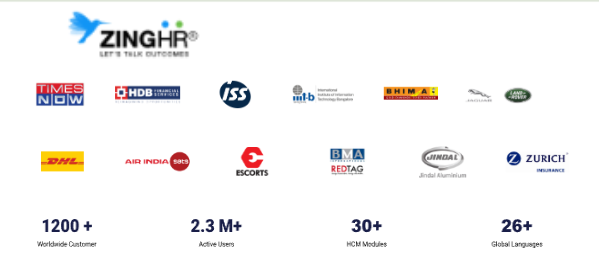
ZingHR (Cnergyis Infotech, founded 2014) is an India-focused cloud HCM serving around 550 organisations across BFSI, healthcare, IT, manufacturing, and retail with 26-language support. Module spread covers Core HR, Recruitment, Performance, Attendance, Payroll, and Workforce Management. It is primarily used by multi-vertical groups needing a broad hire-to-retire footprint under one subscription.
Core Services
- Core HR and Workforce Management: employee master, organisation structure, and lifecycle.
- Payroll and Compliance: Indian statutory support with tax simulator and NPS handling.
- Attendance and Leave: biometric integration and geo-fencing for field teams.
- Recruitment Module: sourcing to onboarding.
- Performance Management: goal cascading and review cycles.
- LMS Module: learning delivery and tracking.
🇮🇳 India-Specific Compliance and Localization
- PF/ESI/TDS: Yes.
- Labour law compliance: Moderate.
- Payroll localization: Yes (India-tuned).
- Multi-state compliance: Partial (verify state-by-state PT matrix during RFP).
Who This Is Built For
- HR team at a BFSI or multi-vertical group needing broad module spread under one vendor.
- Manufacturing HR lead managing attendance and payroll for distributed locations.
Who Should Skip This
- Teams prioritising modern UI and fast configuration. Reviewers repeatedly flag outdated UX.
- Buyers needing quick, predictable implementation. Customization is partner-led and time-consuming.
💰 Pricing Structure
- Plan Types: Quote-based, customization-heavy.
- Starting Price: around ₹2/user/month entry-level listed on GetApp; real cost rises sharply with customization.
- Tier-wise Breakdown: Not publicly disclosed.
- Incremental Cost Drivers: Customization, integration, and module add-ons.
- Implementation Fee: Yes, bundled into customization scope.
- Cost at 200 Employees: Not publicly disclosed. Cost at 500 Employees: Not publicly disclosed.
For side-by-side module and implementation depth, see the HROne vs ZingHR comparison.
Implementation and Support Reality
- Average go-live reported as 6 plus months for complex deployments.
- Ticket-based support with partner-delivered customization.
- Vendor-led or partner-led data migration.
- Publicly reported NPS not disclosed.
Reviews
“System implementation experience was horrible, in 6 months the implementation was barely completed to 40%. Support is never on time. Replies to emails get delayed by days if not weeks.”
— Sanmeet S., HR User ZingHR – G2 Verified Review
“It has the option to upload tax deductions and download payslips automatically and also features like a Tax simulator and NPS, which are much needed and take time if done manually.”
— Tanishq G., Employee User ZingHR – G2 Verified Review
4. Darwinbox, Enterprise HCM for 1,000 Plus Employee Indian Groups
Overview
Darwinbox (Hyderabad, founded 2015) is the India-origin enterprise HCM of choice for 1,000 plus employee groups, backed by Microsoft, Salesforce Ventures, and Sequoia. G2 carries 189 verified reviews at 4.2/5. Named clients include Tata, Mahindra, Kotak, and Adani. It is primarily used by enterprise HR teams needing broad lifecycle coverage and enterprise-grade configurability.
Core Services
- Core HR, Recruitment, Payroll, Performance, Attendance, Engagement, and Expense: full lifecycle module set.
- Enterprise Workflow Engine: configurable approvals across multi-entity structures.
- AI Chatbot: informational employee assistant; execution-first agent not confirmed.
- Workforce Planning: enterprise-grade headcount and budgeting.
- Mobile App: attendance, leave, and payslips for distributed workforces.
🇮🇳 India-Specific Compliance and Localization
- PF/ESI/TDS: Yes.
- Labour law compliance: Strong (enterprise implementations).
- Payroll localization: Yes.
- Multi-state compliance: Yes.
Who This Is Built For
- CHRO at a 1,000 to 5,000 employee Indian enterprise needing broad module spread and brand trust.
- HR Ops lead at a multi-entity group needing enterprise configurability for complex approvals.
Who Should Skip This
- 200 to 500 employee mid-market buyers. Darwinbox is overbuilt and over-priced for this band; review data flags mid-market implementation drag.
- Teams needing transparent published PEPM. Darwinbox is quote-only.
💰 Pricing Structure
- Plan Types: Enterprise, quote-based.
- Starting Price: Not publicly disclosed, request a quote; typically lakhs annually for 500-employee organisations.
- Tier-wise Breakdown: Not publicly disclosed.
- Incremental Cost Drivers: Per-module, per-entity, implementation, and training fees.
- Implementation Fee: Yes, bundled into enterprise contract; range not disclosed.
- Cost at 200 Employees: Not publicly disclosed. Cost at 500 Employees: Typically lakhs annually (quote-based).
For a transparent module-by-module commercial view, review our HROne vs Darwinbox comparison.
Implementation and Support Reality
- Enterprise implementations typically 3 to 6 months.
- Enterprise CSM with ticket-led escalation.
- Vendor-led data migration for enterprise deals.
- Billing typically starts from day one of purchase. Verify with vendor.
Reviews
“Darwinbox has made HR processes much smoother by bringing everything together on one platform. From attendance to payroll and performance tracking, it saves time and reduces manual effort.”
— Saksham A., HR User Darwinbox – G2 Verified Review
“Bad implementation experience, bad UI/UX, configurations getting broken in production on its own due to product deployments, terrible customer service.”
— Verified User in Computer Software Darwinbox – G2 Verified Review
5. greytHR, India Payroll-Compliance Authority for SMEs
Overview
greytHR (Greytip Software, Bangalore, founded 2000) is the India payroll-compliance authority with 30,000 organisations and 3 million users across India, the Middle East, and Southeast Asia. G2 carries 1,253 verified reviews at 4.4/5; Gartner Peer Insights carries 280 verified reviews. It is primarily used by SME and early mid-market teams (5 to 500 employees) prioritising payroll stability over workflow automation.
Core Services
- Payroll Engine: automates EPF, ESI, TDS, PT, and LWF with configurable compliance logic, reducing manual reconciliation errors during month-end runs.
- Attendance and Leave: standard biometric integration, geo-fencing available.
- Core HR, Recruitment, Onboarding, Offboarding, and Engagement: standard module spread.
- Employee Self-Service: payslip access, leave applications, and tax declarations.
- Reports and Analytics: payroll and statutory reporting.
🇮🇳 India-Specific Compliance and Localization
- PF/ESI/TDS: Yes (India’s deepest compliance content authority).
- Labour law compliance: Strong (known for monthly compliance consistency).
- Payroll localization: Yes.
- Multi-state compliance: Yes.
Who This Is Built For
- SME HR team (25 to 300 employees) running payroll with statutory compliance as the top priority.
- Payroll Manager at a 200 to 500 employee firm wanting a proven payroll engine without the enterprise uplift.
Who Should Skip This
- Mid-market teams needing modern UI, configurable workflows, and OKR-depth performance management.
- Buyers wanting execution-first AI. greytHR’s AI is informational (JD generator, text AI).
💰 Pricing Structure
- Plan Types: Starter (Free up to 25 employees), Essential, Growth, and Enterprise.
- Starting Price: Free up to 25 employees; Enterprise plan around ₹7,495/month flat (verify live pricing page).
- Tier-wise Breakdown: Tiered by module depth and employee cap; verify from greytHR pricing page.
- Incremental Cost Drivers: Add-on modules (Performance, Recruitment), and marketplace integrations.
- Implementation Fee: Not publicly disclosed, request a quote.
- Cost at 200 Employees: around ₹7,495/month (Enterprise). Cost at 500 Employees: around ₹7,495/month flat (verify tier cap).
For operator-grade commercial and feature parity, review the HROne vs greytHR comparison.
Implementation and Support Reality
- Fast for payroll-only deployments; broader module rollouts take longer.
- Ticket-based support with customer-service callbacks reported within 1 to 2 hours.
- Self-serve data migration with partner assistance.
- Publicly reported NPS not disclosed.
Reviews
“The system acts as per its own whims and gives error reports. We have to spend time manually to find errors. Not one month has passed where we have not raised a ticket.”
— Maheshkumar J., HR User greytHR – G2 Verified Review
“GreytHR is not much good at customizing based on our requirements. For our case, from implementation onwards, there were issues with leave balance. Many times we were manually correcting the leave balance of employees.”
— Verified User, IT Services greytHR – G2 Verified Review
6. factoHR, Manufacturing and Shift-Heavy Workforce Specialist
Overview
factoHR is an India-focused HRMS specialising in manufacturing, factory, and contract-labour-heavy operations. G2 carries 166 verified reviews. It is strong on Factories Act, CLRA, and Maharashtra MLWF depth. It is primarily used by plant HR managers at 500 to 2,000 employee manufacturing operations with shift complexity and biometric hardware dependencies.
Core Services
- Multi-Shift Management: rostering, shift weekly-off rules, and overtime per Factories Act.
- Contract Labour Tracking: CLRA headcount, welfare, and licence tracking.
- Biometric-Integrated Attendance: standard Indian biometric brand support claimed.
- Payroll with Maharashtra MLWF and State PT: manufacturing-state compliance.
- Mobile App for Blue-Collar Workers: geo-tagged attendance and multilingual.
🇮🇳 India-Specific Compliance and Localization
- PF/ESI/TDS: Yes.
- Labour law compliance: Strong (Factories Act, CLRA, and MLWF).
- Payroll localization: Yes.
- Multi-state compliance: Yes (manufacturing-state depth).
Who This Is Built For
- Plant HR manager at a 500-person manufacturing plant managing 3-shift rosters and contract labour.
- Payroll Manager handling Factories Act wage compliance and piece-rate overtime calculations.
Who Should Skip This
- White-collar IT/ITeS teams prioritising performance management, OKRs, and polished UI.
- Teams needing execution-first AI and a modern Super Inbox task UX.
💰 Pricing Structure
- Plan Types: Three tiers (Basic, Standard, and Premium, verify live page).
- Starting Price: ₹4,999/month for up to 50 employees; PEPM ₹45 to 85 thereafter (per secondary sources).
- Tier-wise Breakdown: Tiered by module depth; verify from factoHR pricing page.
- Incremental Cost Drivers: Per-module upgrades and biometric integration setup.
- Implementation Fee: Not publicly disclosed.
- Cost at 200 Employees: around ₹9,000 to ₹17,000/month (estimate at mid-tier PEPM). Cost at 500 Employees: around ₹22,500 to ₹42,500/month (estimate).
For the specific shop-floor fit comparison, see our manufacturing HR solution and the HROne vs factoHR comparison.
Implementation and Support Reality
- Go-live timelines not publicly disclosed; manufacturing-complex deployments typically 2 to 4 months.
- Email and ticket support.
- Partner-led data migration for complex setups.
- Publicly reported NPS not disclosed.
7. Zoho People, HCM for Teams Already on the Zoho Ecosystem
Overview
Zoho People is a cloud HCM best fit for companies already running Zoho Books, Zoho CRM, or Zoho One. India payroll compliance requires the Zoho Payroll add-on. It is primarily used by SMB to early mid-market teams wanting HR integrated into an existing Zoho stack.
Core Services
- Core HR and Employee Database: centralised employee master.
- Attendance and Leave Management: digital approvals and holiday calendar.
- Onboarding: candidate-led data entry and same-day completion.
- Zoho Payroll Integration (add-on): India statutory compliance when bundled.
- Zoho Recruit Integration: ecosystem recruitment flow.
- Performance Management: goal tracking and reviews.
🇮🇳 India-Specific Compliance and Localization
- PF/ESI/TDS: Yes (with Zoho Payroll add-on only).
- Labour law compliance: Moderate.
- Payroll localization: Yes (Zoho Payroll bundle).
- Multi-state compliance: Yes (Zoho Payroll).
Who This Is Built For
- SMB HR team (50 to 300 employees) already running Zoho Books or Zoho CRM wanting HR in the same ecosystem.
- Startup HR lead wanting affordable ESS and attendance management with bundle economics.
Who Should Skip This
- Mid-market Indian firms whose primary requirement is deep payroll compliance. Payroll add-on fragmentation creates configuration risk.
- Teams needing purpose-built multi-legal-entity OU structures or manufacturing shift depth.
💰 Pricing Structure
- Plan Types: Essential HR, Professional, Premium, Enterprise, and People Plus.
- Starting Price: around ₹60/user/month (Essential HR).
- Tier-wise Breakdown: Tiered by module depth. Essential HR covers leave and attendance; Premium adds performance; People Plus bundles Zoho Payroll.
- Incremental Cost Drivers: Zoho Payroll add-on, Zoho Recruit integration, and per-user tier uplifts.
- Implementation Fee: No setup fees for standard plans.
- Cost at 200 Employees: around ₹12,000/month (Essential HR). Cost at 500 Employees: around ₹30,000/month (Essential HR).
For an India-compliance-first comparison, see our HROne vs Zoho People comparison.
Implementation and Support Reality
- Fast go-live for Zoho ecosystem users (days to weeks).
- Ticket-based support, email-led.
- Self-serve data migration.
- Publicly reported NPS not disclosed.
Reviews
“As an HR professional, what I appreciate most about Zoho People is its onboarding process. Candidates can enter their own information, making the onboarding process smooth and allowing it to be completed within a day.”
— Dhana C., HR Professional Zoho People – G2 Verified Review
“The biggest drawback for me has been the lack of customer support. Whenever I try to reach out, it often takes a long time to get a response. Additionally, the mobile application is quite limited, I can’t access most features on it.”
— Dhana C., HR Professional Zoho People – G2 Verified Review
8. Pocket HRMS, AI-Led Payroll Basics for Price-Conscious SMBs
Overview
Pocket HRMS is a price-conscious Indian HRMS with an AI assistant “smHRty” for employee self-service. Module depth covers Core HR, Payroll, Attendance, and basic Performance. It is primarily used by SMB and early mid-market teams wanting AI-led payroll basics without a large implementation commitment.
Core Services
- Payroll Engine: India statutory support (PF, ESI, TDS, and PT).
- Attendance and Leave: mobile and biometric support.
- smHRty AI Assistant: informational chatbot for policy and payslip queries.
- Employee Self-Service: payslip access and leave applications.
- Basic Performance Module: goal setting and review cycles.
🇮🇳 India-Specific Compliance and Localization
- PF/ESI/TDS: Yes.
- Labour law compliance: Moderate.
- Payroll localization: Yes.
- Multi-state compliance: Partial (verify state coverage during RFP).
Who This Is Built For
- SMB HR lead (50 to 200 employees) wanting affordable India-compliant payroll with basic AI ESS.
- Early mid-market team upgrading from Excel to structured HRMS with a tight budget.
Who Should Skip This
- 500 plus employee manufacturing or multi-legal-entity firms. Module depth and multi-entity OU are shallow.
- Buyers needing execution-first AI and 127-workflow breadth.
💰 Pricing Structure
- Plan Types: Essential, Professional, and Enterprise (verify live page).
- Starting Price: Not publicly disclosed, request a quote.
- Tier-wise Breakdown: Tiered by module depth and employee cap.
- Incremental Cost Drivers: Per-module add-ons and AI feature upgrades.
- Implementation Fee: Not publicly disclosed.
- Cost at 200 Employees: Not publicly disclosed. Cost at 500 Employees: Not publicly disclosed.
For SMB and mid-market parity analysis, review the HROne vs Pocket HRMS comparison.
Implementation and Support Reality
- Go-live timelines typically fast for SMB deployments (4 to 8 weeks).
- Email and chat support.
- Self-serve data migration with vendor assistance.
- Publicly reported NPS not disclosed.
Each ranking above maps directly to the seven evaluation criteria in the next section. For a deeper feature, TCO, and 2026 AI-readiness comparison across these same eight vendors, see Q4. You can also run your own savings math on the HROne ROI calculator or book a demo to see the Super Inbox and One AI Suite live.
Ready to see how HROne replaces your Keka-plus-biometric-plus-Excel stack?
Walk through the Super Inbox, 127 pre-built workflows, One AI Suite, and the inbuilt ROI Dashboard with a prior-HR onboarding SPOC, billing starts only at go-live.
Q2. What Selection Criteria Were Used to Rank These Keka Alternatives?
The eight Keka alternatives in this guide were scored against five weighted criteria summing to 100, namely Mid-Market Fit (20%), India Statutory Compliance Depth (20%), Payroll Reliability and Automation (20%), Implementation Speed and Support Quality (20%), and Pricing Transparency and ROI Visibility (20%). Star ratings map directly to the weighted score, with HROne clearing the 81 to 100 band on architectural and commercial dimensions mid-market buyers actually decide on.
How Each Criterion Was Tested
Every vendor was scored on verifiable operator evidence, including G2 and Capterra review themes, live pricing pages checked in April 2026, named customer case studies, and published compliance documentation, not vendor marketing decks.
- Mid-Market Fit (20%) ✅: does the platform scale cleanly from 200 to 2,000 employees on a single instance, handle multi-legal-entity OU structures without a parallel deployment, and support 127-workflow breadth covering onboarding, confirmation, transfer, promotion, and exit clearance. See our core HCM scope for the reference architecture.
- India Statutory Compliance Depth (20%) 🇮🇳: multi-state PT coverage (Maharashtra, Karnataka, and Telangana simultaneously), PF, ESI, TDS, LWF, Gratuity, Bonus, Factories Act, CLRA contract-labour tracking, FBP declarations, and the new wage-code two-working-day FFS settlement requirement. Depth benchmarks align with our statutory compliance in payroll guide.
- Payroll Reliability and Automation (20%) 💰: auto-scheduled runs triggered from Time Office, group payout validations that catch computation errors pre-disbursal, arrears and CTC-revision handling, and JV export field-mapping to Tally. The engine baseline reflects capabilities shipped in payroll software.
- Implementation Speed and Support Quality (20%) ⏰: review-reported go-live timelines, phone plus email SLA vs. email-only ticket queues, dedicated prior-HR SPOC vs. technical PM, and data-migration model (self-serve, vendor-led, or partner-led).
- Pricing Transparency and ROI Visibility (20%) 💸: published PEPM on a live pricing page, billing trigger (go-live vs. day-one), lock-in terms and exit portability, hidden per-entity charges, and whether the platform ships a native ROI layer or forces a Power BI bolt-on.
Scoring Rubric and Master Scorecard
The rubric assigns stars by aggregate weighted score. 0 to 20 equals 1★, 21 to 40 equals 2★, 41 to 60 equals 3★, 61 to 80 equals 4★, and 81 to 100 equals 5★. Vendors clearing 61 on four of five criteria earn 4★; clearing 81 on four of five with no criterion below 61 earns 5★.
| Vendor | Mid-Market Fit | India Compliance | Payroll Automation | Implementation and Support | Pricing Transparency | Total | Stars |
|---|---|---|---|---|---|---|---|
| HROne | 19 | 18 | 18 | 18 | 19 | 92 | ⭐⭐⭐⭐⭐ |
| PeopleStrong | 14 | 14 | 13 | 10 | 6 | 57 | ⭐⭐⭐ |
| ZingHR | 14 | 13 | 12 | 8 | 6 | 53 | ⭐⭐⭐ |
| Darwinbox | 10 | 15 | 14 | 10 | 6 | 55 | ⭐⭐⭐ |
| greytHR | 10 | 17 | 12 | 10 | 12 | 61 | ⭐⭐⭐⭐ |
| factoHR | 12 | 15 | 12 | 10 | 10 | 59 | ⭐⭐⭐ |
| Zoho People | 9 | 9 | 8 | 9 | 12 | 47 | ⭐⭐⭐ |
| Pocket HRMS | 9 | 10 | 9 | 9 | 6 | 43 | ⭐⭐⭐ |
How Buyers Can Replicate This Scorecard Internally
This framework isn’t academic. It is the scorecard a mid-market buying committee can hand to any shortlisted vendor during RFP. We built HROne’s inbuilt ROI calculator for exactly this post-purchase test: it benchmarks lifetime hours saved by each workflow against average HR salary, so the CFO sees rupee-denominated savings, and the CHRO walks into the next board review with HR-tech ROI already quantified, rather than repeating this scoring exercise manually every quarter.
Q3. Why Are Mid-Market Indian Companies Switching Away From Keka, and What Do Long-Term Customers Actually Say?
Mid-market Indian companies are leaving Keka in 2026 for five converging reasons: email-only support that leaves teams stuck during payroll cycles, workflow-configurability ceilings that break at multi-entity scale, painful data migration during onboarding, shallow multi-state payroll depth, and the absence of a native ROI layer for the board. Long-term customers consistently flag these as the failure modes that triggered their shortlist.
The Operator Reality at 300 to 1,500 Employees
Picture the HR Ops lead at a 600-employee manufacturing firm on payroll-close day. Keka handles salary processing, but attendance sits in a biometric portal, contract-labour tracking lives in Excel, expense receipts are on paper, and recruitment runs on a separate ATS. Month-end becomes a manual reconciliation drill across five data sources, and the CHRO walks into the quarterly board review unable to answer “how many days on average are we taking to close a confirmation letter?”
The tooling isn’t the problem. The architecture is. A 300 to 1,500 employee HR function is processing 2,000 plus transactions a month across onboarding, transfers, FBP declarations, arrears, and exits, and each handoff between Keka and the surrounding point tools is where grievances and leakage multiply. A consolidated HR software stack collapses those handoffs into one surface.
Where Long-Term Customers Report Keka Breaking
Keka’s G2 profile carries 1,941 reviews at 4.5/5, strong on UX, but the recurring negative themes cluster tightly around four operator pain points. Keka ranks #16 for Ease of Use and #55 for overall satisfaction on G2, against HROne’s #3 position in Core HR Customer Satisfaction. For a side-by-side view, see the HROne vs Keka comparison.
- ⚠️ Support latency: reviewers report email-only ticketing with no weekend phone escalation. The evaluation question for any alternative: does support answer phone plus email within 24 hours with a dedicated SPOC?
- ⚠️ Customisation ceilings: company-specific policies need workarounds. The evaluation question: can HR configure multi-entity leave, PT, and attendance rules from the front-end without a developer ticket?
- ⚠️ Migration friction and Fair Usage Policy lock-in: Keka’s minimum-headcount commitment penalises firms downsizing mid-cycle. The evaluation question: does billing trigger at go-live, and is there an exit data-portability clause?
- ⚠️ Tax-computation and mobile-app reliability: CA-flagged FY differences and Play Store reports of GPS clock-in failures. The evaluation question: what is the Play Store rating against review volume, and is offline attendance with auto-sync documented on the mobile HR app?
The Shift From Feature Checklist to Operating System
The mid-market buyers I speak to in 2026 have stopped asking “which HRMS has the most modules” and started asking “which HRMS collapses my daily chaos into one surface?” That shift, from feature checklist to operating system, is why a platform with fewer marquee modules but a genuine Super Inbox, 127 pre-built workflows, and an inbuilt ROI Dashboard wins over a feature-richer tool with email-only support.
We built HROne around that exact reframe. Every pending task, request, and approval surfaces in one Gmail-style HR inbox that closes 110 daily tasks in three clicks, payroll runs through an auto-scheduler with group payout validations, and the dedicated prior-HR onboarding SPOC (9.8 NPS) answers phone and email within 24 hours, not a ticket queue.
Proof Where It Counts
“We started working with Keka HRMS in August, and to this day, we have been unable to implement the tool in our company due to their consistently delayed responses and poor coordination between their internal teams.”
— Divya P., HR Leader Keka – G2 Verified Review
“The InboxforHR is a game-changer, centralizing every HR task into one simple inbox, cutting down administrative time by 60–70% and preventing tasks from falling through the cracks. The initial setup of HROne was surprisingly straightforward, much lighter than expected for a full HRMS.”
— Waldon S., HR Leader HROne G2 – Verified Review
The MR DIY India case study tells the story in numbers. Payroll cycle compressed from 10 days to 5 to 6 days, live on HROne in 30 days, with billing starting only after go-live.
Q4. How Do the Top Keka Alternatives Compare on Features, Total Cost of Ownership, and 2026 AI-Readiness?
Across three buyer lenses, namely at-a-glance features, total cost of ownership, and 2026 AI-readiness, HROne leads on features and TCO transparency, while HROne and Darwinbox lead on AI-readiness depth. The honest caveat: greytHR remains the strongest India-compliance authority on pure payroll, and factoHR carries manufacturing-shift depth where HROne’s white-collar UX is less specialised. For vertical-specific depth, review our manufacturing HR solution.
At-a-Glance Feature Comparison
| Vendor | Mid-Market Fit | India Compliance | Payroll Depth | Support Model | Starting PEPM | Impl. Time | Go-Live Billing |
|---|---|---|---|---|---|---|---|
| HROne | ✅ 100 to 5,000 | Strong (PF/ESI/TDS/PT/FBP/CLRA) | Auto-scheduler plus group validation | SPOC plus phone plus email, less than 24hr | ₹99/user | 30 to 60 days | ✅ Yes |
| PeopleStrong | Enterprise 2,000 plus | Strong | Enterprise payroll | Ticket plus enterprise CSM | Quote-based | 3 to 6 months | ❌ Day-one |
| ZingHR | Multi-vertical | Moderate | Standard | Ticket, partner-led | around ₹2/user entry | 3 to 6 months | ❌ Day-one |
| Darwinbox | Enterprise 1,000 plus | Strong | Enterprise payroll | Enterprise CSM | Quote-based | 3 to 6 months | ❌ Day-one |
| greytHR | SME 5 to 500 | Strong | Reliable SMB payroll | Ticket plus callback | Free to around ₹7,495/mo flat | 4 to 8 weeks | ❌ Day-one |
| factoHR | Manufacturing 500 plus | Strong (Factories Act, CLRA) | Shift plus contract labour | Email plus ticket | ₹45 to 85/user | 2 to 4 months | ❌ Day-one |
| Zoho People | SMB 50 to 300 | Moderate (needs Zoho Payroll) | Add-on only | Email ticket | around ₹60/user | Days to weeks | ❌ Day-one |
| Pocket HRMS | SMB 50 to 200 | Moderate | Basic payroll | Email plus chat | Not disclosed | 4 to 8 weeks | ❌ Day-one |
Total Cost of Ownership, Beyond the Sticker PEPM
PEPM is rarely the real cost. Add-ons for performance, recruitment, WhatsApp, BI, per-entity surcharges, and implementation fees typically inflate 24-month spend by 30 to 50% against the advertised headline. The HR software pricing transparency case is exactly why this matters. Below is a 3-year fully-loaded estimate for a 500-employee mid-market firm.
| Vendor | Subscription (Yr 1) | Implementation Fee | Typical Add-Ons | Per-Entity Surcharge | Annual Renewal Hike | 3-Year Loaded (500 emp) |
|---|---|---|---|---|---|---|
| HROne | around ₹5.94L | None on standard; enterprise bundled | Transparent, WhatsApp, BI, and Workforce Planning priced openly | None hidden | Flat PEPM | around ₹18 to 22L |
| Darwinbox | Quote-based | Bundled into enterprise | Per-module, per-entity charges common | Yes, typical | Contract-driven | around ₹35 to 60L |
| Keka | around ₹19,188/mo base plus ₹150/add-l user | Separate | Keka Hire ₹20 to 34/recruiter, API, and Performance | Yes | Day-one billing | around ₹28 to 45L |
| greytHR | around ₹89,940 flat (Enterprise) | Not disclosed | Performance and Recruitment add-ons | Yes | Flat | around ₹4 to 8L |
| factoHR | around ₹2.7 to 5.1L | Not disclosed | Biometric setup and modules | Yes | Moderate | around ₹10 to 18L |
| Zoho People | around ₹3.6L (Essential HR) | None standard | Zoho Payroll add-on mandatory for India | Low | Ecosystem-driven | around ₹12 to 18L (with Payroll) |
2026 AI-Readiness Scorecard
Most HRMS vendors advertise “AI-powered” in 2026. The real question is whether the AI executes tasks or just surfaces answers. Execution-first AI (apply leave, regularise attendance, raise ticket, and parse 200 CVs) is the 2026 differentiator. Our HROne AI and employee AI agent were built on this thesis.
| Vendor | Resume Relevancy Scoring | Receipt Parser | Employee AI Agent (Execution) | JD/Interview Generator | GenAI Analytics / ROI | Agentic Workflow Execution |
|---|---|---|---|---|---|---|
| HROne | ✅ | ✅ | ✅ (Apr 2025 launch) | ✅ | ✅ (inbuilt ROI Dashboard) | ✅ |
| Darwinbox | ✅ | Partial | ❌ informational only | ✅ | Partial | Partial |
| PeopleStrong | Partial | ❌ | ❌ “Jinie” informational | Partial | ❌ | ❌ |
| ZingHR | Partial | ❌ | ❌ | Partial | ❌ | ❌ |
| greytHR | ❌ | ❌ | ❌ | Partial | ❌ | ❌ |
| factoHR | ❌ | ❌ | ❌ | ❌ | ❌ | ❌ |
| Zoho People | Partial | Partial | ❌ | Partial | Partial | ❌ |
| Pocket HRMS | ❌ | ❌ | ❌ informational (smHRty) | ❌ | ❌ | ❌ |
Flat PEPM, billing-after-go-live, and an execution-first native AI suite is the only commercial-plus-architectural combination that satisfies the CFO’s transparency brief and the CHRO’s board-ready-ROI brief simultaneously. That is why HROne leads on two of three lenses and ties Darwinbox on the third.
Hand this scorecard to your shortlisted vendors, then see the real thing live.
Walk through the Super Inbox, 127 pre-built workflows, One AI Suite, and the inbuilt ROI Dashboard with a prior-HR onboarding SPOC. Billing starts only at go-live.
Q5. What Is the Best Keka Replacement for a 500-Person Manufacturing or Deskless-Workforce Company?
For a 500-person Indian manufacturer running two or three plants with contract labour on the shop floor, HROne is the strongest Keka replacement. It pairs offline mobile attendance, multi-plant RBAC, and an auto-scheduled payroll engine with India-tuned compliance across Factories Act, CLRA, and state-wise PT. factoHR and PeopleStrong become legitimately credible once contract-labour headcount crosses 3,000 or shift complexity goes beyond three rotating cycles per plant.
The Plant-HR Scenario on a Payroll-Close Day
Picture the HR lead at a 500-person manufacturing firm with three plants across Maharashtra, Karnataka, and Gujarat. Payroll close takes 10 days because biometric exports from eSSL machines don’t match the leave portal, contract-labour hours come in on WhatsApp from plant supervisors, and overtime under the Factories Act requires manual reconciliation. A lateral exit on the 25th triggers a two-working-day FFS scramble under the new wage code, and the MD wants a confirmation-letter TAT dashboard by Friday.
This isn’t a feature-depth problem. It’s a data-flow problem. Every manual touchpoint between the biometric portal, the outsourced payroll vendor, the contract-labour Excel, and the ATS is where overtime disputes, wrong paydays, and CLRA compliance gaps quietly accumulate. Consolidating these touchpoints into a single manufacturing HR platform is the architectural fix.
Where Keka Strains on the Shop Floor
Keka’s strengths sit firmly in white-collar IT/ITeS, including clean UX, performance modules, and ATS polish. Plant HR reality exposes four specific gaps.
- ⚠️ Limited shift configurability: 3-shift rotating rosters with weekly-off rules, split shifts, and plant-wise overtime policies need workarounds rather than native rule-builders. See managing shift schedules for the reference capability set.
- ⚠️ Weak contract-labour flows: no native CLRA headcount, principal-employer reporting, or licence-expiry tracking, so the plant HR team runs it in Excel.
- ⚠️ No offline-first mobile attendance: Play Store reviewers report GPS clock-in failures on low-end Android devices common in factory environments. Our mobile HR app ships offline attendance with auto-sync.
- ⚠️ Multi-plant RBAC depth: one plant HR seeing another plant’s payroll is a recurring pain point in group-company deployments.
HROne’s Manufacturing Stack
We built HROne’s attendance management module specifically for multi-plant, multi-shift Indian operations, covering shift auto-scheduling, biometric integration across eSSL, ZKTeco, and Matrix, offline mobile attendance with auto-sync for low-connectivity zones, and multi-legal-entity RBAC that isolates plant-wise payroll from group HQ. The auto-scheduled payroll software pulls attendance directly from Time Office, runs group payout validations before disbursal, and handles arrears, FBP, and new wage-code FFS in the same cycle.
Lux Industries documented 95% automation of leave, OT, and compliance calculations after moving to HROne, with 50% of blue-collar workers onboarded via mobile and a 30% drop in HR bandwidth spent on reconciliation. The MR DIY India case study shows the payroll cycle collapsing from 10 days to 5 to 6 days on a single instance. That is the same compression a 500-person plant HR team can realistically target in the first three months post-go-live.
When factoHR or PeopleStrong Legitimately Beat HROne
I’d honestly steer a buyer toward factoHR or PeopleStrong in two edge cases:
✅ Very large contract workforces (3,000 plus blue-collar plus contract heads): factoHR’s specialisation in CLRA, Factories Act wage compliance, and Maharashtra MLWF depth is purpose-built for this scale, with G2 reviewers specifically calling out shift-attendance strength. See the HROne vs factoHR comparison for the direct contrast.
✅ Extreme shift complexity across 10 plus plants: PeopleStrong’s enterprise mobile-first ESS and branch-wise claim flows are designed for distributed enterprise operations at 2,000 plus employees, where the configuration uplift is justified. Review the HROne vs PeopleStrong breakdown for module parity.
Below that threshold, the switch economics favour HROne, with flat PEPM from ₹99/user, billing starting only at go-live, no fixed lock-in, a 30 to 60 day implementation led by a prior-HR onboarding SPOC rather than a technical PM, and the inbuilt ROI layer (run the math on our ROI calculator) that gives the plant-group CFO a rupee-denominated savings figure before the next board review. The question plant HR should ask every shortlisted vendor: does this platform reduce my payroll cycle by at least three days in the first quarter, and will it show me the time-saved arithmetic on a dashboard the MD can read?
Q6. How Should You Evaluate a Keka Alternative and Execute the Switch Without Breaking Payroll?
Evaluate any Keka alternative against seven architectural and commercial criteria, namely unified task surface, 100 plus pre-built workflows, multi-entity policy engine, India-compliance isolation, native AI suite, go-live billing, and phone plus email support SLA. Then execute the switch as a 30 to 45 day project with parallel payroll for one full cycle, phased cutover, and a RBAC audit. The most common switching failures come from skipping the parallel run or migrating policies without re-mapping OUs.
The Wrong Criteria and the Right Scorecard
I’ve watched buying committees lose six months chasing the wrong signals. Brand familiarity, lowest sticker PEPM, and “whatever the peer company picked” are the three most expensive criteria in HR-tech procurement. They optimise for RFP comfort, not operational outcome. For a discipline-first primer, see our how to choose HRIS HRMS software guide.
| Evaluation Criterion | HROne | Typical Competitor |
|---|---|---|
| Unified task surface (Super Inbox) | ✅ 3-click close, 110 tasks | ❌ Tab-switching across modules |
| 100 plus pre-built workflows | ✅ 127 shipped | Partial (30 to 60 typical) |
| Multi-entity policy engine (front-end) | ✅ HR-configurable | ❌ Developer ticket needed |
| India-compliance isolation (multi-state PT, CLRA, and FBP) | ✅ Strong | Partial, vendor-dependent |
| Native AI suite (execution-first) | ✅ One AI Suite | ❌ Informational chatbot |
| Billing trigger | ✅ Go-live | ❌ Day of purchase |
| Support SLA | ✅ Phone plus email, less than 24hr, plus SPOC | ❌ Email ticket only |
The 5-Step Migration Playbook
A Keka-to-HROne (or any alternative) switch breaks payroll when teams skip the parallel run. The operational sequence I’ve seen work at the 300 to 1,500 employee band is deliberately boring. A stepwise hassle-free payroll processing discipline reinforces this cadence.
- Export Keka master data and payslip history ⏰ (Days 1 to 5): pull employee master, CTC structures, leave balances, YTD tax, FBP declarations, and 24 months of payslip history as reference ground truth.
- Map OUs, legal entities, and policies (Days 6 to 15): re-mapping is where most failures occur. Multi-legal-entity OU structures and state-wise PT slabs must be configured before any transactional data flows in.
- Run parallel payroll for one full cycle 💰 (Days 16 to 30): process the same month on both systems, reconcile to the rupee, and sign off variance under ₹10 per employee before cutover.
- Cut over attendance and ESS (Days 25 to 35): biometric integration, mobile ESS rollout, geo-fencing rules, and employee login enablement go live in a staggered plant-wise or department-wise sequence.
- Decommission Keka post-reconciliation (Days 35 to 45): only after two consecutive clean payroll cycles on the new system, with signed-off variance reports in the CFO’s hands.
Change-Management and RBAC Checklist
Technology rarely breaks a switch. Change management does. The discipline below is what separates a 30-day go-live from a 6-month drag. A well-structured onboarding process anchors this discipline.
✅ Manager training on three-click approvals, Super Inbox closure, and mobile-app usage before cutover day.
✅ Employee communications: two-week pre-launch email sequence, in-app walkthroughs, and a dedicated help channel for the first two payroll cycles.
✅ RBAC audit: validate that plant HR, group HR, and finance roles cannot cross-view payroll across legal entities. Document exception handling.
✅ BGV and LMS integration re-wiring: confirm AuthBridge, IDfy, and any LMS connector is re-authenticated on the new platform before the first hire.
⚠️ Month-end overlap risk: never cut over in the last week of a payroll cycle. Schedule the switch between Day 5 and Day 20 of the salary month.
How HROne Collapses This Into a Single Implementation
We assign a prior-HR onboarding SPOC, not a technical PM, who has personally run month-end cycles, understands FBP and CTC-revision edge cases, and maps the migration against your statutory calendar. MR DIY India went live in 30 days on this model. Asia Healthcare Holdings consolidated 20 pan-India units on a single HROne instance with multi-legal-entity configuration, and billing started only at go-live. That is the single commercial lever that removes switching-cost anxiety for the CFO signing the RFP. See why HROne for the full implementation thesis.
Q7. Keka Alternatives in India 2026, Frequently Asked Questions
What Are the Best Keka Alternatives in India 2026?
The strongest India-ready Keka alternatives for 2026 are HROne, Darwinbox, greytHR, factoHR, Zoho People, PeopleStrong, ZingHR, and Pocket HRMS. HROne leads on mid-market fit, flat PEPM with go-live billing, 127 pre-built workflows, and India’s first inbuilt ROI Dashboard across 100 to 5,000 employee organisations. For a broader decision-stage view, see our top 10 HR software India shortlist.
Why Are Companies Switching Away From Keka in 2026?
Five converging reasons drive 2026 switches, namely email-only support with no weekend phone escalation, workflow-configurability ceilings at multi-entity scale, Fair Usage Policy lock-in that penalises downsizing, shallow multi-state payroll depth, and the absence of a native ROI layer the CHRO can show the board. Keka ranks #55 on G2 overall satisfaction against HROne’s #3 Core HR position. See the HROne vs Keka page for the direct contrast.
Manufacturing and Long-Term Customer Questions
What Are Keka’s Limitations for Manufacturing Companies in India?
Keka’s shop-floor gaps cluster around four operator realities, namely limited 3-shift rotating roster configurability, weak CLRA contract-labour tracking, no offline-first mobile attendance for low-connectivity plants, and multi-plant RBAC that leaks payroll visibility across legal entities. Play Store reviewers specifically flag GPS clock-in failures on low-end Android devices common in factory environments. The why HROne for manufacturing breakdown addresses each of these gaps.
Keka HRMS Reviews, What Do Long-Term Customers Actually Say?
Long-term customers praise Keka’s clean UX and performance module but repeatedly flag four pain themes, namely support latency with email-only ticketing, customisation limits requiring workarounds for policy changes, tax-computation discrepancies flagged by CAs during FY reconciliation, and implementation drag during migration. G2 carries 1,941 reviews averaging 4.5/5, with recurring negative themes on mobile GPS reliability and weekend support unavailability.
Replacement Recommendation and Next Step
What Is the Best Keka Replacement for a 500-Person Manufacturing Company?
HROne is the strongest replacement for a 500-person Indian manufacturer, shipping offline mobile attendance, multi-plant RBAC, auto-scheduled payroll with group payout validations, and India-tuned Factories Act, CLRA, and state-wise PT compliance on a single instance. Lux Industries documented 95% automation of leave and OT calculations. MR DIY India compressed payroll from 10 days to 5 to 6 days in a 30-day go-live.
➡️ Next step, book a 30-minute walkthrough of the HROne inbuilt ROI Dashboard.
See hours-saved benchmarked against your current HR salary cost, before your next board review. Billing starts only at go-live, with no fixed lock-in.














 Secures Top Spot in
