








Q1: Why Does HR Break at the 100, 250, 500, and 1,000 Employee Inflections in India?
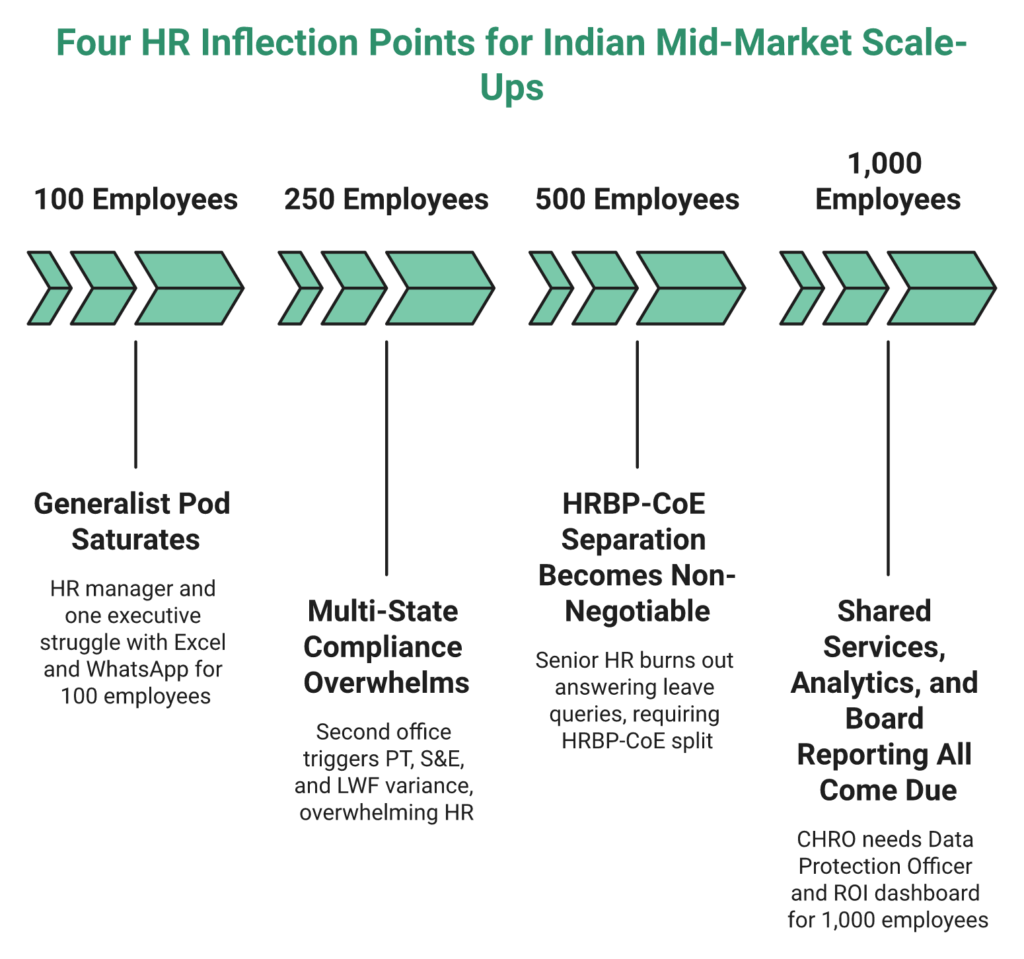
HR in the Indian mid-market doesn’t break gradually. It snaps at four predictable inflection points. At 100, the generalist pod saturates. At 250, multi-state compliance load overwhelms the stack. At 500, the HRBP-CoE separation becomes non-negotiable. At 1,000, shared services, analytics, and board reporting all come due at once. Each inflection demands a simultaneous shift in org design, HRMS architecture, and compliance depth, not more headcount on the same rails.
The 100-Employee Reality Most Founders Recognise
Picture the 100-employee Indian scale-up I’ve walked into dozens of times. One HR Head, sometimes two, running hiring on email, payroll on Excel, attendance on a biometric portal that exports CSVs, onboarding on WhatsApp, and attrition numbers buried inside a PowerPoint the CHRO updates the night before the board review. ⏰ It works, until month-end compounds, a Maharashtra hire triggers a Professional Tax scramble, and an MD asks for TTH and cost-per-hire with no dashboard to point at.
Why the “Add More Generalists” Playbook Breaks
The playbook most SMB-first HR blogs push, scale linearly by adding more HR generalists as headcount grows, is the single most expensive mistake Indian CHROs make between 100 and 500 employees. ❌ Linear headcount scaling doesn’t fix data fragmentation across 3 to 4 disconnected tools, it doesn’t resolve multi-state PT/S&E/LWF variance the moment a second office opens, and it absolutely doesn’t deliver the HRBP-CoE-Shared Services work-type separation that any 500+ Indian firm needs to stop senior HR leaders from answering leave-balance queries between board reviews. Keka and greytHR content keeps the conversation centred on “which HRMS” while the real question is “which operating model, compliance matrix, and architecture scales through all four inflections”.
The Strategic Reframe: Sequenced Architecture, Not Headcount
Scaling HR from 100 to 1,000 is not a hiring problem. ✅ It is a sequenced architecture problem where org design, policy engine, multi-state compliance matrix, and HRMS stack must evolve in lockstep across four inflections. Treat 100-250-500-1000 as the operating lens for every decision, who to hire next, which policy to codify next, which module to switch on next, which metric to surface to the board next. Everything that follows in this playbook is organised against those four gates.
How HROne Is Built to Carry All Four Inflections
We engineered HROne specifically to carry a company from 100 to 1,000 on a single instance, so you change operating models without re-platforming. The Super Inbox collapses 110 daily HR tasks into three-click closures from one screen, 127 pre-built hire-to-retire workflows auto-assign asset handover, salary structure copy-over, and FFS clearance without email chasing, and the multi-legal-entity architecture lets a 20-unit group operate on one tenant with entity-independent payroll compliance. MR DIY India went live in 30 days, Asia Healthcare Holdings runs 20 pan-India units on one HROne instance, and customers have compressed 10-day payroll cycles to 5 to 6 days after consolidation. 💰 Subscription meters only after go-live, pricing stays flat PEPM, and there’s no multi-year lock-in, so the inflection-based playbook is backed by the architecture, not another bill for air during implementation.
“The InboxforHR is a game-changer, centralizing every HR task into one simple inbox, cutting down administrative time by 60–70% and preventing tasks from falling through the cracks.”
— Waldon S., Verified User HROne G2 – Verified Review
“I love HROne for its cost efficiency and holistic approach, which is why I prefer it over other vendors like Workday… The ability to manage various HR processes from a single platform is incredibly convenient and cost-effective for mid-level and enterprise customers.”
— Priyanka S., Verified User HROne G2 – Verified Review
Q2: How Should HR Team Structure Evolve Across 100, 250, 500, and 1,000 Employees?
HR team structure should evolve from a 2-person generalist pod at 100 employees, to a 5 to 6 person specialist team with a dedicated Payroll & Compliance Lead at 250, to an HRBP + CoE split at 500, to a full HRBP-CoE-Shared Services operating model at 1,000, with the HR-to-employee ratio tightening from roughly 1:50 to 1:100 as specialisation and automation compound.
The Stage-Gated Org Design Blueprint
The table below is the blueprint I use when advising mid-market CHROs across IT/ITeS, Manufacturing, and BFSI in India. Ratios are anchored to SHRM India and Deloitte People Operations benchmarks, with the IT/ITeS band running closer to 3.91% HR cost-to-revenue versus ~2% in generic sectors.
| Inflection | Team Composition | Key New Hires | HR:Employee Ratio | Reporting Line |
|---|---|---|---|---|
| 100 employees | HR Manager + 1 HR Executive | First full-time HR Manager; Admin-cum-HR Executive | ~1:50 | HR Manager to Founder/COO |
| 250 employees | Head of HR + Payroll & Compliance Lead + TA Specialist + L&D Coordinator + People Experience Exec | First specialist hires at 120 to 150 | ~1:60 | Head of HR to COO/CEO |
| 500 employees | VP HR / CHRO + 3 HRBPs + Payroll CoE Lead + TA CoE Lead + HR Ops Lead + L&D Lead | First HRBP per BU; first CoE leads | ~1:80 | CHRO to CEO; HRBPs dotted to BU heads |
| 1,000 employees | CHRO + Heads of HRBP / CoE / Shared Services + Analytics Lead + POSH-ER Specialist + DEI Lead | Shared Services head; Analytics Lead; DEI/ER specialist | ~1:100 | CHRO to CEO; functional heads to CHRO |
When to Hire the First Specialist, First HRBP, and First CoE Lead
- First specialist, at 120 to 150 employees. Hire a Payroll & Compliance Lead before TA. ⚠️ Incorrect paycheques at 150 employees generate 2 to 3x more grievances than hiring delays, and the 2-working-day FFS clearance under the Code on Wages doesn’t forgive Excel-based ignorance.
- First TA Specialist, at 180 to 220 employees once hiring volume crosses ~15 roles per quarter and cost-per-hire needs ATS instrumentation.
- First HRBP, at 350 to 450 employees when business units cross 3 and the Head of HR can no longer answer unit-specific performance or attrition questions.
- First CoE lead, at 500 to 600 employees for TA or Payroll, whichever is breaking first. L&D and Comp CoEs typically follow at 700+.
- Shared Services Centre, at 800 to 1,000 employees once transactional ticket volume crosses ~400/month and SLA tracking becomes a board topic.
- POSH/ER Specialist, mandatory beyond 500 employees for quarterly POSH audits, DPDP compliance oversight, and disciplinary case handling.
How HROne Lets Team Structure Evolve Without Tool Changes
✅ HROne’s Super Inbox and 127 pre-built workflows let a 2-person HR pod at 100 employees operate with the capacity of a 5-person team at 250. Role-based access control, HRV Studio’s low-code app builder, and single-instance multi-legal-entity architecture let the same tenant scale to 1,000 without re-platforming, so you evolve org structure, add HRBPs, and stand up a Shared Services ticket queue inside one system through the HelpDesk module, not three.
Q3: What Does the HRBP–CoE–Shared Services Maturity Curve Look Like for Indian Enterprises?
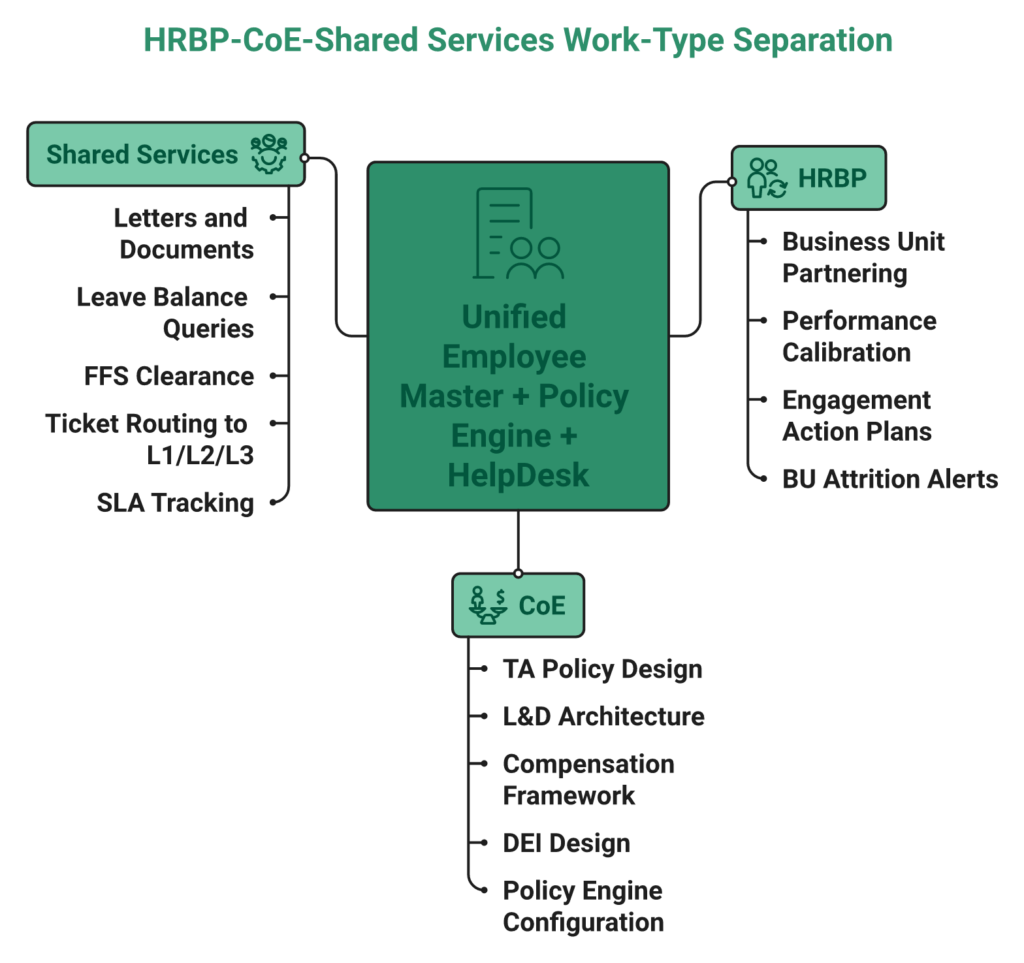
The HRBP-CoE-Shared Services split should kick in around 500 employees. HRBPs partner with business units on talent, performance, and engagement; CoEs own TA, L&D, Comp, and policy design; Shared Services run transactional HR (letters, tickets, queries, FFS clearance) on SLAs. Below 500, a blended team still works; above 1,000, the separation is non-negotiable.
The Senior-Layer Burnout You See at 500 People
Walk into almost any 500-person Indian firm that’s nominally adopted the Ulrich model and you’ll find the same operating reality. The HR Ops Lead chairs a board-level attrition review at 10am, answers a “what’s my leave balance?” WhatsApp from a new joinee at 12, approves an expense reimbursement at 2, and sits with the CFO at 4 to explain why the PowerPoint attrition number doesn’t match the payroll headcount. Strategic work and ticket work collapse into one inbox, and the senior layer burns out inside 18 months.
Why Most Indian Firms Copy the Model Cosmetically
Most Indian mid-market firms copy the Ulrich model nominally, HRBP on a business card, CoE on a slide deck, Shared Services mentioned in the annual plan, without the operating separation that makes the model work. ❌ There’s no CoE formally owning policy design, no Shared Services running on SLA-tracked tickets, no helpdesk queue with routing rules, no unified employee dossier for HRBPs to walk into a unit review with.
Where the Tech Layer Reinforces the Gap
Platforms like greytHR and Zoho People reinforce this cosmetic adoption by bundling transactional modules without a ticketing or helpdesk layer underneath, so strategic work stays buried under operational firefighting. One verified greytHR user on G2 put the pattern bluntly:
“Extremely poor customer support — They have an under-trained team handling tickets you raise… Managers can’t mark leaves on behalf of their direct reports, unlike other HR tools where they cover this as a basic feature.”
— Verified User, Information Technology and Services greytHR – G2 Verified Review
The Strategic Shift: Work-Type Separation, Not Org-Chart Cosmetics
The HRBP-CoE-Shared Services model isn’t an org-chart change. It’s a work-type separation enabled by a helpdesk, ticketing, and self-service architecture sitting underneath the HR function. ✅ Without the tech layer, an HRBP title is a promotion with the same inbox. With the tech layer, transactional queries flow to a ticket queue on defined SLAs, CoEs configure policy once in a policy engine, and HRBPs walk into business reviews with a unified employee dossier already loaded.
How HROne Separates the Three Work-Types Natively
We built HROne so the three work-types live on separate rails from day one of your 500-employee inflection. The HelpDesk module runs Shared Services on SLA-tracked tickets with auto-routing to L1/L2/L3. The Super Inbox surfaces HRBP pending tasks, confirmation approvals, BU-level attrition alerts, performance calibrations, in three-click closures. The front-end Policy Engine lets CoEs configure leave, comp, and hybrid policies across entities without raising a developer ticket. The ESS portal and AI Employee Agent absorb L1 queries on leave balance, payslips, and policy, reducing HRBP interruption volume by 30 to 40% at enterprise scale. Asia Healthcare Holdings runs 20 pan-India units on a single HROne instance with one RBAC layer, entity-independent compliance, and a unified employee master, which is what HRBP-CoE-Shared Services looks like when the architecture actually supports it. Explore tailored CHRO solutions for enterprise scaling.
“Core modules like Workforce, Time Office, and Payroll work seamlessly together. Modules like Performance, Engage, and Helpdesk improve employee engagement, feedback management, and query resolution.”
— Shilpi M., Verified User HROne G2 – Verified Review
“The setup phase has been a bad experience for us and worst is that even after so many hit trials by the team keka, my policies still are not applied the right way. Many of the features reflected are not even working!”
— Shakti B., Verified User Keka – G2 Verified Review
Q4: How Do You Build Multi-State Compliance as You Scale Offices Across India?
Multi-state compliance requires mapping five variable statutes, Professional Tax, Shops & Establishments Act, Labour Welfare Fund, state-specific leave rules, and the Code on Wages FFS timeline of 2 working days, to every office location, with entity-independent payroll compliance to prevent a Bangalore policy contaminating a Mumbai payslip.
The State-Wise Compliance Matrix Every Scaling Firm Needs
The matrix below is the minimum working map for an Indian firm opening its second, third, and fourth state offices. Slabs and rates are indicative of current state notifications. Always confirm with the latest state labour department and EPFO circulars before payroll cutover. You can cross-check current slabs via state-wise Professional Tax rates.
| State | Professional Tax (monthly ceiling) | S&E Act, Working Hours / Leave | Labour Welfare Fund | State-Specific Leave Notes |
|---|---|---|---|---|
| Maharashtra | ₹200/₹300 (Feb) | 9 hrs/day, 48 hrs/week; EL 21 days | ₹6 employee + ₹18 employer (half-yearly) | PL earned at 1 per 20 days worked |
| Karnataka | ₹200 (above ₹25,000) | 9 hrs/day, 48 hrs/week; EL 18 days | ₹20 employee + ₹40 employer (annual) | National & Festival Holidays Act |
| Tamil Nadu | ₹1,250 (half-yearly top slab) | 8 hrs/day, 48 hrs/week; EL 12 days | ₹10 employee + ₹20 employer (annual) | Sick leave 12 days separate |
| Telangana | ₹200 (top slab) | 8 hrs/day, 48 hrs/week; EL 15 days | Not applicable | Sick + casual separately defined |
| Delhi | ❌ No PT | 9 hrs/day, 48 hrs/week; EL 15 days | Not applicable | Compensatory off rules strict |
| Haryana | ₹200 (above ₹50,000 annual) | 9 hrs/day, 48 hrs/week; EL 15 days | ₹31 employee + ₹62 employer (monthly) | Weekly off mandatory |
| Gujarat | ₹200 (top slab) | 9 hrs/day, 48 hrs/week; EL 15 days | ₹6 employee + ₹12 employer (half-yearly) | Women night-shift rules per notification |
| West Bengal | ₹200 (top slab) | 8.5 hrs/day, 48 hrs/week; EL 14 days | ₹3 employee + ₹15 employer (half-yearly) | Puja holidays factored |
The Five-Step Multi-State Rollout Sequence
- Register each entity state-wise under S&E Act, PT, and LWF within 30 days of opening the office. EPFO and ESIC registrations flow centrally, but state codes must be mapped per location.
- Map PT and LWF to the payroll engine per state, slab-wise deduction logic, half-yearly versus monthly versus annual filing cadences, and state challan formats must all be configured before the first payrun. Reference statutory compliance in payroll for a complete checklist.
- Configure S&E leave policies per state, earned leave accrual rate, sick leave quantum, and national/festival holiday lists vary materially. A Karnataka policy pushed to Tamil Nadu creates statutory leave shortfall.
- Set FFS clearance SLA at 2 working days per the Code on Wages from the date of separation, with asset recovery, final payroll arrears, and statutory dues computed and disbursed inside that window.
- Build a quarterly statutory audit calendar, Q1: PF/ESI/PT filings and returns; Q2: S&E renewals and LWF; Q3: POSH annual report + Gratuity liability; Q4: Bonus computation and DPDP review. Use a structured payroll audit checklist to anchor the cadence.
⚠️ Cite EPFO circulars, Ministry of Labour & Employment notifications, and each state labour commissioner’s office for current rates. A stale slab is how 4 to 8% payroll inaccuracy enters the system undetected.
How HROne Turns This Matrix Into Configuration
✅ HROne ships this matrix pre-built as India-compliant out of the box. Entity-independent payroll compliance means Maharashtra PT, Karnataka LWF, and Tamil Nadu S&E leave accruals compute on separate rails inside one tenant, with no cross-state contamination. Multi-state PT/PF/ESI auto-computation, state-wise challan generation, and a front-end Policy Engine let HR configure S&E leave rules without a developer ticket, so opening the fifth state office becomes a one-hour configuration, not a three-week statutory scramble. Book a demo to see the compliance engine in action, or compare directly via HROne vs greytHR.
Q5: How Do You Build Multi-State Compliance and Handle the Indian Statutory Stack?
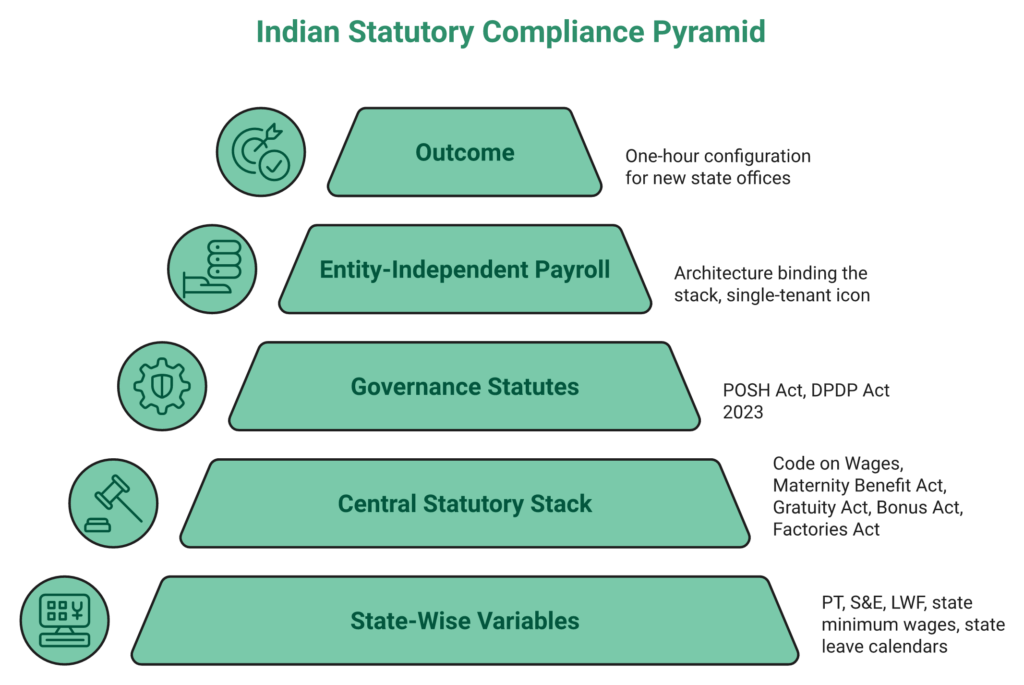
Multi-state compliance in India means mapping five variable statutes, Professional Tax, Shops & Establishments Act, Labour Welfare Fund, state minimum wages, and state-specific leave rules, to every office location, layered on the central statutory stack: the Code on Wages (2-working-day FFS clearance), Maternity Benefit Act, Payment of Gratuity Act, Payment of Bonus Act, Factories Act, and the DPDP Act 2023.
The Central Statutory Stack Every Scaling CHRO Must Operationalise
Before the state-wise matrix, lock down the seven central statutes that apply regardless of geography. These are the rails your payroll engine, HR policies, and compliance calendar run on.
| Central Statute | Core Obligation at Scale |
|---|---|
| Code on Wages, 2019 | 2-working-day FFS clearance from separation date; uniform wage definition for PF/Gratuity/Bonus computation |
| Maternity Benefit Act | 26 weeks paid leave; crèche facility mandatory above 50 employees |
| Payment of Gratuity Act | 5-year eligibility; 15 days’ wages per completed year; cap ₹20 lakh |
| Payment of Bonus Act | 8.33% to 20% bracket on eligible wages for employees drawing ≤ ₹21,000/month |
| Factories Act, 1948 | Working hours (9/day, 48/week), overtime at double rate, statutory welfare provisions |
| POSH Act, 2013 | Internal Committee mandatory above 10 employees; annual report to district officer |
| DPDP Act, 2023 | Employee-data processing consent, breach notification SLA, Data Protection Officer at 1,000+ employees |
The State-Wise Variability That Breaks Single-State HR Teams
A Bangalore-only HR team opens its first Mumbai office, and the payroll engine silently falls out of compliance by the first payroll cycle. Five variables shift state-to-state:
- Professional Tax, slab structures and filing cadence vary. Delhi and Telangana have no PT, Tamil Nadu files half-yearly, and Maharashtra files monthly. See state-wise Professional Tax slab rates for the current map.
- Shops & Establishments Act, working-hour caps, earned leave accrual rates, women night-shift rules, and registration renewal cycles differ per state.
- Labour Welfare Fund, contribution amounts and filing cadence vary. Some states (Haryana and Karnataka) mandate it, others (Telangana) don’t.
- State minimum wages, notified by state labour departments, revised semi-annually, and skill-category specific.
- State leave calendars, national and festival holiday lists, compensatory-off rules, and state-specific public holidays.
The Quarterly Compliance Audit Template
⏰ A scaling HR function needs a rolling four-quarter audit cadence that maps every filing, renewal, and return to a named owner and due date. Cite the Ministry of Labour & Employment notifications, EPFO circulars, and state labour commissioner orders for current rates. A structured payroll audit checklist anchors the cadence.
- Q1 (Apr to Jun): PF, ESI, and PT filings plus returns; TDS Form 24Q; annual PF reconciliation.
- Q2 (Jul to Sep): S&E Act renewals per state; LWF contributions where applicable; mid-year minimum wage revision check.
- Q3 (Oct to Dec): POSH annual report to district officer; Gratuity actuarial liability refresh; Factories Act inspection readiness.
- Q4 (Jan to Mar): Payment of Bonus Act computation and disbursal; DPDP Act policy review and breach-drill audit; year-end Form 16 cycle.
How HROne Turns Compliance Into Configuration
✅ We built HROne’s compliance engine for exactly this matrix. Entity-independent statutory compliance in payroll lets Maharashtra PT, Karnataka LWF, and Tamil Nadu S&E leave accruals compute on separate rails inside one tenant. Multi-state auto-computation of PT, PF, ESI, and LWF, a front-end Policy Engine for state-wise S&E leave configuration, and pre-built POSH policy and DPDP templates turn this entire matrix into a few hours of configuration, not weeks of legal drafting followed by a six-week implementation scramble with an outsourced payroll vendor.
Q6: What HR Policies Must Every Indian Company Have in Place by 2026?
Every Indian company in 2026 needs ten foundational HR policies, POSH, leave, code of conduct, DPDP/data privacy, hybrid/remote work, moonlighting, whistleblower, DEI, anti-bribery, and grievance redressal, phased from 100 employees (POSH + leave + code of conduct baseline) to 1,000 employees (full stack plus a Data Protection Officer).
The Ten-Policy Stack, Phased Across Inflections
- POSH IC is mandatory above 10 employees under the Sexual Harassment of Women at Workplace (Prevention, Prohibition and Redressal) Act, 2013, with annual reporting to the district officer and an external IC member on the committee.
- DPDP Act 2023 mandates employee-data processing consent, breach notification SLAs, and a designated Data Protection Officer at 1,000+ employees. The policy needs to cover data retention, right to erasure, and vendor data-sharing.
- Moonlighting policy has become table stakes after the 2023 IT-sector precedents. It must define disclosure rules, conflict-of-interest boundaries, and a graded consequence framework.
- Hybrid/remote work policy must cover attendance classification, expense reimbursement norms, and statutory location for PT purposes. A Bangalore-resident engineer working from Pune changes the PT liability.
- Code on Wages FFS clearance mandates final settlement within 2 working days of separation. The policy must codify asset recovery, arrears, and gratuity computation timelines.
- Leave, code of conduct, whistleblower, DEI, anti-bribery, and grievance redressal round out the baseline stack expected by any enterprise buyer, lender, or acquirer conducting HR due diligence.
The Phased Rollout by Inflection
⭐ At 100 employees, lock POSH, leave, and code of conduct. At 250, add DPDP, hybrid/remote, and grievance redressal. At 500, add moonlighting, whistleblower, and anti-bribery. At 1,000, formalise DEI with measurable representation targets and appoint a Data Protection Officer. Treating this as a phased roadmap rather than a one-shot drafting exercise prevents the “policy debt” that compounds with headcount and surfaces only during an acquisition diligence or a regulatory notice. You can accelerate the drafting with an HR policy generator and cross-reference employee data privacy best practices for DPDP alignment.
How HROne Ships Policies as Configuration, Not Drafting
✅ HROne’s Policy Engine ships with pre-built POSH, leave, hybrid, moonlighting, DPDP, and grievance templates configurable at entity and state level. Automated FFS workflows clear the 2-working-day Code on Wages window without manual chasing. Policy rollout drops from weeks of external legal drafting to hours of HR configuration inside leave management and the core policy layer.
Q7: What HRMS + ATS + LMS + Finance ERP Stack Architecture Actually Scales from 100 to 1,000?
An HRMS stack scales from 100 to 1,000 only when ATS, Core HR, Payroll, Time Office, Performance, LMS, Engagement, and HelpDesk share one employee master, one policy engine, and one data pipeline, with Finance ERP integrated via standard GL sync, not CSV exports stitched together by an HR Ops Lead at 11pm.
The 200-Employee Frankenstein Stack You’ve Almost Certainly Inherited
Picture the stack I walk into at most 200-employee Indian firms. 💸 Payroll is outsourced to a vendor who emails a provisional register on the 25th. Attendance runs on biometric machines with a standalone portal that exports CSVs. Recruitment lives in a disconnected ATS. Performance reviews are Excel sheets circulated over email. Expenses arrive as scanned receipts on WhatsApp. Month-end means three reconciliation cycles, two CSV uploads, and one delayed payroll.
Why “Best-of-Breed” Stacking Breaks at Every Inflection
The industry has spent a decade selling “best-of-breed” stacking as the smart choice, one tool for each HR function, connected via APIs when needed. ❌ In practice, it produces data fragmentation, duplicate employee masters across four systems, inconsistent audit trails, and zero single source of truth for HR-to-CFO reporting. Over-customisation and feature overload compound the tool-hopping tax. Every new state, entity, or module exposes another integration break. Payroll-outsourcing-vs-in-house becomes a false choice when the underlying stack can’t propagate attendance-to-payroll natively. Reference integrating payroll software with HR systems for the architectural why. One verified Darwinbox user flagged this exact architectural pattern on G2:
“Bad implementation experience, bad UI UX, configurations getting broken in production on its own due to product deployments, terrible customer service… The solution was supposed to act as a full fledged HRMS for us. We are ending up doing most of the products manually and all the data is messed up.”
— Verified User, Computer Software Darwinbox – G2 Verified Review
Integration Is an Architecture Decision, Not a Connector Feature
The strategic reframe: integration isn’t a connector you bolt on later, it’s a single-instance architecture decision you make at the 200-employee inflection. Build-vs-buy-vs-outsource per function must be scored against one question, does the core stack maintain one employee master across all eight HR functions and sync cleanly to Finance ERP, or are you buying a prettier portal for the same reconciliation chaos? Compare approaches via HROne vs Darwinbox.
How HROne Runs the Full Hire-to-Retire Stack on One Instance
We run HROne as eight native modules, Core HCM, Payroll, Time Office, Recruitment, Performance, Engagement, LMS, and HelpDesk, on a single employee master with 127 pre-built hire-to-retire workflows. Super Inbox surfaces pending tasks in three-click closures across all eight. ERP, BGV, and marketplace integrations plug in via standard APIs. JV integration syncs payroll into the GL automatically. 98% of customers run the four-module core bundle, and go-live billing starts only after deployment, no day-one meter while implementation drags. MR DIY India went live in 30 days on this architecture and compressed payroll cycles from 10 days to 5 or 6 days.
“HROne offers a simple, unified platform that makes it easy to automate all HR processes, including Recruitment, Time Attendance, Performance, Payroll, Expense, and Core HR functions… The well-known Inbox For HR has resolved many of our issues. It allows users to manage multiple tasks from a single window, eliminating the need to switch between different modules.”
— Vignesh J., Verified User HROne G2 – Verified Review
“I love HROne for its cost efficiency and holistic approach, which is why I prefer it over other vendors like Workday… It has streamlined processes like attendance and leave management, and the recruitment module has automated onboarding, greatly boosting efficiency.”
— Priyanka S., Verified User HROne G2 – Verified Review
Q8: How Should AI-Era People Operations Be Built Into Your Scaling Playbook?
Deploy six AI use cases by the 500-employee inflection, agentic onboarding/offboarding workflows, HR copilots for HRBPs, employee-facing chatbots, predictive attrition, internal mobility engines, and Gen-AI LMS for blue/grey-collar upskilling. Pilot at 250, scale at 500, and operationalise at 1,000.
The Six AI Use Cases Worth Operationalising
Most “AI in HR” conversations in the Indian mid-market collapse into chatbot demos. The actual leverage sits across six distinct use cases, each with a measurable outcome and a specific inflection to turn it on. For a grounded take on what works, see AI in HR: hype vs reality.
- Agentic onboarding/offboarding workflows, asset assignment, document collection, background-verification triggering, salary-structure copy-over from the offer letter, and FFS clearance fire in parallel rather than sequentially. A 7-day onboarding collapses to Day 1 productive. Reference onboarding process for the full workflow.
- HR copilots for HRBPs, surface talking points before a business review: at-risk attrition names, comp-ratio outliers, engagement-score dips by team, and open performance actions. HRBPs walk into unit reviews prepared instead of pulling reports at midnight.
- Employee-facing chatbots, handle L1 queries on leave balance, payslip access, policy interpretation, and holiday calendars. Typical reduction is 30 to 40% of HR ticket volume at 500+ employees via the Employee AI Agent.
- Predictive attrition, tenure, engagement score, compensation-ratio, and manager-change signals combined in a model that flags flight risk 60 to 90 days early. Pilot at 500 with the highest-attrition BU first.
- Internal mobility engine, maps employee skills to open roles, nudges managers toward internal candidates, and cuts external hiring cost 15 to 20% on mid-career openings.
- Gen-AI LMS for blue/grey-collar upskilling, vernacular content delivered on the mobile HR app with voice input, critical for manufacturing shop-floor and field logistics workforces where laptop-based LMS fails.
The Adjacent TA and Expense AI
⭐ Two adjacent AI layers compound the ROI. Resume relevancy scoring stacks genuinely relevant CVs on top instead of keyword-filter matches, and receipt parsers auto-extract vendor, amount, and tax data from scanned receipts, eliminating the expense-fraud slip-through that manual approval workflows normalise. Both should be live by the 250-employee pilot phase, not deferred to 1,000. See how AI detects expense fraud in practice.
Source Authority
⚠️ When building the business case for AI-era people operations, anchor the numbers to published benchmarks from Deloitte’s Global Human Capital Trends, SHRM India’s People Analytics reports, and NASSCOM’s IT-ITeS workforce studies rather than vendor marketing. The AI layer earns board sign-off only when the savings are tied to a baseline the CFO already trusts.
How HROne’s One AI Suite Ships These Natively
✅ We ship all six use cases inside HROne’s One AI Suite, resume relevancy scoring in Recruit, receipt parser in Expense, AI Employee Agent for L1 chatbot, JD and interview-question generators, predictive attrition signals surfaced in the Super Inbox, and agentic onboarding/offboarding orchestrated across Core HR, Payroll, and Time Office. The AI layer doesn’t require a separate vendor, a Power BI overlay, or a data-science contractor. It runs on the same employee master the rest of the platform uses.
Q9: Which Metrics, Dashboards, and Unit Economics Should a CHRO Track at Each Inflection?
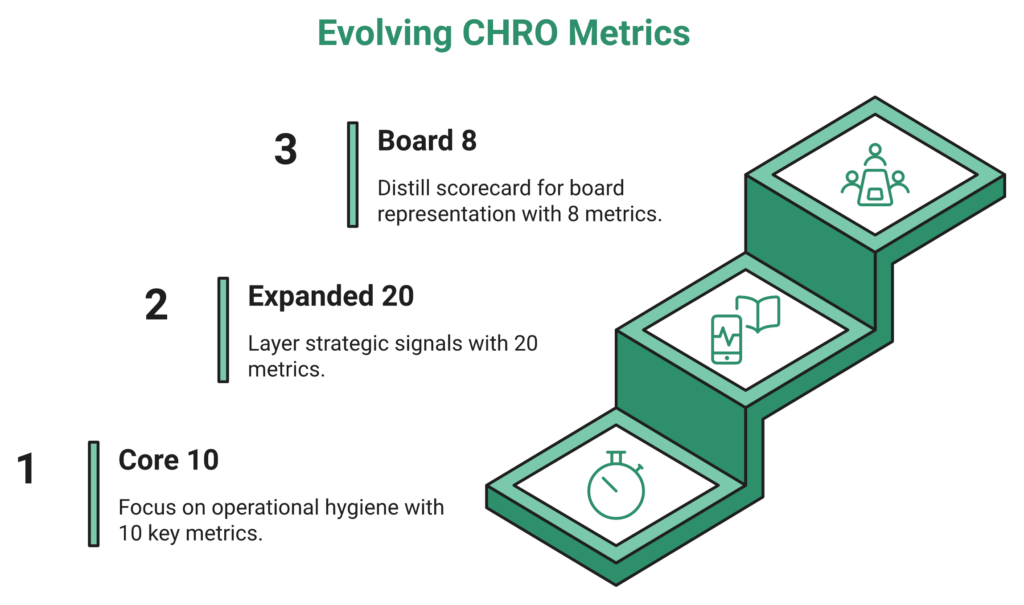
Track 10 core metrics at 100 employees, expand to 20 at 500, and distil to an 8-metric board scorecard at 1,000. HR cost-to-revenue benchmarks are ~2% for generic industries and ~3.91% for IT/ITeS, with HR-to-employee ratios tightening from roughly 1:50 at 100 to 1:100 at 1,000 as specialisation and automation compound.
The Three-Tier Metrics Stack Every Scaling CHRO Needs
- Core 10 at 100 employees: time-to-hire, cost-per-hire, annualised attrition, HR-to-employee ratio, payroll accuracy, absenteeism, offer-to-join conversion %, onboarding TAT, training hours per FTE, and grievance resolution TAT. ⭐ These are the operational hygiene metrics that tell the founder whether the HR function is functioning.
- Expanded 20 at 500 employees: add quality-of-hire (90-day retention), internal mobility %, engagement score, eNPS, comp-ratio distribution, high-potential retention rate, succession coverage %, L&D ROI, DEI index, and predictive attrition score. These layer strategic signal onto the operational baseline, and mirror the shift from annual to continuous measurement covered in continuous feedback vs annual reviews.
- Board 8 at 1,000 employees: revenue-per-employee, HR cost-to-revenue %, regretted attrition, leadership bench strength, engagement score, compliance audit score, HR-tech ROI (lifetime hours saved), and DEI representation. This is the scorecard that earns the CHRO a board seat rather than an attendance slot. See how these ladder into dedicated CHRO solutions.
The Unit Economics That Pin Your Benchmarks
💰 HR cost-to-revenue is the number CFOs anchor on, and it varies materially by sector. Roughly 2% for generic industries, ~3.91% for IT/ITeS (SHRM India and Deloitte People Ops benchmarks), with Manufacturing sitting between 1.5% and 2.2% and BFSI between 2.5% and 3%. Cost-to-serve per employee should decline at each inflection. A well-run 1,000-employee firm should spend ~40% to 50% less per employee on HR operations than its 100-employee baseline, driven by shared services leverage and HRMS automation, not by cutting headcount. Quantify the savings directly via the ROI calculator.
How HROne’s Inbuilt ROI Dashboard Makes This Board-Ready
✅ HROne’s inbuilt ROI Dashboard, India’s first, surfaces all three metric tiers plus lifetime HR hours saved measured against average HR salary, giving the CHRO a board-ready view without PowerPoint stitching, a Power BI overlay, or a data-science contractor. The performance management layer and HR Ops heat map flag which processes are in good health and which are silently bleeding, so the conversation with the CFO moves from “we’re doing our best” to “here’s the rupee value we’ve reclaimed this quarter.”
Q10: Should You Build In-House HR, Outsource, or Hire a Fractional CHRO, and Which HRMS Fits?
Build in-house below 250 employees when HR work is predominantly operational, hire a fractional CHRO between 100 and 300 for strategic guidance without premature full-time cost, and build a full in-house team with a salaried CHRO above 500. Pair the org model with an HRMS scoring high on India compliance depth, scalability, ESS mobile-first UX, go-live billing, and flat PEPM pricing.
The Decision Dilemma Indian Founders Face at 100 to 300 Employees
Most Indian founders hit the build-vs-buy question at 100 to 200 employees and the HRMS-vendor question simultaneously, and default to peer mimicry or cheapest PEPM, which locks them into re-platforming by year two. The two decisions are coupled. The wrong org model on the right HRMS still underperforms, and vice versa. For a structured vendor shortlist, reference how to choose the best HRIS/HRMS software.
The Wrong Way to Decide
❌ Avoid deciding by revenue (too lagging), by peer-company headcount (ignores industry variance), by budget (underfunds HR when it matters most), by brand recognition (Darwinbox-by-default), or by module count (more features rarely means more outcomes). These criteria optimise for short-term cost and miss India-specific compliance depth, multi-entity architecture, and go-live billing transparency. Review common traps in HRIS buyer pitfalls.
The Seven-Criteria Evaluation Framework
Score each 1 to 3. Totals: 7 to 12 = fractional CHRO paired with an SMB-grade HRMS; 13 to 17 = in-house team paired with a mid-market HRMS; 18 to 21 = salaried CHRO paired with an enterprise-grade single-instance HRMS.
- Headcount threshold, current and projected 24-month headcount.
- Number of legal entities, single or multi, with anticipated additions.
- Multi-state footprint, PT, S&E Act, and LWF complexity across offices.
- India compliance modules, PF, ESI, PT, Code on Wages FFS, and DPDP coverage depth.
- Scalability plus ESS mobile-first depth, field, shop-floor, and hybrid workforce support via a mobile HR app.
- Implementation timeline plus go-live billing, no day-one meter while deployment drags.
- Hidden costs, per-entity charges, per-module upsells, and multi-year lock-ins. Review the case for pricing transparency.
Applying the Framework, Platform Fit and Proof
| Criterion | HROne (Position 1) | Darwinbox | Keka | greytHR | Zoho People |
|---|---|---|---|---|---|
| India compliance depth | ✅ Full (PF/ESI/PT/FFS/DPDP) | ✅ Full | ✅ Full | ✅ Full (SMB focus) | ⚠️ Partial |
| Multi-entity single instance | ✅ Unlimited | ✅ Yes (add-on) | ⚠️ Limited | ❌ Rigid | ❌ Weak |
| Mobile-first ESS | ✅ Offline sync + geo-fence | ✅ Yes | ✅ Yes | ⚠️ Limited | ⚠️ Limited |
| Go-live billing | ✅ Only after go-live | ❌ Day-one meter | ⚠️ Mixed | ⚠️ Mixed | ⚠️ Mixed |
| Flat PEPM, no lock-in | ✅ Yes | ❌ Multi-year | ⚠️ Annual | ✅ Annual | ✅ Annual |
⭐ HROne ranks #3 on G2 for Easiest-to-Use Core HR (against Keka at #16), #8 Best HR Software Worldwide (against greytHR at #42), carries a 9.8 NPS on dedicated prior-HR SPOC support, took MR DIY India live in 30 days, and runs Asia Healthcare Holdings across 20 pan-India units on a single instance. For a direct head-to-head, compare HROne vs Keka. One verified reviewer captured the operator contrast:
“Extremely Disappointing Experience with Keka HRMS… We started working with Keka HRMS in August, and to this day, we have been unable to implement the tool in our company due to their consistently delayed responses and poor coordination between their internal teams.”
— Divya P., Verified User Keka – G2 Verified Review
“HROne has a very easy and intuitive UI, making navigation across the platform simple… Having the entire visibility at one place makes it easy for me to lead my team of three members effectively and make informed decisions.”
— Naman G., Verified User HROne G2 – Verified Review
Meta-insight: The real question isn’t “in-house vs fractional.” It’s whether your HRMS lets either model scale without re-platforming.
Q11: Frequently Asked Questions on Scaling HR from 100 to 1,000 Employees in India
These are the questions Indian CHROs, HR Heads, and founders ask most often when scaling from 100 to 1,000, each answered directly so the answer stands alone.
The Four PAA Questions From the Description
1. How do you set up HR processes for a company scaling from 100 to 500 employees?
Sequence specialist hires (Payroll & Compliance Lead at 120, TA Specialist at 200, HRBP at 400), roll out a single-instance HRMS with Core HCM, Payroll, Time Office, and Recruit modules, codify POSH, leave, and hybrid policies, and stand up a state-wise compliance matrix before opening the second office.
2. How do you manage HR during rapid scaling from 200 to 1,000 employees?
Split work into HRBP (business partnering), CoE (TA, L&D, Comp, and DEI design), and Shared Services (tickets, letters, and FFS) around the 500-employee mark, deploy predictive attrition and AI chatbot layers by 500, and move to an 8-metric board scorecard anchored on revenue-per-employee and HR-tech ROI.
3. What HR policies should every Indian company have in place in 2026?
Ten policies, POSH (mandatory above 10), leave, code of conduct, DPDP/data privacy, hybrid/remote work, moonlighting, whistleblower, DEI, anti-bribery, and grievance redressal, phased from baseline at 100 to full stack plus a Data Protection Officer at 1,000.
4. How do you build a high-performing HR team in a mid-market Indian company?
Hire specialists over generalists after 150, maintain a 1:60 HR-to-employee ratio at 250 tightening to 1:100 at 1,000, appoint HRBPs aligned to business units, separate strategic from transactional work via a HelpDesk ticketing layer, and instrument the team with a board-ready metrics dashboard.
Five Adjacent High-Intent FAQs
- When should I hire my first HRBP? At 350 to 500 employees, or earlier if functional complexity spans three or more business units.
- What HRMS is best for Indian startups scaling to 500? A single-instance, India-compliant, flat-PEPM, go-live-billed platform. HROne, Darwinbox, and Keka are the three most-evaluated in that segment. Start with the top 10 HR software in India shortlist.
- How many HR people should a 500-employee company have in India? Approximately 6 to 8 at a ~1:80 ratio, split across HRBP, Payroll, TA, L&D CoE, and HR Ops.
- How do I handle multi-state compliance? State-wise PT/S&E/LWF matrix plus an entity-independent payroll engine that computes each state’s deductions on separate rails.
- Should I outsource payroll at 300 employees? ❌ No. In-house payroll via an integrated HRMS delivers higher accuracy and meets the Code on Wages 2-working-day FFS clearance reliably.
How HROne Answers All Nine Architecturally
✅ HROne addresses every FAQ above on one instance, single-instance HRMS for 100 to 1,000 scale, pre-built policy templates inside the Policy Engine, a state-wise compliance engine with entity-independent payroll, HelpDesk for Shared Services separation, One AI Suite for people ops, and the inbuilt ROI Dashboard for board reporting.
Q12: Ready to Scale Your HR from 100 to 1,000 on One Platform?
Scaling from 100 to 1,000 employees without re-platforming, without losing payroll accuracy, and without a fragmented stack is exactly what HROne was built for, one instance, four inflections, zero handoffs.
The Value Anchor That Closes the Loop
⭐ MR DIY India went live in 30 days. Asia Healthcare Holdings runs 20 pan-India units on a single HROne instance with multi-legal-entity configuration. Customers have compressed 10-day payroll cycles to 5 to 6 days after consolidation. HROne ranks #3 on G2 for Easiest-to-Use Core HR, carries a 9.8 NPS on dedicated prior-HR SPOC support, and ships India’s first inbuilt ROI Dashboard that surfaces lifetime hours saved against average HR salary, a board-ready number no CHRO on Keka, greytHR, or Darwinbox can produce natively. See more customer success stories.
Book Your Demo
One instance. Four growth inflections. Board-ready ROI.
Trusted by 2,000+ brands and 10 lakh users across IT/ITeS, Manufacturing, BFSI, Logistics, and Healthcare.
Book a DemoStill shortlisting? Compare HROne vs Darwinbox, HROne vs greytHR, or check HROne Pricing to shortlist with numbers, not marketing decks.












 Secures Top Spot in
