








Q1: Payroll Software vs Outsourcing in India 2026: What’s the Fastest Way to Choose?
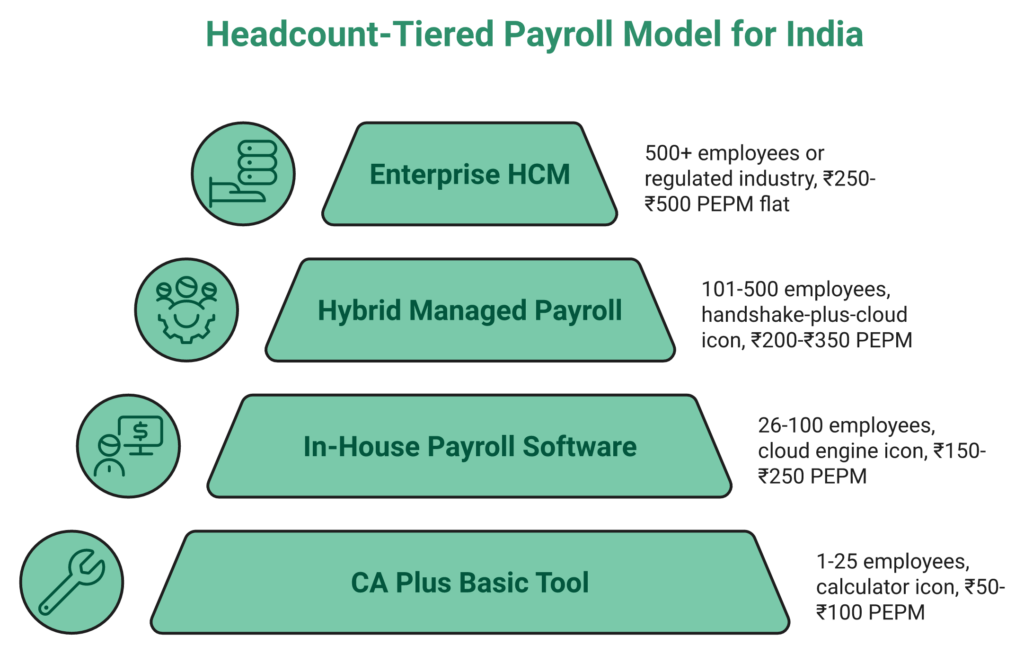
India’s payroll services market is projected to cross ₹4,200 Cr in 2026, and the choice between software and outsourcing is no longer a cost conversation. It’s a DPDP liability, New Labour Code readiness, and data-fiduciary question. The 60-second answer: CA up to 25 employees, in-house payroll software from 50, hybrid from 500, and enterprise HCM from 2,000.
⭐ The TL;DR Verdict Box, Pick Your Tier
Most Indian buyers waste three weeks of evaluation before realising headcount and entity count decide the model, not brand halo or the cheapest PEPM quote. Use this as the decision shortcut before the rest of the article unpacks each tier.
- 1–25 employees (single entity): Stay with a CA plus a basic payroll tool (₹50–₹100 PEPM). Break-even logic fails below this scale.
⚠️ Risk flag: New Labour Code two-day FnF will expose manual Excel workflows the moment you cross one state. - 26–100 employees: Move to in-house payroll software (₹150–₹250 PEPM). Break-even lands between 45 and 80 heads.
⚠️ Risk flag: FBP declarations and variable pay break every CA-run Excel at this range. - 101–500 employees: In-house software with selective outsourced filings (₹200–₹350 PEPM blended).
⚠️ Risk flag: Multi-state PT, LWF, and shift-based attendance create reconciliation debt that outsourcing alone cannot absorb. - 500+ employees (or regulated industry): Managed-hybrid or in-house enterprise HCM (₹250–₹500 PEPM, flat).
⚠️ Risk flag: DPDP Act fiduciary liability caps at ₹250 Cr. Brand halo and peer-group choice are the worst criteria to optimise against at this tier.
💰 Why Break-Even Logic Beats Brand Halo
The reason this tiering works is arithmetic, not opinion. Once you add internal FTE cost, penalty-risk exposure, and DPDP breach probability, outsourced PEPM at ₹1,200+ stops winning against software at ₹200 anywhere north of 80 employees for most multi-state Indian firms. Read our full guide on how to choose the right payroll software before committing.
✅ Where HROne Sits Across All Four Tiers
HROne covers every tier on a single flat PEPM: ✅ software-only for mid-market, ✅ optional managed payroll and statutory filings for hybrid buyers, and ✅ enterprise HCM with multi-legal-entity configuration for 500+. Subscription metering only after go-live and one Super Inbox plus India’s first inbuilt ROI Dashboard replace the dual-contract sprawl most competitors force.
Q2: What Is Payroll Software vs Payroll Outsourcing vs the Hybrid Model in India?
Payroll software is an in-house engine (cloud, on-prem, or self-serve) that your team operates. Outsourcing hands execution to a BPO, managed service, or co-sourced vendor. Hybrid splits the engine (software) from the filings (vendor), and CA-managed payroll runs on a chartered accountant’s spreadsheets and practice tools.
⭐ How Payroll Actually Works in India
Every delivery model plugs into the same three-stage pipeline: inputs, engine, and outputs. The model only changes who owns which stage.
- Inputs: Attendance data, leave balances, CTC masters, FBP declarations, arrears, loans and advances, variable pay, and one-time payments.
- Engine: Gross-to-net computation, statutory deductions (PF, ESI, PT, LWF, TDS), FBP optimisation, arrears reconciliation, and group payout validation.
- Outputs: Payslip, bank file (NEFT/RTGS), ECR for PF, ESIC challan, 24Q quarterly return, Form 16, and full-and-final settlement file.
✅ The Four Delivery Models, Stage by Stage
| Stage | In-House Software (Cloud/On-Prem/Self-Serve) | Full Outsourcing (BPO) | Hybrid / Managed Software | CA-Managed Excel |
|---|---|---|---|---|
| Inputs | Your team captures in HRMS | Vendor collects via template | You capture in HRMS, vendor reads API | CA receives Excel from HR |
| Engine | Your software computes | Vendor’s engine computes | Your software computes | CA’s practice tool computes |
| Statutory filings | Your team files; software generates challans | Vendor files end-to-end | Vendor files, software retains audit trail | CA files |
| Data fiduciary | You (employer) | You (employer) | You (employer) | You (employer) |
| Typical fit | 50–2,000 employees | 100–5,000 with low HR headcount | 500+ multi-entity | 1–25 single entity |
Cloud software updates statutory logic centrally, on-prem requires IT patch cycles, and self-serve assumes internal HR expertise. The same stack can flex from one model to another only if the underlying software is cloud and API-first. See cloud vs on-premises HR software for the deeper comparison.
💸 Why “Managed Payroll” Is the Fastest-Growing 2026 Category
NASSCOM’s payroll BPO taxonomy and Ministry of Labour circulars on New Labour Code FnF timelines both acknowledge that pure-outsourcing is losing share to managed payroll, because DPDP obligations make employers reluctant to hand raw PII to vendor email inboxes. Managed payroll keeps the engine inside the employer’s tenant while outsourcing only the filing execution. This is the structural compromise Indian CFOs have been asking for since 2023.
✅ How HROne Handles the Flex
HROne is a cloud self-serve payroll engine with an optional managed-compliance layer, so teams start software-only and flex into hybrid without switching vendors or signing a second MSA. This is unlike Keka (software-only) or ADP India (outsourcing-heavy), where a model change means a migration project. See the full HROne vs Keka comparison for the architectural detail.
Q3: What Does India’s Statutory Stack Really Cover in 2026, PF, ESI, PT, LWF, TDS, Gratuity, Bonus, and the New Labour Codes?
India’s payroll statutory stack covers PF (12% employee + 12% employer), ESI (0.75% + 3.25% for wages up to ₹21,000), PT (₹0–₹2,500/year, state-variable), LWF (state-variable), TDS (slab-based), gratuity (15/26 × last drawn × years), and bonus (8.33%–20%). The New Labour Codes 2026 add a two-working-day FnF mandate and a unified wage definition capping basic at 50% of CTC. Our full breakdown on statutory compliance in payroll expands every line.
⭐ State-Wise Professional Tax, The 10 States That Matter
PT is where most multi-state payroll runs break, because every state sets its own slab and cadence. Here’s the 2026 snapshot for the 10 states covering roughly 85% of India’s formal payroll base. For complete slabs, see our state-wise professional tax slab rates reference.
| State | Max PT / Year | Cadence |
|---|---|---|
| Maharashtra | ₹2,500 | Monthly |
| Karnataka | ₹2,400 | Monthly |
| Tamil Nadu | ₹2,500 | Half-yearly |
| Gujarat | ₹2,400 | Monthly |
| West Bengal | ₹2,496 | Monthly |
| Telangana | ₹2,500 | Monthly |
| Andhra Pradesh | ₹2,500 | Monthly |
| Kerala | ₹2,500 | Half-yearly |
| Madhya Pradesh | ₹2,500 | Monthly |
| Assam | ₹2,500 | Monthly |
✅ Labour Welfare Fund, The Hidden Variance
LWF is the statute most outsourcers quietly skip. Contributions range from ₹6 to ₹75 per employee per cycle, and cadence varies. Maharashtra and Karnataka run half-yearly, Tamil Nadu and Kerala run annually, and Delhi and Haryana run monthly to quarterly. Missing a single state’s filing after a remote hire is how ₹5 Cr penalty exposures are built quietly over three years.
✅ The Compliance Calendar You Cannot Miss
- ⏰ Monthly: TDS by the 7th, PF ECR by the 15th, ESIC challan by the 15th, and PT by the state-notified date.
- ⏰ Quarterly: 24Q TDS return by the 31st of the month following the quarter.
- ⏰ Annual: Form 16 by 15 June, gratuity actuarial valuation before year-end close, and bonus register under the Payment of Bonus Act.
⚠️ New Labour Codes 2026, What Actually Changes
The four Codes (Wages, Industrial Relations, Social Security, and OSH) reshape payroll inputs more than outputs. The 50% basic-wage rule inflates PF and gratuity bases, the two-working-day FnF TAT kills the 30-day exit cycles most outsourcers still quote, fixed-term contract workers gain full statutory parity, and gig-worker contributions become mandatory in covered states. Our guide on navigating changing labor laws walks through each Code’s payroll impact.
✅ How HROne Simplifies This
HROne’s India-compliant engine ships every state’s PT and LWF rules, auto-updates New Labour Code logic, and exposes timestamped statutory logs. Payroll teams stop chasing circulars, and CAs review signed audit trails instead of re-keying Excel into the government portal. Finance heads can verify the math directly through our salary calculator and TDS calculator.
Q4: How Does the DPDP Act 2023 Rewrite Who’s Liable When Payroll Data Leaks?
Under the Digital Personal Data Protection Act 2023, the employer is the Data Fiduciary and the payroll vendor is a Data Processor. Penalties up to ₹250 crore for a breach land on the employer first, not the vendor. Outsourcing transfers execution. It never transfers liability.
⭐ The Comfortable Illusion Most CHROs Are Living Inside
Walk into any 800-employee Indian company, and the story is the same. The CHRO signed a payroll MSA two years ago assuming the vendor “handles compliance.” The quarterly SOC 2 attestation email arrives, nobody reads it, and it gets filed into a folder called “Vendor Docs.” Meanwhile, employee PII sits in vendor operator inboxes, attendance files travel over WhatsApp between the biometric partner and the payroll team, and the FnF calculator lives in a shared Google Sheet that three ex-employees still have access to. The MSA said “ISO 27001.” Everyone slept well. Our note on employee data privacy best practices lays out what a DPDP-ready posture looks like.
❌ Where the Industry Approach Actually Breaks
The prevailing outsourcing playbook treats DPDP as a procurement checklist: tick ISO 27001, sign the standard DPA, and move on. That approach ignores four structural realities.
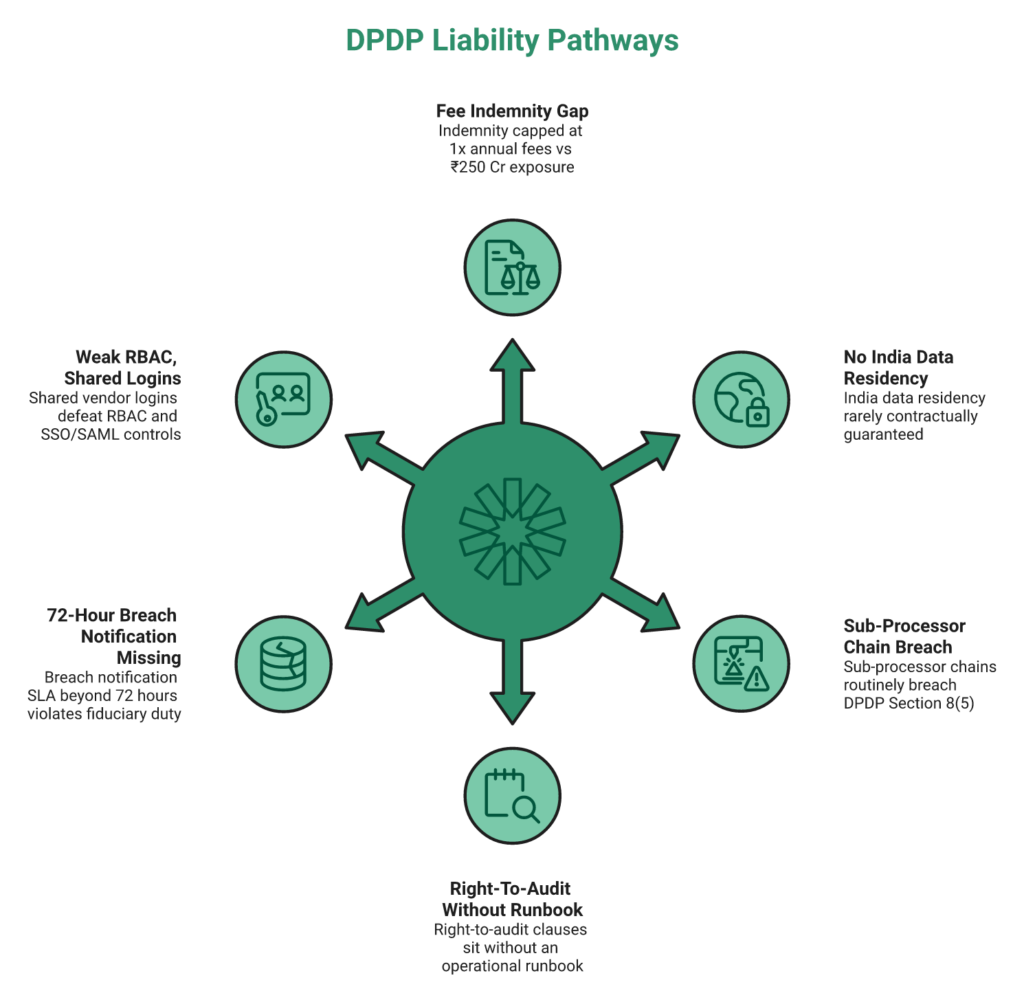
- Most Indian payroll outsourcers cap indemnity at 1x annual fees, so a ₹20 lakh contract gives you ₹20 lakh of cover against a ₹250 Cr penalty.
- India data residency is rarely contractually guaranteed. Vendors quietly use overseas cloud regions or sub-process through global payroll networks.
- Sub-processor chains routinely breach DPDP Section 8(5), which requires the fiduciary to approve every downstream processor.
- Even ISO 27001-certified vendors fail the Right-to-Audit test the first time a buyer actually invokes it, because the clause sits in the MSA without any operational process behind it.
Keka and greytHR deliver competent payroll logic, but the accountability still sits with the employer. Darwinbox’s enterprise DPAs are better but lock clients into multi-year terms that make exit-on-breach practically impossible. The side-by-side HROne vs Darwinbox and HROne vs greytHR comparisons map these gaps.
⭐ The Strategic Shift, Compliance Is an Architecture Problem
DPDP readiness is not a vendor certificate. It is an architectural decision about where PII lives, who can read it, and whether the audit trail exists continuously or gets reconstructed at incident time. Treat the employer as the fiduciary it legally is, and the question stops being “which vendor do I trust?” and becomes “which architecture gives me provable control, even when the vendor fails?” That reframe collapses a 10-clause MSA negotiation into a 10-point scorecard anyone in the buying committee can run.
✅ The 10-Point Vendor Due-Diligence Scorecard
- ISO 27001 certification with scope covering India payroll operations.
- SOC 2 Type II report, current within 12 months.
- Contractual India data residency for all PII.
- Named Data Protection Officer with published grievance channel.
- Breach notification SLA of 72 hours or less.
- Full sub-processor disclosure with change-notification rights.
- Indemnity of at least 3x annual contract value, with regulatory-fine carve-outs.
- Audit-trail exportability in a machine-readable, timestamped format.
- RBAC with SSO/SAML, no shared vendor logins.
- Annual right-to-audit clause with operational runbook attached.
✅ How HROne Closes the DPDP Gap
We run HROne on India-resident cloud with RBAC, SSO/SAML, and timestamped audit logs that a DPO can export directly for regulatory review, backed by a fiduciary-first MSA template that assumes the employer’s liability exposure rather than deflecting it. Combined with Asia Healthcare Holdings running 20 pan-India units on a single instance under unified access control, the architecture closes the gap between what outsourcers promise in a sales cycle and what the Act actually requires when a notice arrives. See why HROne is built for this reality or book a demo.
Q5: What Does Payroll Actually Cost in India 2026, In-House Software vs Outsourcing vs Hybrid?
Payroll outsourcing in India 2026 ranges ₹100 to ₹2,075 PEPM. In-house payroll software sits at ₹85 to ₹250 PEPM plus one-time setup, and hybrid lands between the two. The viral “70 to 90% savings from outsourcing” claim only holds below 50 employees, and the “in-house costs 4x more” counter-claim ignores penalty and attrition-cover cost lines that every honest TCO model must carry.
💰 Building the True Cost Model, What Each Line Item Actually Looks Like
Most rupee comparisons circulating online stop at PEPM. That’s where every Indian CFO who has been burned once knows the math really starts. A defensible TCO must include internal FTE, penalty risk, rework hours, change fees, and exit costs, not just the sticker on the quote. Our guide on HR software pricing transparency expands on the line items buyers routinely miss.
- In-house software TCO = licence (₹85 to ₹250 PEPM) + 0.5 to 1.5 FTE salary (₹6 to 15L annually) + training (₹25k to ₹1L) + penalty-risk reserve (1 to 3% of annual payroll) + rework hours (avg 40 to 80 hours/month).
- Outsourced payroll TCO = PEPM fee (₹100 to ₹2,075) + setup fee (₹15k to ₹2L) + change-request fees (₹2k to ₹10k per change) + exit fee (1 to 3 months of fees) + DPDP risk premium (unbudgeted but real).
- Hybrid TCO = software PEPM + managed-filing fee per entity (₹8k to ₹25k/month) + lower internal FTE (0.25 to 0.5) + the same penalty reserve, absorbed by the managed partner under contract.
⭐ The 2026 Rupee Benchmark Table Nobody Publishes Openly
This is the table most vendor quotes leave out because it exposes the break-even math. Figures are blended annual TCO at the India mid-market midpoint.
| Headcount | In-House Software | Full Outsourcing | Hybrid |
|---|---|---|---|
| 25 | ₹4.2L | ₹1.5L | ₹2.8L |
| 100 | ₹9.4L | ₹14.4L | ₹11.6L |
| 500 | ₹28L | ₹62L | ₹41L |
| 1,000 | ₹45L | ₹1.18 Cr | ₹72L |
Below 50 heads, outsourcing genuinely wins on raw rupee spend. Between 50 and 500, in-house software opens a clear gap. Above 500, hybrid becomes the DPDP-adjusted optimum because it trades roughly 20% extra spend for auditable fiduciary control.
❌ Fact-Checking the Two Viral Claims
The “70 to 90% savings from outsourcing” narrative traces back to a 2019 Deloitte SMB benchmark that excluded any penalty, rework, or DPDP variable. It only holds for firms under 50 employees running one-entity, single-state payroll.
The counter-claim that in-house software “costs 4x more” comes from Ramco and Paybooks comparison decks that bundle enterprise HCM licences into the payroll-only TCO. A cleaner 2025 error-rate survey across 100 Indian firms found in-house payroll error rates at 1.2% vs outsourced at 2.8%. The rework cost alone closes much of the spread the “4x” figure assumes. Read our analysis of payroll automation, errors, and efficiency for the underlying data.
⚠️ The Costs Vendors Don’t Quote
- Attrition cover: when your one outsourced account manager quits, the replacement takes two cycles to stabilise, and Indian firms routinely absorb one botched payroll during that window.
- Change-request drift: every new state, entity, or policy change averages ₹5k to ₹15k per request, and multi-state expansion hides this under “implementation extension.”
- DPDP exposure premium: unquantified in MSAs but capped at ₹250 Cr in the Act itself.
✅ How HROne Collapses the Math
We bundle Core HR, Workforce, Time Office, and Payroll at a single flat PEPM with no entity surcharge, go-live billing that ends the practice of paying during setup, and India’s first inbuilt ROI Dashboard computing lifetime hours saved against average HR salary. The rupee math that CFOs usually rebuild in Excel every budget cycle ships inside the product itself. Verify your own numbers through the ROI calculator.
Q6: What’s the Rupee Break-Even Headcount? (Interactive Payroll Cost Calculator)
Break-even headcount = (Software annual TCO minus Outsourcer annual TCO) divided by (PEPM outsourcer minus PEPM software). For most Indian mid-market firms in 2026, the number lands between 45 and 80 employees. Above 80, in-house software wins on pure rupee math before you even weight penalty risk or DPDP exposure.
⭐ The Calculator Inputs, Outputs, and ROI Framework in One View
Break-even is a three-line formula, but the inputs that drive it are the parts buyers keep underestimating. Plug your own numbers against the structure below before signing any payroll MSA or software contract. Our buyer checklist on choosing payroll software adds a further scoring layer on top.
- Inputs to capture: total employee count, average CTC, number of states, number of legal entities, current outsourced PEPM quote, FBP complexity (low/medium/high), expected year-on-year headcount growth, and number of shift patterns.
- Outputs the calculator must produce: annual rupee delta between models, break-even headcount, 3-year NPV at 12% discount, and penalty-risk reserve as a percentage of payroll.
- ROI framework: Annual ROI = (Hours saved per month × 12 × average HR salary ÷ 160) + (Penalty-risk reduction in rupees) + (DPDP breach probability × expected impact), minus (Software TCO delta).
- Worked example at 100 employees: Outsourced = ₹1,200 PEPM × 12 × 100 = ₹14.4L. In-house software = (₹200 × 12 × 100) + ₹1L setup + ₹6L half-FTE = ₹9.4L. Rupee delta = ₹5L/year. Break-even crossed at around 65 employees for this firm’s profile.
💸 Why Break-Even Happens Earlier Than Most Founders Expect
Three variables pull break-even leftward. First, multi-state expansion adds PT and LWF complexity that inflates outsourcer change fees faster than software licence cost. Second, FBP rollout adds per-employee computation load that outsourcers price as a tier upgrade. Third, DPDP penalty-risk weighting alone shaves 10 to 15 employees off the break-even point once a ₹250 Cr exposure is modelled at even 0.1% annual breach probability. The broader payroll calculation logic and CTC breakup format deepen the rupee reasoning.
✅ How HROne Ships the Calculator Natively
HROne’s inbuilt ROI Dashboard auto-computes this exact comparison against lifetime hours saved and average HR salary. Finance teams stop rebuilding the Excel model every budget cycle, and CHROs walk into board reviews with a ballpark rupee figure for savings already quantified, not a post-hoc narrative. For persona-level fit, see our CHRO solutions page.
Q7: Pros, Cons, and Hybrid Architecture: Which Model Wins on Which Axis?
Software wins on control, real-time data, customisation, and integration. Outsourcing wins on compliance expertise, speed to readiness, and lower HR load. Hybrid wins on DPDP posture and exception handling. No single model wins on all four axes of speed, compliance exposure, resource load, and control. This is why the architecture, not the vendor, is what matters.
⭐ The Three-Column Pros/Cons Matrix
This is the scorecard most RFPs should lead with. Axes are weighted by what actually moves during a 12-month payroll cycle, not by what looks good on a sales deck. Compare against our top payroll software features checklist before finalising.
| Axis | In-House Software | Outsourcing | Hybrid |
|---|---|---|---|
| Control over data | ✅ Full | ❌ Vendor-held | ✅ Full |
| Real-time data | ✅ Live | ❌ Lagged by cycle | ✅ Live |
| Customisation | ✅ High | ⚠️ Capped by vendor SKU | ✅ High |
| Integration footprint | ✅ Open APIs | ⚠️ Vendor-gated | ✅ Open APIs |
| Compliance expertise | ⚠️ Internal team burden | ✅ Vendor-owned | ✅ Managed partner |
| Speed to readiness | ⚠️ 30 to 90 days | ✅ 7 to 21 days | ⚠️ 30 to 60 days |
| HR team load | ❌ Heavy | ✅ Light | ⚠️ Moderate |
| Data-sharing risk | ✅ Low | ❌ High | ⚠️ Medium |
| Vendor lock-in | ✅ Low | ❌ High | ⚠️ Medium |
| Customisation ceiling | ✅ None | ❌ Hard cap | ✅ Soft cap |
| Exit cost | ✅ Low | ❌ 1 to 3 months fees | ⚠️ 1 month fees |
⭐ The Hybrid Architecture Blueprint, Who Owns Which Layer
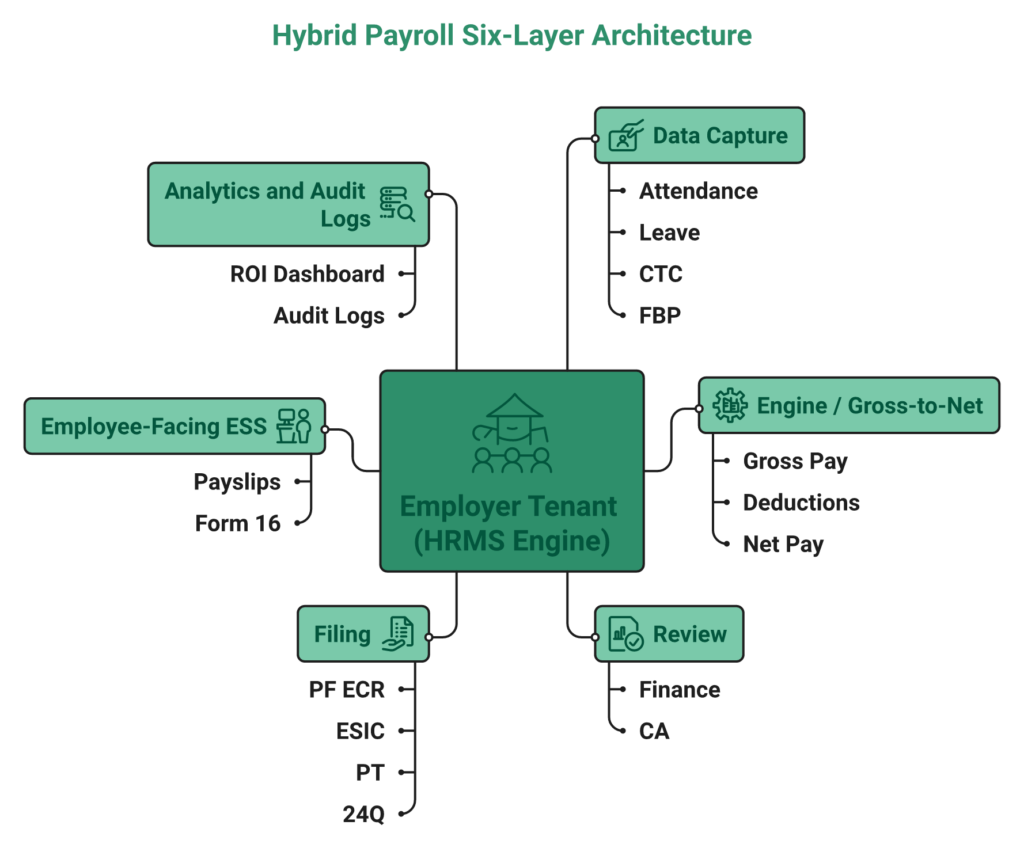
The hybrid model isn’t a compromise. It’s a deliberate separation of duties that satisfies DPDP while keeping execution efficient. Picture six stacked layers, each with one clear owner. For integration considerations, see our guide on integrating payroll with HR systems.
- Layer 1, Data capture: Attendance, leave, CTC, and FBP live inside the HRMS, owned by the employer.
- Layer 2, Engine: Gross-to-net computation runs inside the HRMS, and the employer’s tenant holds all PII.
- Layer 3, Review: Finance and the CA co-sign over read-only dashboards, and no data leaves the tenant.
- Layer 4, Filing: A managed partner (or the CA) submits PF ECR, ESIC challans, PT, and 24Q on government portals using exported files, never raw PII.
- Layer 5, Employee-facing: ESS, payslips, and Form 16 are served from the HRMS, and employees never interact with the vendor.
- Layer 6, Analytics: ROI dashboard, HR Ops heat maps, and audit logs stay inside the HRMS for board reporting.
✅ Why This Separation Satisfies DPDP Section 8
Because the fiduciary (employer) retains the master dataset, and the processor (managed partner) only touches purpose-limited extracts, the architecture enforces data minimisation, auditability, and purpose limitation by design. These are three clauses that audit teams otherwise reconstruct from email threads at notice time. Our employee data privacy best practices explains the operational detail.
✅ How HROne Executes the Hybrid Blueprint
The Super Inbox handles exception workflows across all six layers in one screen, the Auto Scheduler runs the engine with zero manual handoffs, Group Payout Validations catch computation errors before disbursal, and read-only CA access closes the filing loop without ever giving external vendors raw PII. This turns hybrid from a theoretical model into a live operating architecture.
Q8: Which Model Fits Your Headcount and Scenario, GCC, Startup, SaaS, or Manufacturing?
1 to 25 employees: CA plus basic software. 26 to 100: in-house payroll software. 101 to 500: software with optional outsourced filings. 500+: managed-hybrid or enterprise HRMS. Score every option on speed, compliance exposure, resource load, and control before you commit. Those four variables beat brand and PEPM every time.
⚠️ The Decision Dilemma Every Indian Founder Hits
Switching payroll models mid-year is painful. Staying on the wrong one for two years is worse. Four triggers force the model to change whether you planned for it or not, and once any of them fires, the cost of delay compounds monthly. Our note on streamlining payroll during business growth maps each trigger to an action.
- Multi-state expansion: the moment you add a second state, PT and LWF reconciliation breaks every CA-run Excel.
- FBP rollout: adds per-employee computation load that outsourcers price as a tier upgrade.
- New Labour Code two-day FnF: kills the 30-day exit TAT most outsourcers still quote.
- DPDP audit exposure: forces a fiduciary-first architecture most legacy outsourcers cannot retrofit.
❌ The Wrong Way Most Teams Decide
I’ve watched otherwise sharp buying committees default to the four shortcuts that predict regret: picking the cheapest PEPM quote, matching a peer group’s brand, defaulting to “my CA has done it for ten years,” or scoring vendors on module count. Every one of these ignores complexity triggers, and every one shows up as a painful migration project eighteen months later. Avoid the traps covered in our HRIS buyer pitfalls breakdown.
✅ The Right Framework, Score Four Variables Against Four Scenarios
Apply the scorecard below. Each variable weights equally, and each model gets a ✅, ⚠️, or ❌ per cell.
| Scenario | Variable | Outsourcer | Software | Hybrid |
|---|---|---|---|---|
| GCC entering India (200 to 800) | Speed | ✅ | ⚠️ | ✅ |
| Compliance | ✅ | ⚠️ | ✅ | |
| Resource load | ✅ | ❌ | ⚠️ | |
| Control | ❌ | ✅ | ✅ | |
| Startup <25 | Speed | ✅ | ⚠️ | ❌ |
| Compliance | ✅ | ⚠️ | ⚠️ | |
| Resource load | ✅ | ⚠️ | ❌ | |
| Control | ⚠️ | ✅ | ✅ | |
| Fast-scaling SaaS (100 to 500) | Speed | ⚠️ | ✅ | ⚠️ |
| Compliance | ⚠️ | ✅ | ✅ | |
| Resource load | ⚠️ | ✅ | ⚠️ | |
| Control | ❌ | ✅ | ✅ | |
| Manufacturing multi-state (500+) | Speed | ⚠️ | ⚠️ | ✅ |
| Compliance | ⚠️ | ✅ | ✅ | |
| Resource load | ⚠️ | ❌ | ✅ | |
| Control | ❌ | ✅ | ✅ |
⭐ The Pattern Buyers Keep Missing
Hybrid doesn’t win every scenario, but it wins every scenario above 500 employees where DPDP exposure and multi-state compliance exist simultaneously. That single pattern explains why managed-hybrid is the fastest-growing 2026 Indian payroll segment. Manufacturing buyers specifically should read our manufacturing HR module and the why HROne for manufacturing breakdown.
✅ Proof the Framework Plays Out in Real Deployments
Asia Healthcare Holdings runs 20 pan-India units on a single HROne instance with multi-legal-entity configuration, unified RBAC, and entity-independent statutory compliance. MR DIY India went live in 30 days and cut its payroll cycle from 10 days to 5 to 6 days after consolidating from a fragmented outsourced setup. Both firms hit the same inflection point the framework predicts. Once complexity triggers cross the threshold, the architecture has to flex, and the right model wins on compounding operational leverage, not on the lowest PEPM at signing.
“I really like how HROne has a very easy and intuitive UI, making navigation across the platform simple. Its super easy for me to see how my teams attendance looks and how the leaves align, along with all the well-documented and organized policy documents. Having the entire visibility at one place makes it easy for me to lead my team of three members effectively and make informed decisions.”
— Naman G., HROne User HROne G2 – Verified Review
“I love HROne for its cost efficiency and holistic approach, which is why I prefer it over other vendors like Workday. The initial setup process was smooth, thanks to the supportive team that helped configure everything according to our needs. The ability to manage various HR processes from a single platform is incredibly convenient and cost-effective for mid-level and enterprise customers.”
— Priyanka S., HROne User HROne G2 – Verified Review
“Its user-friendly interface and automated workflows save time, while the support team is ready to assist. HROne simplifies attendance, payroll, and employee management, making processes seamless and transparent.”
— Rishiraj R., HROne User HROne G2 – Verified Review
Q9: Which Payroll Software and Outsourcing Vendors Should You Shortlist in India 2026?
Shortlist on five axes: scope coverage, SLA/TAT, pricing transparency, DPDP/ISO posture, and transition complexity. Brand halo and the lowest PEPM quote are the two worst criteria to optimise against. The matrix below splits the market into three honest categories so your buying committee compares vendors in the right bucket. For a broader listicle view, see our top 10 payroll software India roundup.
⭐ Category A, Top Payroll Software in India 2026
Software buyers are picking the engine, not the operator. Evaluate on workflow depth, India statutory coverage, and whether the platform can flex into managed services later without a second MSA.
- HROne: Best for 100 to 5,000 employee multi-entity mid-market and enterprise. Skip if you have under 25 employees and one entity. Flat PEPM, go-live billing, and no entity surcharge. DPDP posture: India-resident cloud, RBAC, SSO/SAML, and timestamped audit logs.
- Keka: Best for surface UX and SMB simplicity. Skip if you need weekend support or complex multi-entity. Per-employee pricing with feature tiers. ⚠️ #55 G2 overall satisfaction vs HROne’s #3.
- Darwinbox: Best for 2,000+ enterprise brand-alignment buyers. Skip if implementation speed and ROI instrumentation matter, because day-one billing and multi-year lock-ins are documented in G2 reviews.
- greytHR: Best for single-entity SMB payroll. Skip for multi-state or shift-based manufacturing, because workflow and customisation ceilings appear fast.
- Zoho Payroll: Best for existing Zoho One customers. Skip if you run complex FBP or multi-legal-entity OU structures.
- Paybooks: Best for SMB outsourcing-adjacent buyers wanting a software front-end.
- RazorpayX Payroll: Best for early-stage startups wanting bank-integrated disbursal.
- sumHR: Best for 50 to 200 employee firms needing lightweight workflows.
For head-to-head evaluations, browse HROne vs Keka, HROne vs Darwinbox, HROne vs greytHR, and HROne vs Zoho People.
⭐ Category B, Top Payroll Outsourcing Providers
- ADP India: Global SLAs, strongest for MNCs and GCCs, with higher PEPM and rigid customisation.
- Ramco Outsourced: Deep enterprise payroll, India and Middle East footprint.
- Paychex India: US-parent BPO with Indian operations, good for cross-border teams.
- Neeyamo: Global payroll network, strong for firms operating across 10+ countries.
- IRIS FMP: Outsourced compliance specialist with India statutory depth.
- Voltech: Transparent pricing (₹623 to ₹2,075 PEPM), India-focused.
- TopSource Worldwide: Managed payroll and accounting combo for UK-India firms.
- Aon Hewitt: Enterprise-grade, premium pricing, best with advisory bundled.
A deeper look at the operator landscape is covered in our top payroll outsourcing companies India guide.
⭐ Category C, Managed-Hybrid Providers
- HROne Managed: Software plus managed filings under one contract, flat PEPM, no dual-MSA.
- Ramco Managed: Enterprise hybrid with deep statutory automation.
- PeopleStrong: Strong in regulated and public-sector buyers.
- Excelity: Mid-market hybrid with decent compliance depth.
- Ascent HR: Boutique hybrid provider, strong service layer, limited software depth.
✅ The 20-Question RFP Checklist and Red Flags
Before signing anything, run this short list. If a vendor stalls on three or more, walk away. Our choosing payroll software checklist expands every line item.
- Scope coverage: PF, ESI, PT, LWF, TDS, FBP, FnF, gratuity, bonus, Form 16, arrears, and variable pay.
- SLA clarity: monthly payroll cycle TAT, FnF TAT under the New Labour Code two-day rule, and support response time.
- DPDP posture: India data residency, ISO 27001 plus SOC 2 Type II, sub-processor list, and breach SLA of 72 hours or less.
- Contract terms: auto-renewal clauses, exit notice period, data-portability SOP, and indemnity cap of at least 3x.
❌ Red flags: unilateral price-hike clauses, silence on sub-processors, 90-day exit notice, no right-to-audit, and entity-level surcharges buried in annexures.
✅ Why HROne Leads the Software and Managed-Hybrid Lists
We offer the same flat PEPM across software and managed payroll, go-live billing, zero entity surcharges, the Super Inbox as a single operating surface for both models, and an optional managed layer under one MSA. We’re the only vendor on this list collapsing software and managed execution without forcing you into dual contracts. See why HROne and the transparent pricing page.
“Strong payroll and compliance, automate salary and attendance processing with PF, ESI, TDS. But PMS module is confusing and needs to be simpler. LMS module needs improvement to be more user-friendly.”
— Kiran B., Keka User Keka – G2 Verified Review
“I love HROne for its cost efficiency and holistic approach, which is why I prefer it over other vendors like Workday. The ability to manage various HR processes from a single platform is incredibly convenient and cost-effective for mid-level and enterprise customers.”
— Priyanka S., HROne User HROne G2 – Verified Review
Q10: How Do You Actually Switch, Transition Playbooks, Parallel-Run Checklist, and Real Case Studies?
A clean payroll migration runs in 90 days: 30 days for data and configuration, 30 for parallel runs, and 30 for cutover and stabilisation. Skipping the parallel-run month is the single biggest cause of post-migration errors, regardless of whether you’re moving in-house to outsourced or the other way around.
⭐ Playbook A, In-House Software to Outsourced
This is the rarer direction, but it still happens when firms shrink or offload to a GCC parent. The sequence that doesn’t break. See our steps for hassle-free payroll processing for the operational baseline.
- Extract 24 months of payslip history, CTC masters, and statutory registration numbers.
- Sign a DPDP-compliant DPA before any PII moves, with a named DPO and a breach SLA of 72 hours or less.
- Transfer PF establishment, ESIC code, PT registrations, and LWF state codes formally.
- Run a written sign-off SLA for the first two cycles, where the vendor owns filing and you own review.
⭐ Playbook B, Outsourced or CA to In-House Software
This is the common 2026 direction, driven by DPDP exposure and New Labour Code FnF timelines. Our payroll automation complete guide walks through the transition deeper.
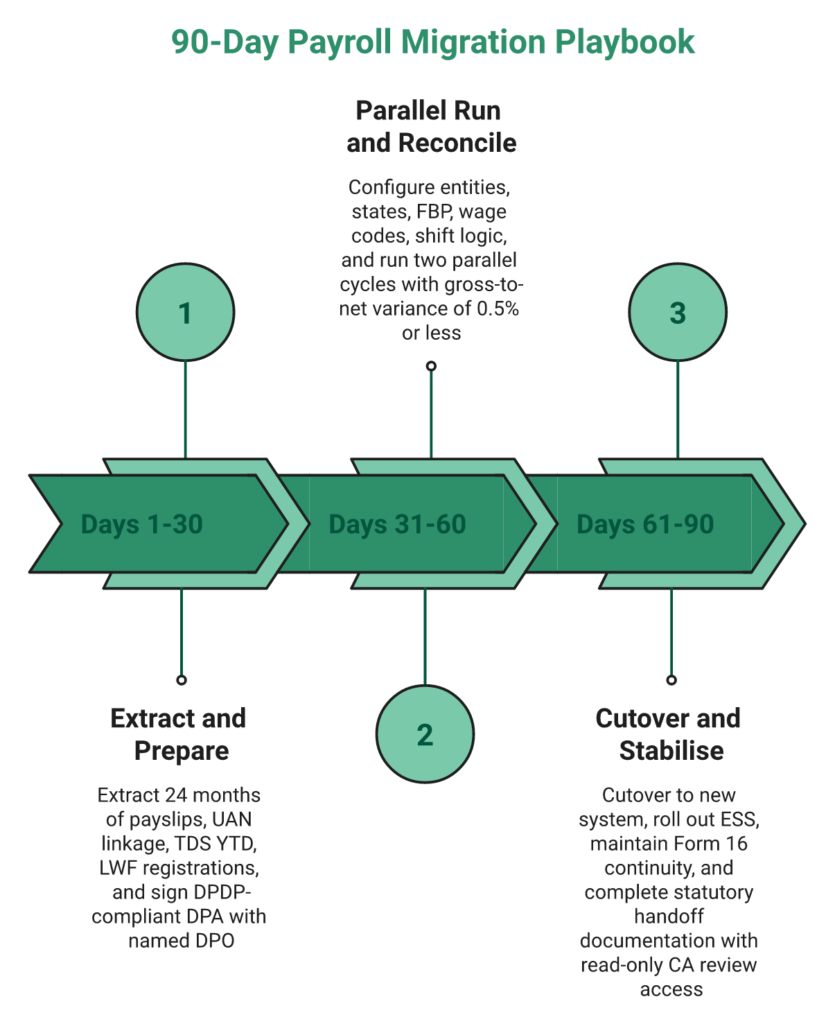
- Days 1 to 30: Extract 24 months of payslips, UAN linkage file, TDS YTD carry-forward, loan/advance balances, LWF state registrations, gratuity actuarial file, and arrears history.
- Days 31 to 60: Configure entities, states, FBP, wage codes, and shift logic, then run two parallel payroll cycles and reconcile variance line-by-line.
- Days 61 to 90: Cutover, employee ESS rollout, Form 16 continuity, statutory handoff documentation, and read-only CA review access.
✅ The 12-Point Parallel-Run Checklist
- ⏰ Gross-to-net variance of 0.5% or less across two cycles.
- ⏰ PF ECR matches on UAN, wage, and contribution lines.
- ⏰ ESIC challans match on insurable wage.
- ⏰ TDS YTD matches for every employee.
- ⏰ PT deducted per-state matches prior cycles.
- ⏰ LWF triggers fire in the right cadence per state.
- ⏰ FBP declarations carry over without reset.
- ⏰ Arrears, LOP, and one-time payments reconcile.
- ⏰ Loan and advance balances match rupee-for-rupee.
- ⏰ Gratuity actuarial file matches opening balance.
- ⏰ Bank file passes NEFT/RTGS dry run.
- ⏰ Form 16 preview matches prior employer declarations.
For a compliance-focused view, see our payroll audit checklist.
⭐ Three Real Case Studies From 2025 to 2026
- 50-person SaaS startup: Switched from outsourcing to in-house software, and the cycle dropped from 9 days to 4 days while FBP errors fell to zero. CFO quote: “The moment we hired in our third state, the outsourcer’s change-fee list killed the deal.”
- 300-person manufacturing firm: Moved to hybrid, and penalty exposure dropped by ₹8L annually after multi-state PT and LWF were automated. CHRO quote: “We stopped discovering LWF gaps during audits.”
- 1,000-person GCC: Started outsourced, then transitioned to in-house after the first DPDP audit flagged sub-processor exposure. IT Director quote: “The MSA indemnity was 1x fees against a ₹250 Cr cap. That math made the switch a board decision.”
✅ How HROne Runs the Playbook by Default
Our prior-HR onboarding SPOC (9.8 NPS) runs this exact migration playbook, with MR DIY India live in 30 days and billing starting only at go-live. The transition month is never a dual-cost month for finance. Explore more customer success stories for proof of repeatable execution.
“The initial setup process was smooth, thanks to the supportive team that helped configure everything according to our needs. The software frees up my team to focus on employee engagement and retention strategies instead of manual data updates.”
— Priyanka S., HROne User HROne G2 – Verified Review
“We started working with Keka HRMS in August, and to this day, we have been unable to implement the tool in our company due to their consistently delayed responses and poor coordination between their internal teams.”
— Divya P., Keka User Keka – G2 Verified Review
Q11: What’s the Final Verdict? Decision Tree Plus FAQ for 2026 Buyers
If you’re under 25 employees with one entity, CA plus basic software. 26 to 500 employees with multi-state or FBP exposure, in-house payroll software. 500+ or regulated industry, managed-hybrid. Treat DPDP fiduciary liability as the primary decision axis, not PEPM. That single reframe prevents the ₹250 Cr downside the Act allows.
⭐ The Decision Tree, Five Yes/No Branches
Choosing the right model in 2026 is harder than it looks, because four market shifts, DPDP enforcement, New Labour Code rollout, multi-state hiring, and FBP democratisation, hit buying committees at the same time. The tree below collapses that complexity into five yes/no questions. Our guide on how to choose the best HRIS/HRMS software complements this.
❌ Where Most Buyers Go Wrong
Defaulting to the cheapest PEPM, the loudest peer-group brand, the longest-tenured CA, or the fattest module checklist, all four shortcuts predict regret inside 18 months.
✅ The Right Branches to Follow
- Do you have more than one legal entity? If yes, in-house software or hybrid. If no, proceed.
- Do you operate in more than one state? If yes, in-house software minimum. If no, CA may still work.
- Are you above 50 employees? If yes, software wins on break-even math. If no, CA plus basic tool.
- Are you New Labour Code-ready (two-day FnF)? If no, outsourcing cannot deliver the TAT, and software can.
- Is DPDP audit exposure real for your industry? If yes, hybrid or in-house. Full outsourcing becomes the weakest option.
⭐ Scoring the Output
Options meeting four of the five branches in favour of software or hybrid represent genuine long-term fit. Anything below three, you’re buying for this quarter, not for 2028.
| Scenario | Recommended Model |
|---|---|
| Single-entity, single-state, <25 | CA + basic software |
| Multi-state, 50 to 500, FBP active | In-house software |
| Multi-entity, 500+, regulated | Managed-hybrid |
| 2,000+, global parent, DPDP-audited | Enterprise HCM + managed filings |
✅ The Compact FAQ for 2026 Buyers
- Do I need HRMS if my CA manages payroll? Yes. The CA files statutory returns, and HRMS runs the engine that feeds accurate data to the CA. Replacing Excel with HRMS cuts error rates from around 2.8% to around 1.2%. See HCM vs HRIS vs HRMS for the category framing.
- Who’s liable under DPDP if my outsourcer leaks data? The employer, as Data Fiduciary, faces penalties up to ₹250 Cr regardless of the vendor’s role as Data Processor.
- What’s the break-even headcount? 45 to 80 employees for most Indian mid-market firms, and earlier if multi-state or FBP-heavy.
- Can I run hybrid without two contracts? Yes, if the software vendor offers an optional managed layer under one MSA. HROne is currently the Indian vendor doing this.
- What’s the real exit cost from outsourcing? 1 to 3 months of fees plus data-extraction effort. Negotiate portability clauses upfront.
- How do New Labour Codes change the 2026 decision? Two-day FnF and 50% basic-wage rules make manual and Excel-based setups non-viable above 50 employees. Our guide on navigating changing labor laws explains each Code.
⭐ The Meta-Insight That Reframes the Decision
The real question is not “software vs outsourcing.” It’s “who bears the DPDP liability and who controls the audit trail?” Answer that, and the model picks itself.
✅ Methodology and Sources
Benchmarks drawn from Voltech (₹623 to ₹2,075 PEPM), Paybooks, Ramco, and Deloitte India 2025 payroll data. Statutory references from the Ministry of Labour and MeitY DPDP draft rules. Error-rate survey across 100 Indian firms. Reviewed by a practising CA with 15+ years of Indian payroll compliance experience. HROne product claims verified against published G2 rankings and documented customer outcomes at MR DIY India and Asia Healthcare Holdings.
Q12: Ready to Consolidate Payroll, Compliance, and HR Ops Into One Super Inbox?
Running multi-entity Indian payroll without the Excel-plus-CA-plus-biometric-plus-outsourcer patchwork, inside one Super Inbox with DPDP-grade audit trails and India’s first inbuilt ROI Dashboard, is exactly what HROne was built for.
⭐ Why Decision-Ready Buyers Pick HROne
The choice isn’t module-count vs module-count. It’s which architecture turns HR from a monthly firefight into a function that compounds. HROne ships that architecture with the pricing model to match.
- Flat PEPM across software and managed payroll, no entity surcharges, and no tier upgrades for FBP or multi-state.
- Subscription meters only after go-live, with no day-one billing during implementation.
- 127 pre-built hire-to-retire workflows covering onboarding, confirmation, transfer, promotion, FnF, and exit.
- #3 G2 Easiest-to-Use Core HR ranking against Keka at #16, and Darwinbox on long-cycle implementation.
- MR DIY India live in 30 days, with payroll cycle cut from 10 days to 5 to 6 days.
- NPS 9.8 on a dedicated prior-HR SPOC answering phone and email within 24 hours.
Explore the full HR software suite, the core HCM, or step into persona-specific views like CHRO solutions and CXO solutions.
⭐ The 30-Minute Walkthrough That Saves the Quarter
Instead of another RFP round, see your own payroll TCO, break-even headcount, and DPDP audit trail live against the framework in this article. Paste the block below into your site or share it with the buying committee. Validate the rupee math alongside with the ROI calculator and the salary calculator.
See Your Payroll TCO in 30 Minutes
Get a live walkthrough of HROne’s payroll engine, ROI Dashboard, and DPDP-ready audit trail, built for Indian multi-entity reality.
Book Your Payroll Demo →













 Secures Top Spot in
