







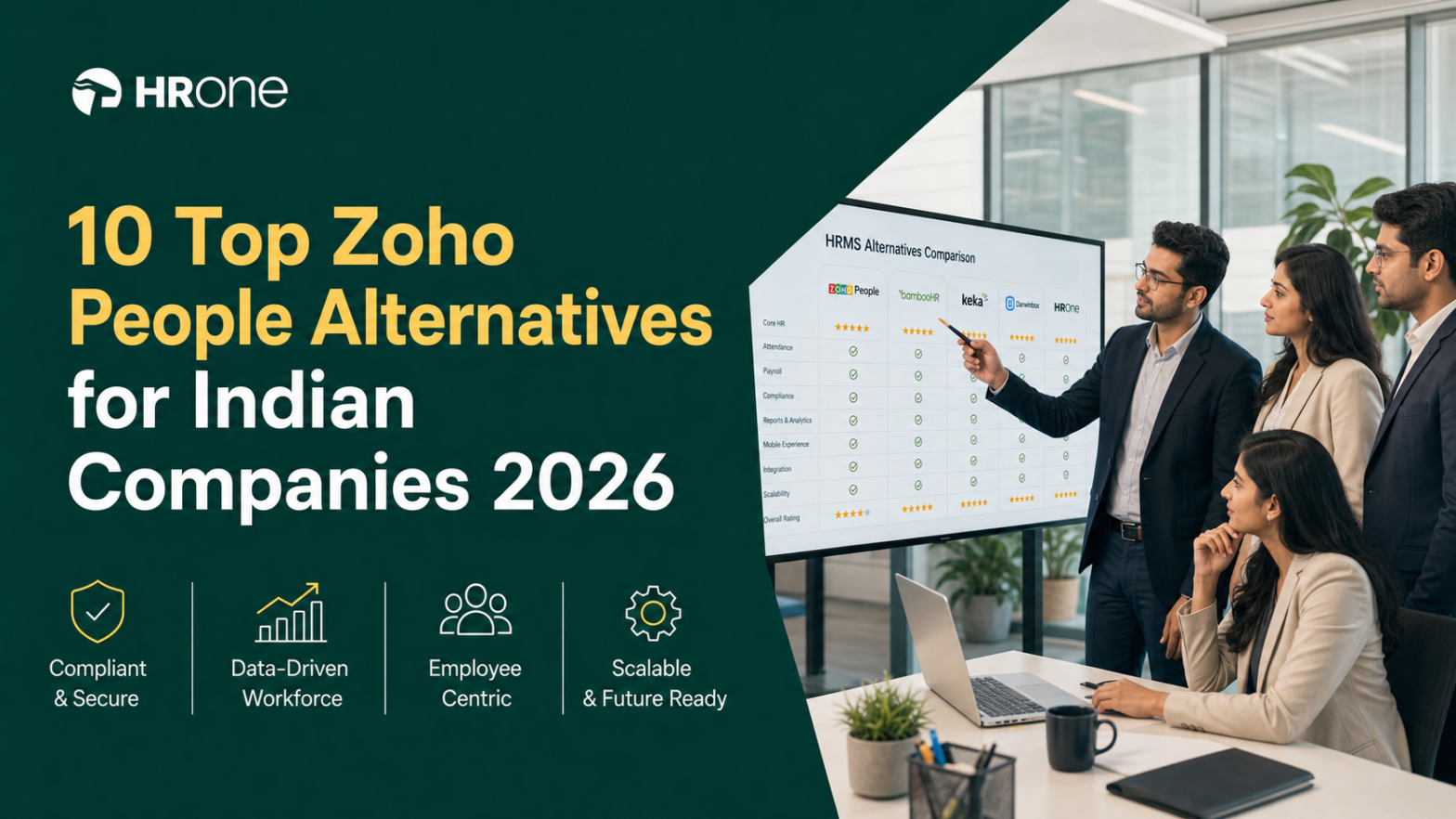
Q1: What are the 10 best Zoho People alternatives for Indian companies in 2026?
Choosing an HRMS to replace Zoho People is a high-stakes call for Indian organisations between 100 and 5,000 employees, where payroll integrity, multi-state compliance, and OU configuration decide whether HR runs the month or the month runs HR. Rather than ranking by brand familiarity, this guide evaluates ten platforms against operational, statutory, and economic criteria that matter to mid-market and enterprise India. We assessed publicly documented G2 standings, India payroll depth, implementation experience, and pricing posture, with primary input from the G2 Winter 2026 Grid for Core HR India and the NASSCOM Zinnov India HR Tech Landscape report. The reader we wrote this for is the HR Ops lead living inside the system every day, with the CHRO, CFO, and IT Director reading over their shoulder. Compare options on our top 10 HR software India guide.
Our evaluation criteria
- India statutory and payroll depth (PF, ESI, TDS, multi-state PT and LWF, Gratuity, Code on Wages 2019 readiness)
- UX and cognitive load (clicks-to-close, mobile parity, navigation pattern)
- Implementation and support quality (go-live timeline, support model, NPS or CSAT signal)
- Pricing transparency (flat PEPM, lock-in, go-live linked billing)
- Integration and AI breadth (ERP, biometric, BGV, LMS, resume parsing, receipt scanning)
- Operating model fit for 100 to 5,000 employee Indian companies
Who this guide is for
- CHROs and HR Heads consolidating fragmented hire-to-retire stacks across multiple legal entities
- Payroll Managers running multi-state, India-compliant monthly cycles with FBP and CTC revisions
- CFOs and MDs validating HR tech ROI and flat PEPM commercials before signing
- IT Directors evaluating mobile-first HCMs against legacy global suites and disconnected portals
The shortlist at a glance
| Provider | Best For | Standout Strength | Known Limitation | Go-live Timeline | Support Model | Pricing Model |
|---|---|---|---|---|---|---|
| HROne ⭐⭐⭐⭐⭐ | HR Ops leads drowning in multi-entity payroll and tab-switching across five tools | Super Inbox closes 110 daily tasks in three clicks; subscription meters only after go-live | Onboarding curve for power users on advanced Performance and Audit modules | 30 days (MR DIY India reference) | Phone, email, dedicated prior-HR SPOC | Flat PEPM, no lock-in, billing post go-live |
| Darwinbox ⭐⭐⭐⭐ | 1,000+ employee Indian enterprises wanting module breadth | Comprehensive HR module suite on a single platform | Implementation and configurations break in production; outdated UI per reviewers | 8 to 16 weeks | Email, ticket, partner-led | Quote-based, billing from day one |
| Keka ⭐⭐⭐ | Sub-500 employee firms wanting clean UX | Intuitive interface and mobile app | Email-thread-only support; weekend support gaps; slow onboarding | 8 to 12 weeks | Email, ticket | Per-user per month, tiered |
| greytHR ⭐⭐⭐ | SMB payroll under 500 headcount | SMB payroll and statutory filings | Rigid configuration, weak customer support, payroll edge-case errors | 4 to 8 weeks | Email, partner-led | Tiered PEPM |
| SAP SuccessFactors ⭐⭐ | 5,000+ global enterprises with SAP ERP | Global module breadth and security posture | Over-engineered for Indian payroll; needs developers to change a leave policy | 6 to 12 months | Partner-delivered | Quote-based, enterprise contract |
| PeopleStrong ⭐⭐⭐ | India enterprises wanting mobile-first SaaS | Strong mobile experience for ESS | Desktop version cluttered; reimbursement approvals can lag | 8 to 14 weeks | Email, SPOC | Quote-based |
| ZingHR ⭐⭐ | Manufacturing and BFSI hire-to-retire | Broad module coverage including LMS | Outdated UI, slow servers, customer support gaps reported | 6 to 12 months (per reviewer) | Email, ticket | Quote-based |
| BambooHR ⭐⭐ | US-headquartered teams with light India ops | Clean US-style UX and time-off flows | Not built for India payroll; limited customisation; pricing escalations | 4 to 8 weeks | Email, chat | Per-employee per month |
| factoHR ⭐⭐⭐ | Cost-conscious SMBs needing India payroll | Affordable India payroll and compliance | Lighter on AI and workflow depth | 4 to 6 weeks | Email, phone | Tiered PEPM |
| Pocket HRMS ⭐⭐ | Sub-200 employee SMBs | Simple setup, India payroll basics | Limited at multi-entity OU and complex workflows | 2 to 4 weeks | Email, chat | Tiered PEPM |
1. HROne, the hire-to-retire operating system for India
HROne is a cloud-native HCM built for 100 to 5,000 employee Indian organisations, founded in 2016 and now live across 1,500+ brands including MR DIY India and Asia Healthcare Holdings. It is ranked #3 globally on G2 for customer satisfaction and #8 Best HR Software Worldwide, with a dedicated prior-HR SPOC operating at a 9.8 NPS. Primarily used by HR Ops leads tired of stitching payroll outsourcing, biometric portals, standalone ATS, Excel for performance, and WhatsApp for approvals into a single working day. Explore the full core HCM suite.
Core services
- Super Inbox, consolidates 110+ daily HR tasks into a Gmail-style inbox, with three-click closures across confirmations, leave, expenses, and exit clearance. See the HR inbox.
- 127 pre-built hire-to-retire workflows, onboarding, transfer, promotion, FFS triggered automatically, so HR stops chasing managers over email
- One AI Suite, resume relevancy scoring, receipt parser, AI Employee Agent, JD generators, so recruiters and finance stop manual sorting. Powered by HROne AI.
- Payroll engine, automated PF, ESI, TDS, PT, LWF, Form 16, and 24Q with auto-scheduler and group payout validation, delivering zero-delay salary under Indian statutory law via payroll software
- HRV Studio, low-code custom app builder for visitor or vendor management, so HR ships internal apps without raising a developer ticket
- ROI Dashboard, India’s first inbuilt HR ROI calculator comparing average HR salary against lifetime hours saved, so CHROs walk into board reviews with a rupee figure
- Mobile-first architecture, offline attendance, geofenced punch, payslip access, sub-500ms response, so field teams act from the phone using the mobile HR app
🇮🇳 India-specific compliance and localisation
- PF, ESI, TDS support: Yes, automated calculation, filing, and reconciliation
- Labour law compliance: Strong, including Code on Wages 2019 wage redefinition and two-day FFS
- Payroll localisation: Yes, India-first with FBP, CTC revisions, and mid-year arrears
- Multi-state compliance: Yes, native PT and LWF across 16 states with multi-legal-entity OU
Who this is built for
- HR Ops lead manually reconciling biometric exports against leave portal across two or more entities
- Payroll Manager firefighting CTC-revision arrears, FBP declarations, and two-day FFS at month-end
- CHRO unable to answer the board on average days to close a confirmation letter or onboard a lateral hire
Who should skip this
- Sub-50 employee single-entity startups that only need a leave tracker and a basic payslip generator
- Teams that want a pure global suite with non-Indian payroll as the centre of gravity
Pricing structure
- Plan Type(s): Flat PEPM tiers across Core HR, Workforce, Time Office, and Payroll bundles. View pricing.
- Starting Price: Not publicly disclosed, request a quote
- Tier-wise Breakdown: Module bundles published privately
- Incremental Cost Drivers: Add-on AI agents and HRV Studio premium templates
- Implementation Fee: Bundled, with subscription metering only from go-live day
- Cost at 200 Employees: Request quote | Cost at 500 Employees: Request quote
Implementation and support reality
- Average go-live: 30 days, evidenced by MR DIY India consolidation
- Support channels: Phone, email, dedicated prior-HR SPOC operating at 9.8 NPS
- Data migration: Vendor-led with prior-HR consultants who speak the customer’s domain
- Subscription meters only after go-live, no lock-in
Reviews
“The InboxforHR is a game-changer, centralizing every HR task into one simple inbox, cutting down administrative time by 60 to 70 percent and preventing tasks from falling through the cracks.”
— Waldon S. HROne G2 – Verified Review
“HROne has revolutionized manual master data management, allowing me to pull reports rapidly without the hassle of multiple spreadsheets. The ability to manage various HR processes from a single platform is incredibly convenient and cost-effective for mid-level and enterprise customers.”
— Priyanka S. HROne G2 – Verified Review
2. Darwinbox, the enterprise incumbent
Darwinbox is the unicorn-backed Indian HCM most often shortlisted by 1,000+ employee enterprises, founded in 2015 with a strong brand presence in BFSI and IT services. It carries module breadth across attendance, payroll, performance, and onboarding on a single platform. Primarily used by enterprise HR teams replacing legacy ERP modules with a modern Indian suite. Compare on the HROne vs Darwinbox page.
Core services
- Core HR and Workforce, unified employee record across entities, reducing scattered Excel trackers
- Performance and Goals, cascading OKRs and reviews, structured appraisal cycles
- Recruitment, ATS with offer management, one place for hiring funnels
- Payroll engine, India statutory calculations across PF, ESI, and TDS, monthly payroll runs
- Mobile app, leave, attendance, and payslip access on the go
🇮🇳 India compliance
- PF, ESI, TDS: Yes, statutory calculations and filings
- Labour law compliance: Strong on core acts, moderate on multi-state edge cases
- Payroll localisation: Yes, India-tuned with FBP support
- Multi-state compliance: Yes, configurable but configuration-heavy
Who this is built for
- CHRO at a 1,500+ employee enterprise needing module breadth on a single India platform
- IT Director evaluating Indian HCMs with strong enterprise security posture
Who should skip this
- HR Ops lead at a 200 to 800 employee firm wanting fast go-live without partner involvement
- CFO who refuses to pay subscription during a 4-month implementation
Pricing structure
- Plan Type(s): Quote-based enterprise contracts
- Starting Price: Not publicly disclosed, request a quote
- Implementation Fee: Yes, separate, billed alongside year-one subscription
- Cost at 200 Employees: Request quote | Cost at 500 Employees: Request quote
Implementation and support reality
- Go-live: 8 to 16 weeks for mid-market, longer for enterprise
- Support: Email, ticket, partner-delivered
- Data migration: Partner-led
- Subscription billing from day one
Reviews
“Bad implementation experience, bad UI UX, configurations getting broken in production on its own due to product deployments, terrible customer service. Basically everything.”
— Verified User in Computer Software Darwinbox – G2 Verified Review
“Transitioning from the old system to Darwinbox is quite difficult. User interface of Darwinbox is very outdated. Darwinbox Support team is not supportive.”
— Ankush B. Darwinbox – G2 Verified Review
3. Keka, the mid-market UX favourite
Keka is a Hyderabad-headquartered HRMS that wins sub-500 employee Indian firms on interface polish and a clean mobile app. Primarily used by IT services, consulting, and digital-first SMBs that prioritise ESS adoption. See a head-to-head on HROne vs Keka.
Core services
- Payroll, PF, ESI, and TDS automation, monthly cycles closed digitally
- Time and Attendance, biometric and geofencing, leave and attendance tracked centrally
- Performance, OKRs and reviews, structured cycles
- Hiring (Hiro), ATS with workflow approvals, recruitment pipeline
- Mobile app, ESS for leave, attendance, and payslip, field-friendly
🇮🇳 India compliance
- PF, ESI, TDS: Yes, statutory automation
- Labour law compliance: Moderate, gaps reported on TDS revisions and CTC components
- Payroll localisation: Yes, India-built
- Multi-state compliance: Partial, location-based policy gaps reported
Who this is built for
- HR generalist at a 200 to 400 employee IT services firm wanting clean ESS adoption
- Founder-HR at a digital SMB wanting mobile-first attendance
Who should skip this
- HR Ops lead at a multi-entity manufacturing setup with shift-based wage rules
- Payroll Manager who needs phone-based weekend support during salary runs
Pricing structure
- Plan Type(s): Foundation, Strength, and Growth tiers (per Keka public pricing)
- Starting Price: Per-user per-month, tiered
- Implementation Fee: Yes, separate
- Cost at 200 Employees: Refer Keka pricing page | Cost at 500 Employees: Refer Keka pricing page
Implementation and support reality
- Go-live: 8 to 12 weeks, longer for complex setups per reviewers
- Support: Email and ticket, weekend gap reported
- Data migration: Self-serve plus vendor assistance
Reviews
“We started working with Keka HRMS in August, and to this day, we have been unable to implement the tool in our company due to their consistently delayed responses and poor coordination between their internal teams.”
— Divya P. Keka – G2 Verified Review
“From Friday evening 6 PM to Monday morning 10 AM there is no source of support from KEKA, telephonic communication to a POC during emergency is not possible.”
— Prem K. Keka – G2 Verified Review
4. greytHR, the SMB payroll workhorse
greytHR is a Bengaluru-based HRMS optimised for SMB payroll and statutory filings, with strong adoption under 500 headcount. Primarily used by finance-led SMBs that treat payroll as the centre of gravity. See the HROne vs greytHR comparison.
Core services
- Payroll, PF, ESI, PT, and TDS calculations, monthly statutory output
- Leave and Attendance, policy-driven leave balances, ESS access
- Compliance reports, Form 16, 24Q, and PT returns, statutory hand-offs
- Employee self-service, payslips and tax declarations, reducing HR queries
🇮🇳 India compliance
- PF, ESI, TDS: Yes, statutory calculations
- Labour law compliance: Moderate, configuration-heavy
- Payroll localisation: Yes, India-built
- Multi-state compliance: Partial, customisation gaps flagged by reviewers
Who this is built for
- Finance manager at a 100 to 400 employee firm running monthly payroll as the priority
- HR generalist needing simple ESS for payslips and tax declarations
Who should skip this
- HR Ops lead with multi-entity, shift-based, or manufacturing payroll
- CHRO wanting modern AI recruitment and performance modules
Pricing structure
- Plan Type(s): Starter, Essential, Growth, and Enterprise tiers
- Starting Price: Tiered PEPM (per public pricing)
- Implementation Fee: Yes, separate
- Cost at 200 Employees: Refer greytHR pricing | Cost at 500 Employees: Refer greytHR pricing
Implementation and support reality
- Go-live: 4 to 8 weeks
- Support: Email and partner-led, ticket SLAs criticised by reviewers
- Data migration: Vendor-led with manual elements reported
Reviews
“Lack of timely, responsive, and easily reachable customer support. Lack of user friendly software, there is a very high dependency on the greytHR team to customize and the customization is full of gaps.”
— Verified User in IT and Services greytHR – G2 Verified Review
“Honestly the worst payroll I have seen in my career so far. They do not care about your tax savings and put in low to zero effort into the suggestions on optimizing employees tax saving.”
— Verified User in IT and Services greytHR – G2 Verified Review
5. SAP SuccessFactors, the global enterprise suite
SAP SuccessFactors is a global HCM suite often selected by 5,000+ employee enterprises already running SAP ERP, with deep module coverage and enterprise security posture. Primarily used by multinationals with India as one of many geographies. Compare on HROne vs SAP.
Core services
- Employee Central, global core HR record, multi-country employee data
- Performance and Goals, cascading OKRs across geographies, enterprise reviews
- Learning, LMS with compliance training, global learning paths
- Recruitment, ATS with offer management, global hiring
- Compensation, planning and review cycles, annual cycles
🇮🇳 India compliance
- PF, ESI, TDS: Partial, requires localisation packs and partner customisation
- Labour law compliance: Limited out of the box, partner-delivered
- Payroll localisation: Partial, often paired with Indian payroll partners
- Multi-state compliance: Partial, partner-configured
Who this is built for
- Multinational CHRO standardising on SAP globally with India as a sub-geography
- IT Director wanting deep ERP integration with SAP financials
Who should skip this
- HR Ops lead at a 200 to 1,500 employee India-only firm
- CFO unwilling to pay full subscription during 6 to 12 month implementations
Pricing structure
- Plan Type(s): Quote-based enterprise contracts
- Starting Price: Not publicly disclosed, request a quote
- Implementation Fee: Yes, partner-delivered, often higher than annual subscription
- Cost at 200 Employees: Not viable | Cost at 500 Employees: Request quote
Implementation and support reality
- Go-live: 6 to 12 months
- Support: Partner-delivered
- Data migration: Partner-led with internal IT involvement
Reviews
“Not user-friendly, system often freezes. Data is unreliable and cannot always be trusted. Customization requires third-party vendors, every change is costly. Extremely expensive for what it delivers, Ferrari price, Trabant value.”
— Janka Z. SAP SuccessFactors – G2 Verified Review
6. PeopleStrong, the India enterprise SaaS
PeopleStrong is an India-headquartered HCM serving large enterprises across BFSI, manufacturing, and IT services. Primarily used by enterprise HR teams that prioritise mobile ESS and reimbursement workflows. See the HROne vs PeopleStrong comparison.
Core services
- Core HR, enterprise record management, unified employee data
- Payroll, India statutory automation, monthly cycles
- Performance, goals and reviews, structured cycles
- Mobile app, ESS for attendance, leave, and payslip, strong mobile UX
- Recruitment, ATS with workflow, enterprise hiring
🇮🇳 India compliance
- PF, ESI, TDS: Yes, automated
- Labour law compliance: Strong
- Payroll localisation: Yes, India-built
- Multi-state compliance: Yes, configurable
Who this is built for
- CHRO at a 1,000+ employee India enterprise wanting mobile-first ESS
- Payroll Manager running multi-entity reimbursements
Who should skip this
- Sub-300 employee firms wanting fast self-serve onboarding
- Teams that prefer flat published PEPM pricing
Reviews
“Its mobile-friendly, unlike the one we used before this is mobile friendly and can be accessed most of the HR-related info in 1 tap away.”
— Nikhil S. PeopleStrong – G2 Verified Review
“The reimbursement and claims process can feel a bit slow at times, especially when approvals take longer than expected. The interface can also lag occasionally, making navigation slightly frustrating.”
— Anusha PeopleStrong – G2 Verified Review
7. ZingHR, the manufacturing and BFSI hire-to-retire
ZingHR is a Mumbai-based HCM with deep adoption across manufacturing, BFSI, and field-heavy operations. Primarily used by enterprises that need a broad module footprint including LMS and learning. See HROne vs ZingHR and the manufacturing HR page.
Core services
- Core HR and Workforce, enterprise records, multi-entity data
- Payroll, statutory calculations, monthly cycles
- Performance and LMS, reviews and learning, development cycles
- Workforce management, shift and roster planning, manufacturing fit
🇮🇳 India compliance
- PF, ESI, TDS: Yes
- Labour law compliance: Strong on shift and factory acts
- Payroll localisation: Yes
- Multi-state compliance: Yes
Who this is built for
- Plant HR at a manufacturing enterprise running shift-based payroll
- BFSI HR running structured hire-to-retire across geographies
Who should skip this
- HR teams that prioritise UX polish and modern AI recruitment
- Mid-market firms wanting fast go-live and self-serve adoption
Reviews
“Zing is extremely slow, its server takes a lot of time to respond. Sometimes the webpage does not open at all. Customer support is extremely bad, they do not resolve issues on time, ensuring that critical payroll related issues cannot be solved on time.”
— Verified User in Pharmaceuticals ZingHR – G2 Verified Review
“System implementation experience was horrible, in 6 months the implementation was barely completed to 40 percent. Support is never on time, replies to emails get delayed by days if not weeks.”
— Sanmeet S. ZingHR – G2 Verified Review
8. BambooHR, the US-first generalist
BambooHR is a US-headquartered HRMS popular with small businesses globally for clean UX and time-off flows. Primarily used by US-based or US-headquartered teams with light India operations.
Core services
- Core HR records, employee directory, centralised data
- Time off, request and approval workflow, simple ESS
- Reporting, standard reports, US-style outputs
- Onboarding, checklist-based new hire flow, digital onboarding
🇮🇳 India compliance
- PF, ESI, TDS: No, not built for Indian payroll
- Labour law compliance: Limited
- Payroll localisation: No, third-party only
- Multi-state compliance: No
Who this is built for
- Sub-100 employee teams with US headquarters and minor India presence
- HR generalist running simple time-off and onboarding only
Who should skip this
- Indian HR Ops running PF, ESI, TDS, PT, and LWF as core monthly work
- Companies above 50 employees with multi-entity Indian operations
Reviews
“The sales rep lied to us about what the platform was capable of, they said Bamboo would integrate with our payroll system which is not true. This platform is terrible for companies with more than 20 employees.”
— Verified User in Construction BambooHR – G2 Verified Review
“Biggest issue is how much they have increased prices and continue to do so. They know that switching HRMS is painful. Every year is either a large price increase or our plan being sunsetted.”
— Josh A. BambooHR – G2 Verified Review
9. factoHR, the cost-conscious India payroll specialist
factoHR is an India-built HRMS focused on payroll, attendance, and statutory automation for cost-conscious SMBs and growing mid-market firms. Primarily used by HR teams wanting straightforward Indian payroll without enterprise complexity. See HROne vs FactoHR.
Core services
- Payroll, PF, ESI, and TDS automation, monthly cycles
- Attendance and leave, biometric integration, daily tracking via attendance management
- Compliance, Form 16, 24Q, and PT returns, statutory hand-offs
- Mobile app, ESS access, field-friendly
🇮🇳 India compliance
- PF, ESI, TDS: Yes
- Labour law compliance: Strong on payroll
- Payroll localisation: Yes
- Multi-state compliance: Yes
Who this is built for
- Cost-conscious SMB HR running monthly payroll as the central use case
- Growing mid-market firm wanting affordable Indian payroll automation
Who should skip this
- Enterprises needing AI recruitment, ROI dashboards, or low-code app builders
- Teams that need deep performance and engagement modules
10. Pocket HRMS, the SMB starter
Pocket HRMS is a starter India HRMS for sub-200 employee SMBs needing simple payroll, attendance, and leave automation. Primarily used by founders and HR generalists at early-stage Indian companies. See HROne vs Pocket HRMS.
Core services
- Payroll, PF, ESI, and TDS basics, monthly cycles
- Attendance and leave, simple tracking, ESS access
- Compliance, statutory reports, basic hand-offs
- Onboarding, simple new-hire flow, digital intake
🇮🇳 India compliance
- PF, ESI, TDS: Yes, basic
- Labour law compliance: Limited
- Payroll localisation: Yes, light
- Multi-state compliance: Limited
Who this is built for
- Founder-HR at a sub-200 employee SMB
- HR generalist at a single-entity Indian startup
Who should skip this
- Mid-market and enterprise firms above 300 employees
- Multi-legal-entity setups with shift-based wage rules
I have watched the Indian shortlist compress from 30+ vendors to a repeatable seven or eight in the last four years. Working with HR teams across BFSI, manufacturing, and ITeS, what I have felt is that most teams already know the answer after two demos. They are looking for permission to stop evaluating, not more comparisons. The “last switch” aspiration is real. CHROs are tired of migration fatigue and want one platform that earns the next decade. My current thinking is that the next two years will reward platforms that meter only after go-live and prove ROI on the dashboard rather than on a sales deck. Map your decision against the how to choose HRIS HRMS software checklist before signing.
Ready to see HROne in action?
See how 1,500+ Indian brands closed the Frankenstein stack on a single platform with go-live linked billing.
Q2: How did we score and star-rate each Zoho People alternative?
We scored each alternative on five weighted criteria that Indian HR buyers in 2026 actually care about: India Statutory and Payroll Depth (25%), UX and Cognitive Load (20%), Implementation and Support Quality (20%), Pricing Transparency and Go-Live Billing (20%), and Integration plus AI Breadth (15%). Tools scoring 81 to 100 earn 5 stars, 61 to 80 earn 4, 41 to 60 earn 3, 21 to 40 earn 2, and 0 to 20 earn 1. HROne is the only 5-star entry on the list.
The weighted criteria
We deliberately rejected the feature-checklist model that most listicles still use. A platform with 200 features and email-only weekend support fails a payroll manager at midnight on the 31st. The weighting below punishes subscription-from-day-one and rewards cognitive-load reduction. Buyers wanting the broader category map can review the top 10 HR software India guide alongside this scorecard.
| Criterion | Weight | What it measures |
|---|---|---|
| 🇮🇳 India Statutory and Payroll Depth | 25% | PF, ESI, TDS, multi-state PT and LWF, Gratuity, Code on Wages 2019 readiness, two-day FFS, FBP, and CTC revisions |
| 🧠 UX and Cognitive Load | 20% | Clicks-to-close on routine tasks, mobile parity, navigation pattern, and ESS adoption signal |
| 🤝 Implementation and Support Quality | 20% | Published go-live timeline, support channels, SPOC model, and NPS or CSAT signal |
| 💰 Pricing Transparency and Go-Live Billing | 20% | Flat PEPM versus quote-based, lock-in length, and when subscription metering starts |
| 🔌 Integration and AI Breadth | 15% | ERP, biometric, BGV, LMS connectors, resume parsing, receipt scanning, and custom app builder |
The G2 2026 Satisfaction Index informed UX, support, and ease-of-setup signals across vendors. The SHRM India State of HR Technology 2024 report informed statutory and integration weighting based on what 1,000+ Indian HR leaders flagged as their top switching triggers. Our HR software pricing transparency primer expands on the commercial weighting.
The star-band legend
- ⭐⭐⭐⭐⭐ 81 to 100, category-leading across all five criteria
- ⭐⭐⭐⭐ 61 to 80, strong on three or more criteria, soft on one
- ⭐⭐⭐ 41 to 60, solid on two criteria, gaps on others
- ⭐⭐ 21 to 40, meaningful gaps on three or more criteria
- ⭐ 0 to 20, operationally unfit for 100 to 5,000 employee Indian companies
The star ratings revealed
| Provider | Score | Stars | One-line justification |
|---|---|---|---|
| HROne | 92 | ⭐⭐⭐⭐⭐ | Only platform with go-live linked billing, 9.8 NPS prior-HR SPOC, native multi-state PT and LWF, and a built-in ROI Dashboard |
| Darwinbox | 74 | ⭐⭐⭐⭐ | Module breadth is strong, but billing from day one and reported configuration drift in production drag the score |
| PeopleStrong | 66 | ⭐⭐⭐⭐ | Strong India compliance and mobile UX, soft on flat published pricing |
| factoHR | 64 | ⭐⭐⭐⭐ | Affordable Indian payroll, lighter on AI and workflow depth |
| Keka | 58 | ⭐⭐⭐ | Clean UX, but weekend support gap and slow onboarding pull it down |
| greytHR | 52 | ⭐⭐⭐ | Reliable SMB payroll, rigid configuration past 500 employees |
| Pocket HRMS | 42 | ⭐⭐⭐ | Simple SMB starter, limited multi-entity OU |
| ZingHR | 38 | ⭐⭐ | Broad modules, but server speed and support gaps reported |
| BambooHR | 32 | ⭐⭐ | Clean US UX, no native Indian payroll |
| SAP SuccessFactors | 28 | ⭐⭐ | Enterprise-grade globally, partner-delivered Indian payroll, 6 to 12 month go-live |
My perspective on the methodology
Working with 2,000+ HR teams, what I have felt is that the feature-checklist model fools buyers into rewarding surface area instead of operational fit. My current thinking is that the next two years will reward platforms that meter only after go-live and reduce cognitive load on a payroll manager’s daily list. Read the HRIS buyer pitfalls guide alongside this scorecard.
Q3: Why do Indian companies switch away from Zoho People, and where does it break on payroll compliance?
Indian companies leave Zoho People for four compounding reasons. Payroll sits in a separate Zoho Payroll product, multi-legal-entity OU configuration breaks past 300 employees, navigating multiple tabs creates daily friction, and basic keyword filters fail modern AI recruitment. On compliance, Zoho People lacks native coverage for 16-state LWF, multi-slab Professional Tax, Code on Wages 2019 wage redefinition, FBP with mid-year CTC revisions, and the new two-day full-and-final settlement norm. See the head-to-head on HROne vs Zoho People.
Pain 1: unbundled payroll and navigation as a design failure
Zoho People sells Core HR. Indian payroll lives inside Zoho Payroll, a separate purchase, and expense lives inside Zoho Expense, another separate purchase. An HR Ops lead opens 110 tasks a day across leave approvals, attendance regularisations, expense queries, payslip questions, confirmation letters, and exit clearances. Four-tab switching turns a 30-second action into a 3-minute slog. Multiply by 110 tasks and a working day disappears into navigation, not work. Modern HR inbox patterns collapse the same workload to three-click closures.
What this means for Monday morning
If your payroll runs on Zoho Payroll and your master sits on Zoho People, every CTC revision becomes a reconciliation between two products. The HR Ops lead absorbs that reconciliation, not the vendor.
Pain 2: multi-legal-entity OU limits past 300 employees
Zoho People’s Organisational Unit (OU) configuration handles single-entity setups well. Past 300 employees and two or more legal entities, customers report that statutory rule overrides, location-specific holiday lists, and entity-specific approval matrices need workarounds. A mid-market manufacturing firm with three plants across Maharashtra, Tamil Nadu, and Gujarat usually hits this ceiling within the first quarter post go-live. Manufacturing HR setups need entity-aware shift, wage, and policy logic out of the box.
Pain 3: thin AI recruitment versus modern stacking
Zoho People’s recruitment relies on basic keyword filters. Modern AI recruitment requires resume relevancy scoring that reads job context, candidate experience, and skill adjacency, not just keyword matches. A 600-employee IT services firm hiring 40 laterals a quarter cannot triage 4,000 applications with keyword filters alone. AI-driven CV stacking and JD generation is now the baseline, as covered in our AI automation in recruitment guide.
Pain 4: missing two-day FFS and Code on Wages readiness
The new two-day full-and-final settlement norm under the Code on Wages 2019 reshapes exit workflows for Indian employers. Customers report that retro-fitting two-day FFS, wage redefinition (50% of CTC as basic), and 16-state LWF into a Zoho People plus Zoho Payroll setup needs heavy customisation. See our explainer on navigating labor laws and statutory compliance payroll.
Indian statutory coverage matrix
| Statutory Item | Zoho People + Zoho Payroll | HROne |
|---|---|---|
| PF (Provident Fund) | ✅ Yes | ✅ Yes, automated filing and reconciliation |
| ESI (Employees’ State Insurance) | ✅ Yes | ✅ Yes, automated |
| TDS (Tax Deducted at Source) | ✅ Yes | ✅ Yes, with 24Q and Form 16 |
| PT (Professional Tax, multi-slab) | ⚠️ Partial | ✅ Native, all states |
| LWF (Labour Welfare Fund, 16 states) | ❌ Limited | ✅ Native, all 16 states |
| Gratuity | ✅ Yes | ✅ Yes, automated |
| POSH workflows | ⚠️ Configurable | ✅ Pre-built |
| Maternity Benefit Act | ✅ Yes | ✅ Yes |
| Code on Wages 2019 wage redefinition | ⚠️ Partial | ✅ Native |
| Two-day FFS norm | ❌ Manual | ✅ Workflow-driven |
State-by-state PT and LWF heatmap (16 states)
| State | PT applicable | LWF applicable |
|---|---|---|
| Maharashtra | ✅ | ✅ |
| Karnataka | ✅ | ✅ |
| Tamil Nadu | ✅ | ✅ |
| Telangana | ✅ | ✅ |
| Andhra Pradesh | ✅ | ✅ |
| West Bengal | ✅ | ✅ |
| Gujarat | ✅ | ✅ |
| Madhya Pradesh | ✅ | ✅ |
| Kerala | ✅ | ✅ |
| Odisha | ✅ | ✅ |
| Punjab | ✅ | ✅ |
| Haryana | ❌ | ✅ |
| Delhi | ❌ | ✅ |
| Chhattisgarh | ✅ | ✅ |
| Goa | ✅ | ✅ |
| Bihar | ✅ | ✅ |
Code on Wages 2019 and two-day FFS walkthrough
The Code on Wages 2019 redefines wages so that basic plus dearness allowance must equal at least 50% of total CTC. This recalibrates PF, gratuity, and bonus calculations for nearly every Indian employer. The two-day FFS norm requires final settlement within two working days of an employee’s last working day. Retro-fitting these into a generic global core is structurally slower than running them on an India-first payroll software with workflow-driven exit clearance.
Zoho’s horizontal bet across finance, sales, and HR is genuinely impressive. But a finance-suite parent under-invests in Indian labour-law edge cases that an India-first founder lives with daily. The “keyword versus need” fallacy also matters here. Buyers search “Core HR” but actually need a full HCM, the difference between a digital filing cabinet and an operating system. Read more on HCM vs HRIS vs HRMS.
Reviews
“While the platform offers a lot of value, the user interface can sometimes feel a bit cluttered, especially when navigating between modules. Customizations options, while available, can be a bit tricky to set up without help, especially for non-technical users.”
— Pruthviraj S. Zoho People – G2 Verified Review
“Customer support is the worst part of zoho people. After purchasing the application I have raised numerous tickets to clear my queries however no help is given by the support team. Customer support staff are not capable of providing solution to the customer.”
— Verified User in Computer Software Zoho People – G2 Verified Review
Q4: How do HROne, Darwinbox, Keka, greytHR, and Zoho People compare head-to-head across the criteria that matter in India?
Head-to-head, HROne wins on Ease of Setup, Ease of Admin, and Quality of Support on G2, is the only platform metering subscription after go-live, and carries native multi-state PT and LWF. Darwinbox leads on module breadth but bills from day one. Keka has clean UX but trails on support (#55 satisfaction versus HROne’s #3). greytHR excels in sub-500 SMB payroll. Zoho People fits single-entity startups only.
The five-vendor comparison matrix
| Criterion | HROne | Darwinbox | Keka | greytHR | Zoho People |
|---|---|---|---|---|---|
| 💰 Pricing Model | Flat PEPM, post go-live billing, no lock-in | Quote-based, billing from day one | Tiered PEPM | Tiered PEPM | Per-user, multi-product |
| 🇮🇳 India Payroll Built-in | ✅ Native | ✅ Native | ✅ Native | ✅ Native (SMB depth) | ❌ Requires Zoho Payroll |
| Multi-state PT and LWF | ✅ Native, 16 states | ✅ Configurable | ⚠️ Partial | ✅ Yes | ⚠️ Limited |
| ⏰ Implementation Time | 30 days (MR DIY) | 8 to 16 weeks | 8 to 12 weeks | 4 to 8 weeks | 6 to 10 weeks |
| G2 Support Rank | #3 satisfaction | Mid-tier | #55 satisfaction | Mid-tier | Mid-tier |
| Best-fit Segment | 200 to 5,000 employees | 1,000+ enterprises | Sub-500 SMBs | SMB payroll-first | Single-entity startups |
| AI Suite | ✅ One AI Suite (CV, receipts, agent) | ⚠️ Module-level | ⚠️ Limited | ❌ Minimal | ⚠️ Keyword filters |
| Lock-in | No lock-in | Multi-year | Annual | Annual | Annual |
| ROI Dashboard | ✅ India’s first inbuilt | ❌ | ❌ | ❌ | ❌ |
Scenario-based recommendations
- Pick HROne if you are 200 to 5,000 employees, multi-entity, and want post go-live billing with an inbuilt ROI Dashboard. Compare on why HROne.
- Pick Darwinbox if you are 1,000+ employees, want module breadth, and accept day-one billing during a 4-month implementation.
- Pick Keka if you are sub-500 employees, prioritise UX polish, and accept email-thread support gaps over weekends.
- Pick greytHR if you are sub-500 employees, finance-led, and treat monthly statutory payroll as the centre of gravity. See top 10 payroll software India.
- Pick Zoho People if you are a single-entity startup already on the Zoho suite for finance and sales.
G2 signal callouts per vendor
“In a year of using Hrone, the experience has been quite good. The ease of access of the application has been pretty efficient and the user friendly nature of the application makes it convenient and easy to use.”
— Yojit S. HROne G2 – Verified Review
“Bad implementation experience, bad UI UX, configurations getting broken in production on its own due to product deployments, terrible customer service. Basically everything.”
— Verified User in Computer Software Darwinbox – G2 Verified Review
“From Friday evening 6 PM to Monday morning 10 AM there is no source of support from KEKA, telephonic communication to a POC during emergency is not possible.”
— Prem K. Keka – G2 Verified Review
“Lack of timely, responsive, and easily reachable customer support. Lack of user friendly software, there is a very high dependency on the greytHR team to customize and the customization is full of gaps.”
— Verified User in IT and Services greytHR – G2 Verified Review
Three operating realities
Working with 2,000+ HR teams, what I have felt is that buyers fall into three operating realities. The entrenched incumbent (running SAP or legacy ERP, allergic to migration), the mid-market mainstream (200 to 1,500 employees, juggling four tools), and the Frankenstein stack (a vendor for every problem, no unified record). Diagnose which one you are in before reading the matrix. The mid-market mainstream wins the most from an HCM that meters after go-live, while the Frankenstein stack wins the most from a Super Inbox collapse. Read our how to choose HRIS HRMS software guide for the diagnostic.
Run your own head-to-head
See HROne against your current Zoho People plus Zoho Payroll setup, with a 30-day go-live track and post go-live billing.
Book a demo or use the ROI calculator.
Q5: Which alternative fits your persona and company size, the buyer-persona × headcount map?
Sub-200 single-entity startups are fine on Zoho People or factoHR. In the 200 to 1,000 mid-market, HROne wins across CHRO, HR Ops, and CFO personas because it collapses the Frankenstein stack and meters only after go-live. Between 1,000 and 2,000 employees, HROne and Darwinbox split the field on depth versus velocity. For 2,000 to 5,000 enterprises weighing SAP SuccessFactors, HROne matches the trust bar (RBAC, SSO, sub-500ms response, 1,500+ brands) without the developer tax. Map your fit on the CHRO solutions page.
How to read this map in 30 seconds
Find your headcount band first. Then find your role. The cell is the shortlist, not the verdict. Validate it against the matrix in Q4 and the TCO model in Q6 before signing. Cross-check on the HRIS buyer pitfalls primer.
The persona × headcount quadrant
| Persona | Sub-200 | 200 to 1,000 | 1,000 to 2,000 | 2,000 to 5,000 |
|---|---|---|---|---|
| CHRO and HR Head | Zoho People, factoHR (single-entity simplicity) | HROne (Frankenstein-stack collapse) | HROne or Darwinbox (depth vs velocity) | HROne or SAP SuccessFactors (India velocity vs SAP-ERP fit) |
| HR Ops Lead | factoHR (light statutory) | HROne (Super Inbox, three-click closures) | HROne (multi-entity OU, native PT and LWF) | HROne (1,500+ brand precedent) |
| Payroll Manager | greytHR, factoHR (SMB payroll) | HROne, greytHR (HROne for multi-state) | HROne (Code on Wages, two-day FFS) | HROne (auto-scheduler, group payout validations) |
| CFO and MD cost approver | Zoho People (low ticket size) | HROne (post go-live billing, ROI Dashboard) | HROne (flat PEPM, no lock-in) | HROne (with SAP for SAP-ERP houses) |
| IT Director | Zoho People, BambooHR (low integration scope) | HROne, Keka (mobile-first, biometric APIs) | HROne, Darwinbox (RBAC, SSO, ERP integration) | HROne, SAP SuccessFactors (sub-500ms, marketplace) |
What each band means for procurement on Monday
- Sub-200, single entity. Procurement should keep the spend under ₹3,00,000 a year, prioritise time-to-value under 3 weeks, and not over-buy. Action: short Zoho People or factoHR demos and decide in 10 days.
- 200 to 1,000, mid-market. Procurement should write three rows into the Request for Proposal (RFP), total subscription across all sub-products, implementation billing trigger, and quantified ROI commitment. Action: shortlist HROne and one mid-market alternative, run a 30-day pilot using the ROI calculator.
- 1,000 to 2,000, growing enterprise. Procurement should ask for multi-legal-entity OU references and a named prior-HR SPOC. Action: site-visit one HROne customer and one Darwinbox customer in your industry.
- 2,000 to 5,000, enterprise. Procurement should benchmark SAP SuccessFactors quote-based pricing against an India-first flat Per Employee Per Month (PEPM) commercial. Action: model TCO over 5 years, not 3.
The Frankenstein stack and the CFO conversation
Most 200 to 1,000 employee Indian firms run a five-tool patchwork. Outsourced payroll vendor, biometric attendance portal, standalone Applicant Tracking System (ATS), Excel for performance reviews, and WhatsApp for everything else. The visible cost looks manageable. The compounding damage shows up at month-end. See the integrations hub for the consolidation pattern.
The MR DIY India shift
MR DIY India consolidated this stack onto HROne and cut its payroll cycle from 10 days to 5 to 6 days, with the implementation closing in 30 days. The CFO finally had a single rupee figure for HR savings to take to the board. That is the conversation a CFO at this size actually wants, and the reason the persona × headcount map collapses to one cell for the cost approver in this band. Read the MRDIY case study.
The enterprise-tier contrast
Between 2,000 and 5,000 employees, the buyer is usually a CHRO inside an SAP-ERP house weighing SAP SuccessFactors against a modern Indian Human Capital Management (HCM) suite. Gartner’s 2024 Market Guide for HCM Suites flagged that India buyers in this band increasingly trade global module breadth for localised statutory automation and faster policy-configuration velocity. Compare directly on HROne vs SAP.
The Asia Healthcare Holdings proof
Asia Healthcare Holdings runs 20 pan-India units on a single HROne instance with multi-legal-entity Organisational Unit (OU) configuration, Role-Based Access Control (RBAC), and Single Sign-On (SSO), all without a back-end developer changing leave policies. The trust bar is met. The developer tax is removed. That combination is what the 2,000+ headcount CHRO is solving for, especially in BFSI and manufacturing where state-wise PT, LWF, and shift-based wage rules compound daily. See healthcare HR.
A manufacturing CHRO scenario
A CHRO at a 2,200-employee manufacturing group with plants in Maharashtra, Tamil Nadu, and Gujarat usually carries three burdens at once. State-wise PT and LWF, shift-based wage rules under the Factories Act, and CFO pressure on per-employee tech spend. The procurement frame here is not “best HRMS.” It is “which HRMS lets a payroll manager close the month in 5 days, a CHRO show the board a savings number, and an IT director sleep through the SAP integration.” See manufacturing HR.
What I think we will see in the next two years is a clearer split between toolkit platforms and cockpit platforms. Below 200 employees, a toolkit is fine. Above 1,000 employees, policy-configuration velocity becomes the real moat, and a cockpit, where every workflow connects, beats a toolkit every time. My current thinking is that the persona × headcount map should be the first thing in any RFP, before the feature list. Diagnose your reality. Then read the table.
Q6: How does the three-year total cost of ownership compare across alternatives?
The three-year TCO model for a 500-employee Indian company shows HROne lower than Darwinbox, SAP SuccessFactors, and PeopleStrong because subscription metering starts only after go-live, implementation is bundled, and there is no lock-in. Zoho People looks cheapest on subscription alone but adds Zoho Payroll, Zoho Expense, and Zoho Shifts to match scope, raising effective TCO. greytHR is competitive on payroll-only TCO, but customisation and integration costs rise past 500 employees. Validate the inputs against the pricing page and the HR software pricing transparency primer.
The TCO line items
- Year-one subscription (PEPM × headcount × 12)
- Implementation fee, billed by some vendors during go-live
- Year-two and year-three subscription with renewal escalations
- Customisation, integration, and biometric API setup
- Internal HR and IT effort during go-live
- Switching cost from prior HRMS or outsourced payroll
Three-year TCO comparison, 500-employee Indian firm
| Provider | Year-1 subscription | Implementation | Year-2 and 3 subscription | Hidden cost flag |
|---|---|---|---|---|
| HROne | Quote-based, flat PEPM, metered after go-live | Bundled | Renewal at flat rate, no lock-in | None reported |
| Darwinbox | Quote-based, billed from day one | Separate, partner-led | Renewal escalations possible | Configuration drift in production reported |
| Keka | Per-user per month, tiered | Separate | Tier upgrades drive cost | Slow onboarding, weekend support gap |
| greytHR | Tiered PEPM | Separate | Customisation costs rise | Rigid configuration past 500 employees |
| SAP SuccessFactors | Quote-based, enterprise contract | Partner-delivered, often greater than year-one subscription | Renewal indexed | Localisation and developer cost for India payroll |
| Zoho People (with Zoho Payroll) | Lowest published PEPM | Self-serve to light vendor support | Add-on bundles raise cost | Tab-switching tax, support service quality |
| PeopleStrong | Quote-based | Separate | Renewal indexed | Reimbursement workflow lag reported |
Why the HROne TCO line drops fastest
Three structural choices keep HROne’s three-year TCO low. Subscription metering begins only on day 31, after MR DIY-style 30-day go-lives, so customers do not pay during implementation. Implementation is bundled rather than partner-billed. Renewal is on a flat PEPM with no lock-in, removing the year-three escalation that quote-based vendors typically apply. Use the salary calculator and the payroll automation complete guide to model the savings.
What I have seen in CFO reviews, again and again, is that the published PEPM is rarely the deciding number. The deciding number is the implementation invoice that lands in month two, and the renewal increase that lands in year two. My current thinking is that any HRMS evaluation should require the vendor to commit, in writing, to “no subscription before go-live” and “renewal capped at flat rate for three years.” Most vendors will refuse. That refusal is the answer.
Q7: How do you migrate off Zoho People in 30 days, the migration playbook?
A clean Zoho People migration takes 30 calendar days when run as a four-week sprint with named owners, a frozen scope, and a pre-go-live parallel-run on payroll. Week 1 is data and policy lock. Week 2 is configuration and integration. Week 3 is parallel payroll and UAT. Week 4 is cutover, training, and live first cycle. This is the exact sequence used by MR DIY India and 1,500+ HROne customers, and it works because subscription metering starts only on day 31. Pair the playbook with the best onboarding practices guide.
Week 1, data and policy lock (days 1 to 7)
- Day 1: Kickoff call with the prior-HR SPOC, confirm scope, freeze policy variations
- Day 2: Export employee master, salary structure, leave balances, attendance logs from Zoho People
- Day 3: Map Zoho fields to HROne fields, flag custom fields and FBP heads
- Day 4: Lock leave policy, attendance policy, and reimbursement matrix per legal entity
- Day 5: Document statutory inputs, PF, ESI, PT slabs by state, LWF applicability
- Day 6: Sign off on the org structure, OU, departments, reporting lines
- Day 7: Vendor confirms data sanity, raises gaps for HR to close
Use the payroll audit checklist as the data-lock companion.
Week 2, configuration and integration (days 8 to 14)
- Day 8: Configure leave types, holiday calendar, shift patterns per OU
- Day 9: Configure salary structure, FBP, CTC heads, tax regime defaults
- Day 10: Set up biometric or geofencing attendance, and the attendance management rules
- Day 11: Connect ERP, BGV, LMS, and email systems via the integrations layer
- Day 12: Configure approval workflows, confirmation, transfer, exit, expense
- Day 13: Configure RBAC, SSO, mobile app permissions
- Day 14: Internal HR sandbox walkthrough, sign off on configuration
Week 3, parallel payroll and UAT (days 15 to 21)
- Day 15: Run a parallel payroll on HROne against the last closed Zoho cycle
- Day 16: Reconcile gross, net, PF, ESI, TDS, PT, and LWF line items
- Day 17: Fix variances, rerun parallel payroll until variance is zero
- Day 18: User Acceptance Testing (UAT) with HR Ops, Payroll Manager, and IT Director
- Day 19: UAT with line managers on approval workflows
- Day 20: UAT with employees on ESS, payslip, leave, and reimbursement
- Day 21: Sign-off from CHRO, CFO, and IT Director
Week 4, cutover, training, and live first cycle (days 22 to 30)
- Day 22: Final data reload, freeze Zoho People as read-only
- Day 23: Train HR Ops on the HR inbox and Super Inbox closure flows
- Day 24: Train Payroll Manager on the auto-scheduler and group payout validations
- Day 25: Train managers on approvals, train employees on ESS via mobile
- Day 26: Communicate go-live, support channels, and SPOC contact
- Day 27: Live system available, first day of production use
- Day 28: Daily issue triage, prior-HR SPOC on call
- Day 29: First confirmation, transfer, and reimbursement cycles run end-to-end
- Day 30: First live payroll dry-run reviewed, ready for month-end
The named-owner RACI
| Workstream | Responsible | Accountable | Consulted | Informed |
|---|---|---|---|---|
| Data export and mapping | HR Ops Lead | CHRO | Vendor SPOC | CFO, IT Director |
| Policy lock | CHRO | CHRO | Legal, Compliance | All |
| Configuration | Vendor SPOC | HR Ops Lead | Payroll Manager | CHRO |
| Integration | IT Director | IT Director | Vendor SPOC | CHRO |
| Parallel payroll | Payroll Manager | CFO | Vendor SPOC | CHRO |
| UAT | HR Ops Lead | CHRO | Managers, Employees | CFO |
| Cutover and training | Vendor SPOC | HR Ops Lead | CHRO, IT Director | All |
What goes wrong, the four migration risks
- Scope creep, mid-sprint requests for new policy variations that should be parked for phase two
- Data hygiene, Zoho People exports that carry duplicates, missing PAN, or stale leave balances
- Statutory drift, PT slab updates or LWF changes published mid-migration that need re-configuration
- Change management, employees not trained on the mobile ESS before cutover
The Monday-morning checklist
- Name the prior-HR SPOC on the vendor side, in writing
- Lock the policy scope and put new requests on a phase-two list
- Schedule the parallel payroll for week three, not week four
- Get CFO sign-off on “no subscription before go-live” in the contract
- Communicate cutover dates to all employees on day 22
My perspective
Working with HR teams across IT services, manufacturing, and BFSI, what I have felt is that the difference between a 30-day and a 90-day migration is rarely the platform. It is policy discipline. CHROs who freeze scope on day 7 finish on day 30. CHROs who keep adding “one more thing” finish in month three. My current thinking is that the 30-day migration is a leadership test as much as a technology test. Pair this with the hassle-free payroll processing steps guide.
Plan your 30-day migration with HROne
Get a named prior-HR SPOC, a bundled implementation, and subscription metering only after go-live.
Book a demo or talk to our team via contact us.
Official Docs / Indian Statutes
- Ministry of Labour and Employment, “Code on Wages 2019,” Government of India Notification, 2019.
- Zoho Corporation. “Zoho People and Zoho Payroll Product Pages” Published: accessed May 2026.
- Zoho People Help. “Organisational Units and Multi-Entity Configuration” Published: 2025.
- Zoho Corporation. “Zoho People, Zoho Payroll, Zoho Expense, and Zoho Shifts Public Pricing Pages” Published: accessed May 2026.
- Ministry of Labour and Employment, “State Professional Tax Acts and Labour Welfare Fund Acts, consolidated state notifications,” Government of India.
Datasets
- G2. “Winter 2026 Grid Report for Core HR India,” 2026.
- NASSCOM and Zinnov. “India HR Tech Landscape 2024,” 2024.
- SHRM India. “State of HR Technology in India 2024,” 2024.
- G2. “Keka, greytHR, Darwinbox, Zoho People Product Pages and Verified Reviews,” 2024 to 2026.
Blogs
- G2. “HROne G2 Verified Review by Nijanthan R.” Published: 2026.
- G2. “Darwinbox G2 Verified Review by Verified User in Computer Software.” Published: 2024.
- G2. “Keka G2 Verified Review by Divya P.” Published: 2024.
- G2. “greytHR G2 Verified Review by Verified User in IT and Services.” Published: 2022.
- G2. “SAP SuccessFactors G2 Verified Review by Janka Z.” Published: 2025.
- G2. “PeopleStrong G2 Verified Review by Nikhil S.” Published: 2023.
- G2. “ZingHR G2 Verified Review by Verified User in Pharmaceuticals.” Published: 2019.
- G2. “BambooHR G2 Verified Review by Josh A.” Published: 2025.
- Gartner. “Market Guide for HCM Suites for 1,000+ Employee Enterprises,” Published: 2024.















 Secures Top Spot in
