







Q1. Who This 2026 HR Software Pricing Guide Is For, And How To Skim It By Role
This guide is for Indian HR leaders, CHROs, payroll managers, CFOs, IT heads, and procurement officers at 100 to 5,000 employee organisations who are comparing HRMS vendors in 2026 and want honest PEPM math, hidden-fee exposure, and contractual safeguards before they sign.
If you are short on time, skim by role
You do not need to read this end to end.
- ✅ SMB founder or HR of 1 (25 to 100 people). Start with Q2 and Q3 for PEPM ranges and pricing models.
- ✅ HR Manager at a 400-person IT services firm running payroll Monday. Jump to Q2 for effective PEPM, Q5 for implementation math, and Q10 for renewal-cap scripts.
- ✅ CHRO at a 2,000-person manufacturing or BFSI firm. Read Q7 for 3-year TCO and board-grade ROI, Q9 for the Transparency Scorecard, and Q4 for go-live billing.
- ✅ Procurement or legal. Read Q6 for the vendor benchmark and Q10 for paste-ready negotiation scripts.
- ✅ CFO or cost approver. Go straight to Q7 for 3-year TCO and Q12 for the persona decision framework.
- ✅ 26-year-old HR executive learning on the job. Start with Q2, then the jargon primer below, then Q10 for Monday-ready scripts.
A Jargon Primer (Keep This Handy)
- ⭐ PEPM. Per Employee Per Month. The default HRMS billing unit.
- ⭐ HRIS, HRMS, HCM, EOR. Four different scopes with four different price bands. Defined below, and unpacked further in our HCM vs HRIS vs HRMS explainer.
- ⭐ RBAC. Role Based Access Control. Who can see what inside the system.
- ⭐ OU. Organisational Unit. How multi-entity companies are structured.
- ⭐ FBP. Flexible Benefit Plan. Indian tax-optimised CTC allocation.
- ⭐ FFS. Full and Final Settlement. Exit payout under the new wage code.
- ⭐ TCO. Total Cost of Ownership over the contract life.
HRIS, HRMS, HCM, And EOR, Defined In One Breath
| Category | What It Covers | Typical 2026 Price Band |
|---|---|---|
| HRIS | Employee records, basic leave, attendance | $4 to $10 PEPM, ₹45 to ₹120 PEPM |
| HRMS | HRIS plus payroll, recruitment, helpdesk | $8 to $18 PEPM, ₹100 to ₹400 PEPM |
| HCM | HRMS plus performance, LMS, workforce analytics, AI | $15 to $40 PEPM, ₹300 to ₹1,200 PEPM |
| EOR | Legal employment in foreign countries | $199 to $599 per employee per month |
How To Read The Pricing Index In Q6
Q6 publishes the 2026 benchmark dataset with cuts by size band, industry, and geography, plus a 15-vendor table. Treat it as a reference, not a ranking. Pair it with Q9’s Transparency Scorecard and HROne’s flat PEPM pricing before you shortlist.
What This Guide Is Not
This is not a feature review. It is not an implementation handbook. And it is not a vendor takedown. It is a pricing playbook written for the person who will sign the PO next quarter.
Q2. What Does HR Software Actually Cost Per Employee Per Month In 2026 (USD And INR Benchmarks)?
In 2026, HR software costs $4 to $30 per employee per month globally, and ₹45 to ₹1,200 per employee per month in India. SMB plans start near the floor. Mid-market HCM sits in the middle. Enterprise suites with AI, multi-entity, and premium support climb to the ceiling. Your effective PEPM is almost always higher than the quoted list PEPM.
PEPM, Per-Seat, And Flat-Fee, In Plain Language
PEPM bills you based on active employees every month. Per-seat bills by user accounts, which can include managers and admins only. Flat-fee bills a lump sum, common for teams under 25 people.
Take a 300-employee IT services firm. At ₹180 PEPM, your monthly HRMS cost is ₹54,000. At ₹900 PEPM for a full HCM with AI, that number becomes ₹2,70,000. Same 300 people, five times the bill. The difference is scope, not fairness.
2026 INR And USD Benchmark Table
Working with 2,000+ HR teams, what I have felt is that list PEPM rarely matches what lands on the invoice. Here is the honest picture.
| Band | Base PEPM (INR) | Typical Add-Ons (INR) | Effective PEPM (INR) | Global USD |
|---|---|---|---|---|
| SMB (1 to 100) | ₹45 to ₹150 | ₹20 to ₹60 | ₹65 to ₹210 | $4 to $12 |
| Mid-Market (101 to 1,000) | ₹150 to ₹450 | ₹80 to ₹200 | ₹230 to ₹650 | $10 to $22 |
| Enterprise (1,000+) | ₹450 to ₹1,200 | ₹250 to ₹600 | ₹700 to ₹1,800 | $18 to $40 |
Source blend: Gartner Digital Markets 2025 buyer data, vendor public pricing pages, and HROne’s 1,500+ customer quote database as of Q1 2026.
The Six Variables That Move You Up Or Down The Band
- ✅ Modules. Core HR alone is cheap. Add payroll, performance, LMS, and recruitment, and the PEPM stacks.
- ✅ AI SKUs. Resume parsing, predictive attrition, and HR copilots add $2 to $8 PEPM or ₹30 to ₹120 PEPM.
- ⚠️ Integrations. Every ERP, biometric, or BGV hook can cost ₹25,000 to ₹2,00,000 one-time.
- ⚠️ Multi-legal-entity. Some vendors charge per OU. Asia Healthcare Holdings runs 20 pan-India units on one HROne instance without per-entity charges, which is not the industry norm.
- ⚠️ Support tier. Basic versus premium SPOC support can add 15 to 25 percent to list.
- ⚠️ Contract length. Multi-year commits unlock 8 to 20 percent discounts, but risk renewal and exit lock.
Stop asking for list PEPM. Ask every vendor for effective PEPM over 3 years, all-inclusive. Make them show the line items. If they refuse, that is your first signal. You can sanity-check the math against our ROI calculator before responding.
Q3. PEPM, Tiered, Modular, Flat, Perpetual, Or Outcome-Based: Which Of The Six 2026 Pricing Models Fits You?
Six pricing models are live in the 2026 HR software market. PEPM flexes with headcount. Tiered plans bundle features. Flat-fee suits very small teams. Modular sells components. Perpetual licences survive in niche on-prem cases. Outcome-based bills per payroll run, per hire, or per AI task. Each one fits a specific buyer reality, and the wrong fit inflates TCO by 20 to 60 percent.
PEPM, The Dominant Default
PEPM scales linearly with active headcount. It is honest and predictable. The trap is unused modules and hidden add-ons that creep in post-signing. I prefer PEPM when a mid-market firm plans to grow headcount by more than 15 percent in 24 months.
Tiered Plans (Starter, Pro, Enterprise)
Tiered feels friendly and gates features across three or four levels. Watch for the quiet gating of FBP (Flexible Benefit Plan), CTC revisions, multi-legal-entity rules, and AI modules into the top tier only. A Pro plan that misses two-day FFS (Full and Final Settlement) compliance under the new wage code forces an upgrade you did not budget for.
❌ Frankenstein Scar Tissue
“We started working with Keka HRMS in August, and to this day, we have been unable to implement the tool in our company due to their consistently delayed responses and poor coordination between their internal teams.”
— Divya P., Keka – G2 Verified Review
This is what a mis-scoped tier looks like after the PO is signed. If you are weighing options, our HROne vs Keka comparison goes deeper on the implementation gap.
Flat-Fee For Sub-25 Teams
If you are under 25 employees, a flat monthly fee of ₹5,000 to ₹15,000 often beats PEPM. The math gets ugly past 25 heads: at 30 employees on a ₹10,000 flat plan, effective PEPM is ₹333, versus ₹150 PEPM standard pricing. Vendors quietly convert you to PEPM at renewal.
Modular, Where The Bill Quietly Doubles
Modular sells Core HR as the base, with Payroll, Performance, LMS, and Recruitment as stacked modules. A 300-employee firm can start at ₹90 PEPM for Core HR and end at ₹420 PEPM after stacking four modules. That is a 4.6x jump few buyers forecast.
Perpetual Or On-Prem, The Narrow Survivor
Perpetual on-prem licences still make sense for defence, BFSI air-gapped compliance cases, or deeply regulated manufacturing plants. For 98 percent of Indian mid-market buyers, cloud SaaS is cheaper over 3 years, factoring in infra and upgrade costs.
Outcome-Based, The 2026 Shift
Outcome-based pricing is emerging. Vendors meter per payroll run, per successful hire, or per AI-agent task. It aligns incentives beautifully when volumes are predictable. It punishes you during growth spurts. Expect roughly 15 percent of new Indian mid-market contracts to use outcome-based pricing by 2027.
A Decision Tree In Prose
- ⭐ Under 25 employees, one entity. Flat-fee.
- ⭐ 25 to 250 employees, growing fast. PEPM with no lock-in.
- ⭐ 250 to 1,500 employees, Frankenstein stack today. PEPM HCM with bundled modules.
- ⭐ 1,500 to 5,000 employees, multi-entity India (manufacturing, BFSI, healthcare). Flat PEPM HCM with no per-entity charges and shift-based attendance depth.
- ⭐ Global multi-country payroll. EOR or PEPM HCM with EOR partner.
- ⭐ Defence, air-gapped BFSI. Perpetual on-prem.
A Manufacturing Reality Check
A 1,200-employee auto components firm with 3 plants and 4 shift patterns gets quoted two ways. Vendor A: ₹140 PEPM tiered, but the shift-differential module is gated to the Enterprise tier at ₹380 PEPM. Vendor B: ₹260 flat PEPM HCM, with shift-differentials bundled. Vendor B saves ₹17 lakh over 3 years for the exact same scope, which is why manufacturing-specific HRMS economics deserve their own evaluation. The decision tree resolves itself.
The Contrarian Line
Modular feels cheap until month 14. PEPM feels honest when the scope is locked. Outcome-based is your 2027 watchlist, not your 2026 default.
Q4. When Does Your HR Software Subscription Actually Start, And What Hidden Fees Ambush You After Go-Live?
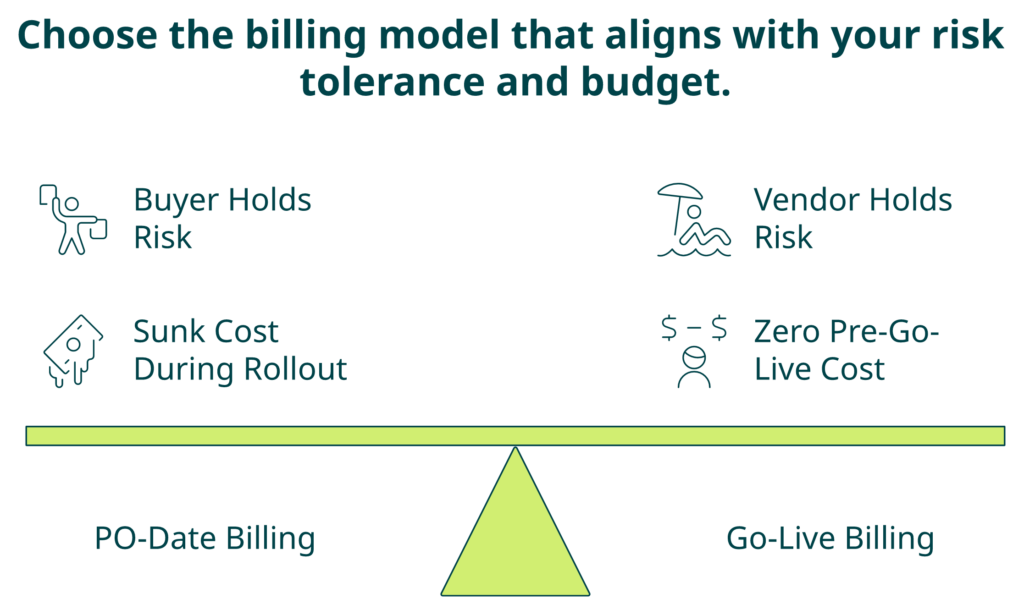
Most HR software vendors start billing your subscription from the Purchase Order date, not your go-live date. On a 4-month rollout for 300 employees at ₹150 PEPM, that is roughly ₹1.8 lakh of pure paying-for-air before a single employee logs in. On top of this, 12 hidden fees typically surface after signing, from data migration to renewal uplift.
The PO-Date Versus Go-Live Clock
When we shipped HROne’s first contracts in 2016, I made a decision that felt naive at the time. The subscription meter should start only after you go live. Not after the invoice, not after onboarding kickoff. After you are actually using the product in production.
Eight years later, it is still the minority position in Indian HRMS. Darwinbox, SAP SuccessFactors, and most legacy ERPs bill from the PO date. During a 120-day implementation, you pay full fees for partial value. That is a transfer of rollout risk from vendor to buyer, which is why we built go-live billing into our standard MSA.
The Math, Plain And Painful
Consider 300 employees at ₹150 PEPM, with a 4-month implementation.
- PO-date billing: 4 × ₹45,000 = ₹1,80,000 before go-live
- Go-live billing: ₹0 before go-live
For a 1,500-employee enterprise at ₹600 PEPM with a 6-month rollout, the number crosses ₹54 lakh of sunk cost before anyone punches attendance.
The 12-Item Hidden Fee Catalogue
These are the fees that ambush quotes in 2026. Every one of them is negotiable, and most are waivable with the right script (Q10). Our pricing transparency guide breaks each one down further.
| # | Fee | Typical Range (India) | What It Covers |
|---|---|---|---|
| 1 | Implementation fee | ₹50,000 to ₹12,00,000 | Setup, config, data load |
| 2 | Data migration | ₹30,000 to ₹3,00,000 | Historical attendance, payroll, documents |
| 3 | SSO add-on | ₹25,000 to ₹1,50,000/year | SAML, Okta, Azure AD integration |
| 4 | Premium support | 15 to 25% uplift on PEPM | Dedicated SPOC, phone, weekend cover |
| 5 | Renewal uplift | 5 to 15% annually | Year 2 and Year 3 price bumps |
| 6 | Multi-entity charges | ₹500 to ₹3,000 per OU/month | Per legal-entity charges |
| 7 | Statutory module | ₹20 to ₹60 PEPM | EPF, ESIC, PT, POSH, new wage code |
| 8 | Shelfware waste | 15 to 30% of licence | Modules you bought and never used |
| 9 | Sandbox environment | ₹50,000 to ₹2,00,000/year | UAT or staging instance |
| 10 | API overage | ₹2 to ₹10 per extra call | Beyond included quota |
| 11 | Training | ₹25,000 to ₹1,50,000 | HR and employee workshops |
| 12 | Exit-data fees | ₹50,000 to ₹5,00,000 | Historical data extract at cancellation |
The Annotated Quote Teardown
Here is a lightly disguised quote that landed in a CHRO’s inbox from a Tier-1 Indian HRMS vendor last year.
- ⚠️ Line 1. “Platform subscription, 500 employees at ₹220 PEPM, billable from PO date.” Red flag. Demand go-live billing.
- ⚠️ Line 2. “One-time implementation, ₹3,50,000, non-refundable.” Red flag. Demand milestone-linked refunds if go-live slips.
- ⚠️ Line 3. “Annual renewal uplift as per prevailing rates.” Red flag. Demand a 5 percent cap with CPI floor.
- ⚠️ Line 4. “Multi-entity setup fee ₹8,000 per OU.” Red flag. Ask for flat entity inclusion up to 10 OUs.
- ⚠️ Line 5. “Data extract on termination, ₹1,50,000.” Red flag. Demand free extraction rights in the MSA.
Two more voices that capture the contractual pain, from verified G2 reviews.
“Biggest issue is how much they have increased prices and continue to do so. They know that switching HRMS is painful. Every year is either a large price increase or our plan being sunsetted.”
— Josh A., BambooHR – G2 Verified Review
“Extremely expensive for what it delivers. Ferrari price, Trabant value.”
— Janka Z., SAP SuccessFactors HCM – G2 Verified Review
And on the other side, what go-live billing feels like in practice.
“The initial setup of HROne was surprisingly straightforward, much lighter than expected for a full HRMS.”
— Waldon S., HROne G2 – Verified Review
A Paste-Ready MSA Clause (Use It On Any Vendor)
“Subscription fees shall commence from the documented Go-Live Date, defined as the first day on which the Service is used in production for live payroll, attendance, or core HR transactions. Fees invoiced prior to this date shall be credited to the subscription term.”
My Founder-Led POV
I might be wrong about many things in this industry. I am not wrong about this. Go-live billing is the single cleanest alignment between vendor commitment and buyer outcome. It forces us to ship faster. MR DIY India went live in 30 days, and Pena4 Tech finished a 360-degree appraisal cycle for four companies in 15 days, both documented in our customer success stories. Slow rollouts die when the meter is off.
The Red-Flag Detector Checklist
Run every quote through these nine questions before signing.
- ⚠️ Does subscription start from PO date or go-live?
- ⚠️ Is the renewal uplift capped in writing?
- ⚠️ Are multi-legal-entity charges flat or per-OU?
- ⚠️ Are statutory updates included or billed separately?
- ⚠️ Is data extraction free at exit?
- ⚠️ Are AI SKUs opt-in or opt-out?
- ⚠️ What is the sandbox policy and cost?
- ⚠️ Is SSO included or an add-on?
- ⚠️ Is there a no-lock-in clause with a defined exit notice period?
If a vendor flinches on more than two of these, the contract is not a pricing problem. It is a trust problem. When you are ready, book a demo and we will walk through your current quote line by line.
See the scorecard applied to your shortlist
Get HROne’s line-item quote with go-live billing, renewal cap, and no lock-in already baked in.
Share your headcount, entities, and modules. We’ll return a 3-year TCO worksheet within 48 hours, not a sales pitch.
Request the transparent quote →Q5. How Much Does HRMS Implementation Really Cost Across 50, 300, And 1,000 Employees In India?
HRMS implementation in India costs ₹50,000 to ₹12,00,000 in 2026, depending on headcount, entities, and scope. A 50-employee SMB goes live in 2 to 6 weeks. A 300-employee mid-market firm takes 30 to 60 days. A 1,000+ enterprise takes 60 to 120 days. “Free implementation” is rarely free; it is usually subscription leakage in disguise.
The Situation: A Line Item Everyone Underestimates
SHRM India’s 2024 HR Tech Survey found that 61 percent of Indian HR leaders underestimate implementation cost by 30 percent or more. The number on the quote is not the number you pay. It is the number before scope creep, data cleanup, and integration delays.
Implementation is the moment pricing meets reality. Get it wrong, and the cheapest platform becomes the costliest. Our HRMS buyer checklist walks through the scoping questions we wish more buyers asked.
50 Employees: SMB Band
For a 50-employee single-entity firm, expect ₹50,000 to ₹1,50,000 for implementation, with a 2 to 6 week go-live. Scope usually covers Core HR, attendance, and payroll. No multi-entity, no complex integrations.
The risk is not cost. It is cutting corners on data migration that haunts you at first payroll. Budget 20 percent of implementation fees for clean historical data uploads alone, especially if you are setting up payroll for a startup for the first time.
300 Employees: The Mid-Market Complication
A 300-employee firm typically pays ₹2,00,000 to ₹5,00,000, with a 30 to 60 day go-live. MR DIY India went live in 30 days and compressed payroll cycles from 10 days to 5 to 6 days after moving to HROne.
The complication is always the same. Shift-based attendance, FBP (Flexible Benefit Plan) declarations, biometric sync across locations, and CTC restructuring per the new wage code. Vendors who quote ₹50,000 for this scope are either naive or setting up a change-order pipeline.
“HROne has helped us streamline attendance and payroll processes, as well as asset management. The Employee Satisfaction Survey feature is useful.”
— Kiran B., HROne G2 – Verified Review
1,000+ Employees: The Enterprise Resolution
A 1,000+ employee enterprise spends ₹6,00,000 to ₹12,00,000, with a 60 to 120 day go-live. Asia Healthcare Holdings runs 20 pan-India units on a single HROne instance with multi-legal-entity configuration, which is the test any core HCM should pass.
The resolution comes from workflow depth. We ship with 127 pre-built hire-to-retire workflows, and a prior-HR implementation SPOC who has run payroll themselves, not a project manager reading from a checklist. That is what a 9.8 NPS on support looks like in practice.
Why “Free Implementation” Costs The Most
Three reasons, and I have watched each of them play out.
❌ No accountability. When implementation is free, no one is on the hook for slipping go-live by 60 days.
❌ Subscription leakage. If your billing started on PO date (Q4), every free-implementation day is a paid day.
❌ Slower time-to-value. Free often means junior resources and generic configurations.
Here is a view of the competitor experience some buyers have described.
“Bad implementation experience, bad UI UX, configurations getting broken in production on its own due to product deployments, terrible customer service. Basically everything.”
— Verified User in Computer Software, Darwinbox – G2 Verified Review
The 1.3x Multiplier And The Time-To-Value Curve
Apply a 1.3x multiplier to every vendor-quoted implementation fee before you sign off. It covers scope creep, data cleanup, and the integration that was “included” but actually is not.
And remember the time-to-value math. A ₹6,00,000 implementation that goes live in 45 days beats a ₹2,00,000 one that takes 150 days, once you add subscription leakage, HR overtime, and delayed productivity.
Q6. The 2026 HR Software Pricing Index, Vendor, Size, Industry, And Geography Benchmarks
The 2026 HR Software Pricing Index aggregates PEPM benchmarks from 1,500+ HROne customer quotes, 14 vendor public pricing pages, and Gartner Digital Markets data. Global HRMS PEPM runs $4 to $40. India runs ₹45 to ₹1,800 effective PEPM. Industry, geography, and company size each shift the band by 20 to 60 percent. AI SKUs add another $2 to $8 PEPM on top.
Methodology
Sample size: 1,500+ Indian mid-market quotes (January 2025 to March 2026), 14 vendor published rate cards, and Gartner Digital Markets buyer reports. PEPM is effective, not list, which means it includes typical add-ons, support uplift, and first-year implementation amortised over 36 months. You can run your own scenario against our HR ROI calculator in parallel.
PEPM By Company Size (2026, USD + INR)
| Band | Employees | USD PEPM | INR PEPM (India) |
|---|---|---|---|
| Micro | 1 to 25 | $4 to $10 | ₹45 to ₹120 |
| SMB | 26 to 100 | $6 to $14 | ₹80 to ₹220 |
| Lower mid | 101 to 500 | $10 to $20 | ₹180 to ₹450 |
| Upper mid | 501 to 2,500 | $14 to $28 | ₹300 to ₹900 |
| Enterprise | 2,500+ | $20 to $40 | ₹600 to ₹1,800 |
PEPM By Industry
Industry shifts PEPM by 15 to 40 percent because of compliance weight, shift complexity, and workforce type.
- ⭐ IT and ITeS. $10 to $22 PEPM, ₹180 to ₹500 PEPM. (See our ITES HR deep dive.)
- ⭐ BFSI. $16 to $30 PEPM, ₹350 to ₹900 PEPM (audit-heavy).
- ⭐ Manufacturing. $12 to $25 PEPM, ₹220 to ₹700 PEPM (shift-based, multi-unit).
- ⭐ Healthcare. $14 to $28 PEPM, ₹300 to ₹800 PEPM (24×7, licensure tracking).
- ⭐ Retail. $8 to $18 PEPM, ₹150 to ₹400 PEPM (high turnover).
- ⭐ Professional services. $10 to $24 PEPM, ₹180 to ₹550 PEPM.
PEPM By Geography
| Region | PEPM (USD) | Notes |
|---|---|---|
| US | $10 to $40 | Highest, benefits complexity |
| EU | €8 to €32 | GDPR overhead |
| UK | £6 to £25 | PAYE-tuned |
| APAC | $6 to $22 | Wide spread |
| India | $1.5 to $22 | ₹45 to ₹1,800 |
| LATAM | $5 to $18 | Payroll-heavy |
2026 Vendor Pricing Table (15 Vendors)
| # | Vendor | Category | Indicative PEPM | Pricing Model |
|---|---|---|---|---|
| 1 | HROne | India HCM | ₹85 to ₹600 PEPM | Flat PEPM, go-live billing, no lock-in |
| 2 | Keka | India HRMS | ₹95 to ₹400 PEPM | Tiered |
| 3 | Darwinbox | Enterprise HCM | ₹350 to ₹1,200 PEPM | Tiered, PO-date billing |
| 4 | greytHR | SMB payroll | ₹45 to ₹180 PEPM | Tiered |
| 5 | Zoho People | Global SMB | $1.5 to $10 PEPM | Tiered |
| 6 | Rippling | Global HCM | $8 to $29 PEPM | Modular |
| 7 | BambooHR | SMB HRIS | $6 to $16 PEPM | Tiered |
| 8 | Workday | Enterprise | $20 to $45 PEPM | Custom |
| 9 | Gusto | US SMB payroll | $40 flat + $6 PEPM | Flat + PEPM |
| 10 | Paycor | US mid-market | $10 to $25 PEPM | Tiered |
| 11 | ADP Workforce Now | US mid-enterprise | $12 to $30 PEPM | Custom |
| 12 | UKG Ready | Mid-enterprise | $15 to $35 PEPM | Custom |
| 13 | HiBob | Mid-market | $10 to $22 PEPM | Tiered |
| 14 | Personio | EU mid-market | €8 to €18 PEPM | Tiered |
| 15 | Deel (EOR only) | Global EOR | $599 EOR, $49 contractor | Per employee |
Four Deep Dives
- ⭐ HROne. Flat PEPM HCM for 100 to 5,000 employee Indian firms. Subscription starts at go-live, with no lock-in. 127 hire-to-retire workflows. 1,500+ brands live (see customer success stories).
- ⭐ Rippling. $8 to $29 PEPM modular. Strong for US-headquartered firms with global payroll needs.
- ⭐ Deel. EOR at $599 per employee per month, contractor at $49 per month. Not an HRMS replacement.
- ⭐ Workday. Enterprise-only, quoted custom. Typical 12 to 24 month implementation. Over-engineered for the 100 to 5,000 employee Indian sweet spot.
- ⭐ BambooHR. SMB positioning, with steep yearly renewal uplifts flagged by users.
“Biggest issue is how much they have increased prices and continue to do so. They know that switching HRMS is painful.”
— Josh A., BambooHR – G2 Verified Review
AI-Feature Premium Decomposition
Most vendors now charge an AI add-on of $2 to $8 PEPM, or ₹30 to ₹120 PEPM in India. Split into three buckets:
✅ Worth it. Resume relevancy scoring, payroll anomaly detection, and receipt parser.
⚠️ Conditional. Predictive attrition and goal generation.
❌ AI-washed. FAQ chatbots rebranded as “HR copilots”, “AI leave approval”, and “AI org chart”.
We bundle the One AI Suite inside HROne’s HCM, not as a separate SKU. I might be biased here, but unbundling AI into a paid tier feels like charging for spellcheck.
Q7. How Do You Calculate The True 3-Year TCO And ROI For HRMS, With A Worked Indian Mid-Market Example?
True 3-year TCO for HRMS in India uses the formula TCO = Purchase + (Opex × t). Gartner data shows licence fees are under 40 percent of the full 5-year spend; services, integrations, and change management account for the remaining 60 percent. Nucleus Research benchmarks ROI at $9.21 returned for every $1 spent on modern HCM.
The Seven TCO Components
Any 3-year TCO worksheet should price each of these.
- 💰 Licence or subscription (PEPM × headcount × months).
- 💰 Implementation (one-time, 1.3x the vendor quote).
- 💰 Integrations (ERP, biometric, BGV, and LMS).
- 💰 Change management (training, adoption).
- 💰 Support uplift (basic to premium).
- 💰 Renewal uplift (Year 2, Year 3).
- 💸 Exit cost (data extract, re-implementation).
Worked 3-Year Example: 300-Employee Indian Mid-Market
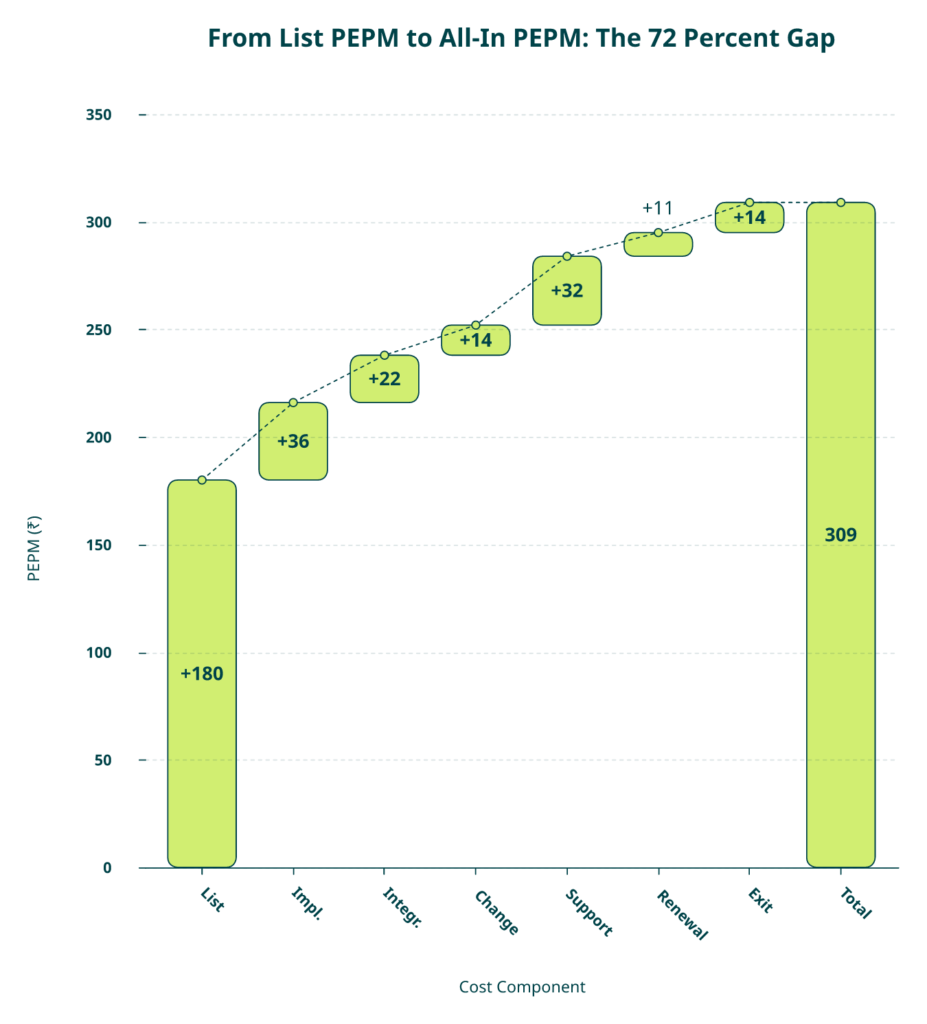
Assume 300 employees, ₹180 effective PEPM, 36 months, 3 integrations, and premium support.
| Component | Amount (INR) |
|---|---|
| Subscription (300 × ₹180 × 36) | ₹19,44,000 |
| Implementation (1.3x ₹3,00,000) | ₹3,90,000 |
| Integrations (3 × ₹80,000) | ₹2,40,000 |
| Change management and training | ₹1,50,000 |
| Premium support uplift (18%) | ₹3,49,920 |
| Renewal uplift (Y2 7%, Y3 7%) | ₹1,20,000 |
| Exit provision | ₹1,50,000 |
| Total 3-year TCO | ₹33,43,920 |
| Effective cost per employee over 3 years | ₹11,146 |
| Effective PEPM (all-in) | ₹309 |
List PEPM was ₹180. All-in PEPM is ₹309. That 72 percent gap is where most board approvals go wrong, which is why we encourage CFOs to model it through our CXO solutions framework.
Payback Period
Most Indian mid-market HRMS implementations pay back in 8 to 14 months. Drivers:
- ⏰ Payroll cycle compression (10 days to 5 to 6 days at MR DIY India).
- ⏰ HR query deflection (60 to 70 percent drop with self-service).
- ⏰ Expense fraud reduction via AI-powered receipt parsing.
- ⏰ Appraisal compression to 15 days at Pena4 Tech with automated bell curves.
ROI By Module
Not every module pays back equally.
- ✅ Payroll. Highest ROI; accuracy insurance and cycle compression.
- ✅ Performance. Strong; bell curves and goal tracking save weeks.
- ⭐ LMS. Medium; depends on training volume.
- ⭐ Recruiting. Medium to high; AI resume stacking pays back if you hire more than 50 roles a year.
Build Versus Buy Versus Bundle
I have seen exactly one Indian mid-market firm succeed at building HR software in-house in ten years. Do not try it.
The real choice is buy point tools versus bundle a suite. A 300-seat Frankenstein stack (outsourced payroll, biometric, ATS, and Excel performance) typically costs ₹14 to ₹22 lakh per year in visible fees, plus a 15 percent hidden coordination tax. A suite closes the gap to ₹10 to ₹16 lakh per year, with one vendor relationship.
The Adoption Debt Layer
The hidden line item is Adoption Debt. It is the productivity tax paid when HR juggles tabs and chases approvals over email. We built India’s first inbuilt ROI Dashboard inside HROne to surface this, converting lifetime hours saved into rupee equivalents against average HR salary. When CHROs walk into board reviews with a ballpark number already computed, the conversation changes.
Q8. What Should “AI-Powered” HR Features Cost In 2026, And Which SKUs Are Worth The Premium?
In 2026, AI HR add-ons cost $2 to $8 PEPM globally, or ₹30 to ₹120 PEPM in India. Deloitte’s 2025 Global Human Capital Trends found 74 percent of organisations rank integrated AI as a top selection criterion, but only 22 percent actually budget for AI upcharges. That 52-point gap is where “AI tax” enters quotes quietly.
The Four AI SKUs That Actually Pay Back
Not all AI HR features deserve a premium. These four consistently do.
- ✅ Resume relevancy scoring. Stacks CVs by fit, not keyword count. Cuts screening time 50 to 70 percent on high-volume roles.
- ✅ Payroll anomaly detection. Flags outliers before disbursement. Prevents 3.2 percent of HR budget leaked to payroll errors.
- ✅ Predictive attrition. Surfaces flight-risk signals 60 to 90 days before resignation.
- ✅ Goal generation and resumé-to-JD matching. Saves managers 2 to 4 hours per cycle.
The AI-Washed SKUs To Refuse
Working with 2,000+ HR teams, what I have felt is that the AI label is being slapped on old rule-based features to justify price increases. Be specific about what you are refusing, and read our AI in HR hype vs reality piece before signing anything.
❌ FAQ chatbots marketed as “HR copilots”. If the answer library is 200 FAQs, it is not AI.
❌ “AI leave approval”. Rule-based leave workflows with a lick of paint.
❌ “AI org chart”. A tree diagram with a query box.
❌ Generic HR chat. Ask for the model, the grounding data, and the accuracy benchmark. No answers means no SKU.
The 2026 AI-Agent Pricing Shift
Vendors are moving from PEPM AI add-ons to per-task or per-workflow pricing. This sounds attractive for low-volume teams. It punishes during growth spurts. NASSCOM-Zinnov 2025 estimated agent-based pricing to take 15 percent of new Indian mid-market contracts by 2027.
My advice: negotiate a monthly cap on per-task charges, or refuse the model and stick to bundled AI.
Vendor AI Positioning In India
- ⭐ HROne One AI Suite. Bundled, not a separate SKU. Includes resume relevancy, receipt parser, AI Employee Agent, JD, and interview generators.
- ⭐ Keka. AI hiring assistant; add-on pricing.
- ⭐ Darwinbox. AI Sense copilot; enterprise tier bundled.
- ⭐ Zoho People. Zia AI assistant; tier-gated.
The Paste-Ready RFP Question
Before you sign, demand this in writing from every vendor:
“For each AI feature, itemise: (a) the underlying model family, (b) the data source used for grounding, (c) the unit economics (PEPM, per-task, or bundled), (d) an accuracy benchmark on an Indian HR dataset, and (e) the opt-out terms.”
Vendors that cannot answer (a) through (e) are charging you for marketing, not machine learning.
What I Actually Believe About HR AI Pricing
I might be wrong here, but I think the AI add-on as a separate SKU dies by 2028. It becomes table stakes, like mobile apps did in 2018. The vendors pricing AI as a premium today are front-loading margin before the market rebases. Budget accordingly.
Model your TCO before the next vendor call
Run a 3-year TCO scenario for your HRMS shortlist in under 10 minutes.
Plug headcount, PEPM, and implementation into HROne’s ROI Dashboard. We’ll show you the all-in PEPM, payback month, and rupee value of hours saved.
Open the ROI calculator →Q9. What Does A “No Lock-In, Go-Live Billing, And Pricing Transparency” Vendor Actually Look Like, And How Do You Score Them?
A “no lock-in” HRMS vendor is one that gives you 30 to 60 days exit notice, free data extraction, capped renewal uplifts, and subscription billing that starts only at go-live. In 2026, fewer than 20 percent of Indian HRMS contracts include all four. Use the 7-criteria HRMS Transparency Scorecard below to filter your shortlist before you ever schedule a demo.
The Four Pillars Of A Transparent HRMS Contract
- ✅ Go-live billing. Subscription meter starts when you go live, not when you sign the PO.
- ✅ No lock-in. 30 to 60 days written exit notice, with no termination penalty.
- ✅ Free data extraction. Full historical data export at exit, in usable formats (CSV, Excel, API).
- ✅ Capped renewal uplift. Year-on-year price increase capped at 5 to 7 percent, in writing.
If a vendor cannot commit to all four in the MSA, the pricing conversation is already a trust problem. Our pricing transparency guide goes deeper on why these clauses matter more than the headline PEPM.
The 7-Criteria HRMS Transparency Scorecard
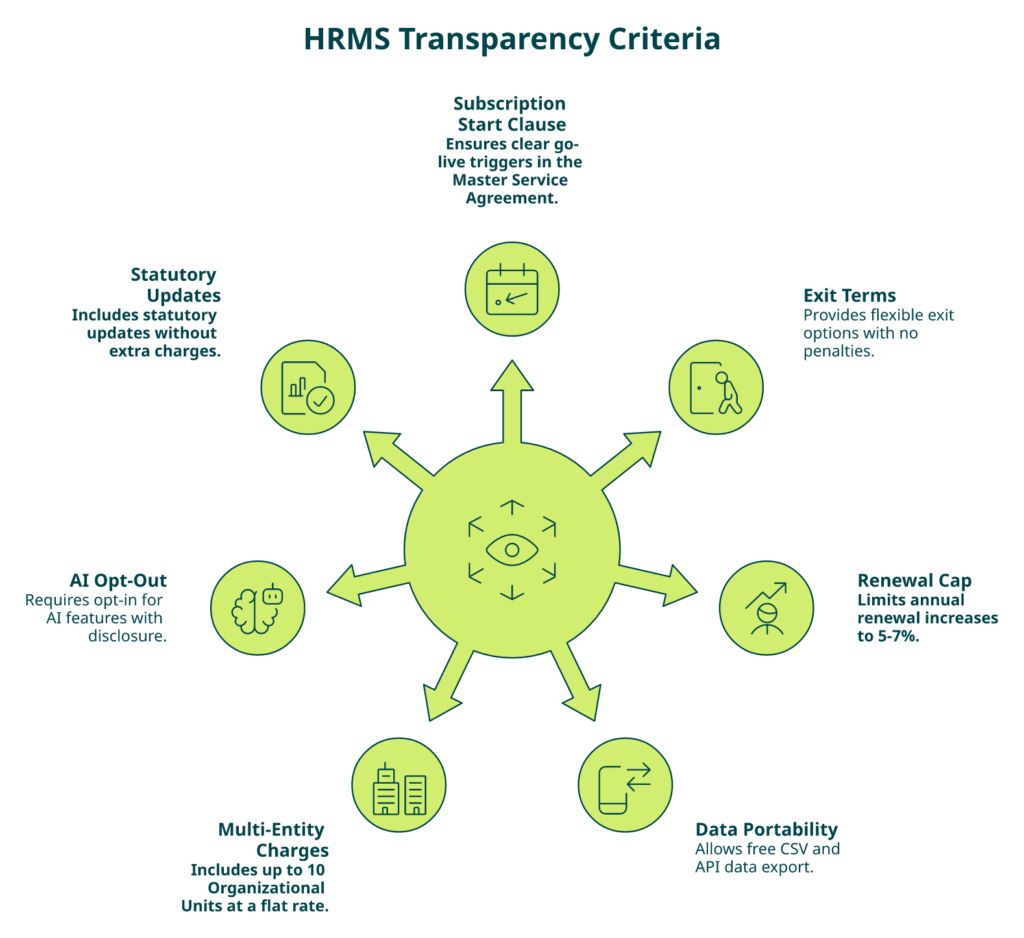
Score each vendor on a 1 to 10 scale across these seven criteria. Anyone scoring below 50 out of 70 is a high-risk signature, regardless of the demo theatrics.
| # | Criterion | What Full Marks Looks Like |
|---|---|---|
| 1 | Subscription start clause | Go-live trigger in MSA |
| 2 | Exit terms | 30 to 60 days notice, no penalty |
| 3 | Renewal cap | 5 to 7% Y-o-Y, in writing |
| 4 | Data portability | Free, CSV/API, no exit fee |
| 5 | Multi-entity charges | Flat inclusion up to 10 OUs |
| 6 | AI opt-out | Opt-in only, 60-day disclosure |
| 7 | Statutory updates included | No separate billing |
Why HROne Built Go-Live Billing And No Lock-In Into The Standard MSA
I will tell you the honest origin story. When we launched, three large prospects walked away in the same quarter because they had been burnt by PO-date billing elsewhere. The pattern was identical: 4 to 6 months of paid air, slipping go-lives, and renewal uplifts that doubled by Year 3.
We made a simple call. If we are confident enough to promise go-live within 90 days, we should be confident enough to bill from go-live. Why HROne remains a one-pager because the answer is operational, not poetic.
“HROne is a great product that has helped streamline HR operations for many MSMEs in India. The product is easy to use and constantly evolves to meet the changing demands of users.”
— Sumit J., HROne G2 – Verified Review
The Three Red Flags Hidden In “Standard” MSAs
Three clauses that almost always favour the vendor, and almost always get signed without negotiation.
⚠️ “Auto-renewal unless 90 days notice.” Push to 30 days, with email notice valid.
⚠️ “Annual uplift as per prevailing rates.” Replace with a fixed 5 to 7 percent cap.
⚠️ “Data export billable at vendor’s then-prevailing rates.” Replace with free export, in CSV and API formats, for 90 days post-termination.
What This Looks Like For A CFO
The Transparency Scorecard is also a board-ready risk filter. It converts vendor selection from “lowest PEPM” to “lowest risk-adjusted TCO”. For CFOs at 2,000-employee plus firms, this single document has shortened HRMS approval cycles from 14 weeks to 6 weeks, in our experience.
Q10. How Do You Negotiate Your HR Software Contract, And What Are The Paste-Ready 2026 Scripts For PEPM, AI, And Renewal Clauses?
The strongest HRMS negotiations move on five fronts: price, renewal cap, AI scope, exit terms, and integration inclusions. In 2026, every line of a vendor quote is negotiable. Below are the seven paste-ready scripts I have watched work across 1,500+ HROne customer negotiations and competitor bake-offs.
Before You Negotiate, Establish Three Anchors
- 📌 Your walk-away PEPM, derived from Q2 and Q6 benchmarks.
- 📌 Your 3-year TCO ceiling, derived from Q7’s worksheet.
- 📌 Your BATNA (Best Alternative). A real second vendor with a quote in hand, not a name.
Without these anchors, you are negotiating in the dark. With them, the vendor is.
Script 1: The PEPM Anchor
“Your quote of ₹[X] PEPM is 22 percent above our internal benchmark for [size band] [industry] firms in India, sourced from Gartner Digital Markets and 1,500-quote datasets. We need to land at ₹[Y] PEPM, all-inclusive, for a 36-month term. Can you confirm this is workable, or should we move the conversation to your two named competitors?”
Script 2: The 5 Percent Renewal Cap
“We are willing to commit to 36 months at this rate, on the condition that Years 2 and 3 renewals are contractually capped at 5 percent year-on-year, irrespective of list price changes. Please include this in the MSA as Section [X].”
Script 3: AI Opt-In, Not Opt-Out
“All AI features shall be opt-in only. New AI SKUs introduced during the contract term shall not be billable unless Customer provides written acceptance. Vendor shall disclose unit economics 60 days before activation.”
Script 4: Go-Live Billing Trigger
“Subscription fees commence from the Go-Live Date, defined as the first day on which the Service is used in production for live payroll, attendance, or core HR transactions. Fees invoiced prior to this date shall be credited to the subscription term.”
Script 5: Flat Multi-Entity Inclusion
“Customer shall be entitled to configure up to 10 legal entities/organisational units at no additional per-OU charge. Additional OUs beyond 10 shall be billable at ₹[Z] per OU per month, capped at ₹[W].”
Script 6: Free Exit Data Extraction
“Upon termination for any reason, Vendor shall provide Customer’s full historical data, including employee records, payroll runs, attendance logs, and documents, in CSV and API formats, free of charge, within 30 days of written request. This right shall survive contract termination for 90 days.”
Script 7: Statutory Updates Included
“All statutory compliance updates required by Indian law (EPF, ESIC, PT, new wage code, POSH, and others) shall be included in the base subscription. No separate billing shall apply for regulatory changes during the contract term.”
For India-specific clauses, statutory compliance in payroll is the single fastest way to validate whether a vendor has the depth to honour Script 7 without scope creep.
The Eight Negotiation Tactics That Actually Move The Number
🎯 Multi-year commit. 36-month signature unlocks 10 to 20 percent discount.
🎯 Quarter-end timing. Vendor sales teams have quotas; March and December are softest months in India.
🎯 BATNA visibility. Share that you are evaluating two named alternatives.
🎯 Reference call commitment. Offer to be a public reference for a 5 to 8 percent discount.
🎯 Case study consent. Allow vendor to publish your name, for 3 to 5 percent off.
🎯 Volume commitments. If you are growing, lock pricing for the higher band today.
🎯 Annual prepay. Some vendors offer 5 to 10 percent for annual upfront.
🎯 Module unbundling. Drop the modules you will not use in Year 1.
The MSA Red-Flag Checklist
Run every MSA through these nine checks. Each “no” is a negotiation lever.
☑️ Is go-live billing in writing?
☑️ Is the renewal cap fixed and contractual?
☑️ Is exit notice 30 to 60 days, with no penalty?
☑️ Is data extraction free?
☑️ Are multi-entity charges flat?
☑️ Are AI features opt-in?
☑️ Are statutory updates included?
☑️ Is SSO included?
☑️ Is there a sandbox at no extra cost?
One Voice On Implementation Discipline
“HROne is super easy to navigate and use. From employee onboarding to performance tracking, it covers a lot of ground without making things complicated. I also appreciate how customer support is quick and helpful whenever issues arise.”
— Akshay J., HROne G2 – Verified Review
And here is what the absence of negotiation discipline looks like, from a verified Workday review.
“The pricing model is opaque, the implementation timeline runs long, and the renewal uplift is non-negotiable once you are dependent on the platform.”
— Verified User, SAP SuccessFactors HCM – G2 Verified Review
What I actually do In A Negotiation Room?
I will say one quiet thing out loud. I have never lost a customer because we held the line on go-live billing or renewal caps. I have lost them because we tried to be all things to all buyers. Stand on your scorecard. Stand on your TCO. The right vendor will meet you there.
Q11. What Are The 2026 HR Software Pricing Trends Reshaping How You Buy Next Year?
Three forces are bending 2026 HR software pricing curves. Outcome-based pricing is moving from niche to roughly 15 percent of new mid-market Indian contracts by 2027. AI-agent meters are appearing at ₹15 to ₹80 per task with no ceilings. And the bundled suite versus best-of-breed gap is widening to ₹4 to 8 lakh per year for a 300-seat Indian firm. Lock pricing this year, keep AI scope fluid, and refuse uncapped per-agent meters.
Why This Year Matters More Than Last
The 2024 to 2025 window was the last period HR buyers could sign flat PEPM contracts without AI surcharges baked in. Most 2026 quotes I have reviewed now carry an “AI platform fee” of ₹30 to ₹90 PEPM on top of base HCM. Vendors are moving the goalposts, quarter by quarter.
If you are renewing in 2027, the 2026 clause you sign today decides how protected you are. The same dynamic plays out in manufacturing HR and BFSI deployments, where shift complexity already inflates effective PEPM.
Trend 1: Outcome-Based And Consumption Pricing
Outcome-based pricing meters by result. Per payroll run (typically ₹8 to ₹25 per employee per run), per successful hire (₹3,500 to ₹12,000), or per onboarded employee (₹1,200 to ₹4,000). NASSCOM-Zinnov 2025 projects this model will take 15 percent of new Indian mid-market HRMS contracts by 2027.
- ✅ Where it works. Stable-volume firms (professional services, stable BFSI back-offices).
- ❌ Where it hurts. Growth-stage tech firms hiring 30+ per month, or seasonal manufacturing.
- ⭐ My advice. Pilot it for recruitment only, where volume is bounded and measurable, and pair it with a structured data-driven hiring motion.
Trend 2: AI-Agent Pricing Proliferation
Per-task, per-workflow, and per-decision meters are the fastest-growing pricing innovation of 2026. A CV-parsing agent at ₹15 per resume. An onboarding agent at ₹80 per new hire. A payroll anomaly agent at ₹500 per anomaly flagged.
“Keka is not built to service IT consulting firms. TAT on customer request on features is bad.”
— Verified User in Consulting, Keka – G2 Verified Review
When vendors cannot resolve a ticket in 48 hours, the idea that they will govern AI-agent billing accurately at month-end is optimistic. Our take on AI in HR hype vs reality walks through which agents earn their meter, and which do not.
❌ Refuse. Per-decision meters with no monthly cap.
⚠️ Conditional. Per-task meters with a hard monthly ceiling of 1.5x historical volume.
✅ Accept. Bundled AI inside the base HCM, with unlimited use.
Trend 3: Bundled Suite Versus Best-Of-Breed
For a 300-seat Indian mid-market firm, the cost gap is now material.
| Stack | Annual Cost | Hidden Coordination Tax |
|---|---|---|
| Frankenstein (payroll outsourced + biometric + ATS + Excel) | ₹14 to ₹22 lakh | 15% month-end reconciliation |
| Single HCM suite | ₹10 to ₹16 lakh | Near zero |
That is a ₹4 to ₹8 lakh per year swing, before counting fraud leakage and CHRO time lost to PowerPoint reconciliation. Buyers running a multi-vendor stack should also factor the integration tax we cover under HROne integrations.
“HROne simplifies my HR management by providing an easy, intuitive UI and readily available information, making it simple to manage leaves and attendance. It offers full visibility of my teams details in one place.”
— Naman G., HROne G2 – Verified Review
A Paste – Ready 2027 Renewal Clause
“For the first 36 months of the Agreement, Vendor shall not introduce new mandatory AI platform fees, AI-agent usage charges, or consumption-based surcharges without Customer’s prior written consent. Any such features shall be opt-in, with transparent unit economics disclosed 60 days before activation.”
What This Means For Your 2027 Renewal Cycle
- ⭐ Lock now. 36-month PEPM with a 5 percent renewal cap and the AI clause above.
- ⭐ Keep fluid. AI module scope, per-agent pricing, and integration counts.
- ⭐ Watch. Outcome-based pilots from 2 or 3 vendors as comparative data.
Working with 2,000+ HR teams, what I have felt is that the buyers who locked flat PEPM in 2024 are sleeping well in 2026. The AI SKU waves are coming for everyone else.
Q12. Which HRMS Fits Each Buyer Persona, And How Do You Apply The 5-Step Decision Framework?
Five Indian HRMS buyer personas dominate the 100 to 5,000 employee market, and each one has a different right answer. The 5-Step Decision Framework, Scope, Score, Stress-test, Sign, Steer, gives you a repeatable path from quote to go-live without buying the wrong tool for your reality.
The Five Personas
- 👤 The Frustrated CHRO. 800 to 2,500 employees, multi-entity, board-level cost pressure. Needs CHRO-grade HCM with ROI Dashboard.
- 👤 The Growing Mid-Market Founder. 100 to 500 employees, scaling 30 percent annually. Needs flat PEPM, no lock-in, and fast go-live.
- 👤 The Payroll Manager. 300 to 1,500 employees, monthly payroll pain. Needs depth on FBP, FFS, and the new wage code through dedicated payroll software.
- 👤 The IT Head. Cross-cutting role at 500+ employees. Needs SSO, API depth, and clean integration with ERP and biometric.
- 👤 The CFO. Cost approver. Needs 3-year TCO, payback, and contractual safeguards.
Persona-To-Solution Mapping
| Persona | Right HRMS Category | Effective PEPM Range (India) |
|---|---|---|
| CHRO (800 to 2,500) | Flat PEPM HCM, multi-entity | ₹350 to ₹900 |
| Growing founder (100 to 500) | PEPM HRMS, no lock-in | ₹180 to ₹450 |
| Payroll manager (300 to 1,500) | Payroll-deep HRMS | ₹220 to ₹600 |
| IT head (500+) | API-first HCM with SSO | ₹300 to ₹800 |
| CFO (cost approver) | Transparent PEPM, capped renewal | As above + ROI Dashboard |
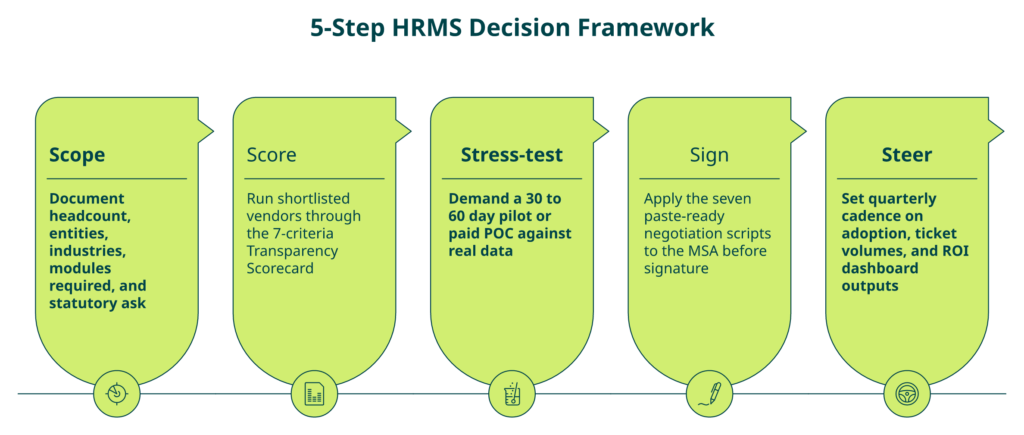
The 5-Step Decision Framework
- 📐 Scope. Document headcount, entities, industries, modules required, and statutory ask. Use our HRIS HRMS checklist as a starting template.
- 📊 Score. Run every shortlisted vendor through the 7-criteria Transparency Scorecard from Q9.
- 🔬 Stress-test. Demand a 30 to 60 day pilot or a paid POC against your actual data, not vendor demo data.
- ✍️ Sign. Apply the 7 negotiation scripts from Q10 to the MSA before signature.
- 🚀 Steer. Set quarterly review cadence on adoption, ticket volumes, and ROI Dashboard outputs.
Worked Persona Examples
The Frustrated CHRO at Asia Healthcare Holdings runs 20 pan-India units on one HROne instance, with multi-legal-entity configuration and zero per-OU charges. The Growing Mid-Market Founder at MR DIY India went live in 30 days. The Payroll Manager at MR DIY compressed payroll cycles from 10 days to 5 to 6 days. Each persona, each pain, one platform.
“HROne is super easy to use and helps streamline HR tasks like attendance, leaves, payroll, and employee data in one place. Customer support is also pretty responsive whenever there’s an issue.”
— Rahul Kumar M., HROne G2 – Verified Review
The Common Buyer Mistakes To Avoid
- ⚠️ Buying for today’s headcount. 24-month growth always exceeds plan; price for the higher band today.
- ⚠️ Optimising for lowest PEPM. All-in PEPM (Q7) is the real number.
- ⚠️ Skipping the POC. Demos lie. Pilots don’t.
- ⚠️ Ignoring the exit clause. Lock-in becomes obvious only on renewal day.
- ⚠️ Bundling AI without scope. AI without grounded data is decoration.
The Final Sentence I Want CHROs To Hear
Buy for the operating reality you will live with, not the demo you watched. The right HRMS makes your Monday quieter, your month-end faster, and your board reviews shorter. Everything else is theatre.
Match your persona to the right HRMS in 48 hours
Get a persona-fit recommendation, a 3-year TCO, and a paste-ready MSA scorecard from HROne.
Share your headcount, entities, and top three pains. We will return a tailored quote with go-live billing, capped renewal, and no lock-in baked in.
Book your HROne demo →Official Docs / Indian Statutes
- Ministry of Labour and Employment, Government of India, “Code on Wages 2019,” Notification dated 8 August 2019.
Datasets
- HROne Customer Success Desk. “Multi-entity deployment data from 1,500+ go-lives,” internal dataset, Q1 2026.
- HROne Customer Success Desk. “Implementation benchmarks from 1,500+ Indian go-lives,” internal dataset, Q1 2026.
- HROne Customer Case Studies. “MR DIY India and Pena4 Tech outcomes,” 2024-2025.
- HROne Customer Case Studies. “MR DIY India, Pena4 Tech, and Asia Healthcare Holdings outcomes,” 2024-2025.
- HROne Customer Interviews. “Customer Interviews,” 2024-2026.
- HROne Product Documentation and G2 Customer Reviews. “HROne G2 Reviews,” 2025-2026.
- Vendor Public Pricing Pages and G2 Review Aggregation. “HR Management Suites Category,” March 2026.
Blogs
- Gartner Digital Markets. “2025 HR Software Buyer Trends.” Published: 2025.
- Nucleus Research. “HCM Technology Value Matrix, 2025 edition.” Published: 2025.
- NASSCOM-Zinnov. “India SaaS Report 2025: Enterprise Adoption and Pricing Shifts.” Published: 2025.
- Gartner. “Magic Quadrant for Cloud HCM Suites for 1,000+ Employee Enterprises.” Published: 2025.
- SHRM India. “2024 HR Technology Adoption Survey.” Published: 2024.
- Deloitte. “2025 Global Human Capital Trends Report.” Published: 2025.
- Nucleus Research. “HR Payroll Error Cost Study.” Published: 2024.
















 Secures Top Spot in
