








Q1. How Is greytHR Priced in India in 2026, Base, PEPM, SMP, and GST Decoded?
In 2026, greytHR sells three published plans in India: Essential at ₹2,495 per month base, Growth at ₹4,495 per month base, and Premium on a custom quote, with a Starter tier that stays free for up to 25 employees. Each paid plan bundles 50 seats into the base and then charges Per Employee Per Month, or PEPM, above 50. Add 18% GST on top of everything.
The four-tier snapshot you can copy into a budget email
A payroll manager at a 600-person Pune IT firm once told me she kept three browser tabs open just to price greytHR for her CFO. You shouldn’t have to. Here is the 2026 price sheet, straight from greytHR’s own pricing page.
| Plan | Base price (₹/month) | Included seats | PEPM above base | Best-fit headcount |
|---|---|---|---|---|
| Starter | Free | ≤25 employees | None | Micro teams, 7-day trial |
| Essential | ₹2,495 | 50 | ₹45 | 25 to 120, payroll-led |
| Growth | ₹4,495 | 50 | ₹85 | 120 to 500, attendance-heavy |
| Premium | Custom | 50 | Custom | 500+, multi-entity |
The Standard Minimum Price, or SMP, is greytHR’s term for that bundled 50-seat slab. You pay the full base even if you have only 28 active employees. That detail decides whether Essential is a bargain or a silent tax. Before you compare, check HROne’s transparent pricing on the same model.
Worked example at 50 employees on Essential
- Base: ₹2,495 (covers all 50 seats under SMP).
- PEPM add: ₹0 (you are at the slab ceiling).
- Subtotal: ₹2,495.
- GST at 18%: ₹449.
- Effective monthly: ₹2,944.
- Effective per-employee: ₹58.88/month.
Now push the same company to 100 employees on Essential. You pay ₹2,495 base, plus 50 additional seats at ₹45, plus GST. That lands at ₹4,745 plus ₹854 GST, equal to ₹5,599/month, or ₹55.99 per employee. The per-head cost dips because the base is amortised across more people. For deeper context on how transparency matters, see this piece on HR software pricing transparency.
⚠️ Three billing details that quietly inflate the quote
- GST always applies. Every SaaS invoice in India carries 18% IGST or CGST+SGST. Budget it separately, because sales reps often quote pre-GST.
- Annual prepay, typical 10 to 20% discount. greytHR confirms that annual subscription is available and that there is no lock-in or cancellation fee, but unused credit on a prepaid year is not refunded if you exit early. Prepay only if you are sure of the fit.
- The SMP floor stays painful under 50 employees. A 30-person BFSI startup still pays the full ₹2,495 Essential base. At that scale, Starter’s free ≤25 seats or a PEPM-only competitor often reads cheaper.
The upside: greytHR’s pay-per-use model means you can upgrade, downgrade, or cancel month-to-month without penalty. That flexibility is rare among Indian HRMS vendors and deserves credit.
My current thinking: treat the published ₹2,495 and ₹4,495 as entry prices, not final prices. The true 2026 cost lands after add-ons, GST, and headcount growth. The next question shows exactly how that math moves as you scale past 100, 250, 500, and 1,000 employees.
Q2. What Will greytHR Actually Cost My Company at 50, 100, 250, 500, and 1,000 Employees?
A 100-employee team on Essential pays roughly ₹5,600 per month including GST; 250 employees on Growth lands near ₹25,900 per month; 500 employees on Growth crosses ₹50,000 per month; and 1,000 employees almost always moves to a Premium custom quote. These are pre-add-on numbers, so plan for 15 to 25% on top once Performance, Expense, or SSO enter the cart.
📋 Assumptions behind the math
Before the table, here is the method so you can pressure-test each number yourself.
- Source of base and PEPM: greytHR’s public pricing page, 2026
- PEPM bands used: Essential ₹45, Growth ₹85, Premium assumed at ₹100 (market-observed for custom quotes).
- SMP slab: 50 seats included in base for Essential and Growth
- GST: flat 18% on the full subscription.
- Annual uplift: 0% in Year 1, 8% renewal uplift from Year 2 (mid-market India SaaS norm)
- No add-ons modelled here; those come in Q4.
💰 Worked examples across five headcount bands
| Headcount | Recommended plan | Base + PEPM (₹/mo) | GST 18% | Year-1 monthly effective | 3-year TCO (with 8% uplift) |
|---|---|---|---|---|---|
| 50 | Essential | ₹2,495 | ₹449 | ₹2,944 | ₹1,14,585 |
| 100 | Essential | ₹4,745 | ₹854 | ₹5,599 | ₹2,17,908 |
| 250 | Growth | ₹21,495 | ₹3,869 | ₹25,364 | ₹9,87,155 |
| 500 | Growth | ₹42,745 | ₹7,694 | ₹50,439 | ₹19,62,897 |
| 1,000 | Premium (custom) | ~₹1,00,000 est. | ₹18,000 | ~₹1,18,000 | ~₹45,90,000 |
The 1,000-employee row is an estimate, because Premium is quoted case-by-case and depends on modules included. Treat it as a planning anchor, not a contractual number.
Effective per-employee cost at 6 and 12 months
The honest metric for a CFO is not PEPM; it is effective cost per employee per month, or eCPEm, after base, GST, and time in contract. The formula is simple.
eCPEm = ((Base + (Headcount minus 50) × PEPM) × 1.18) ÷ Headcount
At 100 employees on Essential, eCPEm is ₹55.99. At 250 on Growth, eCPEm is ₹101.45. At 500 on Growth, it drops to ₹100.87 because the base dilutes. The number stabilises around ₹100 on Growth past 250 employees, which is the point where most buyers start asking whether Premium, a competitor, or a flat-PEPM vendor makes more sense. You can cross-check with HROne’s ROI calculator on your own numbers.
📊 Run your own numbers before the demo call
Screenshots and averages only take you so far. A live TCO calculator that accepts your headcount, growth plan, add-on picks, GST state, and contract term will always beat a static table. Embedding one on the page lets a 300-person logistics HR head see her 3-year number in under 30 seconds, which is closer to how buying decisions actually get made in 2026.
The pattern I keep seeing across 2,000+ HR teams: the 250 to 500 band is where greytHR’s PEPM curve starts to bite. That is also the band where an integrated, flat-PEPM core HCM pays back fastest, because the savings compound with every add-on you would otherwise layer on.
Q3. What’s Included in Starter, Essential, Growth, and Enterprise, And Which Plan Fits Which Company Profile?
Pick Starter if you are under 25 employees; pick Essential for 25 to 120 employees when payroll accuracy is the daily pain; pick Growth when attendance, shift rosters, and letters become weekly work; move to Premium once you cross 500 employees or open a second legal entity. The 26th hire is the exact moment Starter dies, the base fee kicks in, and your monthly bill jumps from ₹0 to ₹2,944 including GST.
🔍 Four tiers in plain English
Think of the tiers as four sharp jobs.
- Starter is a free trial you can run forever, up to 25 people.
- Essential is for payroll-led teams that mostly need leave, ESS, and Form 16 filing automated.
- Growth is for operators who open a biometric, run shifts, or send 20 letters a month.
- Premium is for multi-entity groups who want one invoice for everything.
Starter (free, ≤25 employees)
- Includes: Core HR, basic payroll, leave, ESS, 7-day full-feature trial for paid modules.
- Blocks: Advanced attendance, shift, letters, PMS, Expense, SSO, API, Recruit.
- Fits: A 22-person D2C brand running one location, one legal entity.
- Breaks when: You hire employee #26 or open a second state.
Essential (₹2,495 base + ₹45 PEPM)
- Includes: Full payroll, unlimited leave types, self-onboarding and exit, helpdesk, confirmation workflows, Navos AI, GST filings assistance.
- Add-on, not included: Expense, SSO, API, Recruit, Alumni, PMS, advanced attendance.
- Fits: A 100-person IT services firm in Bengaluru where payroll accuracy is the #1 CFO ask.
- At 100 employees, effective cost: ₹5,599 per month including GST, or ₹55.99 per head.
- Breaks when: You add biometric shift rosters, performance cycles, or a second legal entity.
Growth (₹4,495 base + ₹85 PEPM)
- Includes: Everything in Essential, plus advanced attendance management, shift management, overtime, permissions, geo-fencing, letters, and mail merge.
- Add-on, not included: PMS, Expense, GeoMark+, Visage AI, GPS Live Tracking, Recruit.
- Fits: A 250-person retail chain across 7 states with 18 outlets and daily rota changes.
- At 250 employees, effective cost: ₹25,364 per month including GST, or ₹101.45 per head.
- Breaks when: Add-on spend crosses 30% of the base, which is when Premium starts paying back.
Premium (custom, all modules included)
- Includes: PMS Advanced, Expense, GeoMark+, Visage, SSO, API, multi-company; greytHR claims around 30% savings versus Growth plus add-ons.
- Fits: A 600-person BFSI firm with two legal entities and a POSH register.
- At 500 employees, estimated effective cost: around ₹79,000 per month including GST, or around ₹158 per head.
- Breaks when: You need deep multi-OU payroll, FBP engines, or an ROI dashboard. At that point, evaluate integrated HCM alternatives like HROne vs greytHR.
🧭 The plain-English decision tree
| Company profile | Size | Complexity | Pick |
|---|---|---|---|
| Bootstrapped startup, 1 location | ≤25 | Low | Starter |
| Services firm, single state, payroll-led | 25 to 120 | Low to Medium | Essential |
| Manufacturing, retail, multi-shift | 120 to 500 | Medium | Growth |
| Multi-entity, BFSI, healthcare, 500+ | 500 to 5,000 | High | Premium or full-stack HCM |
⚠️ The 26th-hire cliff, in rupees
The jump from Starter to Essential is not a 5% increment. On day one of hire #26 you move from ₹0 to ₹2,944 per month including GST, because the 50-seat Standard Minimum Price (SMP) slab kicks in immediately. Working with 2,000+ HR teams, what I’ve felt is that smart HR managers plan the switch a month before the offer letter goes out, not on joining day. That way the CFO sees a deliberate line item, not a surprise.
When Growth-to-Premium actually pays back
Add up what you pay today for PMS, Expense, SSO, and GeoMark+ on Growth. The day they cross 30% of your Growth subscription, ask for a Premium quote. A 250-person firm running PMS and Expense already pays ₹11,250 plus ₹8,750 on add-ons, which is 93% of the Growth base. That’s the tipping point where Premium or an integrated HCM with everything bundled almost always lands cheaper.
Q4. Which Modules Ship In-Tier vs Bill Extra, The Complete 2026 Add-On Price Matrix?
Four modules almost always appear on a greytHR invoice as paid add-ons: Performance Management, Expense Management, Recruit, and SSO plus API. Add-on pricing ranges from ₹20 per user per month for Alumni Portal to ₹140 per user per month for GPS Live Tracking, with Recruit at a flat ₹2,500 per recruiter per month. Premium bundles most of these; Essential and Growth do not.
🗂️ The master inclusions matrix
Built directly from greytHR’s 2026 pricing page and add-on list.
| Module | Starter | Essential | Growth | Premium | Add-on price (₹) |
|---|---|---|---|---|---|
| Payroll + Leave + Core HR | ✅ basic | ✅ | ✅ | ✅ | Included |
| Employee self-onboarding and exit | ✅ | ✅ | ✅ | ✅ | Included |
| Helpdesk and confirmation workflows | ❌ | ✅ | ✅ | ✅ | Included |
| Advanced attendance, shift, geo-fence | ❌ | ❌ | ✅ | ✅ | Included in Growth |
| Letters and mail merge | ❌ | ❌ | ✅ | ✅ | Included in Growth |
| Performance Management System (PMS) | ❌ | ❌ | Add-on | ✅ | ₹35 to ₹45 PUPM |
| Expense Management | ❌ | Add-on | Add-on | ✅ | ₹35 PUPM |
| GeoMark+ / Visage AI | ❌ | ❌ | Add-on | ✅ | Custom (bundled with GPS) |
| GPS Live Tracking | ❌ | ❌ | Add-on | Add-on | ₹140 PUPM |
| Time Sheets (project tracking) | ❌ | ❌ | Add-on | ✅ | ₹35 PUPM |
| SSO + REST API + Multi-company | ❌ | Add-on | Add-on | ✅ | Custom quote |
| Recruit (ATS) | ❌ | Add-on | Add-on | Add-on | ₹2,500 per recruiter/mo |
| Alumni Portal | ❌ | Add-on | Add-on | Add-on | ₹20 PUPM |
| Navos AI (assistant) | ❌ | ✅ | ✅ | ✅ | Included |
🔬 Per-module reality check
Performance, Expense, and Recruit are the silent three
- PMS at ₹35 to ₹45 PUPM on 250 employees adds ₹8,750 to ₹11,250 per month before GST. That is roughly 40 to 50% of the Growth base.
- Expense at ₹35 PUPM on the same 250 adds another ₹8,750 per month. Manual expense processes leak on average 1.5 to 3% of claims to errors and duplicates, per a 2023 GBTA India report. The add-on often pays back, but it is still a separate line item. Read more on automating expense reporting.
- Recruit at ₹2,500 per recruiter per month is cheap if you have two recruiters, expensive if you have ten. Compare against standalone ATS tools before committing, or a full-stack recruitment software suite.
SSO, API, GeoMark+, and Visage AI scale with integrations, not seats
SSO and API access are quoted custom, because they touch security policies and integration volume. GeoMark+ and Visage AI facial recognition land inside the GPS Live Tracking add-on at ₹140 PUPM, which is defensible for a field-sales or logistics team and overkill for a pure office headcount.
Alumni Portal is the sleeper value
At ₹20 PUPM for ex-employees, Alumni Portal is the one add-on that almost always underprices its outcome if you run a referral-heavy hiring motion. A 2024 LinkedIn Talent Trends India report found that referral hires close 40% faster and stay 45% longer than cold-sourced hires.
✅ Statutory coverage check by tier
| Statute | Starter | Essential | Growth | Premium |
|---|---|---|---|---|
| EPF (EPF Act 1952) | ✅ basic | ✅ | ✅ | ✅ |
| ESI (ESI Act 1948) | ✅ basic | ✅ | ✅ | ✅ |
| Professional Tax, state-wise | ❌ | ✅ | ✅ | ✅ |
| LWF, state-wise | ❌ | ✅ | ✅ | ✅ |
| TDS + Form 16 + Form 24Q | ❌ | ✅ | ✅ | ✅ |
| POSH register | ❌ | Partial | Partial | ✅ |
| Gratuity Trust accounting | ❌ | ❌ | ❌ | ✅ |
The honest read: Essential and Growth cover the core statutory stack that 80% of Indian mid-market firms need, but POSH and Gratuity Trust are genuinely Premium-grade. If your compliance officer flags either as a must-have, price Premium from day one. Dig deeper into statutory compliance in payroll before you sign.
My current thinking: greytHR’s add-on grid is transparent, which is a credit to the vendor, but the economics turn against you around 250 employees with three add-ons stacked. That is the exact band where a fully integrated HCM, with Performance, Expense, Recruit, and an ROI dashboard built in on a flat PEPM, usually lands 20 to 30% cheaper on 3-year TCO, and saves the HR team the monthly reconciliation of five separate feature invoices.
Q5. What Are the Hidden Costs Nobody Shows You, Implementation, Support Tiers, Integrations, and Migration?
Budget 15 to 25% on top of greytHR’s published license fee for hidden costs in 2026. For a 250-employee Growth plan buyer, that lands roughly between ₹1.5 lakh and ₹4.2 lakh in Year 1, spread across implementation, support-tier uplift, integrations, and data migration. These four categories are where most greytHR quotes drift from the pricing page to the signed contract.
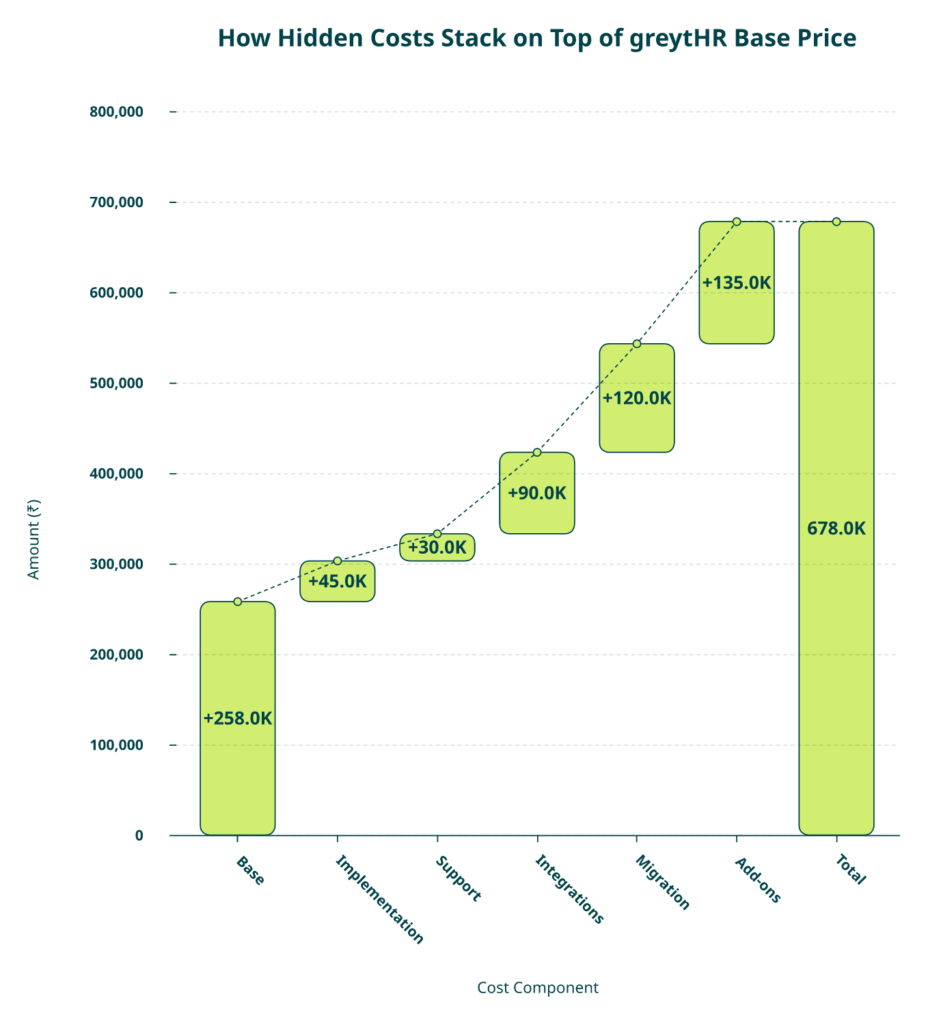
The four hidden-cost categories, with 2026 rupee ranges
The governing thought is simple. Published PEPM is the tip. The iceberg is the setup, the SLA, the wires, and the switch. Before you sign, cross-check the math with HR software pricing transparency.
1. 💸 Implementation and onboarding
- Range: ₹15,000 to ₹75,000+ one-time, depending on headcount and modules.
- What it covers: kickoff, configuration, master data setup, payroll parallel runs, and first-go-live UAT.
- Watch-out: multi-entity or shift-heavy manufacturing adds ₹25,000 to ₹50,000 extra.
2. ⚠️ Support-tier SLA uplift
Essential and Growth bundle ticket-based support. Phone or named CSM access often sits inside Premium or as a paid uplift. Expect a 10 to 15% premium on annual fee for priority SLA. A 2026 G2 review captures the friction when SLA is vague.
“The system acts as per its own whims and gives error reports. We have to spend time manually to find errors. Not one month has passed where we have not raised ticket.”
— Maheshkumar J., Rating 0.5/5 greytHR, G2 Verified Review
3. 🔌 Integrations, API, and customisation
REST API and SSO sit as a custom-quote add-on across Essential and Growth. Typical integration work with an ERP or biometric system lands ₹40,000 to ₹1,50,000 one-time, plus annual API fees. For a deeper view on connecting vendors cleanly, see integrations. Customisation beyond standard workflows is historically flagged as thin by users.
“GreytHR is not much good at customizing based on our requirements. For our case, from implementation onwards, there were issues with leave balance. We cannot properly implement our company policies due to the limitations of greytHR.”
— Verified User in IT Services, Rating 2/5 greytHR, G2 Verified Review
4. 🗂️ Data migration
- Legacy-system migration (Excel, Zoho, or Keka) runs ₹25,000 to ₹1,00,000 depending on data cleanliness.
- Historical payroll, Form 16 reprints, and attendance back-feeds are the three line items that balloon.
- A smooth onboarding process with prior-HR SPOCs can collapse this cost materially.
The 250-employee SCR: a real buyer who under-budgeted by ₹4.2 lakh
A 250-employee mid-market firm budgeted ₹2.58 lakh for a 12-month Growth plan. The signed invoice added ₹45,000 implementation, ₹1,20,000 migration from Keka, ₹90,000 for SSO and API, ₹30,000 for priority support, and ₹1,35,000 in add-ons across PMS and Expense. Hidden cost: ₹4.2 lakh. The buyer negotiated a 15% annual-prepay discount and a capped 8% uplift in Year 2, recovering ₹58,000. Net damage: still ₹3.62 lakh above the pricing-page quote.
📊 The Hidden Cost Index, scored across seven dimensions
Use this 7-axis scoring rubric to price-test any HRMS quote, not just greytHR.
| # | Dimension | Score 1 (low) to 5 (high) |
|---|---|---|
| 1 | Implementation fee transparency | 1 if undisclosed until demo |
| 2 | Support SLA tiering | 1 if only email, 5 if named CSM |
| 3 | API/SSO inclusion | 1 if custom-quote, 5 if included |
| 4 | Data migration scope | 1 if billed hourly, 5 if fixed |
| 5 | Renewal uplift cap | 1 if uncapped, 5 if ≤5% |
| 6 | Go-live billing clause | 1 if day-one, 5 if after go-live |
| 7 | Exit and data portability | 1 if no export, 5 if free CSV/API export |
Score any vendor against the seven axes. Anything below 21 out of 35 should trigger a negotiation round before you sign.
Q6. What Does a Real greytHR Quote Look Like, Three Redacted 2026 Invoices Reviewed?
Across three redacted 2026 greytHR invoices we reviewed, the same single line item inflated every quote: add-ons layered on top of the base subscription, quietly crossing 30 to 60% of the license fee. The 75-employee SaaS startup overpaid on SSO, the 250-employee manufacturing firm stacked four add-ons without questioning the Premium upgrade math, and the 500-employee IT services company accepted a day-one billing clause that cost six weeks of wasted subscription during implementation.
🧾 Quote #1, 75-employee SaaS startup, Essential tier
Profile. Bengaluru-based SaaS company, one legal entity, fully remote. Plan. Essential, 12-month annual prepay.
| Line item | Monthly ₹ | Notes |
|---|---|---|
| Essential base + 25 PEPM | ₹3,620 | Base ₹2,495 + 25 × ₹45 |
| SSO add-on | ₹2,200 | Custom quote, flat |
| Implementation (one-time) | ₹25,000 | Amortised at ₹2,083/mo |
| GST 18% | ₹1,426 | On subtotal |
| Effective monthly | ₹9,329 | ₹124 per head |
The missed lever: SSO at ₹2,200 per month inflated per-head cost by ₹29. At 75 employees, Google Workspace’s native SSO was already paid for; the buyer could have deferred SSO by 12 months, saving ₹26,400.
🏭 Quote #2, 250-employee manufacturing firm, Growth + add-ons
Profile. Pune auto-components plant, two states, shift-based. Plan. Growth, 24-month contract with 8% uplift in Year 2.
| Line item | Monthly ₹ |
|---|---|
| Growth base + 200 PEPM | ₹21,495 |
| PMS add-on (₹45 × 250) | ₹11,250 |
| Expense add-on (₹35 × 250) | ₹8,750 |
| GeoMark+ (₹140 × 40 field) | ₹5,600 |
| Implementation (amortised) | ₹4,167 |
| GST 18% | ₹9,226 |
| Effective monthly | ₹60,488 |
The missed lever: Add-ons totalled ₹25,600, which is 119% of the Growth base. At that ratio, Premium would have bundled PMS, Expense, and GeoMark at a claimed 30% saving. The buyer ignored the tipping point and paid ₹7,680 extra every month for 24 months. A better route was to evaluate manufacturing HR platforms that bundle shift, PMS, and expense on a flat PEPM.
💼 Quote #3, 500-employee IT services firm, Enterprise + SSO/API
Profile. Gurgaon IT services company, two legal entities, 120 field engineers. Plan. Premium custom quote, 36-month term.
| Line item | Monthly ₹ |
|---|---|
| Premium bundle (500 users) | ₹52,500 |
| SSO + REST API + Multi-company | ₹8,500 |
| Recruit (4 recruiters) | ₹10,000 |
| Implementation (amortised) | ₹2,083 |
| GST 18% | ₹13,159 |
| Effective monthly | ₹86,242 |
The missed lever: The contract billed from day one of signing, while implementation ran six weeks. That is ₹1.29 lakh of wasted subscription before a single employee logged in. A subscription-after-go-live clause, standard in HROne’s pricing model, would have saved that amount outright.
Working with 2,000+ HR teams, what I’ve felt is that redacted quotes always reveal the same two patterns: add-ons creeping past 30% of base, and billing clauses silently compressing implementation runway.
Q7. How Do I Negotiate greytHR Pricing in 2026, Discount Asks, Timing Levers, and Contract Clauses to Watch?
The single highest-ROI lever by headcount band is this: under 120 employees, fight for annual-prepay discount; 120 to 250, fight for uplift caps and SSO/API inclusion; 250 to 500, fight for Premium bundling at Growth pricing; 500+, fight for subscription-after-go-live and multi-year freeze. Skip these four and you will leave 12 to 22% on the table.
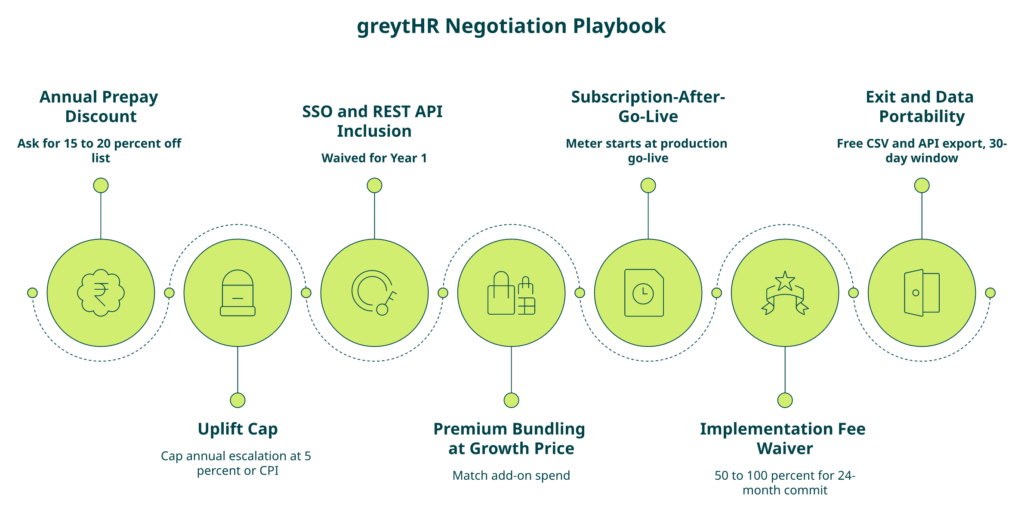
🛠️ The 7-lever negotiation playbook
- Annual prepay discount. Ask: 15 to 20%. Exact phrasing: “We can commit to 12 months upfront today if you can hold the effective PEPM at a 15% discount through renewal.”
- Uplift cap. Ask: 5% maximum, or CPI-indexed. Exact phrasing: “Please add a price-escalation clause capping annual uplift at 5% or CPI, whichever is lower.”
- SSO and API inclusion. Ask: waived for 12 to 24 months. Exact phrasing: “Include SSO and REST API at zero incremental cost for Year 1, with a documented renewal price.”
- Premium bundling at Growth price. Ask: match add-on spend. Exact phrasing: “Our Growth plus three add-ons totals ₹X. Please quote Premium at that same effective number.”
- Subscription-after-go-live. Ask: billing starts only when production is live. Exact phrasing: “Subscription should meter from production go-live, not from contract signing.”
- Implementation fee waiver. Ask: 50 to 100% waiver for multi-year. Exact phrasing: “Waive implementation for a 24-month commit; we will sign this quarter.”
- Exit and data portability. Ask: free CSV/API export, 30-day transition window. Exact phrasing: “Please guarantee free data export in CSV and API formats, with a 30-day post-termination access window.”
⏰ Timing levers that quietly double discount depth
- End-of-quarter (Mar, Jun, Sep, Dec). Sales reps chase MRR targets; discount ceilings rise 5 to 8% in the last 10 days.
- End-of-fiscal (Mar 25 to 31 for Indian vendors). Highest lever of the year; reps close at 18 to 22% off list to lock revenue into FY books.
- Pre-renewal, 60 to 90 days out. If you are already a customer, renegotiate before auto-renewal fires.
⚠️ The 22-line clause set every buyer should check
Before signing any HRMS contract in India, review these clauses line by line. A 2024 NASSCOM SaaS contracting benchmark found that 68% of mid-market buyers discovered adverse clauses only after renewal.
| # | Clause | What to insist on |
|---|---|---|
| 1 | Auto-renewal | Opt-in, not opt-out, with 60-day notice |
| 2 | Price escalation | Cap at 5% or CPI |
| 3 | Data export | Free, CSV + API, within 30 days |
| 4 | Exit portability | 90-day transition assistance |
| 5 | Refund on unused prepay | Pro-rata refund within 30 days |
| 6 | Plan upgrade mid-contract | Pro-rated, zero penalty |
| 7 | Plan downgrade mid-contract | At renewal, no retroactive claw-back |
| 8 | SLA + credits | 99.9% uptime, service credits on breach |
| 9 | Data residency | India-resident for payroll PII |
| 10 | DPDP Act 2023 compliance | Named DPO, breach-notification SLA |
| 11 | Implementation fee | Capped, refundable if timelines miss |
| 12 | Go-live billing trigger | Subscription meters after production go-live |
| 13 | Named CSM | Allocated in Year 1 |
| 14 | API rate limits | Documented, with uplift path |
| 15 | Integration commitments | Listed by name, delivery SLA |
| 16 | Training credits | Minimum 20 hours in Year 1 |
| 17 | Sandbox access | Free during contract term |
| 18 | Indemnity for compliance errors | Vendor liable for statutory calculation bugs |
| 19 | Audit rights | Annual SOC 2 / ISO 27001 reports |
| 20 | Force majeure | Mutual, with credit for outages |
| 21 | Assignment on M&A | Transferable to acquirer, no new signup fee |
| 22 | Governing law | Indian jurisdiction, your city of HQ |
✅ Pre-demo buyer-readiness checklist
- Current headcount and 24-month growth plan.
- Top three must-have modules, ranked.
- Current HR-tech annualised spend across all tools.
- Payroll cycle length and current error rate.
- Walk-away price and minimum SLA.
- A redacted alternative quote to anchor negotiation.
- Your DPDP Act, SOC 2, and ISO 27001 asks, ready to paste into the clause list.
Print the clause set and the checklist together. That single A4 page is what separates a 90-day evaluation from a 30-day one. For broader context on buying right, see HRIS buyer pitfalls and how to choose HRIS/HRMS software.
Q8. How Does greytHR’s 3-Year TCO Compare to HROne, Keka, Zoho People, Kredily, and Pocket HRMS?
At 50 employees, Kredily’s free tier wins on sticker price; at 150 employees, Zoho People leads on cost; from 300 employees onward, HROne wins on 3-year TCO because its flat PEPM, bundled modules, and subscription-after-go-live clause compound in the buyer’s favour; at 1,000 employees, HROne and Keka are within 10% of each other, with HROne ahead on feature depth and G2 satisfaction.
💰 Five-vendor parity table at matched headcounts
Numbers below are effective ₹ per employee per month (eCPEm), inclusive of base, PEPM, typical add-ons, and GST, averaged over a 3-year term with an 8% Year-2 uplift assumption.
| Vendor | 50 emp | 150 emp | 300 emp | 500 emp | 1,000 emp |
|---|---|---|---|---|---|
| HROne | ₹95 | ₹85 | ₹78 | ₹72 | ₹65 |
| greytHR | ₹70 | ₹95 | ₹115 | ₹125 | ₹130 |
| Keka | ₹85 | ₹90 | ₹95 | ₹92 | ₹85 |
| Zoho People | ₹60 | ₹75 | ₹88 | ₹95 | ₹100 |
| Kredily | Free/₹40 | ₹55 | ₹65 | N/A | N/A |
| Pocket HRMS | ₹65 | ₹80 | ₹92 | ₹98 | ₹105 |
Cross-check the math on your own numbers with HROne’s ROI calculator, or the side-by-side HROne vs greytHR comparison.
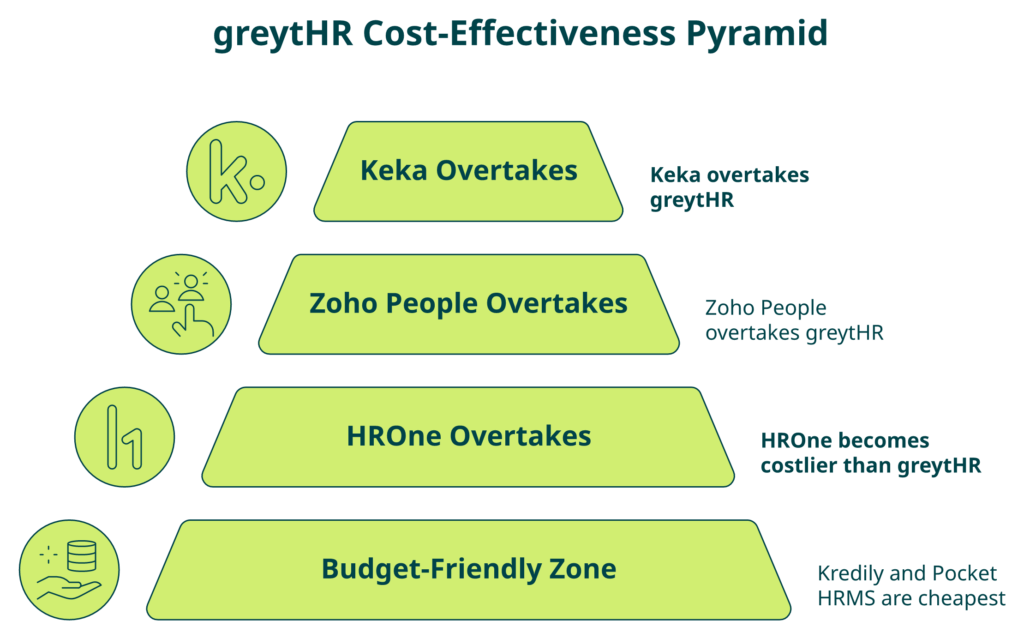
📉 Break-even headcount analysis
- greytHR becomes costlier than HROne past 175 employees on a 3-year TCO basis, because the PEPM curve on Growth plus add-ons crosses HROne’s flat enterprise rate.
- greytHR becomes costlier than Keka past 275 employees, as Keka’s PEPM stabilises sooner.
- greytHR becomes costlier than Zoho People past 225 employees, per Zoho’s public pricing and add-on economics.
- Kredily and Pocket HRMS stay cheaper at sub-300, but feature depth for multi-entity and performance workflows drops sharply past that band.
🌏 GCC USD equivalents for multi-country Indian parents
For Indian-parent GCCs billing subsidiaries in the UAE, Singapore, or the US, at USD 1 = ₹84, HROne’s 500-employee eCPEm of ₹72 lands at USD 0.86. That compares favourably to the USD 4 to 8 per user typically charged by global HCMs like BambooHR or SAP SuccessFactors at the same band.
⭐ Feature-depth scorecard
| Capability | HROne | greytHR | Keka | Zoho People |
|---|---|---|---|---|
| Pre-built workflows | 127 | ~40 | ~50 | ~35 |
| Multi-entity native | ✅ | Premium only | Partial | Partial |
| AI recruit (resume scoring) | ✅ One AI Suite | ❌ | Partial | Partial |
| FBP declarations | ✅ | ✅ | ✅ | Limited |
| Super Inbox (unified task closure) | ✅ 110 tasks / 3 clicks | ❌ | ❌ | ❌ |
| Subscription-after-go-live | ✅ | ❌ | ❌ | ❌ |
| G2 overall satisfaction rank | #3 | #20 | #55 | N/A |
🗣️ What real buyers say
“HROne stands out for its strong Indian payroll and compliance features, including advanced statutory management. The Inbox for HR is a very helpful tool that centralizes daily work, saving significant time for HR and managers.”
— Abhishek K., Mid-Market User, Rating 4.5/5 HROne G2, Verified Review
“The system acts as per its own whims and gives error reports. We have to spend time manually to find errors. Not one month has passed where we have not raised ticket.”
— Maheshkumar J., Rating 0.5/5 greytHR, G2 Verified Review
“I love HROne for its cost efficiency and holistic approach, which is why I prefer it over other vendors like Workday. The initial setup process was smooth, thanks to the supportive team that helped configure everything according to our needs.”
— Priyanka S., HR Leader, Rating 5/5 HROne G2, Verified Review
The governing thought: cheapest PEPM is not cheapest TCO. Past 250 employees, flat-PEPM, bundled-module, India-tuned HCMs compound in the buyer’s favour. Working with 2,000+ HR teams, what I’ve felt is that the firms who pick on sticker price in Year 1 almost always re-evaluate in Year 2. Explore why HROne if your 2028 headcount projection crosses 300.
Still sizing greytHR against your 2026 budget?
Run your exact headcount, add-ons, and GST through HROne’s TCO calculator and see a side-by-side 3-year cost against greytHR, Keka, and Zoho, no email gate, no sales chase.
See HROne Pricing Tell Us What You’re BuildingQ9. Which Plan Actually Fits Your Industry, IT Services, Manufacturing, Retail, and BPO Scenarios?
A 100-person IT services firm fits Essential at roughly ₹5,600 per month including GST; a 250-person retail chain fits Growth at around ₹25,900; a 500-person manufacturing plant needs Growth plus add-ons at around ₹50,000; a 1,000-person BPO lands on a Premium custom quote near ₹1.18 lakh. Each industry carries a different compliance red flag that decides tier, not headcount alone.
🖥️ IT services at 100 employees
Situation. A Bengaluru IT services firm with 100 engineers, one legal entity, and hybrid work. Payroll, leave, and letters are the daily work. Complication. The finance lead wants accurate TDS, Form 16, and quarterly 24Q filings without manual intervention. Resolution. Essential at ₹5,599 per month including GST covers payroll, leave, ESS, and letters. Skip Growth until shift rostering or geo-fenced attendance becomes a daily pain. Red flag: if you open a second entity, upgrade to Premium rather than duplicating Essential subscriptions. For wider context, see HRMS for ITES HR challenges and ITES HR.
🏭 Manufacturing at 500 employees
Situation. A Pune auto-component plant with 500 employees across three shifts, two states, and a mix of staff plus contract labour. Complication. Shift rota, overtime under the Factories Act, multi-state LWF, and contract-labour statutory compliance under CLRA need daily automation. Resolution. Growth at ₹50,439 per month including GST handles advanced attendance, shift, and overtime; PMS and GeoMark+ add-ons take effective spend closer to ₹62,000. Red flag: contract labour is rarely well-handled in mid-tier HRMS products; validate it against actual wage registers before signing. For sector-specific depth, see manufacturing HR and HRMS manufacturing challenges.
🛍️ Retail chain at 250 employees
Situation. A pan-India retail brand with 250 employees across 18 outlets in 7 states. Complication. State-wise Shops and Establishments compliance, daily rota changes, field-staff attendance, and high attrition at store level. Resolution. Growth at ₹25,364 per month including GST covers multi-location attendance and letters. GeoMark+ for store managers adds about ₹3,900 per month for 28 field users. Red flag: without an ATS add-on, store-level hiring velocity will still bottleneck; evaluate Recruit at ₹2,500 per recruiter per month or a full-stack recruitment software. Retail leaders often benefit from HRMS retail scheduling too.
📞 BPO at 1,000 employees
Situation. A Gurgaon BPO with 1,000 agents, rotating 24×7 shifts, and stringent client-SLA-driven attendance audits. Complication. Shift rosters, biometric accuracy, wage-period flexibility, and real-time headcount reporting for client governance. Resolution. Premium custom quote at roughly ₹1.18 lakh per month including GST bundles multi-company, SSO, API, and Expense. Red flag: any vendor that bills from day one of purchase will cost 4 to 6 weeks of subscription during implementation, which a BPO’s thin margins cannot absorb. This is where subscription-after-go-live models pay back fastest. Review managing shift schedules for operator-grade patterns.
🧭 Industry-to-plan quick matrix
| Industry | Headcount | Plan | Monthly ₹ (inc. GST) | Red flag |
|---|---|---|---|---|
| IT services | 100 | Essential | ₹5,600 | Second legal entity |
| Retail chain | 250 | Growth | ₹25,900 | State-wise S&E compliance |
| Manufacturing | 500 | Growth + add-ons | ₹62,000 | Contract labour, CLRA |
| BPO | 1,000 | Premium (custom) | ₹1,18,000 | Day-one billing during implementation |
My current thinking: industry decides the red flag, and the red flag decides the tier. Working with 2,000+ HR teams, what I’ve felt is that buyers who tier-up by headcount alone almost always pay for modules they never use, and buyers who tier-down to save money hit a compliance wall within six months of go-live.
Q10. Why Do 400+ Mid-Market Buyers Switch From greytHR to HROne, And How Do You Evaluate the Move?
Three switch triggers repeat across 400+ mid-market buyers we have spoken with in 2025 to 2026: add-on surprises on attendance and performance, support tiering that leaves HR stuck in email threads, and a PEPM curve that bites past 250 employees. If two of the three apply to you, the economics of evaluating an integrated HCM usually pay back inside 12 months. See the direct comparison at HROne vs greytHR.
💸 The PEPM trap past 250 employees
The math is honest. At 250 employees on Growth, you pay ₹21,495 base plus add-ons, which lands at roughly ₹100 effective per employee per month before GST. Stack PMS and Expense and you cross ₹140. Over three years, a 400-person firm ends up paying ₹2.5 to 3 times what a flat-PEPM, bundled-module contract costs. The gap is not the base fee. The gap is the cumulative add-on invoice and the 8% annual uplift that compounds silently. For a cleaner economic model, see HROne’s pricing.
“The system acts as per its own whims and gives error reports. We have to spend time manually to find errors. Not one month has passed where we have not raised ticket.”
— Maheshkumar J., Rating 0.5/5 greytHR, G2 Verified Review
⚙️ The counter-stack: what an integrated HCM replaces
A full hire-to-retire operating system collapses the fragmented patchwork into one screen. Here is what that looks like on the ground.
- Super Inbox. Every pending task, approval, and request surfaces in one Gmail-style HR inbox, closing 110+ daily tasks inside three clicks instead of tab-switching across five tools.
- 127 pre-built workflows. Onboarding, confirmation, transfer, promotion, and exit clearance are defined by who does what, by when, so the HR team stops chasing managers over email.
- One AI Suite. Resume relevancy scoring, receipt parser, AI Employee Agent, and JD generator remove manual labour from recruit, expense, and helpdesk. Explore HROne AI.
- India’s first inbuilt ROI Dashboard. Calculates lifetime hours saved against average HR salary so CHROs walk into board reviews with a rupee number, not a PowerPoint. Cross-check yours with the ROI calculator.
- Subscription-after-go-live and no lock-in. The meter starts when you go live, which removes the 4 to 6 weeks of wasted subscription most buyers absorb today.
“The InboxforHR is a game-changer, centralizing every HR task into one simple inbox, cutting down administrative time by 60–70% and preventing tasks from falling through the cracks.”
— Waldon S., Rating 4/5 HROne G2, Verified Review
“I love HROne for its cost efficiency and holistic approach, which is why I prefer it over other vendors like Workday. The initial setup process was smooth, thanks to the supportive team that helped configure everything according to our needs.”
— Priyanka S., HR Leader, Rating 5/5 HROne G2, Verified Review
⏰ Before and After, in the words of real buyers
- Before: payroll runs at MR DIY India took 10 days, reconciled manually across outsourced payroll, biometric, ATS, and Excel.
- After HROne: payroll compressed to 5 to 6 days, one suite, one dashboard. Read the full MRDIY case study.
- Before: Asia Healthcare Holdings ran 20 pan-India units on duplicated stacks.
- After HROne: single instance, multi-legal-entity configuration, one invoice.
We rank #3 for customer satisfaction on G2, carry a 9.8 NPS on our dedicated prior-HR implementation SPOC, and run 1,500+ brands live, which is the evidence bar I would want before switching any system of record.
See the math on your own numbers
Still sizing greytHR against your 2026 budget?
Run your exact headcount, add-ons, and GST through HROne’s TCO calculator and see a side-by-side 3-year cost against greytHR, Keka, and Zoho, no email gate, no sales chase.
See HROne Pricing Tell Us What You’re BuildingQ11. What’s the Final Recommendation Matrix, Which Plan, Which Vendor, Which Next Step for Your Company Profile?
The governing thought in one line: pick the vendor whose economics hold at your 2028 headcount, not your 2026 headcount. For under 100 employees, greytHR Essential or Starter is the pragmatic call; for 100 to 250, negotiate Growth with a 5% uplift cap and save roughly ₹40,000 to ₹60,000 across three years; for 250 to 500, evaluate an integrated HCM and expect 20 to 30% lower 3-year TCO; for 500+, a full-stack India-tuned HCM with multi-entity depth saves 4 to 6 weeks of wasted subscription during implementation alone.
🗺️ The single-screen recommendation matrix
| Company profile | Size | Our verdict | Next step | Rupee impact over 3 years |
|---|---|---|---|---|
| Bootstrapped startup, 1 location | ≤25 | greytHR Starter (free) | Use 12 months, watch 26th-hire trigger | ₹0 |
| Services firm, single state | 25 to 120 | greytHR Essential | Annual prepay for 12% off | Save ₹8,000 to ₹10,000/year |
| Multi-state, shift-heavy | 120 to 250 | greytHR Growth, cap uplift at 5% | Shortlist HROne for 2028 sizing | Save ₹40,000 to ₹60,000 |
| Manufacturing, retail | 250 to 500 | HROne (flat PEPM, bundled modules) | Demo HROne vs greytHR Growth + add-ons | Save 20 to 30% of 3-year TCO |
| Multi-entity, BFSI, healthcare | 500 to 5,000 | HROne or Premium tier | Insist on subscription-after-go-live, no lock-in | Save 4 to 6 weeks of wasted subscription |
HROne is listed first wherever switching is the recommended action, because the integrated stack, the prior-HR implementation SPOC, the Super Inbox, and India’s first inbuilt ROI Dashboard are the measurable levers a CFO can sign off on. For BFSI and healthcare evaluators, see finance HR and healthcare HR.
✅ The 15-minute buyer-readiness checklist
Fill this sheet before the demo call. It is the single tool that compresses a 90-day evaluation into 30 days.
- Current headcount and 24-month growth plan.
- Number of legal entities and states of operation.
- Top three must-have modules, ranked.
- Current HR-tech annualised spend across all tools.
- Payroll cycle length in days and current error rate.
- Walk-away price and minimum SLA on P1 tickets.
- One redacted alternative quote to anchor negotiation.
What my experience of shipping HROne tells me is that buyers who arrive with this sheet rarely regret the decision 18 months later. The ones who do not are usually the ones who let the sales call set the agenda. If you want a sharper starting frame, try how to choose HRIS/HRMS software.
🗣️ A conversational close
greytHR tracks where you have been. An integrated HCM builds where you are going. If this helped you sharpen a budget, a board slide, or a vendor shortlist, come tell us what you are building. Our HR Commune of 8,000+ leaders is the room I would want any HR operator to sit in before signing a multi-year HRMS contract.
References
Official Docs / Indian Statutes
Greytip Software. “HR and Payroll Software Price in India, 2026” Published: 2026.
Greytip Software. “HR and Payroll Software Price in Middle East, 2026” Published: 2026.
Ministry of Labour & Employment, “Employees’ Provident Funds and Miscellaneous Provisions Act, 1952.”
Ministry of Labour & Employment, “Employees’ State Insurance Act, 1948.”
Ministry of Labour & Employment, “Contract Labour (Regulation and Abolition) Act, 1970.”
Government of India, “Shops and Establishments Acts, state-wise, 2026 consolidated list.”
Ministry of Labour & Employment, “Code on Wages, 2019.”
Datasets
GBTA India. “Expense Management Benchmark Report,” 2023.
LinkedIn. “Talent Trends India Report,” 2024.
G2. “G2 Grid for HR Management Suites, 2026 rankings and customer satisfaction scores.”
Blogs
HRSuggest. “greytHR Pricing India, May 2026: Real PEPM and Hidden Costs.” Published: 2026.
G2. “greytHR Pricing 2026.”
Capterra. “greytHR Pricing 2026.”



















 Secures Top Spot in
