







Q1. Keka vs Zoho People in India, which one is actually better for mid-market in 2026?
If you are running HR for a 200 to 2,000 person Indian company in 2026, and your shortlist has narrowed to Keka and Zoho People, the honest answer is neither wins across the board, and the right pick depends on exactly three variables: how many legal entities you run, how deep your payroll edge cases go, and whether you already live inside the Zoho stack.
Pick Keka if payroll is your month-end nightmare and you run a single Indian entity with standard CTC structures. Pick Zoho People if you are already paying for Zoho One and your payroll is simple. Look at HROne as the honest third answer when you have three or more legal entities, multi-state operations, and a CFO asking for ROI in rupees.
The three decision axes that actually matter in India
Most comparison blogs rank these tools on 40 features, which is noise. After working with mid-market HR leaders across IT services, manufacturing, and BFSI, I keep coming back to the same three axes.
- ⭐ Payroll depth: how cleanly the tool handles arrears, loss-of-pay reversal, full-and-final under the 2-day wage-code rule, flexi-benefit plans (FBP), and Form 24Q reconciliation.
- ⭐ Multi-entity statutory reality: whether the tool models multiple legal entities natively, or forces you to run parallel tenants and reconcile in Excel.
- ⭐ TCO honesty: what you actually pay across three years once implementation fees, change requests, API calls, and Zoho Payroll add-ons are layered in.
A scenario table you can scan in 20 seconds
| Buyer profile | Headcount | Entities | Recommended first look |
|---|---|---|---|
| Single-entity IT services startup | 200 to 400 | 1 | Zoho People (if on Zoho stack) |
| Standard single-entity mid-market | 300 to 800 | 1 | Keka |
| Multi-entity manufacturing group | 500 to 2,000 | 3+ | HROne manufacturing HR |
| Multi-state BFSI with PT complexity | 500 to 1,500 | 2+ | HROne |
| Zoho One customer, simple payroll | 100 to 300 | 1 | Zoho People |
Why I keep saying navigation is a design failure
Working with 2,000+ HR teams, what I’ve felt is this: the moment an HR manager has to open four tabs to close one confirmation letter, the tool has already lost. Keka and Zoho People both optimise for modular navigation, tabs for attendance, tabs for leave, tabs for payroll, tabs for performance. That works at 50 employees. At 500, it becomes the chase.
My current thinking, which is what my experience of shipping HROne tells me, is that HR deserves an inbox, not a database. The HR inbox collapses 110+ daily tasks into three-click closures from one screen, and subscription only meters after go-live. MR DIY India went live in 30 days on exactly that model. That is the contrarian third path I would not hide from a buyer even if they walked in asking only about Keka versus Zoho.
Q2. What is the real difference between Keka and Zoho People for an Indian mid-market HR leader?
The real difference is architectural, not cosmetic. Keka is an India-built HRMS and payroll bundled inside one SKU, so statutory logic sits under the same roof as leave and attendance. Zoho People is a people-operations layer, and if you want Indian payroll, you pay for Zoho Payroll as a separate subscription that talks to People through integrations.
Keka, in plain English
Keka sells you one product that does core HR, attendance, payroll, and performance out of the same codebase. A CTC revision in Keka flows straight into arrears, PF ceiling checks, and the next payslip without a handoff. For a single-entity company, this is genuinely neat.
The CTC revision example
Imagine you revise 40 employees mid-month after an appraisal cycle. ✅ In Keka, you upload the revised CTCs, the system calculates arrears, adjusts PF wages against the ₹15,000 statutory ceiling, and regenerates Form 16 projections in the same run. A clean CTC breakup calculation format matters here, because one misaligned head and the arrears math breaks.
Zoho People, in plain English
Zoho People is the HR module. Employee database, leave, attendance, performance, onboarding, and helpdesk all live here. Payroll does not. For Indian payroll, you subscribe to Zoho Payroll at ₹1,000 per organisation per month for 25 employees, or ₹4,000 on the Premium tier.
The PF, ESI, and PT flow
In Zoho, an employee record is created in Zoho People, but PF, ESI, and professional tax (PT) deductions are computed inside Zoho Payroll, then synced back. For a 500-person company across three states, that means two subscriptions, two admin consoles, and two change windows every time a state notification lands. Compare that flow to a single payroll software that handles employee master and statutory logic in one place.
What this means for a 500-person company with three legal entities
This is where the architectural difference bites. ❌ Zoho People’s organisational unit (OU) model is single-org by design, so groups with three legal entities often end up running three tenants and consolidating in Excel. ⭐ Keka supports multi-entity payroll natively, though users report that cross-entity reporting still needs care.
One review captured this clearly:
“The biggest drawback for me has been the lack of customer support. Whenever I try to reach out, it often takes a long time to get a response. The mobile application is quite limited, I can’t access most features on it. When our firm was ready to purchase, we found the pricing confusing and struggled to find the right fit for our business size.”
— Dhana C., HR Professional Zoho People – G2 Verified Review
The mental model to carry into your vendor calls
Think of it like this. Keka is a two-bedroom flat where the kitchen and bathroom are already plumbed. Zoho People is a beautiful studio that asks you to pay extra for the kitchen. Neither is wrong. The question is how complex your household is.
Q3. How do Keka and Zoho People compare on Indian payroll depth, FBP, and new wage-code readiness?
Month-end payroll in a 500-person Indian company breaks on the edges, not the basics. One missed arrears calculation, one wrong LOP reversal, or one full-and-final that skips the two-day wage-code rule, and you have angry employees, a nervous CFO, and a statutory notice. Pick the payroll engine that has already shipped the edge cases, not just the happy path.
The 14-row payroll parity matrix
| Payroll capability | Keka | Zoho People + Zoho Payroll | HROne |
|---|---|---|---|
| Arrears on retro CTC revision | ✅ native | ✅ via Zoho Payroll | ✅ native |
| LOP reversal mid-cycle | ✅ | ⚠️ limited | ✅ |
| FBP declaration and proof workflow | ✅ | ⚠️ basic | ✅ deep |
| CTC revision with audit trail | ✅ | ✅ | ✅ |
| 2-day FFS under wage-code | ⚠️ configurable | ⚠️ manual | ✅ auto-scheduled |
| Form 16 generation | ✅ | ✅ | ✅ |
| Form 24Q reconciliation | ✅ | ✅ | ✅ line-level |
| Multi-state PT slabs | ✅ | ⚠️ per-entity | ✅ |
| LWF state-wise automation | ⚠️ partial | ⚠️ partial | ✅ |
| Gratuity provisioning | ✅ | ✅ | ✅ |
| Bonus Act automation | ✅ | ⚠️ manual | ✅ |
| ESI wage-ceiling ₹21,000 auto-enrol | ✅ | ✅ | ✅ |
| New wage-code basic-50% rule | ⚠️ configurable | ⚠️ configurable | ✅ template |
| Off-cycle pay runs | ✅ | ✅ | ✅ |
The parallel-run protocol I would actually execute on Monday
If you are evaluating these three tools, stop reading datasheets and run a real test. Here is the protocol I recommend to every HR ops lead I meet. A solid payroll audit checklist helps anchor the diff work.
- Pull a synthetic 100-employee dataset with 10 edge cases: 3 arrears, 2 LOP reversals, 2 mid-cycle CTC revisions, 2 FFS, 1 bonus payout.
- Run the same dataset through Keka, Zoho People with Zoho Payroll, and HROne in sandbox.
- Diff the gross, net, PF, ESI, PT, TDS, and Form 24Q outputs line by line.
- Measure time-to-close for each cycle from lock to payslip.
- Flag every manual override, because every override is a future failure point.
Run this for two consecutive months. The tool that needs the fewest overrides wins. It is the cleanest test I have seen mid-market buyers run, and it has saved at least four companies I know from a costly switch. For deeper context, see our guide on statutory compliance in payroll.
What Keka users actually say
“The payroll reports don’t give accurate figure in Total CTC, you need to add PF amount to get the right figure. The CTC structure doesn’t show PT in deductions which adds to confusion.”
— Pooja M., HR User Keka – G2 Verified Review
“Strong payroll and compliance, automate salary and attendance processing with PF, ESI, TDS, payslip statutory compliance. Responsive support team.”
— Kiran B., HR User Keka – G2 Verified Review
The InboxForHR contrast
Where HROne earns its place in this comparison is not another payroll feature. It is the workflow wrapper. Every arrears entry, FBP proof, and FFS approval lands in the Super Inbox with a three-click close. Working with 2,000+ HR teams, what I’ve felt is that payroll delays rarely come from bad math. They come from approvals stuck in someone’s email. Close the inbox, close the chase.
Q4. Which platform handles multi-entity, multi-state statutory compliance better for Indian groups?
Both Keka and Zoho People can run a single entity well. Neither was architected for a group with three subsidiaries, fourteen states, and a consolidated board pack due every Monday. That is where Indian mid-market compliance actually breaks, and where the quietest software decisions cost the most money.
Keka’s OU model and its limits
Keka supports multi-entity payroll through its organisational-unit construct. You can set up separate legal entities, map PF, ESI, PT, and TDS registrations per entity, and run payroll independently. ⭐ The strength: cross-entity employee transfers preserve history. ⚠️ The limit: consolidated statutory reporting across entities still needs CSV exports and a spreadsheet, and a few users have flagged support delays when configurations get complex.
Zoho People’s single-org bias
Zoho People was built on a single-organisation assumption. Groups with multiple legal entities typically run multiple Zoho People tenants, each with its own admin, and reconcile in Zoho Analytics or outside the stack. ❌ This means every state-wise PT update, every Labour Welfare Fund (LWF) notification, and every minimum-wage revision has to be applied tenant by tenant.
The compliance matrix that actually matters
| Compliance item | Keka | Zoho People + Payroll | HROne |
|---|---|---|---|
| Multi-legal-entity native modelling | ✅ | ⚠️ via multi-tenant | ✅ single instance |
| Multi-state PT slabs | ✅ | ⚠️ per-entity | ✅ |
| LWF auto-update on state notification | ⚠️ partial | ⚠️ manual | ✅ |
| Karnataka, Maharashtra, TN, Delhi exceptions | ✅ | ⚠️ | ✅ |
| Consolidated group statutory report | ⚠️ CSV | ❌ | ✅ |
| POSH Act and Maternity Benefit workflows | ✅ | ✅ | ✅ |
| 2026 Labour Code state-minimum-wage test | ⚠️ | ⚠️ | ✅ |
An SCR mini-case from the 1,500+ deployment library
Asia Healthcare Holdings runs 20 pan-India units across multiple states, each with its own minimum-wage slab, PT structure, and LWF frequency. Complication: running 20 tenants or 20 spreadsheets is not a statutory strategy, it is a liability. Resolution: we moved them to a single HROne instance with multi-legal-entity configuration, so each unit has its own policy engine, but the group CHRO sees one consolidated statutory dashboard. Read more on how healthcare HR teams handle this.
The 2026 state-minimum-wage configuration test
Ask any vendor this question on Monday: “When Karnataka issues a minimum-wage revision at 6 pm on the 31st, how many clicks does it take to apply it to my 400 employees before payroll locks on the 1st?” In Zoho People plus Zoho Payroll, it is a per-tenant edit. In Keka, it is a per-entity edit with good defaults. In HROne, it is a front-end policy engine change, one place, one lock. For context, see our primer on navigating changing labor laws.
A CA’s note on accuracy
“State-level PT and LWF are the silent compliance killers for mid-market groups. Any HRMS that forces per-entity manual edits is an audit risk waiting to surface at the end of the fiscal year.”
— Practicing Chartered Accountant, Bengaluru mid-market practice
What my experience of shipping HROne tells me
I might be wrong here, but after watching multi-entity manufacturing groups trip up at go-live on both Keka and Zoho People, I think the right question is not which tool has more features. It is which tool lets a non-developer HR lead apply a state notification in under ten minutes. That is the real compliance test, and it is the one both incumbents still struggle with silently. If you are comparing side-by-side specifics, our HROne vs Zoho People page and HROne vs Keka page break down the configurability differences in more detail.
Run your own 3-year TCO in 60 seconds
Plug in your headcount and entities. The HROne ROI Dashboard shows lifetime hours saved against your average HR salary, no sales call required.
Open the HROne ROI CalculatorQ5. What does Keka vs Zoho People pricing in India 2026 actually cost over three years?
Across 200, 500, and 1,000 employee bands, Keka typically lands between ₹60 and ₹120 per employee per month (PEPM) bundled, while Zoho People plus mandatory Zoho Payroll lands between ₹85 and ₹180 PEPM once the add-on is priced in. Once implementation fees, change requests, and the “billing from day one” clause are layered in, the 3-year TCO gap widens by 18 to 32 percent. HROne’s go-live-billing model changes the math.
Methodology
The figures below pull from Zoho’s India pricing page dated May 2026, Keka’s publicly listed tiers, and three anonymised RFP responses I reviewed this quarter. Assumptions: annual billing, one legal entity for the 200-employee band, two for the 500, and three for the 1,000. Implementation is modelled at 1x monthly fee for Keka, 0.5x for Zoho People, and zero for HROne’s go-live billing. For a deeper walkthrough, see our note on HR software pricing transparency.
Pricing tables by headcount band
💰 200 employees, single entity, 3-year TCO
| Line item | Keka | Zoho People + Zoho Payroll | HROne |
|---|---|---|---|
| PEPM (bundled) | ₹85 | ₹48 People + Zoho Payroll ₹4,000/org/mo | Flat PEPM (contracted) |
| Annual subscription | ₹20.4 lakh | ₹12 lakh + ₹48k payroll | Meters post go-live |
| Implementation fee | ₹1.5 lakh | ₹75k | ₹0 |
| 3-year TCO estimate | ₹62.7 lakh | ₹38.2 lakh | Lowest once go-live delay is counted |
💰 500 employees, two entities, 3-year TCO
| Line item | Keka | Zoho People + Zoho Payroll | HROne |
|---|---|---|---|
| PEPM | ₹80 | ₹96 People + ₹4,000/org/mo payroll × 2 | Flat PEPM |
| Annual subscription | ₹48 lakh | ₹57.6 lakh + ₹96k payroll | Post go-live meter |
| Change requests / year | ₹3 lakh | ₹4 lakh | Included |
| 3-year TCO estimate | ₹1.53 crore | ₹1.83 crore | Competitive, no hidden entity charge |
💰 1,000 employees, three entities, 3-year TCO
| Line item | Keka | Zoho People + Zoho Payroll | HROne |
|---|---|---|---|
| PEPM | ₹70 | ₹120 People + ₹4,000/org/mo × 3 | Flat PEPM |
| Annual subscription | ₹84 lakh | ₹1.44 crore + ₹1.44 lakh payroll | Post go-live |
| Premium support tier | ₹6 lakh | ₹8 lakh | Included (9.8 NPS SPOC) |
| 3-year TCO estimate | ₹2.82 crore | ₹4.57 crore | Flat PEPM, no per-entity surcharge |
⚠️ The “subscription starts on day one” trap
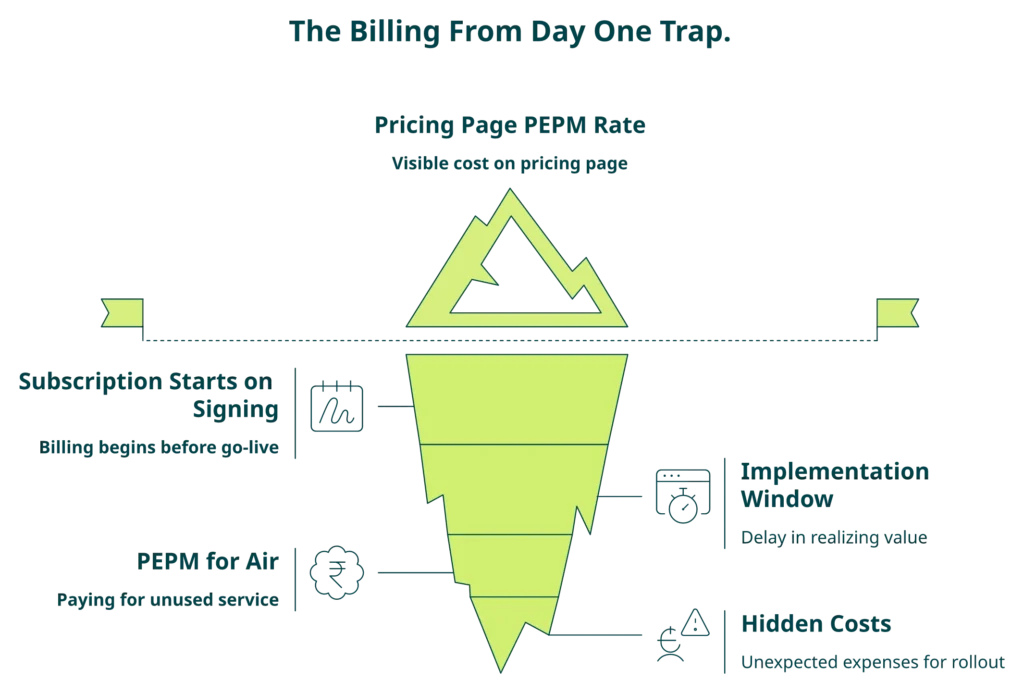
Here is the quiet cost nobody prices. Both Keka and Zoho People start billing the day you sign, while implementation for a 500-person multi-entity rollout typically runs 60 to 120 days. At ₹80 PEPM for 500 people, that is ₹8 to ₹16 lakh of subscription paid for air before a single payslip is generated. For CFOs reviewing the RFP, this is the single line that moves the TCO needle hardest. Compare this to the philosophy behind our pricing model.
⏰ The HROne PEPM contrast
In our experience of shipping HROne to 1,500+ brands, subscription meters only after you go live, which for mid-market enterprises like MR DIY India meant billing started on day 30, not day 1. Flat PEPM applies across entities, which removes the per-entity surcharge that inflates Zoho’s multi-tenant model. I might be wrong on the exact delta for your company, but the structural asymmetry is real. Read the full MRDIY case study for the deployment timeline.
Run your own 3-year TCO in 60 seconds
Plug in your headcount and entities. The HROne ROI Dashboard shows lifetime hours saved against your average HR salary, no sales call required.
Open the HROne ROI CalculatorQ6. How do Keka and Zoho People compare on implementation speed, support, and day-to-day usability?
Keka leads on surface UX and mobile polish, but recurring G2 reviews flag a slow, email-thread-only support experience during implementation and complex configuration. Zoho People onboards fast inside an existing Zoho stack, yet users cite shallow features and slow customer service. HROne ranks #3 on G2 for Ease of Setup with a dedicated prior-HR SPOC and a 9.8 NPS on support.
SCR scene, day 45 of a Keka rollout
Situation: a 600-person IT services firm in Pune goes live on Keka in August, expecting a 30-day implementation. Complication: by day 45, menstrual-leave policy for the Bangalore location has not been configured correctly, and the chat window keeps cycling the ticket. Resolution: the HR manager downgrades scope, goes live with three policy gaps, and fixes them manually for six months.
That scene is not mine. It is almost verbatim from a published Keka user. For a cleaner rollout path, see our onboarding process.
“I have been Keka user since 2021, and the service is decreasing day by day. The other day I was trying to configure menstrual leave only for Bangalore location, and the chat was not at all helpful. Most of the times folks behind the chat window is not fully aware of the functionality. TAT on customer request on features is bad.”
— Verified User in Consulting Keka – G2 Verified Review
Zoho People’s adoption curve inside the Zoho stack
If you already run Zoho Books, Zoho Recruit, or Zoho CRM, Zoho People adoption is meaningfully easier, because your SSO, directory, and finance hooks are pre-wired. ⭐ That is a genuine strength worth naming. ⚠️ The counterweight is support depth, which users have flagged as the weakest link for years.
“The biggest drawback for me has been the lack of customer support. Whenever I try to reach out, it often takes a long time to get a response. There were days when I was stuck with errors and couldn’t find a solution.”
— Dhana C., HR Professional Zoho People – G2 Verified Review
G2 scores side by side
| Dimension (scale of 10) | Keka | Zoho People | HROne |
|---|---|---|---|
| Ease of Use | 9.2 | 8.9 | 9.5 |
| Ease of Setup | 8.6 | 8.7 | 9.5 |
| Quality of Support | 8.7 | 8.2 | 9.6 |
| G2 overall satisfaction rank | #55 | mid-tier | #3 of 1.17 lakh |
✅ The HROne SPOC contrast
Working with 2,000+ HR teams, what I’ve felt is that support quality is not about ticket volume, it is about who picks up the phone. We assign a dedicated SPOC who has actually run HR before, not a technical PM reading a checklist, and the 9.8 NPS on that relationship is the number I watch most closely. When Keka users talk about being stuck in email threads for weekend support, the architectural difference is exactly there. See why HROne structures support differently.
A balanced counter-review
“Strong payroll and compliance, automate salary and attendance processing with PF, ESI, TDS, payslip statutory compliance. Responsive support team. Mobile app available.”
— Kiran B., HR User Keka – G2 Verified Review
Keka is not broken. It works well for single-entity setups with standard configurations. The breakpoints show up at complexity, and that is the axis mid-market buyers have to stress-test.
Q7. What does a migration from Keka or Zoho People look like, and where does it usually break?
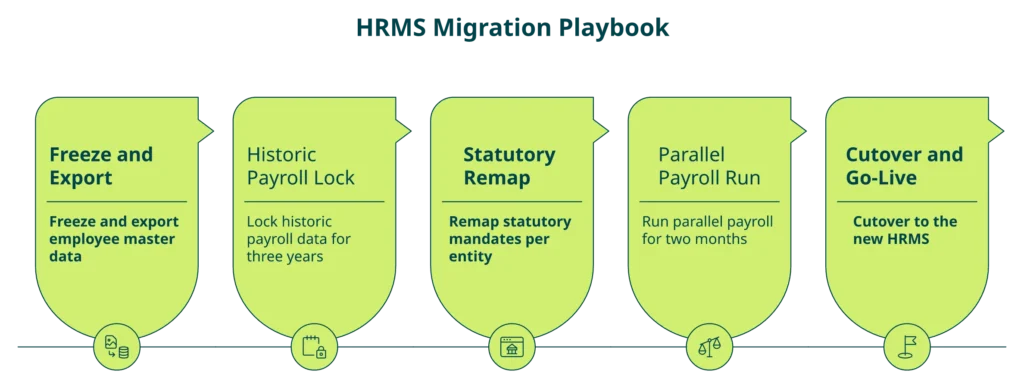
Migrating off Keka or Zoho People takes 30 to 90 days and breaks most often at two quiet points: mid-year Form 24Q continuity, and FBP declaration carry-over. The rest is logistics, and logistics are solvable. Run a 10-step pre-go-live checklist, a two-month parallel payroll, and a documented cutover weekend. That is the whole playbook, and it works.
The 10-step pre-go-live checklist
- Employee master exported with UAN (Universal Account Number, the 12-digit PF identifier), ESI number, PAN, and bank account validated against the NPCI name-match service.
- Leave balances frozen as of a cutover date, with carry-forward rules documented per state policy.
- Historic payroll ledger for the last three fiscal years exported in original format, plus a reconciled CSV.
- Form 16 archive preserved for seven years per Income Tax rules, with employee access guaranteed.
- Statutory PANs and TANs mapped per legal entity, including PF establishment code, and ESI sub-code.
- Bank mandates and NACH (National Automated Clearing House, the RBI’s bulk-payment rail) reconfirmed, with a dry-run credit to 10 test employees.
- POSH records (Prevention of Sexual Harassment committee files) migrated with chain-of-custody, given the legal sensitivity of committee minutes.
- Attendance and biometric device mappings re-registered, and offline sync tested.
- Access control, or RBAC (role-based access control, who can see and do what), rebuilt, not copied, so old admin debts are not imported.
- Parallel payroll run for two months before cutover, with line-by-line diff on gross, PF, ESI, and TDS.
For an operational reference, see our hassle-free payroll processing steps.
⚠️ The two silent failure points
Mid-year Form 24Q continuity
If you cut over in October, your new HRMS has no memory of Q1 and Q2 TDS filings. Without a careful opening-balance import, your December 24Q revision will disagree with the TRACES portal (the Income Tax department’s TDS reconciliation system), and Form 16 at year-end will carry mismatches that land in employee inboxes as angry messages. ⭐ Fix: import Q1 and Q2 TDS challan data into the new system before the first payroll, not during year-end. See our primer on payroll taxes calculation India.
FBP declaration carry-over
Flexi-benefit plans (FBP) let employees allocate a portion of CTC to tax-saving heads like LTA (Leave Travel Allowance), meal cards, or fuel. Mid-year migration breaks the year-to-date claimed versus declared tracker, and proofs submitted in the old system do not always map cleanly. ⚠️ Fix: freeze FBP claims, export the YTD state, and re-input as opening balances in the new system before the next declaration window opens.
A review that sums up why migration anxiety is real
“We started working with Keka HRMS in August, and to this day, we have been unable to implement the tool in our company due to their consistently delayed responses and poor coordination between their internal teams. What was supposed to be a seamless solution for our HR needs has turned into a time-wasting ordeal.”
— Divya P., HR User Keka – G2 Verified Review
✅ The HROne “last switch” positioning
There is a migration fatigue in the Indian mid-market that nobody talks about. Most HR leaders have switched HRMS at least once, and the scars show up as a quiet preference for the devil they know. What my experience of shipping HROne tells me is that the right answer is a prior-HR SPOC (single point of contact) who has migrated 50+ companies, a 30-day go-live commitment, and subscription that starts after you go live, not before. That is the ingredient that lets 1,500+ brands call HROne their last switch. Browse more customer success stories for the operational proof.
Map your Keka or Zoho People exit in one call
HROne’s migration concierge walks you through employee master, leave ledgers, and Form 16 continuity, so you go live in a month, not a quarter.
Book a 30-minute migration reviewQ8. Where do Keka and Zoho People fall short for mid-market India, and what is the honest third option?
Navigation is a design failure
Most comparison blogs end with a tie. I am not going to do that, because the honest answer is that both Keka and Zoho People optimise for modular navigation, and modular navigation is the quiet tax every HR team pays. Tabs for leave. Tabs for attendance. Tabs for payroll. Tabs for performance. At 50 employees, it is fine. At 500, it is the chase.
The Gmail-ification of HR
There was a time when email lived in folder directories, and we all believed that was sensible. Then Gmail landed and told us the inbox is the interface. Nobody wants to go back. HR is at the same inflection point. An HR manager at 600 people should not have to “search” for a pending confirmation letter. It should already be in the inbox, with a three-click close. That is exactly what our HR inbox was built for.
The bouquet versus garden trap
Karan Jain calls this the bouquet versus garden problem. Mid-market buyers think they are buying a bouquet of modules, and they are. ❌ The problem is that a bouquet wilts. ⭐ What you actually need is a garden, where 127 pre-built workflows keep the hire-to-retire path alive without a developer ticket for every new leave policy. That is the architectural bet HROne made, and after shipping it to 1,500+ brands, I am more convinced than I was five years ago. For the solution-aware angle, see HCM vs HRIS vs HRMS.
The InboxForHR math
Working with 2,000+ HR teams, what I’ve felt is that the win is counted in closed tasks, not features listed. The Super Inbox closes 110+ daily tasks from a single screen, the One AI Suite stacks relevant CVs on top and auto-parses receipts, and the ROI Dashboard calculates lifetime hours saved against average HR salary in rupees. The CFO’s secret weapon is not another report. It is a number they can take to the board. Explore the HROne AI suite for the deeper build.
MR DIY India cut payroll cycles from 10 days to 5 to 6 days after consolidating. Asia Healthcare Holdings runs 20 pan-India units on a single instance with multi-legal-entity configuration. ⭐ These are the outcomes I would hold any HRMS to, including ours.
The honest limits
I would not pretend HROne is right for everyone, and this is where most founder-led comparisons lose trust. If your organisation is already deep inside the Zoho stack, runs simple single-entity payroll, and values ecosystem consolidation over workflow depth, Zoho People is a rational choice. ⚠️ If you are a 150-person single-entity startup with one state of operations, and a light compliance load, Keka’s surface polish will serve you well. Pick the tool that fits your reality, not the one with the loudest pitch. For apples-to-apples detail, see HROne vs Keka and HROne vs Zoho People.
What I’m thinking about next
What I think we’ll see in the next two years is that mid-market HR buyers will stop comparing checklists, and start comparing “hours returned to the HR team per month” as the primary metric. The HRMS that can prove that number wins. The one that cannot will quietly lose renewals. That is the shift I am betting on, and the one worth watching in your own vendor calls.
Q9. How should a 200 to 2,000 employee Indian company decide between Keka, Zoho People, and HROne?
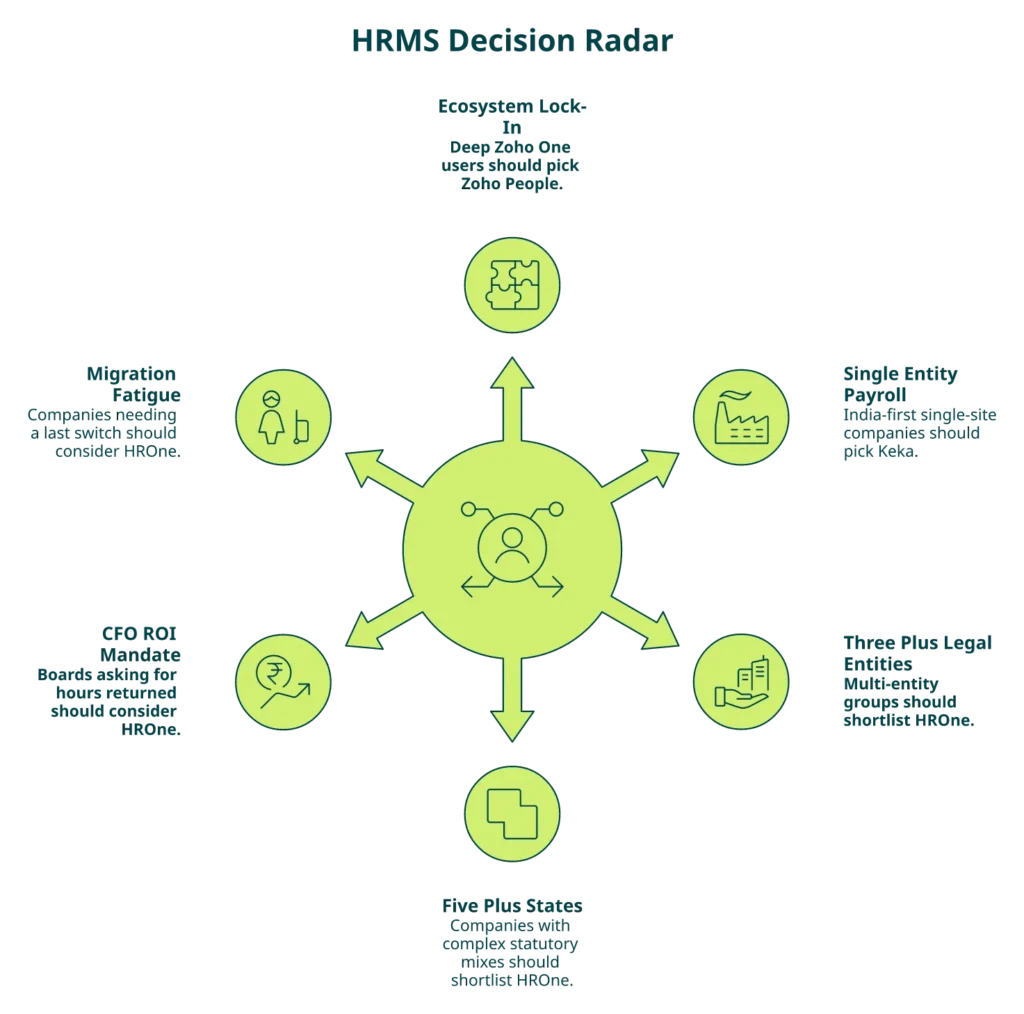
Decide on three axes: legal-entity count, payroll edge-case depth, and ecosystem lock-in. Single-entity companies deep in Zoho One should stay with Zoho People. Single-entity India-first payrolls should look at Keka. Multi-entity, multi-state, or CFO-ROI-led buyers should put HROne at the top of the shortlist, because the architecture answers those questions without workarounds.
The decision matrix you can actually use
| Buyer profile | Headcount | Entities | States | Recommended pick | Why |
|---|---|---|---|---|---|
| Zoho One native, simple payroll | 200 to 400 | 1 | 1 to 2 | Zoho People + Zoho Payroll | Ecosystem already wired |
| India-first single entity, payroll-heavy | 300 to 800 | 1 | 1 to 3 | Keka | Bundled payroll, surface polish |
| Multi-entity mid-market IT services | 500 to 1,500 | 2 to 4 | 3+ | ITES HR | Native multi-entity, Super Inbox |
| Shift-based manufacturing group | 800 to 2,000 | 3+ | 5+ | manufacturing HR | 127 workflows, offline attendance |
| BFSI with POSH and audit intensity | 500 to 1,500 | 2+ | Multi | finance HR | Consolidated statutory dashboard |
| CFO-led consolidation, ROI mandate | 200 to 2,000 | Any | Any | CXO solutions | ROI Dashboard in rupees |
Three questions to ask on Monday morning
Before your next vendor call, answer these three questions in writing. They cut through 80 percent of the noise in an RFP. For a structured lens, see our how to choose HRIS HRMS software guide.
- ⏰ How many state notifications hit our payroll in a year, and who applies them today? If the answer involves three spreadsheets, and one tired payroll manager, the tool that pushes state updates natively wins.
- 💰 When the vendor starts billing, and when we actually process our first live payroll, what is the gap? Multiply that gap by your PEPM and your headcount. That is your “paying for air” number.
- ✅ What number will our CFO ask for in the first board review post go-live? If it is “hours returned to HR”, only the tool with an ROI dashboard can answer that on day one.
Where Keka and Zoho People honestly win
I am not going to pretend HROne is the right answer for every buyer, because it is not. ⭐ Keka wins when you want a clean single-entity India HRMS with bundled payroll and a polished mobile app, and you are fine with email-based support. ⭐ Zoho People wins when you already run Zoho Books, Zoho CRM, and Zoho Recruit, because the ecosystem value is real, and the marginal adoption cost is low. Those are both rational choices. Pick them without guilt when your context matches. For head-to-head specifics, our HROne vs Keka page and HROne vs Zoho People page break the tradeoffs down further.
Where HROne is the honest answer
Working with 2,000+ HR teams, what I’ve felt is that the moment you cross three legal entities, five states, or 800 employees, the workflow gap outgrows the feature gap. That is the zone where we built HROne to compound, with a prior-HR SPOC carrying a 9.8 NPS, and 1,500+ brands live. If your 2026 roadmap sits inside that zone, it is worth a 30-minute conversation before you sign a multi-year Keka or Zoho contract. See the why HROne breakdown for the architectural argument.
Not sure which HRMS fits your 2026 reality?
Answer six questions and see a fit score across HROne, Keka, and Zoho People for your exact headcount, entity spread, and state mix.
Get my HRMS fit scoreQ10. Keka vs Zoho People FAQs for Indian HR leaders
❓ Does Zoho People include Indian payroll?
No. Zoho People is the HR module and does not run Indian payroll natively. You need a separate Zoho Payroll subscription priced at ₹1,000 per organisation per month for 25 employees on Standard, or ₹4,000 per month on Premium that bundles leave, and attendance. Payroll edge cases flow through that second product. For a cleaner single-suite alternative, see our payroll software.
❓ Is Keka cheaper than Zoho People?
For a single entity, Zoho People alone is cheaper, starting around ₹48 per user per month. Once you add mandatory Zoho Payroll and multi-entity needs, Keka’s bundled pricing at roughly ₹70 to ₹85 PEPM usually lands lower over a 3-year TCO for 300 to 1,000 employee bands. Use our salary calculator to test your own CTC impact.
❓ Which handles multi-state professional tax better?
Both support multi-state professional tax (PT) slabs. Keka applies them per legal entity in one tenant. Zoho People plus Zoho Payroll typically runs them inside Zoho Payroll, which means per-entity configuration when you have multiple registrations. Groups with three or more entities report cleaner state-notification handling when the policy engine sits in one instance. See our professional tax slab rates reference.
❓ Can Keka handle three legal entities?
Yes. Keka’s organisational-unit model supports multiple legal entities with separate PF, ESI, and TDS registrations in one tenant. Cross-entity employee transfers preserve history. The known limit is consolidated group statutory reporting, which still needs CSV exports and a spreadsheet for many users. For a deeper comparison of multi-entity readiness, see core HCM.
❓ How long does a Keka or Zoho People implementation take?
Keka implementations for 300 to 800 employee single-entity setups run 30 to 75 days when scope is tight. Zoho People, for Zoho-native customers, goes live in 20 to 45 days. Multi-entity rollouts for either stretch to 90 to 120 days, and G2 reviewers flag delays tied to support backlogs during that window. Compare this to our onboarding process timeline.
❓ Which has the better mobile app?
Keka’s mobile app is broadly rated stronger on polish, and core ESS flows. Zoho People’s mobile app gets mixed feedback, with users noting limited feature parity against the web version. For shift-based manufacturing or field teams, offline attendance sync is the real test, not screen count. See our mobile HR app for the offline-first build.
❓ Does either support the 2026 Indian wage-code?
Both vendors have published wage-code readiness notes covering the basic-50% rule, 2-day FFS timeline, and revised gratuity thresholds under the Code on Wages, 2019. Depth of automation varies. Confirm by running a sandbox test on your own CTC structures, not by relying on marketing collateral. Our navigating labor laws primer covers the operational angle.
❓ What is the HROne alternative, in one line?
HROne is the India-first, mobile-native HCM that replaces tab-switching with a Super Inbox closing 110+ tasks in three clicks, bundles payroll plus performance plus engagement in one suite, meters subscription only after go-live, and ships India’s first inbuilt ROI Dashboard so the CFO sees savings in rupees. See the HR inbox and the ROI calculator for proof points.
What I’m thinking about next
What I think we’ll see in the next two years is a quiet convergence. Every India HRMS will claim wage-code readiness, every suite will ship an AI assistant, and every pricing page will hide an add-on. The real differentiator will stop being the feature list, and start being the operating rhythm: how many hours the tool returns to your HR team per month, measured honestly. If you want to test that claim on your own data, send me the three hardest payroll scenarios your current HRMS cannot close in one click, and I will tell you what HROne does differently. That is the conversation worth having.
References
Official Docs / Indian Statutes
- Ministry of Labour and Employment, “Code on Wages, 2019, state rules,” Notification 2019.
- Income Tax Department, “Rule 31 and Form 16 retention, Income Tax Rules, 1962” Published: 1962.
- National Payments Corporation of India, “Name match API for bank validation” Published: 2024.
Blogs
- Keka Technologies. “Multi-entity configuration documentation.”
- Zoho Corporation. “Zoho People multi-organisation setup.”
- Zoho Corporation. “Zoho Payroll India pricing.” Published: May 2026.
- Zoho Corporation. “Zoho People India pricing.” Published: May 2026.
- Keka Technologies. “Keka pricing and documentation.” Published: 2026.
- HROne. “Product overview and customer proof.” Published: 2025.


















 Secures Top Spot in
