







Q1. Darwinbox vs Keka in 120 Seconds: Quick Verdict and Who This Guide Is For
Pick Darwinbox if you are a 2,000-plus employee Indian enterprise that values module breadth over rollout speed. Pick Keka if you are a 200 to 800 employee firm that wants surface polish and transparent plan pricing. Pick HROne if you want both, without paying PEPM (per-employee-per-month) subscription during a five-month rollout.
✅ Who wins for which buyer
| If your reality looks like this | The honest pick | Why in one line |
|---|---|---|
| 500 to 5,000 employees, multi-entity, billing sensitivity, 30-day go-live | HROne | Super Inbox, flat PEPM, subscription meters only after go-live |
| 2,000-plus employees, RFP pre-qualified by Gartner, module breadth | Darwinbox | Deep enterprise modules, strong G2 enterprise fit score |
| 100 to 800 employees, SMB payroll simplicity, plan-based pricing | Keka | Slick PF and ESI automation, published Foundation, Strength, and Growth plans |
I have sat in enough RFP rooms to know that most CHROs arrive at a comparison page with a half-formed preference, a bruised procurement budget, and a DPO (Data Protection Officer) whispering about DPDP. The goal of this guide is to turn that three-way confusion into a clean call by Monday.
📌 Who this guide is for
This is written for CHROs, CFOs, CIOs, and HR Ops leads running 500 to 10,000 employee Indian businesses in IT/ITeS, BFSI, manufacturing, logistics, healthtech, retail, and real estate. It assumes you already run some HR software, you have a Frankenstein stack hiding behind it, and you are evaluating Darwinbox or Keka (or both) as your next platform. If your headcount is below 200 and single-entity, the trade-offs in this guide will feel heavier than your reality. Read it anyway for the procurement clauses in section ten.
💡 What you should do after reading
Shortlist two vendors max, insist on a go-live-billing clause in writing, and bring the compliance grid from section four into your demo. Everything else is noise.
Q2. Who Are Darwinbox and Keka, and How Did They End Up on Every Indian RFP in 2026?
Darwinbox is the 2015 Hyderabad-born HCM that grew into a unicorn by selling enterprise breadth to 800-plus large customers across Asia, and is the only India-founded vendor cited repeatedly in Gartner’s HCM coverage. Keka is also a 2015 Hyderabad story, but it climbed the opposite ladder, winning 8,000-plus SMB and mid-market customers with clean plan-based pricing and surface UX polish.
🏢 Darwinbox in one paragraph
Founded in 2015 by Jayant Paleti, Chaitanya Peddi, and Rohit Chennamaneni, Darwinbox is headquartered in Hyderabad with offices across APAC and the Middle East. It raised Series D funding at unicorn valuation in 2022, and currently serves 800-plus enterprise customers covering more than three million users, including brands like Kotak Life, Tokopedia, and Max Life. Its positioning is clear: the India-built enterprise HCM that wants to displace SAP SuccessFactors and Oracle HCM in Asia.
🏢 Keka in one paragraph
Keka, founded the same year by Vijay Yalamanchili, also operates out of Hyderabad and is bootstrapped (with a single large round from WestBridge Capital in 2022). It serves 8,000-plus customers, skewing heavily toward 50 to 800 employee firms, and publishes its pricing openly as Foundation, Strength, and Growth plans, which is rare in the Indian HRMS market. Keka’s pitch has always been “good software with clean UX at a fair price” rather than enterprise muscle.
📊 Snapshot comparison
| Attribute | HROne | Darwinbox | Keka |
|---|---|---|---|
| Founded | 2016 | 2015 | 2015 |
| HQ | Noida | Hyderabad | Hyderabad |
| Funding stance | Bootstrapped by Uneecops | Unicorn, VC-backed | Primarily bootstrapped |
| Customers | 1,500-plus Indian brands | 800-plus enterprise | 8,000-plus SMB to mid-market |
| Core positioning | High-velocity hire-to-retire OS | Enterprise HCM breadth | SMB-to-mid-market polish |
| Typical deal size | 200 to 5,000 employees | 1,000 to 20,000 employees | 50 to 800 employees |
| Go-live benchmark | 30 days (MR DIY India) | 90 to 150 days | 45 to 90 days |
🧭 Why both names keep surfacing
Darwinbox rides the Gartner halo. Every large enterprise RFP in India lists it by reflex. Keka rides the SEO halo. Type “HR software India” into Google and you meet Keka on page one. Most buyers do not realise that their shortlist was shaped by two different forms of gravity, not by a deliberate evaluation.
🎯 What this means for your RFP
If you are running a 1,000-plus employee enterprise, weight Darwinbox against HROne on implementation speed and billing alignment, not brand. If you are running a 300 to 800 employee firm, weight Keka against HROne on multi-entity depth and support responsiveness, not price-per-seat. The rest of this guide pressure-tests both axes.
Q3. Module-by-Module: How Do Darwinbox and Keka Compare on Core HR, Payroll, Attendance, Recruitment, Performance, Engagement, and Expense?
Features are a commodity in 2026. Depth is not. Darwinbox wins on module breadth for 2,000-plus enterprises. Keka wins on payroll UX and attendance polish for sub-800 firms. HROne closes the gap both leave open, a single Super Inbox that collapses 110 daily tasks into three-click closures across every module.
📊 The master depth matrix (scored 1 to 5, higher is deeper)
| Module | HROne | Darwinbox | Keka |
|---|---|---|---|
| Core HR | 5 | 5 | 4 |
| Payroll (India statutory) | 5 | 4 | 4 |
| Attendance, Leave, Timesheet | 5 | 4 | 5 |
| Onboarding and Recruitment | 5 | 4 | 4 |
| Performance and OKR | 4 | 5 | 3 |
| Engagement and Pulse | 4 | 4 | 3 |
| Expense, Asset, Travel | 5 | 3 | 4 |
| Workflow Automation | 5 | 4 | 3 |
| Analytics and Reporting | 5 | 4 | 4 |
| Mobile ESS | 5 | 4 | 4 |
🧱 Core HR
Core HR is the employee master, the org structure, and the letter factory. HROne holds one unified employee record with 127 pre-built workflows across the full lifecycle, from requisition to full-and-final settlement (F&F). Darwinbox matches on breadth for multi-country OU (organisation unit) hierarchies. It forces HR Ops to jump between tabs to close common tasks. Keka keeps Core HR simple, which helps single-entity firms and hurts multi-entity ones.
💰 Payroll depth
HROne runs a zero-touch payroll engine. It validates PF, ESI, PT, LWF, and TDS against the latest Indian statutory slabs on every run. The same engine handles FBP (Flexible Benefits Plan) declarations and mid-year CTC revisions cleanly. Darwinbox shipped a 100% digital payroll upgrade in late 2024 that automates audit trails, but configuration still leans on a consultant. Keka automates SMB payroll beautifully at single-entity scale. Buyers repeatedly flag edge-case pain when the entity count rises or incentive structures get complex.
“Payroll not getting processed due to RBI regulations. No option to add monthly incentive separately. CA raised a concern that tax figures deducted in the last FY vs the amounts reflecting on system now are different.”
— Pooja M., Keka User Keka – G2 Verified Review
🕒 Attendance, leave, and timesheet
Keka is the category reference for clean attendance UX. Its mobile app is frequently cited as an adoption win. Darwinbox handles multi-shift manufacturing attendance at scale, but customers note sluggishness under bulk loads. HROne ships real-time biometric sync, geofenced mobile punch, offline attendance, and approval flows that live inside the Super Inbox, backed by its attendance management engine.
“Real-time sync of biometric timings is available. Calculation of comp off on weekly off working is up to the mark. Salary processing has been done in simpler 3 steps without error.”
— Ajay K., HR Leader HROne G2 – Verified Review
🎯 Onboarding and recruitment
HROne’s One AI Suite stacks CVs by resume relevancy score. It also generates JDs, interview kits, and offer letters from a single screen. Darwinbox’s recruitment module is full-featured, and its own customers describe a learning curve. Keka Hire is lightweight and fine for firms hiring 50 people a year, and thin for volume recruiting. For context on where HROne AI fits in the hiring funnel, see the One AI overview.
📈 Performance and OKR
Darwinbox leads here. Its calibration, 9-box, and competency framework depth is the deepest in the Indian HCM space, and enterprise PMS teams genuinely like it. Keka’s PMS is frequently flagged by its own customers as confusing, which is a pattern not a one-off.
“PMS module is confusing and needs to be simpler and easier to use. User access is difficult for employees who do not have an email ID.”
— Kiran B., HR Leader Keka – G2 Verified Review
HROne sits a shade below Darwinbox on PMS depth. It compensates with automated bell curves that compress appraisal cycles to 15 days, which is what mid-market CHROs actually need. See how the performance management module stitches this together.
❤️ Engagement, pulse, and expense
Darwinbox and HROne both ship pulse surveys, recognition walls, and communication feeds. Keka’s engagement surface is thinner. On expense, HROne’s receipt parser AI auto-reads invoices, extracts GST, and flags duplicate claims before approval. Finance teams running reimbursement on paper call this the single most valuable AI feature in the stack. Keka offers expense and reimbursement functionality, and reviewers call out a missing department-wise budget for travel claims. Darwinbox is the thinnest of the three on expense and travel.
⚙️ Workflow automation, analytics, and mobile ESS
HROne’s 127 pre-built hire-to-retire workflows plus HRV Studio (a low-code app builder) let HR teams ship a visitor or vendor module without raising a developer ticket. Darwinbox’s workflow engine is configurable, with heavier consultant dependency. Keka’s engine is the least flexible of the three, confirmed by multiple customer complaints about rigid customisation.
“Customisation required as per company policy finding difficult to incorporate. There should be a report generator.”
— Prem K., HR Professional Keka – G2 Verified Review
All three ship mobile apps. Only HROne and Keka ship apps employees actually open daily. Darwinbox’s app is full-featured, and reviewers flag sluggishness under bulk data. Explore the mobile HR app experience for field and hybrid teams.
What my experience of shipping HROne tells me is this: CHROs weight recruitment and PMS in demos. The modules that decide adoption a year later are attendance, leave, and the inbox that sits on top of every workflow. Score those three hardest.
Q4. Who Wins on Indian Statutory Compliance, PF, ESI, PT, LWF, TDS, Code on Wages, Gratuity, and F&F?
Both Darwinbox and Keka claim full Indian statutory coverage on paper, and both genuinely handle the nine common pillars, PF, ESI, Professional Tax, Labour Welfare Fund, TDS/Form 16/24Q, Code on Wages readiness, Gratuity, Bonus, and Full-and-Final settlement. The gap opens on multi-entity consolidation, state-wise Professional Tax nuance, and DPDP Act 2023 data-fiduciary artefacts. That gap is where the rollout either survives or breaks.
📋 The 2026 statutory grid
| Statutory pillar | HROne | Darwinbox | Keka |
|---|---|---|---|
| Provident Fund (PF) filings | ✅ Automated | ✅ Automated | ✅ Automated |
| ESI coverage and filings | ✅ Automated | ✅ Automated | ✅ Automated |
| Professional Tax (state-wise) | ✅ Full state coverage | ✅ Full state coverage | ✅ Full, slab-mapping flagged by users |
| Labour Welfare Fund (LWF) | ✅ Full state coverage | ✅ Full state coverage | Partial (state gaps reported) |
| TDS, Form 16, 24Q filings | ✅ Automated | ✅ Automated | ✅ Automated |
| Code on Wages 2019 readiness | ✅ Ready | ✅ Ready | Partial |
| Gratuity, Bonus Act, F&F | ✅ New two-day F&F rule supported | ✅ Supported | Partial (two-day F&F under configuration) |
| DPDP Act 2023 data-fiduciary | ✅ Consent artefact + audit trail | Partial | Partial |
| ISO 27001 / SOC 2 posture | ✅ ISO 27001, SOC 2 Type II | ✅ ISO 27001, SOC 2 | ✅ ISO 27001 |
For deeper reading on the moving parts, see the statutory compliance in payroll primer, along with the ESI contribution calculation guide and the state-wise Professional Tax slab rates reference.
🧭 India’s statutory churn, and vendor regulatory lag
Working with 2,000-plus HR teams, what I’ve felt is that Indian statutory updates are not a quarterly event, they are a fortnightly one. A PF wage cap amendment, a new PT slab in Karnataka, a 24Q format change from the Income Tax department, these land with 30-day notice, and the vendor’s update velocity decides whether you are compliant or not. The Code on Wages 2019 two-day full-and-final rule (section 17(1)) is the latest example. Buyers should ask each vendor for the exact release date when their platform shipped this rule. I have seen mid-market CHROs eat three months of manual reconciliation because their vendor took a full quarter to ship a single PT slab update.
🛡️ Listed-company audit trail and maker-checker
For listed Indian companies or their subsidiaries, the statutory bar rises. You need SOX-equivalent maker-checker controls on payroll changes, an immutable audit trail for every salary revision, and RBAC (Role-Based Access Control) granularity that passes an internal audit without a single screenshot. Darwinbox ships strong audit logs, and configuration is consultant-heavy. Keka’s audit trail is functional, and customers flag RBAC constraints, especially for dotted-line managers. HROne’s workflow audit log plus group payout validation is built for pan-India listed-company audits, and our 127 pre-built workflows enforce maker-checker on every approval step by default.
“Proper calculation of PF and ESI was a pain area for us before, but now with the HROne automated calculation process, results are up to the mark and following Indian tax compliances properly.”
— Ajay K., HR Leader HROne G2 – Verified Review
🎯 The Monday-morning checklist
- Ask each vendor for the release date when they shipped the Code on Wages two-day F&F rule.
- Ask for the statutory-update SLA in writing: how many working days from notification to production release.
- Ask for a live demo of a multi-entity payroll run with three different Professional Tax states in a single cycle.
- Ask for the DPDP consent artefact and the cross-border transfer register as part of the RFP response, not after signing.
If a vendor cannot produce the first two in writing, your compliance risk is higher than your feature risk, regardless of which logo you pick. For a deeper walkthrough, keep the payroll audit checklist handy before you sign.
Q5. How DPDP Act 2026-Ready Are Darwinbox and Keka for Enterprise Data Governance?
Every Darwinbox vs Keka comparison skips the single question your Data Protection Officer will ask first: can the vendor produce a DPDP Act 2023 consent artefact, a cross-border transfer register, and a 72-hour breach notification workflow on day one? Both vendors are ISO 27001 certified and partially DPDP-aligned, but neither ships the full data-fiduciary stack out of the box in 2026.
⚠️ The question nobody is asking in the demo
Indian DPOs I have spoken with in the last six months all say the same thing. The DPDP Act 2023, now fully enforceable through 2025 rules, treats your HRMS as a data fiduciary, not a passive processor. That shift changes the evaluation criteria entirely. It is no longer enough for a vendor to show you a privacy policy PDF and an ISO badge. Your DPO needs proof that consent is captured with a timestamp, purpose is limited on record, and breach notification to the Data Protection Board can clock within 72 hours. Our primer on employee data privacy best practices covers the baseline every Indian CHRO should demand.
🛡️ The five DPDP obligations your HRMS must satisfy
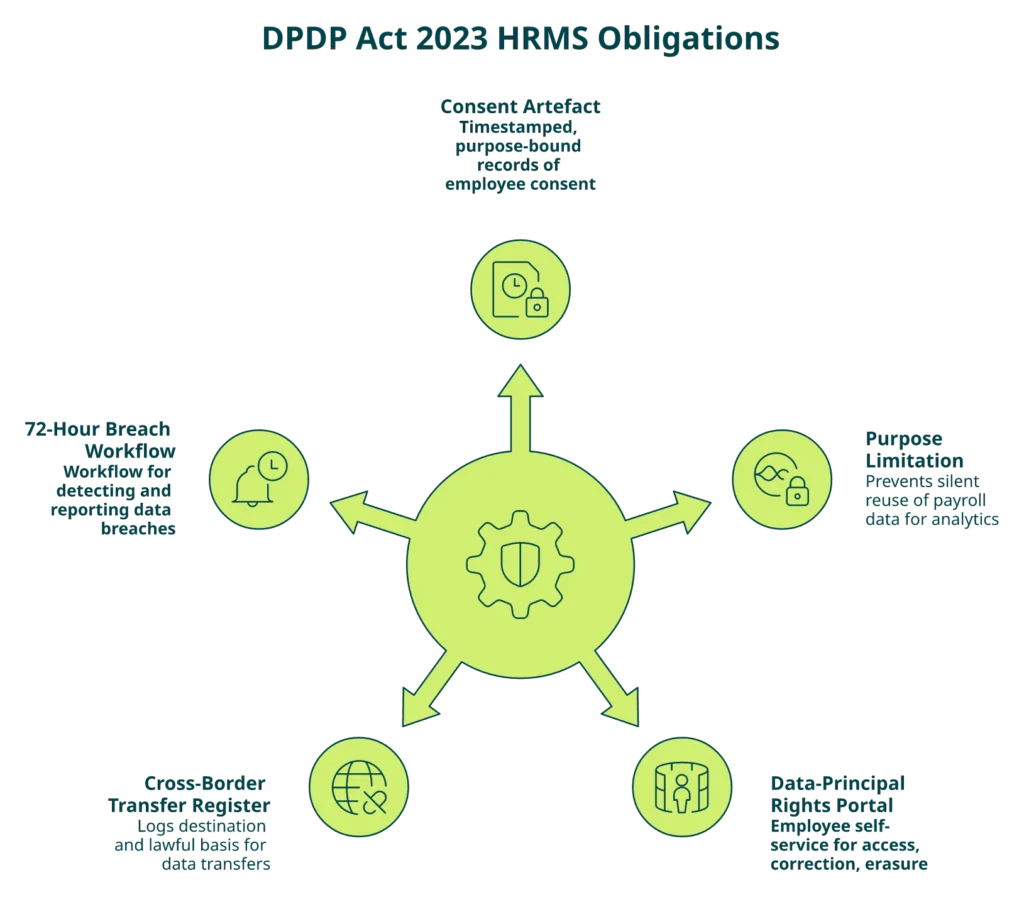
For an Indian enterprise running 500 to 10,000 employees, five obligations matter most in an RFP:
- Consent artefact. A timestamped, purpose-bound consent record for every data-principal (employee), retrievable on demand.
- Purpose limitation. Data collected for payroll cannot be silently reused for analytics or third-party enrichment without fresh consent.
- Data-principal rights portal. Employees must be able to access, correct, and request erasure of their personal data from a self-service screen.
- Cross-border transfer register. If the HRMS hosts data outside India or passes it to an international parent, the transfer destination and lawful basis must be logged.
- 72-hour breach reporting workflow. A defined runbook, owner, and system trigger from detection to Data Protection Board notification.
📊 How each vendor stacks up
| DPDP obligation | HROne | Darwinbox | Keka |
|---|---|---|---|
| Consent artefact with audit trail | ✅ Built-in workflow | ⚠️ Partial, configurable | ⚠️ Partial, manual setup |
| Purpose limitation controls | ✅ Module-level RBAC | ✅ RBAC, consultant-led | ⚠️ Coarse RBAC |
| Data-principal rights portal | ✅ Employee self-service | ⚠️ Via ticket flow | ⚠️ Via ticket flow |
| Cross-border transfer register | ✅ India-hosted by default | ⚠️ Multi-region hosting | ✅ India-hosted |
| 72-hour breach workflow | ✅ Runbook + SPOC | ⚠️ Documented, process-heavy | ⚠️ Documented |
| ISO 27001 + SOC 2 Type II | ✅ Both | ✅ Both | ✅ ISO 27001 |
🧭 The honest reading
Darwinbox has the deepest enterprise security posture of the three and multi-region hosting that is useful for global parents, but that same architecture triggers the cross-border transfer register requirement your DPO will ask about. Keka keeps data in India, which simplifies one clause, but its RBAC and data-principal rights flows are thinner than what a listed company’s audit committee expects. HROne ships a DPDP-aligned consent flow, an employee self-service rights portal, India-only hosting by default, and a dedicated HR SPOC who is trained to run the 72-hour breach runbook with you, not at you. For teams running regulated BFSI operations, see how our finance HR stack handles audit trails end to end.
My current thinking is this: DPDP readiness is going to separate serious vendors from marketing-first ones over the next 18 months. Ask for the consent artefact sample in the RFP, not after signing. Teams managing distributed workforces should also reference our cross-border compliance tools guide when shaping the RFP.
Q6. What Do G2 and Enterprise Buyers Actually Say About Darwinbox and Keka Adoption?
G2 data shows Darwinbox winning on enterprise fit (9.9 of 10) and Keka winning on payroll-feature satisfaction, but both vendors lose reviewers on implementation pain and support responsiveness. HROne’s published G2 scores on Ease of Setup (9.5), Ease of Admin, and Quality of Support (9.6) lead the three-way comparison, and the verbatim reviews from real HR Ops leaders explain why. Browse the customer success stories for context on how these scores translate into rollouts.
📊 The adoption scorecard
| G2 dimension (out of 10) | HROne | Darwinbox | Keka |
|---|---|---|---|
| Ease of Use | 9.5 | 8.5 | 9.2 |
| Ease of Setup | 9.5 | 7.8 | 8.6 |
| Quality of Support | 9.6 | 8.4 | 8.7 |
| Meets Requirements | 9.3 | 9.0 | 9.1 |
| Enterprise Fit | 8.9 | 9.9 | 7.1 |
💬 The Keka story: migration pain and support gaps
The Keka review pattern is consistent across the last 24 months. Customers love the interface in the demo, then hit a wall during migration and policy configuration. Support, delivered through email threads and a chat window, struggles to close tickets under complex Indian payroll realities. For a deeper head-to-head, see the HROne vs Keka comparison.
“We started working with Keka HRMS in August, and to this day, we have been unable to implement the tool in our company due to their consistently delayed responses and poor coordination between their internal teams.”
— Divya P., HR Professional Keka – G2 Verified Review
“I have been a Keka user since 2021, and the service is decreasing day by day. The other day I was trying to configure menstrual leave only for Bangalore location and needed some help, the chat was not at all helpful. Most of the times folks behind the chat window is not fully aware of the functionality.”
— Verified User in Consulting Keka – G2 Verified Review
💬 The Darwinbox story: breadth versus everyday friction
Darwinbox customers praise the module breadth and mobile app, then flag slowness under bulk loads, support that is not always responsive, and workflows that need consultant-led changes. For a side-by-side, see the HROne vs Darwinbox breakdown.
“Bad implementation experience, bad UI UX, configurations getting broken in production on its own due to product deployments, terrible customer service. Basically everything.”
— Verified User in Computer Software Darwinbox – G2 Verified Review
“Darwinbox is a great tool to work but have some drawbacks like transitioning from the old system to Darwinbox is quite difficult. User interface of Darwinbox is very outdated. Darwinbox Support team is not supportive.”
— Ankush B., HR Professional Darwinbox – G2 Verified Review
🎯 Why adoption risk is the metric nobody prices
Working with 2,000-plus HR teams, what I have felt is that adoption risk is the line item every RFP forgets and every CFO pays for later. If 40% of managers never open the HRMS, every module you paid for becomes Excel with extra steps. The G2 signal that actually predicts adoption is Quality of Support, because slow support equals abandoned workflows equals shadow spreadsheets. See why CHROs weight this dimension heavily in our HRIS buyer pitfalls guide.
Q7. How Do Implementation Timelines and Change-Management Risk Compare Between Darwinbox and Keka?
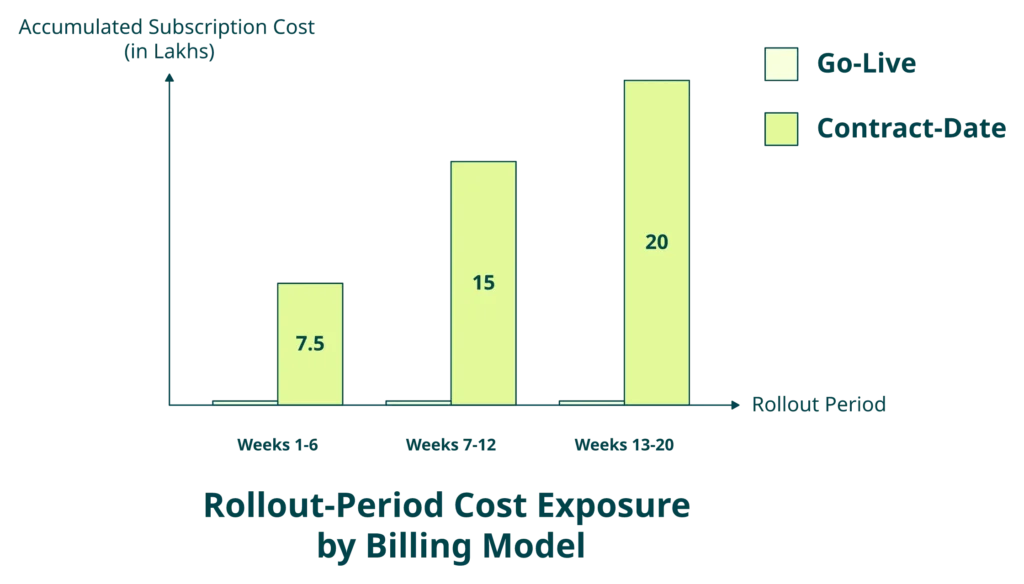
The capsule: Expect a 90 to 150-day Darwinbox rollout and a 45 to 90-day Keka rollout for a 1,000-employee Indian enterprise, with both vendors billing from the contract date rather than go-live. HROne’s public benchmark is 30 days (MR DIY India) with subscription meters only after go-live, which removes the financial penalty of a slow rollout and re-aligns vendor incentive with your success.
⏰ The rollout timeline, week by week
| Milestone | HROne typical | Darwinbox typical | Keka typical |
|---|---|---|---|
| Week 1: Scoping, data mapping | Done | Done | Done |
| Week 2 to 4: Data migration | Near-complete | In progress | In progress |
| Week 5 to 8: Policy configuration | UAT starts | Configuration | Configuration |
| Week 9 to 12: UAT + manager training | Live in select BUs | UAT | UAT, go-live |
| Week 13 to 20: Go-live + stabilisation | Stabilised | Go-live + fixes | Stabilisation |
| Billing starts | After go-live | From contract signing | From contract signing |
The slow-rollout, full-billing trap is the single biggest hidden cost in enterprise HRMS procurement. A 2,000-employee firm paying Rs. 250 PEPM from day one of a 120-day rollout leaks roughly 20 lakh in pre-go-live subscription with zero value captured. Most CHROs never model this line item. Use the ROI calculator to quantify this leakage before you sign.
👥 Change-management hours nobody budgets
Research on enterprise SaaS rollouts consistently finds HR and IT teams under-budget change management by 30 to 40%. For a 1,000-employee Indian enterprise, you should plan for approximately:
- 120 to 180 hours of HR Ops configuration time over the rollout
- 4 to 6 manager training sessions of 90 minutes each
- 2 to 3 communication waves for employee adoption
- 40 to 60 hours of payroll parallel-run validation
Darwinbox rollouts typically demand the upper end of each bracket because of consultant-led configuration. Keka rollouts are lighter on hours, and heavier on email-thread support wait-time, which is an equally real cost. Our best onboarding practices piece walks through how to compress these cycles.
🎯 The “prior HRs as implementers” difference
This is the part where I am admittedly biased, so treat it as experience, not evidence. At HROne, we staff onboarding with consultants who have previously run HR Ops teams, not project managers reading from a checklist. The intuition is simple. When a consultant has run a PF reconciliation at month-end themselves, they configure your payroll differently than someone who has not. See how this shows up in our onboarding process.
“The delivery team has expertise, energetic and helpful during configuration phase. Real-time sync of biometric and mobile mark punch functionality available. Arrear day calculation is correct.”
— Deepak K., HR Leader HROne G2 – Verified Review
Working with 2,000-plus HR teams, what I have felt is this: the implementation partner’s domain fluency decides whether your go-live happens in 30 days or 130 days. Ask for the onboarding consultant’s resume in the RFP.
Q8. Which HRMS Delivers Better AI Workflows, Analytics, and Day-to-Day HR Ops for 2026?
Darwinbox and Keka have both shipped AI features in the last 18 months, mostly as assistants bolted onto existing modules. The category shift in 2026 is from AI-as-feature to AI-as-operating-system, and that is where the HR manager’s Monday actually changes. HROne’s InboxForHR plus One AI Suite collapses 110 daily tasks into three-click closures from a single screen, and the G2 reviews confirm the productivity lift.
❌ The Before: a 110-task day across tabs and threads
A typical HR Ops lead at a 1,000-person Indian firm logs into five screens before lunch. Darwinbox customers describe toggling between attendance, leave, performance, and helpdesk modules, each with its own navigation pattern. Keka customers describe chasing approvals through email threads because the platform does not surface pending work as a task queue. Recruiters re-read the same 80 CVs because the system has no relevance scoring. Finance re-keys receipts because expense is manual. Every handoff is where time and accuracy leak. Explore how AI automation in recruitment changes this for hiring teams.
✅ The After: AI inside an Inbox, not inside a menu
The practical 2026 shift is to move HR from a database you visit, to an inbox that finds you. In this model, every pending task, approval, or exception surfaces in a Gmail-style queue with three-click closure. AI does four things quietly in the background:
- Resume relevancy scoring: stacks the most relevant CVs on top so recruiters read 12 instead of 80.
- Receipt parser: reads invoices, extracts GST, flags duplicates, and catches expense fraud pre-approval.
- AI letter generator: drafts confirmation, PIP, and promotion letters in the right tone, pre-populated with employee fields.
- Anomaly detection: flags a PF contribution that broke a slab change, or an attendance pattern that does not match policy.
CFOs evaluating the expense side should also review our AI detecting expense fraud guide.
“The InboxforHR is a game-changer, centralizing every HR task into one simple inbox, cutting down administrative time by 60 to 70% and preventing tasks from falling through the cracks.”
— Waldon S., HR Leader HROne G2 – Verified Review
“The well-known Inbox For HR has resolved many of our issues. It allows users to manage multiple tasks from a single window, eliminating the need to switch between different modules. Searching for information is as simple and efficient as using Google.”
— Vignesh J., HR Leader HROne G2 – Verified Review
🌉 The Bridge: why the Gmail analogy is not marketing
The reason InboxForHR works is not the AI underneath it. It is the interaction pattern employees already know. A 26-year-old manager does not need to learn a new navigation tree, because Gmail taught them the pattern 12 years ago. Darwinbox and Keka put AI inside modules, which means users still have to know which module to open. HROne puts tasks inside an inbox, which means the software finds the user. That is the architectural difference that decides Monday-morning adoption. Our take on the broader shift is in AI in HR hype vs reality.
What I think we will see in the next two years is this: every serious HRMS will collapse into an inbox-style OS. The ones that do not will keep winning demos, and losing adoption.
Still stuck between Darwinbox and Keka?
See why 1,500-plus Indian brands picked HROne over both, go live in 30 days, pay only after go-live, and close 110 daily HR tasks from one Inbox.
Book a 20-minute walkthrough Or see the HROne vs Darwinbox deep-dive
Q9. Darwinbox vs Keka vs HROne: Which Is the Right High-Velocity HCM for Enterprise India?
If Darwinbox sells breadth and Keka sells polish, HROne sells velocity. The three-way choice for an Indian enterprise buyer in 2026 is not about feature checklists. It is about which platform turns HR from a backlog into a function that compounds. Darwinbox carries the enterprise halo. Keka carries the SMB simplicity. HROne pairs depth and simplicity with a go-live billing model, InboxForHR, and a founder-led implementation philosophy that shortens rollout to 30 days in real deployments. See how this plays out on the HROne vs Darwinbox page and the HROne vs Keka page.
⭐ Pillar 1: Go-Live Financial Alignment
The single biggest hidden tax in Indian HRMS procurement is paying full subscription during implementation. Darwinbox and Keka both start billing from the contract date, which means a 120-day rollout bleeds four months of PEPM (per-employee-per-month) subscription with zero adoption. HROne reverses that incentive. Subscription meters only after go-live. That one clause changes how every downstream decision gets made, because the vendor now has skin in the game to finish the rollout fast, not to stretch it. Model the leakage using our ROI calculator and compare against our pricing page.
MR DIY India, a 20-plus unit retail operation, went live on HROne in 30 days, and collapsed their payroll cycle from 10 days to 5 or 6 days immediately after. Asia Healthcare Holdings runs 20 pan-India units on a single HROne instance with multi-legal-entity configuration, which is the exact scenario where Keka buyers hit the multi-entity ceiling, and Darwinbox buyers pay for custom configuration.
⭐ Pillar 2: InboxForHR, not another dashboard
Darwinbox and Keka both ship dashboards. A dashboard is a place you visit; an inbox is a place that finds you. InboxForHR surfaces every pending approval, employee request, exception, and letter trigger in one Gmail-style queue that closes tasks in three clicks. HR managers report 60 to 70% reductions in administrative time because they stop toggling between five modules.
“InboxforHR is a game-changer, centralizing every HR task into one simple inbox, cutting down administrative time by 60 to 70% and preventing tasks from falling through the cracks.”
— Waldon S., HR Leader HROne G2 – Verified Review
Around the Inbox sits the rest of the operating system: 127 pre-built hire-to-retire workflows covering requisition, onboarding, confirmation, transfer, promotion, and exit; the One AI Suite with resume relevancy scoring, receipt parsing, and an AI Employee Agent; HRV Studio for low-code custom apps when HR wants a visitor or vendor module without raising a developer ticket; and India’s first inbuilt ROI Dashboard that calculates lifetime hours saved against average HR salary.
⭐ Pillar 3: Founder-led implementation, not a project checklist
This is the part I am admittedly biased about, so read it as experience, not evidence. When we staff onboarding with consultants who have previously run HR operations themselves, rollouts happen differently. A consultant who has personally closed a PF reconciliation at month-end configures your payroll the way you need it, not the way the manual reads. The 9.8 NPS on our dedicated HR SPOC is the operational proof. See the end-to-end onboarding process, and the why HROne rationale for this model.
“The delivery team has expertise, energetic and helpful during configuration phase. Real-time sync of biometric and mobile mark punch functionality available. Arrear day calculation is correct.”
— Deepak K., HR Leader HROne G2 – Verified Review
“The system itself sends reminders to me to complete them on time. If any detail is missing in the policy or an employee profile, it doesn’t allow the process to move forward until the checklist is fully completed.”
— Bindu P., HR Professional HROne G2 – Verified Review
🎯 The last-switch aspiration
CHROs I meet are tired of migration cycles. What they really want is a last switch, backed by a CFO-ready ROI number. That is where the ROI Dashboard earns its keep, because it calculates savings in rupees, and closes the boardroom question before it gets asked. See how CHRO solutions tie this together. My current thinking is that velocity, not breadth, will decide the 2026 Indian HRMS winner.
Still stuck between Darwinbox and Keka?
See why 1,500-plus Indian brands picked HROne over both, go live in 30 days, pay only after go-live, and close 110 daily HR tasks from one Inbox.
Book a 20-minute walkthrough Or see the HROne vs Darwinbox deep-dive
Q10. What Questions Should You Ask in Your Darwinbox vs Keka RFP Before You Sign?
The capsule: The feature list is table stakes; the contract clauses decide whether your rollout survives. Before you sign either Darwinbox or Keka (or any HRMS), get written answers to the 12 procurement questions below. Skip this step, and you will pay for it in month three. For a deeper buyer’s primer, see the how to choose HRIS HRMS software guide.
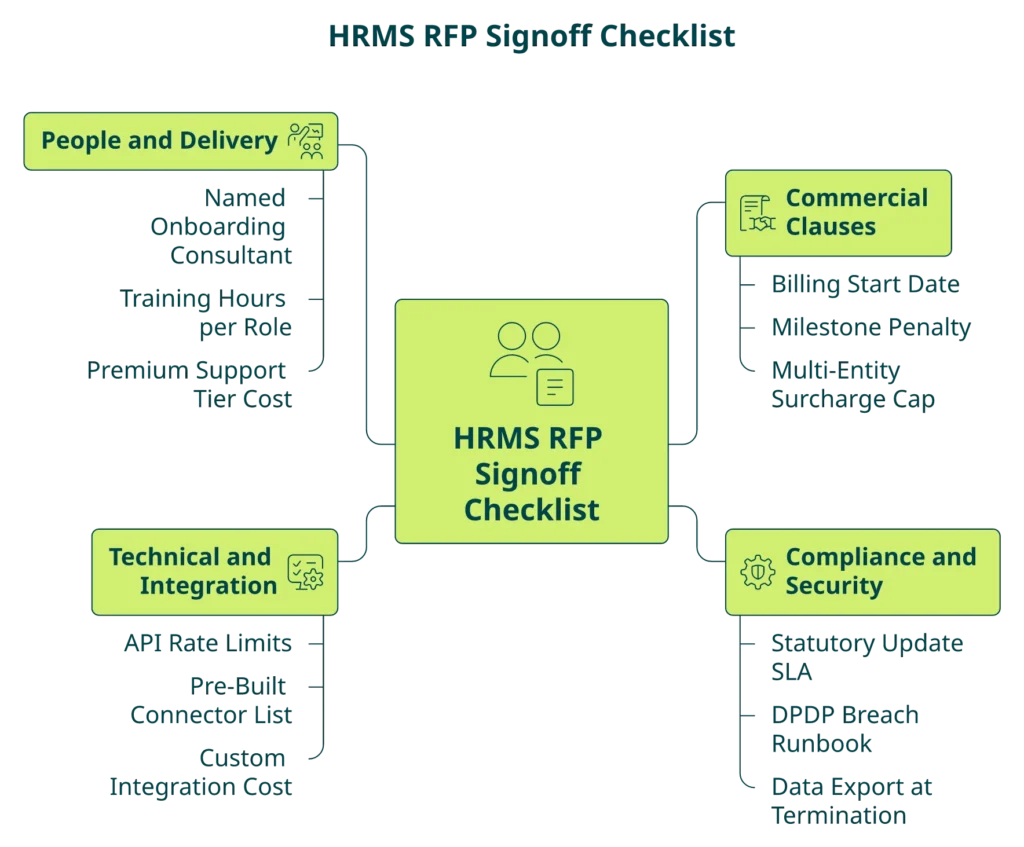
📋 The 12-question RFP checklist
- When does billing start? Ask for a clause that meters subscription from go-live, not from contract date. Get the go-live definition in writing with a named signoff event.
- What is the implementation milestone penalty? If the vendor misses a milestone by more than 15 days, what is the credit back to you? A vendor that refuses this clause has no confidence in its delivery timeline.
- What is the multi-entity surcharge? Some vendors charge per legal entity on top of PEPM. Get a flat cap in writing for up to 20 entities at a minimum.
- What does a custom report cost? Ask for the per-report charge, and whether the first 10 custom reports are bundled. This is where scope creep bleeds budget quietly.
- What are the API rate limits? Integration with Tally, SAP, Oracle NetSuite, and BGV vendors needs predictable throughput. Ask for calls per minute per endpoint. Review the integrations scope before you sign.
- What is the DPDP breach notification SLA? Your Data Protection Officer needs a 72-hour runbook with a named vendor owner.
- What does premium support cost? If 9-to-6 support is baseline, price the 24×7 tier and the named SPOC upgrade separately. See the helpdesk module for context on in-platform support flows.
- What is the data export clause at termination? You should get full data export in CSV and XLSX, with employee records, payroll history, and audit logs, within 10 working days of termination. Get the format list written in.
- What is the statutory update SLA? Ask how many working days from a government notification (PF cap change, new PT slab, or 24Q format) to production release. A credible answer is 10 to 15 working days. Cross-check against our payroll audit checklist.
- What is the integration marketplace scope? Get a named list of pre-built connectors (ERP, ATS, LMS, BGV, SSO, and SCIM), and the custom integration cost if something is missing.
- How many training hours are included? Ask for hours per role (HR Ops, manager, and employee), and whether train-the-trainer sessions are bundled or billed. See how this shows up in our manager solutions workflow.
- Who is the onboarding consultant? Ask for the named resource, and the number of prior Indian HRMS rollouts they have led. Their domain fluency decides your timeline.
🎯 One invitation, no hard sell
Tell us what you are evaluating. We will share the RFP template we use with 1,500-plus Indian brands, along with the exact clauses that have protected them from hidden-cost surprises during and after rollout. Start the conversation on our contact page, or book a slot on the demo page.
References
Official Docs / Indian Statutes
Ministry of Electronics and Information Technology, “Digital Personal Data Protection Act, 2023,” Notification Date: August 11, 2023.
Ministry of Labour and Employment, “Code on Wages, 2019,” Notification Date: August 8, 2019.
Employees’ Provident Fund Organisation, “EPF Contribution and Compliance Circulars,” Published: 2024.
Income Tax Department, India, “Form 24Q Quarterly TDS Statement and Form 16 Guidelines,” Published: 2024.
Blogs
G2. “Darwinbox HCM Reviews,” Published: 2024-2025. [Secondary source]
G2. “Keka Reviews,” Published: 2024-2025. [Secondary source]
G2. “Uneecops HROne Reviews,” Published: 2024-2025. [Secondary source]
HROne. “MR DIY India Success Story,” Published: 2024. [Secondary source]
HROne. “Why HROne,” Published: 2024. [Secondary source]
HROne. “InboxForHR Product Page,” Published: 2024. [Secondary source]
HROne. “HROne vs Darwinbox Comparison,” Published: 2024. [Secondary source]
HROne. “HROne vs Keka Comparison,” Published: 2024. [Secondary source]



















 Secures Top Spot in
