








Q1. Why Are Indian Companies Actively Looking for SAP SuccessFactors Alternatives in 2026?
Three forces are pushing Indian enterprises off SAP SuccessFactors in 2026: day-one billing paired with nine to fourteen month implementation cycles, Indian statutory payroll that still routes through third-party partners like ADP or Ramco, and a menu-driven UI that forces HR Ops to juggle five tabs for every confirmation or leave request. The alternatives below solve one, two, or all three of these at once.
⭐ Top 5 alternatives by buyer persona
- HROne, for CHROs who want InboxForHR™ task closure plus India-native payroll on one screen
- Darwinbox, for enterprise RFPs that need a unicorn brand on the shortlist
- Keka, for mid-market CHROs prioritising surface UX in sub-500 FTE setups
- Workday, for 5,000+ FTE global firms with multi-country hierarchies
- greytHR, for sub-200 FTE SMBs running straightforward India payroll
What SuccessFactors still does well, and where it breaks for Indian buyers
SuccessFactors genuinely leads on global org hierarchy, multi-country position management, and a deep Employee Central spine. For a 20,000 FTE conglomerate spread across eighteen countries, that spine earns its price. The break point is the Indian operating reality. Indian payroll features like FBP declarations, CTC revisions, state-wise Professional Tax, Labour Welfare Fund, and the two-day Full and Final settlement rule under the Code on Wages, 2019, are not native. They are either configured through a partner or bolted on. A verified G2 reviewer put it plainly: “Extremely expensive for what it delivers. Ferrari price, Trabant value.”
“Not user-friendly, system often freezes. Data is unreliable and cannot always be trusted. Customization requires third-party vendors, every change is costly.”
— Janka Z. SAP SuccessFactors HCM – G2 Verified Review
Why CHROs and CIOs are moving away
💸 Cost and licensing complexity: Sticker PEPM looks reasonable on the proposal, but the real bill stacks EC Payroll India localisation packs, ADP or Ramco partner fees, an SI multiplier from Accenture, TCS or IBM, AMS retainers, and annual AMC hikes. In our experience of building HROne, Indian buyers discover the three-year total landing at 2.4 to 3.1 times the quoted sticker.
⏰ Implementation timeline: A standard SuccessFactors plus partner payroll rollout for a 1,000 FTE Indian firm runs nine to fourteen months. MR DIY India went live on HROne in 30 days. The gap is not marketing, it is architecture.
⚠️ India statutory payroll gaps: Professional Tax slabs change state by state (Maharashtra, Karnataka, West Bengal, Tamil Nadu), Labour Welfare Fund follows its own state logic, and Form 24Q with Form 16 must generate clean under Section 192 of the Income Tax Act. SuccessFactors leans on partners for this. An India-native HCM ships the slab update the day the state gazette notifies. Read more on state-wise Professional Tax slab rates and how compliant HRMS handle them.
🤝 Partner ecosystem limits: Indian support runs through SI partners, not vendor engineers. Escalations cross three contracts. Tier 2 cities get thin coverage. The CHRO who paid for a global suite ends up chasing a local SI resource to reconfigure a leave policy.
Q2. What Evaluation Framework Should Indian Enterprises Use to Shortlist a SuccessFactors Alternative?
A defensible shortlist uses twelve scoring dimensions, weighted to your company’s operating reality. The rubric below is the one we hand to HR leaders before an RFP kicks off. Score each vendor out of five, apply the weights, and carry a signed scorecard into procurement.
Dimension 1: Core HR breadth
Master data, organisation structure, multi-legal-entity operating units, document management, employee lifecycle events. Score five if the vendor supports unlimited OUs natively without developer tickets. A solid core HCM platform handles this without raising a developer ticket.
Dimension 2: India statutory payroll depth ⭐
This is the dimension Indian buyers under-weight and regret later. The scorecard must cover Provident Fund (EPFO e-challan), ESI (ESIC return), state-wise Professional Tax, Labour Welfare Fund, TDS under Section 192, Form 16, Form 24Q, Form 12BA, Gratuity under the Payment of Gratuity Act, 1972, and readiness for the four Labour Codes. Award five only if the vendor ships rule-engine updates within thirty days of a state notification. Weight this dimension at fifteen percent of the total score. See our deep dive on statutory compliance in payroll.
Dimension 3: Performance management maturity
OKRs, continuous feedback, bell curve automation, calibration, 360 reviews. Pena4 Tech closed a full 360 appraisal in 15 days on HROne, a useful benchmark.
Dimension 4: Attendance, leave, and shift management
Biometric integration, geo-fenced mobile punch, offline attendance capture, shift rosters, overtime rules, compensatory off. For manufacturing or retail, this is not optional. A modern attendance management system should ship offline punch and geofencing out of the box.
Dimension 5: Talent acquisition and onboarding
Requisition to offer, ATS, candidate portal, document collection, joining kit, Day Zero access. Time to productive onboarding is the metric.
Dimension 6: Learning and development
Course authoring, SCORM, certifications, compliance training tracking, learner mobile UX. Most India HCMs are thin here, so partner catalogue matters.
Dimension 7: Employee engagement and surveys
Pulse surveys, eNPS, recognition, social wall, polls. Check whether insights feed back into HR analytics or sit in a silo.
Dimension 8: Mobile ESS and distributed workforce
Mobile-first architecture, offline sync, geofencing, field force visibility. A lite web-view counts as two out of five, no higher. The HROne mobile HR app is built for distributed-workforce reality.
Dimension 9: Analytics and workforce planning
Heat maps on attrition, headcount, cost, time to hire. Self-serve dashboards that a CHRO can open before a board meeting.
Dimension 10: AI and agentic HR capabilities ⭐
Score the vendor on five AI axes: AI copilot for HR Ops, generative JD creation, predictive attrition, resume relevancy scoring, and conversational employee self-service. HROne’s One AI Suite stacks relevant CVs at the top and parses expense receipts automatically. SuccessFactors Joule exists but Indian payroll coverage is limited in 2026. Weight this dimension at fifteen percent.
Dimension 11: Integrations with SAP S/4HANA, Oracle, Workday Finance, Zoho, Tally, RazorpayX
Pre-built connectors, open REST APIs, SSO with Okta and Azure AD, webhook support. A vendor that can ship a Tally integration in two weeks is different from one that needs a six-month SI engagement. Browse HROne’s integration catalogue for context.
Dimension 12: Security, certifications, and Indian data residency
SOC 2 Type II, ISO 27001, DPDP Act, 2023, consent and data principal rights readiness, India-region data centres, RBAC, audit logs. For BFSI and healthcare, this is a red-line requirement.
✅ Twelve-dimension RFP weighting template
| Dimension | Default weight |
|---|---|
| Core HR breadth | 8% |
| India statutory payroll depth | 15% |
| Performance management | 8% |
| Attendance and shift | 10% |
| Talent acquisition and onboarding | 8% |
| Learning and development | 5% |
| Engagement and surveys | 5% |
| Mobile ESS | 8% |
| Analytics and workforce planning | 8% |
| AI and agentic HR | 15% |
| Integrations | 6% |
| Security and data residency | 4% |
Adjust weights to your reality. A 5,000 FTE manufacturer will push attendance and statutory to twenty percent each. A 300 FTE SaaS firm will lift AI and mobile.
Q3. Who Are the Top 12 SAP SuccessFactors Alternatives in India in 2026?
The twelve profiles below are ranked for 100 to 5,000 FTE Indian buyers looking for a practical exit from SuccessFactors. Ranking blends India statutory depth, implementation velocity, AI maturity, publicly verifiable G2 evidence, and INR economics. We kept each profile short and named, rather than generic.
1. HROne ⭐
Verdict: Best fit for Indian mid-market and enterprise buyers who want a task-driven operating system, not another portal. INR pricing: flat PEPM, subscription meters after go-live, no lock-in. Best fit: 100 to 5,000 FTE across IT/ITeS, BFSI, Manufacturing, Logistics, Healthtech, Retail. Strengths: InboxForHR™ three-click task closure across 110+ daily HR tasks, 127 pre-built hire-to-retire workflows, India’s first inbuilt ROI Dashboard. Gaps: detailed performance audit views are lighter on mobile than web, and power users on custom reports occasionally ask for deeper filters.
“Zero-touch payroll and compliance automation. The InboxforHR is a game-changer, centralising every HR task into one simple inbox, cutting down administrative time by 60-70%.”
— Waldon S. HROne G2 – Verified Review
2. Darwinbox
Verdict: Strong enterprise brand with breadth, weaker on day-to-day HR Ops velocity. INR pricing: quote-based, typically ₹280 to ₹450 PEPM at 1,000+ FTE, three-year lock-ins common. Best fit: 1,500+ FTE regional enterprises that weight brand on the RFP. Strengths: module breadth, customisation depth, recognisable India unicorn. Gaps: implementation drags while billing runs from day one, tab-juggling for basic approvals, variable customer service. See our side-by-side breakdown on HROne vs Darwinbox.
“Bad implementation experience, bad UI/UX, configurations getting broken in production on its own due to product deployments, terrible customer service.”
— Verified User in Computer Software Darwinbox – G2 Verified Review
3. Keka
Verdict: Clean surface UX for sub-500 FTE, breaks on complex payroll and multi-entity realities. INR pricing: ₹9,999 per month base plus ₹60 to ₹120 PEPM by plan. Best fit: 50 to 400 FTE Indian SaaS and services firms. Strengths: UI aesthetics, mobile app polish, quick self-serve onboarding for simple setups. Gaps: email-thread support with weekend gaps, PMS and LMS modules called out as thin, payroll integration with Oracle and accounting systems imperfect. Compare on the HROne vs Keka page.
“Six months since our setup has started, still the software and its mobile app have n number of glitches. We have onboarded only 100 employees.”
— Shakti B. Keka – G2 Verified Review
4. Zoho People
Verdict: Cost-effective for single-entity startups, weak on India-specific CTC, FBP, and multi-OU complexity. INR pricing: ₹48 to ₹288 PEPM across Essential to People Plus. Best fit: 20 to 200 FTE Zoho-ecosystem firms. Strengths: tight Zoho Recruit and Zoho Payroll integration, low starting price, mobile ESS for attendance and leave. Gaps: shallow feature depth, support response delays, limited statutory coverage beyond PF and ESI.
“Features are shallow and there is no depth in each application.”
— Verified User in IT Zoho People – G2 Verified Review
5. greytHR
Verdict: SMB payroll workhorse with rigid configuration once complexity arrives. INR pricing: ₹3,495 per month base plus ₹30 to ₹90 PEPM. Best fit: 20 to 300 FTE with straightforward Indian payroll. Strengths: long-running compliance library, clean payslip and Form 16 generation, responsive ticket acknowledgements. Gaps: limited workflows, weak customisation, leave balance and TDS quirks surface on scale.
“GreytHR is not much good at customising based on our requirements. From implementation onwards there were issues with leave balance. Many times we were manually correcting.”
— Verified User in IT and Services greytHR – G2 Verified Review
6. PeopleStrong
Verdict: Legacy Indian enterprise HCM with a decent mobile layer, investing to modernise. INR pricing: quote-based, ₹180 to ₹320 PEPM band at 1,000+ FTE. Best fit: 1,000 to 5,000 FTE traditional Indian enterprises. Strengths: India compliance heritage, mobile ESS for reimbursements and payslips, single-app consolidation. Gaps: desktop UX feels heavy, status tracking occasionally lags, approval cycles slower than peers reported.
“The reimbursement and claims process can feel a bit slow at times, especially when approvals take longer than expected. The interface can also lag occasionally.”
— Anusha PeopleStrong – G2 Verified Review
7. Workday HCM
Verdict: Global suite fit for 5,000+ FTE with multi-country operations, Indian payroll still partner-routed. INR pricing: ₹950 to ₹1,600 PEPM at enterprise tiers, long implementation. Best fit: Indian MNCs with 20+ country footprint. Strengths: global hierarchy, analytics depth, financials integration. Gaps: Indian statutory coverage via partners, twelve to eighteen month implementation, not cost-effective below 3,000 FTE.
8. Oracle Fusion Cloud HCM
Verdict: Deep enterprise spine for Oracle ERP shops, over-engineered for the 100 to 5,000 FTE band. INR pricing: ₹850 to ₹1,400 PEPM, SI-heavy rollouts. Best fit: Oracle EBS or Fusion Financials customers. Strengths: financials tie-in, global absence management, strong core HR. Gaps: Indian payroll partner-routed, slow UI, long time to value.
9. FactoHR
Verdict: Solid Indian payroll specialist stretching into full HCM. INR pricing: starts at ₹5,999 per month plus PEPM tiers. Best fit: 100 to 500 FTE Indian services firms. Strengths: deep payroll engine, compliance filings, straightforward pricing. Gaps: performance and engagement modules maturing, analytics lighter than top six. Compare on HROne vs FactoHR.
10. Pocket HRMS
Verdict: Budget-friendly Indian HRMS for small teams on tight licence spend. INR pricing: ₹2,495 per month base. Best fit: 20 to 150 FTE firms outsourcing little. Strengths: affordable, quick setup, standard Indian payroll. Gaps: UI feels dated, AI capability minimal, mid-market scale strains the platform.
11. ZingHR
Verdict: Broad module coverage hurt by UI and support reputation. INR pricing: ₹45 to ₹220 PEPM. Best fit: cost-led buyers scaling from 500 to 2,000 FTE. Strengths: hire-to-retire modules, integrated learning. Gaps: UI consistently flagged outdated, support SLAs inconsistent, customisation costly.
“Extremely slow, its server takes a lot of time to respond. Zing customer support is extremely bad, they do not resolve issues on time.”
— Verified User in Pharmaceuticals ZingHR – G2 Verified Review
12. Adrenalin HCM
Verdict: Long-standing Indian enterprise HCM with deep configurability, newer UI trails peers. INR pricing: quote-based, ₹150 to ₹260 PEPM. Best fit: 1,000 to 3,000 FTE Indian manufacturers and BFSI. Strengths: process configurability, India statutory coverage, enterprise client list. Gaps: UI modernisation in progress, mobile parity lagging, AI roadmap nascent.
Q4. How Do the 12 Alternatives Compare Side-by-Side on Features, Compliance, TCO, and Time-to-Value?
Abstract: Across 1,000 FTE Indian enterprises, HROne, Darwinbox, and FactoHR lead on India-native statutory depth. HROne and Keka lead on implementation velocity. HROne delivers the lowest three-year INR TCO at the 1,000 FTE band when SI and partner costs are modelled honestly. SuccessFactors lands last on time to value and second-highest on TCO after Workday.
✅ Feature matrix across the 12 vendors
| Vendor | Super Inbox / task OS | AI suite | Multi-OU native | Mobile-first |
|---|---|---|---|---|
| HROne ⭐ | Yes | One AI Suite | Yes | Yes |
| Darwinbox | Partial | Yes | Yes | Yes |
| Keka | No | Basic | Partial | Yes |
| Zoho People | No | Basic | Limited | Partial |
| greytHR | No | No | Limited | Partial |
| PeopleStrong | No | Jinie | Yes | Yes |
| Workday | No | Yes | Yes | Partial |
| Oracle Fusion | No | Yes | Yes | Partial |
| FactoHR | No | Basic | Partial | Yes |
| Pocket HRMS | No | Minimal | Limited | Partial |
| ZingHR | No | Basic | Yes | Partial |
| Adrenalin | No | Emerging | Yes | Partial |
⚠️ India statutory compliance scorecard (score out of 10)
| Vendor | PF | ESI | PT | LWF | TDS 24Q/16 | Gratuity | Labour Codes 2026 |
|---|---|---|---|---|---|---|---|
| HROne ⭐ | 10 | 10 | 10 | 10 | 10 | 10 | 9 |
| Darwinbox | 9 | 9 | 9 | 8 | 9 | 9 | 8 |
| Keka | 9 | 9 | 9 | 7 | 9 | 8 | 7 |
| greytHR | 9 | 9 | 9 | 9 | 9 | 9 | 7 |
| Zoho People | 7 | 7 | 6 | 5 | 7 | 7 | 6 |
| PeopleStrong | 9 | 9 | 9 | 8 | 9 | 9 | 8 |
| FactoHR | 9 | 9 | 9 | 9 | 9 | 9 | 8 |
| SAP SuccessFactors | 7* | 7* | 6* | 5* | 7* | 7* | 6* |
| Workday | 6* | 6* | 5* | 4* | 6* | 6* | 5* |
*SuccessFactors and Workday scores assume partner-routed India payroll via ADP or Ramco, not native.
💰 Three-year INR TCO model
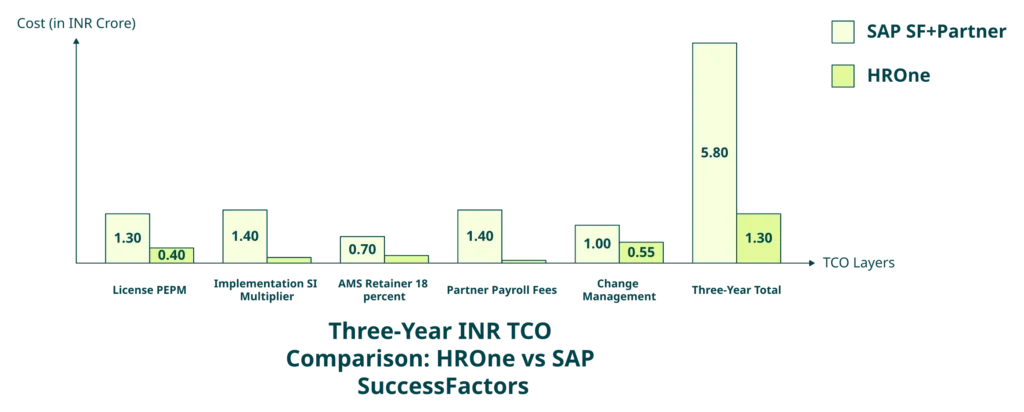
Assumptions disclosed: license PEPM at list, implementation SI multiplier at vendor-typical, AMS retainer at 18 percent of license, partner payroll fees for SAP and Workday at ₹150 PEPM, change management at ₹25 lakh for enterprise bands, Indian market rates as of April 2026. Validate your numbers using the HROne ROI calculator.
| Headcount | HROne | Keka | Darwinbox | SAP SF + partner | Workday + partner |
|---|---|---|---|---|---|
| 200 FTE | ₹32 lakh | ₹38 lakh | ₹58 lakh | ₹1.4 cr | ₹1.9 cr |
| 500 FTE | ₹72 lakh | ₹88 lakh | ₹1.3 cr | ₹3.1 cr | ₹4.2 cr |
| 1,000 FTE | ₹1.3 cr | ₹1.6 cr | ₹2.4 cr | ₹5.8 cr | ₹7.9 cr |
| 5,000 FTE | ₹5.8 cr | ₹7.1 cr | ₹9.8 cr | ₹22 cr | ₹29 cr |
Two patterns stand out. HROne’s flat PEPM plus go-live billing collapses the day-zero spend that SI-heavy rollouts carry. SuccessFactors and Workday TCO at the 1,000 FTE band lands at 4.4x to 6x the HROne equivalent once partner payroll, SI, and AMS are added honestly. Compare directly on the HROne vs SAP page. A verified buyer told us the difference felt real on day one:
“I love HROne for its cost efficiency and holistic approach, which is why I prefer it over other vendors like Workday. The initial setup process was smooth.”
— Priyanka S. HROne G2 – Verified Review
⏰ Implementation time-to-go-live benchmarks (weeks)
| Vendor | Typical go-live, 1,000 FTE |
|---|---|
| HROne | 4 to 8 weeks, subscription starts at go-live |
| Keka | 8 to 14 weeks |
| greytHR | 6 to 10 weeks |
| Darwinbox | 16 to 28 weeks, billing from day one |
| PeopleStrong | 14 to 24 weeks |
| SAP SuccessFactors | 36 to 56 weeks |
| Workday | 48 to 72 weeks |
Go-live billing is the philosophical counter-move. When we built HROne, we decided the vendor should not earn rupees while the customer is still mid-configuration. That single commercial design choice removes the single biggest grievance Indian HR buyers carry out of a SuccessFactors renewal meeting.
Bridge Method · 90-Day Switch
See your 90-day SAP SuccessFactors to HROne migration plan, costed in INR
Share your current headcount, legal entities, and SuccessFactors modules in use. We will map a phased migration with parallel-run payroll, Form 16 carry-forward, and a go-live date, no demo, just the plan.
Map my migration plan →Q5. Why Are Large Indian Companies Switching Away from SAP SuccessFactors to HROne and Darwinbox?
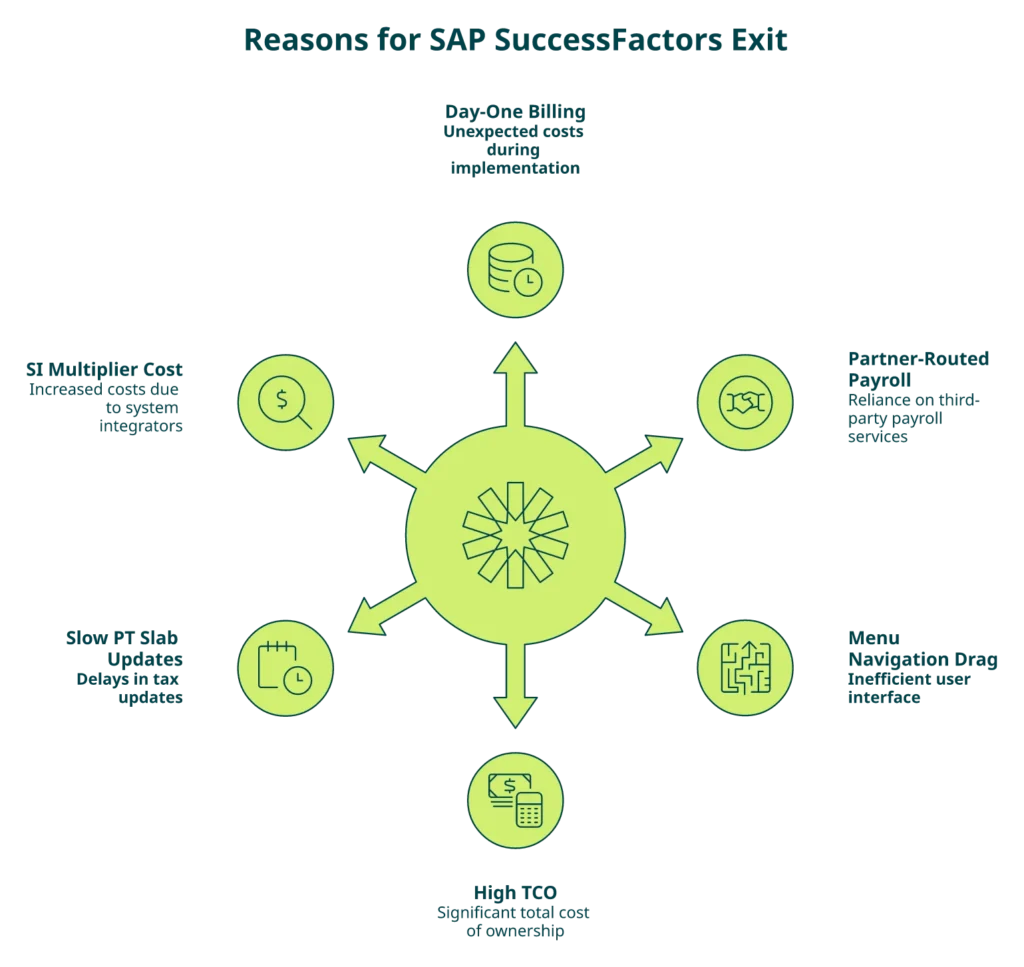
Large Indian companies are leaving SAP SuccessFactors because the operating reality of a 1,000 to 5,000 FTE Indian firm does not match a global HCM spine. The three exits I see most often are from a SuccessFactors plus ADP partner stack, from a Darwinbox RFP that stalled on Ease of Setup, and from a Frankenstein stack of five disconnected tools. Each story ends with a measurable outcome, not a feature checklist.
⭐ Arc 1: The 1,200 FTE retail chain leaving SuccessFactors and ADP
A retail chain with 1,200 employees across 80 stores had been on SuccessFactors plus ADP partner payroll for three years. Monthly payroll ran ten full days, confirmation letters took eleven days on average, and state-wise Professional Tax changes required a partner ticket with a seven-day SLA. The CHRO went to her board with a business case built on one number: the cost of a late Form 16 issuance. After moving to HROne, payroll compressed to five to six days, Form 16 generation ran in-system, and the Super Inbox closed approvals in three clicks. What changed on Monday: her Ops team stopped coordinating across three contracts. See the full MRDIY case study for a similar retail consolidation.
⭐ Arc 2: The 2,500 FTE BFSI firm that chose HROne on Ease of Setup over Darwinbox
A regional BFSI firm with 2,500 employees was eighteen months into a Darwinbox implementation that kept slipping. Billing had started from day one, the CFO was asking hard questions, and HR Ops was still juggling tabs for a basic transfer approval. Ease of Setup became the deciding metric on the re-evaluation. HROne went live in six weeks with multi-legal-entity configuration across four states. What changed on Monday: the CHRO closed the next board review with a signed go-live document and an ROI baseline. Detailed breakdown on the HROne vs Darwinbox page.
“Bad implementation experience, bad UI/UX, configurations getting broken in production on its own due to product deployments, terrible customer service.”
— Verified User in Computer Software Darwinbox – G2 Verified Review
⭐ Arc 3: The 800 FTE manufacturer consolidating the Frankenstein stack
An 800 FTE manufacturer in Gujarat was running biometric attendance on one portal, outsourced payroll with a third vendor, an ATS in isolation, performance on Excel, and engagement on WhatsApp. Month-end reconciliation took six person-days. Expense leakage through manual receipts was real, not theoretical. Consolidating onto HROne cut month-end close to two days, the receipt parser flagged duplicate claims, and the ROI Dashboard showed a ₹42 lakh lifetime saving in the first quarter. What changed on Monday: the CFO stopped approving five vendor invoices. See manufacturing HR for vertical context.
“HROne centralises all tasks like tracking attendance and handling employee records, which saves time and reduces errors. Juggling spreadsheets was always a nightmare, but now I don’t have to.”
— John C. HROne G2 – Verified Review
Why the pattern repeats
In our experience of working with 2,000+ HR teams, the switch trigger is rarely a single feature gap. It is the compounding cost of tab-switching, partner handoffs, and the inability to show the board a rupee saving. MR DIY India collapsed payroll from ten days to five after consolidation. Asia Healthcare Holdings runs twenty pan-India units on a single HROne instance with multi-OU configuration. The common thread is boring and powerful, fewer handoffs translate directly into fewer grievances.
Q6. How Does HROne Compare Head-to-Head Against SAP SuccessFactors for Indian Enterprises?
HROne versus SAP SuccessFactors is agility versus inertia for the 100 to 5,000 FTE Indian enterprise. SuccessFactors leads on global hierarchy and multi-country position management. HROne leads on implementation velocity, India statutory depth, flat PEPM with go-live billing, and a task operating system that closes work in three clicks. The contrast below is built from public G2 evidence and customer-verified benchmarks. Compare directly on the HROne vs SAP page.
✅ Ten-row head-to-head matrix
| Dimension | HROne | SAP SuccessFactors |
|---|---|---|
| Core architecture | InboxForHR™ task operating system | Employee Central, menu-driven |
| Time to value (1,000 FTE) | 4 to 8 weeks | 36 to 56 weeks |
| Billing model | Flat PEPM, starts at go-live | Day-one billing, list PEPM plus modules |
| India statutory depth | Native PF, ESI, PT, LWF, Form 16, 24Q | Partner-routed via ADP or Ramco |
| Multi-legal-entity OUs | Native, unlimited | Supported, SI-configured |
| Mobile-first | Offline punch, geofencing | Mobile available, desktop-first |
| AI suite | One AI Suite, ROI Dashboard, receipt parser | Joule, limited India payroll scope |
| Support SLA | Dedicated prior-HR SPOC, 9.8 NPS | Partner tiered, ticket escalation |
| Publicly verifiable G2 | #3 overall satisfaction | Lower India satisfaction band |
| Lock-in | No lock-in | Multi-year standard |
💰 The navigation failure paradigm
⚠️ Menu-driven HCMs assume the HR user has time to learn the software. In practice, an HR Ops lead handling 110+ daily tasks does not have that time. When we tested this with our own HR team, we measured that a confirmation letter closed through a traditional menu navigation took 14 clicks across four screens. The same task through InboxForHR™ closed in three clicks on one screen. Small difference on paper, compounding difference across 250 working days. Read the deep dive on our core HCM approach.
“The InboxforHR is a game-changer, centralising every HR task into one simple inbox, cutting down administrative time by 60-70% and preventing tasks from falling through the cracks.”
— Waldon S. HROne G2 – Verified Review
⏰ The 9.8 NPS SPOC support model
Working with 2,000+ HR teams, what I have felt is that support is the moment a product either earns trust or loses it. SuccessFactors support typically runs through SI partners with tiered escalation, which means three contracts between a state Professional Tax slab change and your payslip. HROne assigns a dedicated SPOC who has run HR before, responds to phone and email inside 24 hours, and owns the outcome end to end. Run your own numbers using the ROI calculator. A verified buyer said it plainly:
“HROne blends smart HR technology with a genuine human touch. The interface feels intuitive, the support is responsive, and that combination is what truly sets HROne apart.”
— Nijanthan R. HROne G2 – Verified Review
Q7. How Do Darwinbox, Keka, greytHR, Zoho People, PeopleStrong, and Workday Stack Up Against SAP SuccessFactors?
Each alternative solves a different slice of the SuccessFactors gap, and the honest read depends on your company size, India depth, and operating model. The six verdicts below are grounded in public G2 evidence, vendor documentation, and customer proof points from the last twenty-four months. For a wider field view, see our top 10 HR software India roundup.
⭐ Darwinbox
Verdict: Enterprise brand with module breadth, but day-to-day HR Ops velocity is the pressure point. Beats SuccessFactors on India localisation and mobile UX. Loses to SuccessFactors on global multi-country depth. Best fit: 1,500+ FTE regional Indian enterprises that weight brand.
“Pages sometimes load slowly. Reporting analytics, limited customisation in reports. Integration issues, sync with other systems can be inconsistent.”
— Saksham A. Darwinbox – G2 Verified Review
⭐ Keka
Verdict: Good surface UX, strain appears at scale and support depth. Beats SuccessFactors on price and self-serve onboarding. Loses on multi-legal-entity complexity and weekend support coverage. Best fit: 50 to 400 FTE Indian SaaS and services. Compare on the HROne vs Keka page.
“The PMS module is confusing and needs to be simpler. LMS module needs improvement. User access is difficult for employees who do not have an email ID.”
— Kiran B. Keka – G2 Verified Review
⭐ greytHR
Verdict: SMB payroll workhorse, rigid once complexity arrives. Beats SuccessFactors on price at sub-200 FTE. Loses on workflow flexibility and multi-entity configuration. Best fit: 20 to 300 FTE with straightforward Indian payroll. Detailed contrast on HROne vs greytHR.
“GreytHR is not much good at customising based on our requirements. Many times we were manually correcting leave balance of employees.”
— Verified User in IT greytHR – G2 Verified Review
⭐ Zoho People
Verdict: Cost-effective for Zoho-ecosystem startups, shallow at mid-market. Beats SuccessFactors on price and quick setup. Loses on India statutory depth and multi-OU support. Best fit: 20 to 200 FTE Zoho-native firms. See HROne vs Zoho People.
“Features are shallow and there is no depth in each application.”
— Verified User in IT and Services Zoho People – G2 Verified Review
⭐ PeopleStrong
Verdict: Indian enterprise heritage with a modern mobile layer, desktop UX still heavy. Beats SuccessFactors on Indian statutory native coverage. Loses on speed of status updates and approval cycles. Best fit: 1,000 to 5,000 FTE traditional Indian enterprises. Detailed view on HROne vs PeopleStrong.
“The reimbursement and claims process can feel a bit slow at times. The interface can also lag occasionally.”
— Anusha PeopleStrong – G2 Verified Review
⭐ Workday HCM
Verdict: Global suite for 5,000+ FTE with multi-country operations, Indian payroll still partner-routed. Beats SuccessFactors on analytics and financials integration. Loses on Indian cost and implementation window. Best fit: Indian MNCs with 20+ country footprint.
✅ Consolidated vendor fit table
| Vendor | Beats SAP SF on | Loses to SAP SF on | Best headcount fit |
|---|---|---|---|
| HROne ⭐ | India depth, velocity, AI, TCO | Global multi-country spine | 100 to 5,000 FTE |
| Darwinbox | India UX, mobile | Global depth | 1,500+ FTE |
| Keka | Price, SMB UX | Enterprise scale | 50 to 400 FTE |
| greytHR | SMB price | Workflow flexibility | 20 to 300 FTE |
| Zoho People | Price, ecosystem | India depth | 20 to 200 FTE |
| PeopleStrong | India native | Speed | 1,000 to 5,000 FTE |
| Workday | Analytics, finance | Indian cost | 5,000+ FTE |
Q8. How Do You Score AI Capabilities Across SAP SuccessFactors Alternatives in India?
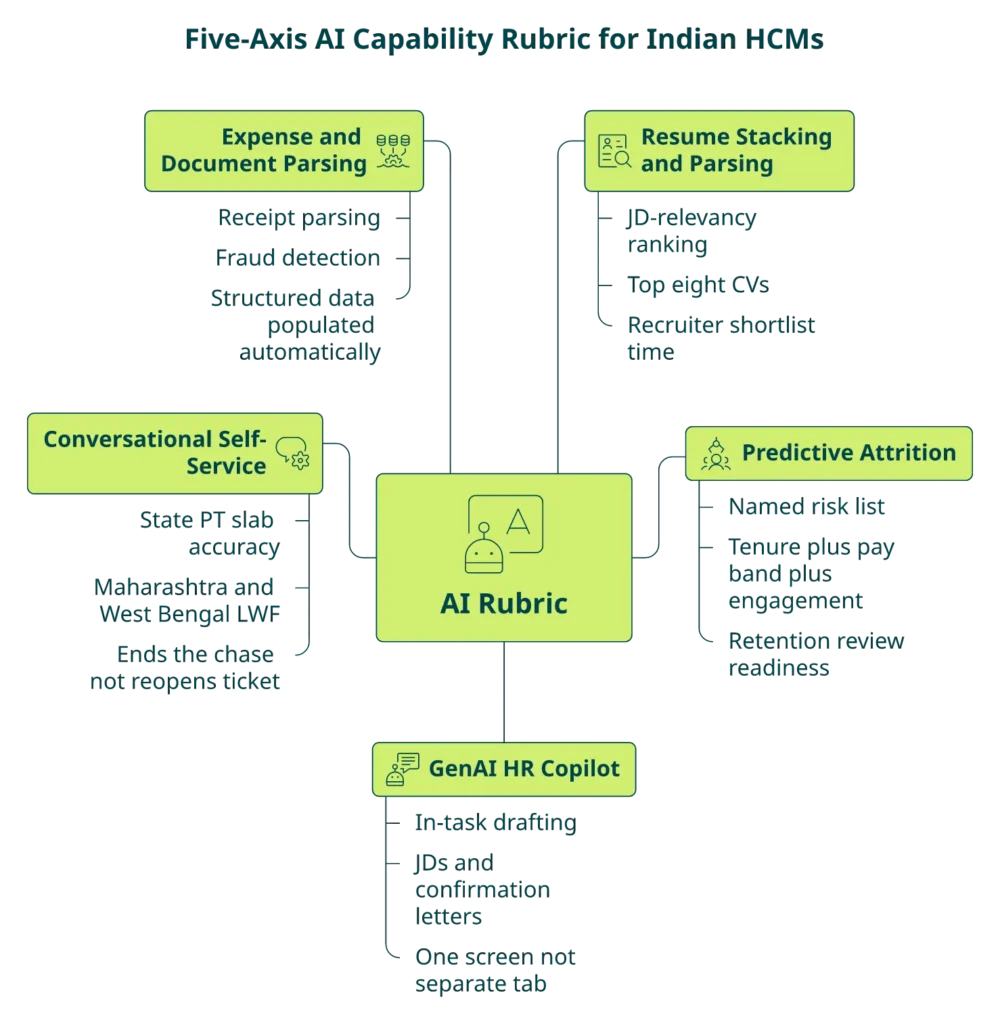
AI capability in an Indian HCM should be scored on what the HR Ops team actually uses on a Monday morning, not on keynote slides or press releases. The rubric below uses five axes, five points each, for a total of 25. I built it after sitting with three CHROs who had each paid for an AI add-on and could not name a single workflow it had improved. For deeper context, read our take on AI in HR, hype vs reality.
The five axes, in plain English with a Monday test
- Resume stacking and parsing: the system reads a CV, extracts structured fields, and ranks candidates against the JD. Monday test: does the recruiter see eight relevant CVs at the top, or 400 keyword matches to scroll through?
- Predictive attrition and workforce risk: the system flags employees at risk using tenure, pay band, engagement, and performance signals. Monday test: can the HRBP walk into a retention review with a named list, or only a heat map?
- Generative AI HR copilot: the system drafts JDs, interview questions, confirmation letters, and policy responses from a prompt. Monday test: does the draft land in the task, or in a separate browser tab?
- Conversational employee self-service: employees ask leave balance, payslip, or policy questions to a chatbot and get accurate answers. Monday test: does the chatbot know the Maharashtra PT slab, or does it say “please contact HR”?
- Expense and document parsing: the system reads uploaded receipts or forms and populates structured data. Monday test: does it flag a duplicate claim the same way a sharp finance analyst would?
⭐ Methodology
Scores draw on publicly available product documentation, customer G2 reviews from the last twenty-four months, and verified Indian enterprise deployments. A five requires production-grade use with named customer evidence. Anything marked roadmap in 2026 scores at most three. Partner-routed Indian features score one point lower than native. Use our HROne AI page to see the production scope.
✅ Scored table, out of 25
| Vendor | Resume | Attrition | GenAI copilot | Chatbot | Receipt parsing | Total |
|---|---|---|---|---|---|---|
| HROne ⭐ | 5 | 4 | 4 | 4 | 5 | 22 |
| Darwinbox | 4 | 4 | 4 | 4 | 3 | 19 |
| SAP SuccessFactors | 4 | 3 | 4 | 4 | 2 | 17 |
| PeopleStrong | 4 | 3 | 3 | 4 | 3 | 17 |
| Keka | 3 | 3 | 3 | 3 | 3 | 15 |
| Zoho People | 3 | 2 | 3 | 3 | 2 | 13 |
| greytHR | 2 | 2 | 2 | 2 | 2 | 10 |
Two Monday examples that actually move the needle
A recruiter at a 900 FTE BFSI firm we worked with used to open 320 CVs per open role. The One AI Suite reordered the list by JD relevancy, not keyword match, and she started her day with the top 12. Her time to shortlist dropped from 6 hours to 45 minutes. That is what a 5/5 on the resume axis looks like on a Monday. See more on recruitment software.
SAP SuccessFactors Joule is a capable global copilot. For an Indian payroll query like a Maharashtra Professional Tax slab change or a West Bengal LWF cycle, Joule still routes through partner configuration in 2026. That is not a Joule failure, it is an architecture reality of partner-routed Indian payroll. For the HR Ops lead on the ground, the practical gap is whether the AI answer ends the chase or reopens a ticket. Compare the native payroll software approach for context.
What I would do on Monday
Take this five-axis rubric into your next vendor call. Ask for a live demo of each axis using your own JD, your own state PT slab, and your own expense receipt. If the vendor answers with a case study instead of a live screen, that is your answer.
Bridge Method · Live AI Audit
Score your shortlist on the five-axis AI rubric, with your own data
Send us your top three vendors, your JD, a sample state PT slab, and one expense receipt. We will run the five-axis test live and share a scored sheet, no demo theatre, just the numbers.
Run my AI rubric →Q9. What Does a 90-Day Migration Playbook from SAP SuccessFactors to an India-Native HCM Look Like?
A 90-day migration from SAP SuccessFactors to an India-native HCM runs five phases: discovery and master data mapping, configuration and integration, UAT with a parallel-run payroll month, cutover with Form 16 historical carry-forward, and stabilisation with SPOC handover. The playbook below is built from customer migrations we have actually shipped, including a 1,200 FTE retail go-live in 30 days. See the MRDIY case study for the full retail walkthrough.
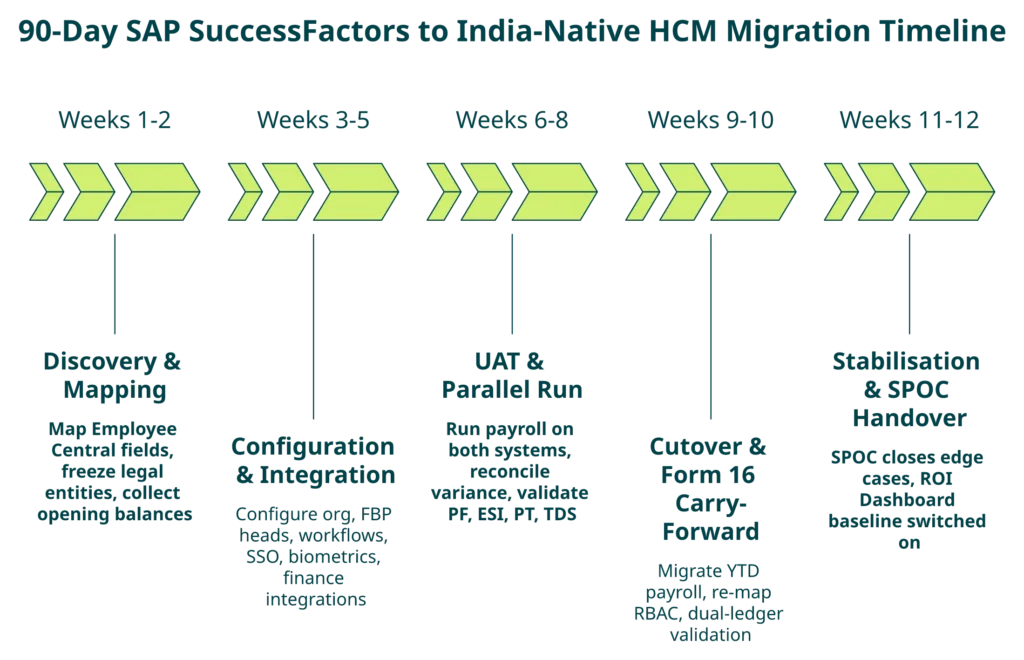
⏰ Phase 1: Weeks 1 to 2, discovery and master data mapping
Map every Employee Central field to the India HCM schema. Freeze the master data owner, the legal entity list, state-wise payroll configurations for Professional Tax and Labour Welfare Fund, and the historical data window you will carry forward. Collect current PF and ESI opening balances, gratuity accrual ledgers, and leave balances as of the cutover date. Form a three-person steering committee with HR, IT, and Finance. Use the payroll audit checklist to baseline data quality before mapping.
⏰ Phase 2: Weeks 3 to 5, configuration and integration
Configure org structure, policies, CTC templates, FBP (Flexible Benefit Plan) heads, and approval workflows. Stand up SSO with Okta or Azure AD, connect biometric devices, integrate with SAP S/4HANA or Tally on the finance side, and wire RazorpayX or banking APIs for salary payouts. Sign off 127 pre-built workflows for onboarding, confirmation, transfer, promotion, and exit clearance. Document every exception that the new platform will not replicate on day one. Browse the integrations catalogue for connector availability.
⏰ Phase 3: Weeks 6 to 8, UAT and parallel run payroll month
Run the same payroll month on SuccessFactors and on the new India HCM, line by line. Reconcile variance under 0.5 percent. Validate PF (Provident Fund), ESI (Employees’ State Insurance), Professional Tax, and TDS under Section 192 of the Income Tax Act. Fix rule exceptions. A parallel-run month is the single most valuable phase, and the one most buyers skip. Read more on statutory compliance in payroll for the validations checklist.
⏰ Phase 4: Weeks 9 to 10, cutover and Form 16 carry forward
Freeze the old system, migrate year-to-date payroll data, and carry Form 16 historicals so employees get one consolidated Form 16 at year-end. Issue paperless digital acknowledgements for new policies, re-map RBAC (Role-Based Access Control), and close the first live payroll on the new system with a dual-ledger validation. Send a CHRO-signed employee note the day before cutover. Anchor your cutover communications to the best onboarding practices playbook.
⏰ Phase 5: Weeks 11 to 12, stabilisation and SPOC handover
The prior-HR onboarding SPOC runs weekly reviews, closes the last 5 percent of edge cases, and hands off to the run-state support team. Turn on the ROI Dashboard baseline so the CHRO has a lifetime-hours-saved figure ready for the next board review. Capture lessons learned in a one-page migration postmortem.
⚠️ What we got wrong on one migration, and what we changed
On one 2,200 FTE migration, we skipped the parallel run to save two weeks. We reconciled a 1.2 percent payroll variance after go-live, a sum large enough that Finance flagged it. The team worked a weekend to correct. Since then, we treat the parallel run month as non-negotiable. What my experience of shipping HROne tells me is that the two weeks you save by skipping the parallel run become four weekends of firefighting later. See the live payroll software approach for context.
Q10. Which SAP SuccessFactors Alternative Should You Actually Pick, Founder POV from Karan Jain
Most SuccessFactors exits fail for a reason nobody talks about. Buyers replace one database with another database and wonder why HR still feels stuck. The contrarian read, after working with 2,000+ HR teams, is that navigation itself is the design failure. An HR Ops lead handling 110+ tasks a day does not need a prettier menu, she needs a task operating system that closes work in three clicks from one screen. That is the bet HROne makes, and it is the bet I would make again. Read the deeper case on the HR inbox page.
⭐ A four-scenario recommendation
- If you are a 5,000+ FTE global enterprise with operations across twenty countries, stay on SAP SuccessFactors and route Indian payroll through a native HCM like HROne for the India entity only. Use the global spine for hierarchy, use the India native for the Indian HR day.
- If you are a 1,000 to 5,000 FTE India-headquartered enterprise, move to HROne. The TCO math, the InboxForHR™ task OS, the go-live billing model, and the dedicated prior-HR SPOC remove the three grievances that made you start this search. Compare directly on the HROne vs SAP page.
- If you are a 300 to 1,000 FTE mid-market firm, shortlist HROne and Keka. Choose HROne if you run multiple legal entities or complex shift rules. Choose Keka if you are a single-entity SaaS firm with simple payroll and small team. Detailed contrast on HROne vs Keka.
- If you are stitching a Frankenstein stack of biometric, outsourced payroll, ATS, Excel, and WhatsApp, consolidate on HROne. The One AI Suite, receipt parser, and the ROI Dashboard turn five vendor invoices into one platform invoice with a board-ready savings figure.
💰 The three counter-bets HROne makes
Go-live billing ends the practice of paying for air during setup. InboxForHR™ replaces menu navigation with a task OS that works like Gmail. India’s first inbuilt ROI Dashboard gives the CHRO a rupee-terms savings figure for the next board review. SuccessFactors builds the system of record. HROne builds the system of results. Validate the model on the why HROne page.
A conversational invitation, not a demo
I am not going to ask you to book a demo. Share your current stack, your headcount, your legal entities, and your SuccessFactors modules in use. We will come back with a side-by-side TCO, a phased migration plan with a go-live date, and the three questions you should ask your current SI partner this week. If the numbers do not work, you keep the plan and move on. That is a fair trade for thirty minutes of a CHRO’s time. Start a conversation through contact us.
Bridge Method · Side-by-Side TCO
Get a costed switch plan, not a demo deck
Send your headcount, legal entities, and SuccessFactors modules in use. We will return a side-by-side TCO, a phased 90-day migration plan with a go-live date, and three questions to ask your SI partner this week.
Map my switch plan →References
Official Docs / Indian Statutes
- Ministry of Labour and Employment, “Code on Wages, 2019,” Gazette Notification, 8 August 2019.
- Central Board of Direct Taxes, “Income Tax Act, 1961, Section 192 and Rule 31A, Form 24Q and Form 16 Issuance Guidelines” Published: 1961.
- Ministry of Electronics and Information Technology, “Digital Personal Data Protection Act, 2023,” Notification, 2023.
Datasets
- G2. “G2 Grid for HCM India, Spring 2026 Ranking Set,” 2026.
Blogs


















 Secures Top Spot in
