


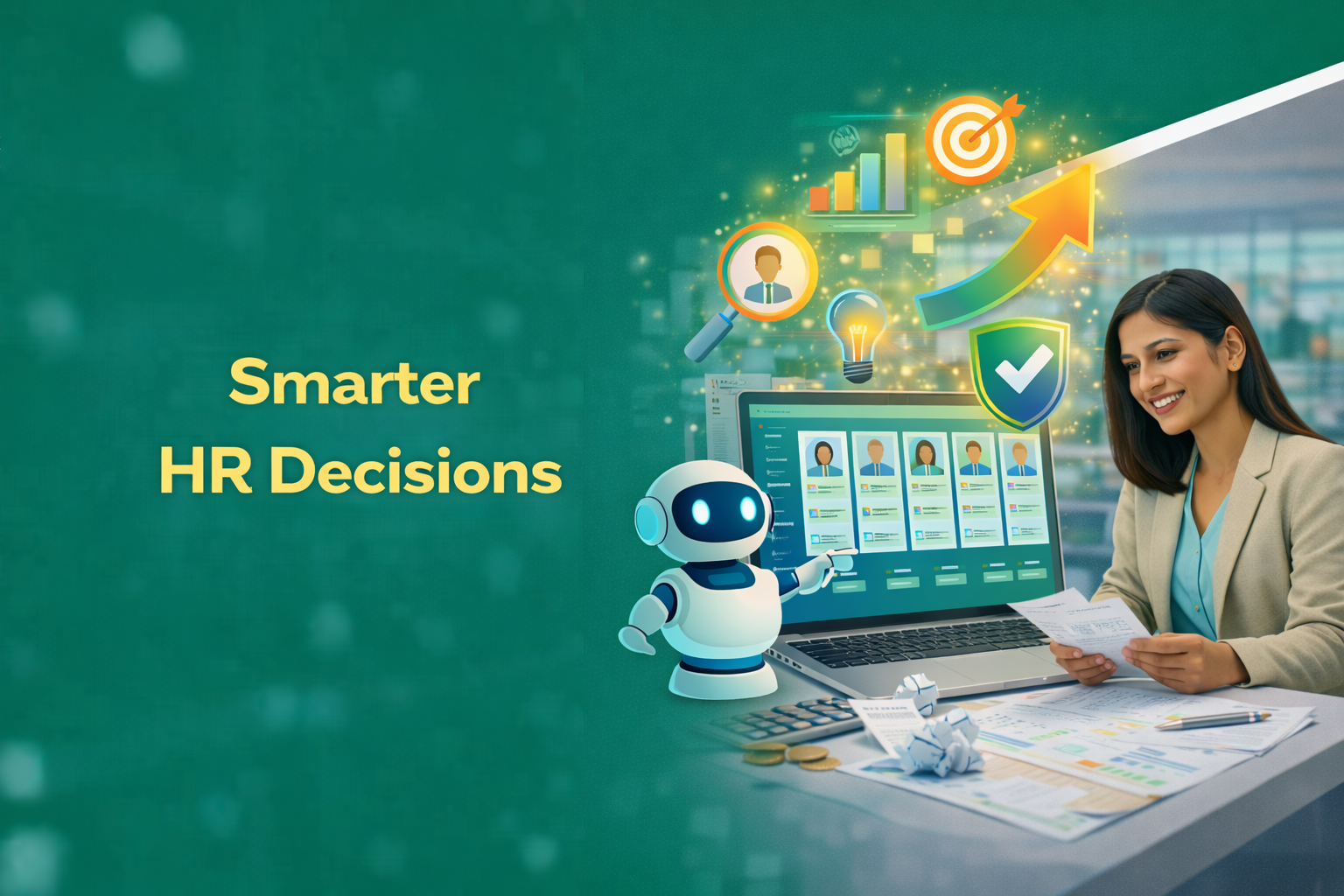
I once watched a CHRO spend three months defending a hiring decision her instinct told her was right. Workforce analytics software could have given her clarity in three minutes.
The cost of making talent decisions without data adds up quickly-bad hires, unexpected attrition, and training budgets invested in the wrong places can run into crores for growing organizations.
Data-driven workforce decisions aren’t about replacing human judgment. They’re about strengthening it. Analytics gives HR leaders evidence to support, question, or refine their instincts before consequences show up on the balance sheet.
When HR understands what the numbers reveal about people, decisions move from guessing to knowing. Organizations that do this well consistently outperform those that don’t.
What Is Workforce Analytics and Why It Matters
Workforce analytics turns employee data into actionable intelligence. It shifts HR from a rearview-mirror view to a windshield perspective. Traditional HR focuses on what already happened. Analytics helps predict what is likely to happen and guides what should be done next.
This evolution began with basic headcount reports in spreadsheets. Today, organizations analyse patterns across recruitment, performance, engagement, compensation, and attrition. The objective hasn’t changed: make better decisions about your most expensive and impactful asset, your people.
Indian organizations are increasingly recognising this shift. HR leaders are prioritising analytics to improve hiring speed, workforce productivity, and retention outcomes. The competitive pressure is real. Companies that use workforce analytics effectively fill critical roles faster, deploy talent more efficiently, and make people decisions with greater confidence.
How Workforce Analytics Software Changes Raw Data
Raw people data sits across multiple systems. Your HRMS holds attendance records. Recruitment tools track candidate pipelines. Performance systems store appraisal outcomes. Workforce analytics software brings these silos together into a single, connected view.
The process typically works in three stages. First, data collection pulls information from different platforms into one place. Second, processing algorithms clean inconsistencies and surface meaningful patterns. Third, visualization presents insights in clear dashboards that HR and business leaders can interpret without statistical expertise.
Modern analytics platforms go beyond static reports. They enable real-time tracking, trend identification, and predictive modelling. This allows HR teams to anticipate attrition risk, identify hiring channels that deliver high performers, and spot compensation gaps before they lead to resignations.
Key Benefits of Data-Driven Workforce Decisions
The business case for workforce analytics rests on measurable outcomes. When organizations adopt data-driven people decisions, improvements show up across hiring, retention, productivity, and cost control. These gains compound over time as data quality improves and HR teams build analytical maturity.
Reduced attrition costs are often the earliest benefit. Employee turnover is expensive once you factor in hiring effort, onboarding time, and productivity loss during transitions. Predictive analytics helps identify attrition risk early, giving leaders time to intervene before resignations happen.
Hiring accuracy improves when organizations understand what actually predicts success in specific roles. Analysing performance outcomes against hiring sources, assessments, and interview signals helps reduce mismatches and improve the quality of hire.
Resource allocation also becomes more precise. Training investments shift from broad, equal distribution to targeted capability building tied to business impact. Compensation benchmarking helps organizations stay competitive without overpaying or losing talent due to outdated pay structures.
Measuring ROI from Data-Driven Workforce Decisions
Return on investment depends on clear baselines and consistent tracking. Start by documenting your current state. Metrics such as cost per hire, time to productivity, voluntary attrition, and employee engagement scores provide a solid reference point.
Review progress quarterly. Where possible, link improvements to specific analytics-led interventions rather than broad HR initiatives. This helps separate correlation from impact and builds credibility with business leaders.
Most Indian organizations track a common set of ROI indicators to evaluate workforce analytics effectiveness. The table below outlines the metrics typically monitored and how they connect to business outcomes.
| Metric | Before Analytics | After Analytics | Improvement |
|---|---|---|---|
| Cost Per Hire | Rs 85,000 | Rs 62,000 | 27% reduction |
| Time to Fill | 45 days | 28 days | 38% faster |
| First Year Attrition | 28% | 19% | 32% reduction |
| Training ROI | Unknown | 340% | Now measurable |
Qualitative benefits matter too. Faster decision cycles, increased HR credibility with business leaders, and improved employee experience contribute to organizational performance beyond direct cost savings.
Essential Applications of Workforce Analytics for HR Planning
Workforce analytics for HR planning moves beyond reactive reporting into forward-looking decision-making. Its applications span the entire employee lifecycle, with the greatest value emerging in predictive and scenario-based use cases.
In talent acquisition, analytics helps identify which sourcing channels, interview signals, and candidate attributes correlate with long-term performance and retention. This allows HR teams to reduce hiring costs while improving the quality of hire by focusing effort where outcomes are strongest.
Succession planning becomes more objective when performance data is combined with potential indicators. Analytics surfaces high-potential employees who may be overlooked and highlights leadership gaps early, giving organisations time to prepare internal successors rather than relying on urgent external hires.
Skills gap analysis compares current workforce capabilities with future business requirements. This is especially critical as Indian organisations adapt to digital transformation and automation. Analytics helps prioritise reskilling investments based on business impact rather than assumptions.
Finally, scenario planning enables HR leaders to test decisions before committing to them. Whether it’s expansion, restructuring, or new shift models, workforce analytics shows the cost, risk, and capability implications in advance—turning HR planning into a strategic input, not a reactive response.
Long-Term Workforce Analytics for HR Planning Success
Long-term workforce planning links people strategies directly to business objectives. It begins with understanding the company’s future direction: which markets will you enter, which products or services will launch, and which technological shifts will affect operations?
Next, translate business plans into workforce requirements. For example, expansion into new regions requires managers, supervisors, and support staff. Analytics can model whether internal development, external hiring, or a mix provides the most effective solution.
Scenario planning adds value during uncertainty. Test different growth paths and understand the workforce implications of expansion, consolidation, or market shifts. Organisations using this approach gain the ability to make informed decisions on hiring, redeployment, and training, turning workforce planning from reactive to strategic.
Predictive Models for Talent Management
Predictive hiring models analyze the attributes of top-performing employees to identify candidates most likely to succeed. This approach goes beyond resumes, using patterns across multiple success factors to guide selection.
Retention analytics flags employees at risk of leaving before they start exploring other opportunities. Models take into account tenure trends, market-relative compensation, manager relationships, career progression speed, and engagement survey responses. Early warnings allow timely interventions while employees remain receptive to staying.
Performance prediction helps optimise development investments. Analytics identifies employees who will gain the most from specific training programs or coaching, enabling targeted interventions rather than spreading resources thinly. The result: smarter development spending and faster impact on organisational performance.
Implementing Workforce Analytics Software Successfully
Implementation success depends more on organizational readiness than on technology choice. Many Indian organisations purchase sophisticated analytics platforms that go unused because foundational elements weren’t addressed.
Start with a current state assessment. What data exists, where is it stored, and how complete and accurate are the records? Most organisations find gaps and inconsistencies in their HRMS that must be resolved before analytics can produce reliable insights.
Data quality drives analytical value. Garbage in, garbage out. Allocate time and resources for data cleansing before deploying analytics.
Training matters just as much as the tool itself. HR teams need to interpret findings and translate insights into action. Technical training alone produces reports nobody uses. Analytical thinking must be paired with a business context.
Choosing the Right Workforce Analytics Features
- Prioritize use-case fit over broad functionality. A company focused on reducing attrition needs different capabilities than one optimising recruitment efficiency.
- Integration with existing systems is critical. The platform must connect to your HRMS, recruitment, performance management, and payroll systems. Manual data transfers create errors and delays.
- User-friendly dashboards drive adoption. Tools that require technical expertise limit usage to specialists. Self-service capabilities empower managers and HR business partners to access insights independently.
- Customization ensures relevance. Platforms should reflect your organisation’s terminology, metrics, and reporting structures. Rigid solutions force workarounds, reducing satisfaction and data accuracy.
HROne provides integrated analytics that connect across HR functions, giving Indian organisations unified visibility into workforce patterns and predictive insights, turning data into decisions.
Overcoming Challenges in Workforce Analytics Adoption
Data privacy is the top concern for Indian HR leaders. Employee information must be handled carefully, both under regulatory requirements and ethical standards. Mitigate risks with clear governance policies, strict access controls, and transparent communication about how data will be used.
Integration challenges often arise when legacy systems lack API connectivity. Plan for middleware solutions or phased replacement of outdated platforms. The upfront investment pays off by unlocking analytical insights impossible with disconnected systems.
Resistance to change can surface when analytics challenges traditional decision-making. Leaders accustomed to intuition may hesitate when data contradicts their judgment. Position analytics as decision support, not replacement, and build credibility through small wins before tackling politically sensitive analyzes.
Skills gaps are common across Indian HR teams. Most professionals have limited statistical training. Address this through formal training programs, mentorship from analytically skilled team members, and hiring specialists to anchor the function.
Budget constraints can limit initial investments. Start with existing tools and manual analysis to demonstrate value. Early successes can justify further investment in dedicated analytics platforms.
Let’s Bring It All Together!
Workforce analytics is no longer a nice-to-have; it’s a strategic enabler. From hiring and retention to performance and long-term planning, analytics transforms raw HR data into actionable insights. The real advantage comes not from the software alone, but from organisational readiness: clean data, skilled teams, integrated systems, and a culture that embraces evidence-based decision-making.
Indian organisations that implement analytics thoughtfully gain clarity, reduce costs, optimise talent, and make people decisions with confidence. By combining predictive insights with human judgment, HR moves from guessing to knowing, delivering measurable impact on business outcomes.
In short, workforce analytics empowers HR to be proactive, strategic, and indispensable to organisational growth.











 Secures Top Spot in
