









India added over 3,200 new startups in 2024 alone. That number is climbing in 2026. And with every new company comes a familiar struggle. People operations.

Table of Contents
I’ve watched founders burn through precious hours on attendance registers, salary calculations, and compliance paperwork. Time they could spend building products or closing deals. The reality? Manual HR processes don’t just slow you down. They actively hurt your ability to scale.
Here’s the thing. Your first ten hires are manageable with spreadsheets. But what happens at fifty? Or a hundred? Suddenly, you’re drowning in PF filings, ESI calculations, and leave disputes. This is exactly why HRMS software has become non-negotiable for Indian startups in 2026.
The shift isn’t just about convenience. It’s about survival. Startups that automate HR early build stronger foundations for growth. They attract better talent because employee experience matters. They avoid compliance penalties that can cripple early-stage businesses.
In this piece, I’ll break down the specific challenges driving HRMS adoption, the benefits you can actually measure, and how to pick the right solution without overspending. Whether you’re pre-seed or Series B, this matters.
Growing HR Challenges Facing Indian Startups in 2026
Let’s be honest about what’s happening on the ground. Indian startups face a unique combination of pressures that make HR exceptionally complicated.
Hiring at breakneck speed
When you close a funding round, you need to scale yesterday. I’ve seen teams go from 15 to 80 people in six months. Try managing that with Google Sheets. Recruitment alone becomes a full-time job. Tracking candidates, scheduling interviews, sending offer letters, collecting documents. It piles up fast.
Compliance is a minefield
India’s labour laws aren’t simple. You’re dealing with:
- Provident Fund contributions and filings
- Employee State Insurance calculations
- Professional Tax that varies by state
- TDS deductions and Form 16 generation
- Shops and Establishments Act registrations
- Gratuity provisions after five years
Miss a deadline? Face penalties. File incorrectly? More penalties. And these rules change. Regularly.
The remote work reality
Your engineering team might be in Bengaluru. Sales in Mumbai. Customer support in Jaipur. How do you track attendance? How do you manage shifts across time zones? The hybrid model isn’t going away. Your HR systems need to handle distributed teams.
Payroll across state lines
Here’s something that catches many founders off guard. Professional Tax differs between Maharashtra, Karnataka, and Tamil Nadu. Minimum wages vary. Labour welfare fund requirements change. Running payroll for a multi-state team manually is asking for errors.
Retention headaches
Good people leave when they feel forgotten. When reimbursements take weeks. When leave balances are wrong. When performance conversations never happen. Startups lose talent not because of compensation, but because of poor employee experience.
Founder time drain
Every hour spent on HR administration is an hour not spent on product, customers, or fundraising. I’ve met founders who spend 10-15 hours weekly on people operations. That’s unsustainable.
Key Benefits of HRMS Software for Indian Startups
So what actually changes when you implement proper HRMS software? Let me walk you through the tangible benefits.
Automation that actually works
Think about your current process. Someone applies for leave. They email their manager. The manager forwards to HR. HR checks the leave balance manually. Updates a spreadsheet. Informs payroll. That’s five touchpoints for one leave request.
With HRMS, the employee applies through an app. The system checks their balance automatically. The manager gets a notification and approves with one tap. Payroll updates instantly. Done.
This automation extends to:
- Attendance capture through biometric integration or geo-fencing
- Automatic overtime calculations
- Reimbursement workflows with approval chains
- Document collection during onboarding
- Exit formalities and full-and-final settlements
Compliance without the stress
Good HRMS software handles Indian statutory requirements out of the box. Your PF challans generate automatically. ESI calculations happen correctly. TDS gets computed based on declarations employees submit through self-service portals.
Here’s a comparison of manual versus automated compliance:
| Manual Process | HRMS Automated | Time Saved |
| PF calculation and filing | Auto-calculated, one-click filing | 8-10 hours monthly |
| ESI computation | Real-time calculation | 4-6 hours monthly |
| Form 16 generation | Bulk generation in minutes | 15-20 hours annually |
| Professional Tax | State-wise auto-deduction | 3-4 hours monthly |
Real cost savings
You might think HRMS software is an expense. It’s actually an investment with measurable returns. One HR executive managing 50 employees manually costs roughly ₹6-8 lakhs annually including benefits. The same person with good HRMS tools can handle 150-200 employees effectively.
Data for better decisions
Why did three people from your engineering team resign last quarter? What’s your average time-to-hire? Which department has the highest absenteeism? Without HRMS, answering these questions requires hours of manual analysis. With it, dashboards give you answers in seconds.
Employee experience matters
Your employees don’t want to chase HR for payslips. They want to download them from an app. They want to see their leave balance without asking anyone. They want their reimbursements processed quickly. Self-service portals make this possible.
Startups using modern HRMS report higher employee satisfaction scores. Not because the software is exciting, but because friction disappears.
Essential Features to Look for in Startup-Friendly HRMS
Not every HRMS fits startup needs. Enterprise solutions are overkill. Basic tools won’t scale. Here’s what actually matters.
Payroll that understands India
This is non-negotiable. Your HRMS must handle:
- Multi-state payroll with different PT slabs
- Flexible salary structures (CTC breakups, allowances, variable pay)
- Automatic PF, ESI, and TDS calculations
- Salary revision tracking
- Arrears computation
- Integration with banks for salary disbursement
If the payroll module doesn’t understand Indian compliance, walk away. It doesn’t matter how pretty the interface looks.
Attendance and leave management
You need flexibility here. Some startups use biometrics. Others rely on mobile check-ins. Some don’t track time at all but manage leave carefully. Look for:
- Multiple attendance capture methods
- Configurable leave policies (different for different employee categories)
- Compensatory off tracking
- Holiday calendar management
- Regularisation workflows for missed punches
Recruitment and onboarding
Your first impression on new hires matters. Features to look for:
- Job posting to multiple portals
- Applicant tracking with stages
- Interview scheduling tools
- Offer letter generation
- Digital document collection
- Onboarding task checklists
- Welcome kits and buddy assignment
Performance management
Annual reviews are outdated. Modern startups need continuous feedback systems. Check for:
- Goal setting and OKR tracking
- One-on-one meeting templates
- 360-degree feedback options
- Performance improvement plan workflows
- Appraisal cycle automation
Mobile accessibility
Your employees are on their phones constantly. If the HRMS doesn’t have a solid mobile app, adoption will suffer. Managers should approve leaves while commuting. Employees should mark attendance from client locations.
Integration capabilities
Your HRMS doesn’t exist in isolation. It needs to talk to:
- Accounting software (Tally, Zoho Books, QuickBooks)
- Slack or Microsoft Teams for notifications
- Background verification services
- Learning management systems
Cloud-based deployment
On-premise HRMS is dead for startups. You need cloud solutions that update automatically, scale without server investments, and allow access from anywhere.
Pricing that makes sense
Startups can’t commit to annual contracts for hundreds of employees they haven’t hired yet. Look for:
- Per-employee-per-month pricing
- No or low setup fees
- Free tier or trial period
- Ability to scale down if needed
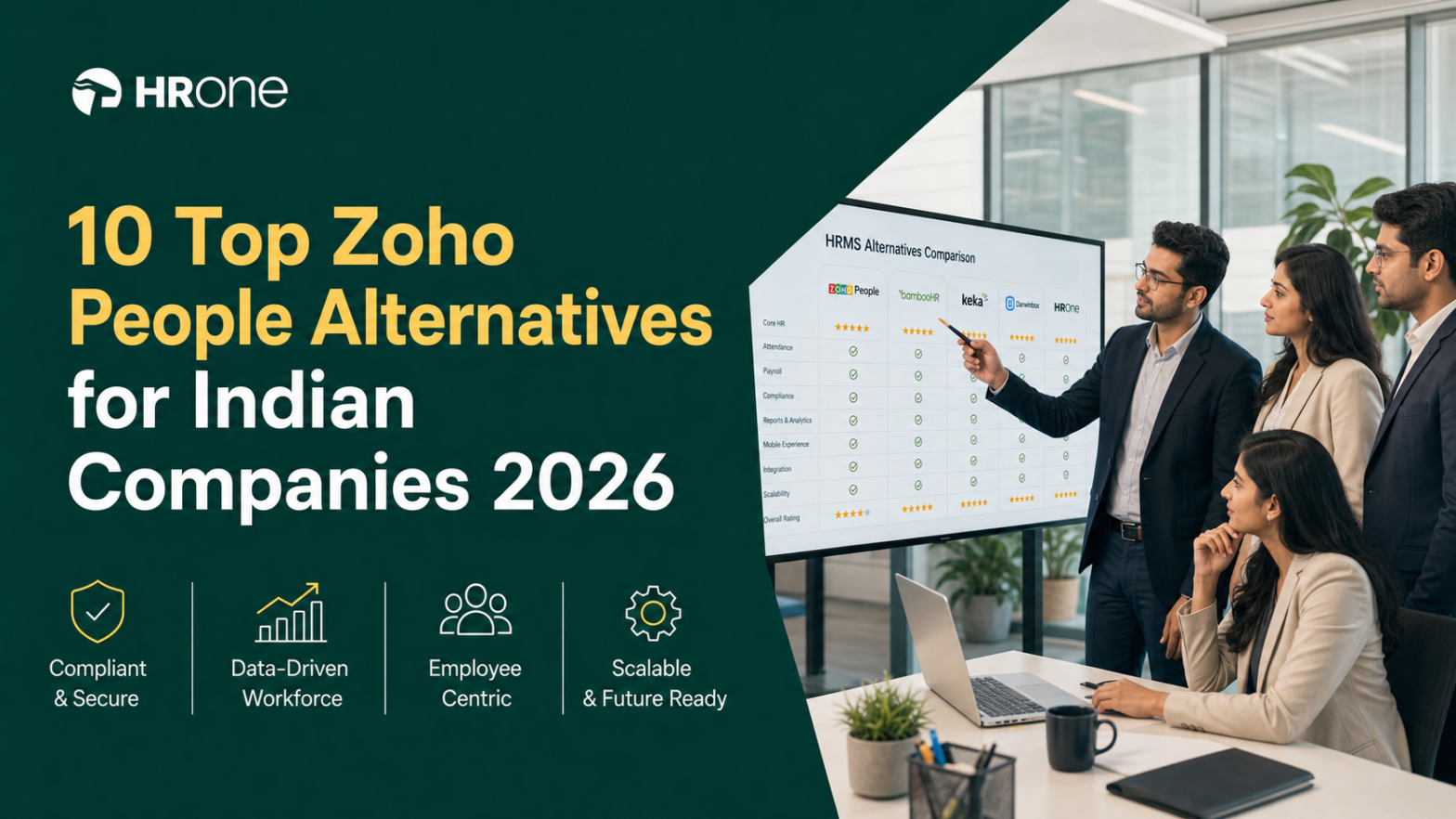
Top HRMS Software Options for Indian Startups in 2026
I’ve evaluated multiple solutions based on startup-specific needs. Here’s an honest breakdown.
| Software | Best For | Starting Price | Standout Feature |
| HROne | Growing startups (50-500 employees) | ₹85 per employee/month | Complete Indian compliance with excellent support |
| Zoho People | Budget-conscious teams | ₹48 per employee/month | Strong integration with Zoho ecosystem |
| greytHR | Payroll-focused startups | ₹75 per employee/month | Robust statutory compliance engine |
| Keka | Mid-size startups | ₹100 per employee/month | Modern interface with performance tools |
| Darwinbox | Well-funded startups | Custom pricing | Enterprise features at startup-friendly tiers |
HROne
This is where I’ve seen the best fit for Indian startups scaling rapidly. HROne handles the complexity of Indian payroll exceptionally well. Their compliance engine stays updated with regulatory changes automatically.
What stands out is the implementation support. Startups don’t have dedicated HR teams to manage lengthy setups. HROne’s team actually helps migrate your data and configure policies. The mobile app is clean. Employee self-service actually gets used.
The pricing works for startups because you pay for what you use. No locking into enterprise contracts.
- Multi-location payroll with state-wise compliance
- Geo-fenced attendance for remote teams
- Automated exit management and F&F calculation
- Strong customer support with quick response times
Zoho People
If you’re already using Zoho CRM, Books, or Projects, this makes sense. The integration is smooth. Pricing is aggressive. For very early-stage startups watching every rupee, it’s a viable option.
The limitation? Payroll isn’t as sophisticated for complex Indian structures. You might need Zoho Payroll separately, and even then, it’s better suited for simpler setups.
greytHR
Built specifically for Indian compliance from day one. If your primary pain point is statutory filings and payroll accuracy, greytHR delivers. The interface feels dated compared to newer players, but the engine underneath is solid.
Good for startups that prioritise payroll accuracy over fancy features.
Keka
Popular with startups that want a modern employee experience. The UI is excellent. Performance management module is strong. It’s pricier than some alternatives but justifies it with polish.
The Indian compliance features have improved significantly over the past two years.
Darwinbox
When you’ve raised a significant round and expect to grow past 500 employees quickly, Darwinbox becomes relevant. It’s more enterprise-focused but offers startup-friendly packages. The talent management and analytics capabilities are advanced.
Not ideal for bootstrapped teams or companies under 100 employees.
How to Choose the Right HRMS for Your Startup
Don’t just pick the most popular option. Your specific situation matters. Here’s how to approach the decision.
Start with your numbers
How many employees today? Where do you expect to be in 12 months? 24 months? If you’re at 30 and expect to hit 200, choose software that handles both comfortably. Migrating HRMS systems mid-growth is painful.
List your actual pain points
Be specific. Is compliance your biggest headache? Or is it recruitment? Maybe it’s just attendance tracking for a distributed team. Prioritise features based on real problems, not theoretical ones.
- Rank your top three HR challenges
- Identify which features directly address them
- Ignore fancy capabilities you won’t use in the next year
Budget realistically
HRMS costs typically range from ₹50 to ₹150 per employee per month for startup-appropriate solutions. Multiply by your team size. Add implementation costs (often one-time). That’s your annual investment.
Compare against the cost of hiring additional HR staff or the penalties from compliance failures. The math usually favours software.
Test before committing
Every decent HRMS offers trials or demos. Use them. Actually run a payroll simulation. Have your team test the mobile app. Check if the self-service portal is intuitive enough that employees will actually use it.
Evaluate support quality
When payroll fails on the 30th, you need help immediately. Ask vendors about support response times. Check reviews for support quality specifically. Indian startups need vendors who understand local context and urgency.
Check implementation timelines
Some vendors promise 2-week implementations. Others need 8-10 weeks. Your situation determines what’s acceptable. If you’re hiring 20 people next month, you can’t wait two months for HRMS.
Data security matters
You’re storing sensitive employee information. Salary details. Bank accounts. Identity documents. Verify that the vendor has proper security certifications. Ask about data residency (where servers are located). Check their backup and recovery policies.
Conclusion
Indian startups in 2026 face a clear choice. Build people operations on shaky manual processes, or invest in systems that scale with you.
HRMS software isn’t a luxury anymore. It’s infrastructure. Like choosing your tech stack or your banking partner, this decision impacts everything that follows.
The startups I’ve seen succeed share something common. They treat HR technology as a growth enabler, not an administrative cost. They implement early, before chaos forces their hand.
Your next step? Audit your current HR processes. Identify where time disappears. Then start conversations with two or three vendors from this list. Most offer free consultations. Use them.
And if you want a solution built specifically for Indian compliance with support that actually responds, take a serious look at HROne. It’s earned its reputation with growing Indian companies.
FAQs (Frequently Asked Questions)
Question: What is the average cost of HRMS software for Indian startups?
Answer: Most startup-friendly HRMS solutions cost between ₹50 and ₹150 per employee per month. For a 50-person team, expect monthly costs of ₹2,500 to ₹7,500. Some platforms offer free tiers for very small teams under 10 employees.
Question: Can HRMS software handle Indian statutory compliance automatically?
Answer: Yes, good HRMS platforms built for India handle PF, ESI, Professional Tax, TDS, and gratuity calculations automatically. They generate challans, file returns, and update when regulations change. Always verify compliance features before purchasing.
Question: How long does HRMS implementation take for a startup?
Answer: Typical implementation ranges from 2 to 6 weeks depending on complexity. Startups with straightforward structures can go live faster. Data migration, policy configuration, and employee training consume most of the time. Choose vendors offering dedicated implementation support.
Question: Should startups choose cloud-based or on-premise HRMS?
Answer: Cloud-based HRMS is the clear choice for startups. It requires no server investment, updates automatically, scales easily, and allows access from anywhere. On-premise solutions are only relevant for large enterprises with specific security requirements.
Question: When should a startup invest in HRMS software?
Answer: Consider HRMS when you cross 15-20 employees or when manual processes start causing errors and delays. Don’t wait until you’re at 100 people. Early adoption prevents data migration headaches and builds good HR practices from the start.














 Secures Top Spot in
